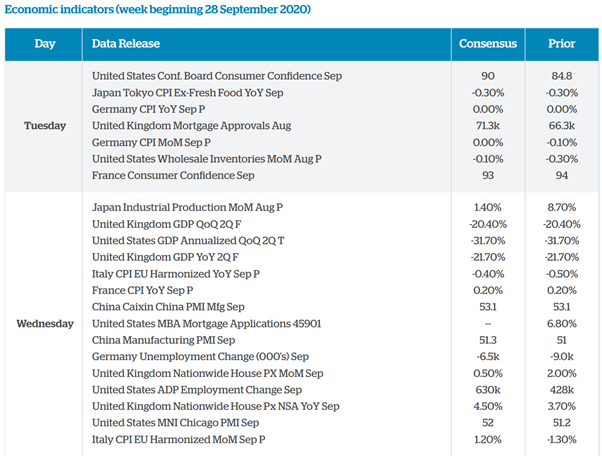
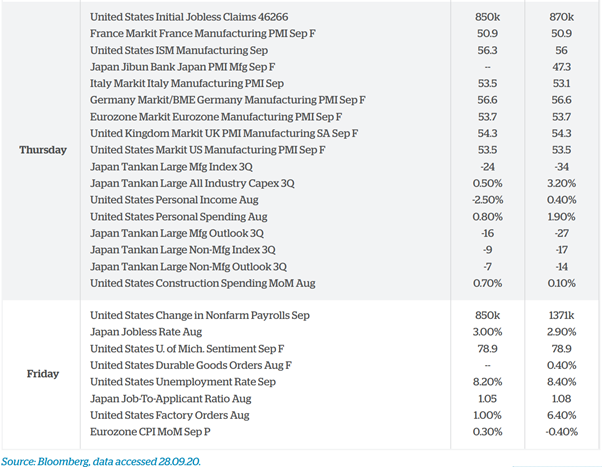
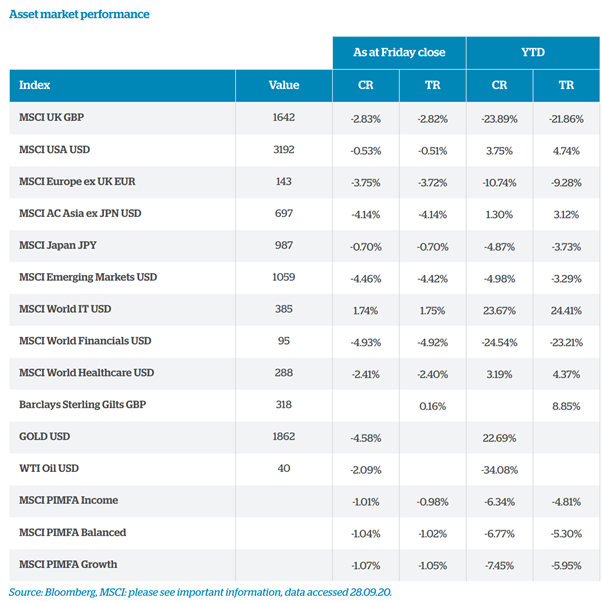
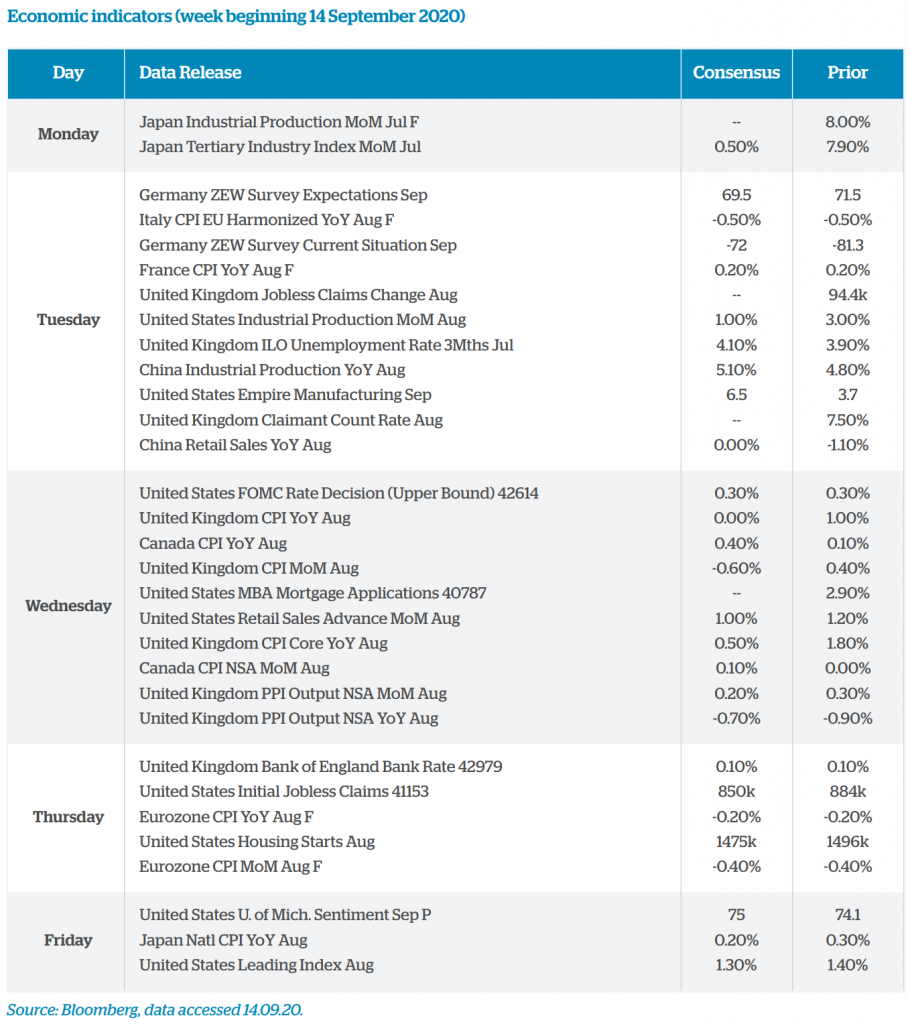
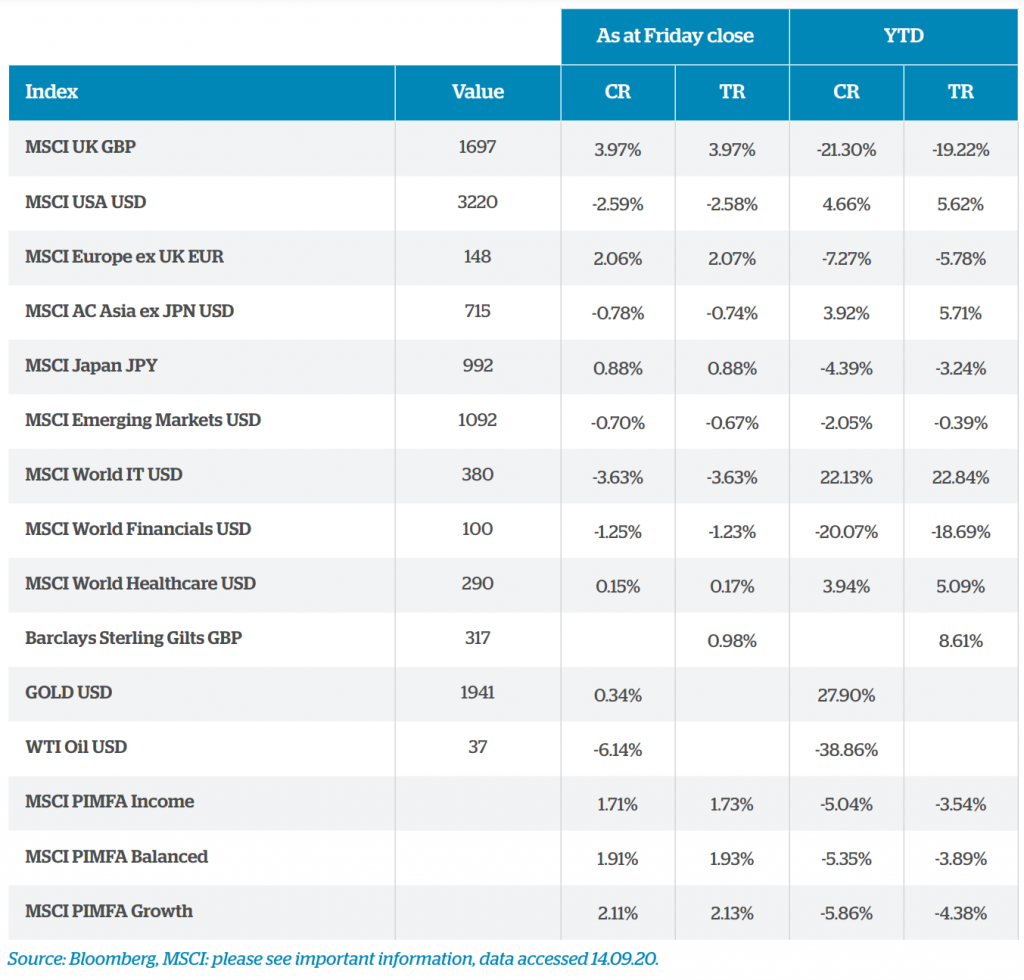
Please see below an article received from Invesco this morning providing their latest market update:
As you can see from the above, many sectors had a positive week last week in terms of investment returns. The main losers appeared to be Government Bonds and some Investment Grade Bonds. Thursday could be a day to watch, with the U.S. Jobless report, the ECB meeting and UK economic activity indicators are all released.
We will continue to provide details on any announcements made on a deal or no deal scenario and what impact this could have on markets and investments.
It is important to remember, whatever happens, it is important to remain invested and focus on your long-term objectives.
Please continue to check our Blog content for advice and planning issues and the latest investment, markets and economic updates from leading investment houses.
Please see below for Brooks McDonald’s weekly market commentary, received late afternoon 26/10/2020:
In Summary
As coronavirus cases continue to rise in Europe and the US, fiscal stimulus needs will increase
The Oxford vaccine candidate is reported to have led to a strong immune response in elderly patients
Central bank season begins with the European Central Bank (ECB) and Bank of Japan meeting this week
As coronavirus cases continue to rise in Europe and the US, fiscal stimulus needs will increase
Over the weekend, the US and many European nations recorded their highest number of daily COVID-19 cases, as the blame game started between House Democrats and the White House over the stimulus impasse. With just over a week to go until the US presidential election, something fairly miraculous would need to occur to get stimulus over the line. US equity futures are trading down to reflect this probability.
The Oxford vaccine candidate is reported to have led to a strong immune response in elderly patients
Momentum remains behind the growing US and European case load. Italy has now approved a new national curfew as the country, which had previously fared well during the second wave, sees a sharp surge in cases. France also set a record high in new cases with the positivity rate of tests also rising to 17%1 . There were some positive vaccine stories over the weekend in relation to two front runners however. The University of Oxford/AstraZeneca candidate is reported to have led to a robust immune response in elderly patients which is critical for an effective vaccine. As the elderly are most at risk of serious illness from COVID-19, and have a weaker immune system than the young, there were concerns that a vaccine would fail to produce an effective immune response. The Oxford vaccine has also seen its trials restart in the US on Friday after being halted last month.
Central bank season begins with the European Central Bank (ECB) and Bank of Japan meeting this week
The ECB are meeting on Thursday, the same day as the Bank of Japan. We expect the ECB to warn of downside risks to the economic outlook as well as inflation. This comes as European coronavirus cases, and subsequent restrictions, have risen significantly since the last meeting. There is likely to be the (now traditional) attempt to hand the responsibility for further accommodation to governments, with the ECB stressing the limits of monetary policy in a negative rate environment. Regardless, we may well see some additional easing before the end of the year, particularly if European fiscal policy disappoints as expected. We are entering central bank season with the ECB and Bank of Ireland this week and the Federal Reserve and Bank of England next week. We are expecting the rhetoric to be very focused on the downside risks to the economy but for central bankers to try to put pressure on further fiscal policy more than promising additional easing. Quantitative easing is very effective at restoring order in financial markets but is less helpful in boosting the real economy. If coronavirus cases continue to escalate, fiscal policy will need to carry the weight of the second wave stimulus.
Articles like these provide an efficient way to receive well-informed views that cover the whole of market and are useful to maintain your up to date view of global market news.
Please keep reading our blogs regularly to give yourself a holistic and up to date view of markets.
Please see below an article received late yesterday afternoon from Legal & General Investment Managers which provides their latest market views:
I think one of the key messages to take from the above is that the U.S. election is high up on people’s priorities, more so than the Covid-19 pandemic. Positive news on a vaccine and a good U.S. election outcome would provide the greatest investor optimism.
Opportunity is still out there for investors, but it remains important to have a diversified portfolio, which is spread across a number of regions and sectors in order to benefit from these opportunities. Having a long-term view when investing is imperative, you should not focus on short-term volatility.
Please continue to check our Blog content for advice and planning issues and the latest investment, markets and economic updates from leading investment houses.
Please see the below investment bulletin received by Brooks Macdonald today (16/10/2020):
What has happened
Markets have been largely willing to shrug off the increased in coronavirus cases in Europe but a series of tightening restrictions across Europe shook investor confidence yesterday. This had led to contagion in US indices however the early losses there were largely recouped by the end of the session.
European cases go the wrong way as restrictions tighten
Italy has been relatively resilient in the face of the second wave, but it also reported close to 9,000 cases yesterday as it joins the European trend. In recent days we have seen the UK moving London and several other areas under Tier 2 restrictions, France imposing a curfew and increasing restrictions in Germany. The key question for markets is whether governments in Europe will continue with the current policy of squeezing social interactions and hospitality but keeping the majority of the economy and schools open. Encouragingly, Reuters have reported that the NHS is in talks with relevant bodies about the mobilisation of a vaccine programme as early as December. If a vaccine allows investors to focus on a ‘beginning of the end’ of COVID restrictions, they will be increasingly comfortable to look through the next 3/6 months of restrictions. This could also increase the political palatability of tougher measures now if light can be seen at the end of the tunnel.
What next for Brexit?
EU leaders agreed at the EU Council meeting to continue negotiations with the UK but the narrative was very much that the UK’s position needs to come towards the EU rather than the other way around. The UK’s chief negotiator Frost said he was ‘surprised’ and ‘disappointed’ by this and we will hear from UK PM Johnson later today with the UK’s view. Sterling has faltered a bit on this news as it makes continued negotiations less likely, on the margin, than a day ago when reports were pointing to an extension into November.
What does Brooks Macdonald think
US fiscal stimulus remains a hot topic in the market but we have avoided discussing this too much today as regardless of whether a given day looks brighter or darker for stimulus, we retain low expectations that anything will happen before November. Should Biden win the White House but not take the Senate, this may prove challenging for risk appetite so we expect investors to react to shifts in the Senate polling odds more than day to day fiscal rhetoric.
Source: Bloomberg as at 16/10/20
The markets have been volatile this week as Covid-19 restrictions have been tightened in the UK. With rising cases and uncertainty about further restrictions and lockdowns, along with the impending US Election. This volatility is likely to continue.
Please continue to look for further updates and blog content from us.
JP Morgan provides an interesting insight into China’s current trading conflicts and the effects of this on the investment market.
On 14 February 2020 the US and China agreed to a trade agreement, known widely as the “phase one trade deal”. As part of the deal, China agreed to increase purchases of US goods by USD 200 billion over the next couple of years, helping to defuse an escalating trade conflict between the two nations.
Although welcomed by markets as a first step to prevent further damage to world trade, the phase one deal was quickly overshadowed by the Covid-19 pandemic. However, trade data from the US Bureau of Census, which is tracking China’s compliance with the phase one deal, has recently raised concern, with China’s additional purchases of US goods standing at only 48% of the year-to-date target by the end of July (Exhibit 1).
Demand disruption due to the pandemic and rising political tensions have contributed to China’s non-compliance. However, in the midst of a polarised US election campaign, the trade truce could be more fragile than investors would wish, and new trade hostilities are an increasing risk for markets.
Exhibit 1: Phase one deal tracker
US goods exports to China with phase one deal targets for 2020 and 2021
USD billions
Source: USTR, US Census Bureau, J.P. Morgan Economic Research, Refinitiv Datastream, J.P. Morgan Asset Management. 2020 and 2021 targets are shown for illustrative purposes and we assume a smooth path toward the year-end target. Chart displays only goods exports and for goods not covered by the phase 1 deal we are assuming they remain at similar levels in 2020 and 2021 as they did in 2017. The phase 1 deal outlines an increase in US exports of $200bn over 2020 and 2021. The breakdown is for roughly $160bn additional goods exports and an additional $40bn of services exports. Past performance is not a reliable indicator of current and future results. Data as of 16 September 2020.
Could a renewed trade conflict undermine the investment case for Chinese assets? When considering this question, we think investors need to look at three aspects: China’s trade dependencies, the impact of an economic de-coupling, and structural growth opportunities.
Trade dependencies: A growing domestic economy overshadows possible trade disruption
The trade conflict and the implementation of tariffs was a big topic and headline risk for markets in 2018 and 2019. However, when we look at equity market performance following the announcement of new tariffs by the US administration, the reaction appears to have been rather moderate. On the six occasions when the US announced new tariffs, the average drawdown of the local Chinese A-Share market was -2% in the five business days after the announcement, with a maximum drawdown of -3.9% in June 2018 (Exhibit 2).
The impact on global markets was also limited. One of the reasons for the lack of market reaction is that China’s dependence on global trade is in decline. Between 2010 and 2019, China’s share of exported goods and services relative to GDP fell from 28.5% to 18.8%, with the US share falling from 4.7% to 2.9%. China’s economy is increasingly driven by domestic consumption, which makes it less prone in total to export shocks, such as the imposition of tariffs.
Exhibit 2: Market impact of trade hostilities
Five-day equity market performance during trade hostilities
% price return
Source: Bloomberg, MSCI, Standard & Poor’s, J.P. Morgan Asset Management. Time periods show the price change in the 5 trading days after a notable trade escalation. Past performance is not a reliable indicator of current and future results. Data as of 16 September 2020.
Nevertheless, vulnerabilities still exist at the sector level. For example, computer hardware, cell phones and telecommunication equipment, which make up the largest Chinese exports to the US, represent 9% of China’s domestic A-Share market, as represented by the CSI 300 Index. So, any further deterioration in trade relations could have a negative effect on these sectors.
The biggest threat to the Chinese economy is not to be found in its exports to the US, however. Instead, China’s most crucial trade dependency is its imports of US semiconductors, which by volume make up the third largest imported good from the US. Most of China’s technology industry, including its 5G, mobile internet and artificial intelligence companies, depend on US microchip technology. A full ban on technology exports to China by the US administration could be very disruptive for the Chinese economy and therefore would also likely cause significant disruption to equity markets. A US technology export ban is therefore probably the worst case in a rising trade conflict scenario.
Whether the current US administration is willing to risk a full escalation of trade tensions before the election in November, risking turmoil in capital markets, is at least questionable. Although surveys show that an increasing number of Americans have an unfavorable view of China regardless of their political preference, recent polls also show that China is a low priority with voters, far behind economic, health, and social issues.
Economic de-coupling: Assessing the risks and opportunities
Despite rising trade tensions with the US, and Beijing’s push to be more self-reliant and de-couple from global value chains, investors should not overlook the investment opportunities presented by local Chinese assets, which look attractive relative to the rest of the world in the aftermath of the Covid-19 pandemic (Exhibit 3).
Following the opening of the USD 15 trillion local renminbi bond market to foreigners, yield starved international bond investors now have the opportunity to invest in government bonds with yields north of 3%. As well as providing access to higher yields, local renminbi bonds have a relatively low correlation to developed market bonds and zero return beta to global equities, helping investors to enhance diversification and target enhanced risk-adjusted returns.
In the past 12 years, monthly return correlations between renminbi bonds and global developed market bonds have been 0.06, compared to a correlation range of 0.43 to 0.72 between developed market bonds themselves. Just like with past performance, there is of course no guarantee that past correlations will be repeated. However, with China’s early success in containing the Covid-19 pandemic knocking its economic cycle out of sync with the rest of the world, and with the Chinese central bank providing a less expansionary central bank policy response compared to developed economies, we would expect correlations to remain low for the time being.
Exhibit 3: Relative attractiveness of China bonds
Fixed income yields
in %
Source: Bloomberg, Bloomberg Barclays, J.P. Morgan Economic Research, Refinitiv Datastream, J.P. Morgan Asset Management. Beta to MSCI World is calculated using monthly total returns since 2008. Indices used are as follows: Euro IG: Bloomberg Barclays Euro-Aggregate – Corporate; Global IG: Bloomberg Barclays Global Aggregate – Corporate; UK IG: Bloomberg Barclays Sterling Aggregate – Corporate; US IG: Bloomberg Barclays US Corporate Investment Grade; Euro HY: Bloomberg Barclays Euro High Yield; Global HY: Bloomberg Barclays Global High Yield Corporate; US HY: Bloomberg Barclays US Corporate High Yield; EMD Corporate: CEMBI Broad Diversified; EMD local: GBI-EM Global Diversified: EMD local – China: GBI-EM China: EMD Sovereign: EMBI Global Diversified. Past performance is not a reliable indicator of current and future results. Data as of 16 September 2020.
Structural growth opportunities: Chinese equities
After a period of strong outperformance investors might look at Chinese equities with a certain amount of skepticism, especially against a background of rising trade tensions and valuations. But in the short term the economic tailwind for the equity market is strong, particularly for domestic-oriented businesses.
China’s containment of the pandemic should enable its economy to recover faster than the rest of the world, and this relative advantage is likely to persist unless a medical solution to Covid-19 is found, which itself is still hard to predict (Exhibit 4a). However, the factor that makes the case for domestic China A-shares even more compelling is, counterintuitively, the fact that economic stimulus measures have been much smaller this round than in the past two downturns (Exhibit 4b). Therefore, we should not expect a massive stimulus-driven Chinese expansion to lead to stronger demand for imports from Asia and the rest of the world, making local Chinese investments relatively more attractive.
Exhibit 4a: China’s recovery – earlier and faster
China vs. developed markets, real GDP
Index level, rebased to 100 at 1Q 2006
Source: BEA, Eurostat, National Bureau of Statistics of China, ONS, J.P. Morgan Economic Research, J.P. Morgan Asset Management. Forecasts are from J.P. Morgan Securities Research. Past performance is not a reliable indicator of current and future results. Data as of 16 September 2020.
Exhibit 4b: Less stimulus compared to prior downturns
China M1 money supply and import growth
% change year on year
Source: China Customs, IMF, PBoC, Refinitiv Datastream, J.P. Morgan Asset Management. Past performance is not a reliable indicator of current and future results. Data as of 16 September 2020.
In the long-term, China’s transition from the workshop of the world into the largest domestic market in the world still demands that Chinese equities are given a significant strategic representation in globally-diversified investment portfolios. And with corporate earnings growth in the China A-Share market providing a better representation of nominal Chinese GDP growth over the last 10 years than the MSCI China, investors may continue to look to domestic stocks for their Chinese exposure (Exhibit 5).
Exhibit 5: Domestic equity market earnings – a better proxy of gdp growth
China nominal GDP and equity market earnings
12 month forward EPS, GDP; Index level, rebased to 100 at start of 2006
Source: Bloomberg, IBES, National Bureau of Statistics of China, Refinitiv Datastream, J.P. Morgan Asset Management. Fwd EPS is next twelve months’ earnings estimates in USD. China nominal GDP is in USD. Shenzhen and Shanghai include all listed A-share stocks and is combined using a market-cap weighted average. Past performance is not a reliable indicator of current and future results. Data as of 16 September 2020.
Summary
A trade conflict between the world’s largest economies is disruptive to established value chains and will certainly be negative for global growth. So, investors should rightly pay attention to any further escalation in tensions.
However, it would in our view be a mistake to single out China as the clear underdog in such a conflict and therefore shun investments into the local markets. As we have shown, the direct impact of the trade tensions on the Chinese economy is limited. Even if there is a further de-coupling between China and the US, the case for local investment in China may strengthen because of the diversification benefits provided by Chinese assets.
Equity investors should find comfort and confidence in the fact that in the past 10 years, Chinese A-share earnings have reflected the strong growth in China’s GDP. In contrast, a less cooperative international trade backdrop in the coming years could see non-Chinese companies lose out on some of their own profits from China’s economic expansion.
We endeavour to publish the most up to date blogs and data on all things markets, advice and planning-related. Please check in again with us soon.
Please see below this week’s market commentary update article from Brooks Macdonald, which was received late yesterday afternoon:
Please continue to check our Blog content for advice and planning issues and the latest investment, markets and economic updates from leading investment houses.
Please see below this week’s market commentary update article from Brooks Macdonald, which was received late yesterday afternoon:
Please continue to check our Blog content for advice and planning issues and the latest investment, markets and economic updates from leading investment houses.
Please see below for the latest Blackfinch Group Monday Market Update:
UK COMMENTARY
House prices rose 1.6% in August from July’s level according to the Halifax House Price Index. The annual increase in house price accelerated to 5.2% from July’s 3.8%, hitting its highest level since 2016.
Reports suggest that the UK is willing to walk away from Brexit negotiations in mid-October if a free trade agreement hasn’t been agreed upon.
A week of Brexit talks conclude with the EU telling Britain that it should urgently scrap a plan to break the divorce treaty, but Boris Johnson’s government have refused and continued with a draft law that could collapse four years of negotiations.
A rise in the number of COVID-19 cases in the UK brings fears of a second wave, forcing the government to reimpose some restrictions over social distancing. Daily cases have risen to close to 3,000, from c.1,000 at the end of August.
The British Retail Consortium’s figures report that year-on-year growth in retail sales rose 3.9% in August, but city centre shops continue to struggle.
UK gross domestic product (GDP) rose for the third month in a row in July, up 6.6%, although this is still 11.8% below January’s level.
A report from the National Institute of Economic and Social Research forecasts that the UK economy will emerge from recession at the end of the third quarter.
US COMMENTARY
Comments from Donald Trump that he may seek to ‘decouple the US economy from China’ suggest that the trade war between the two nations is far from over.
The US revokes visas for over 1,000 Chinese students on grounds of ‘national security’.
Initial jobless claims for the week are an exact repeat of the previous week’s number of 884,000. Continuing jobless claims rose to 13.39mln, above analyst expectations of 12.92mln.
Once again mutual agreement between the Democrats and the Republicans fails to be reached over details of a further COVID-19 support package.
US inflation rises by 0.4% in August, higher than forecast, but below the 0.6% rise seen in July.
EUROPE COMMENTARY
Insee, the national statistics institute of France, forecasts that the economy will contract by 9% this year, down from earlier predictions of an 11% drop.
EBC President Christine Lagarde announces that monetary policy remains unchanged, but that the bank has to carefully monitor the ‘negative pressure on prices’ that the Euro is exerting.
ASIA COMMENTARY
Revised GDP figures for Japan show that the economy shrunk by 28.1% in the second quarter of the year, worse than preliminary estimates released in mid-August.
China reports its largest jump in exports in 18 months, rising 9.5% in August compared to a year prior.
COVID-19 COMMENTARY
AstraZeneca confirmed that it had halted work on its COVID-19 vaccine, currently in development with Oxford University, after a ‘serious event’ during the trial process, reported to be a member of the clinical trial falling ill. However, trials officially restarted over the weekend.
These articles provide concise well-informed views that cover the whole of the market and are useful to maintain your up to date view of the markets globally.
Please keep reading our blogs regularly to give yourself a holistic and up to date view of the markets.
Please see Active Minds article below from Jupiter Asset Management – received 10/09/2020
Active Minds – 10 September 2020
Ed Meier – Fund Manager, UK Alpha
Exciting opportunities in UK’s transition to clean energy
When it comes to the transition to clean energy, the UK is well placed with the North Sea, which provides ample capacity to store captured carbon, along with the country’s amazing wind energy potential, said Ed Meier, Fund Manager, UK Alpha and specialist in utility companies.
In fact, energy from wind assets in the UK has the potential to be comparable to Saudi Arabia’s energy production from oil. Saudi Aramco produces around 12.5 million barrels of oil a day while the UK wind, if fully developed, could potentially generate the equivalent of 20 million barrels of oil a day, Ed said. It’s a phenomenal potential asset that would be exportable, and the UK government is very much supportive, he said.
In utilities there is a shift in market appetite related to the move to net zero emissions, Ed says. It’s now a legal responsibility for many governments around the world. In the EU, final energy consumption has recently been 20% electricity and 80% fossil fuels. To get to net zero, those numbers must reverse. This means extraordinary potential growth for an industry that has been shrinking. This provides an interesting opportunity, though with limited areas to invest in the UK, which has sold off much of its utility assets, he says.
There is a one publicly-listed utility UK company that is producing 12% of the country’s renewable energy, and the market is underpricing the stock, in Ed’s view. The company is reducing its cost base as it aims to produce clean electricity without subsidy post 2027. In addition, the company is developing a technology called biomass energy, carbon capture and storage (BECCS). It’s a global pioneer in this area and potentially could be a negative carbon producer (i.e. removing carbon from the air) – a vital step in helping companies get to net zero. Thus, negative emission technology could provide a significant level of value for the company, he says.
We’re all over the opportunities from the energy transition in the UK and believe it’s quite exciting, Ed says.
Matthew Morgan – Product Specialist, Multi-Asset
Fed’s fatal attraction to loose policy
The significance of what Jerome Powell and the Federal Reserve are trying to do should not be underestimated, said Matthew Morgan, Product Specialist, Multi-Asset. The recent speech from Powell could mark a critical break from three decades of central bank behaviour. It doesn’t necessarily follow that we’re going to see inflation rise imminently. What matters for markets is less the specific outcome a few years hence, more the balance of probabilities now. What the Fed plans to do shifts that balance from deflation towards inflation.
Following the ‘stagflation’ of the 1970s, the US Congress gave the Fed three main objectives in the Federal Reserve Reform Act of 1977: maximum employment, stable prices and moderate long-term interest rates, in that order. Since then, the principal target of central banks has arguably been to control inflation.
It’s the first point (maximum employment) that falls under the spotlight now. The Fed’s recent announcement of Flexible Average Inflation Targeting (FAIT) acknowledged that the Fed will do whatever it takes to deliver full employment, even if it means inflation being above the 2% target for a period of time.
Powell’s speech makes it clear that the lessons learned from the past few years are that the economy can sustain a higher employment level than previously thought without risking inflation (effectively admitting that 2018’s rate hikes were a mistake), and that the benefits of higher employment were beginning to be shared more widely across society. In addition, higher inflation is the easiest way to bring debt levels down.
This is a significant change to the Fed’s interpretation of its mandate. While there are many that will look – with good reason – to the significant deflationary pressures out there, for the multi-asset team the key takeaway is that this announcement frees the Fed to keep its foot on the gas for much longer than it could previously.
Joe Lunn – Fund Manager, Gold & Silver
Hi Ho, Silver!
The current bull market in gold and silver is best explained in macroeconomic terms, says Joe Lunn, Fund Manager in the Gold & Silver team. Investors’ disenchantment with the US dollar, due to the US Federal Reserve’s determination to continue to print money, has led them to reassess the merits of monetary metals. Yields on government bonds have become so low that they are unlikely to outpace inflation which means that some government bondholders face losses in real terms. Gold and silver, by contrast, are stores of real value.
During bull markets for monetary metals, silver can often rise faster than gold, says Joe. During recent months, the gold/silver ratio (the gold price per ounce divided by the silver price per ounce) has contracted. Silver has risen more quickly than gold: their ratio has fallen from 124 on 18 March, to 72 on 8 September. Joe expects it go lower still.
Joe believes silver bulls should play the contraction of the gold/silver ratio by investing in shares of mining companies. This allows investors to take advantage of the operational gearing in businesses where costs are largely fixed. A rise in the gold and silver price of about 20% could translate into a rise in a mining company’s EBITDA (net earnings with interest, tax, depreciation and amortisation added back) of more than 30%, he says. He also likes miners that are unlikely to issue new shares (some North American silver miners are prone to such dilutive behaviour).
A government’s attitude to COVID-19 is also important, Joe says. Mexico, for example, has granted key industry status to mining: mines would stay open even if much of the economy goes into lockdown. Peru, by contrast, is allowing companies to make up their own minds: miners might shut production if the second wave of infections continues to worsen.
While Joe has strong views on the relative merits of individual mining companies, many of whose mines he has visited, he believes they should be held within a diversified portfolio as individual companies are not without risk.
Liz Gifford – Fund Manager, Global Emerging Markets
It’s not all about technology in emerging markets
Liz Gifford, Fund Manager, Global Emerging Markets, spoke about the opportunities available to emerging market equity investors outside of the large cap tech names that have been in such favour, particularly since the start of the pandemic. Liz and the team have a preference for companies with three key features: a high return on capital, a competitive advantage (protective moat) to protect those returns and the ability to grow while maintaining the high returns.
There are several examples of large, high-profile technology companies in emerging markets that meet those criteria, yet last week’s sharp correction in the US tech names underlined the need for investors to be well diversified across sectors. Liz touched on some examples of areas where the team can find attractive opportunities outside of large cap technology stocks.
One example she highlighted was a car rental company in Brazil with a 35% market share. It is the largest player in its local market, has scale and buys twice as many cars as its nearest competitor. This gives the company significant bargaining power that can benefit customers through lower pricing, which further reinforces the company’s dominant position in the marketplace. Covid-19 has presented challenges for the company, of course, but in the end Liz believes it will strengthen this company’s competitive position as smaller players go under.
On a similar theme, Liz also highlighted Thailand’s leading decorative paints company. The company has arguably already achieved its maximum market share, but Liz and the team see the local market has being underpenetrated both in Thailand itself and in neighbouring countries. Here the competitive advantage is in the paint mixing machine at the point of sale, these are expensive to replace and retail outlets don’t typically have capacity for more than one – keeping competitors at bay. The company’s high return on capital and continued growth potential make it attractive to the team. These are just two examples of the kind of stock opportunities that are available outside of the large cap tech names that tend to dominate passive indices.
Articles like this are useful for getting an insight to the market from market experts.
Please continue to check back for our latest blog posts and updates.
Please see article below from Legal & General’s asset allocation team – received 07/09/2020
Techastrophe or Techantrum?
This week we focus on technology stocks, given the recent drama, but also stand back from the hurly-burly and reflect on how far expectations for a vaccine have come since COVID-19 hit in the spring. We also touch on the recent change in tack from the European Central Bank (ECB) where the drumbeats of verbal intervention have started, and inflation data have – once again – been dire.
As with all Key Beliefs emails, this email represents solely the investment views of LGIM’s Asset Allocation team.
Shaken, not stirred
In an impeccably timed blog published last Thursday, Lars asked whether now is the time to start taking profits on technology stocks. Investors across the world obviously took note and decided that the short-term answer was an overwhelming ‘yes’, with the Nasdaq down around 10% in just two days. In recent months, we’ve seen record after record broken by technology stocks.
Nigel Masding on the Active Equity team produced some eye-popping statistics this week, looking at year-to-date returns for the MSCI World, which sum this up nicely. Until the end of August, the index of 1,718 stocks had generated a return of +5.7%. Just four stocks contributed enough on their own to push the index into positive territory and to deliver this return: Apple, Amazon, Microsoft* and Tesla*. An index composed of the other 1,714 stocks is still underwater (source: Bloomberg).
With that in mind, are we seeing the tech bubble pop or is this just a short technical correction? We favour the latter interpretation. There was no apparent news flow that was a convincing catalyst for the move and the overall pattern of performance within equities was not consistent with a risk-off environment or of particular virus concerns. Still, there were a few hints of pretty irrational behaviour in the immediate run-up to Thursday, with high-profile stock splits seemingly responsible for driving tech names higher last Monday and Tuesday.
We have long-held two guiding principles for assessing when the time might be right to exit technology stocks: excessive valuations and excessive bullishness. In our opinion, neither signal has turned red yet. Outperformance has been driven by a step-change in earnings rather than by valuations. On sentiment, it is impossible to argue that tech is a particularly unpopular sector, but we don’t see signs of excessive bullishness either. For context, we’ve been tactically positive on technology stocks (relative to the broader market) since early 2018.
In the week in which a new trailer for the latest Bond film was released, our conviction in that trade is shaken, not stirred.
Vaccination vacillation
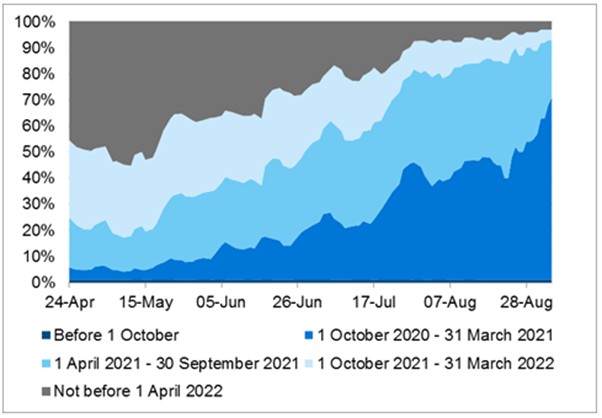
In the late 18th century, Edward Jenner pioneered the world’s first inoculation by intentionally infecting an eight year old boy with cowpox. Medical trials have evolved somewhat since then, but the word vaccine still derives from the Latin for cow. And it is hopes of a vaccine breakthrough that have continued to drive the bull market in equities and credit over recent months. This week saw the Centre for Disease Control (CDC) in the US issue advice to State governors to prepare for potential vaccine distribution as early as 1 November. The chart below, from Professor Philip Tetlock’s Good Judgement Project, shows the extraordinary change in expectations around the timeline to that vaccine. The chance of a vaccine being widely available by March next year is now seen as more likely than not, having been almost inconceivable only a few months ago.
Good Judgement Project: When will enough doses of FDA-approved COVID-19 vaccine(s) to inoculate 25 million people be distributed in the United States?
Source: LGIM, Good Judgement Project, 4 September 2020. There is no guarantee that any forecasts made will come to pass.
In the meantime, Jason Shoup of LGIM America raises the intriguing possibility of a breakthrough in testing technology. If cheap (<$5), rapid (<15 min), saliva-based (i.e. no nose swab), and self-administered coronavirus tests become widely available, it would allow a rapid normalisation in sectors where social distancing is difficult/impossible. The US government have called the development of a vaccine “Operation Warp Speed”. Not to be outdone, the UK government dubbed the development of rapid testing technology “Operation Moonshot”.
Financial markets will be willing to forgive signs of an economic stumble in the short term, provided that the medium-term outlook continues to look reassuring. With COVID-19 cases rising fairly rapidly across large parts of Europe again, these breakthroughs cannot come soon enough.
EUR-eka moment in FX markets
In the last few years, one of the most consistently poorly performing investment strategies has been following currency momentum. The kind of sustained multi-year currency trends that characterised the 1990s and 2000s have become a thing of the past as central banks deploy verbal (and the threat of actual) intervention to manage exchange rates within relatively narrow corridors. This change in landscape has become so extreme that anti-momentum currency trades have been started to become consistent winners. The post-COVID-19 currency markets have been dominated by a lurch lower in the US dollar that threatened to break that pattern: on a broad trade-weighted basis, the dollar index is down around 10% since the March highs with the Federal Reserve’s framework review providing the latest catalyst.
This week brought the first serious pushback against that trend from the ECB. Philip Lane, the central bank’s chief economist said the “euro-dollar rate does matter”. Sternly worded stuff, indeed! More revealing, a number of his colleagues on the Governing Council, under the veil of anonymity provided by an FT article, followed up with even stronger comments: the strengthening of the euro is a “growing concern” and “worrisome”. These kind of comments hark back to the days when Jean-Claude Trichet, former ECB president, used to bemoan “brutal” FX moves.
The market seems to have taken this as an indication that 1.20 is some kind of line-in-the-sand for the single currency. For that to be effective, the ECB will soon need to back up words with action. The ECB is obviously heavily constrained in its ability to cut interest rates further, but we anticipate an extension of the quantitative easing programme to be announced in the next few months. That won’t be a big surprise to the market, but should help to keep a lid on government funding costs in the periphery and tame the recent burst of euro strength, in our view.
The urgency of addressing the situation will have been underlined by some exceptionally weak European inflation data this week. European headline inflation dropped back below zero for the first time since 2016. On a core basis, HICP inflation dropped to the lowest level on record at just 0.4%. There are exceptional circumstances associated with the timing of summer sales, but these are the kind of numbers that will bring an inflation-targeting central banker out in a cold sweat. With the ECB looking dangerously like Old Mother Hubbard (with a bare policy cupboard) we think that staying short European inflation is a strategy likely to benefit from a consistent fundamental tailwind. *For illustrative purposes only. The above information does not constitute a recommendation to buy or sell any security.
A useful article from Legal & General’s Asset Allocation team with a focus on technology stocks, a vaccine for COVID-19 and the recent change in tack from the European Central Bank.
Please continue to check back for out latest updates and blog posts.