
Please see the below daily update from Brooks Macdonald detailing their thoughts on investment markets currently, received this morning 02/10/2026:
What has happened?
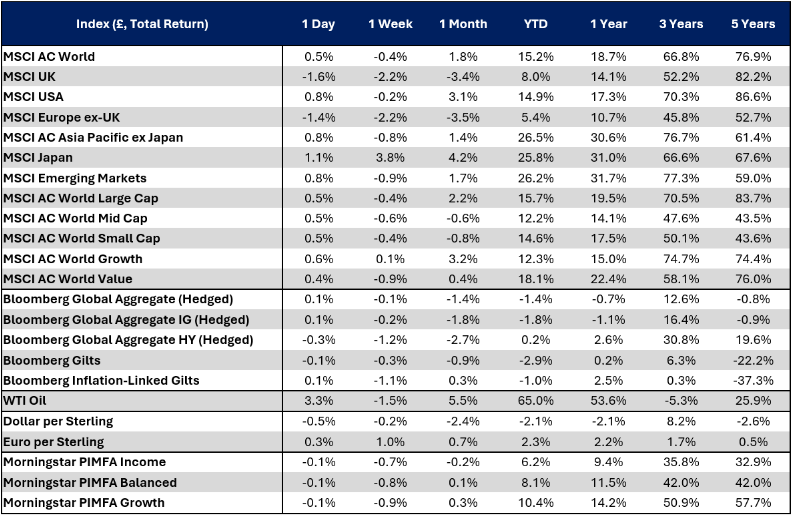
Markets endured a volatile start to the fourth quarter as concerns over European sovereign debt sustainability triggered a broad risk-off move. French and Italian government bond spreads widened sharply versus German bunds, with the Franco-German 10-year spread recording its largest daily jump since March 2020. The sell-off spread across European assets, with the STOXX Banks index falling almost 4%, European high yield credit spreads widening materially and the euro posting its weakest session against the US dollar since June. At the same time, Brent crude rose above $102/bbl amid renewed Middle East tensions and concerns over disruptions to shipping through the Strait of Hormuz, adding to inflation worries and tightening financial conditions. The US market proved more resilient. Although the 10-year Treasury yield briefly reached 5.34%, its highest intraday level since 2002, yields retraced lower as investors reassessed the likelihood of further Federal Reserve tightening. Dovish comments from several Fed officials helped offset another strong set of economic data, with jobless claims falling to a 10-week low and manufacturing surveys continuing to signal economic expansion. The S&P 500 ended higher on the day, with investors increasingly focused on today’s payrolls report as the next major test of the growth, inflation and policy outlook.
Europe’s Bond Market Stress Returns
Recent market moves highlight that concerns around fiscal sustainability are becoming an increasingly important driver of global asset prices. While higher energy prices initially pushed bond yields higher, investor attention quickly shifted towards France, where concerns over budget deficits and debt dynamics have driven a sharp repricing of sovereign risk. The widening in French spreads has begun to spill into other European bond markets, evoking memories of previous periods of euro area stress and weighing on banks, credit markets and the euro. Rising sovereign borrowing requirements across developed markets, combined with heavy corporate issuance linked to infrastructure, AI investment and energy security, are increasing the supply of long-dated bonds. This is contributing to steeper yield curves and tighter financial conditions. Paradoxically, if higher market rates perform some of the tightening normally delivered by central banks, policymakers may feel less need to raise policy rates further.
What does Brooks Macdonald think?
While market sentiment has deteriorated, we believe the message from bond markets is more nuanced than fears of an imminent crisis. Financial conditions have tightened meaningfully, particularly in Europe, and this may reduce the need for central banks to continue raising rates aggressively. We see scope for policymakers, especially the Federal Reserve, to underdeliver relative to current market expectations as inflation gradually moderates over the coming quarters. At the same time, resilient US labour market and manufacturing data suggest growth remains on a firmer footing than market sentiment currently implies. That said, we remain cautious on longer-dated government bonds given persistent fiscal deficits, rising issuance requirements and structurally higher term premia. Higher long-term yields are increasingly being felt across risk assets, although resilient earnings and economic momentum continue to provide support for US equities. In our view, volatility is likely to remain elevated into year-end, particularly around inflation and labour market data, but periods of stress should also create opportunities for active investors to exploit market dislocations.
Please continue to check our blog content for advice, planning issues and the latest investment, market and economic updates from leading investment houses.
Andrew Lloyd
02/10/2026