Team No Comments

Brooks Macdonald – Weekly Market Commentary

Please see below, this weeks Weekly Market Commentary from Brooks MacDonald received late yesterday afternoon (26/09/2022).

This weeks commentary looks at the increase in interest rates around the world in recent weeks, the fiscal event in the UK last week and at the reaction from sterling and the gilts markets.

Global interest rates rise last week as a second week of major central bank meetings conclude

Last week was dominated by monetary and fiscal developments as we saw 500bps of rate rises from global central banks and the unveiling of the UK mini-budget. Against this backdrop bond yields rose and equity markets suffered, bringing major equity indices back to around their 2022 lows.

UK Chancellor unveils the largest tax cutting budget since the 1970s

The UK’s fiscal event was revealed as the single largest tax cutting budget since 19701. The Chancellor has pursued an aggressive tax cutting agenda, particularly impacting higher earners, in order to pursue economic growth. Global financial markets were less keen however, reflecting that such a cut would increase the budget deficit of the UK and raise borrowing costs. There is very much a short term versus long term narrative here. In the long run, cutting taxes may boost growth and help drive internationally mobile talent towards the UK. In the short term though, the higher budget deficit will need to be financed by international investors who have not been won over by what is seen as a fiscal handout at a time of heightened inflation. With markets already highly volatile due to inflation fears, the higher certainty of short term factors have won out, leading to higher gilt yields and weaker sterling.

Friday’s fiscal announcement, and comments from the Chancellor over the weekend that more cuts are on their way, creates a credibility problem for the Bank of England. Last week the Bank opted for a smaller 50bp move instead of a 75bp2 move after balancing inflation and economic growth risks. The heavy downward pressure on sterling since Friday risks further import price inflation which will worsen the cost-of-living crisis. The Bank is therefore likely to want to get on the front foot, raising interest rates by a sizeable quantity to restore faith in the independence of the Bank of England.

Sterling falls and gilt yields rise as investors react to higher government borrowing expectations
Bank of England Governor Bailey has two broad options, talk big or act now. Comments today outlining that the Bank is determined to raise interest rates aggressively in November due to rising inflation fears would be a good start although market assumptions have already baked some of this into expectations. The perhaps politically less palatable move would be an emergency rate hike today which would show that the Bank was determined to act quickly when the facts change. Such a move may look politically charged however, given such a decision would raise government borrowing costs one business day after the government had announced plans which will lead to a larger budget deficit, which the bond market will need to absorb.

1 Bloomberg, 23 September 2022 (https://www.bloomberg.com/news/articles/2022-09-23/uk-sets-out-biggest-tax-cuts-since-1988-to-boosteconomic-growth)

2 Bloomberg, 22 September 2022 https://www.bloomberg.com/news/articles/2022-09-21/bank-of-england-is-set-to-raise-base-interest-rate-andstart-qt-asset-sales

Please continue to check our blog content for advice and planning issues from us and leading investment houses.

Cyran Dorman

27/09/2022

Team No Comments

Tatton Investment –Tuesday Digest

Please see below Tatton Investment’s Tuesday Digest (usually Monday) which looks at the current position in the US and how the upcoming midterms may impact on the markets. This digest was received this morning (20/09/2022):

Overview: The Fed prepares for more tightening 
As the period of mourning for Queen Elizabeth II ends, thoughts again turn to the war that continues to dominate our economy and markets, as it does throughout Western Europe and, to some degree Asia. Meanwhile, seemingly unaffected by the rest of the world, the US is blazing its own trail. This is predominantly because US energy security means it do not face the same input cost pressures. Nevertheless, inflation remains a problem for the US Federal Reserve (Fed) August consumer price data reflected a fall back in oil-related pressures, but tightness in the labour market continues to feed through. Therefore, the US is faced with a more structural inflation issue through looming wage-price-spiral dynamics than Europe. 

It does look like the Fed loosened its grip on the US economy during the summer and will now have to tighten harder, after the fallback in inflation expectations data resulted in a degree of complacency. This week’s meeting of the Federal Reserve Open Markets Committee is expected to result in an interest rate hike of at least 0.75%, bringing the Fed Funds rate up to 3.25%. More importantly, analysts suggest the peak for US interest rates is now around 4.5%.

While the US economy is stronger than expected, one should not overstate it. The summer bounce has been relatively muted and August retail sales disappointed. Seasonally, consumer spending picks up through the last quarter, so the Fed will be keen to see if consumers have just delayed their purchases. It showed determination in the first part of the year, and we expect it will reassert itself this week. We would not be surprised by a 1% rate rise (rather than 0.75%) and think the market is already prepared for the bigger move.

US corporate credit shows few recessionary signs
Declining business confidence and the aggressive Fed has led to fears that debt repayments will become too great, sending companies into bankruptcy. The US yield curve (measuring the difference in payment terms between short and long-term government bonds) is still inverted, often a reliable recession indicator, with investors getting paid less to lend over ten years than over two. Credit spreads – the difference between corporate and government bond yields – have swung up and down over the last few weeks on the back of new inflation data. They widened after last week’s release showed inflation still running hot, prompting expectations of more Fed tightening than previously anticipated. But the Fed is only tightening because the economy is strong, consumers are spending, and employment is holding up well. 

If a recession was looming, you would expect signs of stress in credit markets. While spreads have widened, acute stress has been contained so far. The fact that high yield credit in particular is doing so well speaks against imminent recession fears. Without a particularly sharp cost shock – like the one we are seeing now in Europe – economic strength should allow companies to deal with the rising cost of financing. As for recession indicators, we suspect they are down to global or technical factors, rather than a reflection of the US economy. The yield curve, for example, is skewed by the recent risk-off move from global investors – as many institutions are required to buy long-term US Treasury bonds. 

None of this is to say that things could not turn for the worse. Sharp rate rises take a toll on businesses, and sectors like commercial real estate are particularly sensitive to interest rate moves. But it would likely take a significant weakening to create widespread default pressures. By most measures, equities remain expensive relative to credit – despite the market falls this year. You could read that pessimistically as a sign stocks need to sink further, but it could also signal that corporate credit is undervalued, as backed up by balance sheet resilience. Ultimately, the difference between the two scenarios is market sentiment, rather than underlying conditions. For better or worse, that sentiment will be a deciding factor in how corporate credit fares from here.

US midterms hang in the balance
The US midterm elections are less than two months away, and when America votes, the world watches. Capital markets are focused on ‘money’ rather than political impacts, and some commentators are warning that the midterms could be a source of volatility in the coming weeks. As recently as July, polling showed the Republican Party on track to regain control of the Senate, but the Democrats are now in better cheer with their fortunes improving over the summer. We see the same trend in the House of Representatives, albeit to a much lesser extent. A Republican victory looked a sure thing a few months ago, but the current expectation is that President Biden’s Democratic party will retain or even strengthen control of the Senate, while the Republicans are expected to snatch the House of Representatives away. Ceding the lower chamber would still frustrate Biden’s agenda and compound gridlock in Washington. 

The state of the economy is generally a good guide to the ruling party’s fortunes. Consumer sentiment fell dramatically in the spring and summer, and the Democrats’ approval rating unsurprisingly declined with it. However, the swing may be partly due to the Supreme Court’s decision to overturn Roe v Wade, the landmark case which enabled nationwide access to abortion for the last 50 years. More worryingly for Republicans, it seems to have energised liberal voters. Unsurprisingly, Senate minority leader Mitch McConnell wants to steer the national conversation to inflation, the general economy and perceived “woke” liberal excesses. 

In reality, these mid-terms are unlikely to change fiscal policy dramatically, particularly given the likelihood of a split and gridlocked legislature. For markets, foreign relations could be the most important battleground, especially the relationship with China. Whether markets would prefer Democrats or Republicans in Congress is hard to say and the recent swings do not appear to have been a big factor in asset market moves. Rather than the fiscal deficit, the trajectory for the current account deficit and the US Dollar may occupy investors’ minds.

Please continue to check our Blog content for advice and planning issues and the latest investment, markets and economic updates from leading investment houses.

Cyran Dorman

Trainee Paraplanner

20/09/2022

Team No Comments

Tatton Investment – Monday Digest

Please see below Tatton Investment’s Monday Digest which looks at the current position in UK and Europe and what September may bring. This digest was received this morning (05/09/2022):

Overview: Europe still waiting for policy action

Last week investor attention turned towards what looks like an increasingly bleak winter ahead. The delicate equilibrium we wrote about last week has clearly once again been disturbed. It hasn’t helped that while unacceptable cost shock pressures have hit households and businesses across Europe, very little concerted action has been announced in response. In the UK, all eyes are on the new incoming Prime Minister, while the European Union (EU) is held up by the complexity of the problem paired with the terrible structural slowness of policy makers making decisions. This leaves businesses and households feeling more vulnerable. The energy supply shortfall that needs to be overcome by lower demand is estimated to be around 10-15%, which at current price levels will be massively overshot and lead to an unnecessarily excessive economic and mental health burden to everyone across Europe. Governments will need to devise a policy framework that combines the incentivisation that the price mechanism provides with means of soft (incentivised) energy rationing that achieves the same supply-demand equilibrium, but without the hardship that excessive price signals would cause for households and businesses.

Turning to recent market action in more detail, the past few days have seen markets fall and daily volatility has picked up, but to a much lesser extent than during the falls of earlier in the year. The falls in equity markets have been accompanied by falls in government and corporate bonds, much as when happened at the beginning of 2022 and again in June. However, because of the reduced intraday volatility levels there is much less of a sense as back then that monetary liquidity is draining. Indeed, US retail investors that were heavy sellers of assets during that period appear to be either less important or less scared now.

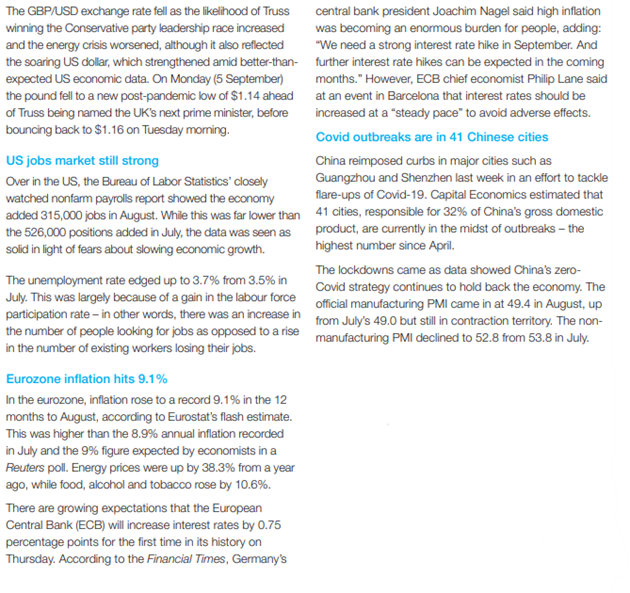
Looking ahead, September can be the most difficult month of the year. Investors will therefore not be holding their breath for a reversal of August’s falls – even though past seasonality trends have not provided particularly helpful guidance during 2022. However, either way, we are not pessimistic, as one of the main sources of equity market weakness this year has been the rise in US bond yields. Last week, those yields bounced back up after the US Federal Reserve (Fed) said it remained more concerned about labour market tightness above anything else. August data published last Friday showed a rise of 315,000 non-farm payroll jobs, still well ahead of the average 185,000 jobs per month of the 2010-2019 decade. This is an ‘improvement’ over July’s 528,000 new jobs number, but indicates that the Fed is unlikely to pivot on near-term policy anytime soon. Despite the Fed’s inflation concerns, the apparent stability of the US in the face of trouble elsewhere led to a sharp rise in the value of the dollar, backed up by a general risk-off move by global investors, in turn lessening the price-push impact of import prices.

For Europe, energy prices remain the focal point. Russia (officially Gazprom) shut down the flow through the Nord Stream pipeline and blamed sanctions and Siemens for “maintenance” issues. The shutdown was extended to “indefinite” late on Friday, and it appears Russia is determined to increase the pressure on European nations with continued supply disruption holding prices high, while not shutting of the gas supply completely to retain the leverage over European politics.

Emerging markets enjoying their time in the sun

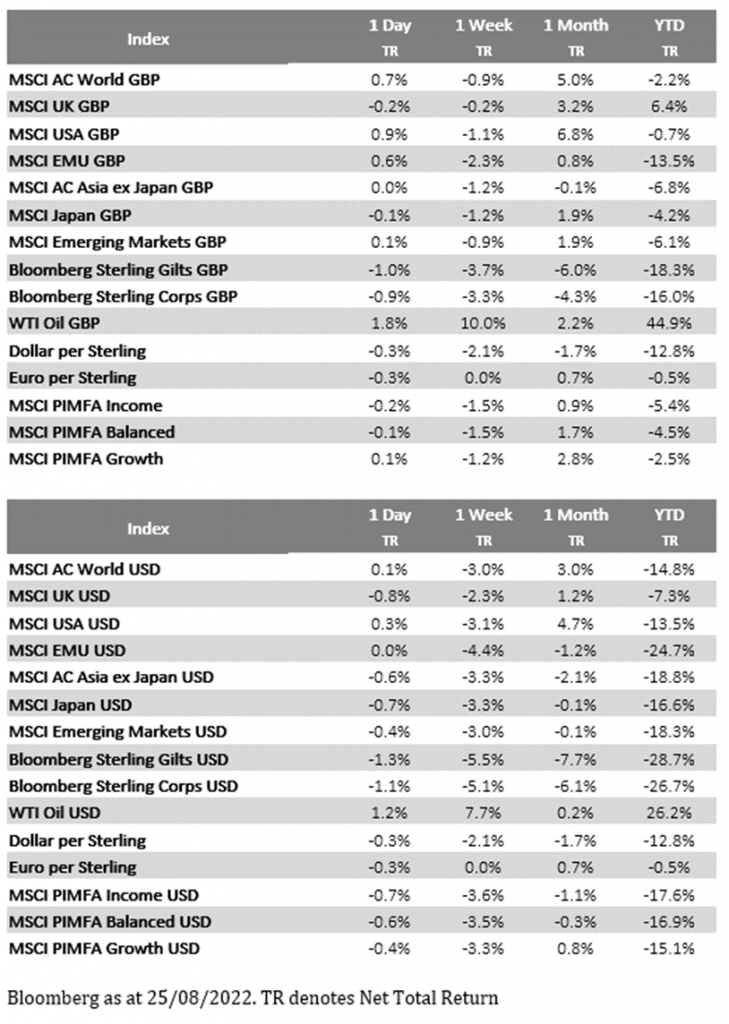
Emerging Markets (EMs) have fared quite well recently, relatively speaking at least. Traditionally, EMs are very cyclical – expanding in times of global growth and falling back during the global economy’s low points. But while the world is undeniably in a slowdown (which became only more apparent over the month) EMs have not suffered as one would usually expect. At first glance, high energy prices would be a likely explanation. EMs are often reliant on commodity exports, meaning that high prices for raw materials can deliver a big boost. But the flaw in this argument is that the energy crunch is primarily in the natural gas market, specifically around Europe. EMs as a whole do not have a great exposure to European gas prices, and are unlikely to benefit from the supply-side tightness there. Energy issues have lately not been reflected in oil and metals prices, for example, which both had a lacklustre August. By comparison, food exporters such as Brazil have done well, despite the apparent fallback in developed world consumer demand.

Granted, from a longer-term perspective, commodities are in a good position. Price pressures are significantly higher than before the pandemic, and those forces are unlikely to dissipate any time soon. Pessimists point to a looming global recession and structural shake-ups from Russia’s war on Ukraine, which could undermine demand for commodities and thereby damage EMs. But the structural backdrop is still supportive of commodity prices – particularly for metals. A prolonged period of commodity strength and a favourable outlook have allowed many EMs to improve their trade balances. Potentially weak commodity demand could undermine some of that improvement, but many EMs have the additional benefit of proactive monetary policy last year. Latin American countries in particular began aggressively tightening interest rates in late 2021, and now have a fair chance of avoiding recessions as it gives them room for easing much earlier than developed countries.

Despite the positives noted above, anxiety lingers for EM investors. EMs have certainly held up better than expected, but what this means for the future outlook is deeply uncertain. Ultimately, the key factor is how bad the global economy gets. For all of the doom and gloom lately, nominal growth has held up well across the world. And while we are certainly in a slowdown, there is no global recession yet, and hence no significant pullback in commodity demand. In fact, fiscal stimulus is forthcoming in the US, Europe, China and Brazil, which will bolster growth in the months ahead. This is likely to lead to further monetary tightening from major central banks in developed markets, as has already been signalled. That scenario will be the real test for EMs. We will see whether EM success is structural and genuine, or just a fluke. The worst could be yet to come for developing economies, but things are at least looking positively different for some EMs for now.

Please continue to check our Blog content for advice and planning issues and the latest investment, markets and economic updates from leading investment houses.

Cyran Dorman
Trainee Paraplanner

05/09/2022

Team No Comments

Brooks MacDonald Daily Investment Bulletin

Please see below today’s Daily Investment Bulletin from Brooks Macdonald – received this morning – 25/08/2022

What has happened

Bond markets continued to price in higher central bank interest rates as fears over the European energy sector weigh on inflation expectations. Despite this bond volatility, equities managed to make gains yesterday with longer duration equities, such as technology, somewhat counterintuitively outperforming.

European energy

European natural gas futures continued their climb yesterday as investors look ahead to higher demand during the winter period. There has also been a growing concern that Russia may not reopen the Nord Stream 1 pipeline after three days of closure from 31st August. Recent rhetoric has also pointed to little appetite for Russia to seek a ceasefire in the Ukraine War, making it ever more likely that Ukraine War related supply side issues will continue well into 2023. Freeport LNG said yesterday that their natural gas terminal in Texas, which was shut down due to an explosion and fire, would not be reopened until November, later than energy markets had hoped. The latest rises in European energy prices quickly filtered into ECB rate expectations with the bond market now expecting 133bps of additional rate rises before the end of this year.

US politics

President Biden announced yesterday that the US would be providing student debt relief of up to $10,000 for graduates on an income of less than $125,000. Those receiving Federal aid would also be eligible for a larger payment. Federal student loan repayments are currently frozen and this pause will now be extended until the end of this year. This is very much a response to the cost-of-living squeeze in the US and while the US cost-of-living pressures are less pronounced than within Europe, the upcoming mid-term elections make proactive economic policy particularly politically attractive.

What does Brooks Macdonald think

Only a few months ago the Democrats looked likely to lose both the Senate and the House of Representatives in November. Recent legislative wins and targeted economic support, such as yesterday’s student loan programme, have put the Democrats odds on to retain the Senate and close to a 25% chance of retaining the House (which was always a distant prospect). Political cycles, and the global lack of appetite for austerity, mean many governments will be tempted to reach for accommodative fiscal policy at this time. Central banks are already wary of this risk however, in case it prompts even higher inflationary pressures.

Please continue to check our Blog content for advice and planning issues and the latest investment, markets and economic updates from leading investment houses.

Cyran Dorman

Trainee Paraplanner

25/08/2022

Team No Comments

Tatton Investment – Monday Digest

Please see below Tatton Investment’s Monday Digest which provides an overview and some interesting analysis of the current state of the Global economy. This digest was received this morning (22/08/2022):

Will a new PM be good news for investors?
It’s almost certain Liz Truss will win the Conservative Party leadership contest and become the UK’s next Prime Minister on Monday 5 September. She will face a very difficult start, given the state of the UK economy. The most obvious expression of this is consumer confidence, and the GfK Consumer Confidence Barometer is currently at -44, in other words, very low. One reason is the reduction in the purchasing power of UK disposable incomes. The reining-in of consumer spending is likely to worsen as the weather cools and the next massive change in energy prices falls due. Average bills are expected to top £3,600 a year when the new energy price cap is announced on Friday. 

Optimists can make a case that it’s not all bad. The unemployment rate is around 3.8% and jobs are plentiful – even if people may feel hard done by. However, while jobs are being created, the pace of job creation has slowed and the fact that consumers are reducing spending in volume terms is evident in declining real GDP terms as well as in the retail spending data. 

For the Bank of England’s Monetary Policy Committee (MPC), another rate rise of at least 0.5% in September seems as certain as Liz Truss’s victory. The market currently prices a rise in base rates to over 3.75% by March 2023. Moreover, the Bank of England will have its remit examined immediately by the new Truss regime, and this might be a source of worry for the currency market. It is unlikely the government would try to challenge the Bank’s independence directly, but currency traders may worry about greater political influence exerted on its decisions and analysis. 

At least we are not alone. The rest of Europe has similar concerns over inflation and energy. And while natural gas and electricity prices continue to rise, oil prices have fallen substantially over the past few weeks. Moreover, US growth remains strong, almost uncomfortably so. Investors are moving back to expecting more rate rises from the US Federal Reserve (Fed) but that is in response to solid signs of economic resilience, something which is welcome for a softer Europe and UK. Despite Europe and the UK’s issues, the profit outlook for our global companies has remained positive, especially in Sterling and Euro terms. As we have observed recently, globally-oriented portfolios can still hold up reasonably well even if the outlook domestically is more gloomy.

Biden’s stalled presidency receives a welcome boost 
For most of his presidency, Joe Biden’s ambitious fiscal plans have been repeatedly thwarted, both by Republican opposition and by those within his own party. So, it was something of a surprise that the commander-in-chief’s $700 billion climate, health and tax package passed through the frequent buffer to Presidential plans, the US House of Representatives. In an era of increased partisan US politics, this is a notable achievement. 

In truth, it is an inflation reduction act in name only. It is designed to increase corporate tax revenue, constrain the pricing power of pharmaceutical companies and increase incentives for green investment. The Act’s environmental provisions will likely have the biggest impact. Americans will be able to take advantage of tax credits to buy electric cars and solar panels for their homes, while the US government will invest heavily in renewable energy production and storage. The Act remarkably also introduces a tax credit for so-called green hydrogen, made via electrolysis of water using renewable energy. This is currently costlier and less popular than standard hydrogen production, which uses fossil fuels and releases large amounts of CO2, but costs are expected to fall over the next decade. 

From an investment point of view, the big positive is that the law invests heavily in long-term supply- side changes. Given the acute undersupply in the current global economy, that is welcome news. These will not affect short-term inflation – whatever the name suggests. But they set the tone for greater opportunity ahead. Whether all these measures stay in place in the years to come is uncertain, but the investment it could spur will have a big impact nonetheless. 

China’s leaders brace an uncertain few weeks 
While the world’s major central banks are aggressively raising rates to fight runaway inflation, the People’s Bank of China (PBoC) surprised us all last week. It delivered a 0.1% cut to the medium-term lending rate, increasing funding to some financial institutions. It also injected CNY 2 billion into the financial system. Even avid watchers of PBoC policy were caught off guard by the move.

China’s monetary policy has diverged from the rest of the world because the key concern is weak domestic demand, from its ailing property sector and sporadic Covid-induced lockdowns. The credit impulse – a measure of how much credit is contributing to overall GDP – has increased in recent months, but not by a huge amount. Alongside falling loan growth, industrial output, investment, retail sales, property sales and construction all showed signs of slowing growth or outright decline. Simply put, following a particularly strong June, July was a disappointingly weak month and appears have been enough to create the policy change.

We should not ignore the other source of consumer disquiet. The zero-Covid policy has repeatedly put swathes of China under damaging lockdowns. Currently over 25% of China’s GDP is at risk of being locked down again (according to Bloomberg Economics’ calculations of 17 August). The policy is harder to change, given it has become ingrained in the way the Party has governed for more than two years. 

The 20th National Communist Party Congress will likely be held at the beginning of November and for President Xi’s to affirm his authoritarianism and aggressive foreign policy, he needs a strong and vibrant economy. This is more than just a question of window dressing. Public desire for personal economic growth and common prosperity are used by the Communist Party to maintain power. For now, economic volatility remains an impediment to consumers, growth is probably improving, while policy continues to ease. Xi may still be reluctant to add to this policy change, but he desperately needs to give consumers the boost they crave.

Please continue to check our Blog content for advice and planning issues and the latest investment, markets and economic updates from leading investment houses.

Cyran Dorman

Trainee Paraplanner

22/08/2022

Team No Comments

Brewin Dolphin – Markets in a Minute

Please find below, a market update received from Brewin Dolphin yesterday evening – 02/08/2022

Strong tech earnings boost investor sentiment

Equities rose last week as strong second quarter earnings from technology giants Amazon, Apple and Alphabet boosted investor sentiment.

US indices managed to shrug off news of a contraction in US gross domestic product (GDP) and another 75-basis point (bps) interest rate hike. The S&P 500 gained 4.3%, the Dow rose 3.0% and the Nasdaq surged 4.7%.

The pan-European STOXX 600 and the FTSE 100 advanced 3.0% and 2.0%, respectively, after data showed the eurozone economy expanded by more than expected in the second quarter.

In contrast, Japan’s Nikkei slipped 0.4% after the government downgraded its forecast for economic growth in the fiscal year ending March 2023 from 3.2% to 2.0%, citing slowing overseas demand and rising consumer inflation.

China’s Shanghai Composite eased 0.5% as a high-level meeting of the Communist Party omitted mention of its GDP growth goal and instead said China should “strive to achieve the best possible results”.

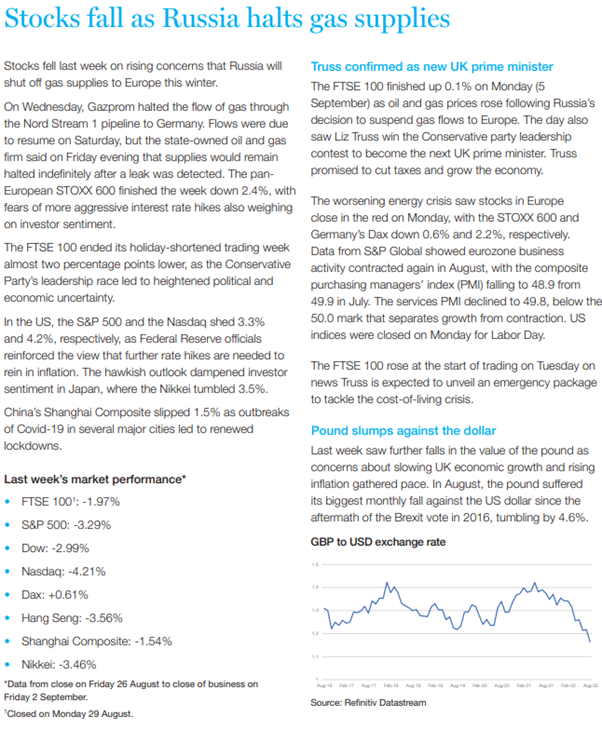
 Last week’s market performance*

• FTSE 100: +2.02%

• S&P 500: +4.26%

• Dow: +2.97%

• Nasdaq: +4.70%

• Dax: +1.74%

• Hang Seng: -2.20%

• Shanghai Composite: -0.51%

• Nikkei: -0.40%

*Data from close on Friday 22 July to close of business on Friday 29 July.

US indices fall after best month since 2020

After July proved to be their best month since 2020, US indices fell on Monday (1 August) as investors feared US House speaker Nancy Pelosi’s potential visit to Taiwan could worsen tensions between China and the US. The S&P 500 slipped 0.3%, the Nasdaq lost 0.2% and the Dow shed 0.1%. Asian stocks suffered on Tuesday, with the Shanghai Composite and Hang Seng down 2.3% and 2.4%, respectively, after Beijing reportedly said it would retaliate with “forceful measures” if the trip goes ahead.

In economic news, data from S&P Global showed UK manufacturing output contracted for the first time in over two years in July because of reduced intakes of new work, weaker market demand, difficulties in sourcing components and transport delays.

The FTSE 100 was up 0.1% at the start of trading on Tuesday, while the Dax opened 0.6% lower.

US slips into a technical recession

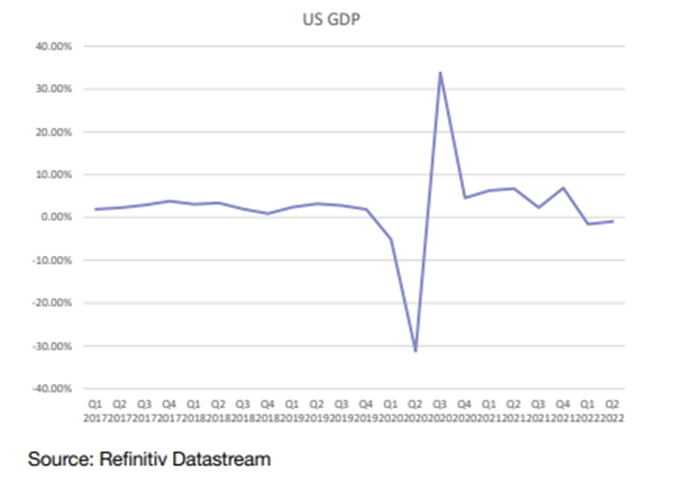
Figures released last week showed the US economy shrank for a second consecutive quarter, meeting one of the most common criteria for a technical recession. GDP shrank by an annualised 0.9% in the second quarter, following a 1.6% contraction in the first quarter, according to the Commerce Department. Economists polled by Reuters had forecast GDP would rebound at a rate of 0.5% in the second quarter.

While back-to-back quarterly GDP contractions meet one definition of a recession, the National Bureau of Economic Research is responsible for making the official call on whether the economy is in a recession. One of the factors it looks at is employment, which remains strong.

Treasury secretary Janet Yellen stated last week: “Most economists and most Americans have a similar definition of recession: substantial job losses and mass lay-offs, businesses shutting down, private-sector activity slowing considerably, family budgets under immense strain. In sum, a broad-based weakening of our economy. That is not what we’re seeing right now.”

Fed hikes rates by another 75bps

The US Federal Reserve approved its second consecutive 75bps interest rate hike last week, taking its benchmark rate to a range of 2.25-2.5%. Investors were largely expecting the move and were cheered by relatively dovish comments by Fed chair Jerome Powell that future rate increases would depend on the data.

“As the stance of monetary policy tightens further, it likely will become appropriate to slow the pace of increases while we assess how our cumulative policy adjustments are affecting the economy and inflation,” he said.

Tourism boosts eurozone economy

In the eurozone, a surge in tourism helped the economy expand by more than expected in the second quarter. According to Eurostat’s preliminary flash estimate, GDP grew by 0.7% when compared with the previous quarter, much higher than the 0.1% growth forecast by economists. France, Italy and Spain all saw an expansion in GDP, whereas Germany’s economy stagnated.

Inflation in the eurozone is expected to hit a new high of 8.9% in July, up from 8.6% in June, driven by price rises in energy and food. There are concerns this could lead to interest rate rises and weigh on growth during the second half of the year. There are also fears that a reduction in gas flows through the Nord Stream 1 pipeline from Russia to Germany could spark a recession.

Elsewhere, the European Commission’s economic sentiment indicator for the euro area fell from 103.5 in June to 99.0 in July, below its long-term average. Industrial confidence fell by 3.5 points, while sentiment in the services sector declined by 3.4 points.

UK consumer borrowing doubles

Here in the UK, data from the Bank of England showed consumers borrowed a net £1.8bn in June, double the £0.9bn in May, most of which was on credit cards. The annual growth rate for consumer credit rose to 6.5%, the highest level since before the pandemic.

The figures have raised concerns that people are resorting to borrowing to fund the rising cost of living. Gas and electricity bills for some of the most vulnerable households could reach an average of £500 a month in January, according to BFY Group, an energy management consultancy.

Please continue to check our Blog content for advice and planning issues and the latest investment, markets and economic updates from leading investment houses.

David Purcell

3rd August 2022

Team No Comments

Weekly Market Commentary

Please see below article received from Brooks Macdonald yesterday afternoon, which provides a global market update following Boris Johnson’s resignation and further rises in energy costs. 

Economic data last week painted a better picture of near-term economic momentum

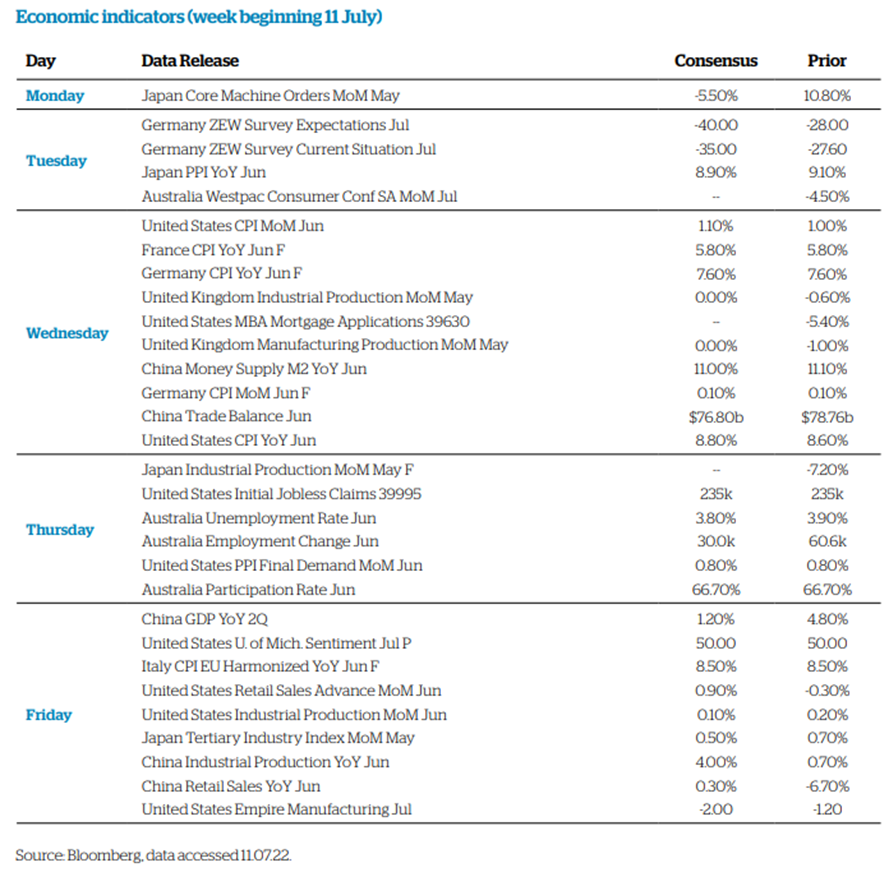
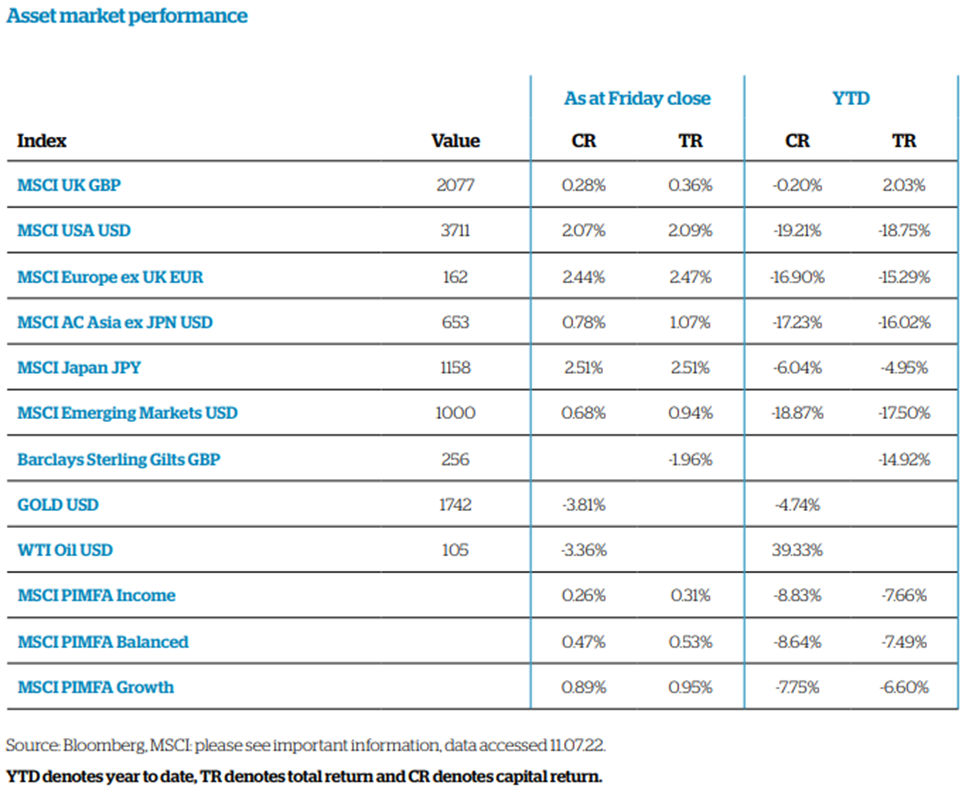
Last week saw a better run of economic data with bond yields and equities rising ahead of the key earnings season. After Boris Johnson’s resignation, a leadership race has begun within the UK’s Conservative party with the field expected to be whittled down this week.

Energy security concerns in Europe led to a surge in European energy costs

While European energy prices have seen sharp moves higher, the US’s energy security has kept US energy prices relatively subdued with US natural gas prices well off the peak set in early June. With US energy prices falling in June, this means this week’s US CPI print will be of particular interest. The first half of the month saw elevated prices whilst the latter part saw substantial declines. As it takes some time for these prices to feed into the consumer price basket, inflation is likely to remain elevated in June’s reading however the core CPI rate is expected to continue its decline on a year-onyear basis due to base effects.

US CPI to be in focus this week with June a month of two halves

Today sees the beginning of the scheduled closure of the Nord Stream 1 pipeline for maintenance with the key pipeline for continental European gas remaining closed until 21st July.

Geopolitical tensions between Russia and the EU remain fraught, there has therefore been some concern that the closure period may be extended by Russia in order to apply economic pressure on European capitals. The planned strikes in Norway would have also impacted gas exports however that has been averted, allowing energy prices to retreat slightly on Friday but remaining considerably higher for the week. The US enjoyed better economic data last week, allowing the US 2-year yield to rise by 27.2bps1, pricing in almost one additional Federal Reserve (Fed) rate hike. By contrast 2-year German bund yields were effectively unmoved as bond markets price in the energy supply fears and investors wagered that this would ensure the European Central Bank (ECB) retained a more cautious stance.

Differences in short dated yields are an important driver of currency returns and have been the dominant force in setting currency leadership this year. The growing gap between US and European 2-year yields led to further underperformance from the Euro versus the US dollar, meaning parity between the two currencies is now a near-term possibility.

Please check in again with us soon for further relevant news and market updates.

Chloe

12/07/2022

Team No Comments

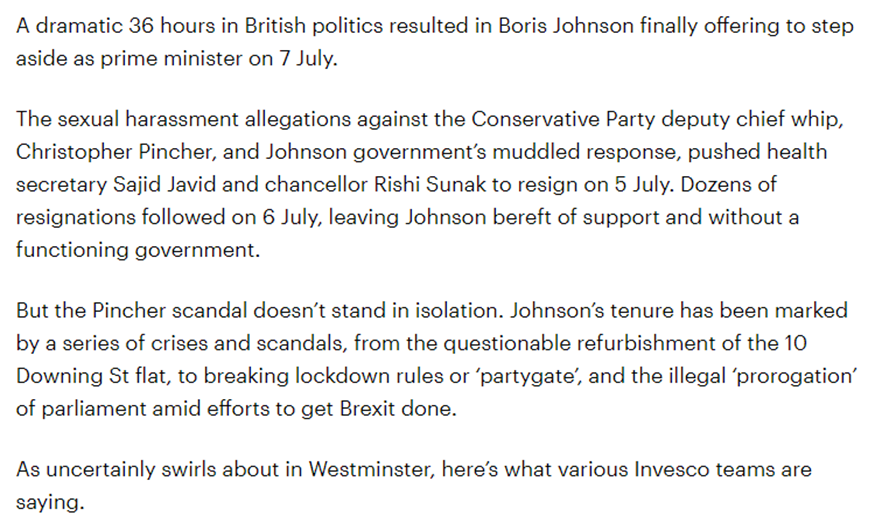
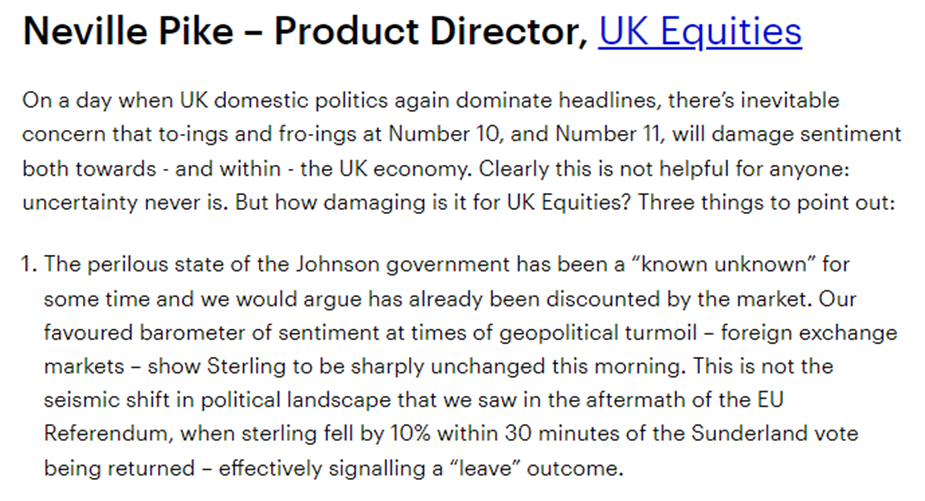
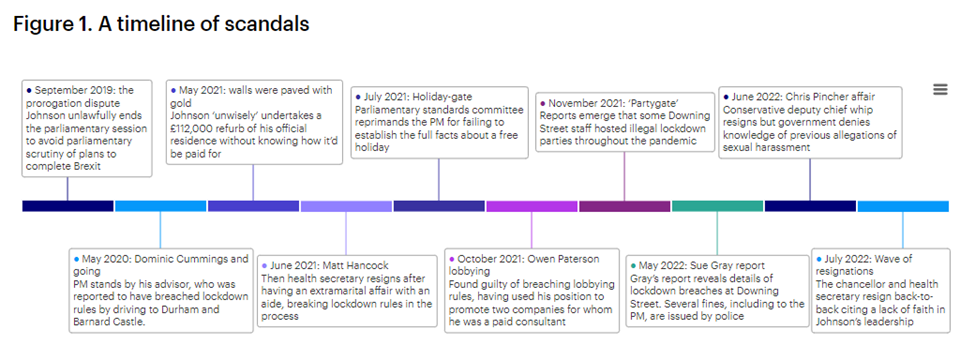
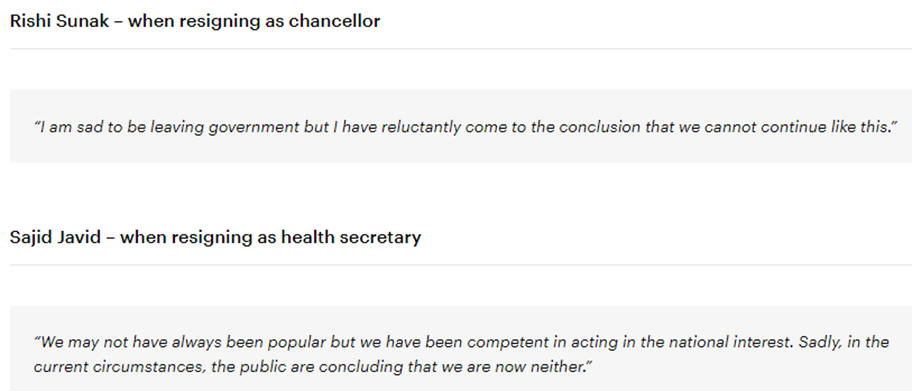
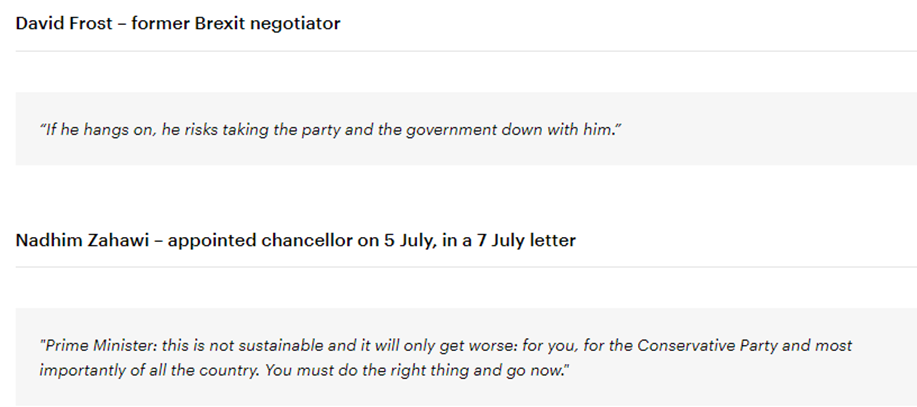
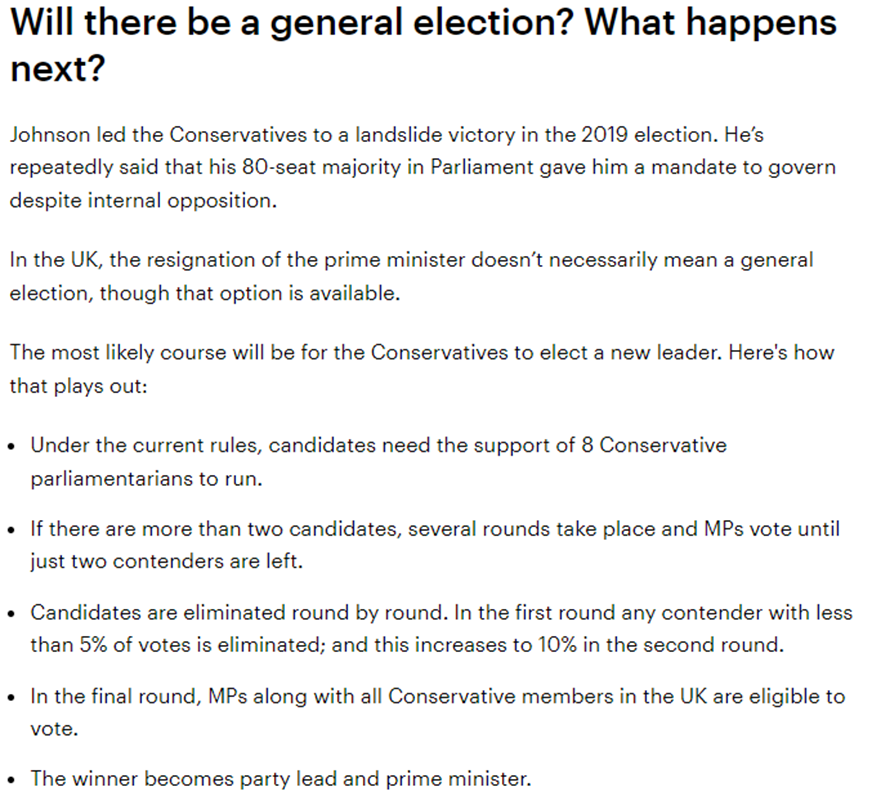
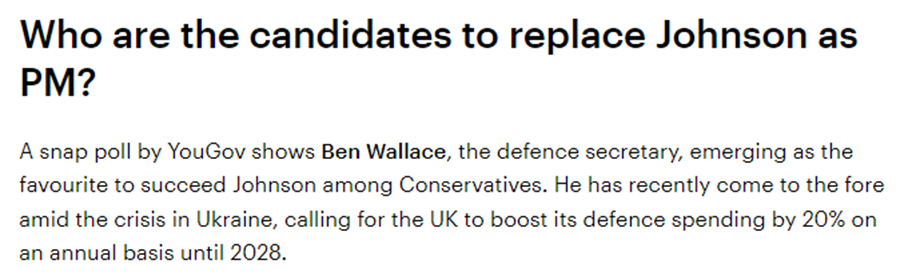
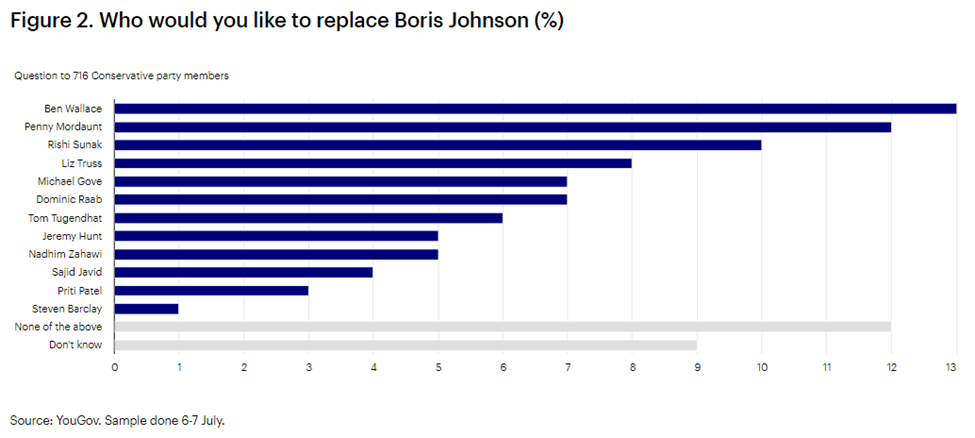
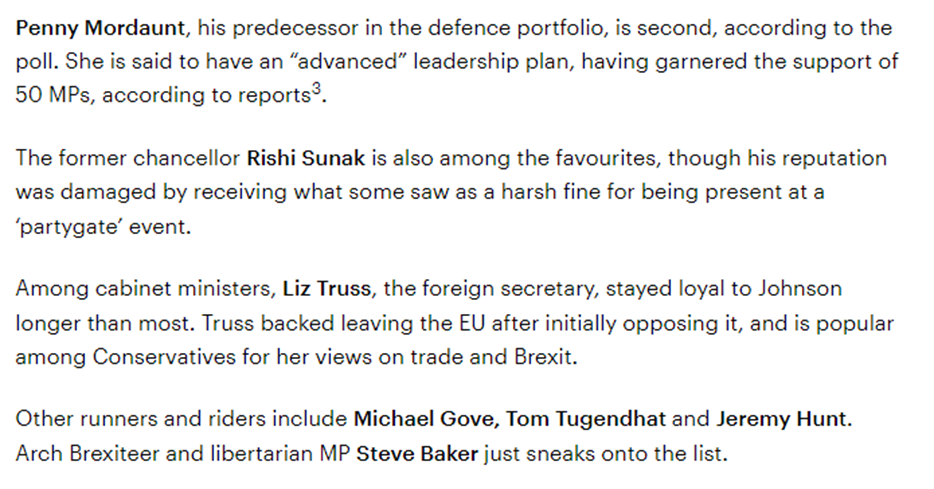
Invesco Analysis: Bye bye Boris. What does his exit mean for the UK?

Please see below for some interesting insights from Invesco regarding the departure of Boris Johnson and its impact on the UK Economy. This was published yesterday, 07/07/2022:

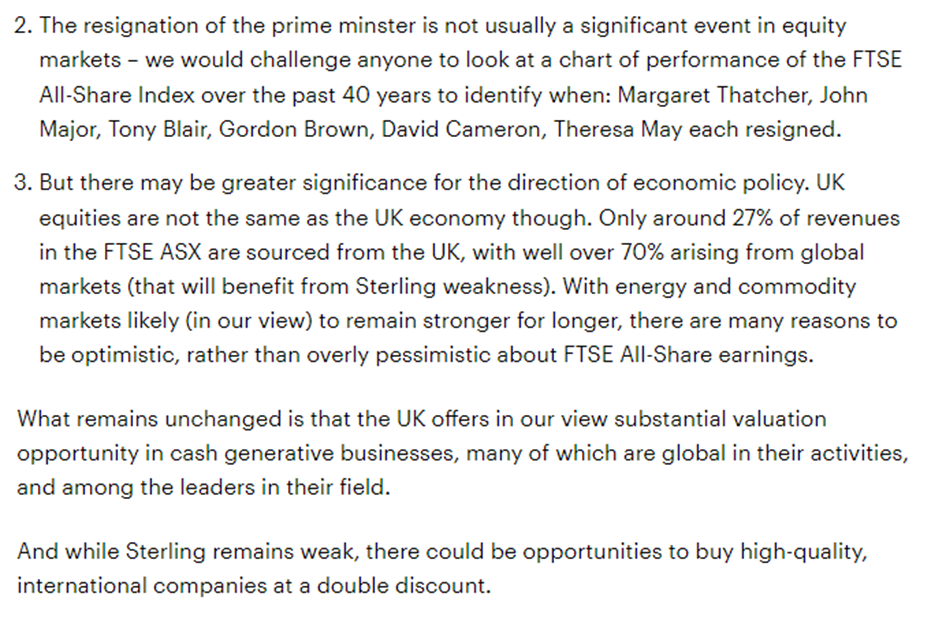
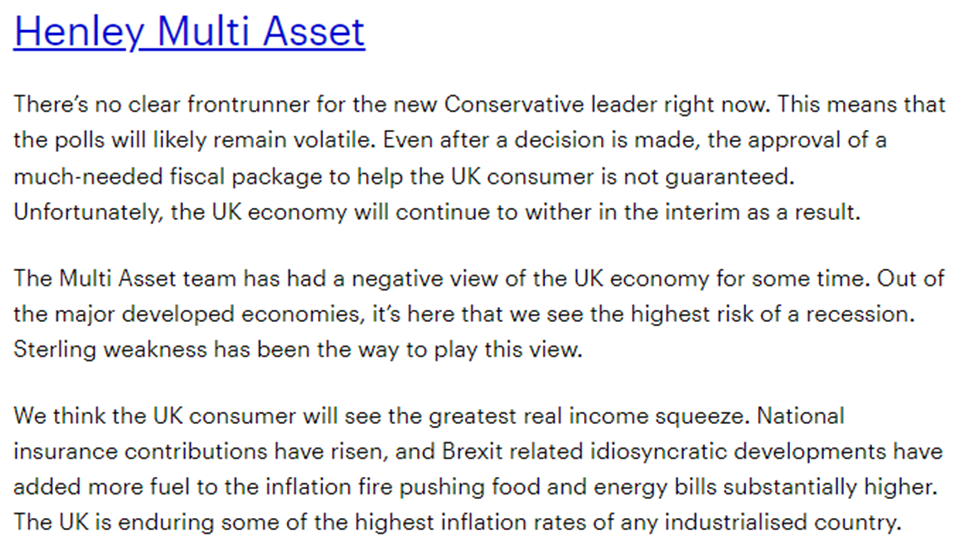
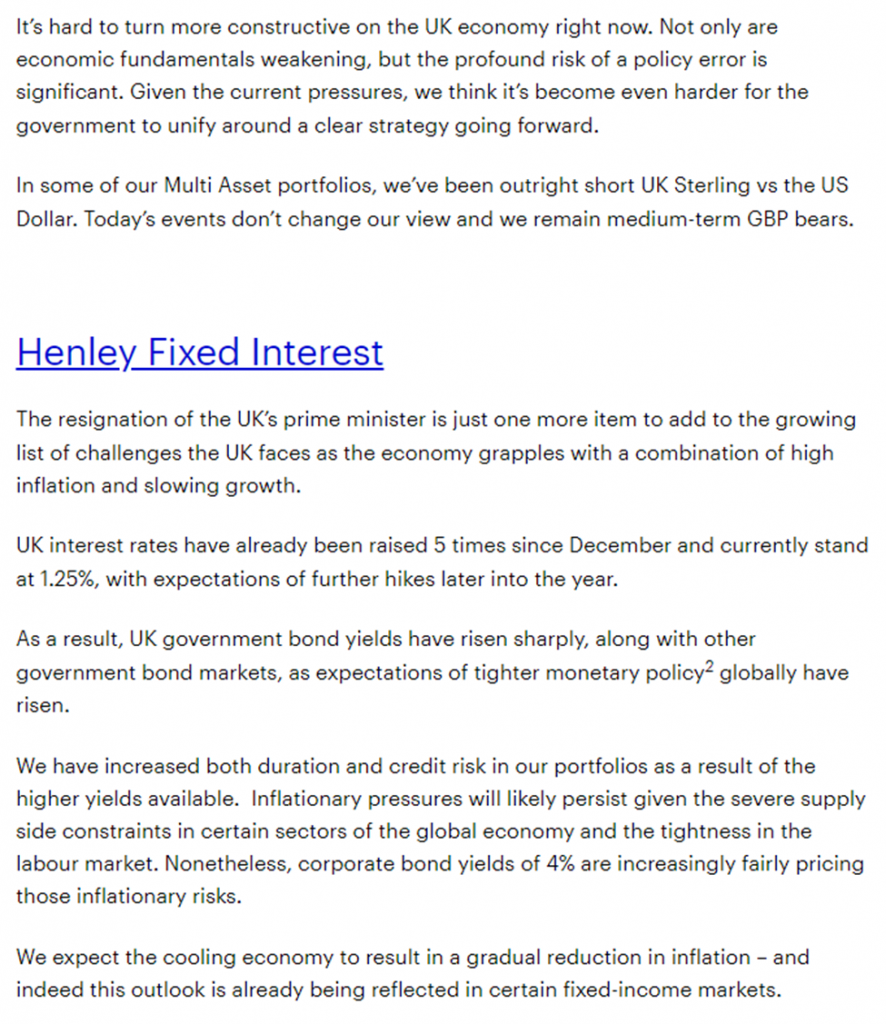
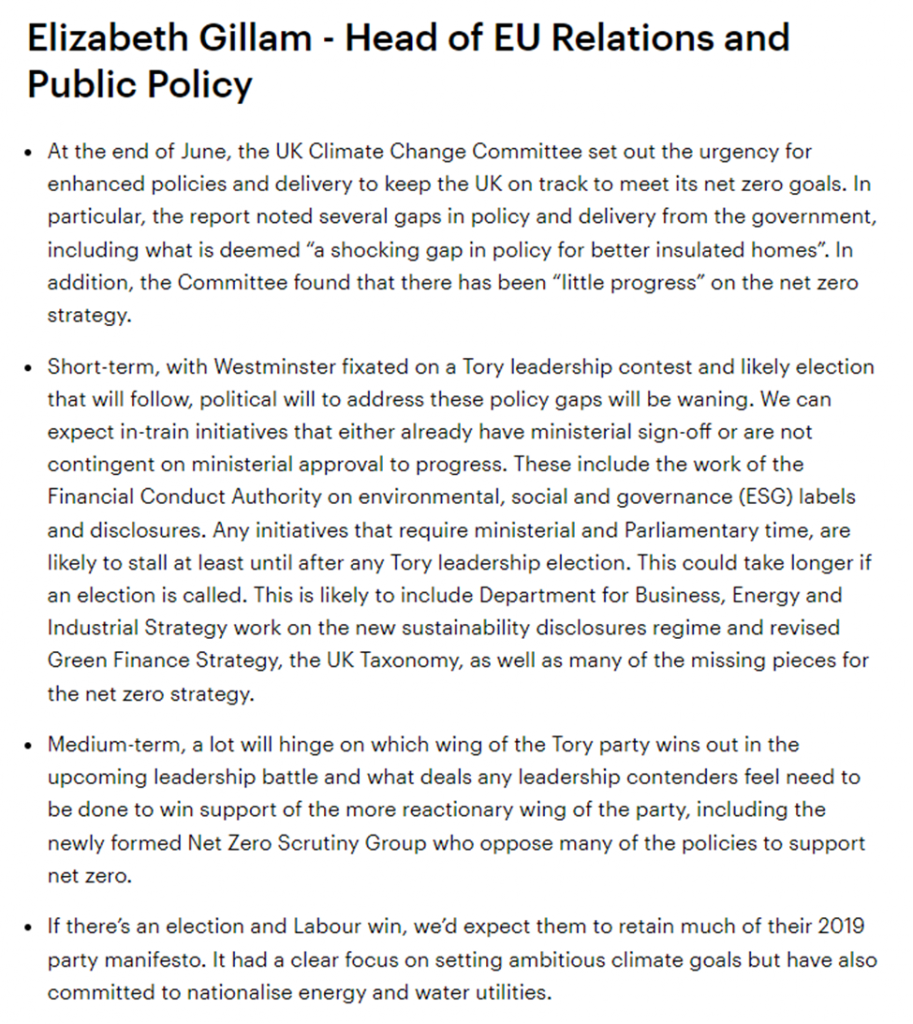
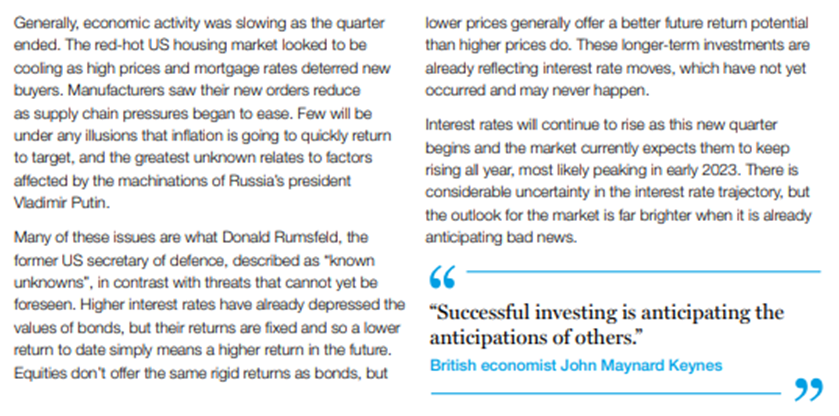
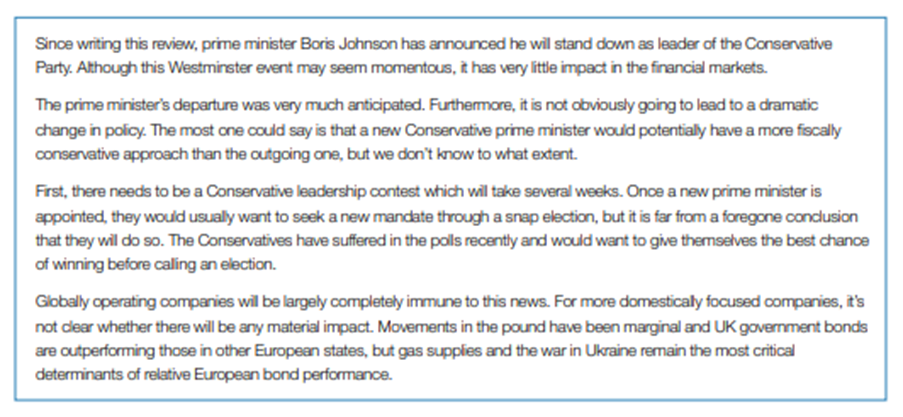
Although replacing the Conservative party leader is unlikely to impact equities, the delay in implementing any further fiscal policies may adversely impact the UK Economy. The hope is that the decision won’t take too long.

Check back for further updates on this and other relevant content.

Cyran Dorman

08/07/2022

Team No Comments

Brewin Dolphin – Quarterly Review Q2, 2022

Please see below the Quarter 2 analysis from Brewin Dolphin which was released yesterday:

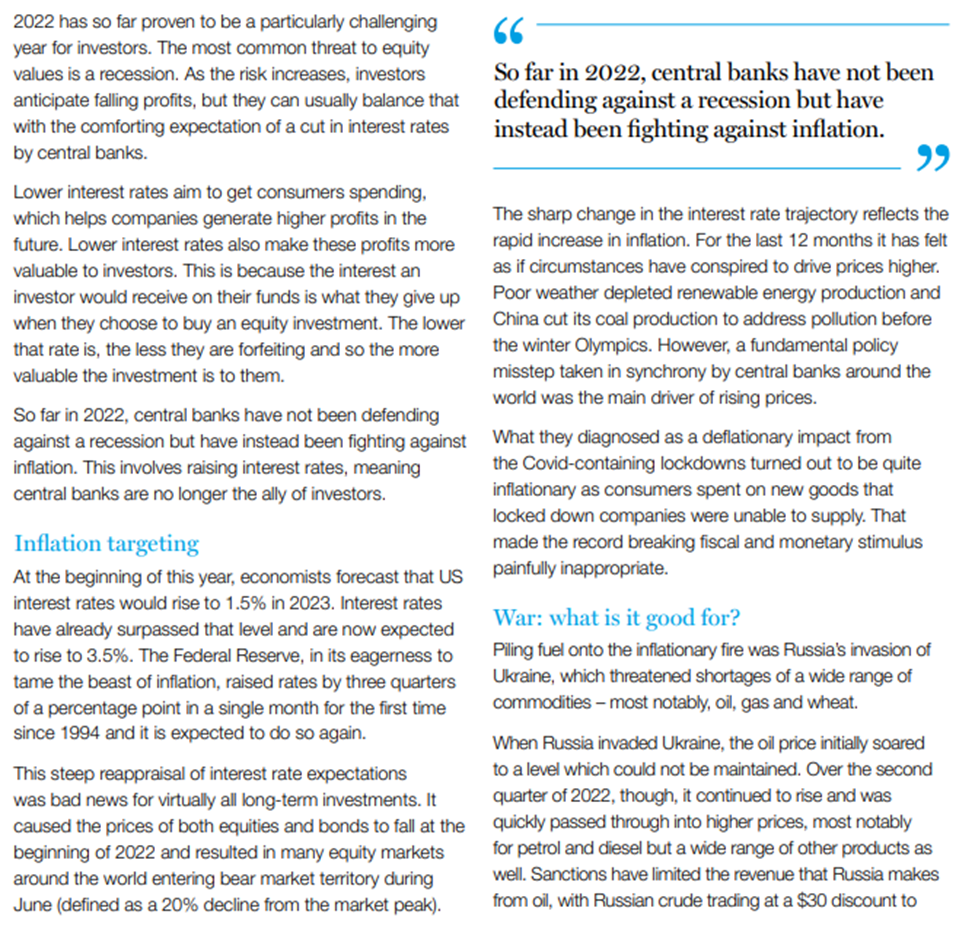
Geopolitical upheaval limiting supplies and exacerbating inflation has been the theme of Q2 and looks to continue into Q3. Brewin Dolphin do hint here that inflation may have reached its peak. This means the volatility we have seen lately may be with us a little longer.

The message is still to focus on long-term investment goals and remain invested while markets recover. Hopefully Q3 will bring more positive news.  

Please check back with us soon for further updates.

Cyran Dorman

08/07/2022