Team No Comments

Weekly Market Commentary – Market shifts focus to Europe

Please see below, a weekly market commentary received from Brooks Macdonald yesterday afternoon – 25/07/2022

  • Europe was in focus last week with Nord Stream 1’s reopening, Italian elections and the European Central Bank’s (ECB) hike all competing for attention
  • This week the US Federal Reserves’ (Fed) meeting and US Q2 Gross Domestic Product (GDP) will set the tone as we close out a volatile July
  • US and European earnings ramp up this week with the majority of companies beating expectations so far

Europe was in focus last week with Nord Stream1’s reopening, Italian elections and the ECB’s hike all competing for attention

Economic growth expectations remained a key driver of market moves last week with weaker data continuing to paint a picture of a slowdown in the US and the rest of the world. As a result bond yields fell, helping growth focused equities outperform already strong gains within the European and US stock markets.

Last week was dominated by European headlines, be those around the resignation of Italy’s Prime Minister, the restarting of the Nord Stream 1 pipeline or the ECB which scrapped its forward guidance in favour of a 50bp hike1 . This week the US will be in focus with the Federal Reserve concluding its rate setting meeting on Wednesday where it is widely expected to hike rates by 75bps2. Investors will be looking at how Fed Chair Powell balances the inflation risks with economic growth risks particularly given the weaker initial jobless claims of recent weeks which suggests a deterioration in the employment outlook. With the market now pricing in a change in tone at the Fed at the start of next year, with subsequent interest rate cuts, how the Fed addresses this elephant in the room is arguably more important than the size of Wednesday’s hike.

This week the US Fed’s meeting and US Q2 GDP will set the tone as we close out a volatile July

With recession fears remaining central to market moves, investors will also be watching the US GDP number on Thursday, which if negative means the US has entered a technical recession after contracting in Q1 of this year. It is worth stressing the technical nature of this recession, should it occur, given Q1 US GDP was driven lower by global factors rather than US factors. Equity markets are likely to look through such an outcome however it may have second order impacts on consumer demand should it solidify consumer negativity about future economic growth.

US and European earnings ramp up this week with the majority of companies beating expectations so far

All of this alongside a bumper week for US and European earnings means that the week will be a fitting end to a volatile July. So far in the earnings season, around 20% of US companies have reported with the majority beating earnings expectations. Many companies have painted a more cautious picture of 2023 however this largely chimes with the market’s broader macroeconomic thinking and therefore has been accepted by investors without too much concern.

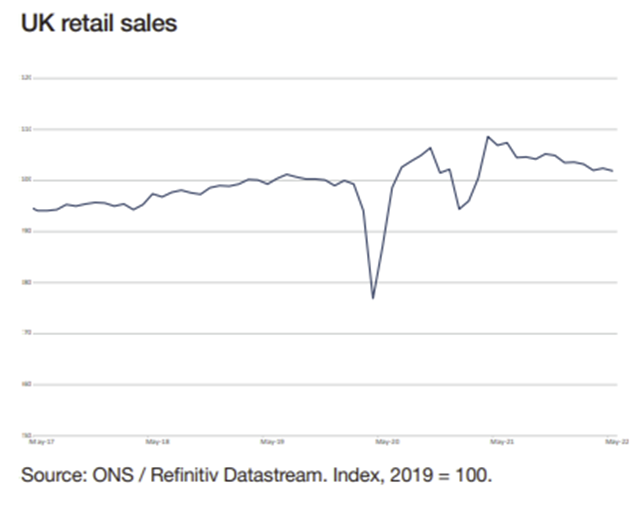
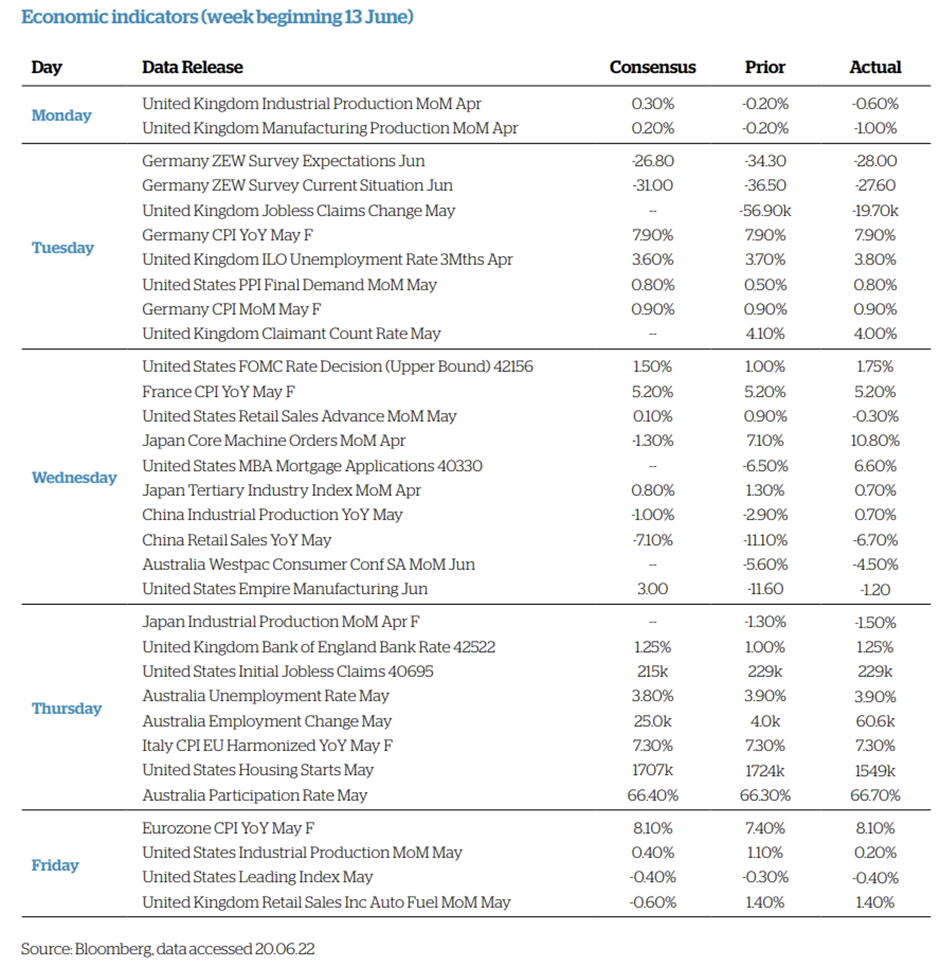
Economic indicators (week beginning 18 July)
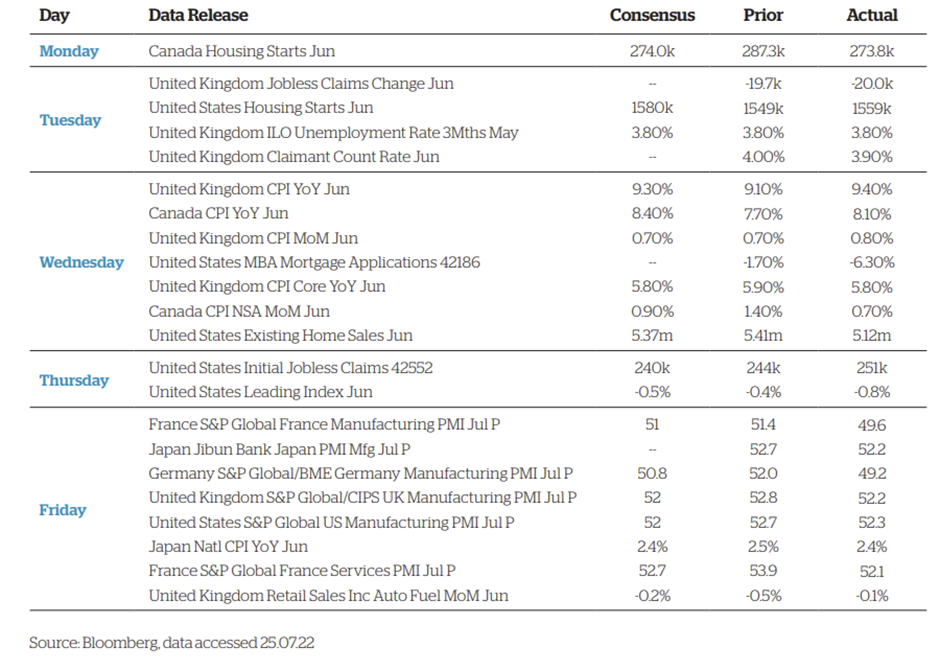
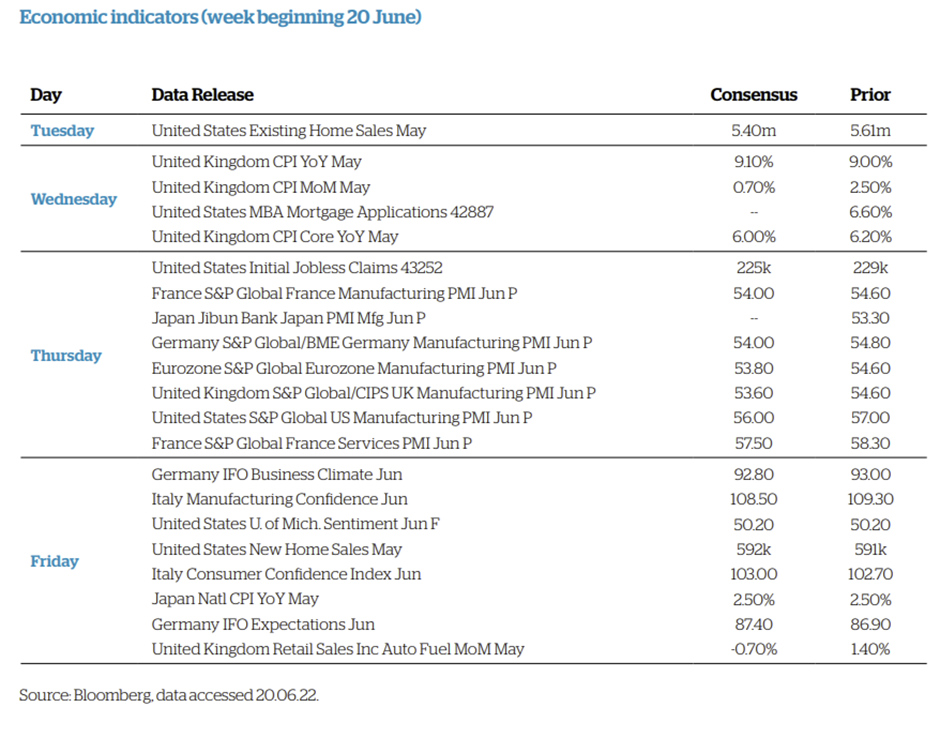
Economic indicators (week beginning 25 July)

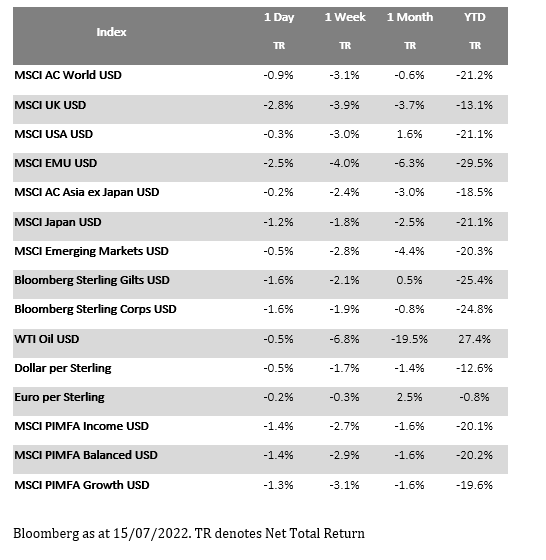
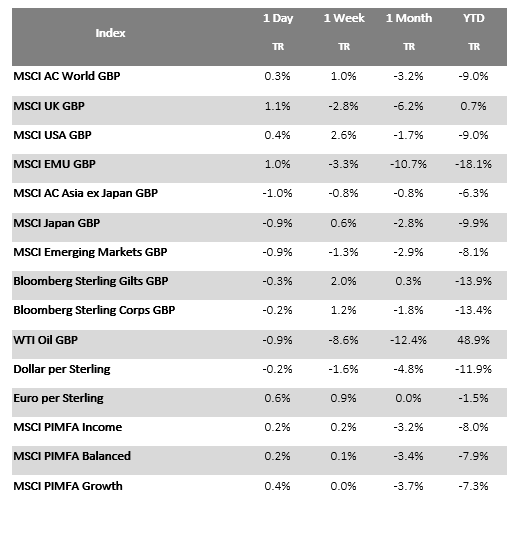
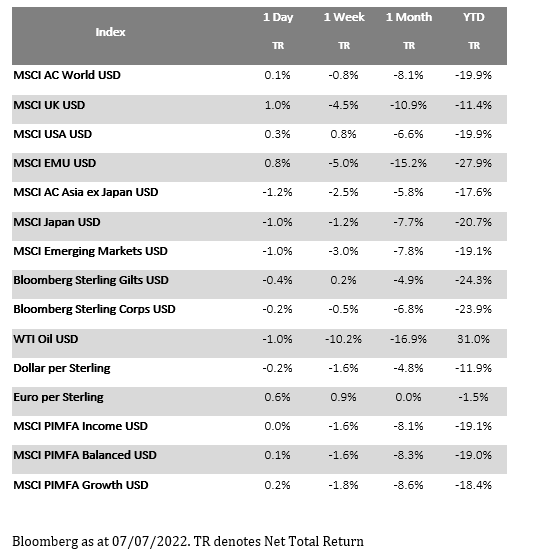
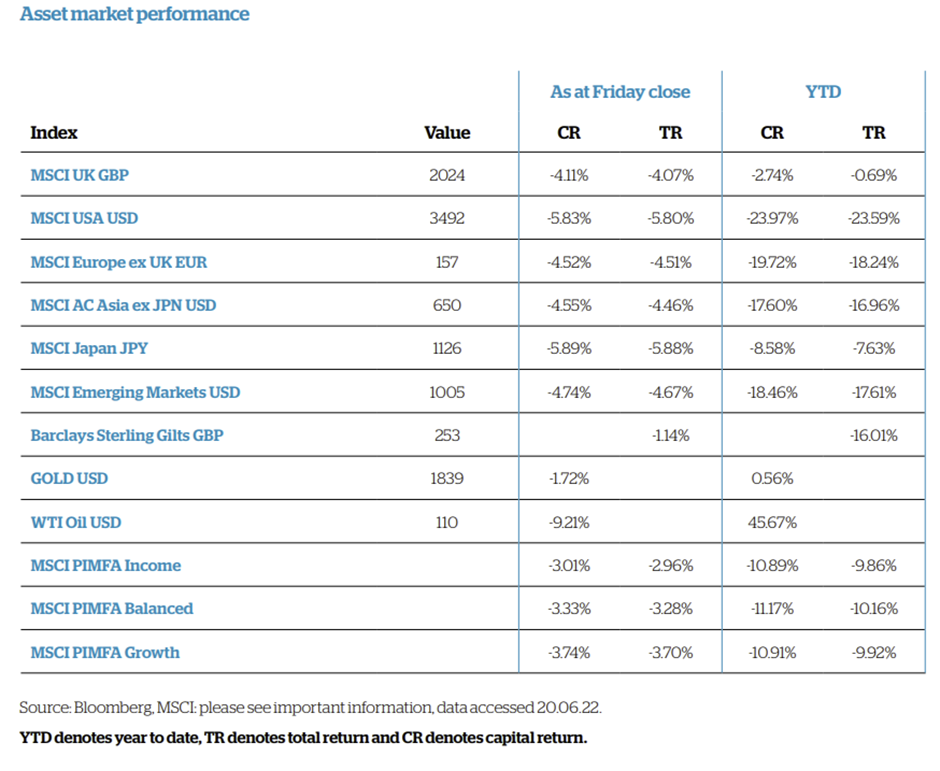
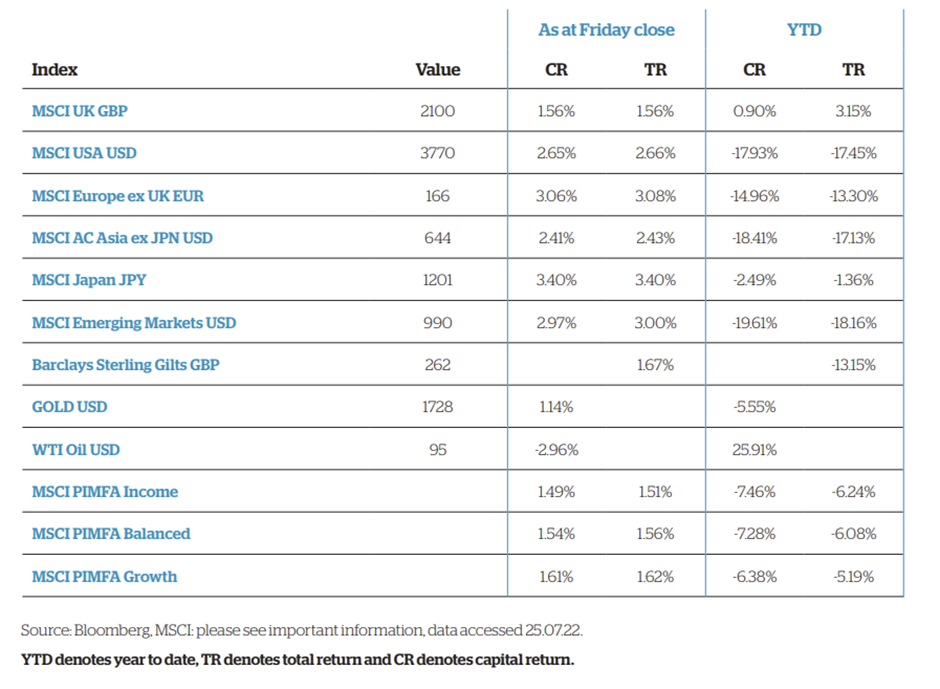
Asset Market Performance
Please continue to check our Blog content for advice and planning issues and the latest investment, markets and economic updates from leading investment houses.

David Purcell

26th July 2022
Team No Comments

Daily Investment Bulletin

Please see below article received from Brooks Macdonald this afternoon, which provides the latest update on global markets.

What has happened

Monday started with a more optimistic tone as earnings reports from Goldman Sachs and Bank of America both beat expectations, an important test after the misses from the financial sector last week. The news that Apple was set to slow hiring and spending in 2023 drove risk appetite lower however with US indices ending down for the day after a sell-off that took place after the European close.

European gas supplies

The timing of the reopening of the Nord Stream 1 pipeline remained high on investors’ agenda on Monday with Gazprom saying that they were unable to fulfil their supply obligations to at least one major customer due to ‘extraordinary’ circumstances. This added to a downbeat assessment of the security of European gas supplies ahead of Thursday’s scheduled reopening. In a sign that the high natural gas price is also weighing on utilities, Germany’s Uniper, applied to extend their credit line from state-owned KfW. There were also reports of a draft EU document that assessed the potential damage caused by a cut-off of Russian gas supplies, with EU GDP hit by 1.5% in the worst case scenario.

Earnings Season

Markets were happy to shrug off the concerns over European energy security earlier on Monday, focusing on the upcoming earning season. Goldman Sachs saw an almost 50% decline in net income for the second quarter but the results came in ahead of market expectations. Comments from the bank suggesting that they may look to pause hiring replacements for departing employees painted a more cautious assessment of the upcoming year however it required similar comments from Apple to catalyse the risk off tone late in the US session. Netflix reports later today and given the poor run of recent earnings results, and stock market reaction, investors will be watching the results closely. Markets may be less keen to extrapolate any Netflix weakness across the broader sector as in recent earnings seasons, at least some of Netflix’s weakness was idiosyncratic rather than a poll on the overall health of the technology sector.

What does Brooks Macdonald think

Yesterday’s price movements, driven by the earnings and guidance from companies, underlines how important corporate results are to market levels. So far this year we have seen heavy falls to the price of companies whilst the earnings expectations have remained robust. Whether or not the market is now ‘cheap’ is largely determined by how earnings develop over the next 12 months.

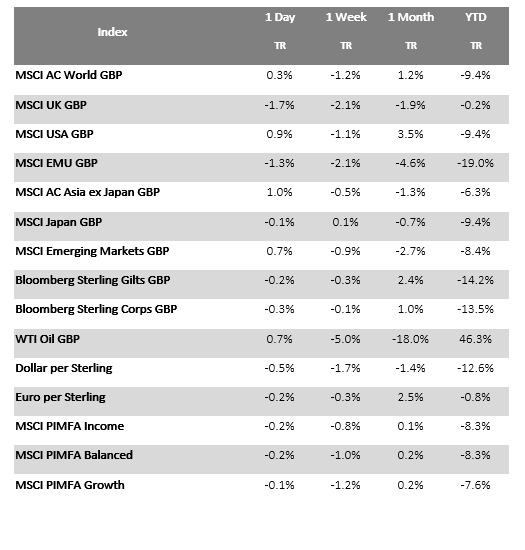
Index 1 Day1 Week1 MonthYTD
 TRTRTRTR
MSCI AC World GBP -0.8%-0.9%4.6%-9.3%
MSCI UK GBP 0.9%0.3%3.1%2.4%
MSCI USA GBP -1.8%-1.4%6.2%-9.9%
MSCI EMU GBP 0.8%1.1%0.5%-16.4%
MSCI AC Asia ex Japan GBP 0.8%-0.8%1.0%-6.9%
MSCI Japan GBP -0.6%-2.2%3.0%-10.1%
MSCI Emerging Markets GBP 0.9%-0.8%0.1%-8.5%
Bloomberg Sterling Gilts GBP -0.5%-0.4%1.2%-15.0%
Bloomberg Sterling Corps GBP -0.3%-0.3%0.7%-14.0%
WTI Oil GBP 4.1%-2.2%-4.7%54.2%
Dollar per Sterling 0.8%0.5%-2.4%-11.7%
Euro per Sterling 0.2%-0.5%1.2%-0.9%
MSCI PIMFA Income -0.4%-0.5%2.0%-8.0%
MSCI PIMFA Balanced -0.5%-0.6%2.4%-8.0%
MSCI PIMFA Growth -0.6%-0.6%3.0%-7.2%
Index 1 Day1 Week1 MonthYTD
 TRTRTRTR
MSCI AC World USD 0.2%-0.1%2.8%-19.7%
MSCI UK USD 1.9%1.1%1.4%-9.4%
MSCI USA USD -0.8%-0.6%4.4%-20.2%
MSCI EMU USD 1.8%1.9%-1.3%-26.0%
MSCI AC Asia ex Japan USD 1.9%0.0%-0.7%-17.6%
MSCI Japan USD 0.4%-1.5%1.2%-20.4%
MSCI Emerging Markets USD 1.9%0.0%-1.7%-19.0%
Bloomberg Sterling Gilts USD 0.9%0.7%-0.1%-24.6%
Bloomberg Sterling Corps USD 1.1%0.9%-0.6%-23.6%
WTI Oil USD 5.1%-1.4%-6.4%36.4%
Dollar per Sterling 0.8%0.5%-2.4%-11.7%
Euro per Sterling 0.2%-0.5%1.2%-0.9%
MSCI PIMFA Income USD 0.6%0.3%0.3%-18.6%
MSCI PIMFA Balanced USD 0.5%0.2%0.7%-18.6%
MSCI PIMFA Growth USD 0.5%0.1%1.2%-17.9%

Bloomberg as at 18/07/2022. TR denotes Net Total Return

Please check in again with us shortly for further relevant content and news.

Chloe

19/07/2022

Team No Comments

Brooks Macdonald – Daily Investment Bulletin

Please find below, a Daily Investment Bulletin received from Brooks Macdonald, this morning – 15/07/2022

What has happened 

Risk appetite remained supressed yesterday as bank earnings and recessionary fears combined into another poor day for equity markets. JPMorgan yesterday missed expectations and Morgan Stanley saw investment banking revenue halve compared to the previous year. Q2 earnings will be a key determinant of whether the market concludes that the year-to-date falls adequately compensate for the expected deterioration of margins over the short to medium term.  

Federal Reserve 

With the US CPI report causing investors to reappraise the near term path for US interest rates, ‘Fed speak’ is being scrutinised to gauge the chances of a 100bp hike. The Fed will enter their communication blackout window on Saturday so yesterday’s comments are one of the last tests of Governor sentiment that the bond market has to work with. Governor Waller yesterday said that the CPI beat earlier in the week justified another 75bp rate hike however he was open to a larger hike if economic data was stronger than expected. President Bullard meanwhile also supported a 75bp hike, with the result that markets reduced their expectations for a 100bp hike. The 2-year US Treasury yield gave back some of its recent rise, trading at 3.11% at the time of writing. US technology stocks were a particular beneficiary of this reduction in rate expectations, managing to secure a small gain yesterday even as the broader US market sold off.  

Italy 

European political risk returned to the fore yesterday as Prime Minister Mario Draghi attempted to resign after the Five Star Movement refused to back his government in a confidence vote. Draghi said that ‘The loyalty agreement that was the foundation of my government has gone missing.’ With President Mattarella declining the resignation, the Italian political backdrop is uncertain with a fresh round of elections possible. Italy has been facing a large number of economic and political challenges since COVID, as reflected in the spread between German bond yields and Italian yields. Yesterday saw that spread widen to its largest level in over a month.

What does Brooks Macdonald think? 

Adding to the concerns of a global slowdown, overnight China released their Q2 GDP data which showed that the economy contracted on a quarter-on-quarter basis. China continues to struggle in applying the zero COVID policy to the latest Omicron led surge and this slowdown may well prompt Beijing to provide further economic support to ensure that the economy does not stall over the summer.

Please continue to check our Blog content for advice and planning issues and the latest investment, markets and economic updates from leading investment houses.

David Purcell

15th July 2022

Team No Comments

Brooks Macdonald Daily Investment Bulletin

Please find below, a Daily Investment Bulletin received from Brooks Macdonald this morning – 07/07/2022

What has happened

 Despite fairly dire economic sentiment, equities made gains yesterday with European equities outperforming as they caught up on the late US rally on Tuesday night. Below the surface, investors continue to rachet up their probabilities of a recession with commodity prices falling and the US 10-year Treasury yield remaining below the 2-year yield, a historical precursor to recessions.

 Boris Johnson

 This paragraph has needed to be rewritten several times in the last hour but with the announcement that Boris Johnson will step down as Conservative leader, the scene is set for a leadership contest, the winner of which will become Prime Minister. Yesterday saw some fairly extraordinary scenes with a large number of ministers resigning but Boris Johnson remaining resolute that he retained a political mandate to govern after the large majority at the last general election. This morning, Downing Street officials briefed that Boris Johnson would resign as Conservative leader later today whilst remaining caretaker Prime Minister until the election process is concluded in the autumn.

 What next

 Sterling has seen a small bounce this morning versus the major currency pairs however until a clear leader emerges from the pack of contenders, the true economic and political impact of the change in leader will be hard to price in. At this stage we probably shouldn’t read too much into the bookmakers odds however Penny Mordaunt is leading. Mordaunt has distanced herself from the Prime Minister for several months, which could prove a factor amongst MPs as well as the Conservative membership, and pairs pro-Brexit leanings with liberal Conservatism – potentially appealing to both wings of Tory MPs. Conservative MPs will debate the benefits of each candidate, voting until two candidates remain, with the ultimate winner chosen by Conservative party members.

 What does Brooks Macdonald think?

 Back in 2019, sterling’s price was closely correlated with the perceived probability of a softer or harder Brexit. In recent weeks, with global central banks opting for differing levels of aggression in tackling inflation, currency pairs have largely been determined by expected differences in interest rate policy. This leadership contest however will undoubtedly draw the attention of currency markets given a) the new leader would have up to 2 years until the next general election b) EU/UK relations remain highly uncertain and c) the cost of living crisis makes fiscal policy even more important.

Please continue to check our Blog content for advice and planning issues and the latest investment, markets and economic updates from leading investment houses.

David Purcell

7th July 2022

Team No Comments

Daily Investment Bulletin

Please see below article received from Brooks Macdonald this morning, which provides an update on markets with a focus on current geo-political events.

What has happened

The financial press is awash with statistics that describe quite how poor H1 was for markets. Some of the more impactful include the worst H1 in total return terms for US equities in 60 years and US 10-year Treasuries have had their worst H1 since… 1788. Yesterday was a fitting end to the turbulent quarter with any positive gains from quarter end rebalancing more than offset by fears over incoming economic data.

Recession fears

June has been characterised by a rapid increase in the market’s implied chance of a US (and global) recession. Yesterday’s string of economic data added incrementally to those fears with US weekly initial jobless claims showing signs of trending higher from the start of the year, and personal spending (inflation adjusted) declining -0.4% in May. The Atlanta Fed 2Q GDP nowcast which attempts to estimate GDP as various data points are revealed, suggested a -1% contraction in Q2. Given US Q1 GDP was negative (though arguably for international rather than domestic reasons), another decline would bring the US into a technical recession. There were some better signs yesterday in the Core PCE inflation readings which grew by 0.3% month-on-month versus expectations of a 0.4% gain. Regardless of this one data point, markets are still fearful of how central banks can respond to this deteriorating economic outlook given enduring inflation pressures.

Energy

One of the major drivers of this enduring inflation pressure is energy, with the supply of Russian oil and gas a particular problem for continental Europe. Yesterday there was some more constructive news with President Biden set to travel to the Middle East in July to discuss increasing oil supply. OPEC+ have ratified a further increase in the bloc’s oil supply which will help to ease some of the supply issues.

What does Brooks Macdonald think

Risk sentiment enters H2 in a despondent mood, particularly as Q2 saw relatively few places to hide from the sell-off in equities and bonds. With yields having now risen significantly since the start of the year, the worst of the bond sell-off may be behind us unless inflation shows signs of becoming much more stubborn than the market currently expects. Against that backdrop, bonds can start to play a more active role in balanced portfolios, providing an additional option to investors looking to diversify away from their equity risk.

Index 1 Day1 Week1 MonthYTD
 TRTRTRTR
MSCI AC World GBP -1.6%0.4%-5.1%-11.3%
MSCI UK GBP -1.9%2.3%-5.2%1.6%
MSCI USA GBP -1.4%0.0%-5.0%-12.5%
MSCI EMU GBP -1.8%0.6%-8.1%-16.8%
MSCI AC Asia ex Japan GBP -1.5%1.5%-1.0%-6.9%
MSCI Japan GBP -1.0%0.4%-4.5%-11.4%
MSCI Emerging Markets GBP -1.7%1.2%-3.2%-8.4%
Bloomberg Sterling Gilts GBP 0.9%-0.3%-2.0%-14.8%
Bloomberg Sterling Corps GBP 0.4%-0.8%-3.4%-14.2%
WTI Oil GBP -4.1%1.9%-4.4%56.3%
Dollar per Sterling 0.4%-0.7%-3.4%-10.0%
Euro per Sterling 0.1%-0.3%-1.0%-2.3%
MSCI PIMFA Income -0.7%0.5%-4.2%-8.8%
MSCI PIMFA Balanced -0.9%0.7%-4.4%-8.9%
MSCI PIMFA Growth -1.2%1.0%-4.8%-8.4%
Index 1 Day1 Week1 MonthYTD
 TRTRTRTR
MSCI AC World USD -1.1%0.0%-8.4%-20.2%
MSCI UK USD -1.5%1.8%-8.5%-8.6%
MSCI USA USD -0.9%-0.4%-8.3%-21.3%
MSCI EMU USD -1.3%0.1%-11.3%-25.1%
MSCI AC Asia ex Japan USD -1.0%1.1%-4.5%-16.3%
MSCI Japan USD -0.6%0.0%-7.9%-20.3%
MSCI Emerging Markets USD -1.2%0.8%-6.6%-17.6%
Bloomberg Sterling Gilts USD 1.1%-1.3%-5.5%-23.6%
Bloomberg Sterling Corps USD 0.5%-1.8%-6.9%-23.1%
WTI Oil USD -3.7%1.4%-7.8%40.6%
Dollar per Sterling 0.4%-0.7%-3.4%-10.0%
Euro per Sterling 0.1%-0.3%-1.0%-2.3%
MSCI PIMFA Income USD -0.3%0.1%-7.6%-18.0%
MSCI PIMFA Balanced USD -0.4%0.3%-7.8%-18.0%
MSCI PIMFA Growth USD -0.7%0.6%-8.1%-17.6%

Bloomberg as at 01/07/2022. TR denotes Net Total Return

Please check in again with us soon for further relevant content and market news.

Chloe

01/07/2022

Team No Comments

Brewin Dolphin – Markets in a Minute

Please find below, a market update received from Brewin Dolphin, yesterday evening – 28/06/2022

Global stock markets rose last week as reports of a slowdown in economic growth helped to calm interest rate fears.

The S&P 500 ended its holiday-shortened trading week up 6.5%, lifting it out of bear market territory, amid signs the Federal Reserve’s monetary tightening was helping to moderate inflation. The Dow and the Nasdaq climbed 5.4% and 7.5%, respectively.

Stocks in Europe broke their three-week losing streak, with the STOXX 600 and FTSE 100 advancing 2.4% and 2.7%, respectively. Weaker-than-expected purchasing managers’ indices (PMIs) helped to alleviate fears of more aggressive interest rate hikes.

In China, the Shanghai Composite gained 1.0% after the country’s president Xi Jinping said it would adopt “more forceful measures to deliver the economic and social development goals for the whole year and minimise the impact of Covid-19”.

Last week’s market performance*

• FTSE 100: +2.74%

• S&P 5001 : +6.45%

• Dow1 : +5.39% • Nasdaq1 : +7.49%

• Dax: -0.06%

• Hang Seng: +3.06%

• Shanghai Composite: +0.99%

• Nikkei: +2.04%

*Data from close on Friday 17 June to close of business on Friday 24 June. 1 Closed Monday 20 June.

China eases Covid-19 restrictions

UK and European indices started this week in the green as an easing of Covid-19 restrictions in China boosted investor sentiment. The FTSE 100 climbed 0.9% on Monday (27 June) with miners leading gains after G7 leaders pledged a $600bn boost to global infrastructure. In contrast, the Dow, S&P 500 and Nasdaq gave back some of last week’s gains, ending the trading session down 0.2%, 0.3% and 0.7%, respectively.

In economic news, US pending home sales unexpectedly rebounded in May after declining for six consecutive months. Sales rose by 0.7% from the previous month but were down 13.6% on a year-on-year basis.

The FTSE 100 was up 1.1% at the start of trading on Tuesday as hopes of an economic rebound drove commodity prices higher and boosted mining stocks.

UK inflation accelerates to 9.1%

The UK consumer price index, published last Wednesday, showed inflation hit a new 40-year high in May as food and energy prices soared. The Office for National Statistics (ONS) said prices rose by 9.1% in the 12 months to May, slightly higher than the 9.0% increase recorded in April. Prices for food and non-alcoholic drinks rose by 8.7% year-on-year, the biggest jump since March 2009.

Encouragingly, core inflation – which strips out food and energy prices – eased to 5.9% in May from 6.2% in April. On a monthly basis, consumer prices rose by 0.7% in May, much less than the 2.5% monthly increase seen in April.

Consumers rein in spending

The latest UK retail sales data suggests rising prices are resulting in consumers reining in their spending. Sales volumes fell by 0.5% between April and May, reversing the expansion seen in the previous month.

The decline was driven by a 1.6% fall in food store sales, which the ONS said seemed to be linked to the impact of rising food prices and the cost of living.

Separate figures showed UK consumer confidence fell to its lowest level since records began. GfK’s consumer confidence index slipped by one point to -41 in June, with a particularly large drop in expectations around personal finances. “With prices rising faster than wages, and the prospect of strikes and spiralling inflation causing a summer of discontent, many will be surprised that the index has not dropped further,” said Joe Staton, client strategy director at GfK.

Eurozone business growth slumps

Last week’s economic data also showed a slowdown in business growth in the eurozone. The S&P Global flash eurozone PMI composite output index fell from 54.8 in May to 51.9 in June, a 16-month low. Manufacturing output contracted for the first time in two years and service sector growth cooled considerably, particularly among consumer-facing services.

Companies also scaled back their business expectations for output over the coming year to the lowest since October 2020. Both the stagnation of demand and worsening outlook were widely blamed on the rising cost of living, tighter financial conditions and concerns over energy and supply chains.

Chris Williamson, chief business economist at S&P Global Market Intelligence, said: “Eurozone economic growth is showing signs of faltering as the tailwind of pent-up demand from the pandemic is already fading, having been offset by the cost-of-living shock and slumping business and consumer confidence. Excluding pandemic lockdown months, June’s slowdown was the most abrupt recorded by the survey since the height of the global financial crisis in November 2008.”

Signs US inflation is moderating

Over in the US, data suggested inflation could be moderating. The University of Michigan’s consumer sentiment survey showed consumers expect inflation to rise at an annualised rate of 5.3% in June, below forecasts and the peak rate of 5.4% recorded in March and April. Meanwhile, S&P Global’s flash PMI data for June showed the pace of input price inflation eased to the lowest for five months, and output charges rose at the softest pace since March 2021.

However, the data also revealed the weakest upturn in US private sector output since January’s Omicron[1]induced slowdown. The rise in activity was the second softest since July 2020, with slower service sector output growth accompanied by the first contraction in manufacturing production in two years. Meanwhile, business confidence slumped to the lowest since September 2020. “Business confidence is now at a level which would typically herald an economic downturn, adding to the risk of recession,” said Williamson.

Please continue to check our Blog content for advice and planning issues and the latest investment, markets and economic updates from leading investment houses.

David Purcell

29th June 2022

Team No Comments

Daily Investment Bulletin

Please see below article received from Brooks Macdonald this morning, which informs us of the key global events effecting markets this week.

What has happened

Equities struggled yesterday as recession fears gripped markets yet again. A fall in the oil price, which has continued today, weighed on energy stocks in particular.

Federal Reserve

The market’s focus yesterday was on Fed Chair Powell’s testimony to the Senate Banking Committee. Whilst his monetary policy comments didn’t deviate too sharply from last week, Powell was open around the risk of a recession, describing it as ‘a possibility’. Powell was also more cautious around the chances of the Federal Reserve engineering the so-called soft landing, with that outcome viewed as ‘very challenging’. On interest rates, Powell said that restrictive interest rates were needed to tackle inflation and that the Fed were proceeding towards that outcome. Bond markets focused on the recession comments with yields falling on the day despite Powell’s commitment to raise rates above their neutral level. Whilst few doubt that the Fed is now serious about inflation, there is scepticism as to whether the central bank will be able to raise rates in time before they need to react to a recessionary backdrop.

UK inflation and politics

The May UK CPI reading came in at 9.1% year-on-year, in line with expectations and its highest rate since 1982, garnering much media attention. The core CPI reading actually came in below market expectations at 5.9% year-on-year which will be a helpful reading for the more dovish members of the Bank of England. Today sees two important by-elections in the UK with the results likely to be viewed as a poll on the future electoral success of Boris Johnson. The Wakefield seat is part of the ‘Red Wall’ so analysts, and Tory MPs, will be scrutinising the results to see whether traditionally Labour seats may now return to Labour, with Brexit less of an everyday topic and the impact of Partygate still fresh in the mind of the electorate.

What does Brooks Macdonald think

Sterling has underperformed due to expectations that there will be an increasingly large gap between the interest rates of major currencies, such as the US dollar, and the pound. Another factor is political risk, both in terms of the leadership of the Conservative Party but also the future trading relationship between the UK and EU. Should today’s by-election result in a poor showing for the Conservatives, near term political risk will likely rise as Tory MPs clamour for a change in the internal rules to allow another vote of confidence on the Prime Minister.

Index 1 Day1 Week1 MonthYTD
 TRTRTRTR
MSCI AC World GBP -0.4%-2.6%-2.6%-12.3%
MSCI UK GBP -0.9%-2.5%-3.7%0.3%
MSCI USA GBP -0.1%-2.4%-2.0%-13.7%
MSCI EMU GBP -0.4%-1.8%-3.6%-16.0%
MSCI AC Asia ex Japan GBP -2.3%-3.8%-0.9%-9.2%
MSCI Japan GBP 0.1%-2.7%-5.6%-12.7%
MSCI Emerging Markets GBP -2.2%-4.1%-2.0%-10.0%
Bloomberg Sterling Gilts GBP 1.7%-0.8%-6.2%-16.1%
Bloomberg Sterling Corps GBP 1.1%-0.8%-4.7%-14.5%
WTI Oil GBP -4.0%-9.4%-4.6%55.8%
Dollar per Sterling -0.1%0.7%-1.7%-9.4%
Euro per Sterling -0.4%-0.4%-1.9%-2.4%
MSCI PIMFA Income -0.1%-1.9%-3.6%-9.6%
MSCI PIMFA Balanced -0.2%-2.1%-3.5%-9.8%
MSCI PIMFA Growth -0.5%-2.4%-3.3%-9.5%
Index 1 Day1 Week1 MonthYTD
 TRTRTRTR
MSCI AC World USD -0.5%-0.9%-4.2%-20.5%
MSCI UK USD -0.9%-0.9%-5.3%-9.1%
MSCI USA USD -0.1%-0.8%-3.6%-21.8%
MSCI EMU USD -0.5%-0.2%-5.2%-23.9%
MSCI AC Asia ex Japan USD -2.3%-2.2%-2.5%-17.7%
MSCI Japan USD 0.0%-1.1%-7.2%-20.9%
MSCI Emerging Markets USD -2.3%-2.5%-3.6%-18.5%
Bloomberg Sterling Gilts USD 2.0%1.2%-7.4%-23.8%
Bloomberg Sterling Corps USD 1.3%1.2%-5.9%-22.3%
WTI Oil USD -4.0%-7.9%-6.2%41.2%
Dollar per Sterling -0.1%0.7%-1.7%-9.4%
Euro per Sterling -0.4%-0.4%-1.9%-2.4%
MSCI PIMFA Income USD -0.1%-0.3%-5.2%-18.1%
MSCI PIMFA Balanced USD -0.3%-0.5%-5.1%-18.3%
MSCI PIMFA Growth USD -0.5%-0.8%-4.9%-18.0%

Bloomberg as at 23/06/2022. TR denotes Net Total Return

Please check in again with us shortly for further relevant investment content. 

Chloe

23/06/2022

Team No Comments

Weekly Market Commentary – The Fed U-turned on its forward guidance

Please find below, a weekly market update received from Brooks Macdonald, yesterday evening – 20/06/2022

  • US and European equity markets fell heavily last week as the Federal Reserve (Fed) u-turned on its forward guidance
  • President Macron’s party has lost overall control of the National Assembly, challenging future legislative plans
  • Fed Chair Powell testifies to Congress this week, keeping central bank policy front and centre

US and European equity markets fell heavily last week as the Fed u-turned on its forward guidance

 Last week saw one of the worst weeks for equity markets in recent memory as last minute changes to central bank policy mixed with a poorer economic backdrop. The losses were widespread with few markets and sectors able to avoid the contagion. European peripheral bond markets fared better, as the market gained some comfort from the European Central Bank’s (ECB) emergency meeting to discuss how to tackle any fragmentation between national bond markets.

Whilst last week’s Federal Reserve meeting is out of the way, investors are still reeling from the last minute change in Fed forward guidance which saw a 75bp interest rate hike in June after such a hike had previously been ruled out1 . Forward guidance is extremely difficult at a time when the central bank is data dependent on what happens to inflation and economic growth, however a feeling that the words of Fed Chair Powell should be taken with a pinch of salt will only heighten volatility. This week Chair Powell will testify to both the Senate and House Committees where he is expected to be questioned on what the central bank is doing to control the inflationary spike in the US. Last week Powell said that a 75bp rate hike would not become a typical event however with forward guidance in question, this may not stop markets from pricing in such an outcome.

President Macron’s party has lost overall control of the National Assembly, challenging future legislative plans

The French legislative elections have seen President Macron lose overall control of the National Assembly. Whilst Macron’s party remains the largest overall party, any legislative items will require delicate coalitions to be formed. The elections saw a strong showing for far left and far right parties, splitting the centrist vote. Macron is likely to rely on votes from the fractured centre right parties to pass key items such as pension reforms however such legislation is likely to need to be watered down to pass through a complex web of political priorities.

Fed Chair Powell testifies to Congress this week, keeping central bank policy front and centre

The recent market volatility has been driven by inflation data and the central bank reaction to that data. With the US closed on Monday, no US inflation releases this week, and Powell unlikely to err too much from his statements last week, we may be in for a calmer week. Now we are back to an era of emergency central bank meeting however, the chance of a surprise has greatly increased.

Please continue to check our Blog content for advice and planning issues and the latest investment, markets and economic updates from leading investment houses.

David Purcell

21st June 2022

Team No Comments

Stocks fall as US headline inflation soars

Please see below ‘Markets in a Minute’ article received from Brewin Dolphin yesterday evening, which provides a global update on markets.

US and European indices fell last week as US headline inflation soared and the European Central Bank (ECB) signalled it could increase interest rates at a faster rate than anticipated.

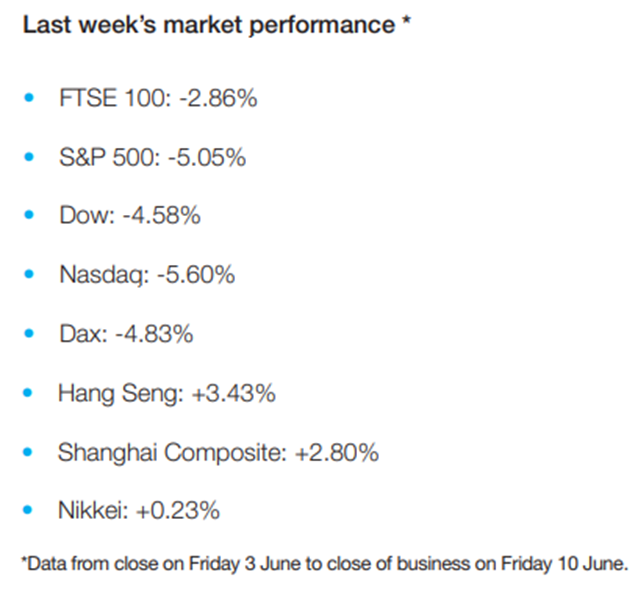
After a positive start to the week, the S&P 500, Dow and Nasdaq slid 5.1%, 4.6% and 5.6%, respectively. The consumer price index (CPI) for May, released on Friday, showed headline inflation rose by 8.6% from a year earlier – higher than consensus estimates.

In Europe, the STOXX 600 dropped 4.0% and Germany’s Dax sank 4.8% after the ECB lowered its outlook for economic growth. The UK’s FTSE 100 fell 2.9%.

Stocks in Asia had a more encouraging week, with the Nikkei 225 edging up 0.2% after figures showed the Japanese economy shrank by less than expected in the first quarter. China’s Shanghai Composite rose 2.8% on news Beijing appeared to be easing its crackdown on the technology sector.

UK GDP unexpectedly shrinks in April

The FTSE 100 slumped 1.5% on Monday (13 June) after data from the Office for National Statistics (ONS) showed UK gross domestic product (GDP) contracted by 0.3% in April after declining by 0.1% in March. Economists had been expecting a slight increase of 0.1%. The ONS said the scaling back of the Covid-19 vaccination programme and pandemic test-and-trace was the biggest contributor to the monthly fall in GDP. Manufacturing also suffered with some companies affected by rising fuel and energy prices.

Stocks in the US and Europe also slid on Monday following speculation the Federal Reserve might decide to raise interest rates by 75 basis points at its next policy meeting on 14-15 June. The S&P 500 and the Nasdaq lost 3.9% and 4.7%, respectively, while the STOXX 600 fell 2.4%. Concerns over a resurgence of Covid-19 cases in China weighed on markets in Asia, with the Shanghai Composite, Hang Seng and Nikkei down 0.9%, 3.4% and 3.0%, respectively.

The FTSE 100 opened in the green on Tuesday as investors mulled the latest UK labour market data. Unemployment edged slightly higher to 3.8% in the three months to April from 3.7% in the three months to March. This was the first increase since the last three months of 2020. The number of job vacancies hit a new record high of 1.3 million, while real wages (adjusted for inflation) fell by 2.2% year-on-year.

US inflation hits new 40-year high

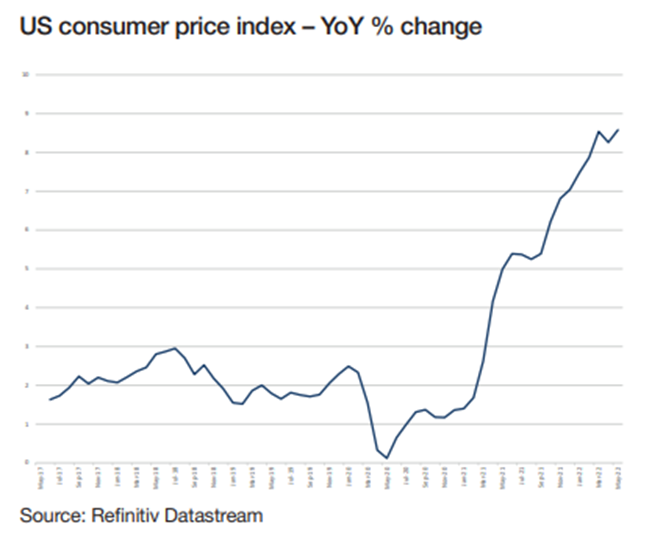
Inflation in the US accelerated to a new four-decade high in May as the cost of petrol, food and other necessities surged. The headline CPI rose to 8.6% from a year ago, faster than April’s year-on-year increase of 8.3% and the highest level since December 1981.

The increase was driven by a surge in prices for gasoline, food and shelter. Energy costs rose by 34.6% from a year earlier, while groceries jumped by 11.9%. On a monthon-month basis, prices rose by 1.0%, significantly higher than the 0.3% increase in April and above economists’ expectations of a 0.7% rise. Once food and energy prices were stripped out, core inflation rose by 0.6% month-onmonth and by 6.0% from a year ago, according to the Department of Labor.

ECB unveils interest rate plans

Inflation and interest rates also dominated the headlines in Europe last week. The ECB signalled it was likely to raise rates by half a percentage point in September, in addition to a planned quarter-point rise in July. ECB president Christine Lagarde and chief economist Philip Lane had previously said rate rises of 0.25% were the benchmark for its meetings in July and September. On Thursday, however, Lagarde said risks to the inflation outlook were “primarily on the upside”, according to a report in the Financial Times.

The comments came as the ECB raised its inflation projections to an average of 6.8% for this year, well above the 5.1% predicted in March. Inflation is expected to ease to 3.5% in 2023 and 2.1% in 2024. The ECB also cut its outlook for GDP growth to 2.8% for 2022 and 2.1% for 2023, down from 3.7% and 2.8% previously.

“Russia’s war against Ukraine has severely hit confidence, caused energy and food prices to soar further and, together with pandemic-related disruptions in China, compounded existing supply chain pressures,” the ECB said. “These factors pose strong headwinds for the economic recovery in the euro area and come at the same time as a relaxation of pandemic-related restrictions, which is providing a strong boost to the services sector.”

Japan GDP better than expected

The latest economic growth figures for Japan proved to be better than expected. According to the Cabinet Office, GDP declined by an annualised 0.5% in the first quarter of the year, less than the initial estimate of a 1.0% contraction. On a quarter-on-quarter basis, GDP shrank by 0.1%, beating expectations for a 0.3% decline. Private consumption, which makes up more than half of Japan’s GDP, rose by 0.1% from the previous quarter, while inventories also increased. This helped to offset a 0.7% quarterly fall in capital spending.

Please check in again with us shortly for further relevant content and market news.

Chloe

15/06/2022

Team No Comments

New worries, old concerns?

Please find below, a summary of this week’s Tatton articles, received from Tatton this morning – 13/06/2022

Outlook: new worries, old concerns?
After renewed positive sentiment in recent weeks, markets once again are showing signs of fragility. We could characterise this ‘risk off’ mood as growth scepticism or more wariness that inflation needs even stronger and swifter central bank policy tightening before being squeezed out. Last week’s change in emphasis from the European Central Bank (ECB) – while expected – provided the necessary headlines. Interest rates were unchanged, but ECB President Christine Lagarde “committed” that rates will rise by 0.25% at the July meeting, and that bond buying will also end (although there was no mention of actual bond sales). From the current overnight market rate of -0.5%, most economists expect the year-end traded rate to be around +0.75%. 

If the ECB is so certain of a rate hike next month, why not start now? If the ECB’s own inflation forecasts keep going up – and all the risks lie towards higher inflation – this is like driving towards a cliff edge with a broken speedometer and promising your passengers you won’t brake too sharply. There may be reasons to think the ECB’s laggardly stance (pun intended) is intentional because most believe the underlying issues are ‘global cost push’, and that the policy that matters comes from the US Federal Reserve (Fed). In which case, policy compression is already underway. US inflation data for May released on Friday worried some investors by being slightly above expectations (with monthly core consumer price index (CPI) inflation still rising at an annualised rate of 7%). US ten-year Treasury yields returned to above 3% last week. Perhaps investors are yet to be convinced inflationary pressures may have peaked.

The current upswing in market risk premia seems to us to be more of a straightforward tale of risk aversion. If energy prices keep rising, or some other external threat emerges, those more anxious investors who headed for the exit might been justified. But resilience levels and activity potential for the global economy have not been in as promising a state for a long time – as has been the resilience of systemically important financial institutions. We suspect last week’s wobble was no more than that. 

Monetary and fiscal policy: giving with one hand, taking with the other
Boris Johnson’s pyrrhic victory on Monday’s ‘no-confidence’ vote could have big implications for the UK economy. Not that you could tell from the market reaction: the FTSE 100 dropped ever so slightly in midweek, while sterling stayed at the same dollar value. But the Prime Minister’s weakened position makes him much more amenable to the whims of his colleagues, and the pressure to ease the UK’s tax burden is mounting. Backbench MPs are reportedly urging the Prime Minister to override the Treasury on cutting taxes, regardless of the inflationary impact. If this happens, it is unlikely to be matched by spending cuts, which could threaten another rebellion. As such, we should expect that the government will loosen fiscal policy in the coming months.

Let that sink in for a moment. Britain is currently seeing its highest inflation levels in 40 years – higher than any other G7 nation – and unemployment is the lowest it has been since the 1970s. Energy and goods supply is severely constrained, and with an excruciatingly tight labour market, we are on the cusp of a wage-price spiral. And amid all of this, the government is throwing more fuel on the fire by loosening fiscal policy. As politically and socially understandable as this may be, such a move would increase inflationary pressures and put the Bank of England (BoE) in a bind. In this environment, monetary policymakers cannot afford to balance growth prospects against price stability. Instead, they must tighten policy hard, raising interest rates and likely choking off growth potential. 

This combination of tight monetary and loose fiscal policy is far from confined to the UK either, as the ECB announcement made clear. More generally, it is a reversal of the policies promoted for more than a decade after the global financial crisis. In that time, we have seen incredibly easy financial conditions while governments have been reluctant to loosen the public purse-strings and in many cases applied outright fiscal austerity. Over the years, many called on politicians to match central banks’ largesse,  that it is happening now – while global inflation surges – will no doubt make many uncomfortable. 

Rising interest rates and central bank tapering puts upward pressure on yields. But so too does loose fiscal policy, as higher government borrowing increases the bond supply competing for investor’s buying interest. Both happening at the same time could mean dramatic upward pressure on yields – which is unlikely to stop anytime soon. Rising bond yields also push up borrowing costs for consumers and businesses. If these increase too rapidly, widespread defaults become much more likely – the classic harbinger of recession. The silver lining is that increased borrowing costs act as a dampener on demand, pulling down inflation and lessening the need for higher interest rates. Yields are pushing up from extraordinarily low levels, so there could still be some way for bond yields to go before there is a significant risk of triggering a debt default cycle. 
The BoE will certainly hope that is enough to tame price rises. With the UK economy forecast  to be the second-worst performing in the G20 (behind only sanction-ravaged Russia) tighter monetary policy could mean severe pain for businesses and consumers. But with the government apparently pushing ahead with fiscal aid, the central bank has little choice. What the new policy mix means over the longer-term remains to be seen.

A fistful of chips: from supply shortage to glut 
US technology giant Intel took a beating from investors last week, leading to a 5.3% fall in its share price on Wednesday. This came after projecting disappointing results for the second quarter. Intel reckons its profits will be around 70 cents a share, well below analyst estimates of 82 cents, and follows a disappointing first quarter of 2022, which saw falling revenues for its PC microchips. Intel’s management insists decent growth forecasts for 2022 will be achieved, implying a stronger second half than previously expected. Investors are not so sure that optimism is warranted, unnerved by signs of faltering demand for PCs – Intel’s largest revenue source. 
Of the other global chip manufacturers, NVIDIA has had a harder time this year whereas Taiwan Semiconductor Manufacturing Co (TSMC), the world’s most valuable chip maker, expects revenues to grow 30% overall this year, a jump from the near 25% growth of last year. TSMC’s projections seem at odds with actual chip price moves, and concerns that demand for computer chips is stalling from global economic and political factors: war in Ukraine, Chinese lockdowns and the cost-of-living crisis across the developed world. Last year, waiting times for games consoles and new cars were unheard of all over the world. TSMC claim these supply shortages continue. 

Wait times for semiconductor delivery hit a record high in May, and chipmakers are raising prices due to rising costs, but in other respects, the chip shortage seems much less pronounced. Companies in need of chips are reportedly starting to see relief and, more importantly, demand has plateaued. Apple, one of TSMC’s best customers, is planning to keep its production of iPhones flat in 2022 – capping off a potential route for growth. This comes as global growth is slowing significantly and inflation is eating into consumers’ disposable incomes. Rapid price rises have also forced the hands of central banks, which are now tied into a rate-hiking cycle that will result in higher borrowing costs and less available capital. The smartphone industry has struggled with these headwinds all year, but the pressures are broad-based, hitting demand for goods well beyond consumer electronics. 

Therefore, despite manufacturer claims to the contrary, capital markets clearly believe chip demand is weaker than supply. Where once there was extreme undersupply, stock markets indicate there is now oversupply. This looks unlikely to change anytime soon, either. Slowing global growth and a cost-of-living crisis will hold back demand in the short term. And over the medium term, there are signs that supply will be boosted. Beyond the question of how we look at chip manufacturers from an investment perspective, the other takeaway from the easing of chip supply is perhaps this: just as chip shortages were the first sign last year of building supply chain disruptions, the easing of supply issues for ‘commoditised’ semiconductor chips now may well mean that price pressures from the supply shortage of goods might be behind us soon.

Please continue to check our Blog content for advice and planning issues and the latest investment, markets and economic updates from leading investment houses.

David Purcell

13th June 2022