Following a meeting with Blackfinch Asset Management earlier this week, they provided the following data discussed during our meeting. I thought it would be useful to share it with you.
Below, we’ve taken a look at the returns of the global stock market (MSCI All Countries World Index) since the start of 2000 up until the close on 18th May 2022. This period includes some of the worst stock market crashes on record including the Dot Com crash, the 9/11 Twin Towers attack, the Iraq Invasion, the Global Financial Crisis, COVID 19 and the ongoing situation with the Russian invasion, inflation fears and interest rate hikes.
Despite these, you will see that if an investor had held their investment for the entire period, they would have returned just over 82%. More importantly though is to see what would have happened if they’d sold out of the market and tried to time their re-entry. It is impossible to predict exactly when the ‘bottom’ of the market is, and history shows us that some of the best, and most pronounced, upside returns have happened in the most challenging economic times. The following table sorts the top 15, single day returns for the global stock market since the start of 2000. Notice how these best returns all happened at a time when investors would have been at their most nervous.
13/10/2008
9.3%
24/03/2020
8.4%
28/10/2008
7.0%
24/11/2008
6.6%
19/09/2008
6.2%
08/12/2008
5.7%
06/04/2020
5.5%
13/03/2020
5.3%
10/03/2009
5.1%
23/03/2009
5.1%
10/05/2010
4.8%
04/11/2008
4.7%
15/10/2002
4.6%
26/03/2020
4.6%
02/04/2009
4.4%
Another way to look at it is by assessing what would have happened if clients had sold out of the market and missed some of these upside days. The following plots what would have happened to an investors returns if they’d missed 1,2,3,4 or 5 of these top performing days (the first bar shows the return if they’d stayed invested over the entire period for reference):
For reference the table below shows the exact return figures plotted on the above chart
Period
Return
Full Period Invested
82.5%
Missing Best 1 Day
67.0%
Missing Best 2 Days
54.1%
Missing Best 3 Days
44.1%
Missing Best 4 Days
35.2%
Missing Best 5 Days
27.3%
As you can see, by missing just 1 or 2 of those best days during the past 22 years would have significantly reduced the client’s overall returns.
Looking at the data also highlights how quickly and dramatically upside moves can come to markets and it is our job as investment managers to ensure your client portfolios are positioned to make the most of those upturns when they arrive and to ensure the overall risk is managed in line with their expectations.
Comment
This understanding and data input from Blackfinch is nothing new. I’ve been looking at this type of information for over 30 years. However, in volatile markets, particularly when we have so much going on at the moment, compounded by a media that can take negative and biased views, it’s nice to remind yourself of the historic facts.
Remain invested, be patient and if possible, continue funding your pensions and investments. Regular monthly funding works well over the long term especially in a volatile market.
Please see below article received by AJ Bell yesterday evening, which provides an insight into the effect that Russia’s invasion of Ukraine has had on oil prices, and consequentially, oil stocks.
Bruce Kovner may not be the best-known hedge fund manager in the world but, as the founder of Caxton Associates, he is one of the most successful. He gives little away in public, but it is worth tracking down his few pronouncements and one of this column’s favourites is his comment, “What I am really looking for is a consensus the market is not confirming.”
Right now, so far as this column can tell, the consensus is that oil prices are going to stay high, either because OPEC+ will maintain supply discipline, or because oil firms are wary of big new drilling projects (because of environmental or political pressure or both), or because of the war in Ukraine, or perhaps a combination of all three.
So concerned is World Bank President David Malpass about oil prices that he is citing the Russian invasion of Ukraine, and its effect upon commodity prices, as a potential cause of a global slowdown, if not an actual recession.
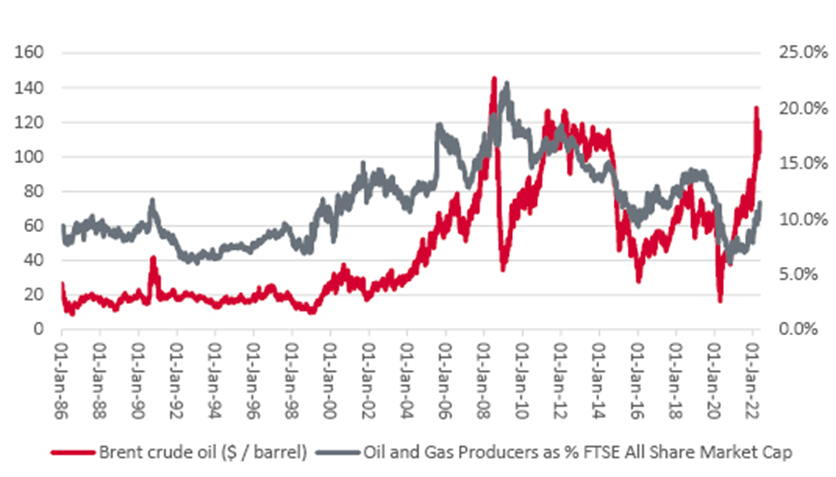
Oil stocks are responding to this environment. Shares in Shell (SHEL) and BP (BP.) are both back to pre-pandemic levels and Shell is nudging toward its prior all-time peaks (even if BP is some way short of that).
But when oil stocks are studied in a wider context, it seems as if investors do not really believe that crude will remain in the ascendent for too long, possibly in the view that the long-run move away from hydrocarbons to alternative, renewable sources of energy is still on track.
Higher price, lower profile
Whether this is a good example of a situation where share prices remain sceptical of what seems like the consensus is something that investors can only decide for themselves, but managing the transition from oil and gas to wind, solar and others may yet take time.
It is therefore interesting to note that oil stocks still represent only 11.4% of the FTSE All-Share’s market capitalisation, compared to historic highs north of 20%, when oil also traded consistently above $100 a barrel.
UK oil stocks remain of diminished importance in the UK equity market
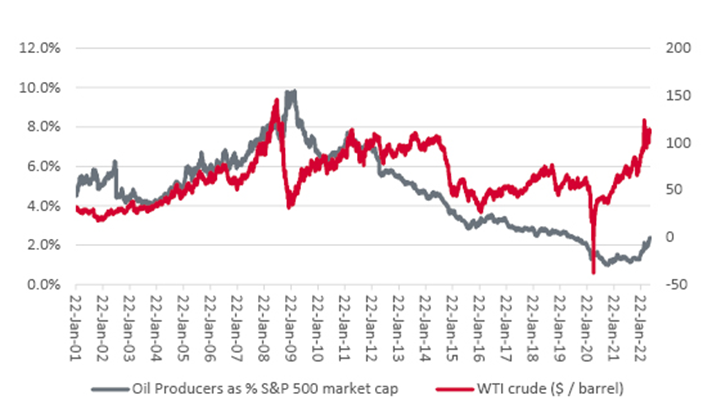
Oil stocks also seem to be relatively out of favour in the USA, where their profile, as measured by their percentage of the overall stock market’s valuation, is still languishing near historic lows.
In the USA, the major oil producers command an aggregate market capitalisation which represents just 2.4% of the S&P 500 index’s total $33 trillion price tag. Granted, that is a big leap from the lows of autumn 2021 but it is barely a quarter of the highs seen in the middle of this millennium’s first decade.
US oil stocks also have a much lower profile relative to historic averages
Love and hate
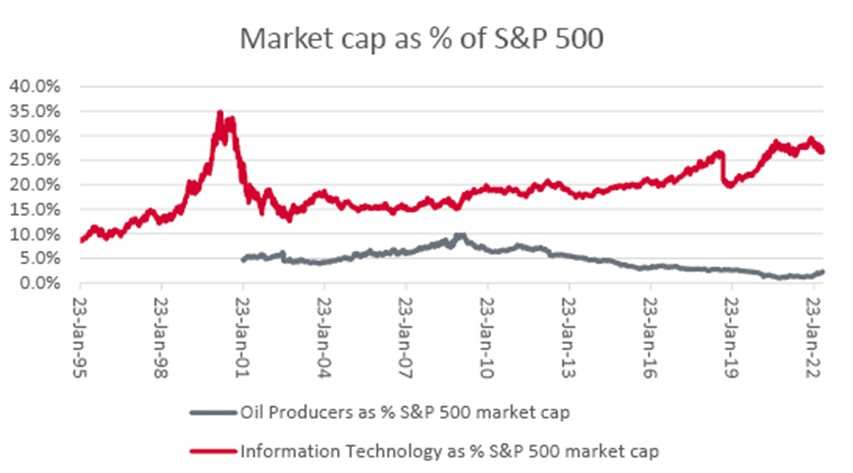
This is in stark contrast to the market’s apparent ongoing love affair with technology stocks. The US Information Technology sector did not quite reach its prior peak at around 35% of total S&P 500 market cap this time around. That may be no bad thing, given how badly that 1998-to-2000 surge came to grief in 2001-to-2003’s bear market, but tech still reached 30% during the pandemic as some investors decided it was the only story in town. Tech’s loss of favour may feel uncomfortable for many, but its reversal of fortune still looks minor compared to the rout of twenty years ago.
Tech still carries a hefty market weighting in the USA
This takes us to another money management legend, Bridgewater’s Ray Dalio, who is less circumspect when it comes to expressing his views publicly than Mr. Kovner. One pearl from Mr. Dalio is this: “The biggest mistake that investors make is to believe that what happened in the recent past is likely to persist. They assume that something that was good investment in the recent past is still a good investment. Typically, high past returns simply imply that an asset has become more expensive and is a poorer, not better, investment.”
The crunching falls in many tech stocks would perhaps lead investors to think the consensus is bearish, just as oil shares’ ongoing resilience, even in the face of the UK’s 25% windfall tax, would give the impression that everyone is bullish on oil stocks.
The historic trends given to these sectors, and their relative weightings now, would suggest that may not be the case. Tech still feels loved, oils still feel reviled.
Such a view may be borne out over time, and this column has no crystal ball with which to confirm or contradict current trends. But the UK Government is now introducing its third piece of legislation that can only sustain demand for oil and gas, in the form of the discount on energy bills for all and further support for less affluent households. This follows the subsidies for domestic air travel and cut in fuel duties.
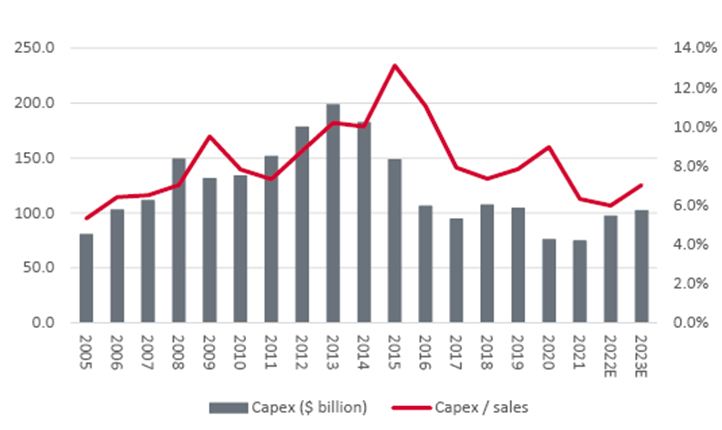
That stimulus, or ‘stimmy,’ comes when supply is already tight relative to demand, as banks, insurers and fund managers decline to offer finance for new exploration work and the Government threatens any successful risk-taking with more tax. Not surprisingly, oil majors’ capex is nearer its lows than cyclical highs.
Oil majors are still being careful with their capex plans
This could be bullish for oil and the consensus seems to agree, even if share prices and valuations appear less convinced. Over to you, Mr. Kovner.
Please check in again with us shortly for further relevant content and news.
Please find below, a Weekly Market Commentary, received from Brooks Macdonald yesterday afternoon – 30/05/2022
Equity markets rallied last week, avoiding an 8-week streak of US equity losses
Stronger than expected US retail earnings as well as reduced expectations of US monetary tightening buoyed sentiment
This week’s focus will be on US economic data, European inflation and the commencement of the Federal Reserve’s (Fed) balance sheet run-off
Equity markets rallied last week, avoiding an 8-week streak of US equity losses
US equity markets broke their 7-week losing streak last week, seeing a strong rally which was led by consumer discretionary stocks as discount retailers posted better earnings than expected. Bond markets also shared this rally as investors priced in a less aggressive pace of tightening from the Federal Reserve in the face of declining economic momentum. This week is likely to be quieter with the US on holiday today for Memorial Day and the UK off on Thursday and Friday for the Queen’s Platinum Jubilee.
Stronger than expected US retail earnings as well as reduced expectations of US monetary tightening buoyed sentiment
Despite the week being truncated on both sides of the Atlantic, there are plenty of data releases for markets to interpret. In the US we will see the latest industrial activity metrics as well as the Institute for Supply Management (ISM) manufacturing data which comes after the misses in the Purchasing Manager’s Index (PMI) surveys last week. The Conference Board will also update their consumer confidence survey which will give an insight not only into current consumer confidence but also expectations around the future. The main event however will be the US jobs report which is released on Friday. Last month’s reading came in ahead of market expectations at 428,000 new jobs created, this month the market is predicting a more subdued 320,000 but the unemployment rate is expected to tick down from 3.6% to 3.5%1.
This week’s focus will be on US economic data, European inflation and the commencement of the Fed’s balance sheet run-off
Wednesday will see the beginning of the Federal Reserve’s balance sheet run off as it commences its quantitative tightening programme. The process ramps up in September with the Fed re-investing an even smaller proportion of maturing Treasury and mortgage securities. The Fed’s logic is that by not re-investing a proportion of maturing funds from current holdings, the shrinking of the balance sheet can be open and transparent to market participants, reducing the risk of bond market turmoil. There is undoubtedly a communication and liquidity challenge posed by the combination of rate hikes and balance sheet run-off however and that will keep risk assets on their toes until the process is bedded in.
Equities have edged higher on Monday, buoyed by a fresh round of stimulus in China and the more optimistic tone that ended the US session last week. This week is likely to contain a focus on the European Central Bank (ECB) with the central bank increasingly positioning for a July rate hike. Expect the market to focus on German inflation data as well as the specific wording adopted by ECB speakers.
Please continue to check our Blog content for advice and planning issues and the latest investment, markets and economic updates from leading investment houses.
Please see below ‘Markets in a Minute’ article received from Brewin Dolphin yesterday evening, which provides a global update on markets and economies.
Fears about the impact of inflation on global economic growth led to further stock market losses last week.
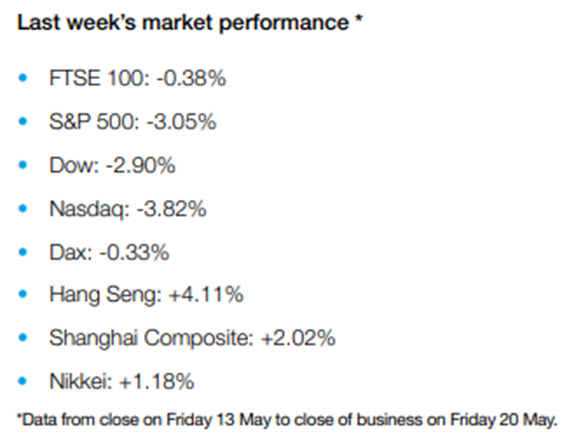
In the US, the S&P 500 suffered its biggest daily fall since the early months of the pandemic, closing down 4.0% on Wednesday following poor results from major retailers. On Friday, the index briefly fell into bear market territory, down more than 20% from its January high, as fears of a recession grew. The index finished the week 3.1% lower, while the Dow and the Nasdaq slid 2.9% and 3.8%, respectively.
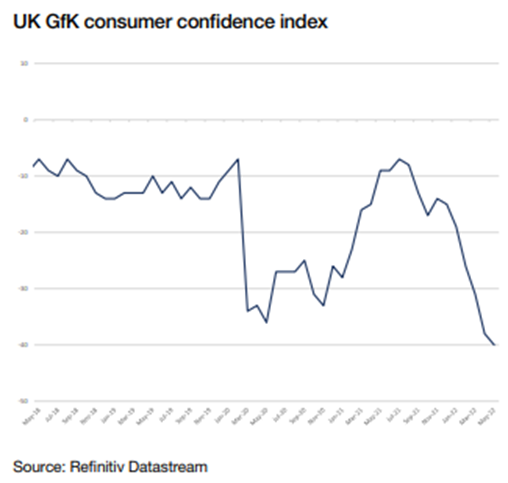
The FTSE 100 slipped 0.4% as UK inflation soared and consumer confidence fell to its lowest level in nearly 50 years. The pan-European STOXX 600 declined 0.6% after the European Commission cut its growth forecasts for the eurozone.
Over in Asia, China’s decision to cut interest rates to support its ailing property sector helped to boost sentiment in the region. The Shanghai Composite gained 2.0% and the Nikkei 225 added 1.2%
UK house prices hit fresh record high
Most major indices started this week in the green, with the FTSE 100, Dax and S&P 500 up 1.7%, 1.4% and 1.9% at the close of trading on Monday (23 May). Comments from US President Joe Biden that he was considering lowering tariffs on certain products imported from China helped to boost sentiment.
In economic news, figures from Rightmove showed the average asking price of a UK property rose by 2.1% month-on-month in May to £367,501, the highest for the time of year since May 2014. On an annual basis, prices surged by 10.2% as supply failed to keep up with continued buoyant demand.
Stocks slipped back again at the start of trading on Tuesday. The FTSE 100 fell 1.0% as investors mulled the latest UK government borrowing data. According to the Office for National Statistics (ONS), borrowing fell by £5.6bn year-on-year in April to £18.6bn but remained above pre-pandemic levels.
UK inflation hits 40-year high
The latest UK inflation figures showed consumer prices rose at their steepest rate for more than 40 years in April as the cost of food and energy soared. The consumer prices index (CPI) rose by 9.0% compared with a year ago, up from 7.0% in March. On a monthly basis, the CPI increased by 2.5%, up from a rise of 0.6% in the same month a year ago.
The ONS said the increase in the energy price cap was the main reason for the jump in CPI. The annual inflation rate for electricity and gas hit 53.5% and 95.5%, respectively. Average petrol prices rose to a record 161.8p a litre in April from 125.5p a year earlier, pushing the annual inflation rate for motor fuels and lubricants to 31.4%. Elsewhere, the end of a temporary VAT cut for the hospitality industry led to a 1.7% monthly increase in restaurant and hotel prices.
The rising cost of living meant GfK’s consumer confidence barometer fell to -40 in May, the lowest level since records began in 1974. “This means consumer confidence is now weaker than in the darkest days of the global banking crisis, the impact of Brexit on the economy, or the Covid shutdown,” said Joe Staton, client strategy director at GfK. The sub-measures on the general economy sank to -63 for the last 12 months and -56 for the coming year. “The outlook for consumer confidence is gloomy, and nothing on the economic horizon shows a reason for optimism any time soon,” added Staton.
Retail sales jump despite rising prices
Despite the doom and gloom, separate figures from the ONS showed a surprise jump in retail sales in April. Sales volumes rose by 1.4% month-on-month following a fall of 1.2% in March. Economists in a Reuters poll had forecast a decline of 0.2%. The rise was led by strong growth in sales of alcohol and tobacco, which drove food store sales volumes up by 2.8%. Clothing sales were also strong as customers booked weddings and holidays.
On a quarterly basis, sales volumes fell by 0.3% in the three months to April, extending the downward trend in place since summer 2021. “Retail sales picked up in April after last month’s fall,” said Heather Bovill, ONS deputy director for surveys and economic indicators. “However, these figures still show a continued longerterm downward trend.
“April’s rise was driven by an increase in supermarket sales, led by alcohol and tobacco and sweet treats, with off-licences also reporting a boost, possibly due to people staying in more to save money.”
US housing market cools
Over in the US, data suggested the housing market could be slowing as rising mortgage rates make it harder for people to get onto the property ladder. Building permits dropped 3.2% month-on-month in April, led by a 4.6% fall in permits for single-family housing, according to the Commerce Department. Housing starts slipped by 0.2%, with single-family housing starts plunging by 7.3%.
It came after the NAHB/Wells Fargo Housing Market Index, a measure of housing market sentiment, dropped to the lowest level in nearly two years in May. This was blamed on rising prices for building materials and rapidly increasing mortgage rates. The 30-year fixed-rate mortgage averaged 5.3% during the week ended 12 May, the highest since July 2009, according to Freddie Mac data reported by Reuters.
Please check in again with us soon for further relevant content and news.
Please see the market update below received this morning from Brooks Macdonald – 19/05/2022
What has happened
The bounce in global equities that had buoyed sentiment on Tuesday, faded fast on Wednesday. Selling the previous day’s rally, investors seemed to focus back on concerns around near-term inflation pressures in particular. In company news, US general merchandise retailer Target missed estimates and the shares fell around 25%, but rather than a read on the health of the US consumer in aggregate, it looked more about the impact of a consumer shifting away from pandemic-driven elevated goods spend, which hit Target’s sales of goods outside of its grocery lines, such as TVs and kitchen appliances. Also on Wednesday, UK CPI data showed inflation rose to 9% Year on Year in April, slightly below a consensus estimate of 9.1%. Boosted by the 1st April rise in the energy price cap, the headline inflation rate reached a 40 year high. In currency markets, Sterling fell versus the Dollar on concerns that the Bank of England might have to tread more carefully around near-term inflation pressures, in order to guard against longer-term economic growth risks.
US retailer Target delivers an off-target negative surprise
US general merchandise retailer Target reported 1Q earnings on Wednesday, but missing estimates the stock fell around 25%. While the retailer was impacted by higher costs (including fuel costs), and supply chain troubles, the dominant impact seemed to be the company caught by a bigger than expected consumer shift out of goods (especially durable goods) such as TVs and kitchen appliances, that had done well during the pandemic, leaving the company overstocked and forced to mark down prices. Without stimulus cheques fuelling spending, combined with a return to more normal consumption patterns as consumers move back towards services, this was seen as a factor the company. As the Target CEO Cornell said on Wednesday, “three core merchandise categories, apparel, home and hardlines, we saw a rapid slowdown … while we anticipated a post-stimulus slowdown and we expected consumers to continue refocusing spending away from goods and into services, we didn’t anticipate the magnitude of that shift.”
Markets caught in an investor sentiment tug-of-war
Markets are caught in an investor sentiment tug-of-war battle at the moment, but relatively high levels of market volatility are likely to be with us for a while yet. For central banks, the challenge is getting the balance right between taming near-term inflation pressures while not impacting longer-term economic growth, but it’s a challenge that’s fraught with difficulty. With US Fed Chair Powell hoping for a “softish landing” and UK BoE Governor Bailey seeing a “narrow path” between the risks of inflation and growth, the question as to whether central banks can successfully thread-the-needle on policy unfortunately has no short-term answer.
How is the inflation picture shaping up?
The inflation picture is rightly dominating investors’ attention, but it can be unpacked into a number of different drivers currently. COVID has created price ‘disruption’ as a result of the post-pandemic restart and the imbalance in supply chains between both goods and services as well as demand and supply. War in Ukraine this year has complicated the inflation picture, adding significant price ‘shocks’ to energy and food in particular. But price ‘disruption’ and price ‘shocks’ are not enough by themselves to kick-start a multi-year inflation process. For that a necessary component would be a significant and sustained rise in inflation expectations (including wage expectations). However, analysis last week from the Peterson Institute for International Economics suggests that the big news in the US April jobs report published earlier this month was a potentially slowing wage growth picture. Looking at US average hourly earnings, the annualized rate of growth (once adjusted for compositional changes in the labour force), was 3.8% over the past three months, a pace considerably slower than in 2021, which saw peaks around 7%.
What does Brooks Macdonald think?
At Brooks Macdonald, we recognise that the current inflation picture is complex and multifaceted. On balance, we expect the current high inflation rates to start to ease over the remainder of this year and into 2023 – but how quickly (and how far) inflation drops back (as well as the impact to economic growth further out from interest rate hikes in the interim), remain difficult to gauge. Ultimately, it’s one of the reasons why, within equities, we continue to hold to our barbell balance between growth/defensive and value/cyclical investment styles at the current time.
Please continue to check our Blog content for advice and planning issues and the latest investment, markets and economic updates from leading investment houses.
Please see below ‘Markets in a Minute’ article received from Brewin Dolphin yesterday evening, which provides a global update on markets and economies.
European indices rose last week despite heightened concerns about the economic outlook and inflation.
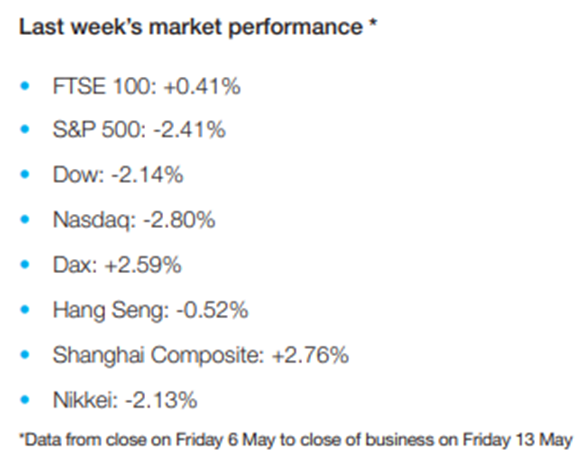
The pan-European STOXX 600 bounced back from its earlier losses to finish the week up 0.8%, while Germany’s Dax rose 2.6%. The FTSE 100 added 0.4%, notwithstanding data showing UK gross domestic product (GDP) unexpectedly contracted in March.
Chinese stocks also rose as the number of Covid-19 cases declined and the China Securities Regulatory Commission pledged to boost confidence in the Shanghai Composite, which is Asia’s worst-performing index so far this year. The index ended the week up 2.8%.
In contrast, US indices fell amid fears the Federal Reserve’s attempts to rein in inflation by increasing interest rates would spark a recession. The Dow fell 2.1% in its seventh consecutive week of losses, while the Nasdaq and S&P 500 slipped 2.8% and 2.4%, respectively.
China’s economy slows as lockdowns hit growth
Stocks were mixed on Monday (16 March) after data from China showed the country’s zero-Covid policy had hit economic activity. The Shanghai Composite slipped 0.3% as retail sales slumped 11.1% year-on-year in April – much worse than the 6.1% decline forecast by economists in a Reuters poll. Industrial production fell 2.9% from a year ago, while unemployment in China’s 31 largest cities jumped to 6.7%. US indices were mostly in the red on Monday, whereas the FTSE 100 managed to reverse earlier losses to finish the trading session up 0.6%.
The FTSE 100 was up 0.4% at the start of trading on Tuesday as investors mulled the latest jobs data from the Office for National Statistics (ONS). Unemployment fell to 3.7% in the first three months of 2022, the lowest level since 1974, while the number of job vacancies in February to April rose to a record 1,295,000.
UK economy shrinks as cost of living rises
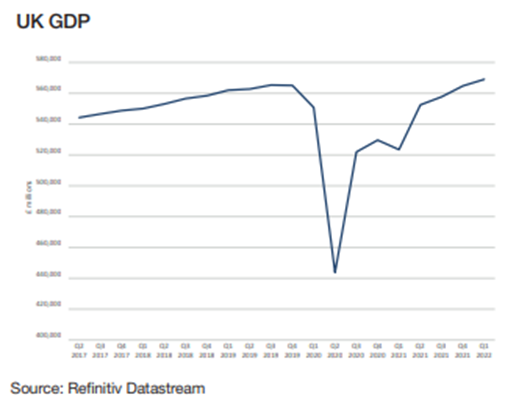
Last week’s economic headlines focused on the unexpected contraction in the UK economy. Figures from the ONS showed GDP slipped by 0.1% in March, driven by a 0.2% decline in services as consumers cut back on spending. Consumer-facing services plunged by 1.8%, led by a sharp 2.8% fall in wholesale and retail trade. Production also fell by 0.2%, whereas construction grew by 1.7%.
The fall in GDP came as a surprise to investors who had been expecting a small rise from the previous month. Figures for February were also revised down from 0.1% growth to no growth, which meant the economy expanded by just 0.8% in the first quarter, less than the 1.0% growth forecast by economists.
The data has exacerbated fears that the UK could slide into a recession – defined as two consecutive quarters of declining GDP – later this year. It comes as households face the biggest cut in real incomes since the 1950s as inflation outpaces wage gains. The ONS is expected to announce that inflation topped 8.0% in the 12 months to April when it releases the next consumer prices index report on Wednesday (18 May).
US inflation moderates less than hoped
Over in the US, inflation slowed in April to an annual rate of 8.3%, down from 8.5% in March, according to the Labor Department. While the data suggests price increases may be peaking, the rate of inflation was higher than consensus estimates of around 8.1%. Core inflation, which excludes food and energy, also pulled back less than expected to 6.2% versus estimates of 6.0%.
On a monthly basis, prices rose by 0.3% in April, the smallest increase in eight months. However, prices for services surged by 0.7% and airline fares jumped by 18.6%, the largest increase on record. The price gains mean workers continue to lose out, with real wages falling by 0.1% month-on-month despite a nominal increase of 0.3% in average hourly earnings. Over the past year, real earnings have dropped by 2.6%.
The inflation report came in the same week as data showing US consumer sentiment slumped to its lowest level for nearly 11 years in early May. The University of Michigan’s preliminary results showed the index of consumer sentiment fell to 59.1 in May from 65.2 in April. The gauge of current economic conditions dropped to 63.6, the lowest reading since 2013, with 36% of consumers attributing their negative assessment to inflation. Buying conditions for durables reached the lowest reading since the question began appearing on the monthly surveys in 1978, again primarily due to high prices. Meanwhile, the measure of consumer expectations fell to 56.3 from 62.5.
ECB could raise interest rates in July
Christine Lagarde, the president of the European Central Bank (ECB), said in a speech last week that she expected the bank to stop expanding its balance sheet through bond purchases early in the third quarter and to raise interest rates “some time” after that, which “could mean a period of only a few weeks”. The comments have led several economists to declare that the first rate hike for more than a decade will go ahead in July. A growing number of governing council members are calling for a 25-basis-point rise in the ECB’s deposit rate at the 21 July policy meeting. The deposit rate is currently -0.5% and has been negative since 2014.
It comes amid concerns that Russia’s invasion of Ukraine could keep inflation high for longer than initially expected. According to comments reported in the Financial Times, Lagarde said the war was “likely to accelerate two ongoing structural changes which, during the transition they entail, could lead to further negative supply shocks and cost pressures”. She added that the ECB’s new quarterly forecasts to be published in June were “increasingly pointing towards inflation being at least on target over the medium term”.
Please check in again with us shortly for further relevant content and news.
Please see below article received from AJ Bell this afternoon, which informs investors of the key factors driving stocks, bonds and other assets in the markets currently.
Many investors are frustrated that a lot of the stocks, funds and bonds in their portfolios have fallen in value this year. It’s been a chaotic time on the markets and negative events keep unfolding.
Inflation is at levels not seen for decades, the first major European war of the 21st century has broken out, and after years of ultra-low interest rates central banks are starting to tighten monetary policy.
Inflation has accelerated over the past year
Investors face a tricky task of determining when things might get better and what they should do with their investments in the meantime. Sitting tight and staying invested is a good strategy, but more active investors might be interested in tweaking their portfolios based on the outlook.
In this article we look at what the experts are forecasting for inflation, economic growth and interest rates and what market observers think has already been priced in. Our aim is to give a picture of how bad life could get or whether things might already be starting to improve.
UKRAINE SHAPES THE OUTLOOK
There is one key source of uncertainty which makes gauging the outlook difficult, namely the progress of the tragic conflict triggered by Russia’s invasion of Ukraine.
As Andrew McCaffery, global chief investment officer for asset manager Fidelity, observes: ‘The war in Ukraine has already caused significant economic damage, and it will continue to shape the near-term outlook for global economies, particularly Europe. Outcomes over the coming quarter will be heavily influenced by the timeline to a resolution and the easing of trade disruptions.
‘In the meantime, any hopes for a moderation in energy prices and supply-chain disruptions have been dashed. Together, these dynamics will continue to dampen growth and put upward pressure on already high inflation.
‘This paints an extremely complex picture, both for policymakers and the markets. We believe the market has yet to reflect the full range of possible outcomes, which span extreme left and right tail risks.’
These ‘tail risks’ refer to more positive or negative outcomes than expected. In this context it’s useful to see what is being anticipated by forecasters and what are the best and worst-case scenarios.
Trying to second guess what happens next in Ukraine is difficult. Chief Europe economist at consultancy Capital Economics, Andrew Kenningham, says: ‘Unfortunately assumptions about the war have steadily got worse over the past two months. We were hoping and assuming the conflict would ease towards the end of the year.
‘Without forecasting exactly what will happen on the ground we are now working on the assumption the conflict will continue with no early resolution but also no major escalation.’
Assuming this reasoning proves correct, companies and countries may be able to adjust to the disruption but if the conflict widens or deepens in any way this could present a new risk for financial markets.
INFLATION
The supply chain issues and high food and energy prices which have contributed to rising prices remain in place. The reintroduction of Covid restrictions in China, the so-called factory of the world, has only added to these inflationary pressures.
UK consumer price inflation forecasts (Q4 2022)
However, there are reasons to think we are close to peak levels of inflation. Investment bank Berenberg expects US inflation to peak at 8.1% and UK inflation to peak at 8.6%, both in the second quarter.
Jennifer McKeown, at the consultancy Capital Economics, says: ‘Globally inflation is going to come down this year thanks to very strong base effects linked to the reopening of economies in the second half of last year.’
Saying that inflation has peaked, for now, is not the same thing as predicting a rapid fall in prices. Berenberg forecasts inflation will remain above 6% in the final quarter of 2022 in the US and the first three months of next year for the UK.
Consensus forecasts on UK inflation may not go far enough. Panmure Gordon chief economist Simon French was already on record as saying UK inflation could hit double digits in 2022 before the Bank of England surprised many observers with a prediction for inflation to peak above 10% at the end of this year.
This would represent the highest level in 40 years but doesn’t seem too extreme given UK inflation data, up to the end of March, is yet to reflect Ofgem’s lifting of the energy price cap by 54% at the beginning of April, with a further big increase expected in October.
The chances of wholesale energy prices easing substantially are limited by attempts on the part of European countries to wean themselves off Russian gas and oil. The US, which is effectively energy independent by comparison, is more insulated on this front.
Tight labour markets, particularly in the developed world, are also contributing to inflation as wages increase.
Eurozone unemployment hit a record low of 6.8% in March and the US reported record job openings for the same month.
GDP
Surging inflation is one of the key reasons economists have been busily revising down growth forecasts this year. In its latest World Economic Outlook, published in April, the International Monetary Fund lowered its global growth forecast to 3.6% in 2022 and 2023. This was 0.8 and 0.2 percentage points lower respectively than in the January report.
UK GDP 2022 forecasts
There is little debate over whether the post-Covid economic recovery has been hit by the Ukrainian conflict. The question is whether it could be derailed entirely. We are already facing stagflation, which is a toxic combination of slowing growth and rising prices.
The yields on two-year and 10-year US government bonds recently inverted, i.e., the longer-dated debt offered a lower yield than the more short-term debt, which is often seen as a signal of recession and US GDP unexpectedly contracted 1.4% in the first quarter.
Nonetheless, non-profit research organisation The Conference Board does not believe a US recession is likely in 2022 – even under its modelling of some extreme scenarios, including oil hitting $200 per barrel.
COVID STILL A PROBLEM
The two main risks to this view are policy mistakes on the part of the US Federal Reserve and mutation or resurgence of Covid-19. Remember the pandemic continues to rage in some parts of the world.
There seems to be a greater risk of recession in Europe. Russia and closely linked emerging European economies look particularly vulnerable to a downturn but developed Europe too could risk slipping into a slowdown.
Capital Economics’ Andrew Kenningham says: ‘For the Eurozone overall we are forecasting almost flat second and third quarters with Italy and Germany at risk of falling into technical recessions; France and Spain should avoid that.’
A technical recession is defined as two consecutive quarters of negative growth and while the Bank of England thinks this fate can be avoided, it is forecasting a 0.25% contraction in UK GDP for 2023.
Outside of the US and Europe, China may be on a different trajectory with the easing of restrictions as Covid cases come down, helping growth to increase through the course of the year. Whether it can hit Beijing’s target of 5.5% is open to question.
INTEREST RATES
The finely balanced outcomes on inflation and economic growth create a tricky backdrop for central banks. It seems certain the Federal Reserve, Bank of England and, even the laggard of the three, the European Central Bank will end the year with higher interest rates.
However, the exact pace and trajectory of those increases remains in question. In its latest update (4 May) the US Federal Reserve lifted rates by 0.5 percentage points for the first time since 2000 but signalled it was not considering a 0.75 percentage point increase in rates for now.
The central bank did nothing to suggest consensus expectations for rates to finish 2022 somewhere around 2.5% were out of whack.
Nick Clay, who runs investment manager Redwheel’s global equity income team, observes: ‘I think the Fed’s been boxed into a corner. It will lead on this, but bond yields particularly in America have already priced a lot of that in.
‘Corporates and governments because of their levels of indebtedness are going to find it difficult to suffer higher interest rates for any length of time. By the time we get to the end of this year we will look back at this period and realise this was the peak in interest rates within the bond yield even if the Fed is still raising rates.’
The negative economic assessment which accompanied the Bank of England’s latest rate hike to 1% (5 May) suggests it may look to avoid hiking rates materially from here. Consensus expectations are for UK rates to reach a high of 2% next year but not everyone agrees with this assessment.
Capital Economics’ chief UK economist Paul Dales says: ‘We think longer-lasting domestic price pressures will mean the MPC (Bank of England’s Monetary Policy Committee) ends up raising rates to a peak of 3% next year, which compares to the peaks of 2.5% priced into the markets and 2% expected by other analysts.’
The European Central Bank may not have moved on rates yet, but it opened to the door to a July rate rise at its meeting in April.
The central bank faces an even more difficult task than the Fed and Bank of England given it needs to balance the needs of economies with very different dynamics. Inflationary pressures are also more acute in the Eurozone given its heavy reliance on Russian energy imports.
Berenberg forecasts two 0.25 percentage point interest rate rises in the third and fourth quarter of this year which would still leave Eurozone rates a long way behind those in the US and UK.
WHERE WILL THE MARKETS END UP?
How much of the increase in rates, reduced growth prospects and higher inflation have been factored in by the markets?
There is no question that investors have reacted to these events. The first quarter saw bond and stock prices fall in tandem for the first time in nearly 30 years.
The table shows how global stock markets have performed year-to-date and it paints an ugly picture in most places. The UK’s FTSE 100 index is doing best thanks to its strong commodities exposure. In the US, the Nasdaq receives the wooden spoon as investors turn away from highly rated growth stocks.
Rupert Thompson, investment strategist at asset manager Kingswood, comments: ‘The falls in both bonds and equities have been driven by the move towards stagflation, the unpalatable combination of high inflation and stagnation in economic activity. Worries on this front have been bolstered by recent developments.’
How major stock markets have fared in 2022
Will there be more pain to come for stocks? In early April, investment bank Goldman Sachs updated its year-end forecasts for the S&P 500 index in the US for a closing level at the end of December of 4,700.
This would represent a modest drop versus 2021’s closing level of 4,766 and compares with a current level of 4,125. This represents its best-case scenario. In the event of a recession the bank thinks the index could fall to 3,600.
Bank of America says there have been 19 bear markets in the past 140 years. A bear market is a 20% decline or more from recent highs.
The average price decline in these 19 bear markets was 37.3% and an average duration of 289 days. It says: ‘Past performance is no guide to future performance, but if it were, today’s bear market ends on 19 October 2022 with the S&P 500 at 3,000 and the Nasdaq at 10,000. The good news is many stocks are already there, e.g., 49% of companies in the Nasdaq are more than 50% below their 52-week highs.’
S&P 500
Elsewhere, Morgan Stanley forecasts the S&P 500 to end 2022 at 4,200, JPMorgan predicts 4,900 and Barclays estimates 4,800.
Gains for US stocks have been driven by the big technology companies and as Redwheel’s Nick Clay says, ‘They are very expensive. Even the best company in the world at the wrong valuation becomes the riskiest company. Your expectations are so high they can’t even deliver on those extended expectations.’
Corporate earnings are holding up well. On 29 April Factset said that of the 55% of companies in the S&P 500 which had reported results for first quarter to that point, 80% had reported earnings per share above estimates, which was greater than the five-year average of 77%.
As we write, about half of the STOXX 600 companies in Europe have reported so far and 71% of those have topped analysts’ profit estimates according to Refinitiv IBES data. Typically, one might expect just over half of companies in this index to beat estimates in a quarter.
The question is whether results for the first three months of 2022 reflect the full impact of rising input costs and reduced consumer spending. After all, some businesses are still enjoying a post-pandemic recovery in demand and may also have been able to react to inflation by driving efficiencies.
It will be worth keeping close tabs on the second quarter and first half reporting season to see if earnings can continue to beat forecasts or if mounting inflation and weaker demand start to have a wider negative impact.
Clay at Redwheel says: ‘I think interest rates aren’t going to go up as much as people ultimately fear they might have to, and therefore by the end of this year we’re going to start talking about when they are going to stop raising rates and start cutting them again. The backdrop has plateaued. We’ve had the worst of it.’
WHAT SHOULD INVESTORS DO?
Many readers will be nursing portfolio losses but it is important not to panic. It is worth having a good look at your investments and if any specific holding has performed very poorly, particularly if it has fallen more than the 13.4% year-to-date decline in the MSCI World, then it is worth taking a good look at why.
However, unless anything fundamental has changed on an individual investment then it is worth staying invested and riding out the volatility if you have time on your side. Time in the market is better than trying to time the market.
Asset manager BlackRock found that if you had invested a hypothetical $100,000 in the S&P 500 index of US stocks between 1 January 2001 and 31 December 2020 you would be sitting on $424,760 if you stayed invested but by missing just the best five days that number dropped to $268,277. Often the best days follow some of the very worst.
One way of smoothing out the impact of volatility and remaining invested in the markets is to invest regularly. By doing so you benefit from an effect called pound cost averaging.
When markets rise, a monthly contribution buys fewer shares or units in a fund. When markets fall the same contribution buys more shares or fund units.
In terms of what you should invest in, Fidelity’s Andrew McCaffery says: ‘We believe focusing on high quality companies, rather than sector selection, is the best approach given the rising geopolitical and stagflation risks.
‘Companies with pricing power and the ability to protect margins should perform relatively strongly in this environment. Equities should still provide a robust source of income, now that balance sheets have been repaired following the worst of the pandemic.’
Please check in again with us soon for further relevant content and news.
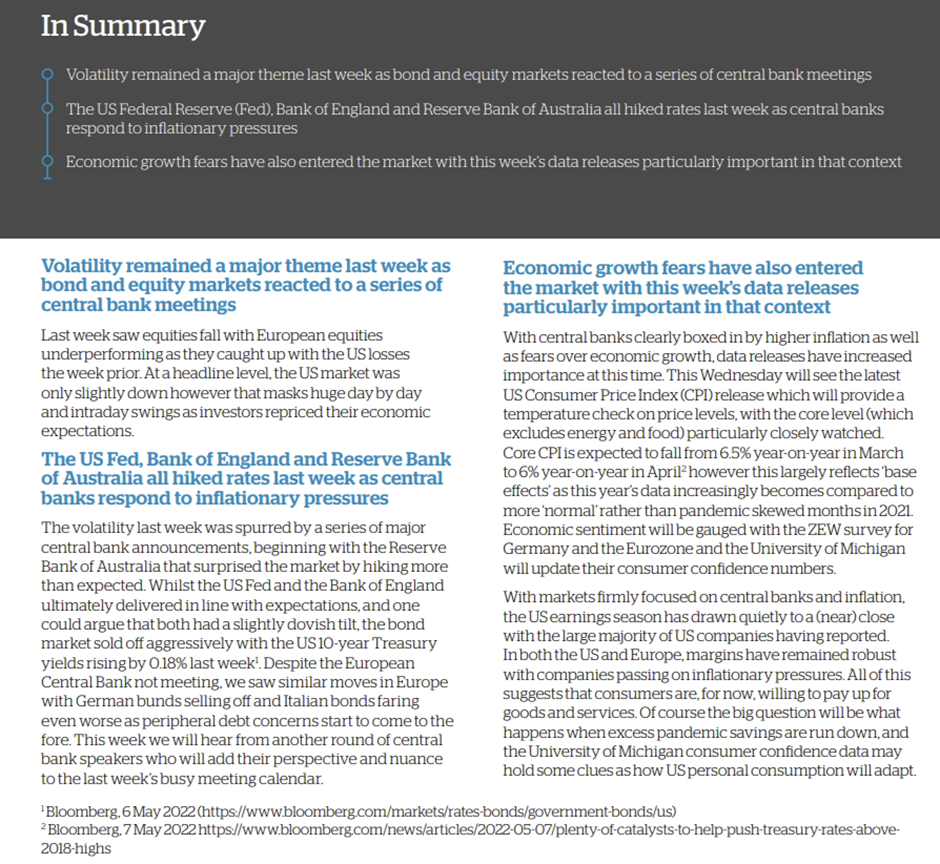
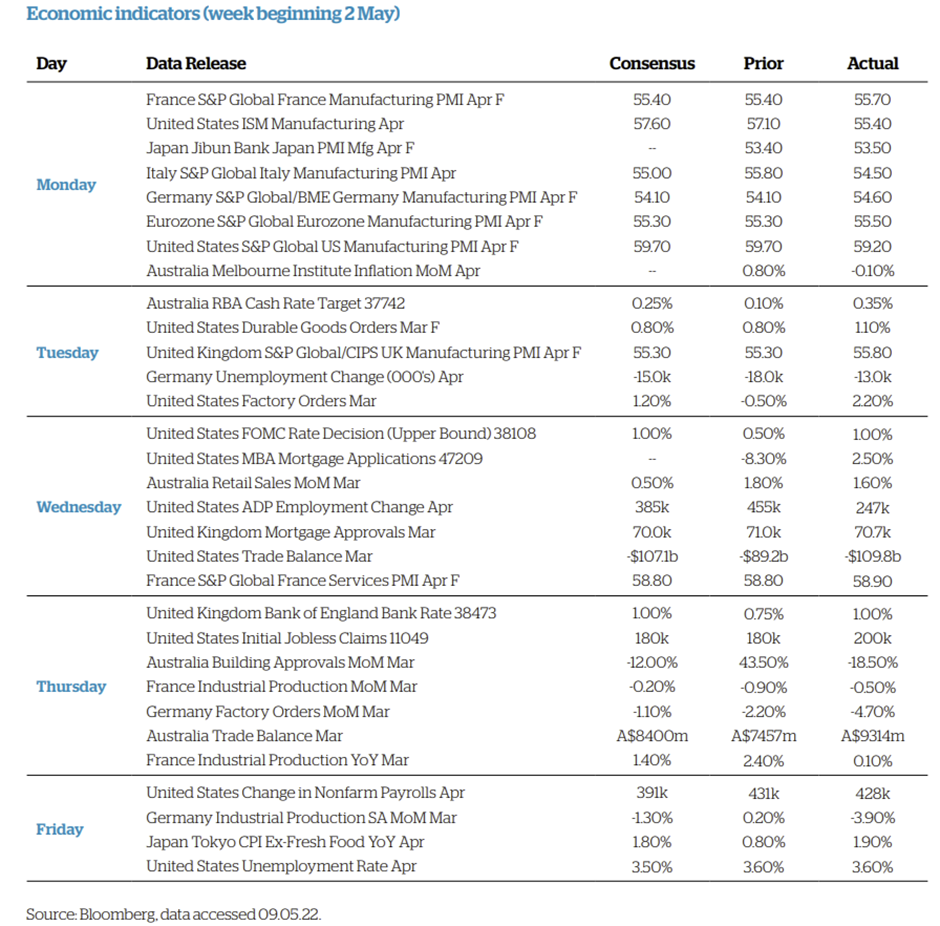
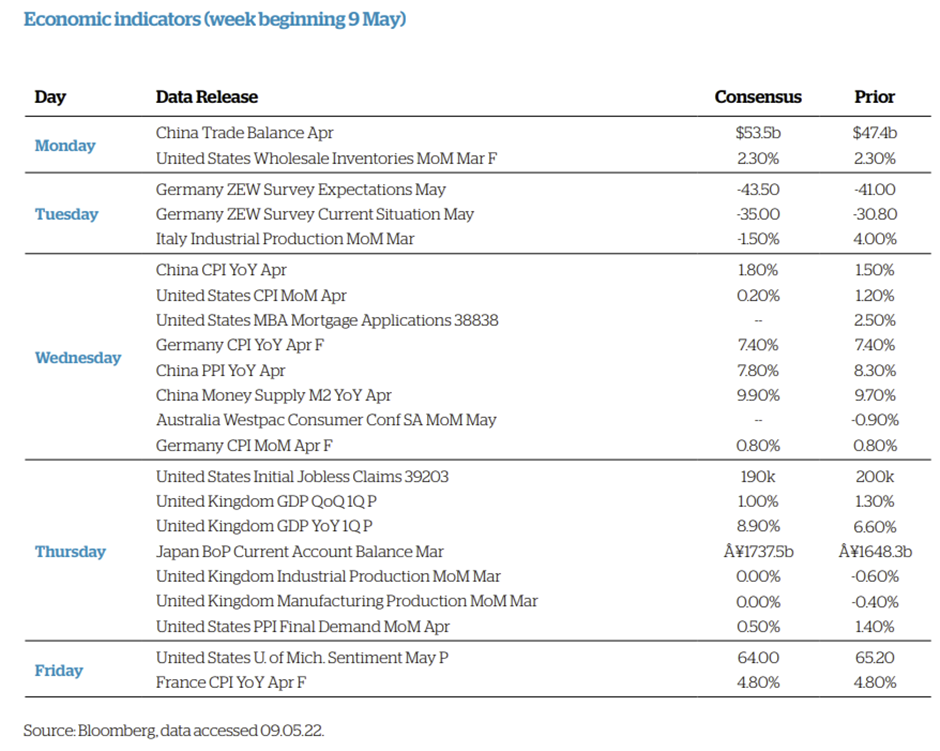
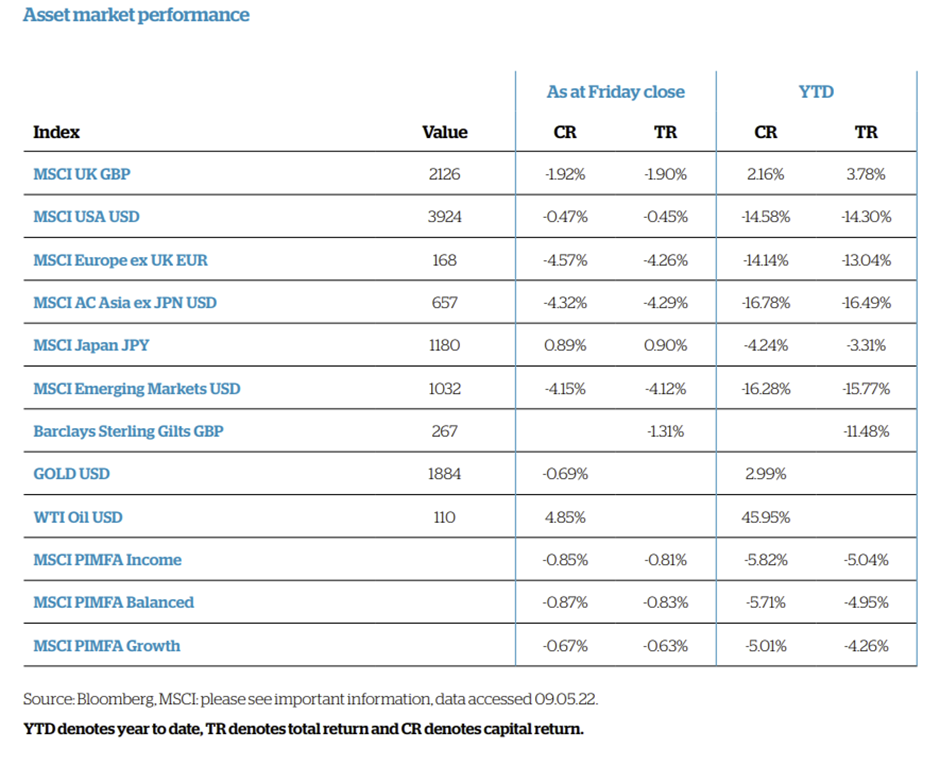
Please see below a Weekly Market Commentary, received from Brooks Macdonald, yesterday evening – 10/05/2022
Please continue to check our Blog content for advice and planning issues and the latest investment, markets and economic updates from leading investment houses.
Pensions, particularly Workplace Pensions, are quite often considered to be confusing. Please see Tom Selby of A J Bell’s article below explaining a little about Auto-Enrolment contributions.
A reader wants to know why the sums don’t add up with retirement savings
Thursday 05 May 2022 Author: Tom Selby
I’m being automatically enrolled into a workplace pension scheme and was told this would be 8% of my salary. However, I’ve just done the sums and my contribution works out less than this – can this possibly be right? I also have a friend who hasn’t been auto-enrolled at all. Are we being shafted by our employer?
Spencer
Tom Selby, AJ Bell Head of Retirement Policy says:
Under auto-enrolment rules, all employers, regardless of size, are required to enrol staff in a pension scheme and pay a minimum level of contributions.
The reason for the reforms was simple – millions of people weren’t saving for retirement. While lots of organisations had a pension scheme, this wasn’t a legal requirement. Even where there was a scheme, plenty of employees simply didn’t join.
Auto-enrolment was first introduced in 2012 for the UK’s largest employers, with medium and smaller employers brought in and contributions scaled up until 2019.
AM I BEING SHAFTED?
While I cannot rule out the possibility your employer isn’t playing by the rules, the answer is likely a lot simpler.
Under auto-enrolment legislation, employees are required to contribute a minimum of 4% and employers 3%, with a further 1% coming via basic-rate tax relief – taking the total to 8%. Employees have the option to opt out of the scheme if they want to, although they miss out on the employer contribution if they do.
However, the minimum requirement is 8% of ‘band earnings’ rather than 8% of total earnings. For 2022/23, the earnings that qualify for minimum auto-enrolment contributions are those between £6,240 (the lower earnings limit for National Insurance contributions) and £50,270 (the upper earnings limit).
Take, for example, someone earning £20,000 a year. If their 8% contribution was based on their total earnings, they would expect £1,600 in total to go into their pension during the 2022/23 tax year.
But if the contribution is based on band earnings, then it will be 8% of (£20,000 – £6,240), which is £1,100.80.
WHAT ABOUT MY FRIEND?
There are various legitimate reasons your friend might not have been auto-enrolled.
If they are under 22 years old or over state pension age (66) then they will not qualify for auto-enrolment, although they have the option to opt-in.
If they have earnings below £10,000 (the auto-enrolment earnings ‘trigger’) they also will not qualify for auto-enrolment, although again they have the option to opt-in if they want to.
Furthermore, employers have the option of not auto-enrolling new joiners for the first three months of their employment.
As an IFA & Employee Benefit Consultant, and an employer, I understand both the value of pensions and how we need to clearly communicate with staff about pensions and employee benefits. Pension contribution rates can make a significant difference over time to the value of your total pension funds on retirement. And whether or not you can afford to retire early!
Communication can be key. Employees need to know what pension provision they have got, what they might need to retire, forecast how it may grow, and how they can make up any potential pension fund shortfall.
Please find below, an update on markets, received this morning from Blackfinch – 03/05/2022
Personal insolvencies have reached a three-year high, as the cost-of-living crisis has left more people unable to repay their debts. There were 32,305 individual insolvencies in England and Wales in the first quarter of 2022, according to the Insolvency Service, which was a 17% increase on insolvencies in the previous quarter.
April’s Industrial Trends Survey from the Confederation of British Industry, the first quarterly survey since Russia’s invasion of Ukraine, suggested a sharp fall in confidence from UK manufacturers. Business optimism fell to a net balance of -34% in April, from -9% in January.
The US Federal Reserve’s preferred measure of consumer inflation – the Personal Consumption Expenditures (PCE) price index – hit a 40-year high. It increased 6.6% in the year to March, with energy prices up 33.9% and food up 9.2%.
The US economy shrank unexpectedly for the first time since the initial COVID-19 outbreak. According to the US Bureau of Economic Analysis. US gross domestic product (GDP) in the first quarter of 2022 fell 0.35%, or at an annualised rate of 1.4%.
US consumer sentiment improved in April, according to a University of Michigan survey. Its index of consumer sentiment increased from 59.4 in March to 65 in April, but was still significantly below the 88.3 reported in April 2021. Most of the improvement came from gains of 21.6% in the year-ahead outlook for the US economy and an 18.3% jump in personal financial expectations.
The number of Americans filing new claims for unemployment support fell last week, according to the US Labor Department. There were 180,000 ‘initial claims’ filed, down from 185,000 the previous week, suggesting the jobs market remains solid.
The Eurozone faces stagflation (slowing economic growth and high inflation) after statistics agency Eurostat reported growth slowed to 0.2% in the first quarter of 2022 while inflation hit a record level of 7.5%.
Natural gas prices jumped as much as 20% as Russia’s energy company Gazprom cut gas supplies to Poland and Bulgaria, after both countries refused to pay for gas in roubles.
Consumer confidence in Germany has reached an all-time low, according to analytics firm GfK. Its confidence index, based on a poll of 2,000 Germans, fell from -15.7 in April to -26.5 in May, far worse than expected.
Russia’s central bank lowered interest rates from 17% to 14%. Economists had expected a smaller cut to 15%, but borrowing costs are still much higher than before the Ukraine war.
Please continue to check our Blog content for advice and planning issues and the latest investment, markets and economic updates from leading investment houses