Team No Comments

Daily Investment Bulletin

Please see below Brooks Macdonald article received this morning, which provides a market update and refers to Ukraine’s successful counter-offensive strategies in their ongoing war with Russia.  

What has happened

Despite a lack of new news on the central bank front, markets have been increasingly preparing themselves for another hawkish rebuke from the Federal Reserve that could lead to a leg higher in interest rate hike expectations. As a possible portent of things to come, Sweden’s Riksbank surprised investors with a 100bp rate hike, which was above expectations.

Federal Reserve

7pm UK time will see the release of the latest Fed decision with markets expecting a 75bp increase in interest rates alongside some aggressively hawkish language. The mood coming into this meeting is a far cry from August when bond markets were hoping for a sign of a Fed pivot towards a more balanced outlook that weighed inflation and recessionary risks. Earlier in the summer we saw a leak when market pricing was significantly different to what the Fed was intending on unveiling, a lack of a similar briefing for this meeting suggests the Fed is comfortable with 75bps. Arguably the key question therefore is how the fresh economic projections from the central bank paint the inflation and growth picture and whether the bank prepares the market for a further 75bp hike in November. Whilst the Fed meeting is the most important of the week, the market is pricing a 50:50 chance between the Bank of England hiking by 50 or 75bps tomorrow.

Ukraine war

Yesterday Russia announced that it would be holding referenda in the four Russian-controlled regions of Ukraine. Such a move has been widely condemned and appears to be part of a strategy to quickly lay territorial claim to parts of Ukraine so as to claim that further incursions into that territory are an invasion of Russia itself. The recent, successful, counter-offensive by Ukraine appears to have raised concerns within the Russian government that further land could be lost, prompting these referenda and also a partial mobilisation of Russian forces. The mobilisation was announced earlier this morning and reservists will now be called up to assist in the invasion of Ukraine.

What does Brooks Macdonald think

The announcement of a partial mobilisation has led to a rise in oil prices but so far is yet to feed into broader equity markets, although it should be noted that an escalation in Ukraine War rhetoric, alongside the US CPI release last week, has already been weighing on risk appetite in recent days.

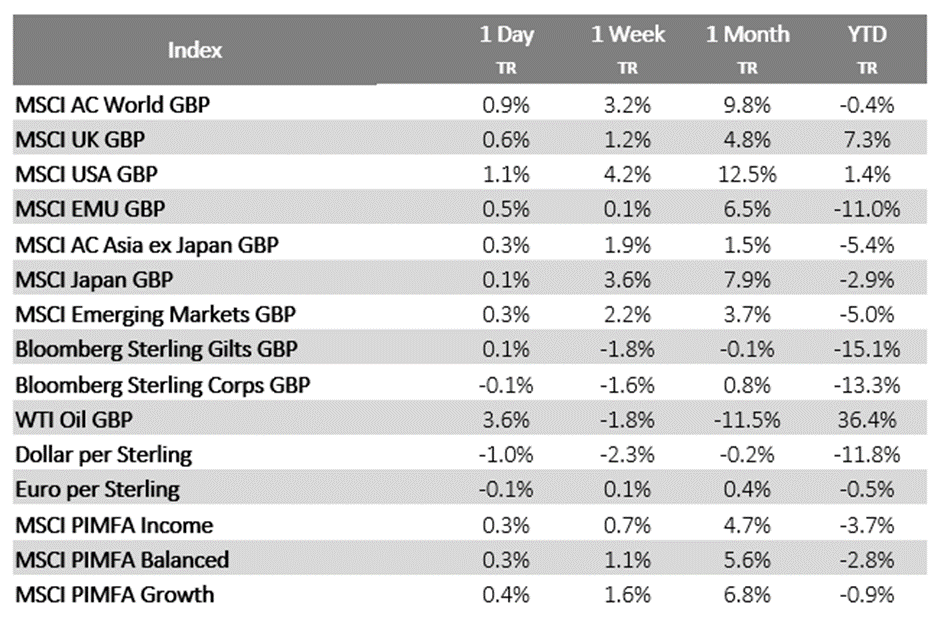
Index 1 Day1 Week1 MonthYTD
 TRTRTRTR
MSCI AC World GBP -0.5%-1.4%-4.4%-5.1%
MSCI UK GBP -0.5%-2.5%-4.5%2.7%
MSCI USA GBP -0.9%-0.8%-5.1%-4.2%
MSCI EMU GBP -1.3%-2.8%-4.3%-15.3%
MSCI AC Asia ex Japan GBP 1.2%-2.4%-1.8%-6.8%
MSCI Japan GBP 0.4%-0.6%-3.7%-6.8%
MSCI Emerging Markets GBP 1.1%-2.2%-1.7%-6.5%
Bloomberg Sterling Gilts GBP -1.2%-1.3%-8.4%-23.3%
Bloomberg Sterling Corps GBP -0.9%-0.9%-6.2%-19.4%
WTI Oil GBP -1.2%-2.1%-3.4%33.5%
Dollar per Sterling -0.4%-1.0%-3.8%-15.9%
Euro per Sterling 0.1%-1.0%-3.1%-4.0%
MSCI PIMFA Income -0.8%-1.4%-4.7%-8.3%
MSCI PIMFA Balanced -0.8%-1.5%-4.9%-7.6%
MSCI PIMFA Growth -0.9%-1.7%-4.7%-5.4%
Index 1 Day1 Week1 MonthYTD
 TRTRTRTR
MSCI AC World USD -0.8%-2.6%-7.9%-20.2%
MSCI UK USD -0.6%-3.7%-8.1%-13.7%
MSCI USA USD -1.2%-2.0%-8.7%-19.4%
MSCI EMU USD -1.6%-4.0%-7.8%-28.8%
MSCI AC Asia ex Japan USD 0.9%-3.6%-5.5%-21.6%
MSCI Japan USD 0.1%-1.8%-7.3%-21.6%
MSCI Emerging Markets USD 0.8%-3.4%-5.3%-21.4%
Bloomberg Sterling Gilts USD -1.4%-2.4%-11.5%-35.3%
Bloomberg Sterling Corps USD -1.0%-2.0%-9.3%-32.1%
WTI Oil USD -1.5%-3.3%-7.0%12.3%
Dollar per Sterling -0.4%-1.0%-3.8%-15.9%
Euro per Sterling 0.1%-1.0%-3.1%-4.0%
MSCI PIMFA Income USD -1.1%-2.6%-8.3%-22.9%
MSCI PIMFA Balanced USD -1.1%-2.7%-8.5%-22.3%
MSCI PIMFA Growth USD -1.1%-2.9%-8.2%-20.5%

Bloomberg as at 21/09/2022. TR denotes Net Total Return

Please check in again with us shortly for further news and relevant content.

Chloe

21/09/2022
Team No Comments

Weekly Market Commentary – Nord Stream 1’s closure has led to volatility in the European energy market

Please find below, a weekly market commentary received from Brooks Macdonald yesterday afternoon – 12/09/2022

  • Central banks continue to dominate sentiment with the ECB raising rates by 75bps and bond markets expecting a similar move from the Fed
  • Nord Stream 1’s closure has led to volatility in the European energy market however prices fell last week as investors positioned for government intervention
  • The US CPI release on Tuesday will be a key input into the Fed’s interest rate policy decision next week

Central banks continue to dominate sentiment with the ECB raising rates by 75bps and bond markets expecting a similar move from the Fed

Central banks remained in focus last week as Federal Reserve (Fed) Chair Powell reinforced his hawkish message, saying that he was entirely focused on fighting inflation. These words impacted bond markets with a 75bp rate hike almost entirely priced in for the Fed’s September meeting. The European Central Bank (ECB) meanwhile raised interest rates by 75bps with President Lagarde noting that inflation was ‘far too high’ and that policy needed to tighten substantially. Despite this, equities performed well, mostly as prior trading weeks had come to terms with the reality that hawkish central bank rhetoric appears to be here to stay for the short term.

Nord Stream 1’s closure has led to volatility in the European energy market however prices fell last week as investors positioned for government intervention

With European energy markets still reacting to the closure of the Nord Stream 1 pipeline, EU energy ministers met on Friday to start forming a plan to help mitigate the energy price surge. Ministers pointed to a large range of tools that they could use to bring price levels under control. Markets were impressed by their fervour, driving European natural gas futures down over 6% on Friday. Over the weekend, the news that Ukrainian forces had successfully executed a counter offensive in the Northeast of Ukraine was welcomed by market participants. With Nord Steam 1 closed, the relative balance of power in the Ukraine War is arguably even more important for investors. Of course, progress by Ukrainian forces does risk a more aggressive escalation by Russia however equities have initially taken this positively.

The US CPI release on Tuesday will be a key input into the Fed’s interest rate policy decision next week

This week’s highlight is likely to be the US Consumer Price Index (CPI) report on Tuesday which will be front and centre of the Fed’s mind when they meet on 21st September. The market is expecting US Core CPI to actually increase year-on-year from 5.9% to 6.1% as housing costs continue to push up the core figures. By contrast, the fall in energy costs in recent months is expected to lead to a substantial fall in headline CPI with the annual rate moving from 8.5% to 8.1%. The month-on-month figure is expected to show a -0.1% decline, reflecting the sharp fall in US gas prices as well as global oil benchmarks.

Given the proximity of the Fed meeting, US central bank speakers are in the communication blackout window meaning that we will have little live reaction to the CPI print. That said, with investors very conscious of the sustained hawkish drumbeat of recent weeks, market pricing will quickly swing based on the CPI report.

Please continue to check our Blog content for advice and planning issues and the latest investment, markets and economic updates from leading investment houses.

David Purcell

13th September 2022

Team No Comments

Daily Investment Bulletin

Please see below article received from Brooks Macdonald this morning, which provides an update on markets following the sad news of Her Majesty Queen Elizabeth II passing yesterday.

What has happened

The very sad news was announced on Thursday that Her Majesty Queen Elizabeth II had died, ending her reign as the longest-serving British monarch in history, and leaving the nation and many around the world in mourning. UK Prime Minister Liz Truss said of the Queen, “She was the very spirit of Great Britain – and that spirit will endure.”

In financial market news

On Thursday, US Treasury bond yields moved higher as Fed Chair Powell took another opportunity to talk tough on inflation. Speaking at a conference on Thursday, Powell said the Fed would not flinch in its efforts to curb inflation “until the job is done”. Despite the hawkish message, equity markets managed to end up on the day – arguably feeding a sense that maybe equity markets have already baked in quite a lot of negative sentiment as regards the interplay between economic growth worries and inflation pressures. Later today, EU energy ministers are due to meet in Brussels to discuss emergency measures to help with high energy prices.

European Central Bank hikes 75bps

The ECB raised interest rates by 75bps on Thursday, representing the biggest single hike since the formation of the single currency. Despite the unprecedented hike, ECB President Lagarde pledged “several” future rate moves to come in order to get inflation heading back towards the bank’s 2% target, and that “we think it will take several meetings”. While acknowledging 75bp hikes was not the norm, Lagarde declined to rule out a similarly large move in the future. In response to the comments, Eurozone bond yields rose following the meeting, with Italian 10 year yields remaining close to 4%.

UK government announces an household energy price cap freeze for 2 years

On Thursday, UK PM Truss announced an unprecedented intervention in the energy market. Under the new policy, ‘a typical UK household will pay no more than £2,500 a year on their energy bill for the next two years from 1st October, through a new Energy Price Guarantee which limits the price suppliers can charge customers for units of gas.’ For businesses there will be ‘equivalent support’ for 6 months, and afterward ongoing support for ‘vulnerable industries’, such as hospitality. Adding to the previously announced £400 energy bill discount for this year, the government said this ‘will bring costs close to where the energy price cap stands today’. Estimated by some to be in the region of £150bn, the costing of the government’s energy policy is due to be set out by the Chancellor Kwasi Kwarteng in a fiscal statement in the coming weeks. For perspective, a £150bn cost, if that is the right estimate, would be more than double the £70bn cost of the UK’s COVID furlough scheme during the pandemic.

What does Brooks Macdonald think

The UK government’s intervention in the energy market creates a difficult balancing act for the Bank of England, which is due to meet next week (15 September). The debate hinges on whether the fiscal support announced is net inflationary over time, requiring a relatively tighter monetary policy response. The UK government expects the policy to dampen inflation by between 4 and 5 percentage points. For context, the Bank said last month that inflation would be around 13% over Q4 2022. Against this, considering the wider implications of the new energy policy, by alleviating pressure on household budgets, it might end up supporting consumer demand and hence price pressures elsewhere in the economy over the longer term.

Index 1 Day1 Week1 MonthYTD
 TRTRTRTR
MSCI AC World GBP 0.9%1.1%0.7%-3.1%
MSCI UK GBP 0.4%1.6%-2.3%3.6%
MSCI USA GBP 0.8%1.6%1.8%-1.3%
MSCI EMU GBP 0.4%2.5%-3.4%-14.4%
MSCI AC Asia ex Japan GBP 0.2%-1.8%0.5%-6.5%
MSCI Japan GBP 2.7%-1.1%-1.4%-7.0%
MSCI Emerging Markets GBP 0.2%-1.5%0.9%-6.3%
Bloomberg Sterling Gilts GBP -1.4%-2.4%-11.6%-22.5%
Bloomberg Sterling Corps GBP -0.7%-1.4%-8.9%-19.1%
WTI Oil GBP 2.1%-3.1%-3.2%30.9%
Dollar per Sterling -0.3%-0.4%-4.8%-15.0%
Euro per Sterling -0.2%-0.9%-2.9%-3.3%
MSCI PIMFA Income 0.1%0.3%-2.7%-7.0%
MSCI PIMFA Balanced 0.1%0.5%-2.2%-6.1%
MSCI PIMFA Growth 0.3%0.9%-0.9%-3.8%
Index 1 Day1 Week1 MonthYTD
 TRTRTRTR
MSCI AC World USD 0.8%0.7%-4.2%-17.8%
MSCI UK USD 0.3%1.1%-7.1%-12.2%
MSCI USA USD 0.7%1.1%-3.2%-16.3%
MSCI EMU USD 0.3%2.0%-8.1%-27.4%
MSCI AC Asia ex Japan USD 0.1%-2.3%-4.5%-20.7%
MSCI Japan USD 2.6%-1.5%-6.2%-21.1%
MSCI Emerging Markets USD 0.1%-1.9%-4.1%-20.5%
Bloomberg Sterling Gilts USD -1.2%-2.7%-16.2%-34.2%
Bloomberg Sterling Corps USD -0.5%-1.7%-13.6%-31.4%
WTI Oil USD 2.0%-3.5%-8.0%11.1%
Dollar per Sterling -0.3%-0.4%-4.8%-15.0%
Euro per Sterling -0.2%-0.9%-2.9%-3.3%
MSCI PIMFA Income USD 0.0%-0.1%-7.5%-21.1%
MSCI PIMFA Balanced USD 0.0%0.0%-7.0%-20.4%
MSCI PIMFA Growth USD 0.2%0.4%-5.8%-18.4%

Bloomberg as at 09/09/2022. TR denotes Net Total Return.

Please check in again with us soon for further relevant content and market news.

Chloe

09/09/2022

Team No Comments

Truss confirmed as new PM

Please find below, an insight into Liz Truss becoming PM received from Brewin Dolphin yesterday evening – 05/09/2022

Following the news that Liz Truss will become the next prime minister of the United Kingdom, Guy Foster, our Chief Strategist, looks at what this means for investors.

Despite not being the favoured candidate among Conservative MPs, Liz Truss has been the frontrunner since the contest was put to the party membership as a straight choice between the foreign secretary and the former chancellor, Rishi Sunak.

The two candidates have been campaigning at hustings events for the last five weeks, with the debate frequently becoming fractious between the two.

Both had talked of their ambitions for growth based on lower taxes.

However, there were some clear dividing lines, particularly with their proposed approaches for managing the cost[1]of-living crisis. Truss has argued for tax cuts immediately while Sunak prioritised curbing inflation first. Both would have needed to adjust their plans in light of the latest increases in gas prices and the prospect of real social unrest this winter.

All incoming prime ministers presumably have a pretty full inbox when they arrive, but this seems particularly the case this time around. As a result, much attention has been focused on the candidates’ statements around the financial support they would offer if they became prime minister.

Truss had said she would hold an emergency budget in September, but that has subsequently been relabelled as a fiscal event where she is nonetheless expected to deliver some of her core tax commitments.

Tax cuts?

There have been a number of tax cut proposals floated over the course of the campaign. Two of the most notable include reversing her rival’s increases to national insurance (the health and social care levy) that was introduced in April, and cancelling the planned increase in corporation tax to 25% that had been due to come in from April 2023.

Alongside those, there have also been pledges to cut fuel duty and suspend the green energy levy, as well as less specific plans to support people with energy costs through the winter. These suggestions are all designed to put more money back in people’s pockets.

None of these pledges will come cheap; the first two alone are forecast to cost almost £28bn by 2023-241.

Truss also considers that the tax system would be fairer if households were treated as a single tax entity; this would reduce the tax burden on those providing unpaid care, but might incentivise people to leave low paying jobs.

Of course, we will have to wait and see what changes the new prime minister chooses to make once she has her feet under the desk – the economic choices that need to be made may seem less palatable than when discussed on the hustings.

The impact on investors

It’s important to remember that the performance of the UK economy is usually relatively muted in its impact on investment portfolios. Most large UK companies are not particularly exposed to the UK economy, being more multinational in nature. For the largest companies, their country of listing is almost a historical accident.

However, some companies do have a specific UK focus, particularly supermarkets and some other retailers as well as some financial companies.

As you move further down the size spectrum, many mid and smaller sized companies will be progressively more exposed to their local market. If investors believe UK consumers will find life hard (as they do) then they will value companies selling to those consumers a little less generously.

 And there are additional effects too, as most UK investments will be affected to some extent by the outlook for the pound and interest rates.

In the run up to the result, the pound has been very weak.

That reflects the particular challenge the UK is facing in terms of soaring inflation, most notably from rising energy prices. The most dramatic weakness has been relative to the dollar, but that is a reflection of dollar strength as much as sterling weakness. Recently though, the pound has been underperforming the euro as well and that should be concerning for Truss, because the pound weakened as her likelihood of winning increased.

Similarly, government borrowing costs, which were rising as a result of the steeper trajectory of UK interest rates, seemed to rise faster as a Truss victory became more likely.

The new prime minister has successfully convinced the Conservative membership she is the right person for the job, but delivering on her promises will be difficult.

She has already been accused of designating the presentation of her economic plans as a fiscal event, rather than a budget, because that will avoid the need for the Office for Budget Responsibility (OBR) to scrutinise them. The markets, however, are passing judgement on them already.

The good news is that the pound’s weakness has been a benefit for the majority of UK companies who earn their revenue in foreign currencies. It has been a bigger benefit for overseas equities within client portfolios.

It does make holding longer-dated UK government bonds risky if, as Sunak has suggested, the UK were to lose the confidence of the markets. However, the chances of a default on a UK government bond are virtually nil because the central bank can print its own currency.

While shorter-dated government bonds anticipate future increases in interest rates and so are already providing a more attractive yield than is available in bank accounts, a quirk of the pandemic-era issuance means that, for many UK taxpayers, holding short-dated government bonds as a savings instrument is often hugely preferable to keeping cash in deposits.

The importance of the markets

The UK has a history of being unable to follow through on some policies because of the market’s reaction. One of the most notable examples was its withdrawal from the exchange rate mechanism, which ended up being economically advantageous for the economy.

Famously James Carville, economic advisor to Bill Clinton, once said: “I used to think that if there was reincarnation, I wanted to come back as the president or the pope or as a .400 baseball hitter. But now I would like to come back as the bond market. You can intimidate everybody.”

The new prime minister will need to have a policy agenda which appeals to her MPs, their voters, and eventually the OBR, and is at least tolerable for the markets.

The implications for portfolios are that we could see further weakness in bonds and the pound until the market builds confidence in the new prime minister. We protect against the weak pound by holding overseas securities. Weaker bonds are a more immediate threat and so we are cautious on this part of the market. However, the weaker they become, the higher the yields they will offer for the future.

Please continue to check our Blog content for advice and planning issues and the latest investment, markets and economic updates from leading investment houses.

David Purcell

6th September 2022

Team No Comments

Tatton Tuesday Digest

Please see below article received from Tatton Investment Management this morning, which provides a market update on Europe, the UK and the US.

Resolute Fed leaves markets in a delicate equilibrium 

All eyes were on the annual Jackson Hole conference last week, where mildly hawkish US Federal Reserve (Fed) chair Jay Powell declared it “must keep at it until the job is done”, repeating his emphasis on controlling inflation and cooling wage demands. This has made investors nervous. Equities rallied last month on the back of improved valuation metrics, but bond market positivity was in large part down to expectations of a less hawkish stance. We suspect that this year’s downward stock market volatility has led to a delicate equilibrium between the negative impact on earnings and the positive reaction that could come from central banks. Should the Fed prove successful in engineering an inflation-busting slowdown in the labour market without an economic crash landing, there will be less upward pressure on bonds. ‘Delicate’ is the key word here. 

Consumer and now also business confidence has taken a downturn, signalling a slowdown in growth, particularly in the US. But despite the gloom, profit margins have held up nicely across the Atlantic. In fact, recent data shows US corporate profit margins expanding to their best ever ‘book profit’ level in the second quarter of 2022. Cash flow is still remarkably strong, giving companies a buffer for the difficult times ahead. Particularly interesting is what this means for different investment styles. So called ‘growth’ stocks, like big tech companies, are usually heavily dependent on bond yields, as they are long-duration assets and therefore sensitive to assessments of long-term risk premia. But bond yields are clearly no longer the only driving factor behind these stocks. The biggest names – Amazon, Netflix, Microsoft and Apple, to name a few – have unquestionably come of age and are now by far the biggest players in their respective sectors. This means that their growth is not so much at the expense of old businesses, but rather a reflection of the market as a whole. Being exposed to the ups and downs of the economic cycle creates new dynamics and new avenues for growth and investment returns. For the discerning investor, this delicate equilibrium could be full of opportunities.

Strategies needed to mitigate Europe’s energy crisis

Closer to home, the UK was hit by the latest news of a near doubling of Ofgem’s energy price cap for the winter months. The arrival of a new prime minister must surely bring more government support for households. Even with government help, households will inevitably struggle, but businesses are under threat too. There is no price cap for businesses, meaning energy costs have increased several times over. Providing support for those businesses – particularly small and medium sized enterprises – is imperative in the months ahead. This is akin to the situation at the start of the pandemic: without help, small businesses will have to shed staff or face total collapse.

Heading into the winter, the energy outlook is harsh across all of Europe. Policymakers have discussed rationing and power outages at length, but there are no coordinated plans yet. In lieu of central edicts, the market is left to do its own energy rationing – as firms or consumers get priced out. Politicians have been quick to signal their support for households in all of this, but help for businesses has been less forthcoming. All across Europe, businesses face worsening conditions. Sales have already slowed somewhat, and inventories of goods have risen. Europe may already be in a recession and business sentiment surveys now firmly point toward contraction in the second half of 2022, while corporate debt is showing severe signs of stress. If politicians want to avoid a harsh economic winter, their options are limited. For now, it looks likely that Putin will keep using gas supply as a weapon in his hybrid warfare. 

Business sentiment takes another battering

August’s sentiment surveys of consumers and businesses paint a rather unpleasant picture for the world economy. Consumers everywhere are not confident and have not been so for some months. This is particularly true in the EU, where confidence measures continue to languish near or at record lows. For the UK, July’s GfK consumer confidence survey hit a new record low of -44. Business confidence surveys, in the form of the Purchasing Managers’ Indices (PMIs), are even more timely than the consumer confidence data. Last week’s flash data for August across developed markets showed the ‘all-industry’ or composite PMI fall to 47.3. Relative to manufacturing, service industry confidence had been holding up relatively well in the first half of 2022, but the August service PMI data was notably weaker than expected. On the other hand, through the past month data sourced from actual activity has kept relatively robust. In Germany, consumer spending is holding up despite the constant depressing news flow. Importantly, jobs are still secure. Firms seldom make significant staff changes in the summer months, partly because doing so takes a lot of management effort. 

Last week’s PMI data did not include China, as its data collectors do not publish flash estimates. Instead, they wait for the full release which will arrive in the first days of September. Last month, China’s service PMI data improved sharply and, given the flash PMI weakness of so many other areas, it will be hoped such resilience can be maintained. PMIs have been signalling a deteriorating environment for the past three months. That has worsened with this month’s output and new orders PMI data. As we emerge from a long hot summer, we are hoping employment remains resilient, but not as overly tight as it has been. Hopefully the future output data will signal a stabilisation of confidence for both consumers and businesses.
 

Please check in again with us soon for further relevant content and market news.

Chloe

30/08/2022

Team No Comments

Brooks Macdonald – Daily Investment Bulletin

Please find below, a Daily Investment Bulletin received from Brooks Macdonald this morning – 19/08/2022

What has happened 

Amidst a quieter day for equities and bonds, European and US equity markets managed to hold on to small gains as bond yields remained steady despite a large volume of central bank speak.

 Ukraine war 

There were some progress around peace negotiations between Russia and Ukraine yesterday with Turkey playing the role of intermediary between the two parties. Alongside President Zelenskiy and President Erdogan, UN Secretary General Guterres joined the talks in Lviv. Turkey are now set to consider launching talks with President Putin as reports suggested that both sides were open to establishing diplomatic channels albeit via the proxy of Turkey for the time being. 

Central banks 

The ECB started the day with some more hawkish speakers setting the tone. ECB board member Schnabel began, suggesting that inflation may continue to rise in the short term and that the ECB’s view of inflation risks is yet to change as ‘I do not think this outlook has changed fundamentally’. It was a similar tone from the ECB’s Kazaks who said that the ECB will ‘continue to increase interest rates’ to bring inflation expectations under control. The market is pricing in 50bps of ECB rate rises at the next meeting in September. Over in the US, there was a range of opinions on the next steps for Fed interest rates at the September meeting. President Daly backed a 50bp move whilst President Bullard supported 75bps and President George spoke more of the risks of inflation complacency. President Kashkari discussed the possibility of a soft landing, admitting that he didn’t have a high level of confidence that the Fed would be able to achieve that nirvana. 

What does Brooks Macdonald think

The tone from both the ECB and Fed were similar yesterday, a reiteration of the need to bring inflation under control and a willingness to hike rates to achieve that outcome. Of course, their domestic inflation and economic paths are likely to be very different therefore the Fed’s desire is probably more focused on convincing the market that future inflation expectations should be close to target. The next major central bank event will be the Jackson Hole symposium next week with Fed Chair Powell speaking on Friday.

Please continue to check our Blog content for advice and planning issues and the latest investment, markets and economic updates from leading investment houses.

David Purcell

19th August 2022

Team No Comments

Equities rally as US inflation starts to ease

Please see below ‘Markets in a Minute’ article received from Brewin Dolphin yesterday evening, which provides a global market update with reference to the current economic position in the US and China.

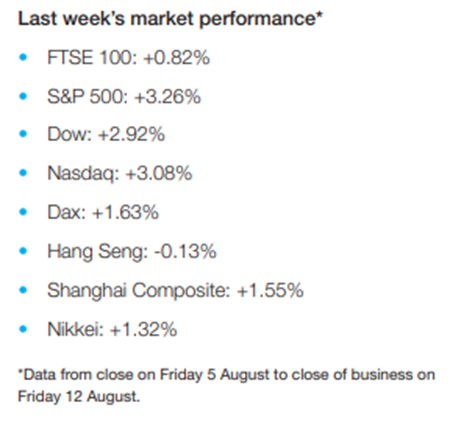
Most major stock markets rose last week as data suggested the rise in US consumer prices may have peaked.

The S&P 500, Dow and Nasdaq surged 3.3%, 2.9% and 3.1%, respectively, as lower-than-projected inflation figures led to renewed optimism that the Federal Reserve will raise interest rates at a less aggressive pace.

Stocks in Europe rallied as industrial production in the eurozone rose by more than expected. Germany’s Dax added 1.6% and France’s CAC 40 gained 1.3%. The FTSE 100 climbed 0.8% as data showed UK gross domestic product (GDP) fell by less than feared in June.

Investor sentiment was also strong in Japan, where the Nikkei added 1.3%. The reshuffling of Japan’s Cabinet signalled policy continuity, with top figures retained in key posts. The Shanghai Composite advanced 1.6% on news China’s trade surplus rose to a new record of $101.3bn for the month July, surpassing the $100bn threshold for the first time ever.

China’s economic data disappoints

Stocks started this week in the green, with the FTSE 100 and S&P 500 edging up 0.1% and 0.4%, respectively, on Monday (15 August). Gains were held back by disappointing manufacturing and retail sales data from China. Industrial production rose 3.8% year-on-year in July, below the 3.9% expansion in June and a 4.6% increase forecast by analysts in a Reuters poll. Retail sales rose 2.7% year-on-year, below the 3.1% growth in June and forecasts for 5.0% growth. China’s central bank responded by lowering interest rates on key lending facilities for the second time this year.

The FTSE 100 rose 0.4% at the start of trading on Tuesday as investors digested the latest UK jobs data. According to the Office for National Statistics (ONS), the real value of workers’ pay dropped by 3.0% in the three months to June, the fastest rate since comparable records began in 2001, as wage increases were outstripped by inflation. Unemployment rose by 0.1 percentage points to 3.8% and the number of new job openings fell for the first time since summer 2020.

US inflation moderates slightly

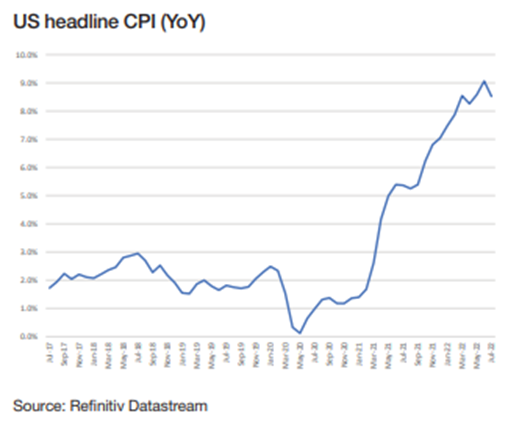
Figures released last week raised hopes that inflation in the US has peaked and started to decelerate. On a monthly basis, the US consumer price index (CPI) was unchanged in July as a fall in gasoline prices offset increases in shelter and food. Food prices rose by 1.1% over the month, whereas gasoline prices declined by 7.7%. On annual basis, CPI eased to 8.5% in July from 9.1% in June, below economists’ expectations of 8.7%. Core CPI – which excludes volatile food and energy prices – was unchanged at 5.9% year-on-year.

Nevertheless, San Francisco Federal Reserve Bank president Mary Daly said it was too early for the US central bank to declare victory in its fight against inflation. In an interview with the Financial Times, she did not rule out a third consecutive 0.75 percentage point rate rise at the next policy meeting in September, although she signalled support for the Fed to slow the pace of its interest rate increases.

“There’s good news on the month-to-month data that consumers and business are getting some relief, but inflation remains far too high and not near our price stability goal,” she stated.

Rising prices hit retail sales and confidence

Here in the UK, figures from the ONS showed the UK economy contracted by 0.1% in the second quarter, led by a large reduction in coronavirus activities, such as NHS Test and Trace and lateral flow orders. Real household expenditure also declined by 0.2%, driven by falls in net tourism, clothing and footwear, food and nonalcoholic beverages, and restaurants and hotels.

The decline in GDP was sharper at the end of the quarter, falling by 0.6% in June. However, this was better than the 1.3% contraction forecast by economists and partly reflected the fact that June saw two fewer working days as a result of the Queen’s Platinum Jubilee.

The Bank of England has forecast that the UK will enter into a recession in the fourth quarter of this year, with output falling in each quarter until the end of 2023.

Eurozone industrial production up 0.7%

Industrial production in the eurozone rose by 0.7% in June from the previous month, following an upwardly revised 2.1% increase in May. This was well above consensus expectations for a 0.2% rise. On an annual basis, production expanded by 2.4%, above the 0.8% increase expected by economists. The rise was driven by an expansion in capital goods and energy output, which more than offset declines in consumer goods output, according to Eurostat.

Elsewhere, however, it was reported that droughts in Europe were hindering energy production, agriculture and river transport. According to Sky News, water levels in reservoirs for hydropower are down in nine countries, including Italy, Serbia, Montenegro and Norway. Water levels in Germany’s Rhine River fell to a new low on Friday, further restricting the distribution of coal, petrol, wheat and other commodities.

Please check in again with us shortly for more relevant content and market news.

Chloe

17/08/2022

Team No Comments

Brooks Macdonald – Daily Investment Bulletin

Please find below, the Daily Investment Bulletin received from Brooks Macdonald this morning – 11/08/2022

What has happened

 Risk appetite was emboldened by one of the largest downside misses to headline CPI in recent history. The equity gains were broad-based with cyclical sectors and technology shares leading the charge as investors wagered that the Fed would need to be less aggressive on monetary policy.

 US CPI Report

 US headline CPI came in at 8.5% year-on-year against expectations of a 8.7% increase and a 9.1% reading for June. If you zoom into the detail, the monthly change was actually negative at -0.02% which is the first monthly fall in over 2 years. As expected, the main driver of this was decline in energy prices and specifically gasoline which was -7.7% lower over the month alone. Core inflation was expected to rise on a year-on-year basis but actually stayed flat at 5.9%, further helping to boost sentiment. Whilst some of the more volatile components of the CPI readings are showing signs of peaking, broad inflationary pressures undoubtedly remain and will take time to filter through to lower median CPI. The Atlanta Fed divides up CPI into ‘flexible’ and ‘sticky’ elements and whilst the flexible reading fell sharply last month, the sticky reading actually saw gains. Words of slight caution but this is unlikely to deter the market which is very much in risk on mode.

 Fed reaction

Bond markets moved quickly to reduce the probability of a 75bp rate hike at the September Fed meeting, with the futures market pricing in a coin toss between that and a 50bp hike. 10-year Treasury yields also fell initially however more hawkish Fed speak ultimately led to the benchmark yield broadly flat for the day. Chicago Fed President Evans said that inflation remained ‘unacceptably high’ and forecast that ‘we will be increasing rates the rest of this year and into next year’. President Kashkari said that he expected a 4.4% Fed interest rate at the end of next year and stressed the commitment of the Fed to bringing down inflation.

 What does Brooks Macdonald think?

 The Fed reaction, warning against inflation complacency, makes absolute sense. The Fed cannot afford for market or consumer inflation expectations to start to rise again after the recent falls. For the time being, investors are happy to look through the more hawkish messaging, expecting this to reversed as we enter 2023 and recessionary risks rear their heads. With central bank forward guidance seemingly dead for the rest of 2022 at the very least, inflation data remains the key determinant of market sentiment, on that basis yesterday is undoubtedly a strong positive for risk assets.

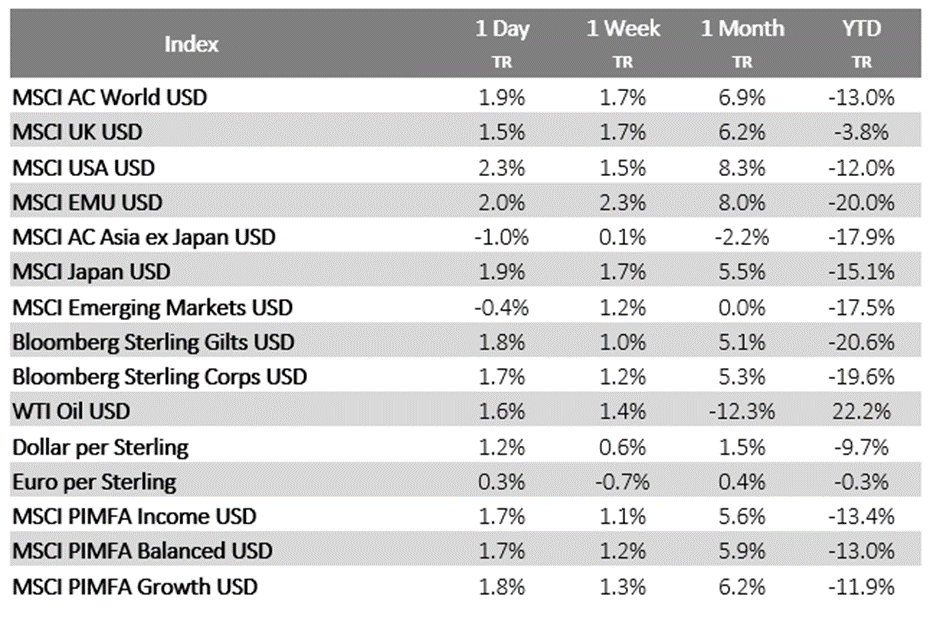
Bloomberg as at 11/08/2022. TR denotes Net Total Return

Please continue to check our Blog content for advice and planning issues and the latest investment, markets and economic updates from leading investment houses.

David Purcell

11th August 2022

Team No Comments

Markets bet on a perfect landing

Please see below article received from Tatton this morning, which reports a surprisingly positive outlook on markets despite high inflation rates, global energy supply struggles and a rising tension between the US and China in relation to Taiwan.

Bad news filled the airwaves last week. Faltering global growth, higher inflation forecasts and rising interest rates set a dour tone – capped off by a geopolitical crisis in Taiwan. UK investors were struck by the Bank of England’s dire warnings: a 13% inflation peak and a protracted recession are now in store for Britons, according to Governor Andrew Bailey. Predicted to last for five quarters, the looming UK recession is set to outlast the one following the global financial crisis in 2008/09. 

Yet despite all that gloom, capital markets have been in surprisingly good spirits. Equities have rallied since the start of July, and bond yields have fallen. As a result, markets have more or less recovered all of their June losses. So, why are investors so unfazed by the current bad news? Judging from bond markets, the feeling is that we have reached peak global inflation. Oil prices have started falling and the actions of oil producers themselves point to a belief that current prices are unsustainable. Supply chain bottlenecks clogged by the pandemic are also improving, while consumer demand has clearly taken a hit from the cost-of-living crisis. The thought is that this will cause a reversal of central bank policy sooner than previously expected, with implied US rates peaking by the end of this year. Investors have essentially given central banks – particularly the US Federal Reserve (Fed) – a vote of confidence. Its policies are expected to prevent a dangerous wage-price spiral while maintaining the economy at a decent level. What’s more, middle-class consumers still have savings to fall back on, while jobs remain plentiful and businesses are more financially sound than in previous downturns. Recessions in most regions are expected to be shallow and brief, while the US might avoid one altogether. 

Monetary policy works on a very long lag, meaning that tweaks to interest rates now will only have an effect a year or so down the line. But if bond markets are to be believed, inflation will already be largely under control by then – meaning further tightening would be overkill. Central bankers want to tame inflation right now, and the only way they can think to do that is by affecting consumer and business behaviour. They will hope that pessimism will stop employees pushing for higher wages, bringing down cost pressures. That is the best-case scenario, and the one markets are currently betting on. Such optimism in bond markets was the main reason for July’s uptick in equity prices – as falling yields made stocks comparatively more attractive. But that positivity is itself a little concerning, as it makes asset prices vulnerable to worse-than-expected news.

There are still many risks to the overall outlook, which are arguably not properly priced-in. Europe is particularly at risk, facing energy shortages and sharply higher costs this winter. This should bring consumer demand down further and eventually cool inflation, but that could take some time. The main source of Europe’s woes is gas supplies, which are very hard to adjust in the short-term, and are highly susceptible to Russia’s war in Ukraine. European businesses could be the hardest hit, as they have less sway over electoral outcomes and are therefore lower down on politician priority lists. 

Markets nevertheless seem to think the inflation battle is already won, and there is a clear path to economic recovery. But none of that is certain, and there are many political obstacles that could get in the way. Governmental paralysis in Britain and Italy could prevent decisive policy action (Conservative MPs have already questioned the Bank of England’s independence in response to its dire forecasts), while US-China tensions over Taiwan are a serious and perhaps under-appreciated risk to global growth. Negative news flow, particularly around energy supplies, could severely dampen market sentiment from here.

Energy profits: here for a good time, not a long time

Oil and gas prices, buoyed by pandemic supply issues and then catapulted skyward by Russia’s invasion of Ukraine, have generated truly astonishing results for the world’s biggest energy companies. Centrica, the owner of British Gas, recently reported profit growth of 500% year-on-year for the first half of 2022. Meanwhile, Shell posted its best ever quarterly profits for Q2 and BP its highest profits in 14 years for the same period. All of this comes while Britons face eye-watering rises in energy and fuel costs. Naturally, the disparity has led to a great deal of negative media coverage.

These profits have naturally benefitted share prices. On a net total return basis, unsurprisingly, Energy is the best performing sector over the last year, by some distance. Bloomberg’s energy index is 28.4% up from a year ago. Utilities, the only other sector to post positive growth over that time, are up just 5.3% by comparison. These moves are made all the more impressive by the negative equity market backdrop in that time. The rise in ‘risk-free’ rates has dampened equity valuations across virtually all industries, and energy is no exception. In fact, on a forward price-to-earnings ratio, energy company valuations have come down more than any other sector. The fact that energy companies have posted the best returns while dropping to the lowest valuations is astonishing, and shows how sharp the recent energy price shock has been. But it also shows investors are much less optimistic about the long-term prospects for energy companies than current results might suggest. Some of this is down to the likely political response: the UK government has already announced a windfall tax on oil and gas companies, and the sharper the contrast between struggling households and booming energy giants gets, the more likely we are to see further taxes – and not just in the UK.

The deeper reason for falling energy valuations, though, are likely to be structural. Russia’s war and the ensuing sanctions delivered the biggest price shock to global energy markets since the 1970s OPEC embargo. Oil and gas supply lines between Russia and the West have been battered and may not ever recover, leading to a sharp squeeze in prices. But over the longer-term, prices are less about what goes where and more about the balance of aggregate supply and demand. That balance has not been fundamentally changed by Russia’s invasion. Russia has a short-term interest in squeezing its European customers – particularly Germany, which has been one of the hardest hit by constrained gas supplies – but has no interest in reducing its oil and gas production over the long term. It has already found many willing buyers in Asia, and will inevitably want to get back to full production and export volumes when it can. Then there is the demand side. The pandemic recovery saw a sharp burst of pent-up energy demand, but this has since cooled off significantly. With looming recession fears, this trend is set to continue. What’s more, the incredible rise in energy prices is already destroying end demand. Come winter, this is likely to mean intense energy saving efforts – with communal heating and power-cuts already being discussed in Germany.

The current price shock will also have implications for the future. Fossil fuel investment measures have been drawn up for the UK and US – which will increase supply some years into the future. More importantly, there is a clear political drive toward increasing renewable or even nuclear energy production. This is part of a much longer-term move away from oil and gas, and the cost-of-living crisis that is rooted in our fossil fuel dependency goes back, has significantly heightened the sense of urgency that already existed from the global warming CO2 side of things. Inevitably, this dampens the long-term outlook for oil and gas demand.

Fossil fuel producers are well aware of this. At their most recent meeting, OPEC+ countries agreed a minimal increase in production despite a seemingly huge price incentive to pump more. This suggests a recognition that current price levels are unsustainable in the face of rising interest rates and a slowing global economy. On the current trajectory, oil supply is likely to outstrip demand within the next four years. As producers see it, increasing production now will just make them more vulnerable to lower prices in the future. With this in mind, lowly valuations for booming energy companies are to be expected. Record oil and gas profits are here for a good time, but not a long time. 

Please check in again with us shortly for further updates and relevant content.

Chloe

08/08/2022

Team No Comments

Brewin Dolphin – Markets in a Minute

Please find below, a market update received from Brewin Dolphin yesterday evening – 02/08/2022

Strong tech earnings boost investor sentiment

Equities rose last week as strong second quarter earnings from technology giants Amazon, Apple and Alphabet boosted investor sentiment.

US indices managed to shrug off news of a contraction in US gross domestic product (GDP) and another 75-basis point (bps) interest rate hike. The S&P 500 gained 4.3%, the Dow rose 3.0% and the Nasdaq surged 4.7%.

The pan-European STOXX 600 and the FTSE 100 advanced 3.0% and 2.0%, respectively, after data showed the eurozone economy expanded by more than expected in the second quarter.

In contrast, Japan’s Nikkei slipped 0.4% after the government downgraded its forecast for economic growth in the fiscal year ending March 2023 from 3.2% to 2.0%, citing slowing overseas demand and rising consumer inflation.

China’s Shanghai Composite eased 0.5% as a high-level meeting of the Communist Party omitted mention of its GDP growth goal and instead said China should “strive to achieve the best possible results”.

 Last week’s market performance*

• FTSE 100: +2.02%

• S&P 500: +4.26%

• Dow: +2.97%

• Nasdaq: +4.70%

• Dax: +1.74%

• Hang Seng: -2.20%

• Shanghai Composite: -0.51%

• Nikkei: -0.40%

*Data from close on Friday 22 July to close of business on Friday 29 July.

US indices fall after best month since 2020

After July proved to be their best month since 2020, US indices fell on Monday (1 August) as investors feared US House speaker Nancy Pelosi’s potential visit to Taiwan could worsen tensions between China and the US. The S&P 500 slipped 0.3%, the Nasdaq lost 0.2% and the Dow shed 0.1%. Asian stocks suffered on Tuesday, with the Shanghai Composite and Hang Seng down 2.3% and 2.4%, respectively, after Beijing reportedly said it would retaliate with “forceful measures” if the trip goes ahead.

In economic news, data from S&P Global showed UK manufacturing output contracted for the first time in over two years in July because of reduced intakes of new work, weaker market demand, difficulties in sourcing components and transport delays.

The FTSE 100 was up 0.1% at the start of trading on Tuesday, while the Dax opened 0.6% lower.

US slips into a technical recession

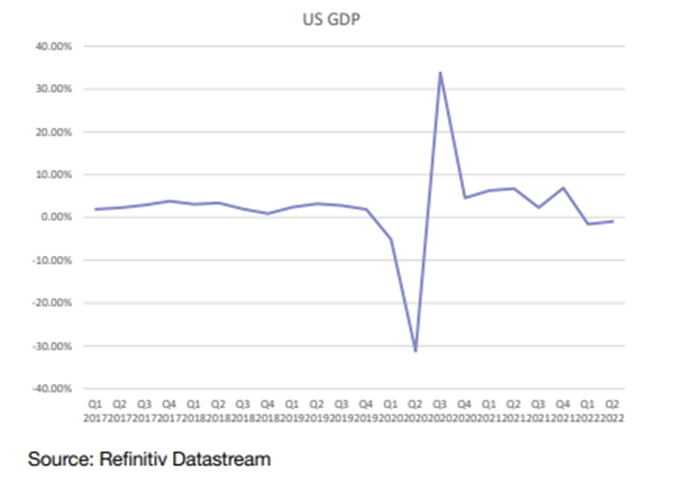
Figures released last week showed the US economy shrank for a second consecutive quarter, meeting one of the most common criteria for a technical recession. GDP shrank by an annualised 0.9% in the second quarter, following a 1.6% contraction in the first quarter, according to the Commerce Department. Economists polled by Reuters had forecast GDP would rebound at a rate of 0.5% in the second quarter.

While back-to-back quarterly GDP contractions meet one definition of a recession, the National Bureau of Economic Research is responsible for making the official call on whether the economy is in a recession. One of the factors it looks at is employment, which remains strong.

Treasury secretary Janet Yellen stated last week: “Most economists and most Americans have a similar definition of recession: substantial job losses and mass lay-offs, businesses shutting down, private-sector activity slowing considerably, family budgets under immense strain. In sum, a broad-based weakening of our economy. That is not what we’re seeing right now.”

Fed hikes rates by another 75bps

The US Federal Reserve approved its second consecutive 75bps interest rate hike last week, taking its benchmark rate to a range of 2.25-2.5%. Investors were largely expecting the move and were cheered by relatively dovish comments by Fed chair Jerome Powell that future rate increases would depend on the data.

“As the stance of monetary policy tightens further, it likely will become appropriate to slow the pace of increases while we assess how our cumulative policy adjustments are affecting the economy and inflation,” he said.

Tourism boosts eurozone economy

In the eurozone, a surge in tourism helped the economy expand by more than expected in the second quarter. According to Eurostat’s preliminary flash estimate, GDP grew by 0.7% when compared with the previous quarter, much higher than the 0.1% growth forecast by economists. France, Italy and Spain all saw an expansion in GDP, whereas Germany’s economy stagnated.

Inflation in the eurozone is expected to hit a new high of 8.9% in July, up from 8.6% in June, driven by price rises in energy and food. There are concerns this could lead to interest rate rises and weigh on growth during the second half of the year. There are also fears that a reduction in gas flows through the Nord Stream 1 pipeline from Russia to Germany could spark a recession.

Elsewhere, the European Commission’s economic sentiment indicator for the euro area fell from 103.5 in June to 99.0 in July, below its long-term average. Industrial confidence fell by 3.5 points, while sentiment in the services sector declined by 3.4 points.

UK consumer borrowing doubles

Here in the UK, data from the Bank of England showed consumers borrowed a net £1.8bn in June, double the £0.9bn in May, most of which was on credit cards. The annual growth rate for consumer credit rose to 6.5%, the highest level since before the pandemic.

The figures have raised concerns that people are resorting to borrowing to fund the rising cost of living. Gas and electricity bills for some of the most vulnerable households could reach an average of £500 a month in January, according to BFY Group, an energy management consultancy.

Please continue to check our Blog content for advice and planning issues and the latest investment, markets and economic updates from leading investment houses.

David Purcell

3rd August 2022