Team No Comments

Why gloomy US jobs data didn’t derail the market

Please see the below article from AJ Bell:

The point at which the Federal Reserve could start tapering bond purchases might have been kicked down the road.

The US equity markets have remained resilient in the face of poor US non-farm payroll growth in August. The consensus estimate was for an increase of 735,000, however the reported figure was just 235,000.

Two factors explain the market’s apparent irrational exuberance to what appears at first glance to be a very bearish jobs report.

First, the media has focused on one specific aspect of the report, which presents an overly dismal picture of the American jobs market. A more detailed and stoic examination of the data depicts a more optimistic scenario.

Second, the apparent weakness in the jobs data is likely to prompt the Federal Reserve to postpone any plans for tapering bond purchases that are part of its economic support measures, which is likely to underpin current equity valuations.

While the August headline non-farm payroll figure was distinctly disconcerting, other aspects of the jobs report were far more encouraging.

The unemployment rate fell to 5.2% in August from 5.4% in July. Moreover, wages continued to grow, increasing 4.3% on a year-on-year basis, and 0.6% on a monthly basis. This compares with estimates for 4% and 0.3% respectively. In addition, the job gains for July were revised up to 1.1 million.

Another potential source of optimism relates to labour shortages. The removal of additional unemployment insurance payments is likely to act as a catalyst for workers to re-enter the jobs market. Better access to childcare as schools reopen should also remove a further obstacle for individuals hoping to get back into work.

Keep checking back for more of our regular blog content including market insights and views from some of the world’s top investment managers.

Andrew Lloyd DipPFS

10/09/2021

Team No Comments

Daily Investment Bulletin

Please see below, Daily Investment Bulletin, received from Brooks Macdonald yesterday afternoon, which provides information on economic developments impacting European and US markets.

What has happened

Monetary policy and COVID provided the drum-beat for investors on Tuesday. In Europe, markets fell as investors appeared to be nervous around the chances that the European Central Bank (ECB) might taper from its current ‘significantly higher’ level of PEPP (Pandemic Emergency Purchase Programme) asset purchases when ECB governors meet on Thursday. Meanwhile, over in the US, markets were similarly weak as the COVID delta variant continued to weigh on sentiment in the wake of last week’s weaker US jobs report. At a sector level, technology stocks were a relative outperformer on the day.

UK government signals tax rise on workers, businesses and shareholders

UK prime minister Johnson announced a tax hike for workers, businesses and shareholders on Tuesday. Billed as necessary to help support the NHS as well as social care spending needs, national insurance, which is tax on earnings, will rise by 1.25% from April 2022 for both employees as well as employers. As the Institute for Fiscal Studies noted on Tuesday, ‘it is really a 2.5 per cent tax rise on earnings … today’s announcements constituted a Budget in all but name’. The Institute of Directors also rounded on the tax plan this week, calling it ‘an extraordinary time to be considering adding to the cost of employing people’. As well as the increase to national insurance tax, there is also a hike on dividend tax with an increase of 1.25%. According to the plans announced, from April 2023, national insurance tax rates will revert back to the current level and the rise will be replaced by a new dedicated ‘health and social care levy’, which will become a separate tax on earned income from April 2023. Separately, the government also confirmed on Tuesday that the ‘triple-lock’ formula for annual state pension increases would be suspended for one year. Instead, the calculation will be based on the greater of 2.5% or inflation, while the third component of average wage increases would be disregarded for one year.

US plans COVID ‘six-pronged strategy’

On Tuesday it was confirmed by White House press secretary Psaki, that US President Biden would later this week on Thursday outline a ‘six-pronged strategy’ and which would involve ‘working across the public and private sectors to help continue to get the pandemic under control’. The announcement is likely to include an update on the plans, initially announced in August, around delivering COVID vaccine ‘booster jabs’ likely later this month. According to US CDC’s vaccine tracker (US Centers for Disease Control and Prevention), 75% of US adults have now had at least one vaccine dose.

What does Brooks Macdonald think?

The UK rise in national insurance contributions breaks a key Conservative manifesto pledge not to increase any of the main rates of tax. That said, it’s worth remembering that this promise pre-dates the COVID pandemic which went on to up-end many governments’ spending plans around the world. In terms of what it means for markets, perhaps more significant is the broader cadence from policy makers, in that following the unprecedented levels of fiscal support during the pandemic last year, this year, fiscal prudence seems to be the dominant theme. At the edges, this also perhaps adds a bit of a headwind for those investors looking for a sustained fiscal impetus to drive a durable reflationary narrative. As we have said before, with 2021 being a year of transition, this is not the year to try to decisively swing the asset allocation ‘bat’ behind any one particular investment style. Instead, balance in portfolios remains key.

Source: Bloomberg as at 08/09/2021. TR denotes Net Total Return.

Please check in with us soon for further relevant content and market news.

David

9th September 2021

Team No Comments

LGIM Asset Allocation Team

Please see below the latest article from the Legal & General Asset Allocation Team which was received on 06/09/2021 and details their thoughts on markets:

Dancing in the dark

Markets remain in a holiday mood. The narratives on which we are focusing are slow-moving – inflation, the Delta variant, and the usual politics and economic datapoints. Could it be that investors are dancing in the dark, totally oblivious to the risks out there?

As with all Key Beliefs emails, this email represents solely the investment views of LGIM’s Asset Allocation team.

Relax

The Jackson Hole symposium is supposed to be a largely academic affair, but it excites investors as we’ve had a few shock policy announcements in the past.

This year, though, Federal Reserve (Fed) chair Jay Powell choose to relax investors. He doubled down on the view that inflation is likely to prove transitory, and gave five reasons to believe recent elevated readings could be temporary:

1) The lack of breadth behind the inflation spike. We largely agree with this assessment. However, we will be watching carefully should we see signs of broadening, especially in traditionally more sticky services.

2) Moderating inflation in pandemic-sensitive components. No dispute from us here. Used-car prices appear to have flattened off and indeed we expect them to become a large drag on inflation in 2022 as prices fall back to more normal levels.

3) Wages that remain consistent with inflation goals. While true, it is surprising that wages have not been weaker given the rise in unemployment. With demand expected to continue growing well above trend, if participation fails to fully recover the danger is that wage pressures intensify next year.

4) Stable long-term inflation expectations. Again true, but our research finds that the formation of inflation expectations is largely adaptive, so the risk is that the longer actual inflation remains elevated the more it might begin to place upward pressure on inflation expectations.

5) Global disinflationary pressure. Powell believes there is little reason to think this has suddenly reversed or abated. We nevertheless find evidence that some of the factors could be moderating, as globalisation seems less intense with countries increasingly looking inward and becoming more protectionist. Fiscal policy, while not yet fully embracing modern monetary theory, appears far less disciplined. Finally, and perhaps most important, is the shifting behaviour of central banks, led by the Fed. Its new framework is a commitment to run the economy hot, partly because it believes continued global disinflationary pressure and well anchored inflation expectations will ensure any inflation increase is so gradual it will have time to adjust policy smoothly.

All in all, Powell could well be proved correct. We also expect inflation to fall back to target for a while next year, but risks to this sanguine inflation outlook appear to the upside.

The power of love

If you ever need a clear example of the power of Strategic Asset Allocation (SAA), compare the performance of UK mid-cap managers versus US large-cap managers over the five years ending June 2020. The best-performing UK managers achieved 36.7%, while the worst-performing US large-cap manager performed slightly better with a 36.8% return. SAA drives portfolio returns, plain and simple!

There are many different models for SAA, some developed by Nobel Prize-winning economists. One unique point about our SAA approach is that we don’t believe it makes sense to presume that one model is able to capture the ever-changing complexity of financial markets well enough. We try to learn and take something from many different models.

For instance, the Yale model gets lots of attention among investors. It is heavily invested in absolute-return strategies and illiquid assets, and has hardly anything in standard asset classes like government bonds and equities. It helps that the endowment does not run daily or weekly liquidity funds and can spend a lot on fees and governance. We see the value of alternatives as well. They form an important and differentiating part of our strategies, but we look for solutions that fit daily liquidity and a more limited fee budget.

Finally, when it comes to building an SAA portfolio, we believe it is all about seeking exposure to the rewarded risks in a (cost) efficient way, getting rid of unrewarded risks, and trying to prevent a dangerous concentration of risks.

As with most things in investment, SAA is more an art than a science and investors should be wary of putting all their money in one model.

Back to life, back to reality

Perhaps surprisingly given the rally we have seen in equities and the narrative moving at a snail’s pace over the summer, consensus positioning isn’t that extreme.

One of our favourite sentiment indicators, the ‘bull minus bear’ survey of the American Association of Individual Investors, is flagging quite neutral sentiment.

The reality is that many people remain cautious. In our view, the most prevalent worries are:

1) Valuations. People usually point to absolute equity valuations, which indeed are scary, but we think valuations relative to bonds matter most.

2) Potential for rising inflation and interest rates. Though inflation is one of our key worries, we are more relaxed about the downside risks to equity markets from rising inflation and interest rates.

3) Peak growth momentum. The Delta variant and its rolling impact on growth is front of mind for many investors. Although growth momentum is fading, that needn’t necessarily take equities lower. Earnings momentum remains favourable, allowing valuations to drift lower while markets grind higher.

We therefore believe the bullish market case remains in place: the economy seems mid cycle, with massive excess savings, quite neutral positioning, and committed support from central banks.

Please continue to check back for our latest blog posts and updates.

Charlotte Ennis

08/09/2021

Team No Comments

Weekly Market Commentary – Spanner in the works from the US Jobs Report

Please see below commentary received from Brooks Macdonald yesterday evening, which presents market analysis following the European Central Bank’s latest monetary policy meeting. 

This week begins with a holiday Monday in the US for Labor Day, with markets closed in the country. In reality, this is just a brief respite before the pace picks up a gear, and there’s quite a lot to keep investors focused. 

The big event this week is the ECB’s latest monetary policy meeting due on Thursday, where attention will be on whether or not they decide to start to taper back their recent higher-level of asset purchases. Elsewhere, we also have central bank policy decisions from Australia (on Tuesday), and Canada (on Wednesday). 

The recent US Jobs Report significantly missed expectations

In the US, investors will be trying to figure out what last week’s US jobs miss means for the Federal Reserve (Fed) and for the timing of any tapering decision. Later this week, the US Producer Price Index (PPI) is due on Friday, which sets up the inflation-focus ahead of US Consumer Price Index (CPI) due the following week. Finally, according to recent reports from Bloomberg, US President Biden might decide this week who is going to be the next Fed Chair. Powell’s current term as Chair ends in February next year, but expectations are that he is likely to get a second term, not least given reports last month that US Treasury Secretary and former Fed Chair Janet Yellen has endorsed Powell’s renomination.

Just as markets had digested Fed Chair Powell’s Jackson Hole script, Friday’s US jobs report has put a bit of a spanner in the works. A week ago, Powell had indicated that with an inflation goal already met and an employment goal in sight, the Fed might soon start to taper its $120bn a month of asset purchases. But then Friday happened, and US non-farm payroll data showed just 235,000 jobs added in August. This is a big miss, given markets had been expecting a print more than three times bigger, versus 725,000 expected1

It was also well outside of the bottom of the forecast range (of 400,000 to 1 million). To put it in context, despite a positive revision to July, this was the lowest monthly jobs add in seven months. Behind the weakness, there was a sharp slowdown in hospitality and retail job creation. Employment in ‘retail trade’ declined over the month by 29,000 jobs, and there was also a loss of 42,000 jobs in ‘food services and drinking places’2. As the US Bureau of Labor Statistics report noted, ‘employment in leisure and hospitality is down by 1.7 million, or 10.0 percent, since February 2020.’ All in all, it’s hard not to see how this report will give some support to the view that the COVID-19 Delta variant is having an impact on both the pace of the economic recovery and the labour market recovery. In terms of how it might influence Fed-thinking, it will be interesting to see what Fed members say about the jobs report, and this week, we have a number of scheduled Fed-speaker events worth keeping an eye on. 

Investors will look to see if the ECB will slow down the Pandemic Emergency Purchase Programme (PEPP)

The highlight for markets this week will be the ECB’s latest monetary policy decision due on Thursday, along with ECB President Lagarde’s press conference that follows the statement as usual. The big question for investors is whether or not the ECB will decide to slow down the recent ‘significantly higher’ rate of Pandemic Emergency Purchase Programme (PEPP) purchases into calendar Q4. In the last week or so, we’ve seen a more public airing of views from both hawkish and dovish ECB governing members. On the outlook for inflation, on the one hand we’ve seen Germany’s Bundesbank chief Weidmann saying ECB members shouldn’t disregard the risk that inflation could accelerate faster than currently anticipated. Against this, ECB chief economist Philip Lane, who recently argued that inflation surprises still did not challenge his views about the temporary nature of price pressures as wage growth, remained muted in his view. All in all, it’s difficult to come down on one side or the other ahead of Thursday.

With the miss in the US jobs report, it is perhaps inevitable that investors will worry that a resurgent COVID-19 infection picture is impacting on the pace of the US economic growth recovery. As for the monetary policy outlook, for the Fed to green-light a future taper programme, the labour market needs to show continued improvement, and Friday’s print won’t have helped that cause. At the end of the day, we have to keep in mind that it’s only one data point. Instead, it now leaves the focus for markets on the Fed’s next monetary policy meeting later this month, on 21 – 22 September. However, the odds that the Fed will press the button on a taper start-date at this September’s meeting are now a little bit longer.

Please check in again with us soon for further news and relevant content.

Stay safe.

Chloe

07/09/2021

Team No Comments

Powell reassures markets that the Fed wont rush rate hikes

Please find below an update from Invesco, received late on Friday, reassuring markets that the Fed won’t rush rate hikes.

Kristina Hooper, Chief Global Market Strategist, Invesco Ltd

Key takeaways

Some Fed officials took a hawkish tone

At Jackson Hole, several Federal Reserve officials were emphatic that tapering needs to begin – and soon.

Powell’s remarks calmed markets

But Powell offered a kinder, gentler view of tapering, declining to establish a timeline.

No rush on rate hikes

Powell also noted that rate hikes have a more stringent set of conditions and are uncoupled from tapering plans.

Last week — in the dead of August — the Kansas City Fed held its annual Jackson Hole Symposium. In a true sign of the times, the symposium was not actually held in Jackson Hole this year, as had been originally planned; instead, it was held virtually. This underscored the reality that things are not back to normal.

Some Fed officials took a hawkish tone

In the run-up to Federal Reserve Chair Jay Powell’s speech, several Fed officials were emphatic that tapering needs to begin soon. Kansas City Fed President Esther George said she expects the Fed to start tapering shortly. Dallas Fed President Robert Kaplan called for tapering to be announced by September and to begin by October or soon thereafter. Perhaps most surprising — and most hawkish — were the words of St. Louis Fed President James Bullard.

Bullard worried that the Fed’s balance sheet expansion is creating a housing bubble. He said that the tapering process should be finished by the end of the first quarter. What’s more, he articulated serious concerns about inflation; he seems sceptical that inflation is actually transitory and argued that by March 2022, the Fed would be able to assess whether inflation had moderated. He suggested that if inflation hadn’t moderated, the Fed would have to get “more aggressive,” which I would presume to mean rate hikes, and that would be sooner than expected. Not surprisingly, these hawkish comments rattled markets.

Powell’s remarks calmed markets

But then came Powell’s speech, and markets breathed a sigh of relief.  It’s true that things are certainly not back to normal, and Powell made that clear. He recognized that the pace of the recovery has exceeded expectations — and has been far swifter than the recovery from the Great Recession, with even employment gains having come faster than expected. However, he underscored the unusual nature of the recovery – he described it as “historically anomalous” — with personal income actually having risen. He said that while labour conditions had improved significantly, they were still “turbulent.” And of course, he pointed out that the economic recovery is being threatened by the resurgence of the pandemic.

Powell also underscored the unevenness of the economic recovery, that the Americans least able to carry the burden are the ones who have had to do just that. He emphasized that the services sector has been disproportionately affected, noting that total employment “is now 6 million below its February 2020 level, and 5 million of that shortfall is in the still-depressed service sector.”1

A kinder, gentler tapering

While George, Kaplan and Bullard took a more hawkish stance on tapering, Powell offered a kinder, gentler view. He recognized that the “substantial further progress” test for inflation had been met, but did not announce the start of tapering, or even call for it to be announced by September. He acknowledged that at the July Federal Open Market Committee (FOMC) meeting, most participants believed it would be appropriate to taper this year. And he recognized that in the month since the last FOMC meeting, there has been more progress on the economic front — but that there has also been further spread of the COVID-19 Delta variant. My read on this is that tapering is likely to be announced soon, but that Powell would like to maintain some flexibility given the uncertainties presented by COVID.

Powell seemed more certain in his assessment that inflation is largely transitory. He offered up compelling arguments to support that view, especially pointing to longer-term inflation expectations remaining anchored. I found this gave credibility to his more dovish stance.

The key takeaway: A ‘conscious uncoupling’

Powell channelled his inner Gwyneth Paltrow in asserting that rate hikes are uncoupled from tapering. In other words, he suggested that we shouldn’t expect rate hikes to begin just because tapering has ended. He asserted that rate hikes have a different and far more stringent test: “until the economy reaches conditions consistent with maximum employment and the economy is on track to reach 2% inflation on a sustainable basis.”1 This was perhaps the most important takeaway from the speech, given that markets seem far more concerned with when rate hikes will begin rather than when tapering will begin.

Looking ahead

All eyes will be on the August jobs report, due out at the end of this week. There are whispers that this could be a blowout with more than 1 million non-farm payrolls created. If that happens, I believe the Fed would be even more comfortable announcing tapering in September and starting to taper in October.

Further off into the distance, questions are swirling about whether Powell will be re-nominated as Fed Chair. While I suspect there may be a little grumbling from the extremes on both aisles of Congress, my money is on his re-nomination. However, speculation about this — and the future of the vice chairs (the vice chair and the vice chair for supervision) — will certainly occupy some markets watchers’ time in the coming months.

Please check in with us soon for further relevant content and market news.

David

6th September 2021

Team No Comments

A.J. Bell – Reasons why stock market moved higher on latest Fed news

Please see below an article from A.J. Bell, which was received late yesterday (02/09/2021) afternoon and details their thoughts on how Fed news flows helped investors remain bullish:

As you can see from the above, the consensus is that the current escalation in prices will be transitory and an interest rate hike is not imminent, although when the US economy reaches conditions consistent with maximum employment, it is possible interest rates will increase.

Please continue to check our Blog content for advice and planning issues and the latest investment, markets and economic updates from leading investment houses.

Please keep safe and healthy.

Carl Mitchell – Dip PFS

IFA and Paraplanner

03/09/2021

Team No Comments

Markets in a Minute – Stocks rebound as Fed calms rate hike fears

Please see below ‘Markets in a Minute’ article received from Brewin Dolphin yesterday evening, which provides up to date analysis on rising global stock markets.

Global stock markets rose last week as the US Federal Reserve signalled that interest rate hikes are still a long way off despite the recent rise in inflation.

The Nasdaq surged 2.8% and the S&P 500 gained 1.5%, with full approval of the Pfizer vaccine helping to offset concerns about the attack at the Kabul airport in Afghanistan. A surge in crude oil prices boosted energy stocks.

In Europe, the STOXX 600 added 0.8% amid encouraging economic data and comments from the European Central Bank that high inflation should prove temporary. The UK’s FTSE 100 also rose, despite figures showing a marked slowdown in the services sector.

Over in Asia, Hong Kong’s Hang Seng recovered from the previous week’s rout to gain 2.3%. Japan’s Nikkei also performed strongly, adding 2.3% despite another extension to the country’s Covid-19 state of emergency.

US indices reach record highs

US stocks started this week in the green amid ongoing optimism that the Federal Reserve will not immediately taper its support for the economy. The S&P 500 and the Nasdaq hit new record highs on Monday (30 August), ending the day up 0.4% and 0.9%, respectively. August was the S&P 500’s seventh consecutive month of gains – its longest winning streak since a ten-month run ending in December 2017.

The FTSE 100 struggled for direction on Tuesday, slipping 0.4% during its first trading session following the bank holiday weekend. The pan-European STOXX 600 also slipped 0.5% after data showed consumer price inflation rose by 3.0% in August – the highest level since 2011.

The FTSE 100 was up 0.8% at the start of trading on Wednesday, ahead of the release of the closely watched US ADP jobs report.

Fed clarifies position on interest rates

Last week’s economic headlines were dominated by Fed chair Jerome Powell’s speech at the Jackson Hole symposium, in which he signalled that while the central bank could begin dialling back its support for the economy later this year, interest rate hikes are still a long way off.

The Fed has repeatedly stated that it will maintain its pace of asset purchases until it sees ‘substantial further progress’ towards its goals of 2% inflation and maximum employment. On Friday, Powell said the first of these thresholds has been met, and clear progress has been made on the second.

Powell reiterated his view that the recent rise in inflation will prove temporary, and insisted that any tapering of economic support would not be a direct signal to increase interest rates. (Higher interest rates are a headwind for stocks because bond yields rise, making stocks look less attractive in comparison.)

UK business output growth slows

Here in the UK, figures suggested growth in the manufacturing and services industries slowed in August amid staff shortages and supply chain constraints. IHS Markit’s preliminary composite purchasing managers’ index (PMI) measured 55.3 in August, down from 59.2 in July. The reading was still above the 50.0 mark that separates growth from contraction, but marked the slowest expansion of output since the UK private sector returned to growth in March.

The services sector suffered the biggest loss of momentum, falling to 55.5 in August from 59.6 in July. Manufacturing output slipped to 54.1 from 57.1 the previous month.

Chris Williamson, chief business economist at IHS Markit, said: “Although the PMI indicates that the economy continues to expand at a pace slightly above the pre[1]pandemic average, there are clear signs of the recovery losing momentum in the third quarter after a buoyant second quarter. Despite Covid-19 containment measures easing to the lowest since the pandemic began, rising virus case numbers are deterring many forms of spending, notably by consumers, and have hit growth via worsening staff and supply shortages.”

Eurozone economy keeps expanding

In contrast, business activity in the eurozone continued to grow in August at one of the strongest rates of the past two decades. Despite supply chain delays, the IHS Markit flash eurozone composite PMI held close to its 15-year high, slipping slightly from 60.2 in July to 59.5 in August.

Growth in the services sector overtook that of manufacturing for the first time since before the pandemic, as lockdown restrictions continued to ease. At 59.7, service sector growth was only marginally lower than July’s 15-year high. Manufacturing output also remained strong at 59.2, down slightly from 61.1 in July.

The report showed inflation in input costs and selling prices remained elevated, although the European Central Bank’s chief economist, Philip Lane, sought to allay fears by telling Reuters that recent inflationary pressures are likely to prove temporary.

China to cooperate on US auditing

Elsewhere, China’s securities regulator said it will ‘create conditions’ to cooperate with the US over how it supervises the auditing of Chinese companies, potentially signalling the end of a long-running dispute between the two countries. Previously, China refused to let US securities regulators inspect the financial audits of its US[1]listed companies on the grounds they could hold state secrets. Earlier this year, Chinese firms were warned they could be delisted if they refused to comply with the US audit rules, raising concerns the two countries’ financial systems could become decoupled.

According to the South China Morning Post, the China Securities Regulatory Commission hasn’t yet released details on how audits will be made more transparent.

Please check in again with us soon for further relevant content and market news.

Stay safe.

Chloe

02/09/2021

Team No Comments

Blackfinch Group Monday Market Update 30/08/2021

Please see below for Blackfinch Group’s latest Monday Market Update Article, received by us yesterday 31/08/2021 due to the Bank Holiday:

UK COMMENTARY

  • Recruitment company Hays warned of “clear signs” of skills shortages worldwide and said hiring woes were pushing up wages in some hard-hit sectors. It also noted salaries are rising in certain industries as employers seek to attract and retain staff, particularly in the technology and life sciences sectors.
  • British car factories produced the fewest cars for any July since 1956 as they struggled with worker absences and the global shortage of computer chips. UK carmakers made 53,400 vehicles in July, a 37.6% drop when compared with July 2020, according to data from the Society of Motor Manufacturers and Traders (SMMT), the industry’s lobby group.

US COMMENTARY

  • The Chair of the US Federal Reserve (Fed), Jerome Powell, expressed concern about rocketing COVID-19 infections and was cautious on when it would start easing back on its stimulus programme. Powell’s remarks were far less hawkish than some Wall Street analysts had expected, and had a positive instant impact on the financial markets.
  • A new survey from the University of Michigan showed weakening US consumer confidence. Its consumer sentiment index fell from July’s final reading of 81.2 to 70.3 in August, the lowest recorded since December 2011.

EUROPE COMMENTARY

  • Rising prices, and the increase in COVID-19 cases, have knocked consumer confidence in Germany, the eurozone’s largest economy.
  • Figures released by Destatis showed that the German government’s efforts to fight the pandemic saw its budget deficit expand  by €80.9bn in the first six months of 2021. That’s equal to 4.7% of GDP, and the highest reading since 1995.

ASIA COMMENTARY

  • Sentiment was weighed down by weaker-than-expected August Purchasing Managers’ Indices (PMIs) from China. The non-manufacturing PMI fell to 47.5, the first sub-50 reading since February 2020 (a sub-50 reading represents a contraction), which was below the 52.0 expected and down from 53.3 in July. Several factors were behind the slowdown, including further lockdowns to control the spread of the Delta variant, flooding in some regions, and ongoing regulatory changes that have impacted domestic wealth.

Please continue to utilise these blogs and expert insights to keep your own holistic view of the market up to date.

Keep safe and well

Paul Green DipFA

01/09/2021

Team No Comments

Over 50s leaving work early could hit retirement plans…and cost the UK economy £88 billion

Please see the below article published by AJ Bell:

The early exit of people aged between 50 and state pension age from the workforce has a significant impact on both individual retirement plans and the wider economy. In fact, it could be costing the UK as a whole as much as £88 billion, according to the latest ONS figures.

While in some cases stopping work early will be a voluntary decision – for example as a result of early retirement – in other situations it will be less voluntary, such as ill-health.

Worryingly, although perhaps not surprisingly, people who work in low-paying or physically intensive sectors are six times more likely to stop working before state pension age because of ill-health than those working in other professions.

What’s more, women are more likely to stop working early than men, potentially further perpetuating the gap in pensions between the sexes.

Stopping working in your 50s – when in theory your earning power and ability to save should be at its highest – could also have a significant impact people’s retirement outcomes.

In many cases it will mean making your retirement income stretch for much longer, meaning you have to live for less in your later years.

It also potentially impacts on people’s health and wellbeing. For all those reasons, supporting people in their 50s to stay in work for longer should be an absolute priority for policymakers.

Our Comment

It’s never too soon to prepare for retirement, for most of us a well-earned stage in your life.

When planning for retirement it’s not just about having enough money – although this is important. You need to be ready for retirement emotionally.

Retirement may take many forms for different people. There is no right or wrong approach. It’s useful to be prepared and flexible in our approach.

Retirement is a stage that transforms an individual’s life. Retirement can be viewed as a time when people cease employment and engage in activities other than a job or career related work.

Politically, for our policymakers, we need cross party consensus and buy in to a long-term strategy for pensions and retirement planning.  You can’t plan for these long-term issues with a short-term political focus from any party.

Policies need to take account of all of the issues and buy in doesn’t just need to be from different parties but also from different areas of government, the Treasury, the DWP etc.

We also need stability, particularly in long term planning issues such as pensions.  People need to know that the legislation in place is long term to have the confidence we need in pensions.

Andrew Lloyd DipPFS

31/08/2021

Team No Comments

Value of the Vaccine’s

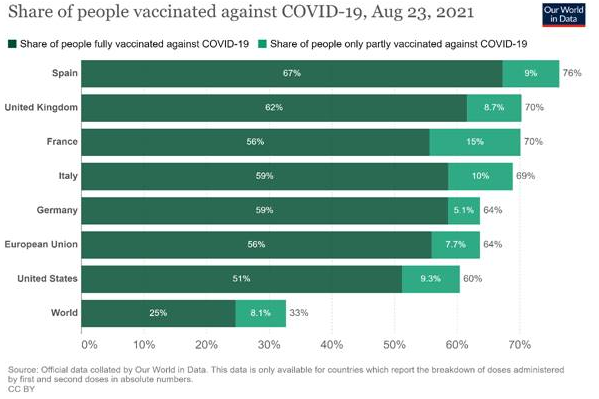
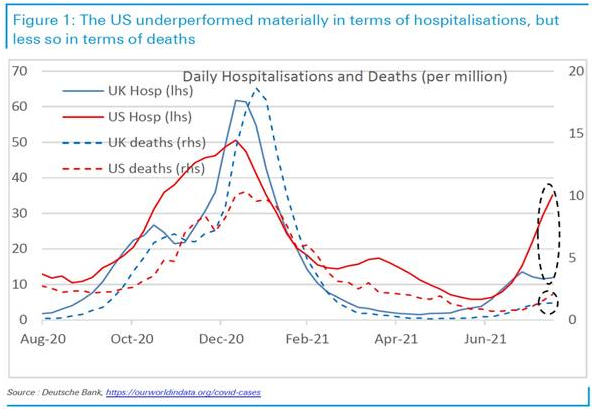
The below charts show some interesting data on the Covid-19 vaccine rollout programme.

Here in the UK, the NHS has had one of the most successful vaccine rollouts in history.

As of this week, nearly 90% of the population aged 16 or over have had their first vaccine, with 75% also having their second vaccine.

As you can see from the first chart, we are only second in the world behind Spain in terms of our rollout.

Fund managers, Brooks Macdonald, commented on 20/08/2021, ‘In low-income populations, you see a very low level of vaccine penetration, only 1.1%. Vaccine inequality is likely to persist.’

Comment from People and Business IFA

You can see that the vaccine roll out is key to how an economy might perform as it tries to re-open.  The age range fully vaccinated is important, as this impacts on the number of hospitalisations and deaths.

The chart above is showing a steep increase in hospitalisations in the US.  In turn it looks like the death rate in the US is starting to rise too.  Why is this?  It looks like it’s a political issue, with a huge divide between states, the Republicans have vaccine hesitancy.

With the lower take up rates of vaccines by both the elderly and the vulnerable in Republican states this is pushing up the hospitalisation rates now.

In Emerging Markets, the low rates of vaccination are creating supply chain issues.  You will have seen this covered in the media with the shortage of microchips slowing down automotive production globally.

The good news is that economies are recovering, inflation does appear to be transitory and both Central Banks and governments remain supportive for now.  We face headwinds, known and unknown, but if you would have asked me in March/April 2020 where we would be now this would have been the best outcome for markets and economies.

Steve Speed

27/08/2021