Team No Comments

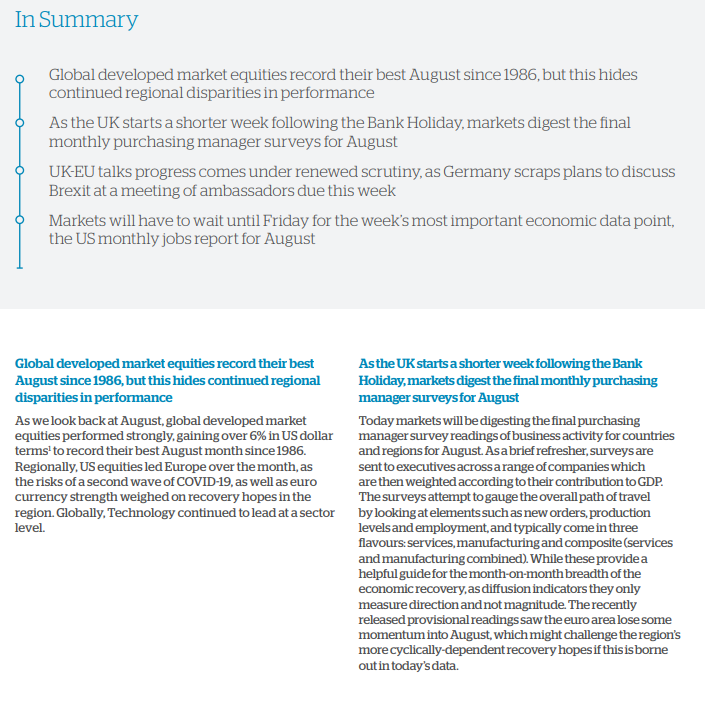
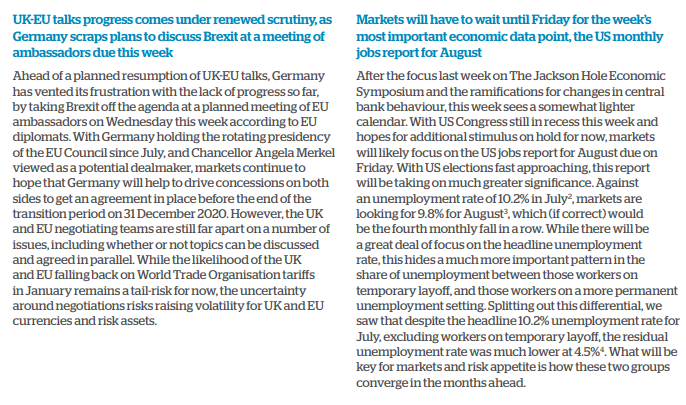
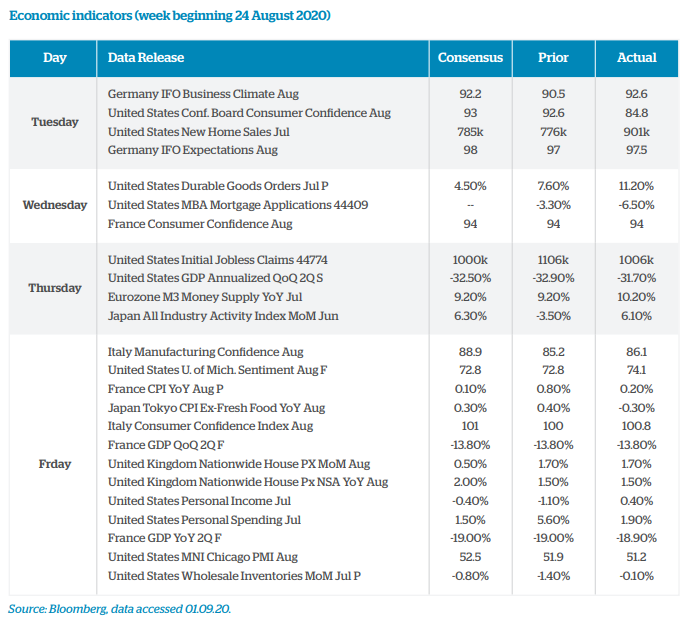
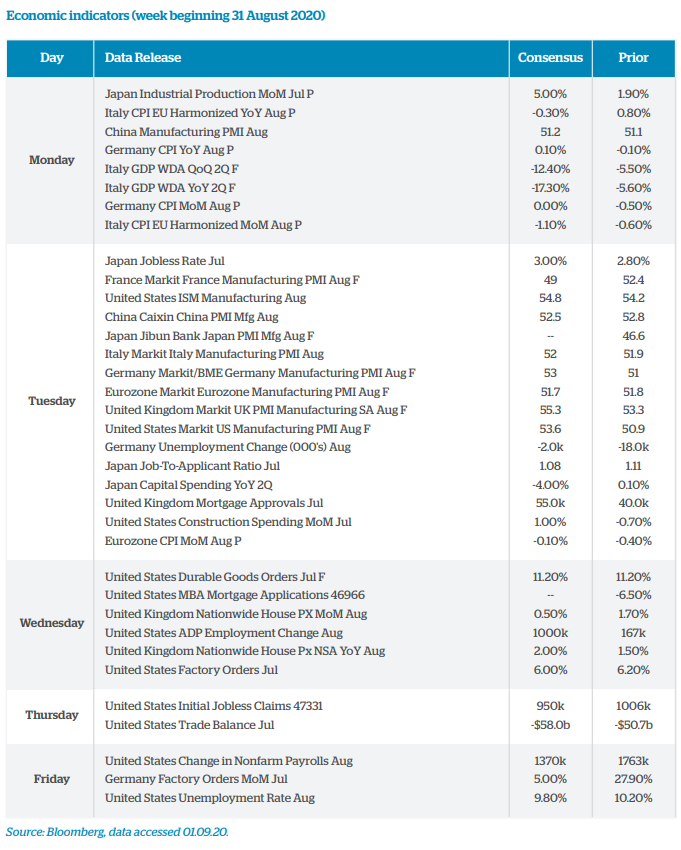
Brooks Macdonald – Weekly Market Commentary

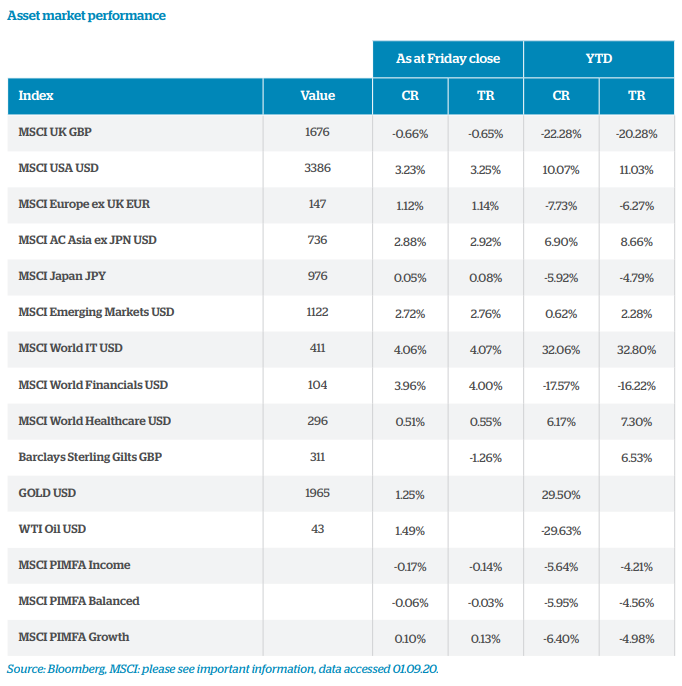
Please see below an article published yesterday (02/09/2020) by Brooks Macdonald, which outlines their latest views on markets:

Please continue to check our Blog content for advice and planning issues and the latest investment, markets and economic updates from leading investment houses.

Please keep safe and healthy.

Carl Mitchell – Dip PFS

IFA and Paraplanner

02/09/2020

Team No Comments

Legal & General: Asset Allocation Team’s Key Beliefs

Please see the below date from Legal & General’s Asset Allocation Team received late yesterday afternoon:

Waking up

Last week was a bit more eventful than the big yawn of the previous week. Rates and inflation expectations drifted up, even more so after Federal Reserve chair Jerome Powell’s speech at the Jackson Hole Economic Policy Symposium indicated the central bank will now look to achieve an inflation rate averaging 2% over time. In addition, Shinzo Abe, the longest-serving Japanese prime minister since the Second World War, resigned and Germany, France, Italy and Spain all experienced accelerating case loads of COVID-19. James Carrick has blogged about developments in the latter country.

Investors can’t get too excited

Overall, sentiment and positioning remain quite neutral. For instance, one of our favourite indicators, the AAII Bull-Bear spread, is still negative and fund-manager cash levels are only neutral. Even sentiment in technology stocks isn’t that exuberant, as I discuss below.

We believe market sentiment is being held back by the general belief that assets have overshot fundamentals. We see some rationale for that in equities, credit and gold. Growth expectations are at their highest since December 2009, albeit from a very low base, and the economic surprise index – which is mean reverting by nature – is close to an all-time high. As investors adjust their expectations up, the market is now more prone to disappointments.

We therefore remain neutral on risk, but are starting to short areas where risks look asymmetric – US investment-grade credit, for example, and EU/GBP inflation. Our rates team likes to be long some markets with higher yields such as Australia, South Korea, and the long end of the US.

What the tech is going on?

It has been another good run for tech. The sector is back at its relative highs from July and, whisper it quietly, even the dotcom bubble’s relative highs from 2000 don’t look that far away anymore. The price charts for some tech names are starting to look exponential.

So is it time to sell the rally or hold on for the ride? We have long had two guiding principles for tactically reducing our tech position: excessive valuations and/or excessive bullishness. Neither signal has turned red yet.

On the first, outperformance has been driven by superior earnings rather than by valuations. In fact, the relative price-to-earnings ratio remains roughly where it was in January. Staying long tech requires a belief in a step change in relative earnings, but in principle this does not feel like a big stretch.

On sentiment, it is impossible to argue that tech is a particularly unpopular sector. But we don’t see signs of excessive bullishness either. The most recent institutional investor surveys actually showed a small decline in positioning. On the increasingly important retail front, Robinhood data show that while there have been flows into tech recently, private investors remain underweight the sector. So, for the time being, we choose to hold on for the ride.

COVID-19 and belief-scarring

An interesting paper has been published that tries to quantify how people’s long-term belief systems have changed because of the pandemic (Kozlowski, Veldkamp & Venkateswaran 2020).

The largest economic cost of COVID-19 could arise from changes in behaviour long after the immediate health crisis is resolved. A persistent change in the perceived probability of an extreme, negative shock in the future affects behaviour. You see a similar phenomenon when people go through deep personal crises due to war or natural disasters.

The authors find that the long-run costs for the US economy from this channel are many times higher than the estimates of the short-run losses in output. This suggests that, even if a vaccine causes the virus to disappear in a year, the COVID-19 crisis will leave its mark on the US economy for many years to come.

The authors conclude that considering the long-run consequences significantly changes the cost-benefit analysis for financial support policies (i.e. providing more fiscal support now to prevent scarring could help GDP growth in the years to come).

This email represents solely the investment views of LGIM’s Asset Allocation team.

As we noted in last week’s Legal & General update, it’s good to have an insight into how some of the big investment companies Asset Allocation teams think, this is just one of the ways that we at People and Business get a view on current market trends and how these are being factored into investments funds and portfolios.

Keep checking back for more updates as we continue to provide commentary from a range of industry experts to keep you updated as we continue to navigate our way through these strange and unprecedented times.

Andrew Lloyd

02/09/2020

Team No Comments

Blackfinch Weekly Market Update

Please see below for this week’s market update from Blackfinch Asset Management – received at lunchtime today.  

Blackfinch Group – Monday Market Update

In the ever changing world that we live in, we recognise the importance
of regular and current communication. This weekly news update from our
Multi-Asset Portfolio Managers provides you with a short summary of events
around the world which we hope you will find useful. 

Issue 6 | 1st September, 2020

UK COMMENTARY

• Speaking at the virtual Jackson Hole symposium, Governor of the Bank of England Andrew Bailey, states that central banks are ‘not out of firepower by any means’.

• Retail footfall in the UK rose by 4.1% from the previous week according to data from market research company Springboard. Retail parks have been the most resilient with numbers down only 10.6% from 2019 levels, whereas shopping centres and high streets have been hit harder, down 32.4% and 39.1% respectively.

• The Financial Conduct Authority announces that the option of a three-month mortgage holiday will end on the 31st October.

US COMMENTARY

• Sunday 23rd saw the US report 34,600 new cases of COVID-19, down 17.8% from the number reported a week earlier.

• Progress appeared to be made in US/China trade talks, as officials continued discussions. Improvements are reportedly being made on key issues such as an increase in number of US products purchased by China, intellectual property rights, and a reduction of tariffs levied by the US.

• Jerome Powell, chairman of the Federal Reserve, spoke at the Jackson Hole symposium, announcing a new monetary policy framework based upon average inflation targeting. Powell stated that should ‘excessive inflationary pressures’ build, the central bank would ‘not hesitate to act’.

• US gross-domestic product (GDP) was revised up from an annualised rate of -32.9% to -31.7% for the second quarter of the year.

EUROPE COMMENTARY

• Germany’s GDP reading for the second-quarter 2020 was revised upwards from -10.1% to -9.7%.

ASIA COMMENTARY

• Long-serving Japanese Prime Minister Shinzo Abe resigned due to ill-health. At eight years in office he is the country’s longest serving Prime Minister. He will remain in office until a successor is chosen by the Liberal Democratic Party.

COVID-19 COMMENTARY

• President Trump announces that his administration granted emergency use authorisation for COVID-19 treatment using blood plasma, although some medical authorities suggest that the data required to support the use of the treatment is still lacking.

• News from the US also suggests that President Trump is attempting to fast-track approval for the vaccine currently in development by Oxford University and AstraZeneca, with reports suggesting that approval could be granted before the presidential election in November.

• Cambridge University receives a £1.9mln from the UK government and plans to start clinical trials of its vaccine in autumn, or early next year. Representatives from the university claim that their approach will not only act as a vaccine against COVID-19, but is aimed at protecting humans from other related coronaviruses.

These articles are useful in providing a short summary of events from around the world over the past week.

Please continue to check back for our regular blog posts and updates.


Charlotte Ennis


01/09/2020

Team No Comments

What the race to the White House means for portfolios

Please see the below article posted by AJ Bell late last week:

Milwaukee, Wisconsin, and Jacksonville, Florida, are home to two of America’s National Football League’s 32 teams: the Green Bay Packers and the Jacksonville Jaguars. Owing to the pandemic, it is not clear at the moment whether gridiron fans will be allowed into their stadia at any stage this season to watch the games, which are due to begin in September.

But two other important events in these cities have already fallen foul of COVID-19. Last week’s Democratic Party convention, slated for Milwaukee, became a virtual affair as the majority of speakers stayed away, even while Joe Biden and Kamala Harris punched their ticket as the party’s chosen pairing for next US Presidential Election – which is due on Tuesday 3 November. Meanwhile, the Republican incumbent in the White House, Donald Trump, had already cancelled his planned convention in Jacksonville, although a pared-down affair took place in Charlotte, North Carolina, earlier this week, as he and Vice President Mike Pence prepared to run for a second term in office.

The race is now on between the Trump/Pence and Biden/Harris teams to give advisers and clients something else to mull over as they continue to wrestle with how the pandemic will continue to affect the world’s largest economy. The political temperature will only rise from here, with three presidential television debates scheduled for 29 September, 15 October and 22 October and one vice-presidential contest on 7 October before Americans head to the ballot box.

Voting patterns

In admittedly very crude terms, you might expect the US stock market to prefer a Republican President to a Democrat one, with the Grand Old Party generally seen as being in favour of small(er) Government and less inclined to interfere in business matters and free markets than the Democrats.

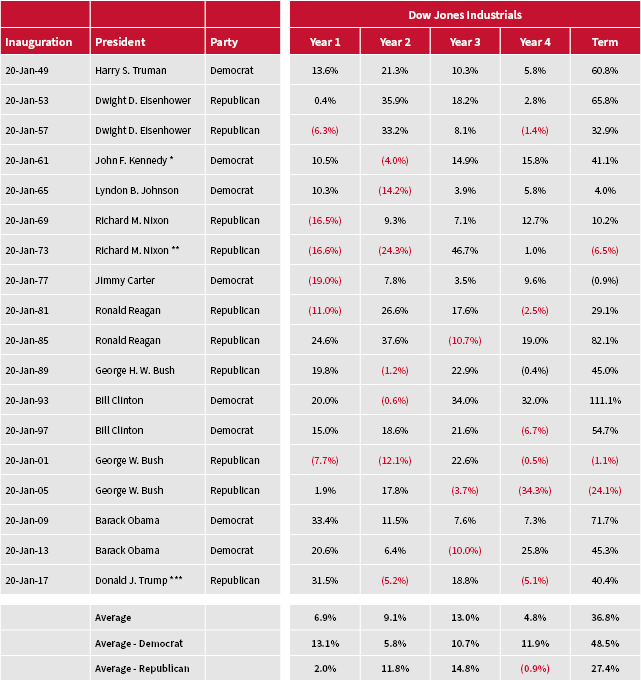
“Over 18 presidencies since the election of Harry S. Truman in 1948, the Dow Jones Industrials has, on average, done better under Democratic presidents than it has under Republican ones.”

However, it generally has not worked out like that, at least not in modern times. Over 18 presidencies since the election of Harry S. Truman in 1948, the Dow Jones Industrials has, on average, done better under Democratic presidents than it has under Republican ones. Even more intriguingly with 2021 in mind, the Dow has done much better in the first year of a Democratic term than it has a Republican one, with an average gain of 13.1% compared to 2% from their rival incumbents.

The Dow Jones has tended to perform better under Democratic presidents than Republican ones, especially during the first year of a term.

Source: Refinitiv data. * John F. Kennedy assassinated in November 1963 and replaced by Lyndon B. Johnson. ** Richard M. Nixon resigned August 1974 and replaced by Gerald R. Ford. *** Data for Donald J. Trump as of 17 August 2020

A long time ago

It therefore is not as simple as ‘Republicans good, Democrats bad’ when American politics is assessed through the very narrow prism of the US stock market. This is particularly the case now, when the Republicans were running up the sort of budget deficits that would make even the most ardently pro-spending Democrat blush, even before the pandemic forced an emergency fiscal response.

Moreover, if advisers and clients cast their minds back four years ago, the Democrats’ Hillary Clinton was then seen as a bit of a shoo-in for the 2016 election, as the Republican’s Trump had surprised everyone by winning the Grand Old Party’s nomination. Trump was also widely perceived as a potentially negative result for markets, thanks to his sabre-rattling on issues such as diplomatic relations with China, Iran and Mexico and desire to rip up several trade agreements, including the North America Free Trade Agreement (NAFTA).

But that isn’t how it turned out.

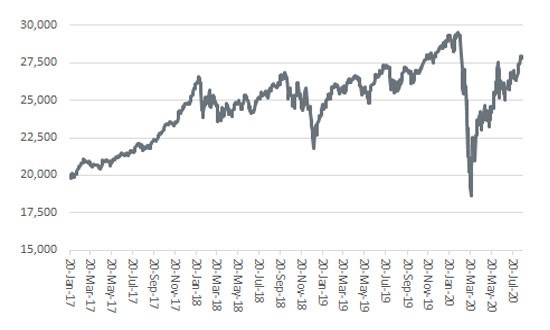
“It may still trade below its all-time high, but the Dow Jones Industrials index is up by some 40% since Trump’s inauguration on 20 January 2017.”

It may still trade below its all-time high, but the Dow Jones Industrials index is up by some 40% since Trump’s inauguration on 20 January 2017, thanks to what had been a steady economic expansion, tax cuts and an accommodative US Federal Reserve, which had pretty quickly backed away from raising interest rates and sterilising Quantitative Easing, even before COVID-19 swept around the globe.

Dow Jones Industrials has powered higher during Trump presidency

Source: Refinitiv data. Covers period since inauguration ceremony on 20 January 2017.

This suggests that there is more than just politics at play when it comes to how a stock market performs, with monetary policy, economic performance and the possibility of exogenous shocks (such as a pandemic) all factors to be considered, among others, even before we get to the vexed issue of valuation.

“How much of a bearing November’s winner has upon financial markets’ performance will to a degree depend upon which party wins the House of Representatives and the Senate, so advisers and clients will need to consider this too.”

That said, Trump has undeniably been influential, from his market-pumping tweets to his economy-pumping tax cuts. How much bearing November’s winner has upon financial markets’ performance will to a degree depend upon which party wins the House of Representatives and the Senate, so advisers and clients will need to consider this too. Trump has achieved less in the second half of his term as the Democrats have controlled both houses on Capitol Hill.

The tricky things is sorting out the policies that are just electioneering and slogans from the plans that may actually be enacted. As the economist Robert Sowell once noted: “Economists are often asked to predict what the economy is going to do – but economic predictions require predicting what politicians are going to do and nothing is more unpredictable.”

The run up to a Presidential election is always interesting, this year even more so with the Covid-19 Pandemic and the complications this has brought and continues to bring.

The next few months will be an interesting ride!

Please continue to check back for further updates on the US Presidential Election and the affect this has on the markets as well as our usual variety of market updates and blog content.

Andrew Lloyd

01/09/2020

Team No Comments

Jupiter Asset Management – Active Minds Blog

Please see Active Minds article below from Jupiter Asset Management – received 27/08/2020

Active Minds – 27 August 2020

James Bowmaker – Fund Manager, UK All Cap

Could the FTSE emerge from lockdown fitter, happier and more productive?

The apparent schism between Growth and Value in global equity markets is starkly illustrated by the FTSE 100 Index, said James Bowmaker, Fund Manager, UK All Cap, in a week where a single US tech company rose to become larger in value than the entire FTSE 100.

The FTSE is down around 20% year-to-date, which is worse than most of the European indices and much worse than the US indices. On a three-year view, ignoring dividends, it is only up around 3% over a period when the S&P 500 Index doubled. To make matters worse, the FTSE has had a tailwind over this period due to the weaker pound boosting overseas earnings, although Brexit uncertainty has kept global investors away. Even more embarrassing, the FTSE 100 Index has underperformed the MSCI World Value Index over most of the past three-to-five years.

Why? There are far too few Growth stocks in the index and too much Value. At the start of 2020, banks and oil companies accounted for around a quarter of the index and around a third of its dividends. These businesses faced structural pressures, had dividend payout ratios that were regarded as unsustainably high and were backed by volatile commodities and/or cyclical earnings.

But that was then – what about now? We’ve seen aggressive cost cutting and huge dividend cuts in large caps, James pointed out. Some of the cuts are temporary but the dividend reductions of 50%-60% by the large oil & gas companies are permanent. So, starting from here, the prospective dividend yield for the FTSE is around 4.2% – once dividend resumptions are factored in – a yield close to its medium-term average. Furthermore, the cuts have reduced the imbalance in the index and its payouts so the overall yield from the FTSE 100 Index ought to be more sustainable. Banks and oil now account for around 15% of the index compared with 25% at the start of the year and their dividend contribution is no longer 35% of the index payout but a more reassuring 15%. Meanwhile, pharmaceutical companies, with their more stable earnings, now account for a greater proportion of the index and its yield. For investors worried about the prospects of a derating in growth stocks, James says they could do worse than look at the FTSE as it never had that risk in the first place! 

Talib Sheikh – Head of Strategy, Multi-Asset

Growth rally still has legs

Growth vs Value does indeed continue to be the million-dollar question, echoed Talib Sheikh, Head of Strategy, Multi-Asset. The NASDAQ and S&P 500 have hit all-time highs once again, as the growth and technology stocks that dominate these indices continue to see their share prices benefit from the low interest rate environment and negative real yields. Talib expects this trend to continue for some time to come, as he argues that the prime focus for central banks around the world now is to keep real interest rates as low as possible.

Federal Reserve Chairman Jerome Powell’s speech at the virtual Jackson Hole summit later this week is keenly anticipated. Markets are expecting some guidance on how the central bank will address the issue of low inflation, which has persistently fallen below their 2% target for the last decade. Talib expects the Fed will eventually move towards state-contingent forward guidance where they don’t raise interest rates until reaching a certain target. Given this is a live debate and that real interest rates should remain lower for longer, Talib thinks the Growth rally has further to go. In the multi-asset strategy, Talib and the team are focusing on what they believe are high quality assets in the US and high quality, undervalued cyclical stocks in Asia, which are more attractive compared to Europe.

James Clunie – Head of Strategy, Absolute Return

Markets continue to ignore fundamentals

Executing a valuation-driven process remains challenging in the current market environment, where the Growth vs Value performance gap has reached record levels on many measures, said James Clunie, Head of Strategy, Absolute Return. But James and the team continue to believe that the price you pay for an asset is the most important starting point for returns over any sensible time horizon. James used two stock examples to demonstrate the stark contrast in characteristics of stocks found in the strategy’s long and short books.

First, he used the example of a US burger chain as an example of the kind of stock he looks to short. Through a quantitative lens, it looks like a bottom-quartile stock, with poor quality measures, rapid asset growth, and high issuance of new equity, for example. In terms of its valuations, on a discounted cashflow (DCF) model, if you model in 20% growth for the company over the next seven years, assuming margins that meet the industry best thereafter into perpetuity, you can reach fair value – in other words, when you buy its shares, you’re capitalising an extremely rosy future, and paying up for it today as if it’s already happened (and it’s pricey!).

Directors are selling its shares; meanwhile, short sellers are present, and rising. It’s also had significant broker downgrades over the past month, for 2021 and 2022. There’s a lot of work to be done in terms of its business model. It has had a run of disappointing results, and its latest set of numbers recorded losses. However, despite all of these factors, the company’s shares are only down around 2% year to date.

In contrast, James discussed a global shipping company held in the long book. While its balance sheet isn’t perfect, on a quant level, it’s a top-quartile stock; and on a DCF model, it’s trading at about fair value, depending on which assumptions you make. It has a reasonable shareholder base, and it has had huge earnings upgrades, driven by falling fuel costs. Nevertheless, its shares are down around 1% year to date. While it’s not possible to predict where markets are heading, if the market regime does change in favour of value stocks, James and the team believe there is plenty of upside potential for stocks like this.

Patty Cao – Assistant Fund Manager, Emerging Markets Debt

Window of opportunity opens for emerging market bonds

Emerging market debt has been resilient this year as central banks keep rates ultra-low and along with governments provide ample economic stimulus, said Patty Cao, Assistant Fund Manager, Emerging Market Debt. China’s faster-than-expected economic recovery from the impact of the coronavirus has been positive for the asset class, as has the generally improving trend for global PMI data, she said. US real yields at record lows have led to a weaker dollar, which also is supportive for emerging markets, and there is abundant liquidity in the asset class. Retail flows into emerging market debt funds have been positive since July, mostly in hard currency bonds, though local currency fund flows have risen more recently.

The strategy is overweight in local currency emerging market rates, while hard currency corporate bonds have appealing valuations, Patty said. Corporate bonds in hard currency look attractive compared with sovereigns, offering higher yields with shorter duration. She noted that among emerging market currencies, the Turkish lira and Brazilian real have both suffered declines this month.

Positive developments on a coronavirus vaccine and improving economic growth should provide a good environment for emerging market bonds and support continued fund flows for the asset class, Patty said.

A useful article for getting an insight to the market from market experts within their specified field.

Please continue to check back for our regular blog posts and updates.

Charlotte Ennis

28/08/2020

Team No Comments

What Proposed Climate Reporting Duties Could Mean for Trustees?

Please see the below article published recently from Royal London;

Lorna Blyth looks at how an amendment to the Pension Schemes Bill could force pension schemes to align their investment strategies with the Paris climate agreement.

Summary

An amendment to the Pension Schemes Bill has been proposed which could force pension schemes to align their investment strategies with the Paris agreement. This article looks at the implications for trustees, and asset owners more generally, as they consider how they measure and report on the impact of climate risk and the UK commitment to reach net zero carbon emissions by 2050.

Background

The Paris agreement, signed in 2015 by the majority of global leaders, established a legally binding commitment to curb carbon emissions in order to limit the global temperature rise to below 2 degrees celsius with the ambition to work towards a lower threshold of 1.5 degrees. In order to reduce the risks associated with long lasting or irreversible changes to the earth’s atmosphere and ecosystems the Intergovernmental Panel on Climate Change (IPCC) reported that global carbon emissions would need to reach net zero by 2050. In 2019 the UK government committed the UK to achieving this target and became the first major economy to pass this into law. Policymaker focus is supporting this transition and we are seeing a much greater focus on sustainability from the government and the regulator.

The levels of pension savings and wealth in the UK is a significant part of the UK economy and has a huge part to play in helping companies to meet this target through voting and engagement rights that share ownership brings. There is no doubt that climate risk is an investment risk and going forward those responsible for investment solutions will be expected to have explicit policies on climate risk to explain how they are addressing it and building a roadmap to move to net zero.

What is climate risk?

Climate risk could crystallise in a number of different ways given the complex nature of the risk and the different time horizons for impacts. Typically we see the risk impacts grouped into two categories – physical risk and transition risk.

Physical risk relates to the impact of climate change, for example damage to land, buildings or infrastructure as a result of adverse weather conditions or rising sea levels as well as the knock on effects such as food shortages, supply chain disruption and civil unrest.

Transition risk relates to the disorderly impact on markets as a result of the transition to a low carbon economy. This could include the impact of policy action such as carbon pricing, emission caps and subsidies or the emergence of changing consumer behaviours and reputational risk as expectations to address climate change evolve and increase.

It won’t have escaped you that some of the knock on effects described here are similar to those that many of us have experienced as a result of the COVID lockdown measures put in place by governments. The impact this has had on our lives, wellbeing and finances has not been neat and orderly, nor has it been the same for all of us and it’s not difficult to imagine how the effects of climate change could bring similar impacts, albeit on a much larger scale.

The scale of the challenge

To help bring the impact of climate change into a financial context a recent report by the Carbon Disclosure Project forecast that $1trn of climate related costs will be borne by 200 of the world’s largest listed companies within the next five years. Regulations currently require that trustees disclose and report on their climate policies and the government has made it clear that their aim is for schemes to start actively managing their exposure to climate-related risks in order to limit the risk climate change poses to their members’ future retirement income. This focus has also been extended to IGCs who now have a specific remit to provide an independent consideration of a firm’s policies on environmental, social and governance factors including climate change.

Where to start

Transparency is a key first step in order to understand climate risk and the impacts on the investment strategies and a good place to start is the Task Force on Climate Related Financial Disclosures (TCFD). It was set up in 2015 and delivers a set of consistent, climate-related financial risk disclosures for use by companies in providing information to investors, lenders, insurers, and other stakeholders. It’s a widely-adopted approach to manage and report climate risk and provides a framework to help trustees embed this within existing governance and decision making processes including defining investment beliefs, setting investment strategy and manager selection and monitoring.

TCFD reporting is voluntary at the moment however it will become mandatory by the end of this year and as an asset owner we have already committed to report against the TCFD framework.

A net zero economy is the direction of travel and the risks that lie in how we get there will affect investment returns. Given the scale of the challenge the quicker we can understand and quantify these risks the better in order that we can manage them and deliver not only good returns for customers but also a more sustainable future.

This blog demonstrates what we have been talking about with regards to ‘socially responsible investing’ and investments shifting in the ‘ESG’ direction.

As we have noted before, we expect the majority (if not all) investment companies to keep moving towards this style of investing over the next few years, particularly once the FCA post their guidance and position with ESG policies and investing.

The FCA began consulting on this late last year and were due to publish their findings this year, however this has been delayed due to the Pandemic and we expect them to publish this later in the year or in early 2021.

Andrew Lloyd

27/08/2020

Team No Comments

Brewin Dolphin – Markets in a minute

Please see below an article published by Brewin Dolphin yesterday (25/08/2020), which summarises last week’s investment market performance:

Please continue to check our Blog content for advice and planning issues and the latest investment, markets and economic updates from leading investment houses.

Please keep safe and healthy.

Carl Mitchell – Dip PFS

IFA and Paraplanner

26/08/2020

Team No Comments

Legal & General Update: Summertime, and the living is easy

Please see the below article posted late yesterday (24/08/2020), by the investment management team at Legal & General.

Summertime, and the living is easy

Markets have effectively been flat-lining recently and trading volumes have collapsed by even more than normal in the summer. We believe this is a sign that there is not yet broad exuberance in markets, but also that the risks around crowded trades are bigger than normal.

This update represents solely the investment views of LGIM’s Asset Allocation team.

A known unknown

The ‘inflation versus deflation’ debate is likely to intensify in the coming years, but at least for a while it’s mainly going to be a theoretical discussion. Some great economists have recently predicted runaway inflation, as today’s policy measures are injecting cash directly into the hands of consumers, while other equally great economists have forecast continuous deflation, pointing towards the demand shock and output gap.

We need to acknowledge that so far there hasn’t yet been a satisfying explanation for why there has been so little inflation in recent years, despite strong growth and record low unemployment. How can the market possibly have conviction on the future path of inflation when we collectively were not very good at predicting the past five years?

What does this ‘known unknown’ mean for our inflation positioning? In the absence of a strong directional view, we will need to play inflation tactically; positioning and the market narrative become the important drivers. At the moment we are short UK and European inflation, as we think both are overpriced.

Nothing to see, yet

The first half-year review of the US-China Phase One trade deal has been postponed and not yet rescheduled. It is unclear what caused the delay in the talks, although President Trump has said he cancelled them. Markets have ignored the delay for now as both sides still have incentives to keep the agreement intact before the US elections and expect the talks to happen relatively soon.

We believe China views the deal as a stabiliser to bilateral relations with the US, while from Trump’s perspective the deal is an important political asset during the presidential campaign.

On a different front in what we see as ‘the new cold war’, the US again tightened restrictions on Huawei, by blacklisting more of the Chinese company’s subsidiaries and reducing its access to chips and technology that have been developed or produced with US involvement.

We don’t think Huawei is an immediate breaking point for China, where reactions to the news were muted. Over the medium to long term, we believe Huawei and 5G will certainly become a major area of competition between the US and China. In the short term, however, Huawei can in our view survive until after the US election.

Wall Street versus the High Street

Clients often ask us whether we perceive a disconnect between markets and the real economy.

We believe there are three reasons that explain their apparent divergence:

  1. Central banks have slashed rates and restarted asset purchases while governments embarked on fiscal stimulus. This has pushed interest rates even further down. All else being equal, lower yields are good for risk assets through the discounting of future earnings.
  2. Markets are a forward-looking mechanism. It’s the collective view of market participants on the future state of the world, not the current state, that drives asset prices. It is therefore the expectation of a better economy in the future that drives markets up today. We believe markets look forward about three to 12 months. Given this window, the question around the discovery of a vaccine comes into play. The probability of such a vaccine by mid-2021 is around 80%, in our view. Focusing on this allows investors to imagine a world in a somewhat normal state by then.
  3. The outperformance of mega-cap technology stocks is distorting the market picture as well. The Nasdaq has outperformed the S&P 500 year to date, for instance, while the S&P 500 ex Technology is still down in 2020. This could end up in a technology bubble, but we don’t believe we are there yet. Our bubble monitor, the Heiligenberg Index, is elevated but not yet in the stratosphere. We therefore remain overweight technology.

The combination of these three factors should give some comfort that the disconnect between financial markets and the real economy is a matter of perception. Having said that, we remain cautious in our current positioning as we believe the market has gone too far, too quickly in its optimism on earnings, the economy, politics, and the shorter-term virus dynamics.

Its good to have an insight into how some of the big investment companies Asset Allocation teams think, it helps us get a view on current market trends and how these are being factored into investments funds and portfolios.

This year has been a unique year for markets and investors and you can see a range of views, Legal & General being more cautious, from fund managers.

Keep checking back for more updates as we navigate our way through these strange and unprecedented times.

Andrew Lloyd

25/08/2020

Team No Comments

Brooks Macdonald – Weekly Market Commentary

Please see below the weekly market commentary from Brooks Macdonald – received 24/08/2020.

Weekly Market Commentary | Fed policy review findings to be revealed this week amidst rising Coronavirus cases in Europe

24 August 2020

Read detailed economic and market news from our in-house research team.

  • Weekly Market Commentary
  • COVID-19 updates

By Edward Park

  • European COVID-19 cases continue to rise, raising the risk of further reintroductions of restrictions
  • The Jackson Hole economic symposium takes place this week with Jerome Powell expected to discuss the Federal Reserve (Fed) policy review
  • The Republican National Convention contains a keynote from Donald Trump on Thursday – investors will be looking for any China hawkishness as the November election approaches


European COVID-19 cases continue to rise, raising the risk of further reintroductions of restrictions

The second wave of COVID-19 in Europe continued to gain pace over the weekend with France, Italy and Spain all seeing an increase in new cases. Investors will be watching to see if this is the prelude to a reintroduction of restrictions or any localised lockdowns. This uncertainty appears to largely be in the price however, with European equities and US futures starting the week strongly.

The Jackson Hole economic symposium takes place this week with Jerome Powell expected to discuss the Federal Reserve (Fed) policy review

The main event this week is likely to be the Jackson Hole economic symposium on Thursday and Friday. The keynote speech will be from Fed Chair Jerome Powell and he is expected to unveil the key findings and next steps from the Fed policy review. The full results are likely to be delayed until the Federal Reserve’s September meeting, but the key messages will be important to the future path of interest rate and inflation expectations. The review considers, amongst other items, whether the Fed could move away from a fixed inflation target to an average target. In practice this would mean far less sensitivity to upside surprises in inflation during this economic cycle. 

The Republican National Convention contains a keynote from Donald Trump on Thursday – investors will be looking for any China hawkishness as the November election approaches 

In terms of speeches, Donald Trump will be giving his main speech on Thursday at the Republican National Convention. However, with Trump to appear on every night of the convention, there is the possibility that this could generate volatility. On both national polls and betting odds there is a significant gap between Joe Biden and Donald Trump opening up, which increases the risk of escalating rhetoric as November approaches. Markets will be looking particularly closely at any proposed actions around China hawkishness which could impact the bull run in US equities over the last month. With just ten weeks to go until the 3rd November election date we continue to expect this to be the primary source of market volatility.

US Fiscal stimulus talks appear at a stalemate with the Democrats and White House still far apart. This continued disagreement makes it even less likely that an agreement, even a ‘skinny’ deal, will be reached ahead of the return from Congress’s recess in September. US politics will remain the market’s focus but closer to home, Brexit trade talks continue to generate an impasse, particularly over the ‘level playing field’ and fishing rights. 

Another quick update from Brooks Macdonald, the weekly market updates are useful in providing a short summary of events from around the world over the past week.

Please continue to check back for our regular blog posts and updates.

Charlotte Ennis

25/08/2020

Team No Comments

AJ Bell Investcentre – Are Commodities Primed to Shine Again?

Please see article below from AJ Bell Investcentre – received 23/08/2020

Are Commodities Primed to Shine Again?

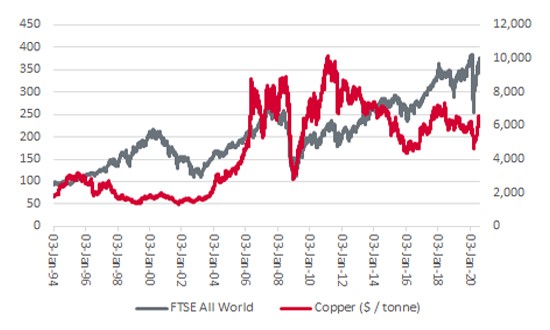
Copper’s surge from its spring lows to a three-year high at around $6,500 a tonne is an eye-catching development and one that will quicken the pulse of those advisers and clients who are exposed to miners, cyclical stocks or even equities more generally.

The metal is malleable, ductile and a terrific conductor. As such, it has many industrial uses – ranging from construction to automotive production to wiring to integrated circuits – and as a result, the metal is nicknamed ‘Doctor Copper’, because it is often seen as a good guide to the globe’s economic health. Advisers and clients also seem to treat copper as a useful indicator, since surges in copper seem to coincide with periods of strong performance from the FTSE All-World index and periods of weakness in both also seem to tally (although we must accept that the past is no guide at all to what may happen in the future).

A rally in ‘Doctor Copper’ could be an encouraging sign for equity markets

Source: Refinitiv data

After a minor retreat from its July high, advisers and clients who are bullish on the global economy and equities will be looking to copper to make fresh ground, while sceptics will be waiting for a longer, deeper slide in the metal’s price.

On a wider basis, commodity prices more generally have rallied from the lows plumbed in spring, when investors fled pretty much all risk assets thanks to fears about what the pandemic may mean (fears which could yet be borne out). The Bloomberg Commodity index – which tracks the ‘spot’ price of 24 raw materials ranging from copper to aluminium, gold to silver, hogs to crops and oil to gas – is up by almost a third since late March.

“The Bloomberg Commodity index is up by almost a third since late March but that pales next to the 51% surge seen in America’s S&P 500 equity benchmark over the same time period.”

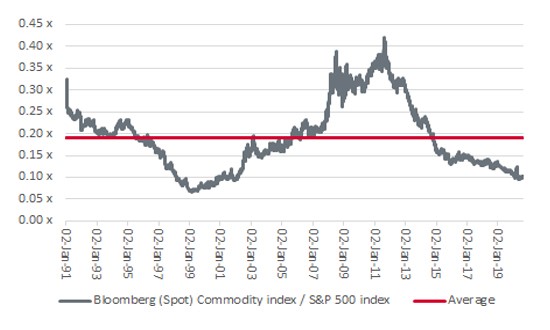
However, that pales next to the 51% surge seen in America’s S&P 500 equity benchmark over the same time period and the chart shows that commodities’ performance badly lags behind that of American stocks for a good decade or more.

This is intriguing, as commodities and commodity-related stocks dominated for much of the first decade of this millennium, to the extent that ExxonMobil (XOM:NYSE), Petrochina (HK:0857), BHP Billiton (BHP) (as it was then), Petrobras (PETR4:BVMF) and Royal Dutch Shell (RDSB) were among the 10 largest stocks in the world by 2010, as ranked by market capitalisation. Investors were clambering over themselves to buy commodity and commodity-related and China-related stocks, in the view that the Middle Kingdom would continue to grow at a rapid clip, driving both global economic activity and raw material demand in the process.

That narrative came unstuck fairly quickly. Oil – for one – has never reclaimed the heights it reached in 2007–08 and the Bloomberg Commodity index now trades close to the all-time relative lows against the rampant S&P 500 benchmark, reached when technology, media and telecoms (TMT) stocks were in very bubbly form in 1999.

“The Bloomberg Commodity index now trades close to the all-time relative lows against the rampant S&P 500 benchmark, reached when technology, media and telecoms (TMT) stocks were in very bubbly form in 1999. Yet sentiment was similarly in favour of tech in 2000 (when commodities, miners and oils promptly beat tech stocks hands down for a decade).”

Commodity prices trade near their lows on relative basis against the S&P 500 index

Source: Refinitiv data

That begs the question of whether we are now seeing another period when tech stocks are getting overheated and commodity stocks are being underappreciated. Investor sentiment is clearly lopsidedly in favour of tech, in the view that growth is scarce and companies that are capable of generating strong increases in earnings on a secular basis are inherently more valuable than raw material producers where price is their only weapon and end demand is uncertain.

Yet sentiment was similarly in favour of tech in 2000 (when commodities, miners and oils promptly beat tech stocks hands down for a decade) and in favour of raw materials in 2010 (when tech stocks promptly got their own back for the next ten years). Could investors be about to be sandbagged by a similar switch in the next decade, restoring faith in commodities as a worthwhile diversifier and a potential provider on uncorrelated returns as part of a diversified portfolio?

It is possible that the foundations for their renaissance are in place, especially as the best cure for low prices is low prices, as they destroy supply and boost demand. Granted, we are seeing demand destruction right now thanks to the recession that followed the pandemic. But we are seeing supply-side destruction too, as miners and oils alike rein in capital expenditure, focus on cash flow and curb production in many areas.

“Cheap assets can get a lot cheaper if nothing happens to change perception and bulls of commodities need a catalyst that will get other investors interested. One possible such catalyst would be the (quite unexpected) return of inflation.

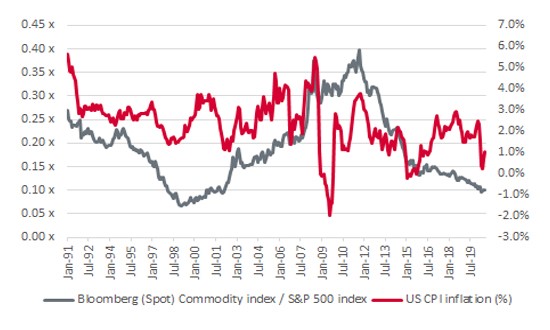
But cheap assets can get a lot cheaper if nothing happens to change perception and bulls of commodities need a catalyst that will get other investors interested – as Jim Grant once wrote, “Successful investing is about having people agree with you… later.” One possible such catalyst would be the return of inflation. This would be all the more powerful as it would be so unexpected at a time when the depth and duration of the recession is the main market topic of discussion today and most investors seem frightened of a downturn and deflation above all else.

A resurgence of inflation could be one trigger for renewed interest in commodities and commodity-related stocks

Source: Refinitiv data

This column noted two weeks ago (Shares, 6 August) how inflation expectations are slowly ticking higher in the US, thanks to massive amounts of fiscal and monetary stimulus. If this trend continues, commodities could benefit, as the final chart suggests, although higher inflation expectations are likely to be needed to prise some investors away from their beloved tech stocks.

These articles are a useful way to get a good insight of the markets from different investment companies, this particular part of AJ Bell is a stock broker.

Please continue to check back for our regular blog posts and updates.

Charlotte Ennis

24/08/2020