Team No Comments

AJ Bell Article: What moves a share price?

Please see the below article posted by AJ Bell late yesterday (20/08/2020):

Forecast-beating results, game-changing contract wins and takeovers are just some of the catalysts that shift a stock.

So you have opened a share dealing account, familiarised yourself with the mechanics of buying a share and purchased a few companies for your portfolio. The next step on the novice investor’s journey is to learn about the numerous factors that drive a share price higher, or lower.

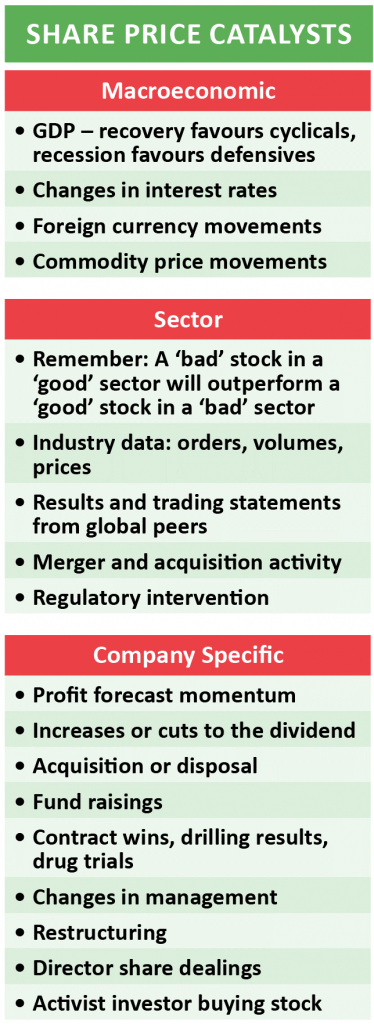
From a top down level, these factors include macro-economic events and data points such as gross domestic product (GDP) readings or interest rate movements, which can impact how shares as an asset class are valued relative to bonds and cash, as well as general investor sentiment towards a particular sector.

However, the key determinant of a share price is how well the company in question is performing; when a business is doing well investors want to own it, so demand pushes the share price higher, and vice versa.

Why shares fall on good results

You might notice on occasion a share price will fall after an excellent set of numbers are published. Typically, this happens when results are published after a bullish update, as the market will already have factored in strong performance.

THE POWER OF CATALYSTS

Investors need a reason to buy a share and some of the strongest catalysts to influence trading are announcements by companies to the stock market. These can be contract wins or directors buying or selling shares, though the most obvious catalysts are the publication of half-year (interim) and full-year results.
As a first-time investor, you need to understand that markets are inherently forward looking and financial figures are historic. Their ability to move a share price is determined by the outlook statement and whether the numbers are ahead of or behind market expectations.

Many companies update on trading in between their published results and analysts often respond by upgrading or downgrading their earnings forecasts.

Stockbrokers compile in-depth financial forecasts for companies which they issue to clients; these are then aggregated to arrive at consensus estimates for sales, profits and earnings per share (EPS), which the first-time investor can access via financial information providers including Bloomberg or Refinitiv, or via free-to-use websites such as Shares own site or Sharecast.com.

Forecast-beating financial results typically drive upgrades to earnings estimates, which can often combine with a ‘re-rating’ of the multiple investors are prepared to pay for a stock, providing investors with a double-whammy that sends the shares surging higher.

In contrast, profit warnings trigger downgrades and ‘de-ratings’ of a stock and its earnings multiple. Over-supply of a stock following the issue of new shares, which dilutes equity ownership, can also exert downwards pressure on a share price.

OTHER CATALYSTS TO CONSIDER

Other catalysts that move share prices include fundraisings, earnings enhancing acquisitions or balance sheet strengthening disposals. New contract wins or stake building by activist investors seeking to shake things up are additional events that can drive share price upside.

In the biotech sector, watch out for positive drug trial results, as these can drive dramatic share price appreciation, while drilling and project updates are often catalysts in the resources space.

For example, Touchstone Exploration (TXP:AIM) confirmed its significant Cascadura natural gas discovery in February and has had positive updates on the find since, sending the Trinidad oil firm’s shares gushing higher year to date.

Takeover bids typically drive a share price higher, as the acquirer usually offers a premium to the prevailing share price in order to persuade shareholders to accept cash today in return for foregoing the potential long-term upside from owning the share.

An example is motor insurer Hastings (HSTG), which recently surged higher on the back of a 250p cash bid.

The offer represented a 47.1% premium to the Hastings share price before the company alerted the market that it had received an approach.

Investing solely on the expectation of a takeover is not a sensible approach. You’ll never be able to predict with 100% accuracy which companies in your portfolio will entice a bid.

Recovery funds look for stocks that have fallen in price, yet which have the potential of climbing back or even exceeding previous levels. But an undervalued stock can remain undervalued indefinitely without the catalyst to prompt a re-rating. These might include a change of strategy or the repair of a battered balance sheet, usually accompanied or preceded by a change in senior management.

A maiden or resumed dividend can be a catalyst even if it has already been well flagged as new investors are attracted by the prospect of regular income.

WHY PROFIT WARNINGS ARE PORTFOLIO PUNISHERS

Share prices can go down as well as up and one of the main catalysts for losses is the dreaded ‘profit warning’, a broad term to describe a situation when a company is forced to downgrade its earnings guidance. It might have lost a contract, suffered higher than expected costs or experienced a difficult trading period that has caused sales growth to slow or even a sales slump, to give just a few examples.

Understanding the cause of the profit warning is paramount for deciding whether to keep hold of the shares or to get out quickly in case the shares fall further.

Sadly, lots of investors underestimate how far a share price needs to travel in order for you to get back to the level it traded before.

If a share price halved from 100p to 50p, equal to a 50% decline, then you would need the share to double, or increase by 100%, in order to get back to 100p. So try not to get too carried away when a share price starts to recover, as you may have to wait longer than you think in order to get back on track.

We often post updates and insights on the markets, but articles like this help give you a better understanding into how the markets actually work i.e. what moves a share price?

Whether you invest in direct shares or into funds/ portfolios, it is good to understand what can influence the price of a share (and ultimately your fund value).

Keep checking back for a variety of different blog content to help keep you updated, informed and to give you insights like this which help to build your knowledge of investing.

Andrew Lloyd

21/08/2020
Team No Comments

J.P. Morgan – Monitoring the global impact of Covid-19

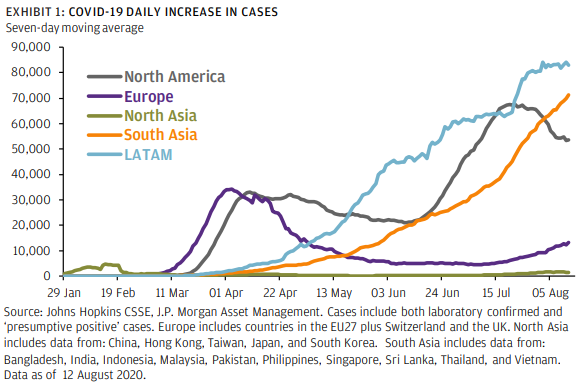
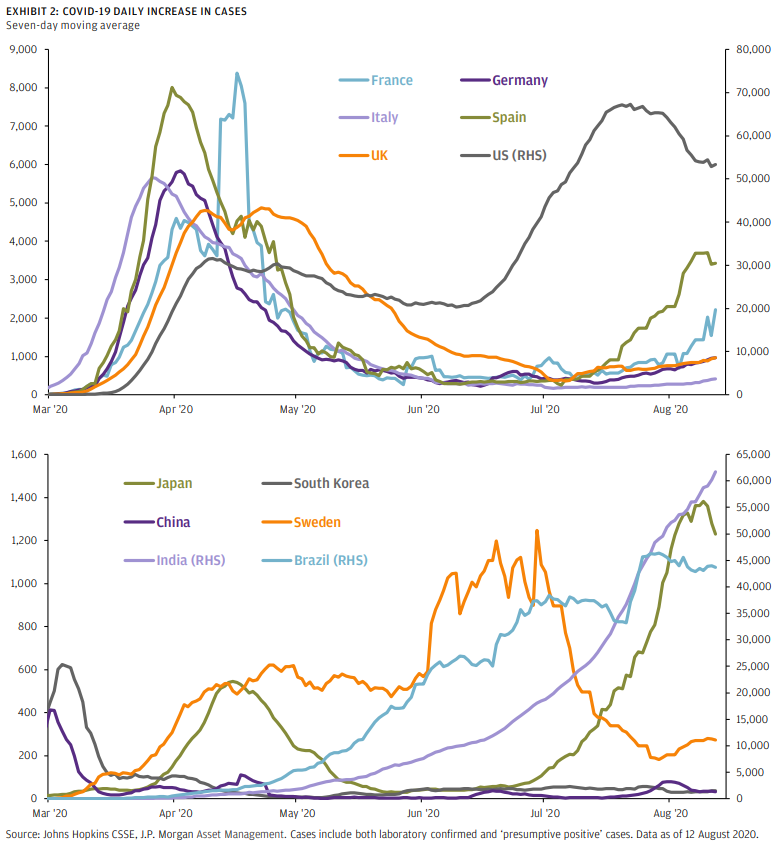
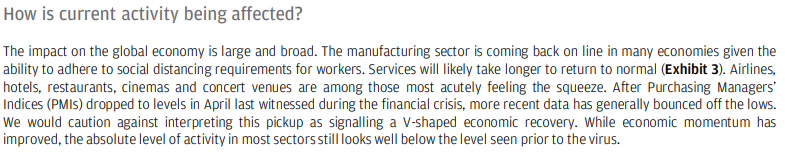
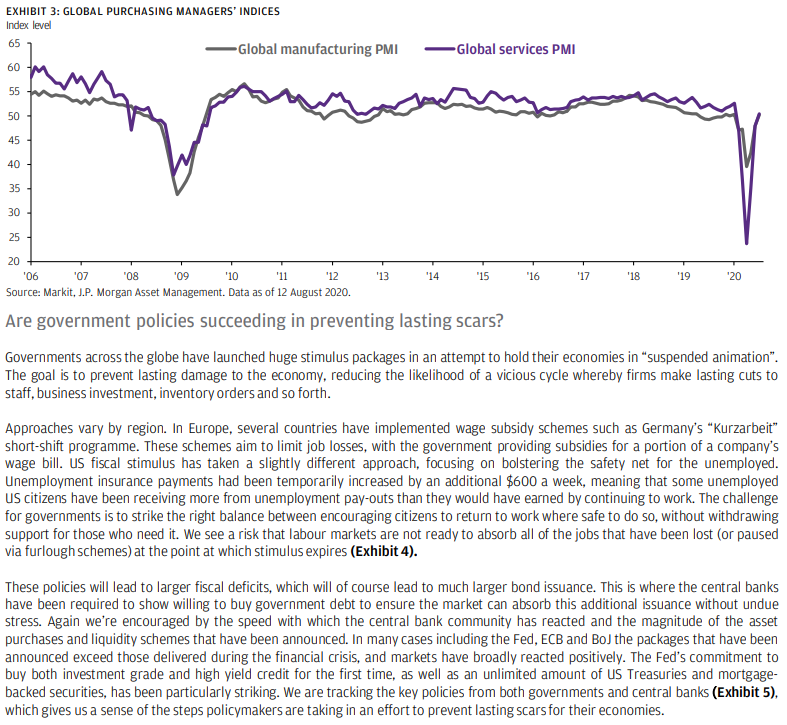
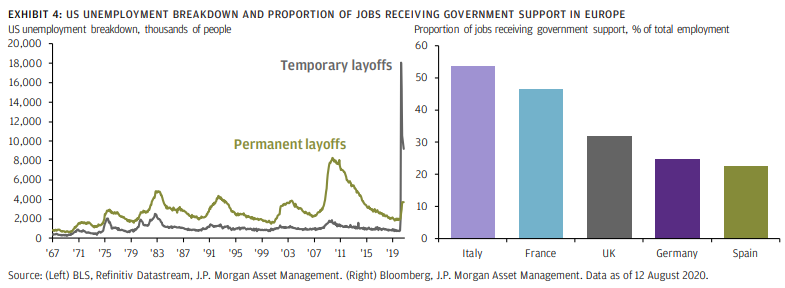
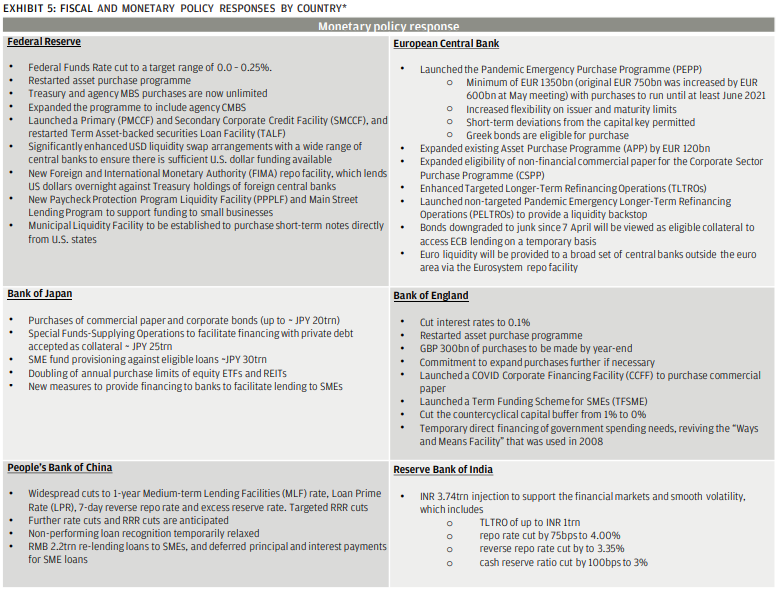
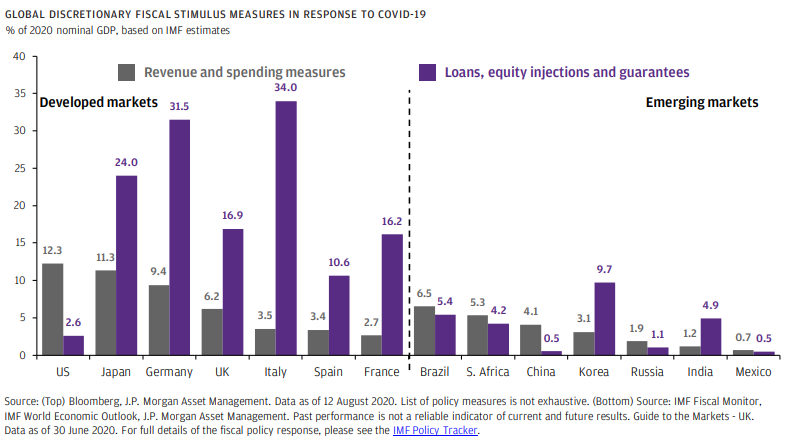
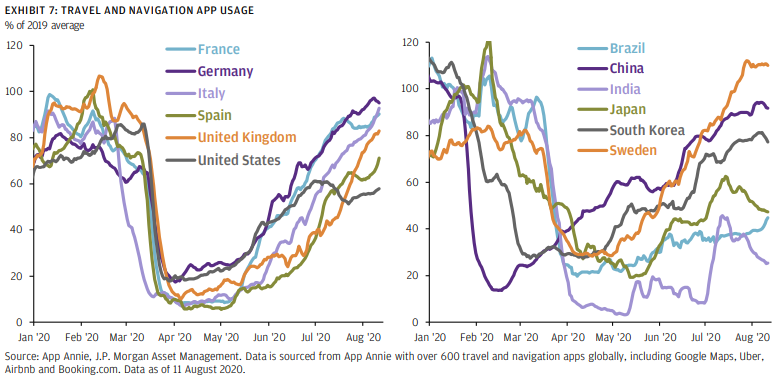
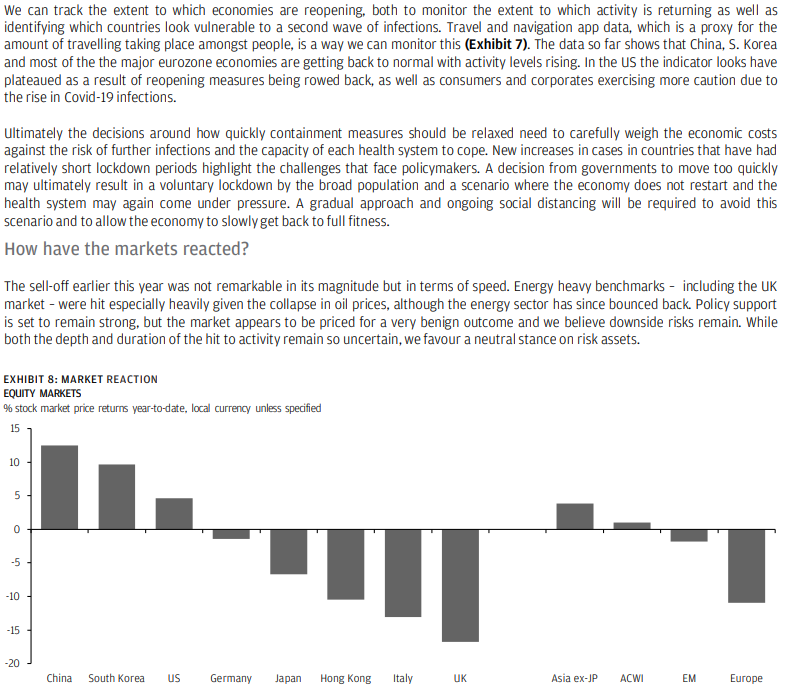
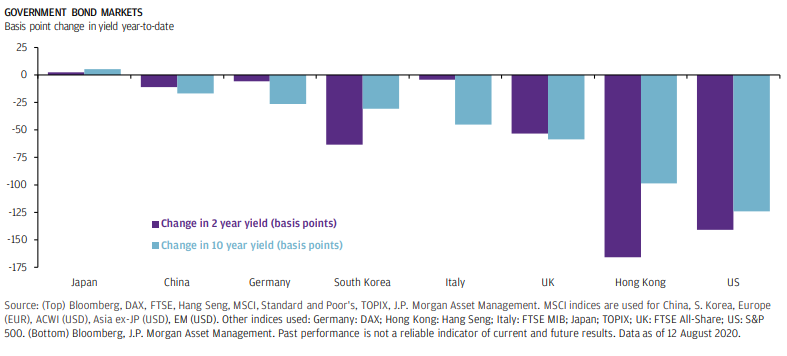
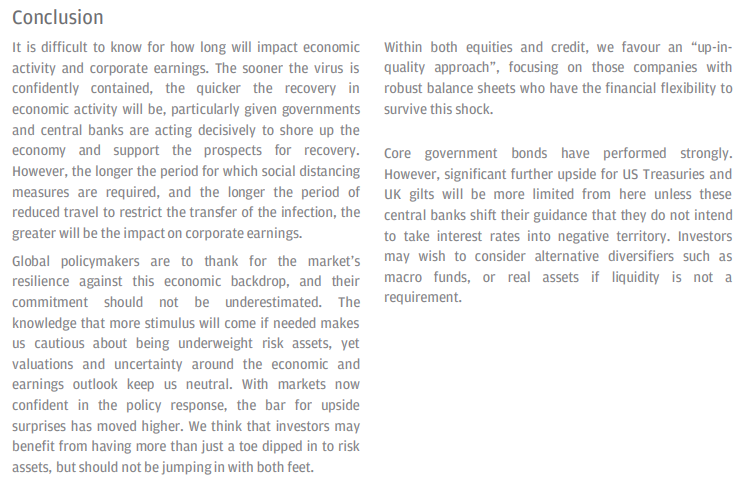
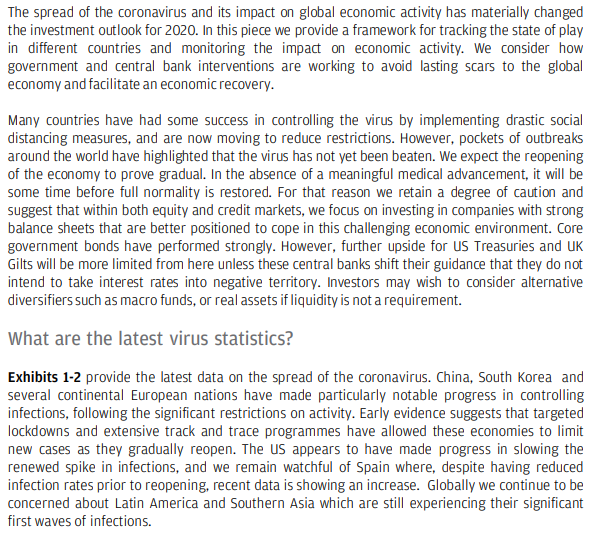
Please see below an article published by J.P. Morgan’s Chief Market Strategist (Karen Ward) and Global Market Strategist (Ambrose Crofton) last Thursday (13/08/2020) and received yesterday afternoon by email outlining the impact Covid-19 has had globally.

As you can see from the above, the stimulus packages introduced by governments globally have really helped protect the markets from big backdrops and the promise of further stimulus input by governments (if needed) is helping provide some investor confidence.

Trying to time the markets is almost impossible and investors need to remain invested and focus on long-term investment returns and their objectives.

Please continue to check our Blog content for advice and planning issues and the latest investment, markets and economic updates from leading investment houses.

Please keep safe and healthy.

Carl Mitchell – Dip PFS

IFA and Paraplanner

18/08/2020

Team No Comments

Brooks Macdonald – Weekly Market Commentary

Please see below the weekly market commentary from Brooks Macdonald – received 17/08/2020

Weekly Market Commentary | US focus shifts to presidential race as tensions with China ease

17 August 2020

Read detailed economic and market news from our in-house research team.

  • Weekly Market Commentary
  • COVID-19 updates

By Edward Park

  • US indices stop just short of all-time highs
  • Fiscal stimulus in the US is delayed as Congress’s focus moves to the presidential race
  • US/China Phase One talks postponed, easing fears of an imminent escalation

US indices stop just short of all-time highs

US indices have stubbornly stayed below their all-time high as delays to the US stimulus package dampened a more buoyant mood. Last week saw a steepening of bond curves globally which implies expectations of stronger inflation, and therefore higher rates, down the line.

Fiscal stimulus in the US is delayed as Congress’s focus moves to the presidential race

With the Democratic and Republican nominating conventions taking place over the next two weeks, markets will need to push back their hopes for a US fiscal stimulus package. This delay means unemployed Americans now see a significant fall in the federal support they receive as part of the COVID-19 relief measures. Given this is around 10% of the US workforce1, this may have a sizeable impact on consumer confidence and demand. This delay will likely put even greater focus on monetary policy in the short term. This week we have the publication of The Federal Open Market Committee (FOMC) minutes for July, where markets will be looking for any discussion on average inflation targeting by the US Federal Reserve. If inflation was taken as an average (rather than a single target), this would allow the central bank to let the economy inflate in the short term without immediately needing to curb monetary policy. However, if fiscal policy is delayed, the market will start to expect further proactive monetary stimulus from the US in lieu of targeted fiscal measures such as unemployment relief.

US/China Phase One talks postponed, easing fears of an imminent escalation

Investors were expecting a call between US and Chinese officials to discuss the Phase One trade deal this weekend. This did not transpire which has helped reduce fears of an imminent escalation between the two sides. This week however will focus on the US election, with the Democratic convention starting today. The main event will be Joe Biden’s speech on Thursday which is of major importance given his current lead over President Trump. Any specific comments around minimum wages, fiscal stimulus, healthcare reform and taxation will be closely watched.

With earnings season slowing, this week is likely to be predominantly driven by US politics as the presidential race increases in pace and US/China tensions remain in the background. US viral cases continue to slow but European countries have stepped up restrictions as governments seek to curb the spread across the continent.

The weekly market commentary articles are useful in providing a quick update regarding recent events from around the world.

Please continue to check back for our regular blog posts and updates.

Charlotte Ennis

18/08/2020

Team No Comments

Blackfinch – Monday Market Update

Please see below for this week’s market update received from Blackfinch Asset Management earlier today:

UK COMMENTARY

  • UK Gross Domestic Product (GDP) falls by a record 20.4% in the second quarter of the year, the biggest fall of any G7 country, although the timing of lockdown measures being implemented means that fair comparisons are difficult.
  • The number of unemployed people in the UK has risen by 730,000 since lockdown, and increase of 94,400 in July. The Office for National Statistics (ONS) estimates that a further 7.5mln are still temporarily away from offices and factories, presumably as a results of the furlough scheme.
  • Survey data from the ONS shows that 29% of businesses currently trading said their operating costs were exceeding or were equal to their turnover.
  • The British Retail Consortium figures show that year-over-year growth in total retail sales declined only marginally from 3.4% in June to 3.2% in July.
  • Chief Brexit Negotiator, David Frost, states that a deal with the EU could be reached in September.

US COMMENTARY

  • As the next stage of a fiscal deal once again stalls in Congress, Donald Trump takes matters in to his own hands, as he had signalled he would, by passing a number of executive orders.
  • Payroll taxes for workers who earn c.$100,000 or less will be halted between 1st September and 31st December.
  • Emergency federal unemployment benefits are reinstated at $400, down from the $600 payments that lapsed at the end of July and interest on student loans is being waived until the end of the year.
  • Consideration is also being given to halting evictions and a cut to capital gains tax.
  • First-time jobless claims declined to 963,000 from 1.19mln the previous week. This is the first time since March that new claims were below one million.
  • Retail sales rose by 1.2% in July, following an 8.4% increase in June. Whilst this was below expectations of 2%, the June figure was revised upwards from 7.3%.

ASIA COMMENTARY

  • The US imposes sanctions on 11 Beijing and Hong Kong officials after the imposition of new national security laws in Hong Kong
  • Retail sales and industrial production in China suggest that the recovery is still weak. Data shows a seventh straight monthly decline in retail sales, and industrial production increasing by 4.8%, below market expectations.

COVID-19 COMMENTARY

  • Russia declare that they have approved an effective vaccine against COVID-19, with President Putin announcing that his daughter has already been inoculated.
  • Moderna Inc secures a $1.5bn order from the US government for 100mln doses of its COVID-19 vaccine that is currently undergoing phase III clinical trials. Donald Trump announces that the order also provides an option to purchase a further 400mln doses.
  • The US also strikes a purchase deal with Pfizer Inc for its vaccine, at a cost of $2bn.

These weekly updates from Blackfinch (one of the investment managers we use) give you a good bullet point update which provides you with a short summary of events from around the world over the past week.

These quick read updates are a good way of keeping up to speed with developments both politically and in the markets.

Please check back for our regular market updates from a wide range of different providers from across the industry.

Andrew Lloyd

17th August 2020

Team No Comments

A.J. Bell Article – Infrastructure could offer welcome shelter

Please see below an article published by A.J. Bell on last week on 13/08/2020, which outlines why the Infrastructure sector might appeal to investors looking for alternative assets to hold within their portfolios to provide some diversification.

Why the asset class has appeal in the current environment and the risks to consider

Traditional portfolio asset allocation tends to start with equities and bonds, with a bit of a cash buffer thrown in, before thoughts move to areas that are designed to provide some diversification, in the theory (or hope) that their performance does not correlate with (or mirror) that of the other options.

These ‘alternative’ areas can include commodities, commercial property or even private equity funds but one area which may still be flying a little under the radar is infrastructure.

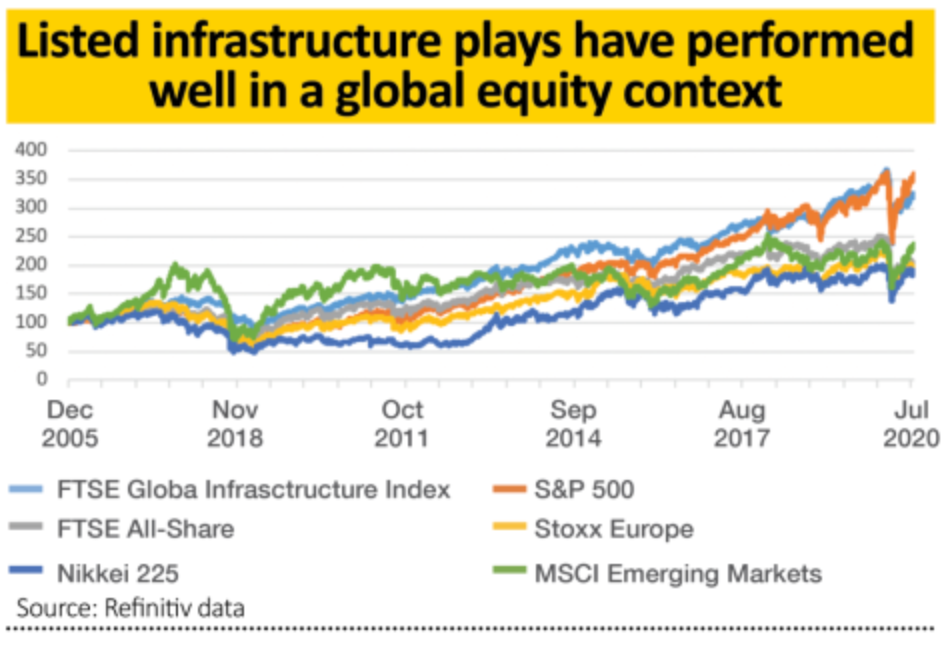
This is surprising in some ways, since infrastructure, as an asset class has performed well for a decade or more. Looking at it from the perspective of only listed firms in this field, infrastructure stocks have outperformed all of the major geographic indices bar the super, soar-away US, which continues to benefit from the barnstorming run generated by Facebook, Alphabet, Amazon, Apple, Netflix and Microsoft.

While we must all accept that past performance is no guarantee for the future, the past 15 years’ data may give investors some confidence that infrastructure is at least no flash in the pan. In addition, the asset class has several other facets which means it may be worthy of consideration as a part of a balanced, diversified portfolio, especially for those investors who have a long-term time horizon and are seeking income.

Four factors

A selection of companies, held directly or via a fund, that own or operate assets which can range from ports to airports, toll roads to pipelines and essential water and electricity utilities may not appeal to everyone – the thought of owning a stake in an airport in particular right now could leave many investors feeling green at the gills.

But, beyond the tempting past performance record, which appears to show strong total returns over the past 15 years and with lower volatility than most equity benchmarks, there are four other reasons why infrastructure may suit the overall strategy, target returns, time horizon and appetite for risk of certain investors.

The rise of environmental, social and governance factors

The COVID-19 outbreak, a global recession and resulting collapse in the oil price that leave investors contemplating this year’s dividend cuts from BP (BP.) and Royal Dutch Shell (RDSB) are all good near-term reasons which explain the poor share price performance of the oil majors.

But on a longer-term basis, many investors are now steering clear of ‘Big Oil’ not just for financial reasons, and concerns over peak demand and the risk of stranded assets, but ethical ones and issues relating to carbon footprint. Infrastructure funds can help here, as there several specialists in the area of renewables and battery or energy storage technology, notably among UK investment trusts.

Fears of inflation

Some investors may not be convinced by talk of inflation, at a time when the pandemic is still weighing on the jobs market and consumer confidence and demand destruction
and a period of weak economic growth remain clear risks.

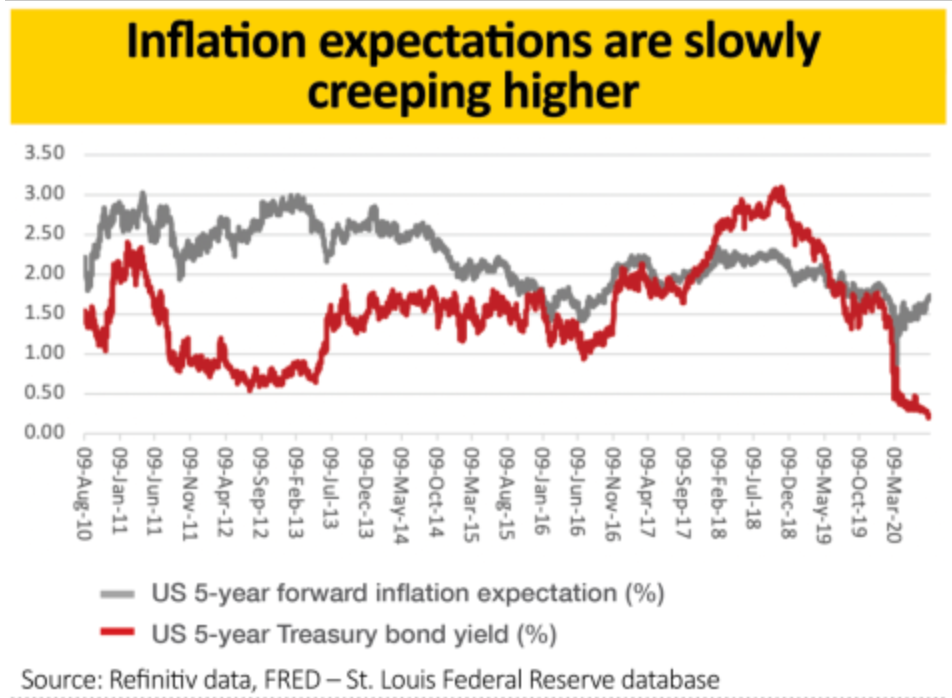
But central bank money-printing schemes, ballooning government deficits, supply-chain disruption (if production is brought back home from China, for example) and firms jacking up prices to cover extra Covid-related costs could yet combine to create a surprise.

The US five-year forward inflation expectation indicator is ticking higher, for example, especially if you adjust for the five-year US Treasury yield. This would be a game-changer, as the last 30-40 years have all been about disinflation, and would perhaps make investors appreciate the index-linked nature of many infrastructure firms’ revenue streams.

Property woes

Commercial property has long been seen as a useful and welcome source of portfolio diversification. Some investors may now fear, however, that the relentless rise of online shopping and the pandemic’s effect upon office working and gatherings at leisure sites like restaurants, bars and clubs are going to deal rental incomes and asset values a severe blow.

The reach for yield

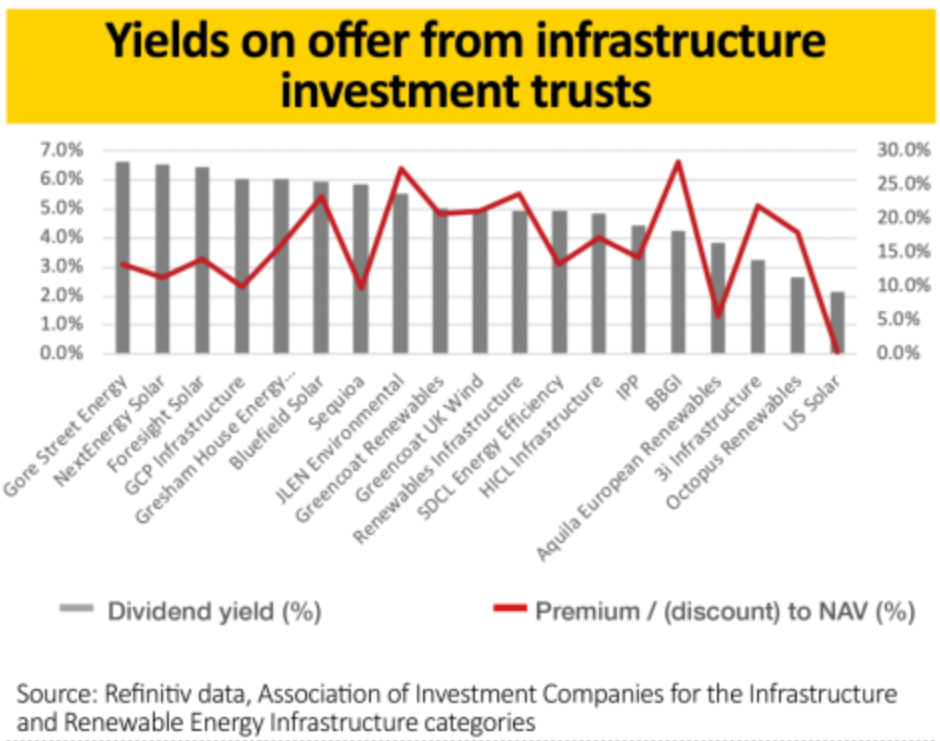
Several REITs have cut their dividend and over £40 billion of cut, cancelled, suspended or deferred dividends in the UK stock market alone since March leave income-seekers in a bind, especially as government bonds offer little joy either. Infrastructure could again play a role here, as shown by the investment trusts which specialise in this area – though it must be noted that there are open-ended funds which operate here, too, and even a couple of passive, exchange-traded funds (ETFs) which track the performance of a basket of listed infrastructure stocks.

Note the yields on the investment trusts range from 2.1% to 6.6% for renewables specialists and from 3.2% to 6.2% for infrastructure experts.

Risks

As ever, however, there is no free lunch. Infrastructure stocks (and the collectives which own them) need to offer a yield to compensate investors for the risks involved, which can include regulation, political interference and top-line growth that is usually modest at best. In addition, the UK-listed investment trusts come with an annual fee and they also currently trade at lofty premiums to their net asset value.

At least some of their potential is factored into valuations already and, by paying that premium, investors are effectively giving away some of their future returns. Patience will therefore be required if anyone does feel infrastructure is a suitable option for them, once they have done their own research.

Most of our investment propositions (multi-asset funds or managed portfolio services) take infrastructure in to account as we do.

Please continue to check our Blog content for advice and planning issues and the latest investment, markets and economic updates from leading investment houses.

Please keep safe and healthy.

Carl Mitchell – Dip PFS

IFA and Paraplanner

17/08/2020

Team No Comments

ESG Matters – The Smarter Investment in Our Future

Please see the below ESG article from Aberdeen Standard Investments written by Jerry Goh, their Asian Equities Investment Manager, received yesterday afternoon (13/08/2020).

These past few months have forced fund managers, like everyone else, to become more flexible while waiting for life to get back to normal.

Luckily, technology allows me to work from home with minimum disruption. I can mirror my office desktop on my home computer to securely access work programmes and files. I can easily talk to company executives via widely-used video conferencing apps.

My job is to analyse corporate governance (G) issues at Asian companies. Governance, along with ‘environmental’ (E) and ‘social’ (S) factors, make up the ESG trinity.

ESG, and responsible investing, have become hot topics in recent years. This will become even more so as the coronavirus pandemic forces us to rethink our priorities when pursuing economic growth.

As governments around the world pledge trillions of dollars to support businesses and save jobs, this presents a one-in-a-million opportunity to make a substantial commitment towards a sustainable future. One thing I have learned during this time is that sustainability and resilience are often synonymous.

Asia’s record on ESG matters is mixed. After decades of rapid growth, the world’s 10 most polluted cities are located within this region1. Labour conditions can be appalling2. Corporate governance standards, while improving, tend to lag global best practice.

Having said this, there are many signs that things are getting better. Here are a few from my travels – in person and online:

In recent years the region’s investors – asset owners and asset managers – have shown more of an interest in responsible investing. This will put more pressure on companies to change bad behaviour.

For example, Japan’s Government Pension Investment Fund, one of the largest pension funds in the world, announced in 2017 its plan to increase allocations in responsible investments to 10% from 3%3. The targeted amount is equivalent to some US$33 billion today.

Fund managers are signing up to internationally recognised agreements, such as the United Nations Principles for Responsible Investment (PRI), to demonstrate their commitment to sustainability tenets. In China and the ‘rest of Asia’, the number of net new PRI signatories grew 64% and 17% during 2018/2019, compared to a year earlier. In Japan and Australasia, gains were 12.5% and 8% respectively. Combined, net new signatories in all these markets rose by 3394.

Regulators are also doing their part. The Singapore Exchange introduced sustainability reporting for listed companies on a ‘comply or explain’ basis in 20165. Hong Kong Exchanges and Clearing is implementing the recommendations from a consultation paper designed to strengthen ESG rules6. Policymakers in Thailand are driving changes that have made Thai companies among the region’s best for sustainability disclosure7.

Regional industry groups, such as the Asian Corporate Governance Association, provide platforms for stakeholder conversations on responsible investing via conferences and other events.

As a result, Asian companies have become more fluent in the language of ESG, demonstrating evidence of ESG considerations within business strategies and adopting more robust governance practices.

There is still room for improvement, of course. For instance, there is insufficient transparency around materiality assessment – identifying the ESG factors that affect business performance. There is confusion over disclosure of relevant ESG-related data. Lack of reliable data remains a problem.

As I write this, Singapore (where I am based) has relaxed some of the restrictions put in place to combat the spread of the coronavirus. A few countries within this region are also taking the first tentative steps towards normality.

Everyone has to think carefully about the sort of future they want. Even when the coronavirus is beaten, the world still faces significant challenges.

But this cannot mean that it’s ‘business as usual’. Everyone has to think carefully about the sort of future they want. Even when the coronavirus is beaten, the world still faces significant challenges.

For example, climate change poses an even greater long-term threat than Covid-19. Many people around the world would have seen, or experienced, the effects of rising temperatures. Societies are already counting the human and financial costs of higher sea levels and extreme weather events.

Social inequality – the growing gap between the world’s haves and have-nots – is another major challenge. Inequality has led to widespread anger that, in some cases, has unleashed social and political upheaval.

The world is also consuming resources at an unprecedented rate. People are depleting the world’s natural resources which cannot be easily replaced, if these resources can be replaced at all.

Investors everywhere have an important role to play in finding answers. We can help direct investments towards companies that are working on sustainable solutions, or engage with companies to help change bad corporate behaviour.

Recalcitrant firms that persist with carbon-heavy activities, that exploit their workers, or damage the environment, can be penalised by having their access to capital revoked.

Even if our work and personal lives won’t feel completely ‘normal’ for some time, we mustn’t allow this sense of suspended reality delay those important decisions that will have profound effects on the world.

Finding solutions will generate new investment opportunities. However, our generation also has a huge responsibility to all those that follow us. We cannot let them down.

1World Economic Forum

2The New York Times, Foxconn Is Under Scrutiny for Worker Conditions. It’s Not the First Time, June 11 2018

3Reuters, Japan’s GPIF to raise ESG allocations, July 2017

4UN PRI, Annual Report 2019

5SGX, Sustainability reporting guide and rule, June 2016

6HKEX, Exchange Publishes ESG Guide Consultation Conclusions And Its ESG Disclosure Review Findings, Dec 18 2019

7CFA Institute, Market Integrity Insights, June 12 2019

Our Comment

This blog highlights Asia’s focus on ESG and ‘responsible investing’, and as we have noted before, the Coronavirus Pandemic has brought ESG matters to the forefront, not just in Asia, but globally.

It seems that this type of governance and investment will become (to use a phrase which now seems to be used daily) ‘the new normal’ with investing.

If you haven’t already, please see the below links which will take you to our 3-part blog series, ‘An Introduction to ESG’ which we posted throughout July for an introduction to what ESG is, how its measured and what we at People and Business are doing to make sure we are moving in the right direction with regards to sustainable investment themes.

We will continue to post regular ESG content, both our own original content and a selection of good quality input from various Fund Managers and investment houses.

Part 1 – https://www.pandbifa.co.uk/what-is-esg-an-introduction-part-1/
Part 2 – https://www.pandbifa.co.uk/what-is-esg-an-introduction-part-2/
Part 3 – https://www.pandbifa.co.uk/what-is-esg-an-introduction-part-3/

Andrew Lloyd

14/08/2020

Team No Comments

Brewin Dolphin – Markets in a Minute Update

Please see this week’s Markets in a Minute update from Brewin Dolphin published yesterday (12/08/2020) and received late last night.

Please continue to check back for our regular blog posts for a variety of market and economic updates from a range of leading investment houses and fund managers, plus our own original content and views.

Andrew Lloyd

12/08/2020

Team No Comments

Legal & General – Asset Allocation Team Key Beliefs Blog

Please see article below from Legal & General’s asset allocation team – received 10/08/2020.

Legal & General Asset Allocation team’s key beliefs

American Express

This week, we take a tour of the United States – taking in the election, the economy, and the risk outlook for markets.

As with all Key Beliefs emails, this email represents solely the investment views of LGIM’s Asset Allocation team.

Biden: his time?

US presidential elections rarely lack drama, but it’s hard to recall one being carried out in such unusual circumstances as this year’s campaign. A few weeks ago it looked as good as it gets for Democratic candidate Joe Biden following months of terrible headlines for President Donald Trump, with polls and betting odds shifting in Biden’s favour. But then the polls stabilised and it seemed Trump was at his polling floor, making it difficult for Biden to gain more voters. With the potential for the news flow to normalise as new virus cases peak, the risks are skewed towards a tightening race.

The betting odds have barely moved, with the market average still giving Biden a 60% chance of winning. But polls have seen more movement, with Biden’s lead falling from an average of nine points to six over the past month. A few more polls in this direction and the narrative could escalate, pricing out some of the risk of a Democratic sweep.

The next major development is likely to be Biden’s pick for vice president. Betting markets suggest the contest is between Senator Kamala Harris and former national security advisor Susan Rice, with Senator Elizabeth Warren the only potentially market-moving – but low probability – option.

The focus then turns to party conventions over the second half of August. It remains to be seen how these translate as virtual events, how the press will cover them, and how voters will respond. Historically, a convention has given candidates a bump in the polls; they are likely to have a smaller effect than normal this time, but remain a wildcard, nonetheless.

Loan Concern

The US Senior Loan Officer (SLO) survey released last Monday night showed aggressive tightening across all categories, and by almost as much as during the financial crisis. The SLO survey has historically been a key metric for our economists in tracking bank lending standards, but how relevant is it this time round?

Lending standards tightened 2.8 standard deviations, not far away from the peak tightening of 3.4 standard deviations in October 2008. The tightening was broad based across all categories, with demand also weak for all loan types except mortgages.

But comparisons with 2008 are perhaps unfounded. Thanks to unprecedented support for corporate borrowers, strong bond sales have so far more than offset weak issuance of rated bank loans, meaning we are unlikely to see similar levels of bankruptcy, in our view – at least among companies with access to bond markets.

The key question is whether this tightening is bad news for the future or merely reflects a terrible second quarter. On the optimistic side, auto sales were not far from normal in July despite a huge apparent tightening in auto credit and very weak demand in this survey, while forward-looking housing market indicators look strong despite the tightening in mortgage credit availability in the second quarter.

The tightening nevertheless raises the risk that, without further large fiscal support, there will be economic scarring from bankruptcies as borrowers are not able to roll over loans. At a minimum, it is inconsistent with our most optimistic scenario which now will require some reversal of this tightening for the economy to return to trend growth by the end of next year. Employment data have also been mixed, with Friday’s non-farm payrolls just beating expectations following weaker PMI and ADP prints.

Risk Waiting

Last week saw us close out two of our more defensive tactical positions – long US Treasuries and short equities – following a cluster of near-term risks that appear not to have played out. New virus cases have slowed both in states that re-imposed harsh restrictions and those that did not, making further shutdowns less likely in the short term. Although we are seeing potential second waves in a number of other countries, nothing is spinning dramatically out of control, and vaccine news has added to a more positive tone of late.

In addition, incoming economic data last week had the potential to change the market’s assessment of what’s possible for growth over the next year, but have not proved to be a catalyst. And finally, concerns about US/China relations have so far failed to ignite. The South China Sea announcement came and went, while the forced sale of TikTok also seems unlikely to escalate tensions further.

This is not to say that all is rosy. Donald Trump may yet choose to fan the flames of Chinese resentment as an election tactic, while vaccine hopes and virus containment measures may not live up to the hype. As mentioned in previous editions of Key Beliefs, we now prefer to express our caution via selling investment-grade credit given the more stretched market positioning in that asset class.

A useful article from Legal & General’s Asset Allocation team on the United States election, the economy and the risk outlook for markets.

Please continue to check back for our latest updates and blog posts.

Charlotte Ennis

11/08/2020

Team No Comments

AJ Bell Article: Bargain hunting investors still avoiding UK equity funds

AJ Bell Article: Bargain hunting investors still avoiding UK equity funds

Please see the below article which we received from AJ Bell yesterday 09/08/2020:

Investors returned to markets in force in the second quarter of the year, on the hunt for bargains following market falls earlier this year, according to the latest figures from the Investment Association. A total of £11.2bn was invested in funds in the three months to the end of June, helping to counteract some of the mass outflows seen in March when market volatility was at its peak.

In equity markets investors hedged their bets and invested in global funds, rather than pegging their hopes on one country getting out of the current pandemic in better shape than others. In the first six months of the year investors put £2.8bn into global equity funds, despite the sector seeing almost £700m of outflows in March alone. However, this is still a 20% drop in inflows when compared to the same period last year.

Investors’ view of the UK is not as rosy, with June seeing just over £1bn pulled from UK equity funds, and UK All Companies funds seeing the largest outflows at £662m. Worries about a second wave of the virus in the UK, fears about the nation’s economic outlook and the current drought of income in the market all turned investors away in search of better prospects elsewhere.

Tracker funds returned to favour, after investors had shunned them earlier this year in favour of active managers. During June they saw £2.1bn of inflows, making up the vast majority of inflows in the month. This is likely because active managers have failed to outperform on average in many sectors during 2020’s volatility and market recovery, leaving investors disappointed and switching back to cheaper rivals.

Absolute Return funds have now chalked up £3.5bn of outflows in the first six months of this year alone, with some funds shrinking in size dramatically during that time. Investors have been fleeing the sector for two straight years now, with 24 consecutive months of outflows totalling £11.4bn, as disappointing performance from some of the bemouths in the sector coupled with worries about how well the sector as a whole was performing mean investors have lost faith. The size of the sector, including the effect of performance, has shrunk from being the third largest at £80.7bn two years ago to £53.7bn today – a drop of more than a third.

As you can see, the impact from the still ongoing Pandemic continues to be very prominent in the markets, with the ‘second wave’ fears showing no sign of market stability in the near future.

We expect this volatility to continue for some time, however for long term investors, this can be used to their advantage as investing now can be seen as ‘good value for money’ (i.e. you are generally buying assets at lower prices).

We will continue to post our regular blog updates from a large variety of fund managers and experts to help keep you up to date with the market developments as the Pandemic continues.

Andrew Lloyd

10/08/2020

Team No Comments

Jupiter Asset Management – Active Minds Blog

Please see Active Minds article below from Jupiter Asset Management – received 06/08/2020

Summer warmth turns chilly for UK equities

In contrast to the warm, sunny weather in the UK at the moment, the UK equity market feels quite chilly and unloved in a global context, said Dan Nickols, Head of Strategy, UK Small & Mid Cap. The S&P 500 Index in the US is now up year-to date, while FTSE All-Share Index is down over 20% and the Numis Smaller Companies Plus AIM ex Investment Companies Index of UK small and mid-caps is down almost 18%.1

The reason why the UK has been so weak compared to other markets is partly compositional, as it contains fewer technology names, more financials, and more discretionary consumer stocks. Dan believes there is another layer too: the ongoing Brexit drama means that, for overseas investors, the UK can simply be filed under ‘too difficult’ and ignored for now in favour of other equity markets.

With an eye on the future, Dan is looking at real-time data around things such as credit card transactions, which indicate there was a good recovery until the end of June that then showed signs of slowing in July. Dan also highlighted a risk off unemployment picking up in the coming months, as the furlough scheme tapers off into a weak economy, bringing the importance of judicious stock and sector selection into sharp relief.

All of the above creates a challenging environment for UK equity investors. Dan highlighted that, in the UK small and mid-cap world, leadership in the market from a style perspective is very stark, as value continues to struggle badly while momentum, growth and revision factors remain relatively strong. Dan and the team are trying to navigate this by being purposefully overweight structural growth names, while tempering that with some exposure to what they believe are well-managed, conservatively financed stocks that are more geared into economic growth – although they have pared these back over the last few weeks, while retaining exposure to the stocks in which the team have highest conviction.

Large-cap tech stocks drive emerging markets

Emerging markets had a pretty good July, with the MSCI Emerging Markets Index finishing the month up around 3% (in sterling terms), noted Colin Croft, Fund Manager, Emerging Markets. Year to date, the index is almost flat, which is quite remarkable given the state of the global economy, said Colin.2  However, gains have been concentrated in a fairly narrow set of large-cap tech stocks, which now represent significant weightings in the index. These stocks are up significantly year to date, almost entirely driven by re-ratings, rather than seeing much in the way of earnings upgrades.

It is impossible to predict what the trigger could be for a change in the relative rating of these kinds of stocks. However, Colin suspects that as soon as there’s some sort of light at the end of the tunnel in terms of the pandemic, investors will want to take profits in these kinds of ‘haven’ stocks that have become so expensive, and could instead choose to move into stocks with more leverage to the recovery. It’s likely to be a bumpy road to get there though – for example, sentiment for recovery-dependent sectors such as financials and travel has been badly affected by a pickup in cases in countries that were previously looking much more encouraging, such as Spain and Australia. Elsewhere, the outbreak in Latin America shows no signs of abating – instead, it is plateauing at high levels.

Fortunately, there are some structural themes playing out that are more or less independent of the pandemic, highlighted Colin. One of these is the likely positive impact of the 5G rollout; another is the gas pipe reform we’re seeing in China. The latter has been under discussion for years, but finally some progress was made over the past month or so. Pipelines there were owned by the big three majors, which were also producers; however, now China is injecting all the pipe assets into a national company, which will then allocate the capacity in a strategic manner. Colin noted that this is happening on terms that have been surprisingly favourable to investors: they’re being injected at 1.2x or 1.4x book value; they’re also getting 40% cash payments for it, not just shares; and there’s talk about paying special dividends too.

Tech in the time of coronavirus 

The significant impact of technology across various sectors has been one key positive theme accelerated by the pandemic, says Makeem Asif, Fund Manager, Multi-Asset. Whether it is working from home, educating children online, retailers’ pivoting to online distribution or the need for more cybersecurity, the pandemic has led to a step change in the use of tech.

But, for Makeem and the global convertibles team, the biggest issue has been the valuation of some software companies where it is not unusual to see shares trade on 25x-40x revenues. In the semiconductor space, despite some initial supply chain disruptions, production in most factories in Asia is back on track. Earlier this week the semiconductor industry association published its monthly report which tracks sales and average selling prices of units. This highlighted how robust the semiconductor industry has been during the pandemic: in the twelve months to June, sales grew 7%, up from the 3% annual growth seen in May. The team expects chip sales to continue to rise driven by demand from data centres, autos, electric vehicles and other devices. In addition, says Makeem, such companies tend to have more reasonable valuations with good cashflow metrics.

In the fintech space, the hygiene requirements arising from the pandemic have acted as a catalyst to accelerate the uptake of digital payments with their clear advantage over cash. One of the dominant US card payment companies said it expected to reissue around 70% of its cards in the next 12-18 months. Although the switch to digital payments is not new, Makeem says there is still a significant amount of growth to come as some economies have been slow to adapt. Furthermore, there are still around 1.7 billion people worldwide who do not have a bank account.

1Source: FE, index returns in GBP to 31.07.2020
2Source: FE, index returns in GBP to 31.07.2020

Articles like this are useful for getting an insight to the market from market experts within their specified field.

The Coronavirus Pandemic has affected our lives in many different ways but as noted above a key positive theme has been the boost of the technology sector within the markets.

Please continue to check back for our latest blog posts and updates.

Charlotte Ennis

07/08/2020