Team No Comments

EPIC Investment Partners – Unlocking Value Beyond the Index

Please see below the daily update article from EPIC Investment Partners, received this morning – 17/10/2025:

EPIC Fixed Income philosophy: breaking free from debt-driven returns

The EPIC Fixed Income Strategy is designed to provide investors diversification beyond the confines of a traditional benchmark. Cognisant of the limitations of fixed income indices, which leads to larger exposure to highly indebted nations, the strategy prefers a rigorous, global search for mispriced sovereign and quasi-sovereign debt issued by wealthy nations, as defined by our Net Foreign Analysis (NFA). Our active approach is built on discipline and deep fundamental insight, creating value across the portfolio.

Active management in practice: the Pemex rally

This active approach is exemplified by our position in Petróleos Mexicanos (Pemex) bonds, a primary contributor to our outperformance. Despite persistent operational and financial challenges, Mexican state-owned Pemex has been one of the major outperformers across the strategy.

For instance, the 7.69% bond maturing in 2050 has seen a remarkable rally of approximately 28% year-to-date*. The true catalysts were the explicit government backing and undervaluation of the bond. The strategic selection of undervalued bonds enables us to bypass the limitations inherent in an index.

Outperformance versus the JP Morgan EMBI Global Index
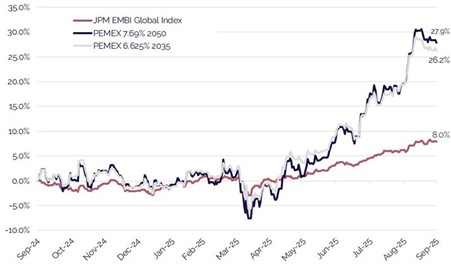
* Source Bloomberg LP and EPIC Calculations. As at end September 2025.

The Sheinbaum administration – a new chapter for PEMEX

The election of President Claudia Sheinbaum signalled a decisive shift in approach, committing to addressing the company’s deep-seated financial issues. This renewed government support is the single most important factor for bond investors. The explicit commitment underscores the quasi-sovereign character of Pemex’s debt, effectively positioning the Mexican government’s creditworthiness as the ultimate backstop.

The administration’s proactive steps, which underscore their commitment to stabilise Pemex and other-state owned companies, include:

  • A comprehensive 10-year plan (2025–2035): This strategic roadmap aims to transform Pemex into a more efficient and sustainable entity through debt reduction, production stabilisation, and the revival of key operations.
  • Fiscal relief: A new tax reform is designed to significantly reduce Pemex’s historically high tax burden, freeing up capital for productive investment.
  • Direct financial lifelines: The government has provided, and committed to providing, substantial financial support, including a large investment fund to finance projects and ensure timely payments to suppliers.

The market’s confidence has been formally validated by credit rating agencies. In a matter of weeks:

  • S&P Global Ratings affirmed its BBB rating in September, a benchmark that has remained in place since March 2020. This consistency is key: unlike other agencies whose recent upgrades were a direct reaction to immediate government action, S&P’s investment-grade rating is the clearest reflection of its belief that the Mexican sovereign link is the fundamental driver of value.
  • Moody’s upgraded Pemex by two notches (from B3 to B1) in September, citing a “very high” government support assumption for the company.
  • Fitch Ratings followed suit with a further upgrade to BB+ in October, specifically noting that the successful execution of a large government-funded tender offer indicated an “increased linkage between Pemex and the sovereign.”

This wave of upgrades confirms that the government’s financial strategy, centred on improving stability and sustainability, has dramatically improved the credit profile of the Pemex bonds.

The value of vision

The success of the Pemex position validates our core philosophy. By focusing on fundamental analysis and identifying the true drivers of value, such as explicit government support, we capitalise on opportunities consistently overlooked by passive strategies.

Our unconstrained approach allows us to look past headline risk and conventional metrics, enabling us to target value across three distinct areas:

  • Political and structural catalysts – identifying sovereign actions that fundamentally alter credit risk.
  • Mispriced technical dynamics – exploiting situations where index constraints force others to sell.
  • Deep fundamental dislocation – uncovering value where a market’s negative perception ignores strong underlying economic realities.

Our unconstrained process actively creates value for our clients. We move decisively beyond the limitations inherent in index structures, applying deep insight and rigorous selection to generate performance. Our focus remains squarely on value, discipline, and delivering robust returns for your portfolio.

Please continue to check our blog content for advice, planning issues and the latest investment market and economic updates from leading investment houses.

Andrew Lloyd  

17/10/2025
Team No Comments

Brooks Macdonald Daily Investment Bulletin

Please see below article received from Brooks Macdonald this morning, which provides a global market update for your perusal.

What has happened?

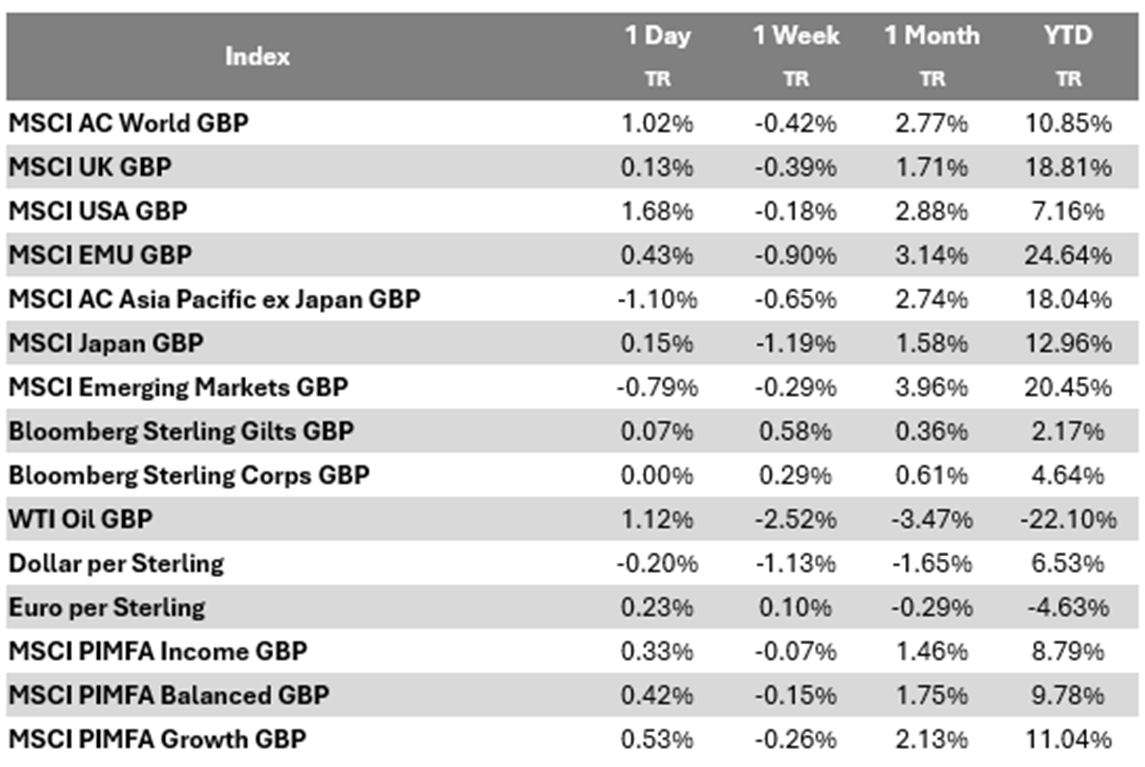
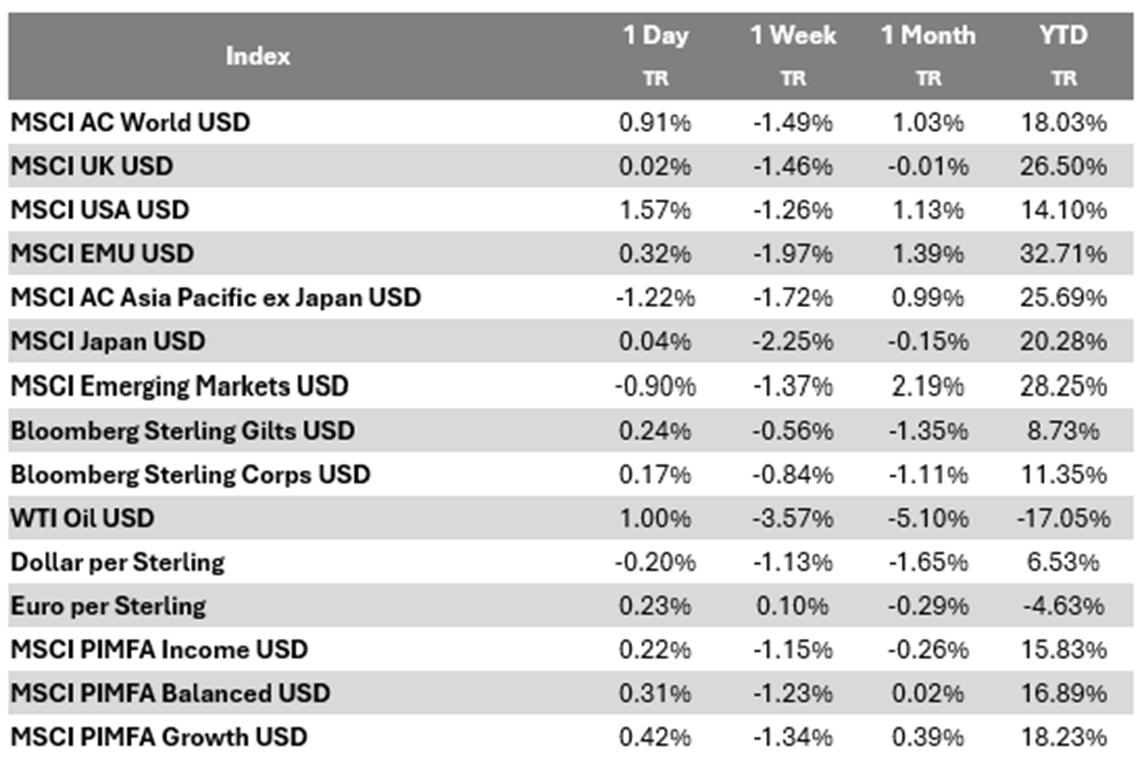
US equities closed mostly higher on Wednesday. The S&P 500 gained +0.40% and Nasdaq gained +0.66%. Banks and semiconductors led as the outperformers, while the big techs were mixed. Treasuries weakened slightly, contributing to some curve steepening. The dollar index dipped -0.3%, gold climbed +0.9% to surpass $4,200 per ounce, and WTI crude oil declined -0.7%. In Europe, markets were slightly positive with the STOXX 600 edging up +0.1%. The FTSE 100 and DAX both gained +0.2%.

Trump continues hawkish tone on trade

US Trade Representative Greer labelled China’s new rare earth export restrictions as a ‘global supply chain power grab’ and a breach of prior agreements. Treasury Secretary Bessent dismissed reports that Beijing is banking on Trump’s stock market focus to force concessions, emphasising that the US won’t negotiate under market pressure. He branded Chinese Vice Commerce Minister Li Chenggang as ‘unhinged,’ accused China of questionable supply chain practices, and announced plans for price floors in various industries to counter market manipulation. However, Bessent offered a glimmer of compromise: a longer pause on high US tariffs if Beijing delays its rare earth limits, potentially negotiable in the coming weeks. Trump has questioned the need for a meeting with Xi at the upcoming Asia-Pacific Economic Cooperation summit in South Korea, but Bessent indicated it’s still likely on.

Fed’s Beige Book reveals stagnant economy

The Federal Reserve’s latest Beige Book reported minimal change in economic activity since the prior period, with three Districts showing slight to modest growth, five unchanged, and four experiencing a slight slowdown. Employment remained stable, but labour demand was subdued, with more firms reporting layoffs. Prices continued to rise, accelerated by higher input costs, which are often linked to tariffs. Wages increased modestly. Consumer spending dipped slightly, especially on retail goods, though electric vehicle sales boosted auto demand. Lower- and middle-income households hunted for discounts, while high-income luxury spending stayed robust. District outlooks varied, blending improved sentiment with persistent uncertainty.

What does Brooks Macdonald think?

US-China trade frictions show no signs of easing. But there were some positive trade developments elsewhere, US-South Korea talks signal headway on a $350 billion investment pledge, while US-India relations warm with Trump’s praise for PM Modi and claims of Delhi halting Russian crude purchase. Closer to home, UK monthly activity expanded marginally in August as expected, though July’s figure was revised to a 0.1% contraction. In France, political drama unfolds with PM Lecornu facing two no-confidence votes—one from the far-right (likely to fail) and one from the left-wing bloc, whose outcome hinges on a few votes despite offered compromises to Socialists.


Please check in again with us soon for further relevant content and market news.

Chloe

16/10/2025

Team No Comments

EPIC Investment Partners – The Daily Update | Who Picks Up The Bill?

Please see below the daily update article from EPIC Investment Partners, received this morning – 15/10/2025

Trade tensions remain elevated ahead of the planned meeting between President Trump and President Xi Jinping early next week. Toe to toe negotiations can be expected.

An interesting article from Goldman Sachs’ economists, recently published, is worthy of note. Elsie Peng and David Mericle suggest that the vast majority of tariffs increases will be borne by Americans, perhaps three quarters. Consumers are estimated to shoulder 55% of tariff costs while American business absorb a further 22%.

The pair estimate that foreign exporters would absorb just 18% of tariff costs by cutting pricing while 5% of tariffs will be evaded by one means or another.

Last year the United States was China’s largest export market accounting for roughly 15% of total exports but exports have fallen sharply this year. This has been more than offset by higher Chinese exports to other markets, especially the Global South.

Following the Irish famine of 1845, the following year Conservative Prime Minister Robert Peel, assisted by the Liberal Party, abolished high tariffs on imported grain which had protected British landowners.

This ended protectionism and ushered in an era of free trade which Britain, unchallenged on the seas, took full advantage of.

Please continue to check our blog content for advice, planning issues and the latest investment market and economic updates from leading investment houses.

Charlotte Clarke

15/10/2025

Team No Comments

Brewin Dolphin – Markets in a Minute

Please see this week’s Markets in a Minute update below from Brewin Dolphin, received yesterday afternoon – 14/10/2025.  

What’s behind the latest U.S. stock sell-off?

Key highlights

  • Stocks rally on Takaichi win: Japanese stocks got off to a flying start after Sanae Takaichi was announced leader of the Liberal Democratic Party.
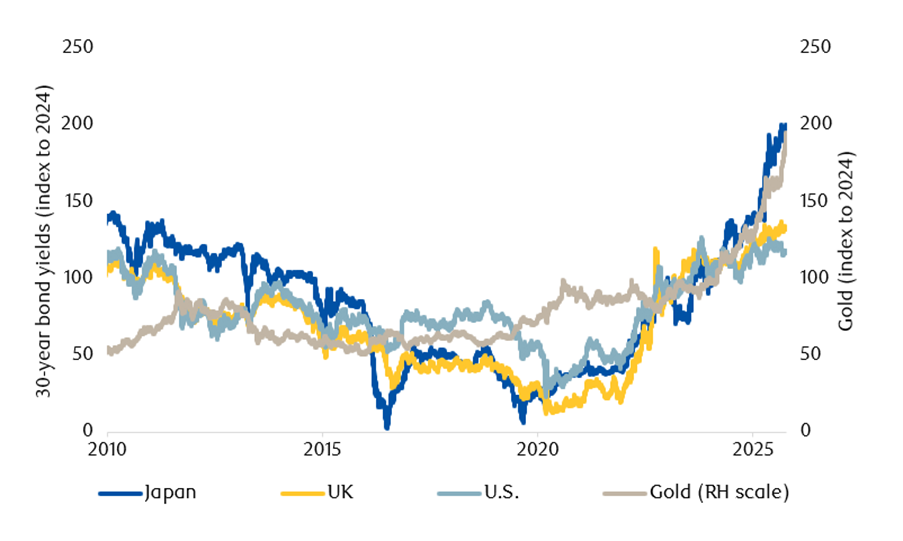
  • Why are long-term bond yields rising? Inflationary pressures returning, a lack of fiscal restraint, and rising gold prices have seen global long-term bond yields rise.
  • The risk of a circular AI investment model: The adoption of a ‘vendor financing’ model could see companies misjudge the underlying demand that the system’s built on, potentially leading to a depreciation in asset value.

Stocks buffeted by political waves

Stocks fell sharply on Friday, driven by concerns of a renewed U.S.-China trade war. The initial action came last Thursday, with China raising export controls on rare earths (metallic elements found throughout the Earth’s crust), which is assumed to be in retaliation against U.S. technology curbs. China also imposed special port fees on U.S. vessels docking at Chinese ports, and an anti-trust investigation into U.S. semiconductor manufacturer Qualcomm.

President Donald Trump announced he would respond with a new 100% tariff on Chinese imports, which was to be imposed over and above all pre-existing tariffs. These latest measures prompted the biggest U.S. equity sell-off since April. It was led by technology companies, which risk being caught in the political crossfire of the dispute and face their own investment controversies, as we discuss later.

Sunday saw some remarks by President Trump and Vice President JD Vance that are being treated as evidence that the TACO (Trump Always Chickens Out) heuristic remains in play. The implication is that a violent market reaction makes the administration reverse or delay its measures. But did the White House promise anything like that? Not really.

The president just emphasised that he thinks it won’t be a problem, and that the U.S. and China aren’t trying to impose pain on each other. At the time of writing, the dispute has yet to be resolved.

Bond yields and gold have risen as governments become more wasteful

Source: LSEG Datastream

Japanese stocks got off to a flying start last week following the surprise result of the Liberal Democratic Party (LDP)’s leadership election.

Sanae Takaichi emerged as the winner, causing ructions in financial markets due to her previous statements on the best course for monetary and fiscal policy. Takaichi is considered a dove on both fronts – advocating for tax cuts and opposing interest rate increases.

Government intervention into monetary policy has been a bit of a theme since U.S. President Donald Trump’s return to power. He’s locked horns with his previous appointment to the Federal Reserve (the Fed), Chair Jay Powell, and more recently with Fed Governor Lisa Cook. The Japanese government has also attempted to steer policy before, but previous efforts were rebuffed by the Bank of Japan (BoJ) board.

The reaction was a fall in the yen and consequent rise in equities. The bond market’s response was more nuanced. Shorter-dated bonds saw gains (yields fell) as it seems less likely that interest rates will go up in the short term due to Takaichi’s perceived political pressure. However, longer-dated bonds weakened (yields rose) because a more accommodating fiscal attitude means higher inflation and more bond issuance.

These reactions did partially reverse toward the end of the week as the early challenges of Takaichi’s prospective premiership emerged. She and her government need to gain parliamentary support, but the LDP-led coalition doesn’t have a majority in either of the two chambers of the Japanese National Diet.

To compound these challenges, the junior coalition party, Komeito, threatened to leave the coalition (which has broadly endured since 1999) due to differences with Takaichi. This prompted anxieties over whether a budget could be passed and what it would contain. However, it still seems likely that Takaichi will be able to form a government, and pass a budget, with opposition more likely to be directed at looser fiscal policy, rather than tighter.

The direction of monetary policy is harder to call. For the time being, neither the BoJ nor the government seem inclined to raise interest rates. They are concerned about weak wage growth due to a lack of profitability when the spring Shunto wage negotiations begin.

Why are long-term bond yields rising?

The rise in long-dated bond yields is part of a trend we’ve seen in other countries. The UK has suffered from them, as has the U.S., and the change is particularly pronounced in Japan (because rates are rising from such a low level).

It’s not a coincidence that long-term bond yields have risen, as inflationary pressures return from deglobalisation and a lack of fiscal restraint at the same time as gold prices have risen. Notably, each phase of bond market weakness (first in the UK, then the U.S., and now Japan) has been accompanied by an increase in gold prices.

The pace of gains naturally raises the question of whether gold has entered a bubble. With no valuation metric or yield, it’s impossible to definitively rule it out. However, the news flow remains supportive of gold, with little prospect of that changing.

What could change it? One possibility is a bond market riot forcing a return to fiscal restraint. Another is the natural cycle of any bull market – peaking when there are no prospective buyers left. For now, however, it seems there are still plenty of potential new buyers for gold.

Why AI’s circular investment environment is risky

Concerns of a bubble have also infected the artificial intelligence (AI) ecosystem.

For many years, the biggest players in AI have been the hyper-scalers, which generate enormous cashflows and have been well placed to funnel some of that funding back into building out cloud capacity. But over time, other players have also risen in prominence and have contributed to financing increasing investment into the IT and AI space.

However, over the last couple of years, the means of funding new investment has switched from customers paying suppliers, to more novel mechanisms of circular investments. These sometimes-complex transactions involve technology suppliers – primarily semiconductor manufacturers and cloud providers – taking equity stakes, providing capacity guarantees, or offering debt to secure long-term procurement commitments from AI developers and infrastructure tenants. These tenants can be individual customers or organisations within a larger, shared infrastructure.

This ‘vendor financing’ model helps share the risk of the colossal capital expenditure required for some AI infrastructure suppliers. However, it can also flatter the reported revenue and subsequent market valuations of the suppliers – establishing a potent, self-reinforcing cycle.

NVIDIA has been leading in this space by actively guaranteeing customer demand through direct equity investments and capacity backstop agreements. The company has enjoyed enormous cashflows in recent years and is now using them to create its own demand for the future. NVIDIA reached an agreement for CoreWeave to buy its chips, committing to buy any excess cloud capacity that CoreWeave has available.

A commitment from such a financially robust counterparty serves as security against CoreWeave’s own borrowing. NVIDIA also committed to invest up to $100 billion in OpenAI, on the condition that NVIDIA systems power 10 gigawatts (GW) of capacity.

There are reasons to be cautious about these arrangements. Firstly, the fact that so much investment is taking place raises fears of previous over-investment cycles. Most companies investing $5 billion today will be suffering a $1 billion depreciation charge next year. If demand doesn’t meet expectations, there could be a further write-down charge.

The very clear and present demand for these relatively short-lived assets has underpinned the investment case to date. But as the circular commitments become more prevalent, there’s a risk that the companies fundamentally misjudge the underlying demand on which the system is built.

That risk seems modest right now, but it’s one that needs to be monitored closely.

Please continue to check our blog content for advice, planning issues and the latest investment market and economic updates from leading investment houses.

Charlotte Clarke

15/10/2025


Team No Comments

Brooks Macdonald – Daily Investment Bulletin

Please see the below article from Brooks Macdonald detailing their brief discussion on markets with a focus on the US-China trade spat. Received this morning 14/10/2025.

What has happened?

Markets showed signs of stabilisation yesterday after a turbulent close to last week. One of the main drivers was OpenAI signing a major deal with Broadcom, whose shares surged 9.88%, to acquire 10 gigawatts of advanced computer chips, signalling robust demand for AI infrastructure. The S&P 500 clawed back more than half of Friday’s losses, while Brent crude oil edged up 0.94% to trim its weekly decline. However, Washington remains in gridlock as the government shutdown drags into its third week. Across the Atlantic, European indices posted steady gains. The STOXX 600 rose 0.44%, and the FTSE 100 gained 0.16%. This morning, though, Japan’s Nikkei fell 2.80% amid fallout from the ruling coalition’s collapse. Investors are questioning whether new Liberal Democratic Party leader Sanae Takaichi can secure enough votes to become prime minister.

US-China trade spat

The US-China trade spat reignited Friday when President Trump floated massive tariff hikes on China, including a potential 100% levy, rattling global nerves. Yet, the White House quickly tempered the rhetoric, signalling willingness for a deal to de-escalate tensions, particularly over China’s recent restrictions on rare earth exports. Officials emphasised maintaining pressure on Beijing while reassuring markets that outright escalation isn’t inevitable. US Treasury Secretary Scott Bessent reinforced this on Fox Business, affirming that the Trump-Xi summit in South Korea remains on track. As of this morning, Polymarket has the odds of the meeting at 74%.

What does Brooks Macdonald think?

Monday’s market bounce hints at a resurgence of the ‘TACO’ (Trump Always Chickens Out) trade, where investors wager that Trump will dial back his fiercest trade rhetoric to avoid deeper selloffs. This optimism lifted trade-sensitive names, with the NASDAQ Golden Dragon China Index (tracking US-listed firms heavily exposed to China) jumping 3.21%. As the US earnings season kicks off today, featuring heavyweights like JPMorgan Chase, Wells Fargo, Goldman Sachs, and Citigroup, investors will scrutinise their results in a data-starved environment due to the ongoing US government shutdown. Federal Reserve rate cut, a rebound in capital markets activity, and the absence of downward earnings revisions this quarter should support a bullish view; however, sky-high valuations mean companies must deliver near-flawless results to sustain the rally, leaving little margin for error.

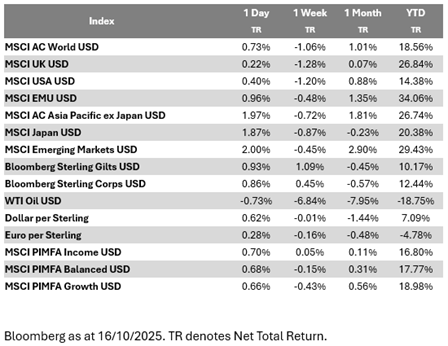
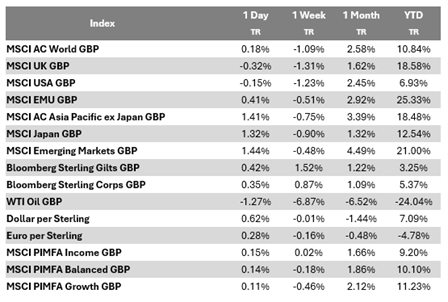
Bloomberg as at 14/10/2025. TR denotes Net Total Return.

Please continue to check our blog content for advice, planning issues and the latest investment, market and economic updates from leading investment houses.

Alex Clare

14/10/2025

Team No Comments

Tatton Investment Management: Monday Digest

Please see below, an article from Tatton Investment Management, analysing the key factors currently affecting global investment markets. Received this morning – 13/10/2025

Volatility on the horizon

Stocks were pushing all-time highs early last week, but sold off sharply after Trump’s tariff threats against China. At the open in Asian markets there was further selling but this lasted only minutes. From thereon there was healthy “dip buying”. Trump intimated that he saw the spat over wider rare earth product controls as temporary, having previously also said he would probably now meet Xi (a reversal of his previous threat).

Meanwhile, cryptocurrency markets were alive with a rumour that a Trump insider had placed shorts on Bitcoin ahead of the first TruthSocial post on Friday, potentially earning millions of dollars.

Our conversations with investors over the past week suggest they remain bullish for the medium-term. However, in general, short-term sentiment is waning. Risks are rising for the short-term and many expect a dip before the bullish trend reasserts itself.

Everyone expects tax rises in the UK’s autumn budget. The government is likely to raid banks or savings to maintain its electoral pledge, but an income tax rise would probably do the least economic harm. The UK has a debt problem – but it’s a problem of bond market structure, not overspending. There’s too many long-term bonds and not enough short-term bonds (a legacy of historic pension regulation) and the oversupply puts off foreign investors. This could be solved, if the government borrowed at the short end and bought back its long-term bonds cheaply. It would be criticised for ‘fiscal dominance’, but if the treasury can match bond supply and demand while lowering its own debt costs, what’s not to like?

There’s a cacophony of debate about an AI bubble (prompted by Nvidia’s ‘vendor financing’ with OpenAI) but even, in pure valuation terms, that’s exaggerated. We note, though, that rental prices for Nvidia’s H100 GPU (at the heart of the AI revolution) have declined more than expected – suggesting an oversupply. Nvidia and its peers – the world’s biggest stocks – could be vulnerable in the short-term, even if AI’s long-term growth is assured.

With the leading lights shining less brightly and liquidity tapering off, investors will struggle to get more optimistic. Volatility could increase – like on Friday. While index-level volatility has been low recently, volatility in underlying stocks (particularly the biggest names) has increased, making equities riskier.

The US government shutdown means that economic data isn’t being published either – starving markets of the information they feed off. Kept in the dark, markets fixate on the information they do have, like some poor credit and sentiment data. Investors aren’t worried about the data yet and the profit outlook remains solid, but a patch of volatility is becoming more likely.

How stable are stablecoins?

With the Bank of England relaxing its limits on stablecoin holdings and governor Bailey opining on their potential, the digital assets look set to play a big role in global finance.

Stablecoins are cryptocurrencies pegged to other assets, like fiat currencies or gold, where the peg is maintained by ‘safe’ assets like cash or short-term debt. They’re more like money market funds than traditional credit-backed bank deposits. The US government threw its weight behind stablecoins with the “GENIUS” act, and most existing stablecoins (like Tether’s USDT) are backed by short-term US treasury bonds. The benefit of using them is the underlying blockchain technology, which allows for instant, 24/7 transactions.

The ECB worries that stablecoins could undermine financial stability (by encouraging risk-taking on the asset-backed side) and its ability to control monetary policy. That’s why the ECB wants to pursue its Central Bank Digital Currency (CBDC) instead. But it’s no surprise why the US is in favour of stablecoins: in their current form, they reinforce the dollar’s global dominance and are likely to provide massive demand for US bonds.

The sector is set to expand, after getting official US backing. But as Citi researchers point out, other digital assets (like free-floating cryptos and CBDCs) can co-exist and flourish alongside stablecoins. European policymakers would do well to promote their own preferred medium rather than trying to put the stablecoin genie back in the bottle.

But the ECB isn’t wrong about the risks from stablecoin adoption. Much has been said about the potential for issuers to obfuscate risks in their collateral base, but less explored is how the increased demand for ‘risk free’ US bonds could distort the financial system. Their entire value is linked to debt provision for a highly leveraged institution with declining governance standards. That this institution is the US government makes it ‘risk free’ in name only.

Serial French government collapse isn’t a Euro crisis

The resignation and reappointment of French Prime Minister Lecornu is, at its heart, about the split parliamentary blocs’ inability to agree a budget. President Macron has reportedly offered to suspend his pension reform to salvage a workable government and avert an election. Lecornu has now built another cabinet. Today they must agree a new budget and then it will be taken immediately to parliament for a vote. It is likely that the net impact will be tempered from the previous proposal of -0.7% of GDP to -0.4%, leaving an ongoing 2026 deficit of 5% of GDP.

Budget deadlock has been constant since the 2024 election, but the inability to cut spending or raise taxes goes much further back. In the meantime, France’s debt and deficit are too high for bond markets’ comfort. Mohamed El-Erian warned the French bond and equity sell-off is a problem for the whole of Europe and the UK. Needless to say, a French debt crisis would be worse than previous episodes with Greece or Italy.
French markets didn’t have a good week, but in truth the reaction was mild. French government bond (OATs) yields increased their spread over Germany, but not dramatically – and French stocks recovered their losses midweek. There was little impact on broader European assets. This might just be because markets have started ignoring political noise – a lesson learnt from the US. But also, Europe’s fundamentals are decent. ‘Periphery’ growth is good, and Germany’s fiscal impulse has increased growth expectations and investment into Europe. Perhaps markets hope growth will ease France’s debt problems.

We agree that the governmental collapse is unlikely to create another euro crisis, but it’s still a problem. Our measure of government debt risk increased for OATs this week, suggesting markets see France as a less reliable move. The worrying part is that this isn’t a short-term panic; it’s the culmination of France’s inability to agree a sustainable tax and spend policy. If OATs spiral, the ECB has the firepower to intervene and stabilise European bonds. The risk isn’t that France collapses; it’s that the drift continues.

Please continue to check our blog content for the latest advice and planning issues from leading investment management firms.

Marcus Blenkinsop

13th October 2025

Team No Comments

EPIC Investment Partners: The Daily Update

Please see below, an article from EPIC Investment Partners discussing the challenges for Eurozone economies. Received today – 10/10/2025

The euro was born out of a grand bargain: the stability of the core would anchor the discipline of the periphery. By stripping away the safety valve of devaluation and the natural brake of rising interest rates, the single currency was meant to force governments to live within their means. In practice, it did the opposite. Membership dulled market discrimination, allowing countries to borrow at rates that bore little relation to their economic fundamentals. For a while, the illusion held.

Greece was the first and fiercest warning. Flush with cheap credit after joining the euro, successive governments borrowed freely and spent lavishly, confident that default within the common currency was unthinkable. Beneath the surface, debt piled up, competitiveness eroded, and statistics were massaged. When the truth finally emerged in 2010, the reckoning was swift. The deficit was far higher than reported, the credibility of official data collapsed, and investors fled. Bond yields soared, funding evaporated, and Greece was forced into the first of several bailouts. The crisis exposed the structural flaw at the euro’s heart: a shared currency without a shared fiscal authority, where moral hazard was baked into the system. The warning was clear: markets might ignore imbalances for years, but when trust breaks, the punishment is sudden and unforgiving.

Fifteen years on, the pressure has shifted from the periphery to the core. France, long seen as the anchor of the eurozone, is testing the limits of the system in a different way. Its challenge is not an external liquidity squeeze but a domestic solvency problem: a political inability to stop borrowing. The country’s debt now exceeds 110% of GDP, while deficits hover around 6%, double the level permitted under European rules. Decades of high social spending and generous pensions have become politically untouchable, and attempts at reform have met fierce resistance. Tax cuts designed to spur growth have eroded revenues, leaving the government trapped in a cycle of chronic shortfalls.

For years, French bonds traded almost as safely as German Bunds. That calm has begun to fray. Investors are starting to price in not default risk, but dysfunction. Repeated government collapses and the use of constitutional shortcuts to force through budgets have undermined confidence in France’s ability to govern itself. The spread between French and German yields has widened to its highest in a decade, a quiet but telling signal that markets are losing faith in the country’s capacity to generate the surpluses needed to stabilise debt.

The parallel with Greece is uncomfortable. In 2010, Europe had the political will and the financial tools to contain a small nation on the periphery. France is different. It is too big to bail out and too central to fail. The European Central Bank can buy time with bond purchases, but it cannot manufacture consensus or rewrite budgets. The euro’s early lesson still stands: credibility, once squandered, cannot be printed. France’s fate will determine whether Europe has learned from 2010, or whether history is preparing to repeat itself once again.

Please continue to check our blog content for the latest advice and planning issues from leading investment management firms.

Alex Kitteringham

10th October 2025

Team No Comments

EPIC Investment Partners: Will the Government Get a Windfall from Public Sector Productivity Gains or AI?

Please see the below article from EPIC Investment Partners detailing their discussions on the UK Public Sector. Received this morning 09/10/2025.

The UK has a big public sector productivity problem

As the Chancellor does her sums, she will see that UK public sector productivity is still 4% below the levels it reached in 2019 (ONS estimate), with the NHS lagging by rather more. This is a major extra cost to the taxpayer and probably is larger than the whole of the overrun in the deficit the OBR will report to her. If only she could magic it away, harder choices like tax rises or cuts in spending that people value would be avoided.

The previous government presided over a big recruitment into the civil service and into NHS Administration during covid, and those extra numbers have stayed in post. The current government has added further to them.

What is current policy to boost productivity?

The present budgets assume there will be a squeeze on staff numbers and an increase in output to tackle this problem. The spending figures on administrative overhead, which is running at £14.08bn this year, are for it to rise to £14.23bn next year, before falling away to £13.2bn by 2028-9 and tumbling to £12.6bn the following year, after an election. This implies reducing numbers, as there will be pay awards and promotions to cater for.

However, if you read on in the public accounts, you discover that a Transformation Fund has been set up to spend £3.25bn on the application of AI and other improved processes to achieve some productivity gains. Adding those back into the figures, the administrative costs rise from £14.33 bn this year to £16.23bn next, an increase of 14% before falling to £14.89bn in 2027-8. That is still 4% above the current year level.  The “Transition costs” are said to be one offs and temporary so are not included in the main figures.

It may well be that AI offers plenty of scope for economies in administration in government. The expensive welfare system can be extensively computerised and already uses a lot of computing power to distribute benefits to millions of people. The NHS might be able to handle patient records, bookings, workforce planning and other central tasks better with more AI. These gains should, however, be additional to recovering the lost productivity since 2019, as 2019 was a pre-AI age.

It is also the case that spending more money on digital systems only delivers productivity gains and cost savings if sufficient staff posts are removed to more than offset the extra computer cost. The government needs to explain both to its staff and to the public what it has in mind in terms of lower staff numbers and how it can handle that without compulsory redundancies. Natural wastage can achieve a lot but it requires more discipline over external hirings than the government has managed so far.

Trends in civil service numbers and gradings

Civil service numbers fell to 384,000 full time equivalents in 2016, following a long period of controls on recruitment and replacement. It has now risen to 516,000, an increase of a third.  The public sector as a whole employs 6.1m workers, of which 1.2m are designated as being in administration.

Between 2014 and 2024 there was substantial grade inflation or promotion. In 2014 58% of the civil service was at Executive Officer or higher grade, whilst that rose to 74% ten years later. Some of this reflects the automation of some lower paid jobs and the need for higher paid supervisory. Some of it probably was caused by the wish to retain people without being able to give them an above average pay rise, unless they could redefine their responsibilities and be promoted.  Either way the civil service is now more top heavy and has higher average pay.

What are the likely chances of getting a decent boost to growth and to cost savings from public sector productivity?

In theory the chances are good. We know the government can be run with far fewer civil servants without new technology, as has been done in the recent past. It should be possible to recapture the lost productivity by better management of staff numbers as people move jobs or retire. AI should be an ideal technology to make a big reduction in civil service administration costs. Much of the work is drafting briefs, policy papers and administrative documents. AI would be well placed to do the first draft and to give officials easy access to the stock of established government policies, positions and data to inform the latest brief or decision.

In practice it looks as if the transformation will be delayed and the costs will be front loaded. The second year of a new government would be the ideal time for Ministers, when they have learned more of their departments, to work with the senior officials to get some savings. The Transformation fund, with a very round number of £2bn to spend next year, clearly needs a lot more work on what the money will buy, how long it will take to put in and where the savings will come from. The forecast of bigger savings in a future year that will definitely be after the election is not a very bankable proposition in this fast-moving world of AI. The Chancellor will need to look elsewhere for savings or put up taxes if the AI programme remains on its current leisurely timetable.

Please continue to check our blog content for advice, planning issues and the latest investment, market and economic updates from leading investment houses.

Alex Clare

09/10/2025

Team No Comments

Brewin Dolphin – Markets in a Minute

Please see this week’s Markets in a Minute update below from Brewin Dolphin, received yesterday afternoon – 07/10/2025.  

How are politics affecting markets?

Explore how political events in France, Japan, and the U.S. are influencing investor sentiment.

Key highlights

  • Shutdown? So what? Global stocks rallied to fresh highs, brushing off the U.S. government closure and subsequent economic data blackout.
  • Jobs jigsaw: Although fewer U.S. jobs are being created, layoffs remain at low levels.
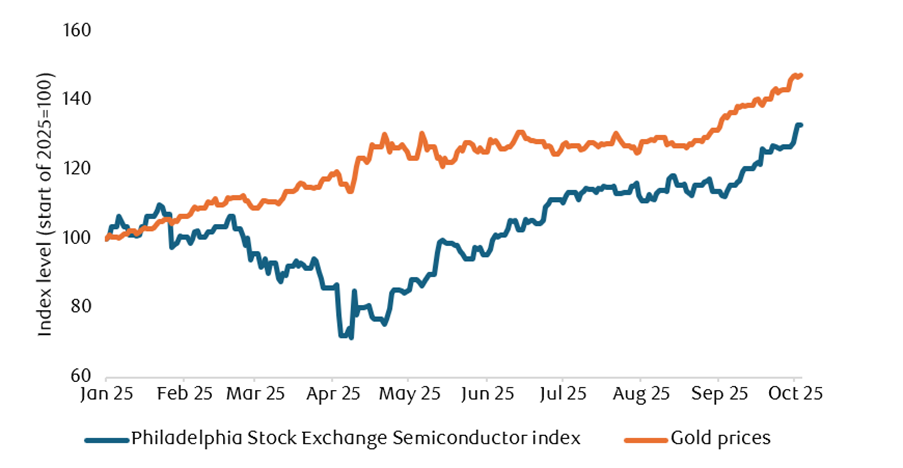
  • Artificial intelligence (AI) alliance boom: Chip stocks surged as global mega-deals signalled structural tailwinds for AI infrastructure.

Markets look past the U.S. government shutdown

Global stocks continued their steady march to new highs last week despite the U.S. government shutdown and disappointing private jobs data.

Last week’s price action tells us something important: markets are looking past the short-term noise of politics and patchy data and instead balancing between structural optimism for AI and cyclical caution – with AI having an upper hand due to strong evidence of financial commitment and collaboration amongst players within the AI infrastructure ecosystem.

The U.S. government officially shut down on 1 October, as Congress failed to pass the necessary spending bills to fund federal operations into the new fiscal year. Around 750,000 federal workers are now furloughed, including many responsible for compiling key economic data. That means that data such as non-farm payrolls, the consumer price index (CPI), retail sales and gross domestic product (GDP) won’t be released until the government reopens.

This creates a significant information gap for investors and policymakers, particularly at a time of economic uncertainty over the labour market. The Federal Reserve (the Fed) will be flying blind ahead of its next policy meeting in October, with markets leaning on a rate cut.

From an economic perspective, the impact of a U.S. government shutdown tends to be modest. Historical estimates suggest a temporary drag of -0.1% to -0.3% on GDP, typically reversed when back pay is issued to federal workers. The greater risk would come from a prolonged shutdown, which could begin to affect broader confidence and spending.

For now, markets are sanguine. U.S. stocks have shown mixed performance during past government shutdowns. What’s different this time is the potential for deeper, structural implications. President Donald Trump has suggested he may take this opportunity to permanently lay off government workers providing services outside of the administration’s core policy goals. That would mean a shift from the usual furlough and back pay approach that tends to have little economic impact. So far, the markets’ base case is that the shutdown will again be temporary and its impact manageable.

A low-hire, low-fire U.S. jobs market

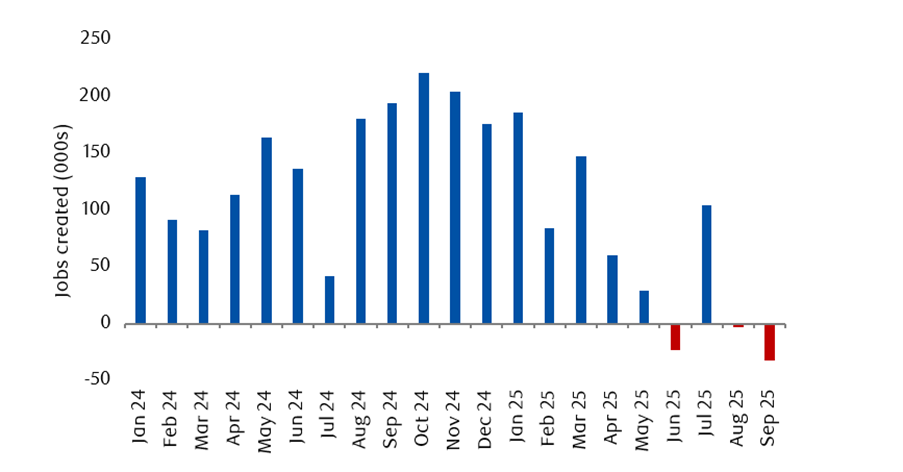
With official payroll data suspended, attention turned to private indicators. The ADP (Automatic Data Processing)’s employment report showed private sector job losses for the second consecutive month, adding to evidence of a slowing labour market.

U.S. private employment changes

Source: ADP

Still, the narrative isn’t one of collapse. For instance, jobless claims remain stable and low. Companies seem to be reluctant to lay off workers due to lingering skill shortages and a lower labour supply due to immigration policy changes. This low-hire, low-fire dynamic means the labour market is slowing gently rather than falling off a cliff.

The positive news is that consumers are still spending and companies are investing in technology. Supporting this sanguine view, the Atlanta Fed’s GDPNow model projects 3.8% GDP growth in the third quarter. This is hardly consistent with a recessionary economy.

That said, the Fed’s policy challenge remains. Without timely official data, policy decisions will rely on alternative sources and sentiment surveys. Markets are pricing in interest rate cuts for October and December, driven by a weaker labour market and Fed officials’ view that current rates remain high relative to the neutral rate – the level that neither stimulates nor suppresses inflation.

Mega AI deals fuel global chips rally

The standout story remains the surge in AI infrastructure-related stocks, as a fresh wave of deals and capital commitments highlight the scale and potential longevity of this investment cycle.

Following Nvidia’s $100 billion investment in OpenAI, OpenAI is touring the world securing its data centre buildout partners. In Korea, Samsung and SK Hynix signed new deals to supply high-bandwidth memory chips for OpenAI’s Stargate project. Japan’s Hitachi and Fujitsu expanded collaboration with Nvidia and OpenAI to support energy and infrastructure projects.

This reinforces a critical theme: that no single company or country can deliver the scale of infrastructure required to support the insatiable demand for computing power in the age of AI. As such, collaboration across the ecosystem is essential. Whether it’s data centre construction, memory chips, energy infrastructure, chip design, or cloud storage, the size of the opportunity demands deep partnerships.

This interdependence enhances visibility into the longevity of capital investment while keeping the benefits within the AI infrastructure ecosystem, making the theme a firm favourite amongst investors.

The asset performing as well as, or even better than chips, is gold, which has gained momentum amid broader concerns about institutional credibility. The current U.S. government dysfunction adds further rationale for continuing this trade.

Chip stocks and gold prices rallied hard this year

Source: Bloomberg

Will Japan see its first female prime minister?

In Japan, Sanae Takaichi has emerged as the winner of the weekend’s Liberal Democratic Party (LDP) leadership election. Although the LDP-Komeito coalition currently lacks a majority in the lower house of the National Diet, it will still likely elect her as the country’s first female prime minister. Voting is likely to take place later this month.

Takaichi’s election has sparked speculation about her potential policies, particularly regarding the economy. The key controversy is whether she may try to influence the Bank of Japan (BoJ)’s monetary policy and whether she can bring about fiscal expansion. She has in the past been responsible for some dramatic quotes about the future direction of interest rates, but more recently, she has seemed to endorse the need for the BoJ to make its own decisions. She has also pledged fiscal expansion through income tax cuts and even cash handouts. A cut in sales tax already seems likely.

The market reaction to Takaichi’s victory has been notable, with the yen weakening against major currencies and longer-term bonds falling. However, stocks have risen, with the Nikkei 225 Stock Average reaching a record high.

Exporters and certain manufacturers have also seen significant gains, as investors bet on the potential for increased government spending and stimulus under Takaichi’s leadership. Overall, Takaichi’s election is being seen as a positive for risk assets, with investors weighing the potential benefits of her policies against the potential risks.

The view for the bond market is more nuanced. Short-term yields have fallen, reflecting a real impression that Takaichi will coerce monetary policy. In contrast, longer-term bond yields have risen, reflecting expectations of higher eventual interest rates and inflation.

French political turmoil continues

In France, Sébastien Lecornu resigned as prime minister on Monday, which came less than 24 hours after President Emmanuel Macron appointed a new cabinet. It highlights a political gridlock that’s very difficult to break, involving the near-impossible task to pass a budget that involves unpopular spending cuts and tax increases to reduce the budget deficit.

Although markets have become used to French political drama, investors are losing patience and French borrowing costs are rising. To see French bonds yield more than Italian bonds is the kind of shock that might galvanise the electorate or the French parliament into action. France has an average maturity of eight years on its government bonds, so it’ll take some time for higher bond yields to do lasting damage.

The banks are in decent shape. The European Central Bank (ECB) has a transmission protection instrument (TPI) to prevent regional spillovers. The TPI allows it to purchase a country’s government bonds if it decides that its borrowing costs are higher than justified by economic fundamentals. For this reason, the ECB is comfortable to see borrowing costs rise until it needs to force some corrective action.

However, the political steps needed to get to that point don’t seem imminent, and so it seems likely that French government bonds will remain under pressure.

Please continue to check our blog content for advice, planning issues and the latest investment market and economic updates from leading investment houses.

Charlotte Clarke

08/10/2025

Team No Comments

EPIC Investment Partners | Another One Bites the Dust

Please see below, an article from EPIC Investment Partners with their views on the French Prime Minister’s resignation. Received today – 07/10/2025

France’s fifth Prime Minister in two years resigned yesterday morning, making the UK appear a relative haven of stability. Mrs Reeves is wrestling with some frightening numbers prior to another tax raising budget on November 26th, but she must be relieved that she isn’t in charge of the French economy.

In summary:

  1. The French state forms the largest part of the economy with the highest percentage of total spending in the world at 57%. The UK’s is 44%.
  2. French debt has edged ahead of the UK. Including off balance sheet liabilities such as pensions, French debt exceeds 400% of GDP
  3. France has not run a budget surplus since 1980
  4. The French have the longest retirements in the world, averaging in excess of 25 years.
  5. France is the only place in the world where the average pensioner earns more than the average worker. The annual cost exceeds 350 billion euros.
  6. France spends 14% of GDP on pensions vs 8% in the UK, and as the population ages, this cost is crowding out all other areas of public spending
  7. France’s retirement age is 64
  8. GDP per capita at $44,000 compares with the US at $82,000 and the UK at $49,000.
  9. Average French tax rates are 46%. The UK figure is 35%.
  10. In 2023, average French real wages fell 3.6% while state funded pensions rose 5.3%
  11. France’s population is ageing faster than the European average. In 1981 there were 5 million pensioners. Today there are 17 million
  12. French bond yields are now higher than in Spain, Greece and Italy

Absent a decade of explosive economic growth, France’s trajectory is not sustainable, and continuing political instability prevents any meaningful cuts in government expenditure. Being part of the Eurozone will be a mixed blessing. The ECB’s promise to do ‘whatever it takes’ to protect and preserve the Euro was an expensive undertaking when Greece faced similar issues. France, as the second largest economy in the EU, will be totally a different proposition.

The price of an ECB rescue will include the loss of control over government spending, and given the inevitable reaction of the French population to the end of their ‘Social Contract’, a more realistic option could be a return to the French currency. France must have noticed the improvement in the UK’s competitiveness and affordability of its assets to foreign buyers as the Pound fell following the financial crisis in 2008. The alternative could be catastrophic.

Please continue to check our blog content for the latest advice and planning issues from leading investment management firms.

Andrew Lloyd

7th October 2025