Team No Comments

Brooks Macdonald Daily Investment Bulletin

Please see below article received from Brooks Macdonald this afternoon, which provides an update on the US economy and markets.

What has happened

Ahead of a key monthly US jobs report due out later today, markets appear to have regained a bit more optimism. To be honest though, it’s hard to pin down the better mood to any one specific data point. In a somewhat familiar theme, once again, leading the broader US equity market yesterday were the so-called ‘Magnificent 7’ group of US megacap technology stocks. The latest return to positive market sentiment is likely to carry over into today’s session as well, given the better results from US tech company Apple that were reported after the US market close yesterday. Otherwise, overnight in Asia it’s been very quiet, with markets closed for holidays in both Japan as well as mainland China.

Apple announces biggest ever US share-buy-back

Apple shares jumped in late trading on Thursday after the company posted stronger-than-expected sales. The company also buoyed growth hopes looking forwards, having had to contend with a hitherto sluggish smartphone market plus headwinds out of China in recent quarters. Perhaps most significantly, Apple announced the biggest US buyback ever, at US$110bn. According to Bloomberg, Apple is currently responsible for 6 out of the 10 biggest US share-buy-backs ever made. Apple shares rose as much as +7.9% at one point in after-hours trading on Thursday.

US non-farm payrolls beckon

Later today, we get the latest monthly US non-farm payroll jobs employment data due out at 1.30pm UK time. This data is always closely watched, so today won’t be much different in that regard. In terms of what to expect, from a Bloomberg median survey estimate, payrolls are thought to have grown by a net 240,000 in April. Meanwhile, average hourly earnings are expected to have risen +4% over the past year, which if that’s the number would be the slowest annual growth in almost 3 years, since June 2021.

What does Brooks Macdonald think

It will be interesting to see if today’s US non-farm payrolls data points to any softening trends emerging in the jobs market that have been arguably hinted at from other data releases recently. The US JOLTS (Job Openings and Labor Turnover Survey) report for March that came out earlier this week for example showed that both job openings and the quits rate were down to their lowest in over three years. Ultimately, should we see some cooling off in the job market dynamics for economies more broadly, that isn’t necessarily a bad thing, and may even help support the narrative of a softening inflation pressure outlook.

Please check in again with us soon for further relevant content and market news.

Chloe

03/05/2024

Team No Comments

EPIC Investment Partners: The Daily Update | No Surprises There

Please see below, an update from EPIC Investment Partners on US economic data released this week and the possible implications for US monetary policy. Received this morning – 02/05/2024

We had a mixed bag of US data yesterday. The ADP employment change surprised to the upside with private payrolls adding +192k in April, coupled with a substantial upward revision to the previous print.  Interestingly, the annual wage gain eased to 5%yoy; the smallest gain since August 2021. Next, the JOLTS job openings missed expectations, released at the lowest level since February 2021. We wonder whether these data points signal the start of a loosening labour market. The ISM manufacturing print followed, falling back into contraction, and the ISM prices paid unexpectedly shot up to 60.9 (exp. 55.4), the highest level since June 2022. The new orders component slipped back below 50, while the employment figure rose marginally, remaining in contraction. 

We also heard that the US Treasury kept its issuance of longer-term debt securities steady, according to its latest quarterly announcement released yesterday. This was widely anticipated by market participants. However, the Treasury also unveiled details about its first debt buyback programme in over two decades, set to commence May 29th. The upcoming programme will involve weekly buybacks of up to USD 2bn in nominal coupon securities and USD 500m in inflation-protected securities. The goal is to bolster market liquidity and enhance cash management practices, following an extensive review process spanning more than a year. 

However, the event markets were waiting for was Fed Chair Powell’s post-FOMC announcement remarks. Following three consecutive hotter-than-expected inflation reports, the FOMC unanimously voted to hold rates at 5.25%-5.50%, as expected. Powell noted that “so far this year, the data have not given us that greater confidence” on inflation moving sustainably towards the 2% goal. He went on to add that “readings on inflation have come in above expectations” and that “gaining such greater confidence will take longer than previously expected.” He also noted that rate hikes are unlikely as price pressure will likely ease this year. Although he gave no indication on the timing of a rate cut, he appeared to leave a cut this year on the table. Ahead of the meeting, futures markets were pricing between 1-2 cuts this year, with the first reduction likely to come in December. This morning the odds have edged up marginally for a December cut. 

Regarding the balance sheet, the Fed said it will slow the pace of run-off, starting June 1st, lowering the monthly redemption cap on Treasuries to USD 25bn, from USD 60bn, while the cap for mortgage-backed securities (MBS) will remain at USD 35bn. Any excess MBS principal payments will be reinvested into Treasuries. All-in-all, the Fed has reduced its holdings by roughly USD 1.5bn to USD 7.5tn. 

Markets had quite a lot to chew on overnight; US Treasury yields ticked lower, while stock market action was mixed. We will receive further colour on the health of the labour market on Friday. Currently, expectations are that +240k jobs were created in April; unemployment will remain at 3.8%; and average hourly earnings will have eased to 4.0%yoy in April. The ISM services prints will also garner market focus on Friday.

Please continue to check our blog content for the latest advice and planning issues from leading investment firms.

Alex Kitteringham

2nd May 2024

Team No Comments

Brewin Dolphin – Markets in a Minute

Please see the below article from Brewin Dolphin detailing their insights into global markets. Received yesterday.

Earnings season continues…

The U.S. first quarter earnings season reached its zenith last week. Almost half of the companies had reported, and analysts will now start to question what share of them have beaten profit forecasts. Regular readers will know this is an almost irrelevant number, which tends to be pretty consistent at around 80%. Indeed, for the current quarter it stands at just under 81% for now. Similarly, sales surprises tend to be fairly consistent at around 50% (this quarter, it’s 56% for now).

The tone of reports has been mixed, with nuances seeming to reflect the characteristics of individual companies rather than clear macroeconomic trends. Overall consumption continues to support earnings in the U.S.; the question is how long that can continue for.

Did GDP growth disappoint?

A slight shock came with the first quarter gross domestic product (GDP) numbers from the U.S., which were significantly below the average forecaster’s estimate. However, further reading shows that U.S. demand remains pretty robust, with final demand growing by over 3% (annualised) during the quarter.

The drag came from two sources. One source is unsold stock held by companies, known as inventories. Growing inventories imply backlogs of unsold goods piling up in warehouses, which suggests companies need to slow production to let sales catch up. In this instance where inventories are declining, the opposite is true, which is encouraging.

The other drag on GDP was net trade. When net trade is a drag on GDP, this is because imports grow relative to exports.

However, GDP are quite lagged data, so the more timely measure comes from purchasing managers indices (PMIs). The contrast here was striking. In the U.S., manufacturing activity appears to be slowing in April. It seems too early for the current upturn to be petering out, especially if inventories contracted last quarter. At the same time, even services activity, which had been the brightest spot globally, seemed to slow in the U.S.

Again, this could be mere noise because outside the U.S. the consumer recovery continues to gather pace.

Is the UK government on borrowed time?

UK public finances for March were released last week, and they made disappointing reading. Borrowing was considerably higher (£6.6bn) than the Office for Budget Responsibility predicted the previous month. This is both an economic and political setback because in an election year, it was widely assumed the government was planning to cram in one further “fiscal event” before calling an election. The schedule always looked tight for that, as the most anticipated date for an election seems to be mid-September, although there are some reasons to be sceptical about that.

One compelling reason is that an established preference exists to not have elections coinciding amongst members of the so-called Five Eyes intelligence collaboration alliance (driven by the U.S. and UK and incorporating Canada, Australia and New Zealand). The perception is that a change of power in these countries can complicate their responses to signals intelligence.

The UK and U.S. electoral systems tend to mean complete changes in the executive government, rather than the evolving coalitions seen in other countries, which heightens the risk.

The U.S. election will take place on 5 November, although recent elections suggest the scope for a disputed result may be higher than has historically been the case. This is partly mitigated by the fact that the incoming president is not scheduled to take power for more than 70 days while a transition is planned.

Aside from the timing being tight, these latest data suggest UK finances are also getting tight. There will be little point in holding a fiscal event if there is no scope for further tax cuts. If forecasts are excessively optimistic, the risk is that fiscal policy might need to be tightened, a politically unpalatable prospect both parties are hoping to postpone until after the election.

What can be done?

The implication in the UK is that either taxes will rise, or spending will be cut after the election. However, certain areas of expenditure are protected (e.g., the NHS, schools, aid and childcare) meaning much steeper cuts of around 2-3% in real terms for areas like further education, courts and prisons. Even these forecasts likely understate the money needed to flow into the NHS or for this week’s pledge to increase defence spending to 2.5% of GDP by 2030.

Polling still indicates that any long-dated commitments would likely have to be delivered by a new government, but making the commitment now forces the opposition to either match the pledge (and tie its own hands for the future) or risk losing votes.

The challenge the UK faces is that it has relatively high debt already, which was assumed at a time of low interest rates. Over time, that debt will be refinanced at higher interest rates and as it does so, it will absorb a growing share of national income – currently estimated at 3.2%.

The Bank of England (BoE) is the owner of £700m worth of UK government bonds. As the BoE is owned by the public sector, when it buys government bonds, it is arguably cancelling the debt. However, although it is widely understood that the BoE buys these assets with printed money, which sounds costless, they are actually purchased in return for bank reserves, which suffer the BoE rate of interest. Unusually, that rate is currently above the government bond yield, so the debt has become more expensive since being acquired, because interest rates have risen.

By the end of this week, most of the excitement of earnings season will be starting to wind down. But it is at this stage we start to see the upgraded estimates from analysts feeding into consensus numbers. It’s also a big week for economic news, with hopes for another quarter of a million new jobs to have been created during April.

Please continue to check our blog content for advice, planning issues and the latest investment, market and economic updates from leading investment houses.

Alex Clare

01/05/2024

Team No Comments

Brooks Macdonald: Daily Investment Bulletin

Please see below today’s Daily Investment Bulletin from Brooks Macdonald, which was received this morning (30/04/2024):

What has happened

Equities had a solid-enough start to the week on Monday, with a so-far-respectable Q1 earnings results season edging out concerns that central banks might have to keep interest rates higher for longer in the battle against the risk of still-sticky inflation pressures. In stock news, Tesla, one of the so-called ‘Magnificent 7’ group of US megacap technology companies saw its share price close up +15.3% after news reported by Bloomberg that it had cleared key regulatory hurdles to unlock more autonomous driving technology for its cars in China. Elsewhere, overnight, Samsung Electronics has topped earnings estimates for calendar Q1 after its semiconductor division returned to profitability.

Japanese yen rebounds

The Japanese yen saw some big swings on Monday. After touching its weakest level versus the US dollar in 34 years, the yen staged a decent rebound, with speculation that authorities in Japan had intervened to support the currency. Intraday, after briefly weakening through an exchange rate of 160 to the US dollar, the yen rallied. The day’s trading range of around 160.25 – 154.5 was the widest one-day trading range since late 2022. Japan’s top currency official, Masato Kanda, yesterday declined to comment specifically as to whether or not policy makers had intervened but did add that “we cannot overlook the negative impact that excessive and abnormal foreign exchange fluctuations driven by speculation are having on the nation’s economy … so we will continue to take appropriate measures as necessary.” For context, the Japanese yen is the worst performing G10 currency (group of ten major currencies globally) year-to date, down around -10% against the US dollar.

Oil prices fall as markets weigh up renewed Middle East peace hopes

Brent crude oil prices were down -1.2% to $88.40 per barrel yesterday, as investors weighed up the chances for renewed Middle East peace hopes. The US has been trying to broker a peace deal between Israel and Hamas, with the US Secretary of State, Antony Blinken, visiting the region again on Monday – his seventh visit to the region since the Israel-Hamas war started last October. Blinken boosted peace hopes, saying that Israel had been “extraordinarily generous” in its proposals during talks mediated by Qatar and Egypt, adding that Hamas “have to decide quickly.”

What does Brooks Macdonald think

In commodity markets, the copper price was up +1.7% yesterday, and back up above US$10,000 a ton, at around 2-year highs. The latest copper price rise has come on the back of the recent news in the past week that BHP, the world’s biggest mining group is seeking to acquire Anglo American in an all-share offer. More generally, the rise in the copper price this year (up around 18% year-to-date in US$ terms) is in part reflecting growing concerns around a future where supply constraints are increasingly coupled with structural demand growth. As regards supply, copper production from existing mines globally is forecast to fall sharply in the coming years according to industry research group CRU – they estimate that miners globally in aggregate would need to spend more than US$150 billion between 2025 and 2032 to fulfil the industry’s copper supply needs.

Please continue to check our blog content for advice, planning issues and the latest investment, market and economic updates from leading investment houses.

Carl Mitchell – DipPFS

Independent Financial Adviser

30/04/2024

Team No Comments

Tatton Investment Management: Monday Digest

Please see below, Tatton Investment Management’s ‘Monday Digest’ which summarises all the key factors currently affecting global markets and economies:

Inflation, a common side effect of growth

Volatility is back, but it’s not all bad. UK stocks fared well, thanks to BHP’s takeover bid for Anglo American, and China is recovering from January blues. On the other end is Japan, whose equities are now 7% down from their March peak in Sterling terms – partly down to currency weakness. Geopolitics were thankfully calmer, but bond yields edged higher.

US growth for Q1 came in below expectations, but this hides the strength of US demand – with domestic final demand still above 3% annualised. Inventories came down and, for the first time in two years, the US imported more than it exported. While it is unusual that net exports have taken this long to move into a negative contribution, the fact that this has happened shows the strength of US demand.

This is a problem for the Fed. Core personal consumption is running well above where it should be to meet the 2% inflation target. The US is so strong it’s making problems for the world’s other central bankers – with March’s core global inflation picking up to 3.7% annualised. The ECB will probably cut rates in June, but its recent messaging suggests it may leave a big gap before the next cut.

That is unusual in rate cut cycles, which normally move down swiftly. Markets are pricing just 1 percentage point’s worth of cuts in Europe for the next year, and less in the US. At least inflation pressures aren’t enough to make central bankers talk about raising rates. And at the moment, interest rate disappointment is being offset by strong corporate results and pricing power – as shown in the Anglo American deal and the impressive profits at Microsoft and Google.

Next week’s Fed meeting will be key to watch, but we should brace for more volatility before then. It seems markets have finally realised that returning inflation could be bad news after all, having gotten overexcited during the Q1 equity rally. The correction makes sense, but the medium-term growth outlook remains strong, as shown by earnings reports. Keep calm and carry on.

Buying Back: growth strategy or accounting trick?

UK companies have a deserved reputation as dividend payers, but many are increasingly opting to buy back shares instead – most notably Tesco’s recently announced £1 billion buyback plan. People debate whether dividends or share buybacks are better value for the company or its investors: US companies historically favour big share buybacks, while European firms prefer to give shareholders the money directly.

In theory, there should be no difference for long-term investors. If the capital that would have been paid out instead manifests as added stock demand, the share price should go up in direct proportion, all else being equal. If you are a total return investor, the value of your holdings (cash plus stock) should be the same. But the reality is more complicated in terms of tax implications, for example, with share buybacks historically having more tax benefits.

The bigger debate is about how buybacks affect value. Self-bought shares are cancelled after buybacks, which reduces the number of shares outstanding and therefore increases earnings per share. This shouldn’t affect valuation in terms of price-to-earnings, since the price should go up in equal measure. But growing EPS looks good, particularly in the current era where ‘growth’ stocks dominate the market.

Moreover, the more companies spend on buying back shares, the less they have for earnings. So if firms are always opting for buybacks instead of dividends, their share price will go up but projected earnings would go down, meaning the price-to-earnings ration increases. This growth focus is probably why European firms are increasingly buying back shares instead of paying dividends. They are emulating the American model, which ironically seems to be delivering less value for US corporates now than it used to. European corporates might stand to benefit though, as buybacks are starting from a low base. If it is an accounting trick, it could be a very handy one to use.

China long on copper

Copper is in the news after BHP lodged a takeover bid for Anglo American. The world’s biggest mining company wants Anglo’s copper exposure, and is willing to pay above market valuation for it. This comes amid rallying prices: S&P’s copper index is up 6% in April, despite negative returns for wider commodities.

Citi Research reported that copper funds have a record $36 billion in ‘long’ investment positions – an all-time high. Copper prices rallied above $10,000 per tonne on Friday, but Citi think they could go even high thanks to structural and cyclical factors. Copper funds with ‘short’ positions are also at a record $21bn, but these bets could drop out as prices rise. Underneath this prediction is both long-term copper demand from the global green energy transition, and short-term demand from returning global growth.

The fact so many are buying doesn’t mean the buying is justified, though. Other eco-related assets haven’t done as well recently, and the global reflation story has been challenged in recent weeks. Interestingly, a lot of the physical copper demand is coming from China – despite continued weakness in the world’s second-largest economy. Chinese companies’ copper buying has been well above seasonal trends this year.

We suspect this is a precaution against potential currency devaluation. The People’s Bank of China (PBoC) is letting the renminbi-dollar exchange rate push the boundary of its target range, something it historically does before devaluing. Chinese citizens are buying gold to protect against this (a big reason for gold’s huge rally) and it looks like firms are buying copper.

This will likely continue as long as the PBoC maintains its holding pattern with the currency. If devaluation happens, copper demand could drop suddenly. Until then, Chinese manufacturers and financial speculators will probably keep buying, even if the metal looks expensive in dollar terms.

Please continue to check our blog content for advice, planning issues and the latest investment, market and economic updates from leading investment houses.

Andrew Lloyd DipPFS

29/04/2024

Team No Comments

Evelyn Partners Update – US Q1 2024 GDP

Please see below, a short update from Evelyn Partners on yesterday’s US GDP announcement and what this means for markets and investors. Received yesterday afternoon – 25/04/2024

What happened?

US real gross domestic product (GDP) increased at an annualised rate of 1.6% in the first quarter of 2024, according to the “advance” estimate released by the Bureau of Economic Analysis. This was lower than the consensus estimate among economists of 2.4% and indicates a slower yet still positive growth rate than in the fourth quarter of 2023, when real GDP increased by 3.4%.

What does it mean?

The US economy continued to expand albeit below expectations in the first quarter and at a slower rate than in Q4 of last year, with real GDP growing at 1.6% on an annualised basis and represents the weakest quarterly gain for nearly 2 years. This figure was lower than the 2.4% expected by the consensus of economist’s forecasts and the latest estimate from the Atlanta Fed GDP nowcast which estimated GDP at 2.7%.

The key driver of this came from personal consumption. Once again, the US consumer remained resilient over much of the quarter, regardless of the heightened interest rate environment. Despite weakening during January, retail sales rebounded during February and March, with a monthly growth rates of 0.6% and 0.7% respectively. This translated to a 1.7 percentage point contribution from consumption to the real GDP figure for Q1.

The robust labour market is a vital reason behind the resilient consumer and why US growth is holding up. Despite the rapid hiking of interest rates we’ve seen, the unemployment rate remains low and initial jobless claims are also subdued with a figure of 210k reported in the final week of Q1, far lower than the long-term average of 365k. While the labour market remains near full employment, households have the ability and willingness to spend, supporting the economy.

Despite consumption remaining strong, inventory accumulation remained subdued, subtracting 0.4 percentage points from the figure. However, if consumers keep spending and consumption remains strong, we expect this will increase during the coming quarters as businesses look to replenish stock.

Looking further into the rest of the underlying data, A narrowing in net exports took 0.9 percentage points off the headline figure. Government expenditure added 0.2 percentage points.

Core PCE, the Federal Reserve’s (Fed’s) preferred measure of inflation came in at 3.7%, slightly exceeding forecasts of 3.4% and Q4’s reading of 2%.

Looking at what this means for growth and monetary policy over the coming quarters. In recent months markets have reined in their rate cut expectations for 2024. At the start of the year markets had priced in nearly seven, 25 basis pint rate cuts, commencing from March, considerably more optimistic than the three cuts indicated by the FOMCs recent guidance. However, following three consecutive 0.4% monthly increases to Core CPI this year, markets have dampened their expectations, with less than two cuts now priced in for this year. With growth remaining resilient and inflation proving sticky we could see fewer rate cuts this year than the FOMC previously guided.

Bottom Line

The US economy continues to expand and with consumption remaining strong, supported by robust labour market conditions, growth should continue to hold up through 2024, prompting the economic soft-landing scenario to seem increasingly more likely. However, with the deceleration of inflation stalling, the start of rate cuts could be delayed until the second half of the year.

Please continue to check our blog content for the latest advice and planning issues from leading investment managers.

Alex Kitteringham

26th April 2024

Team No Comments

EPIC Investment Partners – The Daily Update | ASEAN Survey – China or USA

Please see today’s daily update from EPIC Investment Partners below:

Over half of Southeast Asians would now prefer to align with China over the USA if ASEAN were forced to choose between the rival superpowers according to a recent regional survey by a Singapore-based think tank.  This reflects Beijing’s growing influence in the region.

According to the State of Southeast Asia 2024 survey, compiled by the ISEAS-Yusof Ishak Institute, 50.5% of respondents opted for China while 49.5% preferred the USA if ASEAN had to pick sides — the first time Beijing edged past Washington since the annual survey started asking the question in 2020. 

Last year’s survey showed 38.9% preferred China and 61.1% chose the U.S. 

The think tank’s flagship survey polls people from the private and public sectors, as well as academics and researchers in Southeast Asia. Hence, it represents the prevailing attitudes among those in a position to inform or influence policy on regional issues. 

Among the 10 countries of the Association of Southeast Asian Nations, the possible alignment to China was most evident among respondents from Malaysia, at 75.1%, followed by Indonesia and Laos at 73.2% and 70.6%. All three nations have benefited significantly from China’s Belt and Road Infrastructure initiative and robust trade relations. 

It is noteworthy that Washington gained strong support from the Philippines and Vietnam at 83.3% and 79%, which in large part reflects tensions these two countries have with China due to overlapping claims in the South China Sea. 

Please check our blog content for advice, planning issues and the latest investment, market and economic updates from leading investment houses.

Charlotte Clarke

25/04/2024

Team No Comments

Brewin Dolphin – Markets in a Minute

Please see the below article from Brewin Dolphin providing their insight on global markets. Received yesterday.

There is a well-known proverb that all roads lead to Rome. In the context of current market psychology, most market worries ultimately stem from uncertainty around inflation. The strong equity rally of the first quarter of the year has so far been met with a flurry of challenges in the second.

The “good” thing to worry about is the ongoing strength of the U.S. economy, which may keep inflation sticky, and in turn restrain the ability of the Federal Reserve (the Fed) to cut interest rates this year.

The “bad” thing to worry about is the direct confrontation between Israel and Iran, which keeps geopolitical tensions elevated, impacting oil prices, which are important variables affecting the outlook for inflation.

Iran-Israel conflict intensifies

The market has been arguably sanguine since the October 7 attack by Hamas on Israel. The Organization of the Petroleum Exporting Countries (OPEC+) even extended supply cuts to keep oil prices relatively high. However, things took a sharp turn the weekend before last, when Iran directed hundreds of drones and missiles at Israel. The attack was calibrated to cause minimal damage and there have been no casualties, but Israel has vowed to respond despite the U.S. urging restraint.

Overnight on Friday, Israel reportedly struck at Iran, causing a near 5% spike in oil prices to take it over $90 per barrel. However, as of Monday, oil prices have retreated to about $86 per barrel.

Overall, Israel’s retaliation is perceived to be restrained in nature. Markets have, for the time being, assessed that both sides were trying to show strength in a way that is not intended to cause harm. Importantly, Iran has apparently already indicated that it will not respond to this attack. There is hope for a potential path of de-escalation.

There is little room for complacency, though, as tensions will remain high in the Middle East. The recent conflict has opened a new stage of direct warfare between Israel and Iran and the possibility of a cycle of retaliation is enough to keep markets on their toes.

Hence, oil prices will continue to trade with a high geopolitical risk premium, especially when global demand remains resilient. However, we don’t see oil prices spiralling out of control. OPEC+ has the spare capacity to increase production, and it’s in its interest to not let oil prices get too restrictive.

The U.S. is now a reliable energy exporter, too. The uncertain dynamics of the ongoing geopolitical situation and inflation supports our positive view on global energy majors, which can act as a portfolio hedge.

Hope for rate cuts in the U.S. diminishes

The rise in geopolitical tensions and the uncertain outlook on energy prices further complicates the job of the Federal Reserve. There is more evidence that inflation in the U.S. is heating up again, and the Fed can no longer afford to lean on its dovish pivot.

In a week rather light in terms of U.S. data, a number of Fed speakers sounded more cautious on inflation. Fed chair, Jay Powell, pointed out it will likely take more time for officials to gain the necessary confidence that price growth is headedtoward target before cutting rates. Fed vice chair, Philip Jefferson, said he expects inflation to continue to moderate, but persistent price pressures would warrant holding borrowing costs higher for longer.

There seems to be a sense of reckoning at the Fed that inflation is more stubborn than thought, and the risk of heating up is real. The likely outcome of this is the number of rate cuts signalled by the Fed’s next Summary of Economic Projections, will be revised down. There is also a question of whether the current Fed funds rate level is indeed restrictive, which will impact the Fed’s stance on the long-term Fed funds rate (the neutral rate, which is neither stimulative nor restrictive for the economy).

Bond markets have dialled back the number of rate cuts expected for 2024 to just one and a half, compared to about six at the start of 2024. U.S. benchmark ten-year treasury yields reached a 2024 high of 4.67% last week, whereas two[1]year treasury yields briefly touched 5%.

Global equity markets have navigated higher bond yields in Q1 this year but are currently hitting some resistance. There is only so much patience from investors on the disinflation and Fed cuts narrative. Add to the mix geopolitical tensions, stretched positionings, and disappointment from a few closely watched companies amid Q1 earnings season, and it’s not surprising that risk assets took a hit last week.

Against this backdrop, safe havens such as the U.S. dollar and gold are well bid – a reminder of the importance of diversification in portfolios.

IMF growth upgrade highlights U.S. exceptionalism

We mentioned at the beginning that the “good” thing to worry about is the ongoing strength in the U.S. economy, which risks keeping inflation sticky. Last week, the latest quarterly forecasts from the International Monetary Fund (IMF) shed a light on how mind-blowing the relative strength of the U.S. economy is compared to its peers.

The IMF revised up U.S. 2024 gross domestic product (GDP) growth forecasts from 2.1% to 2.7%, after 2023 GDP growth of 2.5%. Meanwhile, UK and eurozone 2024 GDP growth forecasts were both revised down by 0.1% to 0.5% and 0.8%, respectively. Think about that for a second – these forecasts mean the U.S. economy is expected to grow at more than five times that of the UK and three times that of the eurozone in 2024. As such, it is reasonable to expect some differences in their respective pace of monetary policy adjustments.

The reasons why the U.S. economy is expected to do so much better than its peers are multi-faceted. When you think about growth, it is about labour, investment, and productivity. The U.S. has enjoyed better developments in all key drivers of growth due to high immigration and the CHIPS Act, which is stimulating a buildup of semiconductor infrastructure and superior tech innovation.

The U.S. has also weathered the higher interest rate environment better thanks to the dominance of 30-year fixed mortgages, rendering its economy relatively less interest rate sensitive. All these factors suggest the bar for the Fed to ease policy is high.

Yes, it is true that U.S. rate cuts will be pushed back to later in the year, and rates will likely remain higher for longer. From a positioning perspective, the significant repricing of the path of U.S. interest rates suggests the room for disappointment has reduced.

Our core view is that high-quality companies with a strong competitive advantage and sustainable earnings growth are less sensitive to fluctuations in rates and the economic cycle, so they can still do well in the long term. These stocks will still be subject to volatility depending on market mood and news flow, but the investment thesis is intact.

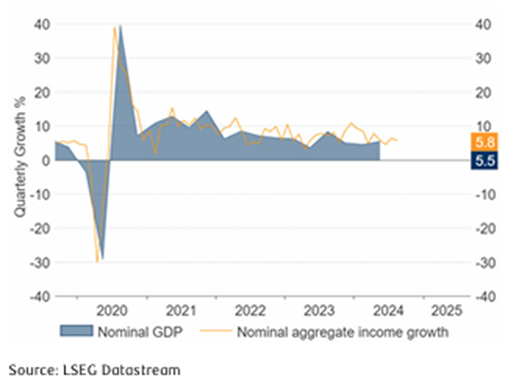
We think a resilient U.S. economy is a positive thing and should not be talked down as something dreadful. A stronger economy means higher nominal GDP growth, which is a macro driver for corporate profits.

Obviously, the earnings season will provide fresh catalysts on market direction. On that, lower inflation should help with corporate margins and resilient consumer and business investment should support the top line. The earnings recession should be over with more recovery in sight.

Please continue to check our blog content for advice, planning issues and the latest investment, market and economic updates from leading investment houses.

Alex Clare

24/04/2024

Team No Comments

Brooks Macdonald Daily Investment Bulletin

Please see below article received from Brooks Macdonald this morning, which provides a global market update as tensions appear to settle in the Middle East.

What has happened

Monday saw a modest recovery in markets in aggregate – it was enough for US equities to end their back-to-back run of 6 daily declines in a row, with the US S&P 500 equity index ending the day up +0.87%. With hopes that Middle East tensions were easing back a little for now at least, oil prices edged lower with Brent crude dropping back -0.33% to US$87 a barrel, its lowest level so far this month. Bucking the improved sentiment however are Chinese stocks, with both China’s CSI and Shanghai Composite equity indices trading lower currently. In bond markets, government 10-year bond yields edged lower (bond prices rose) in both the US and Europe on Monday.

Japan’s flash PMIs land

Today sees the latest preliminary, so-called ‘flash’ Purchasing Manager Index (PMI) surveys land for the month of April for a number of countries globally, across Asia Pacific, Europe, and the US. Over in Japan, manufacturing and service activity improved in April to its highest levels in nearly a year, with the April flash manufacturing PMI up to 49.9 (from 48.2 in March), and just below the 50 mark which marks the dividing line between month-on-month (MoM) contraction versus expansion in activity levels. Meanwhile, Japan services PMI rose MoM, to 54.6 in April (up from 54.1 in March), so the economy is still being services-led relative to manufacturing currently, a not-unfamiliar theme in other developed economies around the world.

Middle East tensions ease a little

Middle East tensions appear to have continued to ease so far this week. Yesterday, Iran’s foreign ministry spokesman said that Israel had received the “necessary response at this stage”. This proved enough for oil prices to drop, as well as a pull back in the gold price which fell -2.59% on the day and which is down again this morning at the time of writing.

What does Brooks Macdonald think

US megacap technology stocks narrowly led the market yesterday, but it was a mixed affair with Tesla weaker. All eyes now turn to the 4 of the so-called ‘Magnificent 7’ which report this week, starting with Tesla due after the US close later today.

Please check in again with us soon for further relevant content and market news.

Chloe

23/04/2024

Team No Comments

Tatton Investment Management: Monday Digest

Please see below, Tatton Investment Management’s ‘Monday Digest’ which summarises all the key factors currently affecting global markets and economies:

Market quiet on the Middle Eastern front

Israel and Iran’s escalating conflict presents huge risks for the world, but at the moment we can take comfort that the respective aerial bombardments seem to be more about showing force than hurting each other. Israel’s allies don’t want a full-scale conflict and the Iranian regime is weak in its domestic support. Hopefully, this should mean each country’s hawks are satiated by bold but ultimately ineffective long-range shots.

Our job is to think about investment implications. Capital markets weakened last week, but surprisingly this was only partly about the Middle East and global oil fears. Falling stocks and a stronger dollar show falling risk appetite. Investors are booking profits, which is why last week’s worst performers – like Japan – were the best performers year-to-date.

The Mexican peso fell against the dollar, having been on a stellar run (we cover below). But major developed currencies were only slightly weaker and were stable through Israel’s retaliatory strike. Bond yields spiked but, with the exception of the US, real (inflation-adjusted) yields were stable, indicating higher inflation expectations (which we also cover below). We might have thought oil would surge, but Brent crude prices were stop-start – hitting a high of $92 per barrel on Friday morning before slipping back to $87, a pattern it held every day last week.

Growth expectations have been hit by delayed interest rate cuts. Fed chair Powell admitted last week that we will have to wait longer than expected for a cut, but BoE governor Bailey was more dovish, downplaying the UK’s recent inflation surprise and saying the BoE need not wait for the Fed to act.

Investors are having to discount the possibility of tighter short-term policy, which could challenge growth. But analyst expectations for corporate earnings are high – and markets’ implied expectations are even higher. This means stocks valuations are expensive, making them vulnerable – especially as risks grow and volatility rises.

We shouldn’t give up on medium-to-long-term optimism, though. Recession risks are minimal, so if valuations fall it will likely mean buying opportunities. Less exuberant markets could help inflation expectations too, meaning rates can finally fall and the growth cycle start anew.

Real yields, real growth?

Sticky inflation and delayed interest rate cuts are pushing up bond yields. 10-year US Treasury yields have gone from 4.2% to over 4.6% this month, while UK gilt yields have shot from under 4% to nearly 4.3%. One might think this is down to higher-than-expected inflation figures in both regions – which would also explain why the less inflationary Europe has seen smaller bond moves.

However, UK and US bonds differ greatly when it comes to real yields. We work these out from inflation-adjusted bonds. They pay interest on the amount borrowed – but that amount rises each year in line with the official inflation index. Like any bond, changes in the traded price are inverse to changes in yield. So, the difference between the inflation-adjusted face value and the current market price tells you the ‘real’ yield.
 
US real yields have risen sharply through the latest bond sell off, but UK real yields have stayed fairly stable. Real yields are supposed to reflect markets’ growth expectations, so basically they are saying US growth prospects have improved while Britain’s have stalled. That shouldn’t surprise anyone; the US economy continues to outdo expectations while the UK is at best stagnant.

The more interesting thing is what it says about inflation. Since UK real yields have stayed put, the move up in nominal yields suggests markets expect higher inflation. But US real yields have moved up basically in line with nominals, meaning inflation expectations have not gone up in the US. That is incredible when you consider how strong recent US inflation data has been.

Something has to give. Either inflation has to fall rapidly, growth expectations must weaken of nominal US yields must adjust higher. The first two look unlikely, but the latter could be painful for risk assets. Markets have taken the bond sell-off well so far – but might not be able to take much more. 

Mexican peso going strong

The Mexican peso is the only major Emerging Market (EM) currency to gain against the US dollar during this latest rate rise cycle – jumping 20%. President Andrés Manuel López Obrador (nicknamed AMLO) has played a big part. International investors were concerned about the leftist president when he took office six years ago, but as we approach the end of his administration, AMLO will almost certainly be the only Mexican leader in modern history to leave office with a stronger peso than he inherited.

Mexico’s central bank helped him by raising interest rates hard and fast in 2021 – long before developed nations joined in. The Bank of Mexico’s total cumulative rate rise was higher than the Federal Reserve’s too – 7.25 percentage points compared to 5.25 in the US. That made the ‘carry trade’ – borrowing money where it’s cheap (US) and keeping it where rates are higher (Mexico) – more attractive. Capital flowed from the US to Mexico, bolstering the peso.

These flows were only possible because of Mexico’s strong trade links with the US. Mexico officially became the US’ largest trading partner last year, overtaking China. US-China trade has taken a huge hit from the nations’ sour relations, and manufacturers are keen to produce closer to the US – benefitting Mexico.

This structural force pushing up the peso was bolstered by cyclical flows, but those might be ending. Mexico is now cutting rates, and the next president (elections in June) might well want a weaker peso to boost exports – considering the recent drop in activity.

In purchasing power parity terms, the peso is stronger against the dollar than it has been in years. This might mean there is little room to go higher, or it could mean a deep structural change in US-Mexico economic ties. In any case, global trade is clearly shifting – which should shift how investors think about global growth, and EMs in particular.

Please continue to check our blog content for advice, planning issues and the latest investment, market and economic updates from leading investment houses.

Carl Mitchell – DipPFS

Independent Financial Adviser

22/04/2024