Team No Comments

AJ Bell Budget Update – How Budget changes might impact your money

AJ Bell Budget Update – How Budget changes might impact your money

Please see below, AJ Bell’s Technical Analysis of yesterday’s Autumn Budget, with a comment from us at the end:

Among a raft of changes, chancellor Rachel Reeves announced reforms to salary sacrifice as well as increases to income tax on savings and dividends as she attempts to bridge the gap between spending and revenue in the UK’s finances.

The protracted leadup to the Budget included rumours around gifting limits and a hike in employee income tax. However, these were not introduced. Instead, tax rises are centred on dividends, interest on savings, and additional council tax for high-value properties. Tax threshold freezes will also continue, and the rules around salary sacrifice are set to change so that contributions over £2,000 will be subject to national insurance.

The subscription allowance for Cash ISAs has also been reduced to £12,000 each year for those under age 65. Stocks and shares ISAs remain at the £20,000 limit.

Here’s a breakdown of the main policy changes in the Budget, when they come into play, and how they could affect your finances:

Limit on salary sacrifice

Beginning in April 2029, salary sacrifice will have a £2,000 limit on pension contributions each year that are not subject to national insurance. After this point, both employees and employers will face national insurance on their contributions. Salary sacrifice currently helps workers save up to 8% in employee national insurance on the cost of their pension contributions. The below table shows the impact on employee’s pay packets per year, assuming the employee has agreed to exchange 6% of their notional salary for a pension contribution, with a 6% matched contribution from their employer.

Despite the new national insurance cap, pension contributions will still be exempt from income tax and workers can continue to enjoy pension tax relief up to their marginal rate of tax. Plus, making pension contributions to schemes like SIPPs will still reduce a taxpayer’s ‘adjusted net income’, pulling them out of higher rate tax while also boosting their retirement savings.

Rather than making a formal arrangement to keep their salary below a certain level, workers will need to work out what extra contributions they need to make to reduce their ‘adjusted net income’. This will involve a little bit of extra admin but will still be well worth it when you consider the potential tax savings on offer.

Lifetime ISA scrapped

The government will be making a new product available in early 2026 to replace the Lifetime ISA. It will attempt to create a simpler ISA product, focused on helping first-time home buyers. The Budget does not mention if the refreshed vehicle will encompass the other main purpose of Lifetime ISAs, which is as a means of building a retirement pot.

In the 2024/2025 tax year, 87,250 individuals took money out of their Lifetime ISA to purchase a home and about 960,000 people subscribed to a Lifetime ISA, according to the Office for National Statistics. These wrappers currently allow for subscriptions of up to £4,000 each year with a 25% government top up.

Withdrawals can be used to buy a first home with a value of £450,000 or less or for an income in retirement after the age of 60. Withdrawals for any other reason are subject to a penalty charge except in a few exceptional circumstances.

Reduction of Cash ISA allowance

While Stocks and shares ISAs will maintain their £20,000 annual subscription allowance, Cash ISAs will have a £12,000 subscription limit each year beginning in April 2027. This limit will not apply to those over the age of 65.

For those searching for cash alternatives following the policy change, there are ways to create cash-like holdings within a Stocks and shares ISA. These include money market funds, treasury bills, or low-risk, multi-asset instruments which have large cash holdings.

Tax threshold freezes

Tax threshold freezes have been extended for another three years until 2031, meaning income bands will be on track to stay the same for the best part of a decade. The cumulative effect of the freeze means people are seeing their tax bills rise dramatically when compared to a scenario in which thresholds had increased in line with inflation each year. Extending the freeze until 2031 will cost individuals up to £1,293 in extra tax over the next three years, according to AJ Bell’s calculations.

The extent of the tax hit is dictated by how much you earn, with an extra tax bill of £683 over the three years for someone on £45,000 or £1,293 for someone on £70,000.

More than 8.3 million people are now paying higher or additional rate tax, up by 45% since 2021, and extending the freeze will push even more working people and pensioners into higher tax bands.

If there had been no freeze, the OBR estimates that the personal allowance would have been £17,470 by 2030/31 and the higher rate threshold would have been a whopping £20,100 higher – standing at £70,370.

If you take Reeves’ extension to the freeze alone, the personal allowance would have stood at just over £13,353 by the 2030/31 tax year – instead it will remain stuck stubbornly at £12,570.

Increased tax on dividends

Both basic and higher rate taxpayers will face an increase of two percentage points in the amount they pay on dividend income starting in April 2026. This means that basic rate taxpayers will now face a 10.75% tax while higher rate taxpayers face a 35.75% tax. There is no tax increase for additional rate taxpayers from their current 39.35% rate.

If dividend-paying investments are held in an ISA or pension, there will be no dividend levy to pay. Outside of these wrappers, investors will have a £500 tax-free dividend allowance before they begin to be taxed at the above rates.

For example, if a basic rate taxpayer was earning a 4% yield on a £100,000 portfolio, their tax bill would increase from £306.25 at the current 8.75% rate to £376.25 at the new rate (10.75% of £3,500).

Increased tax on savings income

Savings income will also see a 2% tax increase for all levels of taxpayer beginning in April 2027. Basic rate taxpayers will pay 22%, while those in the higher and additional rate brackets pay 42% and 47% respectively.

Thanks to the extended freeze on income tax bands, more people will be pushed into a higher tax band, resulting in a cut to or loss of their tax-free savings allowance. Basic rate taxpayers have a tax-free savings allowance of £1,000, but it decreases to £500 for higher rate taxpayers and there is no allowance for additional rate taxpayers.

For someone with £5,000 of savings interest above their personal savings allowance, the tax increase will cost them an extra £100 a year in tax.

Over 10 years, a higher rate taxpayer with a £50,000 savings pot earning 4% interest (£2,000) will face £380 of additional tax thanks to the increase. A basic rate taxpayer will face £135 in extra tax across the same period.

Additional tax for high value properties

Starting in April 2028, owners of properties valued at more than £2 million will be subject to an additional yearly charge on top of their existing council tax bill in a so-called ‘mansion tax’.

The surcharge will begin at £2,500 and scale in bands to £7,500 for those with properties valued at £5 million or more. These levies will increase over time on an annual basis in line with consumer price inflation.

OBR estimates that this tax will be factored into the price of properties over time and result in price bunching below each band on the scale.

Stamp duty waived for new shares

In a rare bright spot for investors, the Budget introduced an exemption of stamp duty for newly listed stocks in the UK for the first three years. Investors currently pay stamp duty of 0.5% on share purchases. The waiver aims to boost demand for new additions to the market and thereby increase the appeal of London to businesses considering a stock market listing.

Our Comment

From my point of view this Budget did not focus enough on growing our economy here in the UK.  Unfortunately, the factions within the Labour party appear to be constraining any real focus on business growth.

The impact of this Budget over the next few years is that we are all going to be paying more taxes.  This includes the core Labour voters.  As a result, domestic consumption could be impaired.

Businesses and individuals will need to plan to alleviate the impact of some of the Budget measures.  It is more important than ever that we use the allowances and reliefs available to us while we have them.

I’m hoping for more output focused on economic growth, we will see.  This morning I’ll be listening to a technical review of the Budget.  We will keep you posted.

Steve Speed

27/11/2025
Team No Comments

Brewin Dolphin – Markets in a Minute

Please see this week’s Markets in a Minute update below from Brewin Dolphin, received yesterday afternoon – 25/11/2025.  

Stocks rebound despite AI bubble concerns

Markets responded positively to new AI applications and tech firm earnings results following last week’s performance slump.

Key highlights

  • Artificial intelligence (AI) bubble concerns grow: Nvidia’s earnings report impressed, but valuation concerns dominate sentiment.
  • Foggy view of U.S. data: Markets think a December interest rate cut is less likely, as limited data visibility favours a pause.
  • Nerves ahead of the Autumn Budget: Weak UK economic data lays bare the challenging backdrop that’s confronting the chancellor.

Markets hit a wall last week

Markets traded with a more cautious undertone last week, as concerns around stretched AI valuations linger despite Nvidia once again reporting an outstanding quarter. U.S. economic data provided little clarity ahead of the December Federal Reserve (the Fed) meeting, while UK indicators weakened further ahead of this week’s Autumn Budget.

Let’s kick off with AI, and markets were nervous ahead of the highly anticipated Nvidia earnings results on Wednesday.

As the poster child and arguably one of the biggest beneficiaries of AI, Nvidia is in a position to make or break the AI enthusiasm that has propelled global stock markets to record highs this year. But it once again beat high expectations and delivered a stellar report card. Revenue increased 62% year-on-year (YoY), and earnings per share surged 67% YoY against a tremendous base, both handily above expectations.

In terms of outlook, Nvidia highlighted continuously strong demand for AI data centres, high utilisation rates, and continued momentum in new platform deployment. CEO Jensen Huang said demand for Blackwell (its top AI chip infrastructure) is “off the charts”. Broader integration across software and networking reaffirms Nvidia’s competitive advantage. As a result of its moat (its long-term competitive advantage), the business is highly profitable, with an impressive 75% gross margin guided for Q4 2025, despite the surging cost of memory chips.

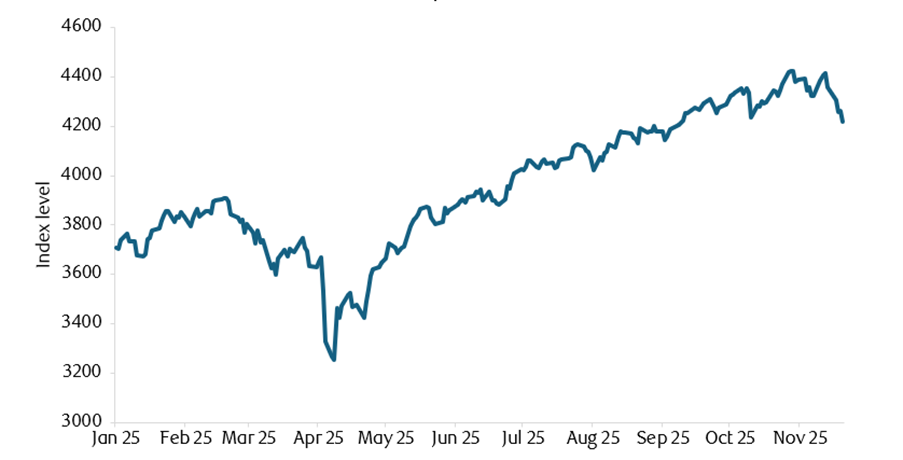
MSCI World Index showed a decline in performance

Source: Bloomberg

However, market reactions show sentiment has turned fragile on AI. Nvidia and the broader AI-related stocks initially rallied but reversed intraday to end the session lower. With Nvidia now comprising around 8% of the S&P 500 index, its price movement has a significant influence on the broader market. This behaviour suggests even companies with exceptionally strong fundamentals and growth prospects face a valuation reality check. It could simply come down to investors taking profits before year-end across a sector that has performed so well.

It’s too early to say that the AI rally is over, but we’re entering a stage where investors are putting more scrutiny on aspects such as return on investments and valuations.

The long-term AI opportunity remains intact. Demand for compute capacity (the total amount of computing resources available to process data), infrastructure upgrades and AI adoption continues to accelerate. However, the market discussion has shifted from pure growth momentum to valuation and over-investment risks.

While we believe that AI will be a transformative technology, there are lingering questions about whether the returns generated by providers of AI services will be high enough to justify both the massive levels of investment, and the extended valuations the AI picks and shovels plays trade on. In addition, the S&P 500, excluding the so-called ‘Magnificent Seven’, also trades on a large price-to-earnings premium compared to the World ex U.S. market. Therefore, we hold a neutral view of U.S. stocks for now.

The U.S. unemployment rate rose

Another highly anticipated event last week was the release of the September U.S. employment report, which was significantly delayed due to the U.S. government shutdown.

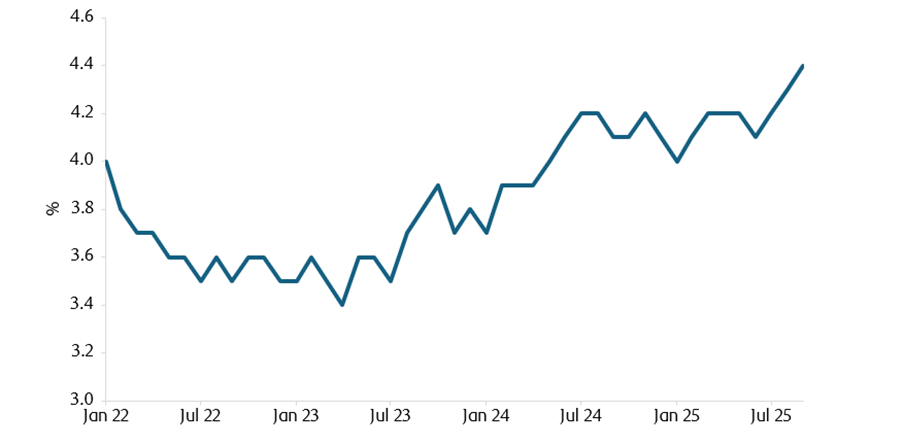
The report showed 119,000 new jobs were created over the month, well above the 51,000 expected. However, the unemployment rate edged higher from 4.3% to 4.4%. This was the third consecutive monthly increase, defying expectations of no change. This is likely to add to the dovish view within the Fed.

U.S. unemployment rose to 4.4%

Source: Bloomberg

However, the Fed will not receive another jobs report before its December meeting, and visibility on inflation data is expected to remain more limited than usual due to the previous government shutdown. With the labour market a bit weaker (but still generating jobs), and conditions not deteriorating sharply, most investors now view a Fed pause in December as the most appropriate and likely scenario.

Markets have reduced expectations for a December interest rate cut, and further policy easing is considered more likely from 2026 if inflation and growth slow.

Economic trouble for the chancellor

In the UK, the data flow remained weak ahead of this week’s Autumn Budget. October retail sales fell by 1.1%, while the private sector business survey (PMI) suggested the economy was stagnant. Fiscal indicators have deteriorated, with the fiscal deficit widening more than expected in October.

This is an economic backdrop that makes it hard to raise taxes without further dampening growth, but it’s widely speculated that this is what Chancellor Rachel Reeves will do.

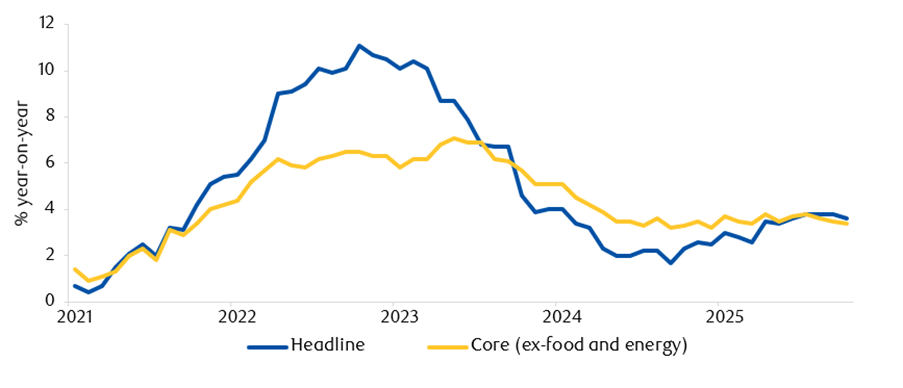
One silver lining is that inflation is heading in the right direction, albeit slowly. Headline UK CPI (Consumer Price Index) slowed from 3.8% to 3.6% while core inflation slowed from 3.5% to 3.4% in October. Services inflation, which is closely monitored by the Bank of England (BoE) as a measure of domestic price pressure, softened from 4.7% to 4.5%, falling below expectations.

The UK Consumer Price index slowed to 3.6%

Source: Bloomberg

A lower inflation trajectory helps support the case for a rate cut in December. Markets are pricing in a very high chance of that happening. Ultimately, whether the BoE will proceed with that depends on Governor Andrew Bailey’s swing vote. The latest inflation figure probably ticked a box, but we still need to see how the Budget goes.

Overall, last week’s market action reflected a more cautious stance. AI remains the dominant structural theme, but greater scrutiny is being applied now, so the bar for a further rally is high at this stage.

In the U.S., job growth continues, but there are signs of cooling. In the UK, data confirms a weakening backdrop ahead of significant fiscal decisions that ultimately impact growth.

Staying diversified remains highly relevant in this environment.

Please continue to check our blog content for advice, planning issues and the latest investment market and economic updates from leading investment houses.

Charlotte Clarke

26/11/2025

Team No Comments

EPIC Investment Partners – The Daily Update

Please see the below article from EPIC Investment Partners detailing their discussions, pre-Autumn Budget. Received this morning 25/11/2025.

On Wednesday, the UK Chancellor, Rachel Reeves, has the unenviable task of delivering a budget that achieves fiscal stability while actively reducing the official inflation forecast provided by the Office for Budget Responsibility (OBR). This challenge is framed by the political reality that the economy “feels stuck” for too many and that rising prices “hit ordinary families most.” As Ms. Reeves wrote in The Sunday Times, “Delivering on our promise to make people better off is not possible if we don’t get a grip on inflation,” adding that it is “a fundamental precursor to economic growth. It is essential to make families better off and for businesses to thrive.”

The Chancellor has two principal routes to lower inflation: first, by announcing measures that directly weigh on consumer prices within the CPI basket, and second, by heavily front-loading the fiscal adjustment to dampen aggregate demand. Given the urgent political pressure, the former approach, direct intervention, is seen as the most likely and impactful strategy. Ms. Reeves emphasised, “There is an urgent need to ease the pressure on households now. It will require direct action by this government to get inflation under control.”

This direct intervention could lead to the BoE’s headline inflation forecast easing by 0.4% from April of next year. Measures being considered include freezing regulated rail fares, abolishing the reduced 5% VAT rate on domestic energy bills from April 2026, and another annual freeze on fuel duty. The combined effect of these steps is estimated to lower annual CPI by 0.4% in the second quarter of 2026 (2Q26), reducing the forecast to 2.5% compared to the BOE’s current 2.9% projection.

Despite the focus on relief, the Chancellor is simultaneously expected to raise taxes when she sets out economic policies on 26 November as she seeks to bridge a multibillion-pound gap in her spending plans. While immediate, heavy fiscal tightening to directly impact demand is seen as less likely, the budget must still signal a credible plan.

Beyond these potential price-cutting policies, the government may also address long-term structural issues that plague the economy. Ms. Reeves indicated that reforms would change the welfare system from “trapping millions of people on benefits” to one “designed to help people succeed,” suggesting a focus on increasing the workforce and national productivity. These supply-side efforts, if judged credible by the OBR, could help lower future cost pressures by boosting the economy’s capacity to grow without generating inflation. Ultimately, by combining immediate cost reduction designed to tame the headline CPI figure with pledges for long-term growth and responsible fiscal management, the Chancellor aims to create the necessary conditions to help the BoE achieve its 2% inflation target. Not a tall ask!

Please continue to check our blog content for advice, planning issues and the latest investment, market and economic updates from leading investment houses.

Alex Clare

25/11/2025

Team No Comments

Tatton Investment Management: Monday Digest

Please see below, an article from Tatton Investment Management, analysing the key factors currently affecting global investment markets. Received this morning – 24/11/2025

Ripe for a rotation 

Last week ended with lower stock prices and a cryptocurrency sell-off – despite a bump midweek from Nvidia’s better than expected profits (and news that Warren Buffet bought into Alphabet).

Deep divisions at the Fed – likely due to Trump appointee Stephen Miran – have thrown a December interest rate cut in doubt, although quantitative tightening (QT) will stop on Dec 1st, which should ease near-term liquidity pressure. The US economy is itself divided: some fear a rate cut could exacerbate the supposed ‘AI bubble’, but consumer-focussed companies show a weak outlook. US growth will likely come through its soft patch but may need policy support, perhaps from Trump’s promised ‘tariff dividend’.

Bond markets didn’t move much in response to stock volatility, suggesting bond investors see a growth bounce back ahead. The equity sell-off is likely down to profit-taking after a tremendous post-April rally. Investors around worried about fundamentals; they just need liquidity. The nosedive in cryptocurrencies (which are liquidity sensitive) is a clear sign of this. Cryptos could fall further but the knock-on effects to other markets could be muted – since the total crypto market cap, relative to equities, has fallen.

Liquidity will come back in the short-term, thanks to money flowing out of the US Treasury General Account and the reduction in QT. But US policymakers are moving to a lower liquidity provision over the medium-term (‘abundant’ to ‘ample’). That could cause a capital rotation to ‘value’ stocks, as people tend to prefer money now to growth later when there’s not much cash around. If so, there could be greater opportunities for active investors in 2026.

Lastly, a little note on this week’s UK budget: taxes will go up in some form, and the more straightforward the better for the economy. We just hope there’s some relief for small businesses. The government has sent mixed messages in the buildup, but has consistently prioritised a stable bond market. That should keep UK a lid on UK bond yields, which is important for the economy even if it’s uninspiring.

Renewable energy: profitable, not fashionable 

The US government is openly antagonistic towards renewable energy and ESG investing. And yet, renewable energy stocks are some of the best performing in 2025. L&G’s renewable energy ETF has outperformed even Nvidia this year and is far ahead of oil companies. Performance isn’t uniform; US fuel cell producer Bloom Energy is up nearly 350% year-to-date while Dutch wind farm specialist Oersted is down 30%, largely thanks to president Trump’s suspension of new licenses. But the sector is doing well, despite political challenges and bearish investor sentiment (investors pulled $5.7bn out of sustainable funds in Q2 alone).

Interestingly, oil and gas stocks have underperformed this year, as Trump’s “drill baby drill” promise isn’t as good for oil profits as hoped. There’s a strong push to upgrade energy infrastructure, but 93% of US energy capacity growth this year has come from renewables. Trump’s removal of future tax credits may have encouraged this, by forcing developers to rush projects. Renewables are also benefitting from the surge in AI capex, with Bloom Energy (which makes fuel cells for data centres) the clearest example. Renewable energy has now become one of the most efficient ways of expanding energy capacity, largely thanks to past investment (like China’s overproduction of solar panels).

ESG investing is in a difficult spot, but the fact renewable stocks are still performing so well suggests we are in a new phase, where the “E” has been spun out as a specific economic theme, rather than a background investment trend. That’s a sign of maturity. When ESG was a growing rapidly, renewable stocks were popular but people doubted their profitability. Now they’re profitable, but unfashionable. That’s ultimately better for the industry’s long-term growth and the energy transition overall. Whatever politicians say, renewable energy is good business.

Why is Britain’s energy so expensive? 

Britain has some of the most expensive energy in the world. It’s politically popular to blame this on net-zero targets and ‘green levies’ on energy bills, but these are realistically a small part of overall costs. Wholesale energy costs are by far the biggest component. Britain’s marginal pricing system means national costs are set by the most expensive generator – overwhelmingly natural gas. The energy operator pays all producers the highest price regardless of their costs, which is why UK energy providers (particularly renewables and those involved in grid provision) did so well when gas prices spiked in 2022.

The government plans to reform the balancing mechanism for supply and demand, but has declined to switch to a system where prices vary zonally. Zonal pricing was rejected on the basis that it would be unfair and introduce uncertainty – which is a barrier to investment – but it’s hard to overcome the marginal pricing problems without some zonal pricing, which proponents argue would incentivise energy users moving closer to cheaper sources, and energy producers building closer to high demand areas.

There are also regulatory costs along the chain that increase our energy costs, a key one being how transmission charges are implemented. The government says it wants to reform these, but we don’t know what the reformed system might look like. Removing certain energy taxes would be difficult, as all the talk is that higher taxes are needed to balance the budget. However, recent suggestions that green levies should be scrapped does not have the support of the majority of stakeholders.

Energy costs are a headwind for businesses and prevent international companies setting up in the UK. Reforming the pricing model will help, but it’s likely that the system needs bolder long-term solutions (like investing in better storage or nationalising the expensive marginal producers) than current budget realities allow.

Please continue to check our blog content for the latest advice and planning issues from leading investment management firms.

Marcus Blenkinsop

24th November 2025

Team No Comments

EPIC Investment Partners | The Daily Update

Please see below, an article from EPIC analysing the latest US labour market report. Received today -21/11/2025

America’s long-delayed labour market report has finally emerged, seven weeks overdue, offering a headline that looks steady while the underlying trend grows unmistakably weaker. September’s payrolls, postponed by the government shutdown, showed a 119,000 rise in non-farm jobs — slightly above expectations but increasingly at odds with the broader direction of the economy.

Unemployment climbed to 4.4 per cent, the highest level in four years, and its upward trajectory is now clearly established. The timing is unhelpful. With October’s data lost entirely during the shutdown, the next full reading will not appear until mid-December, leaving policymakers and investors facing one of the largest information gaps in recent memory at a moment when visibility is vital.

Revisions added to the softer tone. Job gains for July and August were reduced by more than 30,000 in total, extending a year-long pattern in which early estimates have overstated labour market strength. What previously appeared to be a stable, if subdued, summer now looks materially weaker.

The two main labour market surveys continue to diverge. The establishment survey delivered the 119,000 payrolls figure, but the household survey reported simultaneous increases in employment and unemployment, driven partly by higher participation. The year-to-date contrast is stark: payrolls suggest the economy has added more than half a million jobs; the household survey implies total employment has fallen by roughly a quarter of a million. Full-time employment is down by more than 700,000 since January, indicating a shift towards part-time and lower-quality roles rather than genuine labour market expansion.

Even September’s reported rebound in full-time jobs — more than 650,000 — sits uncomfortably alongside widespread hiring freezes and restructuring. Volatile swings in part-time work, combined with reliance on statistical adjustments such as the “birth–death” model, heighten doubts about data reliability at a time when agencies are still clearing a backlog.

Wage data did little to reassure households or investors. Average hourly earnings rose by nine cents to $36.67, a 3.8 per cent annual increase, yet continue to lag the inflation categories that dominate everyday spending. The average workweek held at 34.2 hours, while manufacturing hours edged slightly lower. Small reductions in hours, when spread across an economy of more than 160 million workers, translate into a meaningful fall in aggregate income — a quiet tightening that typically precedes outright job losses.

Alternative indicators point to further cooling. Real-time private-sector data suggests job creation has recently turned negative, while layoff announcements have risen to their highest level in two decades, led by technology and industrial companies responding to weaker demand and tighter financial conditions.

For the Federal Reserve, the message beneath the statistical noise is increasingly clear: the labour market is weakening, and the rise in unemployment is becoming firmly established. A labour market losing traction strengthens expectations of rate cuts in 2026 and underpins the ongoing rally in US government bonds. Rising joblessness, persistent downward revisions and softer wage pressure together create a distinctly bond-friendly backdrop, suggesting not a crisis but an economy gradually losing altitude — and an interest-rate path now turning decisively more supportive of lower Treasury yields.

Please continue to check our blog content for the latest advice and planning issues from leading investment management firms.

Alex Kitteringham

21st November 2025

Team No Comments

EPIC Investment Partners – The Daily Update

Please see the below article from EPIC Investment Partners detailing their discussions on the AI Bubble. Received this morning 20/11/2025.

Talk of an AI bubble keeps resurfacing, yet Jensen Huang sees it differently, and Nvidia’s results back him up. Positioned at the heart of the AI stack, the company has unmatched visibility into demand and has repeatedly overdelivered on every forecast. Huang revealed $500 billion in combined 2025–26 orders, covering current Blackwell GPUs, next-year Rubin chips, and networking components, underscoring that demand shows no signs of slowing. Furthermore, with each 1 GW data centre representing roughly a $50 billion revenue opportunity, Nvidia has clear sight of tens of these gigawatt-scale builds over the decade.

Nvidia delivered another exceptional quarter. Q3 revenue hit $57 billion, up 22% sequentially and 62% year-over-year, comfortably above guidance. The January-quarter outlook is $65 billion, beating the $62 billion consensus and pointing to 65%yoy growth. Demand continues to outpace supply.

Data centre revenue reached $51.2 billion, up 66%yoy and rising $10 billion sequentially, the largest quarterly increase in Nvidia’s history. Supply commitments are up 63%yoy as Blackwell Ultra ramps. Management reiterated its $500 billion Blackwell/Rubin revenue target by end-2026, implying $300 billion+ from data centres alone.

Gross margins came in at 73.4% GAAP, supported by Blackwell Ultra. Q4 guidance calls for mid-70s margins despite rising input costs, highlighting Nvidia’s pricing power.

Nvidia expects $3-4 trillion in annual AI infrastructure spending by 2030, and given Jensen Huang’s proven track record, this projection should be taken seriously. If he is correct, Nvidia’s current valuation is well below its true potential, leaving substantial upside.

Please continue to check our blog content for advice, planning issues and the latest investment, market and economic updates from leading investment houses.

Alex Clare

20/11/2025

Team No Comments

Brewin Dolphin – Markets in a Minute

Please see this week’s Markets in a Minute update below from Brewin Dolphin, received yesterday afternoon – 18/11/2025.  

How are the U.S. and UK economies faring?

With the U.S. government shutdown ending and the UK Autumn Budget approaching, we analyse the state of the respective economies.

Key highlights

  • U.S. government shutdown ends: the record-breaking 43-day shutdown finally came to an end.
  • Autumn Budget speculation continues: the focus last week was dominated by speculation that risks undermining the government’s hard-won fiscal credibility.
  • Geopolitical tensions: the U.S.-China trade dynamic remains an exercise in tactical de-escalation rather than fundamental peace, while Europe’s approach hardens.

Market sentiment challenged

Last week saw a challenge to the prevailing market sentiment, moving from cautious optimism to a more pronounced nervousness, triggered by fragile geopolitical truces, evidence of economic cooling and (for gilts) a potential U-turn in UK fiscal planning.

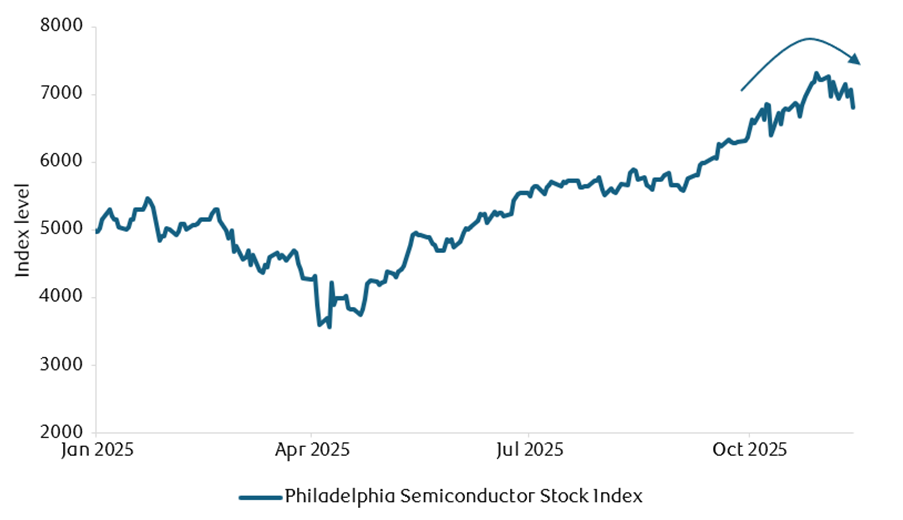
Semiconductor stocks slid back after an extraordinary run

Source: LSEG Datastream

In the current financial landscape, a dichotomy exists between high-growth structural technology demand i.e. artificial intelligence (AI), and short-term cyclical credit risks. The two shouldn’t be directly connected but, as is so often the case, the best performing assets are susceptible to pullbacks when investor anxiety rises. That seemed to be the case last week.

Macroeconomic and credit backdrop: Signs of cooling

The best news of the week was that the U.S. government shutdown finally came to an end. While it was in place, we were without the usual catalogue of economic indicators. Those that were available (from private sources) were downbeat. For example:

U.S. small business nervousness −the National Federation of Independent Business (NFIB) survey of smaller businesses showed weakness across several categories. Companies are less confident that the economy will improve, they are less likely to increase employment and have lower expectations for sales.

Evidence of credit distress − the structural issues in the credit market are worsening, especially in less-liquid areas:

  • Commercial real estate (CRE): the commercial mortgage-backed securities (CMBS) market − the most timely indicator of distress − confirmed a rise in delinquency. The CMBS loan delinquency rate (30+ days past due) rose to 5.66% in the third quarter of 2025 (source: MBA). While traditional bank data is lagged, this shows concentrated distress in non-bank and office-sector debt.
  • Private credit: the Federal Reserve’s (Fed’s) Financial Stability Report (FSR), released on 7 November 2025, confirmed elevated vulnerabilities, noting that while banks are sound, the ability of risky privately held firms to service their debt continues to decline amid high corporate leverage.

UK economic fragility − the UK economy is suffering from a cautious business sector in anticipation of a tax hiking Autumn Budget. The unemployment rate rose to 5% in the three months to September, increasing the risk of weak consumer demand and late payments for small-to-medium enterprises (SMEs).

UK Budget speculation: The tax U-turn challenge

The focus last week on the Autumn Budget on 26 November was dominated by speculation that risks undermining the government’s hard-won fiscal credibility.

The background to this was a slightly greater-than-expected increase in unemployment to 5%.

Unemployment in the UK has continued to rise, reaching 5% in September

Source: LSEG Datastream

  • Doubt over “hard choices”: Chancellor Rachel Reeves has successfully anchored gilt yields by maintaining a stern rhetoric of fiscal prudence and signalling a willingness to make “hard choices.” The market appraisal of this restraint is fragile, relying entirely on the assumption that the government will deliver sufficient revenue-raising measures to plug the estimated £30 to £40 billion fiscal shortfall against its fiscal rules.
  • The U-turn briefing: press reports last week indicated that the chancellor may feel she has to revisit plans to increase headline income tax rates due to internal political pressure. Instead, the final Budget is expected to rely on a complex mix of ‘stealth taxes’, such as extending the freeze on tax thresholds (fiscal drag) and targeting wealth through adjustments to capital taxes.
  • Market risk: there are a couple of reasons to be concerned about this. Currently, there are an estimated 1,100 tax reliefs in the UK. These undermine the concept of tax neutrality, meaning that, when spending decisions are being made, government policy is tipping the scales in favour of one area or another.

This lack of tax neutrality risks causing inefficient allocation of resources. But also, if the final Budget’s numbers are perceived by bond investors to be based on unreliable future spending cuts or insufficient stealth taxes, the gilt market could react badly, resulting in a rise in the political risk premium and higher government borrowing costs.

Rumours of the existence of two Budgets (one with headline tax increases and one without) rattled the bond market, as did rumours of a leadership challenge within the government. The Starmer/Reeves combination may be under pressure politically but remains the ‘devil-you-know’ as far as the bond market is concerned.

Geopolitics: Fragile truce and structural de-risking

The U.S.-China trade dynamic remains an exercise in tactical de-escalation rather than fundamental peace, while Europe’s approach hardens.

A couple of weeks ago, we saw a thawing of relations, with a truce reached between the U.S. and China over trade. Investors realised it was temporary in nature, but last week, the concerns were for how complete the agreement was, specifically in relation to Chinese purchases of U.S. soybeans. These commitments have not been officially recognised on the Chinese side, and purchases don’t seem to have resumed.

Meanwhile in Europe, European Commission President Ursula von der Leyen expressed the region’s commitment to “de-risking” it’s relationship with China. This strategy led to the official anti-subsidy probe into Chinese Battery Electric Vehicles (BEVs) and the activation of new trade defence mechanisms like the Anti-Coercion Instrument (ACI). It creates a long-term headwind for Chinese exporters and accelerates the trends of supply chain diversification and global fragmentation.

Risk assets: Rotation into resilience

The combination of geopolitical tension, economic cooling, and valuation concerns triggered a clear shift to risk aversion last week, with investors rotating out of speculative growth and into assets offering stability and structural tailwinds.

  • Tech sell-off: global equities experienced a pullback, led by the previously market-leading technology sector. The Nasdaq Composite gave back a fraction of recent gains as investors engaged in profit-taking, questioning the lofty valuations of AI-linked stocks and pricing in slower economic growth. This sector weakness comes at a time when RBC’s technical analyst noted the breadth of the market has been showing signs of improving, which is usually a good sign.
  • Defensive sectors: this increased breadth was reflected more explicitly in defensive sectors like healthcare, utilities, and industrials. These outperformed, finally enjoying some benefit from their more predictable earnings, attractive dividend yields, and the long-term investment required for reshoring and supply chain diversification.

Please continue to check our blog content for advice, planning issues and the latest investment market and economic updates from leading investment houses.

Charlotte Clarke

19/11/2025

Team No Comments

EPIC Investment Partners | The Daily Update

The ADQ Spread: The AAA Anomaly in Abu Dhabi?

Please see below, an article from EPIC Investment Partners which details their thoughts on the Abu Dhabi Developmental Holding Company (ADQ) and the effect on markets: Received today – 18/11/2025:

For investors combing the globe for relative value, the pricing gap between Abu Dhabi Developmental Holding Company (ADQ) and the Emirate’s sovereign curve is a useful test of how markets judge risk. On paper, the distinction is academic: ADQ carries Aa2/AA ratings, fully aligned with its sole shareholder, the Abu Dhabi Government. Both sit atop one of the world’s deepest sovereign balance sheets.

Yet the market marks a difference. Abu Dhabi government bonds (ADGB) trade around 44 basis points over Treasuries, while ADQ paper sits closer to 58 bps — a 14bp premium. In a region where spreads are already compressed, that gap is meaningful. However tight the strategic embrace, investors still treat the sovereign signature as the cleanest, least ambiguous claim.

The explanation lies in legal form rather than economic substance. ADQ is a corporate issuer and therefore sits one step below the “full faith and credit” of the state. In any stress scenario the market assumes support would be forthcoming, but it is support that must be extended, not a direct obligation. This is structural subordination in its purest sense: the market prices the legal wrapper, not the underlying reality.

But the underlying reality is precisely what complicates the picture. ADQ owns a portfolio of essential, cash-generative assets whose scale is remarkable by international standards. Between its dominant stake in TAQA — the Emirate’s utility powerhouse — and substantial holdings spanning ports, food security, logistics, healthcare and industrials, ADQ’s asset base is widely estimated at well over $150bn. Its consolidated financial liabilities are a fraction of that, roughly $15bn. On a simple balance-sheet basis, its leverage is closer to that of a sovereign wealth entity than a corporate borrower.

If ADQ were evaluated as a conventional company, judged strictly on asset coverage and balance-sheet strength, it would sit comfortably in Aaa territory. The irony is that its connection to the sovereign — which underpins the rating agencies’ view — is the very reason markets assign it a modest spread penalty.

This creates a clear, if subtle, opportunity. Investors are being paid a 14bp pick-up for credit risk that is, in economic terms, arguably stronger than the sovereign’s. Where the state’s bonds are a promise, ADQ’s are a claim on real operating assets. That distinction almost never matters in the Gulf — but in the logic of fixed income, it is not irrelevant.

Ultimately, the market’s verdict is clear: the sovereign curve remains the purest expression of Abu Dhabi risk. Yet for investors prepared to look past the legal wrapper, ADQ offers near-sovereign quality, backed by substantial, cash-generative assets and exceptionally low leverage, while delivering a meaningful pick-up over the government curve. It is a neat illustration of how pricing conventions endure: the sovereign trades inside, even when the corporate beneath it is economically the sturdier credit.

Please continue to check our blog content for the latest advice and planning issues from leading investment management firms.

Andrew Lloyd

18th November 2025

Team No Comments

Tatton Investment Management: Monday Digest

Please see below, an article from Tatton Investment Management, analysing the key factors currently affecting global investment markets. Received this morning – 17/11/2025

Open and shut

Stock markets rallied early last week and then sold off – strangely, just after Trump signed a bill to open the US government. And, just like the previous week, in the last hours of Friday trading, equities rallied.

First, the UK: the Chancellor has reportedly ditched the simple income tax-raising plans, which isn’t good as it means a more complicated system with unintended impacts. We also had disappointing GDP data, though this largely came from Jaguar Land Rover’s factory closures after August’s cyberattack. Services reported stronger than expected. Bond markets reacted somewhat to the budget shifts although are still relatively sanguine.

The post-shutdown selloff is classic ‘buy the rumour; sell the fact’, and it was notable that US stocks outside tech (more affected by shutdown) had a relatively better week. The resumption of payments out of the US Treasury General Account (TGA) will relieve a liquidity constraint on markets, though it will take time to come through. There wasn’t a big downturn anyway (estimates say an $11bn GDP loss), and the AAII’s bull-bear index suggests investors have turned neutral. Unfortunately, the lack of October data means markets will continue flying blind. We will have to keep an eye on the US consumer through a crucial spending season.

Liquidity flowing from the TGA should mean less volatility, but that doesn’t mean stocks going up – just like recently high volatility didn’t mean stocks went down. The TGA isn’t the only liquidity factor either; AI capex is also taking money out of the financial system to build infrastructure. Oracle’s sharp rise in its credit spread this week shows that, as the computing firm’s demand for capital forces investors to reassess the credit (and consequently equity) valuations.

That’s what happens when businesses invest rather than distribute profits. It can be scary for investors, but it’s ultimately good for long-term growth. If we end 2025 merely at the levels reached at the end of October, this would mean a third strong year for portfolio investors.

Back to the 90s, but what year is it?

If AI is another dotcom bubble and we’re back in the 1990s, what year of the rally is it? Absolute Strategy Research overlayed current trends to the late 90s and found that US stocks are in a similar position to early 1999 – about 16 months before the bubble finally began to deflate in September 2000. We should take simple comparisons like this with a pinch of salt; profits and valuations for the current tech leaders look much healthier than in the 90s, in part because generative AI is prohibitively expensive. But the similarities are undeniable. The last leg of the dotcom rally was significantly more volatile as companies increased capex. We’re seeing record tech capex and bumpier markets now too.

Tech companies aren’t the only ones benefitting from the AI theme. European energy stocks have picked up thanks to plans to raise capital and build infrastructure. Investors normally wouldn’t like utilities companies spending big, but many explicitly reference the need to keep up with the energy demands of AI – showing that AI investment is spreading to other areas too. In the 90s, telecoms companies also benefitted, as new internet companies required greater communications infrastructure.

Back then, dotcom startups were concentrated in the US, while telecoms were prominent in Europe. Now, AI companies are overwhelmingly American, while second-round energy beneficiaries are more European (also related to Europe’s drive to build energy independence).

AI capex going into background infrastructure is good, and should multiply growth. But strong capex can mean lower liquidity in markets (money spent on datacentres is money not with shareholders now). That can make markets volatile, as they have been recently and as they were in the late 90s. Most expect the AI rally to continue for a while, even if the ride is bumpy. And if there is a pullback later, the current investment spend will be good for long-term growth.

The Precautionary Tale of Tony Dye

If we’re going to take the AI-dotcom analogy seriously, we should take lessons from the 90s dotcom doubters – like the infamous late fund manager Tony Dye. Dye managed UBS’ UK funds Phillips and Drew and argued as early as 1995 that equities (particularly US tech) were overvalued. Phillips and Drew underperformed for years as the bubble kept inflating and UBS eventually fired Dye – a week before the Nasdaq peaked. The standard narrative is that Dye was proved right, only too late. His son Jon Dye, now research director at Ruffer, recently wrote to investors about Tony’s commendable detail-oriented approach and not getting carried away with optimistic buzzwords.

However, we don’t think Dye’s badly timed dismissal means he was right to be bearish for so long. In the three-year bear market after dotcom, the S&P 500 never reached its 1995 lows – so you were better off riding the bubble than going bearish too early. Many thought that tech was overvalued in the late 90s but knowing what to do with that information is a different skill. The dotcom bubble might have burst earlier if central banks hadn’t soothed crises in 1997 and 1998, but these external factors always affect the timeline.

We’re not saying there is an AI bubble (big tech is profitable, but there are areas of concern). The point is that even if there is, the rally could run for another two years, at which point investors would likely be better off riding whatever downturn comes than jumping ship too early. Bubbles burst when liquidity runs out and, while liquidity has tightened recently, upcoming interest rate cuts weaken the bearish case for tech. Don’t get too excited but don’t get too gloomy either.  As ever, it’s about time in the market, not timing the market.

Please continue to check our blog content for the latest advice and planning issues from leading investment management firms.

Marcus Blenkinsop

17th November 2025

Team No Comments

EPIC Investment Partners | What should investors expect from COP 30?

Please see the below article from EPIC Investment Partners discussing the upcoming COP 30 summit and what to watch as investors. Received today – 14/11/2025

This week countries are meeting in Brazil for the 30th climate change conference. The aims are to strengthen targets and achievements in reducing CO2, and to provide much more money for developing countries to afford the transition. This is the thirtieth annual gathering, and the tenth since the 2015 Paris Climate Treaty. Despite all the efforts so far, the backdrop for COP 30 is news that world CO2 will hit another new high this year. Whilst the governments and lobbyists can look back on a substantial increase in renewable energy, the need for more fuel for growth has meant many large industrial countries have also opted for more coal, oil and gas to power their economies.

In 1992 in Brazil the UN brought together countries to establish the UN Framework Convention on Climate Change, UNFCCC. This gave international recognition to the idea that burning fossil fuels creates CO2, which acts as a warming gas when released into the atmosphere, affecting future temperatures. Countries acknowledged this effect and resolved to take action to limit man-made CO2.

In 2015 in Paris the regular meeting on climate change created the Paris Treaty, signed by 195 countries. This stated an objective to keep the rise in global temperature down to 1.5 degrees C above pre-industrial levels, with countries taking action and adopting targets to cut their use of fossil fuels. The aim was to get to a peak of greenhouse gas emissions by 2025, and to see a reduction of 43% by 2030, moving towards net zero emissions by 2050. These targets will now not be met.

The UN established an annual meeting or Conference of the Parties (COP) to monitor progress and strengthen targets. It has also added a major transfer of wealth from developed to developing countries to assist them with the high costs of transition from an energy system based on fossil fuels to one based on renewable electricity. This adds substantially to the financial burden on the developed countries who are incurring large costs for their own transition.

Before the start of COP 30, each country was meant to have submitted a memo setting out its “Nationally Determined Contribution”. This sets out promises of cuts in CO2, with details of progress and future plans. Only one third of the countries have done this, so this will turn out to be the implementation conference when more are urged to do so.

COP 29 tried to increase the money paid to developing countries to help them. It ended badly with insufficient pledges, and with big disagreements over the extent of the proposed financial transfers. The current aim is for the developed countries to provide $100bn a year to the developing for climate change investments. This takes the form of a mixture of grants and loans, and of public and private sector money. At COP 29 the developed countries promised to increase this to $300bn by 2035, with the developing countries dismissing this as “paltry” and demanding much more. COP 30 will revisit this sensitive issue at a time when the leading developing countries are seeking to curb their public spending as they battle large deficits. They will at best be trying to find more ways of leveraging private sector money, and at ways of providing loans rather than grants.

Brazil wishes to showcase the Amazon rainforest, a big carbon sink for the world, and gain wider financial help in maintaining and extending forests as absorbers of CO2. Unfortunately, they have cut a way through their forest to produce a new four-lane road for the conference, which has attracted adverse comment from environmental interests… The Conference suffered a protest with people also complaining about Brazil’s plans to expand its oil and gas output.

CO2 emissions have continued to surge throughout the last 33 years under the UNFCCC/ COP regime. Even since the 2015 Paris Agreement and its reduction targets, world CO2 output has increased from 35.4 G tonnes a year to a new peak of 37.8 G tonnes in 2024. The increases have been led by China and India as they use more coal and gas to accelerate growth. The UK has led the reduction, now down by 50%, with the EU also down. The UK closed all its own coal power stations and tried unsuccessfully to get coal out of power generation elsewhere through these conferences. Some of the UK and EU reductions however have been achieved by closing industrial plants, only to import more from Chinese and other overseas locations, with an inevitable corresponding rise in their domestic carbon dioxide emission.

The big emitters India, Russia, Indonesia and Iran are unlikely to offer major changes to start cutting their output. The USA has changed policy to actively promote more and cheaper fossil fuel extraction and use, as it does not accept the theory behind the UN work. China could make stronger announcements about starting to reduce its output of CO2 after years of big increases, which would be an important change. Germany could seek to make faster progress with shutting down its coal fired power stations and switching from imported gas to more renewable electricity. Most countries start by decarbonising their electricity generation, as it is a big source of CO2 controlled by a few large companies, easier to regulate and tax, to help change their behaviours. Progress is much slower to get the public to decarbonise, as most people find gas or solid fuel boilers more affordable than heat pumps, and most still prefer diesel and petrol cars to battery ones.

The Conference is likely to confirm to markets that climate change is no longer the priority issue it was a few years ago. However, there is still a considerable focus on how to satisfy overseas aid requests by the developing countries. It now looks very unlikely that the world will take all the actions agreed at Paris in 2015 and subsequent conferences, making emissions and temperature targets impossible to meet. There will however be continuing pressure to spend more on renewable energy and on shifting more industry and heating from gas and coal to electricity. We will see substantial further global investment in decarbonising technologies with investment opportunities as a result. Fossil fuel-based activities will attract higher taxes and tariffs, with the EU carbon border tax coming in, whilst renewables will be supported by subsidies and guaranteed prices.

Please continue to check our blog content for the latest advice and planning issues from leading investment management firms.

Alex Kitteringham

14th November 2025