Team No Comments

Bouncebackability

Please see below article received from Legal & General yesterday afternoon, which offers insightful analogies relating to inflation and current global market performance.

When two people jump on a trampoline simultaneously, their gravitational potential energy (what goes up must come down) is converted into elastic potential energy in the trampoline (what goes down must come up). If one of the participants (the bouncer) lifts up their legs at the point of maximum trampoline stretch, all the energy is transferred to the other participant (the bouncee). This launches the bouncee into the air much more emphatically than a single person could achieve by themselves. If the bouncer is a lot heavier than the bouncee, then the results can be spectacular. This phenomenon makes us think of inflation today.

Trampolines and inflation

In this analogy, the pandemic is the bouncer and prices are the bouncee. Historically, prices that fall hard have had little tendency to revert. As former Crystal Palace manager Iain Dowie might have put it, there normally isn’t much “bouncebackability”.

But prices have been emphatically “double bounced” in recent months: the pandemic exerted incredibly unusual downward pressures as demands for hotels, restaurants and airlines collapsed. That stretched the trampoline elastic to its limits. Suddenly removing the pressure has catapulted prices higher, with a slew of indicators pointing to near-term inflation taking off.

Having been double bounced, the question is whether inflation will stay high. It is tempting to believe high prices will stay high forever, but financial markets seem to be buying into the Crystal Palace prognosis. Dowie’s comments were triggered by the team bouncing back into the Premier League in the 2003-04 season from a seemingly dire position in mid-November. However, they were relegated again the following season.

Similarly, the US inflation curve is inverted: after a bout of higher inflation over the next few years, markets are priced for a return to something more normal thereafter. Sinkbackability is the flipside of bouncebackability.

The post-recession equity playbook

If you were worried about equity valuations before, are you a little less worried now? Since mid-April, the S&P 500’s forward price-to-earnings (P/E) ratio is down by over a point. At 21.3x we can’t exactly call it cheap, but it reflects an encouraging trend and one we expect to continue for some time. Put another way, the forward earnings yield has increased by around 0.2%.

In a benign de-rating, share prices are up, but by less than earnings; P/E ratios decline as a result. Since mid-April, the S&P 500 is up marginally, but the next 12 months’ forecast earnings are up by 7%.

We’re not just seeing this picture in the US, either. Estimates of forward earnings are upby 5.5% in Europe, and 8% for the DAX; even the less-cyclical FTSE 100 has seen forward earnings estimates rise by 3.5%.

This is a normal pattern after recessions, so not entirely unexpected. But it’s noteworthy that it has started, because until now it had been missing from this cycle.

In Phase 1 after a recession, prices typically go up a lot more than earnings, in anticipation of the earnings rebound. That would be the P/E expansion we had last year. In Phase 2, that picture reverses and earnings go up by more than prices, so P/E ratios contract. That’s what we’re seeing now.

The S&P 500 grinding higher with headline valuations drifting lower is the general pattern we expect to see over the next year. We are therefore relatively relaxed about high P/E ratios today, with a lot of earnings growth likely to be ahead. If we were to be at these same multiples this time next year, we would be a lot more worried.

A tinker, not a taper

Have US interest rates been rising or falling recently? It seems like a straightforward question with a straightforward answer. The first quarter was the fifth-worst quarter for US Treasuries in the past three decades, as 10-year yields rose by nearly 90 basis points. Every market commentator under the sun is now talking about a “rising interest rate environment” and what that means for other asset prices. But, did you know that US money-market rates have just fallen to all-time lows?

That seems a symptom of a superabundance of cash looking for a home in short-dated securities. The Federal Reserve is hosing the financial system with money and there simply isn’t enough short-dated government debt to go around.

Does any of this matter for assets outside the money-market space? We can think of two implications.

First, the dollar’s been weak at the same time as the short end of the yield curve has been collapsing since March this year. The Bank of England’s Jan Vlieghe has signalled a possible rate hike in the UK as early as May next year, we had a similar nod from New Zealand last week, and the rates payable on emerging currencies have started to drift higher. As long as the Federal Reserve refuses to even “think about thinking about” raising rates, it’s hard to see the dollar trend turn around.

Second, we’ve seen general collateral and triparty repo rates nailed to the floor in recent months, down from +10 basis points at the end of last year. That’s not a huge change, but it makes it that little bit cheaper to fund long-duration positions or more expensive to fund short-duration positions. We are tactically short duration, but the emphasis is on ‘tactically’, given the carry costs (which are getting steadily worse) and positioning.

To ‘fix’ the problem, we expect the Federal Reserve to push up its administered rates at the next opportunity in June. Precedent for tinkering with the Interest On Excess Reserves (IOER) can be found in both June 2018 and January 2020. The trick this time will be to persuade the markets that this adjustment is not a tightening of monetary policy. A tinker, not a taper, will be the order of the day.

We will continue to publish relevant content as we edge towards ‘Freedom Day’ on the 21st of June.

Stay safe.

Chloe

02/06/2021 
Team No Comments

Why stock markets are worried about inflation

Please see below article received from AJ Bell yesterday morning, which provides a cautionary commentary on the historic effects of inflation and dissects current market behaviour.

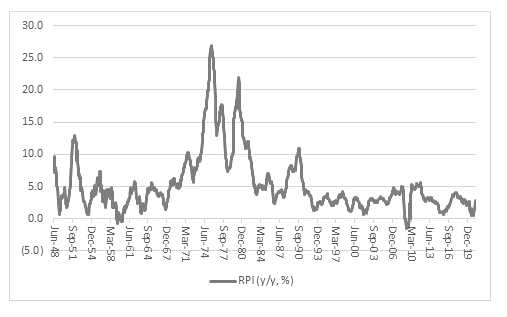
Even a reading of 1.5% inflation in the UK’s consumer price index is giving stock markets the jitters, although that it still a very, very, very long way below the sort of levels which gave investors terrible trouble in the 1970s and early 1980s.

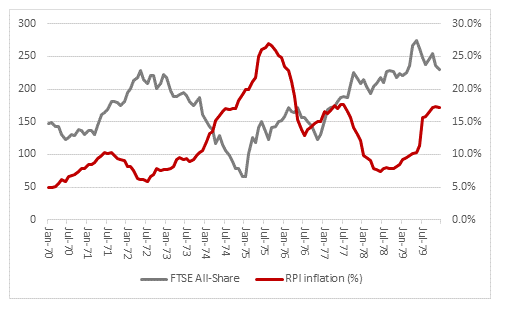
Back then inflation, as measured by the retail price index (for which there is a longer dataset), was roaring away in the twenties. That hurt consumers’ spending power, as their savings lost value in real terms, and dissuaded companies from investing, as the returns on any new projects could not compete with the double-digit interest rates on offer.

Yet the experiences of the 1970s clearly have stock market investors on their guard.

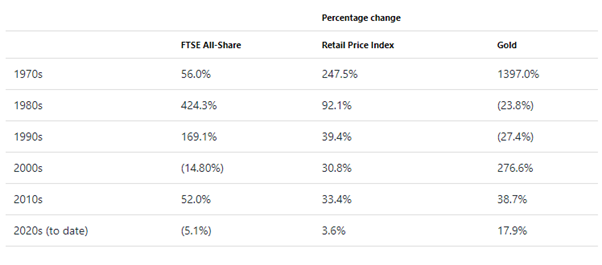
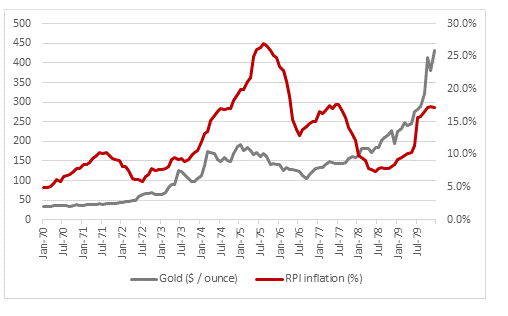
The FTSE All-Share rose by a perfectly respectable 56% in the 1970s, but the retail price index rose by 248%, so equities did not offer as much protection as hoped. Gold did, since the precious metal surged by nearly 1,400%.

Equities came into their own in the 1980s and 1990s as inflation ebbed, interest rates came down and lower returns from cash and bonds persuaded investors to gravitate toward stocks. Gold all but disappeared from view, only to reappear as Governments began to shake the magic money tree in response to the Great Financial Crisis and then came to view such shaking as standard operating procedure in the 2010s and early 2020s.

Investors will also know that the real damage to equity portfolios was done in the late 1970s, when a second wave of inflation hit home, after the appalling state of the UK’s public finances finally caught up with it.

That was also when gold really came into its own, as investors shunned cash and paper assets in favour of ‘real’ assets.

That sequence of events supports the analysis proffered by Jens O. Parrson in his book Dying of Money who studied the surge in American inflation in the 1970s with the even more dramatic surge in Germany in the 1920s:

‘Everyone loves an early inflation. The effects at the beginning of an inflation are all good. There is steepened money expansion, rising government spending, increased government budget deficits, booming stock markets and spectacular general prosperity, all in the midst of temporarily stable prices. Everyone benefits and no-one pays. That is the early part of the cycle. In the later inflation, on the other hand, the effects are all bad. The government may steadily increase the money inflation in order to stave off the later effects, but the later effects patiently wait. In the terminal inflation, there is faltering prosperity, tightness of money, falling stock markets, rising taxes, still larger government deficits and still roaring monetary expansion, now accompanied by soaring prices and ineffectiveness of all traditional remedies. Everyone pays and no-one benefits. That is the cycle of every inflation.

Economists, investors, consumers, savers and above all central bankers will be hoping that Parsson is wrong.

But no-one can ignore how the early building blocks of Parsson’s argument are in place – money supply is rocketing in the US, UK, Europe and Japan; Government deficits are off the clock as they spend like fury to stave off the economic after-shocks posed by the pandemic; asset prices are surging; and calls for yet more spending and stimulus are much louder than those for a scaling back of either fiscal or monetary stimulus. Faith in the existence of a magic money tree that can dispense wealth without consequence is running high.

And yet no central banker can pretend we are in a normal situation or that they are in control. Policies described as emergency measures in 2008-09 are now the norm, as interest rates remain anchored at record lows and Quantitative Easing programmes continue to run at full tilt. Any attempts to row back on those policies prompt financial market volatility and a rapid spill-over in to the ‘real’ economy, as we saw in 2018 and 2019. Global debts continue to accumulate, providing only the weakest of foundations for any economic recovery and ones that are prone to quickly buckling, as we saw globally in 2007-09, in 2011-13 in Southern Europe and around the world again in 2021. Annual Government budget deficits stand at their highest level since the 1940s in many cases and aggregate deficits are in many cases setting new all-time highs on a monthly basis.

Meanwhile, stock markets, cryptocurrencies, non-fungible tokens continue to surge, or at least do so until the threat of rising interest rates, less QE and a drop in the amount of free money with which to idly speculate raises its head once more.

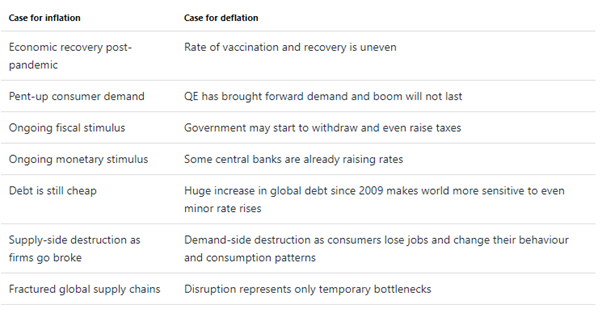
No-one knows what is coming next – inflation, deflation or even stagflation – and investors cannot afford to be too dogmatic about their portfolio allocations, as the three different outcomes require a different response from investors as they seek to augment or at least protect their wealth.

If history is any guide, equities offer some protection against inflation, but with a focus on pricing power, life’s essentials and raw materials. Bonds and cash, both of which are to be avoided in an era of inflation or stagflation, would help in a deflationary environment. And in the case of stagflation, index-linked cash flows such as rents from property, infrastructure projects and index-linked bonds would help, as would gold, at least if the experience of the 1970s is repeated.

Investors therefore need to be prepared for anything with a balanced portfolio that covers all eventualities, because the ultimate outcome is just too hard to predict and also because valuations will reflect different market views at different times.

Just over a year ago, the prospect of inflationary surge was seen as very unlikely and bonds were doing well, shares were doing badly and gold was being completely ignored.

Now, the consensus view is that inflation is indeed coming, as evidenced by how well mining shares and commodity prices have done and sharp falls in bond prices and rapid increases in Government bond yields (albeit from a low base).

Perhaps it is therefore time to start wondering whether it is time to go against the crowd once more.

We will continue to publish relevant content, market analysis and news. Please therefore, check in again with us soon.

Stay safe.

Chloe

24/05/2021

Team No Comments

The Rebound Race

Please see below article received from Legal & General yesterday afternoon, which provides stock market analysis and an update on the progress of global economic recovery. 

Economic clock

We increased our medium-term risk-taking view to +1 (on a range of -3 to +3) in December as it became clear that the vaccine rollout would make rapid progress through the first half of 2021. This view is based on three considerations: the economic cycle, valuations, and systemic risk.

We scored the economic cycle at +2 in December, but believe it is now time to downgrade that to +1. This quarter, US output is expected to exceed its pre-pandemic level and we expect it be about 1.5% above its pre-pandemic trend in the fourth quarter. Meanwhile, we forecast about 4% unemployment in the US by the end of the year, just 0.5% above the pre-pandemic level. So, while we expect rapid growth – we are above consensus on that – and markets remain backed by extensive ongoing policy support, we believe the economy will start to run out of easy expansionary space within 12 months.

The valuations dial remains neutral; despite a 10% S&P 500 index return in the year to date, given earnings growth we don’t feel the move is large enough for a downgrade. Relative valuations remain a positive factor too; as an example, while the gap between earnings yields and bond yields has narrowed, it remains well above long-term averages. On absolute valuations, price-to-earnings ratios are similar to June 2020, but we expect earning upgrades and so believe “real” multiples are lower than the headlines suggest.

Finally, on systemic risk we have upgraded from -1 to 0. This reflects the amalgam of factors that have the potential to derail markets and the economy but are impossible to capture through our normal cyclical analysis. Given countries’ limited space for further monetary easing, US-China relations, and Eurozone debt issues, we have been negative on this factor for most of recent history. However, each of the three major economic blocs has shown impressive institutional resilience in the past year: US civil society bent but didn’t buckle in the aftermath of the election, Europe took a (limited) step towards debt mutualisation, and China has navigated the pandemic remarkably well. Institutions have passed a lot of difficult tests.

So, overall, we remain +1 for the medium term, but somewhat more cautious in how we apply that score. We’ll be more prepared to sell into strength while still planning to buy any significant dips.

Off to a flyer

US core CPI’s 0.9% monthly increase in April was easily the largest since the early 1980s and beat expectations by 0.6%. Everybody knew inflation would pick up in the next few months, but this is a much faster jump than expected.

While dramatic, we think it is mainly transitory as re-opening and supply disruptions combine. For example, used-car prices rose 10% in a month and that alone added 0.3%. Airfares and hotels added 0.2% between them too. The stickier elements of inflation like rent, education and healthcare remained more subdued.

There is certainly a case where the inflation momentum continues and becomes self-perpetuating as excess consumer savings, fiscal stimulus and low interest rates drive demand, all supported by lower commodity inventories and chip shortages. A combination of low unemployment and higher prices in 2022 could lead to wage rises that then spiral into higher prices.

That said, there are also structural deflationary forces that have put downward pressure on global inflation over the past decade and those still apply. In particular, we’ve previously outlined technology’s role and also that of globalisation in creating a more flexible labour force with less bargaining power.

There are even arguments that the COVID-19 crisis will intensify those structural deflationary forces; technology adoption has accelerated and remote working has dramatically increased intra-country workforce flexibility.

So, on balance, we don’t expect sustained inflation pressure and are short US inflation to push back on the increasingly positive narrative, with US 5y5y inflation already 0.5% above pre-COVID levels.

Tech tock

It’s been a tough time for tech, with a 10% correction for Nasdaq stocks versus the S&P 500 index since mid-February. This was the biggest relative fall of the past decade, coming after the biggest rise. Inevitably that’s leading to a lot of headlines on inflation as the driver, high tech valuations, and tech being over-loved and vulnerable – a timebomb waiting to go off. We disagree.

We think that rising inflation has been largely coincidental, not causal. There’s no consistent correlation between inflation or bond yields and tech; it’s in the middle of the pack as a sector. Instead, we link tech’s performance more closely to higher economic growth. Technology is perceived as offering secular growth and so is more attractive when growth elsewhere is weak, so now with the recovery other sectors are re-rating relative to tech. As growth momentum (e.g. purchasing managers’ indices) slows, pressure on tech should moderate. For the longer term, there is an argument that tech will do well if there is sustained inflation, as it implies sustained wage pressure which in turn encourages companies to automate and innovate.

On valuations, price-to-earnings ratios are back to pre-COVID levels despite strong earnings. That isn’t outright cheap but corrected any outperformance in excess of what relative earnings have done. We would expect structurally higher future tech growth as the pandemic has permanently shifted attitudes in areas like remote working and consumers’ online habits, in our view.

Finally, on sentiment, recent broker surveys show large moves out of tech. While price action suggests there are still plenty of owners, we are a long way from the extremes seen in the past with sectors like banks preferred on the basis of their higher expected growth in earnings.

We will continue to publish relevant articles and helpful market updates as the UK Government continues to push for mass-vaccination, with people aged 38-39 able to book an appointment from Thursday.

Stay safe.

Chloe

18/05/2021

Team No Comments

Weekly Market Commentary – Weaker than expected US jobs report splits market opinion

Please see below commentary received from Brooks Macdonald yesterday evening, which provides analysis of the market’s response to political events in the UK and economic developments in the US.

A significantly weaker than expected US jobs report leaves markets baffled

Markets were left baffled on Friday as the US employment report sharply missed expectations, making a US Federal Reserve (Fed) taper of asset purchases in June less likely. Equity markets rallied, with technology performing after a difficult week for growth equities.

The market was expecting around one million new jobs to have been created in the US in April but the final number, 266,000, was far below those lofty expectations1. As commentators scrambled to explain the numbers, there are broadly two camps, one group concluding that this reflects difficulty in making hires, the other that the recovery has less momentum than hoped. The truth will likely lie between these two but President Biden cited the report as evidence of the need for the stimulus that the White House has planned for this year. One of the theories for why the jobs number was so weak is that fiscal support is so large, there is less incentive to take on work, effectively saying that fiscal spending is crowding out private sector employers. If this is the case, additional stimulus could make this imbalance even starker. This could of course just be another short-term demand and supply imbalance and one that will be resolved over the coming quarters, as things return closer to normality.

A strong showing for the Conservatives last week may open legislative policy options

Sterling has begun the week on a stronger note, as investors view the lack of Scottish National Party majority (just) as reducing the risk of an imminent independence vote. Pro-independence parties still have a majority in the Scottish Parliament, however the results, on the margin, reduce the urgency of this question for markets. Tomorrow sees the Queen’s Speech which, given the recent by-election successes from the Conservatives, may be more legislatively ambitious than previously imagined. 

US CPI is released on Wednesday and is expected to contain some substantial year-on-year gains

Friday’s employment report has led to much confusion, particularly as the two interpretations end with contrasting inflationary and deflationary conclusions. This week we will see the unveiling of the April US CPI number which is expected to creep up to 3.6% year-on-year on a headline basis and 2.3% on a core basis (excludes energy and food)2. We are entering the period where the year-on-year comparison is flattering the inflation figures, but it will be interesting to see if bond markets can hold their nerve in the face of these figures, even if they ultimately prove transitory.

We will continue to publish market updates and relevant content as the UK approaches a further relaxation of lockdown rules. Please check in again with us soon. 

Stay safe.

Chloe

11/05/2021

Team No Comments

How can I spot someone trying to scam me?

Please see below article received from AJ Bell yesterday afternoon, which provides useful tips on how to avoid scams and illegitimate investments. As scammers become increasingly more cunning and commonplace, this article is certainly a must-read.

Financial scams are depressingly common and often target people’s hard-earned pensions. This has particularly been the case since 2015, when government reforms gave savers total freedom and choice over what they do with their retirement pot from age 55.

Official estimates from the Pension Scams Industry Group suggest £10 billion has been stolen from pensions in the past six years.

Scam activity has increased during the coronavirus pandemic, with fraudsters aiming to take advantage of increased vulnerability among UK savers.

And while efforts are being made by the authorities to protect people from financial crime – including banning pensions cold-calling and giving providers more power to reject suspicious transfers – the onus remains on individual investors to protect themselves.

Here are five things you can do:

  1. Be suspicious of unsolicited calls, texts or emails about
    your pension: 
    Scams often start with a call, text or email out of the blue offering ‘help with’ or perhaps a ‘review of’ your pension arrangements. To be safe, if someone you don’t know contacts you about your pension – or indeed your finances in general – do not engage with them. If you believe someone is trying to scam you, report them to Action Fraud to help protect other investors.
  2. Be extremely wary of anyone promising large, guaranteed returns: Another tell-tale sign of a scam is the promise of huge, guaranteed investment returns, often over relatively short spaces of time. These investment ‘offers’ take many weird and wonderful forms, while the rise in popularity of cryptocurrencies has also been an obvious target for financial fraudsters.
  3. Only deal with regulated companies and individuals: At the heart of scams are often unregulated ‘introducers’ peddling unregulated investments. While there is nothing wrong with investing in unregulated assets, where fraud occurs these often turn out be vastly overhyped or entirely fictitious. Even where an unregulated investment is real, if you suffer losses through misselling you will not qualify for FSCS protection worth up to £85,000.
  4. Do your due diligence: Scammers’ tactics have become more sophisticated in recent years, with ‘clone’ scams – where fraudsters impersonate a real firm to con you out of your cash – increasingly common. You can cross-check the phone number or email address provided by someone who contacts you with the FCA register to make sure they are who they say they are.
  5. Don’t be rushed and if in doubt, speak to a regulated financial adviser: High-pressure sales tactics – such as telling someone they need to invest by a set deadline – are a classic scam tactic and should immediately set off alarm bells. Do not under any circumstances be rushed into a decision you aren’t completely happy with. If you want help with your options or are unsure what to do, consider speaking to a regulated financial adviser or visit Government-backed retirement guidance service www.pensionwise.gov.uk.

We will continue to publish articles that are relevant and useful to our clients. Please check in with us again soon.

Stay safe.

Chloe

30/04/2021

Team No Comments

Where are we in the market cycle?

Please see below article received from AJ Bell yesterday morning, which provides analysis of the current market landscape and discusses potential investment opportunities.

As regular readers will know, one of this column’s favourite market sayings comes from fund management legend Sir John Templeton, who once asserted that: ‘Bull markets are founded on pessimism, grow on scepticism, mature on optimism and die on euphoria.’

Applying this test can potentially help investors spot where value and future upside opportunities can be found. It can also help avoid areas which are so popular they could be overvalued and capable of doing damage to portfolios.

It is hard to avoid investments everyone is talking about with great excitement and resist ‘fear of missing out’. Yet history suggests looking at assets, stocks or funds no one is interested in is the best way to make premium long-term returns.

The last 12 months are a fine example of how some careful, but not wilful, contrarian research could have yielded rich rewards. As the pandemic began to make its presence felt, share prices plunged, oil collapsed into negative territory and government bonds’ haven status meant their prices rose and yields fell. Cryptocurrencies were tossed aside amid the general panic, too.

Yet wind on a year, and equities have beaten bonds hands down, with commodities not far behind. Technology is no longer the leading equity sector and defensive areas such as healthcare are relatively out of favour. Commodities (with the notable exception of precious metals) are doing well and cryptocurrencies are going bananas, as evidenced by the flotation of America’s leading crypto exchange just last week, namely Coinbase.

Studious analysis of these trends may therefore help investors to spot value and dodge the traps that the coming 12 months and beyond may offer.

UP, UP AND AWAY

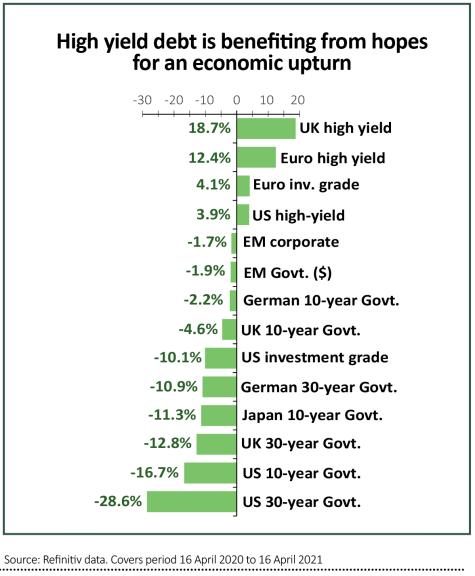
Incredible as this would have seemed a year ago, ‘risk’ assets are showing the best total returns in sterling-denominated terms over the 12 months, as equities and commodities easily outpace bonds. Within fixed income, the riskiest option – high-yield corporate paper – continues to lead government and investment-grade corporate debt.

Within equities, Asia and Japan are doing best, perhaps owing to the relatively limited impact of Covid-19 upon their populations’ health and their economy.

Emerging markets overall are coming in from the cold (in another win for contrarians), and America’s dominance of the geographic performance tables is waning a little, too.

By equity sector, it felt like technology was the only game in town a year ago, with defensive areas like healthcare also proving popular. Yet cyclical, turnaround sectors now lead the way, with defensives and income-generating bond proxies lagging badly.

All of this fits the prevailing narrative that the combination of vaccination programmes, government fiscal stimulus and ultra-loose monetary policy from central banks will see the economy through the pandemic and provide a firm base for a robust economic recovery.

So too do the losses on long-duration government bonds and the outperformance of high yield debt. The latter tends to correlate more closely to equities than it does fixed income. A strong economic recovery would help to bring financially stretched firms back from the brink and leave them better placed to meet their obligations.

NEXT STEPS

Analysis of those performance statistics means this column currently sees the major asset classes like this as we head into summer 2021, using Sir John Templeton’s four phases as a framework.

Euphoria – and optimism – are a lot easier to find than they were a year ago. This is not to say that markets are primed for a collapse, but it may not take much to shake them up a bit as a result.

Scepticism pervades fixed income and government debt, so anyone who fears disinflation or deflation more than inflation could take this as a cue to top up allocations.

Conversely, anyone who sees the world returning to normal pretty quickly could seek out value on commercial property stocks or funds, especially those with exposure to office space, while those portfolio builders who are wary of a market wobble – and suspect that central banks will respond with every greater monetary largesse – may note with interest the underperformance of gold and miners of precious metals.

Please check in with us again soon for further updates and news.

Stay safe.

Chloe

26/04/2021

Team No Comments

Stocks rise as US earnings season kicks off

Please see below ‘Markets in a Minute’ article received from Brewin Dolphin yesterday evening. The commentary provides an update on market performance as it reacts to current global news events.

Most major stock markets rose last week as the start of the US earnings season helped to offset concerns about a resurgence in Covid-19 infections.

The pan-European STOXX 600 added 1.2%, marking its seventh consecutive week of gains. Germany’s Dax rose 1.5%, despite chancellor Angela Merkel warning that the country was firmly in the grip of the third wave of the pandemic. The FTSE 100 advanced 1.5% after official data revealed the UK economy grew by 0.4% in February following a 2.2% contraction in January.

In the US, the S&P 500 gained 1.4% with healthcare and mining stocks performing particularly strongly. The release of earning results from several banking giants also helped to boost investor sentiment. The Dow added 1.2% and the Nasdaq gained 1.1%.

Over in Asia, the Nikkei ended the week down 0.3% amid a spike in coronavirus infections in Tokyo and Osaka. China’s Shanghai Composite fell 0.7% whereas Hong Kong’s Hang Seng managed a 0.9% gain.

Last week’s market performance*

  • FTSE 100: +1.50%
  • S&P 500: +1.37%
  • Dow: +1.18%
  • Nasdaq: +1.09%
  • Dax: +1.48%
  • Hang Seng: +0.94%
  • Shanghai Composite: -0.70%
  • Nikkei: -0.28%

*Data from close on Friday 9 April to close of business on Friday 16 April.

Dull start to the week as investors take profits

US stocks pulled back from record highs on Monday as investors took profits ahead of the peak of the earnings season. The S&P 500, the Dow and the Nasdaq closed down 0.5%, 0.4% and 0.9%, respectively. Nearly half of S&P 500 companies are set to release their first quarter results over the next two weeks, including the majority of the FAANGs.

European stocks also retreated slightly from record highs, following the weaker open in the US and rallying currencies. The FTSE 100 dipped 0.3% yet managed to stay above the 7,000 mark after figures from Rightmove revealed UK house prices rose by 2.1% in April to a record high of £327,797. This marked the second time in only five years that prices have increased by more than two percentage points in a month.

The FTSE 100 was down 0.4% to 6,972 in early trading on Tuesday following mixed employment data from the Office for National Statistics. The unemployment rate fell slightly from 5.0% in January to 4.9% in February, but 56,000 workers were cut from company payrolls in March – the first monthly drop since November.

UK economy expands in February

Last week saw the release of encouraging economic data in the UK. Official figures showed the economy grew by 0.4% in February as companies prepared for the easing of coronavirus restrictions. Growth was helped by the first rise in factory output since November, and a pickup in sales among wholesalers and retailers.

The data also suggested that trade between Britain and the EU partially recovered in February. Goods exports to the EU fell by 12.5% year-on-year in February, versus a 41.4% year-on-year decline in January. Imports declined 11.5% year-on-year in February, compared with a 19.2% drop the month before.

Despite this, UK GDP remained 7.8% below its level in February 2020, shortly before the pandemic struck. It was also 3.1% lower than its level in October, just before further lockdown restrictions hit the services sector.

Non-essential shops and outdoor hospitality venues reopened on 12 April, and it is hoped most restrictions will be lifted before the end of June.

US consumer spending rebounds

Over in the US, figures showed retail sales grew by an eye-catching 9.8% in March, far higher than the 5.8% monthly increase that analysts were anticipating. This followed the continued reopening of restaurants and retail, and a recovery from the severe weather-induced 2.7% contraction in February.

Meanwhile, weekly jobless claims plunged to their lowest level since the pandemic began, and a key gauge of factory activity in the mid-Atlantic region hit its highest level in nearly five decades.

US inflation data revealed headline consumer prices rose by 0.6% in March from the previous month and by 2.6% compared with the same period a year ago. The year-on-year gain was the highest since August 2018. Gasoline prices were the biggest contributor to the monthly increase, surging by 9.1%.

China sees record growth

China’s economy achieved year-on-year growth of 18.3% in the first quarter of 2021 – the biggest jump since the country started keeping quarterly records in 1992. Industrial production rose 14.1% year-on-year, while retail sales surged by 34.2%.

However, the headline growth figure was skewed by the huge economic contraction witnessed in the first quarter of 2020, when China imposed a nationwide lockdown at the peak of the Covid-19 outbreak. On a quarterly basis, China’s GDP grew by a far smaller 0.6% – well below expectations and slower than the revised 3.2% expansion recorded the previous quarter.

We will continue to publish further analysis and input as the UK enjoys an easing of lockdown restrictions. Please check in again with us soon.

Stay safe.

Chloe

21/04/2021

Team No Comments

The economic outlook improves, but the shadow of COVID lingers

Please see below article received from Invesco yesterday afternoon, which conveys a positive outlook for the global economy despite concerns over a ‘fourth wave’ in countries such as Brazil and India.

IMF upgraded its economic outlook

The International Monetary Fund (IMF) provided a press briefing last week, sharing recent alterations to its global economic outlook for this year. The IMF now expects the global economy to grow 6% in 2021 — the highest level of growth since 1980.1 This is an upward revision from its previous estimate in October of 5.5% growth in 2021 for the global economy.

This is a reflection of the optimism created by the discovery and rollout of effective vaccines as well as significant fiscal stimulus, which is already having a positive impact on some countries such as the United States. It dramatically revised its growth expectations for the US economy in 2021 from 5.1% to 6.4%.1 The IMF modestly upgraded its expectations for economic growth in China in 2021 from 8.1% to 8.4%.1 One key takeaway from the IMF’s press briefing is that the world is on divergent recovery paths. The US and China, the two largest economies in the world, are leading the recovery, but other countries are experiencing a far slower recovery and are not expected to reach pre-pandemic GDP levels until 2023.

Eurozone PMIs point to improvement

The final eurozone composite Purchasing Managers’ Index (PMI) reading for March was 52.5 versus 48.8 for February.2 More importantly was the final services PMI reading for March: 49.6 versus 45.7 in February.2 We saw significant improvement in a number of countries including Ireland, the UK, and Germany. And so while it’s no surprise to me that manufacturing continues to strengthen, led by manufacturing powerhouse Germany, it is surprising — and encouraging — to see the services sector improving in some countries despite rising COVID-19 infections and lockdowns.

Chris Williamson of IHS Markit explained what is happening in the euro area: “The survey therefore indicates that the economy has weathered recent lockdowns far better than many had expected, thanks to resurgent manufacturing growth and signs that social distancing and mobility restrictions are having far less of an impact on service sector businesses than seen this time last year. This resilience suggests not only that companies and their customers are looking ahead to better times, but have also increasingly adapted to life with the virus.”2

This is good news, given that the vaccine rollout in the eurozone has been disappointing. While I don’t expect a robust recovery until COVID-19 is well controlled, the PMI readings suggest the economy can still recover in an environment of slow vaccinations and higher stringency.

FOMC minutes represent a ‘have your cake and eat it too’ moment

The Federal Reserve upgraded its economic outlook — but that didn’t change its stance on accommodative monetary policy. The minutes from the March meeting of the Federal Open Market Committee (FOMC) were released last week, showing that its growth expectations for the US economy in 2021 were — similar to the IMF — upwardly revised to 6.5% from 4.2%, while unemployment expectations were revised down to 4.5% for 2021 from 5%.3 The Fed’s optimism was driven by the economic re-opening and increased fiscal stimulus. The Fed also upwardly revised its expectations for inflation, forecasting 2021 core personal consumption expenditures to increase by 2.2% — this is a substantial increase from its previous forecast of 1.8%.3

In my view, these minutes represent a “have your cake and eat it too” moment — a Fed that expects the economy to experience strong growth — but will not pre-emptively tighten as it has often done in the past. The Fed is expecting a brighter economic outlook, but wants to remain very accommodative. The minutes stated that it will be “some time before the conditions are met for scaling back the asset purchase program” — and the Fed still expects rates to remain zero through 2023.3 In these minutes, the Fed once again reiterated its plans to sit on its hands well beyond 2021, anticipating that the spike in inflation it expects this year will be transitory. Investors couldn’t ask for a nicer Fed.

We heard lots of ‘Fedspeak’

We didn’t just get the minutes from the March FOMC meeting last week. We also heard from various Fed officials. Here are the highlights:

  • Last week Fed Chair Jay Powell suggested that COVID-19 infections are the biggest risk to the economy. He shared a cautionary message about the pandemic last week despite growing optimism about the economy: “Cases are moving back up here, so I would just urge that people do get vaccinated and continue socially distancing. We don’t want to get another outbreak; even if it might have less economic damage and kill fewer people, it’ll slow down the recovery.”4
  • St. Louis Fed President James Bullard shared his view that the Fed should not even consider any changes to its monetary policy until we have certainty that the pandemic is over. In my view, this could further delay monetary policy normalization given that it could tether future Fed considerations to health-related accomplishments.
  • Then, last night, Powell appeared on an American TV news show, “60 Minutes.” He reiterated that the principal risk to the economy is a resurgence of the pandemic. Powell stated that the US is “at an inflection point,” and he expects growth to be very strong in the back half of 2021. One important line from his interview, “The Fed will do everything we can to support the economy for as long as it takes to complete the recovery.”5

Signs of inflation in PPIs

The US Producer Price Index (PPI) rose substantially in March, exceeding expectations. However, markets barely flinched. And this rise in PPI is not specific to the US; China also experienced a big rise in producer prices. My view is that these data points are to be expected, a combination of base effects and short-term supply disruptions. However, that doesn’t mean we won’t want to follow future inflation data closely, including US Consumer Price Index this week.

Fears of a ‘fourth wave’ continue

The Fed’s concerns about COVID-19 are well-founded. COVID-19 cases are on the rise in a number of countries, most notably Brazil and India. Bruce Aylward, a World Health Organization official, described the situation in Brazil in stark terms, “What you are dealing with here is a raging inferno of an outbreak.”6 I believe concerns about infections, especially a rise in the spread of more contagious variants, will continue to be an intermittent cause of concern for markets.

So what happened in markets?

The big news is that the yield on the 10-year US Treasury backed down materially last week. This came as a surprise to many, given that the outlook for the economy continues to improve — as have expectations for inflation.

I think there are several possible reasons for this.  First of all, it could be a reaction to rising COVID-19 infections in parts of the world, which could be causing investors to actually lower expectations for growth. Similarly, all this talk of rising taxes in the US could also be dampening expectations about a very strong economic recovery. Or perhaps investors are finally starting to believe the Fed when it says it will not be tightening any time soon.

Not surprisingly, because yields backed down, there was a rotation within stocks. Stocks in general made gains last week, but technology stocks and other more growth-oriented stocks — as well as larger-cap stocks — assumed positions of leadership. Going forward, I would expect a continuation of this trend: rotations in leadership tied to changes in the 10-year yield. But make no mistake — I am in the camp that expects yields to rise this year. Despite last week’s downward moves, I expect the yield on the 10-year US Treasury to reach 2% or higher this year.

Looking ahead

There is a lot to look forward to in the coming week, from US retail sales to UK gross domestic product (GDP) to the business outlook survey from the Bank of Canada. Here are a few items I am focused on:

  • Eurozone retail sales. The services PMIs mentioned previously suggest that the pandemic and lockdowns don’t seem to be having as big an effect on the service sector of the economy. This data should help confirm that theory.
  • Beige Book. The Fed’s “Beige Book” is chock full of anecdotal information from businesses in the different Fed districts across the country. It gives you a real sense of what they are experiencing — and thinking about.
  • China GDP. China has clearly helped lead the economic recovery in the early innings. This will give us a sense of how strong that leadership has been in the last quarter, and what parts of the economy it has come from.
  • Earnings season. Earnings season begins this week. Many companies abandoned guidance in the midst of the pandemic, but I am hopeful we will get more guidance this quarter. Any kind of outlook will be valuable.
  • Global vaccination levels. As always, I remain most concerned about our ability to control the pandemic, and the speed with which we vaccinate populations plays a critical role. As Fed Chair Powell has made clear, he believes the pandemic is the greatest risk to the economy this year. When I went to receive my second COVID-19 vaccine yesterday, the physician’s assistant who inoculated me ominously warned me against laminating my vaccination card. She matter-of-factly explained, “You will be back periodically for boosters. This is not over.” That’s because variants are spreading, especially where COVID-19 hasn’t been controlled, and will likely make it quickly to other parts of the world. There is a funny expression in the US about the city perhaps best known for gambling and general fun that is arguably more decadent: “What happens in Vegas, stays in Vegas.” But there is no such thing when it comes to a pandemic. What happens in Sao Paolo (or New Delhi or Paris or Amsterdam or Los Angeles) doesn’t stay there. It can happen everywhere. So we need to care about vaccinations everywhere.

Please check in again with us soon for further market updates and news.

Stay safe.

Chloe

15/04/2021

Team No Comments

Investment Intelligence Update – Weekly Market Performance

Please see below commentary received from Invesco this morning, which analyses market performance over the past week – as the IMF predicts strong economic recovery this year.

The IMF’s latest World Economic Outlook, published last week, reaffirmed the forecasting community’s expectation of a strong economic recovery in 2021. The rollout of multiple vaccines, better than expected adaption to pandemic life, additional fiscal support in some countries, particularly the US, and continuing monetary accommodation (the Fed reaffirmed during the week that the bar for tapering asset purchases, the first stage in tightening policy, remains high) underpinned the IMF’s 50bp upgrade to 2021 forecasts, from an already strong 5.5% to 6%. However, the IMF continues to expect that differences in the pace of the vaccine rollout, the extent of policy support and structural factors, such as the reliance on tourism, will ensure any recovery will be a multi-speed one. The US leads the way among advanced economies (see chart of the week) and is forecast to surpass its pre-Covid GDP levels this year, while many others (including the UK) won’t do so until 2022. It’s a similar picture in emerging economies, where China already returned to pre-Covid levels in 2020, but many others are not expected to do so until 2023.

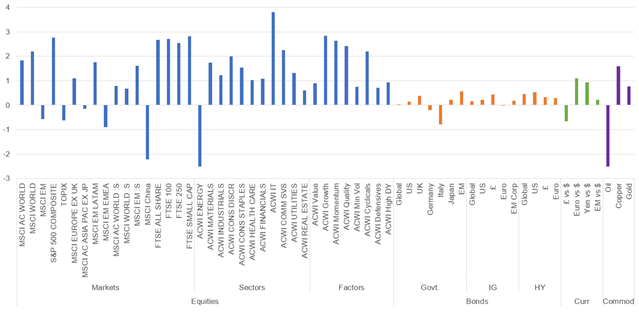
While global equities had a good week overall (MSCI ACWI 1.8%), hitting a new all-time high, not all markets made gains. While DM were up 2.2%, EM continued to struggle, falling 0.6%, led lower by Asia (EM Asia -0.8%). EM are now over 7% below their 12.5% YTD high and are around 4.5% behind DM. As markets have rallied, expectations of future volatility have declined, with the VIX dropping to below 17 for the first time since pre-pandemic, but that remains well above the historical lows (<10) of the late 2010s.  DM performance was led by US equities, with the S&P 500 up just under 3% and hitting a new all-time high. Europe also made gains and is the strongest DM region YTD (MSCI Europe ex UK 10.4%). While Small Caps underperformed (0.8%) they remain well ahead of the overall market YTD. EM and DM small caps have risen broadly in-line. At a sector level, tech-related sectors dominated performance, with IT (3.8%) and Communication Services (2.3%) leading the way. Energy (-2.5%) struggled against a weaker oil price, although remains the best performing sector YTD. In a risk-on environment, defensive sectors underperformed and remain the market laggards. Consumer Staples and HealthCare are only up 2-3% YTD. It was a rare week of Growth (2.8%) outperformance against Value (0.9%). Momentum (2.6%) and Quality (2.4%) also performed well. UK equities outperformed (All Share +2.8%), with both mid and small caps hitting new all-time highs. A weaker £ and an easing of lockdown measures underpinned the market.

Government bond yields were relatively stable, with 10yr USTs, Gilts and JGBs seeing 1-2bp declines. There was modest upward pressure in EZ yields with the 10yr Bund and BTP up 3bp and 11bp respectively. Overall global government bonds are still down YTD (-2.9%), with Gilts and USTs the main laggards. Credit yields and spreads edged lower in both IG and HY, with the latter outperforming (0.5% vs 0.2%). HY is comfortably ahead YTD (1.3% vs -2.7%) with the EZ the best of the regional markets in both IG and HY.

The US$ gave up some of its recent gains with the US Dollar Index down 0.9%, its worst week since December, as both the Euro (1.1%) and Yen (0.9%) appreciated. £ was an outlier, declining 0.7% and back close to its YTD lows at just over $1.37.

After a strong start to the year (up 34% at one point), oil prices have struggled in recent weeks and gave up 2.5% last week as virus-related demand concerns remained and OPEC+ decided to increase supply between May and June by 2mbd. Although it saw a small gain, Copper has struggled to regain momentum since reaching a 9-year high in February as demand concerns, a stronger US$ and rising inventories have weighed on sentiment. Gold (0.8%) has bounced off its lows as a stabilisation in real yields and a weaker US$ have provided some support. It is still down 8% YTD.

Market performance last week (%)

Past performance is not a guide to future returns. Sources: Datastream as at 11 April 2021. See important information for details of the indices used.

YTD market performance (%)

Past performance is not a guide to future returns. Sources: Datastream as at 11 April 2021. See important information for details of the indices used.

Chart of the week: ISM Services PMI Index and S&P 500 performance

Past performance is not a guide to future returns. Source: Datastream as at 12 April 2021. Price only performance.

  • There have been a series of much stronger than expected US economic data releases since the start of April. These include the ISM Manufacturing PMI, that hit its highest level since December 1983, and Non-Farm Payrolls that at 916k came in much better than expected (albeit seasonal effects probably overstated the degree of the beat). Last Monday we saw the ISM Services PMI hit an all-time high of 63.7, rising from 55.3 and well ahead of consensus expectations of 59 (remember here that PMIs are diffusion indices, so tell us the percentage of firms that are experiencing an uptick in business and do not give a sense of the magnitude). While the Services PMI has a much shorter history (since 1997) than the Manufacturing PMI (since 1948), it remains a key guide to business sentiment in what is, of course, the dominant sector in the US economy.
  • And as the chart highlights there has historically been a close relationship between equity market performance and the Services PMI. The correlation is a high 64%, only marginally lower than the 67% correlation with the Manufacturing PMI over the same time period. Given this relationship and the strength of the Services (and Manufacturing) recovery from the pandemic lows, its hardly a surprise that the equity market performance has been so strong.
  • Clearly there is a big surge in activity under way as the weather improves. Alongside that, although new cases have picked up recently, the substantial drop in virus case numbers from the second wave peak and the successful rollout of the vaccination programme (34% have received their first shot) has allowed lockdown restrictions to be lifted at the same time as Biden’s $1.9trn in additional fiscal stimulus boosts incomes. And the improvement in the PMI has been broad-based, with all eighteen industries reporting growth. Among the key sub-components of the index the largest gains were seen in Business Expectations (+13.9pts to 69.4) and New Orders (+15.3pts to 67.2), both at record levels. Employment also saw an improvement, reflecting the strong Non-Farm Payrolls numbers, and at 57.2 is back at pre-pandemic levels.
  • For those concerned about a potential lift-off in inflation, there were further signs that inflation pressures continue to rise. The Prices index rose to 74, its highest level since 2008, a similar picture to what we saw with Manufacturing (85.6). Time will tell whether that turns into a sustained and/or substantial rise in inflation, forcing a change in policy stance from the Federal Reserve. For now, the Federal Reserve thinks not. The risk is that they are wrong.

Key economic data in the week ahead

  • A relatively quiet week ahead with China’s Q1 GDP and US inflation the main features.
  • In the US March’s Inflation data is out on Tuesday. Headline and Core are expected to rise 0.5%mom and 0.2%mom respectively. This would take them to 2.5%yoy and 1.6%yoy, the former the highest it has been since before the pandemic. Initial Jobless Claims posted a surprise uptick last week to 744k. It is expected to drop to 700k on Thursday – still elevated given the strength of the economic recovery. On the same day Retail Sales for March are also forecast to jump thanks to the latest round of stimulus cheques and improved weather. An increase of 5.5%mom is pencilled in following the 3% drop in February. Following the recent batch of positive economic data, the University of Michigan Consumer Sentiment index for April on Friday is expected to rise to 89 from 84.9, the highest reading since March of last year.
  • The only data point of note in the UK is February’s monthly GDP published on Tuesday. Although economic activity is expected to have picked up, increasing 0.5%mom after January’s 2.9% contraction, the rolling 3m number is expected to remain negative at -1.9%. Improvement in services is the key driver here, with February forecast at 0.5%mom after the 3.5%mom fall in January.
  • In the EZ Retail Sales data for February is released on Monday. A small 1.3%mom gain is forecast, but still leaving a -5.4%yoy shortfall. February’s Industrial Production numbers are released on Wednesday. A -1%mom decline is expected, leaving it at -1%yoy.
  • In China Q1 GDP is published on Friday. A quarterly gain of 1.4%qoq is forecast, leaving the economy higher by 18.3%yoy. The increase in economic activity is expected to be broad based, with Industrial Production, Retail Sales and Exports forecast to rise 27.6%yoy, 28%yoy and 28%yoy respectively.
  • There is no data release of significance from Japan this week.

We will continue to publish relevant market analysis and news as we enter the 10-week countdown to the end of the UK’s national lockdown.

Stay safe.

Chloe

12/04/2021

Team No Comments

Weekly Market Commentary – Gains for equities despite European lockdown concerns

Please see below detailed economic and market news update received from the in-house research team at Brooks Macdonald yesterday afternoon.

A far stronger than expected US employment report spurs gains in equities

While Europe was on holiday, a bumper US jobs report on Friday drove risk assets higher on both sides of the Easter weekend. Survey data also beat expectations, and this was enough to allow equities to look through the pickup in global COVID-19 numbers.

The closely watched minutes from the March Federal Reserve meeting are released on Wednesday

The number of new jobs created in the US in March hit 916,000, far in excess of expectations of 660,0001. Standout areas included leisure and hospitality sectors, which are both reopening after being the hardest hit areas from the curbs on activity. The broadest measure of US unemployment, U-6, which includes not only the unemployed but those that are underemployed or discouraged from the workforce, fell but remains in excess of 10%2. For context, this measure was at 6.9% in January 20203 before the pandemic hit and still points to a sizeable gap until the US economy returns to ‘full’ employment. This elevated level of broad unemployment is often cited by US Federal Reserve (Fed) Chair Powell as a sign of the economic output gap that needs to be filled before inflationary pressures could become sustained. 

Since the Fed meeting in March, we have seen the market price in additional rate hikes as the vaccine rollout continues amidst the aforementioned stronger data. The Fed’s last statement said relatively little about how the bank would respond should benchmark Treasury yields continue to rise. As a result, this will be keenly watched for in the minutes released on Wednesday. The disconnect between what the market believes will occur and Fed guidance is widening by the day, so any sign that they will take concrete action will be important for the central bank to remain in the driving seat. This week also sees the European Central Bank minutes released on Thursday, where investors will be looking for further guidance on the pace of quantitative easing purchases over the next few months.

Third COVID-19 wave concerns continue in Europe as France enters lockdown

The counter to the data optimism is the third wave of the coronavirus pandemic which has caused Europe to move further towards lockdowns, with France beginning its lockdown over the weekend. This will remain a hot topic this week as the complicated interplay of vaccine rollouts and rising cases continues to muddy the short-term economic outlook.

Although the UK has been successful in its vaccine rollout so far, it is important for Europe and the rest of the world to achieve mass-vaccination as well. We will continue to publish relevant content as the lockdown rules continue to be relaxed.

Stay safe.

Chloe

07/04/2021