Team No Comments

Equities mixed as third wave undermines recovery

Please see below article received from Brewin Dolphin yesterday evening, which analyses the performance of markets in relation to the big news events of the past week. 

Global equities were mixed last week after renewed lockdown restrictions in Europe dented hopes of a broad economic reopening.

Stock markets in Asia suffered the most, with Japan’s Nikkei declining 2.1% and Hong Kong’s Hang Seng falling 2.3%. In Japan, the recent lifting of the state of emergency in Tokyo provided some optimism, but this was outweighed by concerns that Europe’s third wave of Covid-19 infections could delay the global economic recovery.

France’s CAC 40 ended the week in the red after the country extended its lockdown to cover a third of the country. Germany’s Dax and the UK’s FTSE 100 posted gains of 0.5% and 0.9%, respectively, following a rebound on Wall Street and positive UK retail sales data.

In the US, the S&P 500 edged up 1.6% following Joe Biden’s pledge to vaccinate 200m Americans in the first 100 days of his administration – double his previous target. Energy stocks performed particularly strongly after the closure of the Suez Canal boosted oil prices. The Nasdaq declined 0.6% amid ongoing interest rate and inflation concerns.

Stocks flat after hedge fund fire sale

Stock markets were largely flat on Monday as investors turned their attention to the fall-out from the collapse of family office hedge fund Archegos Capital Management.

Archegos was forced to sell billions of dollars’ worth of shares after its positions turned sour, prompting a margin call from its prime brokers. Nomura and Credit Suisse, who were among the banks handling Archegos’ trades, warned of significant losses after Archegos defaulted on the margin calls, forcing brokers to dump shares.

So far, the impact of the fire sale has been limited to the stocks that were part of Archegos’ portfolio and its banking and brokerage partners. The Dow edged up 0.3% on Monday, while the S&P 500 and the Nasdaq ended the day down 0.1% and 0.6%, respectively.

European shares also managed to brush off the fall-out from Archegos, with the STOXX 600 adding 0.1% and Germany’s Dax gaining 0.5%. The FTSE 100 closed down 0.1% as the pound gained 0.03% on the dollar.

The FTSE 100 was up 0.7% in early trading on Tuesday, following encouraging news about the vaccine roll out in the UK and the US.

Suez Canal blockage disrupts trade

Last week’s headlines were dominated by the blockage of the Suez Canal – one of the world’s busiest trading routes. On 23 March, the 200,000-tonne ship Ever Given ran aground, resulting in a queue of approximately 370 ships either side. Some ships resorted to rerouting around the southern tip of Africa.

Around 12% of world trade flows through the canal, carrying more than $1trn worth of goods every year. Delays can cause severe disruption to supply chains, ultimately leading to a shortage of goods and higher prices. On the day after the ship ran aground, there was a 5.8% spike in the price of Brent crude oil.

The Ever Given was finally freed yesterday (29 March), but clearing the backlog of container vessels, tankers and bulk carriers is expected to take several days.

Europe extends lockdown restrictions

Last week also saw renewed lockdown restrictions in several European counties, as a third wave of Covid-19 infections spreads across the continent.

Data released on Sunday revealed the number of new Covid-19 patients in intensive care units in France has risen to 4,872 – close to the November peak but below the high of 7,000 in April 2020. In Germany, the incidence of the virus per 100,000 rose to 130 on Sunday, from 104 a week ago.

Rising infections, a slow vaccine rollout and renewed lockdown measures are threatening Europe’s economic recovery. The European Commission is calling for tougher controls on vaccine exports, after its own data suggested 77m doses have been exported outside the bloc, while 88m doses have been delivered to its members.

Vaccine rollout affecting services recovery

The speed at which vaccines are being distributed is having a profound effect on the recovery of the global services sector. In the eurozone, the manufacturing PMI has surged to a three-year high, whereas the services PMI is stuck in contractionary territory below 50. The recovery in services is expected to be pushed back because of delays in issuing the vaccine and the surge in new coronavirus cases.

In contrast, the UK’s services sector is outpacing manufacturing for the first time since the start of the pandemic. In March, the services PMI rose to a sevenmonth high of 56.8, while the manufacturing PMI stood at a three-month high of 55.6. The rebound in services suggests businesses are getting ready for a reopening from mid-April.

Meanwhile, the US manufacturing PMI rose to 59.0 in March, while the services PMI increased to 60.0 from 59.8. The University of Michigan revised its gauge of March consumer sentiment to 84.9, its highest level in a year, while weekly jobless claims fell more than expected to 684,000. Sales of existing and new homes tumbled in February, but this was largely because of severe winter weather.

We will continue to publish relevant content as lockdown restrictions begin to ease over coming the coming weeks. Please check in again with us soon.

Stay safe.

Chloe

31/03/2021
Team No Comments

Why emerging market financials are different

Please see below article received from AJ Bell yesterday afternoon, which presents the advantages of investing in emerging markets. The commentary advises that there is more scope for growth in this area due to large populations having no access to banking services.  

In the developed world the banking and wider financial industry is very mature with limited avenues for rapid growth and the focus from an investment perspective is typically on the income they pay out – subject to regulators’ approval.

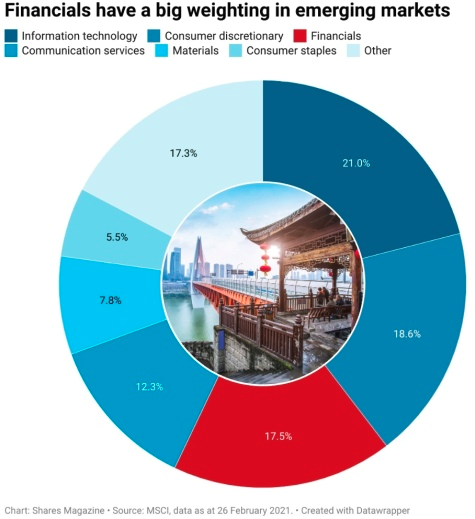
Financial stocks in emerging markets are, on the whole, quite different. While technology firms have increased in importance in recent years, financial stocks remain a key component of the emerging markets story with the MSCI Emerging Markets index having a 17.5% weighting to this sector.

In contrast the MSCI World developed markets index has a weighting of 13.6% to the financial sector.

According to a 2017 report from the World Bank about 1.7 billion adults globally and 58% of people in developing nations remained ‘unbanked’ – although there is considerable diversity across different geographic regions.

Capturing these customers should allow emerging market financial firms to grow more rapidly than their counterparts in the West. It explains why Prudential (PRU) has pivoted away from markets in Europe and the US to focus more on Asia.

The question of how these unbanked customers are reached is an interesting one with financial technology and mobile payments, in particular, likely to play an increasing role.

The same 2017 World Bank report commented: ‘The benefits from financial inclusion can be wide ranging. For example, studies have shown that mobile money services — which allow users to store and transfer funds through a mobile phone — can help improve people’s income earning potential and thus reduce poverty.’

Please check in again with us soon for further market analysis and news.

Stay safe.

Chloe

26/03/2021

Team No Comments

Brooks Macdonald – Weekly Market Commentary

Please see below this week’s Market Commentary from Brooks Macdonald, received late yesterday afternoon – 22/03/2021

Weekly Market Commentary | EU leaders to meet this week as concerns continue over vaccination pace

  • Weekly Market Commentary
  • COVID-19 updates

By Edward Park

  • Bond yields remain the primary driver of risk assets as central bank meetings conclude
  • Purchasing Managers’ Index (PMI) data to be released on Wednesday will highlight the relative successes between Europe and the US
  • Thursday’s European summit is likely to focus on the vaccine rollout and COVID-19 cases

Bond yields remain the primary driver of risk assets as central bank meetings conclude

Bond yields continued to climb last week with the effect that the US index closed marginally down but the European market, with a greater weighting to cyclicals, eked out a small gain for the week.

Purchasing Managers’ Index (PMI) data to be released on Wednesday will highlight the relative successes between Europe and the US

With a week of major central bank meetings behind us (though Powell and Yellen are speaking to Congress on Tuesday and Wednesday), markets are likely to start taking their direction from economic data. On Wednesday, flash PMI (economic survey) data will be released from around the world. Of note will be the headline differential between the US and European PMI data. US data is expected to be helped along by imminent stimulus cheques and loosening COVID-19 restrictions. By contrast, European countries are moving the other way with their COVID-19 cases and lockdowns are being announced across the continent.

Thursday’s European summit is likely to focus on the vaccine rollout and COVID-19 cases

On Thursday, EU leaders are holding their latest European Council summit in Brussels and, more than likely, COVID-19 and the vaccine rollout will feature heavily on the agenda. Having previously been held as a beacon of European solidarity during the COVID-19 pandemic in 2020, the European Commission’s strategy of joint vaccine procurement and delivery continues to be judged by many as being too slow and bureaucratic. The shortfall of pace of immunisation among the EU member countries versus the likes of the US and UK remains stark. Risking a rise in vaccine nationalism, the European Commission President von der Leyen has refused to rule out using Article 122 of the EU treaty. Article 122 would, in theory, allow the EU to take control of the production and distribution of vaccines, potentially placing export controls on vaccines that had been destined elsewhere, such as the UK.

While ultimately our expectation is that the vaccine lag for the EU will last maybe one or two quarters at most, it risks keeping EU member countries’ economies in various degrees of more stringent lockdown. At the same time, the length of time it is taking to effect fiscal spending disbursements from the EU’s Recovery Fund, which was agreed in July 2020, is also risking a later recovery path than what is currently expected in some other countries globally.

A good update from Brooks Macdonald on recent economic data and market news.

Please continue to check back for our latest updates and blog posts.

Charlotte Ennis

23/03/2021

Team No Comments

Lessons one year on from the low

As we reach the anniversary of the UK’s first national lockdown, please see below article received from AJ Bell yesterday, which reflects on how different parts of the market performed during the pandemic.

It was Warren Buffett’s mentor, Benjamin Graham, who once wrote: ‘The intelligent investor is a realist who sells to optimists and buys from pessimists.’ Such plain-speaking, common sense has yet again proved its worth over the past 12 months to offer a timely lesson to us all.

It is almost a year to the day (23 March 2020) since the FTSE 100 bottomed at 4,994 amid widespread fear over what the pandemic could do to global growth and corporate profits. 

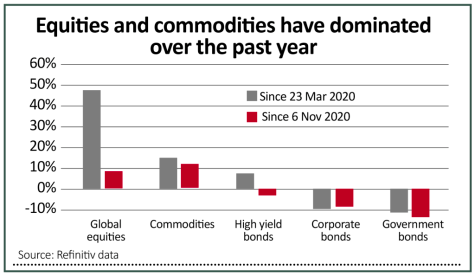
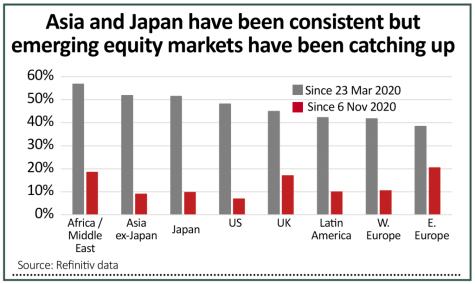
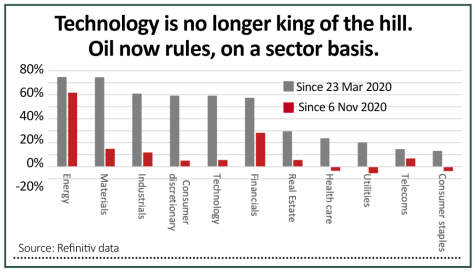
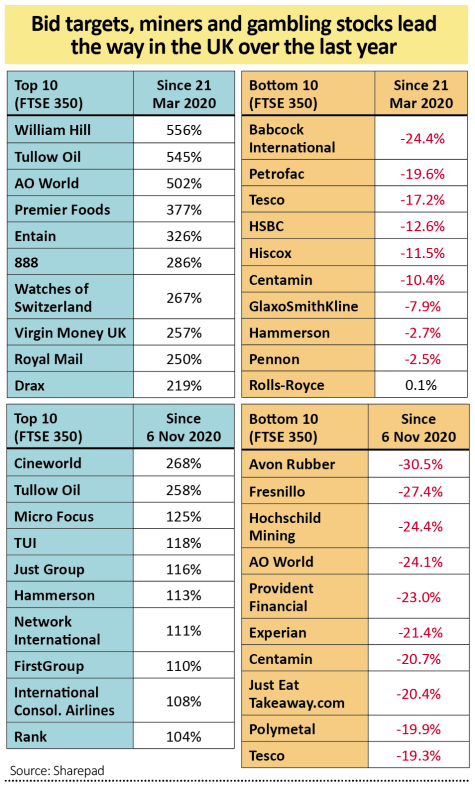
A year later and the picture is very different. Anyone brave enough to have started to take on more risk a year ago would have done remarkably well, as four data sets show. Investors now must decide whether these trends will continue, further changes in performance trends since ‘Pfizer Monday’ on 9 November will dictate or that a further shift in gear is imminent.

GLOBAL ASSET CLASSES

Fear may have dominated a year ago, but equities have been the best place to be over the past 12 months. As benchmarked by the MSCI All World index, global stocks have beaten commodities and bonds. Government bonds, in theory a port in a storm, have provided no shelter with capital losses more than offsetting any yield that they offered.

There have been subtle changes since November. Commodities have taken the lead from equities and high yield bonds have started to flag. Meanwhile, the rout still seems to be on when it comes to investment-grade corporate and government bonds.

STOCK MARKETS

Unlike bonds, where all major categories have fallen on a one-year view, all geographic equities options have gained. Asia and Japan have performed consistently well, perhaps thanks to the relatively low number of pandemic cases they have suffered and their rapid, robust approach to test, track and trace as well as containment.

America’s domination of early 2020 has faded and it is prior laggards who have come to the fore – emerging markets and even the unloved UK equity market has put on a spurt, finding itself outpaced by just Eastern Europe and the Africa/Middle East region since November. This may be down to the perception that the UK is ahead of the game when it comes to vaccination programmes, having previously struggled to contain the virus.

EQUITY SECTORS

Technology continues to grab the headlines, especially as a raft of new initial public offerings tempts investors’ wallets. But miners, industrials and consumer discretionary stocks have all beaten tech over the past 12 months and oil has been the best performer of the lot, to reaffirm the adage that the darkest hour is before the dawn. 

Meanwhile, sectors that looked reliable going into a pandemic – utilities, consumer staples and even healthcare – have lagged, a trend that has become ever-more noticeable since the Pfizer-BioNTech announcement of last autumn.

UK STOCKS

These ‘big picture’ trends – a switch from defensives to turnaround plays, from ‘growth’ (and promises of long-term secular growth, or ‘jam tomorrow’, almost regardless of the economic backdrop) to ‘value’ (cyclicals that offer growth now, or ‘jam today,’ in the event of a recovery), from pandemic winners to bounce-back candidates can be seen on a bottom-up basis in how individual UK-quoted stocks have performed

That said, it has been hard to lose money since last year’s panic. Just nine of the FTSE 350’s current membership have lost ground over the last 12 months.

These trends have become even stronger since Pfizer Monday. Beneficiaries of an economic reopening dominate the leaderboard, notably travel and leisure stocks. The laggards include online delivery plays, precious metal miners, pharmaceutical plays and previously dependable names where investors may have paid too high a valuation, and thus mistaken reliability of earnings for safety of share price. Pay the wrong valuation and nothing is safe.

CONCLUSION

No-one will time a market bottom or top perfectly and trying is a mug’s game. But the trends of the past year show how investors can calibrate risk and earn rewards over time by going against the crowd, focusing on valuation and not getting carried away.

The best approach now could be to heed the words of another investment legend, Sir John Templeton: ‘Bull markets are born on pessimism, grow on scepticism, mature on optimism and die on euphoria.’ It is perhaps time to once more research those areas of which investors are frightened and tread carefully where fear of missing out predominates.

It will be interesting to see how markets and economies react to the easing of restrictions over the next few months. Please check in again with us soon.

Stay safe.

Chloe – 22/03/2021

Team No Comments

Jupiter Merlin Weekly: Cracks appearing in the central banks’ wall?

Please see below article received from Jupiter Asset Management yesterday afternoon, which comments on how major central banks are grappling with their reaction to rising bond yields, with the European Central Bank being the first to break ranks.

UK GDP shrank 2.9% in January, rather better than the 4.5%-5% contraction feared in the consensus estimate, bearing in mind not only the first full month of new Covid restrictions after Christmas but also the dislocation in the movement of imports and exports following Brexit on December 31st. The anecdotal ‘fast’ data, monitoring day-to-day consumer patterns (e.g., traffic congestion, credit card usage, electricity consumption etc) had suggested that Lockdown 3 would be less economically sensitive than its predecessors, and while a near 3% decline in normal circumstances would be a horror, it says much that it is a relative triumph of resilience when compared to the 20% economic decline recorded in April 2020.

Andrew Bailey, Governor of the Bank of England, still believes the economic outlook is good (the Bank’s “coiled spring”) but speaking at a symposium this week, he said that he would need to see evidence of prolonged excess inflation above 2% to require interest rates to be raised to cool any potential heat. In the meantime, he is still preparing the implementation of negative interest rates should the economy falter again. Among many mixed messages here, and despite markets’ scepticism reflected in higher bond yields (and therefore more expensive financing costs), he is effectively saying “I have all bases covered, and until anyone says otherwise, I propose to do nothing”.

The ECB, on the other hand, has broken ranks with the US Federal Reserve and the Bank of England and has responded to the challenge of rising bond yields (or more accurately, less negative yields in the case of Germany and Holland) and borrowing costs in the eurozone: it pledged to step up its QE programme with yet more incremental bond purchases on the simple premise that if demand exceeds supply, prices will rise and yields will fall. For the first time in two months eurozone yields have responded by moving in the opposite direction to their Anglo-Saxon counterparts.

The geopolitical risks of decarbonisation

As US Congress passes President Biden’s $1.9 billion Covid-recovery package, on top of the equally massive programmes implemented last year under Donald Trump’s administration, the political and fiscal spotlight is falling on the budgets of those departments which can be used to help fund such expenditure while relieving the pressure on government finances. Much the same is happening here in the UK, and in both instances defence spending is in the rifle crosshairs. As a barometer of the passion the subject excites, Bernie Sanders’ senate performance a few days ago was instructive: on full tub-thumping form, he made the social case for slashing defence dollars to “feed our people, put clothes on the backs of poor Americans”, to help realise their “expectations of, their right to, a better standard of living and higher wages!”. With Biden more understatedly making much the same case, the Chair of the Senate Budget Committee is clearly pushing on an open door among the Democrat leadership.

In the UK, Boris’s announcement in December of an additional £16 billion of spending on cyber and space defence comes at a price, largely thanks to the £17 billion ‘black hole’ in the MoD accounts. Robbing Peter to pay Paul, hence yet another Treasury-led defence review in the offing and a suggested reduction in the establishment of the Army from 82,000 to 72,000 (not quite enough soldiers to fill Old Trafford, let alone Wembley).

Why is this of relevance? Defence strategists are pointing to the opportunities and threats arising from the global decarbonisation programme. As the ice caps shrink at both poles thanks to global warming, Greenland and the Antarctic become viable for mining, being rich in the rare-earth minerals and ores increasingly in demand as the digital and decarbonisation revolutions gather pace. Not only those landmasses: it has also been suggested that mining the seabed in the deep, deep ocean, particularly in regions of high tectonic and volcanic activity where those same ores and minerals abound, is now a commercial possibility. And returning to the far north, as the pack ice retreats and becomes less enduring, so there is the possibility of year-round trans-polar maritime routes. The US, China and Russia are all sizing up the opportunities and the threats, each keeping a beady eye on the others’ movements, reading the signals of intent. Both China and Russia are investing heavily in naval capabilities (China now has the largest navy in the world, though lags well behind the US in aircraft carriers) and, while nobody is predicting a hot war, the potential for diplomatic or military stand-offs over strategic maritime assets is only likely to grow. While many treated Donald Trump’s unsubtle overtures to ‘buy’ Greenland from Denmark as a joke, in reality he was deadly serious. In the North Atlantic, Denmark becomes a key strategic player through its ownership of both Greenland and the Faeroe Islands, the latter already becoming one of the most secretive and sensitive of NATO’s watching and listening posts, keeping tabs on both the Russians and Chinese.

From an investment standpoint, while peripheral to current events and pre-occupations, however glacially and imperceptibly, these new and growing risks will be factored into longer-term risk premia.

We will continue to publish market updates and analysis, so please check in again with us soon.

Stay safe.

Chloe

18/03/2021

Team No Comments

Daily Investment Bulletin

Please see below market update received from Brooks Macdonald yesterday afternoon. The commentary provides investment analysis linked to global news.

What has happened

Whilst there was a cyclical tilt to yesterday’s equity moves, it was a far calmer backdrop with sub 1% moves for most headline US and European markets. Technology pulled back a little, however this is within the context of Tuesday’s exuberance. The US market is within a hair’s breadth of hitting an all time high which is quite remarkable given the amount of ink that has been expended talking about market volatility.

US Auction and Inflation update

The auction of $38 billion of US 10 year bond yields followed in the footsteps of the 3 year and was well received by the market. Bond yields fell again as bond investors had a sigh of relief albeit a more modest sigh after imminent fears of an auction inspired spike had subsided earlier in the week. The core (ex Energy and Food) US CPI figures came in modestly below market expectations at 1.3% year on year gain. Of course, as we have said on multiple data points, this data is arguably less useful as we haven’t yet seen the recovery or impact of the latest round of stimulus and equally the comparable a year earlier was muddied by the beginning of COVID restrictions. That said, investors were comforted that inflation remains under control for the time being.

US/China

In 2018 and 2019 one of the largest geopolitical risks was the ongoing trade war between the US and China. Whilst the Biden administration is expected to take a less antagonistic stance with China, it is not expected to entirely retreat from the battle. Yesterday the White House announced a summit with Chinese officials in Alaska in a weeks’ time. The agenda for this hasn’t been announced but Secretary of State Blinken said topics would include areas ‘where we have deep disagreements’, so the meeting isn’t merely to exchange pleasantries. This latest development is a reminder to markets that a change in the US Presidency has not removed the risk of a ‘tough on China’ stance that has bipartisan support from Congress.

What does Brooks Macdonald think

With yesterday’s inflation data and auction results giving investors little to worry about there was a sense of calm in markets. It is far too early for us to conclude that inflation will remain under control as the key data points will arrive when the recovery kicks into gear.

Please check in again with us soon for further updates.

Stay safe.

Chloe

12/03/2021

Team No Comments

Weekly Market Commentary: Yields continue to rise amid Federal Reserve communications blackout

Please see below market analysis received from Brooks Macdonald yesterday evening. The article comments on how the continuous rise in yields is affecting market volatility and refers to political developments during Biden’s first 100 days in Office.  

The US Federal Reserve (Fed) enters its communication blackout period at a crucial time for sentiment

European and US equities had a pretty subdued Friday until after the European close, when US equities picked up to close higher for the day and the week. Market expectations are now for the first Fed rate hike to occur in early 2023 and with the Fed now absent due to the communications blackout, further assumptions could be baked in given the policy void1.

Rises in yields continue to drive market volatility

US 10-year yields are now over 1% higher than their lows last August2. This is a testament to the dramatic moves seen over the last few months. Of course, for context, a circa 1.6% yield is still on a par with the lowest rates seen in 20193, so perhaps it’s remarkable that rate expectations had stayed so low in Q4 2020 when more economic optimism was being priced in. In Q2 and Q3 last year, the equity market was drawing its optimism from the low rate environment and the relative support this gave to high growth equities. Since November 2020, and the first vaccine efficacy trials, we have seen a boost to economic expectations which brought cyclical equities into vogue and has catalysed this reappraisal of bond yields. The big question in markets is whether the Fed are comfortable with this rapid rise, albeit only to 2019 lows, and to find that out we need to wait another week.

The Senate passes President Biden’s $1.9 trillion US fiscal stimulus package

The Senate passed President Biden’s $1.9 trillion package on Saturday meaning it will now move to the House for a final vote before going to the White House for Biden’s signature. The economic growth expectations that have been revised up since November 2020 take account of both the expected post-COVID-19 recovery but also the size of US stimulus. With the package’s total size having survived Congress intact, despite some concessions to moderate Democrats, we are likely to see a supercharged period of economic growth and short-term inflation.

With the Democrats only able to use the budget reconciliation process for a fiscal stimulus package once in 2021, the instinct was always to ‘go big’. Market concerns that the support would be too large and therefore inflationary has been one of several factors being priced into equity and bond markets this year. With the package likely to enter law early this week, and the Fed blackout period ongoing, rising inflation expectations could be a major driver of volatility this week.

Please check in again with us soon for more news updates and interesting analysis.

Stay safe.

Chloe

09/03/2021

Team No Comments

Budget 2021: look to the long term, Rishi

Please see below article received from Jupiter yesterday evening, which analyses whether the measures announced by Rishi Sunak in Budget 2021 will sustain the UK’s economic and financial market recovery in the years ahead.

In every downturn, the UK Government’s finances turn down sharply. Tax receipts fall as job losses, bankruptcies and subdued spending impact the three big sources of revenue for the Treasury – income tax, National Insurance and VAT. But Government spending must rise to cushion the impact of a recession, through unemployment benefits and welfare payments.

There is always a moment at the depths of a downturn when the Government’s budget deficit looks awful and the prospect of a return to more balanced books nigh impossible.

Clearly this pandemic has a rather different dynamic, as the Government measures to support the economy from complete collapse during extended lockdowns, has pushed their spending to levels unprecedented outside wartime. Roughly 75% of the increase in the budget deficit has arisen due to these support measures – about £200bn. Today’s extension of such support until September will only increase the scale of this spending, all funded through borrowing.

Whilst tax receipts have fallen during the pandemic, they have done so only modestly – testimony to the success of the support in limiting the rise in unemployment and bankruptcies thus far. Tax receipts as a percentage of GDP have remained roughly in line with their long run average of 37% of GDP.

Government spending, by contrast, has risen from its more usual level of 40% of GDP to 55% and rising. Hence the Chancellor’s desire to ‘level with the British people’ on the unsustainability of current levels of borrowing and spending by Government and the need to rebuild public finances in the future.

The risk of raising taxes too soon into the post-pandemic recovery is that it saps the strength of the recovery. I believe there is bound to be a surge in consumer spending as individuals and families enjoy their freedom from lockdown to shop, eat out and holiday. But it won’t be until well into 2022 before we know the full scale of the likely bankruptcies to come, the peak levels unemployment will reach – today’s more upbeat forecast notwithstanding – nor the longer-term psychological impact on consumers of the pandemic on spending and saving habits.

Crucially, though, the Chancellor needs to remember the lesson of all his predecessors in the depths of a recession. The cyclicality of Government finances means that as the economy recovers, automatically Government spending will fall and tax receipts will rise. The end to Government support measures and a resumption of consumer spending will boost VAT receipts just as the support cheques cease to be written; in this regard, I believe the transition measures announced today are to be welcomed.

Clearly though, one of the most significant of today’s announcements is the planned increase in Corporation Tax as of April 2023 from the current 19% to 25%. While this does indeed give businesses clarity, it is nevertheless a substantial increase, which will in time impact on companies’ ability to return profits to shareholders, and at variance with widely held expectations that such hikes would begin sooner and would be more gradual in their introduction.

Investors will be considering the impact of this pending rise and will be asking themselves to what extent it can be offset by the generous-sounding 130% “super deduction” on business investment. While this is, in my view, an innovative and progressive policy, taken together with the upcoming rise in Corporation Tax, it is likely to mean that the economic growth benefits resulting from the policy will be somewhat front loaded.

Meanwhile, the decision to maintain income tax, National Insurance and VAT at their current levels should provide some support consumer confidence and household budgets as the country emerges from the pandemic. Nevertheless, the Chancellor’s explicit announcements of upcoming fiscal drag – the result of not adjusting taxation thresholds to take account of future inflation – reflects the reality of the situation of the post-pandemic economy. Although this is undoubtedly a progressive policy, put simply, the higher inflation rises, the more the Treasury is likely to benefit. Over time, should we enter a more inflationary environment, in public finance terms this may well turn out to have been a prudent decision, given the impact of rising inflation on the cost of servicing our national debt.

Turning to the UK equity market, it was no surprise to see rising share prices among those businesses that should be beneficiaries of further support to the domestic economy, such as banks and leisure stocks, alongside housebuilders. The latter may well benefit from the extension of the stamp duty holiday and mortgage guarantee programme, as well as a more benign backdrop through the extension of Government support through the summer’s transition from lockdown and re-opening to the end of measures such as the furlough scheme.

Looking to the longer term, to my mind, the truly prudent but wise Chancellor will not risk the upturn by setting out a plan for increased taxation in the years ahead, but keep his powder dry to see just how radically Treasury finances improve over the coming year, without any action on his part whatsoever. While today’s Budget announcements appear well placed to support the transition to life after the pandemic over the next couple of years, it remains to be seen whether the “front-loading” of business incentives to spend now but be taxed later leads to a slowdown in growth thereafter which might not have been necessary.

We will continue to publish relevant content and news as the vaccine roll-out in the UK continues to expand and the light at the end of the tunnel brightens. Please therefore, check in again with us soon.

Stay safe.

Chloe

04/03/2021

Team No Comments

Normal Pension Age Update re early access to pension benefits

HM Treasury and HMRC quietly launched additional proposals on 11/02/2021 with the potential to have a much greater effect on retirement planning over the coming years.

The proposals

The main proposal is this: anyone who was a member of a registered pension scheme on 11 February 2021 (the date of the consultation) and had a right to take pension benefits before age 57 on that date, would keep that right as a protected pension age. That protected pension age (which in most cases would be 55) would be scheme specific and work similarly to existing protected pension ages. This would mean:

  • Anyone joining a new pension scheme from 12 February 2021 onwards would have an NMPA of 57 from 2028 for that scheme, although they may have other pensions that they could still access before age 57.
  • From 12 February 2021, anyone who transfers to a new scheme would lose the right to take benefits from that pension before age 57 (assuming the original scheme offered that right), unless they completed a block transfer.

One key difference highlighted between the rules for existing protected pension ages and these proposals, is that clients would not need to crystallise all the benefits within a scheme on the same date in order to keep their protected pension age.

Next steps

The timing of proposals like these is always difficult. The consultation doesn’t close until 22 April, and we don’t expect to see draft legislation from the Treasury until the summer. However, if the proposals do go ahead as they stand, transfers that take place from today could affect when clients are able to take benefits. While many people may not expect to retire at 55 or 56 (and until yesterday might have assumed it simply wouldn’t be an option), it still adds an additional consideration into people’s pension planning.

It’s still early days, and I’m sure you’ll see more about the industry’s thoughts about the proposals over the coming weeks. What seemed like a very straight forward upcoming pension change has suddenly become something to keep a keen eye on.

Our Comment

We need to see what the outcome is in the summer, but this is one to watch for those who are considering retiring early at age 55 or if you thought you might access your pension benefits, typically tax free cash, early at age 55 from 2028.

In real terms this will only be a few people, most in the UK haven’t got the pension assets they need for early retirement and shouldn’t access their pension funds too early either.

However, if you are one of the few that may have a plan to retire early or access your pension benefits early, at age 55, from 2028 you now need to be careful about any pension switching or consolidation. Let’s see what we get at the end of the consultation, hopefully draft legislation in the summer.  Watch this space.

Steve Speed

03/03/2021

Technical content cut and pasted from Curtis Banks Technical Update.

Team No Comments

An emerging trend to note in bond markets

Please see below article received from AJ Bell yesterday afternoon, which provides a global review of bond markets and offers recommendations for potential future investment winners.

Zambia, Venezuela, Tajikistan and Armenia do not make a habit of featuring in this column, not least as they are a bit off the beaten track, even for the most intrepid adviser or client. But they catch the eye because each member of this quartet has seen an increase in interest rates this year, to take the total for 2021 so far to five increases and two cuts from global central banks (Mozambique is the fifth for those who are interested).

Five central banks have raised rates so far in 2021

“Many advisers and clients are unlikely to be stirred by events in Zambia, Venezuela, Tajikistan and Armenia but they may need to pay attention for three reasons.”

Those who are not interested will ponder the relevance of this possible trend, but they may need to pay attention for three reasons.

  • It could be an early ‘risk-off’ sign in financial markets. When markets become incrementally more cautious, they tend to cut their riskiest positions first. Frontier markets such as these, or even more generally, would fit that bill. Their central banks may be raising rates to try and lure capital back or at least reaffirm their credibility with overseas lenders.
  • It could be a sign that markets are, at the periphery, starting to deleverage or at least balk at the tidal wave of debt that continues to build – Bloomberg data shows that the total of global bonds in issue now stands at a record-high $67.6 trillion. And, generally speaking, when markets turn cautious, it is the peripheral markets that show distress first, rather than the core ones, as it is in the latter that the bulls always have the greatest faith and thus where they make their final stand before they capitulate and make way for the bears.
  • It could be a sign that inflationary worries are seeping into Government bond markets the world over (see this column, SHARES, 11 February 2021). Bloomberg research reveals that the value of global bonds with negative yields has dropped by $3 trillion this year so far, although that still leaves a total of some $14 trillion.

None of these things may come to pass. It could be that the deflationary force of interest payments, demographic trends and central bank intervention keep fixed-income investors in clover as they combine to keep interest rates and inflation well and truly anchored, to the benefit of the bond portion of any portfolio, especially the long-duration segment. Yet if any of the above three trends keeps running, then the meagre coupons offered by most fixed-instruments would leave them looking like return-free risk and speak in favour of short-duration exposure for anyone seeking bond-like ballast in their asset allocation plan.

“If any of the above three trends comes to pass, then the meagre coupons offered by most fixed-instruments would leave them looking like return-free risk and speak in favour of short-duration exposure for anyone seeking bond-like ballast in their asset allocation plan.”

Turning tide

A quick look at the benchmark 10-year bonds of key emerging markets might suggest that investors are taking risk off the table. Selling bonds here means yields are creeping up and prices creeping down. They might not look like big moves, but the very right-hand side of those lines show an upward shift in bond yields – to 6.59% from 6.15% in the last month alone in Russia.

Emerging market bond yields are moving higher

A look at developed market bonds suggests concerns over gathering debt. In Europe, for example, benchmark 10-year bond yields are creeping higher, despite the European Central Bank’s quantitative easing (QE) scheme. No wonder, when advisers and clients consider that the world’s debt pile soared by $24 trillion to a record $281 trillion in 2020, according to the Institute of International Finance. That was an extra 35 percentage points of GDP to take the debt/GDP ratio to 355%. Remember that the Global Financial Crisis started in 2008 when the global debt was ‘just’ $187 trillion.

Developed market bond yield are going up

Even the yield on 10-year Japanese Government Bonds (JGBs) stands at 0.10%, the top of the Bank of Japan’s target range and no different from late January 2016. Perhaps even loyal holders of JGBs are contemplating the return of inflation after 30 years.

10-year JGB yield sits at top of BoJ’s target range

China syndrome

“In a worst-case scenario, central banks may want to raise rates to curb inflation, if it really does run hot, but struggle to do so, because of the immediate impact this would have on economic growth – and financial asset prices.”

Again, all of these trends could yet fizzle out. In a worst-case scenario, they become more pronounced. Central banks may want to raise rates to curb inflation, if it really does run hot, but struggle to do so, because of the immediate impact this would have on economic growth – and financial asset prices. In this context, China is an interesting test case.

China did not hike overnight lending rates for long

The People’s Bank of China jacked up overnight borrowing costs in late January but quickly backed off as the Shanghai Composite index wobbled. As soon as policy was eased, share prices rose. The monetary authorities have a delicate balancing act ahead of them.

We will continue to publish market analysis and thought-provoking financial news, so please check in again with us soon.

Stay safe.

Chloe

01/03/2021