Team No Comments

Brooks Macdonald – Daily Investment Bulletin

Please see today’s Brooks Macdonald Daily Investment Bulletin received earlier this morning (20/10/2022):

What has happened?

After a good start to the week, equity markets ran out of steam on Wednesday with US government bond yields moving higher, as worries surfaced again over inflation and the expected next round of central bank interest rate hikes. The US Federal Reserve meeting on 2 November is now less than 2 weeks away, and markets have priced in a 75bp hike, which if it happens would be the fourth 75bp-sized hike in a row. Elsewhere, of interest was a Bloomberg news report that China is considering cutting quarantine for arrivals from abroad from 10 days (with 7 days in a hotel followed by 3 at home), to 7 days (with 2 days in a hotel followed by 5 at home), giving oxygen to hopes that China’s zero-Covid policy might be loosening a bit.

Dare markets hope again for a Fed monetary policy pivot?

Federal Reserve Bank of Minneapolis President Neel Kashkari said on Wednesday that the US central bank could potentially pause its interest-rate increases at some point next year if policymakers see clear evidence that core inflation is slowing. “My best guess right now is yes, do I think inflation is going to level out over the next few months, the services, the core inflation, and then that would position us some time next year to potentially pause,” For balance however, Kashkari did make it clear that he saw no evidence yet to give him “comfort” that core prices were moderating, and that was something he was “quite concerned about”. Also supporting the idea of an easing in Fed interest rate ‘tempo’ at least, Federal Reserve Bank of St. Louis President James Bullard, said on Wednesday that he expects the US central bank to end its front-loading of aggressive interest-rate hikes by early next year and shift to keeping policy sufficiently restrictive with small adjustments as inflation cools. “You do have to think about what the reasonable level is” Bullard said.

Mounting pressure for the UK Truss government

Over the course of yet another dramatic day in Westminster, the Home Secretary Suella Braverman resigned over what was described as a national security breach, reportedly sending sensitive documents from a personal email. However, adding to the sense of a volatile political climate, in her resignation letter Braverman said “Pretending we haven’t made mistakes, carrying on as if everyone can’t see that we have made them, and hoping that things will magically come right is not serious politics”, and adding that “I have concerns about the direction of this government. Not only have we broken key pledges that were promised to our voters, but I have had serious concerns about this Government’s commitment to honouring manifesto commitments”.

What does Brooks Macdonald think

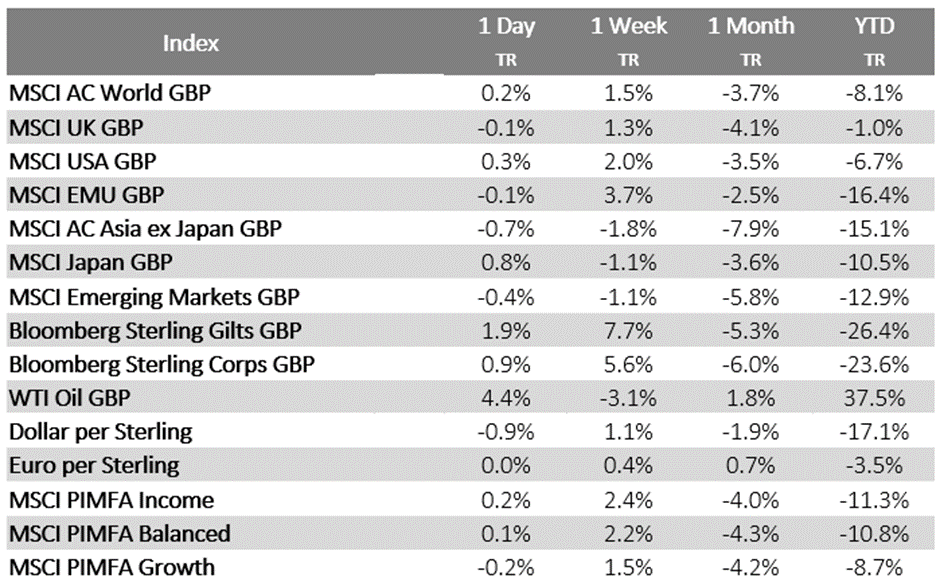
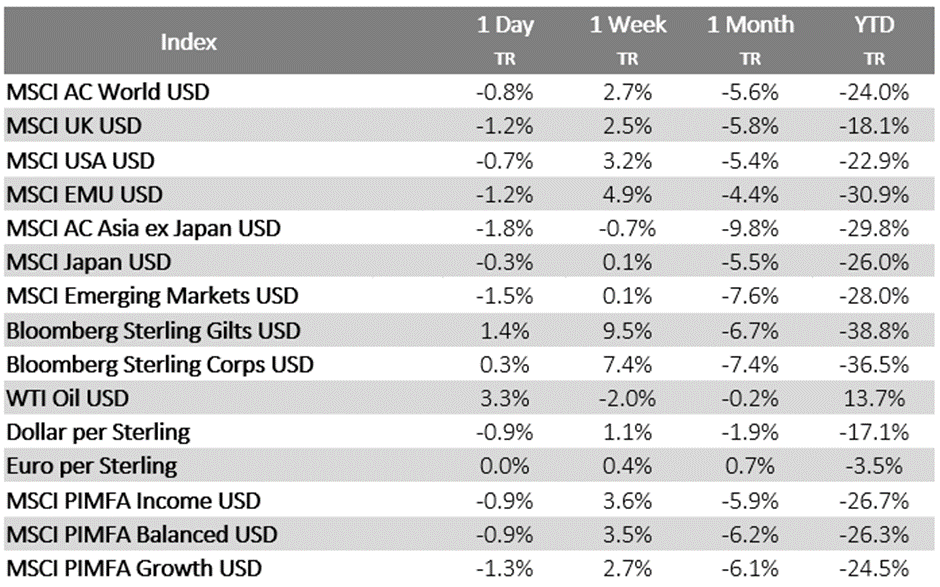
While the UK is dominating the political headlines for now, it is not the only country facing the risk of political upheaval. Over in the US, crucial mid-term elections are due to take place on 8 November (with some states having already started early-voting). According to the latest financial betting odds from PredictIt, Democrats are expected to cede control of the House of Representatives, and lately in recent days, possibly also the Senate, to the Republicans. While the risk of impending political gridlock sounds unwelcome, for markets it can often be a least-worst option –  as it stymies the chance of any more radical political policy ambitions becoming law, and supporting a political status-quo. Simply then, for markets, political risk can become one less thing to worry about.
Please continue to check our Blog content for advice and planning issues and the latest investment, markets and economic updates from leading investment houses.

Carl Mitchell – Dip PFS

Independent Financial Adviser

20/10/2022
Team No Comments

Markets in a Minute – Stocks mixed as mini-budget fallout continues

Please see below article received from Brewin Dolphin yesterday evening, which provides a global market update with reference to economic developments in the UK, US and China.

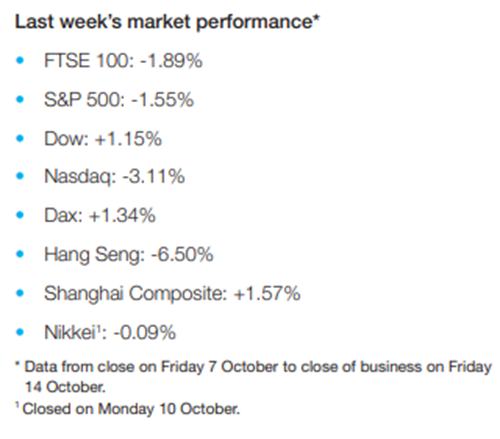
Stock markets were mixed last week as US inflation proved higher than expected and the UK government announced its second major mini-budget U-turn.

The S&P 500 dropped sharply on Thursday morning as the latest US consumer prices data was released, before surging 5.5% in its largest intraday move since March 2020. The index ended the week down 1.6% after data on Friday showed consumer inflation expectations had worsened.

In the UK, the FTSE 100 lost 1.9% and yields on ten-year gilts retreated from near 14-year highs after the government reversed its decision to scrap a planned increase in corporation tax. The Dax gained 1.3%, despite Germany’s economy minister predicting a 0.4% decline in the country’s gross domestic product (GDP) next year.

In China, the Shanghai Composite rose 1.6% after the governor of the People’s Bank of China said the central bank would step up the implementation of prudent monetary policy and provide stronger support for the real economy.

Hunt reverses mini-budget tax cuts

New UK chancellor Jeremy Hunt announced on Monday (17 October) the reversal of almost all the tax-cutting measures contained in last month’s mini-budget. The planned reduction in basic-rate income tax and the reversal of the dividend tax rate hike will no longer go ahead. Plans to freeze alcohol duty, introduce VAT-free shopping for tourists and reverse off-payroll working rules have also been overturned.

The emergency statement came just one working day after UK prime minister Liz Truss announced the departure of former chancellor Kwasi Kwarteng following weeks of market turmoil. Truss also overturned plans to cancel next year’s increase in corporation tax. Together with the decision to scrap proposals to axe additionalrate income tax, the changes are expected to save the Treasury around £32bn a year.

The pound rose, gilt yields fell and the FTSE 100 rose 0.9% on Monday as investors welcomed Hunt’s emergency statement. The positive sentiment continued in Europe and the US, with the pan-European STOXX 600 and S&P 500 climbing 1.8% and 2.7%, respectively.

Investors will now be looking ahead to a big week for US corporate earnings, including from the likes of Netflix, Tesla and IBM.

US inflation remains high

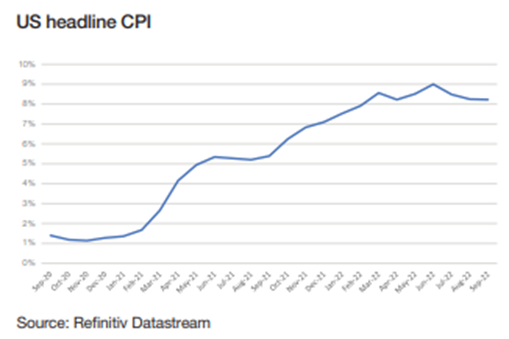
Last week’s US inflation data cemented expectations for another 0.75 percentage point interest rate hike by the Federal Reserve. The headline consumer price index (CPI) rose 8.2% year-on-year in September, only slightly lower than the 8.3% annual rise recorded in August.

More concerning was a 6.6% annual rise in core inflation, which strips out volatile energy and food costs. This was higher than the 6.3% rate in August and the fastest pace in four decades. On a monthly basis, core CPI was up 0.6%. President Joe Biden said Americans were being squeezed by the cost of living and that there was “more work” to do to fight inflation.

The CPI was followed a day later by the University of Michigan’s consumer sentiment index, which showed expectations for price rises over the next 12 months had risen to 5.1% in October from 4.7% in September. Five-year inflation expectations increased to 2.9% after falling to 2.7% the previous month. Consumer sentiment improved modestly, with the index rising to 59.8 from 58.6 in September. The current economic conditions index jumped to 65.3 from 59.7.

UK economy shrinks by 0.3%

The UK’s GDP shrank by 0.3% in August from the previous month, led by a 1.6% decline in manufacturing. GDP also fell by 0.3% over the three months to August, suggesting the 0.1% increase in July reflected a rebound from the Queen’s platinum jubilee celebrations the previous month.

Services fell by 0.1% in August, driven by cuts to health service spending and a 5.0% drop in arts, entertainment and recreation activities. Output in consumer-facing services declined by 1.8% following a 0.7% rise in July, according to the Office for National Statistics.

China’s ‘Golden Week’ hit by Covid curbs

China celebrated a weeklong National Day holiday – known as Golden Week – at the beginning of October. The week is typically a peak period for travel and consumption, but tourism revenue this year was down 26.2% from a year ago and equal to just 44.2% of the revenue in 2019’s Golden Week. Some popular tourism destinations remain subject to strict Covid curbs, resulting in many people choosing to stay close to home.

Authorities in cities such as Beijing and Shanghai tightened restrictions ahead of the Communist Party’s congress, which began on Sunday. The congress will lay out the party’s policy for the next five years. It is expected that president Xi Jinping will win a third term as party general secretary.

Please check in again with us shortly for further relevant content and news.

Chloe

19/10/2022

Team No Comments

Brewin Dolphin: Hunt reverses mini-budget tax cuts

Please see the below article from Brewin Dolphin, which takes a look at the new Chancellors reversal of last month’s ‘mini-budget’ and the impact of this on the market. This was received late Monday afternoon – 17/10/2022.

UK chancellor Jeremy Hunt has announced a reversal of almost  all the tax-cutting measures contained in last month’s mini-budget.  Guy Foster, our Chief Strategist, highlights the key announcements and how markets are responding.

On his first full working day as the new UK chancellor, Jeremy Hunt has overturned nearly all of his predecessor’s tax-cutting proposals. In an emergency statement, Hunt said the government was committed to doing whatever necessary to achieve UK financial stability and put the public finances on a sustainable path.

The statement was not only about further plugging the gap in the government’s fiscal plans, but also restoring the UK’s economic credibility after the turmoil created by September’s mini-budget.

Here, we highlight the main measures and the impact on financial markets.

Key measures

Hunt announced that the planned reduction in basic-rate income tax will no longer go ahead in April. Instead, the rate will remain at 20% “indefinitely” until the economic circumstances allow it to be cut.

The new chancellor also overturned Kwasi Kwarteng’s plan to reverse the 1.25 percentage point rise in the rate of dividend tax. The rate of dividend tax increased in April 2022 to 8.75% for basic-rate taxpayers, 33.75% for higher-rate taxpayers and 39.35% for additional-rate taxpayers1. Today’s announcement means these rates will remain in place rather than fall next year.

Plans to freeze alcohol duty, introduce VAT-free shopping for tourists and reverse off-payroll working rules have also been axed. Together with the corporation tax U-turn and the decision to scrap proposals to axe additional rate income tax, the changes are expected to save the Treasury around £32bn a year2. And while energy support for households will not change between now and April, beyond that it will depend on the outcome of a Treasury-led review rather than stay in place for a further 18 months.

The only tax-cutting measures from the mini-budget that haven’t been axed are those that are already going through parliament – namely, the reform to stamp duty and the reversal of the 1.25 percentage point National Insurance (NI) rate hike. Reforms to stamp duty came into effect on the same day as the mini-budget, and the rate of NI will reduce from 6 November.

How are markets reacting?

Sterling extended its early morning gains against the US dollar and the yield on UK government bonds (gilts) fell following the statement, suggesting financial markets are so far welcoming the changes.

The decline in bond yields means government borrowing is less expensive. The things financial markets worry about the most are the ability of a country to pay interest, the potential for more debt to be issued in the future (which weighs on the price of existing debt) and to maintain the value of its currency. If any of these things are in doubt, financial markets will feel less inclined to hold gilts and less inclined to hold the pound, unless they can be compensated by higher interest rates. Those higher interest rates end up being suffered each time the government issues a new bond and will last for as long as that bond lasts (some bonds borrow money over a few years, whereas others borrow over several decades).

Ultimately, government expenditure must be met from taxes or borrowing. If it is met from borrowing, this debt will have to be repaid and so will the interest on that debt which, in turn, will have to be borrowed or paid from taxation.

If the market starts charging the government more over the coming years, then it will affect interest rates for other kinds of borrowing as well. The most obvious example of this is mortgage rates.

Will borrowing costs fall further?

Borrowing costs for governments rose throughout this year, reflecting the return of inflation and the prospect of higher interest rates to try and bring that inflation down. From the beginning of August onwards, borrowing costs in the UK rose a bit more than in its international peers, which likely reflected anxiety over promises being made to cut taxes and increase spending. These fears were amplified by the mini-budget.

While we have seen some improvement in borrowing costs, there is still further to go. Even accounting for the general increase in global borrowing costs, UK bond yields were still higher than they were in July, when the Conservative Party leadership contest began to narrow. This, however, has been changing fast.

Markets have been highly volatile, but one silver lining has been improved buying opportunities in the UK government bond market. Gilt prices move in the opposite direction to yields, so the recent sharp rise in yields has seen the prices of some longer-dated gilts fall substantially. Gilt prices are expected to stabilise as the market starts to anticipate the onset of a recession, and they could rise if held until redemption.

Inflation-protected (index-linked) bonds, where the redemption amount and the interest rise with inflation, now offer positive returns which are comparable with the rates offered by other savings instruments and they can also be very tax efficient.

Is further volatility on the cards?

The chancellor is due to deliver a medium-term fiscal plan on 31 October. This will contain the government’s fiscal rules and a forecast by the Office for Budget Responsibility. The experience of his predecessor means Hunt will likely be careful not to spook the markets at Halloween.

In the meantime, UK inflation data due out this week will serve as a reminder that not all challenges can be walked away from as the mini-budget has been.

The UK bond market is very responsive to changes in the UK economy, but the equity market is typically more global or even US-centric in nature, so being too absorbed in domestic challenges has never served UK investors well.

Nevertheless, today’s statement has shown how the UK’s institutions will step in when policymaking is shown to be unsustainable. That may offer investors a degree of confidence in what has been a truly tumultuous month for UK financial assets. 

1 https://www.gov.uk/tax-on-dividends

2 https://www.gov.uk/government/news/chancellor-brings-forward-further-medium-term-fiscal-plan-measures

Please continue to check our Blog content for advice and planning issues and the latest investment, markets and economic updates from leading investment houses.

Cyran Dorman

18th October

Team No Comments

Competing policy measures leave markets fearful – Tatton Monday Digest

Please find below, an update on markets received from Tatton, this morning – 17/10/2022

Outlook: Bond markets 1 – UK Government 0

It is seldom that the UK alters the course of global capital markets, particularly given our domestic stock market comprises just 3.1% of global equities and 4.1% of the global government bond market. However, over the course of October, far bigger bond markets – like that of the US and Italy – have experienced significant changes in the wake of events earlier in the day in the UK.

In our view it can all be traced back to a profound misunderstanding of the UK’s relative position in the global competition for capital at just the point when central bank’s decisive anti-inflation measures have re-introduced fragility into capital markets not seen since the 2010-2012 Eurozone crisis. To this end, the US economy has been attracting huge swathes of capital and the US dollar has motored ahead, with interest rates and bond yields rising in parallel to expanding economic activity. In particular, the sharp rise in yields on US inflation-linked bonds has been at the heart of the stresses in the global economy. With the rest of the world facing massive competition for capital, it was unwise for the UK government to make a grab for more at a point when the costs have been made almost unbearable. To blame circumstances now suggests Liz Truss et al. were unaware of the situation when devising the policies. It’s no wonder the Chancellor is now a different person. Indeed, global markets have been cheered by signs the UK is unwinding its recent pronouncements. Should it reverse the bulk of policies that capital markets balked at as fiscally irresponsible, then rates and yields may still revert to the trajectory they were on before September’s fateful fiscal event. Whether they can do so fully will largely depend on how much of the reputational trust in UK institutions lost by international investors can be regained.

From the global perspective, beyond the UK’s domestic woes, the October 2022 UK bond market crisis will be remembered as the moment when central banks around the world were forced to grapple with something they have been denying for many months. Namely that their formidable efforts in forcing the inflation genie back into the bottle have unveiled fragilities in the global financial markets that may now hamper their ability to follow through with their inflation fighting strategy. The dependencies on ultra-low interest rates they had allowed to build up since the Global Financial Crisis mean that the risk that something, somewhere, in the global financial ecosystem would break – or at least seriously buckle – has now become all too apparent.

Will UK property downturn change the investment landscape?

In the wake of Kwasi Kwarteng’s ill-received fiscal event, lenders pulled swathes of mortgage products in expectation of sharply higher interest rates from the Bank of England (BoE). The potential effects on consumers and households were well-publicised – but as well as households, damage has also been done to equity markets – particularly to property funds and house builders. Both have fared substantially worse than the broader market throughout the year, and the latest drama precipitated another swipe down. The building sector has nearly halved in value since January, while real estate investment trusts (REITs) have lost around 40%.

Clearly, these problems precede the fiscal fallout – though it undoubtedly made the situation considerably worse. Both sectors fared well throughout the pandemic, buoyed by an increase in consumer savings and property deals. But the sharp contraction of monetary policy since the beginning of the year has made conditions extremely difficult.

With the UK probably already in recession, commercial property is one of the most vulnerable sectors. This would be the case even without the supply-side inflation pressures and fiscal imprudence, since house building and purchasing are extremely cyclical. We are also seeing this stress spread to banks with large property-related loans on their balance sheets – many of which have seen their share prices come under pressure. It seems that, having (somewhat) stabilised the pension fund problem in recent weeks, property is the new site of financial and economic instability.

Unfortunately for many property companies, there is little they can do about the situation. Balance sheet management has improved vastly in recent years, and property funds have made themselves much more resilient. But with the tide turning against them, some will probably fail – barring a shock turnaround in the underlying trends. However, improved balance sheets mean many of the larger players -particularly those unrelated to danger areas like inner city office space – will be able to weather the storm. When they come out the other side, they will find a significantly cheaper market ripe for plundering.

Headaches all round after the UK’s Gilt trip

The BoE’s emergency intervention three weeks ago was vital in stopping the gilt market bleed. But last week, Governor Andrew Bailey was keen to remind everyone that what the Old Lady giveth, she can taketh away. He responded to extension requests on the BoE’s bond-buying programme by firmly telling UK pension funds “you’ve got three days left”. Before giving way to optimism over the UK government’s latest U-turn, fear spread that pension funds would once again come under extreme pressure, with volatility pushing up collateral demands and making them forced sellers once more. The downturn was not limited to the UK either: US stocks fell sharply with investors concerned about global financial contagion. Bailey’s deadline was treated as an “all-time central bank gaffe” in some quarters, and sterling dropped hard and fast immediately after his comments.

But the BoE chief is in an unenviable position. His team is tasked with taming runaway inflation while avoiding a financial crisis triggered by government action that markets deemed fiscally profligate and irresponsible. In the current environment, these goals pull in opposite directions. Exceptionally high inflation requires exceptional monetary tightening, while the threat of pension fund collapse requires liquidity injections. Setting a timeline on these injections threatens to create a cliff-edge scenario, but open-ended purchases would undermine any monetary tightening done elsewhere. The BoE line was always that bond purchases were an emergency provision and would be dialled down when the immediate threat was gone.

We have grown used to near or below-zero real yields in the last decade and a half. But with the world in a sharp supply shortage (now mainly labour and fossil fuels), it is reasonable to think yields must move higher over the long-term to re-establish the balance between supply and demand. Currently, RPI-linked ten-year gilts yield 0.75% (above retail inflation). Runaway inflation necessitates some compression of activity from the BoE, meaning these real yield levels look justified. In fact, these yields arguably look attractive to global investors. That might seem bizarre, given BoE intervention seems to be the only thing keeping gilt markets intact. But the sharp sell-off had more to do with pension fund ‘fire sales’ because of a structural weak link in UK pension regulation, rather than underlying fundamentals.

The recent mayhem has caused many commentators to liken the UK to an emerging market, with fiscal imprudence and policy divergence from its central bank. But Britain is not an emerging market – it has highly functional financial and corporate structures and a highly skilled workforce. Recent bond movements bely this, but arguably suggests there are now bargains to be had. This is not to say we expect a sharp rebound (and thereby fall back in yields) – there are far too many intractable short-term problems for that – but there could be healthy returns in the future and, for the time being, yield-based return contributions we have not seen in over a decade.

Please continue to check our Blog content for advice and planning issues and the latest investment, markets and economic updates from leading investment houses.

David Purcell

17th October 2022

Team No Comments

Brewin Dolphin: Truss Confirms Corporation Tax U-Turn

Please see the below article from Brewin Dolphin, highlighting the economic impact of the government U-turn on freezing corporation tax, and the effect this is having on markets. Received late Friday afternoon – 14/10/2022.

Prime minister Liz Truss has reversed the decision to scrap the planned rise in corporation tax. Guy Foster, our Chief Strategist, discusses the impact this could have on financial markets.

Prime minister Liz Truss has announced a second major mini-budget U-turn and the departure of chancellor Kwasi Kwarteng following weeks of market and economic turmoil.

Plans to scrap next year’s increase in corporation tax will no longer go ahead and the role of chancellor has now been filled by former health secretary Jeremy Hunt. Chris Philp is no longer chief secretary to the Treasury and has been replaced by Edward Argar, former paymaster general.

Background

Today’s statement comes after the mini-budget on 23 September resulted in a steep decline in UK government bonds (gilts) and the pound, widespread stock market volatility, and lenders pulling mortgage deals from the market. The mini-budget included a much bigger package of tax cuts than had been expected, raising concerns about a surge in government borrowing and more aggressive interest rate hikes. According to the Institute for Fiscal Studies (IFS), the tax cuts would have cost the Treasury almost £45bn a year1 , contributing towards an £80bn increase in borrowing by 2026/27.

One of the biggest measures in the mini-budget was scrapping the planned increase in corporation tax from 19% to 25%. Today’s U-turn means the increase will now go ahead in April 2023, saving the government around £18bn a year, Truss said.

The government had already announced on 3 October that it was scrapping plans to axe additional-rate income tax. Removing the 45% tax rate would have cost about £2bn a year according to the government, or £6bn a year according to IFS estimates.

How are markets reacting?

Bond and share prices rose ahead of Truss’s statement as speculation about the corporation tax U-turn mounted. There were large swings in the value of the pound as traders digested the sacking and replacement of the UK chancellor.

The market’s reaction was somewhat tempered by the fact that a tax cut U-turn had been widely anticipated. Borrowing costs have, however, fallen this week as speculation continued to mount.

Today’s stock market rally came in the context of markets which were higher globally as the news was announced. This largely reflected a strong performance on Wall Street following the latest US inflation figures. Speculation about the return of the corporation tax hike did cause some volatility among companies with particularly significant UK operations, such as banks, housebuilders and some retailers, who are now facing higher tax bills.

What is the longer-term outlook?

Speculation about the U-turn had already seen UK borrowing costs fall and the new chancellor will be aware of the need to emphasise fiscal sustainability as many of his predecessors were too. It would not be surprising to see the return of self-imposed fiscal rules, which serve as guard rails to keep policy on track, and which give investors a sense of how policy will develop. These form part of the economic orthodoxy that had been shunned by this government, despite being seen as an essential policy signal by previous governments.

The latest period of turbulence could worry investors that one benign economic strategy can quickly be replaced by another they find more alarming. However, it should also reassure them that it demonstrates how the government of the day is accountable to its party, the electorate, and the Office for Budget Responsibility. An independent Bank of England will support the financial system without interfering with policy. And these institutional protections mean that change can be forced to retain the confidence of the markets. That is not true of all countries and should enable the UK to quickly regain investors’ confidence.

This is a turbulent time for the government, and we expect further changes to be announced today by our new chancellor.

Please continue to check our Blog content for advice and planning issues and the latest investment, markets and economic updates from leading investment houses.

Alex Kitteringham

17th October

Team No Comments

Brooks Macdonald – Daily Investment Bulletin

Please see today’s Daily Investment Bulletin from Brooks Macdonald received this morning:

What has happened

Markets endured another day of extreme volatility yesterday with US equities trading at one point c. -2.5% before rallying to close over 2.5% higher on the day. The cause of the volatility was of course the CPI print although it is difficult to decipher what catalysed the late market rally other than perhaps a feeling that the CPI beat ‘could have been worse’.

UK

While the attention was firmly on the US yesterday, UK assets rallied yesterday on speculation that the Truss government could reverse some of the unfunded tax cuts announced in the ‘mini-budget.’ Sterling was a particular beneficiary of reports suggesting a U-turn on corporation tax rates may be on the cards. Adding further weight to speculation was the premature exit of Chancellor Kwarteng from the IMF conference in Washington, with sources suggesting he was returning to the UK to brief MPs on proposed changes. Yesterday saw sterling rally by over 2% against the US dollar, the largest gain since March of 2020. Gilt yields also fell as bond markets priced in reduced gilt supply from a less expansionary set of fiscal policies.

US CPI Report

There was little good news for the markets within the US CPI report with headline CPI coming in above expectations, at 0.4% month-on-month. Whilst the year-on-year measure ticked down, it fell by less than the market had hoped, now standing at 8.2%. Core CPI, the more important measure to gauge the transmission of inflation throughout the economy, rose by 0.6% month-on-month compared to expectations of 0.4%. In terms of the drivers of the inflationary pressure, these were broad-based, suggesting that the Federal Reserve will be emboldened to continue their rate hiking cycle apace. Markets have fully priced in a 75bp rate hike in November and have ratcheted up the probability of a further 75bp move in December of this year. With this repricing, Treasury yields rose yesterday, and equity markets sold off sharply before climbing into the end of the day.

What does Brooks Macdonald think

There has been much speculation over the cause of the late rally in US equities given the CPI report showed more inflationary pressures than the market had expected. With equity positioning being at extremely bearish levels coming into the data release, the simplest explanation may be that many in the market had a sense of relief that headline year-on-year continues to fall, even if it continues to remain stickier than economists had hoped.

Please continue to check our Blog content for advice and planning issues and the latest investment, markets and economic updates from leading investment houses.

Carl Mitchell – Dip PFS

14/10/2022

Team No Comments

Waverton Update – Light at the end of the tunnel

Please see the below update from the fund managers at Waverton Investment Management regarding the current market activity.

Headlines in the last few weeks have been very worrying for investors. After a bad start to the year, the new Chancellor’s ‘mini-budget’ didn’t have the desired effect and has subsequently brought the topic of financial instability back into the news. But despite, or perhaps because of, the weakness in markets, there are now some great opportunities available to investors across asset classes.

At Waverton, we are watching the economic and financial developments carefully and, as active investors who are predominantly directly invested in the underlying assets, we are well positioned to adjust our holdings as and when we see fit. We have a fundamental understanding of the risks that we have chosen to take with our investments and feel that we are well placed for the coming months and years. We have a tried and tested investment process which we have confidence in.

It is important to note that as global investors we are not overly exposed to any one regional risk, we are far less invested in the UK than many of our peers for example, and while currency moves introduce a degree of uncertainty in international investments, the falling value of sterling has actually increased the value of some of our foreign assets. We are also able to hedge currency risk if we wish, something that we have recently done in some of our funds – locking in some of the returns that we earned from the move in the value of the pound.

We are, as always, wary of any macroeconomic risks that may exist, but are not yet convinced that a recession is inevitable, at least in the US where there is still a degree of economic momentum, and, for now, conversations between Waverton’s analysts and the management teams of various companies suggests that there is a degree of resilience to corporate profits. Valuation is one (very important) aspect of our equity investment process, and the fall in equity markets this year means that we are still able to find companies that we believe are both attractively valued and fulfil our other selection criteria. One example is Netflix, which we previously avoided due to elevated content costs as it built its own library, significant competition from legacy media companies, and a premium valuation. Now, the price has fallen to a level which mitigates these risks and creates potential upside from a transition to an advertising supported subscription service. Given this, we believe it to be a good addition to some of our portfolios.

Within the Sterling Bond Fund, the historic fall in prices has meant that our Fixed Income team are now more bullish on bonds than they have been in a decade. At one end of the scale there are some great yields available on short-dated bonds, such as a Thames Water bond, that matures in seven months and offers an annualised yield-to-maturity of 6%. We are however being very selective with any credit that we buy. Government bonds are now offering better yields than they have for years – you can now earn 5% nominal yield, or 2% real – and are still likely to offer protection to a portfolio if there is a major shock to equity markets, particularly the longer-dated bonds.

A textbook 60:40 portfolio has had its worst start to a year since World War Two, as both equity and bond markets have suffered. This has served to highlight the importance of diversification within a portfolio. Waverton’s two alternatives’ funds – the Real Assets Fund and the Absolute Return Fund – have provided this diversification and, in aggregate, have out-performed traditional asset classes this year.

Frustratingly, some sub-sectors of these strategies have also seen very poor performance so far this year, but in the wake of these revaluations there are some potentially great opportunities – the UK REIT market now trades close to its all-time discount to NAV and in all prior periods when discounts have been over 20% to NAV forward looking returns on a one, two and three year basis have been sharply higher.

Not only do alternative assets provide diversification within a portfolio, but some are well positioned to perform in the current environment of higher inflation and rising interest rates. Many have inflation-linked incomes while some, such as commodities, look to hold their value in real terms and benefit from changes in demand from infrastructure and technology. There are also sophisticated products that we are able to invest in that actively benefit from the rising rates.

We believe that our active, global, diversified and direct style of investment means that we are well positioned, and that even if we do see a material economic slowdown, we maintain good exposure to downside protection vehicles that will help to preserve capital for our clients.

Please continue to check our Blog content for advice and planning issues and the latest investment, markets and economic updates from leading investment houses.

Andrew Lloyd DipPFS

13/10/2022

Team No Comments

Stocks break three-week losing streak

Please see below ‘Markets in a Minute’ article received from Brewin Dolphin yesterday afternoon, which provides a global update on markets.

Most major stock markets rose last week as softer-than[1]expected US economic data raised hopes the Federal Reserve might slow its pace of interest rate hikes.

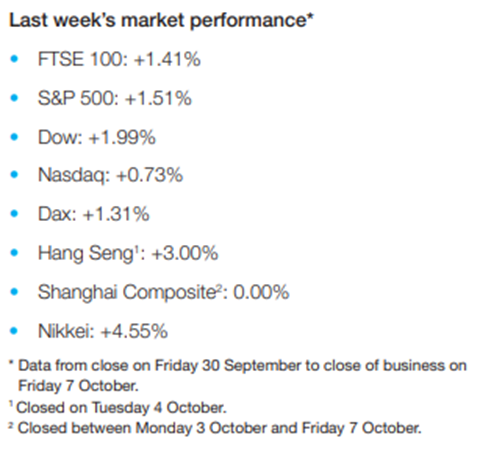
These hopes were quashed towards the end of the week as signs of labour market strength and a cut to oil production led to renewed inflation fears. After jumping 5.6% on Monday and Tuesday, its biggest two-day gain since 2020, the S&P 500 finished the week up 1.5%. The Dow and Nasdaq added 2.0% and 0.7%, respectively.

UK and European shares also rose, despite a jump in eurozone producer prices and signs of a deepening economic slowdown in Germany. The FTSE 100 gained 1.4% and Germany’s Dax rose 1.3%.

In Asia, Japan’s Nikkei surged 4.6%, although sentiment soured towards the end of the week following hawkish comments from US Federal Reserve officials. China’s stock markets were shut all week for the National Day / Golden Week holiday.

BoE doubles size of bond-buying programme

The Bank of England (BoE) announced on Monday (10 October) that it had doubled the size of its temporary bond-buying programme, which it introduced following the market turmoil created by the government’s mini[1]budget announcements.

The BoE doubled the size of daily auctions to a maximum of £10bn from £5bn previously, in an effort to “support an orderly end” of the scheme, which is due to conclude on 14 October. Chancellor Kwasi Kwarteng also confirmed yesterday that his medium-term fiscal plan would be brought forward from 23 November to 31 October.

The FTSE 100 slipped 0.5% on Monday as Russian attacks on the Ukrainian capital of Kyiv sparked concerns the war could escalate further. Wall Street stocks also declined after JPMorgan chief executive Jamie Dimon warned of a US recession in six to nine months. The downbeat mood continued into Tuesday, with the FTSE 100 down 0.8% at the start of trading.

US labour market remains strong

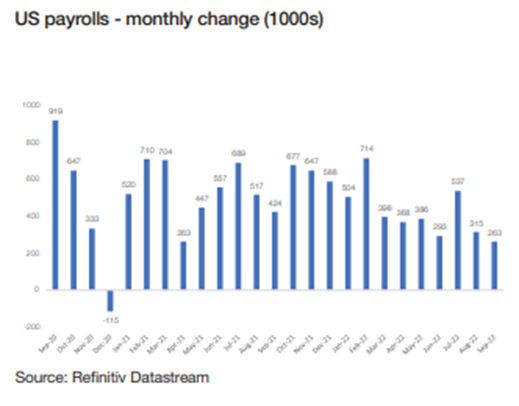
The release of the closely watched US nonfarm payrolls report last Friday cemented expectations that the Federal Reserve will increase interest rates by another 0.75 percentage points at its next meeting in November. Although the pace of jobs growth cooled in September, the unemployment rate unexpectedly dropped.

According to the Department of Labor, the US economy added 263,000 jobs in September. This was below than the 315,000 positions created in August, but was higher than forecasts for 250,000 new jobs.

The unemployment rate edged down to 3.5% from 3.7% the previous month, while the participation rate – the percentage of people working or actively looking for work – slipped to 62.3% from 62.4%, suggesting competition for workers is likely to remain high. Average hourly earnings increased by 0.3% month-on-month, but the annualised rise slowed slightly to 5.0% from 5.2% in August.

US services activity slows slightly

Economic activity in the US services sector slowed slightly in September, according to the Institute for Supply Management’s (ISM) purchasing managers’ index (PMI). The index measured 56.7 in September, which was 0.2 points lower than August’s reading of 56.9. The new orders index slipped to 60.6 from 61.8, while a gauge of prices paid by services industries for inputs dropped to 68.7, the lowest since January 2021.

It came after separate data from ISM showed US manufacturing activity grew at its slowest pace in nearly two-and-a-half years in September. The manufacturing PMI dropped to 50.9, reflecting “companies adjusting to potential future lower demand”, ISM said. A measure of prices paid by manufacturers dropped to 51.7, the lowest reading since June 2020, largely due to falling commodity prices.

Eurozone producer prices jump

Whereas US economic data showed some signs of easing inflationary pressures, the opposite was true in the eurozone. According to Eurostat, factory gate prices in August rose by 5.0% month-on-month and by 43.3% year-on-year, driven by increasing energy costs. Meanwhile, S&P Global’s eurozone composite PMI showed cost pressures intensified in September for the first time since March, again reflecting sharply rising energy costs as well as higher wages.

S&P Global said output in both the manufacturing and service sectors fell at a quicker rate in September as high inflation, soaring energy costs, rising economic uncertainty and weakening demand drove the euro area economy into a deeper contraction. Total new orders fell at the fastest rate in almost two years, while a considerable drop was seen in export sales.

German economic data worsens

In Germany, there were further signs the country could be heading for a recession. Retail sales fell by 1.3% in August from the previous month, worse than the 1.1% dip forecast by analysts in a Reuters poll. Meanwhile, import prices in August were 162.4% higher than a year ago, and industrial output declined 0.8% month-on[1]month, the sharpest fall since March. The German economy is expected to slide into a recession next year, according to reports by Reuters. Sources told the newswire that the government had cut its growth forecasts to 1.4% for 2022 and -0.4% for 2023, down from 2.2% and 2.5% previously. Official figures are due to be published on Wednesday.

Please check in again with us shortly for further relevant content and news.

Chloe

12/10/2022

Team No Comments

Weekly market commentary: Equities post reasonable gains despite volatility

Please find below, an update on markets from Brooks Macdonald, received yesterday afternoon – 10/10/2022

  • Equities soared early last week before being given a quick rebuke by central bank speakers
  • Last Friday’s employment report showed a strong labour market but declining participation
  • Thursday’s CPI release will be vital for the direction of equities and bonds over the coming weeks.

Equities soared early last week before being given a quick rebuke by central bank speakers

This week is expected to start in a quieter fashion after the volatility of last week. The US bond market is closed for Columbus Day, but equity markets remain open. The start of last week saw a rekindling of hope that the Federal Reserve (Fed) may pivot towards a more accommodative stance but by the end of the week central bank speakers convinced the market that it had been too eager to price in a change of policy. Overall equities posted reasonable gains over the course of the week however volatility remains a more consistent theme than direction.

Last Friday’s employment report showed a strong labour market but declining participation

The US employment report on Friday catalysed the latest leg lower for equities with the total number of new jobs coming broadly in line with consensus at 263,000 (255,000 consensus). The August dataset showed the labour force participation rate increase, a sign that employment conditions may have been tempting workers back into the workforce. The reading for September however, saw a reversal of some of those gains with the participation rate declining from 62.4% to 62.3%. News that jobs growth was stronger than expected but labour supply side issues remain was enough to drive equities sharply lower on the day.

Thursday’s CPI release will be vital for the direction of equities and bonds over the coming weeks

This week’s major market event will be the US Consumer Price Index (CPI) release on Thursday. The higher-than-expected US CPI release last month started a broad sell-off amongst equities and bonds. The market is expecting the CPI report for September to show Core (excluding energy and food) CPI to rise by 0.5% month-on-month and for that to lead the year-on-year rate to 6.5%  (compared to 6.3% for August). With US energy prices continuing to fall, headline CPI is expected to fall from 8.3% year-on-year to 8.1%.

Relatively few economists are expecting US CPI readings to rise dramatically from current levels, but there is still division as to whether inflation remains sticky, and will therefore plateau at an elevated level, or will begin to fall. Markets latched onto a new narrative around an accommodative Fed at the start of last week with little catalyst, we should therefore expect markets to overinterpret this week’s CPI release and extrapolate any upside or downside reading into the future. It is difficult to overstate the importance of Thursday’s US CPI release to market direction.

Please continue to check our Blog content for advice and planning issues and the latest investment, markets and economic updates from leading investment houses.

David Purcell

11th October 2022

Team No Comments

Tatton Investment Management – Monday Digest: Reading the runes of October’s market bounce

Please see the below article from Tatton Investment Management, looking at the recent volatility in the market, and the performance of sterling. Received this morning – 10/10/2022.

Outlook: Reading the runes of October’s market bounce
As last week reminded us, volatile markets do not always swipe down, nor do they stay volatile forever. Monday and Tuesday saw a formidable ‘relief’ rally in global equities. Indeed, on Tuesday, US stocks recorded their biggest daily gain since 2020, leaving the S&P 500 up 5% by midweek. Stocks slid back toward the end of the week, but not by the same margin. Nor did they collapse after disappointing news of OPEC+ oil supply cuts. Indeed, the week felt like a microcosm of how the year has gone so far: down-trending capital markets ricocheting between recessionary fear and bear market rallies when hope takes hold that inflation is turning over.

There is much debate about whether a strong dollar causes weaker global growth, or is merely a sign of weak growth beyond the shores of the US economy. Historically, a strong dollar has coincided with weaker global trade, and while the rest of the world languishes, the US Federal Reserve (Fed)’s focus solely on domestic inflation pressures does very little to help the global economy. Last week’s comments from former Fed Chair Janet Yellen that talked of “global repercussions” to the Fed’s policies suggest the US is not totally unaware of its impact on international financial conditions.

Back to last week’s market action, the early-week positivity came perversely from news of weaker US employment data. US job openings fell by more than one million in August, the largest fall since the start of the pandemic. But, with the Fed still intent on crushing inflationary pressure by cooling wages, the bad news is good news as far as investors are concerned. The hope is that rising unemployment will give the Fed license to ease its grip, bringing the fabled ‘peak interest rates’ forward and setting the stage for looser financial conditions next year, as the Fed pivots away from raising rates further. 

Another oil shock in the pipeline?
On Wednesday, OPEC+ countries – led by Russia and Saudi Arabia – agreed to cut output targets by two million barrels per day from November. That represents about 2% of global oil production and, coming in the middle of rapid inflation across the western world, parallels have been drawn to the devastating oil shocks of the 1970s. As well as raising oil prices, Wednesday’s announcement knocked equity markets down on the fear of higher fuel costs, inflation, and lower growth. But the two million barrels per day cut applies to previously agreed targets, rather than actual pumping volumes. Given the gap between what most countries can produce and what they are allowed to, the hit to supplies will be considerably less. 

Crude prices above $100 per barrel would certainly bring unwanted inflationary pressure, but the likely increase is not so huge as to destabilise the world economy. Moreover, Saudi Arabia’s willingness to stick by Russia puts it on a political collision course with the US. We have already seen tensions between the Biden administration and the Kingdom’s Crown Prince, and further escalation could bring damaging uncertainties. One of the reasons for this is that the US arguably has the most to lose from higher oil prices. While Europe has struggled with natural gas supplies, its economy is much less sensitive to oil and refined fuel prices than the US, despite the latter’s access to shale production. American shale producers do not have the capacity to make up for global shortfalls or price jumps, particularly in light of President Biden’s shift towards renewable energy.

We don’t believe this drop in output is at the level of an oil price ‘shock’, but it could bring unwelcome volatility all the same. For now, it seems the US market is the main victim – not so good for global growth if it leads to a yet more hawkish Fed. However, the track of European natural gas prices remains the world’s most important energy price.

Europe’s fiscal in-fighting is just getting started
As for the UK, last week offered some respite – though not much. Gilt yields dropped back below 4% (they had touched 5% before the Bank of England (BoE) intervention the previous week) in tandem with the early-week equity rally. Sterling also recovered, reaching the $1.14 level it held before Chancellor Kwasi Kwarteng’s not-so-mini budget two weeks ago. Midweek jitters reversed these trends though, with yields rising and sterling falling into the weekend. Thankfully, these falls were not as severe as the chaos wrought in the last fortnight. 

Across the Channel, the European press pulled no punches when reporting on the UK drama. And for a group of countries where balancing the books is sacrosanct, such criticism made sense. Budgetary rules have been at the heart of European Union (EU) policies since the global financial crisis and Eurozone crisis, with some nations – such as Greece and Ireland – forced into stringent bailout programms. But if European leaders are concerned about loosening the public purse-strings at a time of rapid inflation, they can look no further than the continent’s largest economy. Just after the UK’s fiscal event fiasco, Germany announced a €200 billion ‘protective shield’ to help businesses and consumers cope with soaring energy costs this winter. The plan, much like Britain’s, will be funded by new borrowing and includes an emergency cap on gas and electricity prices. 

While Britain’s not-so-mini budget clearly put it well in front in terms of energy pricing spending commitments as a share of GDP, Germany’s latest spending programme – fiercely criticised by politicians across the Eurozone – leaves it not that far behind. More importantly, government commitments are high across all of the EU’s major economies (though not as high as the UK and Germany). These include fiscal commitments at or above 3% in France, Italy, and Spain – none of which enjoy Germany’s reputation for balanced budgets.

Within the European Central Bank (ECB), policymakers are already in the process of tightening monetary policy, and energy pressures in the winter will give the motivation to raise interest rates more severely. This is sure to make financing harder for European governments – at the exact moment, some are relaxing their debt constraints. With the EU’s fiscal star pupil Germany now loosening its grip on public finances, the temptation may be there for others to adopt similar tactics. Not only the ECB will be vigilant, but the bond vigilantes are likely to stand ready also.

Please continue to check our Blog content for advice and planning issues and the latest investment, markets and economic updates from leading investment houses.

Cyran Dorman

Trainee Paraplanner

10/10/2022