Team No Comments

Brooks Macdonald Daily Investment Bulletin

Please see below article received from Brooks Macdonald this morning, which provides a market update and reflects on global economic developments.

What has happened

Despite some initial optimism after the release of the Federal Reserve statement, Fed Chair Powell’s press conference lead to concern that the Fed’s terminal rate could be higher than previously guided and that rates may stay at that level for some time. Against this backdrop equities and bonds both repriced in US trading with the US dollar seeing a fresh bout of strength.

Bank of England

Before we turn to the Fed, today’s Bank of England meeting will be the next milestone for central bank watchers to ponder. The Bank of England has seen a remarkable turn of events since its last meeting in September which has seen the mini-budget, quantitative easing, policy reversal and a change in Prime Minister. The net effect of all of this is that, despite a very volatile round trip, markets still expect the Bank to raise interest rates by 75bps at this meeting. In some ways the central bank is flying blind yet again, as the November Autumn Statement by the government may have very different inflationary impacts depending on how the government chooses to fill the fiscal hole. Despite the political backdrop being far more stable than a month ago, the UK still has a significant inflation problem and that will need to be addressed by the Bank today.

Federal Reserve

The market initially rallied after the Fed raised interest rates by 75bps and inserted the following in the statement, saying that the ‘Committee will take into account the cumulative tightening of monetary policy, the lags with which monetary policy affects economic activity and inflation’. The bond market interpreted this as a dovish pivot and a sign that the pace of interest rate hikes would slow. Powell was at pains to stress during his press conference that whilst the pace of hikes may slow, the terminal rate may need to be higher than the Fed had guided in September and policy may need to stay in restrictive territory for some time to keep inflation under control.

What does Brooks Macdonald think

Powell was consistent in stressing that the rises of under-tightening were greater than over-tightening, continuing to stress the Fed’s role in quashing inflation. There was very little new news in Powell’s statement, but his words pushed back against the market’s, perhaps naïve, belief that the Fed would pivot quickly from rapid tightening to rapid loosening. Now markets are beginning to price in interest rates plateauing at the terminal rate for several meetings, bond yields need to readjust.

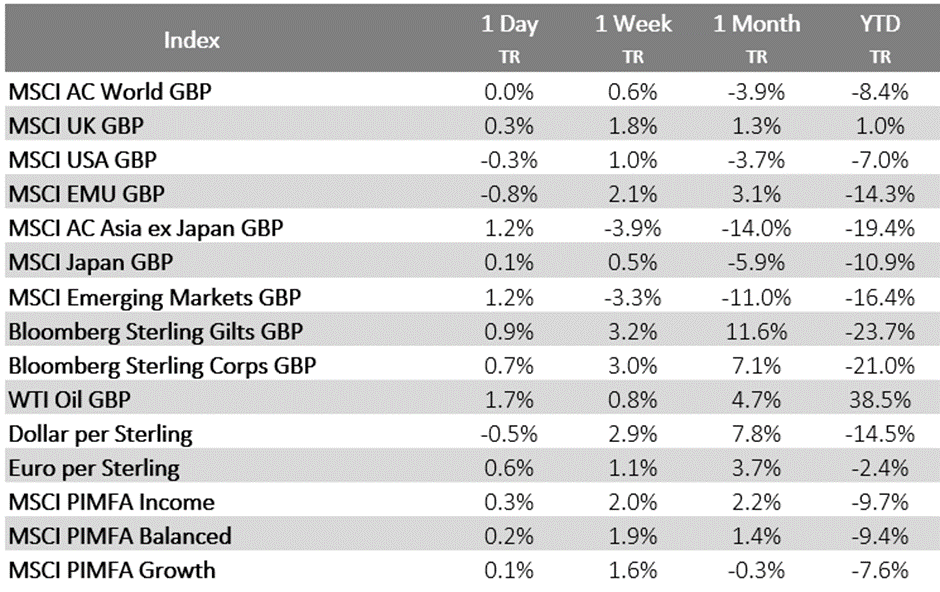
Index 1 Day1 Week1 MonthYTD
 TRTRTRTR
MSCI AC World GBP -1.5%0.2%1.4%-8.3%
MSCI UK GBP -0.6%1.3%3.5%2.1%
MSCI USA GBP -2.5%-0.7%1.6%-7.4%
MSCI EMU GBP -0.7%-0.8%5.6%-14.2%
MSCI AC Asia ex Japan GBP 1.0%4.0%-5.6%-17.2%
MSCI Japan GBP 0.9%2.2%1.6%-9.1%
MSCI Emerging Markets GBP 0.7%3.7%-3.2%-14.3%
Bloomberg Sterling Gilts GBP 0.1%1.5%4.2%-23.3%
Bloomberg Sterling Corps GBP 0.3%1.5%5.3%-20.4%
WTI Oil GBP 2.0%3.6%9.8%41.2%
Dollar per Sterling -0.1%-1.2%2.7%-15.2%
Euro per Sterling -0.1%0.7%1.9%-2.4%
MSCI PIMFA Income -0.6%0.8%3.3%-9.2%
MSCI PIMFA Balanced -0.8%0.7%3.0%-8.9%
MSCI PIMFA Growth -1.0%0.6%2.8%-7.1%
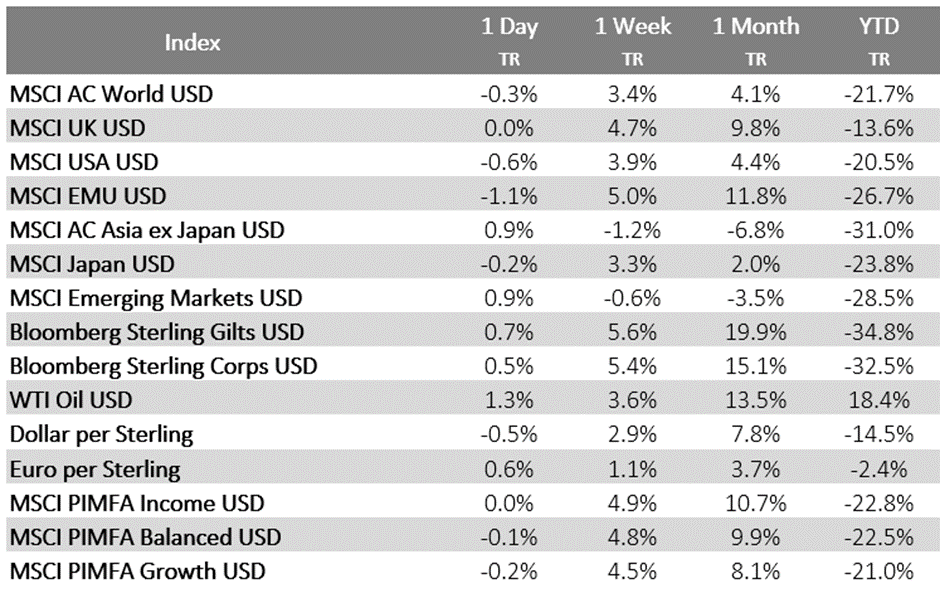
Index 1 Day1 Week1 MonthYTD
 TRTRTRTR
MSCI AC World USD -1.6%-1.0%4.6%-22.2%
MSCI UK USD -0.7%0.1%6.7%-13.5%
MSCI USA USD -2.6%-1.9%4.7%-21.5%
MSCI EMU USD -0.8%-1.9%8.9%-27.3%
MSCI AC Asia ex Japan USD 0.9%2.7%-2.7%-29.8%
MSCI Japan USD 0.8%1.0%4.7%-22.9%
MSCI Emerging Markets USD 0.6%2.5%-0.3%-27.3%
Bloomberg Sterling Gilts USD 0.1%0.3%7.0%-35.1%
Bloomberg Sterling Corps USD 0.3%0.2%8.2%-32.7%
WTI Oil USD 1.8%2.4%13.2%19.7%
Dollar per Sterling -0.1%-1.2%2.7%-15.2%
Euro per Sterling -0.1%0.7%1.9%-2.4%
MSCI PIMFA Income USD -0.7%-0.4%6.4%-23.1%
MSCI PIMFA Balanced USD -0.9%-0.5%6.2%-22.8%
MSCI PIMFA Growth USD -1.1%-0.6%5.9%-21.2%

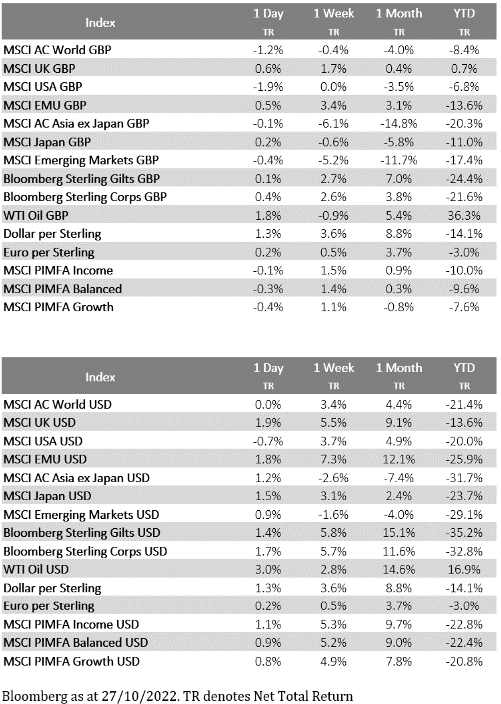
Bloomberg as at 03/11/2022. TR denotes Net Total Return

Please check in again with us soon for further relevant content and news.

Chloe

03/11/2022
Team No Comments

Brewin Dolphin: Hopes rise of more moderate rate hikes

Please see below, an article from Brewin Dolphin regarding global trends in interest rates and their current and potential impact on economic growth and the markets. Received late yesterday afternoon – 01/11/2022. 

Hopes rise of more moderate rate hikes

North American and European markets rose last week amid prospects that interest rate rises to tackle inflation may not be as steep as previously predicted, but a different story emerged from Asia.

Reports that the Fed may moderate its rate rises buoyed US markets, with some encouragement north of the border from Canada. The Bank of Canada increased its rates by a less-than-expected 50 basis points to 3.75%.

This was seen as a sign that central banks are stepping back from overly aggressive rate rises, increasing expectations that the Fed would follow suit or at least signal a slowdown when it meets this week. Markets are predicting a 75 basis points rise.

In the UK, gilt markets and Sterling reacted positively to the appointment of Rishi Sunak as prime minister and the FTSE 100 broke back through the 7,000 barrier, ending the week up 1.12% at 7,047.67.

Even the STOXX Europe 600 seems to have got a Sunak boost, rising 3.65% last week.

In contrast, Asian markets have lagged over the week, both in terms of performance and monetary policy.

Last week’s market performance*

• FTSE 100: 1.12%

• S&P 500: 3.95%

• Dow: 5.72%

• NASDAQ: 2.24%

• Dax: 4.03%

• Hang Seng: -8.32%

• Shanghai Composite: -4.05%

• Nikkei 225: 0.80%

• STOXX Europe: 3.65%

US markets rise off back of mixed data

US consumer confidence in the country dipped during October to 102.5, from 107.8 in September after two months of gains. Jobless claims rose from 214,000 to 217,000 while pending home sales of single-family homes plunged by more than 10% in September and mortgage rates rose to a two-decade high of 7.16%.

On the positive side, US GDP rose 2.6% annually during the third quarter, ahead of expectations for a 2.4% increase. It was the first boost to GDP for six months.

However, durable goods orders – seen as a proxy for investment activity – contracted in September and the latest US purchasing managers’ index (PMI) points to weaker private sector demand.

US markets lifted off the back of the mixed data. The S&P 500 ended the week up 3.95% and the Dow Jones was up 5.72%. Meanwhile, the Nasdaq managed to overcome poor technology earnings to finish last week up 2.24%.

Alphabet and Microsoft reported lower than expected third-quarter earnings, while Facebook owner Meta signalled that it would lose more cash next year as it continues to invest in creating the metaverse.

UK and European markets get ready for Rishi

The UK’s blue-chip index received a boost last week as the appointment of former chancellor Rishi Sunak as prime minister – replacing Liz Truss – suggested a return to greater political and economic stability in the country.

Mortgage rates – which rose to average highs of 6% off the back of Truss and ex-chancellor Kwasi Kwarteng’s much-maligned mini-budget – fell during the week, while markets are now expecting the Bank of England’s next interest rate hike to be 75 basis points or less.

At one point recently it looked as though that the increase may need to be around 150 basis points to curb rising inflation. However, UK interest rates are now expected to peak at below 5% in 2023, down from as high as 6.3% just after the mini-budget.

The much-anticipated Autumn Statement, originally scheduled for 31 October, was delayed until 17 November. That doesn’t necessarily bring an end to the UK’s corporate and economic woes though.

Data from the S&P Global/CIPS UK Composite PMI showed activity in the services and manufacturing sectors fell from 49.1 in September to 47.2 in October, below analyst expectations of a 48 reading. Manufacturing PMI hit a 29-month low of 45.8, while the services sector was also at a new low of 47.5.

The CBI’s latest quarterly survey found business sentiment has reached the lowest level since April 2020 at -48. The monthly net balance of manufacturers that expected prices to rise over the next three months fell from +59 to +46 between September and October – the lowest reading since September 2021.

ECB raises rates as expected

The European Central Bank increased interest rates as expected by 75 basis points to 1.5% – the highest since 2009. ECB President Christine Lagarde told reporters that “we will have further increases in the future,” adding that it might well be the case at “several meetings.”

Despite this, business activity still declined across the Eurozone in October. Its services purchasing managers’ index fell to 48.2 in October, down from 48.8 in September, hitting a 20-month low. The manufacturing PMI also fell to a 29-month low from 48.4 in September to 46.6 in October.

European natural gas prices also fell, helped by warmer weather and traders reducing reliance of supplies from Russia amid its invasion of Ukraine.

Bucking the trend

Unlike other financial policymakers, the Bank of Japan last week held interest rates at record low levels of -0.10. The central bank said it would continue to purchase as many Japanese government bonds as necessary, at a fixed rate, to keep 10-year bond yields at its 0% target.

While its manufacturing and services PMI data remained above the positive 50 reading, suggesting that growth continues, both consumer prices and the unemployment rate were up – at 3.5% and 2.6% respectively – above analyst expectations. The Nikkei 225 ended the week almost flat at 0.80%.

The economic growth news coming out of China was better than expected, with gross domestic product (GDP) data showing 3.9% annualised growth during the third quarter, up from just 0.4% in the previous period.

The next three months may be more uncertain though, as rising Covid-19 cases in the People’s Republic have led to lockdowns in several areas of the country.

Corporate data was already looking precarious with retail sales coming in at 2.5%, missing forecasts of a 3.3% rise.

China’s National Bureau of Statistics also reported a 2.3% annual fall in industrial profits for the first nine months of 2022, with manufacturing companies down 13.2%.

Amid these declines and new Covid-19 uncertainty, the Shanghai Composite closed the week down 4.05%. There was also a big outflow from Chinese equities amid the latest Communist Party Congress, which contributed to Hong Kong’s Hang Seng index falling 8.32% last week.

President Xi further cemented power by removing his premier Li Keqiang, historically a supporter of economic reforms. The next premier will not be announced until the National People’s Congress in March but it is expected to be Li Qiang, chief of the Chinese Communist Party (CCP) in Shanghai.

This may further hit market confidence as he doesn’t have any central government experience and was criticised for his management of a two-month lockdown in Shanghai earlier this year.

However, Chinese stocks rallied on Tuesday amid social media speculation that a committee is being formed to reduce stringent lockdowns and exit the country’s zero Covid strategy. The yuan strengthened and the Hang Seng Tech Index jumped as much as 9.3%.

*  Data from close on Friday 21 October to close of business on Friday 28 October

Please continue to check our Blog content for advice and planning issues and the latest investment, markets and economic updates from leading investment houses.

Cyran Dorman

2nd November 2022

Team No Comments

Brooks Macdonald Weekly Market Commentary: All eyes on the Federal Reserve with a 75bps interest rate hike expected

Please see below, the weekly market commentary from Brooks Macdonald. Received yesterday afternoon – 31/10/2022.

Hopes for a US Federal Reserve (Fed) pivot gathered pace last week despite strong European inflation numbers

Markets continued their repricing of the bond market last week, preparing for a possible pivot of the Fed towards accommodative policy. The fresh attempt at a pivot narrative gained further traction as the Bank of Canada and European Central Bank (ECB) both sounded less hawkish at their latest meetings. By the end of the week however, European inflation readings, which came in far above expectations, poured some cold water on imminent hopes for a change in inflation momentum. 

Russia has announced that it will end its grain deal with Ukraine, putting pressure on wheat prices

Over the weekend, Russia announced that it would be withdrawing from its agreement that allowed grain to leave Ukrainian Black Sea ports. Russia blamed this change in policy on a Ukrainian attack on ships within Crimea. The grain agreement was due to end in the middle of November however there was little expectation of a sudden termination in the agreement. Ukraine represents the fifth-largest exporter of wheat in the world so the end of the deal may lead to food shortages, particularly within poorer nations. Wheat prices rose earlier today as other agricultural commodities also rose as investors priced in the need to substitute wheat for other food supplies. The Brazilian election proved to be extremely tight with left wing leader Lula winning the election with 50.9% of the vote. The campaign proved to be highly divisive with Lula now needing to unite the country after allegations of possible voter fraud and corruption.

All eyes on the Federal Reserve with expectations of 75bps of interest rate hikes on Wednesday

Wednesday’s Fed decision will be the main macroeconomic event this week with the US central bank expected to raise interest rates by 75bps. The key question will be whether the Fed signals that it may slow the current pace of interest rate rises. With US interest rates some way below their expected terminal rate, interest rates are still likely to rise in subsequent meetings however if the pace was slowed to 50bp then 25bp hikes, this would take some pressure off the bond market.

Fed Chair Powell will be cautious of re-introducing granular forward guidance at this point given the uncertainties over both economic data and inflation. Indeed, before the December meeting, the market will need to absorb two US employment reports and two US Consumer Price Index (CPI) releases. Should Powell refer however to the fact that interest rate rises take some time to filter through to the economy, and suggest that it may soon be time to slow the pace of rate rises to see how the economy absorbs the recent hikes, this would be warmly welcomed by investors.

Please continue to check our Blog content for advice and planning issues and the latest investment, markets and economic updates from leading investment houses.

Alex Kitteringham

1st November 2022

Team No Comments

How to measure the new Chancellor’s progress

Please find below, an update on the new Chancellor’s progress so far, received from AJ Bell, yesterday evening – 30/10/2022

Jeremy Hunt is the fourth Chancellor of the Exchequer in four months. He is likely to measure success in terms of jobs, economic growth and ultimately opinion polls and then votes when the next General Election comes around, in 2024, if not earlier.

“Jeremy Hunt is the fourth Chancellor of the Exchequer in four months. He is likely to measure success in terms of jobs, economic growth and ultimately opinion polls and then votes when the next General Election comes around, in 2024, if not earlier. Advisers and clients will be looking to their portfolios to gauge the effect of his policies.”

Advisers and clients will be looking to their portfolios to gauge the effect of his policies. Mr Hunt’s first-day hat-trick of share prices up, sterling up and gilt yields down (17 October) was a good start, as he calmed markets with a return to something that looked like fiscal orthodoxy and promises of some numbers that would actually add up, come the launch of the Medium-Term Fiscal Plan, and the Office for Budget Responsibility’s independent analysis, on 31 October.

Gilt yields have started falling as the pound stabilises

But sterling might already be rolling over and the benchmark ten-year gilt yield is still some fifty basis points (0.50%) higher than when Mr Hunt’s predecessor Kwasi Kwarteng launched his hurried, and ultimately ill-fated, mini-Budget on 23 September. There is still work to be done before jokes about the UK turning into an emerging market stop being funny and start turning serious.

Lessons of history

Jeremy Hunt is the twentieth Chancellor of the Exchequer since the inception of the FTSE All-Share index in 1962. Whether he will match Gordon Brown for longevity remains to be seen, as the Labour Chancellor held office for 3,708 days from 1997 to 2007, but he will certainly be hopeful of outlasting his Conservative predecessor, Kwasi Kwarteng, who managed just 38 days.

Fourteen of his predecessors have been Conservative and five Labour, so the public has, so far, preferred to have the Tories in office and in charge of the nation’s finances.

At first glance, from an advisers’ and clients’ point of view, there is little in it between the two parties’ financial stewardship.

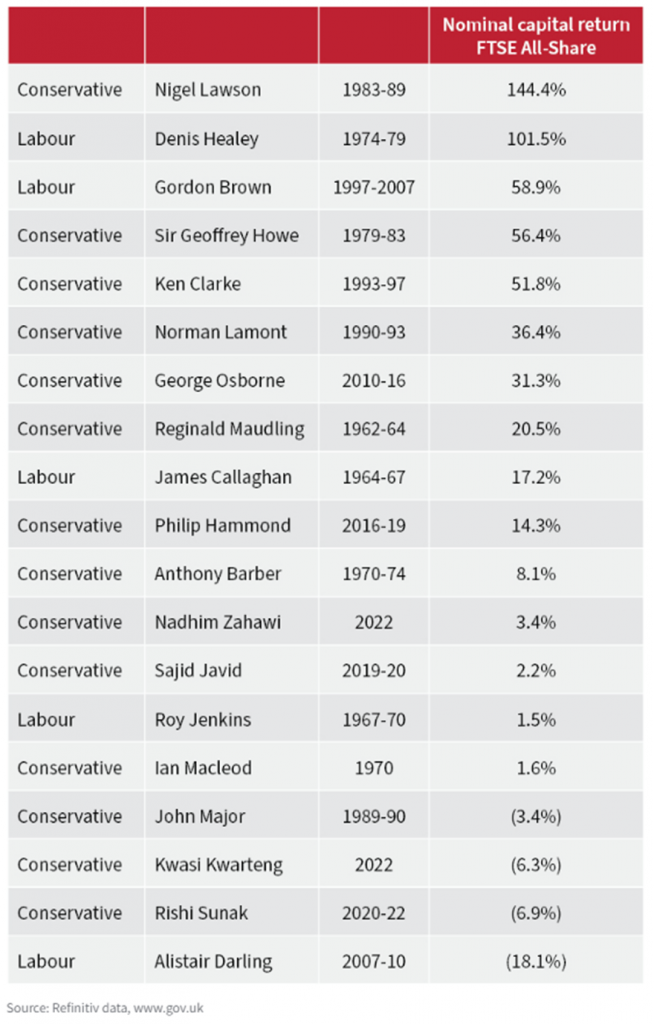
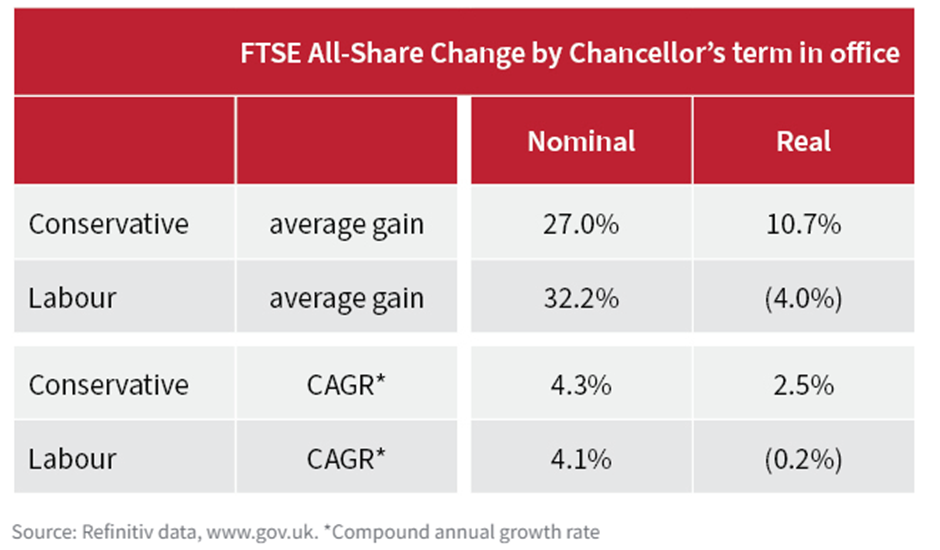
Under Conservative Chancellors, the FTSE All-Share has chalked up a total capital gain of 354%, in nominal terms. That equates to an average advance per Chancellor of 27% (and the average is dragged down by the short tenure of both Nadhim Zahawi and Kwasi Kwarteng).

Under Labour the benchmark has risen by 161% for an average gain of 32.2%.

Across 36 years of Tory Chancellorships that is a compound annual growth rate (CAGR) of 4.3% against 4.1% under 24 years of Labour in 11 Downing Street and two of the top-five best spells under a single Chancellor come under Labour, again in nominal terms.

FTSE All-Share performance by Chancellor of the Exchequer in nominal terms

“The picture changes profoundly when inflation is taken into account and capital returns from the FTSE All-Share are assessed in real (post-inflation) terms rather than nominal ones.”

However, the picture changes profoundly when inflation is taken into account and capital returns from the FTSE All-Share are assessed in real (post-inflation) terms rather than nominal ones.

FTSE All-Share performance by Chancellor of the Exchequer in real terms

Here, Conservative Chancellors come out well on top, as the withering effect of inflation upon investors’ returns from the stock market under Labour’s Healey Chancellorship of the mid-to-late 1970s comes into play, even if Labour supporters will argue his record is tarnished by the need to tackle the mess left behind by the Conservatives’ Anthony Barber’s crack-up boom and the oil price spike of the early seventies.

“The Barber boom and its legacy was one reason why the Truss-Kwarteng mini-Budget frightened markets, as inflation was already lofty before the stimulatory, tax-cutting plan, which conjured up the spectre of more inflation and faster interest rate increases, even as the economy potentially slowed.”

The Barber boom and its legacy was one reason why the Truss-Kwarteng mini-Budget frightened markets, as inflation was already lofty before the stimulatory, tax-cutting plan, which conjured up the spectre of more inflation and faster interest rate increases, even as the economy potentially slowed.

From the narrow perspective of advisers and clients, inflation also chewed up the nominal gains made by the FTSE All-Share under Mr Barber (and under one of his Conservative successors, Geoffrey Howe, for that matter).

FTSE All-Share performance by Chancellor of the Exchequer in real terms

Advisers and clients could therefore be forgiven for wishing Mr Hunt to look back to, and learn from, the experiences of both Barber and Healey, as, helped by the Bank of England, he attempts to steer the economy between the twin threats of inflation on one side and recession on the other.

Misery Index

“The economist Arthur Okun’s Misery Index could be a useful tool to measure the Chancellor’s progress.”

The economist Arthur Okun’s Misery Index could be a useful tool to measure the Chancellor’s progress. It simply adds together the prevailing rate of inflation to the prevailing rate of unemployment, to remind all that full employment is no guarantee of content if there is inflation and that low inflation is no guarantee of happiness (or political success) if unemployment is high.

The Misery index, based on the last published unemployment rate of 3.5% and the last retail price index inflation reading of 12.4%, is 15.5% (RPI is no longer an officially recognised statistic, but the dataset has a longer history that CPI).

That is the highest reading since 1991, when the UK was in a deep recession, and one that was resolved, at least in part, by the devaluation of sterling after its inglorious exit from the Exchange Rate Mechanism in 1992. If the Misery Index starts to drag Mr Hunt down, then sterling could be quick to show further strain.

Past performance is not a guide to future performance and some investments need to be held for the long term.

Please continue to check our Blog content for advice and planning issues and the latest investment, markets and economic updates from leading investment houses.

David Purcell

31st October 2022

Team No Comments

Brooks Macdonald – Daily Investment Bulletin

Please see today’s Brooks Macdonald Daily Investment Bulletin received earlier this morning (28/10/2022):

What has happened?

Bond markets continued to price in a heightened probability of a Federal Reserve ‘pivot’ as signs emerged of a more dovish tone within the ECB. Despite this bond market pricing, concerns about the forward guidance from major US technology companies dampened the mood with the US index falling and Europe ending the day in slightly negative territory.

US Tech earnings

Meta (Facebook) fell by almost a quarter yesterday after its poorer than expected earnings report released on Wednesday. Last night saw Apple and Amazon report with Apple producing a report that largely satisfied the market, particularly given growing concerns that Apple may join the other tech heavyweights in a disappointing release. Amazon however guided that Q4, a critical quarter for retailers given the build up to Christmas, would be much weaker than markets had been expecting. Amazon fell by almost 13% in after-hours trading which is a remarkable fall in market capitalisation given the company’s c. $1tn size.

The ECB

The press conference that followed the ECB statement contained some more dovish language, which was welcomed by the bond market despite the central bank raising interest rates by a further 75bps, in line with expectations. Specifically the conference focused on the downside risks to economic growth, the lagged impact of interest rate hikes and more generally a less aggressive tone regarding future tightening of monetary policy. The bond market concluded that the ECB was getting closer to its terminal rate for this cycle and reduced expectations of that rate down to 2.6%. As a result, the euro underperformed and bond yields fell across Europe. Italian government bonds which have been under pressure due to higher interest rate expectations, outperformed German bunds. The ECB also said that the principles around quantitative tightening would be discussed in December, giving a sense that actual implementation could be a little way away still. 

What does Brooks Macdonald think

With the ECB sounding more balanced, the key question is whether Fed Chair Powell follows suit next week. A 75bp rate rise still looks highly likely however what the Fed will do in December is now up for debate. It is tricky for the Federal Reserve to commit to too much next week as there are two months of inflation and employment releases between the November and December meetings. Bond markets are used to Powell delivering a rebuke in his press conference, even the absence of that could be taken very positively by the still skittish bond market.

Please continue to check our Blog content for advice and planning issues and the latest investment, markets and economic updates from leading investment houses.

Carl Mitchell – Dip PFS

Independent Financial Adviser

28/10/2022

Team No Comments

Brooks Macdonald Daily Investment Bulletin

Please see todays Daily Investment Bulletin from Brooks Macdonald:

What has happened

Hopes of a Fed pivot towards less aggressive monetary tightening gathered pace yesterday after the Bank of Canada raised interest rates by 50bps instead of the 75bps expected. Bond markets quickly extrapolated this change in tone into the US Treasury market, reducing the expectations for interest rate hikes in the US next year. Despite this more positive tone, US equities struggled yesterday as investors absorbed the weaker-than-expected technology earnings from the previous evening.

Corporate earnings

Technology and Communications were the two underperforming sectors during the late US equity sell-off. Alphabet fell by almost 10% and Microsoft by almost 8% as the market repriced after the earnings releases. Given the size of these two heavyweights in the index, this helped drive the sector and overall index lower. After the closing bell last night, Meta (Facebook) released their earnings, missing expectations, falling by almost 20% in afterhours trading. Outside of technology the earnings have been more robust with Kraft Heinz, for example, reporting alongside Meta with an earnings beat and upside revision to the company’s future guidance.

ECB

Today sees the latest interest rate decision from the European Central Bank. The market is expecting a 75bp increase in European interest rates however it is the pace and timing of the ECB’s balance sheet reduction and the forward guidance that will be of most interest to financial markets. Quantitative tightening has been kicked down the road due to concerns over fragmentation risk which could see the difference in yields between Italian and German debt, soar. Looking further ahead, the bond market has less confidence around the future path of interest rates in December and into early next year. A hawkish tone is expected within the ECB’s statement as well as the subsequent press conference though investors will be eagerly searching for any signs that the ECB is considering a Bank of Canada style pivot.

What does Brooks Macdonald think

The Bank of Canada was one of the first central banks to start raising rates and also one of the first banks to embrace larger interest rate rises to ramp up its response to inflationary pressures. As a result, it is seen as somewhat of a bellwether for Federal Reserve policy. We have however seen many attempts this year at beginning a ‘pivot rally’ with the US central bank pushing back against the narrative each time. 

These daily investment bulletins from Brooks Macdonald provide us with a short clear overview of what is happening in the global markets.

Please continue to check our Blog content for advice and planning issues and the latest investment, markets and economic updates from leading investment houses.

Andrew Lloyd DipPFS

27th October 2022

Team No Comments

Markets in a Minute – Stocks rise as Liz Truss resigns as prime minister

Please see below ‘Markets in a Minute’ article received from Brewin Dolphin yesterday evening, which provides a global market update with reference to Rishi Sunak’s replacement of Liz Truss as Prime Minister of the UK.

Stocks in Europe and the US recorded strong gains last week as Liz Truss resigned as UK prime minister and many of her fiscal policies were scrapped.

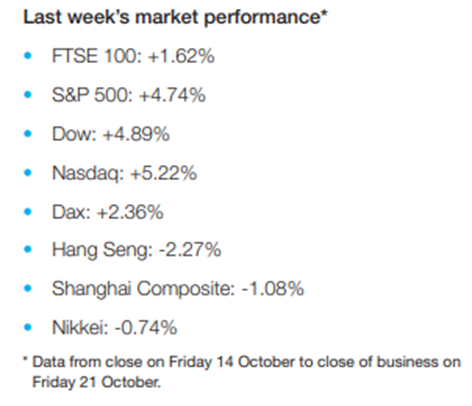
The FTSE 100 gained 1.6%, Germany’s Dax added 2.4% and the pan-European STOXX 600 advanced 1.3% as Truss resigned after only 45 days in office. The announcement came after new UK chancellor Jeremy Hunt reversed almost all the tax-cutting measures contained in last month’s mini-budget.

In the US, the S&P 500 enjoyed its best weekly gain in nearly four months, rising 4.7%. Strong third quarter earnings results and a suggestion that the Federal Reserve might moderate its pace of interest rate hikes helped to boost investor sentiment.

In Japan, the Nikkei declined 0.7% as the yen hit a 32-year low against the US dollar and Japanese core annual inflation accelerated to 3.0% in September. China’s Shanghai Composite fell 1.1% after the country’s statistics bureau said it was delaying the release of third quarter gross domestic product (GDP) data, leading to speculation that China is on track to miss its official growth target of 5.5% this year.

Rishi Sunak named UK’s next PM

Stocks rose on Monday (24 October) as Rishi Sunak was named the UK’s next prime minister. The announcement came shortly before the Conservative Party leadership nominations deadline, with Sunak’s rival Penny Mordaunt pulling out of the race and backing him in the final minutes. The FTSE 100 ended the trading session up 0.6%, while Germany’s Dax gained 1.6%. In the US, the S&P 500 added 1.2% ahead of a big week for third quarter earnings, including Microsoft, Alphabet, Meta Platforms, Apple and Amazon.

UK inflation rises to 10.1%

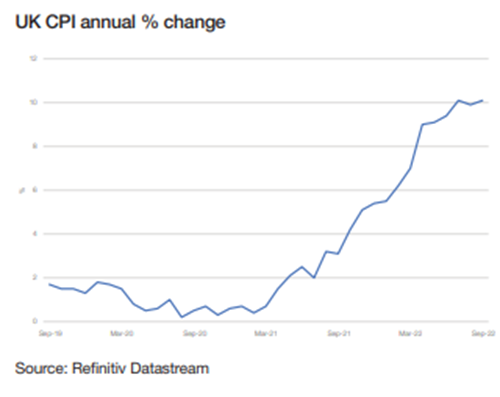
Inflation in the UK rose above 10% for the second time this year in September, according to figures from the Office for National Statistics (ONS). The headline consumer prices index (CPI) measured 10.1%, matching July’s 40-year high after dipping slightly to 9.9% in August.

Food and non-alcoholic drinks were the biggest contributor to the increase, with prices soaring by 14.6%, a 42-year high. Of this, the largest upward effects came from bread and cereals, meat products, and milk, cheese and eggs. This more than offset price declines at petrol pumps. Motor fuels inflation eased to an annual rate of 10.9%, down from a peak of 15.2% in June.

Core inflation, which excludes energy, food, alcohol and tobacco, rose to 6.5% in September from 6.3% in August, adding to expectations of a large interest rate rise on 3 November.

Inflation hits spending and confidence

The latest retail sales data suggests high inflation is resulting in UK shoppers reining in their spending. Retail sales volumes fell by 1.4% in September from the previous month, according to the ONS. This was much worse than the 0.5% fall forecast by economists in a Reuters poll. Retail sales in September were below pre-pandemic levels for the first time since February 2021. However, the ONS emphasised that data had been affected by the bank holiday for the funeral of HM Queen Elizabeth II. In the three months to September, sales volumes were down by 2.0% when compared with the previous three months, although the amount spent was up 0.5%, reflecting higher prices.

Elsewhere, GfK’s consumer confidence index remained close to last month’s historic low, rising by just two points to -47 in October. The major purchase indicator fell by three points, which GfK’s client strategy director Joe Staton said was particularly worrying for the final quarter, which many businesses rely on to strengthen their balance sheets.

“But the biggest danger by far is inflation, now rising at its fastest rate for 40 years,” said Staton. “Households are not just running scared of burgeoning energy and food prices, and the prospect of further base rate rises increasing mortgage costs. They are now facing the likelihood of tax rises and even austerity measures.”

US homebuilder sentiment at a decade low

Over in the US, an index of homebuilder sentiment hit a ten-year low in October as rising mortgage rates and supply chain bottlenecks for building materials made new housing less affordable. The National Association of Home Builders / Wells Fargo Housing Market index dropped eight points to 38. That marked the lowest reading since August 2012, excluding a short-lived drop in spring 2020 when the US went into lockdown.

Meanwhile, mortgage applications fell by 4.5% in the week ending 14 October from a week earlier, and housing starts dropped 8.1% in September to a seasonally adjusted annual rate of 1.439 million units. The average 30-year fixed mortgage rate has hit 6.94%, the highest since 2002, according to the Mortgage Bankers Association.

Please check in again with us soon for further relevant content and news.

Chloe

26/10/2022

Team No Comments

Brewin Dolphin: Rishi Sunak confirmed as new Prime Minister

Please see below, an article from Brewin Dolphin on Rishi Sunak being confirmed as the UK’s new Prime Minister and the potential impact on the markets. Received late yesterday afternoon – 24/10/2022. 

Rishi Sunak has been named the UK’s next Prime Minister.

Paul Danis, Head of Asset Allocation at Brewin Dolphin, discusses whether the announcement could herald a more stable environment for financial markets.

After one of the most turbulent periods in the UK’s political history, Rishi Sunak now faces the difficult task of rebuilding the country’s economic and fiscal credibility.

Sunak takes the helm at a time when inflation is at a 40-year high, borrowing costs are rising, and a recession seems increasingly imminent. That backdrop existed even before the economic and market turmoil created by September’s mini-budget.

Despite not winning the Conservative Party leadership race over the summer, Sunak quickly became the heavy favourite this time around after Boris Johnson announced over the weekend that he was pulling out of the race. Just before today’s nominations deadline, rival Penny Mordaunt also dropped out of the contest, thereby securing Sunak’s position as leader of the Conservatives.

Sunak’s leadership race over the summer emphasised curbing inflation, which was in stark contrast to Liz Truss’s pledges for unfunded tax cuts. Last month’s announcement that those pledges would go ahead saw UK government bonds and the pound tumble, the sacking of former chancellor Kwasi Kwarteng, a reversal of nearly all Truss’s proposed tax cuts and, ultimately, the resignation of Truss herself last week.

How are markets reacting?

So far, the news has been welcomed by financial markets, as Sunak is perceived to be fiscally conservative and market savvy. The makeup of the cabinet will be important to instilling much needed stability.

The pound has been gaining on the dollar and the yield on UK government bonds (gilts) has fallen back to pre-mini-budget levels. Both are welcome developments. A rise in the pound means it costs less for companies in the UK to buy things from abroad, and lower yields make government borrowing cheaper.

Are calmer times ahead?

The past month has been a tumultuous one for investors, who will no doubt be hoping for calmer times ahead. From a political point of view, we would expect much less turbulence going forward, which should help to restore confidence.

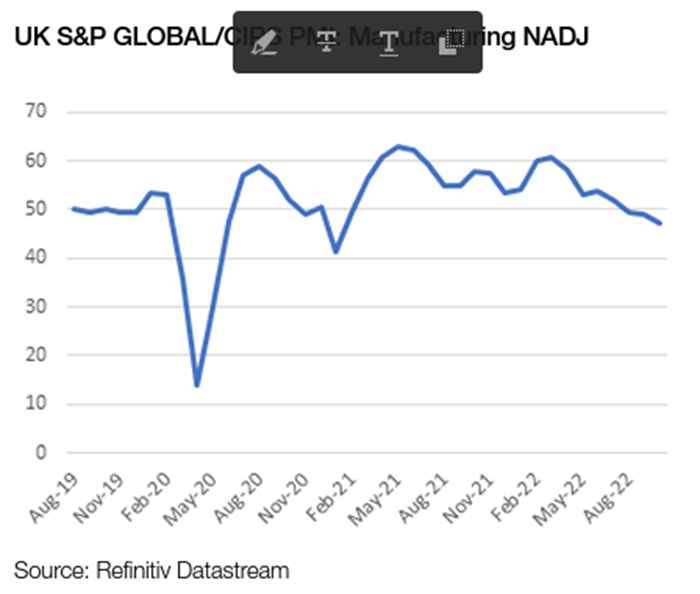
Yet we can’t escape the fact that the wider problems facing the UK haven’t gone away. Today’s purchasing managers’ indices suggest the UK is already in a recession, with business activity falling for a third consecutive month. The country is still suffering from a worsening budget and current account (twin) deficit.

Gilt yields have declined over the past 12 days, but they still stand substantially above the levels we saw last December. Higher borrowing costs place a further burden on government, household and business finances. And although the pound has stabilised after the recent policy U-turns, it should remain under downward pressure versus the dollar over the medium-term as global economic growth momentum slows.

Ultimately, Sunak is inheriting an economy which is in or heading into a recession, with little room for policy support. It will be an extremely difficult balancing act. The next big focus will be on the medium-term fiscal plan, which is due to be announced on 31 October; every figure will be subject to heavy scrutiny.

The outlook is no doubt challenging, but the silver lining is that fiscal and monetary policy are now aligned to fight inflation. As inflationary pressures moderate and UK credibility is regained, the worst of sterling and gilt volatility should be past us. In addition, with UK bond yields easing off the highs of earlier this month, mortgage rates will likely come back down as well, which will provide some relief to homeowners.

Please continue to check our Blog content for advice and planning issues and the latest investment, markets and economic updates from leading investment houses.

Cyran Dorman

25th October

Team No Comments

Markets look on as Westminster psychodrama continues

Please find below, an update on how politics are affecting global markets, received from Tatton, this morning – 24/10/2022

Overview: markets look on as Westminster psychodrama continues

Given the volatility in UK politics last week, broader capital markets felt like a sea of calm in comparison. Markets had already priced in the upside on sterling, believing unfunded Tory tax cuts were no longer on the agenda, but not another leadership hiatus or even the possibility of an early general election. This perhaps explains that after initial cheers, sterling settled at where it had been already against the US dollar before Liz Truss tendered her resignation. Gilts have experienced a rollercoaster of wild and outsized movements during her short but turbulent reign and so the relief rally that followed her departure is understandable.

However, as noted before, the ill-advised fiscal event that triggered Truss’s political death spiral unhelpfully boosted an uptrend in bond yields that had been well underway since the beginning of the year. How yields and yield differences will fare from here will (hopefully) now only partially depend on the further political developments in the UK, but much more on where the rate of inflation is heading and with it, economic activity levels. On the so-called ‘loss of trust’ of international capital markets in the reliability of the UK and its institutions, the past week has demonstrated that while the UK is most certainly not immune from political mistakes, the system deals swiftly and reliably with failure.

UK inflation (as measured by the Consumer Prices Index) was interesting last week, with food and insurance leading the core (non-energy prices) back up to 10.1%. Both may be seeing lagged impacts from previous energy price rises – but also the shortage of available labour. Our food has become much more energy-intensive in recent years. Indeed, the lagged impacts of energy are still evident across the board. Overall, and compared to previous weeks, the market has been cheered by a lessening of the sense of crisis around Europe and the UK, even if the backward-looking economic data reports still look concerning. 

Europe’s energy struggles may be easing 

Regarding price pressures on consumers, last week offered some good news for Europe, including the UK. Gas and electricity prices for near-term delivery (over the winter) have come down, as gas storage reserves have filled to higher levels and earlier than anticipated, while industrial demand has fallen much more quickly than thought possible. There was further good news on the electricity front as Germany’s Chancellor Scholz spoke a ‘Machtwort’ (meaning word of authority) and more or less forced his coalition partners to agree a temporary extension of the life of the three remaining German nuclear reactors over the winter. 

This altogether lower temperature from the demand and the supply side in pan-European energy markets has led to a sense that the probability and extent of downside scenarios have lessened. This in turn is taking fiscal support pressure off politicians, and leaves markets anticipating less bad times ahead. Despite government-imposed price caps, there had been heightened fear of bankruptcies – which remains elevated, but the immediate danger is clearly receding, as we note from falling European high yield credit rates for those firms with the lowest credit ratings. 

Increasingly, scenario assessments like the recent one from Bloomberg’s energy analysts are raising the possibility that Europe could find itself with a gas surplus should the coming winter prove not to be particularly cold one. This would certainly be very good news for hard-pressed consumers, even though the boost to demand from the release of energy earmarked savings could fan broader inflation once again and force the hand of central banks to follow the US Federal Reserve’s push for rates that are anticipated to reach 5% at the end of Q1 next year. 

How much isolation can President Xi’s China afford?

Attention has been on Beijing over the last few days, as the Chinese Communist Party hosted its 20th national congress. Held every five years, the congress decides key party posts – which in turn decide state, military and commercial appointments – and sets the policy agenda for the next half a decade. The biggest but least surprising announcement was the inevitable reappointment of Xi Jinping as leader, with party rivals purged (including the very public ‘retirement’ of Xi’s predecessor Li Keqiang) and loyalists installed in his new leadership team. Without question, this is now Xi’s China.

It is somewhat disheartening, then, to hear Xi’s priorities are more political than economic. The biggest brake on growth is Beijing’s strict zero-COVID policy. China is still cycling through regional lockdowns every few months, while its housing market is still ailing from the slow-motion collapse of property developers such as Evergrande. Meanwhile, slowing developed world demand makes it difficult for China to export its way out of trouble. Growth was slowing even before the pandemic, thanks to Beijing’s deleveraging efforts and crackdown on the shadow banking sector. But that was at least an admirable goal – removing excessive debt and improving economic or financial stability. However, harsh crackdowns at home (both COVID- related and on corporates) and tough rhetoric against major trading partners – in the face of an economic slowdown – are a different matter.

It was easy to see why Chinese officials delayed the release of GDP data last week: people may not like what they see. Economists predict annual growth has slowed to 3.3%, the second-lowest figure in the last three decades (after 2020’s initial lockdown year). This is deeply worrying for the party. Just last week, the US announced a de facto embargo on selling high-end technology to China, pushing the rivalry between the world’s pre-eminent powers into something approaching a cold war. This hit tech stocks in the US, but had a broader impact on Chinese stocks. If sustained, the effective ban on technology intellectual property transfer could have a severely limiting effect on long-term growth.

Indeed, the longer-term picture is clouded by China’s ageing population and its increasingly isolated position. Some analysts suggest we are moving into a structurally weaker period for China, where growth may average around 3% per year instead of the incredible 7% or 8% we have grown accustomed to. Even if true, base effects would mean that growth opportunities would still be very significant. China’s estimated 2022 GDP is $18.3 trillion, meaning that 3% growth would add over $500 billion to the global economy – that is still more than China’s total growth in 2016. Zero-COVID is still the biggest hurdle, but if we see signs of that policy loosening early next year – which may well happen if vaccinations of the elderly continue and economic growth falters – then global investors could in the short term become very positive on China. 

Please continue to check our Blog content for advice and planning issues and the latest investment, markets and economic updates from leading investment houses.

David Purcell

24th October 2022

Team No Comments

Brewin Dolphin: Truss Resigns After 45 Days In Power

Please see below, an article from Brewin Dolphin on the resignation of Liz Truss and what this means for markets. Received late yesterday afternoon – 20/10/2022.  

Liz Truss’s resignation as UK prime minister brings an end to the shortest premiership in UK history, following a tumultuous few days. Guy Foster, our Chief Strategist, looks at the market’s perspective on the news.

The press has been rife with speculation that the government has been on the brink of collapse for weeks. However, the developments on Wednesday with the resignation of the home secretary and chaotic scenes in parliament at the evening vote on fracking, mean today’s news did not come as a great surprise.

Markets focused on policies not personalities

From an investor’s perspective, political drama can be unnerving. After all, political chaos is often associated with financial market chaos. However, the two do not always go together.

The concerns that we saw from the markets in recent weeks stemmed from the forceful ideological position of the Truss government and its working majority – ie an unorthodox approach to economic policy with the political means to implement it.

In that sense, the markets cared less about the identity of the prime minister than about her economic agenda – and Trussonomics left Downing Street a week ago with the dramatic sacking of Kwasi Kwarteng, his replacement by Jeremy Hunt and the new chancellor’s rapid response in abandoning the majority of the tax changes from the mini-budget.

The return of a more orthodox approach to economic policy seems already fairly established, and has been welcomed by investors. Markets have adapted to that new reality and priced it in. Indeed, following the announcement of Truss’s resignation, markets were benign.

What will the succession hold?

Investors will be looking ahead to the succession, but after this bruising experience it is unlikely that any candidate will succeed without taking a very orthodox position on economic policy.

In a YouGov poll of Conservative Party members this week, Boris Johnson came out on top – that would be an extraordinary comeback.

Rishi Sunak, Penny Mordaunt and Ben Wallace continue to be talked about as the leading contenders, after Jeremy Hunt moved quickly to remove himself from leadership speculation shortly after Liz Truss’s announcement. A brief seven-day process demonstrates recognition of the need for stability at this time, and it is likely to be a key watchword as the contest unfolds.

The importance of strong institutions

The short-lived reign of Liz Truss has underlined how robust institutional protections are in the UK. This has been a brief, painful but ultimately reparable loss of credibility with the financial markets.

Some social media commentators may have flippantly taken to comparing the UK to an emerging market, but that is a long way from the reality. Taking a look at Turkey, where unorthodox economic policy has been failing for several years and where further stimulus seems set to be poured upon inflation that has already risen to 70% in a year, and the difference is significant. The markets recognise this and it does not seem to be taking long to regain investors’ confidence.

The next week will, of course, carry much political speculation. In terms of market reaction, however, Truss’s resignation is the moment the curtain comes down quietly after a period of high-octane drama.

Please continue to check our Blog content for advice and planning issues and the latest investment, markets and economic updates from leading investment houses.

Alex Kitteringham

21st October 2022