Team No Comments

Brooks Macdonald – Daily Investment Bulletin

Please see below todays (10/03/2023) Daily Investment Bulletin from Brooks Macdonald:

What has happened?

Earlier on Friday, the Bank of Japan (BoJ)’s last meeting under outgoing Governor Kuroda was the epitome of a non-event. There was no change to its -0.1% interest rate, no change to the +/-50bp tolerance band around its 0% target for 10-year JGB yields, and nothing in the accompanying BoJ statement that would suggest an imminent end to yield-curve-control. Instead, market volatility has centred around falls in the US banks sector on Thursday, led by a -60.41% share-price fall in SVB (Silicon Valley Bank) Financial Group, a California-based firm specialising in funding to venture-capital-backed companies to the tech sector. The turmoil started late Wednesday when SVB Financial Group announced a $2.25bn share-sale to shore up capital after being hit by loses on its securities portfolio. Negative sentiment spread across the US bank sector yesterday, even including far-better-capitalised banks, with JP Morgan shares off -5.41% on the day. The SVB news was also seen driving a risk-off move in US Treasuries, with 2 year yields down -20bps to 4.87%, its biggest daily fall in over 2 months, and the ‘10-year less 2-year’ yield spread steepened up through -1%, closing at -97.3bps on Thursday. Closer to home, this morning, we’ve seen UK GDP for January come in at +0.3% month-on-month, better than the +0.1% market consensus expected.

US jobless claims gives some support to the bulls

Thursday saw US weekly Initial Jobless Claims data, which showed that claims had risen to 211,000 during the week ending Saturday 4th March. That was higher than market estimates for 195,000, and up from 190,000 the week before. It also marked the first time claims has come in above 200,000 since early January. Cutting the data another way, the week-on-week gain in claims of 21,000 was the biggest weekly gain in 5 months, since October last year. That said, whilst this is a pick-up in claims, it’s coming from a low base. For context, the US labour market remains tight, with the US JOLTS (Job Openings and Labor Turnover Survey) data out earlier in the week showing that there was still a ratio of 1.9 job openings for every 1 unemployed person in January – that’s down from 2.0 in December last year, but well above the circa 1.2 level before the pandemic.

US non-farm payrolls

Today sees the first instalment of a double-header of crucial data that could tip market expectations (and the Fed for that matter), either towards a 25bp or 50bp hike on 22 March. US non-farm payrolls are due at 1:30pm UK time, and the Bloomberg market consensus is looking for a month-on-month gain of 225,000 (which incidentally is up from an earlier 215,000 estimate at the start of this week). Meanwhile, the unemployment rate is expected to stay unchanged at a 53 year low of 3.4%. Within the release, average hourly earnings are expected to be up 0.3% month-on-month, the same as last month’s gain. After today, markets will be looking ahead to the US CPI (Consumer Price Index) print due next Tuesday.

What does Brooks Macdonald think

After a run of stronger economic data recently, markets are firmly in the mindset of ‘bad-news-is-good-news’. That’s to say, bad news for the economy translates as reducing the urgency of central banks to hike interest rates, and that would be good news for risk assets. So, will markets get some bad economic news today? To be fair, it all feels a bit US-centric right now in terms of the news flow, but we won’t have long to wait to see if the US jobs data later today, or the US CPI data on Tuesday next week plays ball.
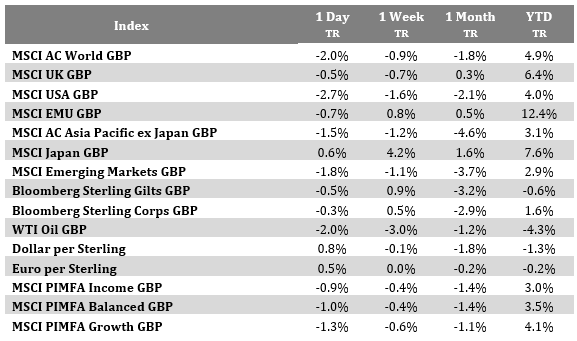
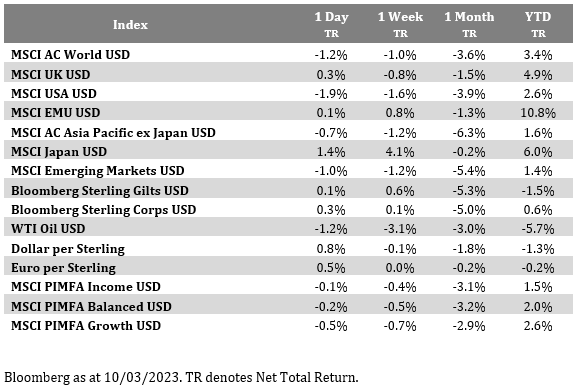
Please continue to check our Blog content for advice and planning issues and the latest investment, markets and economic updates from leading investment houses.

Carl Mitchell – Dip PFS

Independent Financial Adviser

10/03/2023
Team No Comments

Church House Investment Management – Multi Asset Market Analysis

Please see the below market update from Church House Investment Management received yesterday:

After the relief for bond markets in January as longer-term yields fell back despite the latest round of base rate increases, February saw a sharp reversal.

The US ten-year yield jumped from 3.5% to 4%, with a similar 50bp jump in UK yields taking the ten-year Gilt to 3.8%.  Of course, this led to steep falls for Gilt prices, which are now down for the year.  Possibly the most dramatic was the jump in Eurozone yields where the German ten-year Bund hit yield levels not seen since 2011, negative rates now being consigned to a historical oddity.

The change in mood followed better economic data with subsequent warnings of more to come from central bankers.  Here is Jerome Powell, Chairman of the US Federal Reserve, at yesterday’s testimony to the Senate Banking Committee:

“The data from January … have partly reversed the softening trends that we had seen … just a month ago … the breadth of the reversal along with revisions to the previous quarter suggests that inflationary pressures are running higher than expected at the time of our previous [FOMC] meeting.”

“The latest economic data have come in stronger than expected, which suggests that the ultimate level of interest rates is likely to be higher than previously anticipated …If the totality of the data were to indicate that faster tightening is warranted, we would be prepared to increase the pace of rate hikes.”

Chairman Powell continues to stress that they will be guided by the “totality” of the data as it emerges.  Next up being the US employment figures due on Friday, which are likely to set the tone for the next few weeks, along with inflation figures the following week.  Expectations for the peak levels to be reached by central banks have been ratcheted up again with a 50bp increase from the Federal Reserve later this month now anticipated (to 5.25%).  The Bank of England also meets later in the month and expectations have also been raised for their next move, we expect a 25bp increase to 4.25%.

Most equity markets sold-off as the mood soured in the bond markets, but the UK held on to modest gains (it does look quite compelling in an international context and seriously shunned…) and a mooted Middle Eastern bid for Standard Chartered contributed.  Consumer staples out-performed as usual in nervous markets, notably L’Oréal, Unilever, Walmart; oil stocks jumped again after good figures and despite a weakening oil price.  In contrast, mining stocks had a poor month, notably Anglo American, Barrick Gold and Newmont with a falling gold price and concerns that the Chinese recovery might disappoint.

We don’t think that much has changed with our four key questions/concerns for the year:

  • Have we seen the worst of inflation?
  • How far will the Federal Reserve (and the other CBs) go?
  • Will the recession be worse than currently expected?
  • Is there an endgame in Ukraine or does it get worse?

Despite the noise, we still expect to see lower inflation as the year unfolds with a shallow recession the most likely.  But we do expect the swings in sentiment to be repeated over coming months with markets in thrall to the employment, inflation and other economic releases.  Stick with (shorter-dated) sterling corporate fixed interest and take a fresh look at the UK equity market!

Please continue to check our Blog content for advice and planning issues and the latest investment, markets and economic updates from leading investment houses.

Andrew Lloyd DipPFS

09/03/2023

Team No Comments

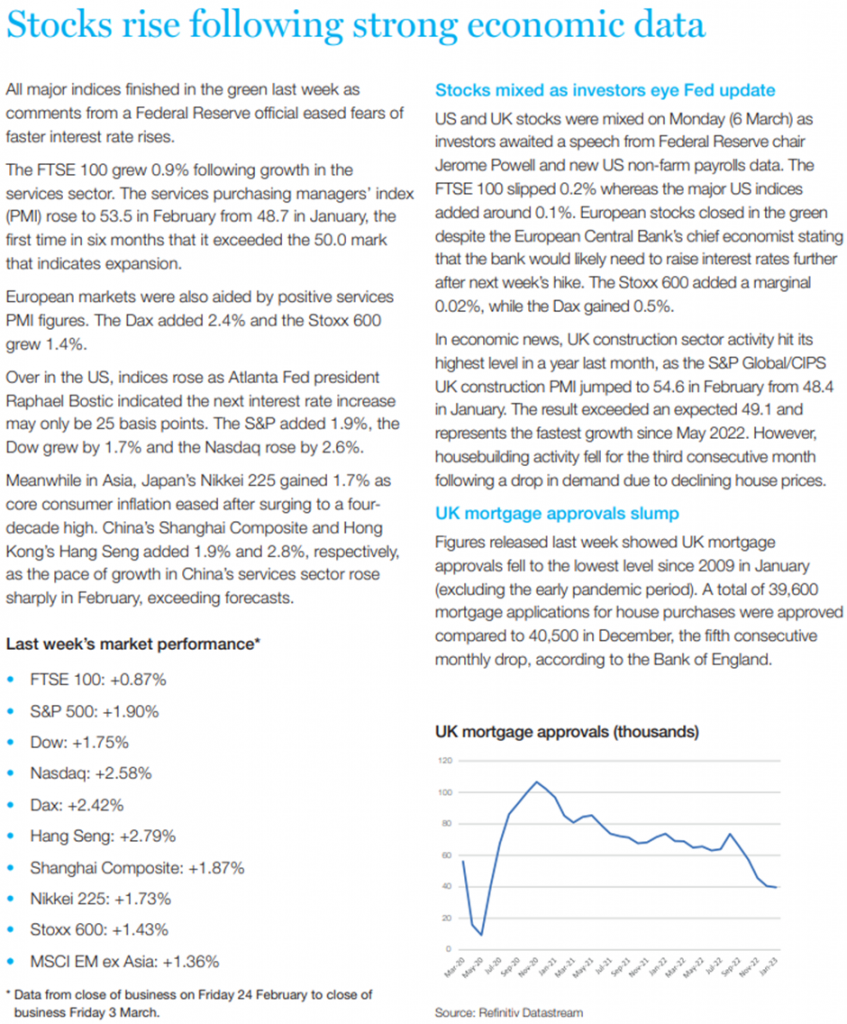
Brewin Dolphin: Markets in a Minute

Please see below, Brewin Dolphin’s ‘Markets in a Minute’ article summarising the key economic and markets news from the past week. Received late yesterday afternoon – 07/03/2023

Please continue to check our Blog content for advice and planning issues and the latest investment, markets and economic updates from leading investment houses.

Carl Mitchell – Dip PFS

Independent Financial Adviser

08/03/2023

Team No Comments

China sets economic growth target

Please see below weekly market commentary received from Brooks Macdonald yesterday afternoon, which provides global economic data and market news.

  • China officials set out an economic growth target of “around 5%”, a little below expectations and potentially cooling hopes for fresh stimulus later this year
  • Next 8 days will be crucial for shaping the market’s outlook on jobs and inflation, with US Federal Reserve (Fed) Chair testimony to Congress plus monthly jobs and Consumer Price Index (CPI) all in the mix
  • Bank of Japan’s Governor Kuroda takes his last meeting this week, as markets continue to speculate if and when his successor might change BoJ policy goals

China officials opt for a slightly-softer-than-expected economic growth target of “around 5%”

Over the weekend, China officials set out a modest economic growth target of “around 5%” for 2023, at the low end of estimates that had hoped for more than 5% or maybe even 5.5%; the implication is that it lowers, a little, hopes for the size of any fresh policy stimulus later this year. As a result, Chinese equities are lagging small gains across Asia Pacific in early trade this morning. Over in the US, equity futures are indicating up, having capped off a positive day on Friday – that was despite a stronger US ISM Services print pointing to a still-tight labour market and inflation stickiness. Turning to the week ahead, the US will dominate the news flow with the latest jobs report out on Friday, along with US Fed Chair Powell’s biannual monetary policy report to Senate and House committees tomorrow and Wednesday respectively. Elsewhere this week, we also get China CPI on Thursday, UK January GDP on Friday, as well as 3 central bank decisions this week from Australia (tomorrow), Canada (Wednesday) and Japan (Friday). Also looming on the horizon for investors is next week’s CPI print (next Tuesday) which will cap a busy next 8 days for news flow.

What markets are looking for in this week’s US monthly jobs report

This coming Friday sees the latest print for the US monthly jobs report (for February), the non-farm payrolls data. It’s always a key print for markets, but arguably more so now given the importance that the Fed has put on the strength of the jobs data as a key factor in sticking to its hawkish rhetoric on interest rates in recent months. Friday’s monthly jobs data will also be the last one ahead of the Fed’s next FOMC (Federal Open Market Committee) decision due 22 March. In terms of what to expect, Bloomberg’s estimate is for 215,000 jobs added in February (down from January’s monster gain of 517,000 where some think the mild winter weather ended up providing a bit of a boost), with the unemployment rate expected to hold at over-50-year-lows of 3.4%.

Bank of Japan’s last meeting for Kuroda, and expectations for policy change are low….for now

Also due Friday is the Bank of Japan (BoJ)’s rate decision, and it’s the last meeting for the outgoing Governor Kuroda. Expectations for any fireworks are low, given the incoming Governor Ueda (pending final voting by Japan’s parliament on his appointment) said last month that current monetary policy settings remained appropriate. That said, markets are still speculating that the BoJ might change its yield-curve-control policy framework later this year, allowing bond yields to rise. The BoJ policy direction this year could have major ramifications for markets globally – with the BoJ as the last major central bank hold-out of zero rates, it has arguably hitherto pushed Japanese liquidity overseas in the hunt for yield – but if the BoJ allows yields to rise later this year, this could suck some of that liquidity back home again, and which might end up creating upward pressure on yields in other international bond markets.

Will the Fed stick to its rate-hike down-shift path or change course?

Fed speakers in recent weeks have raised the risk of a higher terminal interest rate, with market expectations for peak rate currently at 5.439% in September this year, and vs the current Fed policy rate range of 4.5-4.75%. After last month’s nonfarm payrolls print came in well above expectations, and the recent CPI (Consumer Price Index) and PCE (Personal Consumption Expenditures) reports showed stickier-than-expected price pressures, this next set of data will be crucial. Markets are currently pricing in 29.8bps of hike in March, so split between expecting 25bps which is still seen as the most likely for now, or whether there’s a small-outside-chance of a 50bps move instead – the latter would be tough pill for markets to swallow, with the Fed so far having down-shifted its rate-hike pace from 75bps to 50bps to 25bps over the last 3 consecutive meetings.

Please check in again with us soon for further relevant content.

Chloe

07/03/2023

Team No Comments

Tatton Investment Management: Monday Digest

Please see below article from Tatton Investment Management received today regarding their market commentary:

Overview: Mood swings

Bond and equity markets have been experiencing teenager-like mood swings for some time now. Investors have oscillated between optimism over the surprising resilience of consumer demand and relative company earnings stability, and pessimism that the same economic resilience will force central banks to keep raising rates for longer. Last week, focus shifted back to more positive growth indicators, resulting in an improvement at least for equity markets. Meanwhile, the bad mood in the pan-European bond market worsened. While Europe’s economy has avoided an outright energy crisis, and delivered some positive economic updates, the unfortunate upshot of this has been inflation creeping back up.

The latest purchasing manager index (PMI) reports of business expectations showed that global growth had returned in February but that it (quite literally) came at a cost. Despite falling energy prices, input cost pressures rose, a sign that even the smallest amount of growth takes us back to a position where there is little or no spare capacity. That view was backed up by German, French and Spanish inflation data which showed a surprising rebound, especially given that companies’ energy bills should have fallen somewhat.

For the central banks, therefore, this information has been enough to warrant another round of warnings that rates will probably have to go higher and stay there for longer. In the US, there is growing talk of a return of a jumbo 0.5% rate rise step on 22 March. The European Central Bank (ECB) had already said rates would rise by 0.5% on 16 March, but could be tempted to go to a deposit rate of 3.25%, a rise of 0.75%. On the back of this, bond yields rose again, with ten-year US Treasuries decisively breaching 4% for the first time since last November and German ten-year Bunds for the first time up to 2.7%. It is worth remembering it was only a year ago that Bund yields stopped being negative.

Higher government bond yields are problematic for other asset classes since they form an important part of market valuations. However, even with the impact of higher yields, confidence in the resilience of economies and household spending has improved – in terms of that looming recession, we are not even close to a downwards spiral. Equity markets are still in a risky position, particularly if consumer demand was to eventually buckle and corporates were no longer able to maintain revenues and thus profits. But if profit growth confidence is starting to improve – as we had some reason to believe last week – then we could see reasonable upside from current levels.

Will financial crackdowns mean China’s recovery bounce falls short?
Global investors were delighted when President Xi Jinping finally reversed China’s zero-Covid policy at the end of last year, opening up the world’s second-largest economy. Many predicted a post-pandemic bounce even bigger than that experienced in the west two years ago. But those expectations have faltered as the year has gone on. China’s stock rally tailed off at the end of January, and the CSI 300 – mainland China’s benchmark equity index – traded sideways through all of February, while Hong Kong’s Hang Seng index fell by more than 6%. So, should we be worried about China’s recent lack of spark? The answer is not just yet.

Following  the Lunar New Year and subsequent spring festival, early March has seen some overwhelmingly positive signs. February PMI data shows the best reading for the manufacturing sector in more than a decade, well above economist expectations and suggesting manufacturers are increasingly positive about the near term. Likewise, high-frequency data like mobility figures are extremely positive, suggesting citizens are taking the opportunity to travel. While it remains to be seen how this will impact the hard data later on, the signs are exactly what we would expect from a strong demand-led rebound.

Some commentators have sought deeper explanations for China’s disappointment, such as the (supposedly) lower savings base that consumers have to work with, compared with western counterparts in 2021. But we suspect that funding troubles on the institutional side – for property companies and local governments – are one of the reasons why China’s bounce has been underwhelming. As well as a break from zero-Covid, Chinese positivity was prompted by a change of fortunes for the property sector. Developers were suffering after the crisis at Evergrande, and found funding hard to come by, thanks to Beijing’s crackdown on private sector lending. There are signs Beijing may be embarking on another crackdown, this time across the financial sector. Deleveraging and financial crackdowns are part of Xi’s drive for stability in China, but pushing too hard too soon could massively destabilise things. Central authorities will no doubt be aware of some of these issues, but we have seen how Chinese ideology can often trump pragmatism and short-term growth. 

That Chinese growth is a vital part of the world economy is arguably truer now than ever before, partly due to its size but also because of the current relative weakness of the western world. For global investors, positivity around China has been one of the few bright spots in an otherwise challenging environment. Fear of disappointment is therefore understandable. If there is a broad and deep crackdown ahead, it would be a mismatch with Beijing’s stated growth drive. While the consumer demand bounce is most definitely coming, we will be keeping a close watch on measures which could undermine confidence at least in the short-term, even if authorities believe they act for the greater good. 

Please check out our blog content for advice, planning issues and the latest investment, market and economic updates on leading investment houses.

Adam

06/03/2023

Team No Comments

Markets then and now: What’s changed after a year of war in Ukraine and rampant inflation?

Please see the below article from Invesco received this morning:

Key takeaways

  • In our analysis, Invesco experts offer key insights into the changing risks facing markets and offer their views on what this means for fixed income and equities.
  • The outbreak of conflict on 24 February 2022 exacerbated inflationary pressures. And in hindsight it seems clear that central banks reacted too slowly.
  • Geopolitical and energy risks, though still present, have receded. The focus has largely shifted to monetary policy and whether central banks can curb inflation and avoid recession.

On the first anniversary of Russia’s invasion of Ukraine, the outlook for the global economy is much changed. Geopolitical and energy risks, though still present, have receded. The focus has largely shifted to monetary policy and whether central banks can curb inflation and avoid recession.

So, Russia’s belligerence is just one facet of a complex macroeconomic environment. After years of persistently low inflation, the post-Covid economic restart in late 2021 unleashed inflationary forces across the world as pent-up consumer demand was released despite snarled supply chains. The outbreak of conflict on 24 February 2022 exacerbated inflationary pressures. And in hindsight it seems clear that central banks reacted too slowly. In Europe, meanwhile, the war has had an outsized impact, especially on its energy security.

Amid this backdrop, Invesco experts offer insights into the arc of economic, geopolitical and policy changes since the war started. They also offer their views on key asset classes and environmental, social and governance (ESG) considerations.

Flexible thinking in the fixed income space

The period following the invasion was the worst ever for global credit, which lost 18% from January to October, surpassing even the drawdowns of 2008.

“In truth, the conflict was more of an aggravating factor to the monetary tightening by central banks which had started in Q4 2021,” said Co-Head of Global Investment Grade Credit Lyndon Man.

“Nevertheless, we did see European assets impacted more acutely given the physical proximity and the tighter squeeze on energy supplies.”

Man expects the US Federal Reserve’s rate hikes to “top out” this year, notwithstanding some recent hawkish comments.

“The European Central Bank is playing catchup and European spreads remain wider3 vs. US; Asia also looks attractive having underperformed last year. Though we had a strong rally in January, yields are still at highs not seen since 2009, while flows and corporate fundamentals remain broadly supportive,” he said.

European equities: Renewables in focus

Fears that Europe could face widespread energy shortages were commonplace at the outbreak of the war. But a relatively warm winter helped countries navigate the crisis despite higher energy prices.

“After the initial shock sell-off when Russia invaded Ukraine and subsequent short-term market recovery, energy security and inflation have become the dominant themes driving the European market,” said European Equities Fund Manager James Rutland.

“Energy costs have already fallen substantially, with economists revising up their negative economic forecasts accordingly. With inflation starting to fall from high levels, we could see the headwind from falling real wage growth turn into a tailwind and therefore a rather better outlook for the consumer alongside the broader economic environment,” he said.

ESG and policy: The energy transition

The EU agreed to phase out the bloc’s dependency on Russian fossil fuel imports in March last year. It banned almost 90% of all Russian oil imports by the end of 2022 (with a temporary exception for crude oil delivered by pipeline). In December, it followed up with the introduction of a temporary emergency energy price cap to protect its citizens from excessively high gas prices.

“While much of the response this past year has been dealing with the immediate priority of keeping the lights on by finding alternative sources of gas and oil, political focus is starting to shift towards more structural reforms. These include the structure of the European electricity market and measures to further support renewable energy,” said Invesco’s EU Government Relations and Public Policy team.

The energy trilemma – energy security, affordability, and sustainability – points to renewables in the medium to long term as a resolution to some key underlying pain points around regional energy supply and fossil fuel-led inflation, according to Sudip Hazra, Head of ESG Research.

“Calls for the oil and gas sector, which has the expertise and cash flow to increase investments into the energy transition via diversification into renewables, look set to continue,” he said.

Please continue to check our Blog content for advice, planning issues and the latest investment, markets and economic updates from leading investment houses.

Andrew Lloyd DipPFS

03/03/2023

Team No Comments

AJ Bell: What are the rules around topping up national insurance contributions?

Please see the below article from AJ Bell which provides useful information regarding topping up national insurance contributions. Received this afternoon – 02/03/2023

You need a 35-year National Insurance (NI) contribution record to qualify for the full ‘new’ state pension, worth £185.15 per week in 2022/23. This was increased from 30 years when reforms to the system were introduced in April 2016.

You also need to have an NI record of at least 10 years to qualify for any state pension, with deductions made for every year you have missing.

This doesn’t just include being employed and paying NI – you can also get NI ‘credits’ for things like caring for children or elderly relatives.

If you have worked abroad, earned a low salary or had gaps in employment, you might have holes in your NI record. Handily, there is a website where you can check your NI record and state pension forecast. 

Anyone who previously ‘contracted-out’ of the state pension under the old system (which existed before 6 April 2016) might also be entitled to less than the full state pension (even if they have a 35-year NI record).

Contracting out (which no longer exists) just meant you paid lower NI and in return didn’t receive entitlement to the state second pension (the state pension used to be made up of two parts – the basic part and the state second pension, which was previously called ‘SERPS’).

If you have previously contracted-out, a deduction will be made to your state pension entitlement.  If you aren’t entitled to the full state pension as a result of being contracted-out or you having missing NI years for other reasons, you can buy extra NI years to make up the gap.

However, not everyone who was contracted-out will benefit from buying extra NI years. This is quite complicated and will depend on what you’d have been entitled to under the old system.

The Government’s Future Pension Centre should be able to tell you whether topping up your NI voluntarily will boost your state pension income. If you are considering voluntarily buying NI, contact the Future Pension Centre before parting with any cash, as if you buy NI years and it doesn’t boost increase your state pension, there is no guarantee you will get your money back.

You can usually buy NI to fill gaps in your record for the previous six tax years. However, until 5 April 2023, transitional arrangements introduced alongside reforms to the state pension in 2016 mean you can fill in gaps all the way back to April 2006.

You will usually need to pay voluntary ‘Class 3’ NI contributions to top up your state pension entitlement. In 2022/23, it costs £15.85 to buy one week’s worth of Class 3 NI, or £824.20 per year.

Based on someone increasing their entitlement to the ‘new’ state pension (worth £185.15 per week in 2022/23), that could result in an income boost of £5.29 per week or £275.08 per year.

Comment

Before you get your cheque book out, if you are grandparents, please look up:

https://www.gov.uk/government/publications/national-insurance-credits-for-adults-who-care-for-a-child-under-12-fact-sheet/specified-adult-childcare-credits-fact-sheet

Please continue to check our Blog content for advice, planning issues and the latest investment, markets and economic updates from leading investment houses.

Alex Kitteringham

2nd March 2023

Team No Comments

Brewin Dolphin: Markets in a Minute

Please see the below article from Brewin Dolphin providing their Markets in a Minute commentary. Received late yesterday afternoon 28/02/2023.

Markets muted following strong inflation data

Most major indices ended the week in the red as strong economic data dented investor sentiment. UK and European stocks fell after the US saw a rise in the core personal consumption expenditures (PCE) price index. Investor sentiment was dented by increased fears that persistent inflation could lead to additional interest rate hikes. The FTSE 100 dropped 1.6%, the Dax lost 1.8% and the STOXX 600 fell by 1.4%. The data led US indices to record their worst weekly performance in two months. The S&P 500 slipped by 2.7%, the Dow lost 3.0% and the Nasdaq was down by 3.3%. Over in Asia, Japan’s Nikkei 225 fell by 0.2% as the country’s annual inflation rate rose to 4.3% in January, its highest reading in over 40 years. China’s Shanghai Composite added 1.3% as increased regulatory support offset concerns about geopolitical tensions with the US. Hong Kong’s Hang Seng dropped 3.4% as a stronger US dollar raised concerns about the strength of China’s economic recovery.

Last Week’s performance

  • FTSE 100: – 1.57%
  • S&P 5001: – 2.67%
  • Dow1 : -2.99%
  • Nasdaq1 : – 3.33%
  • Dax: -1.76%
  • Hang Seng: -3.43%
  • Shanghai Composite: +1.34%
  • Nikkei 225: -0.22%
  • STOXX 600: -1.42%
  • MSCI EM ex Asia: -3.08%

* Data from close of business on Friday 17 February to close of business on Friday 24 February.

1 Closed on Monday 20 February

Investor sentiment mixed following EU-UK trade deal

European and UK indices ended Monday’s trading session (27 February) in the green after investor sentiment was boosted by a new deal between the UK and the EU on trade rules for Northern Ireland. However, markets opened in the red on Tuesday as investors scrutinised the deal and awaited regional inflation data from France and Spain. US indices bounced back on Monday as pending home sales jumped by 8.1% in January, the biggest increase since June 2020.

US inflation accelerates in January

 Last week’s economic headlines were dominated by the surprise acceleration in core PCE (excluding food and energy), which is the Federal Reserve’s preferred measure of inflation. The index rose 4.7% year-onyear in January, exceeding economists’ forecasts of 4.3%. On a monthly basis, prices increased by 0.6%, outperforming a predicted 0.4%. This was the highest increase since August. Consumer spending, which accounts for two thirds of US economic activity, grew by 1.8%, the highest level in almost two years and exceeding a predicted 1.3%. Consumption was boosted by increased spending on motor vehicles, household furnishings and equipment, recreational goods and vehicles, and clothing. The service sector, primarily bars and restaurants, saw a 1.3% jump. Increased spending was also seen across the healthcare, recreation and transport sectors. The PCE figures – combined with a strong labour market and consumer price and retail spending data released earlier this month – have again stirred fears that further interest rate increases will be necessary to stifle inflation. Investors are now anticipating a rise in the federal funds rate to between 5.25% and 5.5% by July. This is more than half a percentage point higher than the peak that investors predicted in early February.

Eurozone inflation cools

Last week also saw the release of inflation figures for the eurozone, which showed price rises eased to 8.6% year-on-year in January, down from 9.2% in December. Economists had predicted a marginally lower rate of 8.5%. Core inflation – excluding energy, food, alcohol and tobacco – grew to 5.3% in January from 5.2% the month before.

Eurozone inflation (% YoY)

Inflationary pressures were exacerbated by the continuing Russia-Ukraine war, which has impacted energy and food prices in particular. Prices for food, alcohol and tobacco increased 14.1% year-on-year in January, up from 13.8% in December, whereas energy price gains eased to 18.9% in January from 25.5% in December.

The European Central Bank has promised a half a percentage point interest rate increase in March. Markets are anticipating a further 0.75 percentage point hike this year, which would take the peak rate to near 3.75%.

UK services activity rebounds

Last week’s provisional purchasing managers’ indices (PMI) showed services sector activity in the UK rebounded in February, raising hopes the country could avoid a long recession. The flash S&P Global/CIPS UK composite PMI jumped to 53.0 from 48.5 in January. It rose above the 50.0 threshold that separates growth from contraction for the first time since July. The dominant services sector drove the improved reading, with the services PMI rising to an eight-month high of 53.3. Survey respondents commented on stronger demand for business services amid an improving global economic outlook and reduced domestic political uncertainty.

Please check out our blog content for advice, planning issues and the latest investment, market and economic updates on leading investment houses.

Alex Clare

01/03/2023

Team No Comments

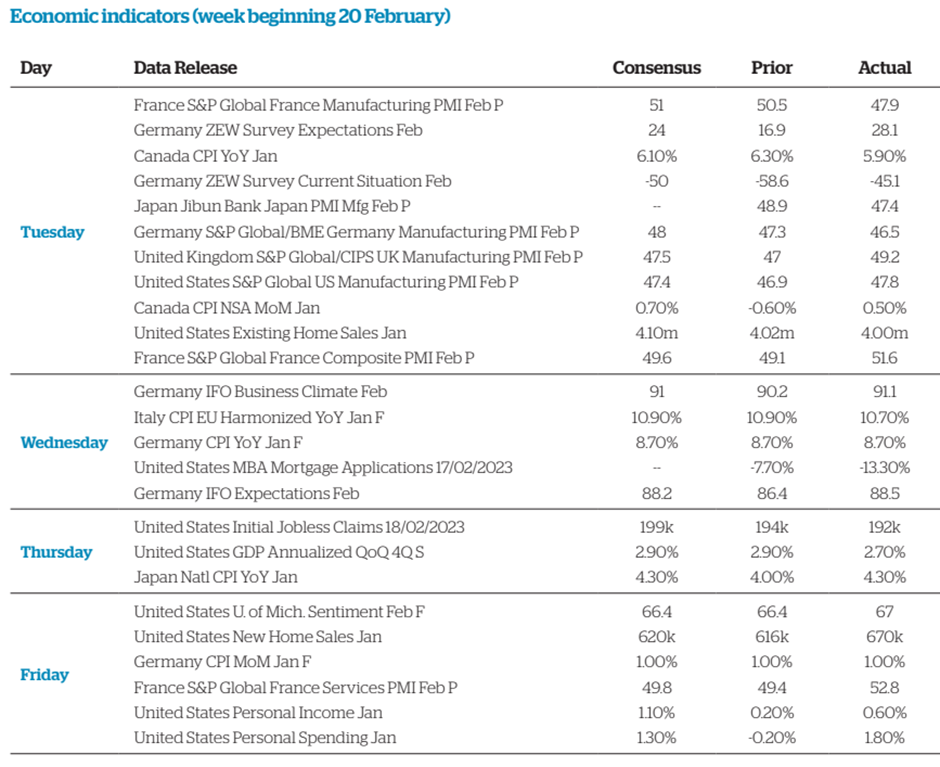
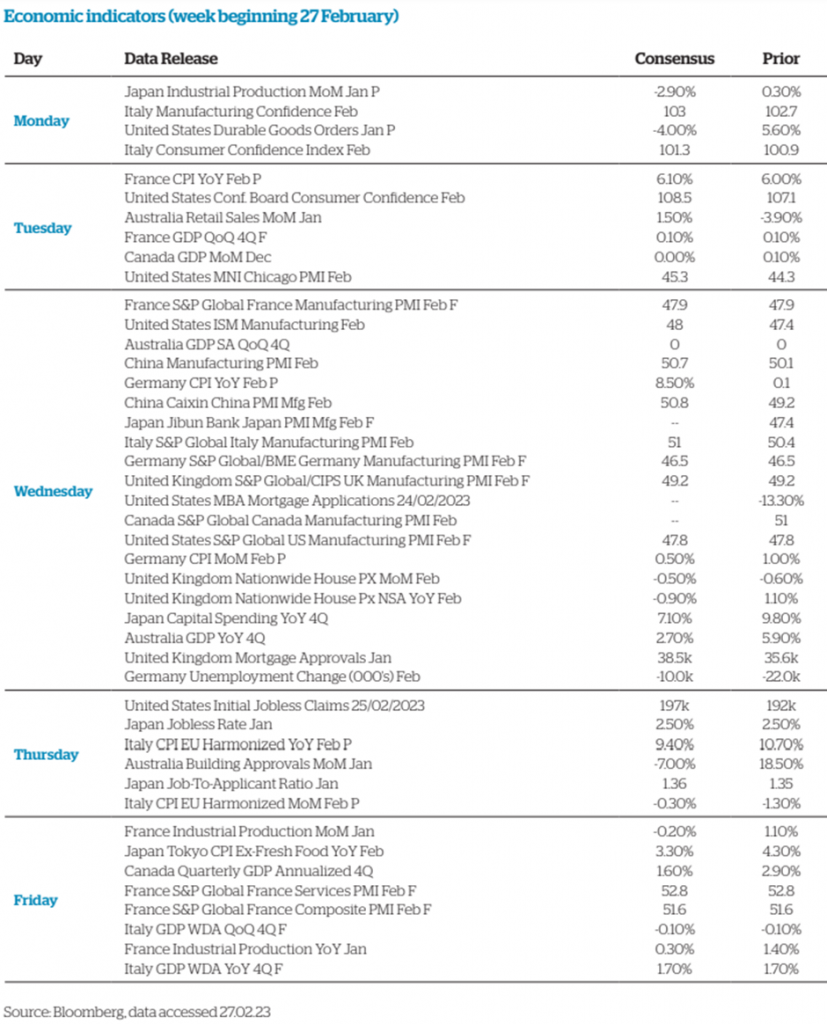
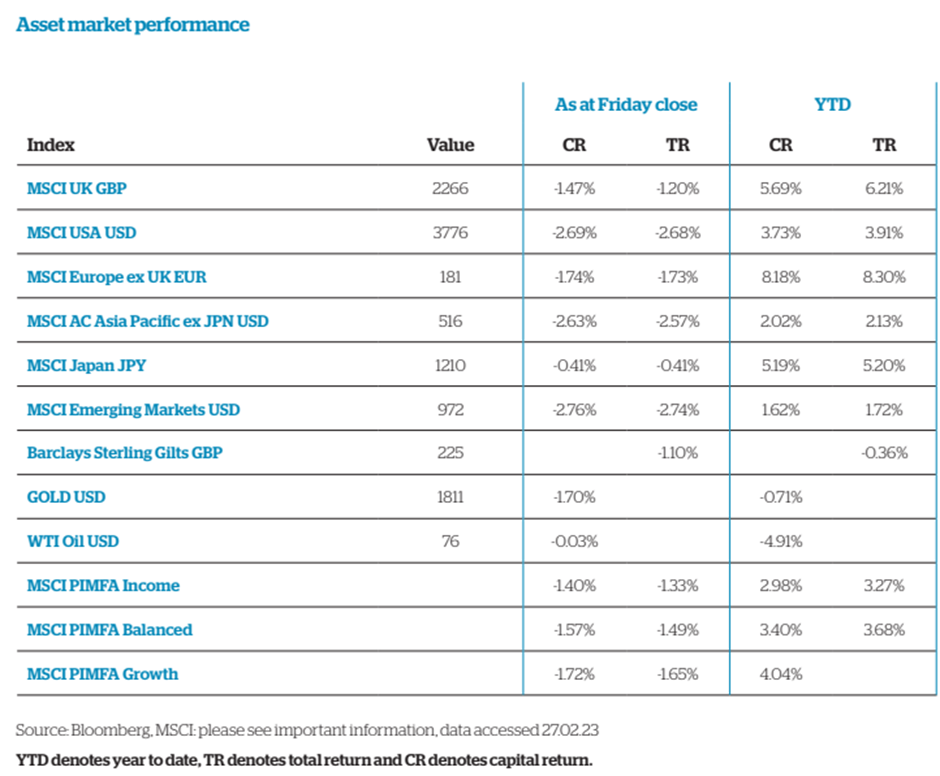
Brooks Macdonald – Weekly Market Commentary: European CPI expected to be a key focus this week

Please see below the latest article from Brooks Macdonald providing their Weekly Market Commentary, which was received late yesterday afternoon (27/02/2023):

Please continue to check our Blog content for advice and planning issues and the latest investment, markets and economic updates from leading investment houses.

Carl Mitchell – Dip PFS

Independent Financial Adviser

28/02/2023

Team No Comments

Tatton Monday Digest

Please see below Tatton Monday Digest article received this morning, which provides a global market update and an update on the UK economy.    

Overview: Balancing acts


Last week saw global equity markets give back some of February’s earlier gains. Even so, global equities have made a total return of around 5% in £-sterling terms since the start of the year. Over the past fortnight though, market participants have come to accept inflation – and in its wake interest rates – will stay higher for longer than previously anticipated. As a result, rising bond yields have been one factor pushing equity markets lower. Global risk assets tend to fare better when the US Dollar is in a bit of a decline, and that was the situation for November through to January. However, as February has progressed, the Dollar has strengthened. The biggest driver of the moves appears to be China, with weakness in the Renminbi. The surprise caused by the end of its zero- Covid policy generated optimism, but a bounce in the economy is taking longer than hoped. Activity may start getting stronger when spring arrives, but global metals and energy price falls are not a great sign.

Still, last week’s preliminary Purchasing Manager Index (PMI) data for January pointed to remarkable strength, especially within services. The resilience of households is striking, but not really surprising, given the buoyancy of jobs markets across the western industrialised world. In the US, seasonally adjusted initial claims (the weekly count of people applying for unemployment insurance) remained below 200,000. A normal level (when the job offers and seekers are in balance) is around 300,000. However, as we discussed last week, despite the tightness in labour markets there is a growing sense that inflation is not in any upward wage-price spiral. Consumption is being underpinned by the solid jobs markets, but not by household borrowing, nor by reducing savings. Spending growth is solid and sustainable rather than booming, and therefore unlikely to be overly inflationary. 

To summarise, it looks as though the big threat to market valuations of a deep and sustained recessionary period – as anticipated at the market lows of last autumn – has passed and given way to a more moderate outlook. At the same time and against the backdrop of once again considerably elevated stock market valuations, this does not mean it is all plain sailing for investors. Nevertheless, as long as labour markets and with them consumer demand continue to be resilient – weakening global growth scenarios should only result in short-term volatility. Patience will once again be of the essence for the long term investor, while for their investment managers, continued scrutiny in assessing and identifying the relative winners and losers from the gradually unfolding scenarios will be the order of the day.

Inconclusive recession indicators leave markets guessing


Recession talk has been rife over the last year, with media commentators – and even some policymakers – suggesting investors and the public should brace for an upcoming global recession. These calls are backed up by many classic contraction signals: bond market upheaval, compressed business sentiment and mortgage credit stress depressing housing market activity. Contrary to this though, several key indicators are suggesting things are not so dire: employment is strong, consumer demand is resilient and equity valuations are still relatively high. With all these mixed signals, what should we make of recession chances?
One of the most well-known predictors of recession is the shape of the yield curve – the difference in maturity between long and short-term government bonds. In a healthy growing economy, the curve should slope upward, as investors expect a stronger economy in the future and therefore demand higher returns when lending over the long-term. By contrast, when investors expect the economy to be weaker in the future than it is now, the reverse happens. The US yield curve has inverted only a handful of times in the last half century. Every single one was followed by a recession. The US yield curve is currently inverted steeper than at any point since the 1980s, as short-term (three-month) deposit rates, and two-year government yields, are significantly higher than the 10-year yield on US Treasury bonds. But this does not mean a recession is guaranteed, much less imminent. For starters, the time lag between inversion and recession is long and variable, historically speaking. And in any case, the effects of rapid inflation and aggressive monetary tightening are severely distorting bond market dynamics. That makes classic signals like these much harder to interpret.

As another fairly reliable recession indicator, credit spreads do reliably spike before and during recessions. But interestingly, the highest credit spreads tend to come when a recession is already at its nadir, which if anything can be seen as a sign of recovery ahead. In fact, since the end of last year, credit spreads around the world have trended downwards. This suggests conditions are not immediately going to turn sour, and explains some of the more positive indicators we are seeing, such as relatively high equity valuations. So, we should take heart in the recent fallback in credit spreads. We are still on recession watch, but the alarms are not sounding just yet.

European gas prices 


Britons are bracing for another energy price hike next month. The energy price guarantee – currently at £2,500 a month per household – will rise to £3,000 in March, unless the Treasury’s plans change, which seems unlikely, despite pressure from major industry players. The recent fallback in wholesale gas prices – which should give the Treasury some breathing room – will only have a “marginal” benefit to public finances, according to Chancellor Jeremy Hunt. That is debatable, depending on how you look at Government spending on the cap which will fall. 

The market prices for natural gas are expected to continue to decline quite substantially. European natural gas recently became cheaper than at any point since the summer of 2021, six months before Russia’s invasion of Ukraine and the subsequent upheaval in international energy markets. Gas is still expensive by historical standards, but crucially, energy supplies – particularly those from Russia – are no longer the immediate threat to British and European economic stability that they seemed for much of last year. Analysis from Morgan Stanley suggests European gas consumption was 22% below the seasonal average in January. Even adjusting for the warmer weather, demand was 14% lower than would be expected at this time of year. The shortfall is not only big but growing too, down from a 10% weather-adjusted fall in December. Much of this seems due to a change in the energy mix, with a 20% increase in wind power generation.

Unfortunately for UK households, falling prices will take time to filter through. But it is only a matter of time, and the effect on budgets should be roughly proportional to the fall in wholesale prices. That means, should gas tumble by more than expected – as is very possible – bills should be lower too. For growth, inflation and for people more generally, that would be a welcome relief during the next cold season.

Please check in again with us shortly for further market news and relevant content.

Chloe

27/02/2023