Team No Comments

Brooks MacDonald Daily Investment Bulletin

Please see below Daily Investment Bulletin from Brooks Macdonald:

What has happened

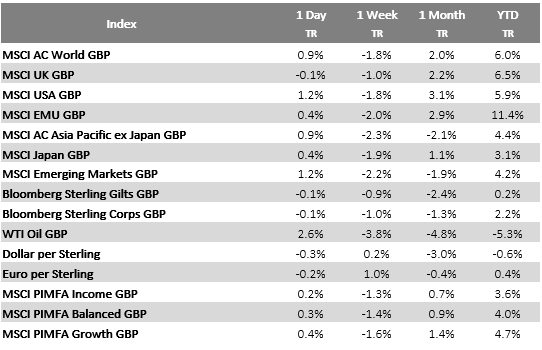
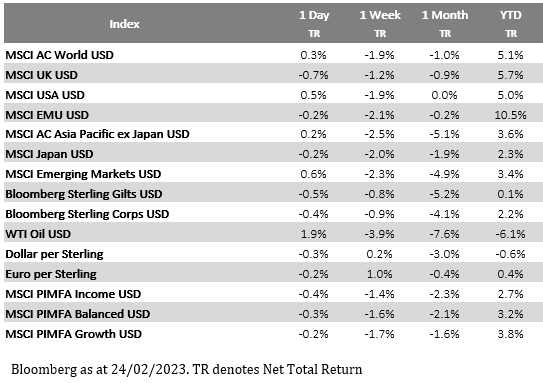
Equity markets saw huge intraday volatility yesterday as risk assets initially surged then retreated before staging an end-of-day rally. The afternoon sell-off was catalysed by further revisions to the US and European inflation prints whereas the final rally has been attributed to technical factors generating buying activity in the options market. While the focus was on the inflation data, Nvidia’s shares surged following their upside beat to revenue forecasts, this helped lift semiconductor shares more broadly.

Inflation data

The Euro Area core inflation print for January was revised upwards by 0.1% yesterday, bringing the year-on-year rate to 5.3%, the highest since the Euro was formed. This will increase the pressure on European bond markets while also giving additional justification to more hawkish members of the ECB to continue to tighten policy aggressively. The US also saw upward revisions to inflation with the PCE inflation measure rising by an annualised 3.7% in Q4 rather than the 3.2% previously. The core PCE number was also revised higher, from 3.9% to annualised 4.3%, showing that the inflationary slowdown in Q4 was less dramatic than markets had hoped.

Jobs data

The release of the weekly jobless claims provided more comfort to market with both the number of new unemployment claims for the week, and the ongoing number of claims, coming in lower than market expectations. Before anyone prematurely declares victory on the tightness of the labour market, the last 3-months of data have continued to show a tight labour market on many measures.

What does Brooks Macdonald think

While the market moves were dramatic yesterday the volume of market data and news was relatively light. One additional area of volatility was the UK gilt market with the Bank of England’s Mann saying that she believed ‘that more tightening is needed, and caution that a pivot is not imminent.’ One should note that Mann is known as one of the tougher hawks on the Monetary Policy Committee but these comments helped bond markets to almost fully price in a 25bp interest rate hike when the Bank of England next meets in March. This would bring the base rate up to 4.25%

Please continue to check our Blog content for advice, planning issues and the latest investments, markets and economic updates from leading investment houses.

Adam

24/02/2023

Team No Comments

Brooks Macdonald Daily Investment Bulletin

Please see todays Daily Investment Bulletin from Brooks Macdonald:

What has happened

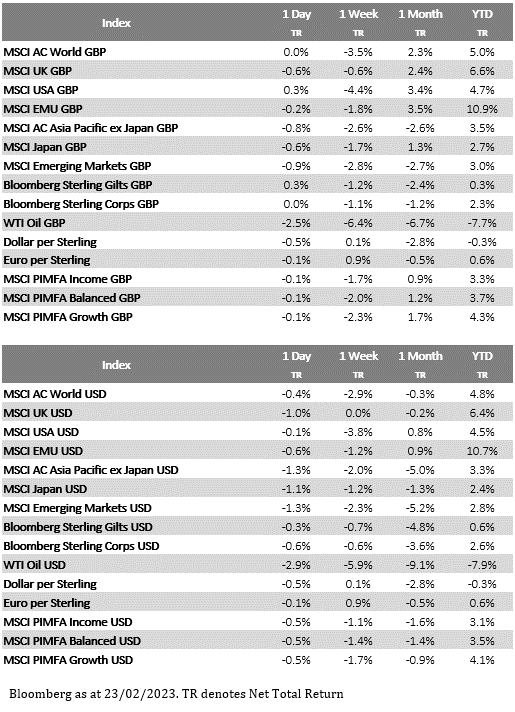
Despite a slightly more upbeat tone to US markets at the start of the day, indices ultimately fell slightly on the back of the release of the latest Federal Reserve minutes. The Federal Reserve terminal rate crept up towards 5.4% after this release while European equities also fell after catching up with the market losses seen late on Tuesday.

Federal Reserve minutes

There has been quite a bit of water under the bridge since the latest Fed meeting, including the strong US jobs report and the stickier US CPI print. Markets were however keen to glean the consensus of the committee and whether it matched the more dovish interpretation given by Fed Chair Powell in the press conference. On the decision to downshift to 25bp interest rate hike increments, this was supported by ‘almost all’ participants.

Prospect of tighter policy

Despite the broad agreement on the downshift, the minutes show significant concerns that insufficiently tight monetary policy now could lead to sticky inflation, a risk that has heightened since the meeting. Specifically, the minutes said that the Fed ‘observed that a policy stance that proved to be insufficiently restrictive could halt recent progress in moderating inflationary pressures, leading inflation to remain above the Committee’s 2 percent objective for a longer period and pose a risk of inflation expectations becoming unanchored.’ Overall, the minutes echoed the more cautious and hawkish central bank narrative that has been expressed by many of the Fed’s voting members in subsequent interviews and press events. President Williams for example yesterday said that he did not want the ‘inflation expectations anchor to slip’, which may require a tougher short term monetary policy response in light of the recent robust economic data.

What does Brooks Macdonald think

The market has largely come towards the Fed’s position over the last few weeks given the stronger economic data. This means that the meeting minutes’ focus on the risks of prematurely loose financial conditions chimes with the bond market’s pricing. One of the metrics that has been highly volatile is the 2-year inflation breakeven which, after approaching 2% around a month ago, now implies an average inflation level of 3%. The Fed will be keen to push that number lower by stressing its commitment to fight inflation.

Please continue to check our Blog content for advice, planning issues and the latest investment, markets and economic updates from leading investment houses.

Andrew Lloyd DipPFS

23/02/2023

Team No Comments

Brewin Dolphin: Markets in a Minute

Please see below, Brewin Dolphin’s ‘Markets in a Minute’ article summarising the key economic and markets news from the past week. Received late yesterday afternoon – 21/02/2023

Stocks mixed as FTSE 100 passes 8,000

Stock markets were mixed last week as US and UK retail sales beat expectations while consumer price inflation eased.

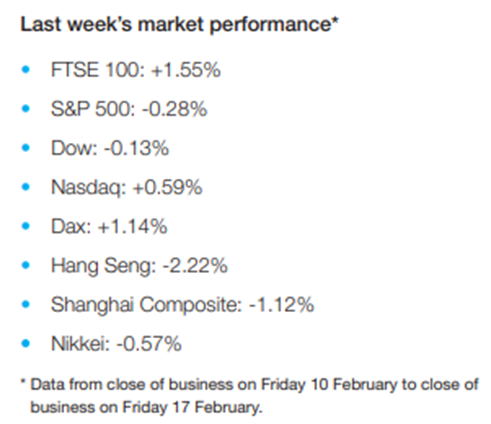
The FTSE 100 added 1.6% in a week that saw the blue-chip index close above 8,000 for the first time. Investor sentiment was boosted by UK retail sales rising 0.5% month-on-month, exceeding economists’ expectations for a 0.3% fall.

In the US, the S&P 500 was down 0.3% and the Dow lost 0.1% as economic data raised fears of further interest rate hikes. A strong performance among technology stocks helped the Nasdaq grow by 0.6%.

In Asia, China’s Shanghai Composite dropped 1.1% and Hong Kong’s Hang Seng lost 2.2% on concerns of escalating geopolitical tensions between China and the US. Japan’s Nikkei dropped 0.6% following lower-than expected gross domestic product (GDP) growth in the final quarter of 2022.

House prices rise by just £14

UK and European indices made marginal gains on Monday (20 February), with the FTSE 100 and STOXX 600 both up 0.1%. In economic news, figures from Rightmove showed UK house prices rose by just £14 in February, the smallest January-to-February increase on record. On an annual basis, house prices grew by 3.9% following a 6.3% rise the previous month.

US markets were closed on Monday for President’s Day.

The FTSE 100 opened in the red on Tuesday (21 February), despite data showing the government unexpectedly recorded a budget surplus of £5.4bn in January as self-assessment income tax receipts hit a record high.

UK inflation slows

Figures released by the Office for National Statistics (ONS) last week showed UK inflation, as measured by the consumer price index (CPI), eased to 10.1% year on-year in January from 10.5% in December, exceeding economists’ predictions of 10.3%. On a monthly basis, the CPI fell by 0.6% in January. Prices for transport, restaurants and hotels fell month-on-month, whereas tobacco and alcohol rose 2.7%.

Encouragingly, core inflation – excluding energy, food, alcohol and tobacco – fell to 5.3% in the 12 months to January from 5.8% in December, much lower than the 6.2% forecast by economists. Nevertheless, economists are still anticipating a further interest rate hike of 0.25 percentage points in March.

Separate figures showed UK retail sales unexpectedly grew by 0.5% in January, whereas economists had been predicting a 0.3% fall. Consumer confidence was boosted by seasonal discounts and falling fuel prices. On an annual basis, sales volumes declined by 5.1% compared to January 2022.

US economic data sparks rate hike fears

Over in the US, figures showed that while consumer inflation eased in January, it remained higher than anticipated. Markets were volatile following the release of the data, which showed prices rose by 6.4% year on-year in January, a modest decline from 6.5% in December and higher than the predicted rate of 6.2%. Core CPI measured 5.6% year-on-year in January, a drop from 5.7% in December but higher than the anticipated 5.5%. On a monthly basis, CPI grew by 0.5%, with about half of the increase driven by rising shelter costs.

Meanwhile, the producer price index (PPI), which measures the change in prices that producers receive for their goods and services, rose at an annual rate of 6.0% in January, down from 6.5% in December. Month-on-month, prices rose by 0.7%, the largest increase since June, surpassing economists’ predictions of 0.4% growth. Core PPI rose by 0.5%, the highest rate since May last year.

US retail sales were also higher than expected, growing by 3.0% in January. This was the largest increase in nearly two years and almost double forecasts of 1.8%. On a year-to-year basis, retail sales rose by 6.4%, largely driven by motor vehicle purchases.

The combination of resilient consumer spending and high inflation has raised expectations that a further interest rate increase of 0.5 percentage points may be necessary to stifle inflation.

Japan GDP grows less than expected

Japan’s economy grew by an annualised 0.6% in the final quarter of last year, falling significantly short of the market’s forecasted 2.0%. Although the Japanese economy avoided a technical recession, it rebounded less than expected after GDP contracted by 1.0% in Q3 2022. For the full year, the world’s third-largest economy expanded by 1.1% compared with a 2.1% increase in 2021.

Please continue to check our Blog content for advice, planning issues and the latest investment, markets and economic updates from leading investment houses.

Alex Kitteringham

22nd February 2023

Team No Comments

Brooks Macdonald Weekly Market Commentary: Increased US inflationary pressures cause the bond market to upgrade its interest rate forecasts

Please see the article below from Brooks Macdonald providing a Weekly Market Commentary. Received this morning 21/02/2023

A near-term increase in US inflationary pressures cause the bond market to upgrade its interest rate forecasts

Last week was characterised by a broad market reappraisal of the likely path of interest rates given stickier inflation and more robust economic growth. The bond market increased its expectations of US terminal interest rates by 10bps, with the US terminal interest rate for this cycle now expected to hit 5.28%. Despite this move, equities managed to insulate themselves from this move, with the US index posting a small loss while the European index outperformed, rising by over 1%.

Global flash PMI surveys on Tuesday will help investors gauge whether the recent US economic strength is broad

Tomorrow sees the release of the global flash PMIs which will provide an assessment of economic growth momentum on a country-by-country basis. Alongside these reports, European consumer confidence surveys will be released as well as important German industry surveys. Markets have been caught off guard by the strength of the US economy so far this year, with Fed Governor Bowman saying that she was surprised that the interest rate hikes so far had done relatively little to cool demand. The economic data this week will help markets assess whether economic demand remains robust outside the United States and whether the recent increase in the market’s ECB interest rate hike expectations is warranted.

The PCE inflation reading on Friday is likely to echo the US CPI report in showing stickier inflation at the start of 2023

With the US CPI release now out of the way, the market will turn to the PCE deflator, the inflation measure preferred by the Federal Reserve. The personal income and consumption report will provide a good gauge of the health of the US consumer on Friday with income and consumption both expected to rise versus last month’s reading. The Core PCE reading will be closely watched to see if it echoes the stickier inflation backdrop suggested by the CPI release. If prices are increasing due to stronger-than-expected US consumer consumption, this will give a clear mandate to the Fed to remain tough on inflation and double down on its hawkish narrative.

After a quiet start to the week as the US closes for Presidents’ Day, the equity market will need to decide whether to retreat or rise after a directionless fortnight for markets. The disconnect between bond pessimism and equity optimism will need to close over the coming months. One of the factors helping support equity markets is that investors, based on recent industry surveys, are still overweight bonds and underweight equities, this may allow equities to continue to perform despite the tougher inflationary backdrop.

Please check our blog content for advice, planning issues and the latest investment, market and economic updates from leading investment houses

Alex Clare

21/02/2023

Team No Comments

Tatton Investment Management – Monday Digest

Please see below, a ‘Monday Digest’ from Tatton Investment Management discussing the key economic news from the past week. Received this morning – 20/02/2023:

Overview: markets acknowledge the enduring stickiness of inflation

After a surprisingly strong start to the year in January, February has brought market consolidation rather than a continued uptrend – despite the FTSE100 finally passing the psychologically important threshold of 8,000 points. In last week’s digest we wrote that the prevailing ‘Goldilocks’ market sentiment of not-too-hot (growth, inflation), not-too-cold (rates coming down again soon) was being replaced by a more realistic view that rates will in all likelihood have to stay higher for longer than previously hoped. Inflation is stubbornly persistent – even as goods and energy/commodity price rises have indeed proven to be transitory – and tight labour markets have carried so-called second-round effects from last year’s price shock into the ‘stickier’ areas of goods and services.

Commentators from the US Federal Reserve (Fed) and the European Central Bank (ECB) have added further evidence to this view, as both said last week that central banks need to do more in their fight against inflation. This came after US consumer price index (CPI) inflation data contained both good and bad news, whereas the producer price index (PPI) inflation data showed a worrying uptick. Worrying, because falling raw material and energy costs were not enough to counterbalance price rises from rising labour and other input costs. While global government bond yields rose quite sharply after the central bank comments, they are not yet making investors fear recession is imminent. Credit spreads – for us the best indicator of fears of a recession – rose slightly last week, but are still close to the lowest levels of the past six months.

That said, the rise in bond yield levels may push the resumption of profit growth out towards 2024, which makes equities once again look relatively expensive and therefore vulnerable to corrections. This means that while we remain optimistic for the 2023 central scenario, we are more cautious for the near-term and have been taking the opportunity to lock in some of the attractive yields this period of uncertainty has brought. The shift in perspective has not necessarily changed the long-term picture of a relatively benign economic slowdown. Rather, the past weeks’ data points have injected a dose of realism into market sentiment.

Falling profit margins meet declining inflation

The last few company earnings reports for 2022 are trickling in, and at the aggregate level they look pretty bad. US companies took a big hit in the last three months of the year, and overall profits are either lower or roughly the same as in 2021 – depending on which measure you use. Relative earnings growth for the next twelve months (the rest of 2023 and the start of 2024) has also been revised down. For US equities, average earnings per share (EPS) is expected to grow by less than 4% compared to the 12 months just gone. European companies are even more sluggish, projecting 2.1% growth. By comparison, the historical averages for both US and Europe are around 11% EPS growth year-on-year.

In the light of rising interest rates and consequent slowing growth across the world, investors are braced for recession. On the face of it, corporate results back up those signs. Still, sales growth slowed rather than fell in the fourth quarter of 2022. What caused the earnings declines were therefore compressing profit margins, which declined markedly. The simple explanation would be that wages and other input costs are growing faster than sales, while on the revenue side of the equation a certain level of price discounting has crept back in following the extraordinary pricing power suppliers enjoyed during the initial post-pandemic period. That matches up with the general stagflation story, as well as with central bankers’ concerns about potential wage-price spirals.

The relationship between inflation and corporate profits is not straightforward, but in general you would expect inflation to cut into a company’s profit margins. The post-Covid episode seems to have differed from other potentially inflationary periods in that many companies appear to have raised prices on existing inventory rather than applying the price rises only to new stock. But regardless of why companies wanted to raise prices, it is still significant that they could. Moreover, the realisation that they could raise prices without choking off too much demand might mean firmer pricing power down the line. But in terms of the current outlook, it is important that rising margins were primarily a defensive move, coming from a position of expected weakness rather than strength. The opposite seems to be happening now, but for the same reasons. Profit margins are coming in, relieving a big chunk of the inflationary pressures we saw before. Whereas before, companies expected sharply higher costs and an okay short-term demand picture, now they see falling input costs and widespread talk of a recession. With sales growth already slowing, businesses likely feel the need to rein in prices – or at least hold them steady – to retain customers.
 
China’s post-pandemic recovery taking time to come through

Chinese investment assets have managed quite a turnaround over the last few months. Since November, China’s benchmark CSI 300 index has rallied by more than 15%, although gains over the last month have been harder to come by. Near-term confidence has probably been knocked by the spy balloon controversy, but markets are still clearly positive about Chinese growth this year. This is helping not only Chinese assets, but emerging markets more broadly. In fact, some market analysts have warned that buying into China’s reopening is becoming a crowded trade.

Despite the high degree of hope around China’s bounce, commodities have lately been surprisingly subdued. Copper, the industrial metal most sensitive to Chinese construction and technology production, rose sharply towards the end of last year. Since then, however, that rally has reversed somewhat. The same is true for energy, which gained momentum after the end of Zero-Covid, but has since cooled. This dynamic is also playing out across a range of industrial metals, including iron and palladium. Both are indicators of swings in the health of domestic vehicle demand. The fact palladium prices have come down is particularly interesting. While other metals point to the strength (or lack thereof) of Chinese industry, cars are more an indicator of consumer spending. Consumers appear to be slower than expected in regaining confidence.

In short, we have yet to see any conclusive signs of a strong post-Covid, post-regulatory crackdown bounce in China, despite the conducive conditions. However, we should not be worried yet that the 2023 Chinese growth spurt might fall short of expectations. When Beijing declared the end of Zero-Covid, we argued it might take some time for the results to show, in part because of seasonal factors. China celebrated its Lunar New Year at the end of January, and is only now coming to the end of its Spring festival – a month usually reserved for spending time with family, often away from the big cities. We said earlier this year that March might be the time when we see growth begin in earnest, and that is still possible. In terms of background conditions, the reopening bounce is very much on: it might just take a little longer to get going

Please continue to check our Blog content for advice and planning issues and the latest investment, markets and economic updates from leading investment houses.

Carl Mitchell – Dip PFS

Independent Financial Adviser

20/02/2023

Team No Comments

Brewin Dolphin – What is the true state of the UK economy?

Please see below article received from Brewin Dolphin yesterday evening, which provides a positive outlook on the UK economy and global markets.

The UK has been the subject of many headlines in recent weeks as journalists and politicians spar over the country’s economic performance. Ironically, this comes at a time when the economy is doing very little. We therefore felt it might be worth giving some consideration to the true state of the UK economy and what it means for investors.

Recession bound?

Traditionally, we measure economic strength by looking at the speed of growth (or shrinkage) in economic activity. The go-to measure here is gross domestic product (GDP). Faster GDP growth is assumed to be better, while two consecutive quarters of declining GDP is often considered a technical recession.

Speculation has been rife recently over whether the UK will enter a recession. If the economy shrank during the final quarter of 2022, then it would meet the technical definition of a recession because it had already contracted in the third quarter. Hence, there was great focus on the first estimate of growth for that period. As it transpired, it neither grew nor shrank, meaning that a recession has been averted for now. This splitting of hairs misses the point that the UK economy stagnated during 2022 and is in danger of doing the same during 2023.

Taking 2022 and 2023 as a whole, a recession could be avoided, or suffered, but the likelihood is that either way the economy will be a lethargic performer throughout. When we talk about the risk of a recession in the UK it conjures pictures of queues outside job centres as unemployment picks up sharply. But the opposite remains the problem for now. Jobs growth has been strong and the challenge for businesses has been finding workers.

Although the worst fears of rapidly rising energy bills due to spiralling gas prices have been eased by a warm winter and bolstering of gas supplies, prices seem likely to hover around the level of the fuel bill cap. More pressing will be the cost of refinancing mortgages for anyone whose deal is coming to an end. Mortgage interest rates have moved sharply higher during the last few years. Taxes are also set to rise from April in a bid to shore up the public finances.

The current economic environment is a difficult one, and so lower rates of growth might be inevitable to some extent.

New highs for the UK stock market

At the same time, though, the FTSE 100 has hit all-time highs. While rising oil and gas prices have weighed on the UK economy, they have helped the commodity-sector[1]heavy FTSE 100 rise by 6.2% year-to-date and breach the 8,000-point mark for the first time ever. Meanwhile, the FTSE 250 is up by around 5% year-to-date. This may initially appear counter-intuitive and, historically, the strength of an economy would inevitably have an impact upon the companies listed on the stock market there.

However, in one of the anomalous features of modern finance, that is no longer necessarily the case. Most of the major companies on the UK stock market are listed there by virtue of history, not as a reflection of their current business activities. Some 80% of FTSE 100 revenues and 50% of FTSE 250 revenues arise from outside the UK. Most companies gather sales from around the world, and a few are even specifically focused on individual countries outside the UK.

That is not just the case in the UK. New technology companies seeking to list on the stock market would feel inclined to do so on the US Nasdaq exchange, almost no matter where they were founded.

The long term

If we were to look to the long term, what can we conclude about the UK?

Convention dictates that we should judge the UK’s performance relative to its peers in the G7. This is a collection of countries who loosely formed a group in the 1970s when they were among the biggest economies in the world, excluding the Soviet Union. Today, most of these countries remain towards the top of the table, with China and India having supplanted the Soviet Union.

Starting at a discreet distance, the UK economy has been a relatively strong performing economy against this peer group since 2000. The trailblazers have been the US and Canada, but the UK has outpaced its European peers.

Much of that strong performance for the UK, however, came in the early years and a series of shocks mark useful milestones to check on our national progress. Since the financial crisis, for example, Germany has pretty much caught up with the UK, while France, Japan and Italy have all lagged.

Looking ahead, we can observe that there are some features of the UK which act as impediments to its economic growth.

The most obvious is demographics. In many parts of the world, populations are growing more slowly or, in some cases, starting to decline. Demographics is one of the key determinants of growth. The UK population has been growing faster than its European peers, but Canada has been the fastest growing in the G7 both economically and in terms of population. The worst-performing economies for growth have been Japan and Italy whose populations, unsurprisingly, are contracting.

Connected with demographics is the fact that the UK is the second-most densely populated of the G7 (after Japan). This results in a lot of opposition to new development, particularly on greenfield sites. This has been a hindrance to economically stimulative activities such as housebuilding as well as new infrastructure projects such as rail links or runways. The UK has a similar population growth rate to that of the US but the latter is managing to grow more strongly than demographics alone would suggest.

The UK also has a disproportionate share of its economy devoted to services. One of the advantages of this is that many services activities create a lot of value. However, one of the shortcomings is that the services sector tends to experience less productivity growth than the goods and production sectors, where new tools and techniques see a more stable pace of efficiency gains.

All European states suffer relative to G7 highflyers like Canada and the US from being relatively poor in natural resources. The UK, in particular, with its higher-than[1]average population density, imports a higher share of energy and food than some other members of the G7.

Growth isn’t everything

If this description of the UK seems very downbeat, then some additional context is needed.

The UK has several strengths, most notably its time zone, its language, its legal system, its universities and its history. As a desirable place to work and live, the UK continues to be an attractive destination for talented young workers. The UK has a strong competence in technology and science, which is not represented in its investment market.

As mentioned at the beginning, GDP is a conventional way of measuring economic performance, but that doesn’t mean that it necessarily captures every aspect of standard of living, which most people would care more about. And which contribute to creating a desirable place in which to work and live.

What does this mean for investors?

When deciding which investment market to invest in, the constituents of the index are as important as the region it is based in. Technology is the largest sector in the US, for example. The UK, on the other hand, has quite a spread of industries represented. The biggest sector is financial companies but that can be misleading; many of them are investment trusts, which themselves invest across a whole host of other sectors within the public markets or more diverse asset classes. The UK is rich in defensive ‘staple’ goods, which are less exposed to the vagaries of the global business cycle. Conversely, however, it also has some of the most economically sensitive companies in the form of its substantial constituents from the energy and mining sectors.

Whilst it makes the market somewhat incoherent – it is neither defensive nor cyclical – it does mean investors in the UK have scope to choose from a lot of different kinds of companies.

The fact that UK stocks generally generate a lot of their revenues from overseas provides some benefits. When the UK economy performs poorly or suffers shocks, the pound tends to fall. We saw this around the global financial crisis, Brexit referendum and emergence of Covid. These falls increase the value of the overseas profits UK companies generate, which helps to cushion some of the falls (although the same can generally be said of overseas-listed companies too).

Other assets such as UK bonds, and particularly UK government bonds (or gilts), are more connected to the UK economy. When the economy is struggling with a more conventional recession, the Bank of England is expected to cut interest rates. This increases the value of UK government bonds, which pay a fixed rate of interest. Some government bonds provide protection against inflation as well, although they are still sensitive to interest rates; balancing the extent to which they may benefit from higher inflation but suffer from higher interest rates is a complex analytical task.

Across the spectrum of company shares, bonds and the pound, there are various ways to benefit from the UK, whether it is on the up or down in the dumps. Currently, we believe that the UK’s economic headwinds make gilts more attractive than most other government bonds. However, we have reduced our long-term UK equity weightings after a strong year that was driven by the resource-heavy nature of the market during 2022.

Please check in again with us shortly for further relevant content and news.

Chloe

17/02/2023

Team No Comments

The minimum age you can access a pension is changing – why does this matter?

Cut and pasted from an A J Bell email received Thursday afternoon 16/02/2023:

It’s important to understand how the rule changes will impact your financial planning

Author: Tom Selby

The earliest age a pension can be taken is going up to 57 in 2028. Those who are 50 now might not be aware the impact this will have on their decisions. Can you elaborate? Steve

Tom Selby, AJ Bell Head of Retirement Policy, says:

You are referring to the ‘normal minimum pension age’ (NMPA), which is the youngest age someone with a defined contribution pension can access their retirement pot.

The NMPA is currently set at age 55 and is scheduled to rise to age 57 in April 2028, the same date the state pension age is due to increase to 67. That means if you are roughly aged 50 or younger today, the earliest you can access your pension in most circumstances will be 57.

The NMPA is then expected to remain 10 years lower than the state pension age, meaning it should increase again to 58 in April 2046 (when the state pension age is due to rise to 68).

If you have a defined benefit scheme, the age at which you receive your retirement income – and any tax-free lump sum entitlement you choose to take – will usually be determined by your scheme’s ‘normal pension age’ (NPA). Some schemes will allow you to take your income early, usually at a lower rate.

It is not possible to take your state pension early, although you can defer taking it if you want to.

The Government has created a complex set of rules to manage the transition to an NMPA of 57. Rather than apply the increase across the board, it has proposed creating a ‘protection’ regime so savers in a scheme which gave an ‘unqualified right’ to a NMPA below age 57 on 11 February 2021 can retain that earlier pension access age. This will be known as a ‘protected pension age’.

If people with this protection subsequently make an individual transfer to another (non-protected) scheme, the transferred funds will be able to keep the lower NMPA – although any benefits held in the receiving scheme before the transfer, or new contributions, will have a NMPA of 57 from April 2028.

People with a protected pension age who transfer as part of a ‘block’ with at least one other member of the same old pension scheme to the same new scheme at the same time will be able to retain the lower NMPA for all their funds in the new scheme, including any new contributions in.

Think carefully about what you are going to do with the money if you do access it early (such as in your late 50s), and how making the withdrawal today could impact the future sustainability of your retirement plan. If you are unsure, speak to a regulated financial adviser to better understand your options.

Comment

This could be a complex area but it’s not likely to impact on too many people in the UK, the majority can’t afford to retire earlier than age 65 or even State Pension age.

With regards to State Pension age we know that we are getting age 67 from April 2028 but age 68 is less clear in terms of timing.  I’ve read that this being looked at for 2044 and that this is under review.  Apparently, the State Pension age could be age 68 as early as 2038.

The key message for me here is that if you want to retire early take control and build enough of your own pension and investment assets so that the State Pension age does not impact on your early retirement plans.

Why are the government increasing State Pension age on a regular basis?  To try and counter the increasing cost of the ageing demographics in this country.  To increase State Pension age is a win/win for the State.  They save money paying out State Pensions later on, and it is likely more people will remain in work paying tax etc.

Steve Speed

16/02/2023

Team No Comments

Brewin Dolphin – Markets in a Minute

Please see this weeks Markets in a Minute update from Brewin Dolphin received yesterday evening:

Please continue to check our Blog content for advice, planning issues and the latest investment, markets and economic updates from leading investment houses.

Andrew Lloyd DipPFS

15th February 2023

Team No Comments

Brooks Macdonald – Weekly Market Commentary

Please see below, Brooks Macdonald’s Weekly Market Commentary, analysing the performance of markets over the past week. Received last night – 13/02/2023

Equities fell last week as investors called into question the disinflationary narrative that has driven returns in 2023

Last week saw the worst US equity performance so far in 2023 with European shares also falling as the disinflation narrative was called into question by investors. Last week began under the shroud of the stronger-than-expected US employment numbers released the previous Friday but hawkish central bank speak and strong US used car inflation caused sentiment to continue to wane after a mid-week attempt at a rally.

US CPI on Tuesday will confirm whether the disinflationary trend remains intact and contains important labour market data

The latest, all-important, US inflation print has come around quickly with the headline US CPI expected to have expanded by 0.5% month-on-month on Tuesday, equating to a 6.2% year-on-year gain. US Core CPI is expected to have expanded by 0.4% month-on-month, driving the year-on-year number to 5.5%. Higher gas prices are the main factor driving the headline CPI number higher. Investors will also be looking at the length of the average workweek which is expected to have contracted last month, and the average hourly earnings which are expected to rise by 0.2% after rising by 0.3% in the last reading. There will be dual hurdles in the data tomorrow, does the headline and core CPI number continue to show disinflationary progress within the year-on-year number and secondly are there signs that some of the tightness in the wage market is easing. Later this week sees the release of the latest US producer price inflation which is considered a lead indicator of future consumer inflationary pressure.

After a dismal set of US leading indicators were released in January, markets expect these to be upgraded in this week’s reading

Recent US economic data has been stronger over the last few weeks and this stands in contrast to the start of the year which saw some pretty terrible releases. One of those poor releases were the US leading indicators, the latest release of which we will see on Friday. The US leading indicators are expected to pick up from the last reading but continue to stay in negative territory. Other data that is expected to bounce from the last reading include regional factory surveys and industrial production.

With the US earnings season well past its halfway point, the main questions that remain in the US market are whether the disinflationary trend continues and how strong the economy is. The data releases this week will help provide some concrete data after the speculation, both by investors and central bankers, over the last week which has driven market volatility.

Please continue to check our Blog content for advice, planning issues and the latest investment, markets and economic updates from leading investment houses.

Alex Kitteringham

14th February 2023

Team No Comments

Tatton Monday Digest

Please see below an article from Tatton Monday Digest. Received this morning 13/02/2023.

Overview: a challenging week brings investors back down to earth

For most of this year, investors have ran with the notion of a decline in longer-term inflation pressures, but they have been less convinced in recent days. As a result, bond and equity markets slipped back last week, despite the FTSE 100 reaching a new all-time price high on Thursday of 7949.57. What’s caused the sudden downward mood? Arguably January’s exceptionally strong US employment data weakened a key component of the market rally, knocking back while expectations that central banks would soon slip into neutral gear. Last week, Catherine Mann, an independent member of the Bank of England’s Monetary Policy Committee, warned there were still likely more rate rises to come in the UK, while in the US, Federal Open Markets Committee members also suggested that while the pace of rate rises may have slowed, the end was not yet in sight.

For most investors the question now is whether growth this year and next year will be slow but steadyish, or will it be “too strong” and therefore be forced to slow more dramatically by ever-tighter monetary policy. If we want an early path to lower interest rates and an early path to steady profitable growth, perhaps it is preferable to get weaker economic data now. The UK’s 2022 fourth quarter gross domestic product (GDP) data could not be described as strong although, contrary to expectations, it did not show a contraction. The quarter showed no real growth at all, while the mix was a little surprising, with services weaker than expected while manufacturing was stronger.

One of the reasons why markets have rallied this year is that we haven’t had any nasty shock for some time – Russia’s invasion of Ukraine was the last serious one. Markets could therefore plod along, eking out steady but small returns, while firms improve their cost bases amid slowish revenue growth alongside slowish economic growth. As we said at the start, further declines in bond yields and inflation expectations would be a big help.

Lastly, a quick mention on energy prices. There is still a possibility of cold weather for this winter, but gas storage levels remain very high across Europe in comparison to past years. In France, the main gas supplier estimated it will have storage at 40% capacity by winter-end, unless there are extremely freezing conditions substantially above normal. Gas and electricity prices continue to fall for next winter’s contracts and are now only double the price of winter 2021, before Russia removed supply. That still may sound terrible, but a return to near-normality now looks increasingly feasible.

Natural disaster hits Türkiye’s economy too 
In the wake of tragedy, discussing the economy can sound a little callous. The earthquake in Türkiye and Syria has killed more than 35,000 people, and injured tens of thousands more. The scale of the devastation is not yet clear, but the real toll will likely be much higher, with hundreds of thousands displaced from their homes. Over the longer term, rebuilding efforts will require resources and investment, which will mean smaller capacity for other things. In short, economic impacts are human impacts too. These impacts could be amplified by the nation’s already weak economy. President Erdogan has already pledged $5.3 billion in emergency aid. Given the government is running a budget deficit, short-term funding will mean extra borrowing. This will likely come at a great cost; yields on 10-year Turkish bonds are at 11% right now, and could go higher if more cash is needed.

Unfortunately, the global financial system does not stop to mourn. In the wake of the disaster, international investors sold Türkiye’s Bist 100 index at a rapid pace, culminating in a 7% fall on Wednesday morning. The negativity caused stock trading to be suspended, and reflected deep concerns over the hit to Türkiye’s productive capacity. However, while the stock market is closed temporarily, other indicators are not currently suggesting volatility in Turkish assets. Spreads on Turkish bonds (the difference between US and Türkiye yields) have barely moved, while the lira has remained static against the dollar in the days since the crisis. Perhaps this is testament to the support that Türkiye now has in the international community. President Erdoğan’s clashes with international markets are well documented, and have led to an inflation crisis in Turkiye which long predates global supply-side problems. But natural disasters can generate a lot of support for the afflicted countries – both politically and financially in the form of aid. If there is any good to come from this at all, it will be that President Erdoğan improves his relationship with western leaders. Regardless of his own politics, that will vastly improve the country’s prospects of rebuilding. The people of Türkiye desperately need that help now.

Will world trade die with the WTO?
When it launched in 1994, the World Trade Organisation (WTO) was the crowning achievement of western neoliberalism: an international regulator dedicated to lowering trade barriers around the world, opening up economies and creating a genuinely global market for goods, labour and services. But WTO members have not made any progress on new rules or treaties for more than two decades, and its court of appeal has not had the required number of judges – meaning disputes cannot be settled and its existing trade rules are unenforceable. Unless the court is rejuvenated, the world’s WTO trade laws will just be scraps of paper.

The question is, then, will world trade wither and die with the WTO? More likely is an increased reliance on regional trading blocs or supply chains. Within these regional blocs, trade links are likely to become deeper, even if the links between regions become shallower. This process is already playing out in Asia, Africa and South America. There is a good chance it could lead to a renewed bout of European integration too, particularly if European leaders think the US is no longer a dependable trade partner. 

The latest White House policies suggest President Biden plans to take full advantage of a world with fewer trade rules. The Inflation Reduction Act (IRA) passed in August promised tax breaks or subsidies for clean energy companies, with support tied to energy being produced in the US. European politicians are reportedly furious with flagrant attempts to give US companies a competitive advantage. But with the WTO crippled, they effectively have no recourse. The impasse seems to be making European Union (EU) lawmakers question their own trade rules. Currently, these restrict subsidies and state investment to encourage greater competition. But last month, European Commission president Ursula von der Leyen told delegates in Davos that the EU “needs to be competitive with offers and incentives that are currently available outside the European Union”. If they follow through, it would likely mean a chain reaction where nations around the world put up higher and higher trade barriers in reaction to one another. Therefore, a moribund WTO could have lasting and wide-reaching consequences. 

Please check our blog content for advice, planning issues and the latest investment, market and economic updates from leading investment houses.

Alex Clare

13/02/2023