Team No Comments

Evelyn Partners Update – March Fed rate decision

Please the below article from Evelyn Partners providing an update on the Federal Reserve decision on interest rates received yesterday, 22/03/2023.

What happened?

The Federal Reserve met today and chose to increase rates 25bps. This was in line with the latest market expectations and takes the target range to 4.75% – 5%. The Fed also published their quarterly ‘dot plot’ which shows where committee members see rates heading in the future. It showed rates peaking this year at a level of 5.1%, the same level they had thought at its last publication in December. The Fed’s quantitative tightening programme continues at its previous pace of up to $95 billion a month.

What does it mean?

Less than two weeks ago Fed chair Powell was suggesting that it may be appropriate to increase rates by 50bps at this meeting if the data continued to show strength. Since then, February’s 300k job growth and 0.5% MoM core CPI inflation bolstered this case, and the meeting may have delivered it were it not for problems in the banking sector. The failure of Silicon Valley Bank in the US and Credit Suisse in Europe caused market participants and the Fed alike to reconsider the path for interest rates in the US.

Futures markets had expected interest rates in the US to peak at around 5.5% in July and remain at this level for the foreseeable future. SVB hit the headlines on 10 March and investors digested the likely fallout over the weekend. By the close of business on Monday, markets were pricing in a peak of just 4.75% as soon as May and a full percentage point of reductions by the year end – a remarkable turnaround. Since then, those expectations moved back higher, and earlier today the peak was expected at around 5% in May before declining to around 4.5% by the end of 2023. Expectations for today’s meeting declined from a 50bps increase to 25bps prior to the announcement, although at one stage markets were suggesting the most likely outcome was no change.

The unusual level of volatility in expectations prior to today’s meeting shows the market’s changing expectations for how the Federal Reserve was going to balance the pressing need for financial stability alongside its mandate of price stability. Clearly stress in the banking sector has added to uncertainty and made the Fed’s job more difficult. In the statement today, they remark “Recent developments are likely to result in tighter credit conditions for households and businesses and to weigh on economic activity, hiring, and inflation. The extent of these effects is uncertain.”

They also changed elements of language in the statement from last month “ongoing increases in the target range will be appropriate” to the softer “some additional policy firming may be appropriate”. Markets’ initial reaction to the statement was dovish, with the yield curve steepening and stock prices broadly increasing. Given the robust economic numbers coming out of the US, some commentators had expected a move higher in the ‘dot plot’ which did not come.

Bottom Line

Today, the Fed followed the European Central Bank in delivering an expected interest rate increase at their March meeting – we expect the Bank of England will do similarly tomorrow and increase their base rate by 25bps. Clearly central banks believe that fight against inflation is not yet won and while recent turbulence in the banking sector is of concern, it is not enough for a significant change of course. After the statement, market expectations are for rates to peak at the next meeting in May, and we continue to suggest increasing duration in government bond portfolios as the Fed comes ever closer to the end of this hiking cycle.

Please check our blog content for advice, planning issues and the latest investment, market and economic updates from leading investment houses.

Adam Waugh

23/03/2023
Team No Comments

Evelyn Partners Update – February UK CPI Update

Please see the below article from Evelyn Partners providing an update on the February UK CPI. Received this morning 22/03/2023.

What happened?

UK February annual headline CPI inflation was reported at 10.4% (Reuters consensus: 9.9%), up from 10.1% in January but down from a recent peak of 11.1% in October. In monthly terms, CPI was up 1.1% (consensus: +0.6%), compared to a fall of -0.6% in January.

February annual core inflation (excluding food, energy, alcohol, and tobacco) was 6.2% (consensus: 5.7%), versus 5.8% in January. In monthly terms, core CPI increased 1.2% (consensus: 0.8%), compared to a fall of -0.9% in January.

What does it mean?

Inflation appears to have re-accelerated in February. In monthly terms, headline CPI accelerated by a sharp 1.1%, while the headline annualised rate has increased slightly (shielded to a certain extent by the base effect). This stickiness has been especially prevalent in core inflation which gained 1.2% on the month, it’s largest month-on-month acceleration since 1993.

Looking at the contribution components to inflation, a large part of February’s acceleration can be attributed to restaurants and hotels, with the category increasing at its fastest annual rate since 1991. Food and non-alcoholic beverages also contributed heavily with their annual rate the highest for over 45 years, vegetables were a notable mention, with a poor crop yield in Europe and Africa reducing supply.

Tightness in the labour market continues to put pressure on wage growth. The risk is that rising wages will feed through to inflation, causing it to become entrenched. The latest data shows that underlying wage rates (ex-bonuses) have re-accelerated to 6.5% on a 3-month moving average, near its highest rate since the summer of 2021.

Bottom Line

With the inflation re-accelerating in February, we’re still a long way off the Office for Budget Responsibility’s (OBR) forecasts of inflation reaching 2.9% by the end of 2023. While inflation continues to remain elevated, the Bank of England (BOE) have a fine line to tread between restoring price stability and limiting additional pressure on the banking sector when they vote on the next monetary policy decision tomorrow.

Please check our blog content for advice, planning issues and the latest investment, market, and economic updates from leading investment houses.

Alex Clare

22/03/2023

Team No Comments

Brewin Dolphin: Markets in a Minute

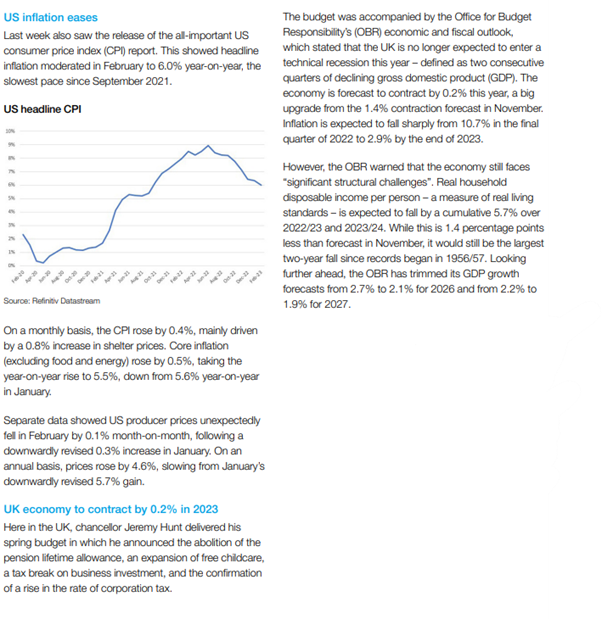
Please see this weeks Markets in a Minute update from Brewin Dolphin received late yesterday afternoon:

Please continue to check our Blog content for advice and planning issues and the latest investment, markets and economic updates from leading investment houses.

Andrew Lloyd DipPFS

22/03/2023

Team No Comments

Brooks Macdonald: Weekly Market Commentary – Credit Suisse takeover sets a new precedent

Please see below, Brooks Macdonald’s ‘Weekly Market Commentary’ which provides a brief overview of the key market events for the past week. Received yesterday afternoon – 20/03/2023

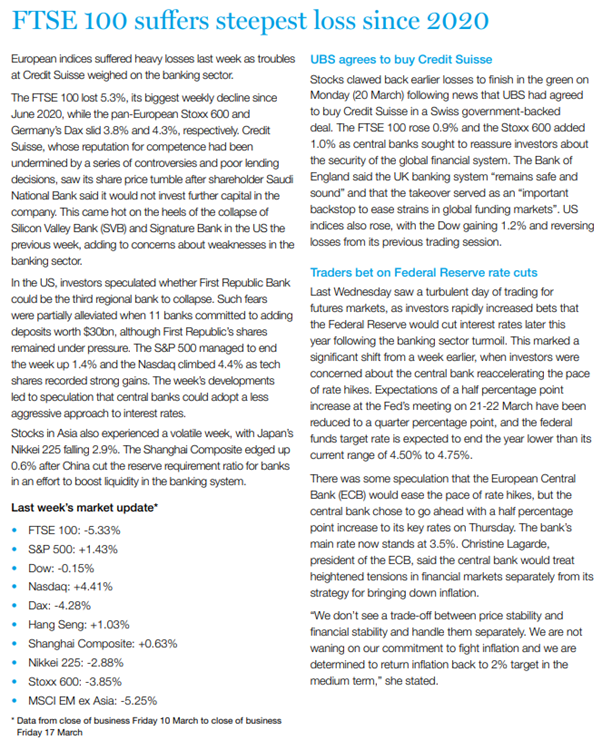
US regional bank concerns move to Europe as Credit Suisse is bought by UBS

The banking sector issues started with Silicon Valley Bank (SVB), moved into the US regional banks but finally became a far wide issue of banking confidence when Credit Suisse’s creditworthiness was called into question last week. Over the course of the weekend UBS and Credit Suisse have agreed a deal which seals the fate of one of the best-known European banks.

The takeover of Credit Suisse bypasses a shareholder vote and sees ‘CoCos’ written down to zero

On Sunday it was announced that UBS would buy Credit Suisse for $3.3bn, a significant discount to where the shares were trading on Friday. The merger is being pushed through without shareholder approval which sets a precedent that systematically important banks can be sold or merged with minority shareholders unable to push back. In practical terms this was designed to avoid a high-profile deal being thrashed out, then voted on, all in the eye of financial markets that are skittish after the events of the last week. The other feature of the deal is that owners of ‘contingent convertible bonds’ (CoCos), a debt security designed to convert to equity during a crisis, will be written down to zero. While Credit Suisse is clearly under major pressure, its actual solvency ratios have been robust, this will undoubtedly raise strong objections from owners of the CoCo securities which have had a worse outcome than equity holders despite appearing to be more senior in the bank’s capital structure.

This week the Federal Reserve needs to weigh up the size of its next interest rate hike amidst the banking volatility

There will be much debate in the coming weeks about what the correct yield is for CoCo bonds going forwards. In the post financial crisis world, they have become an important part of bank regulation which sees a pool of debt capital designed to take losses during a major banking event (rather than just equity holders taking the pain then the government stepping in). The fair price for such securities going forwards will be questioned given the Credit Suisse precedent. Investors will be looking to the ECB and Federal Reserve for confirmation of whether this precedent will only apply to Swiss banks or the wider sector. A consortium of central banks (including the Federal Reserve, Bank of England and European Central Bank) has announced that they will increase the liquidity that they provide to the financial system to help provide a backstop during the current volatility. Later this week attention will turn to the latest Federal Reserve meeting where markets expect only around a 70% chance of a 25bp interest rate hike given the current banking turmoil.

At a macroeconomic level the Credit Suisse/UBS merger reduces market risk and is likely to put a line under the near-term risks of Credit Suisse’s creditworthiness given it comes alongside a large amount of liquidity support from the Swiss National Bank. Credit Suisse has been an outlier amongst European banks for some time, with elevated yields, questions over its management and involvement in several high profile issues (including Archegos and Wirecard). The reduction in the risk of Credit Suisse contagion is good news for financial markets today, however the implications of the rapid deal which has run roughshod over market laws and conventions will have more impact on how banks fund themselves going forwards.

Please continue to check our Blog content for advice and planning issues and the latest investment, markets and economic updates from leading investment houses.

Alex Kitteringham

21st March 2023

Team No Comments

Tatton Monday Digest

Please see below article received from Tatton Investment Management this morning, which reflects on the market’s reaction to global banking issues over the past week.

Overview: Bank stress-testing in real-time 


Following the run on Silicon Valley Bank (SVB), fear has spread. The nervousness of market participants over recently elevated stock and bond valuations found its focal point and so the stock index of the aggregate global bank sector had a very bad week. SVB has become the first sizeable victim of the steepest rise in rates since the 1970s, but its close affiliation with tech, healthcare and crypto is particularly notable. After seeing a near tripling of money deposited by start-up companies and their affiliates during the good times (namely the 2020/2021 tech and healthcare boom), those deposits were heavily drawn on recently when those same companies required funds to bridge the financial strains of these distinctively more challenging times.

Taking into account how much better capitalised and less credit risk exposed banks are today when compared to the run up to the GFC, they seemed an unlikely target and victim this time, but it turns out banking sector trust had never been fully rebuilt. Given SVB specific weakness was an outlier, with its losses from its long maturity government bonds wiping out its equity base, it was right that central banks stepped in to stop the self-enforcing avalanche of mistrust. That stock markets continued their highly volatile trading into the latter part of the week goes to show that once confidence is dented investor are more open to consider that there is the possibility for a much worse than the ‘steady as she goes’ scenario that could play out this year.

The lesson from the past few days is that the pain caused by the rises in rates is hitting small and micro-cap firms particularly hard, even if they are strictly speaking growth stocks whose valuations would otherwise benefit. But we should be heartened that this week proved central banks are reactive to issues of financial instability. The centre of the storm moved to Europe and particularly Switzerland as Credit Suisse came under pressure. The European Central Bank (ECB) still raised rates by 0.5% on Thursday as it had promised at its previous meeting, but President Christine Lagarde was notably reticent about offering any further indications of rate moves.

To top it all off, the market is now pricing in the strong likelihood that March will see an end to all the rate rises in the Western world, and that rates could be cut everywhere by year-end. This week, the Federal Reserve (Fed) and the Bank of England (BoE) meet. Despite the turmoil, markets on balance expect a 0.25% move from both. We have revised our views as well and see a 0.25% move in the US where data remains strong enough to justify it, but we expect the UK will not move. So, for the shorter term it appears that central banks’ objective to tighten financial condition to bring down inflation has suddenly been significantly accelerated through market action.

Is this a banking crisis? And if so, could it get as bad as last time?

 
What makes a crisis a crisis? Ernest Hemingway said bankruptcy happens “gradually, then suddenly”. Weaknesses build up over time, and wider economic circumstances add pressure on them. But for any given company, the full extent of its weaknesses is only revealed when things get so bad those weaknesses cannot stay hidden. The nature of banks means the financial system is more vulnerable than other sectors. Often the first bank failures in a downturn don’t precipitate a crisis but they do reduce the system’s overall willingness to tolerate risk. When the next set of bad news gets out, confidence plummets and financial problems spiral. We saw this a decade and a half ago with Bear Stearns and later Lehman Brothers. Cracks emerge slowly, but shattering happens all at once.

Over the last year, interest rates have risen at the fastest pace in a generation. Meanwhile, economic growth has slowed dramatically. That means higher capital costs with lower aggregate returns, a difficult environment for banks as a whole. When crypto hub FTX collapsed last year, we said this was a sign of the times – opaque high-risk investments being exposed – and that further casualties down the line were likely. That is exactly what happened with Silvergate Capital l, and then SVB. 

The fact that troubles have spilt over to Credit Suisse is a sign that contagion is still very possible, though. Even if the US tech banks can fail in a relatively isolated fashion, a bank as big and important as Credit Suisse is a different matter. Moreover, European banks are much more tightly linked than US counterparts. If Credit Suisse had been allowed to collapse, shockwaves would have been felt far away, and weaknesses at other banks would certainly be exposed. The Swiss regulators’ decision to wipe out holders of Credit Suisse Coco bonds as part of the UBS ‘shot-gun’ marriage deal may still prove too much for the system, with a need to address the failout in some way. That being said, there are two key differences to the events of the global financial crisis. First, the policy response has been swift and decisive. In the US, the Biden administration effectively bailed out depositors of a bank considered too small to be systemically important, as soon as troubles began. Meanwhile, SNB provided billions in liquidity to Credit Suisse on the same day its stock sunk. The long-term merit of these moves is debatable; indeed, European lawmakers are reportedly angry about the US flouting bailout rules they helped create. But they undoubtedly make short-term financial contagion less likely. Second, crises spiral when unknown risks come to light, but most of the current risks exposed at Credit Suisse were already in the light, and known about for some time. We should not underplay the troubles that could spread from such a big institution, but it is important to note that many other banks will have already reduced their exposure to the investment bank. 

We have no doubt that further problems – at different, as yet unknown banks – will become known in the weeks and months ahead. Such is the nature of a monetary tightening cycle. Those institutions that end up in trouble will be those with opaque or misleading balances of assets and liabilities. In that respect, we also expect financial hardship at some (probably recent entrant) private equity or private debt funds (private meaning not available to the general public and therefore not part of Tatton’s portfolios). It may be that such hardship catches only a very small number, and will be seen as idiosyncratic and containable as the demise of SVB, but it is something of which investors should be wary. 

Please check in again with us shortly for further market updates and news.

Chloe

20/03/2023

Team No Comments

Brooks Macdonald daily market update

Please see below an article received from Brooks Macdonald today 17/03/2023 which provides their views on recent global market events:

What has happened

Equities stabilised, then rallied yesterday as investors concluded that contagion risks were receding in the aftermath of the SVB and Credit Suisse issues.

Bank crises

Shares in First Republic Bank, a regional US bank considered to be one of the most exposed to a SVB-style event, opened lower yesterday but started to recover as reports suggested that a support package was imminent. Just before the market closed, a consortium of major US banks contributed $30bn of uninsured deposits to First Republic. First Republic announced after the market close that it would be suspending its dividend and will be seeking to repay some debt instruments. Credit Suisse equity rallied yesterday after the overnight news that the bank would be using a Swiss National Bank liquidity facility to meet near-term liabilities. The bond market was less impressed however with credit default swaps, effectively an insurance contract on the bank’s debt, remaining elevated and their bonds remaining under pressure.

ECB meeting

The ECB chose to follow through on its pre-announced 50bp interest rate hike despite the meeting coming within the midst of the current banking sector turmoil. Arguably the outsized hike was a ‘dovish’ move in that the ECB made no future commitment to the path of interest rates, stressing a data-dependent approach going forwards. This is no real surprise as the ECB must have felt boxed in by their previous 50bp guidance and one wonders whether they would have proceeded with that larger hike without the prior commitment. The ECB said that it was monitoring the current market volatility closely, adding that the ‘euro area banking sector is resilient, with strong capital and liquidity positions.’

What does Brooks Macdonald think

With the ECB meeting out of the way, investors are already looking ahead to the Fed meeting next week with markets broadly pointing to a 80% probability of a 25bp move and 20% probability of no change at all. With the Treasury market the release valve for SVB tensions over the last week, as some of the immediate fears have subsided the yield curve is unwinding its emergency pricing with the 2-year yield up over 25bps yesterday alone. The other important change has been a heavy revision of the number of Fed rate cuts expected in the second half of this year, with bond investors now pricing in a longer pause and decline after the Fed reaches its terminal rate.

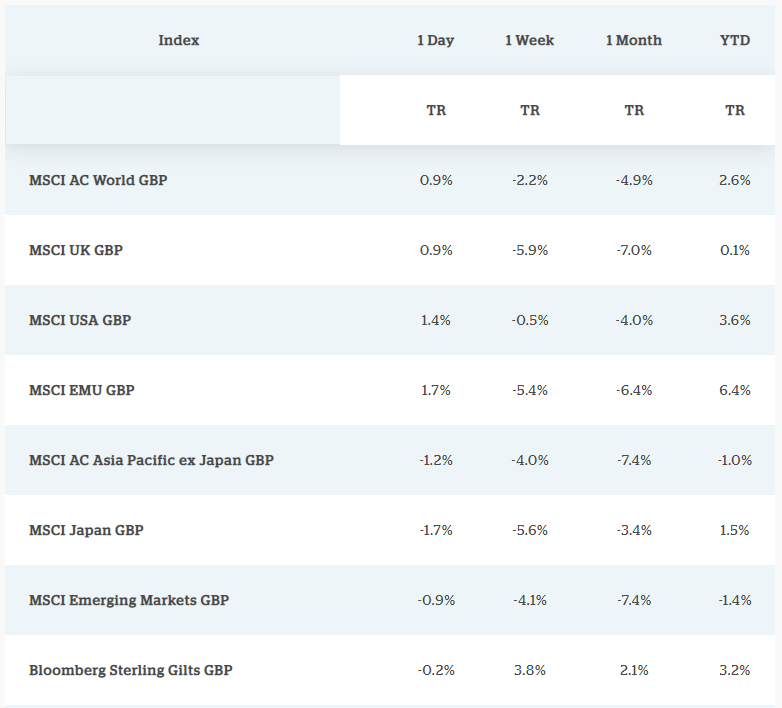
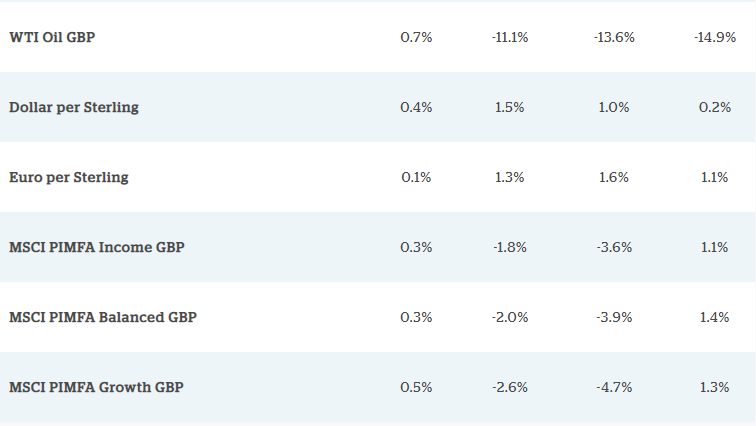
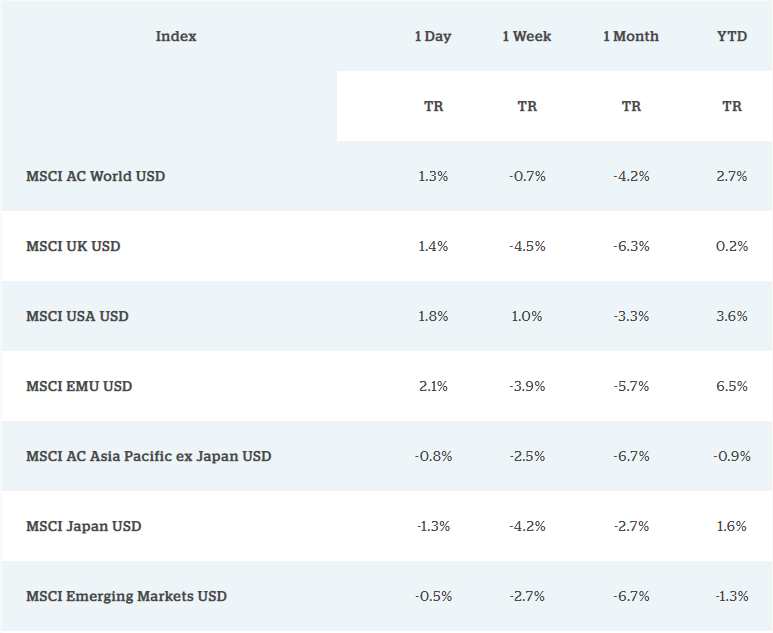
Bloomberg as at17/03/2023. TR denotes Net Total Return

Please check out blog content for advice, planning issues and the latest investment, market and economic updates from leading investment houses

Adam Waugh

17/03/2023

Team No Comments

Brewin Dolphin: Spring budget 2023

Please see below an article published and received late yesterday (15/03/2023) evening from Brewin Dolphin, which provides their summary of the Chancellor’s Spring Budget which he delivered yesterday:

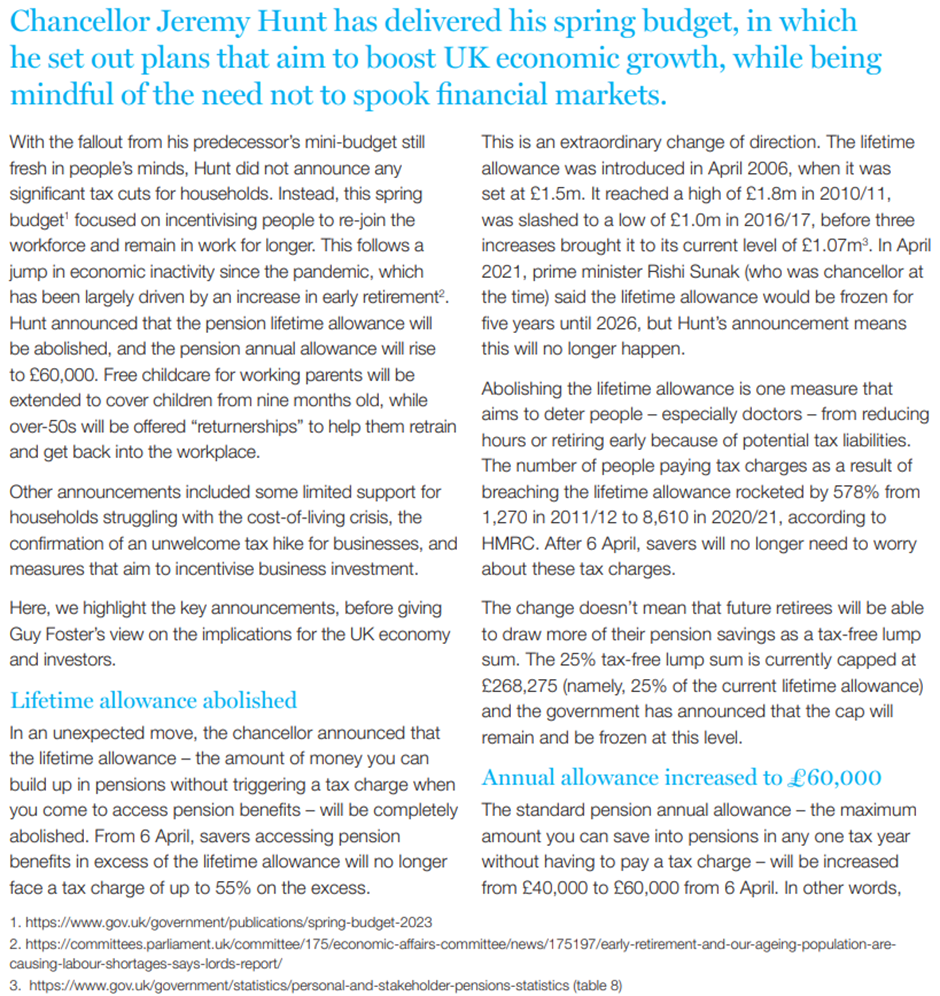
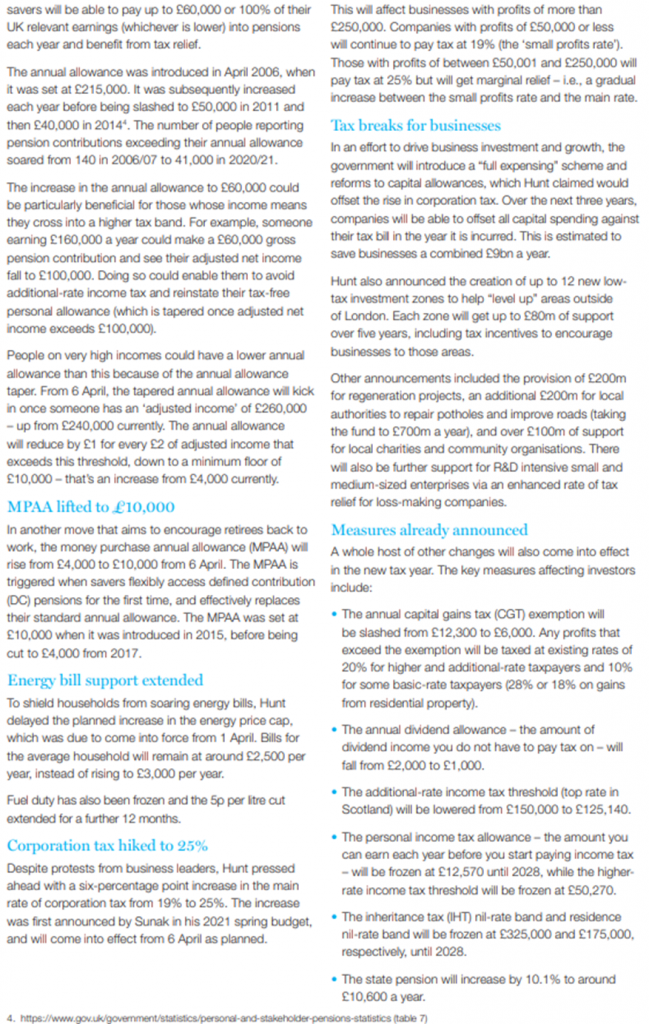
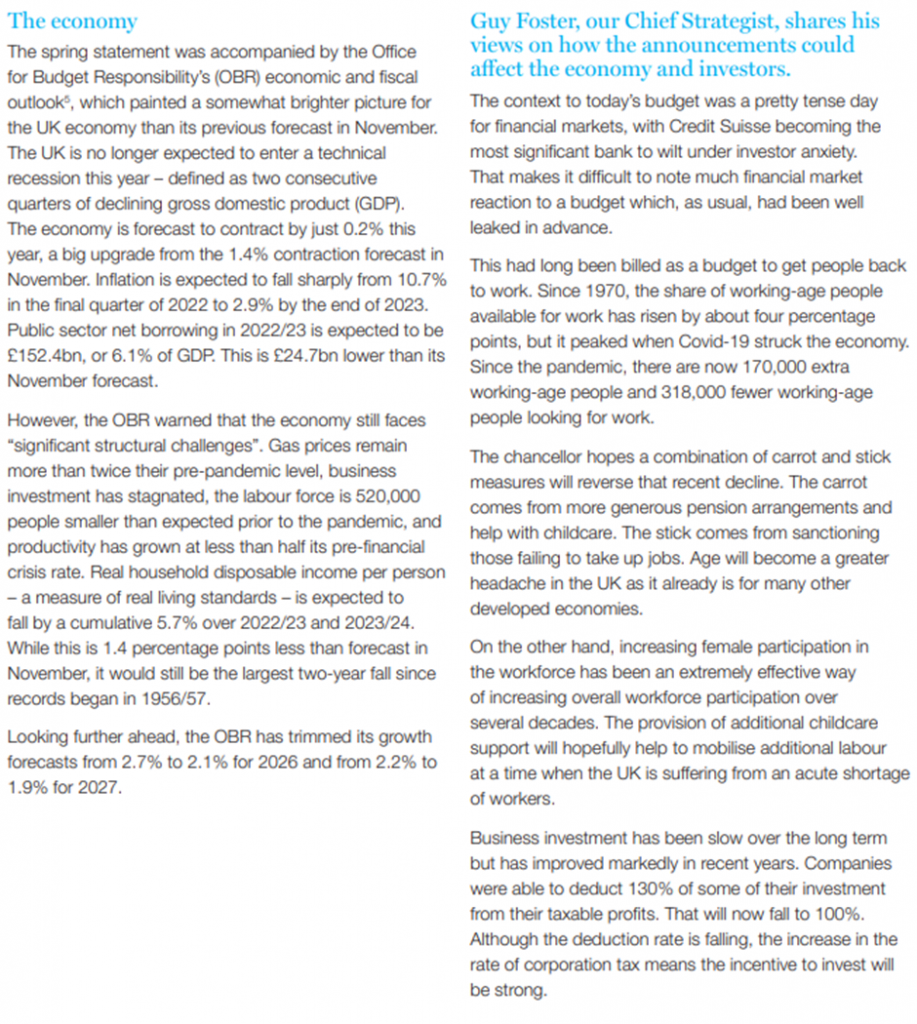
As you can see from the above the Chancellor made some surprise announcements which will certainly be welcomed, particularly around pensions. The announcements on Pensions,

  • Abolishment of the Lifetime Allowance;
  • Increasing the Annual Allowance (annual savings amount) to £60,000.00; and
  • Increasing the Money Purchase Personal Allowance up to £10,000.00 per annum

All of the above will present financial planning opportunities to help people service their overall tax-efficiency.

Please speak to a Financial Adviser if you would like to know more on the above and what opportunities these announcements could mean for you.

Please continue to check our Blog content for advice and planning issues and the latest investment, markets and economic updates from leading investment houses.

Carl Mitchell – Dip PFS

Independent Financial Adviser

16/03/2023

Team No Comments

Brooks Macdonald Daily Market Update

Please see below article received from Brooks Macdonald today, which provides a global market update for your perusal.

What has happened

With markets having run out of fresh reasons to panic, we saw a marked rally across the board in risk assets on Tuesday. Equities, and importantly including bank stocks, saw a major recovery, and sovereign bond yields pared back a good chunk of their declines suffered in recent days. On some measures, US and European banks saw their best positive trading day in 4 and 5 months respectively on Tuesday. In US Treasuries, the 2-year yield saw it’s biggest one-day rise since June last year. Also supporting yields, the US CPI print for February, out yesterday, saw another repeat of the sticky-inflation narrative, with US core CPI month-on-month up 0.5%, above the 0.4% consensus estimate.

Panic over, no global financial meltdown after all?

After the SVB-driven risk-version over the past week, markets seemed to be settling back into a more constructive mood on Tuesday. At their simplest, banks’ operating models are intrinsically linked to a liability-asset duration mis-match… after all, it’s in a bank’s DNA to borrow short (deposits) in order to lend long (loans), and profit from the interest rate spread less some provisioning for the risk of loan-defaults. The fact that banks might choose to park excess deposits into generally-considered-risk free assets such as government bonds is not necessarily bad in and of itself. If banks can hold to maturity, then in nominal terms, there is no risk (assuming we’re not worrying about a government default). As we’ve seen from the SVB debacle last week, the problem arises when a bank cannot hold to maturity, where the discounted mark-to-market price of a bond reflects the impact of the remainder of the bond’s life in real terms. With the Fed now allowing banks to swap Treasury holdings for cash loans at par (the value that the bonds were originally issued at) through a so-called Bank Term Funding Programme (BTFP), this has significantly eased that problem. Initially, the BTFP is to run for one year, but frankly, given the hitherto history of central bank QE-led intervention over the years, it’s probably not a big stretch to assume this programme could be extended if it were needed.

Not yet all clear for bank profit margins though?

Whilst the consensus is that we are not facing financial systemic risk after all, there is still the problem of varied margin impacts for banks. The speed of interest rate hikes over the past year provided a boost to banks’ net interest margins, as interest rates on loans repriced quicker than deposits. The events over the past week have reminded us that with greater competition for deposits, this has given rise to concerns of whether we have seen peak net interest margins for the time being. That said, some relative perspective is important – given we have mostly moved-on from a world of zero interest rates, with interest rates higher and likely to be around these higher levels for some time, the medium-term outlook for bank profitability in aggregate is still arguably much better than it was over the past decade or so.

What does Brooks Macdonald think

With the SVB-induced volatility in recent days now falling, markets are turning back to weighing up the latest economic data, and how it might influence interest rate policy ahead. We have the ECB rate decision up tomorrow, and then it’s the turn of the Fed next week. How these and other central banks balance the recent bout of worries around financial conditions, versus still sticky-inflation pressures, will clearly be the key focus over the near term.

Index 1 Day1 Week1 MonthYTD
 TRTRTRTR
MSCI AC World GBP 0.9%-4.6%-4.9%2.0%
MSCI UK GBP 1.1%-3.5%-3.5%3.1%
MSCI USA GBP 1.8%-4.3%-5.2%1.9%
MSCI EMU GBP 1.8%-3.6%-1.8%9.0%
MSCI AC Asia Pacific ex Japan GBP -1.7%-6.8%-7.3%-1.3%
MSCI Japan GBP -3.4%-5.6%-3.6%0.7%
MSCI Emerging Markets GBP -1.6%-6.8%-6.7%-1.6%
Bloomberg Sterling Gilts GBP -0.8%2.6%0.6%1.7%
Bloomberg Sterling Corps GBP -0.9%1.0%-0.8%2.4%
WTI Oil GBP -4.6%-10.5%-9.8%-11.6%
Dollar per Sterling 0.0%2.7%0.0%0.7%
Euro per Sterling 0.0%1.1%-0.1%0.4%
MSCI PIMFA Income GBP 0.4%-2.1%-2.8%1.6%
MSCI PIMFA Balanced GBP 0.5%-2.5%-3.1%1.8%
MSCI PIMFA Growth GBP 0.8%-3.4%-3.8%1.7%
Index 1 Day1 Week1 MonthYTD
 TRTRTRTR
MSCI AC World USD 0.9%-2.1%-5.0%2.6%
MSCI UK USD 1.1%-0.9%-3.5%3.7%
MSCI USA USD 1.7%-1.8%-5.2%2.5%
MSCI EMU USD 1.8%-1.0%-1.8%9.7%
MSCI AC Asia Pacific ex Japan USD -1.7%-4.3%-7.3%-0.7%
MSCI Japan USD -3.4%-3.0%-3.7%1.3%
MSCI Emerging Markets USD -1.7%-4.3%-6.7%-1.0%
Bloomberg Sterling Gilts USD -0.9%5.0%0.5%2.7%
Bloomberg Sterling Corps USD -1.0%3.3%-0.9%3.4%
WTI Oil USD -4.6%-8.1%-9.8%-11.1%
Dollar per Sterling 0.0%2.7%0.0%0.7%
Euro per Sterling 0.0%1.1%-0.1%0.4%
MSCI PIMFA Income USD 0.3%0.5%-2.8%2.2%
MSCI PIMFA Balanced USD 0.4%0.2%-3.1%2.4%
MSCI PIMFA Growth USD 0.7%-0.8%-3.8%2.3%
      

Bloomberg as at 15/03/2023. TR denotes Net Total Return.

Please check in again with us shortly for further relevant content and news.

Chloe

15/03/2023

Team No Comments

Brooks Macdonald Latest Investment Bulletin

Please see the below article from Brooks Macdonald providing the latest Investment Bulletin. Received this morning 14/03/2023

What has happened

Yesterday saw further wild moves in the bond market with some of the price changes in the US 2-year Treasury rivalling those of 2008. European equity markets caught up with the late US losses on Friday and banks continued to underperform despite measures by the Federal Reserve to rebuild confidence in the regional banking sector.

SVB impact

The market remains deeply concerned that there will be contagion from SVB into other banks and the wider financial system. President Biden said yesterday that he would do whatever it takes to ensure the banking system is secure, raising the possibility of additional regulation to avoid similar collapses in the future. In terms of the quantum of liquidity needed, the US Federal Home Loan Banks raised $88.7bn yesterday to provide funding to private regional banks, including SVB. Other US regional banks under pressure yesterday include First Republic and Western Alliance Bancorp, with both banks experiencing halts to the trading of their shares. The banking giants in the index, such as JPMorgan, outperformed with investors suspecting contagion is limited to the smaller banks.

Bond market impact

The moves within the bond market were far more dramatic than within the equity market yesterday. Market pricing for the US terminal rate plummeted to below 4.8%, this contrasts to just last week where we saw a peak of almost 5.7%. This reflects the new market belief that the Fed, having now ‘broken’ something, may step back from their interest rate hikes. Last week a 50bp interest rate hike was seen as the most likely outcome for next week’s meeting, now markets are weighting up the odds of 25bps or no hike at all. Should the Fed hike by 25bps, the market has concluded that that will likely be the final hike of this cycle. Huge moves within the Treasury market that prior to 2022 has been relatively calm for a decade.

What does Brooks Macdonald think

While bond pricing has moved, investors ultimately have no idea how the Fed will interpret the SVB news and whether voting members will be willing to pause interest rate hikes when CPI remains well above the target range. This of course brings us to today’s CPI release which remains crucially important to the Fed’s room for manoeuvre. How the core CPI number (expected 0.4% month-on-month) and hourly earnings (expected 0.2% month-on-month) unfolds will provide another hurdle for a market still struggling to price the risk of SVB.

Please check our blog content for advice, planning issues and the latest investment, market and economic updates from leading investment houses.

Alex Clare

14/03/2023

Team No Comments

Brooks Macdonald – Weekly Market Commentary

Please see below, the weekly market commentary from Brooks Macdonald highlighting the key economic and markets news over the past week. Received today – 13/03/2023

Silicon Valley Bank’s failure catalysed a rapid sell-off amongst risk assets last week

Equities were sharply lower last week as the US banking sector suffered in the aftermath of SVB’s failure. US equities underperformed with the banking sector, predictably, bearing the brunt of the equity market sell-off. On Friday the number of new US jobs created in February beat market expectations however the average hourly earnings, a key measure of labour market inflation, missed expectations, coming in at 0.2% month-on-month versus 0.4% expected. This, alongside the SVB news, catalysed a broad rally in bond markets which saw US Treasury yields fall alongside expectations for the US terminal rate.

Silicon Valley Bank collapsed last week, bringing with it broad volatility across most asset classes. The bank was heavily exposed to venture capital funded technology companies that were burning cash reserves as funding markets dried up in 2022. Deposit rates also became less attractive as short-term US Treasury yields rose and the yields available on other asset classes improved. Last week these factors were compounded by a growing concern that the bank was likely to fail, which began a bank run as depositors sought to withdraw their funds. Overnight the Federal Reserve and US Treasury announced that they were taking emergency measures to protect the banking system including widening access to the Fed’s discount window. This allows banks to obtain liquidity without selling assets which have been heavily discounted by the rapid rise in interest rates. Specifically for SVB, the Fed announced that depositors ‘will have access to all of their money starting Monday’. The rapid tightening in US monetary policy was always likely to cause heightened idiosyncratic risk within markets and SVB is a high-profile casualty of the seismic shift in interest rates over the last year.

US CPI on Tuesday will be the major market event of this week with implications for the next Fed meeting

Tomorrow all eyes will be on the US CPI report which will play a major role in helping the Fed choose between a 25bp or 50bp interest rate hike at their next meeting. Headline CPI is expected to have expanded by 0.4% month-on-month bringing the annual rate to 6% (from 6.4% at the last reading). Core CPI is expected to also rise by 0.4% over the month however the annual rate is forecast to be stickier, at 5.5% compared to 5.6% for January.

Economic data this week will play a major part in determining whether the Fed hike by 0.25% or 0.5%

The Federal Reserve are in their communication blackout window so will not be able to comment on SVB or the US CPI release this week. Bond markets feel however that a high-profile bank failure may be enough to convince the Fed not to raise interest rates by 50bps at this month’s meeting. Should CPI meaningfully beat to the upside however, the Fed may be forced to take a more aggressive monetary policy approach even if it risks further idiosyncratic contagion in markets.

Please continue to check our Blog content for advice and planning issues and the latest investment, markets and economic updates from leading investment houses.

Alex Kitteringham

13th March 2023