Team No Comments

Brewin Dolphin – Markets in a Minute

Please see this week’s Markets in a Minute update below from Brewin Dolphin, received yesterday afternoon – 27/01/2026.  

How are U.S. tariff threats impacting markets?

We examine the market’s reaction to President Trump’s threats to impose tariffs on Europe over Greenland.

Key highlights

  • Davos and the debt markets: Equities struggled as President Trump threatened tariffs against NATO members for their stance on Greenland.
  • All that glitters is gold: Gold benefitted from the news, exceeding the financial landmark of $5,000 per troy ounce.
  • UK retail sales boost: Retail sales expanded on a seasonally-adjusted basis and consumer sentiment improved.

Davos and the debt markets

Equity markets struggled last week, rocked by a news flow that at times had somewhat ominous overtones – even if the fundamental and tangible drivers of equity performance still seem to be in place.

The ominous news flow predictably came from U.S. President Donald Trump. As he prepared to attend the World Economic Forum in Davos, his rhetoric over Greenland suggested little room for compromise and a determination to take sovereignty over the region from NATO ally Denmark.

In response, some NATO members planned exercises in the region. This prompted the president to declare that they would be punished by tariffs beginning in February, increasing in June and staying in place until America’s acquisition of Greenland has been completed.

With their usual dispassionate approach to foreign affairs, markets were little moved by threats to Greenland’s sovereignty, but they were concerned about the possibility of tariffs. Equities were weaker, the dollar fell, and bond yields rose. Gold remains one of the few asset classes to benefit from this news.
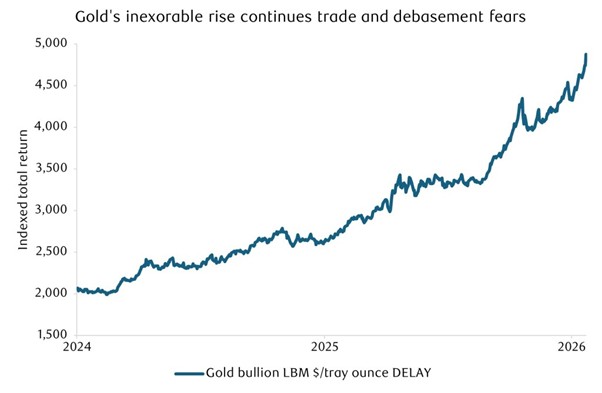
Source: LSEG Datastream

Following the ‘Liberation Day’ tariffs, countries have generally been reluctant to impose retaliatory tariffs on the U.S., partly because those with balance of payments surpluses with the U.S. would appear to have more to lose from a trade war. This latest tariff threat created an additional challenge – U.S. tariffs were only imposed on eight countries participating in NATO exercises, but retaliation would need to come from the European Union as a whole. Dragging a lot of countries into a trade war that has the scope to escalate further would test the unity of the Eurozone.

Could an alternative be for Europeans to sell their holdings of U.S. treasuries? Europe as a region is believed to hold around 12% of U.S. treasuries, the sale of which would put upward pressure on U.S. borrowing costs.

The complication is that many of those bonds are private sector holdings and are therefore outside the control of the state. Mobilising them to sell would be nearly impossible. Many may be beneficially owned by stakeholders outside Europe anyway. And for most, the decision to hold them reflects the liquidity that only the treasury market can offer – or a need to hold U.S. assets to avoid losing currency competitiveness against the U.S. The desire to hold less treasuries is powerful and explains part of the rise in gold as an alternative home.

Returning to the topic of Davos, this has typically been a forum in which countries and business leaders find ways to help each other. President Trump’s involvement has been to shift the narrative to one of greater self-sufficiency and self-interest. It’s a uncomfortable message for those who aren’t part of the world’s largest economy, but it’s one that was taken head on by Canadian Prime Minister Mark Carney. He talked about the need for middle countries to accept that the old global rules-based order is no more, and that middle power countries like Canada, the UK and the EU states finding flexible alliances will be the way to avoid subordination to the global superpowers.

It’s a stark but compelling reality, which RBC Chief Executive Officer Dave McKay was asked to expand upon at the Forum.

As the week progressed, a tentative de-escalation was brokered by NATO Secretary Mark Rutte. It sounded as if President Trump would be willing to drop his demand for Greenland’s sovereignty in exchange for military access. It’s understood that some access to Greenland’s mineral wealth would also be afforded. Greenland holds significant deposits of rare earth elements. However, Helima Croft, RBC’s Head of Commodity Strategy, believes they’re remote, ice-covered and expensive to access.

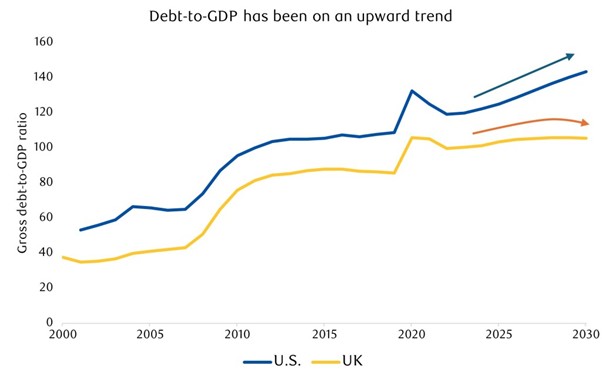
The debate over Greenland forms a further evolution of the ‘Worlds Apart’ theme, which RBC Wealth Management identified three years ago. What began as a rupture in trade seems to be becoming broader and more fundamental with each month that passes. It discourages investors from holding U.S. assets, even if only at the margin, and has contributed towards the weakness of the dollar and the rise in the gold price. As such, it contributes to an overlapping theme of debasement, which is more substantially represented by the U.S.’s reluctance to address its unrepentant government borrowing.
Source: LSEG Datastream

Rising government debt has been a concern for many industrialised countries, but the U.S. is certainly a stand-out because under both the Republicans and Democrats, the forecast public finances have been allowed to worsen.

UK sees retail sales boost

In the UK, by contrast, last week saw some good news on the public finances.

The fiscal position is stretched in the UK. However, governments do take tough actions based on recommendations by the independent fiscal watchdog and will take some comfort that borrowing has increased more slowly than expected.

In other UK news, retail sales expanded on a seasonally-adjusted basis and some aspects of consumer sentiment improved. It does seem as if UK consumers held back spending due to concerns over the prospect of tax hikes in the Autumn Budget, but they may now feel confident to indulge a little more. Recent interest rate cuts will also help.

Please continue to check our blog content for advice, planning issues and the latest investment market and economic updates from leading investment houses.

Charlotte Clarke

28/01/2026
Team No Comments

EPIC Investment Partners – The Daily Update

Please see the below article from EPIC Investment Partners detailing their discussions on China’s Domestic Consumption. Received this morning 27/01/2026.

Picking through China’s FY2025 and 4Q2025 economic data releases does not make great reading for those of us hoping for a decent recovery in Chinese domestic demand. Household savings have gone through the roof in recent years but there are few signs that consumers will run these savings down despite the miserable interest income received.

One bright spot in recent years has been consumer spending on services. Following the 2020 COVID induced collapse in spending, services have recovered to account for some 45% of total consumption expenditure, the same percentage as 2019. The rate of growth, however, has slowed from 7.4% in 2024 to just 4.5% in 2025.

The distinctive whiff of deflation is evidenced by eleven consecutive quarters where nominal GDP growth has been lower than real GDP growth. Nominal growth was just 4.0% in 2025 while 4Q2025 growth fell to 3.8%. The has to be considered in the context of a 5.0% rise in nominal disposable income per capita in 2025. Household consumption accounted for 39.9% of nominal GDP in 2024. While higher than the lows of circa 35% witnessed during the GFC, this compares to 45% or so at the turn of the century.

The continued weakness of residential property prices (prices fell 13.0% while volumes contracted 9.2% in 2025) must be considered one of the main reasons that consumers remain nervous. Many of them (the majority?) are property owners. Spending in the construction and real estate sectors peaked at roughly 15% of GDP in 2021: it is now just 12%.

Rightly or wrongly, our Asian portfolios have significant exposure to the consumer discretionary sector – much of this in Chinese related positions. The authorities have a formally stated objective of boosting household consumption as a percentage of GDP. We just wish they would get on with it!

Please continue to check our blog content for advice, planning issues and the latest investment, market and economic updates from leading investment houses.

Alex Clare

27/01/2026

Team No Comments

Tatton Investment Management: Monday Digest

Please see below, an article from Tatton Investment Management, analysing the key factors currently affecting global investment markets. Received this morning – 26/01/2026

Weak links in the outlook

Trump threatened and retreated, but markets ended slightly down last week. On the bright side, the TACO trade is protecting against the downside.

40-year Japanese government bonds (JGBs) broke through 4% for the first time ever. The long-maturity JGB market is notoriously illiquid, dominated by large insurance companies. Japan’s recent economic and stock market strength actually lessened their need to hold JGBs, which worsened liquidity and allowed small selling pressures (after Takaichi’s tax cuts) to become a sharp sell-off. Just like UK bonds after the ‘Liz Truss moment’, there will be eager buyers for historically cheap JGBs, but they may stay cheap for some time.

US Treasury Secretary Bessent was wrong to blame Japan for the increase in US yields, however. US yields rose higher than others and the dollar weakened – a clear policy risk signal. US bond fundamentals are changing too: wage and supply chain pressures have hardened the inflation and interest rate outlook. US credit demand has disappointed in response – proving money demand is rate sensitive. The government could borrow more to offset (and it probably will) but that will raise yields further. Incidentally, the UK is one of the few governments pursuing mild fiscal discipline to decent effect, but markets just don’t think it will last beyond May’s local elections.

European assets were weighed down by higher energy prices last week, as well as Greenland threats. Natural gas futures spiked on fears that Trump could hold LNG shipments to ransom, and they stayed elevated even after Trump backed down on Greenland. Geopolitical crises can scar markets even if they change little in the short-term. Washington’s confrontational start to the year shines a light on the weak links in the 2026 outlook, particularly around bond yields and gas prices. Markets could do with some calm, but Trump is already talking about another US government shutdown. We won’t hold our beath.

Trump’s soft underbelly

If Europe wants to stop another Greenland crisis, it could help to focus on what American voters – Trump’s base in particular – care about. The majority are opposed to taking Greenland either by force of purchase (only Republicans are in favour of purchasing the territory) but that doesn’t necessarily mean it will be a big electoral issue in November’s midterms. Foreign policy usually only impacts US elections when there is a ‘boots on the ground’ war, which should at least soothe European fears about an invasion. However, affordability (importantly, not inflation) is Trump’s weakest issue with voters, so perhaps shouldn’t be surprised that the 10-25% tariff threats were dropped.

President Macron suggested the EU could use its anti-coercion instrument (ACI) in response to US threats – which would take months to pass but could seriously harm the US. US threats could also backfire on its bonds. Trump and US treasury secretary Bessent dismissed the idea that Europeans could dump US treasury bonds, but we see signs of international investors already reducing their US exposures. According to John Murillo of B2Broker, the ‘Sell America’ narrative is gaining traction, which could result in “higher bond yields, tighter financial conditions, and reduced liquidity for (US) businesses that rely on stable access to capital.”

We can question how much Trump listens to public or market opinion, but he does tend to back down when things threaten to get nasty for his base. That should motivate European leaders to be a little bolder in their responses. Canadian Prime Minister Mark Carney declared at Davos last week that western leaders shouldn’t mourn the old rules-based order because “nostalgia isn’t a strategy”. European leaders could learn something from this, as well as from China and Brazil’s forceful responses to past tariffs, which seems to have earned them more respect from Trump than the EU’s fairly quick acceptance of 15% tariffs.

US consumers and the wealth effect

JP Morgan traders think that US consumers have more cash than ever before, supporting US markets and the economy the same way ‘excess savings’ (a measure of the pandemic-era cash boost) did a few years ago. We’re not sure. We see this as a long-term savings offset to stocks.

JPM’s measure of the “Consumer Cash Pile” (checking and savings accounts, and money market funds) hit a record $22tn in Q3 2025. Almost all income cohorts have more cash in real terms than pre-pandemic, apart from the bottom 20% of earners. Liquid savings support not just consumption but US risk assets, by backing lending and reducing volatility.

However, the proportion of US household assets that are liquid is now at historical lows. Americans are putting their capital into higher risk and return assets like stocks. You could argue that’s a good thing – going hand in hand with the strength of US markets. Stocks are better investments than cash in savings accounts over the very long-term, and it helps an economy when domestic consumers are heavily invested in their own assets. But it also means US savers are taking on more risk than ever before, perhaps without even knowing it.

The higher proportion of equities also increases the wealth effect, tying US consumer demand ever tighter to the ups and downs of US stocks. For years, the outperformance of US stocks has helped US balance sheets, boosting consumption and economic growth – which feeds into corporate profits and back into US stocks. But what happens if the cycle reverses? US growth slowed into the end of 2025, coinciding with equity fund outflows. Large institutional investors are now diversifying their holdings away from the US too, due to political uncertainties. If this continues and the wealth effect reverses, profits will be under threat.

Please continue to check our blog content for the latest advice and planning issues from leading investment management firms.

Marcus Blenkinsop

26th January 2026


Team No Comments

EPIC Investment Partners | The Daily Update

Please see below, an article from EPIC Investment Partners discussing the recent World Economic Forum in Davos and the implications for us as investors. Received today – 23/01/2026

While mainstream headlines remain fixated on the visible theatre of Davos, a deeper structural realignment is being engineered in the shadows of the 2026 World Economic Forum (WEF): the transition from universal globalism to a regime of minilateralism. This shift marks the quiet unwinding of the “Global Village” ideal, and the emergence of a world organised around selective, interoperable clubs of aligned nations and corporations, bound less by ideology than by functional advantage and execution speed.

For the EPIC Fixed Income strategy, positioned across pivotal hubs such as the UAE, Saudi Arabia, Qatar and Singapore, as well as resource-critical nodes like Chile and Mexico, this fragmentation is not a risk but a source of alpha. These states have moved decisively beyond passive participation in global trade. Instead, they are becoming architects of bespoke corridors, designing specialised digital, energy and green alliances that consciously bypass the inertia and consensus paralysis of legacy multilateral institutions.

This new order is underpinned by the rise of the Agentic Web: a decisive evolution from assistive AI towards autonomous digital agents capable of managing supply chains, allocating capital and negotiating trade at machine speed. Within this environment, the UAE, Saudi Arabia and Singapore have successfully repositioned themselves as Digital Sovereign Hubs, hosting trusted data spaces that enable high-velocity, low-friction transactions across jurisdictions. Qatar, meanwhile, has consolidated its role as the system’s critical mediator, providing the LNG energy bridge that, for example, simultaneously fuels Mexico’s industrial expansion and Chile’s green transition. By anchoring the physical energy plumbing of the Middle East, Qatar functions as the structural adhesive of these trade clubs, deploying sovereign wealth into private credit, payments and fintech infrastructure that forms the financial substrate of the Agentic Web.

China occupies the role of Grand Contrarian in this landscape. Publicly, it continues to champion “true” multilateralism; privately, it is constructing the world’s most formidable parallel club through the Industrial Internet. China has become the undisputed factory of the Agentic Web, supplying the hardware and machine-to-machine intelligence that power infrastructure in Riyadh and Abu Dhabi, while remaining the primary demand centre for Chile’s raw materials. China exerts the industrial gravity that prevents full global decoupling, even as it adapts domestic rules to attract capital from Singapore and the Gulf.

For holders of US Treasuries, this shift reinforces a defining paradox of the modern era. While hyper-efficient corridors unlock extraordinary productivity gains, the velocity of autonomous trading introduces a new class of systemic fragility. In the fragmented landscape of 2026, US Treasuries function as the ultimate liquidity hedge against algorithm-driven flash-crash risk. The global economy that emerges rewards investors who balance the offensive growth of Gulf and Asian hubs with the defensive stabiliser of the world’s reserve currency.

The WEF has, in effect, now provided a platform to digitise the “club”. The global winners will be those who secured their seat early, leveraging resource security alongside technological sovereignty, before the doors formally close.

Please continue to check our blog content for the latest advice and planning issues from leading investment management firms.

Alex Kitteringham

23rd January 2026

Team No Comments

The Daily Update| Invasion isn’t the Point: The Real US Strategy for Greenland

Please see the below article from EPIC Investment Partners detailing their thoughts on Donald Trump’s address at the World Economic Forum. Received this morning 22/01/2026.

At the World Economic Forum in Davos yesterday, Donald Trump’s address to the global elite sent a ripple through the polished forums of the Swiss Alps. Few came expecting geopolitical fireworks; many left unsettled. In a speech that explicitly linked American security guarantees to control of the High North, Mr Trump argued that the United States could no longer subsidise the defence of the region without holding the keys to the territory itself. He framed Greenland not as a distant ally but as strategic terrain the United States must secure. He insisted any solution must make both NATO and Washington “very happy’” dismissing the notion that allies could responsibly steward the island’s future without American leadership.

Those remarks elevated what had been a quixotic policy backwater into the realm of serious international crisis. Yet even as markets and capitals scrambled to price the risk, much of the commentary missed a basic point: the United States already occupies the strategic high ground in the Arctic. Under the 1951 defence agreement, Washington enjoys effectively unrestricted access to Greenland’s airspace and waters and operates the island’s most critical military installation, a linchpin of US missile defence and early-warning systems, without paying rent. The American presence is entrenched. An invasion would amount to a hostile takeover of an asset already under operational control.

This is why the fixation on “invasion” is a distraction. The noise from Washington is not about seizing land from Denmark; it is about freezing politics in Nuuk. The real object of American concern is not Copenhagen, long a broadly compliant intermediary, but Greenland’s independence movement. For decades, western capitals treated the prospect of sovereignty with indulgent sympathy, a neat expression of self-determination that could be absorbed into the existing security order. That assumption has now collapsed.

From Washington’s perspective, the danger is not that Greenland remains Danish, but that it ceases to be so. Denmark provides a geopolitical wrapper that matters far more than it appears. Copenhagen absorbs fiscal costs, administers governance and diplomacy, and supplies a legal shield that keeps rival powers at bay. As long as Greenland sits within the Danish kingdom, it is not a free agent. That arrangement has suited the United States perfectly.

Remove that wrapper and the arithmetic changes abruptly. An independent Greenland would be a sovereign state of fewer than 60,000 people occupying some of the most valuable strategic geography on the planet. It would inherit the right to choose its partners and negotiate access, but also a large fiscal gap: Danish transfers cover roughly half of public spending. Independence without replacement revenue would mean immediate economic strain.

The nightmare scenario in Washington is not a hostile Greenland, but a transactional one. A sovereign Nuuk could reasonably ask why the United States pays nothing for facilities underpinning its nuclear deterrent and space surveillance. It might treat the American presence as an asset to be monetised, or invite alternatives from Beijing offering infrastructure or mining investment with obvious dual-use potential. Seen this way, the rhetoric from Davos looks less like imperial impulse and more like pre-emption.

Denmark is left squeezed between American security imperatives and Greenlandic aspirations. The irony is stark: a movement seeking to escape one colonial legacy may have invited a far more powerful overlord. The tragedy is not the threat of war, but the narrowing of choice. The United States does not need to invade to get what it wants; it simply needs to ensure that no one else ever gets the chance to pay the rent.

Please continue to check our blog content for advice, planning issues and the latest investment, market and economic updates from leading investment houses.

Andrew Lloyd

22/01/2026

Team No Comments

Brewin Dolphin – Markets in a Minute

Please see this week’s Markets in a Minute update below from Brewin Dolphin, received yesterday afternoon – 20/01/2026.  

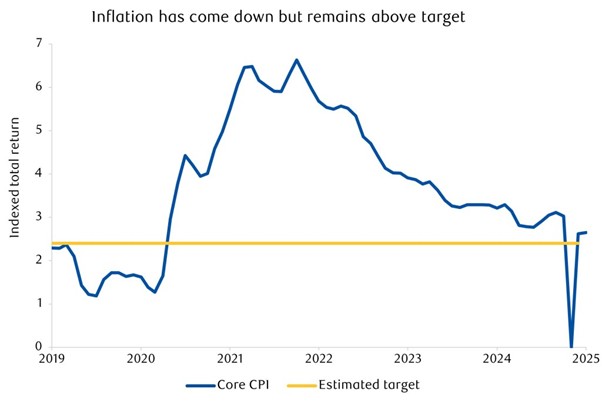
U.S. inflation remains above target

U.S. inflation data came in below expectation, but remains higher than the Federal Reserve’s desired 2% limit.

Worlds apart: Trump challenges Denmark and Iran

Source: LSEG Datastream

For another week, U.S. President Donald Trump’s rhetoric dominated the news, with some headlines explicitly moving markets while others were more subtle. However, there can be no question that the generally chaotic tone and the challenging of norms are causing investors to change the way they deploy capital.

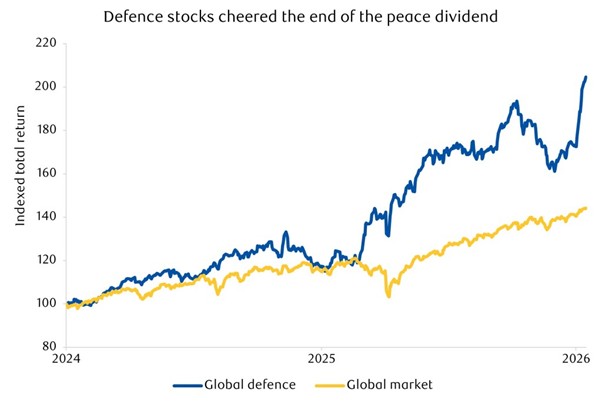
Defence stocks remain in focus and were jostled by two key themes.

Firstly, President Trump has threatened the Iranian regime with military action if its efforts to repress local protests are not tempered, a requirement the regime will find difficult to meet.

Secondly, Trump has continued with assertive rhetoric and candour over his now, very public, desire to assimilate Greenland into the U.S., and his refusal to rule out the use of force. While the prospect of this leading directly to significant military action seems remote, it does emphasise the new vulnerability NATO members are likely to feel over the protection which the alliance had previously afforded them. The logical conclusion is that countries need to develop and invest in their own military capabilities.

President Trump’s recent emphasis on military-focused measures has followed last year’s focus on economic measures, most notably tariffs. However, many of those measures are now in doubt. So far, the Supreme Court of the United States (SCOTUS) has been expected to produce an opinion on this topic twice this year, but as yet, no opinion has been forthcoming.

We have a better idea over the timing of President Trump’s assault on monetary policy because the Court is due to hear oral arguments in the case of Lisa Cook, the Federal Reserve (the Fed) governor, whom President Trump would like to dismiss.

The case is over whether the discrepancies on her mortgage application were an oversight or a fraud, but the reason for bringing the case to SCOTUS is that the president would like to influence monetary policy by placing his own nominees on the Federal Open Markets Committee, which sets interest rates.

Wednesday’s oral arguments should give an indication of whether SCOTUS is planning to rule on the individual case or the broader issue of whether the president has the power to fire members of the Fed’s board. If the court tackles the wider case and rules in the president’s favour, it’ll have significant impact on monetary policy, effectively handing him de facto control. It would mean lower interest rates and a weaker dollar.

U.S. inflation remains higher than desired

Source: LSEG Datastream

Until inflation hits target, the Fed will react to economic data, such as last week’s U.S. inflation report.

The president’s preference for lower interest rates was helped by the unexpectedly weak U.S. core Consumer Price Index (CPI) inflation. While lower than expected, inflation remains slightly above target. There remains some evidence of tariffs affecting inflation, but it isn’t vast and it’s tended to be overshadowed by weakness in other categories like used cars this month. Shelter costs should keep overall inflation restrained but core services remain a little high.

This makes the case for further interest rate cuts difficult to make right now, and so rates are expected to remain on hold until the summer (June or July). Much will depend upon the outlook for the labour market, which for now appears to be treading water.

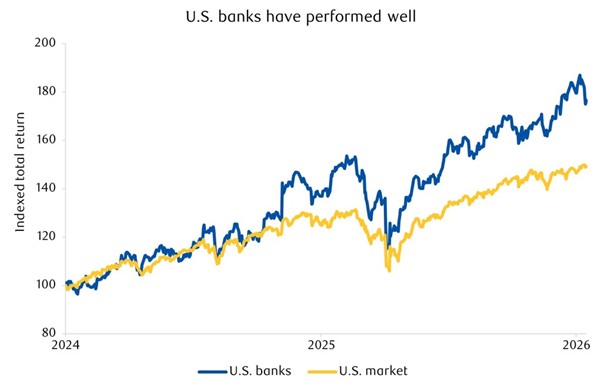
Positive results from U.S. banks

Source: LSEG Datastream

Economic data can only tell you so much. At the start of the new earnings season, a lot of focus is on the banks to see what they can tell us about their own businesses and the state of the broader economy. Last year was a great one for banks, with the interest rate environment broadly supportive, companies doing large deals, a big increase in corporate borrowing, and plenty of market upheaval to trade through, even if the final quarter saw some moderation in these trends.

According to the banks, the economy is in good shape, with consumers spending and businesses investing. The short-term outlook remains positive even while the protective institutions of the U.S. economy and global community come under pressure from a disruptive president.

Please continue to check our blog content for advice, planning issues and the latest investment market and economic updates from leading investment houses.

Charlotte Clarke

21/01/2026

Team No Comments

EPIC Investment Partners – Would re-joining the EU Customs Union and Single market boost UK growth?

Please see the below article from EPIC Investment Partners detailing their discussions on the UK re-joining the EU Customs Union and single market. Received this morning 20/01/2026.

Labour MPs and leadership hopefuls are being dragged towards the UK rejoining the EU Customs Union and single market by the voices of the Lib Dems and Greens. These parties think much closer ties to the EU would be good for business and trade. This note looks at what would happen if the UK adopted either or both of these choices. Those in favour argue that the UK trades more with the EU than with any single country. Those who disagree point out that 59% of UK trade is non-EU, with the US as the most important single market. This non-EU trade has been growing faster than EU trade in recent years.

When the UK left the EU Customs Union at the end of 2020 the government removed all tariffs on raw materials and components that UK manufacturers import from non-EU countries all round the world. This amounts to some £30 bn of imports. It took tariffs down to zero on 650 product lines in machinery, electronics and tools, and 20 lines of metals and metal products. The EU imposes tariffs on these items partly because they receive most of the revenue from customs dues or tariffs, but they are also protecting EU companies from more intense global price competition.

The UK government also removed all tariffs on items the UK cannot produce or grow for itself, covering another £10bn of imports and including various food and textile product lines. In total the UK took tariffs off 2,000 product lines. 91% of the UK’s imports of goods are now tariff-free thanks to these reductions and to the various free trade agreements negotiated with the EU, TPP, India and many others. As the government said at the time in 2021 “The UK General Tariff almost doubles the number of tariff lines that have zero import tariffs (compared to the EU tariff the UK used before)”.

Were the UK to rejoin the Customs Union it would need to amend or rescind the free trade deals with the Transpacific Partnership, India, Australia and New Zealand because they would break EU rules. Some say these deals do not add much to UK GDP so their loss would have limited impact. By the same logic you could say a new trade deal with the EU would not add much to UK GDP, especially as the UK already has a free trade deal with no tariffs. The new trade deals the UK has negotiated since leaving, and the rolled over EU trade deals now renegotiated, have highlighted a number of opportunities particularly for services.

The case for rejoining is based around trade in goods. The proponents hope there will be advantages in less bureaucracy if the UK adopts EU rules and customs levels. This will not always be the case. The EU, for example, has the Meursing table for tariffs on certain foods, with 13,000 varied tariffs depending on the milk and sugar content of food products. The UK has dropped use of this table and gone for a much simpler tariff structure on biscuits, confectionery and spreads with fewer rates. The government is seeking EU agreement on rules covering animal products to see if the complexity and frequency of veterinary inspections can be reduced.

56% of UK exports are services. Services are the fastest growing part of UK trade, and they are much bigger with non-EU countries than with the EU. There are no tariffs on services. The new UK trade deals struck after Brexit have chapters dealing with services, which EU trade deals either left out or changed very little. Looking ahead the UK needs greater liberalisation of services to reinforce this dominant and fastest growing part of the country’s exports.

Aligning the UK with single market rules brings some downside as well as upside. The government is keen to join the EU electricity trading and carbon emissions scheme. This will put up the UK carbon tax level to align with the higher EU one. This would push energy costs higher at a time when the government says it wants to get energy bills down and to ease the pressures on the cost of living.

Aligning with EU rules on dairy and meat as the UK did in the EU might not produce the improvement in UK output the government wishes. During the UK’s time in the Common Agricultural Policy the UK was short of milk quota, restricting the growth of value-added milk-based products in the UK. It fell into difficulties with health controls on beef where an EU ban on sales was extended beyond the time UK experts thought necessary. Part of the price of a possible deal has been the UK offer of 12 more years of high quotas of UK fish for continental boats, delaying new policies to restore the size of the former UK fishing fleet.

The government thinks it can negotiate less bureaucracy for farm exports and for matters like music visits by UK orchestras and choirs abroad. It is looking at possible mutual recognition of professional qualifications between the continent and UK and is seeking to rejoin the Erasmus student scheme. They have not clarified whether this entails scrapping the cheaper UK Turing scheme which gives grants to UK students to study abroad but does not give grants to EU students to come to the UK as Erasmus does. Erasmus only allows students to go to EU Colleges.

Any possible reset the UK agrees and implements is unlikely to make much difference to exports or growth. The concessions the UK are seeking will have a modest impact, and will come with UK payments to the EU, the adoption of more EU laws and an end to freedom to negotiate better deals with the rest of the world. The government seems to have ruled out joining the Customs Union and is more likely to align more rules and practices with the single market than to go for full membership. However, if the enhancement of growth is the core driver for closer ties with the EU, it is unclear how this would manifest itself and over what timeframe.

Please continue to check our blog content for advice, planning issues and the latest investment, market and economic updates from leading investment houses.

Alex Clare

20/01/2026

Team No Comments

Tatton Investment Management: Monday Digest

Please see below, an article from Tatton Investment Management, analysing the key factors currently affecting global investment markets. Received this morning – 19/01/2026

Are markets right to be relaxed?

Markets kept up their strong start during last week, shrugging off growing political worries. This week begins with the startling escalation in “the grab for Greenland”. Both bonds and equities are under pressure and, although the US is on holiday, US assets are weaker than European assets, with the US dollar also slipping slightly.

Under pressure from low approval ratings, the Trump administration is in a more reactive policy mode now and that raises risks. The goals appear to be less obvious, the policies and potential consequences not well thought through.

Markets barely reacted to Trump’s attack on Fed independence, in the belief that US institutions can withstand the pressure. The backlash, from global central bankers and Republican senators, seems to have softened Trump’s stance. The attack is oddly timed, considering the President wants lower rates and, regardless of political threats, the Fed is likely to deliver them. The latest data show little US inflation pressures, reduced tariff effects and weak employment.

US bank stocks sold off, partly because of ‘disappointing’ earnings (profits were reasonable but loan growth could have been stronger), but also due to Trump’s threat of a 10% cap on credit card rates. The White House has no legal power to enforce that, but that’s besides the point: banks are now in Trump’s sights. Affordability is now Washington’s top priority and the administration has no qualms about using price caps – so hated by markets – to achieve it. The flipside of affordability, in some cases, is the profitability that has attracted global capital into US stocks. If the administration cracks down, it could be a bad phase for consumer-sensitive US companies.

PIMCO is reportedly diversifying its vast holdings away from the US, due to uncertainties around the administration. Is this a sign of capital outflow? It would take a lot for investors to actually sell US holdings, considering the continued profitability of US tech stocks. By comparison, European profits for Q4 are being downgraded by analysts. Clearly, though, investors see US assets as riskier than they were. We see this in higher US bond yields, despite benign inflation, and those yields not tempting traders into dollar assets. The dollar will be a key risk signal this year.

Japan’s snap election rumour weakened the yen but didn’t stop Japanese stocks gaining. France’s failed budget hurt its assets but not wider European markets. US stocks edged forwards – led by previously unloved sectors.

How strong are Chinese exports really?

China’s trade surplus (exports minus imports) reached a record $1.2tn in December, and its exports were 6.6% higher in dollar terms year-on-year – despite US tariffs. The “in dollar terms” part is doing a lot of heavy lifting, with the dollar 5% down against the renminbi since April’s ‘Liberation Day’. Chinese trade figures show only modest growth in local currency terms. Beijing has been deliberately pushing the renminbi stronger, despite a weak domestic economy that many expected would require a weaker currency. But Beijing’s currency strategy is about long-term status, not growth.

China’s export numbers are still decent in renminbi terms, considering US pressure and currency moves. Exports to the US fell 20% year-on-year, but increases elsewhere (Africa, Asia, Europe) more than made up the difference. Unlike Trump’s first term, this doesn’t seem to be just rerouting either; the biggest export growth came from sectors not reliant on US demand. Chinese exporters are concentrating on higher value goods – evidenced by BYD outselling Tesla worldwide in 2025.

Export resilience is good news, but it also lays bare the weakness in domestic demand. Beijing has been stimulating its economy for over a year, but tariff-compressed trade is still contributing more to growth. The communist party’s upcoming five-year plan will reportedly put more emphasis on supporting businesses – but actually achieving that is difficult. There are both ideological and structural barriers to pro-consumption policies, which often leaves China reliant on exports. That reliance is a problem. China is growing its trade surpluses with various countries, but populist movements in Europe and Asia are no happier with China’s trade practices than the Trump. China cannot keep exporting its way to growth forever.

FOMO and diversification

How much diversification is enough? A well-known rule of thumb (originating from a 1987 Meir Statman paper) suggests 30-40 stocks is enough to protect your portfolio from idiosyncratic risk, but a recent paper titled “FOMO in equity markets?” suggests the right amount is much higher, somewhere between 100-750. The authors reach this conclusion by simulating performance with random stock sampling (within various portfolio construction rules) from 1985 to 2023. They bring this up in the context of ESG investing – where stock concentration is typically higher – but the basic idea is broadly applicable. This is because stock market returns are highly concentrated on a few winners. The fewer stocks in your portfolio, the more likely you are to miss out on the winners – which they call FOMO risk.

Of course, this is using random sampling, and the whole point of active investment management is to be better than random. Joachim Klement, in his blog, points this out as a benefit of selective stock pickers: you can easily see how good a manager is at weeding out idiosyncratic risk. Active managers have struggled in recent years, though, because following the big stock names has been highly profitable (and stock pickers tend to avoid the biggest names with the highest valuations). We’ve argued before that 2026 could be better for active managers though, as we expect a fair amount of dispersion in global markets.

The point here isn’t to disparage selective investors. Taking on extra idiosyncratic risk can pay off – but you should always be away that you are taking on extra risks. The ’30-40 stocks is enough’ adage obscures those risks, making investors feel like they can have their cake and eat it.

The best stock pickers are rare, so we always prefer well diversified portfolios, in line with our long-term guardianship principles. That’s also why we prefer fund-based investment structure in our portfolios, allowing us to build holistic and well-diversified portfolios with some funds riskier – and potentially more rewarding – than others.

Please continue to check our blog content for the latest advice and planning issues from leading investment management firms.

Marcus Blenkinsop

19th January 2026

Team No Comments

Brooks Macdonald | Daily Investment Bulletin

Please see below, an article from Brooks Macdonald which discusses the key factors currently affecting global investment markets. Received today – 16/01/2026

What has happened?

Markets strengthened yesterday as geopolitical concerns eased and supportive US data lifted sentiment. A more conciliatory tone from the US helped oil prices break a five day winning streak, easing some of the recent risk premium embedded in energy markets. Brent crude saw its sharpest decline since June, falling -2.18% to $63.76/bbl, while gold and silver both edged back from Wednesday’s highs. The S&P 500 gained +0.26%, led by semiconductor stocks after TSMC’s upbeat results, with the Philadelphia Semiconductor Index up +1.76% and Nvidia rising +2.13%. Banks also outperformed, helped by strong earnings from Morgan Stanley and Goldman Sachs. Meanwhile, expectations of fewer Fed rate cuts pushed the 10 year US Treasury yield up to 4.17%. In Europe, the STOXX 600 and FTSE 100 both closed at record highs, supported in the UK by stronger than expected November GDP (+0.3%).

US data keeps the expansion narrative alive

Momentum was reinforced by a series of strong US economic indicators. Initial jobless claims fell to 198k (vs. 215k expected), pulling the four week average to a near two year low. Though seasonal effects may be at play, the data added to the impression of a resilient labour market. Two regional Fed surveys echoed that message: the New York Fed’s Empire State manufacturing index rose to 7.7 (vs. 1.0 expected), while the Philadelphia Fed survey climbed to 12.6 (vs. -1.4 expected). Both showed easing cost pressures, with prices paid components at multi month lows. This mix of firm growth and moderating inflation led investors to scale back rate cut expectations in 2026. Markets now price just 48bps of cuts by year-end. Treasury yields moved higher across the curve, helped by comments from several Fed officials emphasising that inflation remains above target and that policy should stay restrictive for the time being. Today is the last chance to hear from Fed speakers before the blackout period begins.

What does Brooks Macdonald think?

The continued leadership from cyclical and small cap equities stands out, with the Russell 2000 outperforming the S&P 500 for the tenth consecutive session, which is the longest streak since 1990. This suggests investors are becoming more comfortable with the durability of the US expansion, even as policy expectations move toward fewer cuts. A good balance between solid growth and gradually easing inflation would support risk assets, but geopolitical developments and new data releases could shift sentiment quickly.

Please continue to check our blog content for the latest advice and planning issues from leading investment management firms.

Alex Kitteringham

16th January 2026

Team No Comments

EPIC Investment Partners – The Daily Update | Cap It Like It’s Hot

Please see below article received from EPIC Investment Partners this morning.

US President Trump has intensified his push for a nationwide, one-year 10% cap on credit card interest rates, presenting the proposal as a direct challenge to what he describes as “extortionate” lending practices. Announced as a cornerstone of his second-term affordability agenda, the measure is scheduled to take effect on 20 January 2026. With average credit card rates currently ranging between 20-30%, the administration argues that the policy would provide immediate financial relief to a public burdened by a record $1.23 trillion in revolving debt. Supporters, including an increasingly influential bipartisan coalition, maintain that the cap would function as a substantial “bottom-up” economic stimulus, potentially returning an estimated $100 billion annually to US households and enabling borrowers to reduce principal balances rather than remain trapped in spiralling interest payments.

The proposal reflects the legislative intent of the 10 Percent Credit Card Interest Rate Cap Act, an uncommon point of convergence between populist Republicans and progressive Democrats. Its advocates contend that the modern financial system relies excessively on predatory usury to inflate corporate profits. From an economic perspective, the redirection of funds into consumer hands could strengthen retail demand and enhance housing stability. Financial markets, however, have responded with evident unease. The announcement triggered notable sell-offs across the financial sector, as analysts warned that such an intervention threatens the long-standing risk-based pricing model that underpins consumer lending, raising concerns over a possible contraction in credit availability.

From a macroeconomic standpoint, the proposal carries complex implications for inflation and growth. While the cap would increase disposable income for many households, some economists caution that the resulting surge in consumer demand could become inflationary if it outpaces productive capacity. Conversely, should banks react by sharply tightening lending standards to compensate for lower yields, the economy could face a damaging credit crunch that suppresses GDP growth. There is also concern that a reduced supply of regulated credit may drive high-risk borrowers towards more expensive, unregulated alternatives, thereby increasing systemic vulnerability.

As the deadline approaches, attention is increasingly turning to the long-term stability of the financial markets. The central challenge lies in reconciling immediate consumer relief with the risk of distorting the broader credit cycle. If the cap is interpreted as an encroachment upon the Fed’s authority over the cost of credit, it could elevate long-term inflation expectations and heighten volatility in bond markets. Ultimately, the success of the policy will depend on whether enhanced household purchasing power can outweigh the potential contraction in the velocity of credit across the US economy.

Please check in with us again soon for further relevant content and market news.

Chloe

15/01/2026