Team No Comments

EPIC Investment Partners – If you don’t hold it, you don’t own it

Please see the below article from EPIC Investment Partners received this afternoon 11/02/2026.

Rock, paper, scissors

Following the silver price crash in the first few days of February when the paper derivatives market drove the Comex silver strike price down by 26% in 24 hours, given the structural global shortage of silver, surely this presented an opportunity to buy physical silver at attractive levels? I therefore set out to add to my holdings of the metal.

My first port of call was the Royal Mint, but the site displays the message ‘Email me when in Stock’ for both silver bars and bullion coins. Perhaps I would have more success with other bullion dealers that provide access to product from smaller secondary mints. Finally, I found a small amount of Swiss 10 ounce bars and Britannia coins on offer from Atkinsons Bullion providing the buying opportunity I sought. However, nobody appeared to have explained to the metals dealers that silver on the Comex and the London Metal Exchanges was now quoted at a little over $70 an ounce. None seemed to have accepted that the price of an ounce of silver was now below $100. Of course, the answer was that the price of the rock bore little relation to the games being played and price manipulation in leveraged paper derivatives. I did buy the small amounts on offer but at prices near or above the highs seen quoted at the end of last year and nowhere near the current LME screen price. The physical rock was only available in tiny volumes at prices at least 25% above the quoted paper price. As of today, I can find none.

This will not end well. March is a major delivery month. Information on open interest in silver derivatives is publicly available and the arithmetic points to an approaching crisis. The data from Comex is extraordinary. In every month of 2025, the number of futures contracts called for delivery was over twice that of the previous year, and a total of 474 million ounces versus 202 million over the entire twelve month periods. So the trend was already highly visible and it has become obvious that the Comex is no longer used primarily as a hedging mechanism – it is increasingly used by industry and trade buyers as a mechanism to access wholesale deliveries of metal. Scroll forward to January 2026 and 49.4 million ounces were called for delivery, four times the 11.8 million January 2025 figure. January is not a major delivery month and these numbers show that market participants are not prepared to risk waiting for March, the next major delivery month.

Four days into February 2026, deliveries of 18.72 million ounces had already been made, a sum exceeding the whole of February 2025, with 98% of open interest being called for delivery, compared with the previously typical 5%-10%. Over the past three years, March open interest has risen from 24 million ounces in 2024, to 80 million in 2025, to 429 million at the time of writing. Some of this will roll forward to May, but we should expect a large proportion to be called. If March simply only matches 2025 with 25% called for delivery, the Comex must deliver 125 million ounces of silver. The more likely percentages of 50% or 70% would require deliveries of 214 million and 300 million ounces respectively.

I am sorry to bombard readers with numbers, but Comex registered silver inventories do tell a very worrying story. Last October, the freely deliverable silver at the exchange amounted to 167 million ounces, and by 22 January this year, this had fallen to 114 million and has since dropped further to 103 million. The pace is accelerating, and by March delivery (from 27 February), Comex inventories are likely to be under 100 million ounces. Using the most conservative estimates, this leaves a shortfall of 20 million ounces, but using less conservative assumptions it is quite possible that the shortfall could be as much as 200 million ounces of silver. The maths doesn’t work, and even on the slender chance that the Exchange survives the March delivery commitments without defaulting, May’s open interest is already above 132 million and July’s 88 million.

Although these figures move daily, it is hard not to conclude that the writing is written indelibly on the wall – the highly leveraged silver derivatives market has been exposed by the Exchange’s lack of tangible metal to back contracts and is therefore insolvent. Similar dynamics are evident within the gold markets, but supply constraints are much less acute. The structural industrial silver deficit is growing, and above ground stockpiles are exhausted. Over 70% of silver is mined as a byproduct of copper, lead and zinc and it will take years if not decades before we can expect to see any meaningful increase in supply – and of course by then, more silver will be required just to keep pace with the growth in demand for what is now globally acknowledged to be a critical mineral. Truth will out in the end, but the successful short term manipulation of the paper price was intended to shake out nervous holders and allow traders to square their books. The most reliable exposure to silver remains the physical metal and ETFs with 100% designated metal backing each share, the Sprott Silver Trust (SPLV). Silver mining equities also offer leveraged exposure to the rise in the price of the metal.

Readers might wonder why they should worry about what is happening within a relatively small, opaque and complex silver derivatives market, but the recent volatility provides a warning. What I describe above has a parallel with the 1980 Bunker Hunt bankruptcy, but never before against a background of an acute supply shortage of a critical metal upon which a frightening proportion of the modern world relies. What we have learned is that even derivatives offering traders, consumers and producers hedging facilities in a relatively small underlying market, comes fraught with danger. The silver experience calls into question the safety of other series within the $600 trillion derivatives markets.

The silver price crash was precipitated by the market’s increased margin requirements that, in a reaction to rocketing prices, forced participants to put up more cash or sell down their positions. A move from a 15% to an 18% margin requirement doesn’t sound much – until you impute the enormous amounts of leverage employed by many market participants. The 2008 subprime mortgage crash was not caused just by poor lending criteria, but by massively leveraged structures that contained these assets. Today, as well as the example provided by the recent silver manipulation, which itself threatens to provide a systemic shock to the banking system, we have the private debt markets showing signs of stress, auto loan bankruptcies and worryingly leveraged AI data centre investments. So there were already enough ‘known unknowns’ to concern investors, quite apart from the relatively small silver derivatives markets that have exposed the financial system to systemic risk. By itself, the bullion banks with leveraged short positions and even an insolvent Comex can be bailed out either by higher prices (tempting eligible holders within the Comex vaults to trade), or by a central bank with an infinite capacity to print Dollars. But this episode does call into question the trust required to sustain larger and even more highly leveraged derivatives markets.

To dodge the bullets, precious metals stackers should stick to ownership of the rock and eschew the paper. If you do not hold it, you do not own it.

Please continue to check our blog content for advice, planning issues and the latest investment market and economic updates from leading investment houses.

Charlotte Clarke

11/02/2026

Team No Comments

Brewin Dolphin – Markets in a Minute

Please see this week’s Markets in a Minute update below from Brewin Dolphin, received yesterday afternoon – 10/02/2026.   

Markets respond to political turmoil

We examine how markets have reacted to political developments in Japan and the UK as well as the impact of AI.

Key highlights

  • More U.S. workers are let go…: The Challenger Report, which summarises U.S. job cut announcements, showed an increase in job cuts.
  • … but AI’s not to blame: Despite concerns over AI-related job losses, the Challenger Report showed that AI has only accounted for 3% of layoffs since 2023.
  • Software stresses: The software industry saw a sharp share class decline over fears AI can replace many applications.

A rapidly disrupted world

Source: Challenger Report

Not all of the disorder stems from government, but some does; specifically, the controversy over U.S. Immigration and Customs Enforcement (ICE) agents causing fatalities. This has seen U.S. Congress deny funding to the Department of Homeland Security (DHS), which funds ICE. A compromise has been reached but it will be short lived, with DHS funding due to expire on 13 February.

The compromise came too late for some of last week’s anticipated jobs data releases, which have been delayed as a result. It’s a shame, because jobs growth has been slowing this year, and the interest rate outlook is uncertain. Compounding concerns, the week saw a further step up in the anxiety investors are feeling over the effects of AI on companies and workers.

However, some jobs data was released last week – including the Challenger Report, which summarises job cut announcements. The report showed an increase in U.S. job cuts.

There have been various reasons for layoffs over the last year, a lot of which related to federal spending cuts under Elon Musk’s Department of Government Efficiency (DOGE). But technology job losses, specifically in software, have been a regular feature.

It may seem ironic that the technology sector can bear the brunt of technological advances, but digital industries remain the most vulnerable to digital disruption. The Challenger Report has been tracking how many job losses are associated with AI, but the numbers have been comfortingly small. Since 2023, AI has been cited as the reason for just 3% of layoffs, although it’s likely job losses in other categories are at least partly enabled by AI.

The lack of hard jobs data came as Anthropic, one of the four main foundational AI models, released a series of products designed to deliver efficiencies in various industries. A document review and analysis plugin for legal documents was interpreted as a threat to existing legal data services from RELX and Thomson Reuters. The new plugin overlaps significantly with some review and drafting workflows but doesn’t seem to disrupt the companies’ crown jewel assets − their validated data sources.

Source: LSEG Datastream

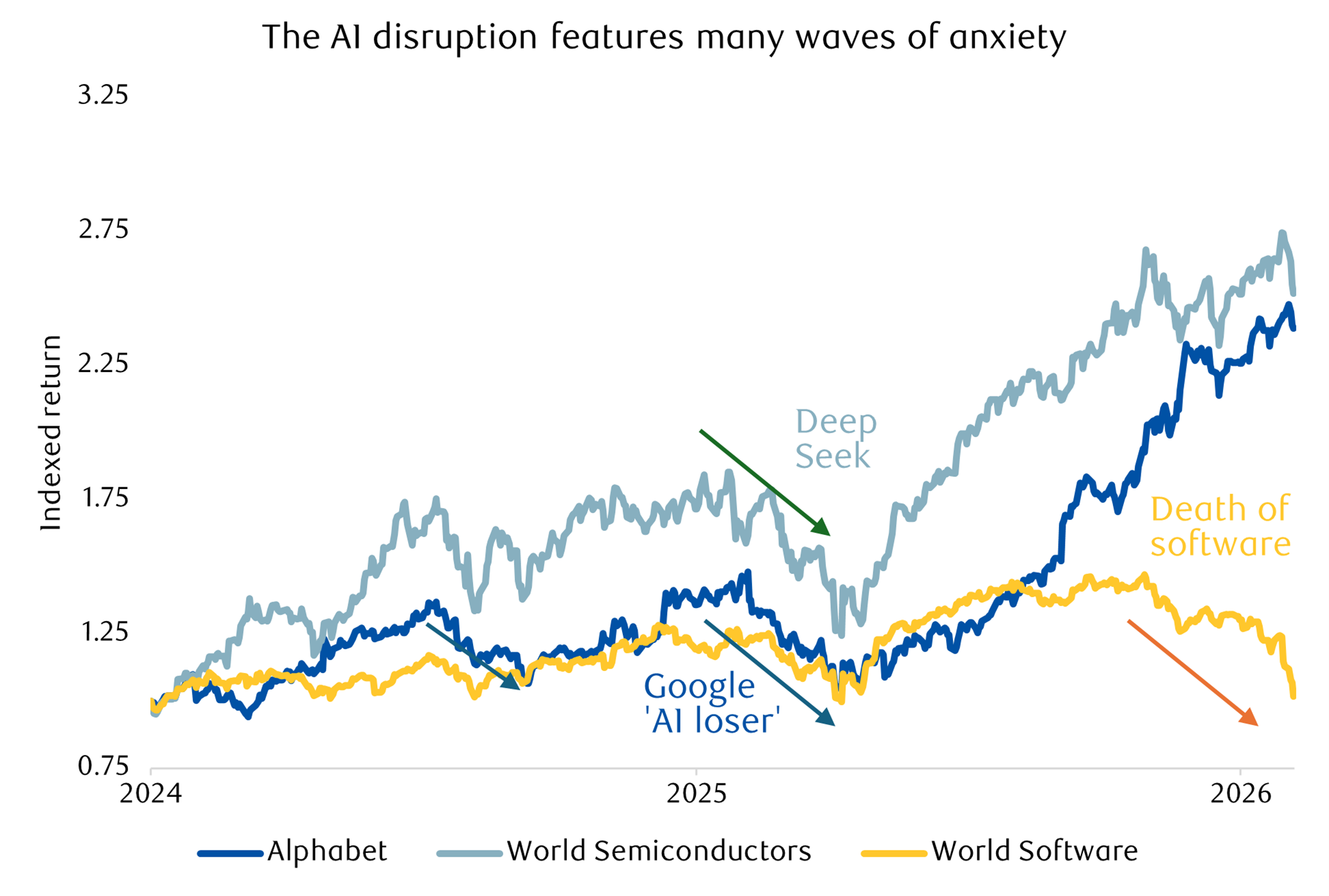
Similar stresses were seen in software, which saw sharp share class declines over fears that AI could replace many applications. The controversy investors are struggling with is whether AI is a tool for the software industry or an existential threat.

Early evidence suggests the former, and was validated to some extent by comments from Sundar Pichai, CEO of Alphabet. He pointed out that 19 of the top 20 Software as a Service (SAAS) firms were using Gemini (Alphabet’s AI model).

Either way, this seems like good news for Alphabet, but the stock sold off last week despite delivering record profits and performing strongly on most metrics. Amazon’s results were also good but were received even more poorly.

The anxiety for both companies seems to be related to plans for capital investment. While the investment still seems to be supported by demand, and therefore doesn’t echo the speculative investment of the technology, media and telecommunications (TMT) bubble era, it nevertheless represents an increase in capital intensity for the hyperscalers, which will depress profitability going forwards. What investors don’t know right now is whether that increase in costs will be justified by even greater increases in revenue.

It’s worth remembering that this time a year ago, the release of the Deep Seek large language model, which seemed much more efficient than the existing foundational models, caused significant sell-offs in AI hardware providers (such as Nvidia).

A year before that, AI was seen as an existential threat to Google’s search business. Since then, Google has emerged as one of the greatest beneficiaries of AI.

Looking back, those times represented attractive investment opportunities. The same could well be true for software and legal data companies today. The bigger question is what it would take for the market to regain confidence in the value of these businesses, just like it was able to do for the hardware companies and Alphabet itself.

Please continue to check our blog content for advice, planning issues and the latest investment market and economic updates from leading investment houses.

Charlotte Clarke

11/02/2026
Team No Comments

Tatton Investment Management: Monday Digest

Please see below, an article from Tatton Investment Management, analysing the key factors currently affecting global investment markets. Received this morning – 09/02/2026

Flipping the narrative

Global stocks marked time overall last week but US equities were a notable underperformer again despite a late Friday rally. AI is at the centre of the narrative but, this time, it’s not a positive. Other regions held up better: Japanese stocks soared ahead of an expected Takaichi’s election win (now a confirmed landslide victory). UK equity weathered political turmoil (helped by a more dovish Bank of England) and European stocks benefitted from the ECB also recognizing a benign inflation outlook.

Kevin Warsh’s nomination as the next Federal Reserve chair calmed markets to a degree, although some fear he might prove less positive for equities. He’s a strong-willed, orthodox and surprisingly hawkish pick – but his hawkish streak is more on reducing the Fed’s bond holdings. He’s said recently that AI productivity will suppress inflation and allow for lower rates (Trump wouldn’t have picked him otherwise) but he wants to reduce the Fed’s liquidity provision – returning it to the true lender of last resort. It’s a worthy aim but will likely mean more market volatility and valuation gains will be more difficult. On the plus side, his arrival will likely mean banking deregulation. Banks can and should pick up the liquidity slack over time.

The AI sell-off started with software companies but spread to the likes of Nvidia and Oracle when it became clear that layoffs are a growth risk – compounded by weak US jobs data. The US economy is sensitive to its stock market. The strongest effect is felt when businesses react to a fall in their share prices by switching from expansion to cost-cutting. If stocks keep falling, the labour market could deteriorate further. Recent growth data has held up well, but markets are already directly impacting economic confidence.

Falling bond yields are providing an offset – both for investors and by lowering borrowing costs. US businesses will likely start borrowing again when if rates and yields fall, benefitting sectors outside of tech and further fuelling the small cap rotation. The AI macro risk is more pronounced in the US than elsewhere, exemplified by the relative outperformance of UK and European equity.

We shouldn’t lose sight of the fact that productivity growth is the ultimate driver of growth and investment returns. Disruption brings risks, but creates its own balancing forces.

January Asset Returns Review

Stocks edged up 0.9% in sterling terms in January, while bonds gained 0.2%, but with significant variation. Trump’s tariff threats over Greenland had only a mild impact on equities, and his threat on Fed independence pushed up US bond yields. Bond markets were soothed by the appointment of Kevin Warsh as the next Fed chair, but that wasn’t enough to revive the dollar. US stocks lost 0.6% due to currency weakness and concerns over big tech. Microsoft’s disappointing earnings sent its shares down 12% in the space of a few hours – though Meta’s jumped after strong earnings. Meanwhile, stronger US economic data pushed up 2026 growth estimates, helping small-cap stocks.

Regional rotation continued: European stocks gained 2.2% and UK 3%, thanks to more attractive valuations (and despite still weaker earnings growth than the US). Japanese stocks jumped 4.5%, with improving corporate profitability now backed up by global cyclical trends. But Japan’s bonds sold off sharply and the yen sank. The bond market has structural problems (similar to the UK’s ‘Liz Truss moment’) but the current discount looks attractive. The global growth narrative also pushed emerging markets up 6.7%, with high-tech Korea a standout once more.

Gold’s price spike was remarkable, but it was more driven by speculation and illiquidity than its usual long-term supports (central bank purchases, private Chinese demand and retail momentum trading). Silver prices gained too, but cryptocurrencies – a similarly speculative, liquidity-driven asset – sank. That sends mixed signals about investor risk appetite. Other commodities sent mixed signals too: oil prices have been weak over the last three months (despite gaining in January) but industrial metals gained. The former points to weaker growth, and the latter suggests strength.

AI losers emerge

The AI trade started eating itself, after Anthropic’s new Claude Cowork tools threatened to replace workers and entire industries. Anthropic CEO Dario Amodei has been vocal about this, publishing an essay last month that predicted “unusually painful” job losses, as AI cuts across all industries simultaneously. We already see stories about AI-related layoffs at the likes of Amazon, Expedia and Dow Jones, and we think it’s a significant factor behind the lack of hiring in developed economies. Last week, the fear of AI displacement forced a sell-off across legal services, analytics and software sectors.

A recent IFS working paper suggests AI innovations increase output, investment wages and employment over the long-term – as productivity gains and job creation outweigh job displacement over the long-term. But rapid transitions are painful in the medium term: the UK’s transition from manufacturing caused a long and deep recession in the early 1980s. And manufacturing accounted for just 30% of UK GDP in 1979, whereas services today account for 81%. The fear of job replacement alone can cause a recession too, as workers save more and consume less, hitting business revenues and causing layoffs.

We aren’t saying this will happen, but it has become a clear and present macroeconomic risk. Where investors used to only see upside in AI, now they see a growth risk. This is different to the ‘AI bubble’ narrative. It’s not that investors are worried inflated valuations or unsustainable profits for AI companies; it’s that the pain could outweigh the gain in the short or medium-term. Even Nvidia and Oracle – two of the biggest AI winners, whose share prices dropped last week – need customers who can afford to buy. This also doesn’t negate the positivity about long-term productivity. But the losers are now clearly in focus – which could reinforce the capital market rotation we have seen recently.

Please continue to check our blog content for the latest advice and planning issues from leading investment management firms.

Marcus Blenkinsop

9th February 2026

Team No Comments

Brooks Macdonald – The Daily Investment Bulletin

Please see today’s Daily Investment Bulletin from Brooks Macdonald detailing their discussions on global markets:

What has happened?

Risk assets continue to be under pressure due a tech-led sell-off combined with softer US. Software stocks led the move, with the S&P 500 software component down -5.01% (its seventh consecutive decline) and the broader S&P 500 falling -1.23% for a third straight session. Volatility rose, with the VIX up to a 2026 high of 21.77. The rout gathered further momentum after the close when Amazon flagged much higher capex (now expected to reach $200bn this year) and cut operating income guidance for the quarter, sending its shares down more than -10% in after hours trading. The weakness was not confined to tech: equal weighted S&P 500 and Europe’s STOXX 600 pulled back from recent record highs, and Bitcoin plunged -13.14% to a 15 month low of $63,083, roughly 50% below its October peak.

Data softening shifts Fed expectations

Yesterday’s US data releases reinforced a softer tone for the labour market. Weekly initial jobless claims rose to an eight week high of 231k (vs. 212k expected), and the JOLTS report showed job openings fell to 6.542m in December (vs. 7.25m expected), the lowest since 2020 and below consensus. Markets interpreted these signs of cooling as giving the Fed more room to ease, pushing the probability of additional cuts higher; the cuts priced by the December meeting rose by 10bps to 60bps. That repricing drove Treasury yields lower across the curve, with the 2 year yield down 10.3bps to 3.45% (its largest one day drop since August) and the 10 year yield down to 4.18%.

Both ECB and BoE pause rates

The ECB held the deposit rate at 2%, with President Lagarde describing inflation as in a “good place,” and markets continue to expect rates to be on hold this year with downside risk. In contrast, the Bank of England’s decision had dovish undertones: a narrow 5–4 vote to hold at 3.75%, language indicating rates are “likely to be reduced further,” and heightened political uncertainty around the Prime Minister weighed on sterling and pushed shorter-dated gilts lower. The 2 year gilt fell 5.6bps to 3.64%. Long end yields rose, leaving the 2s10s curve at its steepest since 2018.

What does Brooks Macdonald think?

The recent moves looked more like a rotation and a volatility repricing than the start of a broad market correction. Software and other high beta names have led the decline, but widening breadth or macro signals deterioration could alter the near term risk/reward. We remain cautious on positioning: expect elevated volatility around earnings and data releases, monitor whether labour market weakness persists, and watch how central bank communications evolve.

Please continue to check our blog content for advice, planning issues and the latest investment, market and economic updates from leading investment houses.

Andrew Lloyd

06/02/2026

Team No Comments

Brooks Macdonald Daily Investment Bulletin

Please see below article received from Brooks Macdonald this afternoon.

What has happened?

Tuesday’s software sell-off broadened into a wider tech decline yesterday, with concerns around AI disruption dragging the NASDAQ (-1.51%) and the Mag 7 (-1.75%) lower and pulling the S&P 500 (-0.51%) into a second consecutive day of losses. The rotation out of large-cap tech continued to benefit the rest of the market, however. The equal‑weighted S&P 500 (+0.88%) closed at a record high, as did Europe’s STOXX 600 (+0.03%). Beneath the headline weakness, market breadth was remarkably strong, with 363 S&P 500 constituents advancing, the most in two weeks. Energy stocks (+2.25%) outperformed as Brent crude rose +3.16% amid renewed concerns over US‑Iran tensions. One notable outlier was silver, which fell -14%.

Cracks showing in the tech narrative

Weakness was most pronounced in semiconductors. AMD fell -17.31% after issuing guidance that disappointed investors, its worst single-day performance since 2017. That pressure cascaded across the sector, driving the Philadelphia Semiconductor Index down -4.36%, including a -3.41% drop for Nvidia. The developments reinforced the recent narrative of tech vulnerability following months of elevated expectations. On a more positive note, Alphabet reported a solid top-line beat after close, with Google Cloud revenue up 48% to $17.7bn in Q4 (vs. $16.2bn expected). But the market reaction centred on the company’s sharply higher investment plans: CAPEX is now projected at $175–185bn for 2026, more than double 2025 levels and significantly above consensus expectations of $120bn. Alphabet shares swung in after-hours trading—down as much as -7% at one point—before stabilising near flat after a -2% decline during the session.

US economic signals remain steady but inflation risks linger

US macro data continued to indicate stable underlying momentum. The ISM services index rose to 53.8 in January (vs. 53.5 expected), its strongest reading since late 2024. However, the details were mixed: new orders (53.1 vs. 56.5 expected) and employment (50.3 vs. 51.7 expected) softened, while the prices paid component climbed to 66.6 (vs. 65.0 expected). Given its historical correlation with inflation trends, this uptick raised some concern around the disinflation trajectory. Meanwhile, the ADP report showed private payrolls rising by 22k in January (vs. 45k expected), alongside modest revisions to prior months. The official jobs report (typically released the same week) has been delayed by the partial government shutdown, with the BLS now set to publish it on Wednesday next week.


What does Brooks Macdonald think?

We see a sharply diverging narrative emerging. Large-cap tech is experiencing a meaningful squeeze as markets reassess the idea that everyone will be long-term winners from AI. The environment is shifting toward a more selective landscape, where competitive advantage and capital discipline may increasingly drive performance dispersion. Yet despite the tech correction, broader equity indices have remained comparatively resilient, supported by solid market breadth and ongoing rotation into cyclicals and energy. Today’s focus turns to monetary policy. The ECB is widely expected to keep the deposit rate unchanged at 2%. However, heightened geopolitical uncertainty could bring a more dovish tone. In the UK, the Bank of England is also expected to hold Bank Rate at 3.75%. Domestic political noise has added an additional layer of uncertainty, with 10yr gilts rising +2.9bps yesterday against the broader global trend amid speculation around pressure on PM Starmer following the handling of the Peter Mandelson story.

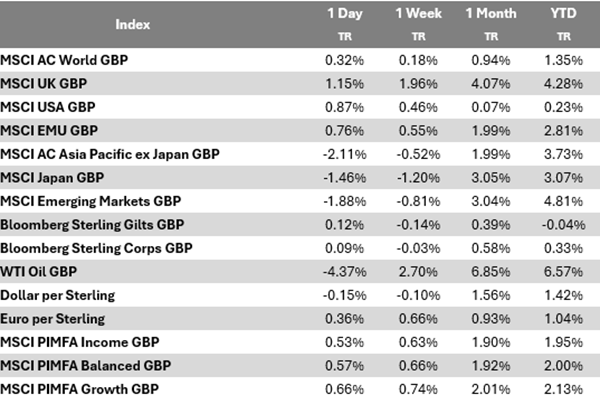
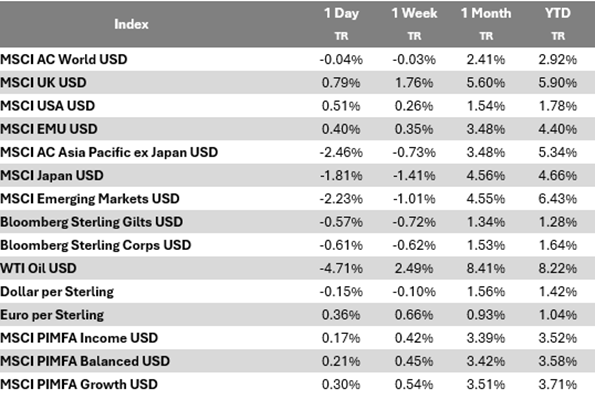
Index   1 Day 1 Week 1 Month YTD
  TR TR TR TR
MSCI AC World GBP   0.32% 0.18% 0.94% 1.35%
MSCI UK GBP   1.15% 1.96% 4.07% 4.28%
MSCI USA GBP   0.87% 0.46% 0.07% 0.23%
MSCI EMU GBP   0.76% 0.55% 1.99% 2.81%
MSCI AC Asia Pacific ex Japan GBP   -2.11% -0.52% 1.99% 3.73%
MSCI Japan GBP   -1.46% -1.20% 3.05% 3.07%
MSCI Emerging Markets GBP   -1.88% -0.81% 3.04% 4.81%
Bloomberg Sterling Gilts GBP   0.12% -0.14% 0.39% -0.04%
Bloomberg Sterling Corps GBP   0.09% -0.03% 0.58% 0.33%
WTI Oil GBP   -4.37% 2.70% 6.85% 6.57%
Dollar per Sterling   -0.15% -0.10% 1.56% 1.42%
Euro per Sterling   0.36% 0.66% 0.93% 1.04%
MSCI PIMFA Income GBP   0.53% 0.63% 1.90% 1.95%
MSCI PIMFA Balanced GBP   0.57% 0.66% 1.92% 2.00%
MSCI PIMFA Growth GBP   0.66% 0.74% 2.01% 2.13%
Index   1 Day 1 Week 1 Month YTD
  TR TR TR TR
MSCI AC World USD   -0.04% -0.03% 2.41% 2.92%
MSCI UK USD   0.79% 1.76% 5.60% 5.90%
MSCI USA USD   0.51% 0.26% 1.54% 1.78%
MSCI EMU USD   0.40% 0.35% 3.48% 4.40%
MSCI AC Asia Pacific ex Japan USD   -2.46% -0.73% 3.48% 5.34%
MSCI Japan USD   -1.81% -1.41% 4.56% 4.66%
MSCI Emerging Markets USD   -2.23% -1.01% 4.55% 6.43%
Bloomberg Sterling Gilts USD   -0.57% -0.72% 1.34% 1.28%
Bloomberg Sterling Corps USD   -0.61% -0.62% 1.53% 1.64%
WTI Oil USD   -4.71% 2.49% 8.41% 8.22%
Dollar per Sterling   -0.15% -0.10% 1.56% 1.42%
Euro per Sterling   0.36% 0.66% 0.93% 1.04%
MSCI PIMFA Income USD   0.17% 0.42% 3.39% 3.52%
MSCI PIMFA Balanced USD   0.21% 0.45% 3.42% 3.58%
MSCI PIMFA Growth USD   0.30% 0.54% 3.51% 3.71%
Index   1 Day 1 Week 1 Month YTD

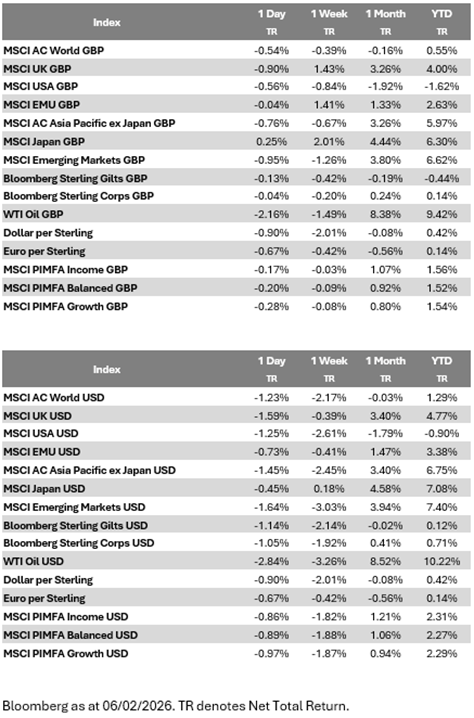
Bloomberg as at 03/02/2026. TR denotes Net Total Return.

Please check in again with us soon for further relevant content and market news.


Chloe


05/02/2026

Team No Comments

Brewin Dolphin – Markets in a Minute

Please see this week’s Markets in a Minute update below from Brewin Dolphin, received yesterday afternoon – 03/02/2026.   

Markets respond to Fed chair nomination

We explore how markets have reacted to President Trump nominating Kevin Warsh as new Federal Reserve chair.

Key highlights

  • Trump makes Fed chair nomination…..: He’s gone for former Federal Reserve (Fed) Governor Kevin Warsh.
  • … and markets react: Silver and gold markets took a downward turn on the news, while Treasury yields and the dollar rose.
  • Earnings season: The first batch of tech companies reported earnings, with a normal-seeming beats-to-misses ratio (80% for equities, 60% for sales).

Warsh nominated as Federal Reserve chair

A few weeks ago, we discussed Kevin Hassett, who President Donald Trump was strongly hinting would be his nominee for Fed chair. That’s now history. Instead, the president has nominated former Fed Governor Kevin Warsh. The question is – does this have implications for investments?

We know that President Trump is anxious to replace Jerome Powell as Fed chair because he wants interest rates to be lower. That aligns with the recent commentary Kevin Warsh has been providing, in which he too suggests that interest rates are too high and are disadvantaging small businesses. This sounds as if it aligns with President Trump’s ‘man of the people’ instincts, but Warsh’s views still seem to clash with those of the president, and to a surprising extent.

Warsh says “[the Fed] should abandon the dogma that inflation is caused when the economy grows too much and workers get paid too much. Inflation is caused when government spends too much and prints too much.”

President Trump has been explicit about wanting lower interest rates to support the housing market, but also to lower the federal interest expense. This is a concept called fiscal dominance, which means setting interest rate policy to ease fiscal challenges rather than moderate inflation, and it seems like one Kevin Warsh would struggle to find peace with.

Warsh emphasises the role of credibility, which he says Powell has undermined through the use of the Fed balance sheet during lockdown. He accuses the Fed of prioritising Wall Street over Main Street (the financial sector over more traditional businesses). As such, he’s been advocating reducing the balance sheet (selling the bonds the Fed holds to justify cutting interest rates, which he says would support Main Street over Wall Street).

Warsh has also stated that he believes the dollar’s role as a reserve currency brings benefits to the U.S. There was quite a market reaction to this because it seems so at odds with the rhetoric and actions that have come from the Trump administration. The idea of shrinking the Fed balance sheet would seem set to put upward pressure on bond yields and mortgage rates, and make longer-term borrowing more expensive.

Some within the Trump administration have wanted a weaker dollar to support the manufacturing industry – Kevin Warsh doesn’t seem to advocate that.

So, despite the preference for lower interest rates, Kevin Warsh seems like quite an austere choice for a president who wants to use interest rates to reduce the federal interest expense.

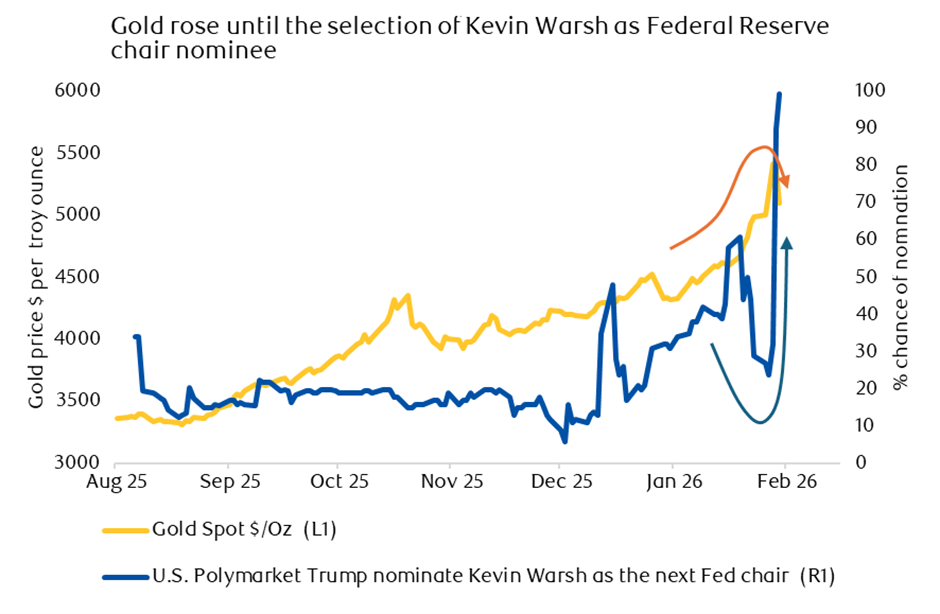
Understandably, the rumour caused quite sharp reversals in the gold and silver markets, which had been performing extremely well. Gold rose from below $4,000 per troy ounce as recently as November, briefly touching $5,600 on an intraday basis before dipping back towards $5,000.

Source: Bloomberg

Treasury yields rose as the news was digested and the dollar, which had been in freefall, began to rise.

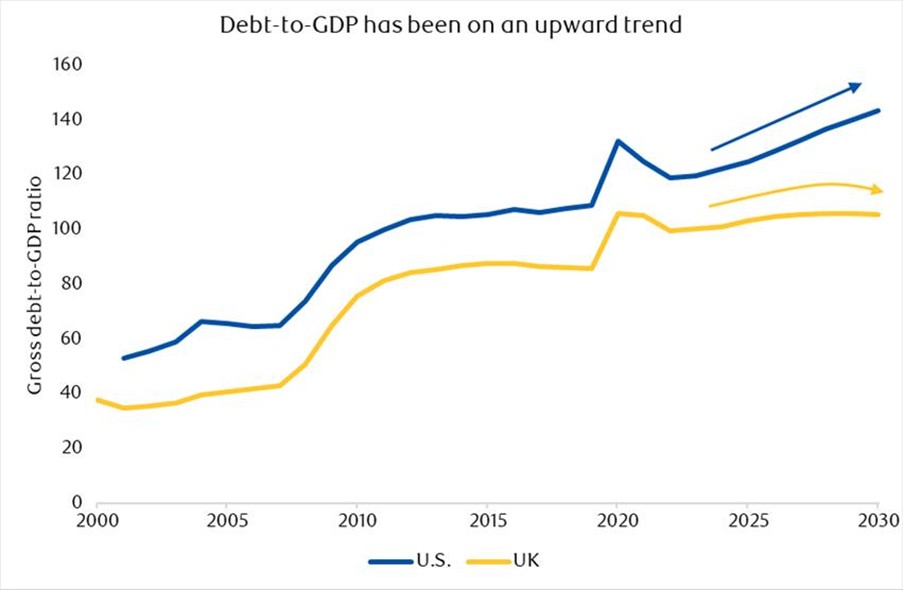
These moves seem quite rational. Appointing a generally hawkish advocate of a strong dollar as Fed chairman weakens the evidence that the dollar is going to be debased over time, and that monetary policy will be used to suppress interest rates to help fund the deficit. What it doesn’t do, however, is reduce the size of the budget deficit and therefore the amount of bonds the federal government will need to issue. Nor does it create an alternative mechanism for dealing with that debt burden. And it seems unlikely that it reflects a change in President Trump’s desire to see interest rates lower in order to reduce the federal interest rate bill.

LSEG: Datastream

Earnings season is underway

Away from Washington, earnings season proceeds with the first batch of technology company earnings. As always, the beats-to-misses ratio appears normal (80% for equities, around 60% for sales) and the general message from companies has been that consumers remain in decent shape.

Any market disappointment has tended to be on the basis of guidance rather than results. U.S. equities were on track for modest gains over the week, most of which were lost for overseas investors due to the dollar depreciation that preceded Kevin Warsh’s appointment.

Please continue to check our blog content for advice, planning issues and the latest investment market and economic updates from leading investment houses.

Charlotte Clarke

04/02/2026

Team No Comments

Brooks Macdonald – The Daily Investment Bulletin

Please see the below article from Brooks Macdonald detailing their discussions on global markets. Received this morning 03/02/2026.

What has happened?

Equity markets staged a sharp rebound following the weekend volatility, with the S&P 500 rising +0.54% and ending just 0.03% below its all time high. While the Mag 7 lagged again (-0.10%) for a third consecutive session, leadership broadened meaningfully: small caps outperformed, with the Russell 2000 up +1.02%. The catalyst for the turnaround was a surprisingly strong ISM manufacturing release, which reached its highest level since 2022 and fuelled renewed optimism around the 2026 economic outlook. European equities echoed the upbeat tone as the STOXX 600 climbed +1.03% to set another record high. However, precious metals were an outlier. Gold fell -4.76% yesterday, marking a two day drop of -13.28%, its steepest since 2013 and the second largest since the 1980s. Silver experienced an even more dramatic move, plunging -6.96% on the day and -31.48% over two sessions, which was the biggest two day decline since Bloomberg’s daily price records began in 1950.

US data surprised on the upside

The ISM print was crucial in shaping yesterday’s risk-on sentiment. January’s reading rose to 52.6 (vs. 48.5 expected), returning to expansionary territory and exceeding most economists’ forecast. New orders surged to 57.1, the largest monthly gain since June 2020, reinforcing the picture of resilient underlying demand. Bond markets adjusted quickly as investors scaled back expectations for near-term Fed easing, with futures reducing the implied probability of a June rate cut from 87% to 70%. This drove Treasury yields higher, with the 2 year rising +4.9bps to 3.57% and the 10 year climbing +4.2bps to 4.28%.

Energy weakness eased inflation concerns

Oil prices extended their decline as geopolitical risk premium eased. Reports indicated that US Special Envoy Steve Witkoff is due to meet Iran’s foreign minister in Istanbul on Friday. It was an unexpected development but helped reverse the sharp risk-driven energy rally seen in January. Brent crude fell -4.36% to $66.30/bbl, while WTI dropped -4.71% to $62.14/bbl, relieving some pressure on inflation expectations. The US 2 year inflation swap declined -4.7bps to 2.55% as a result.

What does Brooks Macdonald think?

While the strong ISM reading reinforces the narrative of resilient US growth, the near-term policy outlook is clouded by the ongoing partial government shutdown. The BLS confirmed that Friday’s January jobs report will not be released as scheduled, again limiting visibility on labour market momentum. Political developments remain fluid: former President Trump urged House Republicans to approve the Senate backed funding deal, with a House vote expected today. From a market perspective, the combination of stronger activity data and easing energy prices paints a mixed but broadly constructive picture, but the underlying trends suggest a market sensitive to incremental information.

Please continue to check our blog content for advice, planning issues and the latest investment, market and economic updates from leading investment houses.

Alex Clare

03/02/2026

Team No Comments

Tatton Investment Management: Monday Digest

Please see below, an article from Tatton Investment Management, analysing the key factors currently affecting global investment markets. Received this morning – 02/02/2026

End of euphoria, back to normal? 

Equities hit all time highs early last week, but US stocks sold off after Microsoft’s earnings. A ‘normal’ sell-off based on earnings would be mildly comforting, after recent political risk sell-offs. However, there are liquidity risk signals over weekend trading. Gold, silver and Bitcoin have hit large profit-taking, which appears to be bleeding into emerging market equities; for example, the main South African index has fallen over 6% in today’s first hours of trading.

Gold prices have skyrocketed over the past two years, and the total stock of gold is probably now worth over $35tn – twice the size of the US treasury market and nearly a quarter the equity market capitalisation. Investors have raised their gold allocations, but we don’t think this reallocation is sustainable. Highly leveraged positions in gold suggest there has been a lot of short-term speculation recently. Gold’s actual free-float and daily trading liquidity is much smaller than bonds or equities, meaning it doesn’t take much to move gold prices. Long-term investors should be wary: it’s a valuable insurance in uncertain times, but the insurance premium is now very high.

The dollar slid to its lowest level in four years after Trump called dollar weakness “great”, but Scott Bessent’s reassurance stabilised the currency. The TACO factor is helping to calm things, from (temporarily) avoiding a government shutdown to Trump appointing the experienced Kevin Warsh as next Fed chair. Markets didn’t even mind the president calling current chair Powell a “moron” for the Fed not cutting rates. The Fed referenced a rebounding labour market, but high profile layoffs still have bond markets betting on a summer rate cut. In any case, Trump’s usual disruption isn’t putting any extra pressure on the dollar.

US threats against Iran pushed up oil prices, but stock markets were focussed on Microsoft’s earnings. The tech giant’s cloud growth disappointed and its intertwining with OpenAI revived the talk of ‘circular financing’. In contrast, Meta’s better-than-expected results boosted its shares, even though Meta is spending big on AI too. This shows investors will still reward big investments, as long as they’re the right ones.

The fundamental growth and earnings outlook is strong, so it would be nice if politics continued to take a backseat.

Starmer in China – a pragmatic friendship

Kier Starmer’s trip to China has yielded incremental but meaningful results: visa-free travel for UK citizens, a “feasibility study” on a future services trade deal, and lines of communication on trade. Britain has a large trade deficit with China (it’s more than doubled since the last time a Prime Minister visited China in 2018), so the biggest prize for UK businesses would be gaining market access. There were encouraging signs on this, but the underlying problem is a chronic lack of Chinese consumer demand. Despite Beijing’s continued fiscal stimulus, Chinese consumers save too much and don’t spend enough. Measures to address the problem have mostly just added to overproduction issues (e.g. by increasing employment).

But trade deals are about the long-term – and China will have to resolve its oversaving problem one way or another. Beijing’s next five-year economic plan will reportedly emphasise private business, so this could be the ideal time to get access to Chinese markets. In theory, Britain’s supply-side problems and investment services expertise complements China’s overproduction and huge stock of savings. But in practice, restricted information on Chinese companies hinders investment, while Chinese imports to the UK often incur accusations of ‘dumping’.

Trump called the UK’s talks with China “very dangerous”, and last week threatened a 100% tariff on Canada if it makes a trade deal with China. But these are increasingly seen as empty threats, given the US Supreme Court’s pending ruling on tariffs, and Trump’s own record of backing down. China itself can be a dangerous trading partner, though: Beijing restricted Nexperia chips last year over a feud with the Netherlands, nearly halting global car manufacturing.

China is currently trying to play nice, though, and its long-term goals (creating an alternative to US-led order, internationalising the renminbi) suggest that will continue. Pursuing closer ties with China is a gamble, but probably a worthwhile one.

Will European growth stay peripheral?

Absolute Strategy Research (ASR) point out that Europe’s so-called periphery nations are doing much better than the core. Since the start of 2025, stock returns in Greece (+55%), Spain (+46%) and Italy (+37%) have been better than France (+8%) and Germany (+18%). Peripheral corporate profits are being revised up, and core profits down. It’s a role reversal for the previously high debt, low growth countries derogatorily referred to as the ‘PIIGS’ (Portugal, Italy, Ireland, Greece and Spain).

ECB interest rates used to be low for the German growth machine and punishingly high for the periphery – but that trend has now reversed. Peripheral stocks still have lower valuations than in France and Germany, too.

The NextGenerationEU fiscal package has boosted periphery growth more than in the core, but the NextGen boost won’t be as strong in 2026 as it has been since the pandemic. In contrast, Germany’s defence spending spree will come this year, benefitting manufacturers with spare capacity. We therefore expect core profit growth to catch up – with the possible exception of France, with its idiosyncratic political paralysis.

A strong periphery is good news for Europe, as the concentration of European growth on Germany has been a structural problem for decades. Peripheral profit growth is a strong counterpoint to those who are sceptical of the US-to-EU capital rotation. While aggregate European profits still lag US large cap, there are decent earnings dynamics to be found in Europe and, thanks to lower European equity valuations, profits don’t need to be world bearing to be attractive.

Peripheral growth is helping to overcome Europe’s structural inequalities and fiscal stimulus should help its oversaving problem. There’s talk of a “two speed” union, to get around the paralysis issue too. This is helping the mood for European equities.

Please continue to check our blog content for the latest advice and planning issues from leading investment management firms.

Marcus Blenkinsop

2nd February 2026

Team No Comments

EPIC Investment Partners | The Daily Update

Please see below, an article from EPIC Investment Partners which discusses the fall in the value of the US Dollar over the past year. Received today – 30/01/2026

Eight billion dollars a day is the cost of US borrowing. That was the pace at which federal debt was rising when it passed the $38.5tn milestone earlier this month. Interest payments have already overtaken defence spending and are on track to exceed $1tn this year, absorbing an ever-larger share of fiscal capacity. At this rate, the durability of the dollar depends less on the size of the American economy than on the credibility of the institutions that manage its liabilities.

When governments borrow at this scale, reserve-currency status becomes a matter of trust rather than output. Investors must believe that monetary policy remains insulated from political pressure and that central banks act independently when fiscal strains intensify. Once that assumption weakens, risk premia rise incrementally rather than dramatically, through quiet reallocations rather than sudden flight.

History offers clear precedents. Spain’s silver-backed real faltered not because silver disappeared, but because repeated defaults revealed a state willing to treat money as an extension of war finance. The Dutch guilder followed a subtler path. In the late eighteenth century, the Bank of Amsterdam relaxed its rigid metallic discipline to support favoured borrowers, including the Dutch East India Company and struggling municipalities. When that became apparent, confidence in bank money evaporated and did not recover.

The United States now faces a comparable test on a far larger scale. The pressure is not inflation in the narrow sense, but institutional. The issuing of grand jury subpoenas to Federal Reserve chair Jerome Powell, after months of political attacks linked to the cost of servicing federal debt, marked a break with conventions markets had long treated as settled. The legal merits matter less than the precedent. If the independence of the central bank can be challenged in this way, monetary policy no longer appears neutral. It begins to look constrained by the state’s borrowing requirements.

That backdrop lends financial relevance to a dispute far from Washington. Greenland’s strategic value has long been managed through alliance structures that separated military access from political ownership. By reframing the issue as one of control, and by briefly threatening tariffs against European partners, Washington turned a peripheral security question into a broader test of restraint. Investors were less concerned with the Arctic itself than with the willingness to deploy economic pressure in ways that cut across long-standing norms.

Markets responded predictably. The dollar has fallen roughly 10 per cent over the past year and slid to a four-year low this week. More telling has been the behaviour of long-term institutions. Denmark’s AkademikerPension has reduced its holdings of US Treasuries, citing concerns over public finances and the independence of the Federal Reserve.

In numerical terms, the move is modest. As a signal, it is not. When investors that have long treated US government debt as the world’s risk-free benchmark begin to price in political risk, the foundations of reserve status begin to shift. The dollar continues to function, but it loses something more subtle: its presumption of neutrality.

None of this points to an imminent end to dollar dominance. Liquidity, scale and legal infrastructure still matter, and no alternative offers a comparable combination of depth and reach. But reserve currencies rarely fail abruptly. They erode through higher term premia, gradual diversification and declining assumptions of institutional restraint.

The Arctic dispute, then, is not about ice or islands. It is a stress test of credibility at a moment when the fiscal arithmetic has become unforgiving. History suggests that once trust is traded for convenience, even briefly, it is difficult to reclaim. Confidence rarely collapses in public. It erodes quietly, over time.

Please continue to check our blog content for the latest advice and planning issues from leading investment management firms.

Alex Kitteringham

30th January 2026

Team No Comments

EPIC Investment Partners – President Trump seeks to demolish Davos internationalism

Please see the below article from EPIC Investment Partners detailing their discussions on Trump’s latest activities. Received yesterday afternoon 28/01/2026.

Should investors worry?

President Trump’s much anticipated speech at Davos confirmed what many of us have assumed, that the US will not use force against Greenland, a NATO ally. It also laid into many globalist beliefs, branding net zero policies as a “green scam”, attacking Europe’s continued shortfall on defending itself and saying that countries that want to shift to renewables and decarbonised industry are stupid, playing into the hands of a strong and cynical China. President Trump is still determined to get a better deal over Greenland, frustrated over the absence of agreement to end the war in Ukraine and dismissive of European dear energy and high migration policies which he thinks undermine their economies and societies. President Trump continues with tariffs as his main weapon and refuses to worry about the damage to trade and relations these cause.

By way of balance to these views, Prime Minister Carney of Canada has also told some home truths to his fellow globalists. He recognises the break down in the international rules-based system of NATO, WTO, UN and urges other middle powers to take action to protect themselves. “A country that cannot feed itself, fuel itself or defend itself has few options”. He is seeking closer contacts with China, the EU and other players for Canada as he worries about how much continued trade and support he can count on from his neighbour, the USA. Mrs Von Der Leyen on behalf of the EU also thinks the “shift in the international order is not only seismic – but it is permanent” “We now live in a world of raw power”. This is a strange time to announce this, as surely Putin expressed that view with force from 2014 onwards in Ukraine and China has always taken an asymmetric approach to international law. The USA has never accepted the right of international courts to dictate to it and has always had a veto on UN action. The EU proposes closer and faster European integration and wants a stronger EU military with capability in the Arctic circle to help Denmark/Greenland.

The US sphere of influence

President Trump has been clear in his foreign policy aims. He thinks Europeans should take more responsibility for their own defence. He has pushed them to increase their spending on military force and sees Ukraine as an EU problem as Ukraine is seeking to be a member and has close relations with the EU. Whilst he has not pulled the US out of NATO, he uses the full bargaining power US dominance gives to make it clear Europeans have to do much more. The US has no wish to fund or fight the war in Ukraine for them.

He has modernised the Monroe doctrine which stated that Europeans should keep out of the Americas and the US would keep out of Europe. His Monroe doctrine sees the lands from Greenland and Canada in the North to Chile in the south as an area of great strategic importance to the US where the US will intervene and influence developments.

Some think this means the US becomes a dominant regional power, but the President has been keen to set out he sees the US in a competition with China for world sway. He has not ruled out defending or intervening in Asia should China overreach. He is keen to keep Diego Garcia and other big Asian bases and to reinforce the freedom to navigate the China Sea and the Taiwan Straits. He looks to Japan to provide more support.

He now intends to heavily influence Venezuela by channelling investment and organising the oil trade and oil revenues, sharing them with Venezuela itself. He wants a new relationship with Greenland as he wishes to strengthen US/Greenland defences into the Arctic circle and to exploit the minerals there.

The Greenland problem

Greenland is a self-governing territory but also a colony of Denmark; with Denmark having powers over foreign policy, defence and providing some money. It has a population of just 56,000 people in a few small towns on the relatively ice free southwestern coastal strip. It is a huge area of land and ice sheet covering several islands in the Greenland group. The Danish King is the Head of State for ceremonial purposes. Denmark sends an annual grant to assist the Greenland economy. Greenland has two representatives elected to the Danish Parliament. Most Greenlanders want to be independent of Denmark, but do not want to become a state of the USA.

During the Second World War the US sent a military force to Greenland to prevent German occupation at a time when Denmark had been incorporated into the Third Reich by force.

Greenland has a defence agreement with the USA. There is an important US military base on the islands. The US would like to strengthen its defences in the area given Russian and Chinese interest in the Arctic Circle. The US sees the oil, gas and minerals potential as a way to pay for the defence and to improve the incomes of local people. Greenlanders are in the main opposed to a big increase in commercial exploitation of natural resources. Most of the deposits are well away from the small populated coastal strip in the southwest corner.

The main European allies of the US have said the US should rule out any idea of sending in forces to take charge of a democratic member of NATO. There are diplomatic possibilities to improve the US offer of defence support and to find some agreement on joint economic development. Given the wish of many Greenlanders to be free of Denmark they would need more revenue to replace the Danish grant. With agreement it would be possible to settle many new people in Greenland well in excess of current population numbers to boost investment and output. President Trump was accompanied in Davos by Trade Secretary Lutnick and Treasury Secretary Bessent. The Secretaries were measured and keen to engage in negotiations to seek to find a way round a tariff war over Greenland’s future.

The Chinese sphere of influence

China joined the World Trade Organisation in 2001 on favourable terms. It gave China easy access to lucrative Western markets whilst allowing a variety of restrictions and obstacles to trade to still be imposed on Western exporters to China and investors in China. China has used the last quarter of a century well, to accelerate growth and to build its Belt and Road initiative. This has meant investing in crucial infrastructure in a wide range of countries between China and the West, gaining profitable contracts, creating plenty of Chinese jobs and securing influence over those countries.

China has tightened its control and restricted democracy in Hong Kong after negotiating a transfer based on promises to keep the freedoms of the previous system going. China has built settlements and facilities on small islands and atolls in the China Sea to claim much greater sway over the whole area. China is building a huge military including amphibious capability of the kind needed to invade Taiwan.

China has seen Russia’s difficulties in trying to secure Ukraine and has used these to strengthen its dominant position in the Sino-Russian alliance. It has helped it secure more cheap energy and more markets for its military and manufactured products. China has increased its influence in the Middle East with strong links to Iran and its proxies. China’s reach also stretches into Latin America via Cuba, and it was close to the Venezuela dictator. China wishes to be the world’s dominant power and has almost four times as many people than the US as a help. However, China remains respectful of US technology and military reach.

Likely developments

Geopolitics remains an important backdrop to investing. It is unlikely there will be war between the US and Russia, let alone China. It is proving difficult to resolve war with Ukraine as Russia still thinks there is gain to be had by continuing the murderous conflict, relying on the inability of the Europeans to marshal enough money and force to give Ukraine a victory. The US is unlikely to invade Greenland but will intensify diplomatic pressures to see if there is a deal to be done on defence and minerals. China will continue to menace Taiwan but will not invade given President Trump’s new belligerence. There will be further action by the US to enforce sanctions more strictly.

The Canadians and Europeans are overstating the seismic change they see. Over the last decade it has been quite clear Russia, China, Iran, North Korea and others have always reserved their claimed right to exercise raw power and have applied world rules only when it suits them. Over the next decade there could be further large changes in US policy under President Trump’s replacement. The biggest change being brought about by President Trump is to energy, where he has given a big boost to fossil fuels alongside the use of them in China, Russia, India, Brazil and other big markets. This has helped strand the EU and the UK with dear energy and with a big demand for imports of green products from China. Meanwhile the US giant companies in digital technology have extended their lead on the rest and dominate world stock markets and economies.

On these assumptions share markets can make more progress for investors this year. The announcement of a massive increase in defence spending by the US is providing a further boost to the defence sector which has been doing well on better prospects for orders for some time. Adding Venezuelan oil to western sources and building up the flows will help prevent big upward moves in energy prices to worry Central Banks about inflation. There are some signs that inward and domestic digital investment is giving the US a substantial productivity boost, with the US representatives at Davos particularly bullish about likely growth this year for their own economy.

Please continue to check our blog content for advice, planning issues and the latest investment, market and economic updates from leading investment houses.

Andrew Lloyd

29/01/2026