Team No Comments

Brewin Dolphin – Markets in a Minute

Please see this week’s Markets in a Minute update below from Brewin Dolphin, received yesterday afternoon – 13/01/2026.  

An uncertain world for investors

Geopolitical tensions, weak U.S. jobs data, and silver supply restrictions shake markets.

U.S. jobs growth disappoints

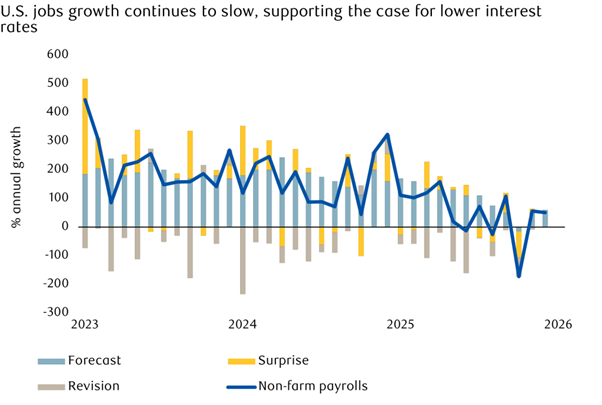
Most of last week was dominated by geopolitical news related to the U.S. and China, but the week ended with the U.S. non-farm employment report. This was being closely watched because a strong report would reduce the rationale for interest rate cuts and could imperil the strong equity market performance.

Jobs growth in December was slightly below expectations, but the most eye-catching figures were the revisions to November’s numbers. Non-farm employment has failed to return to its previous peak since November, which was affected by the U.S. government shutdown. The unemployment rate declined, but if jobs growth is low or even negative, the Federal Reserve (the Fed) will be keen to cut interest rates and may possibly do so sometime in the second quarter.
Source: LSEG Datastream

The ‘Donroe’ doctrine

Former U.S. President James Monroe believed that any external power’s interference in the politics of the United States should be treated as a hostile act. This principle has been cited as the rationale for the indictment, extraction and pending prosecution of Venezuelan President Nicolás Maduro and his wife. The accusation? Facilitating the transit of narcotics into the U.S. as an act of narco-terrorism.

The extraction only had a modest impact on major markets. Few mainstream leaders express any sympathy for President Maduro, whose position was widely considered illegitimate anyway. Once a rich country, Venezuela now has minimal impact on economic growth and has been a bond market pariah for many years.

Despite having the largest proven oil reserves in the world, Venezuela’s current production is marginal, with extraction and transport infrastructure having fallen into disrepair, particularly following their nationalisation under former President Hugo Chavez (which contributed towards the country’s growing reliance on narcotics as a source of revenue).

There’s scope for a huge increase in Venezuelan oil production of hundreds of thousands of barrels per day this year, and potentially a few million barrels per day in future years. This stretched timescale made no immediate impact on the oil price this week, but some oil stocks did benefit.

Chevron has production in Venezuela and is therefore best placed to extract and transport oil from the region. Exxon Mobil and ConocoPhillips hold legal claims on Venezuela, which could now be satisfied. Other perceived beneficiaries included those refining companies that have capacity on the U.S. Gulf Coast. Crude oil comes in various flavours, and the Gulf Coast refineries are configured to use heavy crude oil, such as that which comes from Venezuela, which is quite different from the light oil the U.S. produces.

President Donald Trump’s plan for a U.S.-led revival of Venezuela’s oil industry would be a years-long process, which could potentially cost upwards of $100 billion and create opportunities for oil services businesses such as Halliburton and Baker Hughes.

However, it’s important to recognise that despite the ousting of President Maduro, Venezuela retains a deeply entrenched criminalised state structure, which needs to be displaced to encourage the kind of investment that brings oil output up to potential.

Aside from addressing narco-terrorism and increasing access to heavy crude oil, the intervention in Venezuela expanded U.S. influence over the region, which has been courted over many years as a source of mineral resources for China. Under U.S. sanctions, China had become the marginal buyer of Venezuelan crude oil, a supply that’s now being redirected towards the U.S.

President Trump and his administration have also expressed determination to acquire Greenland, another mineral-rich region that has a strategic geographical value. The White House Press Secretary’s statement that “utilising the U.S. military is always an option” supports the idea that countries will need to invest in their domestic productive capability and seek to diversify their financial assets to reduce risk during a period of geopolitical decoupling.

Going for silver

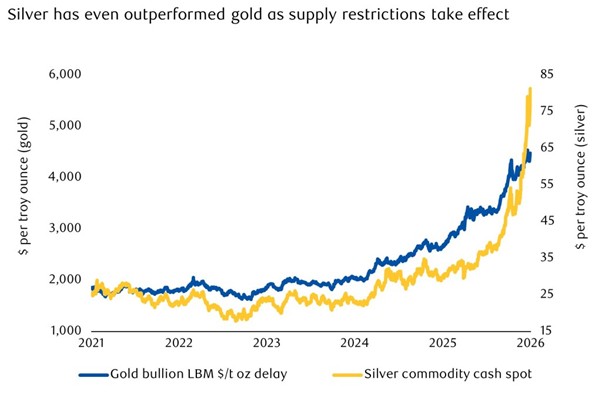
Another prescient illustration of China and America’s resource rivalry comes in silver; China announced at the start of the year that it would restrict exports.

Silver normally trades like a particularly volatile precious metal but has more recently begun to be considered a critical industrial metal. China is the second biggest miner of silver, but by far the biggest refiner of silver. Silver can now only be exported from China with government permission. It’s not banning exports, but rather adjusting the speed of licensing as a tool with which to manipulate global supply chains. Western silver consumers are moving to secure supply.

China is reliant upon imports of silver ores from Peru and Mexico, which other consumers are now understandably keen to intercept. China cannot permanently restrict the silver market as its share of mined silver is too low, but it can cause a medium-term bottleneck while sourcing, verifying and refining capacity catches up in other regions.
Source: LSEG Datastream

In the meantime, the silver market remains under acute strain, with critically low inventories across key hubs colliding with heavy speculative demand, notably from Chinese retail investors. It means that paradoxically, despite the export restrictions, silver is actually more expensive in China than in the West.

Please continue to check our blog content for advice, planning issues and the latest investment market and economic updates from leading investment houses.

Charlotte Clarke

14/01/2026
Team No Comments

Brooks Macdonald – The Daily Investment Bulletin

Please see the below article from Brooks Macdonald detailing their discussions on Geopolitical developments and Fed independence. Received this morning 13/01/2026.

What has happened?

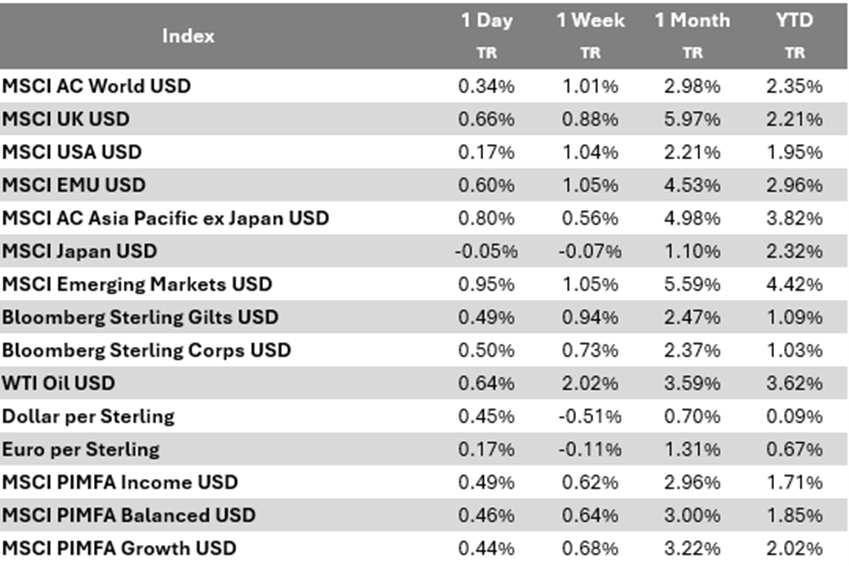
Geopolitical developments in Venezuela and Iran continued to draw attention, while US prosecutors launched a criminal investigation that has revived some fears around central bank independence. Precious metals surged to fresh highs, with gold (+1.97%) reaching $4,598/oz and silver (+6.57%) rising to $85.10/oz. Brent crude (+0.84%) also climbed to a seven week high of $63.87/bbl. Yet equities were largely unfazed: the S&P 500 (+0.16%) and Europe’s STOXX 600 (+0.21%) both closed at new records. Financials lagged, with the KBW Bank Index (-0.95%) under pressure after Trump called for a 10% cap on credit card interest rates. Among the large tech names, the Mag 7 (-0.03%) had a mixed session, though Alphabet (+1.00%) became the latest to surpass a $4trn valuation after securing a multi year agreement to provide AI capabilities for Apple devices.

Market brushed off concerns around Fed independence

Concerns over Fed independence initially pressured US assets, but the reaction proved short lived. Treasury yields briefly steepened before settling only modestly higher, the US dollar weakened slightly, and equities fully reversed early losses to close at new highs. The limited market move reflected growing scepticism about the likelihood of meaningful political intervention. Key Senate Republicans, including Thom Tillis of the Banking Committee and Lisa Murkowski, signalled opposition, raising doubts about the feasibility of any challenge to the Fed’s autonomy. Investors also appear mindful that the administration has previously stepped back when bond market volatility risked lifting mortgage rates. With Powell’s term ending in May, leadership changes are already expected. Still, the next few weeks remain important, with the Supreme Court considering the Lisa Cook case on 21 January ahead of the FOMC meeting on 27–28 January.

What does Brooks Macdonald think?

Risk assets have absorbed political noise well, but incoming data will continue to shape the near term narrative. Attention now turns to today’s US CPI release. The previous print appeared softer but was viewed cautiously due to data collection issues during the US government shutdown, particularly an unusually sharp slowdown in shelter inflation. A more reliable dataset this month should offer clearer insight into underlying price trends. A stronger than expected CPI reading could revive rate cut uncertainty, while confirmation of easing inflation would support the current risk on tone.

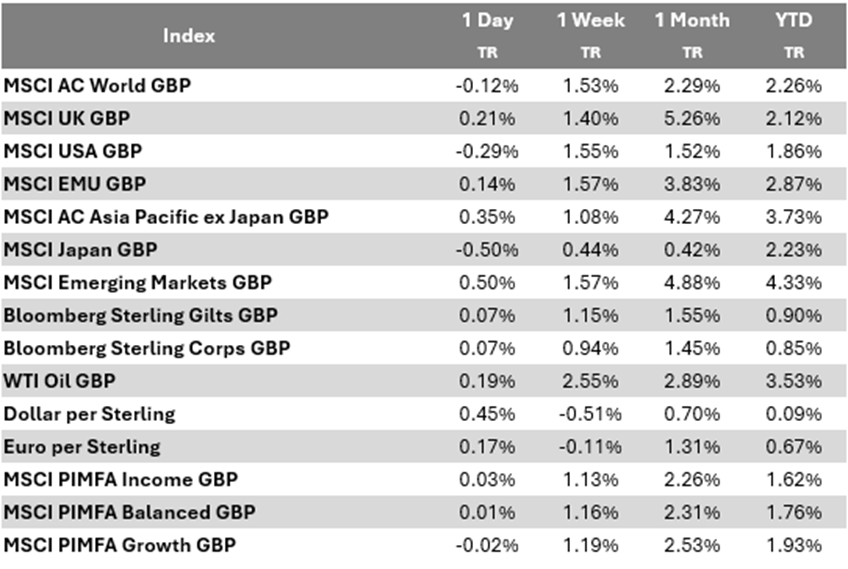
Bloomberg as at 13/01/2026. TR denotes Net Total Return.

Please continue to check our blog content for advice, planning issues and the latest investment, market and economic updates from leading investment houses.

Alex Clare

13/01/2026

Team No Comments

Tatton Investment Management: Monday Digest

Please see below, an article from Tatton Investment Management, analysing the key factors currently affecting global investment markets. Received this morning – 12/01/2026

Optimism prevails

Markets have started the year well, led by small and mid-cap stocks. US military action and threats barely moved markets – not even oil prices. Instead, investors are focused on reasonable growth data and its potential to improve.

According to JP Morgan’s nowcasts, US growth is estimated at to be running at an annualised 1.6%, while the UK is estimated to be expanding 1.5% although both economies did soften at the end of 2025, leading to gloomy commentary.

That slowing is likely to be a positive. It provokes monetary policy action; cooling inflation allows for beneficial interest rate cuts. It provokes government policy action; in the US, President Trump has promised more tax rebates and spending, which will add to the wave of AI investment coming through this year; in the UK, deregulation and a move back towards Europe.

Trump’s focus on interest rates has led to a likely criminal indictment for Jerome Powell and a decree that the housing agencies should buy $200bn of mortgage bonds. Markets seem to think Trump will have some success, that these actions may lower US government yields and mortgage rates in the near-term.

That doesn’t mean disruption isn’t a long-term problem, though. As we saw with Brexit, markets and even corporate profits can hold up decently after structural shocks, but they are felt over the long-term.

The upcoming wave of AI capex – raised by US tech firms last year and soon to be spent – is also soothing markets. We said in our 2026 outlook that the capex surge could cause the previously unloved parts of the market to do better, and we’ve seen that in recent weeks: value is outstripping growth, and small and midcap stocks are pushing ahead. It’s too early to call this a trend, though. Even if it becomes one, that doesn’t mean big tech stocks will do badly. More likely, it means tech stocks’ performance will depend on continued outperformance in profit growth, rather than valuations.

Strong global growth won’t necessarily mean another equity rally – since markets have already front-run strong 2026 growth. Stocks should be supported, but that also relies on inflation staying benign. Inflation has been subdued largely due to weak employment markets (perhaps a consequence of AI). At some point, though, the massive global infrastructure push will surely mean more employment, which could mean higher inflation and central banks turning hawkish. That’s a risk for the second half of 2026.

December Asset Returns Review

Global stocks dipped 0.5% in sterling terms in December, while bond prices dropped 0.2%. Rotation was the flavour of the month, with significant variation between regions and asset classes. US tech stocks dropped 2%, as the fears of an “AI bubble” finally took the wind out of their sails. We think the lack of share buybacks also played a role in US tech’s underperformance; tech companies have been spending big on AI infrastructure, sapping the cash available for buybacks. That made stretched valuations more vulnerable. AI infrastructure investment should benefit smaller US companies and older industries though, which is why small cap US outperformed large in December.

The growth-to-value rotation benefitted Europe’s market, which gained 2.4% as December’s (and 2025’s) standout performer. UK stocks were a close second, gaining 2.3% through the month, thanks to heavy weighting of relatively undervalued energy and financial stocks. The UK and Europe were helped by a weaker dollar.

The dollar was particularly weak against China’s renminbi. Beijing is pushing RMB stronger to boost its global status, but this doesn’t help its domestic economy – evidenced by Chinese stocks’ 2.2% fall last month. Broader emerging markets still did well (+1.5%), led by high-growth India and Latin America.

Commodities prices diverged sharply: oil fell 3.9% but metals gained significantly. Speculative metals trading pushed up prices, evidenced by the 31.5% surge in silver. Gold gained 2% through the month and an astonishing 53.6% in 2025, benefitting from the loss of faith in the dollar as a reliable long term store of value.

Even though there was no ‘Santa Rally’, 2025 was another strong year for investors overall. Some fear that, after three strong years, the good times must be over – but we don’t see any data to back that up. The investment outlook is positive for now.

Don’t count on housing

Residential property had a bad 2025: average UK prices barely moved and global house price inflation was just 2.2% year-on-year in December, according to Absolute Strategy Research. We thought that falling interest rates would support housing demand and construction, but a global lack of affordability meant prices declined in real (inflation-adjusted) terms. Property prices have been increasing faster than wages, without a major correction, for nearly two decades. They usually fall in a recession (banks repossess homes and offload them quickly) but we haven’t had a typical recession (the pandemic being very atypical) for years. Without recession, the only way for affordability to improve is for wages to slowly catch up with prices. That process started last year.

The UK, with its long-term housing supply problems, is a good example. RICS’ House Price Balance has been deeply negative since the summer, despite mortgage rates falling in 2025. Affordability, as a measure of wages to house prices, improved last year but is still historically high. UK housing supply actually expanded – with estate agents reporting a bump in properties on the market – but transactions are still falling, because few can afford to buy them.

One way to get the UK market moving would be easing planning regulation on existing homes, which still have historically high renovation costs. Regulation has already eased on new construction, but developers aren’t building because they are uncertain of demand.

Even if that happens, house prices are unlikely to rise significantly in 2026. Affordability is now a global political priority and policymakers are reluctant to see prices rise, even if they don’t want them to fall. We therefore see a dull outlook for house prices, and don’t consider property a great investment compared to equities or bonds. Hopefully that eases consumer costs and encourages equity investment. If so, a property lull wouldn’t be bad for the world economy.

Please continue to check our blog content for the latest advice and planning issues from leading investment management firms.

Marcus Blenkinsop

12th January 2026

Team No Comments

Brewin Dolphin – Markets’ balancing act: Lessons from a turbulent quarter

Please see below, an article from Brewin Dolphin which reviews the final quarter of 2025 and discusses investment opportunities in 2026. Received yesterday – 08/01/2026

The final quarter of 2025 presented investors with a complicated backdrop. Amid a temporary U.S. government shutdown, scrutiny over the scale and sustainability of AI investment, and a cooling U.S. labour market, investors faced a maze of uncertainty.

Despite these challenges, markets proved resilient, largely due to three forces: AI innovation momentum, intact economic fundamentals, and a Federal Reserve (the Fed) that has begun to ease policy. These themes helped markets look past the noise of Q4 and will continue to shape the outlook for 2026.

AI: Beyond the hype – where substance meets opportunity

AI remained the dominant force behind market performance in the fourth quarter. Stocks tied to AI surged, but so did questions about valuations and overinvestment. Being selective is critical – not all parts of the AI ecosystem will thrive equally.

Here’s the paradox: while earnings growth among AI-exposed companies stayed robust and demand for AI infrastructure and services remains strong, markets began differentiating between substance and speculation. Companies with strong balance sheets and scalable models thrived, while debt-heavy players faced scrutiny of their capital discipline and financing structures.

What distinguishes the current AI phase is a self-reinforcing cycle:

This dynamic helps explain why AI spending has remained resilient even as investors become more discerning about costs and returns.

From an investment perspective, AI remains transformational and is still in its early stages. Exposure continues to make sense, but it needs to be grounded in solid fundamentals rather than unproven promises. As expectations rise, tangible earnings and returns will become non-negotiable, a defining theme for 2026.

The Fed: America’s cheerleader

Assessing the U.S. economy in Q4 required more nuance than usual. A temporary government shutdown distorted the flow of economic data, making it harder to draw firm conclusions from individual releases. As more complete data emerged, attention has now shifted back to the underlying trends rather than the noise.

Those trends point to an economy that’s slowing, but resilient. Growth momentum has softened, and parts of the data have weakened, yet there’s little evidence of an outright contraction. Importantly, the Fed upgraded its GDP outlook, reinforcing confidence in the economy’s stability despite pockets of weakness.

The labour market remains central to this adjustment. Hiring has slowed, job openings have declined, and wage growth has eased from elevated levels. Part of this cooling reflects heightened uncertainty earlier in Q4, including the government shutdown and lingering questions around trade policy, which likely encouraged caution among employers. As these uncertainties fade, the deterioration of the labour market may stabilise.

Elsewhere, resilience has been more evident than many feared. Consumer spending has moderated but hasn’t stalled, supported by real wage growth as pay increases continue to outpace inflation. Meanwhile, easier financial conditions – lower interest rates and rising equity markets – have had a positive wealth effect on households.

Monetary policy has played a key role in supporting this cautious optimism. At its December meeting, the Fed delivered its third rate cut of the 2025. With its inflation forecasts downgraded and the neutral rate estimated near 3%, further interest rate cuts are possible too.

This environment – historically favourable for risk assets – catalysed a broadening of market gains in Q4. Beyond tech giants, U.S. small- and mid-cap stocks surged to new highs, marking a healthier dynamic for investors concerned about concentrated returns.

Risks do remain though. A more stagflationary environment could emerge if the labour market weakens further amid persistent inflation. Equity markets have also become an important transmission channel for the economy: rising prices support confidence and spending, but any sharp correction could work in reverse.

Gold’s stellar performance in 2025 provides useful context. Amid lingering concerns around inflation, fiscal sustainability and policy uncertainty, its rise reflects continued demand for assets that sit outside traditional financial and political systems. Against this backdrop, gold remains a valuable portfolio diversifier.

The UK: Turning the page on the Budget

UK-based investors will be relieved to see the back of a quarter dominated by Budget speculation, scaremongering, and a pervasive sense of gloom.

Pre-Budget fears of drastic tax rises and economic harm proved overblown. While tax increases were announced, many were deferred towards the latter part of Labour’s term, softening their immediate impact. Improved fiscal headroom also reduces the likelihood of another tax-raising Budget next year, easing uncertainty.

That said, the underlying economic backdrop remains challenging: stagnant growth, rising unemployment, and retail sales volumes below pre-pandemic levels. High interest rates, elevated inflation, and ongoing policy uncertainty have weighed on household spending and confidence.

There are, however, early signs of stabilisation. Easing labour market tightness is helping to slow wage growth, which may temper inflation. Recent business surveys, including December Purchasing Managers’ Indexes, also point to tentative improvements in activity, suggesting the economy may be finding a floor after a prolonged period of weakness.

For investors, the UK’s appeal lies in diversification. Even after strong returns this year, UK equities continue to trade at a discount to global peers and offer attractive income characteristics. They can also help balance portfolios that are otherwise heavily exposed to U.S. growth and technology themes.

Meanwhile, UK gilts continue to boast some of the highest yields amongst developed economies. And given the weak economic backdrop, there’s scope for UK interest rates to fall again, further boosting returns.

What this means for investors

We remain cautiously optimistic for 2026. Structural growth drivers like AI, a resilient U.S. economy, and more supportive monetary policy should provide a solid foundation for gains. However, higher valuations and persistent growth risks remain. Returns are likely to be positive but more measured than 2025, and volatility will persist. This makes diversification and a balanced approach essential.

Please continue to check our blog content for the latest advice and planning issues from leading investment management firms.

Alex Kitteringham

9th January 2026

Team No Comments

EPIC Investment Partners – The Daily Update | Wired for Growth

Please see below article received from EPIC Investment Partners this morning.

The global commodities landscape is undergoing a period of structural transformation, and copper has emerged as a central component of this shift. Copper is not only an essential industrial metal but also a strategic asset underpinning the energy transition and digital infrastructure build-out. Within this context, Codelco, the world’s largest copper producer, faces a distinctive combination of historically elevated market prices and notable operational stabilisation.

Copper’s sustained price strength, trading above $12,500 per tonne (up over 40% in 2025), reflects a persistent structural deficit. Demand drivers extend beyond conventional industrial consumption to encompass the energy transition, particularly electrification and renewable energy systems, as well as the rapid expansion of artificial intelligence data centres and related digital infrastructure. These long-term drivers have contributed to a demand profile that is increasingly decoupled from short-term economic cycles.

On the supply side, structural constraints are evident. A decade of underinvestment in exploration and project development, combined with operational disruptions in key producing regions of Africa and Southeast Asia, has limited incremental supply. This combination of robust demand and constrained supply has endowed major producers with enhanced pricing power, with implications for global market dynamics.

Codelco’s operational trajectory over recent years illustrates the interplay between market conditions and institutional performance. The company faced headwinds characterised by declining ore grades, elevated debt levels and delays in strategic capital projects. The stabilisation of production at approximately 1.33 million metric tons in 2025 represents an important inflection point, arresting a multi-year decline and providing a more predictable production base.

In the 2026 contract cycle, Codelco secured above-average premiums, exceeding $330 per tonne in key Asian markets and higher in North America, augmenting cash flows derived from elevated London Metal Exchange benchmarks. These enhanced netbacks support both debt servicing obligations and the financing of an ambitious capital expenditure programme approaching $40 billion.

Looking ahead, Codelco’s ability to execute major development projects, including the transition to underground operations at Chuquicamata and the ramp-up of Rajo Inca, remains central to its long-term competitive position. While execution risks persist, the current price environment provides an expanded margin of safety relative to recent history.

For us, as holders of Codelco debt within the Fixed Income strategy, the principal considerations are operational discipline and execution risk. If Codelco sustains its production targets amid favourable market conditions, it is positioned to strengthen its balance sheet and maintain its role as a cornerstone supplier in a copper market increasingly defined by structural demand pressures.

Please check in again with us soon for further relevant content and market news. 

Chloe 

08/01/2026

Team No Comments

Brooks Macdonald – The Daily Investment Bulletin

Please see the below article from Brooks Macdonald received this morning 07/01/2026.

What has happened?

Global equities extended their rally yesterday, with the S&P 500 (+0.62%) and Europe’s STOXX 600 (+0.58%) both closing at record highs. European bonds also strengthened after softer inflation data reinforced expectations that the ECB’s next move could be a rate cut rather than a hike, particularly as final composite PMIs came in weaker than anticipated. In contrast, US Treasuries edged lower, with the 2-year yield up to 3.46% and the 10-year yield at 4.17%. Oil prices reversed Monday’s gains, with Brent crude down -1.72% as concerns over Venezuelan supply disruptions eased. Overnight, prices fell further after President Trump announced that Venezuela would deliver 30–50 million barrels of oil to the US.

Update on Venezuela

Reports suggest Venezuela’s regime is tightening control following Maduro’s removal, leaving questions about US involvement in the country’s governance. Despite political uncertainty, Venezuelan assets continued to recover, with the 2027 bond up +2.22% to 43.5 cents on the dollar. Energy stocks, however, struggled despite broader equity strength. Chevron (-4.46%), SLB (-0.39%), and Halliburton (-3.41%) all declined as oil price fell. Headlines indicated the US is working to avoid supply disruptions, with Venezuela reportedly negotiating oil exports to the US and Chevron booking additional tankers. Trump’s announcement of a 30–50 million barrel transfer likely reflects existing stockpiles rather than a sustained trend, but it helped ease immediate supply concerns.

Softer inflation fuels optimism

Weaker-than-expected European inflation data supported hopes of a more dovish ECB stance. German CPI fell to +2.0% on the EU-harmonised measure (vs. +2.2% expected), while French inflation met expectations at +0.7%. This sets the stage for a potentially softer Euro Area-wide print today. Bond yields across Europe moved lower. Final PMI readings added to the dovish tone, with the Euro Area composite revised down to 51.5. Against this backdrop, equities surged to fresh highs, including the STOXX 600 (+0.58%), FTSE 100 (+1.18%), and DAX (+0.09%).

What does Brooks Macdonald think?

The strong risk-on rally of 2026 showed no signs of slowing, with markets largely shrugging off geopolitical uncertainty. Looking ahead, the key question is whether this optimism can persist amid lingering geopolitical risks and uneven economic data. For now, the combination of easing inflation pressures and central bank flexibility appears to be sustaining risk appetite, but volatility could return quickly if growth indicators deteriorate or geopolitical tensions escalate.

Please continue to check our blog content for advice, planning issues and the latest investment market and economic updates from leading investment houses.

Charlotte Clarke

07/01/2026

Team No Comments

Brooks Macdonald – The Daily Investment Bulletin

Please see the below article from Brooks Macdonald detailing their discussions on global markets. Received this afternoon 06/01/2026:

What has happened?

Global markets showed resilience yesterday despite heightened geopolitical tensions. The S&P 500 (+0.64%) closed just 0.43% below its record high, while Europe’s STOXX 600 (+0.94%) set a new high. Even with oil prices edging higher, bonds rallied on both sides of the Atlantic as a weak ISM manufacturing report pushed yields lower as 10yr Treasuries fell 3bps to 4.16%, and bunds dropped by the same margin.

Venezuelan bonds, energy and precious metals surge

While broad markets were largely unaffected by developments in Venezuela, certain assets saw sharp moves. Venezuelan bonds maturing in 2027 surged +29.28% to 42.5 cents on the dollar. US energy stocks also benefited, with the S&P 500 energy sector up +2.67%. Chevron gained +5.10%, while oil services giants SLB (+8.96%) and Halliburton (+7.84%) posted strong gains. This followed comments from former President Trump suggesting potential subsidies to rebuild Venezuela’s oil production, and reports that Energy Secretary Chris Wright will meet oil executives this week. Precious metals also rallied, with gold (+2.70%) and silver (+5.18%).

Rate cut hopes drive bond rally

Beyond geopolitics, softer US economic data provided a tailwind for risk assets. The ISM manufacturing index fell to 47.9 in December (a 14-month low) while new orders (47.7) and employment (44.9) remained in contractionary territory. Prices paid (58.5) were broadly in line with expectations. This reinforced market expectations for further Fed easing, with futures pricing in around 60bps of cuts by December 2026. US Treasuries rallied across the curve, with the 2yr yield down to 3.45% (-2.2bps) and the 10yr yield at 4.16% (-3bps), though both edged slightly higher.

What does Brooks Macdonald think?

The combination of weaker manufacturing data and the absence of a major shock from Venezuela supported a positive tone for equities. While geopolitical risks remain in focus, markets appear more sensitive to economic signals and policy expectations. If softer data persists, it could strengthen the case for accelerated rate cuts, which in turn would underpin risk assets.

Please continue to check our blog content for advice, planning issues and the latest investment, market and economic updates from leading investment houses.

Andrew Lloyd

06/01/2026

Team No Comments

Tatton Investment Management: Monday Digest

Please see below, an article from Tatton Investment Management, analysing the key factors currently affecting global investment markets. Received this morning – 05/01/2026

A quiet break from the new normal

The US actions in Venezuela have – as of now – had no negative impact on equity markets. In commodities, metals are stronger again, while oil is slightly lower. US bond markets are a bit weaker in price terms, so yields are marginally higher. Lastly, the US Dollar has risen, with the Japanese Yen being the weakest counterpart.

The consequences of the action may only become apparent over the coming weeks. Still, the opening of US markets will be important, and possibly the area most at risk may be the US bond market. Yields will rise if fiscal discipline is challenged. The Trump administration will have to avoid a policy which requires significant or extended military involvement and that means working with the Venezuelan people to achieve a politically acceptable and stable path back to democracy. Trump’s hard posture in the immediate aftermath probably needs to soften if he is to achieve that.

Before all that, we had crossed over the holiday period with cautious optimism. While US equity markets held steady, Europe’s broad market reached a new high, and the FTSE 100 traded above 10,000 for the first time on Friday. China meanwhile opened 2026 with a 2% gain.

For much of 2025, holidays were tense for investors amid the Trump administration’s unpredictability. Toward year-end, however, the tone shifted. This may have been because of a policy refocus towards South America, although there was talk of an apparent waning in the President’s energy levels. Either way, markets welcomed the calm. After November’s volatility and institutional profit-taking, portfolios were largely set before liquidity dried up. Steady savings flows helped equities recover toward annual highs, with institutional investors adding funds daily, reflected in today’s strong lift.

Bond markets were similarly quiet after absorbing the surge in US data-centre financing bond issuance late last year. Volatility eased, though long-term yields remain elevated. Growth optimism, especially in the UK and Europe, would typically push yields higher, but falling inflation expectations offset this. In the UK, 10-year inflation forecasts dropped from 3.1% to 2.6%.

Precious metals surged into December but saw sharp swings over the holidays amid thin liquidity and repositioning. Platinum and palladium corrected, silver held gains, and gold posted mild increases, supported by safe-haven demand. Industrial metals outperformed, with copper hitting record highs in dollar terms – though still cheap relative to precious metals. Oil remains even cheaper. Analysts remain cautious on energy, but stronger growth could lift industrial commodities in 2026.

The “new normal” of 2025 looks set to continue, with US policy shocks still likely – but also generally expected.

Geopolitically, prospects for peace in Ukraine have improved slightly – not through diplomacy but due to Russia’s weakening economy and strained finances. Oil price softness adds pressure, while Europe boosts defence spending, supporting industry despite Trump’s tariffs. European banks were standout performers in 2025, gaining over 60%, and JP Morgan sees further upside. The ECB expects growth driven by domestic demand, rising real wages, and a resilient labour market, keeping policy stable and lending strong.

In the UK, growth is strong enough to support equities and sterling yet slow enough to keep inflation near target and rates trending lower. Labour faces pressure ahead of May local elections and may pursue pro-growth deregulation, while Conservatives push welfare cuts. If politics shifts toward economics and away from culture wars, investors will welcome it.

The Q4 earnings season begins in two weeks with US banks reporting. Earnings growth drove 2025’s equity gains as tech valuations cooled, though AI remains the dominant theme, with major language-model releases expected soon.

Trump is set to name Jerome Powell’s successor, possibly this week, with Hassett the frontrunner. Markets price only a 20% chance of a rate cut at the January 28 meeting, pending more data. Trump could act to remove Powell before his term officially ends in May. Meanwhile, the Supreme Court will rule early this year on tariffs under emergency powers, with either outcome adding uncertainty. If struck down, alternative revenue measures could impact deficits and bond yields.

Congress returns today, 5th January, having adjourned with nine funding bills unresolved and a looming January 30 shutdown if progress stalls. The House must also vote on extending the Affordable Care Act, with no agreement yet between parties.

Wishing you all a very Happy New Year!

Please continue to check our blog content for the latest advice and planning issues from leading investment management firms.

Marcus Blenkinsop

5th January 2026

Team No Comments

Invesco: 2026 Annual Investment Outlook

Please see the below commentary from Invesco outlining their investment outlook, key themes and takeaways for 2026 – Received on 10/11/2025.

2025 was a year marked by uncertainty, yet risk assets delivered strong returns,1 culminating in what could be described as an “almost everything” bull market. As we look ahead to 2026, we believe the conditions are in place for the market advance to continue. Our outlook, Resilience and rebalancing, reflects two key themes:

Resilience

The private sector has demonstrated a remarkable ability to absorb economic shocks, in our view, supported by healthy corporate and household balance sheets with limited leverage and excess according to our analysis. We expect this resilience to be further bolstered by policy easing in the United States and fiscal support across Europe, Japan, and China. These stimulus measures should help lift the global economy out of what we view as a mid-cycle slowdown.

Rebalancing

While US equity markets, particularly the tech sector driven by the AI trade, are at elevated valuations, we see compelling opportunities elsewhere. Valuations are more attractive in non-US markets, smaller-capitalization stocks, and cyclical sectors within the US. A pickup in global activity could unlock value across these areas, contributing to a more balanced market leadership. We enter 2026 with optimism, confident in the private sector’s durability, inclined to not fight global policymakers, and mindful of the need for diversification as the market narrative evolves.

Key takeaways

We see global growth reaccelerating

Lower US policy rates and greater fiscal spending in Europe, Japan, and China should lead to an improved global growth trajectory next year—and higher global equity markets.

The Federal Reserve (Fed) is cutting rates

With many major central banks on hold, Fed cuts should contribute to a soft dollar environment. Falling costs for hedging US dollar (USD) exposure are likely to encourage investors to increase hedge ratios and exert downward pressure on the dollar.

The US dollar has weakened and growth outside the US has the potential to increase

We expect a weaker USD and better growth outside of the US to support performance of non-US assets, especially emerging market (EM) equities and EM debt.

Amid expensive valuations, we prefer rebalancing

We reduce allocations to expensive parts of the market, particularly large US artificial-intelligence (AI)-related stocks, and look for other opportunities. Alternative assets remain attractive in our opinion with comparatively better valuation opportunities, and we see fundamentals improving in a falling rate environment.

Please continue to check our blog content for the latest advice and planning issues from leading investment management firms.

Marcus Blenkinsop

30th December 2025


Team No Comments

Some good news on inheritance tax hot off the press – it must be Christmas!

Inheritance tax reliefs threshold to rise to £2.5m for farmers and businesses

£1m Agricultural and Business Property Reliefs threshold increased to £2.5m from April 2026 – allowing spouses or civil partners to pass on up to £5m in qualifying agricultural or business assets between them

From:

Department for Environment, Food & Rural AffairsHM TreasuryDepartment for Business and Trade and Emma Reynolds MP

Published

23 December 2025

The government has today (Tuesday 23 December) announced that the level of the Agricultural and Business Property Reliefs threshold will be increased from £1m to £2.5m when it is introduced in April 2026. This allows spouses or civil partners to pass on up to £5m in qualifying agricultural or business assets between them before paying inheritance tax, on top of existing allowances.

Following the reforms to Agricultural and Business Property Reliefs announced at Budget 2024, the government has listened to concerns of the farming community and businesses about the reforms.

Having carefully considered this feedback, the government is going further to protect more farms and businesses, while maintaining the core principle that the most valuable agricultural and business assets should not receive unlimited relief. The change will be introduced to the Finance Bill in January and will apply from 6 April.

Raising the threshold will significantly reduce the number of farms and business owners facing higher inheritance tax bills under the reforms, ensuring that only the largest estates are affected.

Today’s announcement will halve the number of estates claiming Agricultural Property Relief (including those also claiming Business Property Relief) who are affected by the reforms – better targeting the relief.

As a result:

  • The number of estates claiming agricultural property relief (including those also claiming business property relief) affected by the reforms in 2026-27 halves from 375 to 185.
  • Most estates will benefit, with inheritance tax cut by hundreds of thousands of pounds for many families.
  • The number of estates affected by the reforms claiming only business property relief – excluding those holding only AIM shares – will fall by a third, reducing complexity and ensuring support goes where it’s needed most.
  • Around 85% of estates claiming agricultural property relief in 2026-27, including those that also claim for business property relief, are forecast to pay no more inheritance tax on their estates.

Environment Secretary Emma Reynolds said:

Farmers are at the heart of our food security and environmental stewardship, and I am determined to work with them to secure a profitable future for British farming.

We have listened closely to farmers across the country and we are making changes today to protect more ordinary family farms. We are increasing the individual threshold from £1m to £2.5m which means couples with estates of up to £5m will now pay no inheritance tax on their estates.

It’s only right that larger estates contribute more, while we back the farms and trading businesses that are the backbone of Britain’s rural communities.

To deliver this, the government will introduce an amendment to the Finance Bill 2025 to:

  • Increase the threshold at which 100% Agricultural Property Relief and Business Property Relief applies from £1 million to £2.5 million per estate, with 50% relief continuing to apply to qualifying assets above that level.
  • Given the allowance will be transferable between spouses, a surviving spouse or civil partner will be able to pass on up to £5 million of qualifying agricultural and business assets tax-free, on top of existing nil‑rate bands.  This will apply to people who are widowed and have lost spouses or civil partners before the policy was introduced.

The government remains committed to making the tax system fairer by reducing the generous inheritance tax reliefs available to owners of large agricultural and business estates, while continuing to recognise the importance of farms and businesses to local communities and the wider economy. The revised approach continues to ensure that qualifying agricultural and business assets are taxed at a much lower effective rate than most other assets. The changes we are implementing reflects the concerns that have been raised while preserving the majority of the revenue from reform to help cut debt and borrowing and fund public services. The costings for today’s announcement will be incorporated into the next OBR forecast.

Today’s announcement follows the government’s commitment to establish a new Farming and Food Partnership Board to bring together senior leaders from farming, food production, retail, finance and government to take a practical, partnership-led approach from farm to fork to strengthen our food production.

It builds on updates to the planning rules, via the National Planning Policy Framework, to cut unnecessary red tape and help farmers expand their businesses with easier approvals on farm reservoirs, greenhouses, polytunnels and farm shops, boosting food production and rural growth.

ENDS

Notes to editors

  • Further explainer: https://www.gov.uk/government/news/what-are-the-changes-to-agricultural-property-relief
  • A married couple or civil partners can pass on a farm worth up to £5.65 million tax free, by combining two £2.5 million agricultural/business property allowances and two £325,000 nil‑rate bands that can be transferred between them on death.
  • These measures are on top of:
    • The government has allocated a record £11.8 billion to sustainable farming and food production over this Parliament.
    • From 2026/27 onwards, annual investment of £2.7 billion for farming and nature recovery.
    • Funding for Environmental Land Management (ELM) schemes rising 150%, from £800 million in 2023/24 to £2 billion by 2028/29, with around 50,000 farm businesses enrolled – covering half of all farmed land in England.
    • Red diesel continues to benefit from an 80% tax discount compared to full duty diesel (10.18p vs 52.95p per litre), supporting farm operating costs.

Further detail on number of estates affected and costs:

  • These changes will result in the number of estates claiming agricultural property relief (including those also claiming business property relief) affected by the reforms in 2026-27 falling from 375 to 185.
  • Overall, the reforms are now expected to result in up to 1,100 estates across the UK paying more inheritance tax in 2026-27. This is a reduction from around 2,000 estates forecast to pay more at Autumn Budget 2024 and 1,400 forecast to pay more at Budget 2025.
  • Of the 1,100 estates, up to 185 estates claiming agricultural property relief, including those also claiming business property relief, are expected to pay more inheritance tax in 2026-27.
  • This a reduction from up to 375 estates forecast to pay more at Budget 2025.
  • Excluding estates only holding shares designated as ‘not listed’ on the markets of recognised stock exchanges, the reforms are now expected to result in up to 220 estates across the UK only claiming business property relief paying more inheritance tax in 2026-27, a reduction from 325 such estates forecast to pay more at Budget 2025. The treatment of AIM shares was unaffected by today’s announcement.
  • As is normal practice, the Exchequer cost of these changes will be considered by the Office for Budget Responsibility (OBR) and published at the Spring Forecast.

Comment

This really is good news and will help ease the burden of inheritance tax on smaller farms and businesses.

We can now re-evaluate our position on this point, but we still need to factor in inheritance tax on our pension funds from April 2027, should your total assets exceed your nil rate bands.

However, we welcome this news from Labour, it is a nice Christmas present for those who would have been affected.

We wish you all a very Merry Christmas and a Happy, Healthy, and Prosperous New Year!

All the best.

Steve Speed

23/12/2025