Team No Comments

Brooks Macdonald – Weekly Market Commentary

Please see the below article from Brooks Macdonald providing their Weekly Market Commentary. Received yesterday afternoon 24/04/2023.

Fears over US economic weakness created additional volatility last week as investors returned from Easter breaks

After markets became increasingly concerned about weakness within economic growth last week, this week has a series of US data points to ensure economic momentum stays centre stage. Last week equity markets were broadly flat with bond yields moving higher as investors ratcheted up the probability of a May US interest rate hike despite mostly weaker US economic data.

This week sees some major US data releases include the US Federal Reserve’s (Fed’s) preferred inflation measure and Q1 Gross Domestic Product (GDP) 

Thursday sees the release of the US Q1 GDP print which is expected to show that the economic expanded at 1.9% on an annualised basis during the quarter. This compares to a rate of 2.6% in the last quarter. With January and February’s consumer spending buoyed by warmed than expected weather, economists are expecting a softer March which will drive this fall in the rate of GDP expansion. On Friday the release of the core Personal Consumption Expenditure (PCE) report, the Fed’s preferred inflation measure, will contain the personal consumption and spending numbers for March which will confirm whether the US consumer has lost some of its strength from the start of the year. Europe also sees a mix of growth and inflation data this week with the GDP and CPI releases for both Germany and France coming alongside a number of consumer and business confidence surveys. 

Alongside the economic data, investors will also be able to test consumer demand through the earnings of US corporates such as McDonald’s, PepsiCo, Coca-Cola and Hilton this week. This week also sees the release of Q1 earnings for Credit Suisse and UBS, the first results since the banking turmoil and the merger of the two Swiss banks. The key items to watch will be the extent of depositor and wealth management withdrawals and how this has impacted the two banks’ loan-to-deposit ratios.

The Bank of Japan’s first policy meeting under Governor Ueda also takes place this week amidst growing Japanese inflation

The next Bank of Japan policy meeting takes place this week and will be the first meeting for the incoming Governor, Kazuo Ueda. This comes at a time when market participants increasingly expect the Bank of Japan to abandon or revise some of its policy tools such as yield curve control, forward guidance and quantitative easing. Some form of policy review is likely given inflationary pressures appear to be building however the new Governor may wait until the summer before any tweaks. Over the course of this week we also see Japanese labour data, retail sales and the Tokyo Consumer Price Index (CPI) release so plenty for Ueda to consider.

Please check our blog content for advice, planning issues and the latest investment, market and economic updates from leading investment houses.

Alex Clare

25/04/2023

Team No Comments

Invesco: Will Fed hawks go too far in their inflation fight?

Please see the below article from Invesco received over the weekend:

I’ve just returned from my first trip to Asia since the pandemic, where I was honored to be asked to present at a conference. I’d forgotten how long the flights are, and how the onboard movies are critical to passing the time. On one leg of my journey, I counted 12 superhero movies offered on one flight. Thanks to my insomnia, I wound up watching five of them. A pervasive theme, which I never really paid attention to before when I watched these movies with my kids, was the idea that superheroes have enormous power, but sometimes they can make mistakes in using that power — with very significant repercussions. Another theme is that reasonable, well-intentioned superheroes can have strong differences of opinion, and it’s much easier to believe you are right than to actually be right.

Maybe these themes really struck me now because I think central bankers see themselves as modern-day superheroes, or as close to superheroes as economies can find. And to be fair, they have resolved major threats to economies in recent years, from the Global Financial Crisis to the pandemic to the UK gilt yield crisis last fall. But as institutions with powerful policy tools, there is a built-in risk that they might make mistakes that are far-reaching and very consequential. We saw that first-hand when US Federal Reserve (Fed) Chair Jay Powell insisted that inflation was transitory and chose not to start hiking rates until March of 2022.

From there, of course, the Fed embarked on an aggressive tightening policy. And while we wait to see the full impact of that policy on the economy, I think the risks are increasing that the Fed could make a mistake in where it goes from here.

Inflation is cooling, but the hawks remain wary

It’s clear that the US economy is cooling, and so is inflation. Maybe not all forms of inflation are easing as quickly as the Fed would like, but they have been moving in the right direction. Even core services ex-shelter inflation, the focus of the Fed’s inflationary concerns, is showing signs of progress: the 3-month annualized run rate is at 4% after peaking at 9.2% last year. And we got a very encouraging March US Producer Price Index (PPI) report, suggesting we will likely see further easing of the US Consumer Price Index (CPI), as the CPI tends to follow the PPI with a lag.

What is not clear is how much damage the Fed has already done to the economy because of its aggressive tightening thus far, much of which has arguably not yet shown up in the data because of the lagged effects of monetary policy. And yet, we’re still getting hawkish Fedspeak:

  • Last week Fed governor Christopher Waller said there has been minimal progress on inflation in the last year and more rate hikes are needed to get inflation under control. He said inflation “is still much too high and so my job is not done.”
  • San Francisco Fed president Mary Daly said, “While the full impact of this policy tightening is still making its way through the system, the strength of the economy and the elevated readings on inflation suggest that there is more work to do … How much more depends on several factors, all with considerable uncertainty attached to their evaluation.”
  • Perhaps more concerning was what we got from the minutes of the Fed’s March meeting: Federal Open Market Committee (FOMC) participants observed that “inflation remained much too high” and that “the labor market remained too tight.” It seems the Fed would likely have hiked 50 basis points had the banking sector mini-crisis not occurred in March.

Luckily, there are some cooler heads that will hopefully have an impact on Fed deliberations. Chicago Fed President Austan Goolsbee said the Fed should proceed cautiously with any more rate hikes given the stress in the banking system, “At moments like this of financial stress, the right monetary approach calls for prudence and patience.”

Other central banks are taking a hawkish tone

The Fed isn’t the only central bank talking hawkishly:

  • European Central Bank (ECB) President Christine Lagarde continues to share her concerns about inflation. Last week she warned that she expects price pressures to remain high for some time. And now the ECB is considering another “jumbo” rate hike at its next meeting. Don’t forget the ECB is also busy working to rapidly reduce the size of its balance sheet.
  • Last week Bank of England Governor Andrew Bailey assured that the mini-banking crisis would not have an impact on the path of rate hikes: “What we have not done — and should not do — is in any sense aim off our preferred setting of monetary policy because of financial instability. That has not happened.”

I think the Fed poses the most danger to the US economy given how much tightening it has done and given the significant economic weakening that has already occurred, as we have seen in falling Purchasing Managers’ Indexes. But other central banks that continue to tighten in this environment also pose a risk to their respective economies. We just don’t know how much damage has already been done. This adds to the uncertainty around what central banks will do next. As San Francisco Fed President Mary Daly made clear, “…  there are good reasons to think that policy may have to tighten more to bring inflation down…But there are also good reasons to think that the economy may continue to slow, even without additional policy adjustments….” Or as Christine Lagarde said in an interview on Sunday, “… we are faced with high uncertainty because of multiple factors, you know, from all corners of the world.”

The impact of aggressive tightening

Besides the contributions it has made to the mini banking crisis, the Fed is causing other problems too as a result of its aggressive tightening. For example, net interest on public debt has risen 41% thus far in fiscal year 2023 versus fiscal year 2022 largely because of the increase in interest rates. Discussion of this topic might not be found in the FOMC minutes, but it’s an important one since money spent servicing debt is money not available to be spent in other, more productive ways. I can’t help but wonder that, with superheroes like this, who needs supervillains?

Then there is the uncertainty around the debt ceiling. We have to worry that if an agreement is not reached expeditiously, we may have a repeat of the summer of 2011 — or worse. I hope that’s not the case, but in this politically charged environment, it could be.

Implications for investors

As I conclude this commentary, it occurs to me that it’s been another week in which I’m writing about central banks. I realize my central bank commentary series is starting to rival the number of superhero movies I’ve seen — but unfortunately, the reality is that central banks are still largely controlling the narrative when it comes to both economies and markets.

In my view, the current environment with central banks argues for defensive positioning in the very near term, especially in the US, for those who are tactical allocators. However, for those who are strategic allocators, I believe it’s time to start looking for opportunities to selectively add to one’s portfolio.

Whether you are a tactical or strategic allocator, there are two asset classes I believe may perform well in the near term and the longer term:

  • Within equities, I’m most positive on the technology sector. Many tech companies are reducing costs, which should help take pressure off profit margins. In addition, many tech stocks offer secular growth at a time when growth is scarce, which should make them more popular with investors.
  • Within fixed income, I’m most positive on investment grade credit. High quality debt with relatively high yields makes sense to me in this environment.

With both these views, the main short-term risk, especially for tactical investors, is that continued hawkishness by the Fed in excess of what markets already expect could lead to some renewed upward pressure on long-term interest rates, which in turn could drive longer-duration assets like tech equity or investment grade credit prices somewhat lower. But with inflation cooling and the economy slowing, the Fed should be at or near the end of the tightening cycle, which should limit these risks.

In general, though, I favor being diversified across and within the three major asset classes: equities, fixed income and alternatives.

I believe it also makes sense to be globally diversified across asset classes. Western Europe is further behind in its rate hiking phase than the Fed, which suggests that US fixed income and longer-duration sectors of US equities (like technology) are probably better positioned than European fixed income or growth/tech equities.

China is in a much earlier stage of its reopening and recovery, with much less inflation risk (since its government didn’t do major job protection programs, fiscal transfers, or monetary easing in the way the West did, accounting for a less aggressive reopening rebound). The People’s Bank of China can therefore afford to be much more dovish, pointing to a better overall financial environment than in the West. This environment suggests “risk on” positioning may perform better.

Emerging markets as a whole are in a more advanced phase, but with major differences, calling for diversification and active country selection and risk management: Some are arguably at or near in the end of tightening in many cases (such as India), though there are others where more hiking may be needed (South Africa for example, and perhaps parts of Central/Eastern Europe, which still have very high inflation and are probably likely to keep leading the ECB in hiking) or where policy and political uncertainty point to sustained ultra-high rates (like Brazil).

The key for investors is to understand where the risks are, both upside and downside. Right now, many of those risks are coming from central banks. While well intentioned, central bankers don’t often merit superhero status. Don’t forget that central bankers are only human, and they can often be driven by the same emotions that can hobble investors from achieving their goals, such as pride and fear. Central bankers only carry briefcases and financial calculators, not magic lassos and sabers. And while they might wear Canali suits, they don’t wear capes.

Please continue to check our Blog content for advice and planning issues and the latest investment, markets and economic updates from leading investment houses.

Andrew Lloyd DipPFS

24th April 2023

Team No Comments

Brooks Macdonald – Daily Investment Bulletin

Please see below, the ‘Daily Investment Bulletin’ from Brooks Macdonald providing a brief update on markets and economic news. Received late yesterday evening – 20/04/2023

What has happened

Some volatility returned to equity markets yesterday even though US equities managed to rally later in the day to close broadly flat. The catalyst for this was stickier-than-expected inflation data as well as the continuation of the early theme of mixed Q1 US earnings. The UK inflation report, which beat to the upside on both headline and core readings started the more downbeat market tone.

UK impact

UK gilts underperformed again on Wednesday in the aftermath of the inflation report after seeing yields rise on Tuesday after the higher UK wage growth data. A 25bp interest rate rise in May is now fully priced in by the market, the first time this has been the case since February, before SVB/Credit Suisse entered the headlines. Despite the Bank of England continuing to stress that the UK does not require materially higher rates to bring inflation under control, market participants are increasingly sceptical that this is the case in light of the emerging data. The UK data also impacted other geographies with the chance of a 50bp May ECB rate hike being upgraded leading to European bond yields rising as well.

Credit conditions

We will need to wait until next month to see the release of the Senior Loan Officer Survey, a Federal Reserve survey of large banks to gauge bank lending activities, however, yesterday did see the release of the Fed Beige Book. The Beige Book provides a collection of comments/supporting data from the Federal Reserve’s district and contains comments on credit conditions. New York reported that ‘Credit standards tightened noticeably for all loan types, and loan spreads continued to narrow. Deposit rates moved higher.’ That said, many responses did not see large changes, and California reported signs of stabilisation after being at the centre of the turmoil last month. Market measures of financial stress also suggest that much of the tightness caused by the banking issues in March have been reversed but the Senior Loan Officer Survey will be an important data point when released next month.

What does Brooks Macdonald think

While financial market conditions appearing to improve as investors look beyond the banking crisis is a positive, it does mean that if the market is no longer tightening conditions, central banks will need to do the heavy lifting. Yesterday’s move higher in gilt and European yields reflects the reality that central banks will likely now need to tighten more than investors expected a few weeks ago.

Please continue to check our Blog content for advice and planning issues and the latest investment, markets and economic updates from leading investment houses.

Alex Kitteringham

21st April 2023

Team No Comments

Stocks rise as recession fears ease

Please see below ‘Markets in a Minute’ article received from Brewin Dolphin yesterday afternoon, which provides a positive global market update.

Stock markets rose last week as signs of economic growth and easing inflationary pressures boosted investor sentiment.

The FTSE 100 ended its holiday-shortened trading week up 1.7% after figures showed the UK economy rose above its pre-pandemic levels in February. The pan-European Stoxx 600 also rose 1.7% following increases in eurozone industrial output and investor morale.

In the US, the S&P 500 and the Dow advanced 0.8% and 1.2%, respectively, as the annual rate of inflation slowed to its slowest pace since May 2021.

In Japan, the Nikkei 225 surged 3.5% after Warren Buffett said he intended to add to his investments in Japanese stocks. China’s Shanghai Composite edged up 0.3% as investors weighed a surprise 14.8% year-on-year increase in exports against softer-than-expected inflation.

Investors await slew of quarterly earnings

Stock markets had a quiet trading day on Monday (17 April) as investors braced themselves for this week’s raft of US quarterly earnings reports. Bank of America, Morgan Stanley, Netflix and Tesla are all due to release their results this week.

In economic news, a report from the Federal Reserve Bank of New York showed factory sector activity in the region significantly improved in April. The NY Empire State manufacturing index rose from -24.6 in March to +10.8 in April, smashing forecasts of -18 and marking the first increase in five months.

UK economy rises above pre-Covid levels

Figures released by the Office for National Statistics (ONS) last week showed the UK economy has finally risen above its pre-Covid levels. Although gross domestic product (GDP) was unchanged between January and February, revisions to data from previous months meant the economy ended the month 0.3% bigger than in February 2020.

February’s reading was held back by strike action in the services sector and was below the 0.1% expansion forecast in a Reuters poll. However, an upwardly revised 0.4% expansion in January led several commentators to speculate that the economy is unlikely to have contracted in the first quarter. Only a month ago, the Office for Budget Responsibility said GDP would shrink by 0.4% in the first quarter.

US inflation falls to 5.0%

Over in the US, investors were encouraged by figures that showed consumer inflation eased in March to its slowest pace since May 2021. The consumer price index (CPI) rose by 5.0% year-on-year, down from 6.0% in February, according to the Bureau of Labor Statistics.

Energy prices decreased 6.4% year-on-year, with gasoline and fuel oil falling 17.4% and 14.2%, respectively. In contrast, electricity rose 10.2% over the year, while natural gas grew by 5.5%. Food at home prices rose 8.4%, whereas food away from home prices rose by 8.8%.

Core inflation (excluding food and energy) rose by an annualised 5.6% in March. The largest driver was shelter, which grew 8.2% over the year and accounted for over 60.0% of the total increase. Other indexes that saw notable increases included motor vehicle insurance (15.0%), household furnishings and operations (5.6%), recreation (4.8%) and new vehicles (6.1%).

On a monthly basis, headline inflation rose by a lower[1]than-expected 0.1% in March, down from 0.4% in February, while core inflation grew 0.4% in March, down from 0.5% in February.

Producer prices unexpectedly fall

Further evidence of easing inflationary pressures came from the US producer price index (PPI) report. This showed prices paid by businesses unexpectedly fell by 0.5% in March, bringing the year-on-year increase to 2.7%, the smallest annual rise since January 2021.

Two thirds of the decline was attributed to falling goods prices, particularly energy, which decreased 6.4%. In contrast, when excluding food and energy, goods prices grew 0.3%.

Services also saw a decline of 0.3% in March, the largest decline since April 2020. This was primarily driven by a 0.9% drop in trade services margins.

Core PPI – which excludes food, energy and trade services – gained 0.1% in March, down from 0.2% in February. On an annualised basis, the index grew by 3.6%.

Eurozone industrial production rises

In the eurozone, figures from Eurostat showed industrial production grew by more than expected in February, thanks to easing supply chain issues and low energy prices. Industrial production rose by 1.5% month-on[1]month, bringing the year-on-year increase to 2.0%.

Further encouraging data came from the Sentix index of investor morale, which rose in April after dipping in March. The assessment of current conditions rose to the highest level in more than a year.

Please check in again with us soon for further relevant content and news.

Chloe

19/04/2023

Team No Comments

Brooks Macdonald – Weekly Market Commentary

Please see the below article from Brooks Macdonald providing their Weekly Market Commentary. Received this morning 18/04/2023.

A slightly lighter economic calendar, but more company results instead this week

Despite a weaker day on Friday in dollar terms, equity markets managed to finish the week in positive territory, as financial stress fears continued to recede after last month’s hiatus. The flipside though, is that markets have been rebuilding expectations around a Fed hike on 3 May when the Fed next meets, with probability of a 25bps hike now at 81. Turning to the week ahead, it’s a slightly lighter economic calendar. In terms of what to look out for, China’s Q1 growth following its reopening will be in the spotlight when it releases Gross Domestic Product (GDP) numbers tomorrow. Elsewhere, investors will be focusing in on labour market and inflation releases from the UK due tomorrow and Wednesday respectively. Over in the US, the Fed releases its latest ‘Beige book’ on Wednesday, where the regional Fed banks gather up anecdotal information on current economic conditions in their areas. With the US Q1 earnings season now underway, company results ramp up with more bank results due this week, including Bank of America, Morgan Stanley, and Goldman Sachs, as well as results from Tesla, IBM and Netflix. Finally, the global flash PMIs for April due Friday will bookend the week, as investors continue to focus on recession risks.

US bank sector results gets off to a good start

Friday saw US bank sector results get underway, with bellwether JP Morgan easily beating expectations. Alongside an expected boost to deposit inflows following customers seeking perceived safety in the bigger banks, JP Morgan also posted a huge jump in its net interest income (which is broadly speaking the difference between what it pays on deposits and earns on loans and other assets). Significantly, JP Morgan CEO Jamie Dimon and his team stressed that the 1Q deposit inflows were not driving its higher interest-income forecast, now expected to be $81bn this year, up from a previous estimate of $74bn, with Dimon saying that “the US economy continues to be on generally healthy footings, consumers are still spending and have strong balance sheets, and businesses are in good shape,” Clearly one bank’s results doesn’t dictate the whole sector, and it’s likely that results from some other US banks, including smaller regional banks in coming weeks might look less robust, but as results go, it was a good start to the earnings season, which investors are watching closely in terms of the expected earnings outlook for this year.

US debt ceiling talks still a tail-risk

Later today sees US House of Representative Speaker Kevin McCarthy (Republican) giving a speech that’s expected to cover the Republicans’ position on the issue. As a recap, the US is expected to come up against the debt ceiling again this summer, and the Republicans have said they want concessions like spending cuts in return for passing an increase. Since the Republicans now have a majority in the House of Representatives, versus a Democrat-controlled Senate, it suggests that there will have to be some concessions from both sides. For the time being, investors on balance seem to be framing these talks as largely political still, but that does leave a tail-risk for markets should the mood on Congress deteriorate.

What does Brooks Macdonald think

Despite firming expectations of a Fed hike next month, markets are still expecting cuts later this year, with the Fed December meeting rate expectation currently at 4.50%. While that’s up a long way from the 3.75% low at the height of the US banking turmoil last month, it is still at odds with a Fed which on balance is likely looking to want to hike and then hold rates at those higher levels. With the next Fed meeting only two weeks away on Wednesday, this week is the last time we’ll be able to hear from Fed speakers before their blackout period begins on Saturday.

Please check our blog content for advice, planning issues and the latest investment, market and economic updates from leading investment houses.

Alex Clare

18/04/2023

Team No Comments

Tatton Investment Management – Monday Digest

Please see the below article from Tatton Investment Management, providing a brief analysis of the key stories from global markets and economies over the past week. Received this morning – 17/04/2023

The return of calm bodes well for Spring

Considering how unnerving the first three months of the year were, UK investors in globally-diversified multi-asset portfolios (akin to the ones we manage) have not fared too badly. Mildly positive returns across the risk spectrum tell the story of another storm having passed without sinking global capital markets. Of course, predicting a less turbulent lead-in to summer may be foolish. While most global regions appear to be on a gentle economic upswing (and China’s upswing looks increasingly robust) US weekly employment data has been weakening noticeably and, by our measure, is close to becoming a signal of recession. Meanwhile, UK employment has also weakened. Across the Western world, small companies continue to be stressed by high short-term lending costs, if they can even get loans. Some have no longer access to loans at all. In the US, the profitless tech companies are still finding access to equity cash difficult to come by.

This suggests that until central banks are comfortable headline inflation no longer poses a threat, destabilising bankruptcies remain a strong possibility. Last week, we had mixed messages from central bankers, with either warnings about rate rises or statements about “wait-and-see”. We are still yet to hear anyone proposing that cuts should be made. The all-too-predictable danger is that rate cuts are only discussed after economies have started falling. But to give central bankers their due, they have yet to induce recession despite the talk for the past year. The renewed calm in markets is a positive for the prospects of a soft landing. But the outlook feels delicately balanced. Yes, we have lower volatility and progress to towards smaller ‘waves’ in markets and the economy. At the same time, the inflation genie is slowly being squeezed back into the proverbial bottle. This all bodes well – for now.

Mixed risk signals abound

The US dollar has been notably weaker this year. Of course, as the world’s reserve currency, dollar moves are affected by much more than economic fundamentals. Dollar assets, like US Treasury bills, are regarded as safe havens by investors. As such, the dollar tends to strengthen when markets fear weak global growth – one of the defining narratives of last year. By the same token, the dollar tends to weaken when markets are hopeful for the global economy, as other riskier assets become more attractive relative to those US safe havens. Economists therefore sometimes interpret dollar weakness as a sign of risk appetite.

A risk-on move makes some sense in the current environment. Now that economic weakness is clearly coming through, investors are increasingly looking ahead to the next growth cycle. Indeed, US Federal Reserve officials have even started hinting that interest rates might loosen in the near future. The problem is that this rationale does not fit with the wider market moves experienced. The US stock market has traded basically flat over the last two weeks, and shown little sign of a sustained up-turn.

Moreover, gold – the historical safe-haven asset – has rallied strongly over the last month. And to make matters more confusing, so too have the – decidedly less safe – cryptocurrencies. Both Bitcoin and Ethereum have had overwhelmingly positive returns this year, the latter up 55% in dollar terms and the former climbing an eye-watering 75%. What to make of these mixed signals? Looking at the current state of capital markets and the global economy, it is impossible to say for sure, but we have some doubt that dollar weakness and crypto strength should be interpreted solely as signs of general optimism, and other factors are at play, including a dramatic pick-up in Chinese liquidity. In the meantime, the lower dollar is good news for those countries whose currencies have gained, given their input prices from global trade in dollars have fallen, thereby reducing inflation pressures and also improving their relative price competitiveness.

China’s rebound accelerates, while Beijing postpones political agenda

The Chinese government has wholeheartedly shifted to a pro-growth policy set-up this year, abandoning its zero-Covid policy and loosening commercial lending restrictions. As a result, things are undeniably looking better in the world’s second-largest economy. We knew Beijing would provide plenty of fuel for growth, in the form of liquidity injections and easier lending conditions, and signs are clear that this is now having a strong impact. The most recent business sentiment indicators published at the end of March showed a remarkable pick-up coming in the services sector, with the non-manufacturing purchasing managers’ index (PMI) at 58.2 last month, the highest recorded figure since early 2011. China’s manufacturing sector is a little less buoyant, with March’s figure at 51.9, down from 52.6 in February. This suggests an uneven recovery, propelled by consumer spending over industrial activity.

Financial conditions have also eased markedly over the last couple of months, with big increases in overall money supply and the much-watched total social financing numbers. With little inflationary pressure, a desire for domestic growth and muted external support, the People’s Bank of China cut its reserve requirement ratio by another 25 basis points to 10.75% in March. This should encourage banks to lend more, and comes on top of vast liquidity support handed out to struggling property developers last year. Officials are clearly not complacent in supporting growth, as evidenced by the Finance Vice Minister’s plea for more fiscal support and tax cuts for small companies.

While policy conditions are extremely pro-growth, the Chinese government is fully aware that the recovery is fragile. This is likely one of the reasons behind Beijing’s recent détente with western leaders. French President Macron and European Commission President Ursula von der Leyen held a joint summit with President Xi Jinping last week, amid China’s increased military activity in the Strait of Taiwan. Despite the harsh rhetoric between Chinese, US and European officials over recent weeks, Beijing is clearly showing a desire to engage rather than pull out of difficult talks.

One of the most important things to understand about Chinese politics is that issues of national sovereignty – including Taiwan, Hong Kong and Xinjiang – are treated as non-negotiable by the Communist Party, and are therefore ringfenced from economic considerations. What this means is that even if Beijing engages in sabre-rattling around Taiwan, we should still expect conciliatory tones in other areas, in large part because the Chinese economy still needs all the support it can get. And while western consumers struggle, the last thing China will want to do is erect further barriers to trade. Growth is set on an expansion path in China, both now and for the near future. President Xi will not want to crush the green shoots of a recovery. We should therefore expect pragmatism going forward.

Please continue to check our Blog content for advice and planning issues and the latest investment, markets and economic updates from leading investment houses.

Alex Kitteringham

17th April 2023

Team No Comments

Evelyn Partners Update – Investment Outlook

Please see below article received today (14/04/2023) from Evelyn Partners summarising their investment outlook:

Please continue to check our blog content for advice and planning issues and the latest investment markets and economic updates from leading investment houses.

Adam Waugh

14/04/2023

Team No Comments

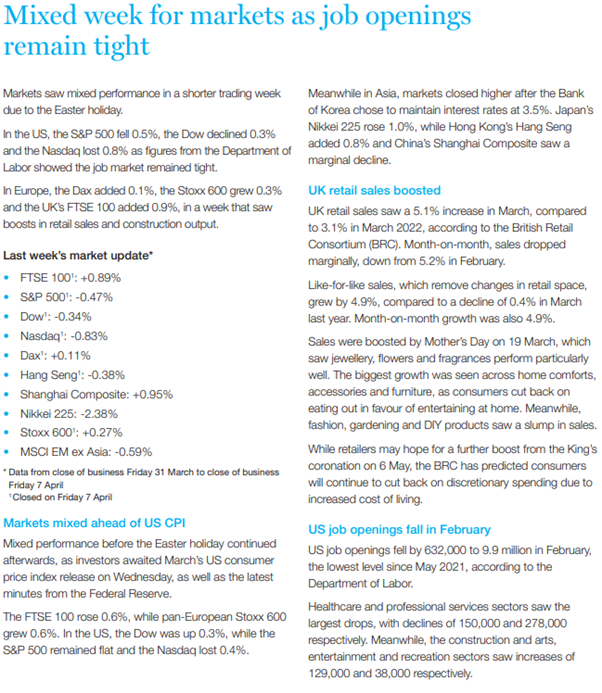
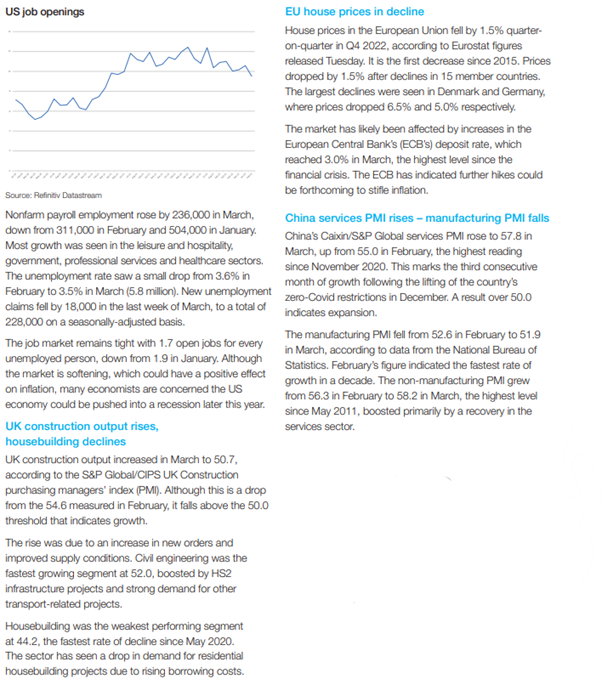
Brewin Dolphin: Markets in a Minute

Please see this weeks Markets in a Minute update from Brewin Dolphin received late yesterday afternoon:

Please continue to check our Blog content for advice and planning issues and the latest investment, markets and economic updates from leading investment houses.

Andrew Lloyd DipPFS

13/04/2023

Team No Comments

EPIC Investment Partners – IMF Growth Forecasts Blog

Please see below and article received from EPIC Investment Partners this morning (12/04/2023), which summarises their views on the International Monetary Fund (IMF) recently revised forecasts for the UK economy and predictions for other global economies:

The Daily Update: IMF Growth Forecasts

Yesterday (11/04) the International Monetary Fund (IMF) upgraded its outlook for the UK economy, saying it now believes Britain is on track to contract by 0.3% this year, half the 0.6% decline the IMF forecast in January, then expand by 1% in 2024. However, that’s where the good news ends for Blighty, as the IMF believes we will still be the worst-performing large economy on the planet this year. Only Germany will be the other advanced nation to see negative growth this year, and that is by just 0.1%.

So much for Chancellor Jeremy Hunt’s view that the “the declinists are wrong, and the optimists are right” about the UK’s economic prospects. Not that he sees anything wrong in that statement. “Thanks to the steps we have taken, the OBR says the UK will avoid recession, and our IMF growth forecasts have been upgraded by more than any other G7 country,” he said. As they say, torture the statistics long enough and eventually they’ll confess.

Overall, the IMF downgraded its forecast for global growth by a small margin of 0.1% from its 2.9% projection in January, lower than the 3.4% seen last year, with a slight recovery next year to 3%. However, there is a 25% chance that global growth will fall below 2% for the first time since the 2008-09 global financial crisis, more than double the normal odds.  

The Fund’s chief economist Pierre-Olivier Gourinchas said the global economy was at risk of a hard landing, pointing to governments and central banks being behind the curve on getting the inflation genie back in the bottle whilst avoiding slamming the brakes on growth and employment. “We are entering a perilous phase during which economic growth remains low by historical standards and financial risks have risen, yet inflation has not yet decisively turned the corner”, he said.  

Advanced economies are now projected to grow by 1.3% this year and 1.4% in 2024. Within the G7, the US leads the way with an expansion of 1.6% in 2023 and 1.1% in 2024. Canada is eyed at 1.5% for both this year and next, with Japan following with estimates of 1.3% and 1% respectively. After growing 3.5% last year, the EU is viewed as growing 0.8% and 1.4%.  

Away from the G7, emerging markets and developing economies are forecast to grow 3.9% this year after a growth of 4% last year and 4.2% next year. China’s forecast came in at 5.2% and 4.5% with India leading the way at 5.9% and 6.3%. Russia’s economy contracted 2.1% last year, however the IMF believes it will recover most of that contraction with 0.7% growth this year and 1.3% in 2023.  

Please continue to check our Blog content for advice and planning issues and the latest investment, markets and economic updates from leading investment houses.

Carl Mitchell – Dip PFS

Independent Financial Adviser

12/04/2023

Team No Comments

Tatton Investment Management – Tuesday Digest

Please see below, a ‘Tuesday Digest’ from Tatton Investment Management discussing the key economic news from the past week. Received this morning – 11/04/2023

Overview: A spring of hope after the gloom of winter?

As the second quarter gets underway, the chances of a global recession seem lower now than they were towards the end of last year. Indeed, a combination of events during the first three months of the year have arguably reduced the likelihood of negative real growth occurring in the next 12 months in most regions. The exception is the US, where chances have increased marginally – the most interesting outcome of this is that it may have reduced the chances of global recession even more.

March saw a flare-up of bank mistrust, which gave investors and capital markets an uncomfortable reminder of the global financial crisis. Bank lending was already tightening and events in March will have made it worse. But rather than tipping things over the edge, markets have viewed this as helping central banks in their inflation fight. Even so, still-sticky inflation makes it harder for central bankers to decide how to proceed, and even harder still for strategists to forecast.

Last week’s crop of economic data only added to the evidence that higher rates in the US are creating a more difficult environment there than elsewhere. Industry has already been slowing, but rates are more keyed on services, which had been expending smartly. The data from the Institute for Supply Management (ISM) showed an unexpected fall, still at a mildly expansionary level of 51.2 but below the ‘inflationary’ level of 52.

It may be that the weaker data from March was directly caused by the fears about banks. Those fears have passed quickly and nobody other than the banks’ equity (and Additional Tier 1) holders have suffered – a very small group. As such, the forthcoming data could bounce back and, with it, inflation. In that case, we’ll be back to square one, only with a weaker set of small businesses.

Right now, the risks feel finely balanced. Will inflation continue to decline, or will it take another financial sector blow-up to make central banks more dovish? At this point, we are happy enough to have stocked up on long maturity bonds in our portfolios after yields spiked higher, but otherwise we remain neutral on risk as the second quarter of 2023 runs its course.

A brief assessment of the global economy

The predictions of imminent recession that pervaded forecasts last year have so far proved somewhat pessimistic. However, economists were generally opining that a stronger than expected 2022 would mean less strength in 2023, so forecasts for the first two quarters of this year were adjusted down.

Yet again, the world’s major regional economies continue to be more resilient than forecasts would suggest. For us, the most notable improvement has been in the Eurozone where economists now estimate gross domestic product (GDP) to rise 0.5% quarter-on-quarter, or 2.1% annualised. By comparison, US GDP is estimated to rise 0.3% quarter-on-quarter (1.3% annualised). The motivation for better expectations has come from falling gas and electricity prices.

China’s growth expectations were also upgraded for this quarter. While China’s rebound proved slower than expected, next quarter’s expectations have been upgraded substantially to a year-on-year growth level of above 7%. Moreover, travel freedoms have spread some of the benefit to the rest of Asia. Meanwhile, Japan’s growth estimates remain positive but optimism has faded, against the trend of other regions.

While consumer confidence has generally improved, house prices remain under some pressure globally and construction has become quite subdued. Business confidence has also improved, and service businesses have become positive. Manufacturers are generally pessimistic still, even if things are not getting worse.

So, overall and in aggregate, the first quarter was a little better than expected. However, the global economy is not growing significantly, and that makes the financial ecosystem somewhat fragile. Perhaps economists remain more concerned about risks than resilience so low expectations can still be beaten for the rest of the year. Much will depend on a resumption of progress towards lower inflation.

Please continue to check our Blog content for advice, planning issues and the latest investment, market, and economic updates from leading investment houses.

Alex Clare

11/04/2023