Team No Comments

Stocks mixed as Fed and ECB hike rates

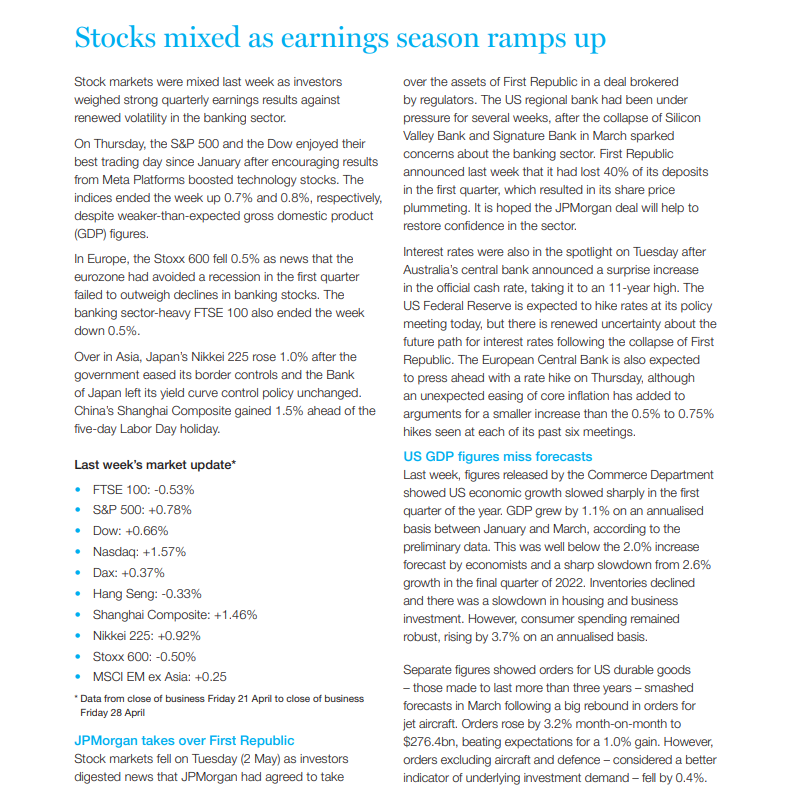
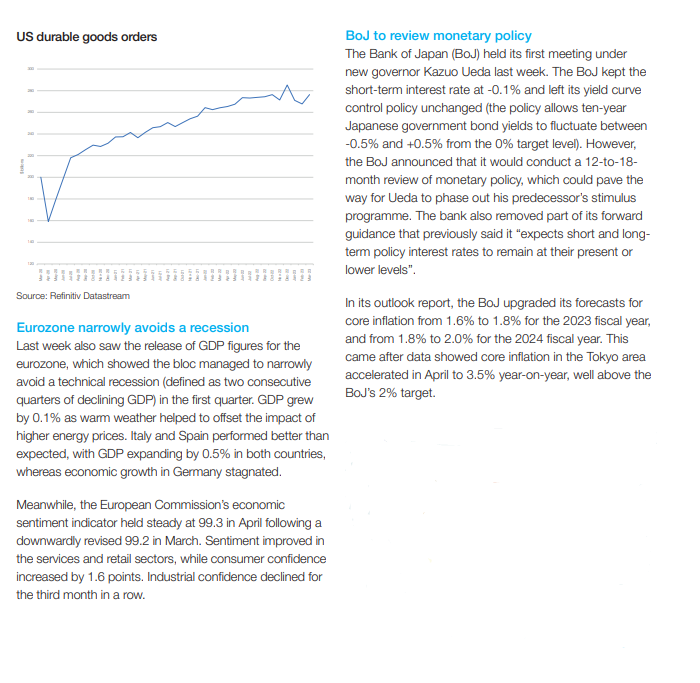
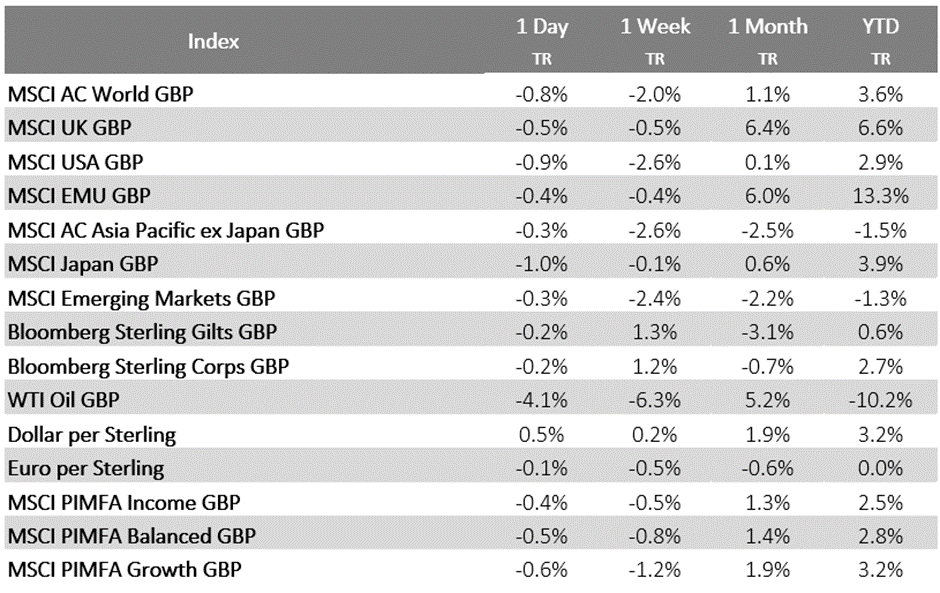
Please see below ‘Markets in a Minute’ article received from Brewin Dolphin yesterday evening, which provides an update on global markets.

Stock markets were mixed last week as the US Federal Reserve and European Central Bank (ECB) hiked interest rates.

The S&P 500 rallied on Friday after the US nonfarm payrolls report beat forecasts. Despite this, the index ended the week down 0.8%, following comments from Fed chair Jerome Powell that interest rate cuts might not happen as soon as investors had hoped.

The pan-European Stoxx 600 declined 0.3% after ECB president Christine Lagarde said interest rates would rise to “sufficiently restrictive levels” until inflation eased to the bank’s 2% target. The UK’s FTSE 100 fell 1.2% ahead of the Bank of England’s (BoE) interest rate decision on 11 May.

Japan’s Nikkei 225 added 1.0% during the first two days of the week following a sell-off in the yen. The index was closed for the remainder of the week for national holidays. China’s Shanghai Composite ended its holidayshortened trading week up 0.3%, despite the official manufacturing purchasing managers’ index falling into contraction territory for the first time since December.

Stocks slip ahead of US inflation data

Stock markets fell on Tuesday (9 May) as investors looked ahead to the release of US inflation numbers on Wednesday. The consumer price index will be closely monitored for any insights into the Federal Reserve’s next monetary policy decision.

The BoE is expected to hike interest rates for the 12th time in a row on Thursday, with economists and markets anticipating a quarter of a percentage point increase to 4.5%. It comes after official data showed the rate of inflation stood at 10.1% in March, far higher than expected.

US nonfarm payrolls beat forecasts

Last Friday saw the release of the closely watched US nonfarm payrolls report, which showed surprisingly strong jobs growth in April. Some 253,000 new jobs were added during the month, higher than the 180,000 forecast by economists and the 165,000 job gains recorded in March.

The report from the Department of Labor also showed average hourly earnings increased by 0.5% month-onmonth, the highest rate since the middle of last year. Meanwhile, the unemployment rate fell back to a 53-year low of 3.4% from 3.5% the previous month.

Separate data showed the number of job openings shrank for a third consecutive month in March. However, there are still 1.6 job openings for every unemployed person, which suggests the labour market remains tight.

Fed hikes rates as expected

Earlier in the week, the Federal Reserve hiked interest rates by a quarter of a percentage point, taking the benchmark fed funds rate to between 5.0% and 5.25%. The statement from the Federal Open Market Committee omitted language saying that further policy firming may be appropriate. Instead, it said officials would take into account how the impact of monetary policy was accumulating in the economy.

At a press conference later in the day, however, Powell indicated that it was too soon to say with certainty that the rate-hiking cycle is over. Powell said the Fed was “closer, or maybe even there”, but that it was “prepared to do more” and future policy decisions would be made on a meeting-by-meeting basis. Powell also indicated that a pivot to cutting rates would not occur this year.

ECB scales back rate increases

The ECB also increased interest rates by a quarter of a percentage point last week, scaling back from its three previous half-percentage point increases. The move takes the main policy rate to 3.25%.

However, Lagarde indicated that the fight against inflation is far from over. “We have more ground to cover and we are not pausing, that is extremely clear,” she said. Lagarde added that some of the ECB’s rate-setters had called for a bigger increase and that the “inflation outlook continues to be too high for too long”. Headline inflation in the eurozone rose for the first time in six months in April to 7.0% year-on-year, up from 6.9% in March.

Housing market shows signs of stabilising

Here in the UK, data from the Bank of England suggested the housing market could finally be stabilising after the turmoil caused by last autumn’s mini-budget. Net mortgage approvals rose for a second consecutive month to 52,000 in March, up from 44,100 in February and much higher than expected. This came after data from Nationwide showed UK house prices unexpectedly rose by 0.5% in April, following seven consecutive months of declines. The cost of an average home increased to £260,441, which was still 2.7% lower than a year ago.

Please check in again with us soon for further relevant content and news.

Chloe

11/05/2023

Team No Comments

Liontrust – Investing for a healthier future

Please see below, an article from Liontrust highlighting the potential opportunities of investing in companies that are striving to provide a healthier future for society. Received this morning – 09/05/2023

With billions of people living longer than ever yet often in poor health, there is a growing focus on investing to improve people’s quality of life.

As society prospers, one of the constant and reliable areas of growth is in enhancing living standards. Medical innovation has driven up life expectancy across much of the world, with significant advancements in the ability to treat ill health and disease. Meanwhile, society has benefited from dramatic improvements in living standards with better urban environments, air quality and nutrition.

Yet there are significant challenges ahead. The combination of rising lifestyle diseases and an ageing population is placing significant strain on healthcare services such as the NHS. But while the challenges are immense, they also provide huge opportunities for those companies innovating to provide solutions to the issues and potential rewards for investors.

Post the Covid-19 pandemic, there has been a renewed focus on the need to improve the nation’s health and wellbeing. According to a survey by Public Health England, 40% of respondents gained around 3kgs of weight during the period. However, a survey by the British Heart Foundation show that two-thirds of respondents say that exercising is a top priority for improving their physical and mental health in the wake of coronavirus.

Martyn Jones, fund manager on the Liontrust Sustainable Future team, says: “The desire to improve quality of life and living standard continues to be an important driving force in the global economy and will provide a strong tailwind to the companies exposed to these trends. Our job is to back the rare businesses that can harness these tailwinds and generate strong profitability over the long-term with durable competitive advantages.”

A key investment theme for the Liontrust Sustainable team is Delivering healthier foods – which seeks to find companies that are helping to improve the nutritional characteristics of food in order to tackle the obesity epidemic.

Jones says: “By 2026, the market for healthier food and drink is expected to be worth around $1 trillion and an area of the market that we particularly like is in the flavour technology space.

“It is a cost that rarely makes up more than 10% of food and beverage products but is extremely important to the end consumer. In our view, this is not just a trend, but a market experiencing structural long-term growth.”

Jones highlights Kerry Group as a great example of this in the Sustainable Future portfolios. Established in 1972 as a dairy cooperative, it has since evolved to become one of the largest and most technologically advanced ingredients and flavours technology companies. Their innovations help to reduce salt, fat and sugar while retaining taste, texture and flavour.

The Sustainable team also focuses on investing in health, under its Enabling healthier lifestyles theme, through companies that provide goods or services that enable people to live a more active and happier lifestyle, such as gyms and fitness chains.

Yet with consumers globally facing a cost-of-living crisis and looking for ways to make ends meet, many are trading down from more expensive options to low-cost options such as Basic-Fit in Europe.

Though lockdowns across the world during the peak of the pandemic have been tough for the gym market, Jones believe that the tougher the situation, the more well-established low-cost providers will take market share, as they are already positioned to embrace home workouts and have lower operating costs and membership fees.

He adds: “Much of our sustainable thinking at Liontrust focuses on a cleaner and safer world in the future but a third goal requires people to be healthy enough to enjoy this. With a fifth of the world’s population expected to be overweight or obese by 2025, and related diseases impacting both life satisfaction and expectancy, there are issues we simply have to face.

“We believe that the long-term improvements in our living standards and quality of life will persist, driving growth in our themes and long-term returns of companies providing some of the innovative solutions.”

Please continue to check our Blog content for advice and planning issues and the latest investment, markets and economic updates from leading investment houses.

Alex Kitteringham

9th May 2023

Team No Comments

Brooks Macdonald – Daily Investment Bulletin

Please see below todays (05/05/2023) Daily Investment Bulletin from Brooks Macdonald:

What has happened

Market sentiment on Thursday showed a split between continued worries around the health of US regional banks on the one hand, versus better than expected results from US tech heavyweight Apple. With Apple’s results announced after the regular market close however, they didn’t arrive in time to help the broader market, which closed lower on the day. For the day ahead, the focus is likely to stick with the banks sector, but elsewhere in economic news, US monthly non-farm payroll employment data for April is due – according to a Reuters survey, payrolls are expected to have increased by 180,000 jobs last month, which would be the smallest gain since December 2020 and which would be the third month in a row of deceleration in employment gains.

US regional bank worries continue

US regional bank news it seems is bookending the week. After the failure and sale of First Republic to JP Morgan at the start of this week, US regional banks resumed their share price slide on Thursday. In the crosshairs, PacWest’s share price has seen heavy falls this week on the back of a Bloomberg story that the bank was exploring sale options. While PacWest has since confirmed that “the company has been approached by several potential partners and investors – discussions are ongoing”, the bank has tried to calm market nerves, saying in a statement released yesterday that “the bank has not experienced out-of-the-ordinary deposit flows following the sale of First Republic Bank”, and that “core customer deposits have increased since 31 March”.

ECB hikes and leaves door wide-open for more, in contrast to Fed’s latest signalling

The European Central Bank (ECB) hiked interest rates by 25bps on Thursday, taking its deposit rate to 3.25%, a post-2008 high, and up from a negative rate of -0.5% in less than a year when it first starting hiking in July 2022. While the pace of hikes was a downshift from 50bps at each of its previous 3 meetings, the ECB did not appear to follow the Fed regarding interest rate path outlooks. While the Fed on Wednesday hinted at a possible pause, the ECB left the door wide-open for additional tightening on Thursday. As well as plans to stop reinvestments of its Eur3.2trillion Asset Purchase Programme from July, ECB president Lagarde said there were “still significant upside risks to the inflation outlook”, and on future possible rate hikes that “we have more ground to cover and we are not pausing”.

What does Brooks Macdonald think

There is a something of a separation in the way that both policy makers and markets are thinking at the moment. For central banks, they continue to believe that they can separate the interest rate ‘inflation vs economic growth’ trade-off from bank stress. Equally, markets are continuing to take solace in the latest Q1 earnings beats, including from tech, and meanwhile treating the current US regional bank hiatus as non-systemic. How US regulators in particular tackle the thorny issues around their regional banks, both in terms of regulatory oversight but also in terms of the potential for any deposit insurance cap changes in the weeks and months ahead will be key.

Please continue to check our Blog content for advice and planning issues and the latest investment, markets and economic updates from leading investment houses.

Andrew Lloyd DipPFS

05/05/2023

Team No Comments

Brewin Dolphin – Markets in a Minute

Please see below article received today from Brewin Dolphin providing a market summary. Received today – 04/05/2023.

Please check out Blog content for advice, planning issues and the latest investment, market and economic updates from leading investment houses.

Adam Waugh

04/05/2023

Team No Comments

The Daily Update: LVMH Reaches The Half a Trillion-Dollar Mark

Please see below article received from EPIC Investment Partners this morning, which provides a succinct and interesting insight into the success of Louis Vuitton’s parent company, LVMH.

Last week LVMH, the parent company of Louis Vuitton, surpassed USD500bn in market value, the first European company to reach the half a trillion-dollar mark, less than two weeks after joining the club as one of the world’s top 10 most valuable companies. LVMH, which also includes brands such as Moët & Chandon, Hennessy, Givenchy, and Bulgari under its umbrella, reported a 17% rise in first-quarter sales earlier in April, more than double analyst expectations. In total, LVMH controls around 60 businesses that manage 75 prestigious brands. The shares were up nearly 33% year to date.

The rise in LVMH stock means that its co-founder, chairman and chief executive, Bernard Arnault’s net worth now approaches USD213bn, the world’s richest man, and a staggering USD50bn more than the world’s second richest, Elon Musk.

Arnault’s vice-like grip on the company is also pretty much guaranteed in the long term after he recently appointed his offspring to key positions within the business. The eldest child, Delphine, was named CEO of Christian Dior, the empire’s second-largest brand. Antoine, her brother, was appointed head of the holding corporation that oversees LVMH and the Arnault family fortune.

His three youngest children were also given important roles within the company. Alexandre is an executive at Tiffany, Frédéric is the chief executive of TAG Heuer, while the youngest, Jean, heads marketing and product development for Louis Vuitton’s watch division.

According to some articles, Arnault, 74, in giving his children the positions, is auditioning them to see which one will be the best fit for the top job the day he decides to hang his boots up. It is reported he invites his offspring to a monthly lunch at the company’s headquarters in Paris, where he asks them for advice, their thoughts on how the company should move forward and even presents a list of topics up for discussion.

However, as the CEO of LVMH’s fashion arm, Sidney Toledano, said recently “there is no guarantee that any of his children will succeed him”.

Please check in with us again soon for further market content and news.

Chloe

03/05/2023

Team No Comments

Tatton Investment Management – Tuesday Digest

Please see the below article from Tatton Investment Management, providing a brief analysis of the key stories from global markets and economies over the past week. Received this morning – 02/05/2023

Overview: Let May’s sway guide your way

In recent weeks, it has been hard to ignore the rather directionless and decreasingly volatile bond, equity and currency markets. In particular, credit markets have been very stable or – as one could also interpret them – indecisive. There appears to be lots of investor demand for higher-yielding corporate bond securities without much new supply through issuance matching it. This demand overhang has cheapened credit spreads, or in layman’s terms the premium that corporates pay over governments. With the current total cost of capital at any maturity still higher than the return on capital that many companies appear to expect over the longer term, there is understandably little appetite among corporates to rollover existing debt, let alone create new finance. Instead, they appear to be collectively trying to sit out this yield high, hoping for better financing terms later in the year. We suspect many mortgage holders in the UK with their mortgage terms nearing expiry are having similar thoughts.

Last week’s earnings reports in the UK, Europe and in the US offered more evidence of companies trying to offset weak (often negative) volume growth by raising prices. Unilever and Procter & Gamble were notable in this respect. Companies don’t like to use whatever pricing power they have, but they will if they have to. We should hope that central banks recognise this as the last throes of a cycle, rather than worrying that the latest service sector-driven inflation data is indicative of a spiral.

As we head into the next round of rate decisions, it will be important for companies – and the risk assets that represent them – that central banks tell us they recognise they have done enough and the growing need to change course. The Federal Reserve Open Markets Committee meets tomorrow, the European Central Bank on Thursday, and the Bank of England meets next Thursday. The expectations are that we will get small rate rises but accompanied by the ‘cooing of doves’ – soothing sounds telling us that they expect inflation to cool and rates to be moved to less tight levels as inflation allows. Therefore, contrary to the old stock market adage of ‘sell in May and go away’ it seems to us that ‘let May’s sway guide your way’ may prove far better guidance for investors this year. We will certainly be monitoring central bank messaging, and the market perception of it, very closely.

Cash and money market funds: part 2

We wrote about US money market funds (MMFs) last week, noting how popular and systemically important they have become and what this might mean for capital markets going forward. MMFs are particularly prominent in the US, due to its specific financial and regulatory structure, and have been for many years. Today, money markets are a global phenomenon. As of late 2020, MMFs held over $5.3 trillion worldwide, $3.9 trillion of which came from institutional investors. More recent data is hard to come by, but we can only assume the current figure is much higher, given recent flows into MMFs.

The main selling point for any MMF is its ability to offer cash-like liquidity with better returns than a regular bank deposit. But, given the focus on extremely safe assets, the actual differences in return – both between MMFs and deposits and between MMFs themselves – are naturally quite low. (Though, as noted last week, when base interest rates change as rapidly as they have, banks’ slowness to adjust can create some pretty wide spreads) Even so, not all MMFs are the same, varying on expected duration, risk level, returns or accounting structure.

UK money markets still operate according to European Union regulations, and in the post-Brexit environment, some investors have been concerned about funds under European jurisdiction. For those that wish only to have a UK-regulated fund, there are only a few choices. Almost all funds are under Irish regulation, some under Luxembourg. The main reason appears to be that the jurisdiction can be costly for both investors and fund managers – Ireland remains the cheapest. Interestingly, MMFs in the US can be quite expensive, despite their prominence and popularity with retail investors. Most MMFs in the US now charge around 0.5%, while the median figure is much closer to 0.15% in the UK. This is a positive for us, as Sterling-based investors. MMFs do not compete much on performance, nor would we really want them to, as the incentive to up returns would go against the need for low risk, low volatility. But being competitive on price is exactly what you would want from cash-like assets.

The resurrection of Bitcoin?

It might be surprising to hear that the largest cryptos have had an incredibly good year so far. At the time of writing, Bitcoin is up nearly 80% year-to-date, while Ethereum has jumped more than 60%. Cryptocurrencies suffered a devastating 2022, and Bitcoin and Ethereum are both still below half their late 2021 peaks. Still, the current rallies are impressive, all the more so given the wider market challenges. Bitcoin’s rebound coincided with the US government’s decision to bail out SVB and Signature Bank depositors. Since, prices have climbed to more than $30,000 per token in mid-April, a level it has bounced around since.

Some of that renewed optimism is because of expectations of looser monetary policy from the Fed in reaction to the banking sector concerns. Many analysts have posited that the crypto world still has a tight correlation with global (and particularly US) money supply growth. But industry insiders also point to the slower rate of Bitcoin mining – the process by which new tokens are produced – as a longer-term reason for price growth. In a year’s time, the world’s biggest crypto is set to go through another round of ‘halving’. This is the process every four years that cuts in half the amount of reward Bitcoin miners receive for their work. It is designed to eventually limit the total Bitcoin supply to 21 million tokens. Prices hit new records after each of the last three halving events, and analysts estimate that only 50% of the upcoming supply reduction is priced in, based on previous cycles. While this might not take Bitcoin to a new record – the $69,000 achieved in November 2021 – analysts think $50,000 is an achievable target.

Although advertised as a long-term alternative to fiat currencies, Bitcoin has mostly traded like a speculative risk asset. Indeed, Morgan Stanley notes that the last 10 years for Bitcoin mirror the behaviour of gold prices in the 1970s, when exchange rates became free-floating, asset price speculation was rife, and the price of gold rose by several orders of magnitude. The similarities with gold hint at a deeper problem with Bitcoin as a functional currency. Halving means Bitcoin is by its very nature limited in supply, which gives holders a huge incentive to hold onto their tokens rather than transact them, as they are likely to increase in value. But transaction is one of the key functions of a currency, and so this disincentive could be Bitcoin’s undoing, whereas Bitcoin’s younger sibling Ethereum is not limited in supply.

One of the reasons gold did so well in the 1970s was that holders of seemingly weaker currencies – those from less-trusted nations and markets – had a huge incentive to buy it before their savings depreciated. A similar dynamic seems to be happening with cryptos increasingly being used as alternatives to Emerging Market (EM) currencies, as recently evidenced by Argentina’s letter of intent to the International Monetary Fund in March, which effectively admitted that EM investors see Bitcoin or Ethereum as more credible than some of the regional currencies. Chinese corporations and wealthy individuals have a longstanding desire to move money out of government control, so given the market hype around China this year, this could go some way to explaining Bitcoin’s recent incredible strength. It could even provide a crucial backstop to Bitcoin’s value in the months ahead. The crypto rally might run out of steam, but it is unlikely to reverse.

Please check our blog content for advice, planning issues and the latest investment, market and economic updates from leading investment houses.

Alex Clare

02/05/2023

Team No Comments

Invesco – UK elections: Sunak’s big test, Starmer’s vision and implications for markets

Please see below Invesco article regarding the upcoming UK local elections. Received today -28/04/2023.

How will the elections impact UK markets?

UK politics and the UK economy are not the same as UK equity markets. Only around 25% of revenues in the FTSE All-Share come from the UK.

“Put simply, the outcome of the May election in Barnsley will have no discernible effect on the prospects for AstraZeneca’s world leading immuno-oncology pipeline; the size of the swing in North Tyneside will not affect sales of Unilever in Indonesia. Yet together these two companies alone comprise almost 12% of the FTSE All-share index,” said Martin Walker, Invesco Head of UK Equities.

That’s not to say we are in any way complacent about different prospects of businesses under future Conservative or Labour governments.

“It’s easy to see how policy on, say, energy supply, provision of utilities in general, or housing policies might potentially cause winners and losers, depending on the outcome of the general election. Indeed, our own investment analysis already factors in where we see opportunity and risk under different scenarios. As fund managers, our job is to stay alert – particularly at a time of heightened volatility,” Walker said.

When is the next UK election?

Voters across 230 English local authorities will head to the polls on Thursday 4th May. About 8,000 council seats are up for grabs across a mix of metropolitan boroughs (traditionally Labour areas) unitary authorities (where Labour is expected to make gains) and district councils (traditionally Conservative areas). The last time these seats were elected was pre-Covid, in 2019, when Theresa May was Prime Minister, Jeremy Corbyn was Labour leader and Parliament was heading for a Brexit deadlock. Then, the Conservative lost more than 1,300 council seats. This was their worst local election result since 1995 – while Labour lost 80 and the Lib Dems emerged with more than 650 gains. The National Equivalent Vote share had Labour and the Tories tied neck-and-neck on 31%, with the Lib Dems winning 17%.

Political momentum with Sunak

The political momentum currently lies with Sunak. After a torrid first 100 days in office, Sunak has begun to make some political headway. 

“Agreement of the Windsor Framework, stronger relations with the EU, a well-received Spring Budget and the handling of the collapse of Silicon Valley Bank’s UK branch have strengthened his leadership after a rocky start. As a result, his stock with the Tory grassroots has risen,” said Hook.

And voters are noticing too. Sunak is on a par with Keir Starmer on the question of who voters think would make the most capable Prime Minister; and Labour’s average poll lead over the Tories is down by 5 points since January.
 

Starmer’s task: demonstrate a decisive vote share lead

Sunak’s progress shouldn’t be overstated. A 15-point lead in a general election would deliver Starmer a substantial Parliamentary majority. Nonetheless, Starmer is under pressure to show that a poll lead translates into real votes at the ballot box.

Rather than council gains / losses, the key figures to watch, will be the projected National Equivalent Vote (NEV) figures from local elections experts Colin Rallings and Michael Thrasher – which calculate support for each party as if the elections were taking place in every part of the country. As a guide to interpreting Labour’s performance:

  • Minimum hurdle: take the mantle of the largest party in local government – a title held by the Tories since 2003.
  • Cause for concern: <6 point lead (NEV) over the Tories – suggests Labour are struggling to convert some poll support into votes.
  • Good: 10+ point lead (NEV) over the Tories – a feat Labour last managed in 1997, would show Labour on course for General Election majority.
  • Excellent: 15+ point lead (NEV) over the Tories – on course for a landslide majority.

How does industry view Starmer?

“In our discussions with the bosses of leading UK companies, it’s clear that there’s a dialogue with the government on matters of importance. Governments (of any colour) understand they need to have a performing banking sector,” said Walker.

“The sector is a significant contributor to the Treasury through the banking levy and surcharge. Our most recent discussions have highlighted that banks and financial services companies are already engaging with Starmer and Shadow Chancellor of the Exchequer, Rachel Reeves.”

In the outsourcing sector, an area of ‘hi-touch’ with central and local government, companies are saying that they’re working on engagement ahead of the 2024 election, and that although governments change, the challenges remain the same. One company pointed out: “the language from Starmer around working with the private sector and partnerships is positive. The depoliticising of the support service relationship is important.”

Segment view: Pensions

The UK pension sector is one of the largest in the world – approximately £1.7 trillion in defined benefits pension scheme assets are on UK companies’ balance sheets, according to McKinsey data from March 20231The sector experienced significant turmoil when Truss announced her ‘mini-budget’ in September last year2.

“After the political turmoil of the last year, a period of relative stability is much needed. The local elections are a good reminder that all politics is local – and the supply of quality, affordable housing remains one of the most pressing needs facing communities across the country. The political focus is necessarily on provision of social housing, but the reality is that more housing of all tenures is needed – and the private rented sector uniquely fulfils strong demand, government policy and investment returns.”

Stuart Boucher, Head of Local Government Pension Schemes, Invesco

Conservative MPs aiming for re-run of 1992

“Tory MPs are bracing for a loss of hundreds of council seats, if not more. But with the PM’s growing reputation for competence and the apparent ‘softness’ of Labour’s lead, they can also see a narrow path to an unlikely election win in 2024,” said Hook.

If, in a year’s time, inflation is substantially lower, economic growth higher, EU relations stronger and public sector strikes are in the rearview mirror, Tory MPs are hoping that voters might just give a less fractious Conservative Party another look. As such, they’re hoping the next election could be more like 1992 than 1997.

Macro view: Inflation

“UK consumer price inflation was reported to be 10.1% in March. Though down from the October peak of 11.1%, this remains uncomfortably high for the Bank of England. However, with natural gas prices down sharply (among other commodity price declines) and sterling strengthening, I suspect that Sunak’s target of inflation halving during 2023 is likely to be met. This should allow the Bank of England to signal an end to tightening around the middle of the year.”

Paul Jackson, Global Head of Asset Allocation Research, Invesco

Starmer’s challenge: define his vision

For Starmer, whatever the result, pressure will grow for him to set out a more detailed alternative vision for the country.

“Starmer’s core challenge is how to articulate a vision for stronger public services when the public finances are already stretched,” said Hook. “Pledging tax rises on higher earners risks undermining his claim to have pulled Labour back to the centre ground; but higher borrowing raises the spectre of a repeat of the market reaction to Liz Truss’s brief premiership.” 

“The third option,” Hook added, “to generate higher revenues from higher growth, would take time and mean Labour are limited in articulating a radical alternative to the current government. This would mean the election could increasingly become a contest between the party leader viewed as most competent: Sunak or Starmer.”

Please continue to check our Blog content for advice and planning issues and the latest investment , markets and economic updates from leading investment houses.

Adam Waugh

28/04/2023

Team No Comments

Brooks Macdonald – Daily Investment Bulletin

Please see below todays (27/04/2023) Daily Investment Bulletin from Brooks Macdonald:

What has happened

US technology shares had a good day yesterday, helped by strong results in the sector. Weighing against this positivity is ongoing concerns around the US regional banking sector which has remained in focus. Ultimately the bearish sentiment won out, with the equity market falling on the day.

US regional banks

First Republic was down an additional 30% yesterday with the share price hitting an all-time low. To show how much equity value has been destroyed, the bank had a market capitalisation below $1bn at one point yesterday, that’s from a peak of just under $40bn. First Republic are reported to be looking for support from the large US banks, emulating the deposit support they received during the March crisis. It appears increasingly likely that if the bank cannot find support from the private market it would need to go to the FDIC for support. The FDIC are alleged to have threatened to downgrade First Republic’s rating if a private deal is not forthcoming. Such a downgrade would limit the bank’s access to the Fed’s liquidity facilities and would likely catalyse another crisis of market confidence. All of this is reoccurring at the same time as the Fed is in its communication blackout window ahead of the upcoming interest rate decision. Given the uncertainties the market downgraded the chance of a 25bp interest rate hike below 75% at one point yesterday.

Technology

One of the positive stories within markets has been the robust earnings of technology heavyweights. The software sector was up over 4% yesterday, outperforming a falling market, as Microsoft surged over 7% due to better than expected results that showed the company’s cloud unit grow revenue by over 30%. After the US closing bell Meta delivered its results, also coming in above market expectations which will help support the wider technology sector in today’s trading.

What does Brooks Macdonald think

While the tug of war of market sentiment is largely taking place between stronger tech earnings and weaker US regional banks at the moment, the US debt ceiling is not far from investors’ minds. Republican House Speaker McCarthy tweaked his proposed debt ceiling bill which passed through the House yesterday but will fail at the Democrat controlled Senate. The bill represents the starting gun on negotiations which could create a significant market risk over the summer.

Please continue to check our Blog content for advice and planning issues and the latest investment, markets and economic updates from leading investment houses.

Carl Mitchell – Dip PFS

Independent Financial Adviser

27/04/2023

Team No Comments

Brewin Dolphin – Markets in a Minute

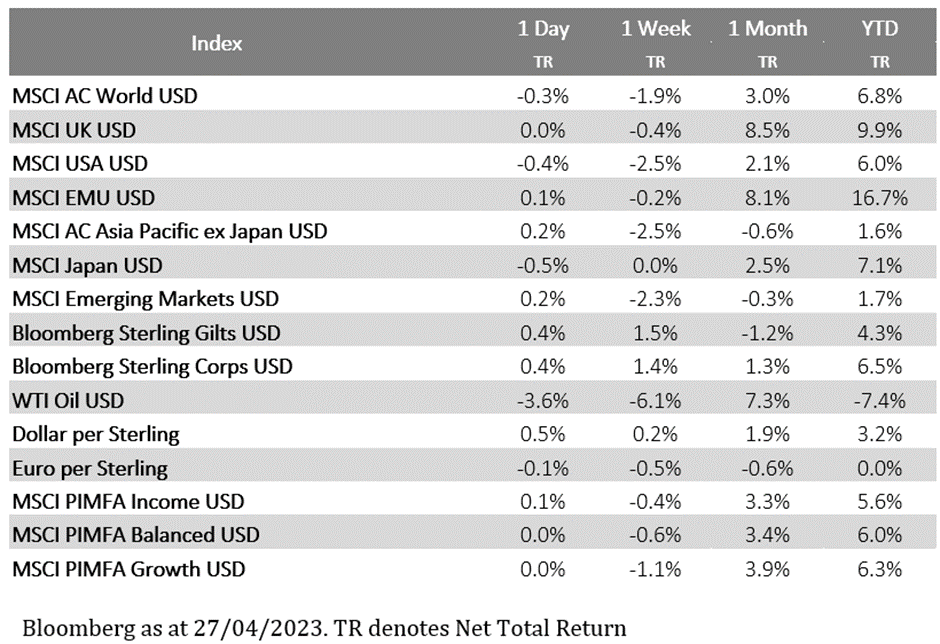
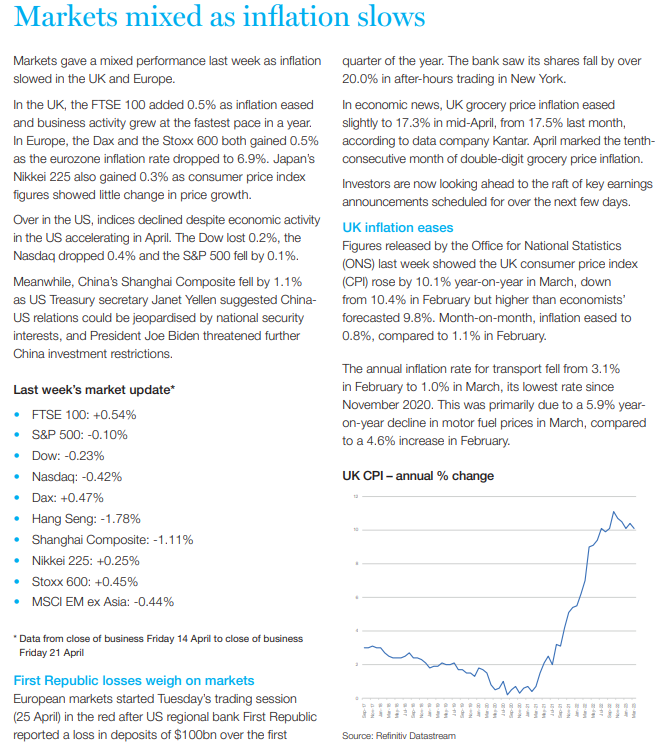
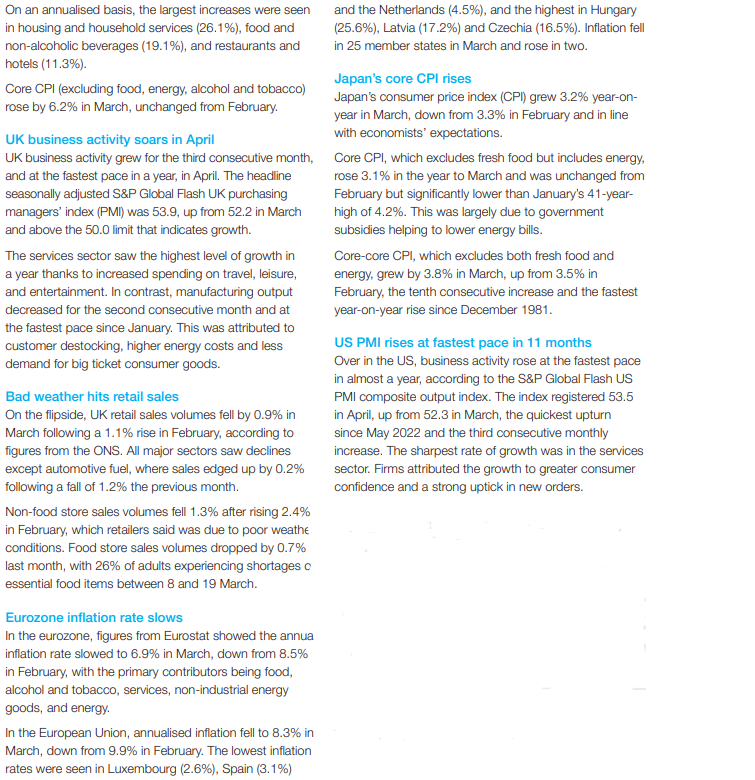
Please see below article ‘Markets in a Minute’ from Brewin Dolphin providing an update on markets and econominc news. Received late yesterday – 25/04/2023.

Please continue to access our Blog content for advice and planning issues and the latest investment, markets and economic updates from leading investment houses.

Adam Waugh

26th April 2023