Team No Comments

Evelyn Partners Update – August Bank of England MPC decision

Please see below, an article from Evelyn Partners discussing the recent Monetary Policy Committee interest rate decision and the implications for markets and the economy. Received yesterday evening – 03/08/2023

What happened?

The Bank of England delivered on the expectations of economists and markets with an increase of 25bps to the base rate at their meeting today. This represents the Bank’s 14th consecutive increase and takes the base rate to 5.25%, its highest in 15 years.  The committee was split 3 ways on the vote, with 1-6-2 members voting for 0-25-50bps increases respectively. 

What does it mean?

Today’s decision by the Bank of England was always likely to be close, if markets are our guide. Prior to the meeting, Overnight Index Swap markets had priced around a 1/3 chance that the Bank would go further and increase by 50bps.  In the end the MPC’s hawks, who would have preferred such a move, were outvoted by the majority, including governor Andrew Bailey.

A key reason the bank will have decided against the larger increase will have been June’s inflation numbers, which finally revealed a downside surprise in headline inflation and, perhaps more importantly, the core (excluding volatile food and energy) print.  The core figure came in at 6.9%, which will still high, was lower than July’s figure of 7.1%.  The expectation is for inflation to continue to fall as lower energy prices continue to feed through to the bottom lines of balance sheets, both for businesses and individuals.  This was reflected in the MPC’s own inflation forecasts, which fell from 5.1% to 4.9% in the fourth quarter of this year, although this was allied with an increase in its inflation expectations over the medium term.

The monetary policy report also included growth forecasts, which continued to make for pretty bleak reading, revealing a cut to forecasts to 0.5% per year for 2023 and 2024.  On the upside, the Bank agrees with the consensus of economists in no longer forecasting a recession in the UK, but it does highlight the risk of one in 2024 and early 2025. 

Previous guidance in the minutes released today was maintained: “if there were to be evidence of more persistent pressures, then further tightening in monetary policy would be required,”. There was an Important addition about rates being “sufficiently restrictive for sufficiently long” for inflation to get back to the Bank’s 2% target.  That implies that interest rate cuts are perhaps further away than some had imagined. 

The Bank provided no clues to the market today on its plans for reducing the size of its balance sheet, saying it will lay out these plans at its next meeting in September. 

Bottom Line

Reaction to today’s 25bps increase by markets was dovish, as expectations of where rates will peak moved slightly lower, from 5.85% before the meeting to 5.75% afterwards, at the end of this year or beginning of next.  This will be welcomed by mortgage holders, in the hope that increasing rate expectations may have peaked, along with the cost of mortgage deals in the market. The yield on the 10 year government gilt remained broadly unchanged on the announcement and looks attractive in our view, at 4.4%, as the Bank gets closer to the top.

Please continue to check our blog content for advice and planning news from us and leading investment management houses.

Alex Kitteringham

4th August 2023
Team No Comments

Brooks Macdonald – Daily Investment Bulletin

Please see the below article from Brooks Macdonald providing their commentary on global markets. Received this morning – 03/08/2023.

What has happened

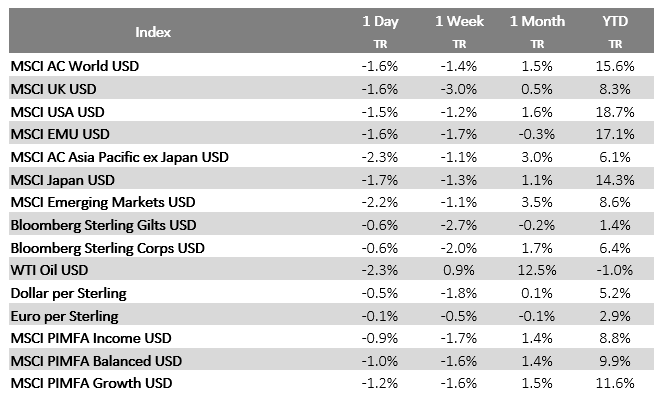
Equities fell sharply yesterday as concerns around the US debt downgrade focused investor attention on the funding needs of the US government. The US equity market fell by over 1%, recording its worst daily return since April of this year.

US debt financing

Concerns over the quantity of US Treasury issuance over the coming months filtered through risk assets yesterday with the near-term borrowing needs being formalised yesterday. Adding concern was the comment from the Treasury that this increase in borrowing was likely to continue, saying that ‘further gradual increases will likely be necessary in future quarters.’ Treasury issuance raises yields as the price adjusts for additional supply. At the same time, this issuance draws liquidity from other areas of the market (such as equities and corporate bonds), decreasing the prices of risk assets. All of this puts the US budget deficit back into the spotlight with the Fitch downgrade effectively just highlighting the funding concerns, recent political impasses and ongoing fiscal spending.

UK

Today the market’s focus will switch to the Bank of England which is unveiling its latest policy change at midday. The consensus expects a 25bp interest rate hike, with economists reducing the chance of a 50bp move given the downside miss to UK CPI last month. The market is only now apportioning around a quarter chance of a 50bp move after it being the most likely outcome a few weeks ago. The political pressure continues in the interim with Prime Minister Sunak saying that inflation was not falling as fast as he would like and stressing the policy importance of a further reduction in price pressure.

What does Brooks Macdonald think

The shift in market expectations towards a 25bp hike at today’s meeting does not mean that the UK will have necessarily reached its peak interest rate after the move. The market is expecting the Bank of England to need to raise interest rates further over the coming months to guide inflation lower. A strong UK labour market is a particular concern to the Bank of England, therefore one should expect the central bank to continue with their hawkish rhetoric alongside the smaller hike.

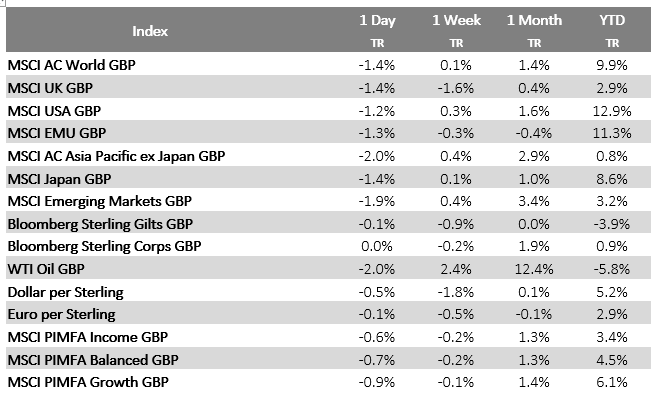
Bloomberg as at 03/08/2023. TR denotes Net Total Return

Please check our blog content for advice, planning issues and the latest investment, market and economic updates from leading investment houses.

Alex Clare

03/08/2023

Team No Comments

Brewin Dolphin – Markets in a Minute

Please see below, Brewin Dolphin’s ‘Markets in a Minute’ update, providing a brief analysis of the key news from markets around the world, which was received late yesterday (01/08/2023) afternoon:

Please continue to check our Blog content for advice and planning issues and the latest investment, markets and economic updates from leading investment houses.

Carl Mitchell – Dip PFS

Independent Financial Adviser

02/08/2023

Team No Comments

Markets in positive mood following better US inflation data

Please see below article received from Brooks Macdonald yesterday afternoon, which provides a detailed market commentary as we head into August.

  • Better inflation data buoys hopes that the US economy might be able to pull-off a soft landing
  • Bank of Japan intervenes to dampen government bond yield moves
  • Company Q2 earnings reports reach the half-way point, so far so good
  • Another interest rate hike expected from the Bank of England later this week

Better inflation data buoys hopes that the US economy might be able to pull-off a soft landing

Markets finished last week in positive mood, as softer US inflation data increasingly suggested the economy might be able to pull-off a so-called ‘soft’ landing (where economic growth slows but avoids recession). Buoying sentiment, both US personal consumption prices and employment costs saw annual gains come in a shade weaker than expected. Looking forward, this week is a relatively busy one for data. It starts with Eurozone consumer inflation later this morning, followed by the US Federal Reserve’s (Fed) latest Senior Loan Officer Opinion Survey on bank lending out later today. Central bank decisions are due from the Reserve Bank of Australia on Tuesday and the Bank of England (BoE) on Thursday. Elsewhere, after last week’s better US Gross Domestic Product (GDP) Q2 print, this week we get some US purchasing manager survey data on manufacturing and services on Tuesday and Thursday respectively. Wrapping up the week, the US monthly non-farm jobs report is out on Friday, where the consensus is looking for 200,000 jobs added in July.

Bank of Japan intervenes to dampen government bond yield moves

After the Bank of Japan (BoJ) surprised markets last Friday by effectively loosening its grip on its yield-curve-control monetary policy, this morning we have been reminded that there still limits to how far the BoJ wants to travel for now. Earlier today the BoJ announced an unscheduled Japanese Government Bond (JGB) purchase operation, spending 300bn yen (around $2.1bn) to buy 5-to-10-year bonds at market yields. This looks consistent with BoJ Governor Kazuo Ueda’s comments last week that the BoJ was ‘not ready’ to allow yields to move freely. It is also interesting that in last week’s latest BoJ forecasts, while it raised its median estimate for fiscal 2023 core consumer inflation (Consumer Price Index (CPI) all items less fresh food and energy) to 3.2% from 2.5% previously, there was no change to fiscal 2024 at 1.7% or fiscal 2025 at 1.8%, which both sit below the BoJ’s 2% inflation target.

Company Q2 earnings reports reach the half-way point, so far so good

We are now half-way through the US company results season, with 51% of US large-market-capitalised companies having reported Q2 results. According to the latest Factset ‘earnings insight’ report, 80% have reported Earnings Per Share (EPS) above consensus, which is above the 10-year average of 73%. Revenues are also so far proving resilient, with 64% of companies reporting revenues above consensus, just about better than the 10-year average of 63%. Meanwhile the longer-term earnings outlook appears to continue to push-back against wider recession fears, with calendar year-on-year earnings growth expected to rise from a flat +0.4% this year, to +12.6% in 2024. Markets are discounting machines, calibrating expected future outcomes into asset prices today. With a strong year-on-year pickup in earnings growth expected next year, that is helping to give oxygen to markets currently.

Another interest rate hike expected from the Bank of England later this week

After hikes from both the Fed and the European Central Bank last week, the BoE is expected to follow suit on Thursday. It is still a bit of a close call however between a 25 basis points (bp) or 50bp hike, The BoE will be weighing up strong wage data on the one hand, but against this, there was the better-than-expected consumer inflation data. On balance, markets expect the BoE to hike by 25bps (which would take interest rates up from 5.00% currently, to 5.25%, which would be the BoE’s 14th consecutive hike in this cycle) but reiterate data-dependency for its forward guidance.

Please check in again with us soon for further relevant content and market news.

Chloe

01/08/2023

Team No Comments

Tatton Investment Management: Monday Digest

Please see below, Tatton’s ‘Monday Digest’ providing their analysis on market movements and economic events during the last week. Received today – 31/07/2023.

Please continue to check our Blog content for advice and planning issues and the latest investment, markets and economic updates from leading investment houses.

Adam Waugh

31/07/2023

Team No Comments

EPIC Investment Partners: Daily Update

Please see below, the ‘Daily Update’ from EPIC Investment Partners for a brief analysis of the key news from markets and economies across the world. Received today – 28/07/2023

Earlier this week, we heard that eurozone banks reported a sharp fall in corporate loan demand, which has fallen to its lowest level on record (since the survey started in 2003). The ECB’s quarterly survey of banks also showed a striking fall in household loan demand and tightening financial conditions, which highlight the impact increasing borrowing costs have had on the eurozone economy. Despite this, the ECB continued on its tightening path, with inflation being the main priority.

As was well priced in, the ECB increased rates by 25bps, to 3.75% on the deposit rate, and left the door open for further hikes. In a statement, the central bank noted that although inflation has been declining, it will likely remain “too high for too long”. Headline eurozone inflation fell to 5.5% in June, from 6.1% previously, however, remains way above the 2% target. There was no forward guidance given, the ECB will maintain its data dependence approach in “determining the appropriate level and duration of restriction”. The statement also highlighted the effects of past tightening as increasingly dampening demand across the region.

In a surprise move, the ECB “set the remuneration of minimum reserves at 0%,” to ensure “the full pass-through of interest rate decisions to money markets”. Adding that “it will improve the efficiency of monetary policy by reducing the overall amount of interest that needs to be paid on reserves in order to implement the appropriate stance.”

Later, ECB President Lagarde repeated: “We want to break the back of inflation”. She also reiterated the data dependence approach, adding that the ECB is unlikely to give forward guidance. She said the ECB has an “open mind” going into the September meeting, adding “We might hike, we might hold.” She came across slightly dovish as she discussed the bloc’s economic outlook and the changing drivers of inflation; namely wage growth and profit margins.

As with the Fed, the ECB’s next meeting is in September, which will allow it a natural pause and lots of data to plan its next steps. Unlike the US, however, inflation in the eurozone is falling much slower, with some calling for a 2% target to be hit at the earliest in 2025. Moreover, the economy is not holding up as well; business activity (measured by the S&P Global PMIs) shrank more than expected, with only services in expansion in July. Prelim. S&P Global PMI readings in key economies (e.g., France) are well in contraction, and the manufacturing gauge in Germany fell to 38.8, with the composite reading dropping into contraction.

The eurozone’s official Q2’23 growth and inflation figures are due on Monday, expected at 0.1%qoq and 5.2%yoy (prelim. for July), respectively. Earlier this week, the IMF said it expected the eurozone could grow by 0.9% this year. However, this factors in a recession in Germany, where the GDP is expected to contract by 0.3%. The Fund noted that Italy will grow at a faster rate than the bloc’s two largest economies, Germany and France.

Lastly, it would be remiss of us to not highlight the new Governor of the BoJ, Kazuo Ueda’s surprise tweak to yield curve control (YCC) flexibility. The central bank will allow 10-year benchmark yields to have a 50bp tolerance, as reference points rather than “rigid limits”. Thus, the central bank will buy the 10-year at 1% each day instead of 0.5%. The BoJ upgraded its forecasts for inflation for this year, to 2.5% (from 1.8%), then falling to 1.9% (from 2%). Having held short-term interest rates at -0.1%, Japan is the only country left with negative interest rates.

Please continue to check our blog content for advice and planning news from us and leading investment management houses.

Alex Kitteringham

28th July 2023

Team No Comments

Evelyn Partners Update – July Fed rate decision

Please see below an article received from Evelyn Partners earlier this morning (27/07/2023), which details their thoughts on yesterday’s interest rate decision that was announced by the Fed:

What happened?

After pausing in June, the FOMC raised its upper bound interest rate by 25bps to 5.50%, which is broadly in line with what the market had expected, and is at its highest level for 22 years.

In the following press conference, Fed Chair Powell did leave open the possibility of further hikes to return inflation to its 2% goal. This means the next FOMC on 20 September is a “live” meeting. As of today, the Fed Futures market is not expecting a full 25bps rate hike in September.

What does it mean?

Unless there is a material rebound in inflation, the Fed is set to pause on interest rates from here, with the next move likely to be down sometime in 2024. Importantly, favourable macro data over the last few months should leave the hawks at the FOMC in the minority, reducing the risk that the Fed goes on to overtighten on interest rates.

First, the June CPI inflation report showed that underlying price pressures continue to subside. All three of the main core inflation categories that the Fed is focusing on, such as housing, core services ex shelter and core goods, are all trending down on an annual basis. Consumer surveys of inflation expectations are also coming down, which will be encouraging for the Fed in its efforts to prevent inflation becoming entrenched in the economy.

Second, the jobs market is cooling. At the headline level, June non-farm payrolls came in at 209k, its lowest increase since the recovery from the pandemic. Importantly, firms are cutting back on job vacancies and this is reducing the number of workers willing to quit jobs to seek higher paying opportunities. In effect, the Fed appears to have reduced the risk of a price-wage spiral that would make its job to bring down inflation more difficult. The next key data point to determine the whether wage rates have indeed peaked is the second quarter Employment Cost Index (a comprehensive measure of wages and benefits) due on the 28 July.

Third, the FOMC will be cognizant of the impact of monetary tightening on the financial system. Back in March, the failure of Silicon Valley Bank (SVB), the 16th largest bank in the US, raised concerns of systemic problems appearing, like those suffered during the Global Financial Crisis (GFC) in 2008. However, those fears proved to be unfounded as SVB was more of a manageable idiosyncratic risk. Nevertheless, further monetary tightening could potentially lead to rising debt default rates in the private sector that leads to material financial and banking sector stress.

Bottom Line

With the Fed set to pause on interest rates, it provides an opportunity for equities to continue to broaden out from the Artificial Intelligence-led rally.

Please continue to check our Blog content for advice and planning issues and the latest investment, markets and economic updates from leading investment houses.

Carl Mitchell – Dip PFS

Independent Financial Adviser

27/07/2023

Team No Comments

Brewin Dolphin – Markets in a Minute

Please see the below article from Brewin Dolphin commenting on the latest stock market movements. Received late yesterday 25/07/2023.

Stocks rise as UK inflation eases

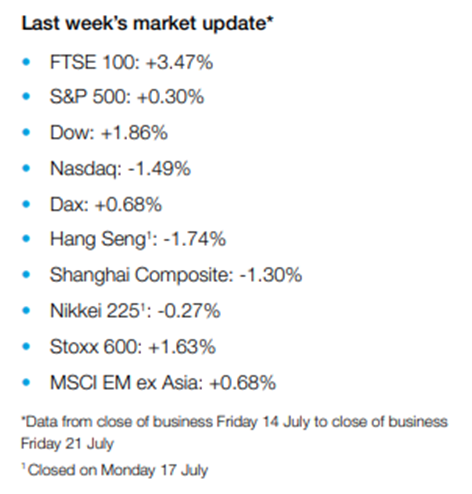
Most US and European indices rose last week as slowing inflation raised hopes that interest rate hikes could be nearing an end.

The FTSE 100 surged 3.5% as UK inflation eased more than expected, triggering a decline in the pound versus the dollar (around 70% of FTSE 100 company revenues come from overseas). The Stoxx 600 and Germany’s Dax climbed 1.6% and 0.7%, respectively, after two hawkish European central bankers appeared to moderate their stance on future rate hikes.

In the US, the Dow enjoyed its tenth consecutive day of gains on Friday – its longest winning streak since August 2017. The Dow ended the week up 1.9%, boosted by comments from Treasury secretary Janet Yellen that the risk of a US recession had fallen. Disappointing technology sector earnings weighed on the Nasdaq, which lost 1.5%. In Asia, the Shanghai Composite and the Hang Seng fell 1.3% and 1.7%, respectively, after figures showed China’s gross domestic product (GDP) grew by just 0.8% in the second quarter, down from the first quarter’s 2.2% expansion.

Investors shrug off weak PMIs

Stocks made small gains on Monday (24 July) as investors digested the latest purchasing managers’ indices (PMIs) for the US, eurozone and UK. The Dow extended its winning streak, advancing 0.5%, while the S&P 500 and the Nasdaq gained 0.4% and 0.2%, respectively. S&P Global’s flash PMI for the US showed business activity slowed to a five-month low in July, dragged down by weaker services sector growth. Manufacturing remained in contraction territory, but rose from 46.3 in June to a forecast-beating 49.0 in July (a reading below 50.0 indicates a contraction).

The Stoxx 600 and the FTSE 100 managed to shrug off weak PMIs to edge up 0.1% and 0.2%, respectively, on Monday. S&P Global’s flash PMI for the eurozone showed business output fell at the fastest rate for eight months in July. The services sub-index fell to 51.1, its lowest in six months, while the manufacturing output index plummeted to 42.9, the lowest in more than three years. S&P Global’s PMI for the UK was also disappointing, with manufacturing and services sector readings both coming in below expectations at 45.0 and 51.5, respectively.

Investors will now be looking ahead to the Federal Reserve’s two-day policy meeting on 25-26 July and the European Central Bank’s policy meeting on 27 July.

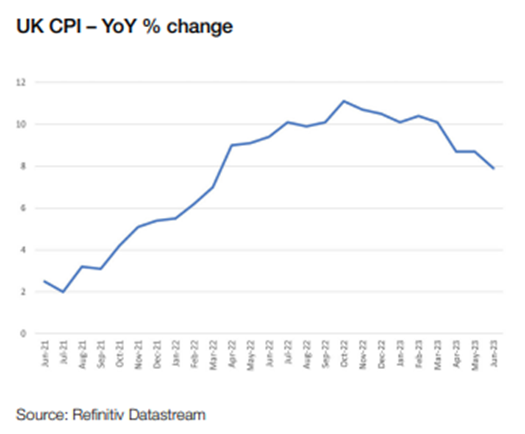
UK inflation rate falls to 7.9%

Last week saw the UK’s Office for National Statistics publish the closely watched consumer price index (CPI) report. The headline rate of inflation eased to 7.9% year[1]on-year in June, down from 8.7% in May and lower than expected. This was mainly driven by a 22.7% year-on[1]year decline in motor fuel prices. Food and drink inflation eased to 17.4% in June from 18.4% in May. Core inflation, which excludes energy, food, alcohol and tobacco, slowed to 6.9% in June after hitting a 30-year high of 7.1% in May.

The report has raised hopes that the Bank of England will be less aggressive when raising interest rates over the coming months. Markets now expect rates to peak at 5.8% this cycle, down from previous forecasts of 6.5%. The peak is expected to be reached in February 2024.

US retail sales rise modestly

In the US, retail sales rose by 0.2% in June from the previous month, while data for May was revised higher to show a 0.5% increase in sales. The data suggests sales have remained resilient despite interest rate hikes, although the rise was lower than the 0.5% increase forecast by economists in a Reuters poll. Online sales surged by 1.9%, the most in six months, whereas receipts at service stations and building material stores declined.

Core retail sales, which exclude automobiles, gasoline, building materials and food services, rose by a healthy 0.6% in June following an upwardly revised 0.5% increase in May. Core retail sales are an important indicator of consumer spending, which accounts for more than two[1]thirds of US GDP

Japan raises inflation forecast

Over in Japan, the government raised its inflation forecast for the current fiscal year to 2.6%, up from its January prediction of 1.7%. The announcement came a week before the Bank of Japan’s (BoJ) policy meeting on 27 July. Markets will be keen to see whether the revised forecast will result in the bank raising its own forecast and, in turn, tweaking its ultra-loose monetary policy. Latest figures show headline and core inflation both rose to 3.3% in June from 3.2% in May. Despite inflation persistently exceeding the 2% target, the BoJ has so far defended its stance. At the beginning of last week, governor Kazuo Ueda told a news conference that the BoJ would only change its yield curve control policy if there was a change in its inflation expectations.

Please check our blog content for advice, planning issues and the latest investment, market and economic updates from leading investment houses.

Alex Clare

26/07/2023

Team No Comments

Is cash king again?

Please see below article received from Brooks Macdonald this morning, which reminds readers to remain invested for long-term growth.

Cash savers are currently enjoying the highest returns in nearly two decades, with some popular savings accounts offering fixed-term deposit rates over 5% p.a. After a prolonged period of virtually zero return on cash, rates today are multiple times higher compared to previous years, and investors are naturally keen to put more into cash than they have done so previously. So, are investors right to prioritise cash? To answer this question, we examine the role of cash in the context of inflation, investment horizon and opportunity cost of reinvestment. Despite the current attractiveness of cash deposit rates, cash may not be the best place to be for long-term investors.

Cash is not inflation-proof

Cash offers certainty only in its nominal value but not its real value, which is measured by the resilience of its purchasing power over time. Inflation erodes the purchasing power of any asset. While cash may retain its real value to some extent during periods of low inflation, its purchasing power rapidly diminishes during times of high inflation. In fact, in the past two decades, there were only three isolated years where cash managed to outperform inflation and retain its purchasing power. Even during the era of subdued inflation that preceded the COVID pandemic, deposit rates languished at levels even lower. Despite the recent surge in cash rates, they still fall short of the prevailing higher inflation rates. Consequently, relying solely on cash rates often proves inadequate in terms of providing comprehensive real value protection.

A diversified portfolio could be a better option for long-term investors

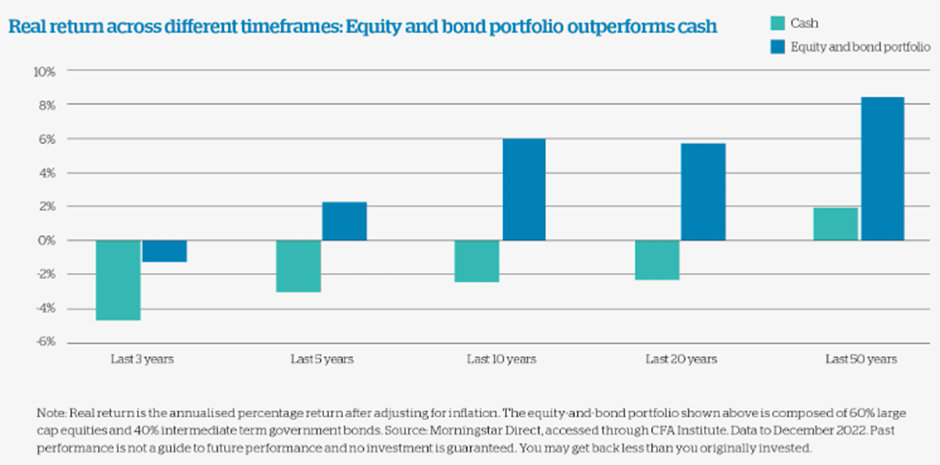
It is important to examine the case for cash in comparison to other investment instruments such as equities and bonds. For investors with long-term goals, a diversified 60% equities and 40% bonds portfolio can hold greater potential for generating real returns. If we examine the excess returns of cash vs. an equities and bonds portfolio across varying time horizons, we see that over the past 3, 5, 10 and 20 years, cash savings have delivered negative real returns, thereby diminishing the purchasing power of depositors. While cash managed to retain a level of real value over a 50-year period which will incorporate many different economic cycles, it is still lower than the returns generated by the equities and bonds portfolio. By contrast, the equities and bonds portfolio has consistently delivered returns that outpaced inflation across timeframes of 5 to 50 years, regardless of the prevailing macroeconomic conditions.

Hidden costs of fixed-term deposits

Investors attracted by the higher rates offered by fixed-term deposits are often locked in for a period of time. One key consideration for depositors in these situations is reinvestment risk, which is the risk of earning lower returns when choosing a new investment after their original fixed-term investment has expired. Once the fixed rate reaches its end, they must either renew at potentially lower rates or explore alternative investment options. However, the financial landscape at that time could differ significantly, and the investor could have missed attractive entry points in equity and bond markets. Historical analysis also reveals that high deposit rates rarely persist over an extended period. Looking at past patterns, in the five previous hiking cycles, the Bank of England typically maintained peak interest rates for an average of 9 months between its last hike and its first rate cut. It is unlikely for higher rates to endure, and investors risk sacrificing long-term opportunities for the allure of short-term ‘guaranteed’ gains.

What does it mean for investors?

While current cash deposit rates may be attractive, investors should carefully evaluate the role of cash in light of inflation, investment horizon, and reinvestment risks. So, whilst holding cash can be a useful tool for investors with a very short investment horizon, a diversified investment portfolio could provide better returns for investors seeking to preserve and grow their wealth over the long term.

Please check in again with us soon for further relevant content and news.

Chloe

25/07/2023

Team No Comments

Tatton Investment Management: Monday Digest

Please find below the Tatton ‘Monday Digest’ which provides an overview of global economic news from the past week. Received this morning – 24/07/2023

Another inflation driver turns over

Last week, markets yet again revolved around inflation, wages and profit margins. In the UK, we finally received some of the positive inflation news that has been stoking US markets. June’s consumer price index (CPI) decline to 7.9% year-on-year could be a watershed moment, giving the Bank of England (BoE) the green light to raise interest rates only by another 0.25% in August. To put this into context, last Tuesday markets were still pricing in a 0.50% hike.

The better-than-expected inflation news helped UK equity markets to storm higher on the week, egged-on by sharp falls in medium-term gilt yields (and parallel gilts price rises!). Sterling retreated from its recent highs against the US dollar, but UK stocks closed the week leading the rest of the world higher, even in UK sterling-based terms.

On the other side of the Atlantic, the US second quarter earnings season has showed that margins are finally coming under pressure across the board. Tesla withdrew its previous statement that margins would “remain among the highest in the industry,” and a cautious commentary left the door open for another round of price cuts soon. It’s not just Tesla, however, and margins have weakened substantially in other integral areas like trucking and freight (which we discuss in greater detail below). We have become used to the UK headlines about strikes, but if the US turns out to have a more entrenched inflation path because labour relations have worsened it may face the same worries as we have faced in the UK.

As the earnings season progresses, we appear to be in a new phase, where companies have lost pricing power but sales should hold up because they are not cutting labour aggressively. We will be listening very closely to what the US Federal Reserve tells us after this Wednesday’s Federal Open Market Committee meeting.

Chinese property developers are on their own

Since property giant Evergrande defaulted on its debt two years ago, the world’s most leveraged property developer has been in a lengthy restructuring process which, for the most part, has looked like artificial life support rather than a cure. Its slow-motion collapse has been a major part of China’s property crisis, and is a substantial drag on growth for the world’s second-largest economy. None of the property developer’s problems should surprise us anymore, and yet, its latest announcements cannot help but make collective eyes water. In just two years, Evergrande made losses of $81 billion. The incredible losses are driven mostly by asset depreciation, thanks to sinking values in China’s building industry. Analysts have suggested that the fact such dire figures are now being released shows an acceptance the hoped-for improvement is not coming anytime soon.

The Chinese government has seemed surprisingly uninterested in arresting the decline. The last few months have been horrendous for the ailing property sector, but policy support has been minimal. If Beijing does let large developers go bankrupt, equity and foreign bondholders will be the least protected. The distress also has big implications for China’s banks – which are among the largest financial institutions in the world. Developers’ financial struggles seriously impact banks, which will inevitably mean tighter lending conditions for everyone. That could well dampen any help that comes from the authorities.

China’s hopes of a post-Covid boom have well and truly evaporated, pushing down asset values which rallied into the start of this year. The property developers’ financial problems are proving contagious as they are weighing down on consumer and business sentiment. As such, they have been at the heart of the weak post-lockdown rebound in Chinese consumption and that has led to rising savings rates and even weaker private sector activity. This is not to say that Beijing is against growth – both words and actions suggest the opposite. However, it wants growth in productive areas and property has become unproductive. Developers may already be resigned to being given nothing more than life support.

Freight not great

There are serious questions over the health of the US freight industry at the moment. Relations between companies, drivers and other workers have become highly antagonistic, just as revenues have been falling. UPS, the world’s biggest courier, has been in the spotlight due to its negotiations with the Teamsters Union, with the two sides failing to agree wage increases for part-time workers, who make up roughly half of UPS’s unionised workforce in the US. UPS isn’t the only company under pressure. Yellow Corporation, the parent company of Holland and Yellow Freight, announced it is $50 million short of the pension contributions it owes, and remains in severe financial distress.

Yellow’s likely demise is a symbol of America’s freight recession. Early in the pandemic, the surge in transport demand created huge capacity expansion in trucking, only for companies to find themselves short of drivers. Workers’ increased pricing power meant significantly higher wage bills, eating into profit margins and worsening financial metrics. When the post-Covid boom dwindled, revenues fell sharply and firms were caught out.

Some of the bad news for freight companies is good news for US consumers. The ongoing freight recession means lower costs, while the inventory situation could also mean the easing of goods prices. This would help inflation-bruised consumers and support demand but, as ever, this has to be balanced against the increased risk of defaults. A wave of defaults hurts everyone, making finances tighter than they already are. This is not happening yet, but is very much a live possibility for the freight sector.

Please continue to check our Blog content for advice and planning issues and the latest investment, markets and economic updates from leading investment houses.

Alex Kitteringham

24th July 2023