Team No Comments

Invesco: Mid-Year Investment Outlook

This has been cut and pasted from Invesco’s mid-year investment outlook received this morning, 21/07/2023:

In an effort to curtail the worst inflation in decades, Western developed central banks have moved aggressively to tighten monetary policy. This has helped exert downward pressure on inflation but has also brought about a meaningful slowdown in global growth and some financial accidents, including several US regional bank failures.

However, against this backdrop, we see resilient domestic demand in many economies, especially in services. Our base case anticipates a relatively brief and shallow economic slowdown as inflation continues to moderate and monetary policy tightening nears an end, followed by a recovery.

We call this a bumpy landing because there will continue to be some economic damage in this scenario. We believe there is the possibility of a downside scenario – a “hard landing” – in which global growth is hit harder, with a recession first in the US, which then cascades into other economies.

We also believe there is the possibility of an upside scenario – a “smooth landing” – in which monetary policy impacts growth less than expected and the global economy is relatively unscathed. In the US, we believe rate hikes are ending, and US inflation will continue to fall significantly, albeit imperfectly.

While discussion of a recession in the US is now commonplace, we continue to believe the US is likely to avoid a substantial broadbased recession. Instead, we expect some weakness in the second half of this year as policymakers accomplish a bumpy landing, but we anticipate activity will nevertheless remain relatively resilient.

As we enter 2024, we expect a more positive growth outlook to unfold as the economy recovers. In our view, the eurozone and UK are likely to follow a pattern similar to the US, but with a lag.

A variety of forces have helped sustain European economic momentum so far in 2023, but we expect tightening financial conditions to weigh on credit growth over time, helping to reduce inflationary pressures but also causing a significant economic slowdown.

In contrast with many major developed market economies, China is in a markedly different place in its cycle. The relaxation of COVID-19 restrictions has driven a meaningful though uneven recovery. The reopening is largely benefiting the services component of the economy while slowing growth momentum globally has meant weaker-than-hoped manufacturing activity.

Nevertheless, China remains a bright spot with subdued inflation and a robust growth outlook. We expect continued accommodation from the People’s Bank of China (PBoC) through the rest of 2023.

In short, we believe we are at a policy peak, that disinflation is underway, and that a relatively brief global economic slowdown is occurring, but markets are likely to soon look past this episode and begin to discount a future economic recovery.

Comment

For circa 40 months conditions have been challenging with volatility ongoing, and for the last couple of years markets have really just traded sideways. 

It will be good to see inflation coming under control in the US, and an economic recovery.  China should help too, lifting the Asia region, and in turn, both the US and China aiding the economic recovery globally.

2024 will hopefully be a better year for invested assets.

Steve Speed

21/07/2023

Team No Comments

Brooks Macdonald: Daily Investment Bulletin

Please see below, Brooks Macdonald’s ‘Daily Investment Bulletin’ providing their commentary on global markets. Received today – 20/07/2023.

Please check our blog content for advice, planning issues and the latest investment, market and economic updates from leading investment houses.

Adam Waugh

20/07/2023

Team No Comments

The gender pay gap and gender pensions gap

Please see the below technical update article from LV:

Over the years, increasing attention has been given to the fact that men historically earn more than women – the ‘gender pay gap’ and how to close or narrow this gap.

Today, public and private sector employers with 250 or more employees are required to annually publish data on the gender pay gap within their organisations.

Over time, the gender pay gap has been shrinking. In fact, recent data shows little difference in median hourly pay for male and female full-time employees aged in their 20s and 30s, but a more substantial gap emerges among full-time employees aged 40 and over.

The reasons for the gender pay gap are complicated. However, parenthood is a major factor – the gap between male and female hourly earnings grows gradually but steadily in the years after parents have their first child.

This difference in earnings across working life has also lead to a ‘gender pensions gap’. With lower earnings, more gaps in work history and the pay gap being more pronounced in the past, many women retiring today have significantly less pension wealth than their male counterparts.

On 5 June 2023, the Government published its first report on the gender pensions gap. This confirmed a 35% gap in private pension wealth between men and women who are at or approaching normal minimum pension age, albeit the gap is smaller at 32% for those who are eligible for Automatic Enrolment. 

Potential pitfalls and planning points

There are a number of steps that can help protect the future pensions of those who are working part time or have taken time out of paid work to care for others.

  • Maternity leave – When maternity leave (or shared parental leave) is taken, it’s important to understand what will happen to pension contributions and consider whether there is any scope to top these up.

Employee contributions are normally deducted as a percentage of pay. As pay will usually be reduced, any employee contributions will be paid at the same percentage as before, but based on the lower income. However, employer pension contributions are based on the employee’s normal salary which he or she would have been paid when they were still at work.

Note that where salary sacrifice is used, the member’s salary has been exchanged for equivalent employer contributions. This means that for a salary sacrifice arrangement, all contributions are technically employer contributions and therefore should normally remain at their prior level during the leave period and should not be reduced at all.

  • Contributions for a lower earning partner – Where one partner in a couple stops working or earns less, the higher earner can make tax relievable pension contributions on their behalf. This may offer tax advantages in retirement, especially where the lower earner has less overall pension wealth and is likely to be a lower tax payer in retirement.

Tax relievable pension contributions can be made up to the higher of £3,600 (£2,880 net) and a scheme members relevant UK earnings each year. However, other factors such as the amount of tax relief available to each partner and availability of matching employer contributions will need to be taken into account.

  • Incorrect NI records – Where someone claimed Child Benefit before May 2000 and did not provide their National Insurance Number on the claim, their National Insurance record may not show the correct number of qualifying years for the state pension – Women in their 60s and 70s are most likely to be affected.

The Department for Work and Pensions (DWP) and HM Revenue and Customs (HMRC) are working to find people affected and correct their records so they receive the correct amount of State Pension. Further information for those who may be affected can be found here.

  • Claiming child benefit today – For households where one partner earns more than £50,000, the ‘high income child benefit charge’ becomes payable. Once earnings reach £60,000, the tax is equal to any child benefit claimed, so it may seem pointless to claim child benefit.

However, where someone has taken time out of work to look after children, they should still always make a child benefit claim to ensure they get NI credits (35 years’ worth are needed for a full state pension). As part of the application process, it is possible to opt out of actually receiving any payment so as to avoid the tax charge (as highlighted below):

  • Voluntary NI contributions – Where someone hasn’t a full National Insurance (NI) record, they may not qualify for certain benefits or a full state pension. Where someone has NI gaps within the past 6 tax years, they can make voluntary contributions to make up these gaps.

Furthermore, for men born after 5 April 1951 and women born after 5 April 1953, there is a temporary extended deadline (until 5 April 2025) allowing for voluntary contributions to be made to make up gaps in NI records between tax years April 2006 and April 2016.

Comment

The implications of the gender pension gap affect not just women and can cause financial implications for the whole household as individuals approach retirement.

Having awareness of the factors mentioned above can enable entitlement to a full state pension and help ensure gaps in work history do not lead to financial hardship in retirement.  

This is an interesting article as this is a real area of advice that needs addressing and something we come across often.

Please check our blog content for advice, planning issues and the latest investment, market and economic updates from leading investment houses.

Andrew Lloyd DipPFS

19/07/2023

Team No Comments

Brewin Dolphin – Markets in a Minute

Please see the below article from Brewin Dolphin commenting on the latest stock market movements. Received 18/07/2023.

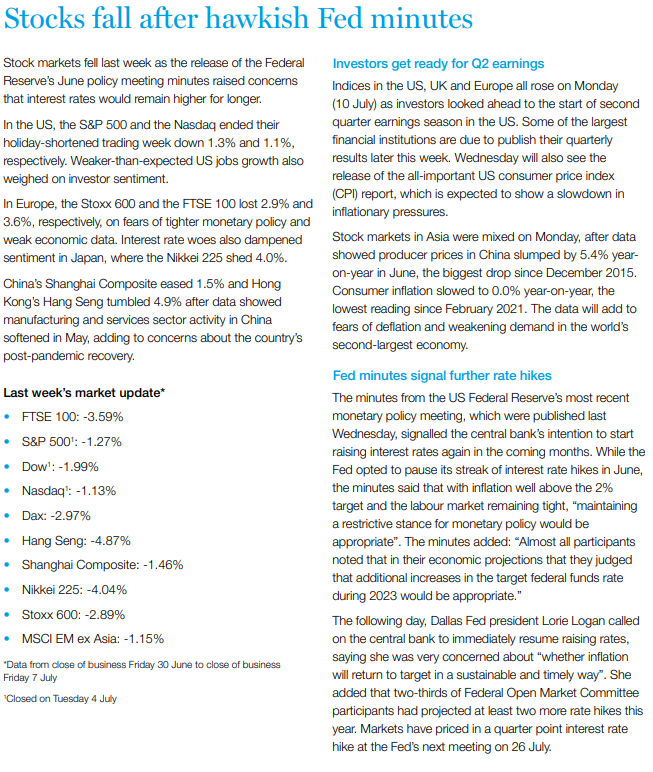
All major indices finished in the green in a week that saw inflation and producer prices falling in the US. The UK’s FTSE 100 and pan-European Stoxx 600 rose by 2.2% and 2.8% respectively on the back of the positive data, while over in the US, the S&P 500 grew 2.2%, the Dow rose by 1.7% and the Nasdaq added 3.1%.

 In Asia, the Shanghai Composite added 1.0% as China extended policies to help bolster its struggling property market. The measures encourage financial institutions to extend loans and adjust repayment arrangements for real estate companies in order to promote completion and delivery of pre-sold housing projects.

Hong Kong’s Hang Seng added 5.1% while Japan’s Nikkei 225 added a more modest 0.6% amid speculation the Bank of Japan may raise its ten-year yield ceiling to 1% later this month.

Last week’s market update*

• FTSE 100: +2.21%

• S&P 500: +2.17%

• Dow: +1.66%

• Nasdaq: +3.13%

• Dax: +2.76%

• Hang Seng: +5.05%

• Shanghai Composite: +1.06%

• Nikkei 225: +0.63%

• Stoxx 600: +2.75%

• MSCI EM ex Asia: +3.15%

*Data from close of business Friday 7 July to close of business Friday 14 July

Markets dampened by Chinese data

Markets in the UK and China ended in the red on Monday (17 July) following disappointing economic data, including lower-than-expected second quarter GDP growth. China’s GDP grew to 6.3% year-on-year in Q2, compared to a forecasted 7.3%. The FTSE 100 lost 0.4% while the Shanghai Composite dropped 0.9%. Japan’s Nikkei 225 was closed Monday due to a public holiday, and Hong Kong’s Hang Seng was closed due to a typhoon.

Over in the US, indices closed in the green, as the anticipation of US earnings reports and retail sales data this week boosted investor sentiment. The Dow Jones added 0.2% for its sixth consecutive day, while the S&P 500 grew 0.4% and tech-heavy Nasdaq increased 0.9%.

The average UK property price has fallen by an average 0.2% (£905) this month to £371,907, Rightmove’s House Price Index shows. The decline is attributed to rising mortgage costs and buyer affordability constraints. The average interest rate on Rightmove’s mortgage tracker is now 5.69% for an 85% loan-to-value five-year-fixed mortgage. However, demand is still resilient and 3% higher than in 2019, despite the number of properties for sale being 12% lower than four years ago.

US inflation cools

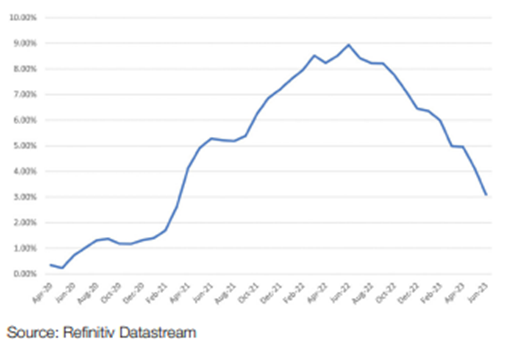
US inflation rose by an annualised 3% in June, the smallest 12-month increase in over two years, according to figures from the US Bureau of Labor Statistics. This is an improvement from the 4% measured in May, and slightly below the market’s expected 3.1%.

On a monthly basis, the US headline Consumer Price Index (CPI) rose by 0.2% in June, up from 0.1% in May. The rise was driven primarily by the index for shelter, which contributed over 70% of the increase.

Core CPI, which includes all items except food and energy, rose 0.2% in June, the smallest monthly increase since August 2021. On an annualised basis, core CPI rose by 4.8%, driven largely by the shelter index, which accounted for two thirds of the total increase.

In another sign of cooling inflation, the US Producer Price Index (PPI) for final demand rose by a better[1]than-expected 0.1% in June, according to the Labor Department. Economists had predicted a 0.2% increase. The increase was primarily driven by a 0.2% rise in the final demand services index, while prices for final demand goods were unchanged. On an annualised basis, the index advanced 0.1%.

Core PPI – excluding food, energy, and trade services – rose by 0.1% in June after remaining flat in May. On an annualised basis, prices rose 2.6%.

Although inflation has eased, many economists still expect the Federal Reserve to raise interest rates by 25 basis points on 26 July. The Fed held rates last month, but policymakers have indicated there may be a further rise of up to 0.5 percentage points before the end of the year.

UK economy shrinks

UK gross domestic product (GDP) is estimated to have fallen by 0.1% in May, after growth of 0.2% in April, according to the Office of National Statistics.

Production output and the construction sector fell by 0.6% and 0.2% respectively in May, while services output remained flat.

The additional bank holiday in early May for the coronation of King Charles III was cited as a reason for reduced output in manufacturing and construction. The bank holiday benefitted industries in the arts, entertainment and recreation, while sentiment in accommodation and the food services sector was mixed, with reports of both increased and reduced output.

Strikes in healthcare, the rail network, education and the civil service were also reported to have had an impact on results.

The market is expecting the Bank of England to raise interest rates again next month in an effort to stifle inflation.

The pound reached a new 15-month high following last week’s GDP report, rising to $1.30 against the dollar for the first time since April 2022. The pound has gained almost 8% on the dollar so far this year.

Germany reduces dependence on China

Germany announced it will reduce its dependence on China for supply chains and export markets. Sectors impacted include medicine, lithium batteries used in electric cars, and elements used in chipmaking. China continues to be Germany’s main trading partner, with goods worth almost €300 billion exchanged between the countries in 2022.

Please check our blog content for advice, planning issues and the latest investment, market and economic updates from leading investment houses.

Alex Clare

19/07/2023

Team No Comments

Brooks Macdonald Weekly Market Commentary: Global equities rose, spurred by softer-than-expected US inflation

Please see the below article from Brooks Macdonald detailing the latest update and economic news from the US. Received 17/07/2023.

Global equities surged last week, spurred by softer-than-expected US inflation

Equities fell marginally on Friday but the week in aggregate saw strong gains in equities and bonds as a softer Consumer Price Index (CPI) report reignited hopes of a US soft landing. This week will see a series of US economic data releases, alongside the first full week of the earnings season, which will help investors gauge whether growth has been impacted yet by the restrictive US monetary policy.

US earnings season is underway with major technology and banking names reporting this week

Last Friday saw the start of the US earnings season and the releases from some of the major US banks. Those banks reporting strong results saw rallies in their share prices, mirroring the anecdotal evidence that global asset allocators are underweight equities and are implying that there is still plenty of cash on the sidelines to enter stocks when there is good news. This week sees Tesla, Netflix and IBM alongside other major US banks such as Bank of America, Morgan Stanley and Goldman Sachs. The earnings season takes some time to get going so we will only see c. 10% of the large US companies reporting this week, though by the end of the week we will have a good idea of how earnings for many sectors are likely to play out.

The latest compendium of Chinese data shows an economy struggling to regain momentum

This morning saw the latest compendium of monthly Chinese data. The data showed an economy still struggling to grow despite the exit of pandemic era restrictions. Gross Domestic Product (GDP) expanded by 6.3% in Q2 on a year-on-year basis but this was well below the 7.3% expected by analysts. Given the comparable quarter in 2022 is a period that saw the Shanghai COVID outbreak, investors had hoped to see a more sizeable rebound. Importantly the quarter-on-quarter GDP growth rate was just 0.8%. Retail sales also marginally disappointed as momentum slowed.

After the market’s strongly positive reaction to the trifecta of slower CPI, Producer Price Index (PPI) and used car prices last week, European investors will be keeping a close eye on the UK CPI report on Wednesday. With the UK experiencing inflation due to domestic issues (such a lack of labour supply) and international factors (food prices), it is likely that any global disinflation will take some time to filter through. That said, expectations around UK inflation are very high at the moment, so a small glimmer of disinflation could be enough to reverse the rapid rise in UK interest rate expectations since the upside surprise to UK CPI a few months ago.

Please check our blog content for advice, planning issues and the latest investment, market and economic updates from leading investment houses.

Alex Clare

18/07/2023

Team No Comments

Tatton Monday Digest

Please see below this week’s Tatton Monday Digest which was received earlier this morning:

Overview: Core inflation slowdown equals upbeat equity markets

We wrote at the end of last week that markets were still absorbing the prospect of another round of significant interest rate rises from central banks, and that equities would therefore come under further pressure. But by the end of last week equity markets had risen sharply, with most more than reversing their losses of the previous week. The catalyst for the US stock market rally was the release of the latest consumer price index (CPI) figures, which showed that core inflation (with energy and food stripped out) cooled to 3% in June, the lowest rate of growth in two years.

Greedflation or wage-price spiral?

Probably not since the 1970s has inflation been such an all-consuming topic in public discourse. This is because, of course, for decades there was very little of it. Things could hardly be more different now. People are clearly worried about rising prices for goods and services, and what might happen to their individual or collective spending power. But beyond that, there is a deep argument raging about what causes inflation. Opinions remain divided across two major camps: those who think corporate ‘profiteering’ is to blame for runaway prices, and those who think wages are the main cause. As you might imagine, the dividing line is highly political. Here in the UK, the Bank of England (BoE) is adamant wages are the biggest inflationary concern, whereas in Europe, policymakers are much more concerned about corporate profits. Last week, BoE Governor Andrew Bailey joined Chancellor Jeremy Hunt in calling on Britons to show restraint in their wage demands. This is his second intervention, having called for similar restraint back in March. At the same time, Hunt reportedly asked the BoE to scrutinise profits in the UK food industry, following accusations of ‘price gouging’ (the British Retail Consortium recently revealed food prices increased 14.6% in the year to June).

Unfortunately, it is almost impossible to objectively say whether profits or wages are the bigger inflationary force, because they are two sides of the same economic coin. There has been a lot of talk recently about the return of labour pricing power – particularly after two years of widespread industrial action. In this sense, the sensitivity of inflation to employment has increased, which the BoE clearly sees as its main way of impacting the economy. But one could just as well argue there has been a return of corporate pricing power, following a long period of consolidation across nearly every major industry. This has led to wages and profits feeding off each other without either backing down – what should perhaps be called the ‘wage-profit spiral’. Who should ‘give in’ first is a political issue but, unless somebody does give in, we will keep talking about inflation for some time to come.

Banking sector pressure appears far from over

Last Wednesday, BoE Governor Bailey called on UK banks to pass along higher interest rates to savers. Over the past year-and-a-half, interest rates have seen the sharpest spike in a generation, going from near zero at the end of 2021 to 5% now, with further hikes set to come. But deposit interest rates from the big retail banks remain at little over 1% in many cases. UK retail banking suffers from a notable lack of competition, being largely dominated by older, established players and building societies. This means savers have few options and have to take whatever rate is offered, as regulators point out, however, both the government and the BoE have been complicit in reducing the number of British banks, leading to the concentrated environment we see today.

The situation is notably different in the US and Europe, where smaller regional banks are much more prominent. But the prominence of regional banks in the US has been much discussed this year after many of them collapsed, most notably Silicon Valley Bank (SVB), bringing to light deeper structural problems. Having many smaller players increases competition and should benefit customers. But for the banks themselves, the lack of scale and the fact their lending and borrowing all happen in relatively small regions, substantially decreases the potential for diversification. As investors know, a lack of diversification can mean losses piling up quickly. That is exactly what happened to SVB, and these problems have not gone away for the regional banks.

A difficult financial and economic climate is toughest for smaller businesses. For banks specifically, tightening financial conditions can boost profitability if it means higher long-term lending rates over short-term deposits (as seen in the UK), but it can also threaten liquidity, something smaller players inevitably have less of. The incentive for mergers or acquisitions is therefore large. We suspect this is less likely to play out in Europe, where the structural barriers to cross-border mergers are higher. European banks tend to be well capitalised, so stormy conditions might not be a problem at first. But the combination of high interest rates for longer and smaller corporates suffering under the higher cost of borrowing could lead to banking stress and even defaults if the Eurozone economy takes a turn for the worse. Here in the UK, we seem not to have these problems, but a highly concentrated banking system has its drawbacks too. Political pressure is now being exerted on British banks, both by politicians and the BoE. If consolidation increases in the US, we should expect the same political problems to play out, and if the US is more active in its antitrust policies – as has often been the case historically – some of that pressure might make it over here too

Please continue to check our Blog content for advice and planning issues and the latest investment, markets and economic updates from leading investment houses.

Andrew Lloyd DipPFS

17/07/2023

Team No Comments

Brooks Macdonald – Daily Investment Bulletin

Please see below today’s Brooks Macdonald Daily Investment Bulletin, which was received earlier this morning (14/07/2023):

What has happened

Equities and bonds continued their surge yesterday as investors contemplated the likelihood of a US ‘soft landing’ where inflation falls sufficiently to allow the US economy to avoid a recession. US equity markets have now recovered a significant portion of last year’s sell-off and are back to levels last seen in April 2022.

Market narrative shifts

It was only one week ago that the market narrative was decisively behind a sticky inflation, high interest rate backdrop however the CPI release (and yesterday’s PPI release) has catalysed a rapid shift towards hope for a sudden cooling in US inflation pressures. Those cooling inflation expectations are then feeding a growing chance of multiple interest rate cuts in 2024. The Producer Price Inflation numbers released yesterday painted a similarly rosy outlook for consumer inflation. Producer Inflation, which will ultimately filter into consumer prices, rose at just 0.1% year-on-year, below expectations and very close to outright deflation territory. The core PPI release also missed expectations and is growing by just 2.4% year-on-year. With the CPI and PPI releases impacting bond market thinking, investors are becoming more confident that the July meeting will be the final rate hike for this cycle.

Fed reaction

The ‘pivot’ towards US rate cuts occurred despite Fed speakers stressing that they could not yet gain confidence that inflation was under control from one reading. President Daly said it was ‘really too early to say that we’ve declared victory on inflation’ with Governor Waller saying that two more hikes this year remained his base case. Waller did show the Fed’s data dependency however, saying that if inflation readings continued in line with this week’s release, a pause may be warranted by September. Today is the last day before the Fed moves into communication blackout ahead of their next monetary policy meeting.

What does Brooks Macdonald think

Markets have been taking strong US economic news as bad news given economic strength is likely to booster consumer demand and therefore inflation. Should inflation show further signs of falling, despite robust economic growth, then this narrative too will change and good news for the economy will become good news for markets.

Please continue to check our Blog content for advice and planning issues and the latest investment, markets and economic updates from leading investment houses.

Carl Mitchell – Dip PFS

Independent Financial Adviser

14/07/2023

Team No Comments

Evelyn Partners Update – June US CPI Inflation

Please see below an article received from Evelyn Partners yesterday (12/07/2023) afternoon, which details their thoughts on yesterday’s US CPI Inflation announcement:

What happened?

US June annual headline CPI inflation rose 3.0% (consensus: +3.1%), its lowest level since March 2021, and compares to 4.0% in May. In monthly terms, CPI rose 0.2% (consensus: +0.3%), compared to a gain of 0.1% in May.

June annual core inflation (excluding food and energy) rose 4.8% (consensus: +5.0%), versus 5.3% in May. In monthly terms, core CPI rose 0.2% (consensus: +0.3%), compared to a gain of 0.4% in May.

What does it mean?

The Fed should take some comfort in the fact that monetary tightening appears to be working to bring down inflation ahead of the FOMC meeting on the 26 July. Annual headline CPI inflation is heading back towards pre-pandemic rates and core (ex-food/energy) price rises are now below 5%. There are three reasons to expect underlying inflation to slow further from here.

First, supply chain disruption from the pandemic has lessened significantly. One way to observe this is through used car prices, which are now falling on an annual basis as production normalises. This puts downward pressure on a past key driver of core CPI inflation during the early stages of Covid from 2020.

Second, rental inflation continues to slow. Using data from timely online residential platforms, recent research from Goldman Sachs shows that average annualised rental inflation has eased to just +1% over the last 8 months to June from 20% plus in mid-2021. It will take time for lower rental prices to feed through to inflation, but there is evidence it is starting to happen. For instance, June shelter CPI inflation slowed to 7.8% from a peak of 8.2% in March. CPI inflation (ex-shelter) in June was up just 0.8% from a year ago. 

Third, lead indicators point to lower core inflation in the months ahead. Selling prices from the National Federation of Independent Business, or better known as the small business survey, have fallen to a level last seen when core CPI inflation was roughly 4%. The annual change in job openings is another lead indicator with a decent track record of leading inflation and this too points to lower pace of price gains ahead. 

Bottom Line

Regardless of whether the FOMC (the US Central Bank’s interest-rate setting body) raises interest rates later this week or not (markets’ expectation is current for a 25bps increase), the Fed is likely coming to the end of its interest rate hiking cycle. This reduces the risk that the FOMC overtightens on interest rates and creates downward pressure to the economy and financial markets. Moreover, as a countercyclical currency, we expect the dollar to depreciate against other major currencies, since the risk of a so-called economic hard landing is reduced. Dollar depreciation should provide additional liquidity, which will help equities to continue their bull run.

Please continue to check our Blog content for advice and planning issues and the latest investment, markets and economic updates from leading investment houses.

Carl Mitchell – Dip PFS

Independent Financial Adviser

13/07/2023

Team No Comments

Brewin Dolphin: Markets in a Minute

Please see below ‘Markets in a Minute’ article from Brewin Dolphin commenting on the latest stock market movements. Received late yesterday afternoon – 11/07/2023.

Please check our blog content for advice, planning issues and the latest investment, market and economic updates from leading investment houses.

Adam Waugh

12/07/2023

Team No Comments

Brooks Macdonald Weekly Market Commentary – US Employment report delivers positives and negatives for investors

Please see the below article from Brooks Macdonald detailing the latest update and economic news from the US. Received 10/07/2023.

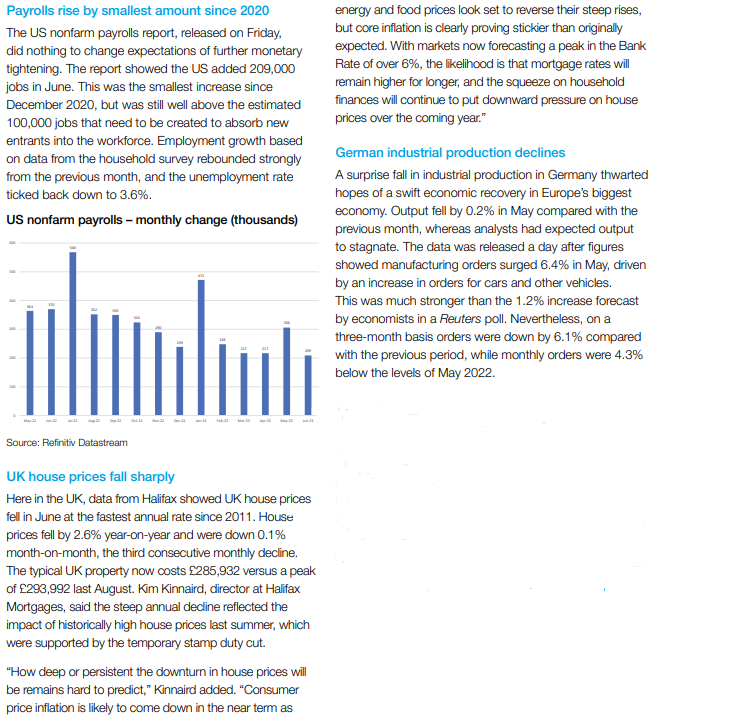
The number of new US jobs in June missed market expectations however wage inflation remains high

The headline miss in the US employment report on Friday was not taken as good news by equity markets who instead focused on some of the stickier labour market metrics. Equities closed lower on the day, with the US down just over 1% for the week and Europe underperforming, down a sizeable 3% over the same period.

The US employment report had positives and negatives for investors worried about labour market driven US inflation. The headline number of new jobs created in June came in below market expectations which is the first miss versus expectations in over a year. The unemployment rate grinded lower however, hitting 3.6% while the average number of hours worked in a week climbed versus expectations. The average hourly earnings also rose more than the market expected, coming in at 4.4% year-on-year. In aggregate, there may be some initial signs that labour market strength may soften in the coming months however the tick up in earnings and hours worked suggest that the inflationary wage pressures are still capable of fuelling consumption demand.

The market expects US headline CPI to fall dramatically on Wednesday but for core inflation to be sticky

This focus on inflation brings us to this week’s latest US CPI print which is released on Wednesday. The release comes amidst a series of US Federal Reserve (Fed) speakers so there will be a live commentary on the inflation results for the markets to consider. The headline US CPI reading is expected to plummet from 4% to 3.1% year-on-year while the US core CPI (excluding food and energy) is expected to fall more gradually, from 5.3% to 5%. The bond market, and Fed, will focus far more on this stickier core CPI target which remains well ahead of the central bank’s target range.

Falling consumer inflation expectations remain critical to avoiding an inflationary spiral

The Fed will be looking closely at the core CPI number when it is released however arguably consumers (and the media) are more likely to focus on the headline number. This is important as later in the week we see the University of Michigan release their consumer sentiment survey which includes inflation expectations. Should the headline US CPI continue to fall, this could quickly filter through to lower consumer inflation expectations which in turn may moderate wage growth demands.

Please check our blog content for advice, planning issues and the latest investment, market and economic updates from leading investment houses.

Alex Clare

11/07/2023