Team No Comments

The Pathway to Inclusive Investment – Why women’s investment matters

Please see below report received from BNY Mellon Investment Management yesterday afternoon, which sets out to explore some of the key drivers behind the persistent gender-investment gap from the perspective of those who currently invest, those who don’t, and the investment industry itself.

We set out to explore some of the key drivers behind the persistent gender-investment gap from the perspective of those who currently invest, those who don’t, and the investment industry itself.

If women invested at the same rate as men, there would be at least an extra:

$ 3.22 trillion of assets under management from private individuals today

$ 1.87 trillionof additional capital into Responsible Investment

We found that if women invested at the same rate as men, there would be at least an extra $3.22 trillion of assets under management from private individuals today. Perhaps more important, our research also reveals that women are more likely to make investments that have positive social and environmental impacts, meaning that there would be an influx of $1.87 trillion of additional capital into Responsible Investment if women invested at the same rate as men.

Three key barriers to higher levels of female participation in investing:

1.     Confidence crisis

Globally, just 28% of women feel confident about investing some of their money.

2.      Income hurdle

On average and globally, women think that they need $4,092 of disposable income each month – $50,000 per year – before [they can begin] investing some of their money.

3.     High-risk investment myth

Almost half of women (45%) say that investing money in the stock market – either directly or in a fund – is too risky for them. Only 9% of women report that they have a high or very high level of risk tolerance when it comes to investing; 49% have a moderate risk tolerance; and 42% have low risk tolerance.

Women tend to feel less confident about investing than savings, property or pensions. In our report, we explore the reasons why more women aren’t investing and how the investment industry can evolve to support more inclusive investment.

1.     Why women don’t invest


Women are less likely to invest than men. This gender-investment gap is a global issue, which limits women’s financial futures and their capacity to influence a better future for the planet. Over half of women believe that it’s important that more women invest to give them the choice to support companies and causes they agree with (53%) and to give them more influence over business and its environmental and social impact (52%).

In order to understand why women don’t invest at the same rate as men, and to explore what we in the industry can do to raise levels of female participation, we interviewed 8,000 men and women worldwide.

Our research reveals that the investment industry must tackle three key investment barriers to encourage more women to invest:

Engagement Crisis

The investment industry is failing to reach, appeal to, and engage women to the same degree as men. Globally, as few as one in 10 women feel they fully understand investing, and less than a third of women (28%) feel confident about investing some of their money.

With so few women comfortable investing any of their money, the urgent need for better communication and engagement is clear. Across key aspects of financial decision-making, investment is the area where the fewest women feel confident, compared to making decisions around savings, property and pensions.

Income Hurdle

On average and globally, women believe they need $4,092 of disposable income each month—almost $50,000 per year—before they would consider investing any of it. In the US, for example, on average women believe that they need over $6,000 of monthly disposable income—just over $72,000 per year—before they can start investing.

Clearly, this is unrealistic, especially given the fact that over a quarter of women (27%) describe their financial health as poor or very poor. For the investment industry, overcoming this misconception and explaining that only a small amount of money is needed to start investing should be a key focus.

Overcoming the income hurdle

Despite the widespread belief that you need large amounts of spare money to start investing, even a small investment habit of setting aside a few dollars each month can really pay off over time. For example, if you began 10 years ago investing $30 a month in the S&P 500 Index, your portfolio could be worth over $8,000 today, of which less than half would be money that you put in yourself.

2.     How women investing can change the world


Higher levels of female participation in investment could not only have a huge impact on women’s lives but also on the world at large, as women are more likely to invest in causes that they believe in, such as protecting the environment.

What then could encourage more women to invest? Our study shows that women across the world are motivated by the impact that their investments could have. More than half of women (55%), for example, would invest (or invest more) if the impact of their investment aligned with their personal values, and 53% would invest (or invest more) if the investment fund had a clear goal or purpose for good. Two-thirds of women who currently invest (66%) try to invest in companies they like and that support their personal values.

This drive to align investments with values seems to be stronger among those with children: three-quarters of parents—both men and women—who currently invest say that they prefer to invest in companies that support their personal values, compared with 59% of adults who do not have children.

Responsible Investment (RI) means investing for a better future; a more sustainable, diverse, and equitable future. RI covers a spectrum of investing styles, including exclusionary screening, ESG integration, sustainable investing and impact investing. ESG integration is the systematic and explicit incorporation of ESG factors into financial analysis and investment decisions to better manage risks and improve returns. Impact investing goes a step beyond ESG investing. It is the practice of investing with the dual objective of generating a positive, measurable and intended social or environmental impact, as well as a financial return.

Investment Shift

The profile of those who invest is changing, and with it there is a shift in focus and values. Our data shows that older men – traditionally the “typical” investors targeted by the investment industry – are less focused on impact investing and aligning their investments with their values. While 69% of young women (aged 18–30) who currently invest select their investments based on their impact, this is true of only a third (33%) of older men (aged over 50). And more than seven in 10 women under 30 (71%) prefer to invest in companies that support their personal values, compared with 54% of men over 50.

3.     Building an inclusive investment industry


If it’s possible to raise the participation rate of women investing, it could increase their personal prosperity and could have a beneficial influence on environmental and social issues.

Making investing more accessible to women isn’t just about ensuring they have the right technology, but also inclusively equipping everyone with the knowledge, skills, and fostering the motivation to engage with investing. This requires a significant cultural shift within the industry—not only in the way that products are developed and marketed but also in the diversity of the investment industry itself.

We asked asset managers – representing nearly $60 trillion of assets under management – for their insights on the key challenges for gender-inclusive investment and for their thoughts on how the industry can change to encourage more women to invest. Their answers reveal the extent to which the investment industry is currently oriented toward male customers and help identify ways in which financial products and messaging could be reshaped to attract and engage more women.

An industry with men in mind

Currently, nearly nine in 10 asset managers (86%) admit that their default investment customer is a man, and three-quarters of asset managers (73%) state that their organization’s investment products are primarily aimed at men, suggesting that they focus on the benefits and features that generally appeal more to men than women.

As a result, potential female investors are met with language, imagery and messaging targeted mainly at a male customer. This often includes the use of high-risk metaphors, such as those used in extreme sports, and the concept of high performance and achievement as a shorthand for investment success.

The answer to engaging women in investment isn’t found in outdated gimmicks and doesn’t require, for example, the increased use of the color pink—rather, it’s about forming a connection by understanding what motivates women to invest and how they like to be communicated with.

If the industry can re-think the language around investing, there’s a significant opportunity to affect how much women invest: 37% of women said that if investment language were easier to understand, it would influence them to invest, or to invest more than they currently do. However, the key takeaway is that the language which describes financial products should not only be simpler, and avoid jargon, but also be more clearly aligned to women’s long-term goals and values.

As increasing health standards mean that today’s women need to plan for what might be a 100-year lifespan, women are motivated to invest by thinking of their long-term financial prosperity, independence, and the impact their investments can have. Products packaged to meet these needs and address these interests, clearly communicated in straightforward language, should go a long way to increasing women’s investment.

What Women Want: Investing in Independence


As discussed earlier in the report, women value responsible investing and investments aligned with their personal values. They are also motivated to invest by a range of other factors, with financial independence topping the list. The investment industry, therefore, has a key opportunity to appeal to women by focusing on messaging around financial independence.

Almost two-thirds of women (63%) believe that it’s important that more women invest to provide for themselves in retirement, and six in 10 women believe that it is important that more women invest in order to give themselves greater financial independence. This rises to eight in 10 women in India (80%) and the US (79%). Historically, the industry has marketed wealth products to women based on financial provision for their families; today, however, we find that investing in independence is more important than financing dependents. Motivators around retirement and independence are rated even more highly than growing a financial legacy for their family, for example (cited as important by 57% of women).

4.     Changing investment, changing the world


The amount of wealth controlled by women globally is disproportionately small, but ever-growing and our research reveals that more women are looking to invest. This could bring benefits not only for those who invest but also for women everywhere, and for the world as a whole. However, women are being held back by lack of confidence, concerns about risk, and an industry oriented toward men.

It is up to us – the investment industry – to lead the change, by educating, inspiring, and including more women in all that we do. The traditional stereotype of the person who is interested in investing – the wealthy older man – is outdated and needs to be dismissed. Young women are interested in investing too, but they need to be empowered to do so. The face of investment is changing – and the industry needs to evolve too. Empowering women to invest can come about by bringing the world of investment to them – by providing the knowledge and skills they need and realigning the messaging to promote conversations both inside and outside of the industry that speak to their motivations, be they financial, societal, or both.

Responsible investing allows women to champion causes they believe in effectively by using their money to directly help reach social and environmental goals. A greater focus on this type of messaging and on the wider benefits of investing should help to attract more women.

Greater diversity within the industry should also help to achieve higher levels of female participation and ultimately investment; but in order for a meaningful industry shift to take place, both women and men will need to help drive change.

If we all work together, we can achieve the goal of making investment more inclusive, for the benefit of all.

The time to act is now. The investment industry needs to be more inclusive, find a better way to engage with women, make investing more accessible and close the gender-investment gap. Because more women investing will benefit everyone: society, the investment industry and the planet.

Please check in again with us soon for further relevant content and news.

Chloe

03/02/2022
Team No Comments

Brewin Dolphin – Markets in a Minute

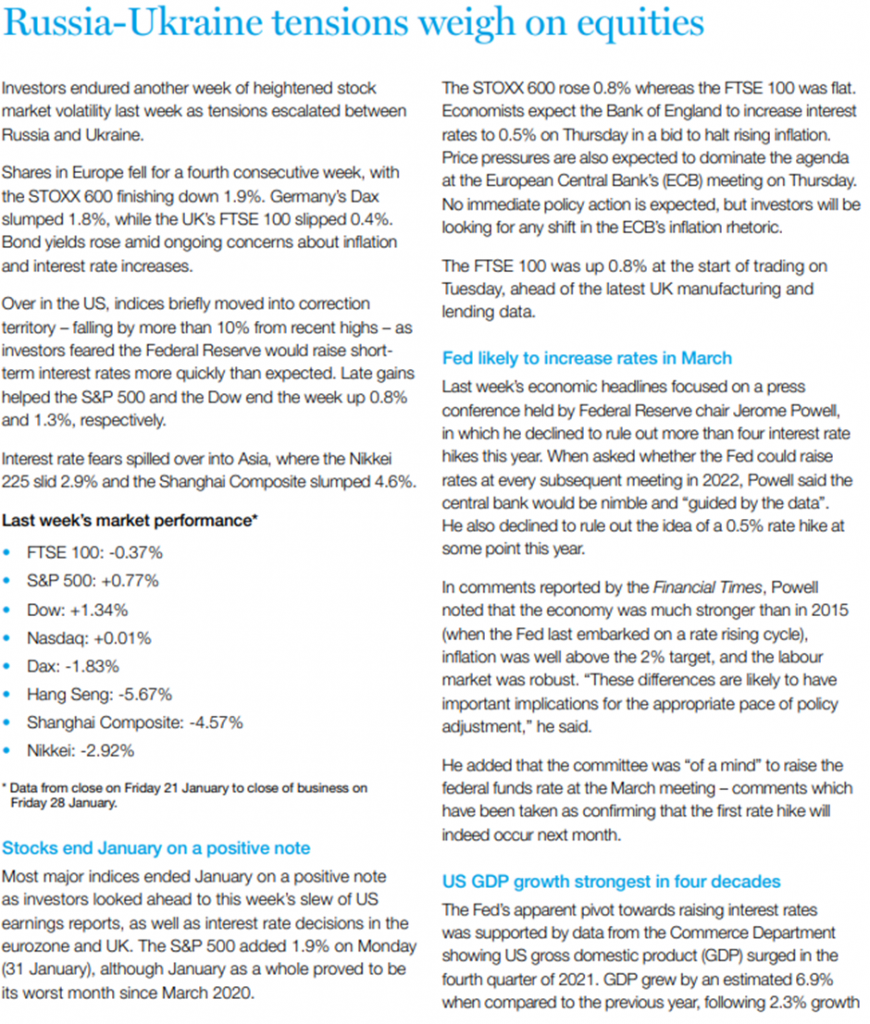
Please see below an article published by Brewin Dolphin yesterday (01/02/2022) detailing their current views on markets:

As you can see from the above, volatility is rife in markets at moment, with a number of factors contributing to this volatility. Hopefully the Russia – Ukraine debacle will reach a peaceful resolution. Interest rates are likely to increase in both the US and UK over the next 12 months, this could dampen consumer confidence.

All in all, volatility is not necessarily a bad thing and could present buying opportunities. Investors need to remain invested and focus on their long-term objectives, given time markets will recover.

Please continue to check our Blog content for advice and planning issues and the latest investment, markets and economic updates from leading investment houses.

Please keep safe and healthy.

Carl Mitchell – Dip PFS

Independent Financial Adviser

02/02/2022

Team No Comments

Investing in Russia and assessing geopolitical risk

Please find below, a breakdown of the impact of Russian politics on economic markets, received from Invesco, yesterday afternoon – 31/01/2022

Key takeaways

Russia could be on the brink of war with Ukraine

We’d like to think that the economic arguments will be enough to prevent conflict, but the Kremlin’s desire to restore friendly buffer states on its borders may yet prove their priority.

How are we exposed?

The Invesco Emerging Markets Strategy has three Russian holdings that comprise approximately 4% of the strategy.

Should we exit our Russian holdings?

We are cautious about capitulating at the moment of maximum fear. During periods of greatest fear, investors get their biggest opportunities.

Assessing risk

Investing by its nature involves taking risks. We’re all taught about the inverse correlation between risk and return, ‘nothing ventured, nothing gained’, even if the psychology of human behaviour can often make that relationship somewhat perplexing.

There have been countless examples of asset bubbles caused by irrational exuberance. This ultimately led to financial calamity for many of those involved, suggesting that risk is often heightened when greed is in abundance, rather than when investors are most fearful. We would argue that it’s often not the risks themselves that prove disastrous for investors, but how those risks are priced.

Take the example Cisco during the Dotcom bubble. In the 10 years following the year 2000, when the shares peaked at US$80 per share, Cisco grew revenue at an 8% CAGR and earnings per share at a 10% CAGR – a respectable rate. Yet, the shares were down around 70% over that period, and they trade at only US$56 today.

The fundamental risks to Cisco’s business in the first quarter of 2000 proved far, far less important to shareholders than the risk they were taking by paying such a high valuation. Cisco shares were trading on roughly 150x earnings in 2000, but trade on around 16x today.and US$.

We seek to minimise the main risk investors face – that of permanent loss of capital – by making sure we don’t overpay for stocks and by ensuring the companies we own shares in have strong balance sheets. We take this approach with companies wherever they’re listed, including in Russia.

Russia and geopolitics

It’s important to keep the context in mind – Russian equities have traded at a steep discount to emerging market peers for many years. There are a good reasons for this:

  • Commodities. A predominance of commodity producers in the Russian market, which typically trade on lower multiples.
  • Governance. Whether it’s fears about government expropriation (à la Yukos in 2003), or that a particular oligarch may get on the wrong side of the Kremlin – there is a governance deficit in Russia.
  • Geopolitics. Russia’s foreign policy approach under Putin has become increasingly muscular, which has led to tensions with neighbours, including those in an expanded NATO. Following Russia’s annexation of Crimea, Western countries introduced a raft of sanctions, largely targeted at individuals close to the Russian President himself.

Given this context, we typically ascribe lower ‘fair’ valuation multiples for Russian stocks than we do for other countries in emerging markets. Effectively, we assume these risks will persist and so we price them into our estimates of what constitutes fair value. This means that we require higher returns from our Russian holdings than we do from holdings in other countries to account for these risks. We believe this fundamental approach to valuation helps reduce the risks associated with investing in Russia.

Take Sberbank, for example, which has delivered a median ROE since 2006 of 20.8%. This compares favourably with HDFC Bank, one of India’s highest quality private banks and a stock we have owned in the past. It has generated a median ROE of 18% over that time (the period in which HDFC Bank has been listed). While returns have been far less volatile at HDFC Bank compared with Sberbank (standard deviation of 1.6 vs. 6.6), we would highlight that Sberbank still provided a around 10% ROE in 2015 – a year of financial crisis in Russia following a more than halving in the rouble’s value vs. the US dollar.

Today, Sberbank trades on 0.9x price to book, having averaged around 1.5x over the last decade. HDFC Bank trades on 3.9x price to book today, having averaged above 4x over the last decade. In short, it feels to us that the risks associated with Sberbank are being clearly factored into the shares when compared to a similarly high-return bank in India.

Portfolio Construction

For portfolio construction, there are some key pillars that further reduce risk for the strategy. They are:

  • Diversification by industry. This applies to the strategy as a whole, but also to our Russian holdings. We are keen to make sure that we have diversification across industries within Russia, so that we’re not overly exposed to sanctions that may fall hardest on one industry.
  • Diversification by owner. We aim to be diversified by the type of business owners, be that government-owned companies, companies run by oligarchs, Western owned companies, or private equity firms. This again reduces the risk that any one type of controlling shareholder is targeted by sanctions.
  • Strong domestic market positions. We make sure that the companies we’re invested in have strong domestic businesses that will enable them to survive even in a tough sanction regime.
  • Strong balance sheets. Ensuring that contrarian ideas have the balance sheet strength to withstand temporary setbacks or ‘unknown unknowns’ is an important way to manage downside risk.
  • Position sizing. By far and away, the biggest tool we have to reduce risk is to keep position sizes measured. Given how lowly valued Russian equities are relative to emerging market peers, you might expect valuation sensitive investors like us to be significantly overweight Russia. We are not. We much prefer to focus on picking stocks and analysing their business fundamentals as the potential source of alpha while minimising country factor risk.
Conclusions

It should go without saying that we see few winners from war in Ukraine, and we hope that diplomacy will prevail. Conflict would likely end up being protracted and destabilising. The economic impact of sanctions could be very severe for Russia’s economy, even after considering Russia’s strong fiscal position (large current account surplus and low government debt).

We’d like to think that the economic arguments will be enough to prevent conflict. But the Kremlin’s desire to restore friendly buffer states on its borders may yet prove their priority, for better or worse.

Regarding potential sanctions, we believe the range of potential outcomes is extremely wide. We’d like to highlight that valuations for many Russian stocks are now back at the levels of the 2014/15 financial crisis. To us, this implies that a good deal of bad news is already priced into shares.

We also feel that the lessons from previous episodes, such as the sanctions that were imposed on Rusal in 2018, will give Western countries pause before enacting sanctions that risk destabilising global commodity markets, as they did for aluminium then. Likewise, should the West choose to cut Russia off from the SWIFT payments system, it could wreak havoc for companies and countries that rely on Russian exports of gas and oil – including many in Western Europe.

Of course, we could just exit our holdings in Russia. However, we are cautious about capitulating at the moment of maximum fear. Looking back, it has been during periods of greatest fear that investors get their biggest opportunities. This experience, plus the low valuations (and high dividend yields) on offer, keeps us invested in Russia, albeit in a measured way.

Please continue to check back for a range of blog content from us and from some of the world’s leading fund management houses.

David Purcell

1st February 2022

Team No Comments

Why markets are worried about inflation and interest rates

Please see below article received from AJ Bell yesterday afternoon, which warns of the potential effects and consequences of longer-term inflation on markets and economies.

Well, that didn’t take long. The Fed began to pump less Quantitative Easing (QE) into the financial system in November and the stock market’s wheels have already started to wobble after barely two months of less ‘cheap’ money, let alone any move to withdraw it.

Advisers and clients can therefore be forgiven for starting to ask themselves how much the US Federal Reserve can do to tighten monetary policy, before it either puts the brakes on the economy, breaks the stock market, or both. In a worst case, the answer might be not very much at all.

“Recent precedents for tighter monetary policy (or even simply, less loose, less accommodative policy) are enough to give advisers and clients pause for thought.”

Recent precedents for tighter monetary policy (or even simply, less loose, less accommodative policy) are enough to give advisers and clients pause for thought:

  • In 2013, financial markets rebelled at the very talk of tighter policy, and the so-called ‘Taper Tantrum’ persuaded the Fed to back off.
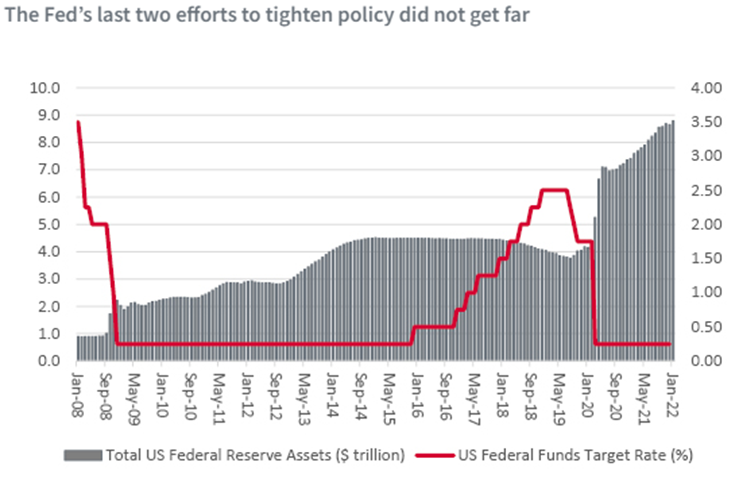
  • Between December 2015 and December 2018, under Janet Yellen and then Mr Powell, the Fed raised rates from 0.25% to 2.50%. It also shrank its balance sheet by $700 billion, or some 17%, between 2017 and 2019. But it then stopped as the US economy began to slow, and signs of stress began to show in the US interbank funding markets in autumn 2019. As a result, the Fed’s balance sheet had started to grow again several months before the pandemic prompted fresh interest rate cuts and more QE in the spring of 2020.

Financial markets have not forgotten this and have become edgy. In theory, that should not be the concern of the US Federal Reserve, or indeed any central bank. Their job is to keep inflation on the straight and narrow, to ensure it does not destroy wealth and prosperity or imbalance the economy.

But a decade and more of zero interest rates and QE – unintentionally or intentionally (judging by a string of speeches from former Fed chair Ben S. Bernanke dating back to at least 2003) – have persuaded or forced advisers and clients to take ever-increasing amounts of risk to get a return on their money.

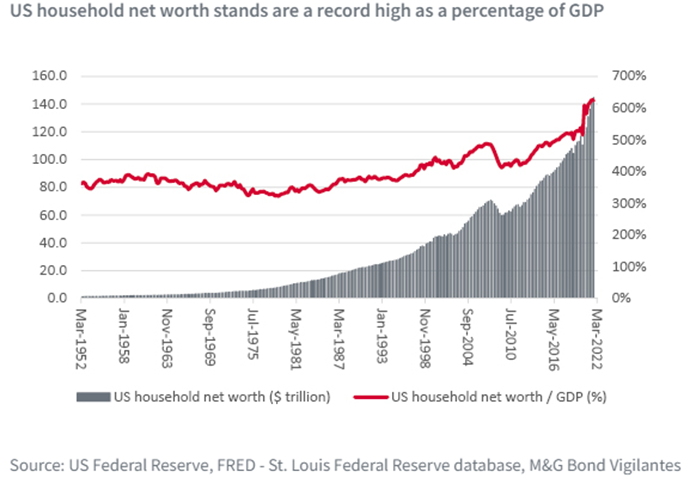
“US household wealth stands at a record high relative to GDP, thanks to booming stock and house prices. If that goes into reverse, the hit to confidence, and consumers ability and willingness to consume, could be considerable.”

Central banks are presumably concerned that having tried to create a wealth effect by stoking asset prices, the opposite effect could now kick in. US household wealth stands at a record high relative to GDP, thanks to booming stock and house prices. If that goes into reverse, the hit to confidence, and consumers ability and willingness to consume, could be considerable.

Choices, choices

Central banks may therefore be stuck between a rock and a hard place. They will want to control inflation on one side, but their ability to jack up interest rates may be constrained by record debts and concerns about the economy, employment (and financial markets’ stability) on the other.

Advisers and clients will have choices to make too.

“If the low-growth, low-inflation, low-rates of the last decade are replaced by higher inflation, higher nominal growth and higher rates it would be logical to expect the outperformers of the last decade (long-duration assets, bonds, tech and growth equities) to struggle, and the underperformers of the last decade (short-duration assets, commodities and cyclical, value equities) to have a chance of a return to favour.”

If the low-growth, low-inflation, low-rates of the last decade are replaced by higher inflation, higher nominal growth and higher rates it would be logical to expect the outperformers of the last decade (long-duration assets, bonds, tech and growth equities) to struggle, and the underperformers of the last decade (short-duration assets, commodities and cyclical, value equities) to have a chance of a return to favour.

A change in market leadership does not necessarily signify a collapse, even if it raises the stakes, but more volatility seems likely unless oil and gas prices start to retreat and cut central bankers, politicians and the public a break.

If forced to choose, this column reckons they will take their chances with inflation and even cut rates and resume QE if the going gets tough.

That could bring fresh challenges of its own. History students know that we have been here before. Jens O. Parsson wrote Dying of Money: Lessons of the Great German and American Inflations in 1974, when US inflation was running rampant thanks to President Nixon’s demolition of Bretton Woods and withdrawal of the dollar’s link to gold, rampant US spending on welfare and Vietnam, and the 1973 oil price shock. He drew parallels between the German experience of the 1920s with that of the US in the 1960s and 1970s, even if the Volcker-led Federal Reserve took upon itself the job of reining in inflation. It did this, albeit at the cost of recessions in 1980 and 1981-82 during President Reagan’s first term.

No-one is expecting a 1920s Weimar-style collapse but the US in the 1970s was not much fun for advisers and clients either. Advisers and clients may need to consider Parsson’s conclusion and, if they consider it relevant, where we may be in the inflationary cycle today and the difficult decisions that central banks and governments may need to take as a result. The author (who was using a pen name) concluded:

“Everyone loves an early inflation. The effects at the beginning of an inflation are all good. There is steepened money expansion, rising government spending, increased budget deficits, booming stock markets and spectacular general prosperity, all in the midst of temporarily stable prices. Everyone benefits and no-one pays. That is the early part of the cycle. In the later inflation, on the other hand, the effects are all bad. The government may steadily increase the money inflation in order to stave off later effects but the later effects patiently wait. In the terminal inflation, there is faltering prosperity, weakness of money, falling stock markets, rising taxes, still larger government deficits and still roaring money expansion, now accompanied by soaring prices and ineffectiveness of all traditional remedies. Everyone pays and no-one benefits. That is the cycle of every inflation.”

Please check in again with us soon for further market-related news and relevant content.

Chloe

31/01/2022

Team No Comments

Active Management and the Bright Side of Volatility

Please see the below article from Cantab Asset Management received late last night:

Cantab Market Update – Recent Volatility

Market conditions at the start of the year have continued to be challenging for investors, with many indices posting drops year-to-date.

We have been preparing portfolios to withstand heightened volatility for some time. Rising fears around potential conflict in Europe are concerning both on a human level and with respect to the potential economic consequences. Should tensions continue to escalate, we would expect short-term market reaction.

Although it is difficult to watch values drop, we encourage investors to remain focused on their long-term objectives. We are confident that despite geopolitical tensions and challenging market conditions, there remain many outstanding companies delivering growth and opportunities.

High growth companies drove significant outperformance in the immediate market recovery following the pandemic drop in March 2020, but values have struggled in 2021 and thus far in 2022. Part of this pullback is likely attributable to a tempering of the optimism around the future for high-growth companies (particularly in the Technology sector).

Concerns over rising interest rates to tackle inflation, which is looking less ‘transitory’ than Central Banks had initially articulated, have added to the headwinds and 2022 has seen wider market corrections alongside rotations between styles.

The current market weakness does not come as a surprise following strong performance in recent years, as investors grapple with a new stage in the economic cycle. We continue to have conviction in our chosen investments and believe that short-term periods of volatility can provide opportunities for active managers as well as challenges. We discussed this topic in more depth in our recent briefing note, ‘Active Management and the Bright Side of Volatility’, which can be found here:

Active Management and the Bright Side of Volatility

The last decade has seen significant asset price appreciation, accommodated by expansionary monetary policy. Alongside this,

periods of uncertainty have led to spikes in volatility. Whilst recent levels of Quantitative Easing are unprecedented in historical terms,

volatility and market corrections are not. This note considers the relationship between active management and market volatility in

the context of achieving strong long-term performance.

The main takeaways from the following analysis are:

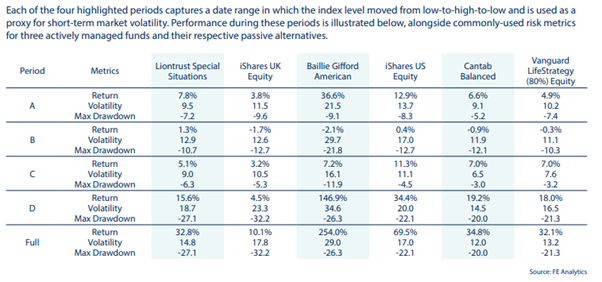
  • The actively managed funds tended to exhibit higher volatility than their passive peers
  • Over each period of heightened volatility, the actively managed funds tended to outperform their passive peers
  • Over the full period, the actively managed funds all materially outperformed their passive peers
  • Despite higher levels of volatility, the actively managed funds tended to prove more resilient than their passive peers from a maximum drawdown perspective. This demonstrates one challenge associated with relying on volatility alone as a measure of risk – it captures upside as well as downside movements
  • Similar results were obtained when comparing the actively managed Cantab multi-asset portfolio to a passive peer

Summary

These findings may or may not be representative of the entire active universe of funds; to test them is beyond the scope of this analysis. What is clear however, is that within the universe of actively managed funds, there are options that provide significant outperformance on a risk–adjusted basis during periods of heightened volatility. It is our role as advisors to identify and monitor these.

When applying the same analysis to the actively managed Cantab multi-asset portfolio, not only did the portfolio outperform its passive equivalent over the full period but also achieved relatively similar volatility and max drawdown metrics overall. The analysis also found that after a material peak-to-trough movement, the actively managed Cantab portfolio recovered considerably faster to previous highs when compared to the passive equivalent.

The results from the analysis not only highlight the importance of taking a long-term view, but also demonstrate that there are two sides to volatility: downside and upside. Volatility is usually calculated using variance or standard deviation, by summing the square of the deviation of returns from the mean return and dividing by the number of observations in the data set. By definition, upside and downside deviations are treated equally. Whilst higher volatility implies higher risk, due to less predictability of asset pricing, investors are typically in favour of upside volatility in practice. By pursuing a passive strategy, investors avoid the downside risk of underperforming a benchmark index; unfortunately, they also miss out on the upside potential of outperformance.

Periods of short-term volatility have been common throughout history and will continue to be common in the future. However, during such periods, investors tend to focus on the negative side of volatility rather than directing their focus to the bright side of volatility that is offered by good active management.

Our Comment

As always, our comment regarding the recent volatility is to remain calm and don’t panic. The markets will stabilise in time.

Volatility is a normal part and a key function of how markets work.

It creates great investment opportunities when buying assets.

Keep checking back for our regular blog updates which cover a range of topics and market updates.

Andrew Lloyd DipPFS

28/01/2022

Team No Comments

Waverton – Inflation and Tightening Monetary Policy

Please see article below from Waverton received yesterday – 26/01/2022, which details some of their thoughts on the recent market volatility.

Investors have been concerned about inflation and about the potential for tighter monetary policy to counter it. UK CPI is up 5.4% from a year ago; RPI is up 7.5%, the highest since 1991. In the US, CPI is up 7.0% on a year ago, the highest figure since 1982. The market expects inflation to be above the central bank target of 2% on both sides of the Atlantic over the next five years. There are signs of wage inflation rising, not just in official statistics but also in what companies are saying about their business prospects in earnings reports, which are coming out this month and next. The unemployment rate is 4% here and 3.9% in the US so the pressure on wages may well be higher in coming months.

The Bank of England raised interest rates in December for the first time since 2018 and also in December the US Federal Reserve Board not only increased the speed with which it intends to reduce its bond purchase programme (so called “Quantitative Easing”) but also discussed the possibility of reducing the level of its bond holdings later this year. That would be an additional tightening of monetary policy on top of any interest rate increases, just as Quantitative Easing is an additional easing of policy above and beyond interest rate reductions.

Tighter monetary policy is making the market rethink the outlook for the economy and for companies. For a number of the fastest growing companies valuations have been elevated relative to history for much of the time since 2009. Higher interest rates will challenge the sustainability of those elevated valuations.

Markets are also likely to have one eye on the growing geopolitical tensions, with developments in Ukraine and Taiwan making the headlines.

In this difficult environment the UK market is outperforming the World index. Partly this is because the UK market does not have many high growth companies trading at elevated valuations. Partly it is because the UK market has a heavier weighting than the world index to energy, financials and consumer staples which are among the sectors that are outperforming.

At Waverton we build global equity portfolios for our clients. The UK market has a weighting of 4% in the World Index and although your portfolio has a higher weighting than that, the vast majority of our portfolios are invested in companies listed overseas. So a period of drawdown in those markets will impact our returns.
It is also worth highlighting that as well as a declining stock market, investors have seen bond investments lose value as interest rates have risen.

Against this backdrop, in building equity portfolios we remain focused on bottom-up fundamentals, ensuring that the companies we own can maintain their competitive advantage, retain the flexibility to absorb higher costs, can continue to grow future free cashflow, with balance sheets that can withstand higher interest rates.

Within fixed income we have a diversified approach that we expect to navigate a sustained period of higher interest rates better than indices. We also expect longer duration bonds to perform better if we enter a prolonged period of stock market weakness.

We remain neutrally positioned in equities but markedly underweight fixed income. Our ability to diversify broadly across a range of alternative asset classes does help us navigate these testing conditions.

Please continue to check back for our latest blog posts and updates.

Charlotte Clarke

27/01/2022

Team No Comments

Brewin Dolphin – Markets in a Minute

Please see below, the Markets in a Minute update received from Brewin Dolphin late yesterday afternoon – 25/01/2022

Stocks slump as interest rate fears grow

Concerns about interest rate hikes in the US, UK and Europe sent stock markets tumbling last week.

In the US, the S&P 500 recorded its biggest fall in more than 14 months, ending the holiday-shortened trading week down 5.7%. The Nasdaq suffered its steepest weekly drop since the start of the pandemic, tumbling 7.6% as technology stocks bore the brunt of rate hike fears.

European indices declined amid expectations the European Central Bank (ECB) and Bank of England (BoE) would tighten monetary policy. The STOXX 600 fell 1.4%, the Dax lost 1.8% and the FTSE 100 slipped 0.7%.

Over in Asia, the Nikkei 225 fell 2.1% as surging coronavirus infections resulted in Tokyo and 12 other prefectures being placed under Covid-19 quasi[1]emergency measures.

Last week’s market performance*

• FTSE 100: -0.65%

• S&P 5001 : -5.68%

• Dow1 : -4.58%

• Nasdaq1 : -7.55%

• Dax: -1.76%

• Hang Seng: +2.39%

• Shanghai Composite: +0.04%

• Nikkei: -2.14%

*Data from close on Friday 14 January to close of business on Friday 21 January. 1 Closed Monday 17 January.

European shares hit by Russia-Ukraine tensions

UK and European shares remained in the red on Monday (24 January) as tensions grew between Russia and Ukraine. The STOXX 600 plunged 3.8% and the FTSE 100 slid 2.6%. Disappointing economic data also weighed on investor sentiment. The flash IHS Markit / CIPS UK composite output index fell to an 11-month low of 53.4 in January, as services activity was hit by the spread of Omicron.

The S&P 500 and the Dow both added 0.3% on Monday to recover some of last week’s sharp selloff. Investors are now looking ahead to the Federal Reserve’s two-day policy meeting on Wednesday, which will hopefully provide much[1]needed clarity on US interest rates.

The FTSE 100 and the STOXX 600 followed US indices higher, gaining 0.5% and 0.3%, respectively, at the start of trading on Tuesday.

Interest rate expectations rise

Last week’s economic headlines focused on mounting expectations that central banks will increase interest rates in the face of rising inflation. In the US, where inflation is running at its fastest annual pace in nearly 40 years, there is widespread speculation the Federal Reserve will hike rates in March, possibly by as much as 0.5%.

The likelihood of the BoE increasing the base interest rate in February also rose after the Office for National Statistics published the latest UK inflation numbers. The consumer prices index (CPI) surged by 5.4% in the 12 months to December – the highest in nearly three decades. On a monthly basis, the CPI rose by 0.5%, driven by price increases in transport, food and non-alcoholic beverages, furniture and household goods, and housing and household services.

Andrew Bailey, governor of the BoE, told MPs that inflationary pressures could prove more persistent than expected. He said energy prices are not expected to start easing until the second half of 2023 – a year later than previously forecast – partly because of tensions between Russia and Ukraine. He also warned there could be a ‘wage-price spiral’, where wages and prices keep chasing each other higher.

UK consumer confidence drops

The latest UK consumer confidence index from GfK shows the impact surging inflation is having on people’s views of their personal finances and of the general economic Markets in a Minute 25 January 2022 situation. The overall index fell four points to -19 in January, the lowest reading since February 2021 and below analysts’ expectations of no change from December.

GfK UK Consumer Confidence Index

All five measures were down when compared with the previous month. People’s opinions of the economy were especially poor, with an eight-point decrease in how they viewed the past year and the year to come.

“Despite some good news about the easing of Covid restrictions, consumers are clearly bracing themselves for surging inflation, rising fuel bills and the prospect of interest rate rises,” said Joe Staton, client strategy director at GfK. “The four-point fall in the major purchase index certainly suggests people are ready to tighten their belts.”

US weekly jobless claims jump

Also weighing on the markets last week was an unexpected jump in US weekly jobless claims. These rose by 55,000 to 286,000 for the week ending 15 January, the highest level since mid-October and the steepest increase since last July. The winter wave of Covid-19 infections is thought to be one of the drivers behind the increase.

There was also discouraging housing market data, with figures from the National Association of Realtors (NAR) showing a 4.6% decline in existing home sales in December from the previous month. On an annual basis, sales were down by 7.1%. Lawrence Yun, chief economist at NAR, said the pullback was more a sign of supply constraints than weakened demand for housing. However, he added that existing home sales would slow slightly in the coming months due to higher mortgage rates.

China steps up monetary stimulus

In contrast to the US and the UK, China last week stepped up its monetary stimulus by lowering mortgage lending benchmark rates. This came after data showed further weakening in the property sector, a downturn which is expected to persist into 2022. According to Reuters, Liu Guoqiang, vice governor of the People’s Bank of China, said the bank should “introduce more policies that are conducive to stability, and should not introduce policies that are not conducive to stability”. Liu added that the bank would widen the use of its policy tools to prevent a collapse in credit.

Please continue to check our Blog content for advice and planning issues and the latest investment, markets and economic updates from leading investment houses.

Alex Kitteringham

26/01/2022

Team No Comments

Brooks Macdonald – Weekly Market Commentary

Please see below an article published by Brooks Macdonald yesterday (24/01/2022) detailing their views on markets over the last week:

Please continue to check our Blog content for advice and planning issues and the latest investment, markets and economic updates from leading investment houses.

Please keep safe and healthy.

Carl Mitchell – Dip PFS

Independent Financial Adviser

25/01/2022

Team No Comments

Share prices stumble after just two months of less loose policy from the Fed

Please find below, an update in relation to share prices, received from AJ Bell yesterday – 23/01/2022

Well, that didn’t take long. The Fed began to pump less Quantitative Easing (QE) into the financial system in November and the stock market’s wheels have started to wobble after barely two months of less cheap money, let alone move to withdraw it.

Investors are already starting to ask themselves how much the US Federal Reserve can do to tighten monetary policy before it either puts the brakes on the economy, breaks the stock market or both – and the answer might be not very far at all.

Some of the asset classes, funds and individual stocks which have performed best, attracted the hottest money flows and drawn the biggest headlines have started to flag, or even fall sharply. All are generally toward the riskiest end of the asset class spectrum, where the rewards can be highest, but the risks are too, should something go wrong.

Small caps are wobbling. America’s Russell 2000 index is now trading below where it was twelve months ago, and the UK’s FTSE Small Cap benchmark is losing a little momentum.

Source: Refinitiv data

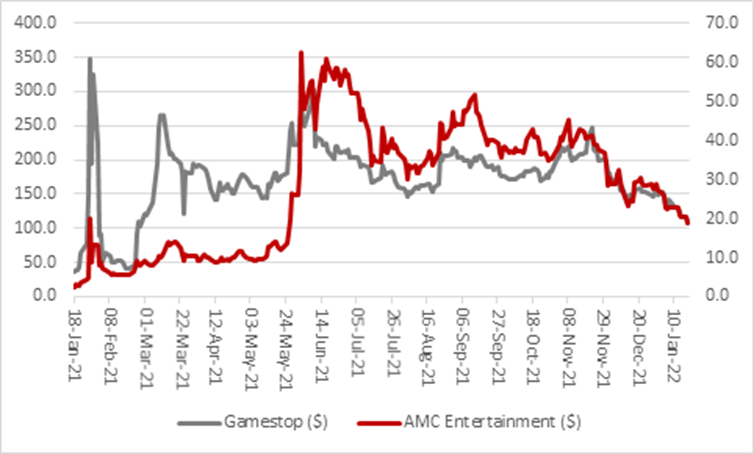
Meme stocks are taking a pasting. You have to hope that anyone who has held on to GameStopAMC Entertainment and others to thwart the hedge funds who were short-selling these names have not ended up cutting off their own noses to spite their face. Buyers in the very early days may still be in the black, but anyone who piled in late to join the fun or try to make a fast buck could now be deeply in the red.

Source: Refinitiv data

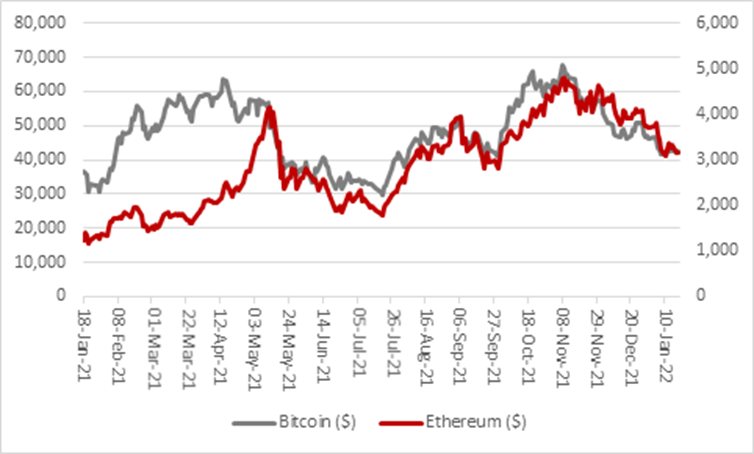
Cryptocurrencies have swooned once more.

Source: Refinitiv data

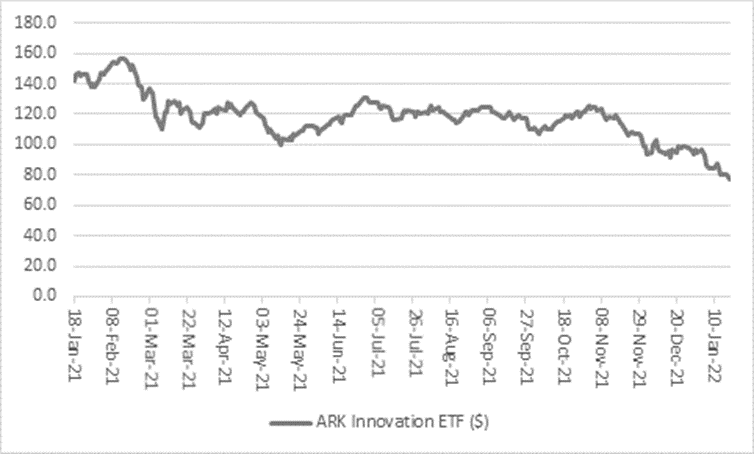
And the poster child for fans of momentum, tech and potential disruptive winners, the ARK Innovations Exchange-Traded Fund (ETF), continues to sink.

Source: Refinitiv data

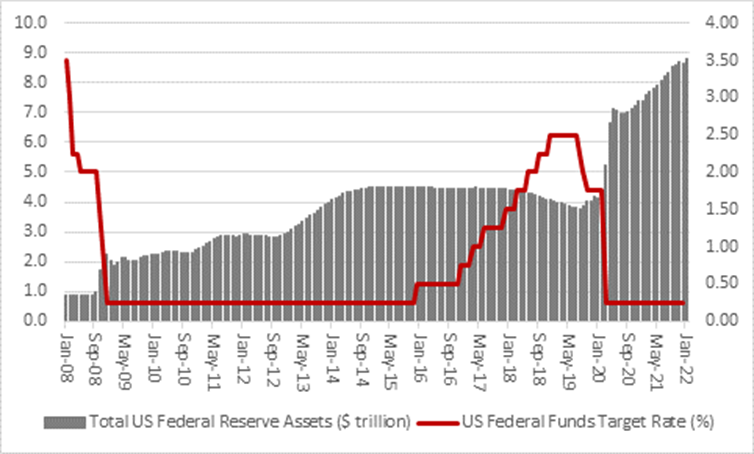
It may not be a coincidence that the Fed has started to reduce the amount of monetary stimulus it was pumping into the US economy via Quantitative Easing. It started to cut QE from a run-rate $120 billion a month by $15 billion a month in November and then by $30 billion a month from December.

That should mean the Fed’s $8.8 trillion balance sheet stops growing in March. After that, the central bank may turn to Quantitative Tightening (QT) and start to withdraw stimulus and shrink its balance sheet.

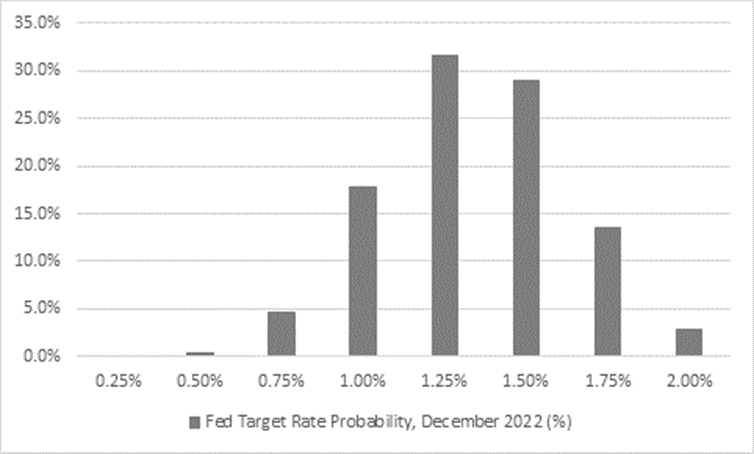
Meanwhile, the markets have started to price in at least four one-quarter percentage point interest rate increases from the US central bank by the end of this year.

Source: CME Fedwatch

Recent precedents for tighter monetary policy (or even simply, less loose, less accommodative policy) are enough to give investors pause for thought:

  • In 2013, financial markets rebelled at the very talk of tighter policy and the so-called Taper Tantrum persuaded the Fed to back off.
  • Between December 2015 and December 2018, under Janet Yellen and then Mr Powell, the Fed raised rates from 0.25% to 2.50%. It also shrank its balance sheet by $700 billion, or some 17%, between 2017 and 2019. But it then stopped as the US economy began to slow and signs of stress began to show in the US interbank funding markets in autumn 2019. As a result, the Fed’s balance sheet had started to grow again several months before the pandemic prompted fresh interest rate cuts and more QE in the spring of 2020.

Source: FRED – St. Louis Federal Reserve database, US Federal Reserve

There are good reasons for such caution. Global debt is so much higher now than it was in 2013 or even 2018, so the economy will be much more sensitive to even minor changes in interest rates.

More specifically for share prices and company valuations, tighter monetary policy – at a time when indebted Governments are throttling back on their fiscal stimulus programmes and looking for fresh sources of income from tax or social levies – has four possible implications:

  • Higher interest rates may mean an economic slowdown, again because there is so much more debt in the system. As the old saying goes, economic upturns don’t die of old age, they are murdered in their beds by the US Federal Reserve. In addition, consumers’ ability to consume will be crimped if inflation outstrips wage growth and their incomes start to stagnate or fall in real terms.
  • Higher rates reflect inflation, and faster (nominal) GDP means investors do not have to pay a premium for long-term future growth (for secular growth names like technology and biotechnology) when potentially faster, near-term cyclical growth (‘value’) can be bought for much lower multiples (even if it comes from oils, miners, banks).
  • Inflation can eat away at corporate margins and profits. Right now, they stand both at pretty much record highs, as do valuations, at least in the USA, based on ratios such as market cap-to-GDP and Professor Robert Shiller’s cyclically-adjusted price-to-earnings (CAPE) ratio. If earnings start falling, valuations could do so, too, if confidence wobbles. Instead of the double-whammy that provides gearing to the upside, as investors pay higher multiples for higher earnings to give ever-higher share prices, markets see the opposite: earnings fall, investors pay lower multiples for lower earnings and share prices fall faster.
  • Higher interest rates mean analysts and investors deploy an increased discount rate in their discounted cash flow models to calculate the net present value (NPV) of future cash flows from long-term growth stocks. A higher discount rate means lower NPV. A Lower NPV means a lower theoretical value of the equity and that means a lower share price.

All four are clearly worrying previously rampant financial markets but that in theory should not be the concern of the US Federal Reserve, or indeed any central bank. Their job is to keep inflation on the straight and narrow, to ensure it does not destroy wealth and prosperity and imbalance the economy.

But a decade and more of zero interest rates and QE – unintentionally or intentionally (judging by a string of speeches from former Fed chair Ben S. Bernanke dating back to at least 2003) – have persuaded or forced investors to take ever-increasing amounts of risk to get a return on their money.

Central banks are presumably concerned that having tried to create a wealth effect by stoking asset prices, the opposite effect could kick now in, hitting confidence and consumers’ ability and willingness to spend.

If inflation really does prove to be sticky, or even keep going higher, central banks may therefore be stuck between a rock and a hard place. They will want to control inflation on one side but their ability to jack up interest rates and withdraw QE may be constrained by record debts and concerns about the economy, employment (and financial markets’ stability) on the other.

Please continue to check back for a range of blog content from us and from some of the world’s leading fund management houses.

David Purcell

24th January 2022

Team No Comments

Oil hitting $100 could take the FTSE 100 to new record highs

Please see below article received from AJ Bell yesterday afternoon, which explains that inflationary pressures are building as crude markets hit their highest level since 2015.

With Brent crude oil at seven-and-a-half-year highs above $88 per barrel there is mounting speculation that prices could hit $100 for the first time since 2014.

The FTSE 100 is also within striking distance of the 7,903.50 intra-day high attained on 22 May 2018. Oil producers are among the big stocks in the FTSE 100.

Oil is moving higher as concerns over the impact on demand of the Omicron variant have faded, as well as supply disruption. An escalation of hostilities on the border between Russia and Ukraine could act as a further jolt to the crude market, only adding to the current inflationary pressures.

These in turn could be positive for the FTSE 100 given its make-up. AJ Bell investment director Russ Mould says: ‘The UK stock market may not be a bad place to be if inflation stays entrenched and confounds any efforts by central banks to rein it in.

‘This is because the leading gainers (year-to-date) operate in industries where demand is fairly price inelastic, such as energy and tobacco; where higher interest rates and steeper yield curves may help profit margins and earnings, at least up to a point, such as banks and insurers; or they own real assets where supply is expensive to build and where that supply is growing more slowly relative to money supply, such as miners.’

We will continue to publish relevant market news and content, so please check in again with us shortly.

Chloe

21/01/2022