Team No Comments

Brooks Macdonald: Daily Investment Bulletin

Please find below, a Daily Investment Bulletin from Brooks Macdonald, received this morning – 31/03/2022

What has happened

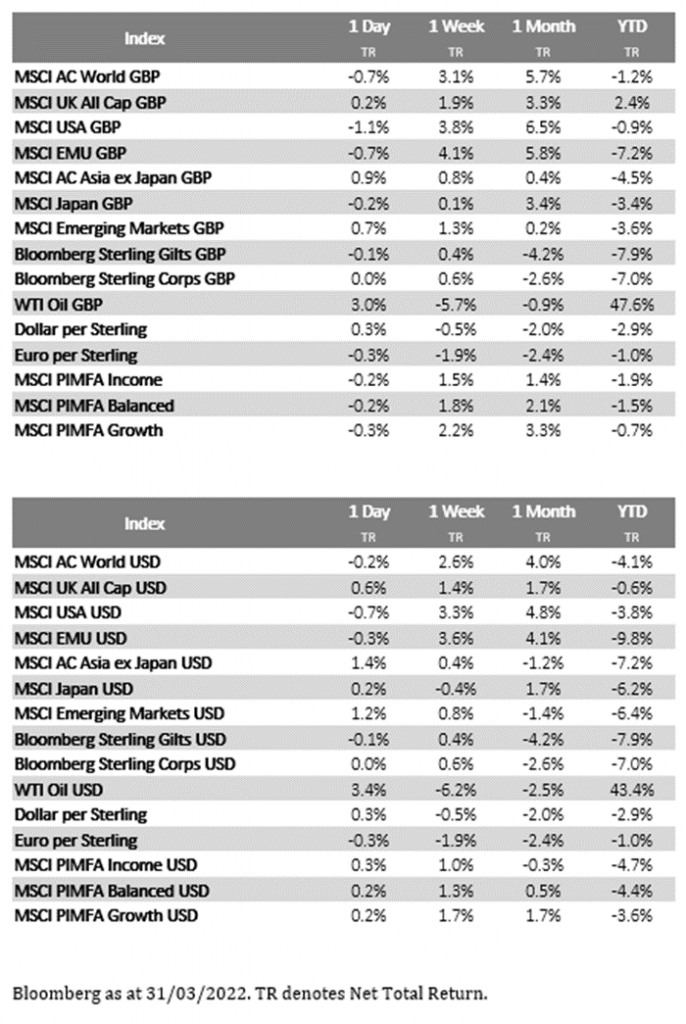
Global equities edged lower on Wednesday as the lack of a breakthrough in Ukraine-Russia peace talks pushed back on hopes of progress the day before. In Europe, a growing risk of Russia cutting off energy supplies coincided with stronger than expected inflation data. Provisional data for German March CPI was up 7.3% annually, vs 6.3% expected (harmonised 7.6% vs 6.7% expected), driven by energy prices (for household energy and motor fuels) up 39.5%. Underscoring the lack of uniformity across the inflation basket (a broader post-pandemic theme), data from the German statistical office showed a big split between goods inflation and services inflation, with goods prices up 12.3% annually, vs services inflation up 2.8%. Overnight, equity futures are up and oil is off on reports that the US Biden administration are considering a major release from their strategic oil reserves in an effort to lower fuel prices.

 Germany takes a step towards possible energy rationing

On Wednesday the German government took the first formal step towards rationing gas consumption, bracing for a potential halt in Russian gas supplies over a dispute in payment currencies. Previously EU members settled payments mainly in euros, but Russia is demanding payment in roubles. German economics minister Habeck activated the ‘early warning phase’ on Wednesday, meaning that a crisis team will monitor imports and storage. If supplies fall short, Germany’s network regulator has scope to ration gas, with industry first in line for cuts. In this scenario, energy priority would be given to hospitals and other critical parts of the economy, as well as households. Later on Wednesday evening, a call between German Chancellor Scholz and Russia President Putin hinted at a possible compromise according to a read-out of the call by German officials.

 Peace talks continue but no breakthrough yet

In a sign of the scale of the challenge in getting a peace deal delivered, both sets of negotiators gave very different accounts on where they were at on Wednesday. While Russia foreign minister Lavrov talked about ‘substantial progress’, Ukraine government spokesperson Nikolenko played down hopes, saying that ‘Lavrov demonstrates misunderstanding of the negotiation process’. In particular, both sides still look to be far apart around the subject of any territorial concessions. Meanwhile, despite Russian pledges on Tuesday to scale down military operations around Kyiv, Russian forces continued to bombard around the capital with shelling on Wednesday, leading to uncertainty as to whether Russia was withdrawing troops in certain areas or simply regrouping ahead of possible fresh assaults.

 What does Brooks Macdonald think

The war in Ukraine creates worrying energy-related headwinds for Europe at a time of post-pandemic recovery.  EU member states are all net importers of energy, with Russia previously the largest single supplier for imported gas, oil and coal. Germany is particularly exposed with gas making up around a quarter of Germany’s total energy consumption mix, with Russia in the past providing around half or more of Germany’s gas needs. Longer-term, tensions between Russia and the West might be permanently reset at a higher level, and a structural lack of EU security of energy supplies risks having a long-lasting impact on both corporate margins and household balance sheets in the region.
Please continue to check our Blog content for advice and planning issues and the latest investment, markets and economic updates from leading investment houses

David Purcell

31st March 2022
Team No Comments

Brewin Dolphin: Markets in a Minute

Please see the below article from Brewin Dolphin, summarising and offering analysis on global market performance over the past week – received late yesterday afternoon – 29/03/2022

Stocks mixed as UK inflation soars

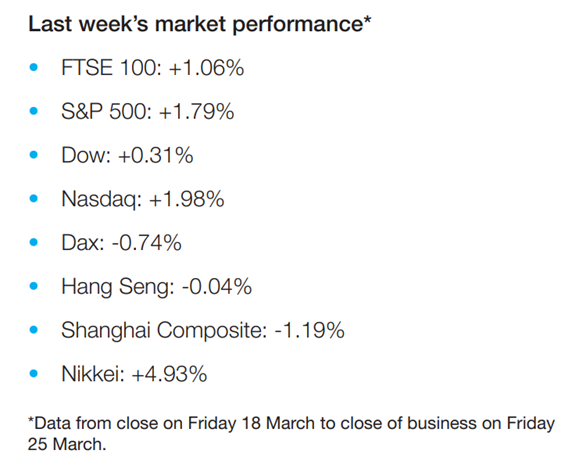
Stock markets gave a mixed performance last week as UK inflation reached a 30-year high and German business confidence dropped sharply.

Major US indices ended the week mostly higher. Information technology stocks outperformed as Apple shares rose on expectations for strong iPhone 13 sales. Energy stocks also performed strongly as commodity prices rose. The S&P 500 added 1.8% and the Nasdaq gained 2.0%.

In Europe, the STOXX 600 lost 0.2% and the Dax slipped 0.7% as heavy fighting continued in Kyiv and Ukraine rejected a demand to surrender Mariupol. The FTSE 100 gained 1.1% despite weak retail sales and a higher-than expected increase in inflation.

Over in Asia, Japan’s Nikkei 225 surged 4.9% on news the government will introduce an additional package of measures to support the economy.

Investors eye next round of ceasefire talks

US and European stocks were mostly in the green on Monday (28 March) as investors eyed the next round of Russia-Ukraine peace talks in Turkey. The STOXX 600 added 0.1%, the S&P 500 gained 0.7% and the Nasdaq rose 1.3%. The FTSE 100 slipped 0.1% as Bank of England governor Andrew Bailey warned the shock to real incomes from rising energy prices could be worse than in the 1970s.

In China, the Shanghai Composite edged up 0.1% as data showed industrial profits rose by 5.0% year-on year in the first two months of 2022. However, this was overshadowed by the start of a city-wide lockdown in the financial and manufacturing hub Shanghai – news that led to a slide in global oil prices.

UK and European stocks rose at the start of trading on Tuesday ahead of further peace talks and the latest US consumer confidence data.

UK inflation reaches new 30-year high

UK inflation figures, released last Wednesday, showed prices rose at their fastest rate for 30 years in February as the cost of electricity, gas and other fuels soared. The consumer price index (CPI) increased by 6.2% in the 12 months to February, up from 5.5% in January. On a monthly basis, the CPI rose by 0.8%, the largest monthly increase between January and February since 2009, according to the Office for National Statistics (ONS).

On the same day, chancellor Rishi Sunak delivered his spring statement in which he warned the war in Ukraine was having a significant impact on the cost of living in the UK. Inflation is expected to reach a 40-year high of 8.7% in the fourth quarter. Sunak announced that fuel duty would be reduced by 5p a litre for the next 12 months, and raised the threshold at which earners start paying National Insurance by £3,000 from July. He also promised a one percentage point reduction in the basic rate of income tax from April 2024. However, the Office for Budget Responsibility warned in its economic and fiscal outlook that households were on course for the biggest fall in living standards in any single financial year since the ONS records began in 1956/57.

Retail sales disappoint

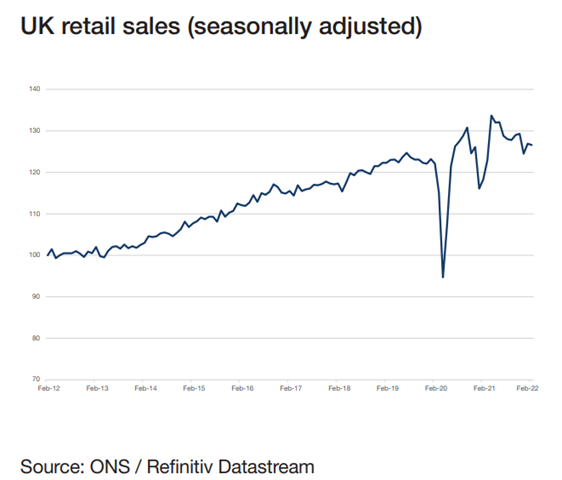
UK retail sales unexpectedly fell in February as online sales declined and stormy weather deterred some people from hitting the shops. ONS data showed the volume of sales dropped by 0.3% between January and February, a sharp fall from the 1.9% expansion seen the previous month. Economists in a Reuters poll had expected sales to grow by 0.6%.

The figures have raised concerns that the cost-of-living crisis is causing people to tighten their belts. Indeed, separate data from GfK showed UK consumer confidence dropped to a 17-month low in March, falling by five points to -31. Joe Staton, client strategy director GfK, said “a wall of worry” is confronting consumers this month.

“Consumers across the UK are experiencing the impact of soaring living costs with 30-year-high levels of inflation, record-high fuel and food prices, a recent interest rate hike and the prospect of more increases to come, and higher taxation too – all against a background of stagnant pay rises that cannot compensate for the financial duress,” he said.

US jobless claims at lowest level since 1969

Over in the US, the number of people applying for unemployment benefits fell to the lowest level since 1969 in the week ending 19 March. Just 187,000 people filed for unemployment, down by around 28,000 from the previous week, according to the Labor Department’s figures. The four-week average for claims fell to 211,750 from 223,250.

The decline in claims has been partly attributed to the lifting of Covid-19 restrictions across the country. The figures have led to speculation the Federal Reserve will raise interest rates by half a percentage point at its policy meeting in May. Jerome Powell, chair of the central bank, recently described the current job market as “tight to an unhealthy level”.

In other US economic news, sales of new single-family homes unexpectedly fell in February as mortgage rates and house prices rose. Sales fell by 2.0% month-on month to a seasonally adjusted annual rate of 772,000 units. On an annual basis, sales were down by 6.2% while the median new house price increased by 10.7% to $400,600, according to the Commerce Department.

German business confidence plummets

German business confidence dropped sharply in March as Russia’s invasion of Ukraine and high energy prices dampened the outlook for Europe’s largest economy. The ifo Institute’s business climate index fell from 95.8 points in February to 90.8 points in March, a 14-month low. The drop was driven by a record collapse in expectations of 13.3 points, a larger drop than seen at the outbreak of the coronavirus crisis in March 2020. Businesses also assessed their current situation as worse, although the fall was comparatively moderate at 1.6 points. Clemens Fuest, president of the ifo Institute, said companies were expecting tough times and that “sentiment in the German economy has collapsed”.

Please continue to check our Blog content for advice and planning issues and the latest investment, markets and economic updates from leading investment houses.

Alex Kitteringham

30th March 2022

Team No Comments

Brooks Macdonald – Weekly Market Commentary

Please see below this week’s market commentary from Brooks Macdonald received yesterday afternoon – 28/03/2022

Weekly Market Commentary | Concerns build over pace of Ukraine peace talks – 28 March 2022

• Bond yields continued to surge within the US Treasury market as bond investors price in further hikes
• Brent Crude oil prices rise as concerns build over the pace of Ukraine peace talks and European energy supply
• Investors await this week’s US average hourly earnings for signs of further inflationary pressure

Bond yields continued to surge within the US Treasury market as bond investors price in further hikes

US bond yields surged last week as Federal Reserve speakers opened the door to a 50bp rate hike at the next Fed meeting in May. Despite this, US equities continued to make gains, outperforming European equities which have been held back by concerns over security of energy supply.

The yield on the US 2-year bond moved up a further 33.3bps over the course of last week which is the largest weekly move since 20091. The US 10-year also moved higher, by a slightly smaller 32.4bps2 meaning that the yield curve continued to flatten (albeit modestly) over the week and sits close to inverting. An inversion of the yield curve has historically provided a strong indication of a recession in c. 18 months’ time so this remains closely watched. The bond market is now expecting around 2.4% of hikes in 20223 (including March’s hike). This week looks to be less exciting on the central bank front with relatively few Fed speakers compared to last week, this may give the Treasury market room to pause for breath.

Brent Crude oil prices rise as concerns build over the pace of Ukraine peace talks and European energy supply

Energy prices saw further volatility last week with Brent Crude oil prices rising over 10%4 as concerns built over Europe’s ability to access Russian oil and gas either due to sanctions or anticipatory measures by the Russian government. Whilst peace talks are continuing, they appeared to make little progress last week, leaving risk assets exposed to the conflict unable to sustain the positive momentum they had established a week ago. Over the weekend the White House needed to walk back comments from President Biden that implied support for regime change within Russia. Senior members of the Biden administration and other Western leaders have distanced themselves from the comments which could otherwise be interpreted as a sharp shift in the stated policy objectives of the US and NATO allies.

Investors await this week’s US average hourly earnings for signs of further inflationary pressure

The bond market moves of the last few weeks arguably tell us two things, firstly investors believe the Fed will aggressively raise rates this year, secondly the yield curve flattening implies the economy lacks the growth momentum to emerge unscathed. This week’s US non-farm payroll employment report will be awaited for the latest data on the health of the US jobs market with average hourly earnings a particularly important number given the impact on both consumer demand but also wider inflation.

Please continue to check back for our latest blog posts and updates.

Charlotte Clarke


29/03/2022

Team No Comments

LTA tax tipped to hit nearly £1.5bn by 2025

An interesting article received this morning, 28/03/2022, in our financial media.

The number of people caught by the lifetime allowance (LTA) is predicted to hit 29,757 and raise nearly £1.5bn in tax by 2025.

Canada Life’s forecast shows more people will be caught each tax year and that means the total value of charges will increase accordingly.

The LTA was introduced in the tax year 2006-2007. It is the total amount an individual can build up in pension benefits without incurring a tax charge.

At the time of its introduction, the LTA was fixed at £1.5m. While it has been increased in the following tax years, the LTA has been constantly reduced since 2012-2013.

The last tax year on record is 2019-2020 when the LTA was £1.055m. In that period, it affected 8,510 people and brought the government £342m in taxes.

Lifetime allowance from its introduction until tax year 2019-2020

Tax yearLTATotal individuals affected by LTATotal value of charges £mYoY increase in individualsYoY increase in total charges
2006-07£1.5m4506
2007-08£1.6m6101436%133%
2008-09£1.65m8302436%71%
2009-10£1.75m890327%33%
2010-11£1.8m1,1803733%16%
2011-12£1.8m1,270467%24%
2012-13£1.5m1,6806032%30%
2013-14£1.5m2,4609746%61%
2014-15£1.25m3,10010426%7%
2015-16£1.25m3,57015915%53%
2016-17£1m5,00020240%27%
2017-18£1m7,04026941%33%
2018-19£1.03m7,1302831%5%
2019-20£1.055m8,51034219%21%

Source: Canada Life


The total value of charges from the LTA has increased every year since the introduction of LTA.

Canada Life technical director Andrew Tully told Money Marketing: “Over the last five years, it has gone up on average by 28% a year.

“If we assume it keeps growing up the same rate, in a few years’ time, we will get to about one and a half billion pounds.

“It starts to get quite interesting from a government point of view and this is only going to go in one direction.”

Estimated figures for the lifetime allowance until tax year 2025-2026

Tax yearLTATotal individuals affected by LTATotal value of charges £m
2020-21£1.0731m10,484437
2021-22£1.0731m12,917559
2022-23£1.0731m15,913714
2023-24£1.0731m19,605912
2024-25£1.0731m24,1541,166
2025-26£1.0731m29,7571,490

Source: Canada Life


As more people have defined contribution pots, Tully warned that more and more people will potentially have to take the LTA in consideration as they move toward retirement.

Tully also urged advisers to inform their clients using drawdown about a potential second tax charge when they turn 75.

He said: “When you take your benefits, it will be tested against a lifetime allowance and there might be a tax charge.

“But if you use drawdown, there is also a second tax charge at age 75.”

If an individual went into drawdown 15 years ago at the age of 60, the government will look at their pension benefits again.

It will measure the growth between the moment this individual went into drawdown and against the current LTA.

Should the amount exceed the limits of the LTA, the individual will have to pay a tax charge.

How to end lifetime allowance quirk leaving DC savers short-changed

Tully said: “That is an area where advisers need to be talking to their clients.

“It is probably not the worst tax charge to face because it means you have got a really nice pension pot and it has grown quite nicely.

“But clients should be aware of it. Clients are going to be upset if suddenly a big tax charge hits them and they did not know anything about it.”

Comment

This LTA tax charge is one of Rishi’s ‘stealth taxes’ in its current format.  The Lifetime Allowance has been frozen for 5 years as outlined in the table above.

From my point of view, if you are paying this particular tax, it means that you have got a good level of pension benefits.  That’s a really positive position to be in.

You have a variety of different strategies to deal with this Lifetime Allowance tax, it depends on your circumstances, needs and objectives to determine the right strategy for you.

The additional revenue raised will help the State now given our current economic situation.

Steve Speed

28/03/2022

Team No Comments

Spring Statement: Initial Reaction

Blackfinch emailed their feedback on the Spring Statement after close of business yesterday (24/03/2022).

This week’s Spring Statement from Chancellor Rishi Sunak saw the government announcing a range of support measures focused on helping working families as well as middle and high-income earners manage the cost-of-living crisis. We outline the key takeaways below, and our analysts offer their insight into what the Spring Statement means for our core business areas.

Key Takeaways:

  • The threshold for National Insurance Contributions (NICs) will be raised by £3,000 to £12,570 in July, the same level at which Income Tax is charged.
  • Workers earning less than £35,000 a year will pay less National Insurance, while those earning more than £35,000 will pay more. With NICs due to be increase by 1.25% in April, this means 70% of UK workers will have their taxes cut, thanks to the higher threshold.
  • In 2024, (General Election year), the basic rate of Income Tax will be reduced from 20% to 19% This 1% reduction should be worth an average of £175 a year to 30 million people.
  • A 5p cut in the duty charged on petrol and diesel has been introduced until March 2023. When VAT is taken into account, this should mean a cut of 6p a litre in forecourt fuel prices.
  • The Office for Budget Responsibility (OBR) expects UK gross domestic product (GDP) to grow by 3.8% in 2022, and by 1.8% in 2023.
  • The OBR expects inflation to average 7.4% this year, before falling back to 4.0% in 2023.

Asset Management Insight

After spending two years fixated on comments offering direction or relief in the wake of the COVID-19 crisis, it was reassuring to see markets give a muted reaction to the Spring Statement. Investor attention has turned almost entirely to central bank policy, leaving the government somewhat toothless by comparison when it comes to having a meaningful impact on markets.

While tax cuts will be welcomed, Rishi Sunak will face criticism over whether more could have been done to counteract the cost-of-living increase, particularly among society’s most vulnerable. The OBR subsequently stated that the tax cuts announced offset only one-sixth of the net tax increases since he became Chancellor two years ago.

The inflation forecast of 7.4% gives an indication of just how much prices are expected to rise this year, but this figure was not unexpected, and the government and the Bank of England have an almost impossible job on their hands to help curb this. Sunak attempted to do his bit by announcing a 5p per litre cut on fuel duty effective immediately, a move worth approximately £2.4bn, which will make a small dent in the price hikes drivers have been experiencing at the pumps.

Even so, a 3.8% GDP growth forecast for 2022 remains higher than pre-COVID levels, and offers some comfort to investors that inflation is not decimating growth as initially had been feared.

Within the Blackfinch Asset Management portfolios, our exposure to UK equities remains closely in line with our strategic asset allocation (our long-term expectations for portfolio positioning). Given the robust GDP forecast from the OBR, we heard nothing that alters our view. By taking a globally diversified approach to investing, our portfolios ensure investors will not be too exposed to any single country across their portfolio.

Business Relief Investments Insight

We didn’t need the Spring Statement to tell us that more investment into renewable energy is needed in the UK. The Russian invasion of Ukraine, and subsequent sanctions imposed on Russia’s oil and gas industry, mean gas looks set to be in short supply for at least the short to medium term. Therefore, the need for the UK to achieve energy self-sufficiency is of paramount importance, particularly as renewable energy is much less exposed to rising gas prices. We expect renewable energy to play a significant role in the UK economy for years to come.

With UK renewable power much more attractive, we expect this will encourage easier planning and the rollout of necessary peripheral energy infrastructure (such as grid reinforcement and capacity). As a reminder, the Blackfinch Adapt IHT Portfolios invest in the proven technology of solar and wind energy, with more than 47 sites nationwide across the UK.

Ventures Insight

The OBR latest suite of forecasts delivered a timely reminder of the economic challenges the UK faces. But the best way out of any economic problem is with growth and job creation. The Blackfinch Ventures team is investing into and backing, small, high growth companies which we believe will deliver the future growth and job creation so desperately need.

Here in the UK, the small and mid-cap market employs three-fifths of the total UK workforce. Therefore, investing into the Blackfinch Ventures EIS or Blackfinch Spring VCT will help ensure this invaluable market can thrive, by helping to create jobs, growth, as well as generating vital tax revenue for the government. And of course, the generous tax incentives meant that clients will also save some tax themselves. It’s a clear win-win, for clients and the UK economy.

A useful alternative view from a fund manager in the Managed Portfolio Service, Business Relief and VCT and EIS markets.  Business Relief, VCT and EIS investments are all high risk and independent financial advice should be sought when considering these products.  Alternative products are available.

As noted above Central Bank policy will be the focus of investors, how they manage inflation and try to sustain economic growth is a difficult balancing act.  Inflation could be a real issue here and globally and could slow down economic recovery.

The drive for control over our energy supplies here in the UK and in Europe will also be interesting to watch as we will now have governments urgently looking for alternative sources of energy.  This should help speed up innovation and investment in cleaner greener energy.

Can Europe afford to stop buying energy, gas and oil from Russia now?  It sounds like Europe can’t quite agree on this.  The economic impact could be high, but we all want to support Ukraine.

I’m still hoping that things calm down in Ukraine without the war escalating.  My thoughts are with the Ukrainian people.

Steve Speed

25/03/2022

Team No Comments

Brewin Dolphin – Insight into the Spring Statement

Please see below an article from Brewin Dolphin which was published and received yesterday (23/03/22) evening. This article outlines their thoughts on the 2022 Spring Statement, which was delivered to the House of Commons yesterday by the Chancellor, Rishi Sunak:

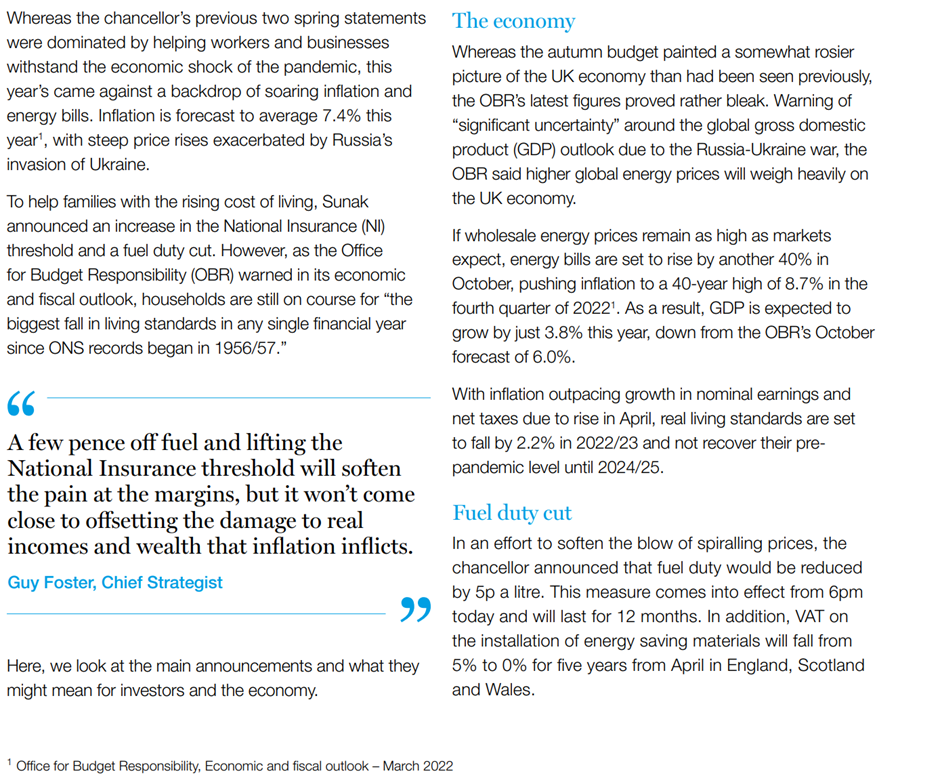
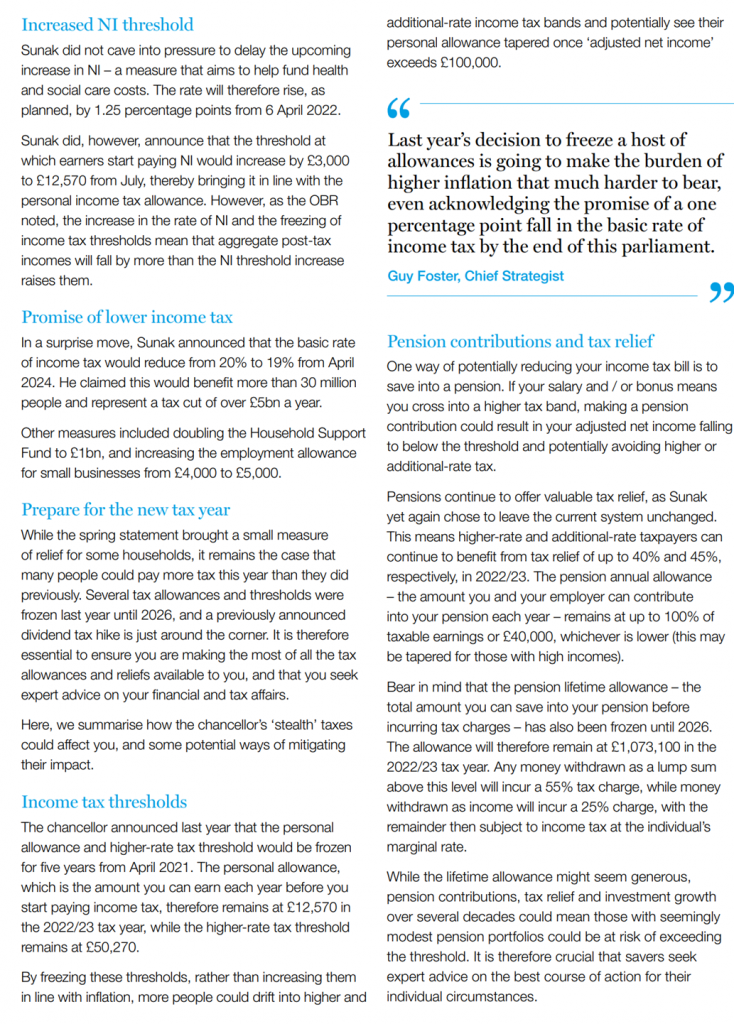
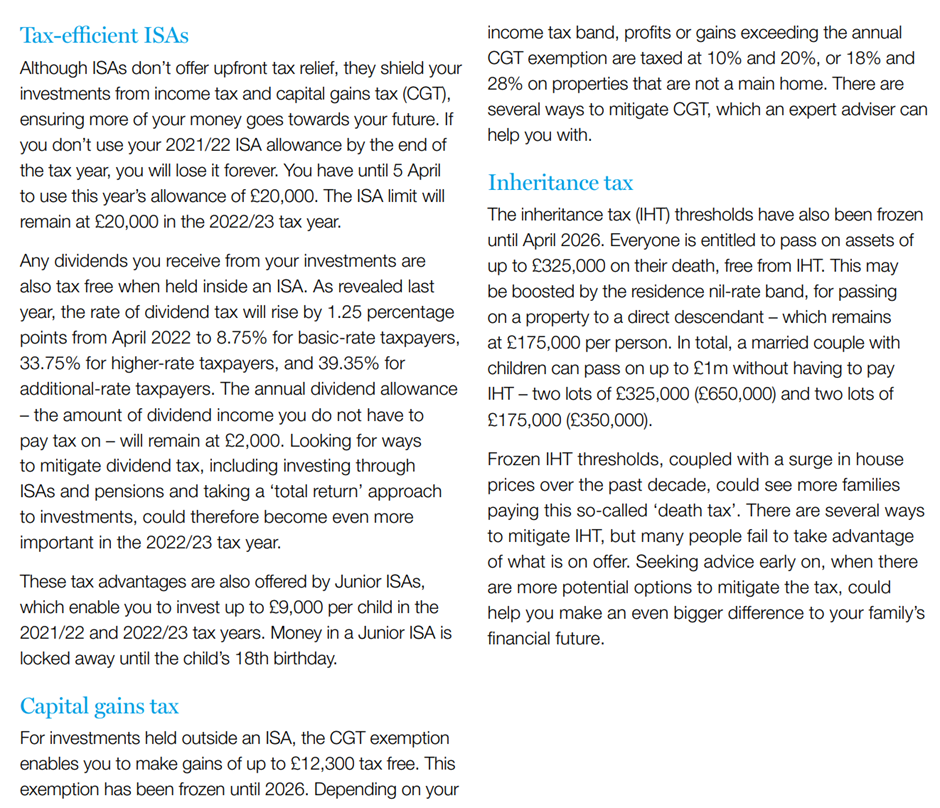
As you can see from the above, the economic outlook remains uncertain as it remains to be seen what the full impact will be on us of Russia’s invasion of Ukraine.

The positive news is the National Insurance equalisation, to bring this in line with the Personal Allowance of £12,570.00 from 06/07/2022. This will help ease some of the burden of the National Insurance increase which is due to come into effect from 06/04/2022.

As the article outlines, with the personal allowances being frozen until 2026, it is more important now to make full use of the reliefs and allowances available, such as Pension contributions and saving into ISAs etc.

Please continue to check our Blog content for advice and planning issues and the latest investment, markets and economic updates from leading investment houses.

Please keep safe and healthy.

Carl Mitchell – Dip PFS

Independent Financial Adviser

24/03/2022

Team No Comments

Stocks soar on Russia-Ukraine peace talks

Please see below Markets in a Minute article received from Brewin Dolphin yesterday evening, which provides a positive update on markets despite the continuing Russian invasion of Ukraine.

Stock markets surged last week on hopes of a positive outcome from Russia-Ukraine peace negotiations.

The pan-European STOXX 600 rose 5.4%, Germany’s Dax added 5.8% and the UK’s FTSE 100 gained 3.5%. Fighting continued throughout the week, but ongoing talks to end the conflict boosted investor sentiment.

Stock markets in the US ended their two-week losing streak as oil prices declined and the Federal Reserve increased interest rates in line with expectations. The S&P 500 rose 6.2% and the Nasdaq soared 8.2%.

The positive sentiment fed through to Japan, where the Nikkei 225 added 6.6% after the government said it would lift all remaining domestic coronavirus restrictions from 21 March. Hong Kong’s Hang Seng also rose 4.2%, whereas the Shanghai Composite eased 1.8%.

Key port of Mariupol under siege

Stocks started this week on a more subdued note amid news Ukraine’s key port, Mariupol, was under siege by Russian military. The STOXX 600 was flat on Monday (21 March), whereas the Dax and CAC 40 both lost 0.6% on concerns the conflict might not end as soon as hoped. The commodity-heavy FTSE 100 managed a 0.5% gain, boosted by a rise in oil and metal prices, while the Dow shed 0.6% to end its four-day rally.

In economic news, asking prices for UK homes rose by 1.7% in March, the biggest monthly rise for this time of year in 18 years. Rightmove said the jump was partly driven by a mismatch between supply and demand, with more than twice as many buyers as sellers. On an annual basis, asking prices were up 10.4% and have topped £350,000 for the first time.

UK and European indices started Tuesday in the green, with the FTSE 100 and STOXX 600 both up 0.5% at the start of trading.

Fed approves first rate hike in three years

Last week saw the Federal Reserve approve its first interest rate hike in more than three years. After keeping the benchmark interest rate at near zero during the pandemic, the US central bank said it would raise rates by 25 basis points. It also pencilled in increases at each of the six remaining meetings this year, pointing to a rate of 1.9% by the end of 2022 – a whole percentage point higher than indicated in December.

The Fed increased its inflation estimates, forecasting a 4.1% increase in the core personal consumption expenditures (PCE) price index this year, up from the previous projection of 2.7% in December. Core PCE is expected to ease to 2.7% and 2.3% in 2023 and 2024, respectively. The Fed reduced its gross domestic product (GDP) growth forecast for 2022 from 4.0% to 2.8%, citing the potential implications of the Ukraine war.

“The invasion of Ukraine by Russia is causing tremendous human and economic hardship,” the statement said. “The implications for the US economy are highly uncertain, but in the near term the invasion and related events are likely to create additional upward pressure on inflation and weigh on economic activity.”

US retail sales disappoint

US retail sales rose by just 0.3% month-on-month in February, less than the 0.4% increase forecast by economists in a Reuters poll. The figures were held back by a 3.7% drop in receipts at online retailers. Sales at furniture stores and health and personal care stores also declined by 1.0% and 1.8%, respectively, according to the Commerce Department.

The smaller-than-expected increase in retail sales in February has been partly attributed to an upwardly revised 4.9% surge the previous month, the largest gain in ten months, as well as households cutting spending on goods as gasoline and food prices soar. Core retail sales (excluding gasoline, building materials and food services) fell by 1.2% in February following an upwardly revised 6.7% gain in January. On an annual basis, overall retail sales increased by 17.6%.

UK base rate lifted for third month in a row

Here in the UK, the Bank of England (BoE) announced an increase in the base interest rate for the third month in a row. The BoE’s monetary policy committee voted 8-1 in favour of an additional 0.25% increase in the main bank rate, taking it to 0.75%.

It comes after UK inflation surged to a 30-year high and a warning that it could increase further following Russia’s invasion of Ukraine. The BoE said the war has led to large increases in energy and other commodity prices and is likely to exacerbate global supply chain disruptions. “Global inflationary pressures will strengthen considerably further over coming months, while growth in economies that are net energy importers, including the UK, is likely to slow,” it stated.

China pledges support for economy

Over in China, the country’s vice premier Lui He said last week that Beijing would roll out support for the Chinese economy and introduce more market-friendly policies. The announcement last Wednesday helped Hong Kong’s Hang Seng record its best trading session in over 13 years, closing 9.1% higher.

According to the Xinhua news agency, China’s Financial Stability and Development Committee said the government should roll out policies favourable to capital markets, while being cautious in introducing contractionary measures. The committee said China’s monetary policy should “actively respond” to support the economy and new credit should help maintain “appropriate growth”. It claimed the Chinese government continues to support companies’ listing of shares overseas and has maintained “good communications” with US regulators on Chinese companies’ listings in the US. Beijing has also paused plans to expand trials of the property tax announced at the end of last year, Xinhua reported.

Please check in again with us shortly for further relevant content and news.

Chloe

23/03/2022

Team No Comments

Ukraine/Russia negotiations continue

Please find below, an update on the ongoing negotiations between Ukraine and Russia and the impacts on markets, received from Brooks Macdonald, yesterday afternoon – 21/03/2022

  • Global equities rallied last week as Ukraine negotiations continued, China hinted at state support and the Federal Reserve meeting concluded
  • The Bank of England and Federal Reserve both increased interest rates last week, citing fears over inflation
  • The Federal Reserve revealed robust economic growth forecasts despite the impact of inflation on the cost of living

Global equities rallied last week as Ukraine negotiations continued, China hinted at state support and the Fed meeting concluded

Whilst last week proved a very strong week for risk assets, this of course needs to be compared to the volatility of March in aggregate. Technology outperformed, with reports of Chinese state support and the Federal Reserve (Fed) meeting both boosting sentiment towards the sector.

Negotiations between Russia and Ukraine continued last week which helped buoy risk appetite. Last night, Turkey’s Foreign Minister suggested that a peace deal and ceasefire was possible assuming neither side changed its negotiating demands too dramatically. The starting point, that Ukraine will agree to be a neutral country and commit to not join NATO, appears to have softened Russia’s prior hard-line approach to talks. After reports broke that Russia had requested military and economic aid from China, China has been in the spotlight over its position on the Ukraine war. On Friday President Biden and President Xi Jinping discussed China’s position over a call and both sides concluded with hopes for a peaceful resolution which saw no further escalation. The latter comment may well allude to suggestions from US intelligence sources that nuclear sabre-rattling could recommence should the Ukraine war become protracted.

The Bank of England and Federal Reserve both increased interest rates last week, citing fears over inflation

After the Bank of England and Federal Reserve both hiked rates last week, we will hear from a steady stream of central bankers this week, giving us more colour on the content of the discussions. The Federal Reserve ‘dot plot’ of interest rate forecasts showed a wide disparity of views amongst the Fed members, suggesting the speeches this week won’t be running off a shared narrative. Fed Chair Powell will be speaking today as well as on Wednesday. The Bank of England warned on inflation and economic growth when it hiked rates last week, the US has taken a different approach, showing heightened inflation expectations alongside robust economic growth forecasts. How the Fed speakers address their expected resilience of the economy in face of tightening monetary policy and cost of living squeezes will be of particular interest.

The Federal Reserve revealed robust economic growth forecasts despite the impact of inflation on the cost of living

The Fed are likely to come under significant pressure over the next few weeks as many economists have criticised the bullish economic growth projections as disconnected from the reality of consumer demand. Should the bond market conclude that the Fed speakers’ belief in the Fed’s own economic growth numbers is less than universal, we could see an extension of the technology outperformance that we saw after meeting last week, as markets price in the risk that the Fed will need to blink in the face of slowing growth.

The information in this article does not constitute advice or a recommendation and investment decisions should not be made on the basis of it. This article is for the information of the recipient only and should not be reproduced, copied or made available to others. The price of investments and the income from them may go down as well as up and neither is guaranteed. Investors may not get back the capital they invested. Past performance is not a reliable indicator of future results.

The MSCI information may only be used for your internal use, may not be reproduced or re-disseminated in any form and may not be used as a basis for or a component of any financial instruments or products or indices. None of the MSCI information is intended to constitute investment advice or a recommendation to make (or refrain from making) any kind of investment decision and may not be relied on as such. Historical data and analysis should not be taken as an indication or guarantee of any future performance analysis, forecast or prediction. The MSCI information is provided on an “as is” basis and the user of this information assumes the entire risk of any use made of this information. MSCI, each of its affiliates and each other person involved in or related to compiling, computing or creating any MSCI information (collectively, the “MSCI Parties”) expressly disclaims all warranties (including, without limitation, any warranties of originality, accuracy, completeness, timeliness, non-infringement, merchantability and fitness for a particular purpose) with respect to this information. Without limiting any of the foregoing, in no event shall any MSCI Party have any liability for any direct, indirect, special, incidental, punitive, consequential (including, without limitation, lost profits) or any other damages.

Please continue to check our Blog content for advice and planning issues and the latest investment, markets and economic updates from leading investment houses

David Purcell

22nd March 2022

Team No Comments

Blackfinch – Monday Market Update

Please see below, an article from Blackfinch Group detailing the market developments across the globe over the past week – received late this morning – 21/03/2022

  • The Bank of England raised interest rates by 0.25% to 0.75%, the third increase in a row, and in line with market expectations. Eight of the nine members of the Bank’s Monetary Policy Committee voted for the increase, with only Sir Jon Cunliffe voting to keep rates on hold.
  • Unemployment fell in the three months to January, according to the Office for National Statistics. The unemployment rate fell to 3.9%, down from 4.1% previously, and below the forecast of 4%. The number of UK employees on payroll increased by 275,000 in February to a record 29.7mn.
  • The UK government imposed further sanctions on Russia, announcing a ban on exports of some luxury goods to Russia, as well as adding a 35% tariff on various Russian imports including iron, steel, white fish and spirits.
  • The US Federal Reserve (Fed) announced its first interest rate hike since 2018, increasing the rate by 0.25%, bringing its target range to between 0.25% and 0.50%. With inflation at its highest level in decades, Fed officials are now pencilling at least six more interest rate increases this year.
  • The US Producer Price Index rose in line with expectations in February, increasing from 9.7% to 10% year-on-year.
  • Retail sales increased at a slower pace of 0.3% in February. Most economists had expected an increase of 0.4%. However, the January retail sales figure was revised up from 3.8% to 4.9%.
  • Weekly unemployment claim figures came in better than expected at 214,000, compared to forecasts of 220,000.
  • China reacted to its worst COVID-19 outbreak since 2020 by putting 17.5mn people in the city of Shenzhen into lockdown and telling all non-essential businesses to close or suspend production.
  • Chinese vice premier Liu He announced that more measures would be rolled-out to boost the economy, as well as introducing favourable policies to support capital markets.
  • Oil prices retreated below $100 per barrel midweek, amid hopes of a positive outcome to peace talks between Ukraine and Russia, as well as expectations that further lockdowns in China would slow demand. The US and Iran were also in talks regarding a nuclear deal which could see further oil exports come to market.
  • Fears of a bond default by Russia eased as £117mn of interest payments were made to international investors on Friday, two days after the due date. The payments were made in US dollars, allaying fears Russia would attempt to pay in roubles, which would have triggered a technical default.

Please continue to check our Blog content for advice and planning issues and the latest investment, markets and economic updates from us and leading investment houses.

Alex Kitteringham

21st March 2022

Team No Comments

US Fed raises rates: how does this impact our outlook and what risks lie ahead?

Please see below article received from Invesco yesterday afternoon:

What happened?

The Federal Open Market Committee (FOMC) released its statement following the March meeting, and US Federal Reserve Chair Powell held his regularly scheduled post-meeting press conference.

As anticipated, the FOMC increased the Fed Funds Target Rate2 by 25 basis points (bps), with James Bullard the sole dissenter preferring to raise by 50bps. References to the balance sheet were limited, with the Fed explaining that “the Committee expects to begin reducing its holdings of Treasury securities and agency debt and agency mortgage-backed securities at a coming meeting.”

There were some significant changes in the Summary of Economic Projections, compared to the December 2021 meeting.

The Fed revised its forecast for 2022 real GDP growth to 2.8% from its December 2021 forecast of 4.0%. The median forecast for 2022 core personal consumption expenditure3 (PCE) inflation increased to 4.1% from 2.7%. This has prompted the FOMC to adjust its 2022-end target for the Fed Funds Target Rate to 1.9% from 0.9%, with the highest individual forecast (presumably Bullard) at 3.1% by the end of 2022.

We welcome the increase in inflation forecasts by the FOMC, which is a reasonable step to move closer to what we are seeing in the data and prepare the ground for further revisions if necessary for 2023.

During the press conference, Powell made some key points:

  • The robustness of the labour market, highlighting that it is “extremely tight”, with wages rising the fastest in many years
  • Risks to inflation remain to the upside
  • The FOMC has “made good progress” in discussing the future of the Fed’s holdings of Treasury and mortgage-backed securities
  • The Committee’s view that the US economy is strong, and well placed for a tightening in monetary policy4. He also believes that a recession in 2022 is unlikely
  • He reinforced the idea that balance sheet reduction can be thought of in terms of interest rate increases, prioritising price over quantity analysis
  • Balance sheet reduction will “be faster than last time”, “earlier in the cycle than last time”, and “will look familiar”

What is our take on what is happening?

What we are experiencing is the unwinding of the “dash-for-cash” phenomenon that occurred in 2020. At the height of uncertainty related to the Covid-19 pandemic, investors de-risked portfolios and demanded to hold more liquid assets, including higher money balances. The Fed rightly accommodated this shift in investor demands, but grossly overestimated how accommodative they could be without affecting future inflation.

As consumer behaviour and spending has normalised, these excess money balances have been reflected in a strong economic recovery in the US, and ultimately accelerating inflation. The transitory explanation of inflation that was endorsed by the Fed has fallen away as inflation has broadened out throughout the US economy.

What is our outlook?

In our view, the Fed is attempting to “thread the needle”, by trying to limit the rise in long-term inflation expectations amid several notable headwinds for global economic growth. The most notable is the war in Ukraine and the zero-Covid policy in China. Three scenarios are possible:

  1. The Fed achieves its desire for a “soft landing”, with inflation returning to 2% relatively quickly, growth affected only marginally, and a terminal Fed Funds Target Rate in line with their projections;
  2. The Fed delays the required degree of tightening as a commodity price shock dramatically slows growth, and the US enters a period of stagflation;
  3. The Fed tightens too aggressively, facilitating a more conventional deflationary recession in 2023.

Our base case (based on current forward guidance from the Fed) remains firmly in the first scenario, but risks have increased recently.

History suggests that despite some initial volatility, stocks tend to outperform bonds once the Fed starts new tightening cycles. The FOMC’s projections portray the desire to remove the generous policy support provided since the outbreak of the pandemic, especially with inflation running higher than previously expected. 

The removal of support is likely to keep Treasury yields moving higher, although a flattening of the yield curve is likely to dampen the effect on longer maturities. It would not be a surprise to see 10-year yields above 2.5% this year, though after recent strong gains, a period of consolidation may be in order.

Higher yields may be expected to support the dollar, but it has already strengthened over the last year, even more so since Russia’s invasion of Ukraine. We wouldn’t be surprised to see the greenback consolidate over the rest of the year.

Within equities, value stock tends to outperform growth stock when inflation is high and falling, as cyclicals do over defensives. Alternatives such as real estate and private credit, as well as commodities, could also outperform in this environment.

US treasuries and high-quality investment grade bonds may be worth watching should the Fed decide to “slam on the brakes” and a recession ensues (where both growth and inflation fall).

What are we looking out for? What are the risks to our view?

The primary risk to the markets in 2022 is if the Fed makes a policy error by engineering a fully contractionary monetary policy in response to persistent, above-target inflation. This would likely result in a recession in 2023. We will follow a variety of incoming data, including inflation and inflation expectations, that could trigger more aggressive monetary policy.

Furthermore, the war in Ukraine has significantly increased the chances of a stagflationary scenario, although this is not our base case.

Please continue to check our Blog content for advice and planning issues and the latest investment, markets and economic updates from leading investment houses.

Andrew Lloyd DipPFS

18/03/2022