
Please find below, a Daily Investment Bulletin from Brooks Macdonald, received this morning – 31/03/2022
What has happened
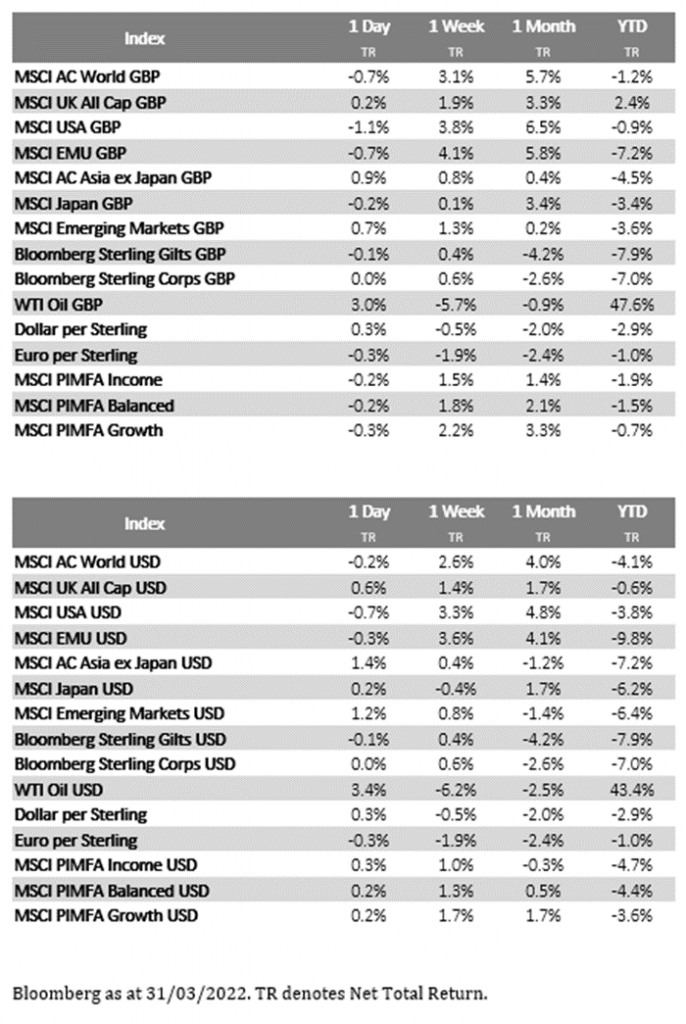
Global equities edged lower on Wednesday as the lack of a breakthrough in Ukraine-Russia peace talks pushed back on hopes of progress the day before. In Europe, a growing risk of Russia cutting off energy supplies coincided with stronger than expected inflation data. Provisional data for German March CPI was up 7.3% annually, vs 6.3% expected (harmonised 7.6% vs 6.7% expected), driven by energy prices (for household energy and motor fuels) up 39.5%. Underscoring the lack of uniformity across the inflation basket (a broader post-pandemic theme), data from the German statistical office showed a big split between goods inflation and services inflation, with goods prices up 12.3% annually, vs services inflation up 2.8%. Overnight, equity futures are up and oil is off on reports that the US Biden administration are considering a major release from their strategic oil reserves in an effort to lower fuel prices.
Germany takes a step towards possible energy rationing
On Wednesday the German government took the first formal step towards rationing gas consumption, bracing for a potential halt in Russian gas supplies over a dispute in payment currencies. Previously EU members settled payments mainly in euros, but Russia is demanding payment in roubles. German economics minister Habeck activated the ‘early warning phase’ on Wednesday, meaning that a crisis team will monitor imports and storage. If supplies fall short, Germany’s network regulator has scope to ration gas, with industry first in line for cuts. In this scenario, energy priority would be given to hospitals and other critical parts of the economy, as well as households. Later on Wednesday evening, a call between German Chancellor Scholz and Russia President Putin hinted at a possible compromise according to a read-out of the call by German officials.
Peace talks continue but no breakthrough yet
In a sign of the scale of the challenge in getting a peace deal delivered, both sets of negotiators gave very different accounts on where they were at on Wednesday. While Russia foreign minister Lavrov talked about ‘substantial progress’, Ukraine government spokesperson Nikolenko played down hopes, saying that ‘Lavrov demonstrates misunderstanding of the negotiation process’. In particular, both sides still look to be far apart around the subject of any territorial concessions. Meanwhile, despite Russian pledges on Tuesday to scale down military operations around Kyiv, Russian forces continued to bombard around the capital with shelling on Wednesday, leading to uncertainty as to whether Russia was withdrawing troops in certain areas or simply regrouping ahead of possible fresh assaults.
What does Brooks Macdonald think
The war in Ukraine creates worrying energy-related headwinds for Europe at a time of post-pandemic recovery. EU member states are all net importers of energy, with Russia previously the largest single supplier for imported gas, oil and coal. Germany is particularly exposed with gas making up around a quarter of Germany’s total energy consumption mix, with Russia in the past providing around half or more of Germany’s gas needs. Longer-term, tensions between Russia and the West might be permanently reset at a higher level, and a structural lack of EU security of energy supplies risks having a long-lasting impact on both corporate margins and household balance sheets in the region.
Please continue to check our Blog content for advice and planning issues and the latest investment, markets and economic updates from leading investment houses
David Purcell
31st March 2022