Team No Comments

Brewin Dolphin – Are we heading towards 1970s-style stagflation

Please see article below from Brewin Dolphin – received late yesterday afternoon – 16/03/2022.

Are we heading towards 1970s-style stagflation?

A growing number of investors are beginning to worry about a return to the environment that characterised the 1970s. Both Otmar Issing, the European Central Bank, s first chief economist, and Larry Summers, former US Treasury secretary, have recently flagged stagflation risks (weak growth and high inflation). Could things get this bad? Paul Danis, our Head of Asset Allocation, discusses below.

What was the economy like in the 1970s? The 1970s was a decade plagued by high inflation. The oil crises of 1973/74 (following the OAPEC oil embargo) and 1979 (following the Iranian revolution) made an already challenging inflation backdrop worse. The spike in energy costs in each crisis left consumers with substantially less disposable income to spend on other goods and services, which weighed on consumption.
Industrial action in the UK was particularly severe in the 1970s. The coal miner strikes early in the decade restricted supply, resulted in blackouts, and forced businesses to close. Ultimately, the government of Edward Heath imposed a three-day week, further weighing on growth. The widespread strikes in the ‘Winter of Discontent’ later that decade led to major disruption, with graves left undug and rubbish piled up in the streets.

High inflation eventually forced central banks to aggressively raise interest rates, which weighed heavily on the interest-sensitive areas of the economy. This combination of high inflation, weak demand and rising long-term interest rates was toxic for financial markets, and led to very weak ‘real’ asset returns (the return that is left over after subtracting inflation).

Just how bad were real returns?

Taking the US as an example, annualised real returns were negative for stocks, cash, government bonds and corporate bonds in the 1970s. In the case of equities, the annualised real return in the decade amounted to -1.5%, which compares to an approximate +7.7% annualised real return over the 100 years leading up to today. Conversely, returns on commodities such as gold and oil were much stronger than average in the 1970s.

What caused the high inflation of the 1970s?

A perfect storm of factors led to the high inflation 1970s. Sticking with the US as an example, government expenditure rose on the back of both the Vietnam War and President Lyndon Johnson’s ‘Great Society’ legislation, with the latter involving higher government spending on social programmes.

When the gold standard came to an end in 1971, the US dollar was able to float freely. The greenback dropped sharply over the next few years, pushing up import cost inflation. President Richard Nixon pressured then Federal Reserve chairman Arthur Burns (who was previously Nixon’s economic adviser) to maintain an expansionary monetary policy heading into the 1972 election, despite a growing inflation problem. Burns complied. Nixon also introduced wage / price controls in the early 1970s in a bid to get inflation under control. While temporarily slowing inflation, these measures led to shortages and so ultimately made the problem worse.
The oil crises of 1973/74 and 1979 reduced global oil supply and drove up petroleum prices. Meanwhile, real-time estimates overstated the ‘potential output’ of the US economy. This led policymakers to believe there was more ‘slack’ (unused resources) in the economy, which caused them to underestimate the inflationary effects of their policies. Finally, labour union worker contracts typically were linked to inflation. This setup produced a ratcheting effect when price increases picked up.

What was happening in the UK?

As was the case in the US, mismeasurement of the ‘output gap’ (the difference between actual output and the level of output consistent with sustainable full employment of resources) was a problem for UK policymakers. A Bank of England (BoE) working paper concluded that monetary policy errors due to this problem contributed about 3.0 to 7.1 percentage points to average UK inflation in the 1970s (Nelson / Nikolov, 2001). Meanwhile, the BoE was not independent. Several studies have established a significant link between the level and variability of inflation and the degree of central bank independence. Both the oil supply shocks and effects of wage indexation played a similar role in pushing up UK inflation as they did in the US.

Are there parallels between the 1970s and today?

Some of the factors that contributed to the high inflation of the 1970s are prevalent today. Labour markets across the developed world are tight. In the US, the unemployment rate heading into the 1970s was 3.5%. At present, it is 3.8%, and likely to reduce further.
The US has enacted massive fiscal stimulus under President Joe Biden at a time when the economy was already expanding rapidly. Global oil prices have surged, most recently on the back of Russia’s invasion of Ukraine. This will bolster inflation, and weigh on growth.

That said, there appear to be more differences than similarities. Central banks today are probably less likely to give in to political pressure. The Federal Reserve restored its credibility under Paul Volker, who quashed inflation after taking charge in August 1979. That credibility largely remains intact. Central banks have formally adopted inflation targets. Households, businesses and investors believe they will take steps to reduce inflation if inflation expectations were to become ‘de-anchored’. Meanwhile, developed world economies are now structured in a way that makes a wage / price spiral less likely. Union power has declined as economies have become more service oriented, and wage indexation is built into a much lower percentage of contracts today. Wage / price controls seem very unlikely. Importantly, the current ‘oil shock’ is nowhere near as bad as either of the two that occurred in the 1970s. We believe that supply concerns linked to the war in Ukraine have boosted the oil price by around 10%. This is far less than the 237% supply-driven rise in 1973/74 and 154% in 1979.
How do you expect the economy and markets to evolve?

Absent an escalation in the Ukraine crisis that causes energy prices to surge anew, it is likely that inflation in the Western world will moderate as the year progresses. Supply bottlenecks should continue to improve, the impact of last year’s fiscal stimulus should wane and monetary policy will tighten. That said, inflation is likely to remain uncomfortably high. Even without additional upside, the process by which commodity inflation filters through to consumer prices should last for some time. Tight labour markets should bolster wage inflation, which will encourage businesses to raise prices to protect profit margins. So-called shelter inflation pressure (categories related to rent and imputed rent) will also likely remain strong.

Regarding growth, we believe that 2022 should see most developed world economies grow at a solid pace. However, the rise in energy costs and inflation more broadly should combine with rising interest rates and slower job growth to weaken the pace of the global economic expansion.

On markets, we continue to expect stocks to outperform bonds. However, the economic cycle has moved into a later stage. As such, we expect to use periods of market strength to lighten our equity exposure.

What about longer term?

Although a repeat of the 1970s seems unlikely, there are good reasons to have subdued expectations with regards to longer-term economic growth prospects. Demographics are a headwind, as labour force growth is likely to be weak.

Meanwhile, we suspect that longer-term inflation risks lie to the upside. Entitlement spending (healthcare, pensions) for ageing populations will require continued deficits. There is a risk that these may end up being partly financed by central banks via additional quantitative easing, which would amount to moneyfinanced fiscal policy. Globalisation headwinds are mounting, and the age structure of populations is shifting so that the ratio of workers relative to consumers will fall. Both developments risk higher inflation. The process of decarbonisation of the global economy also risks boosting inflation over the longer term.
Subdued growth combined with rising inflation risks suggest that equity returns over the next decade will likely be much lower than investors have grown accustomed to since the 1980s. But even so, we would still expect equities to be a better investment than cash over the long term.

Please continue to check back for our latest blog posts and updates.

Charlotte Clarke


17/03/2022

Team No Comments

Protecting your pension in difficult times

Please see below article received from Brewin Dolphin recently, which provides advice on how to protect your pension in these uncertain times, amidst rising inflation and stock market volatility.

It can be difficult to make decisions about how to safeguard your lifetime savings when you’re feeling anxious and unsure about the future. A financial adviser can help you decide on the best route for you but, in the meantime, these are some of the main considerations.

Avoid making rash decisions

It’s perfectly natural to be worried about your investments and the impact of wider economic events on your pension’s performance. However, letting your emotions cloud your judgement could prove extremely costly in the long run. Selling investments that have fallen in value risks crystallising losses; and if the markets recover quickly, you could miss out on subsequent gains.

Before you rush into making any decisions, take a step back and try to understand how recent events may have affected your broader retirement plans. A financial adviser can give you a clear picture of your savings, such as how long they’re likely to last, and whether your goals are still achievable.

Beware inflation

When stock markets are volatile, you might be tempted to start shifting all your retirement savings into cash. However, this might not be the wisest move. As well as the risk of crystallising losses and selling good quality investments at an unfavourable time, you’ll be at the mercy of inflation, which in the UK recently reached a 30-year high. Over time, inflation has the potential to erode the purchasing power of your savings, which means your money might not last for as long as you need it to.

Although cash is important for short-term expenditure and unexpected costs, the current rates of interest on cash savings products tend to be very low and below the rate of inflation. Keeping a portion of your pension invested in the stock market will give it the chance grow in real terms, tax efficiently, over what is hopefully a long retirement. If you don’t need the growth, then instead of cashing in you could move to a lower-risk level to try to limit the level of volatility while still, hopefully, at least keeping pace with inflation.

If you’ve not yet reached retirement, a market dip could present an opportunity to top up your pension; the income tax relief and potential market recovery could give your fund a serious boost. But whether this is appropriate for you will depend on your exact circumstances, objectives, and time horizon, and you should always seek advice before investing.

Maintain a diversified portfolio

Beware that taking on too much investment risk could cause problems. If you’re approaching retirement, your investment time horizon is likely to be much shorter than that of younger investors, meaning you have less time to recover from market downturns. And if you’re already drawing an income, investment losses can deplete your pension savings more quickly, thereby increasing the risk of you running out of money.

One way to seek to safeguard against losses is to hold a range of diversified assets, with different risk and return characteristics. Different asset classes tend to perform differently to one another in a range of market conditions, which can help to minimise overall losses and smooth returns over time.

If you are in the process of de-risking your pension portfolio you could, for example, take gains from the best-performing investments to buy more defensive assets, that are well positioned to weather future market volatility. Doing this by yourself can be complicated. An adviser will help you balance your portfolio to ensure you have the right mix of investments for you, and that they’re appropriate for your stage of life.

Consider your income strategy

If you are already in retirement and markets have dipped, it might make sense to draw from cash holdings to avoid having to sell investments that have fallen in value. You might also want to consider allocating a larger proportion of your portfolio to income-producing assets to meet longer-term spending needs. Again, a financial adviser can help you decide on the right income strategy for your individual circumstances.

Next steps

Understanding the steps you need to take to protect your pension from market volatility and inflation isn’t always easy. The key is to remain calm, and remember that stock markets tend to recover, given time. Seeking some smart advice can help you feel confident you’re doing the right thing and that you’re on track to meet your goals, regardless of where you are in your financial journey.

We will continue to publish relevant content and news on a regular basis, so please check in again with us shortly.

Chloe

15/03/2022

Team No Comments

Blackfinch Group Monday Market Update

Please find below, an update on global markets, received from Blackfinch, this morning – 14/03/2022

  • UK fuel prices hit record highs as the surge in crude oil prices continued. Unleaded petrol hit £1.61 a litre on Thursday, up from £1.51 per litre at the start of March, while diesel reached £1.70 a litre.
  • UK gross domestic product (GDP) was estimated to have increased by 0.8% in January. This was a notable improvement from the 0.2% contraction in December, suggesting the UK economy had shrugged off the negative impacts of the fast-spreading Omicron COVID-19 variant.
  • Figures released by the Office for National Statistics showed every sector in the UK grew in January, with services up 0.8%, production up 0.7% and construction up by 1.1%.

  • Propelled by surging costs for gas, food and housing, US consumer inflation climbed to an annual rate of 7.9% at the end of February, the sharpest rise since 1982, with even higher price increases to come.
  • As various experts highlighted, the reported rise in US inflation came before Russia’s invasion of Ukraine sparked dramatic surges in oil, gas, wheat, metal and other commodity prices.
  • In the US, job vacancies remained high in January as firms continued to struggle to hire workers. According to the Job Openings and Labor Turnover Survey (JOLTS), there were 11.3m job openings at US firms in January, ahead of the 10.9m forecast.
  • The European Central Bank (ECB) announced it would speed up the end of its asset purchase programme – designed to help European economies weather the COVID-19 pandemic – sooner than expected. The announcement sent eurozone bond yields soaring. 
  • The ECB also raised its inflation projections and cut its economic growth outlook, believing war in Ukraine was likely to keep commodity prices high, holding back the ability of households to spend and businesses to invest.
  • Eurozone inflation forecasts for 2022 were revised upwards from 3.2% in December to an average of 5.1%. The forecast for 2023 was also raised from 1.8% to 2.1%. 
  • Western governments announced plans to impose punitive tariffs on Russian trade to further isolate Moscow from the global economy following the invasion of Ukraine.
  • Inflation in Brazil hit a seven-year high as the country’s cost-of-living crisis intensified. Consumer prices increased 10.54% in the year to February, ahead of expectations, with monthly inflation rising to just over 1%.

Please continue to check our Blog content for advice and planning issues and the latest investment, markets and economic updates from leading investment houses

David Purcell

14th March 2022

Team No Comments

AJ Bell – Does invasion of Ukraine mean I should reduce risk in my pension?

Please see below an article published by AJ Bell yesterday (10/03/2022), detailing their views on how investors should view risks in markets arising because of the Russian invasion of Ukraine:

Please continue to check our Blog content for advice and planning issues and the latest investment, markets and economic updates from leading investment houses.

Please keep safe and healthy.

Carl Mitchell – Dip PFS

Independent Financial Adviser

11/03/2022

Team No Comments

Brewin Dolphin: Markets in a Minute

Please see the below article from Brewin Dolphin, summarising the performance of financial markets over the last week, as the Russian invasion of Ukraine and soaring oil prices continue to disrupt the economy – received yesterday afternoon – 08/03/2022

Stocks slide as Ukraine conflict escalates

Stock markets experienced another week of heavy losses last week as the conflict in Ukraine escalated.

The pan-European STOXX 600 and the FTSE 100 both lost around seven percentage points, while Germany’s Dax and France’s CAC 40 plunged by more than 10%. Losses were particularly heavy on Friday as ceasefire talks failed and Russia seized control of a nuclear power plant.

US indices also ended lower. The S&P 500 declined 1.3%, dragged down by the technology, financials, consumer discretionary and communication services sectors. Energy stocks performed well as oil prices surged.

Over in Asia, Japan’s Nikkei 225 slipped 1.9%, with concerns about tightening monetary policy in the US also weighing on investor sentiment.

Oil prices soar to near all-time high

Oil prices soared at the start of trading on Monday (7 March) as the US and Europe mulled a ban on imports of Russian oil. In the first few minutes of trading, the price of Brent crude oil surged to $139 a barrel, the highest since July 2008.

On Sunday, US secretary of state Antony Blinken said the Biden administration and its allies were discussing a ban on Russian oil supplies. Later, US House of Representatives speaker Nancy Pelosi said the chamber was exploring legislation “that will further isolate Russia from the global economy.”

The surge in oil prices was accompanied by another day of losses for global stock markets. In the US, the S&P 500 closed the day down 3.0%, the Nasdaq lost 3.6% and the Dow slipped 2.4% amid fears the conflict could hinder US economic growth and add further inflationary pressure. The pan-European STOXX 600 declined 1.1% and the FTSE 100 slipped 0.4%, with news of a ceasefire offer from Moscow helping to limit losses.

European stocks started Tuesday’s trading session in the green, with the Dax, CAC 40 and STOXX 600 up 1.7%, 2.6% and 1.5%, respectively.

Eurozone inflation hits record 5.8%

In economic news, figures released last week showed inflation in the eurozone surged by a record 5.8% year on-year in February, up from 5.1% in January and above the 5.4% forecast by economists. Energy prices soared by 31.7%, while unprocessed food prices increased by 6.1%, according to Eurostat.

The European Central Bank (ECB) faces the difficult dilemma of whether to raise interest rates in an attempt to combat soaring inflation. Several ECB governing council members have said policy decisions should be delayed because of the uncertainty caused by the Ukraine war. Meanwhile, the heads of the Portuguese and Greek central banks warned the crisis risks plunging the eurozone into a period of stagflation — a mix of stagnating growth and inflationary supply pressures.

According to the Financial Times, Fabio Panetta, an ECB executive board member, said: “We should aim to accompany the recovery with a light touch, taking moderate and careful steps as the fallout from the current crisis becomes clearer.”

UK services activity hits eight-month high

Here in the UK, growth in the services sector accelerated sharply in February as the Omicron wave of Covid-19 subsided. The headline seasonally adjusted IHS Markit/ CIPS UK Services PMI Business Activity Index rose to 60.5 from 54.1 in January, the fastest rise in output since June last year. Respondents said market demand and client confidence improved alongside the reduction in pandemic-related disruption, thereby supporting growth of activity.

However, input costs increased substantially in February, with the rate of inflation the second-fastest in more than a quarter of a century of data collection. The rate of output price inflation hit a fresh record high for the second month running, with around one-third of respondents raising their selling prices during the month.

Andrew Harker, economics director at IHS Markit, said: “Although the latest set of PMI data were encouraging, the inflationary picture still has the potential to limit growth, while it remains to be seen what impact the Russian invasion of Ukraine will have on the service sector and wider economy. As such, there are still downside risks even as disruption from the pandemic finally appears to be fading.”

US jobs growth accelerates

In the US, meanwhile, figures from the Labor Department showed non-farm payrolls rose by 687,000 in February, far greater than the 400,000 increase expected by economists. This was led by hiring in leisure and hospitality, education, and health services. The unemployment rate fell from 4.0% to 3.8%, whereas the annual rate of growth in average hourly earnings slowed from 5.7% to 5.1%.

Federal Reserve chair Jerome Powell described the labour market as extremely tight, and said he would support a 0.25% increase in interest rates at the central bank’s March policy meeting and would be “prepared to move more aggressively” later on if inflation does not start to ease.

Please continue to check our Blog content for advice and planning issues and the latest investment, markets and economic updates from leading investment houses.

Alex Kitteringham

9th March 2022

Team No Comments

Weekly Market Commentary – Ukraine crisis continues to dominate investor sentiment

Please see below article received from Brooks Macdonald yesterday afternoon, which details the impact that Russia’s ongoing invasion of Ukraine is having on markets and economies.

The humanitarian impact of the Ukraine crisis hardens political resolve towards sanctions on Russian energy imports

With US Secretary of State Blinken confirming that the US and allies were discussing bans on Russian oil and gas, energy prices surged on Friday and over the weekend. This rapid increase has spread into equity market volatility with most major indices mirroring their Friday movements, falling further in today’s European session.

Price surges in the oil and natural gas markets hit equity market sentiment and muddy inflation forecasting

Russian oil and natural gas import sanctions were previously avoided by the US coordinated bloc due to disagreement from European allies. As the Ukraine war has continued and the severity of the humanitarian crisis has increased political pressure, a ban on Russian oil and gas has become increasingly possible. Adding to Blinken’s comments, Speaker Pelosi has said that the House of Representatives is exploring legislation on this topic to restrict payments into the Russian economy. One of the big questions is whether a release from the US’s Strategic Petroleum Reserves, or a softening of Iranian sanctions, could take some of the pressure off the dramatic moves within oil prices. With Iran being probed for its ties to Russia over the weekend, the latter may be delayed in the short term at least. In the interim, the oil price remains elevated and highly volatile.

US Consumer Price Index data this week is unlikely to cause the Fed to stray from a 25bp hike in March, however inflation remains the key data point in markets

The Ukraine crisis will dominate investor sentiment this week however we also have the release of the latest US Consumer Price Index (CPI) numbers, as well as the latest European Central Bank (ECB) meeting. US CPI is expected to increase to 7.9% year-on-year in the latest reading (from 7.5%)1 and the core reading (ex-energy and food) is expected to soften slightly from the previous reading. Market expectations were for CPI to begin to plateau in Q2 of this year before falling into the summer, but with the recent moves in energy prices we may well see an increasingly divergent story between US headline and US core CPI data. With Federal Reserve Chair Powell showing his support for a 25bp hike in March, it is likely that the bar to change path from that is reasonably high. In terms of central banks, we expect the ECB to reiterate caution and the need to retain price stability.

Inflation data will become increasingly difficult to read for markets and central banks, as the supply side impacts from COVID-19 will now mix with the sanctions and supply side issues from the Ukraine crisis, as well as the surge in energy prices. As ever, investors will listen closely to central bankers to understand how a short-term overshoot in the CPI numbers will be interpreted within the world’s major economies.

Please check in again with us shortly for further relevant content and news.

Chloe – 08/03/2022

Team No Comments

A Double Edged Sword

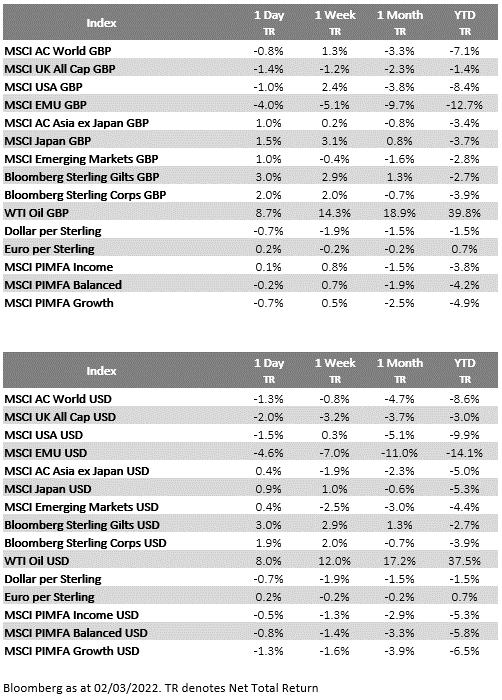
Please find below, an update on how the Russian invasion of Ukraine is impacting markets, received from Tatton, Friday Evening – 04/03/2022

During the course of this week, the impacts of the war on global financial assets changed in nature. Last week, we wrote that minor sanctions were a help for asset prices even if the sanctions did not match the level of outrage. Starting Sunday, the European Union (EU), US and UK imposed new sanctions almost every day. Perhaps inevitably, this has resulted in equity market weakness.

There are separate aspects of the week’s market moves. One is centred around liquidity and the risk of contagion across the financial system. In a separate article below, we write about how Russian equities and bonds have not only seen their values plummet, the inability to trade them at any price has then impacted broader emerging market mutual funds and exchange-traded funds (ETFs).

Often, as in the global financial crisis of 2008-2009, markets worry about the banking system. As the blue line in the chart below shows, currently European financial credit spreads do not show exceptional levels of stress. That’s potentially quite comforting. However, direct sanctions on Russian banks have created problems for financial institutions that share larger lending and trading flows with them. For example, Raiffeisen Bank of Austria saw its share price dive again this week after Europe’s weekend sanction announcements.

Over two weeks, Raiffeisen’s share price has halved, with the collapse in its value being more than all of the Russian-based assets and businesses it had under management. However, its fall in creditworthiness accounts for the rest – other banks are much less willing to transact with it, so its ongoing going costs rise dramatically.

In our opinion, one difficult aspect has been the interplay between sanctions on Russian banks and energy and commodity markets. For example, European utility companies are not barred from buying Russian oil and gas. However, they have difficulty in paying for it in the normal way. Rebuilding these payment channels will take time. If businesses are still able to buy Russian energy, then authorities must ensure financial channels are open to make those energy purchases. Moreover, companies will need reasonable reassurance that energy sourcing sanctions won’t be put in place later, and that they will be protected from other reputational risks.

The confluence of issues has led to another surge in global oil and European gas prices. In past weeks of rising spot prices, the prices of log-dated contracts didn’t rise as quickly. It has therefore been interesting how futures markets have seen longer-dated contracts moving up sharply, perhaps indicating a more extended surge in costs.

And therein lies the other aspect prompting equity market weakness combined with bond market strength. Government bond yields across the developed world have dropped sharply. This is almost certainly because investors have substantially downgraded real growth estimates amid greater inflation pressures for this year. The epicentre has been Europe, but the rise in energy costs has meant the US is also affected.

Bruce Kasman, JP Morgan’s chief economist gave us his team’s thoughts on Thursday evening. They have revised global growth for 2022 lower by 0.8%, down to 3.1%. Here is the table of their new estimates and the extent of the revisions:

Russia is expected to contract almost 10% (in rouble terms). Europe’s growth is now expected to be +2.5%, down from +4.6% previously. The main hit will be for this first quarter.

US growth stays almost unaltered (+2.7%, from +2.8% previously) while China remains at +5.6%. The stability of their stock markets in recent days suggests that investors are broadly in line with these estimates.

Bond markets are telling us a similar story. In particular, the yields on inflation-linked bonds have headed down sharply as increased demand for safe haven assets saw bond prices soar. US ten-year ‘real’ yields are back down to -1.0%, where they were last year. Fixed coupon yields have fallen back to 1.75%. German inflation-linked bonds are at -2.6%, substantially below last year’s low of -2.1%. Fixed coupon yields moved back into negative territory, at -0.16%.

These bond moves also may be telling us that central banks could look through the current input cost-push inflation and keep monetary policy accommodative for the time being, thereby allowing elevated levels of inflation persist for longer. In his three-hour testimony to Congress, US Federal Reserve (Fed) chair Jay Powell said interest rates will still almost certainly go up 0.25% on 16 March, less than the 0.5% almost universally expected two weeks ago. Even today’s startlingly strong US employment numbers (non-farm payroll data) (which suggested the US economy added 678,000 jobs in February) failed to push up fixed coupon yields.

JP Morgan’s economists suggested their growth forecasts are probably still too high. A lot depends on the passage of energy prices so, with European natural gas prices pushing up to new highs again on Friday afternoon, equity markets remain vulnerable.

So, is there any hope? We believe there is. As JP Morgan suggests in its forecasts, the damage is to Europe growth estimates. While there will be a big hit from energy costs, a lot of nominal spending will be unaffected. Impetus from the EU’s Next Generation Fund will continue through this year and next, come what may. And, the massive increase in defence spending by the German government will also come through quickly. A lot of this will be spent among European defence manufacturers (the UK should also benefit). Defence spending has a large ‘multiplier’ effect – the spending being recycled round the economy. Looking out beyond 2022, growth could be shifted up to a higher, not lower, level over the next few years.

Over the short term, as has been the case for the past weeks, much depends on energy costs and how long they remain elevated. While the de-coupling of bond yields to oil prices is heartening, it would be good to see the Brent crude spot price fall back from today’s $120 per barrel to a more manageable level well below $100.

Ultimately, when risks are obvious and emotions are running at a high level, markets will overshoot the downside at some point. Of course, it’s difficult to know when that is. Meanwhile, the strategy of remaining calm and waiting for the market to cool off has usually proved beneficial, and we think it probably still is.

Please continue to check our Blog content for advice and planning issues and the latest investment, markets and economic updates from leading investment houses

David Purcell

7th March 2022

Team No Comments

Invesco – Henley European Equities Team – Our thoughts on the Ukraine/Russia conflict

Please see article below from Invesco received late yesterday afternoon – 03/03/2022.

Henley European Equities Team Our thoughts on the Ukraine/Russia conflict – February 2022

• The immediate equity market reaction to the Russian invasion last Thursday was risk off.
• There have clearly been inflationary shocks, and so we expect increasing pressure on the ECB to act.
• The introduction of new sanctions over the weekend, namely excluding several Russian banks from SWIFT and restricting the Russian Central bank access to some of their international reserves, has caused a fresh bout of volatility impacting the banking sector in Europe.

How the market responded to rising tensions last week


The immediate equity market reaction to the Russian invasion last Thursday was ‘risk off’. ‘Risk off’ meaning, understandably, selling business with direct exposure to Russia and pending sanctions. However, it also meant selling banks and cyclicals more generally.

When the market has been shocked in recent years: Brexit, Trump, Covid and now Putin, share price reactions are Pavlovian. Banks are financially leveraged and cyclically exposed, so they sell-off with ‘risk-off’, and then quickly the market backfills the fundamental rationale.

Yesterday, the explanation was the risk of slower growth but also less rate potential. And so, whilst banks sold off, long duration equities (‘Quality and Growth’) performed strongly. The risk of higher rates being off the table was fuelled by ECB member Holzmann being quoted as having said, “Ukraine conflict may delay stimulus exit”.

But what he actually said was, “It’s clear that we’re moving toward normalizing monetary policy, it’s possible however that the speed may now be somewhat delayed.” The context of which being that he gave a hawkish speech on Wednesday, and then was asked for an update in the wake of the shocking news of Thursday’s invasion.

What’s undisputable is that looking at the market behaviour, investors were clearly more emboldened post his comments to buy more duration equities as a result.

Is this the right reaction?

We believe this reaction may be short lived. Whilst there is a long list of unknowns resulting from Russian actions this week, one of the few likelihoods is yet more inflationary pressure. Our basic point is ‘transitory inflation’ becomes plain old inflation with longevity and actions in Eastern Europe have again pushed commodity prices higher.

Ahead of the conflict ECB policy was set based on inflation returning to below trend (<2%) in 2023, however, to our minds the assumptions left no more room for inflationary shocks. Given our belief EU wages have upside risk to the ECB’s 3% (and now events in Ukraine), there have clearly been inflationary shocks. So, we expect increasing pressure on the ECB to act: European monetary policy remains a risk to the upside.

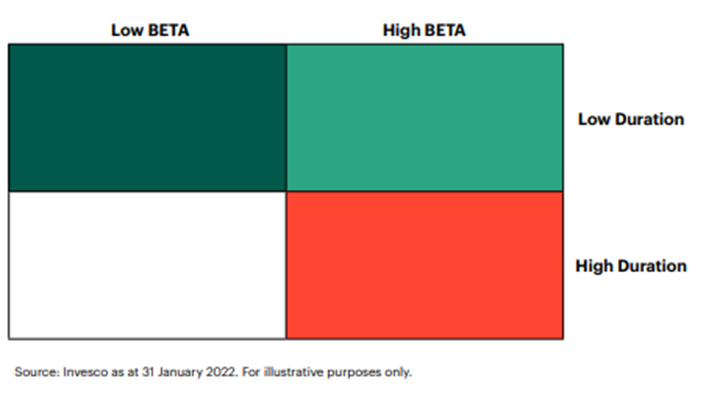
Need to think about duration and beta

As we’ve mentioned in previous comments, the impact of higher interest rates is a risk to the valuation of the more expensive parts of the market: European Quality.

Of course, the impact of the Ukraine crisis is also a threat to growth rates – and that impacts cyclicals. Hence, simply buying the ‘Value’ factor becomes more challenging after this week also. We believe the solution lies not in two dimensions of ‘Value vs Growth’, but rather the third dimension of ‘High vs Low Beta’. Whilst we remain nervous of the crowded positioning in high beta Quality (e.g. Technology, Payments, Luxury), where valuations are high, we think there are areas of defensiveness at reasonable valuations: Telecoms, Insurance, Food Retail, Big Pharma and Utilities.

We believe these are the areas to transfer risk to this week and note they sit within the Value factor buckets. Within cyclical value there remain some pockets of defensiveness to the specifics of this week through exposure to Oil and Resources. Where we are incrementally more cautious is consumer discretionary.

The need for a balanced portfolio

Our conclusion is we think balance is key. We think being heavily skewed to the red quartile is risky. Our debate is our weighting to the top half and how much events of this week mean we should move to the low beta side of the allocation.

How to think about banks given the financial sanctions introduced this weekend

The introduction of new sanctions over the weekend, namely excluding several Russian banks from SWIFT and restricting the Russian Central bank access to some of their international reserves, has caused a fresh bout of volatility impacting the banking sector in particular. In the following paragraphs and charts we provide our thoughts on the market’s reaction.

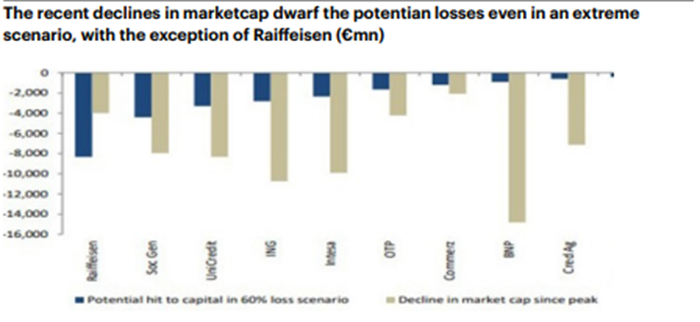
The below chart is from financials specialist research house, Autonomous. They have used the Russian debt crisis in 98 as the basis for impacts when banks lost 60% of their exposures. Note since the late 90s, EU banks exposures to Russia are smaller with, for example, French banks 11% exposed vs 35%. We should also note that assuming 60% of assets are gone is a worse outcome vs walking away from the region – handing Russia back the keys to the assets. However, in this effectively worst-case scenario you can see how much market cap has already been destroyed vs exposure.

Another key point to think about with EU banks is they are long provisions today. Remember, due to the Covid uncertainty, EU banks provisioned their risks aggressively and thankfully because of the extreme fiscal and monetary measures taken, these provisions look overstated. That means banks have a stock of provisions they could be releasing – which can now be redeployed to Russian exposure and thereby absorbing losses for shareholders.

From the list above, the bank with largest risk to Russia is UniCredit. Whilst there is headline risk, we note UniCredit is holding 1yr of normalised provisions in precautionary provisions today (scope 1 & 2). In earnings terms Russia is c3-5% of group only and the assets are well capitalised (18.8% CET1 vs 10% required). Using a 1998 losses analysis means a loss of 90bps CET1 however, walk-away and that loss is estimated at -50bps only (given this would also reduce RWA). This compares to last reported CET1 of 14.1% and co target of 12.5-13% so they have the means to absorb a worst case scenario without fresh equity: this is not a repeat of the GFC.

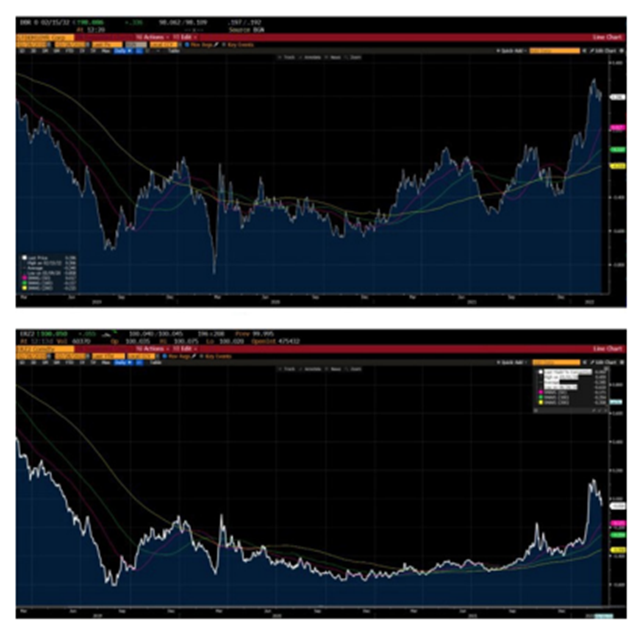
To that point it’s worth highlighting what’s happening in the debt markets vs equity. German 10Y bond yields have moved lower, but as per the chart below we’re at +20bps yield today vs -40/-60bps for much of 2021. Likewise the 3month Euribor (second below) is far from 2021 levels which is where the European banks have retrenched back to.

Please continue to check back for our latest blog posts and updates.

Charlotte Clarke

04/03/2022

Team No Comments

Brooks Macdonald – Daily Investment Bulletin

Please see the below Daily Investment Bulletin, received by Brooks Macdonald late yesterday afternoon:

What has happened

The risk off theme continued in markets yesterday with higher energy prices weighing on investor risk appetite. 2022 interest rate expectations also fell yesterday as bond markets priced in a more cautious central bank backdrop given the Ukraine crisis.

Bond moves

Europe saw some of the most dramatic shifts in interest rate expectations yesterday with the bond market now pricing in only a c. 20% chance of even one rate hike in 2022. This changing narrative led to further declines in European sovereign bond yields with the 10-year bund yield now back in negative territory after declining by 30bps in the last week. UK markets have seen similar moves with the 10-year gilt yield now at 1.17% after being almost at 1.5% a week ago. Given the inflationary impact of higher energy prices and the second order inflation generated by sanctions reducing trade, the bond market feels on a knife edge but for the time being the risk-off of geopolitics is trumping the inflation hawks. The ECB meeting is next week so we will have official confirmation of how Ukraine is impacting the central bank’s thinking in just a few days. Today sees the first of Fed Chair Powell’s Congressional testimonies so market focus could move from the ECB to the Fed today.

State of the Union

President Biden’s State of the Union address began with a message of support for the Ukrainian people alongside a reiteration that there would be no US military deployment unless a NATO ally was threatened. The speech focused on the administration’s economic plans with a particular focus on easing the current inflationary pressures. Biden detailed a number of policies including supply side expansion, removal of anti-competitive structures, productivity improvements and the release of oil form the Strategic Petroleum Reserves.  The President also outlined his proposals for additional corporate taxes and the closure of tax loopholes for richer Americans.

What does Brooks Macdonald think

The huge swings in the bond market have helped cushion the financial market impact from the Ukraine crisis. Central bank speak over the coming weeks (and the meetings themselves) remain critical however as if the bond market concludes that central banks still side with the hawkish inflationary narrative the fall in bond yields, which has offset some of the severity of the market impact, could reverse.

Please continue to check our Blog content for advice and planning issues and the latest investment, markets and economic updates from leading investment houses.

Andrew Lloyd DipPFS

03/03/2022

Team No Comments

Markets volatile as Russia invades Ukraine

Please see below ‘Markets in a Minute’ article received from Brewin Dolphin yesterday evening, which conveys the effect that Russia’s ongoing illegal and unwarranted invasion of Ukraine is having on global markets.

Russia’s invasion of Ukraine sparked heightened stock market volatility and a flight to safe-haven assets last week.

Shares in Europe declined as the crisis led to increased uncertainty and fears of higher inflation. The pan-European STOXX 600 fell 1.6% and Germany’s Dax slumped 3.2%. The FTSE 100 slipped 0.3%, with a rebound on Friday helping to limit losses. Markets in Asia also fell. Japan’s Nikkei 225 shed 2.4%, China’s Shanghai Composite lost 1.1% and Hong Kong’s Hang Seng plunged 6.4%.

In the US, the S&P 500 slumped on Thursday to nearly 15% below its peak at the start of the year, putting it firmly in correction territory. A sharp rally on Friday meant it ended the week up 0.8%, as Western sanctions proved to be less severe than expected, especially in relation to Russia’s energy sector. The Nasdaq finished the week up 1.1% while the Dow was largely flat.

Sanctions-hit rouble plunges to record low

The Russian rouble plunged to a record low on Monday (28 February), sliding 28% versus the US dollar, after countries around the world imposed sanctions on Russian politicians, officials, oligarchs, banks and companies.

Several countries said they would block Russia’s central bank from deploying its international reserves in a way that undermines the impact of sanctions, and some Russian lenders are being removed from the SWIFT financial messaging system for international payments.

The tougher sanctions and lack of progress in the RussiaUkraine ceasefire talks led to another volatile day for stocks. The FTSE 100 managed to pare some of its earlier losses to close down 0.4% on Monday, while Germany’s Dax slid 0.7%. Over in the US, the S&P 500 and the Dow slipped 0.2% and 0.5%, respectively, whereas the Nasdaq managed a 0.4% gain.

UK and European indices were mixed at the start of trading on Tuesday as the military fight in Ukraine intensified.

Wall Street’s ‘fear gauge’ soars

A key measure of stock market volatility surged to its highest level in a year last week, as Russia’s full-scale invasion of Ukraine gave already anxious investors the jitters. According to FactSet, the CBOE Volatility Index – otherwise known as the ‘fear gauge’ on Wall Street – jumped to 36.74 during the day on Thursday, well above its long-term average of about 20.

Yields on core eurozone bonds and UK gilts also fell as the invasion drove a flight to safety (bond prices and yields move in opposite directions). Longer-term US Treasury yields declined for much of the week, but then rose as US stocks rallied on Friday.

US core PCE inflation soars

Last week saw the release of some important economic data, although this paled in comparison to the events in Ukraine. In the US, a key inflation measure showed prices rose at their fastest rate in nearly 39 years. The core personal consumption expenditures (PCE) price index, the Federal Reserve’s primary inflation gauge, rose 5.2% in January from a year ago. Including food and energy prices, the headline PCE was up by 6.1%, the biggest increase since February 1982.

Despite this, consumer spending in the US accelerated faster than expected, increasing 2.1% month-on-month in January. This was above the 1.6% estimate and came after a 0.8% decline in December. The increase was reflected in stronger orders for durable goods, which rose by 1.6%, double the expected 0.8% gain.

US economy rebounds from Omicron

Manufacturing and services activity in the US rebounded in February as virus containment measures, tightened to fight the Omicron wave, were scaled back. IHS Markit’s flash composite output purchasing managers’ index (PMI) rose to 56.0 from an 18-month low of 51.1 in January. Services firms led the rise, although manufacturers also registered a stronger increase in output, buoyed by a slight easing of supply bottlenecks.

“With demand rebounding and firms seeing a relatively modest impact on order books from the Omicron wave, future output expectations improved to the highest for 15 months, and jobs growth accelerated to the highest since last May, adding to the upbeat picture,” said Chris Williamson, chief business economist at IHS Markit.

However, inflationary pressures intensified in February, with the rate of input price inflation quickening from January’s ten-month low, driven by higher raw material, transport and wage costs. Global shortages of raw materials and lingering supply chain disruptions were again cited, albeit less so than in prior months. Meanwhile, prices charged for goods and services in the US rose at a record pace as companies continued to share additional cost burdens with customers.

Please check in again with us soon for further relevant content and news.

Chloe

02/03/2022