Team No Comments

Market Update

Market Update – 21/05/2020

Over the last few days, I’ve been listening to the following Fund Managers for their input on investments and their views on markets:

  • BlackRock
  • J.P. Morgan
  • Schroders
  • Invesco
  • Prudential

In addition I’ve been listening to Curtis Banks on pension technical issues and the Federation of Small Business to hear Liz Truss in her position of MP, Secretary of State for International Trade and her views on where we are up to in the UK and with ongoing trade negotiations.

This research is on top of standard client advice work, I’ve not quite moved into the office, but it feels like I have sometimes!

Why do I do this level of research?  I want to get the consensus view on the global macro situation in the markets from the experts.  Fund Managers have substantial resource and spend a small fortune on research.

Whilst it is not an exact science and at the moment there are a lot of moving parts to take into account, I would say the general view is of cautious optimism.  Most Fund Managers are positioning for growth over the long term and for some Fund Managers for growth over the short term too based on modelling of scenarios and probable outcomes.

Markets are generally probably slightly too high as they tend to look through the very short term and focus on the (post virus?) future.

The risks are many and varied, the biggest one is a bad second wave of the coronavirus.  In addition, we have the US/China situation, Brexit trade deals (no deal Brexit?), Europe and US politics to name a few.

Consensus varies on where to invest if you have the freedom to choose but again common areas that appear good value now are Asia and Emerging Markets if you can take the volatility and associated risks.  As part of a portfolio or fund that is actively managed you get this allocation and the risks managed for you to some extent.

What next?

In summary you need to remain invested as you are for now, it is still too volatile to make fund switches.  If you have spare cash it is also a good time to invest, asset values are still low compared to valuations earlier this year.  You can try and buy into the dips, but this can be difficult to time.  Over the medium (5 years plus) to long term (10 years plus) you will see growth without perfect timing.

Paying regular monthly premiums into either pensions or investments is a good idea too.  If you can afford to increase your regular monthly contributions, please do.  This is a lot easier than trying to buy into the dips with a lump sum investment.  You may, if you are lucky, have spare cash with your reduced holiday and leisure spend!

Steve Speed

21/05/2020

Team No Comments

Brewin Dolphin – Markets in a Minute Update

Please see this weeks ‘Markets in a Minute Update’ from Brewin Dolphin

Brewin Dolphin – Markets in a Minute Update

Markets

Global share markets fell back last week amid worries about a second wave of the virus later this year.

Over the week:

  • US shares fell 2.3%
  • Eurozone shares fell 4.3%
  • Japanese shares lost 0.7%
  • Chinese shares fell 1.3%.

However, the mood changed as hopes of progress on a vaccine were boosted over the weekend, and the trend in new infections continued falling across Europe.

  • The FTSE100 gained 4.3% yesterday. Energy stocks outperformed on a rising oil price rebound in demand for fuel as economies open up again.
  • Stocks were up across Europe, while in the US, the Dow closed up by 3.8% and the S&P500 gained 3.1%.

Markets appear laser-focused on any good news on the fight against the virus and hopes for a quick economic recovery, while ignoring the downbeat economic data and more cautious forecasts.

No expense spared in hunt for vaccine

The government announced that it would provide a further £84m to fund the ongoing vaccine development at Oxford University and Imperial College London.

  • Oxford will receive £65.5m and ICL will receive £18.5m as the vaccine trials on humans and animals are expanded. The idea is to cut the development time for a vaccine from the usual eight years to just two years.
  • Oxford University has also agreed a licensing agreement with AstraZeneca for the commercialisation and manufacturing of their potential vaccine. If the trials are successful it means that AstraZeneca will make up to 30m doses available for UK residents by September, as part of an agreement to deliver a total of 100m doses.
  • The government also plans to contribute up to £93m towards the construction of a new vaccine manufacturing centre, which is intended to open next summer in Oxfordshire, and will have the capacity to produce enough doses for the entire UK population in as little as six months.

However, a note of caution. Nobody has ever succeeded in producing a vaccine for a coronavirus. Even if we develop one, we don’t yet know what depth of immune response it would generate and how long that response would last. It is possible, for example, for a vaccine to prevent suffering from a disease but without inhibiting its transmission. There are numerous reasons to be cautious but the government does at least appear to be throwing everything at its development, and the UK is among the frontrunners in the ongoing research.

Monetary policy

Last week we heard from Bank of England Governor Andrew Bailey. His most eye-catching comment was that the Bank of England can spread the cost of the crisis over time. This is a welcome statement, as it came against the backdrop of a leaked document from the treasury to the Daily Telegraph, which said the government faced a stark choice between spending cuts and tax hikes in order to prevent increased debt triggering a sovereign debt crisis. In other words, a return to austerity once the pandemic is under control.

Since austerity removes liquidity from the economy, it reduces investment and productive capacity, which is essential for economic growth, especially at a time when we will (hopefully) be emerging from recession. There has been a broad outcry from economists against the Treasury’s conclusions.

By way of tools to prevent this eventuality the Bank of England obviously has the ability to buy more bonds and also fund the government through the ways and means account (temporarily of course). At the same time the UK has a floating exchange rate which can decline to improve the attractiveness of UK debt at the cost of inflation to UK consumers. Therefore, there seems no risk of a sovereign debt crisis, even as debt to GDP does increase drastically.

Furlough scheme extended

Chancellor Rishi Sunak extended the job retention scheme that pays 80% of staff wages until the end of July, and then beyond to the end of October. It was due to finish at the end of June. During this longer extension there will be some sharing of the financial burden between the government and employers. There will be details emerging on this over the next fortnight allowing the standard “devil will be in the detail” conclusion. If the extended furlough scheme is not generous enough then it could see a serious increase in unemployment. If it is too generous it will see a serious increase in indebtedness. The latter looks the lesser evil for the time being.

Encouraging news from Asia

Asia is further ahead of the curve and generally seems to have better procedures for tracking and tracing potentially infectious individuals. Infection rates remain well contained. There were some stories of new infections in the Chinese cities of Wuhan and Jilin but the numbers are very low. The same is true for Hong Kong. Asia’s experience probably offers the best case of how we can expect the release of lockdowns to go in the west.

Activity is ramping up in China. Traffic jams have returned to Beijing while 100m students have returned to school across the country. Restaurants are also reporting that customers are dining out again, with no need for social distancing, although diners’ temperatures are usually taken on arrival.

Signs of life in UK property market

Rightmove said on Monday it saw an immediate release of pent-up demand on the day the housing market reopened last week.

Home-mover visits to Rightmove’s site returned to pre-lockdown levels on 13 May with circa 5.2m visits, up 4% on a year earlier. Unique sales enquiries were just 10% behind the same day in 2019, while rental enquiries hit the highest level since September 2019.

However, it seems likely that given the imminent recession, many properties will sell at a discount.

Oil price jumps

Oil prices rebounded by 20% in the week to Friday as production fell and demand rose (US gasoline demand rose by 22% in the last week of April). US WTI rose by a further 4% on Sunday to break through the $30 level for the first time in two months. Global benchmark Brent Crude rose by 3.9% at the weekend to more than $33 a barrel, and continued up past $34 yesterday.


Capital and income from it is at risk.
Neither simulated nor actual past performance are reliable indicators of future performance.
Performance is quoted before charges which will reduce illustrated performance.
Investment values may increase or decrease as a result of currency fluctuations.
The information contained in this document is believed to be reliable and accurate, but without further investigation cannot be warranted as to accuracy or completeness.

Some good news and signs that we are generally moving in the right direction. It may take some time before we reach our ‘new normal’, but these steps in the fight against the virus and some slight recovery in the markets are a good sign. However, we could see further downward legs before we move into full recovery. Volatility will continue.

Andrew Lloyd

20/05/2020

Team No Comments

Business Blog – Commercial Property in your Pension – why?

Over the years a proportion of our clients use their pension assets to buy a commercial property.  Why would they do this?

The general benefits are as follows:

  • You do not pay any tax on rental income received into a SIPP (Self Invested Personal Pension)
  • No capital gains tax is paid on disposal of a commercial property from a SIPP
  • For ‘connected tenants’ (a business owner renting their pension’s commercial property to their own business) rent is generally a tax deductible business expense
  • SIPPs generally are not subject to inheritance tax
  • In insolvency the pension assets are normally out of reach of the trustee in bankruptcy

These are fairly standard benefits above; in the current situation a few useful ideas are as follows:

  • If your limited company owns the commercial property sell it to your pension to inject cash into your business to help with cash flow challenges and/or repay loans
  • If you own your own commercial property personally you could sell your property to your SIPP and if your business needs capital, make a Director’s Loan into your company (if viable)
  • By selling the commercial property you own to your SIPP you reduce your personal inheritance tax bill (if applicable)
  • In the past I have had clients sell their commercial property to their business to enable them to change business bank

When we think of commercial property you would normally think of offices, warehouses, industrial units and shops.  In addition, some stranger commercial property could be:

  • Sports stadium
  • Museums
  • Zoos

It is important to buy only commercial property with your pension, buying residential property could incur tax charges of up to 70%.  If you are not sure we can quickly get opinion on whether a property is commercial or residential for pension purposes.

The process for commercial property into a SIPP is as below:

  1. Validate if it is a potential SIPP investment (commercial property)
  2. Acquisition.  This involves good ‘due diligence’
  3. Ongoing management of the property, rent reviews, leases, insurance etc.
  4. Disposal of the property

During the acquisition stage you are likely to need the assistance of a few professionals, your accountant, a solicitor, a surveyor, the SIPP provider and a bank if you need a loan to assist with the purchase.  And obviously your IFA!

Due diligence is thorough and includes a report on title, information on the lease (is it suitable?), legal title, insurance, VAT, a copy of the EPC and search results (environmental searches too).

Loans to assist Purchase

If you do not have enough capital in your pension fund to buy the required commercial property you could borrow funds to purchase it.  Loans are restricted to 50% of the pension fund value.

For example, if you had £240,000.00 in your pension you could borrow a further £120,000.00.  Please note that you must factor in fees etc.

Connected Purchases and Connected Tenants

If you already own the property and you sell it to yourself this is a connected purchase.  You will then rent the property to yourself and you would be a connected tenant.

Connected party transactions must be completed on commercial terms.  You pay a commercial price for the property and you pay a commercial rent.  Normal due diligence is completed.

Investments

Rent paid initially can be used to pay any loan off asap if there was a loan used in the purchase.  Rent can then be invested in standard investment assets in your SIPP.

Investments can be funded by lump sums and on a regular monthly basis.  Building good liquid assets alongside your property assets is good practice.

Fees

In general terms fees for commercial property purchase in a SIPP and ongoing fees are more expensive than a standard property purchase.  This is because it is more complicated.

You also have the additional costs of your SIPP provider and your IFA in comparison with a standard property purchase.  Are the additional fees worth paying?  That depends on your circumstances and objectives.  Please take advice.

Summary

Whilst it is not for everyone buying commercial property with your pension could be useful, particularly now.  Some general benefits are that you take control of your working environment, property maintenance (and hygiene now) and if you have the space you could have a tenant too.

You can also join together with your life partner or business partners to buy commercial property with a few SIPPs.  You would own the property in proportion to your percentage paid.  This can get complex later, particularly at retirement.

Occasionally a SIPP may not be the right pension vehicle for your commercial property purchase.  A few of my clients prefer the additional benefits a SSAS provides (Small Self-Administered Scheme).   We won’t go into the SSAS benefits in this blog.

Retirement options include retaining the property and using the rent paid as part of your retirement income or selling the property.  If you are selling your business and retaining the property in your SIPP, you should also negotiate good long lease terms to the buyer of your business.

Right now, it could be difficult to get a valuation on a property, but business will gradually start returning to normal over the rest of the year – hopefully, a vaccine will speed things up!

Steve Speed

11/05/2020

Team No Comments

The European Central Bank aims to ‘thread the needle’

Further input from J P Morgan received at 18.25 on Friday night, 01/05/2020.   Although this article is slightly out of date, I think this is important input and an area we need to watch.

The European Central Bank aims to ‘thread the needle’

The leader of the European Central Bank (ECB) has become very familiar with the challenge of ‘threading the needle’ in recent years and the test facing Christine Lagarde today was no different. After last month’s major announcements regarding the expansion of its QE program, the ECB announced few new meaningful measures today. It left its key interest rates unchanged and made no enhancements to its asset purchases. It did however decide to make borrowing conditions more favourable for euro area banks under its Targeted Longer Term Operations III (TLTROs) facility.

With an increasingly restricted toolkit to provide further stimulus, the ECB’s messaging had to be reassuring enough to avoid triggering market volatility and at the same time diplomatic enough to appease divergent views from across the euro area on the appropriate policy path. This task was only made harder by the downgrade of Italy’s sovereign bond rating by Fitch to one level above junk status and the large contraction in eurozone GDP for the first quarter of this year (-3.8% quarter on quarter).

Few new policy changes

With its deposit rate already at -50 basis points, the ECB’s decision to not reduce interest rates so far this year suggests a strong reluctance to go even lower. However, the ECB is not alone in seeing limited value in pushing rates further into negative territory. The Federal Reserve in its own meeting yesterday dismissed the idea that it would consider negative interest rates. The ECB is instead focusing on other tools as its main policy levers.

Borrowing costs for the TLTRO III programme were lowered to -1%, a further 25 basis points lower from last month’s meeting. The recent ECB bank lending survey showed a material increase in demand for loans across the euro area as corporates search for funds to get them though this period. In the near term, another series of short-term refinancing operations were also made available, likely as a safety net over the coming months. These are helpful measures but the magnitude of bond purchases is likely to be more important in supporting government spending to help mitigate the impact on the economy.

What are the other options?

With markets focused on debt sustainability, particularly in countries such as Italy, the ECB will need to focus on expanding its asset purchase programmes. It could do so by ramping up purchase amounts under the Pandemic Emergency Purchase Programme (PEPP). In the press conference Lagarde suggested that PEPP is the preferred tool as opposed to Outright Monetary Transactions (OMT), previously used in the sovereign debt crisis, given this is a euro area wide issue. An extension of PEPP beyond the end of this year, dependent on the duration of the virus was also highlighted as an option.

Having already announced that it would accept recently downgraded high yield bonds – so called ‘fallen angels’ – as collateral for banks’ loans and made Greek bonds eligible for the PEPP, the ECB could also widen the scope of the asset purchases to include high yield bonds. Lagarde stopped short of explicitly confirming the forthcoming implementation of these measures, but stated that the flexibility of the ECB’s mandate can be increased if required.

Ultimately, it is clear that the ECB will need to increase stimulus measures this year to ensure that the wave of bond supply required to fund government stimulus packages is smoothly digested by the market. At this meeting, Lagarde preferred to take a “wait and see approach” in the hope that coordinated government action will shoulder some of the burden and lift some of the pressure on the central bank to save the day.

Investment implications

Trying to find the perfect balance of policy announcement and forward guidance was always a tough challenge and markets appear to have reacted negatively to the measures announced today. The euro has fallen around 0.3% versus the dollar and European equities are also down on the day. The spread of Italian 10-year yields over Germany has been volatile and has broadly risen. With expectations from the ECB that eurozone GDP could fall by 5% – 12% in 2020, calls for further central bank action look set to get louder over the coming months.

As we know markets fell a further c 138 points on Friday, 2.34%.  The ECB will have it’s work cut out keeping all of the eurozone happy with the issues facing the likes of Italy, Spain and Greece and the strength of Germany who don’t want too much change even when we have a crisis of this magnitude.

It does look like countries within Europe are standing on their own. As an initial response to Covid 19 some European countries closed their borders.  Understandable but not very European.

Let us see how this plays out, it could be interesting.  The ECB will have to do a lot more to keep everybody happy.

Steve Speed

04/05/2020

Team No Comments

Why markets have rebounded and what could happen next

Interesting input from Russ Mould of A J Bell written on Thursday and received on Saturday lunch time (25/04/2020). I am conscious of the dates of articles as some of what we receive is out of date by the time we receive it!

Why markets have rebounded and what could happen next

Short-term viral implications for investors to ponder

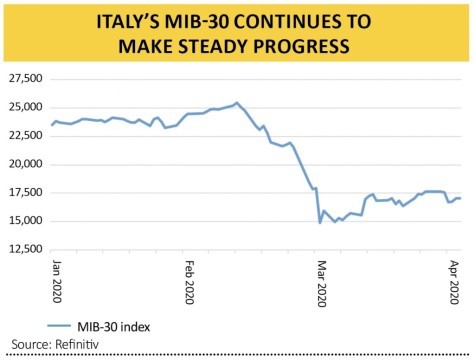
At the time of writing, Italy’s MIB-30 index is up by 15% from its 12 March low, a trend from which this column, looking at it solely from the narrow perspective of investments, can draw some modicum of encouragement.

It is impossible to be dispassionate about, or comfortable with, such matters, but the Milan market benchmark’s steady recovery reflects a peak in the number of new daily cases across Italy on 21 March at 6,155 and in the number of fatalities at 919 six days later.

At the time of writing the last reading for those numbers are 3,047 and 433 respectively and it is to be hoped that the trend remains down, for humanitarian reasons above all others.

As suggested here three weeks ago, this shows that equity markets are responding to changes in the curve of the coronavirus outbreak.

A slowdown in the number of cases was always going to be seen as good news, given how investors would interpret this as a sign that things were getting less bad, and that as a result the outbreak would eventually stop getting worse and once it stopped getting worse it would eventually start getting better.

This is where markets are now. The number of new cases is growing much more slowly, even if the aggregate number of those unlucky enough to catch the dreadful virus is still growing overall. This has been enough for equity markets to start pricing in what might happen if, as and when the government-imposed lockdowns are brought to an end and economic activity resumes.

As a result, several benchmarks are looking even sprightlier than that of Italy. The UK’s FTSE 100 is up 16% from its 23 March nadir of 4,994, while Germany’s DAX and America’s S&P 500 are back in bull-market territory, with gains of more than 20%.

The question now is whether these gains can be maintained or extended and in the short term a lot of that will depend upon the shape of the upturn. The latest Bank of America institutional investor sentiment survey suggests that U-shaped is the current favourite, over W, V, L, ‘bathtub’ or tick-shaped (or any other options that you could think of).

ALPHABET SOUP

What is interesting to note is how a V-shaped recovery is only third choice, according to that Bank of America monthly survey. This suggests some degree of circumspection among the professional investment community and it is easy to see why, as Spain, New Zealand and the UK, to name but three, extend their lockdowns and other nations such as Italy ease them at a very steady pace.
When it comes to judging what sort of recovery might ensue, investors can ask themselves the following questions:
1 When will I first want to use public transport?
2 When will I first want to eat in a restaurant or drink in a bar or pub?
3 When will I first want to board an aeroplane or cruise ship?
4 When will I first want to attend a public event at a cinema, theatre or sports stadium?

The answers could be informative. In addition, you can then imagine that you have been furloughed or even lost your job and see if the answers change at all. The assumption that all of those unlucky enough to find themselves in that position walk straight back into full-time employment could be an optimistic one as unfortunately some firms are going to fail, no matter how much support they receive from the government, management, staff and customers alike.

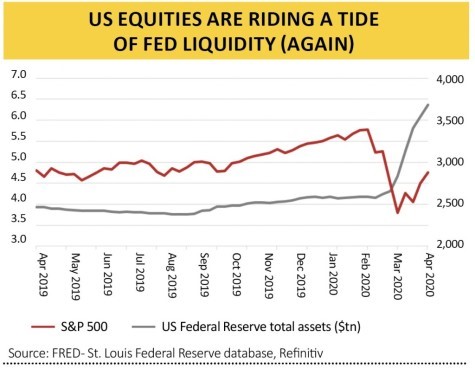
These questions are very difficult, if not impossible, to answer. As such, investing money on the back of them could prove a fraught exercise, even if markets do seem to have one very powerful ally in the form of central banks, notably the US Federal Reserve. The value of the assets held on the American central bank’s balance sheet has swollen by $2.2tn, or 53%, since the end of February.

That tidal wave of liquidity looks to be carrying US stocks higher. Students of history will however remember that the first round of quantitative easing that began in autumn 2008 had a similar initial effect, only for the S&P 500 to buckle in face of weak macroeconomic data and corporate earnings reports and only bottom five months later.

This column will revisit the issue of central bank intervention in an analysis of long-term potential implications of the coronavirus outbreak for financial markets next week. Before then there is one further short-term indicator of note: whether the FTSE 100 can reach (which it did very briefly on 20 April, only to fall back) and stay above 5,816, the high reached after the three-day rally that followed the low on 23 March.

If so, that could break the traditional ‘bear’ market pattern of a series of lower highs and lower lows and give investors real grounds for hope, at least from a portfolio point of view.

A J Bell offer products in the pension SIPP, SSAS and investment areas. They have a Stockbroker within their business too. Russ Mould is quite often heard commenting on Radio 4.
Steve Speed
27/04/2020

Team No Comments

Lessons Learned from the ongoing Pandemic

Lessons Learned from the ongoing Pandemic

We are currently in the midst of an ongoing Global Pandemic, but I’m sure that everybody is already aware of this, as this blog is coming ‘Live from Lockdown’ and I know the majority of you will be reading this in ‘Lockdown’ at home and are probably fed up with hearing about it by this point, from one news bulletin to the next.

We are posting regular blog updates to keep you informed on the developments within the markets as they change with the Pandemic response, so I won’t go into this here, however what I will talk about and what I want you take away from reading this, is what lessons can we learn from this situation?

Other than the obvious lessons we have learned, such as to wash our hands more and never take a trip to the pub for granted! What can we take away from this with regards to financial planning?

Ask yourself the following question,

‘If a situation like this ever arises again, what position financially would I like to be in?’

Whilst this might vary from person to person, I’m sure the answer would generally have the same theme, to have the necessary financial resources to ensure that you wouldn’t be affected by market drops or being unable to earn for a short period of time.

Now you should have an answer to the first question in your mind, ask yourself the next question,

‘What steps can I take to help move towards being in this position?’

Again, this will vary but should follow the same themes.

Do you have an adequate emergency cash fund? The guidance is generally to have around 3 to 6 months emergency fund in an easily accessible cash account for unforeseen circumstances. This would be particularly useful, if not necessary, during a time like this. This was certainly an unforeseen circumstance.

Do you have any expensive debts/ liabilities such as credit cards and loans? What can you do to reduce these? (We should all be spending less now without the freedom to go the pub, go out for a meal and casually stroll around the shops spending too much!). Reducing expensive debts and liabilities will free up more cash for you to build up your emergency funds, Pensions/Investments etc.

Do you have other assets to fall back on? We advise our clients to have a ‘3 pot approach’ which is having a range of different assets such as Pensions, Cash and Stocks & Shares or Investment ISAs to help manage risks in and in the run up to retirement. For example, switching to cash assets from drawing on Pensions/Investments during a market crash (like now!) to allow the funds to have time to recover.

Protection

We have now all seen how fragile life really is. At times like this we think about what life cover, Income Protection and Critical Illness cover we have in place. Do you have enough cover in place to protect your family?

At People and Business IFA we are happy to audit your protection for you and take a holistic view that takes account of your assets, liabilities and employee benefits.

Summary

The aim of this post is to give you some ‘food for thought’ and to get you thinking about how you can improve your financial position to help you generally, not just in times like these.

I will also take this opportunity to once again to remind you to please remain calm and stay invested. Keep funding your pensions/investments if you can (the market downturns give great opportunity for investing and buying assets at low prices!).

Keep calm, stay safe and we will hopefully all get through this together.


Andrew Lloyd

24/04/2020

Team No Comments

The Great Glut: A historic supply and demand shock in the oil market

The Great Glut: A historic supply and demand shock in the oil market

JP Morgan posted a great article earlier this week about the current oil situation (see below);

Rising production and collapsing demand due to the COVID-19 pandemic is creating an unprecedented glut in the oil market. As a result, we are currently witnessing a pronounced supply and demand shock that has driven oil futures below zero for the first time.

At the current pace of production, the world will run out of storage for oil by the middle of the year compounding the imbalance in the market and adding to the pressures faced by producers to slash prices to sell their inventories. As a consequence, energy stocks have been the worst performer year-to-date in global equity markets, while credit spreads of sub-investment grade energy companies have widened dramatically, signaling increasing concerns about the solvency of the sector.

The major oil producing countries, known as OPEC+, have now agreed to cut production starting in May to try to avert the crisis. But will their action be enough to balance the oil market? And what are the implications for investors?

An unprecedented drop in oil demand

The COVID-19 pandemic has led to the implementation of rigorous measures globally to contain the spread of the virus. Travel restrictions, social distancing and stay-at-home orders have reduced global oil demand by an estimated 5.6 million barrels per day (mb/d) in the first quarter of 2020 compared to the same period last year. With the full force of the containment measures expected to continue into May the situation in the oil market may deteriorate further in the near term.

Peak destruction in oil demand is expected in April and May, with an average decrease of 20mb/d. Even in a scenario where global COVID-19 containment policies are gradually lifted by the end of May, the U.S. Energy Information Agency (EIA) is estimating a loss of oil demand in 2020 between 5.2mb/d to 9.3mb/d. To put this number into perspective, in 2009 – the year of the last global recession – oil demand decreased by 0.8mb/d.

Exhibit 1 shows that almost 58% of global oil demand is derived from fuel for transportation. The impact on demand, and thus the oil market, is significantly worse than in normal recessions because of the widespread implementation of travel restrictions, which has reduced global air traffic by 30%. Quarantine measures have also caused a significant drop in road traffic, by roughly 40%, leading to a large drop in demand for petrol and diesel.

EXHIBIT 1: GLOBAL OIL CONSUMPTION BY SECTOR
% of total oil demand
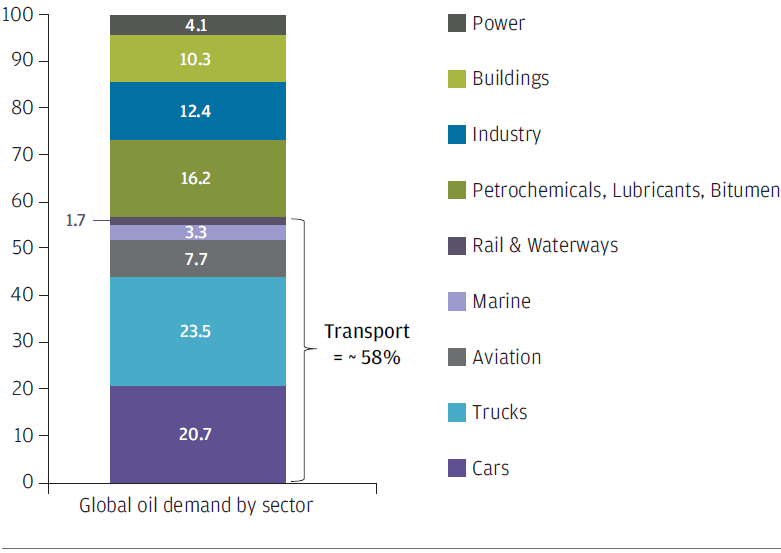
Source: British Petroleum, J.P. Morgan Asset Management. Data shows an estimate of global oil consumption by sector for 2020 from the BP Energy Outlook 2019. Data as of 31 March 2020.

Storage capacity issues in the U.S. created a previously unknown experience of a negative price in the oil futures market. Futures for the month of May 2020 fell sharply as producers effectively paid others to take their oil inventories. Halting production is not feasible for some producers since it could permanently damage their oil fields. Giving, or paying others to take, away their oil for one month may have been the preferred option for the long run health of their business.

Record deal to cut production

The imbalance in oil markets came to the fore in early March, when Russia and Saudi Arabia couldn’t agree on production cuts. In fact, quite the opposite took place as Saudi Arabia, in retaliation, started a price war by giving rebates on their crude oil exports and announced an increase in production starting in April. However, the steep fall in oil demand and rapidly rising inventories have now convinced the world’s top producers to reverse course.

On Easter Sunday, the members of the Organization of the Petroleum Exporting Countries (OPEC) and the main non-OPEC oil producing countries (known as OPEC+) agreed to a historic cut in production to contain the oil glut. Oil production will be cut by 9.7mb/d beginning on 1 May. After that, the group will taper the cuts in July by 2.1mb/d and in January 2021 by another 2.0mb/d. The remaining 5.6mb/d cut will be in place until the agreement expires in April 2022. To put the cuts into perspective, Exhibit 2 shows the main oil producers and their level of current production.

EXHIBIT 2: CRUDE OIL PRODUCTION BY COUNTRY
Million barrels per day (mb/d)
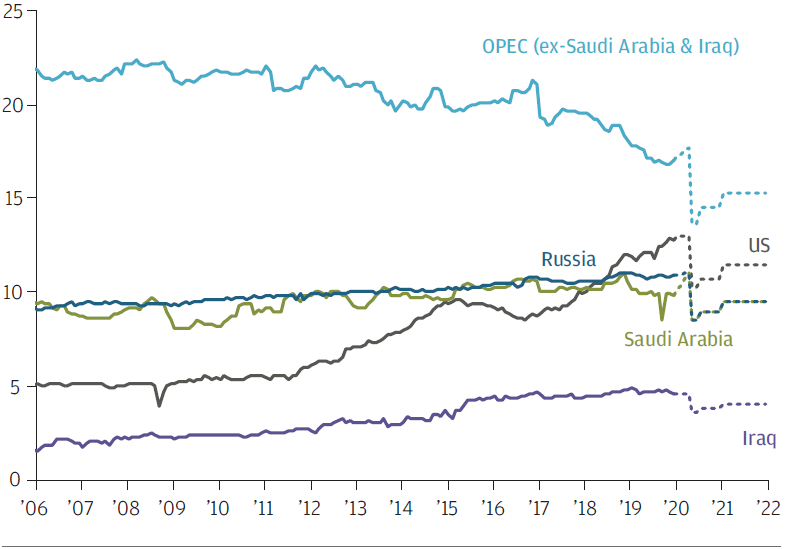
Source: EIA, Refinitiv Datastream, J.P. Morgan Asset Management. 2020 and 2021 data using dotted lines are J.P. Morgan Asset Management estimates based on announced cuts. Data as of 15 April 2020.

Despite the historic size of the announcement it is only a partial step towards the drop in oil consumption as the world’s major economies grind to a halt. An immediate rebalancing of the oil market was never realistic since many higher cost non-OPEC producers would have avoided a large share of the required production cuts. Oil inventories will therefore continue to rise in the short term, likely putting further pressure on storage capacity and oil prices over the next couple of months.

If producers stay compliant to the agreement, and if the major global economies start to ease containment measures form mid-year then fuel and oil demand should start to rise and oil market fundamentals could improve in the second half of the year. However, there remains a large ‘if’.

Even if virus containment measures ease in the coming weeks, the world is going to be awash in oil for some time – economies may be slow to get back up and running to a pace that would warrant a strong increase in demand, especially when it comes to international travel.

What does this mean for investors?

Equity and credit investors in energy can expect a couple more difficult months ahead, with fundamental headwinds and challenging newsflow. Corporate earnings will likely have further to fall and preserving liquidity will remain a main task for the time being.

While sectors such as airlines, logistics and selected industrial (such as chemicals) traditionally benefit from low energy prices, they also face bigger challenges on the demand side of their businesses. Low oil prices will also put pressure on commodity-exporting emerging markets, such as Russia, the Middle East and Latin America. However, this benefits importers in Asia, especially India, whose current account deficit position could benefit from cheaper oil.

It is often in challenging times like these when the foundations of the next upswing are laid. The weak players are dropping out and exploration companies are significantly reducing their capital expenditure. Today’s cancelled projects will be missed in three years’ time. So, companies that survive the “Great Glut” may be able to look forward to a more balanced oil market in the next five years than they have experienced in the previous five.

A good update from JP Morgan giving us an insight to the current oil situation. JP Morgan have great technical and market resources available to them and continuously provide useful insights.

Hopefully now we’ll see a drop in prices at the pumps!

Andrew Lloyd

23/04/2020

Team No Comments

A New World? What Will Happen After The Recovery?

A New World? What Will Happen After The Recovery?

We are living in interesting times now; you couldn’t have made it up. Apparently planning at the highest level in the UK dismissed talking about this global pandemic risk as it was too far-fetched. Things look different now.

I don’t need to describe the current situation as we are all living in it, let’s just say it’s a nightmare. But will any good come of it?

What happens next?

The health crisis will diminish with time and hopefully an anti-virus, ample testing and a vaccine. Globally, economies and markets will recover and life will return to normal or a new version of normal?

Personally, I think it will be the latter. The NHS and other Key Workers are our heroes, Boris owes his life to the skill, professionalism and dedication of the NHS. We will have massive debt as a country. This makes the 2008/2009 global financial crisis look like a stroll in the park!

A few points to consider:
1. We will have to raise taxes to pay for some of the accrued debt. This may not be straight away as the recovery will be fragile. Businesses will have to get back to normal and the consumer will need to start spending and increase spending as the majority of our economy is based on the consumer spend.

2. Some families (consumers) will have debt and very little or no income and will have to find new jobs or ways to generate income.

3. Businesses may have found different ways to do business with technology aiding many of their staff to work from home. Some businesses may decide they don’t need as many staff.

4. On the other hand, entrepreneurs and the technology used may have created new businesses or new sources of business for existing business helping them expand and grow as the UK recovers.

5. The NHS, Social Services and residential care need better funding. We have seen that the NHS has struggled with a lack of essential equipment (PPE) and some other countries appear to have been better resourced and able to cope with the virus with far lower mortality rates, for example Germany.

Societal Change?

Given all of the above are we likely to see a better society; one in which we value our NHS heroes and other Key Workers? I hope so.

Will this mean that we all pay a little more tax for the benefit of everyone? A society that is a little fairer? I don’t mean soft, if you are able to work ideally you should be working and contributing to society.

A society that doesn’t focus too much on money and what you can buy but genuinely values everybody for what they do or what they have done? We may also find it easier to make changes to combat global warming now we understand the damage nature can wreak on us and the power nature still has.

Although what we are dealing with now is pretty awful, hopefully the outcome, the world we live in after this crisis has gone or been controlled sufficiently, will be better for more people.

What do you think?

Steve Speed
20/04/2020

Team No Comments

Thoughts from Global Expert Investors

Thoughts from Global Expert Investors

As I’m sure everyone is aware, volatility in investments markets is currently at an extreme high and we have been helping our clients understand the implications that this level of volatility is having on their portfolios.

This blog is aimed to help investors understand how some of the most successful investors from around the world operate in trying market conditions and take the opportunity to invest as assets are lowly priced. It also aims to try and help reassure investors why now is not a time to panic, but to maintain the status quo or to take advantage of the low asset prices.

What the experts say

These quotes from some of the most successful investors illustrate how investing in stock markets can be a challenging yet rewarding venture, requiring strong research skills, a rational, dispassionate mindset, a long-term horizon and patience in equal measure.

Summary

As can be seen from the quotes above which are from some of the most successful investors from around the world, adverse market conditions should not be seen as a moment to run and hide, but as an opportunistic time to be invested and to make additional investments.

We are confident that fund managers in the market are already looking ahead and looking to purchase investments that might have looked too expensive to buy a couple of weeks ago.

To be invested in real growth assets, means you are willing to take a level of risk with your invested capital in order to have the potential to achieve greater levels of capital appreciation over the medium to long term than would otherwise be available by remaining in pure cash assets.

Time and patience are an investors friend at the moment, and it’s important that investors remain invested in order to reap the rewards of the eventual market recovery that will come, it’s just a matter of time.

If you would like to discuss the impact on your investment further, or perhaps want to invest additional capital, please do not hesitate to contact us.

Please keep safe and healthy.


Carl Mitchell – DipPFS

IFA/Paraplanner

27/03/2020

Team No Comments

State Pensions – What you need to understand well before you retire

When the new State Pension was introduced for those reaching State Pension age on or after 6th April 2016, the intention was to simplify the old system which was a State Pension system with multiple different aspects (i.e. the basic state pension, state earnings-related pension (SERPS), the second state pension (S2P) and the graduated retirement benefit).

The new State Pension is a single benefit paid to individuals who have made (or been credited with) 35 years National Insurance contributions.

Unlike the old system it replaced, the new pension is based solely on the contributions of the individual, with no extra amounts awarded based on contributions made by a spouse or civil partner and no inheriting of rights after the death of a spouse or civil partner.

This loss of the death benefits is just one of the major issues with the new system. Unfortunately, this is not widely known by the general public. Government should publicise this issue.

Apart from the obvious issues regarding longevity and possible legislation changes to the State Pension (including the possible loss of the ‘triple lock’*), one of the biggest issues is incorrect State Pension forecasts.

We wrote about this in a blog back in February 2017, https://www.pandbifa.co.uk/state-pension-forecast-wrong/.

Last year the former pensions minister Steve Webb (in partnership with the ‘This is Money’ website investigated this further and found that in some cases, new forecasts were more than £1,000 a year higher than had previously been expected. These cases were raised with DWP who initially said that these were isolated errors which had now been corrected.

However, there still seems to be issues, particularly around people who were members of Defined Benefit pension schemes that had been contracted out.

Commenting on the findings at the time, Steve Webb (who was also the Director of Policy at Royal London at the time) said: “People are increasingly encouraged to use online services to help plan their retirement, and the new pensions dashboard will rely heavily on such data. It is therefore very worrying that hundreds of thousands of people may have received incorrect state pension forecasts and in some cases will have taken decisions about their retirement plans on the basis of incorrect information. Now that the Government is aware of the scale of the problem, it must put an urgent stop to the issuing of incorrect statements. Individuals need to have confidence that the information they receive from the government is accurate and should not have to live with the uncertainty that a statement they have already received may be seriously incorrect”.

If you haven’t already, please visit https://www.gov.uk/check-state-pension to request a State Pension Forecast or call the Future Pension Centre helpline on 0800 731 0175 and request a paper copy.

We will issue new updates on the future of State Pensions regularly and we take this into account at each of our clients annual reviews.

Comment

In general terms the levelling out of the State Pension in April 2016 was beneficial to a lot of low earners and carers. This is good news.

However, for those of us who have lost significant death benefits from the State Pension, the spouse’s pension element from April 2016, advice should be taken to ensure that our long term partners have enough pension provision (or replacement for it) as soon as possible.

Don’t leave it too late, until just before you draw your State Pension. This could be a mistake that you can’t rectify at this stage.

If you wish to discuss any aspect of the State Pension or retirement planning, please contact us at enquiries@pandbifa.co.uk or call us on 0151 546 1969.

Andrew Lloyd 02/03/2020


*The triple lock is the method under which the State Pension increases each year. This is in line with whichever is the highest of consumer price inflation (CPI), average earnings growth or 2.5%.

Data Source: Royal London Press Release – ‘Minister forced to admit ‘significant’ problems as a third of a million incorrect state pension forecasts issued’ – June 2019