Team No Comments

Where are we now? (Part 1)

I had the privilege of listening to a webinar on Wednesday afternoon, which was hosted by Karen Ward from J. P. Morgan and also featured Dr. Gertjan Vlieghe.  Karen is JPM’s Chief Market Strategist for EMEA (Europe, Middle East and Africa) and Dr. Gertjan Vlieghe is a voting member of the Bank of England’s MPC (Monetary Policy Committee). 

The interview covered a wide range of important topics and I took notes in order to interpret the speakers’ key points.  Please note: Gertjan did point out that the opinions expressed where his views and not necessarily those of the Bank of England’s MPC.

Karen on the topic of the Pfizer vaccine:

‘A 90% efficacy rate is a ‘Game Changer.’  The timing is excellent (of the vaccine against the current backdrop of a high second wave of the virus).  How quickly will we get to that important point of herd immunity?’

Karen went on to ask Gertjan, ‘If the vaccine is distributed, could we be looking at a very strong bounce back in the second half of 2021?’

Gertjan replied, ‘Only if the vaccine works. In a way, the vaccine is already in the forecast. That is precisely what our central forecast is.’

Karen then asked, ‘What will you be tracking to assess the degree of long-term scarring?’

Gertjan’s response was ‘Unemployment dynamics – it’s difficult to all get back into a job.  There is still some slack in the economy and levels of unemployment will not come back down for a long time.  We will need stimulus.’

In relation to Brexit, Karen asked, ‘How is it going and what are the changes that will affect Q1 2021 and the longer term?’

Gertjan responded, ‘This is a longer-term issue. There is a trade-off between sovereignty and smooth and open trade.  It will have a purely economic consequence. We will have less trade, less competition and less technological diffusion.  This is very important for the country, but not for monetary policy.  It has also dampened investment (in UK businesses).  To what extent are UK firms ready?  How much disruption will there be in the short term?  How will financial markets react?  This will impact on monetary policy; it’s about how smoothly we transition.’

Karen on Central Banks, ‘Have Central Banks been monetarily financing governments?’

Gertjan replied, ‘On ‘Co-ordinated action’, I’m not entirely happy with it.’  Fiscal policy is doing the heavy lifting and monetary policy is helping. 

He continued to remark on QE (Quantitative Easing), ‘We expand reserves beyond what banks really need.  The macro-economic impact is very small and expansion in reserves does not lead to a proportionate response in lending.  In 2008/2009, re QE, we had no high inflation.  If inflation does come back, we know what to do; there is no constraint.’

Karen’s next question was, ‘Could a government less focused on austerity contribute to a higher velocity of money?’

Gertjan responded, ‘Completely, absolutely.  Timing is crucial in relation to the government flipping back into debt reduction mode.’

Karen then asked, ‘What can the Bank of England do to support the economy?’

Gertjan replied, ‘The impact of QE on the economy is state-contingent.  When market functioning is impaired, QE can have a big impact.  Expectations of future real interest rates are really very low.  The stimulus power (of QE) now is very low.  With regards to technical constraints, it’s important to understand that they are self-imposed – we can change the rules.’

Comment

This update is based on my interpretation and notes from the first half of the webinar’s discussion and I have tried to stay faithful to the content.

From my point of view, I was happy with the Dr.’s input as he obviously understood everything in detail and had no problem with any of the questions put to him by Karen.  He also gave me confidence (based on his views), that these people on the Bank of England MPC really do know what they are doing and are a great aid to the recovery of our economy in the UK.

Summary

Over the next few days, I will work on a precis for Part 2 of the webinar for you, which starts with a discussion on negative interest rates.

If you have any topics that you think we should cover on markets, advice or planning issues, please let me know.

Steve Speed

13/11/2020
Team No Comments

Vulnerable Clients

The FCA have always had a focus on Vulnerable Clients – in particular, how firms manage and deal with Vulnerable Clients.

Following Covid-19, this focus was heightened given the significant impact of Covid-19 on people’s health (both physical and mental) and finances (stock market drops or possible furlough/job loss).

A key element of the FCA’s focus is on the importance of protecting vulnerable clients at this time and firms should expect to receive continued and increased scrutiny on what they are doing to identify and deliver good outcomes for their vulnerable consumers.

What is a ‘Vulnerable Client’?

FCA Definition: A vulnerable person is someone who, due to their personal circumstances, is especially susceptible to detriment, particularly when a firm is not acting with appropriate levels of care.

In 2018 the FCA Estimated that 50% of adults display 1 or more characteristics that show potential vulnerability. This means that 24m adults in the UK showed signs of vulnerability.

Following COVID-19, it is now estimated that 1 in every 6 adults show signs of vulnerability.

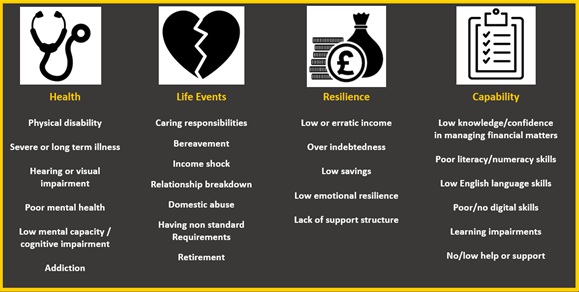
What are the 4 key drivers?

Given the broad scope of the drivers, it’s likely that most people will experience one or more of these drivers at some point in their life.

How do we support Vulnerable Clients?

We have implemented a Vulnerable Client Policy which details how we spot the signs of vulnerability and how we manage and support our client’s needs.

In addition to our policy, we regularly provide training to all staff regarding Vulnerable Clients to highlight our requirements as a firm, the drivers and impact of vulnerability and how to spot and manage vulnerability.

We have a Vulnerable Client Champion (that’s me!), to help make sure that we support clients in the best possible ways and to constantly review and challenge our own internal processes to make sure we are strong in our focus in delivering the right outcomes.

We make it our goal to make sure the fair treatment of Vulnerable Clients is properly embedded into our culture, policies and processes to make sure that we can provide clients with any additional support needs that may be required which helps us deliver the best outcomes for our clients.

Ensuring that this as embedded into our firm’s culture helps us support our clients during periods of vulnerability which is the time when they need it most.

This year has been challenging in many ways and we have recently reviewed our internal training and policies to ensure that we take the potential impact of Covid-19 in how we help provide the best advice and support for our clients.

As a firm, we don’t just look at helping our Vulnerable Clients as a regulatory issue, we do it because we support our clients at all times, no matter what life may throw at them.

We are all likely to be more vulnerable now following the pandemic and its important to remember, we are all in this together!

Andrew Lloyd

Vulnerable Client Champion

09/11/2020

Team No Comments

Market Update and Guidance

Market Update and Guidance – 29/10/2020

As we deal with the health and economic impact of the second wave of the virus in the UK and Europe, markets have hit another patch of turbulence.  We have seen heightened volatility over the last few days.

Why do we have this level of volatility?

The obvious answer is the global pandemic and the impact on our economies around the world.  In addition to this we have the US election and Brexit too to name just a few issues.

The US election has gridlocked the political system in the States and as a result badly needed additional fiscal support has not been forthcoming.  If we get a ‘Blue Wave’ for the Democrats and they are fully in control this gridlock could be resolved fairly quickly and fiscal support could be put in place.

Brexit negotiations rumble on and we could do with a positive outcome.  J. P. Morgan’s base case is that we will get a last-minute fudged deal but there is still a risk of a ‘No Deal’ Brexit.

Volatility could continue with further legs down even as economies and markets recover.  Given time markets and funds will recover.

What is the outlook?

The vaccine (or vaccines) are a key issue.  The consensus view appears to be that we will have a vaccine late this year or early 2021.  This will be a game changer.  Even if we can only protect our Health Workers and the vulnerable initially this should give consumers confidence to return to normal behaviour.

By the end of 2020 we should know who the next US President is, understand our Brexit position and hopefully have vaccines that are starting to be rolled out.

Are there any bright spots?

China and North Asia generally are doing well.  In particular the data coming out of China is really good and they appear to have recovered economically and are growing.  This could have a positive impact not just in the region but globally.

Some sectors have done well too, for example Technology.  We are also seeing more intertest in ‘Green Energy’ as the world starts to grapple with climate change.

Vaccine development is progressing at a pace too.

What might help?

More support from Central Banks such as the Bank of England, the ECB, and the Federal Reserve.  Generally, they look supportive and able to accommodate more help.  The IMF recently indicated that more support should be forthcoming from Central Banks.

Policy support from governments globally will help too.  We need to spend on infrastructure projects and focus on keeping people in work and getting back to work with training and apprenticeships etc.

A weaker dollar would be useful helping Emerging Markets trade and having a positive impact on global trade too.

As an investor what should I do now?

Maintain the status quo and stay invested in real growth assets.  If you are funding pensions and investments keep on funding.  Generally, asset values are low now and should show good returns over the long term.

If you have spare capital now is a good time to invest too if you have the risk appetite.  Buying assets at the right price is the key determinant of long-term investment returns.

Don’t try and time the market, you need time in the market.

Summary

The quote ‘The darkest hour is just before the dawn’ seems appropriate.  Said to emphasise that things often seem at their worst just before they get better.  The English theologian and historian Thomas Fuller appears to be the first person to commit the notion that ‘the darkest hour is just before the dawn’ to print.

We don’t know how long this ‘hour’ will be, but progress is being made.

Just be patient, we should be on the way to a brighter future and hopefully with the aid of vaccines our behaviours will become more normal and economies and markets will recover as our activities increase and life returns to normal, a new normal?

Steve Speed

29/10/2020

Team No Comments

Investment Risk

All investors should have an awareness of risk, but how many actually understand risk and the different types of risk that can come along with investing.

This blog is designed to give you a basic summary of all the different types of investment risk and highlights the importance of diversification within a portfolio of investments.

What is risk?

Everyone knows what risk is, in the simplest terms, risk is the possibility of something bad happening.

Investment risk is no different. Investment risk is defined as the probability or likelihood of losses relative to the expected return on any particular investment. This includes the possibility of losing some or all of an original investment.

Risk is an unavoidable part of the investment process, even so called ‘risk free’ investments are still exposed to a degree of risk.

Most investors simply think of risk in terms of their investment moving up and down in line with the stock markets, i.e. the market crashes for whatever reason, then the investment goes down. We all saw this earlier this year at the height of the Covid-19 outbreak.

However, in actual fact, this is only one type of investment risk. Investment risk can be split into many different types of risk.

The main two types of risk in investing are market risk and investment specific risk.

Market Risk

Market risk is also referred to as systematic risk. This is the risk that affects the markets as a whole and cannot be avoided.

This is the risk that the stock markets will go down (or in some cases ‘crash’) as a result of news or events, such as terrorist attacks, global pandemics (as we are all now very well aware), changes of government or changes imposed by governments (such as tax changes), changes in interest rates, inflation or other general changes in the economy.

Investment Specific Risk

This is also known as non-systematic risk. This is the risk specific to a particular company or investment and can be described as news or events that are specific to that particular company which is unrelated to the systematic risks described above. Examples of this type of risk include, technology breakthroughs which may make a product obsolete or a new competitor coming to the market offering the same product/service etc for potentially more competitive cost.

This can be avoided or diversified away by for example, including investments with multiple companies so that if the investment in one goes down, this will only be a smaller part of a portfolio of investments compared to having 100% of an investment in one company.

Other types of risk include the following;

Inflation Risk

Inflation risk is the risk that inflation will undermine an investment’s returns through a decline in purchasing power. Bonds and cash are most subject to inflation risk.

You may think that cash is a risk free investment however if inflation is higher than the interest rate then the real value of the cash is eroded as it will now buy less than it would have at the time of the deposit.

The best way to avoid inflation risk is by investing in ‘real assets’ such as equities, property etc, which are known to beat inflation over the long term, keeping only the necessary emergency funds in cash so that these are easily accessible.

Interest Rate Risk

Interest rate risk is the potential for investment losses that result from a change in interest rates. If interest rates rise, the value of a bond or other fixed-income investment will decline, and if they fall, the value goes up.

Changes in interest rates can be caused by the general economic cycle (booms, recessions) and government fiscal and monetary policy.

This type of risk can be reduced by investing in shorter duration bonds or in cash.

Credit Risk

Credit Risk mainly affects bonds. This is the risk that the bond issuer will fail (default) to meet their obligations to pay interest payments or return the capital invested. This can happen if the institution issuing the bond gets into financial difficulty or has its credit rating downgraded.

This can be avoided by investing in government issued bonds which are generally secure as they are government backed or by diversifying bond holdings as with investment specific risk, so that losses from one will not affect the others.

Currency Risk

Currency risk is the possibility of losing money due to unfavourable moves in exchange rates.

Investments that operate in overseas markets are exposed to currency risk. For example, if a UK based investor invests in a US Equity fund and Sterling strengthens against the Dollar. This erodes the real value of the Dollar dividends paid into the fund. If Sterling falls, the overseas investment tends to rise.

This can be diversified away by investing in a range different world markets, as not all currencies move in the same way at the same time.

Liquidity Risk

Liquidity is how easily an asset or security can be bought or sold in the market, and converted to cash.

Property is one of the most illiquid investments, how easy is it to release funds if needed if they are tied up in property? Again, diversification of investments can help with this type of risk.

Event Risk

Event risk refers to any unforeseen or unexpected event that can cause losses for investors in a company or investment. This links into market risk, investment specific risk and credit (default risk). For example if a company is unable to pay interest/dividends or return the capital invested due to a specific event (credit risk), either due to a global event such as terrorist attacks or war (market risk), or due to a specific event within a company (investment specific risk).

This can include events such as an industrial disaster such as oil spills. Event risk also incorporates the ‘acts of god’ events such as hurricanes, earthquakes etc.

As with market risk, certain events cannot be diversified away but for the more company or even industry specific risk, a well diversified portfolio can help with these elements of risk.

Political Risk

This is the risk that Governments (or potentially new governments in the lead up to an election) will change monetary or fiscal policies, such as increasing taxation.

However global political risk is also a contributor to the risk and volatility of UK investors.

For example, have you checked the stock markets (like the FTSE 100) lately? How many times do you see an article starting with ‘FTSE down (or up) as Donald Trump says… well ‘something controversial’?

Operational Risk

Operational risk is defined as the risk of loss resulting from inadequate or failed internal processes, people, systems or external events.

This includes the risk of the transaction failing to settle, fraud, misleading reports/ valuations, system failures, trading errors, regulatory risk and staff (human) errors.

Operational risk issues at investment banks are costly to address, but the reputational repercussions also can affect stock prices.

Note on Diversification

You can see from each of the types of risk, the best strategy for reducing risk is good diversification.

This reduces the risks of any one particular investment, asset class, market (i.e. UK, Emerging Markets etc). This minimises the chance of an overall portfolio suffering a loss and increases the probability of good overall investment growth.

However, it is important to note, that some risks cannot be diversified against.

Summary

Hopefully, this content has been useful in helping you understand the different types of investment risk and the need for diversification although some risks such as market risk, cannot be diversified against.

Its also important that you do not invest in any investment that is higher than your risk tolerance or capacity for loss and to make sure you a comfortable with the level of risk taken and the impact of any potential losses.

Please keep checking back for a range of blog content and insights from us like this blog, and updates and insights from a range of leading fund managers and investment houses.

Andrew Lloyd

07/10/2020

Team No Comments

Surprising UK Statistics: Personal Debt & Savings

People in the UK owed £1,681 billion by the end of July 2020, according to The Money Charity’s September issue. These figures have crept up by £28.4 billion comparatively from £1,652 billion at the end of July 2019. This adds up to an extra £539 per UK adult over the past year.

Currently, in England and Wales, approximately 28 people are made bankrupt, 51 Debt Relief Orders are granted, and 159 Individual Voluntary Arrangements (IVAs) are entered into – every single day.

Although there are many contributing factors relating to the above statements, much can be attributed to the events that have unfolded world-wide this year. Restrictions imposed as a result of the Covid-19 pandemic have resulted in job losses which has subsequently affected many people’s financial situation. Addiction, over-spending, and poor money management are also common reasons why one might find themselves ‘in the red’.

From the start of this year until the end of July, the Citizens Advice Bureaux in England and Wales dealt with 2,124 debt issues every day. As the furlough scheme comes to an end over the coming months along with the ban on evictions and the halt on bailiff action, it is likely that these numbers will only increase. How the state of our economy recovers and the consequent effects of this is also to be seen.

According to DWP, 12.8 million households (46% of the total) had either no savings or less than £1,500 in savings. Furthermore, it has been revealed that 19.2 million households (68% of the total) had less than £10,000 in savings.

The reasons why we should save are obvious; comfort can be taken from having cash reserves, particularly in times of crisis. Getting married, getting divorced, having children, or getting onto the property ladder are some examples of milestone events in our lives which often incur considerable cost.

Despite good intentions, it appears that saving is easier said than done. The FCA has revealed that 9 million UK adults rate themselves as having low financial capability in relation to personal wealth, money management, knowledge of financial matters and confidence in buying financial services.

Financial education from an early age in life is vital. We believe this is the game changer and should be a focus of Government, education, and charities. In summary, financial understanding is empowerment.

Chloe Speed

01/10/2020

Team No Comments

Tax & Politics

I listened to a technical webinar at the end of last week presented by Prudential and their senior political and technical staff here in the UK.  Following the cancellation of the Budget (was this previously a pre-Budget debate?) they were discussing what taxes might change when and the politics behind it.

Basically, it is a trade-off between what value any new tax might have (how much will it raise for the State?) balanced against the potential political damage any specific tax change may do.

Thankfully, on this basis a lot of the potential tax changes were discussed and dismissed as unlikely.  I don’t think this is the end of the matter, we will need additional tax for the State to pay for the support during the pandemic and strengthen our recently exposed weak spots, the NHS, residential care, social services etc.

We will also need more money to kick start the economy and help us deal with Brexit, fudged deal, or no deal.  As this is the case, when the economy is recovering, and the consumer is spending freely again (post vaccine?) we will see changes to the tax system.

Given the state of our economy and the outlook, the only thing we know with certainty is the tax position and legislation we have in place right now.  If you have the means, why not take advantage of the tax reliefs and planning opportunities that are available today?

It makes good sense to press on with any beneficial planning now using what reliefs are available today, we know the rules now.  For example, pension funding with higher rate tax relief within the pension contribution limits we have currently.

If you would like to discuss your own personal situation, please get in touch.

Steve Speed

29/09/2020

Team No Comments

Financial Advice and The Young Single Woman

Research conducted by Royal London found that people without a financial adviser were more likely to be female, single, earning around £20-£30,000, and under the age of 35. As a 27-year-old single woman, I fall smack-bang into the middle of this category and was disappointed (but not surprised) when the statement presented itself to me. After some research and a lot of self-reflection, I now feel obligated to provide an insight into the intricacies of this finding from a personal standpoint.

‘I don’t earn enough to seek financial advice.’

Talking about money does not come easily for most of us. It is a personal matter and can feel uncomfortable to discuss. Despite this, it is very important that we do talk about the ‘m’ word. At times, my perception of my own finances has made me feel that I did not earn enough money to warrant financial advice. I did not have enough self-confidence to approach a professional from the financial industry. I think my pre-disposed view of a testosterone-fuelled, overly male-dominated Wall Street had led me to believe that investing was not particularly catered towards women.

I am now aware, however, that specialised advice from a professional adviser can help me set realistic financial goals – and reach them. Ironically, my previous perception of my financial status meant that I denied myself the opportunity to strategically grow my wealth in the first place. To back this up, Royal London and the International Longevity Centre UK (ILC) found that, in the space of just 10 years, customers who had sought financial advice were, on average, £47,000 better off than those who had taken care of things themselves.

‘I don’t have time to seek financial advice.’

A young woman living in the 1950’s and 60’s was typically expected to marry, have children, and assume the role of primary caregiver. Times have (thankfully) changed and for the most part, women can now progress into further education and a career of their choice – should they wish to do so.  The ‘modern woman’ is her own person, has her own money, and can have it all. The only downside of this is that many women are required to perform a constant juggling act between family, friends, and career – often prioritising the needs of others before their own. Perhaps women of this day and age are just so busy living a full life, that they do not have time to seek financial advice?

As it turns out, we have plenty of time. On average, women live 5 years longer than men. Therefore, it makes sense for us to prepare for long-term financial stability and the best way to do this is with professional, preferably long-term, financial advice. One of Royal London’s key findings was that those who fostered an ongoing relationship with their adviser were up to 50% better off than those who had only received advice once.

‘I don’t believe that financial advice would benefit me.’

Money makes the world go round and most of us will experience ‘money worries’ at some point in our lives. New statistics from Fidelity International show that 47% of young women have had their mental health affected by financial worries, but only 12% surveyed would ask for help from a financial adviser. When I feel stressed or over-whelmed, I typically tend to seek advice from friends, family or even a work colleague. To improve my general well-being, I might go shopping, force myself to attend a spin class at the gym or perhaps even visit my GP if necessary.

This year, more than any other, has made me realise the importance of looking after my mental health. I recently realised that when I feel positive about my financial situation, I feel positive about myself. Good quality financial advice can improve emotional as well as financial well-being and the practice of sound financial planning in our 20’s and 30’s builds a strong foundation for a secure future.

And the uncertain times that we now find ourselves in makes the prospect of a secure future all the more appealing.

The year of 2020 has been challenging to say the least. Due to the Covid-19 crisis, the UK went into its first national lockdown on the 23rd March, and, by the end of April, my days had blurred into one self-isolated Groundhog Day. I had lost all sense of routine and was struggling to work productively from home. To add to this, my only form of contact with friends and family was via repetitive virtual quizzes. I was then furloughed and spent my days attempting DIY, and my nights battling anxiety caused by a looming threat of redundancy. It is now apparent that my concerns were not without rationale. New findings from the European Institute for Gender Equality and our Institute for Fiscal Studies indicate that women will be disproportionately affected by job losses as a result of the current economic conditions.

Bottom line; women have never been more in need of financial advice than they are now.

Women of the past fought for our right to vote. Today, we are still striving for equality in relation to the gender pay gap, and it now appears that we are stuck in a pensions gender gap too. Research undertaken by NOW: Pensions and the Pensions Policy Institute has revealed that women in their 60’s have an average of £100,000 less in their pension than men do. 

For me, when it comes to a lack of women receiving financial advice; the worst part of it is that this time, we have nobody to blame but ourselves. I, therefore, implore all women to seek financial advice. You may just unlock your financial potential…

Chloe Speed

24/09/2020

Team No Comments

Responsible Investing

Responsible investing, socially responsible investing, ESG, Ethical investing, these are all terms you will have seen us use this year in our blog content. You may have also seen these terms in the press lately, as the impact of the Covid-19 pandemic has really accelerated these issues and brought them to the forefront.

Research shows that demand for Environmental, Social and Governance (ESG) and sustainable investment focused portfolios has hit record levels.

As we have stated before, this is something that we believe this is going to become a long-term trend and our aim with our blog posts on this area is to help you understand what this is and keep you updated with movement in this area.

Ethical investing has been a traditionally niche market with limited options however with ESG (environmental, social and (corporate) governance) investment become ever more prevalent and the Covid-19 pandemic, there now seems to be turning point for accelerating client interest in this area.

Brooks Macdonald recently conducted a survey in which they asked 188 advisers whether they thought the current pandemic would speed up a transition to a greener, more equitable society.

The response was an overwhelming yes with 90% responding positively.

Global fund data provider FE fundinfo, also did some research and found that 55% of IFAs increased the amount of client money in ESG investments in 2019 and that more than four-fifths of advisers expected demand for ESG options to rise in the coming year.

Many ‘ethical’ or ‘ESG’ screened funds now outperform the more traditional (aka ‘non ethical’) funds and portfolios. Morningstar data examined almost 5,000 Europe-based funds and found that around 60% of sustainable funds have done better than their non-ESG peers over one, three, five and 10 years.

The focus on ‘greener’ investments may suggest that it’s just the ‘E’ in ESG that is currently in the spotlight however if you look at the impact of the Covid-19 pandemic and even the recent Black Lives Matter movement, these also put the spotlight on the ‘S’ and ‘G’, putting diversity and social equality (including employment conditions and healthcare) up at the forefront and may make people think about aligning their investment preferences (i.e. investing into companies which support diversity and equality) with their own personal views.

Brooks Macdonald also did some research last year in which 800 individuals were surveyed on their views on responsible investing. One of their findings was that interest was high across all age groups, however, it was the individuals under 40 that were the most engaged with this with 94% saying they already used a responsible investment solution or would be interested in doing so.

Responsible investing therefore gives us an opportunity to connect with the next generation of clients. As it’s the future generations who will feel the benefit of living on a ‘greener’ planet.

We have noted recently in our ESG blogs that we expect the regulators to hone in on ESG matters and that assessing client’ sustainability preferences be a key conversation topic when discussing investments.

The FCA has already indicated that sustainability risks should be appropriately considered in the advice process that investment objectives should include the understanding of clients’ responsible investing.

Hopefully, this is further ‘food for thought’ for you to start thinking about how can your personal views and beliefs align with your investment strategy?

We are already actively discussing ESG issues with clients on a regular basis and will continue to develop these conversations and use the feedback in our processes within the business.

Please keep an eye out for more posts on these themes in the future, this is something we are committed to as a business and to help our clients understand.

Andrew Lloyd

16/09/2020

Team No Comments

Prudential PruFund Growth Positive Unit Price Adjustments – 25/08/2020

Prudential PruFund Growth Positive Unit Price Adjustments 25/08/2020

I have just finished listening to Prudential about their quarterly update on their ‘PruFund’ range of ‘smoothed’ multi asset funds.

PruFund Funds are reviewed for their Expected Growth Rates (EGR) and their Unit Price Adjustments (UPA) on either a monthly or quarterly basis.  They also have daily smoothing limits too.

The good news is that there has ben no change to EGRs, on PruFund Growth this remains the same at 5.70% gross per annum for pension and ISA investments.

Further good news on the UPA follows for Series A and Series D PruFund Growth:

Series A                                2.73% increase to fund value

Series D                                2.74% increase to fund value

The difference in increase is accounted for by a slight difference in product charges.

Series A covers Flexible Retirement Plan pensions and the ISA product and Series D covers the Prudential Retirement Account, earlier investments.

Please note that Series E for later Prudential Retirement Account investments had a positive UPA of 2.58% applied on 25/06/2020 on a monthly review.

‘Smoothing’ can include further price reductions as well as possible increases.  Volatility will remain based on the current market situation and outlook.

Different charging structures will impact on actual net returns as disclosed in reports etc.

Should you have any questions on the above please do not hesitate to contact me.

Steve Speed

25/08/2020

Team No Comments

Invesco Weekly Market Performance Update

Please see this weeks Weekly Market Performance Update from Invesco which was published today:

The overall tone in forward-looking economic data remains broadly supportive, albeit with occasional disappointments, such as the EZ’s weaker than expected Composite PMI data. Beyond the (inevitable) strong post-lockdown bounce, however, the outlook remains less certain, reflected in continuing dovish comments from Central Banks and further fiscal support. Positive news on the vaccine front continues to come out, but widespread availability of a proven vaccine is likely to be a mid-2021 story rather than anytime sooner. Meanwhile on the virus front the situation remains mixed, with still high levels of new cases globally and the emergence of new clusters of inflections. But these generally have not been met by new aggressive lockdowns as authorities have so far reacted with only very localized and limited measures. With the Democratic Convention over and the Republican equivalent this week, the US Presidential and Congressional elections will increasingly become a major focus for investors as we move into the autumn. Another potential stumbling block for those looking for reasons to be more cautious on the outlook, even if history has shown that such concerns are often misplaced.

Global equities edged higher last week, with the MSCI ACWI in sight of its all-time high set in February. Gains were concentrated in the US, as all other major DMs saw modest declines. Small caps also fell. Value’s relative rally came to an abrupt halt, as Financials and Energy were weak and IT-related stocks boosted Growth. This weighed on UK stocks too.

Fixed income markets eked out modest gains across the board but are struggling to make sustained upward progress with yields at current levels and spreads in credit markets around their post-bear market lows. Government bonds were slightly ahead of credit, with IG ahead of HY.

The US$ recovered the previous week’s losses but remains close to its YTD lows against most major currencies. Commodities had a mixed week. Oil and Gold saw small declines, but copper appreciated.

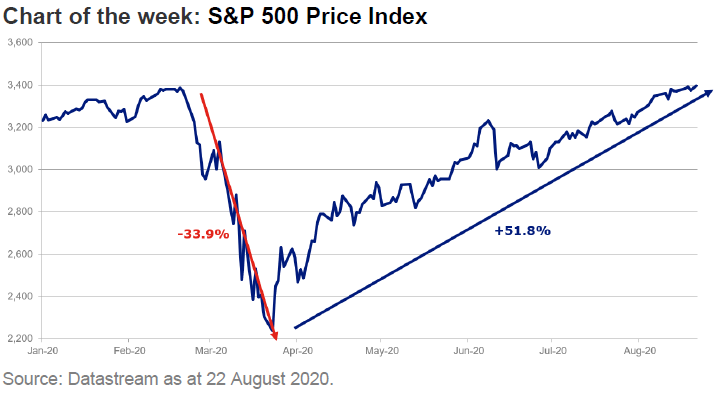
• After a precipitous decline of nearly 34% in just over a month in February and March, the S&P 500 has staged a spectacular rally off its lows, rising just under 52% since then and making a new all-time high last Tuesday. It is now up 5.1% YTD.
• The recovery has surpassed anything seen in other major DM equity markets. Japan (Topix), Europe (MSCI Europe ex UK) and the UK (FTSE All Share) are still respectively -8%, -13% and -21% below their YTD highs. EM equities have fared somewhat better and are now just -1% below theirs.
• The US’s rally has not, however, been exceptional compared to previous bear market recoveries. Post the GFC crisis the equivalent rise was 49.4%, so broadly the same. The difference then, of course, was that this was after a multi-year bear market, which saw the market fall materially further than this time around (-56.8%).
• And a rising tide has not lifted all boats, at least not equally. The equally-weighted S&P 500 remains 7.8% below its all-time high, highlighting that the rally has been mega-cap led. Apple (+71%), the US’s first $2trn company, Microsoft (+36%) and Amazon (+77%), the three largest companies in the index, have all seen outstanding performance YTD. But there are still around 150 companies that are down more than 20%, while more than half the market has not made any gains this year.
• What has driven the rally? It’s been all about a re-rating. The 12m Trailing PE has risen from 23.4x to 29x (based on Datastream data), with earnings down -15%. At 22.3x the 12m Forward PE has only been surpassed during the TMT bubble. It’s been a spectacular rally, but one that has left the market not without its risks against the backdrop of an uncertain economic outlook and expectations of a strong earnings recovery.

Key economic data in the week ahead:

• A light week ahead on the data front.
• While not data, the key focus of the week in the US will be the annual (virtual this time) Jackson Hole Symposium. This year’s symposium is entitled “Navigating the Decade Ahead: Implications for Monetary Policy”. On Thursday attention will be on Federal Reserve Chairman, Jerome Powell, and his expected comments on the Fed’s ongoing policy framework review, while on Friday Governor of the Bank of England, Andrew Bailey, will also be speaking. Outside this, Tuesday sees the Conference Board Consumer Confidence reading for August, which is expected to show a slight improvement compared to July but remaining depressed relative to pre-virus levels. Initial Jobless Claims out Thursday are expected at 925k from last week’s above expectations reading of 1.1m. The week ends with the Fed’s preferred inflation measure, Core PCE Inflation, on Friday, which is expected to show a sharp rise (0.5%mom from 0.2%mom). This outsized gain is unlikely to have a material impact on the Fed’s medium-term inflation outlook given that the drivers of this outperformance largely reflect payback from virus-related declines previously.
• In the UK the Lloyds Business Barometer on Friday is expected to remain relatively weak compared to the robust PMI readings that we saw last week. Nationwide House Price Index on the same day is expected to see year-on-year growth increasing to 2%, up from 1.5% in July.
• No data of note from China, the EZ or Japan.

Please keep checking back for regular updates on the markets from a range of investment managers.

Andrew Lloyd
24/08/2020