Team No Comments

Royal London: Economic and Market View Update

Please see below for Royal London’s latest market update received 29/06/2020. They provide an update on the impact of recent market events:

RLAM Economic Viewpoint

Survey data, high frequency data and now increasingly the hard data too, continue to show that developed economies are in the ‘recovery phase’ of this crisis. Albeit this is the somewhat mechanical bit as economies are allowed to open up and you get a bit of pent-up demand set loose as well. Some of the recent data points have shown much stronger than expected improvements. This, however, doesn’t tell us much about the next stage of the recovery that economists generally expect to be much slower. Social distancing, scarring (including permanent job losses, business closures and balance sheet damage) and residual fear of the virus (including as it relates to job security) will all influence the strength of that recovery and government policy still has a crucial role to play in all of them.

June business surveys improve substantially: Data in the past week or two has included several June business surveys and these have mostly seen solid improvements, with some notable upside surprises in European business surveys and US regional business surveys. However, the headline composite PMI business survey indicators for the US, eurozone, Japan and the UK remain below 50. Taken at face value, remaining below 50.0 would normally signal that these economies are still shrinking. However, mapping PMIs accurately to economic activity levels is somewhat hazardous after such a big shock to GDP (the survey asks whether things are better/worse, rather than by how much). Nevertheless, if you look at the commentary in the PMI surveys – social distancing has eased, helping many firms reopen and firms are more optimistic, but many companies also report weak demand as customers remain cautious. That is – so far – consistent with economies taking time (likely, several quarters) to get back to ‘normal’ levels of activity after a sharp initial recovery phase.

US data continue to suggest a strong start to the early stage recovery, but virus data more worrying: May retail sales, durable goods orders and some housing data have bounced significantly more than expected. However, US COVID-19 numbers have, in the meantime, become more worrying. The increase in virus cases in some states is likely to worry consumers, including the prospects of social distancing being reversed and the impact on job security. Meanwhile, Congress and the White House have still not agreed a package of economic support measures to replace those set to roll off this summer. US government policy interventions have so far done a good job in shielding household balance sheets (and therefore spending power) from the crisis. Reduced/disrupted fiscal support and the progression of the virus both have the potential to curb US recovery momentum.

Here in the UK, data also signal a solid start to the recovery phase but also a weak underlying labour market and an economy still in need of policy support: May retail sales were also an upside surprise, rising 12% in May. They are still 13.1% below February levels, but that’s a solid start to the recovery phase, especially since it was only mid-June that saw ‘non-essential’ retail stores reopen. Just as in the US, however, the UK’s early stage recovery has needed – and still needs – plenty of policy support. Government borrowing was also somewhat higher than expected in May and the levels of government debt as a percent of GDP, on the headline measure, moved above 100% for the first time since 1963. PAYE data meanwhile show the number of paid employees fell by 449K March to April. Early May estimates indicate another drop of 163K. Job vacancies in May fell to a record low. The furlough scheme is set to start unwinding from August, but this is a labour market that is far from out of the woods yet. That was recognised by the Bank of England who extended their asset purchase programme, though reduced the pace. They have become more concerned about long-term damage from the crisis. How the labour market evolves from here will be a key driver of their decisions going forward including, potentially, a decision around negative rates.

Market view from Piers Hillier, CIO, RLAM

The upwards trend in global equity markets was met with some resistance this week, resulting in sideways equity trading and moderate credit spread widening. Investors were perturbed by a sharp increase in Covid-19 cases in the US as the country reported a record number of new cases on Thursday. While the coronavirus appears to be under control in most developed countries at this stage, global new case numbers are at record highs; driven by the US, Brazil and India. In an effort to mitigate the damage of a second wave, US regulators gave in to a long-sought demand for a relaxation of the Volcker Rule as they allowed banks to invest in hedge funds and private equity funds.

Markets have also been rocked by increased global trading tensions. There have been signs of further difficulties in the trade negotiations between the US and China. Meanwhile the US threatened to impose tariffs on $3.1bn of European products, prompting an angry response from the European Commission.

On a more positive note, numerous key economic data releases have been far stronger than anticipated recently. There have been strong improvements in US and UK retail sales and in the European and US business surveys. While activity surveys are still consistent with contractions in many economies, possibly reflecting the elevated corporate debt and unemployment levels, they show that businesses are markedly more upbeat as they emerge from the worst of the lockdowns.

Reflecting a perception that the UK economy is somewhat stronger than expected, the Bank of England surprised investors at its latest meeting. While it announced an additional £100bn of bond buying, as had been expected, it slowed the pace of its purchases. The Bank said it would spend the £100bn by the end of the year, rather than by the end of August as the market had hoped. Of course, the very fact that spending was increased reveals the fragile state that the Bank considers the economy to be in, with serious concerns over the unemployment outlook.

The focus for many in the UK has been on further opening of businesses – both non-essential retail in mid June, and with the prospects of pubs, restaurants and others opening from early July. As investors we are pleased to see this – we are under no illusions that we as a society will return to prior habits in terms of spending; many of us will feel differently about being on a train, plane or in a restaurant for some time. And with other countries seeing flare-ups in the virus, it is clear that this road will have a number of bumps in it. However, it does appear that we are now through the first phase of this crisis, and returning to a more normal cycle of data and market reaction.

Royal London is the UK’s largest mutual life, pensions and investment company. This in-depth market outlook by a market leading financial services organisation adds valuable insight to our consensus view of the markets. It is evident that in recent times these views have been dominated by the Coronavirus Pandemic, but we have also now been offered insight into the socio-political tensions that have recently risen, particularly in the US, and how they in turn are effecting the economy. This is an example of how frequently reviewing these updates gives us a better view of the ‘bigger picture’.

The opinions of market leaders are key to keeping our understanding of the markets up to date. A wide variety of these views from different sources help us paint a more accurate picture on the events of the world and how they are influencing market behaviours.

Paul Green

30/06/2020

Team No Comments

Legal and General: US Update

Please see the below update from Legal and General posted yesterday (29/06/2020) regarding the current situation in the US.

Their Asset Allocation team discuss their thoughts on the presidential election, the market’s likely reaction to what could happen, and the ongoing spread of Covid-19 in some states.

The electoral collage

Momentum is clearly with Joe Biden at the moment. Donald Trump’s handling of the pandemic and protests after the death of George Floyd have eroded his approval rating and have led to him losing ground in poll after poll.

Biden has always held a lead in national polls, but that advantage in poll averages has jumped from 4% in May to 10% now. Arguably even more worrying from Trump’s perspective are polls in swing states also shifting significantly towards Biden, and losses of support among both older voters and even his most reliable base of ‘white, no college’ voters.

Nevertheless, don’t count Trump out (again)! Our baseline remains that it will be a tight race to the end. The heat Trump is taking from the dual crises could calm down and the economy may well look stronger by November. Trump’s strategy again seems to be all about turning out his base. If he can get all of the 35-40% of voters that back him no matter what to turn out to vote, then it will take much more excitement about Biden from the rest of the electorate than is evident so far for him to beat Trump.

It should go without saying that it’s still early in the race and a lot can and will happen. To mention only a few wild cards: What will the economy look like in late October? What if there is a second wave of the virus in the autumn? What if a significant number of people get sick after Trump rallies? What if states need lockdowns on election day? What if targeted lockdowns inadvertently favour Democrats or Republicans? What if COVID-19 influences turnout differently among age cohorts? What if Trump or Biden themselves become ill?

Blue wave versus Trump 2.0

We would not expect a big equity market reaction to any type of divided government. If Trump wins, it would be roughly the status quo; under Biden, it would likely prevent many of the most market-moving policies in either direction.

Yet a Biden victory of any flavour could still bring a few market-related policy changes. America’s China policy would largely remain unchanged in substance, but could become less volatile in style. A multilateral approach to China should make an all-out trade war with the EU less likely. Tech regulation should continue to tighten gradually but, unless personnel choices say otherwise, this has not been a policy area Biden about which has shown particular passion. Generally, expect the policy direction to be more social, more green and more redistributive.

On the other hand, a ‘Blue Wave’ in which Democrats control Washington would be the most market-moving outcome, in our view; this has become the single most likely outcome in betting markets. In short, from a market perspective, this would imply higher corporate taxes and more fiscal spending. Even if these two ultimately balance each other out, the market’s gut reaction seems likely to be negative.

And what would Trump 2.0 look like? The desire to be re-elected has arguably been a moderating force on Trump’s policy choices around issues like the trade war. But in a second term this factor disappears. So what does Trump want to achieve with a second term? Money? Power? Policy? Legacy? Dynasty? We don’t have a clear answer for this question yet. Either way, it is unlikely that Trump 2.0 will be calmer than Trump 1.0.

The only two things we are certain of are that the campaign will get very ugly, and that if Trump loses he will not go quietly into that good night.

Houston, we have a problem

The virus continues to spread at an alarming pace in southern states, with the one-week change approaching Italian peak levels in California, Texas and Florida – a risk James highlighted over a month ago. We don’t think this is due to greater testing (which would dilute the share of positive test results). State governors are becoming concerned, with some Texan cities suspending elective (non-urgent) surgeries to free up hospital capacity.

By and large, the re-opening of the local economy is being ‘paused’ rather than ‘reversed’. But new research from the University of Chicago argues that lockdowns only account for 7% of the loss of economic activity. Instead, it is fear that prevents people going out. The study calculated this by examining economic activity in border towns located between different regulatory regimes.

Apple mobility data also suggest Texans are already cutting back on activity, and there appears to be an inflection point with activity levelling off in the median US state.

From a market perspective, there has been a tug-of-war between economic data continuing to paint a V-shaped recovery picture and deteriorating virus newsflow. We would argue that equities are pricing something at the optimistic end of our Scenario 1, implying there will be little market tolerance of signs the virus is significantly slowing down the economic recovery. But at the same time, the starting point for sentiment is already slightly bearish, so it would not take much of a correction to turn our sentiment signals much greener.

As you can see from this update (and from the news!), the situation in the US looks problematic, with no resolution in sight. The run up to a presidential election is always volatile and this one is likely to no different (if not worse due to the Covid-19 situation).

It will be an interesting few months for the US in the run up to November.

Keep an eye out for further updates here on the US and the impact of their Covid-19 and election struggles, and of course general market updates and other content which we continue to post regularly.

Andrew Lloyd

30/06/2020

Team No Comments

Jupiter: The acceleration of sustainable investment themes

Please see the below article posted by Jupiter earlier this week from their Global Sustainable Equities Fund Manager, Abbie Llewellyn-Waters:

‘Several sustainable themes have continued to accelerate as a result of the Covid-19 crisis, said Abbie Llewellyn-Waters, Fund Manager, Global Sustainable Equities.

Firstly, momentum for environmental policy has gathered pace, despite the fragile state of the global economy. Policymakers have been quick to draw the link between the coronavirus and the environment – like viruses, greenhouse gases care little for borders. The debate around carbon policy, and specifically carbon tax, has notably accelerated. Abbie remarked on the recent write-downs and substantial price disparities within the oil sector as a further pressure point for tightening carbon policy.

There has also been important research quantifying pollution reduction, one of the few positives from this crisis, said Abbie. As a result of the global measures to combat Covid-19, the IEA expects global CO2 emissions this year to decrease to levels of 10 years ago. This is significant and could support the case for a more agile economic culture that includes more working from home. It is effectively an ‘investment-free’ solution to help deliver the legal commitments of the Paris Agreement.

There also continues to be strong momentum in human capital management within the sustainable companies that Abbie and the team focus on, with an increasing correlation between low staff turnover and high recurring revenue models.

Finally, another interesting new theme is the increasing attention on sustainable supply chain management. For years, efficiency has been the overriding aim in supply chains – “just enough, just in time”. Covid-19 has shifted the focus to security. While this has implications for working capital, it also offers new revenue opportunities. For example, infectious diseases have previously been mischaracterised as an issue mainly for developing markets. But a company Abbie recently spoke with highlighted that R&D investment into non-Covid infectious diseases in developed markets has already increased, which has the potential to create entirely new revenue streams not previously captured by analysts. All in all, Abbie expects the journey ahead to be much more complex than the markets rally suggests.’

Socially responsible investing has now gone mainstream and is a key focus for investors with a ‘put your money where your values are’ approach becoming more and more common.

ESG (Environmental, social and governance), which is a ‘set of standards for a company’s operations that socially conscious investors use to screen potential investments’ is now under the spotlight in this industry.

Keep your eye out for more blog content on this over the next few months as we at People and Business, develop our own ESG processes and scrutinise these criteria within the companies we use for our clients.

Andrew Lloyd

26/06/2020

Team No Comments

PruFund Series E ‘Smoothed’ Funds Update – 25/06/2020

Hot off the press, I’ve just come off a webinar update from Prudential notifying us of the following positive Unit Price Adjustments (UPAs):

Series E only

PruFund Growth                            + 2.58%

PruFund Risk Managed 4             + 3.00%

PruFund Risk Managed 5             + 2.56%

The underlying unsmoothed assets were tested against the smoothed prices, the corridors, at 10.56 this morning.

You might ask why we have different UPAs for the different versions of PruFund?  For the following reasons:

  • Different asset mix
  • The starting position
  • Different smoothing limits

The last point, different smoothing limits, doesn’t apply to the three funds we use noted above.  The monthly smoothing limits in use for the funds we use is 5%.

Please see this link for details on how ‘smoothing’ works:

https://www.pruadviser.co.uk/pdf/PRUF1098101.pdf

We could see further UPAs down as well as up, the outlook is for ongoing volatility.  We have a lot of risk in the market globally at the moment.

Steve Speed

25/06/2020

Team No Comments

Brewin Dolphin Update: Markets in a Minute 23/06/2020

Brewin Dolphin’s weekly market update, emailed on 23/06/2020 as below:

Global shares rebounded last week but have still not made up for the losses incurred in the previous week’s sell off. Equity indices in the US rose yesterday and Asian markets were flat or slightly up, while in the UK and Europe, share markets closed down. However, markets got a boost today after President Trump said that the Phase 1 trade agreement with China was still “intact”. As a result, Asian markets closed higher on Tuesday, while equities in the UK and Europe were heading up in early trading.

Last week’s gains*

  • FTSE100: 3%
  • Dow Jones: 1%
  • S&P500: 1.85%
  • Dax: 3.2%
  • Nikkei: 0.77%
  • Hang Seng: 1.4%
  • Shanghai Composite: 1.6%

*Data to close on Friday 19 June

Virus treatment breakthrough

The positive news on the virus front was that Dexamethasone, a cheap, widely available corticosteroid significantly reduces death rates in severely sick Covid-19 patients. Sadly, this doesn’t slow transmission and is therefore unlikely to materially affect the willingness of policymakers to allow a full resumption of economic activity.

Cases rising globally

And there wasn’t much more good news on the virus front.  The big picture globally has not changed; the trend in new cases remains up, driven by increasing numbers in emerging countries such as Brazil, India, Pakistan, Mexico, Saudi Arabia, Bangladesh, Indonesia and South Africa.

Perhaps the most worrying growth is in the southern states of America where hospitalisations are beginning to put real pressure on ICU capacity in Alabama and Arizona.

A new outbreak in Beijing has hopefully been rapidly suppressed, albeit at the cost of intensified lockdown efforts in one of China’s most important cities.

The trouble with easing lockdowns…

In Europe case numbers have stopped falling and, as efforts have switched towards reopening the economies, there has been a clear failure to decisively suppress the virus.

This is particularly marked in the UK where we are less than two weeks away from the Fourth of July, when bars and restaurants could be allowed to reopen. Boris Johnson is due to make an announcement on the reopening of parts of the hospitality sector this week.

UK case numbers have stopped falling which must make it difficult to proceed with lifting lockdown at anything other than a very cautious pace.

Wall Street not so far from Main Street

Whilst there is a lot of scepticism about how the recent rally in markets is disconnected from the real economy, our research shows that, in the US at least, the retail sector has proven to be freakishly well-aligned with the stock market after rebounding strongly in May. Where it is disconnected is further upstream, with industrial production barely staging any recovery at all.

US Retail sales vs S&P 500
Source: Refinitiv Datastream June 2020

Chinese stimulus

After holding off from their traditional recipe of credit and infrastructure growth, the Chinese authorities have found themselves resorting to that playbook again. Excavator sales have picked up as fixed asset investment by state owned enterprises has begun outperforming private sector investment, just as it did during 2016. Money supply growth has been picking up and the authorities are particularly keen to see funds deployed to Chinese small and medium sized enterprises which account for 80% of Chinese employment.

UK asset purchases to slow down

It is far from clear how the Bank of England would react to supply shock-induced inflation, but for now the policymakers remain in reasonably dovish mood.  The Bank kept interest rates unchanged last week but increased its asset purchase target by £100bn. However, it is spreading that out over the remainder of the year, rather than the next three months, marking a marginally more hawkish announcement than had been expected.

That saw a rise in gilt yields as it means net issuance (i.e. bonds not bought by the Bank of England) is likely to be higher over the coming three months, although we don’t yet know how evenly the Bank will spread out its purchases. We think there may be modest upside for yields, notwithstanding the Bank’s generally dovish mindset. Recent movements in commodity prices, the rally in oil and a slight pickup in economic activity would all be consistent with rising gilt yields.

Pull out quote suggestion “UK case numbers have stopped falling which must make it difficult to proceed with lifting lockdown at anything other than a very cautious pace.”

Capital and income from it is at risk.

Neither simulated nor actual past performance are reliable indicators of future performance.

Performance is quoted before charges which will reduce illustrated performance.

Investment values may increase or decrease as a result of currency fluctuations.

The information contained in this document is believed to be reliable and accurate, but without further investigation cannot be warranted as to accuracy or completeness.

A good input from Brewin Dolphin with regards to the global shares rebounding last week. The weekly market updates from Brewin Dolphin are useful given the current volatility we are experiencing.

Keep checking back for regular up to date blog posts.

Charlotte Ennis

24/06/2020

Team No Comments

Legal & General Investment Managers – Investment Update

Please see below a blog received yesterday from Legal & General Investment Manager’s (LGIM) Asset Allocation Team, which outlines their team’s key beliefs within the markets at the moment.

As you can see from the above, global economic stimulus is expected and this will present some medium to long-term opportunities for investing. It remains important to stay invested in order to benefit from the economic impact of the proposed stimulus measures.

Please continue to check our Blog content for the latest investment, markets and economic updates from leading investment houses.

Please keep safe and healthy.

Carl Mitchell – Dip PFS

IFA and Paraplanner

23/06/2020

Team No Comments

AJ Bell Article: EU gears up for its next challenge

Please see the below article by AJ Bell received yesterday (Sunday 21st June):

This week’s online meeting of the European Union’s members to debate the proposed €750 billion COVID-19 recovery plan is vitally important economically and politically. For progress to be achieved and help offered to those who need it, amid predictions that EU GDP will drop by 8–12% in 2020, all 27 nations must agree on:

  • the amount of money to be spent, on top of an EU budget of some €1.1 trillion (itself a matter of some friction between member states);
  • the conditions for awards of the capital available, which appear to include both green and digital criteria for would-be recipients;
  • how the money is to be spent, and the mix between loans and grants; and
  • how and when the money is to be repaid and over what time period, starting in 2027.

The discussions are therefore an opportunity to present a united front, tackle the viral outbreak and shore up the EU edifice at the same time, just as the Brexit negotiations with the UK start to heat up again.

Coming of age

“From the narrow perspective of investing in stock markets, it seems that global capital is yet to be fully convinced by the merits of the European project.”

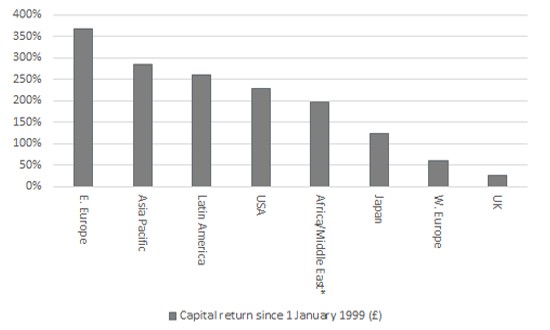
From the narrow perspective of investing in stock markets, it seems that global capital is yet to be fully convinced by the merits of the European project. The sterling-denominated performance of the Stoxx Europe 600 index ranks it seventh out of eight in capital terms since the euro came into being on 1 January 1999.

This poor performance may reflect the lingering effects of the debt crisis that first boiled over a decade ago, as well as the difficulties of providing a solid financial platform with which to support political union, in the absence of fiscal and banking union to support a single currency and unified monetary policy.

EU stock markets have lagged badly since 1 January 1999

Source: Refinitiv data. Capital return in sterling terms. *MSCI Africa/Middle East since inception in September 2003.

It may also reflect the different aims and needs of the 27 member states which are again becoming apparent as the recovery plan and budget come up for discussion.

The most serious questions of the plan are being asked by the so-called Frugal Four of Germany, Denmark, Austria and Sweden.

Failure to agree, in the twenty-first year of the existence of the single currency, would raise existential questions about the euro and the EU’s purpose and usefulness. Government is there to provide assistance in times of crisis above all others and, were the EU to fail to offer help to those nations which COVID-19 has treated most cruelly – notably Italy and Spain – then scope for further local disaffection with the supra-national powers in Brussels is considerable.

“Those nations which COVID-19 has treated most cruelly – notably Italy and Spain – suffered the most in the wake of the debt crisis that started in earnest just under a decade ago. Stock markets clearly believe they have not enjoyed anything like the same degree of economic benefits from monetary union as Germany.”

After all, these countries suffered the most in the wake of the debt crisis that started in earnest just under a decade ago. Stock markets clearly believe they have not enjoyed anything like the same degree of economic benefits from monetary union as Germany. (Eagle-eyed investors will note that two of the three best-performing developed European stock markets since the euro’s launch do not even use the single currency).

In stock market terms, the north looks like a clear winner under the euro compared to the south

Source: Refinitiv data. Capital return in local currency terms.

Great divide

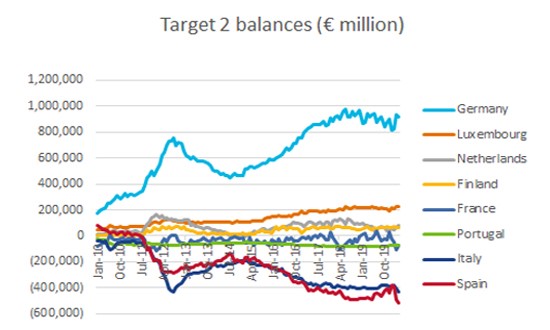
This north-south divide can be seen in another way, via the TARGET2 payments mechanism.

TARGET stands for ‘Trans-European Automated Real-time Gross Settlement Express Transfer’ system. In essence, the system is there to help balance trade flows but it could also reflect capital flows. Supporters argue that the TARGET2’s smooth functioning shows that it balances out the capital needs of the EU’s member nations. Sceptics assert that TARGET2 merely highlights huge capital flight from the south to the north and Germany in particular.

Germany’s TARGET2 surplus is still swelling even as French, Spanish and Italian deficits grow

Source: European Central Bank

No harm is done – unless an EU member defaults or drops out of the monetary union. Then those which have a positive balance are on the hook for the deficits of the member in the red. This may be why the €750 billion recovery plan alarms the Frugal Four, as they fear it could be the first step to debts being aggregated and funded at EU level, potentially leaving them to subsidise what they see as the spendthrift southern members.

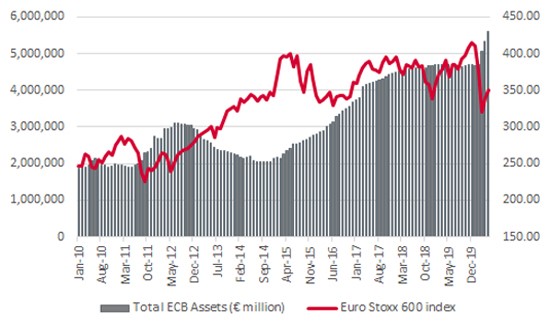
“The European Central Bank is doing its bit to keep the plates spinning and, as is the case elsewhere, quantitative easing (QE) is boosting equity and bond markets to at least create some kind of feel-good factor.”

The European Central Bank is doing its bit to keep the plates spinning, as it holds headline interest rates at zero and its €650 billion expansion of the Pandemic Emergency Purchase Programme (PEPP) to take the total to €1.35 trillion. As elsewhere, that quantitative easing (QE) largesse is boosting equity and bond markets to create some kind of feel-good factor.

More QE from the ECB boosts European equities

Source: European Central Bank, FRED – St. Louis Federal Reserve database, Refinitiv data

But whether QE provides a lasting solution is unclear. The cost of meeting each crisis – 2007–09, 2011–15 and now COVID-19 – is becoming ever greater each time. The euro is under less scrutiny than it would be, even if has lost 84% of its value against gold since its launch, because sterling, the yen and the dollar are also at the mercy of identical monetary policies (and all are down by more than 80% against the metal, too). Investors may not welcome another round of patch fixes and last-minute fudges from the latest series of talks, especially if they only serve to stoke further support for anti-EU parties in the south, should those nations start to feel neglected again.

This article was written by AJ Bell Investment Director, Russ Mould, who has been in that role since 2013. Prior to that he was a Fund Manager from 1991.

Views from experts in this industry help give us a view of the ever-changing landscape.

Keep checking back for our regular blog posts and updates.

Andrew Lloyd

22/06/2020

Team No Comments

A.J. Bell – Understanding portfolio attribution on a multi-manager active portfolio

Please see below an article received today and published by A.J. Bell last Friday (12/06/2020) detailing the importance of fund research and diversification during adverse market conditions.

At first glance, fund-by-fund level attribution of any multi-asset active portfolio may appear confusing, with a mirage of both reds (negative relative returns) and greens (positive relative returns). The AJ Bell Active MPS attribution is no exception, and a number of the underperformers have significantly struggled on a relative sense. However, we actually take great comfort in this picture, as too many negative returns – or, indeed, too many positive returns – could indicate a mismanagement of risk and a lack of diversification. Holistically speaking, the AJ Bell Active MPS performance has been pleasing, both since the product’s launch and through the crisis experienced in March 2020, with an encouraging track record when compared with likeminded active peers.

The unspoken truth about single-strategy active fund performance is that most fund managers take on inherent biases through their investment style exposure. This can, on its own, largely explain much of the performance attribution analysis and is the very reason that performance profiles can be very volatile against an index. A fund manager’s performance can be very strong for many years, during which they get heralded as ‘stars’, only to give back some or all of the relative return (against a mainstream index) in the subsequent years, as the market environment changes and their style goes out-of-fashion – often in a dramatic sense, too. They then get labelled as ‘duds’, or other more disparaging terms. For this very reason, the fund research element of the process at AJ Bell is driven by qualitative analysis. Our quantitative screening process is not, therefore, the dominant factor, but more a useful tool to sense-check our understanding of what a fund could achieve in different market environments. It’s only when you understand this about a manager that you know whether they’ve had a favourable tailwind or been pedalling into a headwind.

In building portfolios, we first and foremost want to invest with conviction and back the fund managers we truly believe can deliver to their stated objectives through multiple market cycles, and in a repeatable manner. This should help the portfolios at AJ Bell to deliver better risk-adjusted, long-term returns. At the same time, the whole portfolio should always maintain diversification by both fund manager and investment style.

Typically, the crystal ball tends not to be very reliable and so, when considering asset allocation, rather than forecast macro events and capital market reactions or market peaks and troughs, our preference is to judge what value creation or destruction remains in an asset class. With diversification in mind when constructing portfolios at AJ Bell, we look to award capital to a number of fund managers with different inherent biases. This leads to blending fund managers, which may not necessarily neutralise all risk factors, but certainly mitigates unwanted risks. Otherwise, there is a very real risk that you will end up with one big momentum portfolio that looks great initially, but then runs out of steam when the wind changes direction.

Therefore, it should not be surprising to learn that the Active MPS portfolios tend to be fairly neutral on investment-style risk against our benchmark by owning offsetting positions. These offsetting positions do not necessarily have to be in the same regions, as we consider the portfolio in total. The portfolios have held a couple of funds which have strongly underperformed on a relative sense and, much like any index fund, the portfolio as a whole is exposed to a whole host of factors at any one time. For instance, whilst the first quarter return of 2020 for the Fidelity Index World fund was circa -15%, the large- and mid-cap value stocks within that portfolio equate to around one third of the exposure and yet nearly two thirds of the fund’s performance detraction. A similar pattern can be seen in the active portfolios, whereby one or two funds have heavily detracted from returns but are offset by other funds held.

The value investment style has come under immense pressure over the past three years, as it has significantly underperformed its growth counterpart, a phenomenon that continued throughout the crisis occurring in March 2020. As a result, any fund which is biased towards value is more likely to have experienced severe underperformance against its mainstream respective index, depending on the extent of its skew. This is one of the key reasons behind the extensive effort directed towards fund research, with thorough research being undertaken prior to initiating any position. This is imperative so that a fund manager’s investment process and philosophy is fully understood – while we also delve under the bonnet and spend time understanding individual stock positions, sectors and themes. This enables us as investors to clearly and concisely understand what to expect from any fund behaviour (excluding poor stock selection, of course).

Across the active MPS range, the funds that should resonate with you while considering the content of this article are Man GLG Japan CoreAlpha, Lazard Emerging Markets and D&C Worldwide US Stock; all have had poor relative performances since our launch over two years ago. While we continually challenge our initial investment thesis, when we stand back and check the facts (aside from a spell of poor performance since our initial investment at the launch of the portfolios), these funds continue to behave in a manner that is expected given the market conditions. These funds therefore remain very relevant within the portfolio to play the part for which we awarded capital to them in the first place – and so they live to fight another day!

Value as an investment style remains extraordinarily cheap these days, and we hold confidence in these funds. When the time comes that markets rotate away from growth and start rewarding value stocks, these value funds could be in the right place to benefit handsomely. However, we are the first to admit that we don’t know when that point will be and, as a result, we never bet the ranch on any one view. As such, you should always expect to see a diverse range of holdings in our portfolios, that in isolation may perhaps look questionable, but remember: it’s how the holdings work together that’s important, not necessarily what they do on their own. That is the benefit of portfolio diversification.

Please continue to check our Blog content for the latest economic and market updates from leading investment houses and professionals.

Please keep safe and healthy.

Carl Mitchell – Dip PFS

IFA and Paraplanner

18/06/2020

Team No Comments

Brewin Dolphin Update: Markets in a Minute 16/06/2020

Brewin Dolphin emailed their weekly market update on Tuesday evening (16/06/2020) as below:

Another good quick update from Brewin Dolphin. These ‘Markets in a Minute’ updates they post weekly give you a good insight without getting overly in depth or technical, just the key points from the week.

Andrew Lloyd

17/06/2020

Team No Comments

Royal London Market Update

Please see below two articles uploaded by Royal London yesterday (15/06/2020). These articles provide an update on the latest market view and economic view according to Royal London.

As you can see from the above, markets remain volatile and it is important to remain invested in order to achieve your long-term goals.

Please continue to check our Blog content for the latest investment, markets and economic updates from leading investment houses.

Please keep safe and healthy.

Carl Mitchell – Dip PFS

IFA and Paraplanner

16/06/2020