Team No Comments

Invesco – Investment Market Update

Please see below the latest market update which was published by Invesco today (13/07/2020):

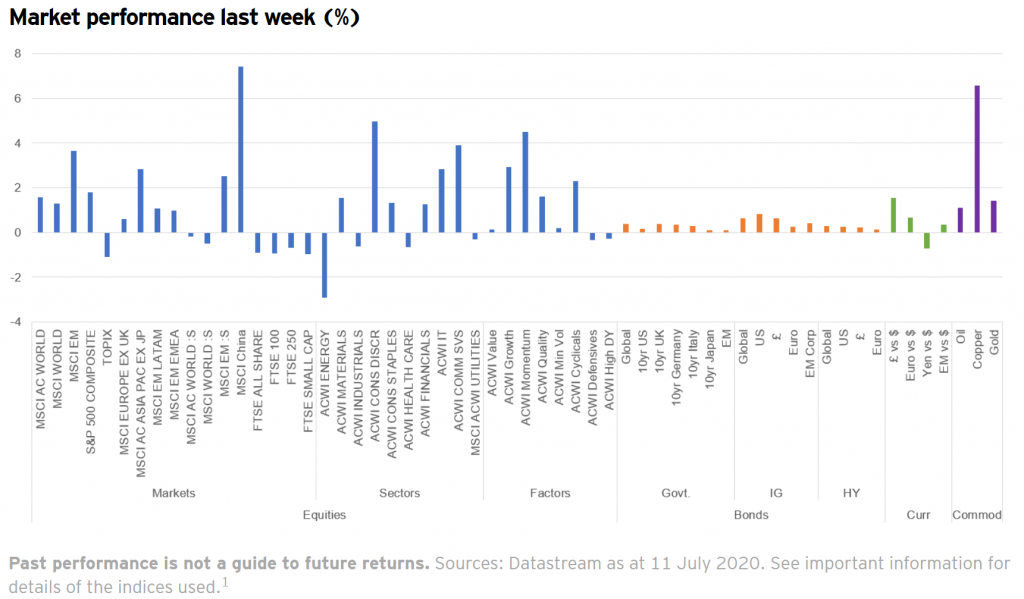
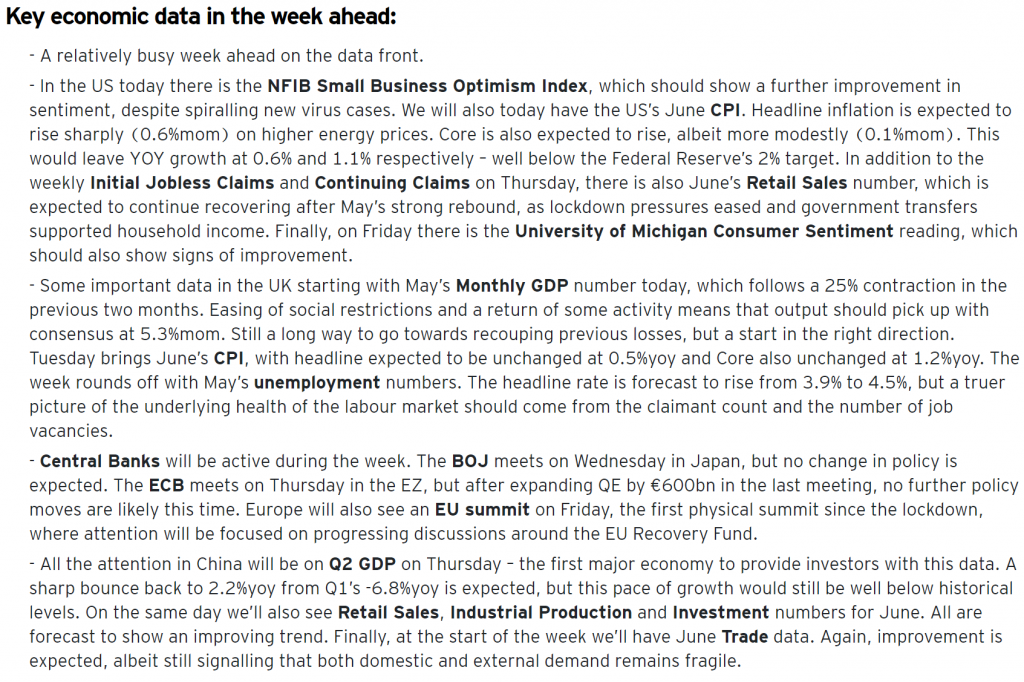
Although the virus pandemic is in decline in many parts of the world we’ve also seen a resurgence in infections, highlighting that the virus is by no stretch of the imagination under full control. Cases continue to rise in many EM, last week saw Melbourne go into a six-week lockdown, while the US’s most populous states, Florida, Texas and California, reported record jumps in deaths.

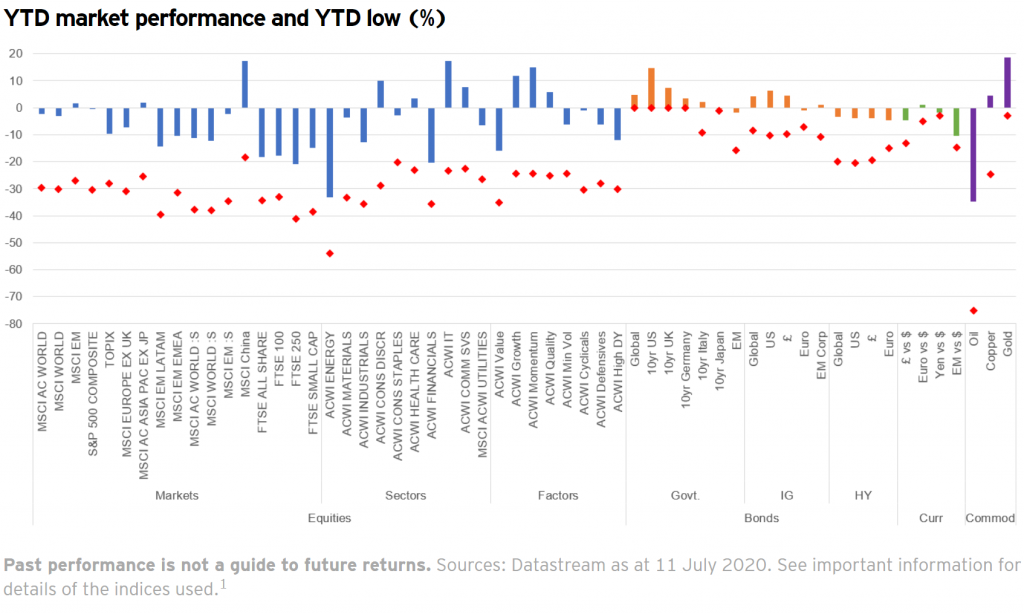
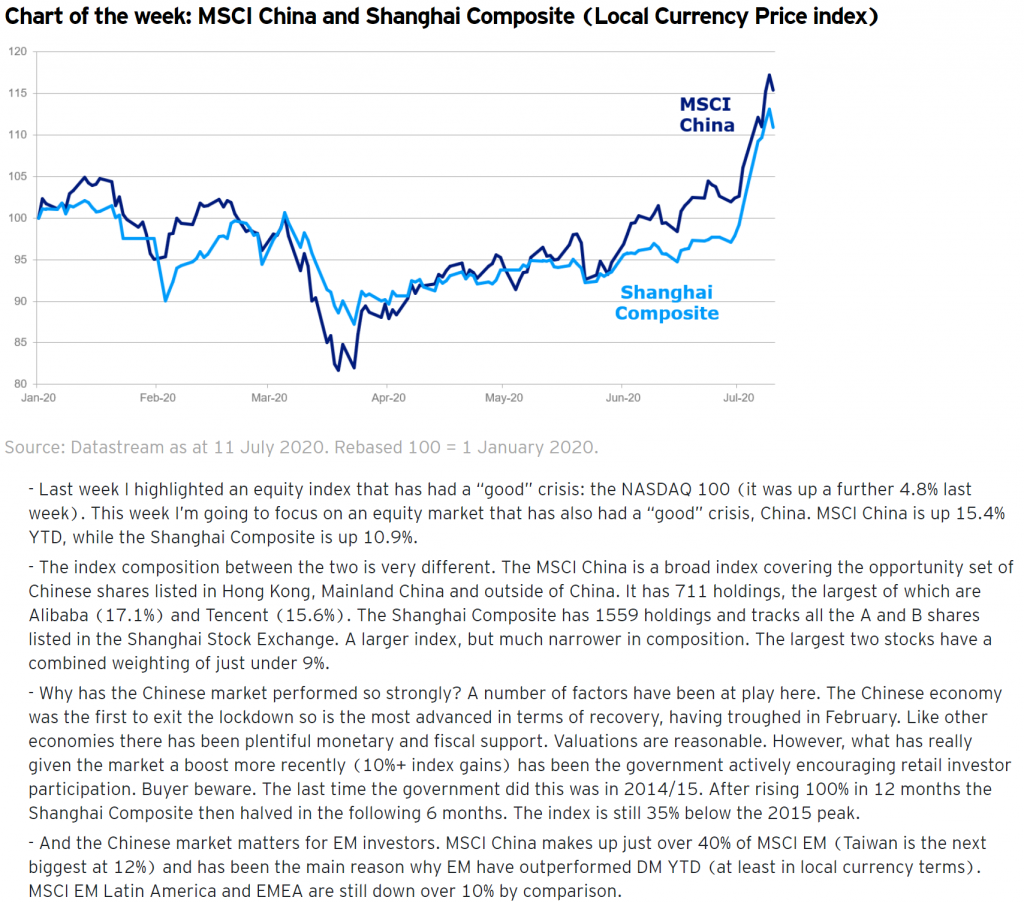
However, that has not been enough to pull the rug from under risk assets, which continued to move higher. More defensive assets, such as government bonds and gold, also gained. Equities led the way with EM at the forefront, helped by a strong rally in Chinese equities (see chart of the week for more background to this). DM, on the other hand, had more mixed fortunes. US leadership continued as index tech and tech-related heavyweights pushed higher, but Japan was lower. Unsurprisingly Momentum and Growth factors dominated from a style perspective. Credit outperformed government bonds, but with IG better than HY. Commodities made further gains, with Gold breaking through $1800 for the first time since 2011 and in touching distance of an all-time high. The US$ weakened further. In the UK, the FTSE All Share declined under 1%. Moves in fixed interest were fairly limited, with IG the best of the pack. £ edged higher against the US$.

Please continue to check our Blog content for the latest investment, markets and economic updates from leading investment houses.

Please keep safe and healthy.

Carl Mitchell – Dip PFS

IFA and Paraplanner

13/07/2020

Team No Comments

What is ESG? – An Introduction – Part 2

What is ESG? – An Introduction – Part 2

Last week, we posted part 1 of our 3-part introduction to ESG blog series. If you haven’t read this already, here’s the link: https://www.pandbifa.co.uk/what-is-esg-an-introduction-part-1/

In part 1, we explained what ESG is. Here, in part 2, we dig a little deeper

As we noted last week, a lot of the ESG processes within this industry are built upon the 10 ‘UN Global Compact Principles’.

The United Nations Global Compact is the world’s largest corporate sustainability initiative.

This is a call to companies to align strategies and operations with universal principles on human rights, labour, environment and anti-corruption, and take actions that advance societal goals.

Their mission:

‘At the UN Global Compact, we aim to mobilize a global movement of sustainable companies and stakeholders to create the world we want. That’s our vision.’

To make this happen, the UN Global Compact supports companies to:

  1. Do business responsibly by aligning their strategies and operations with 10 Principles on human rights, labour, environment and anti-corruption; and
  2. Take strategic actions to advance broader societal goals, such as the UN Sustainable Development Goals, with an emphasis on collaboration and innovation.

The 10 UN Global Compact Principles:

Human Rights

Principle 1: Businesses should support and respect the protection of internationally proclaimed human rights; and

Principle 2: make sure that they are not complicit in human rights abuses.

Labour

Principle 3: Businesses should uphold the freedom of association and the effective recognition of the right to collective bargaining;

Principle 4: the elimination of all forms of forced and compulsory labour;

Principle 5: the effective abolition of child labour; and

Principle 6: the elimination of discrimination in respect of employment and occupation.

Environment

Principle 7: Businesses should support a precautionary approach to environmental challenges;

Principle 8: undertake initiatives to promote greater environmental responsibility; and

Principle 9: encourage the development and diffusion of environmentally friendly technologies.

Anti-Corruption

Principle 10:
Businesses should work against corruption in all its forms, including extortion and bribery.


The Screening Process

A key strategy of sustainable and responsible investing is incorporating environmental, social and corporate governance (ESG) criteria into investment analysis and portfolio construction across a range of asset classes.

The 10 UN Global Compact Principles are the foundation for investment firms who wish to bring ESG on board within their investments.

Firms use 2 methods of screening whether the companies they choose invest in are considered compatible with the 10 principles.

Positive Screening

Investment in sectors, companies or projects selected for positive ESG performance in comparison to industry peers.

This involves selecting firms that show examples of environmentally friendly and socially responsible business practices. This also includes avoiding companies that do not meet certain ESG performance thresholds.

Negative Screening

The exclusion from a fund or certain sectors or companies involved in activities deemed unacceptable or controversial (e.g. tobacco, arms, gambling etc).

This involves avoiding companies that create negative impacts considered incompatible with the UN Global Compact Principles.

Summary

Positive Screening is our preferred method when we are looking at how firms screen, as this shows a more active approach into looking into firms that are committed to making a difference, rather than just excluding the ones that don’t. However, most companies use a combination of both as in reality, as the UN Global Compact was only started in 2015, most investment firms/sectors still have a long way to go towards meeting their ESG goals, but it’s good to see that the industry is starting to adapt.

Check back for Part 3 of this blog series next week, in which we will look at what we at People and Business are doing as a firm to make sure that we are moving in the right direction by selecting firms with good ESG processes.

Andrew Lloyd

13/07/2020

Data Source: unglobalcompact.org, ussif.org and Blackfinch Asset Management’s ESG Policy July 2020

Team No Comments

Tatton Investment Management Portfolio Adjustment

Please see below an article from Tatton Investment Management regarding their recent portfolio adjustment – received 08/07/2020.

Portfolio strategy

As we head into the second half of 2020, we are making some changes to portfolios.

Since April, we have held a small overweight to equities within the portfolios, focused on emerging markets, mainly as a consequence of a positive view on the economic outlook for China. Its weighting within the MSCI EM equity index, and its economic influence, made the position attractive. Within the equity component, we also moved our UK exposure to underweight.

The equity overweight was balanced by an underweight allocation to bonds. Within bonds, we maintained the overweight to non-UK inflation-linked government debt, a position we have held since October 2019.

Our overweight to equities has benefited all portfolios, meaning that the proportional exposure to equities has increased overall.

We remain positive on the medium-term outlook, wishing to retain the overall appetite for risk, but we are now shifting our focus from emerging markets towards Europe. Throughout the coronavirus crisis, the European Union (EU) has proffered surprisingly strong and supportive economic policies, which contrast heavily with China’s reluctance to fuel liquidity. Europe has also led the way in reopening its respective economies while managing to avoid a rebound in infection rates. Additionally, political risks are falling in Europe and rising in emerging markets and especially China. We remain underweight in the UK and have a neutral weighting in the US, Japan, and developed Asia.

Our bond weightings remain as before: weighted towards higher-grade bond issuers and bonds with inflation protection

How have recent events shaped our thinking?

From February to June, the global economy went through the fastest and deepest recession in history. In the midst of this, a disagreement over strategy between oil-producing countries caused energy supply to be increased just as demand was plummeting. Risk assets, including equities and corporate and emerging market debt, came under heavy selling pressure, with equity markets bottoming on 23 March. The US oil spot price remained under pressure, leading to an extraordinary ‘oil price shock’ on 20 April, when some oil futures traders were stuck with contracts and no storage space available – meaning they had to pay counterparties to take the oil off their hands.

It was clear early on that the spread of the COVID-19 virus would create huge disruption, with very little near-term visibility and with countries experiencing different challenges in getting their economies back ‘open’.  However, governments and central banks across the world pledged their support at each point it was needed.

In April, we felt China had dealt with the virus well enough to be in a recovery path ahead of other regions. Its domestic situation was likely to be positive, with strong fiscal and some monetary support. While exports would likely be curtailed by lockdowns elsewhere and continuing political pressure from the US especially, we felt it would provide reasonable demand for other Asian countries and for the wider commodity producers. In terms of the virus impact on emerging nations, we felt that it be difficult for their domestic situations but would probably not greatly affect output.

For Europe, the virus had meant significant lockdowns but also strong monetary support. However, the barriers to effective mutual fiscal support remained high, while it was not clear how long it would take to bring the disease under control.

The same seemed the case for the US, where Federal Reserve Chair Jerome Powell had put in place extraordinary asset purchases, buying unprecedented amounts of US Treasuries well in excess of near-term requirements, and extending this ‘quantitative easing’ into corporate bonds. Meanwhile, Congress gave bipartisan support to large unemployment payments, employment support and, in conjunction with the Fed, providing loan support to businesses.

The UK enacted similar support measures, although economic weakness over the past two years left it marginally less able to sustain long-term support, especially given the process of leaving the EU was still incomplete. We felt this would limit the ability of UK markets to outperform and that sterling would be likely to decline should risks worsen.

Risk markets rebounded in the second quarter, with portfolios recouping much of the losses sustained during the February and March falls. Emerging markets performed well, with China’s economic rebound providing the economic stability we expected.

Government bond markets, having been strong in the first quarter, remained stable. The high level of fiscal deficits created new issuance. Both government and corporate bonds benefitted generally from central bank purchases.

What is the near-term outlook?

As well as claiming the lives of thousands, the coronavirus has altered our day-to-day existence. Without a vaccine, it still poses a threat. Where the disease remains active, life cannot return to normal. China has shown that localised lockdowns can reduce infection rates substantially which, in turn, can allow most people to return to some form of work. However, social distancing rules remain in place, and personal choices about levels of contact mean that life is fundamentally different.

Economic activity is rebounding, helped by relief payments to companies and individuals. In the US, private sector incomes have risen sharply. The effective savings will support activity in the coming months. However, the fall in expenditure still places businesses in a precarious position. Filings for bankruptcy have risen to levels exceeding those of the financial crisis a decade ago.

Monetary policy initiatives have kept liquidity more than adequate and risk asset prices have regained much ground. In the case of the US Nasdaq composite index, prices have even hit new highs. Financial markets have functioned, but the fuel of available economic activity is thinly spread – meaning that current yields – and expected returns – are historically low.

Fiscal support has been more than adequate for this half-year, but more may well be needed through the course of the rest of this year and next. Europe has received a boost in the form of a joint French-German initiative to allow some mutualised debt issuance. Germany has also led the country-specific push for government spending, reversing frugality of previous years.

China’s domestic policies remain fiscally easy, although with less monetary infusion than other developed nations, with the People’s Bank of China still worried about excessive real estate valuations. However, the growing discord between China and the US, and the imposition of draconian new laws in Hong Kong, presents a significant impediment to markets making progress.

Although many aspects remain positive for emerging markets, China’s rising political risks will remain a concern throughout the region, while benefits from its earlier virus actions start to dissipate.

The US outlook remains positive, although risks are still elevated. The Federal Reserve policy framework can continue with significant liquidity injections, but its pace of increase has slowed. As the presidential election approaches, Donald Trump’s appeal to voters has fallen. Joe Biden, the likely Democratic nominee, may well be viewed as less business-friendly, but this is offset by the greater sense of global stability that a Democratic victory offers. Current electoral dynamics are not visibly impacting markets, which are more focused on Congress providing renewed household payments after July, and ahead of businesses being able to resume hiring.

The UK has had the most difficult economic environment of any of the developed nations and a return to normality is proving slow. London has been particularly hard hit, although the financial centre has appeared to function remarkably well given how few people are physically in the City. The Johnson government has announced ambitions for longer-term investment. Much will be needed especially if European trade negotiations are bumpy. The UK remains a concern, with sterling weakness the most likely outcome should risks become reality.

Globally, the most positive improvement has been in Europe’s policy backdrop. In addition to the fiscal stimulus mentioned earlier, the European Central Bank has made substantial injections using a number of tools. The German Constitutional Court’s ruling (that the ECB’s 2015 bond purchases were possibly improper) may yet present problems. However, a sense of discord among EU nations has been quelled – by Chancellor Merkel and other EU leaders – for the time being at least. After experiencing an awful February and March, resilient healthcare systems (particularly in Germany and France) have helped Europe to begin opening up with less personal risk-aversion than in the US, the UK and, to some extent, Asia. All of these factors make us more positive on Eurozone equities and the euro itself.

Portfolio positioning and changes

  • Given our change in focus, most portfolio activity centres on moving from emerging market equities into European equities.
  • A small reduction in cash has been deployed in various regions to balance portfolio exposures.
  • Ethical portfolios reflect this change in positioning through a reduction in emerging markets managers, redeployed in global equity funds.
  • Income portfolios have been rebalanced, with increased equity weights allocated to existing global equity managers.
  • We have not made any fund manager changes to the portfolios in this rebalance.

As you can see from the above, Tatton look to remain positive and wish to retain the overall appetite for risk but are now shifting their focus. As Tatton move their focus from emerging markets equities towards European equities it will be interesting to see what effect this has on their portfolio’s.

Please keep checking back for regular up to date blog posts.

Charlotte Ennis

09/07/2020

Team No Comments

A.J. Bell – Mini Budget Summary – Stamp duty sugar rush for the housing market

Please see below an article published by A.J. Bell yesterday (08/07/2020), which summarises the main housing market points from the Chancellor’s mini budget which he delivered yesterday:

Today’s statement was always likely to focus on ‘good’ news items designed to stir the UK economy from its economic slumber. We got that in the form of a big VAT cut for the hospitality sector, new job creation programmes and a headline-grabbing reduction in stamp duty.

However, the Chancellor was clear stabilising the public finances and paying off the estimated £300 billion bill racked up during the pandemic will be a key priority in his Autumn Budget later this year. And with Boris Johnson ruling out a return to austerity, a tax-grab seems almost inevitable as the Treasury seeks to balance the books.

Stamp duty boost for homebuyers

Homebuyers have been given a potential £15,000 boost in the Chancellor’s move to scrap stamp duty on all homes worth up to £500,000. The almost £4bn giveaway is a massive leap in the stamp-duty-free rate from £125,000 to £500,000, and on the average UK property price* of £231,855 a homebuyer would save £2,137. The tax relief will clearly benefit those in London and the south-east most, where house prices are higher and so the potential tax saving is greater.

The move is also across the board, meaning even those buying a second or third home or buying multi-million pound houses will benefit from the tax break – clearly the intention is to encourage all areas of the market to get buying and stimulate the housing market.

The tax cut should provide a much-needed shot in the arm for the property industry, which saw a complete shutdown during lockdown and is now plagued with worries about falling house prices. The Bank of England’s mortgage approval figures, which are a good indication of the pipeline of new home purchases, have fallen dramatically and are a third lower than their worst point in the financial crisis – showing just how dire the outlook is for the market for the rest of this year.

The fact that the move is temporary will be like a sugar rush for the housing market, with people who were planning to move hurrying to do so before the stamp duty holiday ends at the end of March next year. It means that we’re likely to see transactions fall off a cliff once the tax break is whipped away in 2021.

The Government will hope that the tax giveaway will see some households choose to spend that money somewhere else, on furnishing their home or spending elsewhere – in order to help revive the massive drop-off in consumer spending during lockdown. However, it’s more likely that people will just choose to buy a more expensive property, meaning the additional spending will be focused just on the housing market rather than boosting a range of businesses.

House builders, estate agents and builders’ merchants have something to smile about

Much of the Chancellor’s plan to preserve British jobs and boost the economy had been floated beforehand but house builders, estate agents and builders’ merchants all have something to smile about. Mr Sunak tried to do his bit for hoteliers, restaurateurs and publicans, although his limited room for manoeuvre when it came to spending, owing to the existing national debt, means the benefits here may be more limited.

Estate agents such as Foxtons, Savills and Countrywide will all be hoping for a big step up in business thanks to the stamp duty cuts, especially after May’s disastrous new mortgage applications figure of just 9,273. However, the danger is that demand is all crammed into the next few months and business levels then plunge again come April 2021 when the levy returns. Savills was up 2.5% after the speech, putting it in the top ten performers in the FTSE 250.

House builders did not get an extension to the Help to Buy scheme, though doubtless they will continue to press for it, though they too will be pleased to see the stamp duty cut and the emphasis on helping first-time buyers. Shares in Barratt, Taylor Wimpey, Persimmon and others responded strongly to the rumours of this policy initiative on Monday and so are doing relatively little now the facts are known.

Builders’ merchants may benefit too, which could help Grafton and Travis Perkins, while providers of insulation such as SIG and Kingspan will be looking forward to increased demand as a result of the Chancellor’s commitment to more energy efficient homes and public sector premises. Shares in bathroom equipment and accessories supplier Norcros and Topps Tiles are rising in response to the prospect of higher volumes ahead.

The hospitality sector will welcome attempts to boost spending in pubs, hotels and restaurants though Mr Sunak did not venture down the voucher path. Disappointing as this will be for leisure firms, such a giveaway would potentially have had long-term consequences and set a bad precedent – once free money is offered once it is very hard to stop handing it over.

As such, the policy is more nuanced and therefore less dramatic. The VAT cut may entice some visitors but the Monday-Wednesday time frame and £10 limit for the month of August on dining out may not move the dial much – and nor are any of those incentives likely to persuade those who are too frightened or too vulnerable to venture to such public places, or indeed those who have lost their job or are on furlough, for whom cash could be tight and eating out a luxury anyway.

Nevertheless, Wagamama-owner Restaurant Group is taking some comfort from the plan as the shares are up 6%, to put it in the top ten gainers in the FTSE All-Share and InterContinental Hotels is up 2.3% to place it second-best in the FTSE 100 today.

Please continue to check our Blog content for the latest investment, markets and economic updates from leading investment houses.

Please keep safe and healthy.

Carl Mitchell – Dip PFS

IFA and Paraplanner

09/07/2020

Team No Comments

Jupiter Update: A Golden Age for Technology

Please see the below article by Jupiter which we received yesterday (07/07/2020):

Ross Teverson

Head of Strategy, Emerging Markets

Technology – a bright spot in Emerging Markets

Technology has been a welcome bright spot as we have weathered the global coronavirus pandemic and subsequent social and fiscal response. While the worst of the market reaction appears to be behind us, many emerging and frontier market companies are trading on valuations at or near historic lows.

The same valuation case cannot be made for the technology sector as a whole, given recent strong performance. However, for some companies that are key enablers of long-term technological change, we believe that share prices don’t yet fully reflect the positive outlook. South Korean consumer electronics and semiconductor companies Samsung Electronics and SK Hynix continue to benefit from industry consolidation and now rising demand from other sectors aside from smartphones. The global market for DRAM memory chips – previously characterised by aggressive capex spending and price wars – has now become a global oligopoly with Samsung and SK Hynix two of the three players (alongside US-listed Micron). This means the market is fundamentally different with greater pricing discipline and more rational behaviour.

Market-leading semiconductor chip makers TSMC and Mediatek, both in Taiwan, are also well-positioned to benefit in a post-COVID world. Lacklustre demand for consumer electronics products is being shored up by demand from the rollout of 5G networks and rising demand from servers as people consume more data and employees work from home around the world. We think this is a trend that could continue. People are slowly going back to work, but companies now need to consider the ability of their systems to allow employees to work remotely.

Elsewhere, COVID-related restrictions are driving change in consumer behaviour. More and more consumers are making purchases online. Internet companies are at the forefront of this change, but this is not limited to the Chinese tech giants Tencent and Alibaba. Chinese online retailers JD.com and VIPShop are both benefitting from the shift. The move to cashless payments is another change which is being accelerated by the global response to COVID. One way to gain access to this trend is through payments technology and services companies which provide the equipment or infrastructure to transact digitally. While some of the global leaders are in the US, there are a number of market leading players throughout emerging markets.

The technology sector has had a strong run through the crisis and we believe the long-term structural changes behind the sector are likely to persist.  However, our investment process leads us to be wary of consensus and has, in a number of instances, driven us to look beyond the most well-known names in the index and invest only in those companies where we believe the market currently underestimates their potential.

Outside the technology sector, we continue to find that examples of underappreciated positive change in markets that appear overlooked by investors in the current climate, including frontier markets, Mexico and Turkey. But there are opportunities to be had in Asia and Latin America as well. Investors have to be willing to look beyond the headlines and short-term noise to find operationally robust companies, trading on attractive valuations and exposed to long-term trends which can continue to drive returns over time.

Guy de Blonay

Fund Manager, Global Equities

The financial technology revolution

In a very broad sense, the unthinkable happened as Covid-19 broke out – most of the world decided nearly simultaneously to suspend all activity. Lockdowns have started to be eased in certain parts of the world but there is still a lot of uncertainty around the shape of the recovery and the risks related to a second wave of infections.

Amid all this uncertainty, one aspect of it all seems clear: The financial technology revolution we have discussed in the past remains firmly in place with the pace of change now accelerating. In a recent survey, 75% of Fortune 500 CEOs said technology transformation has gained speed following this crisis.

Obviously, economies will start to re-open and activity will gradually go back to normal at some point. But in some areas, we believe the evolution in company, employee and customer behaviour has reached a tipping point. There are three sub-segments in the financials and financial technology space that look particularly promising to us: digital payments, remote working and cloud computing.

The transition to electronic payments has been a key theme in the portfolios for some time. The decline in retail sales is a headwind for the sector in the short term. But longer-term, in the words of Gary Cohn – former director of the US National Economic Council, “Covid-19 is speeding up the death of cash”. The World Health Organisation has pushed electronic payments as an alternative to banknotes – a potential vector of germs and – in the UK cash withdrawals have halved since the outbreak.  E-commerce is another driver of the transition to cashless societies as the closure of stores has pushed merchants and consumers to migrate to online platforms. Overall, the low penetration of card payments and e-commerce in developed economies bodes well for the growth prospects of the sector.

Working from Home (WFH) and Cloud Computing represent another promising sub-theme. WFH is now socially and professionally acceptable. Jes Staley, Chief Executive of Barclays, said that “the notion of putting 7,000 people in a building may be a thing of the past”. His views were echoed by a recent CFO survey from Gartner. 74% of respondents said they would move 5% or more of their on-site employees to remote positions once the lockdowns are lifted. The first winners of these changes are likely to be the companies that provide tools for employee collaboration.  But remote working also means employees have to access data and application outside the traditional security network. Innovative cybersecurity vendors like Okta will benefit.

All things digital – including WFH – need the cloud to deliver their functionality and services. Cloud is also a driver of business resiliency which is coming at the top of the CEO agenda in a context where the pandemic has disrupted the operations of financial services institutions worldwide. While some companies had to send their entire IT staff back home, cloud infrastructure providers like Amazon, Microsoft, Google, Alibaba and Tencent have demonstrated they could ensure continuity of service for mission-critical systems. Beyond these giants, the mass adoption of cloud computing should also benefit the broader ecosystem of software and services providers that help companies such as financial institutions to modernize their IT systems.

Stuart Cox

Fund Manager, Global

Microsoft – defying gravity

The coronavirus pandemic has radically altered the way we communicate, how we socialise and how we work. This societal shift has proved a great opportunity for companies exposed to this rapid change, and one notable example is Microsoft.

In fact, Microsoft is a stock that to many is defying gravity having rallied back to near all-time highs just when the economic background appears so challenging.

When analysing investment opportunities, above and beyond everything else I am always looking for something that positively differentiates that business from its peers. Sometimes that is a personal observation or judgement. Right now, we have a rare situation where we can share and experience that unique ‘differentiator’, understand its importance and try to value its worth to society and equity investors. Right now, we are living Microsoft Teams, a previously considered modestly useful application integrated into Office365.

Teams was, until recently, considered an incidental application within the Microsoft product range. Now it is a critical addition to Microsoft’s strategy of bundling software products, security, analytics, AI and so on through the cloud to sell to the corporate world. All this leveraging from Office 365 with businesses on long term contracts which are priced off volume of workload data (which tends to go up – hence the high recurring revenue model). Teams provides a competitive advantage, is competing with the equally successful Zoom, both of which have provided unwelcome competition to existing video conference market incumbents.

Turning to the numbers: Microsoft recently reported positive earnings. Sales for the quarter were at 15% and it maintained its start of year guidance of 12% full year. Not bad for a $1.4tn market capitalised business to be able to grow sales at a rate 3-4x the rate of global GDP in a normal year.

Given the economic situation, it is important to also reference previous downturns in 2003 and 2008. In these years, Microsoft reported a significant loss in sales momentum. Both are useful references but are very limited in their predictive ability. We know that Microsoft is a completely different company now. In previous years, the business focused on hardware, phones, computers to the consumer. Fast forward to today, and the focus is selling bundled software to the corporate customer.

Of course, that’s not to say that Microsoft is without risk. While it does have some transaction business risks and is not immune to economic risk, but the company’s earnings reassure the market that the investment case remains very much intact and it is set to continue to be, I believe, a strong performer in this economic environment.

Another interesting insight from Jupiter Asset Management.

COVID-19 has completely changed how we live and work this year, in a way the world has never seen before, and its impact will be felt for a long time.

The change to how we work i.e. working from home has clearly boosted the technology sector within the markets.

Andrew Lloyd

08/07/2020

Team No Comments

Brooks Macdonald – Weekly Market Commentary

Please see below an article written by Edward Park – Brooks Macdonald – received – 06/07/2020

Weekly Market Commentary | Chinese editorial brings optimism despite rising COVID-19 cases in the US

  • Equity sentiment remains torn between a highly accommodative backdrop and the rise in US new cases
  • While US new cases grow by the day, fatalities remain suppressed providing hope to risk assets
  • Chinese state media effectively endorse the strong year-to-date gains in Chinese markets

Equity sentiment remains torn between a highly accommodative backdrop and the rise in US new cases

New cases of COVID-19 in the United States continued to rise over the weekend although, with the Friday holiday, reporting may well be distorted even more than is usually the case at weekends. In terms of the hot spot states, Florida saw a gain of 5.3% and Arizona 3.7% as the growth showed little sign of slowing. The good news remains that fatalities are supressed, with average growth across the US of just 0.2% compared to case growth which increased by 1.7%. This remains key to markets, given the impact of fatalities on the economy versus health trade-off. Markets can be expected to continue to set their tone from this interplay.

While US new cases grow by the day, fatalities remain suppressed providing hope to risk assets

Overnight Chinese indices have seen large gains, as state media stated that a healthy stock bull market was more important than ever post-pandemic. This front-page editorial for the Securities Times suggests that Beijing will continue to act to support the equity market through regulation as well as fiscal and monetary policy. The editorial has supported risk appetite globally, with European indices opening to strong gains and US stock futures implying a solid start to the week. With risk assets currently more finely poised, given what is happening in the US, government and central bank support is of growing importance.

Chinese state media effectively endorse the strong year-to-date gains in Chinese markets

The comment by Chinese state media is viewed as a de facto sanctioning of the market rally in China. This has not always been the case, with the government historically using its powers to try to curb retail-fuelled gains, particularly where there was a concern over leverage. Chinese retail positioning has been gaining traction in recent weeks as the MSCI China edges closer to a 10% year-to-date gain. As the Chinese economy reopens, local investors have been looking past the US new case growth, with the Chinese technology sector being a particular beneficiary of inflows.

Please continue to check back for further blog content and updates.

Charlotte Ennis

07/07/2020

Team No Comments

Invesco – Investment Market Update

Please see below the latest market update which was published by Invesco today (06/07/2020):

The two-way pull in financial markets between improving economic data and concerns over a re-escalation in new virus cases continued last week. Unlike the previous week it was the former which won out this time, on the back of the ISM Manufacturing and Non-Farm Payrolls comfortably beating expectations in the US and final PMIs elsewhere pointing to a robust recovery. This was despite daily new virus cases hitting their highest level since the start of the pandemic, with the US and Latin America at the forefront of this increase.

Risk assets rose across the board. Global equity markets had their strongest week since early June, with the US, the Communication Services and Consumer Discretionary sectors, and Growth and Momentum factors leading the way. Japan, the Consumer Staples and Energy sectors and the Value factor were the main laggards. Credit outperformed government bonds, commodities made further gains (Gold hit its highest level since October 2012) and the US$ weakened.

In the UK, FTSE All Share was marginally higher, held back by the FTSE 100, which was unchanged. Mid and small caps performed slightly better. Moves in fixed interest were limited too, with HY ahead of IG and both outperforming Gilts. £ gained against the US$.

Please continue to check our Blog content for the latest investment, markets and economic updates from leading investment houses.

Please keep safe and healthy.

Carl Mitchell – Dip PFS

IFA and Paraplanner

06/07/2020

Team No Comments

What is ESG? – An Introduction – Part 1

What is ESG? – An Introduction – Part 1

ESG. You may have seen this term in the financial press or in our blogs. We recently posted the following blog, which was an update from Jupiter on Sustainable Investment Themes. https://www.pandbifa.co.uk/jupiter-the-acceleration-of-sustainable-investment-themes/

In our closing comments of this blog we said that we were currently developing our own ESG processes and would post more content on this shortly, so here goes.

What does ESG stand for?

ESG stands for Environmental, Social and Governance

But what is it?

Investopedia definition for ESG is;

‘Environmental, social and governance (ESG) criteria are a set of standards for a company’s operations that socially conscious investors use to screen potential investments.’

ESG is more of a theme or a set of principles to follow rather than a single set principle.

Over the last few years, ESG has started being used more to describe how well a business is managed than to explain how sustainable its product or service is.

More recently, the mainstream press has been using ‘ESG’ as a catch-all term for investing with a ‘responsible’ or ‘ethical’ screen.

There are no official industry or regulatory standards for comparing these different approaches. However, with ESG now so important, some key definitions for certain factors have been accepted across the industry.

Breaking it down

(E)nvironmental

Investing with consideration for the environment. This includes working to reduce pollution and climate change, and to source sustainable raw materials using clean energy sources. The focus is on how a firm approaches environmental concerns, the ecological impact of its products and its carbon footprint.

(S)ocial

Investing with consideration for human rights, equality, diversity and data security. The focus is on how companies are incorporating these. It’s also about looking to see if each is actively investing/working towards a healthier and higher quality of life for staff and stakeholders.

(G)overnance

Investing with consideration for positive employment practices, business ethics and diversity. The focus is on how a company builds its management structure and works with all its different stakeholders. How does it approach investor and employee relations? Does the board work with transparency, honesty and integrity? Does this filter down to the rest of the company?

Summary

Renewed efforts to combat global warming, cutting emissions and reducing our carbon footprints has been highlighted by the Covid-19 Pandemic and this has further raised the profile of ESG.

‘Doing the right thing’, ‘socially responsible’ and ‘ethical investing’ has now hit the mainstream press and become one of our regulators, the FCA’s, focuses.

As a firm, we are committed to ensure that we review the ESG policies of all the companies we work with and recommend.

We started looking at ESG over a year ago and discuss this regularly in our weekly team meetings. We decided that we would make this one of our key projects this year to ensure we stay ahead of the game because we believe this is the right approach and we believe that the regulator will issue guidance for firms over the next few years to ensure ESG is incorporated within their propositions.

We can already say that we are starting to incorporate this within our firms service proposition and are committed to driving this forward even further.

This blog is aimed as a gentle introduction to ESG. A lot of the ESG processes within this industry are built upon the 10 ‘UN Global Compact Principles’.

Check back for Part 2 of this blog next week, in which we will look at these 10 principles and the screening process investment firms use to assess whether an investment is compatible with these principles or not.

Andrew Lloyd

06/07/2020

Data Source: Investopedia and Blackfinch Asset Management’s ESG Policy July 2020

Team No Comments

Who’s in charge of the Treasury, Rishi or Tina?

Article written by Michael Collins – Director of Government Affairs – Prudential – Received 03/07/2020

Who’s in charge of the Treasury, Rishi or Tina?

Margaret Thatcher had an acronym that she employed during her premiership: TINA – There Is No Alternative. For Thatcher this was used to face down opposition (including within her own Cabinet) for a programme of labour market reform, financial market deregulation, and privatisation. Even if he didn’t use the phrase explicitly TINA must have been in Rishi Sunak’s mind as he unleashed a set of public spending commitments in late March that has not been seen outside of wartime.

The scale of the public health threat and the economic hibernation the Government imposed to deal with it meant that there probably was ‘no alternative’ to the furlough scheme, to CBILS, or to unlimited Bank of England liquidity.  That governments across the G20 largely ended up doing something broadly similar adds to the feeling that such measures were inevitable.

Forced by Government edict to shut down almost overnight businesses demanded support to tide them over; unable to go to work because of the public health requirement to ‘stay home’ households expected their incomes protected.  But while the Treasury and HMRC performed a Herculean task in getting this set of assistance schemes up and running so quickly, they wereactually politically straightforward.  It’s only now that the political heavy-lifting begins.

Because, contrary to the Iron Lady’s maxim, there now is an alternative. In fact there are now many alternatives open to the Government as it ponders the right balance of tax, spending and debt for an economy that is moving, tentatively, out of this enforced hibernation.  

Sunak has some big decisions to make, whether in the Summer Economic Update he will provide on 8 July or later in the year.

Public finances

Perhaps the biggest relate to the public finances: what level of public debt is he comfortable running with? And over what timescale does he want to get there?

The Prime Minister promised in his ‘Build, Build, Build’ speech – consistent with his December 2019 election pledge to voters in the Red Wall seats – that there will be “no return to austerity”, but that bird has already flown the nest anyway. Three months of lockdown and the support measures that were put in place have deprived the Exchequer of significant revenue and massively increased spending, putting the country on track for debt-to-GDP ratio north of 100%[1].  And as the economy worsens these twin pressures will increase, as a recession brings lower tax receipts (less corporation tax or VAT, for example) and higher spending (a bigger welfare bill as more people become unemployed), what are often referred to as the ‘automatic stabilisers’.

While it would be hard to describe  a situation in which spending has increased by 50% (as happened in April)[2] and the deficit is potentially hitting 15%[3] as ‘austerity’ it’s what Sunak does next that will settle in the mind of most voters whether the Government has genuinely left this theme (which has almost become a term of abuse in British politics) behind.

There was criticism of George Osborne that he applied the brakes to public spending too rapidly and too indiscriminately from mid-2010, hampering the recovery from the global financial crisis by taking demand out of the economy and hitting programmes that most benefited the poorest.

In the short-term TINA is going to stay in charge as the Government will continue to borrow heavily out of simple necessity

[1] https://obr.uk/docs/May-2020-PSF-Commentary.pdf

[2] https://obr.uk/docs/May-2020-PSF-Commentary.pdf

[3] https://www.ey.com/en_uk/news/2020/05/uk-public-finances-in-deficit-by-record-62-billion-in-april

Higher borrowing

But there’s also a good chance that Sunak will consciously choose a policy path that means higher borrowing, seeing it as a lesser evil than an extended recession that brings with it permanent damage.

The combination of, inter alia, ultra-low interest rates (which makes debt servicing comparatively cheap) and the big increases in public debt across the major developed economies (which means the UK doesn’t look like an outlier) provide the Chancellor with this room to choose.

It provides him with the chance to use his tax and spend powers in a way that focuses on boosting short term growth. With millions of jobs now at risk Sunak is likely to make the calculation (which is both political and economic in nature) that a few more percentage points on the debt-to-GDP ratio will now make little difference to the bond markets (‘in for a penny, in for a hundred billion pounds’, you might say) but could, if he selects the right measures at the right time, make a big difference to the scale and duration of the recession (and thus to the Government’s popularity).

The ideas for possible measures are now pouring in from think-tanks and lobby groups and include such perennial suggestions as a temporary VAT cut and a big boost in infrastructure spending.  But even these seemingly self-evident solutions involve tricky choices, not least around timing.

Do you offer an across-the-board cut in VAT rates? Or target it on certain goods and services?  If so, which ones? What’s the right time to do it? Do it too early, when consumers are still wary about their physical and economic health, and it fails to have an impact.  Do it too late and too many retailers or restaurants have already gone bust.

Increased spending on infrastructure is always a popular idea to boost demand and to get people back to work, but here too there are politically difficult decisions to make.  Those infrastructure projects that might be of most strategic importance to the nation aren’t necessarily the ones that are popular in politically important marginal constituencies (HS2 or Heathrow expansion) or that are ‘shovel ready’ and will actually get people back to work quickly. (A favourite example of this is Crossrail – first proposed by the Government when Margaret Thatcher was Prime Minister!).

The risk in crisis times is that marginal projects that have been gathering dust in the files of central government department or local authorities (for good reason) suddenly emerge with a flourish, seeing this as their moment to get financed. Ministers have some difficult choices to make in the coming months between (quite possibly sub-optimal) projects.

Longer term

But at some point the Chancellor’s attention will inevitably have to come back to the longer term state of the public finances, not least because his party – in the country and in Parliament – still contains plenty of deficit ‘hawks’ who will feel instinctively uncomfortable about a seemingly unrelenting rise in debt.

This is where TINA’s influence seems weakest, given that the Government has the freedom to play about with any and every aspect of its tax system and each and every pound of public spending.

In practice though I suspect that even here Sunak will rapidly feel the constraints on his freedom of action.  The Conservative election manifesto, for example, promised not to raise the rate of income tax, VAT, or National Insurance and to keep the ‘triple lock’ on state pensions; the ‘levelling up’ agenda needs to be seen to be delivered through big investment in the Midlands and the North; and it seems inconceivable that there won’t have to be significant additional investment in public health, the NHS and social care as the lessons of coronavirus become apparent.

And around the time that some of these choices have to be made the UK will leave behind the transition arrangements with the EU on a yet-to-be-defined basis, which may generate its own essential tax and spend policies (would you, for example, want to be raising corporation tax just at the point you’re looking to promote the message that ‘Global Britain in open for business’?)

Summary

At this point it’s impossible to predict the tax and spend decisions that the Chancellor will make. Much will depend still on the trajectory of the coronavirus itself and whether there needs to be a second lockdown (either nationally or city-by-city), on how quickly consumers demonstrate that they are comfortable with returning to pre-pandemic spending and consumption patterns, and on the nature of the UK-EU relationship that is in place from 1 January 2021.  All of these are, at this point, ‘known unknowns’ but will be critical context for the decisions the Chancellor has to make over the coming months (and possibly as early as the next couple of months).

And he does have decisions to make. While some issues (perhaps many issues if you were Margaret Thatcher) are in the hands of TINA, most often it’s another political maxim that ends up on Ministers’ minds: ‘to govern is to choose’. And it’s not easy. 

Politically these are challenging times which have obviously been affected by the ongoing Coronavirus Pandemic. It will be interesting to see how the rest of the year pans out.

Please continue to check for our regular blog posts and updates.

Charlotte Ennis

03/07/2020

Team No Comments

Brewin Dolphin – Markets in a Minute

Please see below the latest market update article from Brewin Dolphin, which was published yesterday (30/06/2020):

As you can see from the above, the virus remains present and its impacts are still being felt globally, with high levels of volatility continuing in markets. These levels of high volatility are likely to continue.

It remains important that you remain invested and focus on your long-term goals until markets recover to more normal levels of volatility.

Please continue to check our Blog content for the latest investment, markets and economic updates from leading investment houses.

Please keep safe and healthy.

Carl Mitchell – Dip PFS

IFA and Paraplanner

01/07/2020