Team No Comments

UK sustainable fund returns show performance doesn’t have to cost the earth

Please see the below article from AJ Bell:

Good Money Week kicks off on Saturday 24 October, in the midst of a bumper year for ethical fund sales and a snowballing spotlight on investing sustainably. But does investing according to your principles mean accepting a lower financial return?

To address this question AJ Bell has analysed funds with a 10 year performance record in the IA UK All Companies and IA Global sectors. These are the two most popular sectors with retail investors by far, accounting for approximately £190bn of assets.

Key findings:

  • The average UK ethical fund has outperformed the average non-ethical fund, and the FTSE All Share
  • This has been a result of luck as well as judgement
  • The average global ethical fund has performed better than the average UK ethical fund
  • BUT it has underperformed the benchmark MSCI World Index
  • Investors in some UK ethical index trackers have been left behind
  • A record amount of money is being invested in ethical funds by UK retail investors
  • Ethical fund picks

These numbers show investing ethically is perfectly compatible with getting an exceptional return over the long term. The number of ethical funds on the market has been growing rapidly and that means investors can now afford to get a bit more picky when it comes to choosing a fund with performance pedigree.

UK ethical funds have done particularly well compared to the market with the average fund showing a clean pair of heels to the benchmark FTSE All Share Index. As ever the devil is in the detail and some funds have let the side down, in particular some of the older UK tracker funds where returns have been eroded by high charges.

On average global ethical funds have done even better in the last ten years than their UK counterparts. But they have fallen behind the MSCI World Index which has been driven relentlessly upwards by the remarkable performance of the US stock market.

On the one hand then, global ethical investors might feel short-changed, but the delivery of high absolute returns while meeting an ethical investment policy should quell any major concerns. The global sector is also heterogenous in its make-up and some ethical funds are pursuing specific investment themes like clean water and urbanisation, which make comparison with the index and the sector less meaningful.

Some global ethical funds have managed to beat the benchmark index which demonstrates that even against the high bar of the MSCI World Index it’s possible to post outperformance while following a responsible investment framework.

Performance of ethical funds in the IA UK All Companies sector

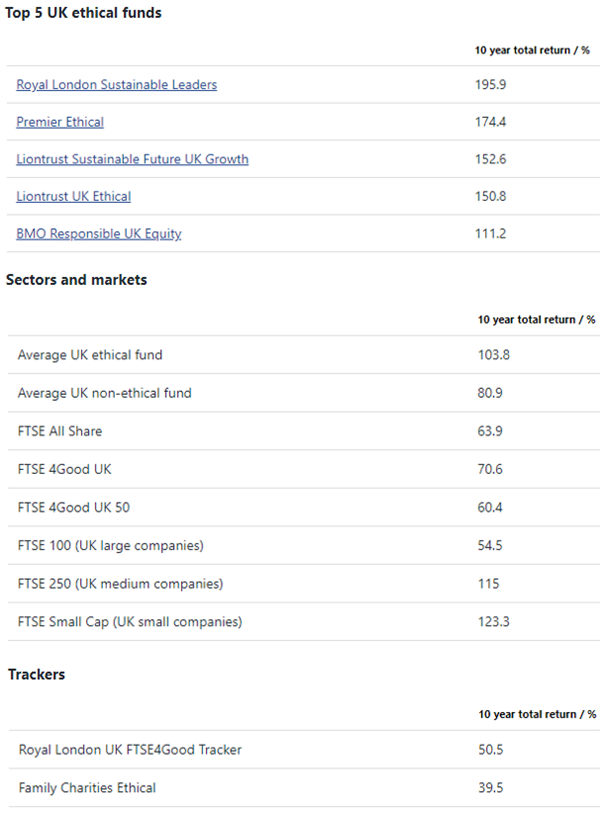
The average UK All Companies ethical fund has outperformed the FTSE All Share by 40% over the last 10 years. It’s also outperformed the average non-ethical fund by 23%. The top performing ethical fund over 10 years is Royal London Sustainable Leaders trust, which has returned 196%, compared to 64% from the FTSE All Share*.

Over half of UK ethical funds sit in the top quartile of performance for UK All Companies funds overall. The top performing ethical fund (Royal London Sustainable Leaders) is the 8th best performing fund in the UK All Companies sector over ten years (i.e. 7 funds bettered it).

Strong ethical outperformance has been achieved by a combination of luck as well as judgement. That’s because responsible funds tend to have less invested in the big blue chips, which have underperformed compared to medium sized and smaller companies (see table below).

On average the top 5 performing UK ethical funds have 31% invested in large companies compared to the UK market index (the FTSE All Share) which has 66% invested in the big blue chips. The top 5 have on average 32% invested in midcaps and 37% invested in small caps, compared to 23% and 11% respectively in the FTSE All Share*

There are some notable laggards in the sector though. Bringing up the rear of the performance table are two passive funds. Passive funds replicate the performance of the index they are tracking, but lag after charges are deducted. The size of the lag depends on the level of charges and the time investors hold the fund. Where charges are high and the investment horizon is long there can be a damaging drag on performance.

The Family Ethical fund is the worst performer, underperforming the FTSE All Share by 24.4%. More relevantly it’s underperformed the index it tracks, the FTSE 4Good UK 50 index, by 20.9%. Over 10 years it’s turned £1,000 invested into £1,390, compared to £1,600 from the FTSE 4Good UK 50 index and £2,040 from the average UK ethical fund. That’s simply a reflection of the compound effect of annual charges of 1.5%, which eat into the fund’s performance year after year. Investors do get an ISA wrapper into the bargain, but that still doesn’t look like great value compared to other options available to investors.
Sources: FE to 30/09/2020

Averages for ethical and non-ethical funds are based on the performance records of those funds with a ten year record only.

Performance of ethical funds in the IA Global sector

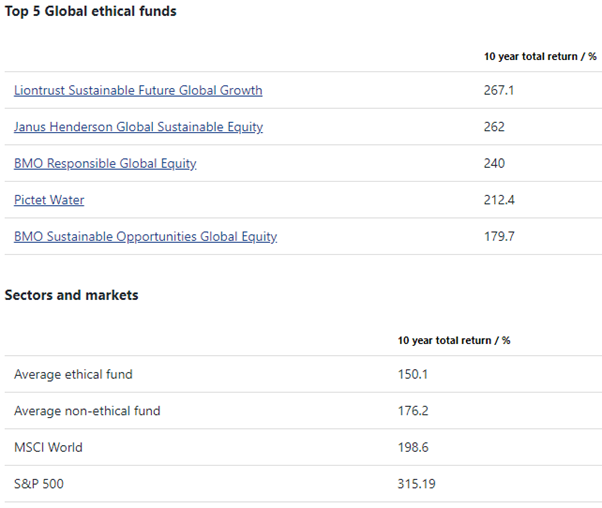
The picture is more nuanced for ethical funds in the global sector. The average global ethical fund with a 10 year performance record has outperformed the average UK ethical fund providing a total return of 150.1% since 2010 compared to 103.8%.

However the bar is set higher in the global sector because of the relative performance of the benchmark index, the MSCI World Index, which itself has been driven higher by an extremely hot US market. Compared to this index the average global ethical fund has underperformed, returning 150.1% compared to 198.6%, and has also failed to match the average non-ethical fund in the sector, which has returned 176.2%.

Given the extremely strong absolute performance of ethical funds in the global sector, it’s difficult to say investors should be disappointed but technically as a group they have underperformed.

There have been some funds which have managed to outpace the racy MSCI World Index though. The Liontrust Sustainable Future Global Growth fund tops the performance chart; it has turned £1,000 invested into £3,670, compared to £2,990 from the MSCI World Index.

There has been a glut of new fund launches in this sector in recent years, and there are now 57 funds available in the sector, which means there are now many more options for investors, albeit with shorter track records.
Source: FE to 30/09/2020

Averages for ethical and non-ethical funds are based on the performance records of those funds with a ten year record only.

A record-breaking year

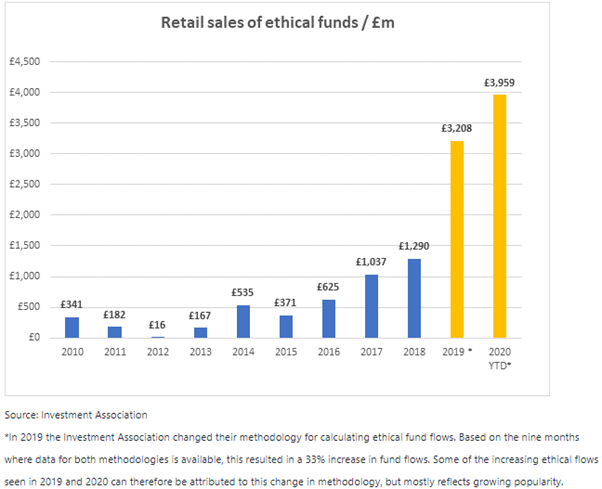
Unless there are heavy withdrawals from the sector in the next few months, ethical funds are on course to have a record-breaking year in terms of retail fund sales, as the chart below shows. And that’s after a bumper 2019.

£3,959 million has been invested so far this year compared to £3,208 million last year according to Investment Association data. Still less than 3% of all Investment Association retail assets sit in ethical funds however which leaves plenty of scope for further growth.

Ethical funds will hope to emulate the success of tracker funds in hitting the mainstream of retail investing. In 2010 less than £7 in every £100 was held in passive funds- that now stands at £18.

As more ethical funds launch on the market, and reach the critical three year performance record which is often used as a bare minimum by professional and retail investors, we can expect flows into these funds to continue to blossom.
Ethical fund launches

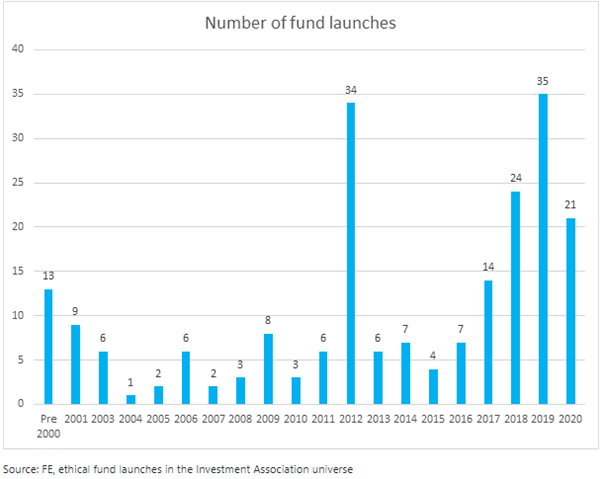
Ethical fund launches have slowed down this year compared to 2019, probably a reflection of the practical difficulties COVID restrictions have thrown up for fund groups. With a few months left to go however, it’s still looking like a strong year for new funds hitting the market.

Looking back 2012 was an anomalously heavy year for ethical fund launches and was only recently bettered in 2019. That can probably be attributed to two big changes which swept through the investment industry in that year. The Retail Distribution Review led to new share classes being introduced after funds were prohibited from paying ongoing commission and at the same time the arrival of pensions auto-enrolment opened up the door for fund groups to lodge new funds in pension plans.
Ethical fund options

Liontrust Sustainable Future Global Growth

Peter Michaelis, head of the sustainable funds team at Liontrust, has been investing in sustainability since 2001. This fund invests across the global stock market in companies that are driving sustainable growth. The fund doesn’t use negative screening – it selects companies on their positive societal benefit, based on around 20 sustainable growth themes identified by the Liontrust team.

Royal London Sustainable Leaders

Manager Mike Fox has been involved in this fund since 2003 – it actually started life at the Co-op. It invests exclusively in the UK stock market and seeks to invest in companies which demonstrate a net benefit to society. The portfolio is constructed using a quantitative and qualitative approach which scores companies according to their sustainability and financial credentials.

Stewart Investors Worldwide Sustainability

The fund invests across the globe in companies that are positioned to benefit from the sustainable development of the countries in which they operate. Manager Nick Edgerton has been managing the fund since 2012 (as co-manager until 2016). He assesses companies based on their social utility and environmental impact, as well as the quality of the management and financial performance.

These articles are for information purposes only and are not a personal recommendation or advice. Past performance isn’t a guide to future performance, and some investments need to be held for the long term.

Comment

This article echoes what we have been talking about recently, that ethical and sustainable investing has gone mainstream and that you no longer have to accept lower performance with ethical investments (compared to standard investments).

Whilst this has been an interesting year, to say the least, one of outcomes of the year has been that ethical and socially responsible investing has become a bigger topic of discussion. We now have more clients than ever asking us about ethical investing.

Keep a look out for more ESG and ethical investment content.

Andrew Lloyd

26/10/2020

Team No Comments

Jupiter Update – Active Minds

Please see the below update from some of the Fund Managers at Jupiter Asset Management received earlier today:

Mark Nash

Fund Manager, Fixed Income

Markets take bad news in stride but need fiscal spending

Markets have run aground in the last few weeks as Covid-19 cases rise in Europe, including Germany, and in the US, and this second wave damages growth prospects, said Mark Nash, Fund Manager, Fixed Income.

The risk-on, reflation trade needs a continued upward trajectory in global growth and central bank support, he said. Central banks remain supportive, but what is lacking is fiscal stimulus, which is needed as a bridge to support growth through the winter before a vaccine arrives. There has been some negative news on a vaccine, with some experts reducing the likelihood of a significant vaccine rollout in Q1 to 45% from 75% previously, he added.

The market’s reaction to the negative news hasn’t been huge, however. The Treasuries market has weakened a little, but risk assets remain reasonably buoyant, and the dollar hasn’t softened, as would be expected in a risk-averse market, Mark said.

There hasn’t been the big risk-off move and dollar scramble seen in recent years when the market panics over dollar liquidity, and Mark highlighted a few reasons for the muted reaction: the Federal Reserve (Fed) is providing liquidity so access to dollars is easier. Also China is doing well, with growth coming from fiscal support, exports and rising consumer spending. This suggests to Mark a more even and sustainable recovery in China, and it’s helping the global economy, with the renminbi acting as a conduit to remove some dollar strength.

The US current account deficit is starting to bite, with the country consuming more than it is producing, and requiring more dollars to buy overseas goods. But as the Fed keeps rates low, overseas investors are less interested in buying US assets, also preventing dollar strengthening, and that’s quite a big structural change, Mark said.

If the bad news stops, Mark expects additional dollar weakness and a continuation of the Treasury market underperforming the rest of the world. He anticipates any risk-off moves as being reasonably shallow, however, and he expects there to be buying opportunities. Mark doesn’t expect an exaggerated move upward in the dollar that does much damage to the risk market, as the Fed would step in to prevent this and there will be more government fiscal support eventually.

Ross Teverson

Head of Strategy, Emerging Markets

Enablers reduce the guessing game in emerging tech trends

Ross Teverson, Head of Strategy, Emerging Markets, drew attention to what he calls the ‘tech enablers’ in emerging markets. These are companies that are key to a lot of the big changes happening in technology, because they supply key components or services to the headline-grabbing companies that get people excited in fields like the cloud, 5G, the Internet of Things and even electric vehicles.

Ross argued, however, that these companies differ from those more glamorous names in a few important ways. Not least is that their share price valuations are generally lower, but also because – as suppliers to entire sub-sectors of the industry – they can benefit whichever of their customers ultimately ends up winning the battle for the public’s wallets.

By way of example Ross highlighted the mobile phone handset market, which is seeing fierce competition, but where semiconductor companies can sell to the market as a whole regardless of which handset manufacturer is currently on top. The autos sector is another example, as clearly there are a lot of people very positive about the potential for electric vehicles (EVs), as reflected in the share price performance of dedicated EV auto firms this year.

A recent forecast from Morgan Stanley put EV penetration at 31% by 2030, although Ross’s own view is that is still too conservative a figure. We are not far from seeing the cost of an EV fall to that of a comparable internal combustion engine car, and all of the concerns people have about charging will begin to fall away as range improves, charge times decline and charging networks expand.

Picking the winner in the EV race from the legacy auto manufacturers or the pure EV newcomers is a process fraught with risk. From an investment standpoint Ross sees a more appealing opportunity in the ‘tech enablers’ serving the EV sector. This includes companies involved in, for example, mining raw materials for the batteries, making the batteries themselves, developing autonomous driving software, or providing testing equipment and services.

Paul Pulickal

Credit Analyst, Fixed Income

Active primary market for credit management services

Paul Pulickal, Credit Analyst, Fixed Income, explained how Covid-19 has impacted the credit management services space. The sector is made up of two primary operating models: debt purchasing, where businesses buy non-performing loans (NPLs) or assets from banks, utilities and telecoms at deep discounts to face value; and debt servicing, where businesses don’t own the underlying loan, but earn a fee on the collected amount on non-performing debt.

The larger operators in Europe tend to use a hybrid model – the servicing segment allows them the opportunity to survey the investment landscape without putting up capital straight away; once they understand the best collection strategy for a specific asset, then they tend to enter as buyers. These businesses have become an integral part of the market structure post-2008/9 when it allowed banks a way to deleverage their balance sheets.

In terms of Covid-19 disruption, we’ve seen real divergence in collection performance driven by the regional exposure, and therefore secured vs unsecured nature of the underlying assets, said Paul. On the secured side, these assets tend to be found in Southern Europe, where NPL markets are relatively young and there’s an existing stock of legacy NPLs that remains on bank balance sheets. Covid-19 lockdowns had the greatest impact on these assets due to closures of court systems and frozen real estate markets, as they often require some form of litigation to extract value.

On the other side are unsecured assets, which are more typically found in the UK and Northern Europe, which have better-developed NPL markets, under which consumers may sign up to payment plans or be offered a haircut on the value of the obligation as to accelerate a lump-sum payment. These assets have held up relatively well – they’ve not had problems with court closures, and there’s a backdrop of government support.

On the servicing side, there has been some marginal weakness as banks and other credit originators pass forbearance measures onto the underlying borrower. But the guidance seems to be for a strong pipeline – Europe not only has an oncoming NPL wave, but legacy issues to be worked out too, especially in Southern Europe. And though regulators’ measures have delayed NPL formation, at some point that insolvency phase will work its way through bank balance sheets, and these services and purchases are set to benefit, said Paul.

Moving into 2021, as the world returns to a more normalised cost base and NPL supply starts to pick up again, Paul expects re-leveraging and this is a key reason why he and the team think it is important for investors to be selective, but this is nevertheless an interesting sector given the opportunity set these businesses will have in the wake of the pandemic.

Please note: Market and exchange rate movements can cause the value of an investment to fall as well as rise, and you may get back less than originally invested. The views expressed are those of the individuals mentioned at the time of writing, are not necessarily those of Jupiter as a whole, and may be subject to change. This is particularly true during periods of rapidly changing market circumstances.

Views from fund managers like this help us to get a handle on what is happening in the markets. We do expect the market volatility to continue as Covid-19 cases continue to surge in the UK and across Europe and with the US Election now less than 2 weeks away.

Please continue to check back for more updates as we help post brief and informative updates to help guide you through these challenging times.

Andrew Lloyd

23/10/2020

Team No Comments

Behavioural Finance & Investments

Please see below an interesting article published by the Association of Chartered Certified Accountants which explains how innate human behaviour effects investment decision-making.

Behavioural finance attempts to explain how decision makers take financial decisions in real life, and why their decisions might not appear to be rational every time and, therefore, have unpredictable consequences. This is in contrast to many traditional theories which assume investors make rational decisions.

One aspect to understand is the market paradox. This occurs because in order for markets to be efficient, investors have to believe that they are inefficient. This is because if investors believe markets are efficient, there would be no point in actively trading shares –which would mean that markets would not react efficiently to new information.

Herding refers to when investors buy or sell shares in a company or sector because many other investors have already done so. Explanations for investors following a herd instinct include social conformity, the desire not to act differently from others. Following a herd instinct may also be due to individual investors lacking the confidence to make their own judgements, believing that a large group of other investors cannot be wrong.

If many investors follow a herd instinct to buy shares in a certain sector. This can result in significant price rises for shares in that sector and lead to a stock market bubble.

There is also evidence to suggest that stock market ‘professionals’ often do not base their decisions on rational analysis. Studies have shown that there are traders in stock markets who do not base their decisions on fundamental analysis of company performance and prospects. They are known as noise traders. Characteristics associated with noise traders include making poorly timed decisions and following trends.

Some investors may have loss aversion, avoiding investments that have the risk of making losses, even though expected value analysis suggests that, in the long-term, they will make significant capital gains. Investors with loss aversion may also prefer to invest in companies that look likely to make stable, but low, profits, rather than companies that may make higher profits in some years but possibly losses in others.

There may be a momentum effect in stock markets. A period of rising share prices may result in a general feeling of optimism that prices will continue to rise and an increased willingness to invest in companies that show prospects for growth. If a momentum effect exists, then it is likely to lengthen periods of stock market boom or bust.

Behavioural finance shows that individuals may not necessarily make decisions on the basis of a rational analysis of all the information. This can lead to movements away from a fair price for an individual company’s shares, and the market as a whole to a period where share prices are collectively very high or low.

This insight is certainly food for thought. Please check in again with us soon for market updates and advice-related content.

Stay safe.

Chloe

22/10/2020

Team No Comments

Brewin Dolphin: Markets in a Minute

Please see below market update received from Brewin Dolphin yesterday evening. The commentary focuses on Brexit, Covid-19 and US stimulus. 

Global equity markets were mixed last week. US indices eked out small gains, making it three positive weeks in a row for US shares. Chinese equities also moved higher on encouraging data.

Other markets struggled due to a worsening second wave of Covid-19 and associated containment measures restricting social and business activities.

However, Boris Johnson’s address to the nation on Friday, in which he suggested talks were “over” and the nation needed to prepare for a no-deal Brexit, was largely dismissed by markets; after an initial sell-off in the pound, it then recovered as investors recognised his speech as political posturing.

Indeed, UK shares finished higher on Friday and, at the start of this week, reports were suggesting it was Boris Johnson who is giving ground. He has reportedly agreed to water down parts of the controversial Internal Market Bill, a key part of the legislation governing the British withdrawal that was said to break international law.

Last week’s markets performance*

  • FTSE100: -1.61%
  • S&P500: +0.19%
  • Dow: +0.06%
  • Nasdaq: +0.79%
  • Dax: -1.08%
  • Hang Seng: +1.10%
  • Shanghai Composite: +1.96%
  • Nikkei: -0.88%

*Data for week to close of business on Friday 16 October.

Share markets start new week on back foot

Equity markets were mixed on Monday. Markets fell across Europe as Covid-19 restrictions continued to spread, and shares in the US were sharply down. At the close, the Dow had fallen 1.44%, and the Nasdaq was 1.65% lower.

Markets were worried by rising Covid-19 cases across the US, and investors are also sceptical about whether a new fiscal stimulus package will be agreed before the election. Democratic House Speaker Nancy Pelosi set a deadline of 20 October for progress to be made towards a deal in the long-running talks. While reports suggest that the “gap is narrowing” on many contested issues, time is running out.

Meanwhile, Donald Trump told a journalist that he was prepared to go higher than the $2.2trillion in fiscal stimulus proposed by the Democrats. If he is serious he will likely face stiff opposition from many Republicans in the Senate who oppose such a large package.

UK Brexit optimism

Currency traders seem to be pricing in a Brexit deal, as the pound rose against the euro and the dollar on Monday. The strength in sterling weighed on the FTSE100, which closed down by 0.6%. The more domestically focused FTSE250, however, gained 0.24% – more evidence that the market believes the UK will avoid a hard Brexit.

Businesses, too, are showing remarkable confidence in a deal. The last time a no-deal Brexit loomed, in March 2019, manufacturers stockpiled goods at record pace in case their supply chains were disrupted. Today, there is no evidence of any such cautionary measures.

Source: Refinitiv Datastream

A choppy outlook for markets

The largely downbeat news flow is causing anxiety for investors even after having been repaid for the courage they displayed in weathering March’s market storm. The prospect of a hard Brexit will be a worry for many, but it should be stressed that most portfolios will benefit from the weakness in sterling and strength in bonds that a no-deal Brexit would provoke. The bigger risk, paradoxically, is that a deal gets done and sterling rallies.

Rising Covid-19 case numbers and a potential disputed US election, however, have the potential to upset markets.

While the market is no longer likely to rise in a straight line, equities remain, perhaps more unequivocally than ever, the most attractive long-term savings vehicle available. There is a higher-than-average chance of volatility in the coming months, but that could lead to excellent buying opportunities and when they arise and we will be looking out for bargain buys on a stock-specific basis.

China revs up its recovery

Economic data out of China on Monday confirmed its recovery is continuing apace. The Chinese economy grew at an annualised rate of 4.9% in the third quarter. The expansion was below expectations but was still well above the 3.2% increase in the second quarter.

The recovery, which has been helped by generous state investment to its industrial sector, now looks to be broadening across the economy, as was hoped by policymakers. Industrial production grew by 6.9% in September, its highest level of the year and equalling the pace of expansion seen last December, before the pandemic began.

In addition, retail sales, which have lagged behind the broader economy, posted their best performance of 2020, rising by 3.3% in September. For context, that is up from growth of just 0.5% in August after seven months of declines.

We value the importance of communicating the most relevant data and information relating to the markets. Please check in again with us soon for further updates.

Stay safe.

Chloe

21/10/2020

Team No Comments

Legal & General Investment Management Blog

Please see below an article received late yesterday afternoon from Legal & General Investment Managers which provides their latest market views:

I think one of the key messages to take from the above is that the U.S. election is high up on people’s priorities, more so than the Covid-19 pandemic. Positive news on a vaccine and a good U.S. election outcome would provide the greatest investor optimism.

Opportunity is still out there for investors, but it remains important to have a diversified portfolio, which is spread across a number of regions and sectors in order to benefit from these opportunities. Having a long-term view when investing is imperative, you should not focus on short-term volatility.

Please continue to check our Blog content for advice and planning issues and the latest investment, markets and economic updates from leading investment houses.

Please keep safe and healthy.

Carl Mitchell – Dip PFS

IFA and Paraplanner

20/10/2020

Team No Comments

AJ Bell – Reasons Why Cryptocurrencies Are Creeping Higher

Please see below the latest ‘Investment Insight’ from AJ Bell received 18/10/2020.

Reasons why cryptocurrencies are creeping higher

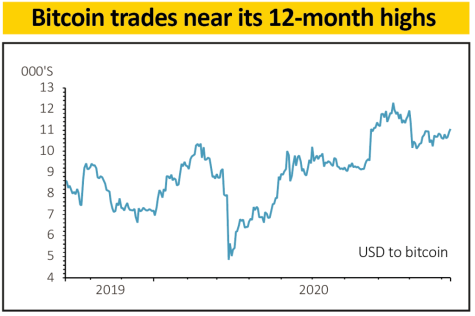
Bitcoin is trading close to a 12-month high

Thursday 15 Oct 2020 Author: Russ Mould

The Federal Reserve Bank of Cleveland’s Loretta Mester has raised the prospect of Americans having an account with the Fed, into which the central bank could directly pump digital dollars, thus bypassing the banks as the main mechanism for quantitative easing (QE).

The European Central Bank has reportedly filed to trademark the term ‘digital euro’ as it assesses the pros and cons of digital currencies.

And the Bank of Japan is openly discussing what it calls central bank digital currency (CBDC), with work beginning in spring 2021 on issues such as resilience, ahead of trials with a limited number
of households.

To prevent a public panic the Bank of Japan continues to stress CBDCs will be used to complement, not supplement, paper money.

Supporters of such experiments will argue they offer another potentially useful tool in the central banker’s kitbox, as the existing policy suite of zero rates, QE, inflation targeting and so on struggles to deliver the growth and inflation the monetary and political authorities crave, to help them escape from their debt burdens.

Sceptics will wonder where this will lead next, with rampant money creation, to fund government debts, interest payments and spending plans, and inflation both possible consequences, unintentional or otherwise.

These doubters may be in the camp that warms to gold in such circumstances or even cryptocurrencies which, rather to this column’s surprise it must be said, refuse to go away.

Bouncing back

Bitcoin may still be trading well below its 2017 all-time high of $18,941 but it is making plenty of ground.

According to coinmarketcap.com, bitcoin’s total value is $210 billion, a fraction below its high for the calendar year. That figure is also pretty much double the value of the FTSE 100’s largest stock by market cap, AstraZeneca (AZN). The total crypto universe, which now comes to over 3,600 different counters, is currently valued at $361 billion according to the same website.

Some may see this as another reason to view financial markets as worryingly frothy, as a plentiful supply of liquidity from central banks and hopes for fiscal stimulus keep them bubbly.

Others will argue that cryptocurrencies’ return to favour supports the view that central bank policies are debasing existing currencies and merely one step down the path toward a reset of how fiat money works, with CBDC experiments the next logical development.

Perhaps Facebook’s work on its own blockchain-based payment system, Libra, is prompting central banks to get cracking on their own version.

Long arm of the law

Regulators are sceptical. Attempts to launch exchange-traded funds (ETFs) dedicated to tracking cryptocurrencies have foundered in the US and Britain’s Financial Conduct Authority has just banned the sale of derivatives and exchange-traded note trackers related to bitcoin to retail investors, citing ‘the inherent nature of the underlying assets, which means they have no reliable basis for valuation.’

No matter how sceptical many financial market watchdogs or participants may be, it can still be argued that if someone, somewhere thinks that cryptocurrencies have a value, then a value is what they have.

Questions over the cost of the bitcoin mining process, the level of mining and transaction fees and efficiency of cryptocurrencies as a payment system relative to cash, or existing credit and debit networks, will also deter many from using bitcoin, let alone treating it as an investable asset class.

Yet the cap on the supply of bitcoin to 21 million will continue to appeal to some investors as they see government deficits balloon and central banks draw up plans for digital currencies and seek out a place to preserve or even hide wealth.

Gold bugs may argue that bitcoin has no physical backing or practical use but critics of the precious metal will assert it is an inert element that generates no yield and is not in frequent use when investors pay for their weekly groceries, either.

Libertarians may also jump in at this point, citing how central bank-backed digital currencies could be the ultimate surveillance tool in any civilised country, let alone despotic, corrupt ones. As such, the battle lines between true believers and nocoiners (and gold bugs) remain drawn.

The ability to pay tax in cryptocurrency or even buy groceries would be a tectonic shift but that looks a long way away. For the moment, the former is having a better year of it than the latter.

The forced shift from cash to cashless payment during the current pandemic is unlikely to do the cause of digital currencies any harm, as more people become accustomed to using their card or mobile device to make a payment in person, let alone online.

Please continue to check back for our regular blog posts and updates.

Charlotte Ennis

19/10/2020

Team No Comments

Investment Bulletin – 16th October 2020

Please see the below investment bulletin received by Brooks Macdonald today (16/10/2020):

What has happened

Markets have been largely willing to shrug off the increased in coronavirus cases in Europe but a series of tightening restrictions across Europe shook investor confidence yesterday. This had led to contagion in US indices however the early losses there were largely recouped by the end of the session.

European cases go the wrong way as restrictions tighten

Italy has been relatively resilient in the face of the second wave, but it also reported close to 9,000 cases yesterday as it joins the European trend. In recent days we have seen the UK moving London and several other areas under Tier 2 restrictions, France imposing a curfew and increasing restrictions in Germany. The key question for markets is whether governments in Europe will continue with the current policy of squeezing social interactions and hospitality but keeping the majority of the economy and schools open. Encouragingly, Reuters have reported that the NHS is in talks with relevant bodies about the mobilisation of a vaccine programme as early as December. If a vaccine allows investors to focus on a ‘beginning of the end’ of COVID restrictions, they will be increasingly comfortable to look through the next 3/6 months of restrictions. This could also increase the political palatability of tougher measures now if light can be seen at the end of the tunnel.

What next for Brexit?

EU leaders agreed at the EU Council meeting to continue negotiations with the UK but the narrative was very much that the UK’s position needs to come towards the EU rather than the other way around. The UK’s chief negotiator Frost said he was ‘surprised’ and ‘disappointed’ by this and we will hear from UK PM Johnson later today with the UK’s view. Sterling has faltered a bit on this news as it makes continued negotiations less likely, on the margin, than a day ago when reports were pointing to an extension into November.

What does Brooks Macdonald think

US fiscal stimulus remains a hot topic in the market but we have avoided discussing this too much today as regardless of whether a given day looks brighter or darker for stimulus, we retain low expectations that anything will happen before November. Should Biden win the White House but not take the Senate, this may prove challenging for risk appetite so we expect investors to react to shifts in the Senate polling odds more than day to day fiscal rhetoric.

Source: Bloomberg as at 16/10/20

The markets have been volatile this week as Covid-19 restrictions have been tightened in the UK. With rising cases and uncertainty about further restrictions and lockdowns, along with the impending US Election. This volatility is likely to continue.

Please continue to look for further updates and blog content from us.

Andrew Lloyd

16/10/2020

Team No Comments

Jupiter Active Minds Blog

Please see below an article received late yesterday afternoon from Jupiter which provides their latest market views:

Global Emerging Markets

A land where banks can grow

Nick Payne, Fund Manager, Global Emerging Markets, highlighted the strong performance of emerging market equities this year, which are approximately back to their pre-Covid levels from earlier in the year. However, Nick wanted to talk about an area that has so far lagged behind: banks.

In contrast to developed markets, where banks are typically seen as mature, low growth businesses with low return on capital, in emerging markets the picture couldn’t be more different. There are around 2 billion people in the world without a bank account, the bulk of them living in emerging markets. Some of those are gaining access to financial markets through fintech solutions, but in emerging markets the traditional banks still have a big role to play, said Nick.

The ability to grow is the main thing that separates emerging market banks from their developed market peers. Nick used as an example the largest privately owned bank in India, with about 8% market share, that has the opportunity to capitalise upon the situation in rural India where there have been great strides made in building up a deposit base, but where banks are still in the early stages of lending to customers (the loan to deposit ratio is just 30%). Indeed, the bank’s CEO stressed that the potential opportunity is so large that at this stage they don’t need to go down the risk scale in order to achieve growth.

The underlying message for Nick is that there is still an enormous runway for growth for banks in emerging markets, and those that are strong enough to come through this crisis will emerge with their competitive positions enhanced. So while the high profile technology names understandably get a lot of attention at the moment, this is an alternative area that Nick sees as presenting a compelling long-term opportunity for emerging market investors, which the market should recognise as and when economies start to normalise.

Fixed Income

Finding pockets of value in Latin America

Risk sentiment in emerging markets has improved in October, following a volatile September, noted Alejandro di Bernardo, Credit Analyst, Emerging Market Debt. The market has turned more positive on a possible Biden win in the upcoming US election, in the belief that a higher fiscal deficit will translate into a weaker dollar, which would be positive for emerging markets.

In Latin America, Brazil is expected to post the lowest decline in growth – estimated at 5% for 2020 – largely thanks to a huge fiscal stimulus package, of over 15% of GDP. PMI activity, consumer confidence, and other industrial indicators are showing a V-shape recovery. On the other hand, however, the political backdrop remains a concern there. Growth relies on subsidies, which isn’t sustainable; and Brazilian debt to GDP is expected to reach about 95% by the end of the year. Alejandro and the team expect the Brazilian real to remain volatile, and in terms of positioning, they prefer to focus on exporters with US dollar revenues. Alejandro used the example of a Brazilian pulp & paper company, with a significant market share and strong operating margins; as the industry was considered ‘essential’, it never closed during lockdowns. So, Alejandro said it’s possible to get paid a premium to have exposure to strong BB exporters in the region.

It is the opposite scenario for Mexico. The country is expected to post the biggest decline in GDP in the region, falling 9%, largely due to a much more conservative approach to fiscal stimulus from the AMLO administration. Politics there are quite stable, but growth is lacking. In Mexico, the team prefers companies with exposure to the US, and investment grade miners that have exposure to copper and gold, where demand is likely to benefit from a Chinese recovery.

Looking forward to 2021, Alejandro and the team take a positive view on countries like Peru, Paraguay, Chile, Guatemala and Panama, which entered the pandemic with very low levels of debt, and which have room to provide fiscal stimulus. Even in countries with weaker macro, the team can still find pockets of value in the BB space, in companies where fundamentals have recovered.

UK Equity – Small & Mid Cap

How to approach three ‘unloved’ buckets in UK equities

Tim Service, Fund Manager, UK Small & Mid Cap, shared his views on how to approach three of the most “unloved” themes in the UK market: stocks affected by Brexit, Covid-19 and value/cyclical stocks.

He said each of these themes requires investors to be “humble” and accept that taking a strong view on the stocks is difficult as outcomes are unpredictable and heavily impacted by politics.

One way to play Brexit exposure is through a domestic sector that is understandable and has growth potential but is disadvantaged by uncertainty around the UK-EU negotiations, Tim said. Housebuilders fit this description – with a dozen or so companies operating in a land market that is much less competitive than it was in the last cycle. The sector trades on 1 to 1.3 times book value and should generate high-teen to 20-plus percent return on equity in a year’s time with a “good” Brexit, he said. Challenger banks may also benefit as their valuations have been held back by concerns about Brexit.

A way to approach the Covid-19 theme is through travel stocks, which have been sharply impacted by virus restrictions, with the most likely scenario being the eventual control of virus transmission in the western world, Tim noted. He prefers to focus on good businesses with solid balance sheets or companies they would support if a capital raising were needed, and with the ability to come through the next six to nine months in a stronger market position.

Some UK cyclical/value stocks may benefit if after the US election there is an increase in infrastructure spending or if there is a change in the inflation outlook. Industrials and aggregates, for example, would fit this description.

Gold and Silver

M&A in the gold mining sector could double

The gold sector has seen around $20bn of mergers and acquisitions this year and this may well double in the next 3-6 months, said Ned Naylor-Leyland, Head of Gold & Silver.

The crisis in depleting reserves among major gold miners has been apparent for decades, said Ned, but it’s taken firmly rising gold and silver prices to get the market to focus on the need for consolidation. Previously, unreasonably low spot prices prevented gold miners from engaging in the sufficient exploration and development needed to boost reserves.

In Ned’s view, we are now at a tipping point of an incoming wave of M&A in the sector and it is the discounted tier one gold miners that he thinks will benefit the most. Elsewhere, Ned pointed to Q3 reporting from silver miners as one to watch: will silver’s spectacular rise this year translate into company numbers? While the market isn’t yet willing to pay a sustainable $20 per ounce for silver, he thinks that is inevitable at some point in the future given the demand for silver in electronics is only going to increase due to powerful trends like the internet of things and clean energy technologies.

I think one of the key messages to take from the above is that opportunity is still out there for investors, but it remains important to have a diversified portfolio, which is spread across a number of regions and sectors in order to benefit from these opportunities. Having a long-term view when investing is imperative, you should not focus on short-term volatility.

Please continue to check our Blog content for advice and planning issues and the latest investment, markets and economic updates from leading investment houses.

Please keep safe and healthy.

Carl Mitchell – Dip PFS

IFA and Paraplanner

16/10/2020

Team No Comments

Daily Investment Bulletin

Please see below market update received from Brooks Macdonald this morning, which comments on the upcoming US election, the Brexit deadline and the rise of Covid-19 cases across Europe.

What has happened

Whilst we are only a few days into the earnings season it has been reasonably mixed with some idiosyncratic misses such as Bank of America, intertwined with cyclical earnings such as United Airlines which reference a still difficult economic backdrop. Once markets had added in another negative news day for fiscal stimulus, equities struggled and this weakness has followed into today.

The last nail in the fiscal coffin?

Treasury Secretary Mnuchin has been a key figure in the fiscal negotiations leading the White House administration in talks with the House Democrats. Yesterday Mnuchin said that he did not expect a stimulus package to be agreed before the election, this comes after extensive talks with House Speaker Pelosi. The issues appear to not just be the overall dollar number, but the policies included in the bill, suggesting that compromise will not be simple. As we have said before, whilst few investors were holding out hope of a full stimulus package, some were expecting a skinny deal ahead of the 3rd November. The market’s weakness post Mnuchin’s comments reflect the dying flame of a small package pre the election.

Brexit…

Today is the self-imposed deadline by Prime Minister Johnson to reach a trade deal with the EU. As widely expected, all reports are suggesting that Johnson will continue the talks post the EU Council meeting which is taking place today and tomorrow. With the Prime Minister under pressure due to the UK’s coronavirus response, adding the perception that he ‘chose’ a no deal route would just increase opposition. Last night a call took place between the EC President, EU Council President and UK PM which concluded with a comment that a decision on the continuation of talks would be made after the Council ends tomorrow. Sterling has taken this news positively, particularly in light of the progress seemingly made by both sides in recent weeks. Reports suggest an extension until early November could be the more realistic deadline.

What does Brooks Macdonald think

With COVID cases rising across Europe and governments taking increasingly tough measures including local and national lockdowns, a no deal Brexit added to the mix would be highly unwelcome. Our base case remains that a deal will be struck though our level of confidence in this isn’t high, this is the primary reason why we retain our underweight to both UK and European equities.

Source: Bloomberg as at 15/10/20

A succinct and interesting summary of the most relevant market information. Please check in with us again soon for further updates.

Stay safe.

Chloe

15/10/2020

Team No Comments

Brewin Dolphin – Markets in a Minute

Please see below the latest ‘Markets in a Minute’ update from Brewin Dolphin received 13/10/2020.

Markets in a minute: Equity markets rally on Trump recovery, Biden lead, and hopes for stimulus deal

Most global equity markets made solid gains last week on hopes of a US stimulus deal, and following President Trump’s return to the White House after treatment for Covid-19.

Markets were also boosted by the increasing likelihood of a Joe Biden election victory. His lead in the polls is expanding, and although Democrats may raise corporate taxes and regulation, investors are encouraged by the party’s approach to job creation and wage growth. Biden’s lead may also mean there is less chance of a disputed election result.

Last week’s markets performance*

  • FTSE100: +1.94%
  • S&P500: +3.84%
  • Dow: +3.26%
  • Nasdaq: +4.55%
  • Dax: +2.85%
  • Hang Seng: 1.47%
  • Nikkei: -0.75%

*Data for week to close of business on Friday 9 October.

FTSE100 lags as global markets rise at the start of the week

Most equity markets rose on Monday, with US indices powering ahead led by gains in big tech. As hopes faded for a new US stimulus deal ahead of the election, investors returned to the growth stocks that have proved so reliable during the pandemic and lockdowns. The Nasdaq closed up by 2.56% at 11,876.26, having been up by 4.1% at one point in intra-day trading. The Dow gained 0.88% and the S&P500 rose by 1.64%. Markets across Europe closed up by around 0.7%.

In the UK, the FTSE100 lost 0.25%, weighed down by a strengthening pound which rose on hopes of a Brexit deal. The more domestically focused FTSE250 closed up by 0.52%, despite yesterday’s introduction of a tiered system of localised lockdowns.
Those in the highest-risk areas could see a range of measures introduced, from bans on households mixing to closures of pubs, bars and gyms. Liverpool is currently the only city to be placed in the highest-risk tier. However, it appears tougher measures are on the way for a number of areas after Chris Whitty, the chief medical officer, said the basic “Tier 3” measures would not be enough to stop the virus spreading.

More UK stimulus

Rishi Sunak unveiled a watered-down furlough scheme for firms which are forced to close under local lockdowns. The government will pay two-thirds of employees’ salaries to a maximum of £2,100 per month. Companies will still need to pay national insurance and pension contributions. The scheme will begin on 1 November and will run for six months, with a review in January.
The announcement followed a disappointing set of GDP data for August that showed monthly growth of 2.1%, less than half the 4.6% rate expected by economists. High-frequency data, such as restaurant bookings, traffic and retail footfall, shows that activity slowed in September, which makes sense given the end of the ‘eat out to help out’ scheme.

US stimulus talks deadlocked

Talks between Democrats and Republicans in the US still appear at an impasse. Trump has given ground and agreed to a slightly larger stimulus package worth $1.8trn, but faces objections from his own party who want the bill capped at $1trn. It is worth noting, however, that the Democrats have already passed a $2.2trn plan. This could be implemented soon after election day if the Democrats gain control of both the House of Representatives, and the Senate, in a so-called ‘blue sweep’.

Brexit clock ticking

Talks resume today ahead of an EU summit this Thursday, when all member states will begin focusing on Brexit negotiations. Thursday is also the day that Boris Johnson has said he would walk away from talks if a deal was not in sight. It seems unlikely Johnson will turn his back on any prospect for a deal given the pressure he is under to reach a compromise, especially amid such intense criticism of his handling of the coronavirus.

Johnson has been on the phone to Macron and Merkel over the weekend in a bout of last-minute diplomacy. While some reports suggest state aid and dispute resolution are the key negotiation sticking points, others point to fishing rights, a topic on which France is particularly vocal. It may be surprising that fishing is such a deal-breaker, given that it accounts for only around 0.1% of UK GDP. But it is the lifeblood of many coastal communities and has an emblematic value beyond that which can be expressed in economic terms. Despite Johnson’s threat to walk away, Michel Barnier, the EU’s chief negotiator, has said talks will continue after Thursday and that a realistic deadline is in fact 31 October.

A duller dollar

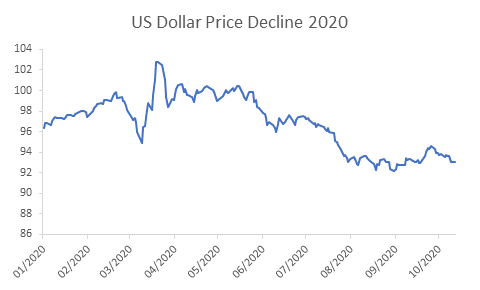
Stephen Roach, former Head of Morgan Stanley’s Asian business, has suggested that the US dollar could decline by 35% as a result of global economic conditions. While we are also bearish on the dollar, we do not foresee such a drastic fall. We suspect the dollar will continue the gradual decline that we have been observing in the market.

Part of our negativity is based on the fact that the greenback has lost the interest-rate support that has held it up in recent years.


Source: Brewin Dolphin, Refinitiv Datastream

A useful article from Brewin Dolphin focusing on the UK, Rishi Sunak’s unveiling of a further UK stimulus package and exploring the reasons why, at the beginning of this week, the FTSE100 has lagged behind global markets.

Please continue to check back for our regular blog posts and updates.

Charlotte Ennis

14/10/2020