Team No Comments

Markets kick off new year with trepidation amid more lockdowns

Please see the below update from Brewin Dolphin received late last night:

Many global markets have fallen over the past week, thanks largely to a sell-off on Monday – the first trading day of the year. While many markets finished 2020 at all-time highs, uncertainty around the new Covid-19 variant, surging case numbers, and new lockdowns have dented optimism.

Hopes are now pinned on the mass vaccination programmes underway around the world.

Despite the pandemic, 2020 ended up being a surprisingly good year for a number of markets. The S&P500 ended the year up by 16.3%, while the Nasdaq gained 44%. In the UK, however, the FTSE100 endured its worst year since the financial crisis, losing 14.3%. The UK’s blue-chip index is heavily weighted towards stocks that were hit hardest by the pandemic, including banks and energy companies. It also has very little exposure to the tech sector, which has had a stellar 12 months. Additionally, the FTSE100 has been hindered by a rising pound; since many companies in the index earn their revenue in US dollars, a strong pound reduces their earnings when converted into sterling.

The performance of other markets varied widely. Germany’s DAX index ended the year up 3.6%, which may not sound much but it did pass its previous record high.

France’s CAC 40 fell by around 7%, while Japan’s Nikkei gained 16%. In China, the CSI300 rose by 27% during 2020.

Last week’s markets performance*

  • FTSE100: -0.46%
  • S&P500: -0.70%
  • Dow: +0.36%
  • Nasdaq: -1.18%
  • Dax: -0.25%
  • Hang Seng: +3.4%
  • Shanghai Composite: +3.66%
  • Nikkei: -1.12%

*Data from close of business on Tuesday 29 December to close of business on Monday 4 January.

Equities in mixed start to new year

Global equity markets saw healthy gains on Monday as continued optimism about the vaccine rollout provided confidence.

However, the mood soured as the day wore on, and markets in Europe and the UK finished off their highs as it became clear that more lockdowns were imminent.

Relatively robust economic data out of China helped most Asian emerging markets at the start of the week.

In the region, the Shanghai Composite closed up by 0.86%, while Hong Kong’s Hang Seng gained 0.89%. South Korea’s KOSPI rose by 2.47% and Taiwan’s TSEC 50 gained 1.15%.

In Japan, however, the Nikkei lost 0.68%, as the government said that vaccinations may not start until February, despite surging cases.

In Europe, markets were up across the board. The German DAX eked out a 0.06% gain, while France’s CAC 40 rose 0.67% and the FTSE Mibtel in Italy rose 0.37%.

But it was the FTSE100 that outperformed on the day, rising by 1.72%, helped by a weak pound. 

In the US, the mood was less upbeat, perhaps caused by news that the Covid-19 variant had arrived in New York, or perhaps the rumblings about more lockdowns in the UK and elsewhere had investors spooked.

Either way, US markets had their worst day since October, with the Dow losing 1.25% to close at 30,223.89, while the S&P500 fell by 1.48% to 3,700.65. The Nasdaq fell by 1.47% to close 12,698.45. It should be remembered the indices are still near their all-time highs.

New lockdowns announced or extended

Boris Johnson’s address to the nation on Monday night, in which he announced a strict national lockdown for England, set to last until at least mid February, has intensified the short-term headwinds now facing the market. Similar lockdowns have been announced around the UK, and also in Germany and Japan, with containment measures increasing in South Korea. Others are certain to follow.

January is traditionally a tough month, and the current market wobble should be set in the context of the recent strong run. November 2020 was the best month for equities in 20 years, and December was also historically strong. It should be no surprise if the markets fall back in the near term. But fundamentals remain solid. There is a lot of money sitting on the sidelines waiting to be invested that has failed to find a home since the sell off last March. Only this time, we are at the beginning of a new business cycle and recovery, as opposed to last March, when we were at the tail end of an old cycle. So on a 12-month view, we remain positive.

Source: Refinitiv Datastream

UK economic data ends year on a high

The last business survey covering the UK’s manufacturing sector shows that factory activity was improving at the fastest rate in three years.

The IHS Markit/CIPS purchasing managers’ index rose to 57.5 in December from November’s 55.6. Any reading above 50 indicates activity is increasing. The rise was due largely to stockpiling by manufacturers ahead of the Brexit deadline, in case a deal was not reached. It may therefore drop back in the near-term as the lockdowns bite and activity reduces.

UK mortgage approvals are also booming, with 105,000 mortgages approved in November – the highest since 2007, before the credit crunch kicked in. Buyers are rushing to take advantage of the stamp-duty holiday announced by Chancellor Rishi Sunak, which expires in March. It is likely that activity will calm down in the summer.

Please continue to check back for more brief market views from a range of different fund managers. This should help you get a handle on the fast changing outlook.

Andrew Lloyd

06/01/2021

Team No Comments

Brooks Macdonald – Weekly Market Commentary

Please see below weekly market commentary from Brooks Macdonald received yesterday afternoon – 04/01/2021

Weekly Market Commentary | COVID-19 restrictions remain in the spotlight as 2021 begins

04 January 2021

Read detailed economic and market news from our in-house research team.

• Weekly Market Commentary

• COVID-19 updates

By Edward Park

• Risk sentiment was positive but muted as a Brexit deal and US Fiscal Stimulus both came over the line

• While vaccines improve the prospects for 2021, restrictions look set to tighten in the interim

• Georgia’s runoff elections tomorrow will determine the makeup of the Senate for the next two years

Risk sentiment was positive but muted as a Brexit deal and US Fiscal Stimulus both came over the line

There was a strong sense of Groundhog Day throughout December as the ‘will they won’t they’ pantomime played out over a Brexit deal and US Fiscal Stimulus. Ultimately, both of them were carried over the line but looking at the rather muted market reaction, investors were too exhausted to care once the result was known.

While vaccines improve the prospects for 2021, restrictions look set to tighten in the interim

The brighter prospect for 2021 firmly lies with the vaccines and, in the UK, we now have the Oxford vaccine to add to the arsenal. The Oxford vaccine is important as, while it appears less effective than the Pfizer/Moderna mRNA options, it is cheaper and easier to handle, only requiring storage in a normal fridge. As the UK and other countries look to ramp up their inoculation efforts, the new viral variant has changed the dynamics for restrictions. Since the lockdown in March of 2020, the government has squeezed social activity and the hospitality industry with the intent of leaving room for the economy to stay largely open and schools to continue operating. The current Tier 4 restrictions, similar to Lockdown 2.0 in November, are seen as insufficient to curb the current variant and UK Prime Minister Johnson yesterday warned on the Andrew Marr show that restrictions were likely to get tougher. A return to a March 2020 lockdown will undoubtedly hit Q1 UK GDP, however markets may continue to look through this near-term uncertainty if they are confident that vaccines make this a temporary, though possibly deep, hit to economic activity.

Georgia’s runoff elections tomorrow will determine the makeup of the Senate for the next two years

Tomorrow sees the runoff elections in the state of Georgia which will ultimately determine the balance of power in the Senate with wide implications for President-Elect Biden’s legislative options for the next two years. It is worth noting that the Republicans currently have 50 seats to the Democrats’ 48, however if the two Georgia seats go blue then Vice President Harris will cast the deciding vote in the Senate, giving the Democrats the narrowest of working majorities. The most important near-term policy will be fiscal stimulus and the lie of the land post tomorrow will be a significant factor in determining how large or small any Q1 stimulus package is.

On Wednesday, we will see the joint session of Congress to formally count the electoral college votes for the next President. This is normally a formality but with several Republican senators saying they will challenge the result, expect some headlines even if the majority vote to move on and certify the result.

Please continue to check back for our latest updates and blog posts.

Charlotte Ennis

05/01/2021

Team No Comments

Investment Intelligence Update

Please see below Invesco’s most recent Investment Intelligence update, received earlier this afternoon. The commentary provides analysis of market performance over the course of 2020 and reflects on influential global events.

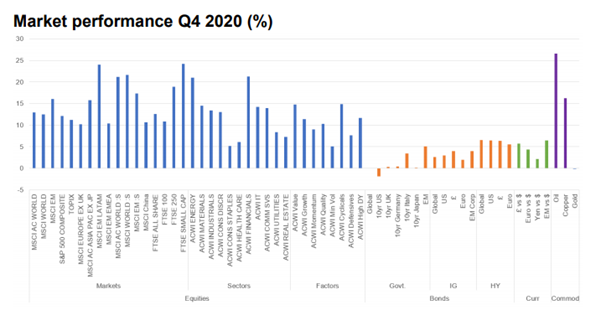
  • Second and third waves of the coronavirus pandemic and their associated containment measures, progress on the vaccine front, US elections, Brexit and the monetary and fiscal backdrop were the main drivers of market performance during the fourth quarter. Investors chose largely to ignore the near-term negative economic consequences of a resurgence in virus cases in many parts of the world, notably the economic heavyweights of the US and Europe, preferring instead to focus on the much hoped for return to some sort of economic normality in 2021 that successful vaccine trials and their subsequent regulatory approvals and roll-out pointed to. As such it was hardly surprising to see that strongest performance during the quarter came from the most economically sensitive assets classes, such as equities, HY credit and commodities.
  • Global equities had a very strong quarter, dominated by a 11.5% gain in November, rising 12.9% overall with DM (12.5%) continuing to lag EM (16.1%). Within DM there wasn’t much to choose between the major markets, with the UK (12.6%) and US (12.2%) ahead of Japan (11.2%) and Europe ex UK (10.2%). Mid (FTSE 250 18.9%) and Small caps (FTSE Small Caps 24.2%) led the way in the UK, well ahead of large caps (FTSE 100 10.9%). Sector mix and £ strength weighed on the latter. EM continued to see wide divergences in regional performance, with Latin America (24%) well ahead of EMEA (10.4%). Small caps (21.1%) outperformed significantly with DM (21.6%) ahead of EM (17.3%), a reversal of what we saw in broader markets.
  • At a sector level there was a shift in market leadership during the quarter. Financials (21.3%) and Energy (21%), the two major sector laggards in the preceding quarters, topped the performance charts, even if that still left them at the bottom of the 2020 performance pile. Tech and techrelated sectors also outperformed, albeit only marginally so, with IT (14.2%) the best of them. Defensives struggled against a backdrop of improving economic sentiment, with Consumer Staples (5.2%) and HealthCare (6.1%) the main performance laggards.
  • On a factor basis, Value (14.8%) had its first quarterly outperformance against Growth (11.4%) for two years. Quality (10.3%) and Momentum (9%) lagged, while Minimum Volatility (5%) brought up the rear.
  • Globally government bond markets went nowhere (flat) for the second quarter in a row. 10yr yields were little changed for Bunds, Gilts and JGBs, but USTs saw yields 24bp higher (-1.9% TR) and contrasted with BTPs, which were down 35bp (3.4% TR) and hit all-time lows. EM Sovereign returns were the strongest of them all (5%) as yields fell 55bp.
  • The risk-on backdrop supported credit markets, where the higher risk HY market (6.5%) comfortably outperformed IG (2.6%). Yields (IG -26bp, HY -119bp) declined to all-time low levels, while spreads narrowed further too (IG -35bp, HY -149bp). Within IG returns were led by £ IG (3.9%) and in HY US HY (6.5%) just edged out £ HY (6.4%). Euro denominated credit lagged in both IG and HY. The lower the credit rating the better, with BBBs (3.4%) outperforming in IG and CCCs and below (11.9%) in HY.
  • Economic optimism and a weaker US$ boosted economically sensitive commodities, with Oil (26.6%) hitting its highest level since February, while Copper (16.2%) made an 8-year high. Gold (-0.1%) struggled as enthusiasm for the precious metal waned as ETF outflows picked up and real yields rose.
  • Another difficult quarter for the US$ with the US$ Index (-4.2%) having its worst quarter since 2017. It is now down -12.5% from its 2020 high and at its lowest level since early 2018. EM currencies (6.4%) led the way, closely followed by £ (5.7%), with sentiment towards the latter clearly boosted by the signing of a post-Brexit trade deal.
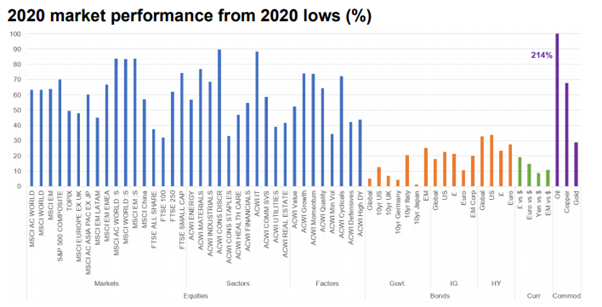
  • An extraordinary year featuring a strong start, a rapid virus induced collapse and then a remarkable rally off the March lows. The result was that most markets delivered positive returns for the year, with many ending at or close to their 2020 and in a number of cases all-time highs.
  • Standout performances in equity markets were US equities in DM and Asian equities in EM, led by China. At the sector level, IT and tech-related sectors, Consumer Discretionary and Comms Services, led the way, which underpinned strong performance from the Growth and Momentum factors.
  • An extraordinary year featuring a strong start, a rapid virus induced collapse and then a remarkable rally off the March lows. The result was that most markets delivered positive returns for the year, with many ending at or close to their 2020 and in a number of cases all-time highs.
  • Standout performances in equity markets were US equities in DM and Asian equities in EM, led by China. At the sector level, IT and tech-related sectors, Consumer Discretionary and Comms Services, led the way, which underpinned strong performance from the Growth and Momentum factors.

The potential approval of mulitple vaccines and the finality of Brexit may provide a more hopeful outlook for 2021. We will continue to publish relevant market data and news so please check in again with us soon.

Happy New Year.

Chloe

04/01/2021

Team No Comments

Blackfinch Group Monday Market Update

Happy New Year and welcome to 2021!

Please see below for our first blog post of the year, a Monday Market Update from Blackfinch.

Please note, this is a 2 week update for the two-week period 21st December 2020 – 1st January 2021):

The ever-changing world we live in reinforces the importance of regular up-to-date communication. This weekly news update from our multi-asset portfolio managers provides you with a summary of global events for your reference and to share with clients.

UK COMMENTARY

  • On Christmas Eve, and with just days to spare, the UK Government and the European Union (EU) put pen to paper on a post-Brexit trade agreement, with UK politicians voting overwhelmingly to back the deal.
  • The UK government confirmed that a new strain of COVID-19 was sweeping across the nation. Travel bans were imposed by a significant proportion of Europe, including cross-channel trade with France. Many travel restrictions were eased within days, although the backlog continued over the festive period.
  • A post-Christmas review of lockdown tiers resulted in a further 20 million people placed into stricter Tier 4 restrictions.
  • The UK government was set to mobilise large-scale vaccination programmes, choosing to focus on ensuring a larger proportion of the public receive their first jab than was planned under the initial roll-out.
  • Third quarter Gross Domestic Product (GDP) bounced back stronger than previously reported, rising 16.0% quarter-on-quarter, following a record contraction of 18.8% in the second quarter.
  • Official figures showed the UK government borrowed £31.6bn in November.

US COMMENTARY

  • Congress approved a $900 bn stimulus package in the days after Christmas, despite a last-minute hold up prompted by President Trump over payment amounts to individuals.
  • The US economy grew at a record pace in the third quarter, and quarter-on-quarter GDP was revised slightly higher, from the initial reading of 33.1% to 33.4%.
  • Jobless data for the week to the 19th December showed 803,000 new unemployment claims, down from 892,000 in the previous week.

COVID-19 COMMENTARY

  • Vaccine producers are confident their existing vaccines will provide similar levels of immunity against the new strain of COVID-19, although no official test results have confirmed this.
  • The UK approved the use of the AstraZeneca and Oxford University vaccine after it passed the necessary regulatory hurdles. The UK has ordered 100 million doses of the vaccine, which is easier to store than the already approved Pfizer/BioNTech version.
  • Many EU countries began their roll-out of the Pfizer/BioNTech vaccine.

Our Comment

Whilst the beginning of this year may not be as happy as usual, we can now finally see light at the end of the tunnel. Yes, the next few months are still going to be difficult with potential lockdowns and heavier restrictions, but with the vaccine roll out which has now begun, life will soon return to normal.

Of course, with this will come market volatility, however they will recover, the FTSE 100 for example is today at its highest point since early March 2020 (this is great news!).

The restrictions and lockdowns are not ideal, but it’s part of a necessary plan to control this virus once and for all, plus, lockdowns are easier to deal with now than they were last year, as this time we know what to expect compared to the end of March last year, when it was all brand new unchartered territory for us, people and businesses (see what I did there?) know how to adapt better now.

Soon the US will inaugurate Present Elect, Joe Biden, into the White House, the mass vaccine roll out is now underway, whilst the next months will still be bumpy, we now have plenty to look forward too!

Thank you to all those who read our blogs last year, and this will be the first of many to come this year. We are not slowing down and we will continue to provide you with market updates from a range of experts and fund managers, plus plenty of our own original blogs and insights into the markets and this new world we are now living in.

Again, a very Happy New Year to all our readers, and I’m sure we are all together in the view that this year will be better than the last!

Andrew Lloyd

04/01/2021

Team No Comments

What a year that was!

You couldn’t have made it up.  If anybody had tried to tell you in January this year what was going to happen, you would have thought they had completely lost it!

We are nearly at the end of 2020 and we have been through the mill.  Covid 19 has had a severe impact on markets, economies, our health, and our wellbeing.  We have not been able to live our lives normally.

Thankfully markets and economies have started to recover. China is in a better place than it was in January.  Different sectors thrived, in particular, Technology.  With c 75% of Technology businesses in the USA their markets have fared well with indices higher.

In November, with the Biden win and then the really good news on the Pfizer vaccine, markets recovered further.  As you know we are now getting vaccinated in the UK in priority-order and we await further good news on the Oxford/Astra Zeneca vaccine.

This Oxford/Astra Zeneca vaccine will make a considerable difference as it’s easier to handle and distribute, and much lower cost.  Not only is this good news in the UK, but also globally and for developing and emerging markets.

The only issue outstanding now, which I understand is nearly resolved, is Brexit.  It looks like we are on the verge of doing a deal.  Hopefully, by the time I relax at home later on, a deal will have been done.  This will bring some certainty to the UK and the EU and we can get on with doing business.

How have we changed?

Personally, I think we have learnt a lot from this challenging year.  As people and leaders, we now hopefully do a better job, with more of an understanding of the needs of our staff and clients, family and friends.  Our culture in the business will have changed as we understand everybody’s needs better.

We now know, more than ever, that we need to work as a team and look after each other.  A healthy culture is one that is diverse and inclusive.  We need to nurture and grow our people.

In terms of investments, we have seen a significant shift to ESG (Environmental, Social and (corporate) Governance) investing.  I think this will continue as Covid 19 has made us reflect on what is important, our health, looking after our environment and dealing with climate change.

The future?

Markets appear to have priced in a good recovery.  With the vaccine roll out in the UK, we would expect volatility to continue and the economy to pick up in the second half of 2021.  We still have a few headwinds. The end of furlough could see unemployment spike and zombie businesses could close.

To counter this, the pent-up demand of consumers will help, if the vaccine roll out is fast and efficient and people in the UK can return to their normal spending habits and make up for this year.

We also need to see the vaccine roll out globally so our amazing scientists and health care professionals can deal with any further mutation of the virus.  Technology and further developments will help too.

I feel positive about the future. It’s been a tough year, but the outlook is brighter.  Innovation and science will really help as we work hard to recover economies globally.

Thank you for reading our blogs. Hopefully, they help keep you informed in this fast-changing world we live in.  If you have any specific questions, please get in touch.

Merry Christmas and a happy, healthy, and prosperous New Year!

Steve Speed

24/12/2020

Festive opening hours

24/12/2020 close at noon.

 Return on 29/12/2020 for standard office hours on both 29/12 and 30/12.

Close at noon on 31/12/2020.

Return to normal working practices on 04/01/2021

Team No Comments

Grey swans on the menu instead of turkey

Please see below article received from Legal & General yesterday afternoon, which sets out their market-related predictions for the year ahead.

A ‘grey swan’ is a by-product of Nassim Taleb’s ‘black swan’. Taleb described a black swan as an extremely unpredictable event where what happens is beyond normal expectations of a situation and has potentially severe consequences. Grey swans should be conceivably possible if not necessarily probable. They typically fall into the camps of geopolitics or macro financial markets but can appear more… left field. This year, we are naturally more attuned to potential COVID-19 outcomes, as well as environmental, social and governance (ESG) -related matters. It’s also a good time to look back at what we said this time last year and consider what impacts those events had on markets, if they materialised.

What did we get right and wrong – and what had an impact?

Let’s start with the small stuff before we move onto the elephant in the room. Among our top risks for 2020 that came true were: Argentina’s default; the Democrats winning the US election; and Hong Kong losing its special status with the US. Of these, despite the deep social impacts of Hong Kong’s political turmoil, the impact on financial assets has been more limited.

We gave credence to idea the UK would leave the EU with either no deal or a very basic deal… something that now seems almost certain. Also high on our list for 2020 was the possibility of ‘helicopter money’, but for all the fiscal stimulus measures of the past year, purists would still say we have not seen the choppers in the sky – although for us this seems like semantics.

Obviously the big risk event of the year was the pandemic. Pandemics are often flagged in tail-risk prediction exercises and were indeed included somewhere in our long list of risks for 2020. If we are generous to ourselves, we even recognised the reality of the risk early in the year, taking out risk-management positions in January and into February to protect against possible impacts of the virus as it started to spread beyond China. But, just like many investors, we underestimated the depth of impact it would have on society and on markets by the end of March.

In hindsight, our actions were too little and too early. The events of the first quarter challenged our previous philosophy: that constant and expensive tail-risk hedging is not a viable solution for portfolios. That view has now become more nuanced. While we still believe tail-risk management should be targeted to the real, or outsized, risks faced by any portfolio or client, we have evolved our commitment to researching such strategies with a lower cost of carry, or performance drag. We believe that some collection of these positions can become more structural in nature even if the components, or underlying trades, are more dynamically managed.

Finally we remained cautious on the markets, economy and virus for too long over the summer, an opportunity missed in what turned out to be a very strong second half of the year for our clients.

2020 will be a hard act to follow. What could put 2021 in the record books?

As exemplified by this weekend’s news in the UK, with a new strain of COVID-19 identified and much of the South-East placed under more restrictive measures, the virus will likely dominate the headlines for the months ahead.

However, there is optimism that the roll-out of vaccines will allow a broad reopening reasonably soon. While such a narrative is a sensible base case, and indeed we have exposure to asset classes that will benefit from this, we see tail risks to the optimism. First, it is sadly not inconceivable that the total number of deaths attributed to coronavirus will be higher in 2021 than for 2020. The social toll will continue to be heavy, and these deaths may come predominantly from emerging markets, where vaccine rollouts look to be slower and countries are experiencing new accelerations in case numbers. A third national lockdown in the UK cannot be ruled out, especially if vaccine distribution cannot meet optimistic targets.

UK politics looks set for more potential upheaval; betting markets attribute roughly a 35% chance of Boris Johnson ceasing to be prime minister in the next year, while a Scottish independence referendum remains conceivable. And that’s not to mention the state of the relationship with the EU, which could stay in the headlines through 2021. UK assets remain sensitive to these developments, but from here we are tactically positioned with a positive view on the pound as we see more upside potential than downside risk.

Beyond our borders, US-China relations remain the predominant geopolitical dynamic that will shape the next decade. When the virus has passed, we believe this topic will come back into focus for investors. Most of our team believe the relationship will either stay the same or mellow, but the path to escalation and even physical combat should not be discounted. Also in the Pacific area, our tail-risk scanning exercises again drew our attention to the possibilities of escalating tension on the Korean peninsula but also suggest that reunification talks accelerating are equally likely.

And finally…

Ten more grey swans for 2021 to consider:

  1. The Hong Kong dollar breaks its peg against the US dollar, first established in 1983
  2. A central bank-sponsored crypto currency goes mainstream, cratering bitcoin
  3. Various new medicines or vaccines are developed for existing illnesses as a result of COVID-19 research, including a possible cure for the common cold and significant improvement in the fight against cancer, leading to the view, with hindsight, that the COVID period has actually improved our life expectancy
  4. 2021 is the warmest year on record. This unfortunately wouldn’t really be a grey swan as the last five years have been the warmest five on record
  5. Extreme weather events lead to poor harvests, shortages and food-price inflation. High food inflation feed social unrests in various countries, spooking markets and upsetting the consensus trade of long emerging-market equities
  6. Brazil or Turkey default on their foreign bonds
  7. Putin retires, creating a buying opportunity for the Russian ruble
  8. Autonomous driving finally hits the big time, with a broad introduction in a major city
  9. Long-lasting broad social unrest in the US in major cities, causing a correction in the S&P and US bond yields to fall below zero
  10. The Pope announces the Catholic church will allow married and female priests in their clergy

Please check in again with us soon for further market analysis and relevant content.

Happy Christmas!

Stay safe.

Chloe

22/12/2020

Team No Comments

The Covid winners/losers narrative could change

Please see below interesting insight received from J.P. Morgan earlier this afternoon, which categorises the ‘winners’ and ‘losers’ following a challenging year for markets and industry.

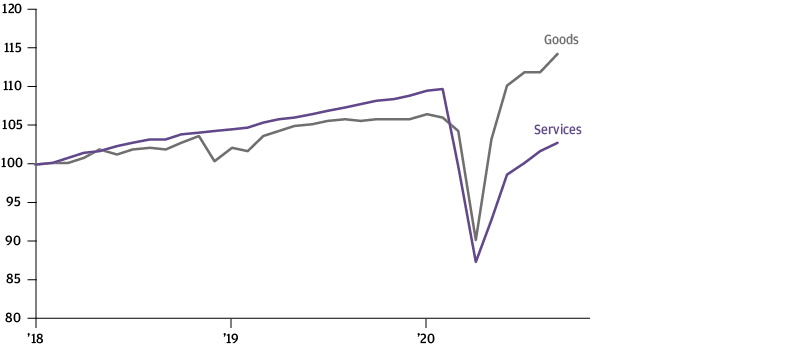
The highly unusual nature of the Covid-19 recession has created stark differences between winners and losers. From a macro perspective, service sectors have suffered disproportionately from social distancing restrictions. But this misfortune has benefited some manufacturers as households have diverted spending from experiences to goods (Exhibit 1). This has also affected regional performance as countries with a high weight to services, and tourism in particular, have generally lagged their more manufacturing-heavy counterparts.

Exhibit 1: People have spent where they could
US goods and services consumer spending
Nominal index level, rebased to 100 in January 2018

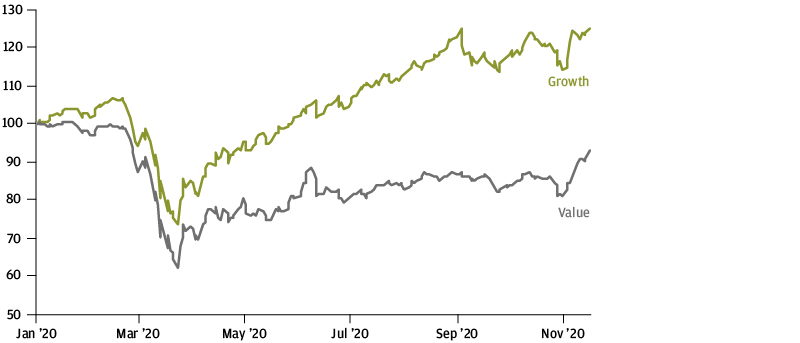
Market performance was similarly bifurcated for much of 2020, as companies with a technology/online tilt benefited not only from their ability to grow earnings when most other sectors saw huge pressure on profits, but also from the decline in the discount rate used to calculate the present value of those future earnings streams (Exhibit 2). In the summer, the gap in valuations between growth and value stocks reached levels not seen since the technology bubble.

Exhibit 2: Growth stocks benefitted from the shifts in spending in 2020
MSCI World Growth and Value price returns
Index level, rebased to 100 in January 2020

Progress towards a vaccine has already changed this narrative as we move into 2021. On the day that the news broke of an effective vaccine, global value stocks experienced their best day relative to growth stocks since records began. The key question for next year is how confident we can be that this shift from the winners to the losers will be sustained.

Valuations alone might suggest there is more room for this rotation to run. Despite the very strong bounce in 2020’s laggards, such as financials and energy, since the vaccine announcement, both sectors still lag broad indexes substantially year to date. Cheaper valuations are also seen in regions such as the UK and Europe that are more tilted towards value sectors, while US indices look relatively more expensive given the ‘big tech’ tilt.

There may come a point at which we are looking at a more meaningful outperformance of value vs. growth. But a precursor to that, in our view, would be higher interest rates and a steeper government bond yield curve, which would be a headwind to growth stocks and would help financials within the value style. This scenario would require a greater acceleration in nominal GDP and a more rapid tapering of central bank asset purchases than we have in our core scenario. With interest rates capped by the burden of debt, we see this outcome as an upside risk rather than our central projection.

For now, we believe the key to successful allocation across equity market sectors – and therefore across regions – will be to differentiate between secular and cyclical tailwinds and headwinds. For growth sectors, the Covid-19 recession has been the catalyst for many years of technological advancement and adoption to be condensed into a few quarters. We are confident that companies will allocate a greater portion of their resources towards technology going forward, and see many beneficiaries from this secular shift, including areas profiting from advancements in semiconductor technology and the adoption of cloud computing. In other cases, though, growth stock valuations appear to assume that behaviours will permanently reflect a Covid-constrained environment. Investors must ensure that the price they are paying for any company reflects an earnings outlook and market share that can be achieved in a post-Covid world, not just the highly unusual environment of this past year.

The same debate of cyclical vs. secular can be used when assessing the opportunities in value. In very simple terms, we expect companies and countries that have suffered most during the pandemic to be the biggest beneficiaries of a vaccine. Yet medical developments cannot remove all of the headwinds for every company. Take the energy sector, for example. An improvement in the economic outlook should clearly help to put upward pressure on oil prices as demand normalises, and energy stocks should benefit accordingly. But secular headwinds remain as the world transitions away from dependence on fossil fuel towards renewables. Careful stock selection will still be required.

In sum, progress towards a vaccine requires a much more balanced approach across styles, sectors and regions for next year. We expect the significant pressures on the Covid-19 laggards to ease, which in turn should catalyse a rotation across markets. But just as we avoided advocating an ‘all-in’ approach to growth in 2020, we do not see the year ahead as the time to allocate indiscriminately towards only the cheapest stocks. A vaccine will be a major step forward, but it will not cure all ailments.

We will continue to publish market analysis as vaccines are approved and rolled out in 2021. Please check in again with us shortly. Happy Christmas.

Take care.

Chloe

21/12/2020

Team No Comments

AJ Bell – The outlook for FTSE 100 dividends in 2021

Please see article below from AJ Bell received yesterday – 20/12/2020.

The outlook for FTSE 100 dividends in 2021

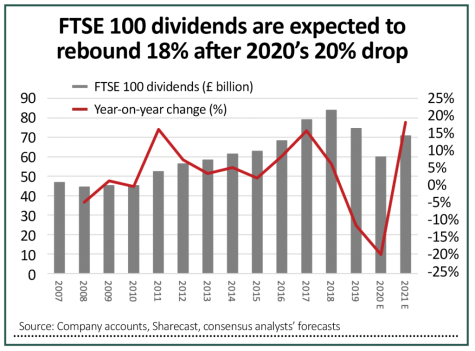
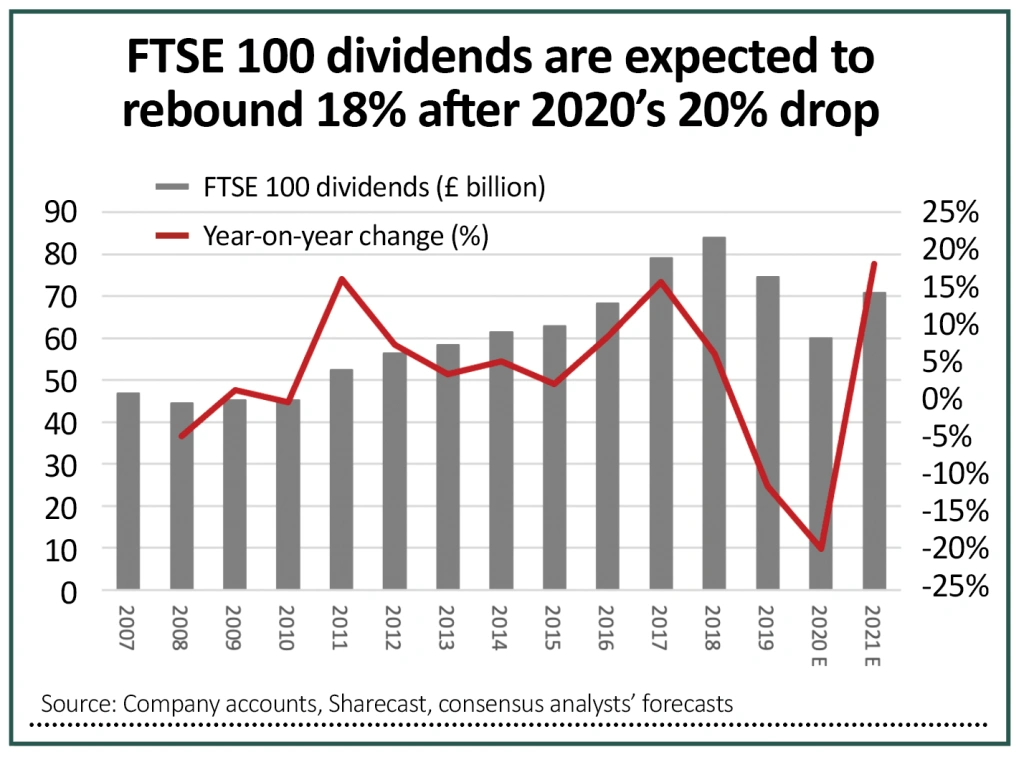
The blue chip index’s dividends are expected to rebound 18% after a 20% drop in 2020

Thursday 17 Dec 2020 Author: Russ Mould

It is unlikely that too many investors will make listening to more announcements from regulators one of their New Year’s resolutions, but no-one could accuse the Prudential Regulation Authority (PRA) of playing Scrooge, at least not this December.

Granted, the PRA may have wounded a few income-seekers’ portfolios with its declaration in late March that the Big Five FTSE 100 banks should not pay dividends (or run any share buyback programmes) in calendar 2020.

The lenders responded immediately by cancelling their planned final payments for 2019, keeping £9.2 billion in cash on their balance sheets. Further possible distributions have been withheld, to deprive income seekers of a further £6.5 billion, based on the payments made for the second and third quarters in 2019.

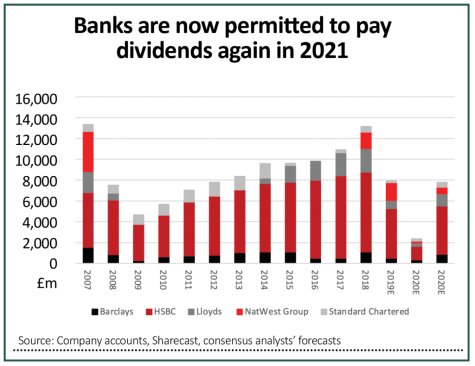
However, the PRA has now relented and granted permission to Barclays (BARC)HSBC (HSBA)Lloyds (LLOY)NatWest (NWG) and Standard Chartered (STAN) to return to cash to shareholders in calendar 2021.

While caps and limits are in place, this still represents good news for those investors who are seeking income from UK equities. The consensus analysts’ forecast of a combined £5.4 billion in dividend increases from banks underpins the estimate of an aggregate £10.9 billion improvement in the FTSE 100’s payout for 2021 to a total of £70.8 billion.

That £70.8 billion figure is, in turn, enough for a 3.8% dividend yield on the FTSE 100. While it is not up there with the 4.5%-plus analysts were hoping for a year ago (and that after a 15% fall on the FTSE 100 to add capital insult to income injury), it may help to provide some sort of valuation support for the headline index.

Banking on the lenders

However, not everyone will be convinced that the 3.8% yield number is reliable, or sufficient compensation given the potential risks that come with the UK market, in terms of Brexit, the ongoing pandemic and the potentially brittle nature of the economic upturn, given the degree of support that the Bank of England and the Government are having to pump in to try and keep the show on the road.

Analysts are not expecting 2021’s profits or dividends to return to the pre-pandemic levels of 2018 or 2019, to suggest they are not going overboard. But four fifths of 2021’s expected £10.9 billion increase in overall FTSE 100 dividends is forecast to come from just three sectors, the form of financials, miners and consumer discretionary. All of this trio could do with an economic tailwind if they are to live up to such expectations.

If the economy offers little or no assistance – or even hinders – then these forecasts could find themselves exposed to the downside. Moreover, the banks must still contend with the margin-crushing effects of the Bank of England’s zero interest rate and quantitative easing policies, while the Government’s apparent desire to increasingly use them as a tool for lending and keeping debt off its own balance sheet adds to the risk of weaker returns and higher loan provisions.

Concentration risk

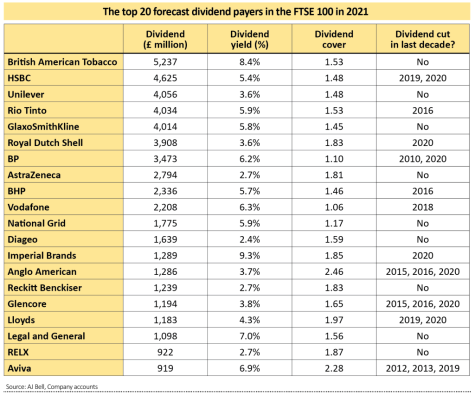
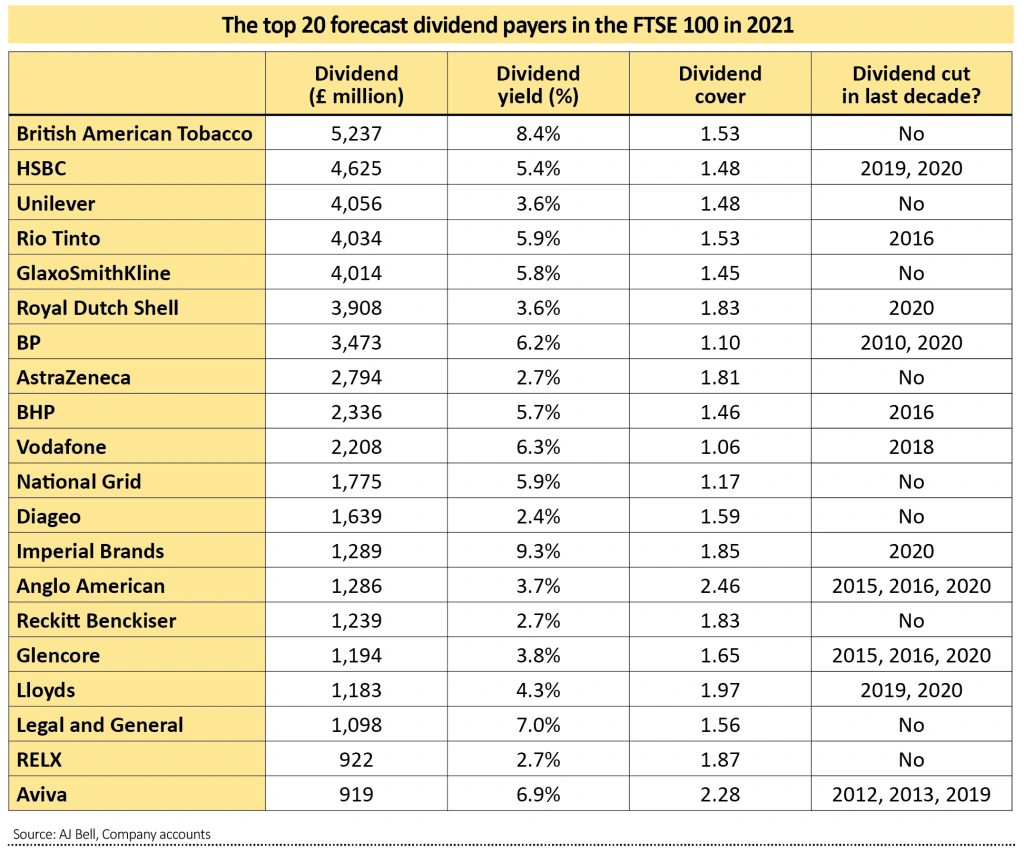
Helpfully for those of a nervous disposition, only one of the big five – HSBC – is forecast to be among 2021’s top 20 dividend payers by value within the FTSE 100. Barclays is the next lender in the forecast rankings, at 21st.

Nevertheless, investors must again assess the concentration risk which has dogged those who have sought income from the UK stock market for some years. Ten stocks are forecast to pay dividends worth £32.3 billion, or 54% of the forecast total for 2020. The top 20 are expected to generate 75% of the total index’s payout, at £44.8 billion.

Anyone who believes the UK stock market is cheap on a yield basis, and is looking to buy individual stocks, glean access via a passive index tracker or even buy a UK equity income fund, needs to have a good understanding of, and strong view on, those 20 names in particular.

Please continue to check back for our latest updates and blog posts.

Charlotte Ennis

21/12/2020

Team No Comments

Brooks Macdonald – Investment Bulletin

Please see below investment bulletin from Brooks Macdonald received today – 18/12/2020.

What has happened

The swinging of the risk pendulum continues with positivity around Brexit, Stimulus and Vaccinations driving markets to fresh all-time/post-pandemic highs yesterday. The feeling of seasonal goodwill faded somewhat as we came into today, however.

Brexit…

This week has been characterised by reports that both the EU and UK legislative bodies were being prepared for an extraordinary series of sessions to ratify a Brexit deal. Overnight however UK PM Johnson and EC President von der Leyen both had a call which concluded that ‘differences remain’. Sterling, after being on a strong run but still within its tight 1.09-1.11 range versus the Euro, is feeling downbeat as investors get increasingly tired of trying to interpret policy from bluster. A new deadline is appearing from the EU to force negotiations to a conclusion with the European Parliament’s Conference of Presidents saying that they would organise an extraordinary session of Parliament as long as an agreement was reached on Sunday. The stakes are high enough on both sides that no one is going to walk away from a compromise reached on Monday morning, but time is very tight and not much Brexit no deal planning can take place within industry given Christmas’s immediacy.

US Stimulus Talks

It wasn’t all gloom and doom yesterday with stimulus talks progressing albeit at a slow pace. Senate Majority Leader McConnell and the White House said that a deal was close as a government shutdown at midnight tonight looms. There appears to be little appetite for last minute brinkmanship on this given the change of guard at the White House but also the precarious economic situation caused by COVID. The current bill is $900bn which contains a large number of the previously discussed measures but predictably excludes state and local aid. One fly in the ointment could be Pat Toomey, a Republican senator from Pennsylvania, who has sought to insert a provision in the stimulus legislation that would prevent the Fed from automatically reviving some several emergency credit facilities that are due to expire at the end of the year. Without this provision the presumed Treasury Secretary Yellen could have restarted the facilities without Congressional approval. One to watch

What does Brooks Macdonald think

It is rather disappointing that the two pieces of unfinished business remain unfinished as the Daily Investment Bulletin packs up for Christmas but it is in many ways apt given how Brexit and post-May US Stimulus have taken up many column inches with little legislation to show for it. Next year will be dominated by the interplay of vaccines reopening economies and short term economic restrictions and hopefully one of the above will be sorted for our return at the start of January…

Source: Bloomberg as at 18/12/20

Please continue to check back for our regular blog posts and updates.

Charlotte Ennis

18/12/2020

Team No Comments

Year in Review: A Turbulent 2020 Yields Bright Spots for 2021

Please see below article recently published by the Head Economist of Commercial Banking at JP Morgan. It focuses on the disruptive effect that the pandemic has had on markets and industry this year, with a positive reflection on how adaptable the economy has proven to be.

Spring shutdowns brought economic shocks: In March, the pandemic abruptly ended the longest U.S. economic expansion in history. However, the economy showed its underlying strength in the face of an unprecedented crisis that immediately produced:

  • Headline unemployment of 15%-20%, the highest since the Great Depression.
  • Workplace closures keeping approximately 50 million workers at home.
  • A 15% contraction in the nation’s economic output, marking the worst quarter in U.S. history.

Fortunately, the Coronavirus Aid, Relief, and Economic Security Act (CARES Act) likely prevented the sharp contraction from becoming a prolonged financial crisis.

  • Low interest rates allowed Congress and the administration to authorize the release of up to $4.7 trillion of deficit-financed relief spending while the Federal Reserve’s asset purchase program helped bond markets absorb the surging federal deficit without crowding out private lending.
  • The Paycheck Protection Program kept workers on the payrolls of businesses temporarily shut down by the pandemic, likely stemming the tide of layoffs.
  • With inflation falling just short of the Federal Reserve’s 2% target, there was little obstacle to dropping the short-term interest rate target to zero, making credit available to struggling businesses.
  • Stimulus spending created a $2.5 trillion jump in retail bank deposits as the household savings rate rose from 8% to 33%.

Over the summer, the economy proved adaptable: Daily life may have been severely disrupted, but most economic activity soon adapted to the new normal.

  • The pandemic struck at a time of maturing e-commerce and telecommuting technologies, allowing large segments of the economy to continue operating safely.
  • Some sectors, like residential construction, capital goods production and real estate saw strong growth following the COVID-19 contraction with new home sales up 50% over pre-pandemic levels.
  • Trade flows also saw a rapid recovery, with imported consumer goods leading the way. Steady demand from American consumers helped stabilize Asia’s industrializing economies.
  • U.S. aggregate output moved within four percentage points of regaining its pre-pandemic trajectory, a remarkable rebound considering COVID-19’s ongoing disruptions.

Autumn came, and some sectors were still struggling: Booming real estate and capital goods markets may have obscured more persistent weaknesses in the economy.

  • Air travel remained significantly depressed as passengers continued to delay trips, creating a ripple effect through the hospitality and tourism industries.
  • Energy exploration has fallen sharply along with oil prices. The North American rig count has dropped by more than half over the past year.
  • However, the unemployment rate fell to 6.7% in November, down from spring’s double-digit levels. COVID-19 vaccine approvals could likely speed this trajectory.

Winter could bring crosscurrents: COVID-19 cases are rising with the possibility of further state and local shutdowns that could reverse some of the year’s economic gains.

  • Cases were increasing going into the holiday period, suggesting that new restrictions on high-risk settings could be coming.
  • However, optimism surrounding potential vaccines is growing. If approval and distribution run smoothly, some experts say the pandemic could be contained as early as the first half of 2021. This could make dislocations from any wintertime shutdowns temporary.
  • A sustained rise in household savings implies that consumers are holding nearly $1 trillion in pent-up demand awaiting full reopening of the economy.  
  • The forward-looking equities market appears to be pricing in a return to normal next year. Investors are confident that historically high profitability and strong global growth will resume driving the market in 2021.

The bottom line

So far, COVID-19’s economic impact hasn’t resembled a typical recession. Though GDP has rebounded close to pre-pandemic levels, the job market still has significant ground to cover. A full economic recovery likely won’t be possible until an effective vaccine is widely distributed and the virus is contained.

We will continue to study market analysis with a keen interest as we enter the New Year. Please check in again with us soon.

Happy Christmas. Stay safe.

Chloe

18/12/2020