Team No Comments

Jupiter Asset Management Outlook: All change but stay diversified

Please see the below 2021 Covid Impact themed outlook from Jupiter Asset Management:

Looking to 2021 and considering the lasting impact of Covid-19, the mountains of debt left in its wake and how stock and bond investors have differing views. Through it all, long-term investors, commensurate with their risk appetite, are best served with a diversified portfolio.

As the year closes, equity indices, especially those in the US, are chasing all-time highs. That could have been written a year ago. What a year! Who would have thought within three months of writing the 2020 outlook, the world would be turned up-side down by Covid-19, entire populations would be locked down, the global economy would be comprehensively trashed, central banks and governments would have to make the most significant monetary and fiscal interventions in history to keep the show on the road and by the end of March, global indices (including the technology-heavy NASDAQ) would have lost a third of their value? Therein lies the inherent risk of writing crystal ball-gazing ‘outlook’ pieces!

But taking the plunge, what of the future? Covid-19 will still be dominating events in 2021. With much of the western world battling a second or third viral wave at the end of 2020, the various pipeline vaccines cannot come too quickly for some semblance of normal social behaviour to resume. Not surprisingly markets reacted strongly to the Pfizer/BioNTec vaccine announcement. But post-vaccine ‘normal’ will not be pre-Covid ‘normal’; too much water has passed under too many bridges. GDP growth will recover, but national balance sheets are a mess and eventually the burgeoning debt mountains are going to have to be tackled, though whether through growth, inflation, taxation or austerity remains a moot point.

The Politics of Covid

But change is perhaps more profound. Like it or not Covid has become deeply politicised; many see it is a catalyst for a different future. In many ways it is easier to predict what the future will not be rather than what it will be. There is no re-set button and we simply erase 2020 as if it never happened; societal norms are shifting and moreover they are expected to shift. It extends to the corporate world where stakeholders with their invested human, regulatory or commercial capital are increasingly prioritised over shareholders and their financial capital.

From an investment standpoint, superficially equities have withstood much bad news and uncertainty albeit with a strong dose of volatility. However, there has been a pronounced bifurcation in performance between ‘growth’ companies and the Covid winners, and everything else. So-called ‘value’ companies have been out of favour for a considerable time but as economies begin to recover, perhaps those which are economically sensitive will enjoy an enduring period in the limelight again.

‘Hard-Nosed Pragmatists’

If equity investors are optimists, bond investors are hard-nosed pragmatists, if not pessimists. As lenders, whether to treasuries or companies, they have only two preoccupations: first, will they get their money back on the bond’s redemption date and second, are they being adequately compensated over the duration of their investment to reflect the risk the borrower defaults. Near-term the inflation risk remains benign thanks to slack economies and surplus capacity. As national governments’ Covid recovery extend-and-pretend support schemes eventually recede and the oversupply of labour and capital narrows as economic recovery progresses, opinion is divided whether accelerating money supply through longer-term strategic fiscal stimulus packages risks inflationary pressures to which central banks feel the need to respond with higher interest rates. The past decade suggests structural deflationary pressures may have the upper hand.

Alongside the shifting sands created by Covid, ramifications also weigh from Brexit and the US election. But in this complex environment awash with uncertainties, we believe long-term investors, commensurate with their risk appetite, are best served with a diversified portfolio comprising different asset classes and geographic exposures, as well as blending different investment styles.

This is another one of the many 2021 outlooks we have shared recently from a number of different fund managers, this time with a main focus on the impact of Covid.

Over the course of the next year, as the pandemic reaches its end point as the mass vaccination programme is rolled out, we will see what the lasting impact really is.

Please keep checking back for more outlooks and blog content from a variety of fund managers and our own input.

Andrew Lloyd

16/12/2020

Team No Comments

Brewin Dolphin – Markets in a Minute

Please below the latest ‘Markets in a Minute’ update from Brewin Dolphin – received yesterday evening 15/12/2020

The rally in global equities took a pause last week in the absence of a new US stimulus deal and worsening rates of Covid-19 infections, which are requiring more lockdowns. In the UK, Brexit has weighed on the pound which helped the FTSE100 outperform in relative terms, although it still lost ground. The more domestically focused FTSE250, however fell more sharply, as hopes of a Brexit trade deal appeared to fade at the end of last week.

Last week’s markets performance*

  • FTSE100: -0.05%
  • S&P500: -0.96%
  • Dow: -0.56%
  • Nasdaq: -0.69%
  • Dax: -1.38%
  • Hang Seng: -1.22%
  • Shanghai Composite: -2.82%
  • Nikkei: -0.36%

*Data for week to close of business on Friday 11 December.

A mixed bag to start the week

Monday saw a mixed performance on equity markets. Most Asian markets rose as investors focused on the vaccine rollout and strong economic data out of China.

However, after a strong start, UK and US markets finished mostly lower as London and New York faced more stringent coronavirus lockdowns amid a continuing surge in case numbers. Severe lockdowns were also announced in Germany, the Netherlands and the Czech Republic, highlighting the near-term threats to economic activity. The FTSE100 closed down by 0.23% at 6,531.83.

In the US, only the Nasdaq finished in positive territory on Monday, rising 0.50% to 12,440.04. And despite signs of a possible breakthrough on stimulus negotiations, the Dow fell by 0.62% to 29,861.55, and the S&P500 dropped 0.44% to 3,647.49.

In Europe there was a more positive mood among investors as the UK and EU agreed to keep trying to hammer out a Brexit trade deal past Sunday’s deadline. The growing optimism that a deal could be done saw markets rise across the continent.

The Euro STOXX 600 gained 0.44% to 391.85, while the German Dax closed up by 0.83% and the Spanish Ibex 35 gained 0.96% to 8,140.80. In the UK, the more domestically focused FTSE250 index closed up by 0.72% on the news.

US stimulus and Brexit hopes increase chance of a Santa rally

There is a chance of a ‘Santa rally’ in the run up to Christmas but bad news headlines are a risk. Additionally, very strong equity performance like we saw in November can prompt some rebalancing at the end of each quarter which may see a reversal from equities back into bonds.

But, generally speaking, December is a time when the wind is in the market’s sails and it’s January that has seen the sell offs.

Supportive of this view, there was positive news overnight on Monday regarding a new US stimulus proposal totalling $748bn. Although smaller than the Democrats would have liked, it looks to have much broader support in Congress. There now appears a genuine appetite to get a deal done before the end of the year, which could avoid a cliff-edge for millions of Americans who were due to see their unemployment benefits cut. That could now be avoided, which would be a boon to markets. The risk, however, is that worsening virus news and widespread lockdowns could sour the mood.

UK and EU investors move back to bonds

That is certainly what we saw signs of at the end of last week as equities suffered a modest setback. None of the reasons should have been a surprise; we have known the Brexit transition period was ending this month; we have known that US Covid-19 infections would likely require more lockdowns; and we could see the labour market would soften if that happened.

So far, markets have been pretty resilient in the face of these risks, which is rational given that they are likely to pass within a matter of months, if not weeks. But it is notable how strong sovereign bond markets have been over the past week, moving back towards their all-time lows in terms of yield. It’s also notable that it is European yields (including the UK) that remain tight. This indicates that investors are becoming more risk averse, and the reason is Brexit.

Source: Thomson Reuters Eikon, Brewin Dolphin

Progress on level playing field and effect on the pound

On Monday there was a more upbeat tone, especially from the EU, as they suggested that negotiations were now focusing on the ‘architecture’ of a deal that would solve the sticking points on competition.

Brussels had wanted the right to impose unilateral tariffs on Britain if the UK failed to match EU rules as they evolved, since this could distort competition.

The EU has now dropped this demand and instead talks are continuing on the mechanism by which tariffs could be applied, possibly by binding arbitration.

President of the European Commission Ursula Von der Leyen and chief negotiator Michel Barnier both seem to believe a deal is possible. Barnier told EU ambassadors that fishing was now the last big obstacle to a deal.

The UK is downplaying any suggestion that it is backing down on the issue of fishing rights and quotas, although it is hard to tell how much of this is for show, and how much is genuine intransigence. Many observers will be hoping it is the former.

But even in the case of a ‘no deal’ outcome in the coming days, it is likely that there could be some form of ‘gentlemen’s agreement’ to prevent large-scale delays at the borders and buy both sides more time to negotiate a trade deal early next year. Indeed, the EU last week published proposed contingency measures in the event of no deal. If the UK agreed, it would involve essentially keeping current regulations in place for air travel and trucking, which would help avoid a lot of the chaos.

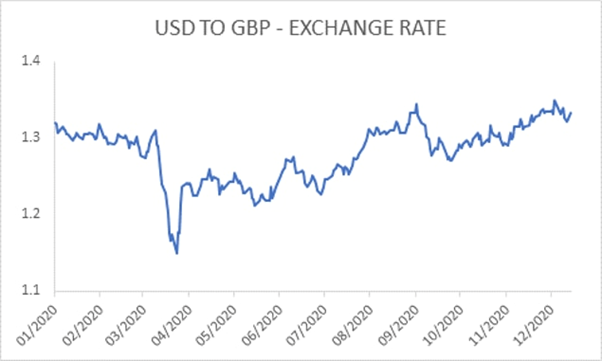
This helped the pound rise significantly on Monday, which suggests that the market is pricing in quite a bit of optimism about a positive outcome. This in turn means that, if there is a deal, the pound may rise modestly. But it also suggests that it is not pricing in a no-deal scenario, which could mean a substantial fall in Sterling if a deal cannot be reached.

This week’s ‘Markets in a Minute’ from Brewin Dolphin reflects on the US stimulus and Brexit news which has increased the chances of a ‘Santa rally’ in the run up to Christmas but worsening virus news and further lockdowns could put this at risk.

Please continue to check back for our regular blog posts and updates.

Charlotte Ennis

16/12/2020

Team No Comments

Weekly Market Commentary: Brexit, US Stimulus and Fed meetings the key focus for investors this week

Please see below weekly commentary received from Brooks Macdonald yesterday afternoon. The article provides market analysis as Brexit and US Stimulus deadlines pass with no significant progress made.

Brexit and US Stimulus deadlines pass without meaningful change

The Collins Dictionary defines a deadline as ‘a time or date before which a particular task must be finished or a particular thing must be done.’ With US Fiscal Stimulus and Brexit talks both hurtling through yet another pair of ‘deadlines’ at the end of last week, one can’t help feeling the 2021 edition needs some updating. 

Yesterday UK Prime Minister Johnson and European Commission President von der Leyen held a call followed by a joint statement confirming that the negotiating teams would continue to talk over the coming weeks. There were no new deadlines set but frankly with two and a half weeks to go until the end of the transition period, there really isn’t a need for manufactured urgency. The tone at a leader level is very much that both sides remain far apart but even if a deal is close this will be the language until the last moment. After a torrid week for sterling and UK domestic equities, we are seeing both bounce today but remaining below levels seen a few weeks ago when more hope was baked into UK sensitive valuations.

Congress is set to debate split stimulus bills as lawmakers attempt to break the deadlock

The big question this week will be whether the US can get a fiscal package over the line ahead of Christmas. In an attempt to break the deadlock, there are two bills going to Congress today – a $748bn package which contains the less contentious areas and a separate c. $160bn bill with the thorny topics such as state and local aid1. House Speaker Pelosi and Treasury Secretary Mnuchin are set to talk yet again to try to reach a compromise position.

This week sees the last Federal Reserve and Bank of England policy meetings of 2020

This week we see the final meetings of the Federal Reserve and Bank of England rate setting committees. The markets are not expecting any meaningful change in the US but for the language around quantitative easing to be ‘enhanced’ as the bank releases its latest Summary of Economic Projections. In the UK a similar meeting is expected, especially after the additional Quantitative Easing announced in the November meeting. 

Despite Christmas being just around the corner, there are some major macroeconomic events for investors to navigate through this week. Optimism has grown today around both US stimulus and Brexit, although this is from the low base set last Friday. The second half of December is traditionally a lower volume period for equities however, with COVID-19 restrictions changing working norms and the macro diary packed, the wind down will likely be delayed a further week. 

We will continue to publish market updates throughout the festive period, so please check in again with us soon.

Take care.

Chloe

15/12/2020

Team No Comments

Brooks Macdonald Investment Bulletin

Please see the below market commentary from Brooks Macdonald received today:

What has happened

The Collins dictionary defines a deadline as ‘a time or date before which a particular task must be finished or a particular thing must be done.’ With US Fiscal Stimulus and Brexit talks both hurtling through yet another pair of ‘deadlines’ at the end of last week one can’t help feeling the 2021 edition needs some updating.

Brexit

Yesterday UK PM Johnson and EC President von der Leyen held a call followed by a joint statement confirming that the negotiating teams would continue to talk over the coming weeks. There were no new deadlines set but frankly with 2 ½ weeks to go until the end of the transition period there really isn’t a need for manufactured urgency. The tone at a leader level is very much that both sides remain far apart but even if a deal is close this will be the language until the last moment. After a torrid week for sterling and UK domestic equities we are seeing both bounce today but remaining below levels seen a few weeks ago when more hope was baked into UK sensitive valuations.

Central Banks and Stimulus

This week we see the final meetings of the Federal Reserve and Bank of England rate setting committees. The markets are not expecting any meaningful change in the US but for the language around quantitative easing to be ‘enhanced’ as the bank releases its latest Summary of Economic Projections. In the UK a similar meeting is expected, especially after the additional QE announced in the November meeting. The big question this week will be whether the US can get a fiscal package over the line ahead of Christmas. In an attempt to break the deadlock, there are two bills going to Congress today, a $748bn package which contains the less contentious areas and a separate c. $160bn bill with the thorny topics such as state and local aid. House Speaker Pelosi and Treasury Secretary Mnuchin are set to talk yet again to try to reach a compromise position.

What does Brooks Macdonald think

Despite Christmas being just around the corner there are some major macroeconomic events for investors to navigate through this week. Optimism has grown today around both US stimulus and Brexit although this is from the low base set last Friday. The second half of December is traditionally a lower volume period for equities however with COVID restrictions changing working norms and the macro diary packed, the wind down will likely be delayed a further week.

It is definitely a more interesting time of the year than usual with the Pandemic and Brexit negotiations.

Please keep checking back for more blog content and investment outlooks from us.

Andrew Lloyd

14/12/2020

Team No Comments

AJ Bell – What is the yield curve telling advisers and clients?

Please see below investment weekly article from AJ Bell received 13/12/2020.

No investment indicator is infallible – if it were, none of us would be working and all of us would be playing the markets (only to find, ultimately, that there would be nothing in which to invest except each other’s investments).

“The curve in the UK stands at its steepest since August 2019, while in the US, the yield premium offered by ten-year US Treasuries relative to two-year paper is at its highest since October 2017.”

However, one which is generally held to stand the test of time is the yield curve, so advisers and clients may be intrigued to learn that the curve in the UK stands at its steepest since August 2019, while in the US, the yield premium offered by ten-year US Treasuries relative to two-year paper is at its highest since October 2017.

In theory, this is the bond markets’ way of saying that an economic upturn, and possibly inflation, are coming. This is a view which has considerable implications for financial markets and asset allocation strategies overall, as well as fund and specific stock selection strategies.

Big switch

In general terms, there are four types of yield curve, using the difference in yield between two- and ten-year Government bonds as a benchmark.

  • Normal. Here, yield on the ten-year paper is higher than that of the two-year. Advisers and clients demand compensation for the additional eight years to maturity, as this means there is more time for things to go wrong, with inflation, interest rate increases or default being the main three dangers.
  • Steep. In this case, long-term yields rise more quickly than near-term ones as investors look to price in an acceleration in economic growth and interest rate increases. Advisers and clients fear being locked into low rates and demand greater compensation for owning longer-dated paper.
  • Flat. This is where the bond market is unsure how to proceed. Yields on two- and ten-year paper are the same as the economy transitions from downturn to upturn or upturn to downturn.
  • Inverted. Here, bond markets fear an economic slowdown or recession and the yield on longer-dated bonds drops below that of shorter-term papers. This happens because advisers and clients price in future interest rate cuts in response to the slowdown and a drop in coupons on bonds issued by Governments in the future.

12-to-18 months ago, all of the talk was of how yield curves were inverting and how that could have been warning of trouble ahead (though no-one would pretend that fixed-income markets saw the pandemic or subsequent recession coming).

“The yield curve is now steepening in the US, a trend which characterised the early stages of the bull equity markets that began in 1982, 1990, 2002 and 2009.”

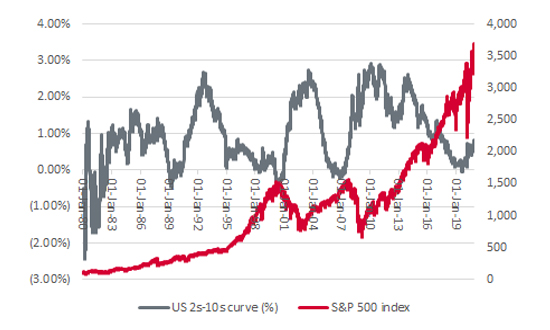
The picture is quite different now. Buoyed by further momentum, the race for a COVID-19 vaccine and further fiscal stimulus from Congress, combined with further monetary largesse from the US Federal Reserve, the yield curve is now steepening in the US, a trend which characterised the early stages of the bull equity markets that began in 1982, 1990, 2002 and 2009.

The yield curve stands at its steepest in over three years

Source: Refinitiv data

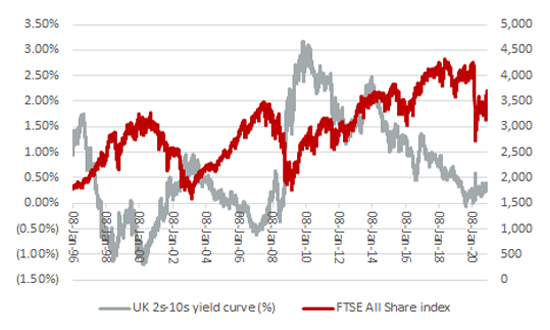
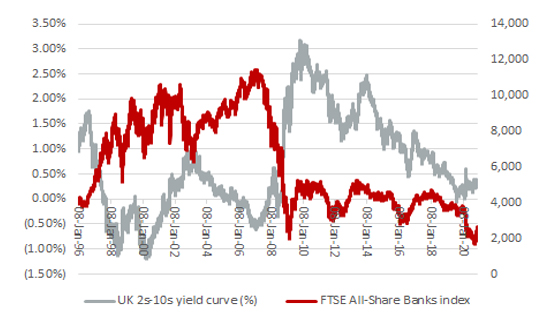
Admittedly, Japan’s experiences since 1990 suggest the yield curve can be a poor predictor of economic activity but the yield curve has had its uses in the UK. Inverted yield curves in 2000 and 2007 helped to call the top for the FTSE All-Share index but a clear steepening marked the beginning of bull runs in 1998, 2003 and in the early stages of the last decade.

The UK yield curve is also steepening

Source: Refinitiv data

Style council

There may be further implications below the level of headline indices. Banking stocks, for example, have been crushed by central banks’ efforts to keep yields low (and, by implication, yield curves flat) as they try to help governments fund their burgeoning debts. A steeper curve could boost banks’ net interest margins, earnings power, share prices and ability to pay dividends. This could be influential in the UK market, for example, where the FTSE 100’s Big Five banks are so integral to earnings and dividend growth forecasts.

Banking stocks could well benefit from a steeper yield curve

Source: Refinitiv data

“A steeper yield curve, hinting as it does at a stronger economy and inflation, seems to favour cyclical earnings growth over secular earnings growth – or, to put it more crudely, ‘value’ as a style over ‘growth’ – at least if history is any guide.”

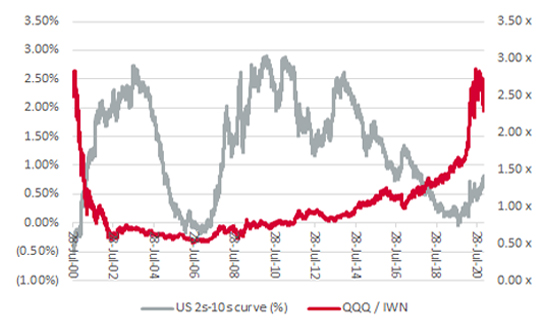
Even more intriguingly, a steeper yield curve, hinting as it does at a stronger economy and inflation, seems to favour cyclical earnings growth over secular earnings growth – or, to put it more crudely, ‘value’ as a style over ‘growth’ – at least if history is any guide.

As this column has noted (30 October 2020), value has tried to forge a recovery relative to growth, using the ratio of the price of the Invesco QQQ Trust, an exchange-traded fund (ETF) designed to track and deliver the performance of the heavyweight NASDAQ 100 index (minus its running costs), relative to the iShares Russell 2000 Value ETF, as a benchmark.

‘Value’ seems to be taking its lead from a steeper curve too

Source: Refinitiv data

Some are wondering if this trade is already exhausted. Looking back at 2000, you could argue that it has hardly begun, such was the violence of the switch from growth to value as the former began to falter under the twin weights of lofty valuations and earnings disappointment.

Russ Mould, AJ Bell Investment Director.

Please continue to check back for our latest updates and blog posts.

Charlotte Ennis

14/12/2020

Team No Comments

A.J. Bell: A year to forget but also one to remember

Please see below an article published late yesterday by A.J. Bell, which looks back on the initial outlook for 2020, in contrast to what was experienced and what we might see in 2021:

Please continue to check our Blog content for advice and planning issues and the latest investment, markets and economic updates from leading investment houses.

Please keep safe and healthy.

Carl Mitchell – Dip PFS

IFA and Paraplanner

11/12/2020

Team No Comments

Jupiter – Investing for a post-Covid world

Please see below an article recently published by Jason Pidcock, who is Head of Strategy on Asian Income at Jupiter, which outlines his thoughts on potential investment opportunities in a post-Covid world:

Please continue to check our Blog content for advice and planning issues and the latest investment, markets and economic updates from leading investment houses.

Please keep safe and healthy.

Carl Mitchell – Dip PFS

IFA and Paraplanner

10/12/2020

Team No Comments

Daily Investment Bulletin

Please see below update received from Brooks Macdonald this afternoon, which comments on the markets’ reaction to political developments in the US as well as ongoing Brexit negotiations in the UK.

What has happened

After starting somewhat moodily, markets gradually recovered ultimately ending in positive territory with the US close. Whilst US Fiscal Stimulus pre-Christmas is still up for debate, constructive comments from the Republican Senate leadership helped support risk appetite.

US Stimulus

Senate Majority Leader McConnell urged both sides to set aside their top priority demands which had generated sticking points earlier in the year. Both parties are acknowledging that this is stage one of the negotiations with another package inevitable when the new administration enters the White House. It’s within that context that the narrative has shifted to ‘pass those things that we can agree on’ in the words of Mnuchin. Treasury Secretary Mnuchin presented a $918bn bill to House Speaker Pelosi so there is a suggestion that we are getting closer to a headline figure on the package. Below the surface there are quite a few differences however, including unemployment insurance where the bipartisan bill backed by Pelosi allocates $180bn with Mnuchin’s White House bill containing just $40bn. Markets have taken the language of compromise, backed by actions, positively however and this has been enough to shrug off the European risk with Brexit.

Brexit

The contentious provisions in the Internal Market Bill were withdrawn by the UK Government yesterday after an agreement in principle was reached around the Northern Ireland arrangements. This draft agreement is yet to be published but these talks, led on the UK side by Michael Gove, have been running in tandem to the main trade talks. This has removed a key point of contention between the EU and UK with the former suggesting that the provisions meant the UK could not be trusted. This improved backdrop is the context for UK PM Johnson to meet EC President von der Leyen over dinner tonight to discuss the Brexit impasse.

What does Brooks Macdonald think

Both sides have played down the odds of a deal and have sounded cautious without entirely snuffing out hope. Is this theatrics or managing expectations ahead of a dinner that shows ‘both sides tried’ – who knows. That said, yesterday was a positive day for Brexit developments as the dropping of the Internal Market Bill provisions (and promise not to include similar measures in the Taxation Bill) does suggest a continued softening of the UK’s position ahead of the crunch dinner tonight.

We will continue to monitor the markets’ performance as we edge closer to the end of the Brexit transition period on the 31st December. Please therefore, check in again with us soon.

Stay safe.

Chloe

09/12/2020

Team No Comments

Jupiter: Views from the House

Please see the below look back at 2020 from Jupiter Asset Management’s Chief Investment Officer:

Jupiter’s Chief Investment Officer reflects on the longer-term implications of a year most unlike any other.

In a year overwhelmingly dominated by the pandemic, it could be tempting to dwell on the challenges that have been presented to businesses and to global society.

Long before any of us had heard – let alone uttered – the words “COVID-19,” there was a trend towards more flexible working in many sectors of the economy, including in asset management. Some in our industry were embracing growing requests for more flexible working arrangements, while others may have viewed them with a certain degree of scepticism, pondering whether fund management was the kind of industry that could accommodate such arrangements at scale.

As much of the world went into lockdown, personal opinions on the merits and disadvantages of remote working became largely irrelevant; a significant policy decision that would, historically, have been the preserve of individual businesses was essentially taken for them.

Simultaneously, the important question as to whether a firm like ours could operate effectively with virtually all employees working remotely for a prolonged and potentially open-ended period was answered; we could, and we did. Indeed, a recent conversation with our head of dealing, Jason McAleer indicated that our industry as a whole has not only coped with the challenges presented, but has seen no perceptible increase in operational errors or issues.

In my view, the changes we have seen have the potential to make asset management a fundamentally more inclusive industry. Put simply, it now feels reasonable to hope that many of those who – for oft-cited reasons, including perceptions of long hours, punishing travel schedules and reconciling the demands of a challenging career with family life – might never have considered a career in fund management, will feel newly emboldened to take a closer look.

If, like me, you believe that more diverse investment teams are better performing ones, then this can only be a welcome development from the perspective of our clients.

Inclusivity leads to diversity

The pandemic and associated changes to working patterns and practices have also reminded us of the value of the office environment, as evidenced by numerous requests from colleagues for permission – which was generally denied, in line with the official guidance at the time – to continue to work from the office as the second UK-wide lockdown came into force.

This all begs a question: how quickly will the potential benefits of changes to working patterns in our sector filter through into the reality of the make-up of our workforce? Naturally, in a profession like fund management, hiring cycles are relatively lengthy. For this, there can be no apologies; the business of taking fiduciary responsibility of other people’s money is a serious one, and it is right that those charged with this duty should first have to prove their aptitude.

Of course, recruitment decisions are largely devolved to hiring managers; while this makes it difficult to “force” change in hiring practices from above, as CIO I am committed to continuing to challenge ourselves.

Changing behaviours: impact on markets and innovation

For a business like Jupiter, one of the more testing trends to emerge over the last year has been a tangible increase in direct participation in financial markets by retail investors. The exact cause of this change in behaviour is difficult to pinpoint, but we can reasonably speculate that it may have much to do with a combination of increased market volatility creating perceptions of attractive entry points, and the simple reality of the increase in available time many people have found in lockdown.

Whatever the cause, there is no doubt that such a sharp increase in activity in stock markets among individual retail investors has had an impact not only on stock prices, but also on liquidity and on sources of liquidity.

For asset managers, this potentially disruptive trend should act as something of a wake-up call; as retail investors in growing numbers show signs of exploring different ways to put their money to work, we must remain relevant, and continue to demonstrate that our products offer value.

As a firm, we place great emphasis on the importance of fostering innovation. A particularly exciting development for us in this regard was the formalisation earlier in the year of our strategic partnership with US-based NZS Capital, LLC (“NZS”), a highly innovative investment boutique which itself focuses on identifying disruptive businesses with the potential to generate favourable outcomes simultaneously for investors, customers, employees, society, and the global environment.

2020: when ESG became truly “mainstream”

Our partnership with NZS also serves as a timely reminder of our commitment to innovation and leadership in the field of ESG investing, a topic that has enjoyed a meteoric rise in prominence over the course of the last year. Indeed, I would be unsurprised if, in the future, social anthropologists looked back on 2020 as the year ESG investing became truly “mainstream.” This is an overwhelmingly positive development, and one to be embraced.

From a fund management perspective, I believe that ESG in the years ahead will be a refinement, evolution and re-categorisation of many of the assessments managers already make when looking at an investment case. How is a company run? Do its activities and/or products cause detriment to the environment? Are its employees mistreated or endangered? Does it mistreat its customers in a way that is detrimental to them and unlikely to build long-term loyalty? Has it taken on excessive leverage in pursuit of short-term shareholder returns that might undermine its longer-term viability? For us, these are not new questions, but they are being asked of us by a broader range of clients and other stakeholders, and with a frequency and determination not before seen.

Such focus on these issues is having a marked effect on markets, and on the way in which capital is being allocated to investment managers. This, in turn is undeniably changing and disrupting perceptions of the characteristics of a business most prized by investors.

The “what” and the “how” of asset management

I believe that the single most important thing we can do as a business is to generate strong and sustainable investment returns for our clients. As the end of every year approaches, we take the time to reflect on our performance; for a year that is likely to stand out in the collective memory for many of the “wrong” reasons, in this particular regard, 2020 has been a year much like any other.

The change, challenges and uncertainties we have all faced notwithstanding, it is pleasing to see that many of our strategies have performed very well throughout this period. Meanwhile, the new colleagues who joined Jupiter through our acquisition of Merian Global Investors have already made a significant contribution to Jupiter, bringing fresh energy, ideas, and perspectives to our debates.

But investment and performance are not the only things about which we hear from clients, who increasingly want to know how a firm like Jupiter manages its money managers. This is perhaps the most important part of the role of the CIO office, and it has been a privilege to speak with so many clients over the course of the year about how we seek to hold our fund managers to account. Put another way, it might be said that in 2020, what we seek to do (generate strong, sustainable investment performance), and how we go about it have become first among equals in the pecking order of clients’ priorities.

In truth, nobody knows how 2021 will play out. With the promise that vaccine programmes may be imminently deployed, a final end to the next chapter of Britain’s exit from the EU in sight, and a the potential for a more stable geopolitical scenario, it is tempting to look forward to the coming year with a great sense of optimism. At the same time, none of us must be under any illusion over the scale of the challenges facing the global economy as the world emerges from the pandemic. Whatever happens, our focus in the CIO office will be on seeking to ensure we deliver the best performance we can, in the most sustainable way we can; it is this pursuit, I believe, that gives us our real licence to operate.

As the end of every year approaches, reflections on the year we are about to leave behind tend to come naturally to everyone.

Look backs at the financial world and investment markets pour out from fund managers followed by outlooks, predictions, and goals for the year ahead.

2020 was a year that nobody could have predicted, and a year I’m sure nobody will look back fondly on.

One of the (positive) key points that can be taken away from this year (as demonstrated in the article above) is something we have been talking about for a while now, ESG is now mainstream.

It’s real, it’s important and it’s here to stay.

From firms and fund managers beginning their ESG journey, to the ones talking about how they already factor in a strong ESG process within their operations.

Whatever our industry takes away from this year, one thing is for sure, ESG is now firmly on everyone’s radar.

Andrew Lloyd

08/12/2020

Team No Comments

Blackfinch Investments – Monday Market Update

Please see below this week’s Monday Market Update from Blackfinch Investments – received today 07/12/2020.

Blackfinch Group – Monday Market Update

Issue 20 | 7th December, 2020

UK COMMENTARY

• The COVID-19 vaccine developed by Pfizer in conjunction with BioNTech was granted authorisation for use in the UK by regulators, with the first doses expected to be rolled out imminently
• The FTSE 100 hit its highest level since March thanks to a solid performance in pharma, mining and energy stocks
• House purchase mortgage approvals increased to 97,532 in October, from 92,091 in September, beating the forecast of 84,000, helped by the stamp duty holiday which has turbocharged the housing market
• Nationwide house price index rose 0.9% in November from October. The year-on-year increased quickened to 6.5% from October’s 5.8%.
• The UK was lifted out of ‘lockdown 2.0’ leading to many UK department stores experiencing a mini boom as shoppers rushed back through their doors. Meanwhile Arcadia group fell into administration, putting 13,000 jobs at risk.
• Tesco surprised markets by deciding not to accept its £585m of business rates relief from the government. Many of its peers followed suit providing a c.£2bn saving to the public purse.
• The manufacturing Purchasing Managers’ Index (PMI) rose to a 35-month high of 55.6 in November (revised up from the ‘flash’ reading of 55.2), up from 53.7 in October. PMI has now signalled expansion (i.e. above the 50.0 level) for six successive months.
• PMI appears to have been boosted by the stockpiling of critical inputs and increased demand from the EU ahead of the UK-EU transition arrangement deadline on 31st December
• Private new car registrations in November were 32.2% lower than in November 2019 caused by the second lockdown. They were up 0.6% year-on-year in October.

US COMMENTARY

• Both the Dow and S&P posted their best November returns since 1928 as hopes around vaccines and a stimulus package assisted sentiment
• US jobless claims fell from 787,000 to 712,000 undershooting the 775,000 consensus estimate. Continuing claims also fell to 5.52m from 6.09m, lower than forecasts of 5.8m. However, 245,000 jobs were added in November compared 638,000 on the previous month and it was the fifth month in a row employment has fallen in the US.
• This mixed jobs report added weight to the argument that further financial assistance and stimulus is needed to help the US economy
• A bipartisan $900 billion relief package bill has been put forward but is it unlikely to get much support as too many discrepancies exist
• Moderna has applied to the US Food and Drug Administration for emergency use authorisation for its COVID-19 vaccine

ASIA / AUSTRALIA COMMENTARY

• China’s Caixin manufacturing purchasing managers’ index (PMI) jumped to 54.9 in November, from 53.6 in October; the consensus forecast was for a reading of 53.5
• Australia’s economy expanded 3.3% quarter-on-quarter in September after a 7% quarter-on-quarter contraction in the June quarter

GLOBAL COMMENTARY

• The Organisation for Economic Cooperation and Development (OECD) now predicts that global Gross Domestic Product (GDP) will contract by 4.2% this year, which is an improvement on the previous forecast of -4.5%. At the same time, it lowered its 2021 forecast to 4.2% from 5%.
• OPEC+ ministers agreed to withdraw previous output cuts by no more than 500,000 barrels a day each month, starting in January, with production hikes subject to review each month helping to push up oil prices

COVID-19 COMMENTARY

• In the UK, cases and hospitalisations continue to fall, with some of the hardest-hit parts of the country reporting a halving in new cases since the second national lockdown began on November 5th
• The US reported 100,000 COVID-19 hospitalisations for the first time

Please continue to check back for our latest blog posts and updates.

Charlotte Ennis

07/12/2020