Team No Comments

Weekly Market Commentary | Equity markets stronger than expected

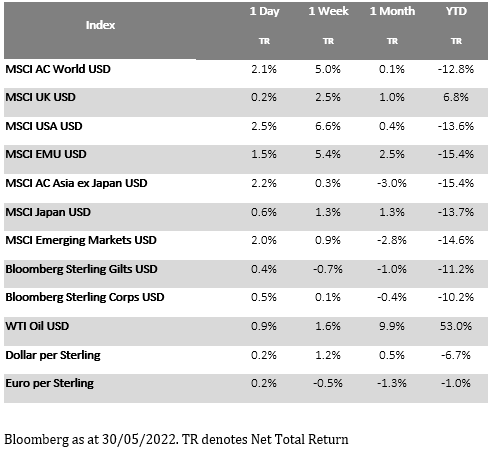
Please find below, a Weekly Market Commentary, received from Brooks Macdonald yesterday afternoon – 30/05/2022

  • Equity markets rallied last week, avoiding an 8-week streak of US equity losses
  • Stronger than expected US retail earnings as well as reduced expectations of US monetary tightening buoyed sentiment
  • This week’s focus will be on US economic data, European inflation and the commencement of the Federal Reserve’s (Fed) balance sheet run-off

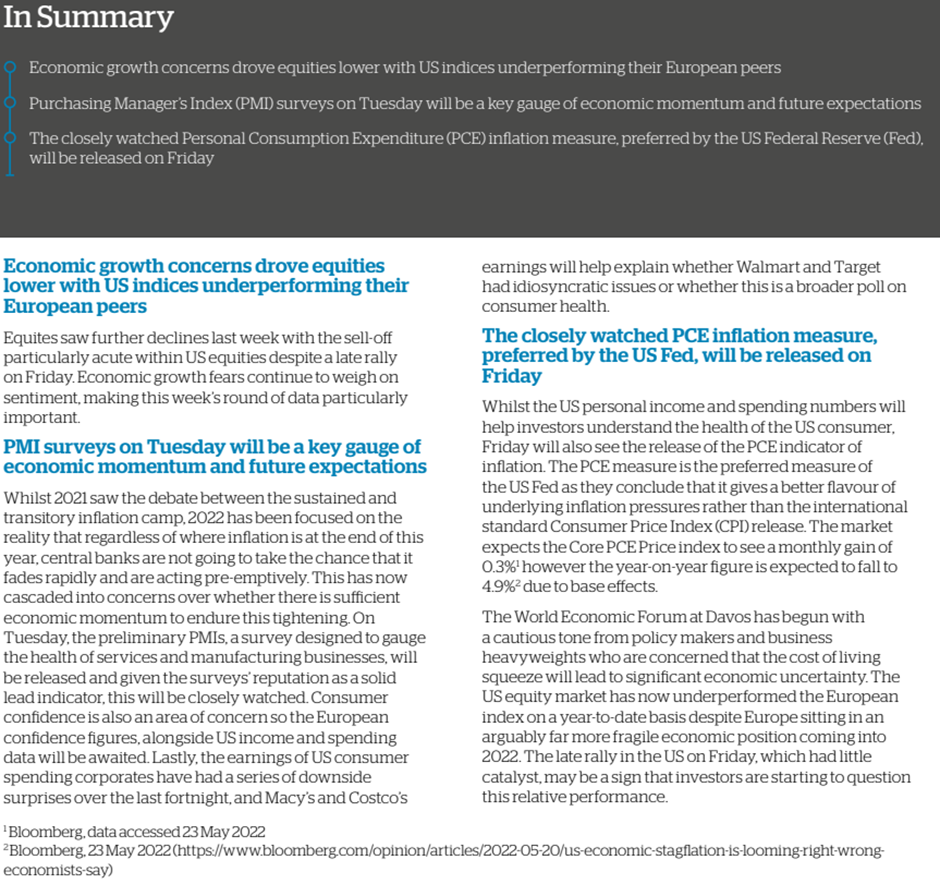
Equity markets rallied last week, avoiding an 8-week streak of US equity losses

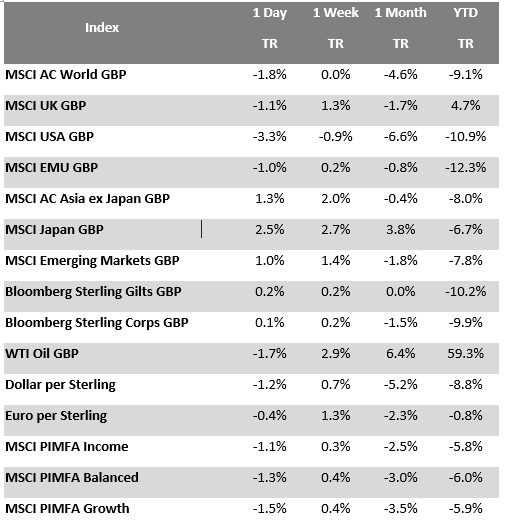
US equity markets broke their 7-week losing streak last week, seeing a strong rally which was led by consumer discretionary stocks as discount retailers posted better earnings than expected. Bond markets also shared this rally as investors priced in a less aggressive pace of tightening from the Federal Reserve in the face of declining economic momentum. This week is likely to be quieter with the US on holiday today for Memorial Day and the UK off on Thursday and Friday for the Queen’s Platinum Jubilee.

Stronger than expected US retail earnings as well as reduced expectations of US monetary tightening buoyed sentiment

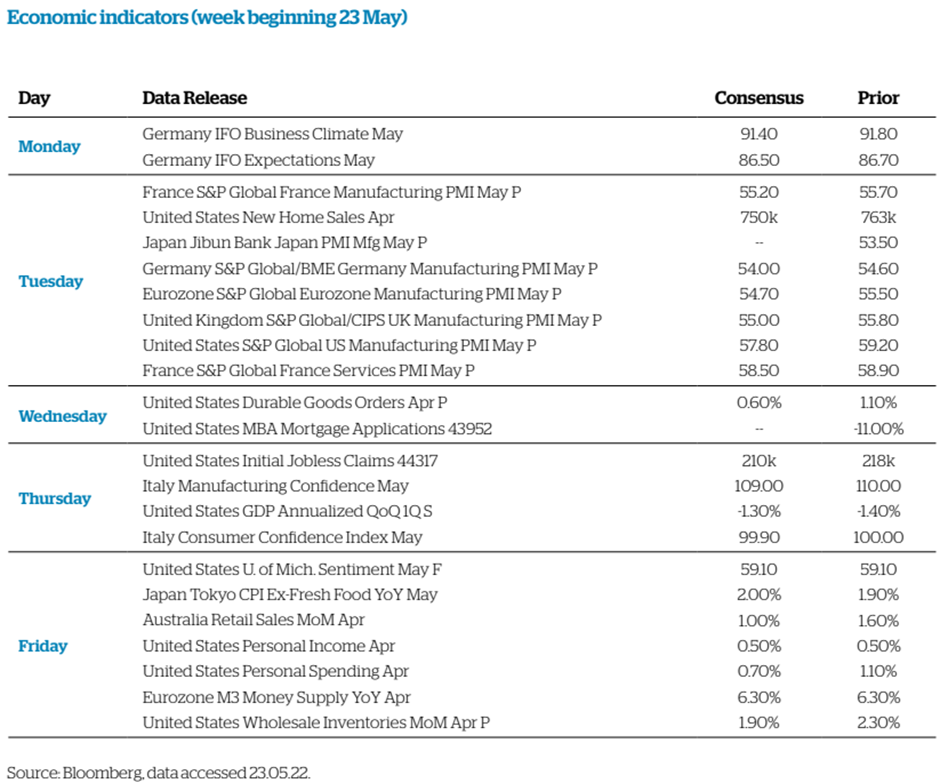
Despite the week being truncated on both sides of the Atlantic, there are plenty of data releases for markets to interpret. In the US we will see the latest industrial activity metrics as well as the Institute for Supply Management (ISM) manufacturing data which comes after the misses in the Purchasing Manager’s Index (PMI) surveys last week. The Conference Board will also update their consumer confidence survey which will give an insight not only into current consumer confidence but also expectations around the future. The main event however will be the US jobs report which is released on Friday. Last month’s reading came in ahead of market expectations at 428,000 new jobs created, this month the market is predicting a more subdued 320,000 but the unemployment rate is expected to tick down from 3.6% to 3.5%1.

This week’s focus will be on US economic data, European inflation and the commencement of the Fed’s balance sheet run-off

Wednesday will see the beginning of the Federal Reserve’s balance sheet run off as it commences its quantitative tightening programme. The process ramps up in September with the Fed re-investing an even smaller proportion of maturing Treasury and mortgage securities. The Fed’s logic is that by not re-investing a proportion of maturing funds from current holdings, the shrinking of the balance sheet can be open and transparent to market participants, reducing the risk of bond market turmoil. There is undoubtedly a communication and liquidity challenge posed by the combination of rate hikes and balance sheet run-off however and that will keep risk assets on their toes until the process is bedded in.

Equities have edged higher on Monday, buoyed by a fresh round of stimulus in China and the more optimistic tone that ended the US session last week. This week is likely to contain a focus on the European Central Bank (ECB) with the central bank increasingly positioning for a July rate hike. Expect the market to focus on German inflation data as well as the specific wording adopted by ECB speakers.

1 Bloomberg, 28 May 2022 (https://www.bloomberg.com/news/articles/2022-05-28/fed-won-t-flinch-as-labor-market-starts-tailing-off-eco-week)

Please continue to check our Blog content for advice and planning issues and the latest investment, markets and economic updates from leading investment houses.

David Purcell

31st May 2022
Team No Comments

Brooks Macdonald – Daily Investment Bulletin

Please see the market update below received this morning from Brooks Macdonald.

What has happened

US equity markets broke their 7-week losing streak last week, seeing a strong rally which was led by consumer discretionary stocks as discount retailers posted better earnings than expected. Bond markets also shared this rally as investors priced in a less aggressive pace of tightening from the Federal Reserve in the face of declining economic momentum. This week is likely to be quieter with the US on holiday today for Memorial Day and the UK off on Thursday and Friday for the Queen’s Platinum Jubilee.

Economic data

Despite the week being truncated on both sides of the Atlantic, there are plenty of data releases for markets to interpret. In the US we will see the latest industrial activity metrics as well as the ISM manufacturing data which comes after the misses in the PMI surveys last week. The Conference Board will also update their consumer confidence survey which will give an insight not only into current consumer confidence but also expectations around the future. The main event however will be the US jobs report which is released on Friday. Last month’s reading came in ahead of market expectations at 428,000 new jobs created, this month the market is predicting a more subdued 320,000 but the unemployment rate is expected to tick down from 3.6% to 3.5%.

Central banks 

Wednesday will see the beginning of the Federal Reserve’s balance sheet run off as it commences its quantitative tightening programme. The process ramps up in September with the Fed re-investing an even smaller proportion of maturing Treasury and mortgage securities. The Fed’s logic is that by not re-investing a proportion of maturing funds from current holdings, the shrinking of the balance sheet can be open and transparent to market participants, reducing the risk of bond market turmoil. There is undoubtedly a communication and liquidity challenge posed by the combination of rate hikes and balance sheet run-off however and that will keep risk assets on their toes until the process is bedded in.

What does Brooks Macdonald think

Equities have edged higher on Monday, buoyed by a fresh round of stimulus in China and the more optimistic tone that ended the US session last week. This week is likely to contain a focus on the ECB with the central bank increasingly positioning for a July rate hike. Expect the market to focus on German inflation data as well as the specific wording adopted by ECB speakers.

Please continue to check our Blog content for advice and planning issues and the latest investment, markets and economic updates from leading investment houses.

Please keep safe and healthy.

Carl Mitchell – Dip PFS

Independent Financial Adviser

30/05/2022

Team No Comments

Brooks Macdonald – Daily Investment Bulletin

Please see investment bulletin below from Brooks Macdonald received this morning – 27/05/2022.

What has happened

Thursday saw further momentum behind the equity rally which has characterised this week so far. Earnings from Dollar and Macy’s helped continue the rally as both retailers posted positive earnings, suggesting that Target and Walmart’s poorer numbers are not necessarily reflective of the broader consumer discretionary sector. Cyclicals outperformed defensive peers as markets concluded there was still some time left in the current economic expansion.

US Housing sector

During May there has been a significant repricing of US interest rate expectations for 2022. In some ways more remarkable than the quantum of the shift is the fact that the month has seen a shift from a bond market eager to pre-empt a hawkish Fed narrative to one which expects a more accommodative central bank. The repricing has started to filter through to mortgage rates with Freddie Mac reporting that the average 30-year mortgage rate fell by 15bps last week alone. This is particularly important given the weaker housing numbers over the last week which was underlined yesterday by the pending home sales figures which fell more than economists were expecting. Such moves will ease consumer pressures on the margin however until the bond market concludes whether the Fed’s hawkishness is truly softening, these rate expectations are likely to remain volatile.

UK cost of living

Yesterday the UK government unveiled a new package to tackle the cost of living squeeze with c. £15bn of stimulus. The quid pro quo was a temporary windfall tax on the profits of oil and gas companies which have benefitted from higher energy prices. There has been much speculation on whether such a windfall tax would be announced and which companies would be caught, however the announcement led UK utilities to fall, underperforming the broad rally seen yesterday.

What does Brooks Macdonald think

Later today we will see the release of the US’s core personal consumption expenditures (PCE) measure of inflation. With economic growth fears front and centre, markets expect year-on-year declines in the core PCE rate as base effects dampen the annual change. With equity sentiment more buoyant this week, avoiding a large upside beat in the PCE figures will be critical to maintaining this positive backdrop into the weekend.

Please continue to check back for our latest blog posts and updates.

Charlotte Clarke

27/05/2022

Team No Comments

Brooks Macdonald Daily Investment Bulletin

Please see today’s daily market update from Brooks Macdonald below:

What has happened

Against the backdrop of the last few weeks of volatility, yesterday can be described as a much needed, orderly trading session. The release of the Federal Reserve minutes did little to upset this state of calm with US equities extending their gains after the publication.

Federal Reserve minutes

The Fed made it clear, in line with recent communications, that they were willing to front-end load monetary tightening in order to fight inflationary pressures. The minutes also endorsed the use of 50bp rate hikes at the next few meetings in order to do this. There were some more dovish overtones within the statement however, with Fed staff saying that financial ‘conditions had tightened by historically large amounts since the beginning of the year.’ Officials were also concerned about the impact of quantitative tightening on liquidity and potential ‘unanticipated effects on financial market conditions.’ The bond market interpreted these doubts around market stability as the Fed acknowledging the tricker economic backdrop and therefore becoming less likely to aggressively tighten policy. Pricing for 2022 rate rises fell back further which means that around one full 2022 25bp rate hike has been discounted since the start of the month. This repricing helped buoy US technology shares which outperformed the broader index.

Inflation and the ECB

As economic growth fears have increased, investors have dialled back their inflation expectations, expecting poorer demand to take the edge off higher inflation risks. In Germany, 10 year inflation breakevens, a measure of expected average inflation over the next 10 years, fell to 2.23%, not far from the ECB’s target and a far cry from the near 3% reading at the start of May. In Europe there are arguably two forces at play, the aforementioned global growth fears but also a growing expectation that the ECB will exit its negative interest rate policy in the short term. Vice President de Guindos of the ECB endorsed the comments made by President Lagarde in her recent blog post, saying that the rate hike schedule was ‘very sensible’ given inflationary pressures.

What does Brooks Macdonald think

The bond market has priced in a softening of Fed monetary policy in recent weeks, wagering that the central bank will blink in the face of growth fears. The coming weeks of central bank speak and indeed the next meeting statement, will be vitally important to test whether the Fed’s inflation fervour has been dented by the recent misses in economic data.

Please continue to check back for our latest blog posts and updates.

Andrew Lloyd DipPFS

26/05/2022

Team No Comments

Markets in a Minute – S&P 500 sees biggest daily loss since June 2020

Please see below ‘Markets in a Minute’ article received from Brewin Dolphin yesterday evening, which provides a global update on markets and economies.

Fears about the impact of inflation on global economic growth led to further stock market losses last week.

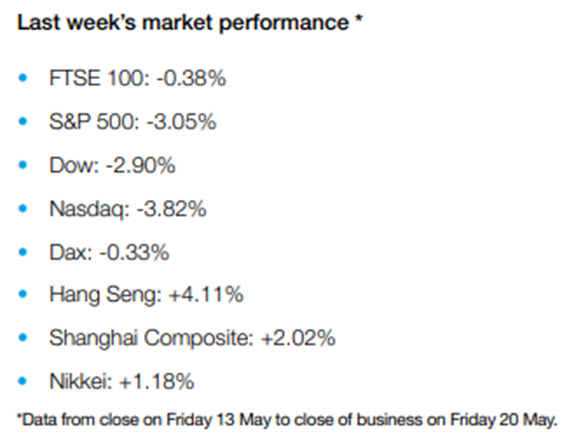
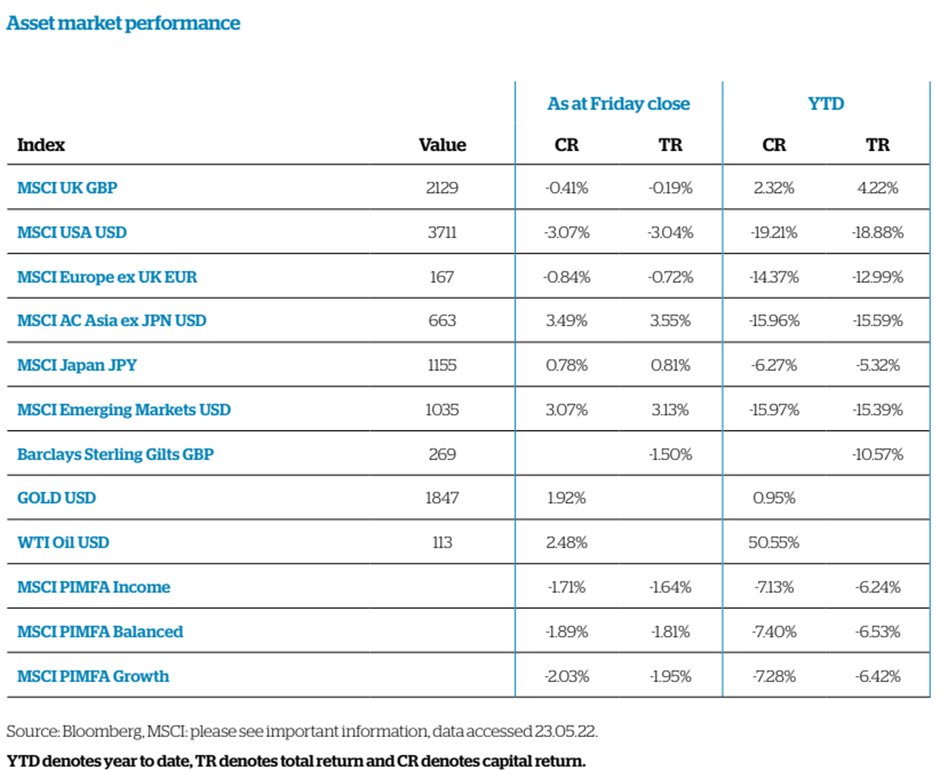
In the US, the S&P 500 suffered its biggest daily fall since the early months of the pandemic, closing down 4.0% on Wednesday following poor results from major retailers. On Friday, the index briefly fell into bear market territory, down more than 20% from its January high, as fears of a recession grew. The index finished the week 3.1% lower, while the Dow and the Nasdaq slid 2.9% and 3.8%, respectively.

The FTSE 100 slipped 0.4% as UK inflation soared and consumer confidence fell to its lowest level in nearly 50 years. The pan-European STOXX 600 declined 0.6% after the European Commission cut its growth forecasts for the eurozone.

Over in Asia, China’s decision to cut interest rates to support its ailing property sector helped to boost sentiment in the region. The Shanghai Composite gained 2.0% and the Nikkei 225 added 1.2%

UK house prices hit fresh record high

Most major indices started this week in the green, with the FTSE 100, Dax and S&P 500 up 1.7%, 1.4% and 1.9% at the close of trading on Monday (23 May). Comments from US President Joe Biden that he was considering lowering tariffs on certain products imported from China helped to boost sentiment.

In economic news, figures from Rightmove showed the average asking price of a UK property rose by 2.1% month-on-month in May to £367,501, the highest for the time of year since May 2014. On an annual basis, prices surged by 10.2% as supply failed to keep up with continued buoyant demand.

Stocks slipped back again at the start of trading on Tuesday. The FTSE 100 fell 1.0% as investors mulled the latest UK government borrowing data. According to the Office for National Statistics (ONS), borrowing fell by £5.6bn year-on-year in April to £18.6bn but remained above pre-pandemic levels.

UK inflation hits 40-year high

The latest UK inflation figures showed consumer prices rose at their steepest rate for more than 40 years in April as the cost of food and energy soared. The consumer prices index (CPI) rose by 9.0% compared with a year ago, up from 7.0% in March. On a monthly basis, the CPI increased by 2.5%, up from a rise of 0.6% in the same month a year ago.

The ONS said the increase in the energy price cap was the main reason for the jump in CPI. The annual inflation rate for electricity and gas hit 53.5% and 95.5%, respectively. Average petrol prices rose to a record 161.8p a litre in April from 125.5p a year earlier, pushing the annual inflation rate for motor fuels and lubricants to 31.4%. Elsewhere, the end of a temporary VAT cut for the hospitality industry led to a 1.7% monthly increase in restaurant and hotel prices.

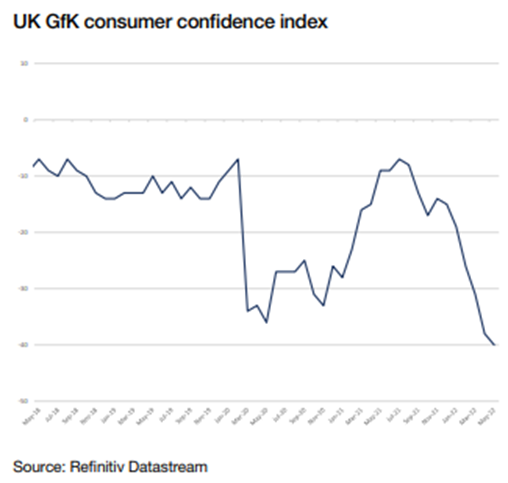
The rising cost of living meant GfK’s consumer confidence barometer fell to -40 in May, the lowest level since records began in 1974. “This means consumer confidence is now weaker than in the darkest days of the global banking crisis, the impact of Brexit on the economy, or the Covid shutdown,” said Joe Staton, client strategy director at GfK. The sub-measures on the general economy sank to -63 for the last 12 months and -56 for the coming year. “The outlook for consumer confidence is gloomy, and nothing on the economic horizon shows a reason for optimism any time soon,” added Staton.

Retail sales jump despite rising prices

Despite the doom and gloom, separate figures from the ONS showed a surprise jump in retail sales in April. Sales volumes rose by 1.4% month-on-month following a fall of 1.2% in March. Economists in a Reuters poll had forecast a decline of 0.2%. The rise was led by strong growth in sales of alcohol and tobacco, which drove food store sales volumes up by 2.8%. Clothing sales were also strong as customers booked weddings and holidays.

On a quarterly basis, sales volumes fell by 0.3% in the three months to April, extending the downward trend in place since summer 2021. “Retail sales picked up in April after last month’s fall,” said Heather Bovill, ONS deputy director for surveys and economic indicators. “However, these figures still show a continued longerterm downward trend.

“April’s rise was driven by an increase in supermarket sales, led by alcohol and tobacco and sweet treats, with off-licences also reporting a boost, possibly due to people staying in more to save money.”

US housing market cools

Over in the US, data suggested the housing market could be slowing as rising mortgage rates make it harder for people to get onto the property ladder. Building permits dropped 3.2% month-on-month in April, led by a 4.6% fall in permits for single-family housing, according to the Commerce Department. Housing starts slipped by 0.2%, with single-family housing starts plunging by 7.3%.

It came after the NAHB/Wells Fargo Housing Market Index, a measure of housing market sentiment, dropped to the lowest level in nearly two years in May. This was blamed on rising prices for building materials and rapidly increasing mortgage rates. The 30-year fixed-rate mortgage averaged 5.3% during the week ended 12 May, the highest since July 2009, according to Freddie Mac data reported by Reuters.

Please check in again with us soon for further relevant content and news.

Chloe

25/05/2022

Team No Comments

Brooks Macdonald – Weekly Market Commentary

Please see below last week’s Market Summary from Brooks Macdonald, which was published and received yesterday afternoon:

Please continue to check our Blog content for advice and planning issues and the latest investment, markets and economic updates from leading investment houses.

Please keep safe and healthy.

Carl Mitchell – Dip PFS

Independent Financial Adviser

24/05/2022

Team No Comments

Blackfinch Group – Monday Market Update

Please see below this week’s Blackfinch Group Monday Market Update received this morning– 23/05/2022.

Blackfinch Group Monday Market Update
Issue 93 | 23rd May, 2022

UK COMMENTARY

Consumer Price inflation hit 9% in the 12-months to April, according to the Office for National Statistics (ONS). This was the UK’s highest inflation rate since 1982.

The ONS also reported that the UK’s unemployment rate dropped to 3.7% in the first three months of the year, its lowest level since 1974, as competition for workers pushed up job vacancies to record highs.

NORTH AMERICA COMMENTARY

The US Commerce Department reported a month-on-month rise in retail sales of 0.9% in April, despite inflation reaching a 40-year high.

Labour markets strengthened across the US in April as unemployment rates fell in most states and the District of Columbia. Encouragingly, labour force participation, which measures the percentage of the working age population either employed or looking for work, also increased in most states.

EUROPE COMMENTARY

The European Commission (EC) downgraded its forecasts for European growth in 2022 from 4.0% to 2.7%, citing the supply chain disruption and higher energy commodity costs driven by the war in Ukraine.

With some European countries heavily dependent on Russian energy exports, growth is expected to slow to 2.3% in the European Union (EU) and euro area in 2023.

The fastest-growing EU countries this year are expected to be Portugal at 5.8%, followed by Ireland at 5.4%. The weakest growth is expected from Estonia, with just 1%, followed by Germany and Finland, both with growth of 1.6% respectively.

According to the EC, inflation in the euro area is expected to average 6.1% this year, three times the European Central Bank’s target, having hit record highs of 7.5% in April.

ASIA COMMENTARY

Unemployment in China rose to 6.1%, while property sales saw their biggest fall since August 2006. Sales of new homes plunged 47% in April from a year earlier, according to the National Bureau of Statistics. 

Please continue to check back for our latest blog posts and updates.

Charlotte Clarke

23/05/2022

Team No Comments

Brooks Macdonald – Daily Investment Bulletin

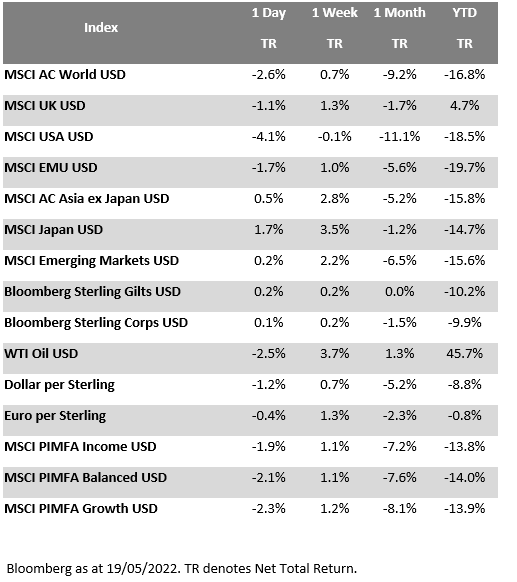
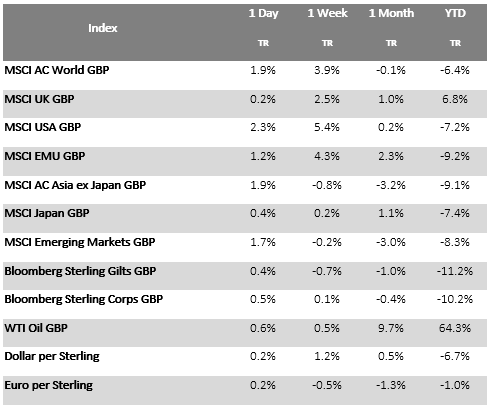
Please see the market update below received this morning from Brooks Macdonald – 19/05/2022

What has happened

The bounce in global equities that had buoyed sentiment on Tuesday, faded fast on Wednesday. Selling the previous day’s rally, investors seemed to focus back on concerns around near-term inflation pressures in particular. In company news, US general merchandise retailer Target missed estimates and the shares fell around 25%, but rather than a read on the health of the US consumer in aggregate, it looked more about the impact of a consumer shifting away from pandemic-driven elevated goods spend, which hit Target’s sales of goods outside of its grocery lines, such as TVs and kitchen appliances. Also on Wednesday, UK CPI data showed inflation rose to 9% Year on Year in April, slightly below a consensus estimate of 9.1%. Boosted by the 1st April rise in the energy price cap, the headline inflation rate reached a 40 year high. In currency markets, Sterling fell versus the Dollar on concerns that the Bank of England might have to tread more carefully around near-term inflation pressures, in order to guard against longer-term economic growth risks. 

US retailer Target delivers an off-target negative surprise

US general merchandise retailer Target reported 1Q earnings on Wednesday, but missing estimates the stock fell around 25%. While the retailer was impacted by higher costs (including fuel costs), and supply chain troubles, the dominant impact seemed to be the company caught by a bigger than expected consumer shift out of goods (especially durable goods) such as TVs and kitchen appliances, that had done well during the pandemic, leaving the company overstocked and forced to mark down prices. Without stimulus cheques fuelling spending, combined with a return to more normal consumption patterns as consumers move back towards services, this was seen as a factor the company. As the Target CEO Cornell said on Wednesday, “three core merchandise categories, apparel, home and hardlines, we saw a rapid slowdown … while we anticipated a post-stimulus slowdown and we expected consumers to continue refocusing spending away from goods and into services, we didn’t anticipate the magnitude of that shift.”

 Markets caught in an investor sentiment tug-of-war

Markets are caught in an investor sentiment tug-of-war battle at the moment, but relatively high levels of market volatility are likely to be with us for a while yet. For central banks, the challenge is getting the balance right between taming near-term inflation pressures while not impacting longer-term economic growth, but it’s a challenge that’s fraught with difficulty. With US Fed Chair Powell hoping for a “softish landing” and UK BoE Governor Bailey seeing a “narrow path” between the risks of inflation and growth, the question as to whether central banks can successfully thread-the-needle on policy unfortunately has no short-term answer.

 How is the inflation picture shaping up?

The inflation picture is rightly dominating investors’ attention, but it can be unpacked into a number of different drivers currently. COVID has created price ‘disruption’ as a result of the post-pandemic restart and the imbalance in supply chains between both goods and services as well as demand and supply. War in Ukraine this year has complicated the inflation picture, adding significant price ‘shocks’ to energy and food in particular. But price ‘disruption’ and price ‘shocks’ are not enough by themselves to kick-start a multi-year inflation process. For that a necessary component would be a significant and sustained rise in inflation expectations (including wage expectations). However, analysis last week from the Peterson Institute for International Economics suggests that the big news in the US April jobs report published earlier this month was a potentially slowing wage growth picture. Looking at US average hourly earnings, the annualized rate of growth (once adjusted for compositional changes in the labour force), was 3.8% over the past three months, a pace considerably slower than in 2021, which saw peaks around 7%.

 What does Brooks Macdonald think?

At Brooks Macdonald, we recognise that the current inflation picture is complex and multifaceted. On balance, we expect the current high inflation rates to start to ease over the remainder of this year and into 2023 – but how quickly (and how far) inflation drops back (as well as the impact to economic growth further out from interest rate hikes in the interim), remain difficult to gauge. Ultimately, it’s one of the reasons why, within equities, we continue to hold to our barbell balance between growth/defensive and value/cyclical investment styles at the current time. 

Please continue to check our Blog content for advice and planning issues and the latest investment, markets and economic updates from leading investment houses.

David Purcell

19th May 2022

Team No Comments

Markets in a Minute – European stocks rise despite growth fears

Please see below ‘Markets in a Minute’ article received from Brewin Dolphin yesterday evening, which provides a global update on markets and economies.

European indices rose last week despite heightened concerns about the economic outlook and inflation.

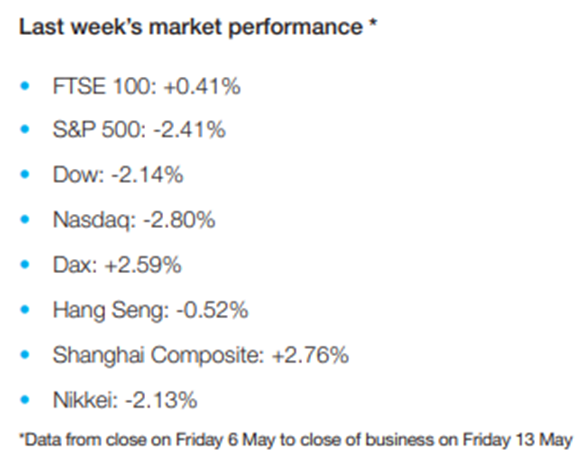
The pan-European STOXX 600 bounced back from its earlier losses to finish the week up 0.8%, while Germany’s Dax rose 2.6%. The FTSE 100 added 0.4%, notwithstanding data showing UK gross domestic product (GDP) unexpectedly contracted in March.

Chinese stocks also rose as the number of Covid-19 cases declined and the China Securities Regulatory Commission pledged to boost confidence in the Shanghai Composite, which is Asia’s worst-performing index so far this year. The index ended the week up 2.8%.

In contrast, US indices fell amid fears the Federal Reserve’s attempts to rein in inflation by increasing interest rates would spark a recession. The Dow fell 2.1% in its seventh consecutive week of losses, while the Nasdaq and S&P 500 slipped 2.8% and 2.4%, respectively.

China’s economy slows as lockdowns hit growth

Stocks were mixed on Monday (16 March) after data from China showed the country’s zero-Covid policy had hit economic activity. The Shanghai Composite slipped 0.3% as retail sales slumped 11.1% year-on-year in April – much worse than the 6.1% decline forecast by economists in a Reuters poll. Industrial production fell 2.9% from a year ago, while unemployment in China’s 31 largest cities jumped to 6.7%. US indices were mostly in the red on Monday, whereas the FTSE 100 managed to reverse earlier losses to finish the trading session up 0.6%.

The FTSE 100 was up 0.4% at the start of trading on Tuesday as investors mulled the latest jobs data from the Office for National Statistics (ONS). Unemployment fell to 3.7% in the first three months of 2022, the lowest level since 1974, while the number of job vacancies in February to April rose to a record 1,295,000.

UK economy shrinks as cost of living rises

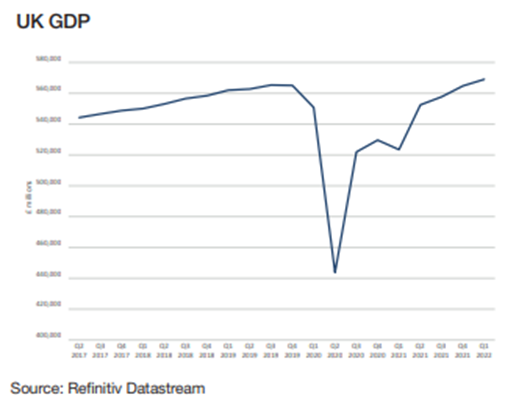
Last week’s economic headlines focused on the unexpected contraction in the UK economy. Figures from the ONS showed GDP slipped by 0.1% in March, driven by a 0.2% decline in services as consumers cut back on spending. Consumer-facing services plunged by 1.8%, led by a sharp 2.8% fall in wholesale and retail trade. Production also fell by 0.2%, whereas construction grew by 1.7%.

The fall in GDP came as a surprise to investors who had been expecting a small rise from the previous month. Figures for February were also revised down from 0.1% growth to no growth, which meant the economy expanded by just 0.8% in the first quarter, less than the 1.0% growth forecast by economists.

The data has exacerbated fears that the UK could slide into a recession – defined as two consecutive quarters of declining GDP – later this year. It comes as households face the biggest cut in real incomes since the 1950s as inflation outpaces wage gains. The ONS is expected to announce that inflation topped 8.0% in the 12 months to April when it releases the next consumer prices index report on Wednesday (18 May).

US inflation moderates less than hoped

Over in the US, inflation slowed in April to an annual rate of 8.3%, down from 8.5% in March, according to the Labor Department. While the data suggests price increases may be peaking, the rate of inflation was higher than consensus estimates of around 8.1%. Core inflation, which excludes food and energy, also pulled back less than expected to 6.2% versus estimates of 6.0%.

On a monthly basis, prices rose by 0.3% in April, the smallest increase in eight months. However, prices for services surged by 0.7% and airline fares jumped by 18.6%, the largest increase on record. The price gains mean workers continue to lose out, with real wages falling by 0.1% month-on-month despite a nominal increase of 0.3% in average hourly earnings. Over the past year, real earnings have dropped by 2.6%.

The inflation report came in the same week as data showing US consumer sentiment slumped to its lowest level for nearly 11 years in early May. The University of Michigan’s preliminary results showed the index of consumer sentiment fell to 59.1 in May from 65.2 in April. The gauge of current economic conditions dropped to 63.6, the lowest reading since 2013, with 36% of consumers attributing their negative assessment to inflation. Buying conditions for durables reached the lowest reading since the question began appearing on the monthly surveys in 1978, again primarily due to high prices. Meanwhile, the measure of consumer expectations fell to 56.3 from 62.5.

ECB could raise interest rates in July

Christine Lagarde, the president of the European Central Bank (ECB), said in a speech last week that she expected the bank to stop expanding its balance sheet through bond purchases early in the third quarter and to raise interest rates “some time” after that, which “could mean a period of only a few weeks”. The comments have led several economists to declare that the first rate hike for more than a decade will go ahead in July. A growing number of governing council members are calling for a 25-basis-point rise in the ECB’s deposit rate at the 21 July policy meeting. The deposit rate is currently -0.5% and has been negative since 2014.

It comes amid concerns that Russia’s invasion of Ukraine could keep inflation high for longer than initially expected. According to comments reported in the Financial Times, Lagarde said the war was “likely to accelerate two ongoing structural changes which, during the transition they entail, could lead to further negative supply shocks and cost pressures”. She added that the ECB’s new quarterly forecasts to be published in June were “increasingly pointing towards inflation being at least on target over the medium term”.

Please check in again with us shortly for further relevant content and news.

Chloe

18/05/2022

Team No Comments

Brooks Macdonald: Weekly Market Commentary – Hopes grow that China can turn a corner on COVID-19

Please see this week’s Weekly Market Commentary update from Brooks Macdonald received late yesterday afternoon:

Hopes grow that China can turn a corner on COVID-19, as Shanghai authorities signal an easing of restrictions ahead

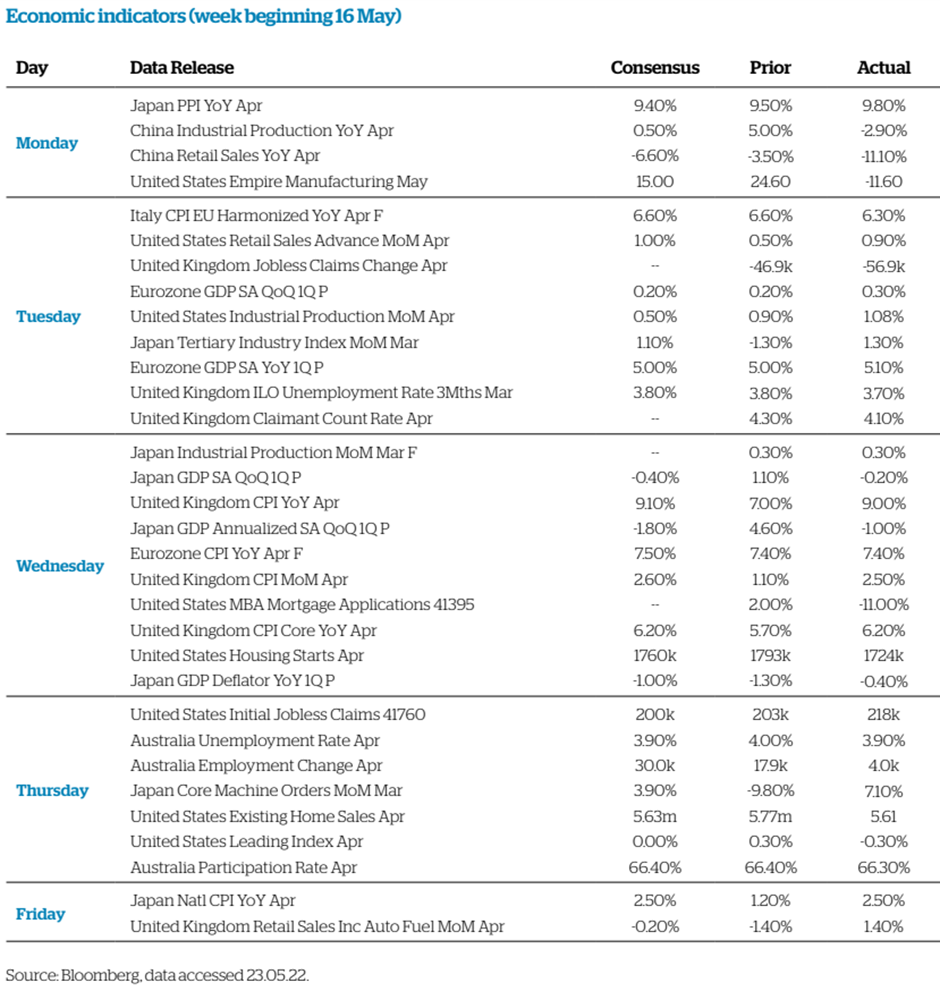
After a difficult week, markets managed a decent bounce on Friday but the mood has soured coming into trading on Monday, following a slew of weaker than expected data out of China. Amongst the data releases, China Industrial production fell -2.9% Year on Year (YoY) vs +0.5% expected, and retail sales was down -11.1% YoY vs -6.6% expected. Despite the disappointment, it’s important to keep in mind that COVID-19 lockdowns in April were the main culprit behind the weaker data, but the good news is that the virus situation looks to be improving. In Shanghai (home to the world’s biggest container port), on Sunday the city reported a second day of no COVID-19 infections outside government-mandated quarantine, and local authorities there have now signalled a timetable for the easing of restrictions and aim to return to normality as early as the start of June.  Starting the return to more normal economic activity, on Monday, the city will begin to reopen supermarkets, convenience stores and pharmacies. Elsewhere in China, with the exception of Beijing, outbreaks in rest of the country look to have eased as well. Assuming this all proves durable, it paves the way for a possible rebound in the economic data going forwards.

Inflation on the radar as UK CPI data is due this week, but keep in mind the caveats with year on year comparisons

After last week’s focus on US CPI (Consumer Price Index data), this week sees more CPI prints for the month of April, including the UK on Wednesday. UK April Core CPI (excluding energy and food) is expected to rise to 6.2% YoY, up from 5.7% YoY in March. The UK headline CPI (including energy and food) is expected to grab most of the headlines however, with an expected print of 9.1% YoY, boosted in part by the 54% rise in the energy price cap set by Ofgem which was introduced on 1st April and which is expected to make its way into the latest reading. With inflation still the focus, markets will be trying to gauge whether the more hawkish cadence from central banks over the past few months has started to filter through into any changes in consumer activity. Taking a temperature-check on spending, we have retail sales data due from the US on Tuesday and the UK on Friday. When we look at UK CPI Year on Year inflation prints, it is important to keep in mind that these tell us just as much about what was happening to prices a year ago, as much as it does about what is happening to prices today. For the UK, this time last year, April 2021 YoY Core CPI was running at 1.3%. Back then, the UK economy was still in the process of coming out of lockdown, with non-essential retail shops only opening up midway through the month, and with restrictions on mixing between different households still in place. As such, the April 2022 CPI print due out on Wednesday is going to be comparing a reasonably ‘normal economy’ this year against a somewhat ‘restricted economy’ last year – as such, while the headline prints will undoubtably generate big headlines, we should treat YoY comparatives with a bit of caution.

Sterling is the pressure release-valve as the risk grows of a UK-EU Brexit bust-up over the Northern Ireland Protocol

Speculation is mounting that the UK government might be willing to unilaterally override parts of the Brexit Northern Ireland Protocol, and an announcement on this might come as soon as this week. In response, the EU has warned that the protocol is a ‘cornerstone’ of the wider UK-EU withdrawal agreement and renegotiation is not an option. The prospect of a possible UK-EU Brexit bust-up has fed into currency markets, with Sterling falling to around 1.22 vs the Dollar last week, levels last seen around May 2020 during the height of the pandemic. Expect Sterling to continue to be the immediate pressure release valve, but there is a potential knock-on factor for inflation also: should Sterling see sustained weakness, then this also risks adding to the current inflation pressures, by adding to import costs.

Please continue to check our Blog content for advice and planning issues and the latest investment, markets and economic updates from leading investment houses.

Andrew Lloyd DipPFS

17/05/2022