Team No Comments

Tatton Update: Market Wobbles Turn into A Rout

Please see the below update from Tatton Investment Management received just now:

Overview: Market wobbles turn into a rout

Last week, as central banks around the world were reasserting their credibility as guardians of monetary stability, recent stock market wobbles turned into a fully-fledged rout. Persistent growth concerns turned into fears that central bank actions would indeed lead to a global recession. This must seem extraordinary to most people, as we have all grown used to central bankers being very effective trouble-shooters. But the pandemic period offers very little precedent – and therefore no sort of economic playbook – of how to handle the post-pandemic ‘hangover’ period. We will never know what would have happened had we not had the biggest dose of central bank support ever to protect us from the economic pain inflicted by the pandemic. However, we can see that the medicine itself, huge monetary injections, has almost certainly contributed to global inflationary pressures in a not insignificant way. Unwinding this support without choking off growth is proving increasingly challenging for policymakers.

Last week, we saw interest rate hikes in the UK and US, an emergency meeting at the European Central Bank (ECB) and some poorly received comments from the Bank of Japan (BoJ) governor. By far the biggest story of the week was the decision from the US Federal Reserve (Fed) to raise interest rates by 0.75%, its biggest single increase since 1994. The decision came after a two-day meeting of the Federal Open Markets Committee (FOMC), where the Fed’s rate setters discussed rampant inflation and its effects. Consumer prices in the US jumped significantly more than expected in May, while a report last Friday showed Americans’ long-term inflation expectations have risen. Together with the continued tightness in US labour markets, this is a worrying sign, suggesting price rises could become embedded in the economy through the dreaded wage-price spiral dynamic that became the hallmark of the 1970s decade of economic stagnation and decline.

Fed chair Jay Powell told the press he is determined to tame soaring prices, even if that means a hit to growth and jobs. According to the ‘dots plot’ of FOMC members’ interest rate expectations the Fed will push interest rates well above 3% by the end of the year, with more hikes to come in 2023. This is a far cry from what was telegraphed as recently as March’s meeting, which pencilled in rates of less than 2% by the end of the year. This is a sign of how much the outlook has changed in the last three months alone. On this basis, it is very likely that Fed tightening has already had an impact on future inflation – just one that will take some time to filter through. The somewhat worrying conclusion is that any further Fed tightening might only have an impact next year, at which point inflation is expected to be much lower anyway. In other words, there is a good chance that hiking rates over the next few months will only serve to make a recession – if and when it does happen – worse.

The good news is that bond markets have not reacted badly to Fed tightening. Indeed, the calm in bond markets after the Fed’s announcement perhaps suggests that investors expect a sharp but manageable slowdown, and that the Fed will indeed do what it takes in the fight against inflation. Credibility – the most important thing for any central bank – seems to have been restored. And even if a recession comes in the next year, market resilience suggests the financial system is stable enough to cope with it. There are many risks ahead, but markets seem confident the Fed can handle them.

The UK: stuck between a rock and a hard place

The Bank of England (BoE) raised interest rates for the second time in as many months last week, after a Monetary Policy Committee (MPC) meeting that had a distinct air of déjà vu. After a split vote – with some members wanting a large hike – the MPC opted for a 0.25% increase that took UK interest rates to 1.25%. And just like at the beginning of May, more dire economic warnings were issued. The BoE now expects inflation to reach 11% in October. At the same time, Britain’s economy is expected to shrink by 0.3% this quarter – a worrying combination of high prices and low growth. The quarter-point rise was in line with expectations, but a minority of economists were expecting a more aggressive 0.5% hike. The MPC promised to “act forcefully” against rapid inflation in its accompanying statement, but investors did not seem convinced. Sterling weakened against the US dollar in the day’s trading – the latter of which was buoyed by the Fed’s much larger rate hike.

On the one hand, Britain faces the highest inflation of any G7 country and has a worryingly tight labour market. On the other, it has the worst growth numbers in the same group, and some economists think we may already be in a recession. These forces pull monetary policy in opposite directions – the former calling for drastic tightening and the latter calling for support. To make matters worse, the UK government has announced several support measures which are expected to boost consumer demand, and more are likely on the way. That drastically reduces the BoE’s room for manoeuvre, and has led some analysts to predict a 0.5% rate hike at the August meeting. In this context, the MPC’s latest move looks particularly cautious. This could well be accompanied by a further deterioration in growth prospects. Ultimately, these will feed through into lower inflation at some point. But given how much consumer inflation can lag, there could be a great deal of pain before that point.

Japan’s outlier role has good and bad effects

It may seem the world’s central banks are in a synchronised tightening mode, but that’s not the case throughout. Both the BoJ and the People’s Bank of China are engaged in forms of quantitative easing. Last week, the BoJ committed to unlimited bond purchases (effectively new easing), a stance reiterated at its Friday meeting. Neither Japan nor China engaged in the massive monetary easing of 2020-2021. Indeed, both have had quite anaemic monetary growth over the period. This may well be a factor in why their (and Asian) growth levels had been well below potential, but now they are able to ease policy rather than having to tighten.

The Bank of Japan is an outlier among the world’s major central banks. While others have fretted over global inflation, Governor Haruhiko Kuroda has stayed calm. And when others trimmed balance sheets and raised rates, Japan stayed the course. Rates are still negative in the world’s third largest economy, and the BoJ is still buying government bonds in massive quantities to maintain its policy of yield curve control. The contrast with the rest of the developed world is now causing strain in Japan’s financial markets. Last Monday, the yen sank to its lowest dollar value in 24 years. That is despite the BoJ, Ministry of Finance and Financial Services Agency issuing a rare joint statement expressing concern over the yen’s slide. The implication was that policymakers may have to shift gears and match their hawkish contemporaries across the globe. But economists expected no changes at Friday’s BoJ meeting, and that is exactly what they got. At the same time, Japanese consumer inflation rose to 2.5% year-on-year in April – the highest level 2014. While that is well short of the price rises seen elsewhere, Japan’s history of chronic disinflation makes anything above the 2% target an eye-catching figure. Earlier this month, Kuroda gave a speech where he claimed that “Japanese households’ tolerance of price rises has been increasing”. His comments were badly received by the public. All of this has increased speculation that the BoJ may finally relent in its monetary support – allowing bond yields to rise. The short trade on Japanese government bonds has increased significantly, forcing the BoJ to spend billions defending yields.

We think this trade is misguided. Japan is in a completely different situation to other major economies, with very little inflation pressure and a still-sluggish economy. Financial conditions have eased recently, and we suspect the BoJ is willing to let this continue. After decades of inertia, the BoJ is likely to want a temporary overshoot of its inflation target, and will likely see it as a spur for economic activity. The same could well be true of currency weakness. There has been speculation that Kuroda sees benefits in a weaker yen, which could help exporters. Even if this is wide of the mark, the yen is extremely cheap on a fundamental basis; rapid inflation elsewhere has increased Japanese consumers’ relative purchasing power. A move down from here would therefore be difficult to sustain. In short, investors bet against the BoJ at their own peril.

Please continue to check our Blog content for advice and planning issues and the latest investment, markets and economic updates from leading investment houses.

Andrew Lloyd DipPFS

20/06/2022
Team No Comments

Brooks Macdonald – Daily Investment Bulletin

Please see investment bulletin below from Brooks Macdonald received this afternoon – 17/06/2022.

What has happened

The latest policy announcements from the Swiss National Bank and Bank of England added to the hawkish rhetoric of recent days, driving equity markets lower. Equities slumped globally with few areas avoiding a widespread collapse in optimism.

Bank of Japan

The Bank of Japan concluded their monetary policy meeting earlier today with the bank deciding to retain its quantitative easing programme. Whilst this was widely expected, the BoJ is a notable exception to the global theme of slamming on the monetary brakes. Bucking the trend has been costly to the Yen which has weakened significantly as policy divides between Japan and, most notably, the United States. The quantitative easing programme is also becoming more expensive, with the Bank of Japan needing to defend their 0.25% cap on 10-year bond yields. The central bank this week alone has had to purchase $9.6tn worth of assets – a staggering amount.

Bank of England

The Bank of England voted for a smaller 25bp rate rise with 3 of the 9 voting members opting for a larger 50bp hike. The move arguably prioritises the committee’s economic growth fears above inflationary fears although the statement was keen to underline the bank’s commitment to tackle inflationary pressures. The bank said it would be ‘particularly alert to indications of more persistent inflationary pressures, and will if necessary act forcefully in response’. The bond market took this as a signal that the bank would act more aggressively in upcoming meetings however there is clearly still some reticence in the committee over the UK economy’s ability to bear much higher rates. Sterling continues to trade weakly versus major trading peers which, given the UK’s dependence on imports, may provide further inflationary pressure over the coming months.

What does Brooks Macdonald think

One of the factors behind yesterday’s selloff was the unexpected hawkish shift from the Swiss National Bank. The SNB hiked rates by 50bps, which not only represents the first hike in 15 years but the bank also decided to go with a super-sized hike to start the cycle. The SNB also established a new currency policy, with the result effectively putting a cap on the Euro/Swiss Franc exchange rate. Whilst it might feel like central bank hawkishness has reached its limit, the SNB decision yesterday is a reminder that central banks still have room for surprise and this reminder was particularly unwelcome given the widespread pessimism amongst market participants this week.

Please continue to check back for our latest blog posts and updates.

Charlotte Clarke

17/06/2022

Team No Comments

Brooks Macdonald – Daily Investment Bulletin

Please see the market update below received this morning from Brooks Macdonald:

What has happened

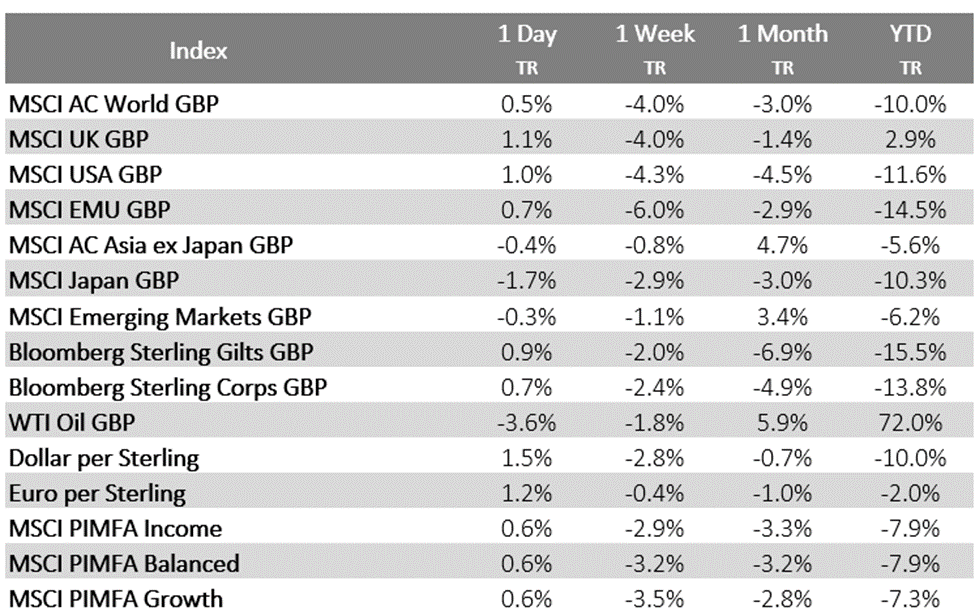
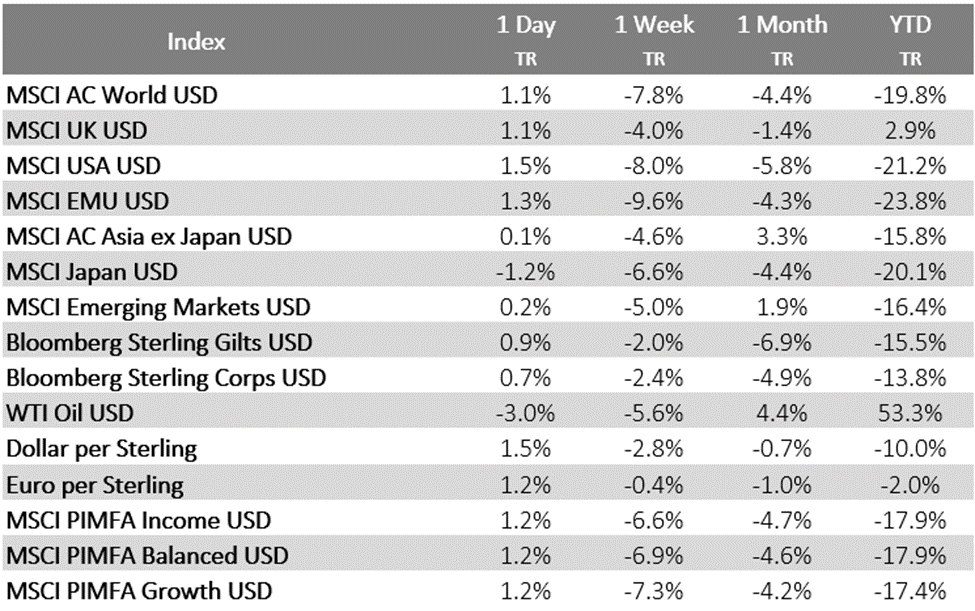
Yesterday saw further swings in bond and equity markets as the ECB and Fed’s latest comments were absorbed by the market 

Federal Reserve

In line with the updated market expectations, the Fed hiked interest rates by 75bps yesterday. Whilst you could argue that forward guidance should be taken with a pinch of salt after the well-telegraphed 50bp hike was abandoned with days to go until the meeting, markets still paid much attention to Fed Chair Powell’s words. The phrase that investors have focused on is the comment from Powell that he didn’t expect 75bp ‘moves to be common’. The market took this positively, with 2-year yields falling sharply and risk assets, particularly rate sensitive areas such as technology, posting gains. Whilst this was the key message that markets took away from the Fed press conference, the economic projections from the Fed underline how difficult it will be for the central bank to engineer a soft landing where inflation comes down but economic growth remains positive.

ECB

We have learnt time and time again to focus on action from the ECB rather than words that can give a misleading impression that there is unity amongst the ECB Governors. Despite this, risk assets appreciated the urgency shown by the ECB in calling an emergency meeting to discuss plans to avoid fragmentation of Eurozone bond markets. The statement suggested that the ECB may use some of the funds generated by bonds maturing in their existing asset purchase programmes to support the peripheral bond market though the general consensus is that such support would be a drop in the ocean compared to the size of outstanding Italian debt. Of more interest is the development of a new ‘anti-fragmentation instrument’ although specific details on the size or conditions of such a plan remain elusive. Despite this room for cynicism, peripheral bond markets rallied significantly yesterday with Italian and Greek 10-year yields falling sharply.

What does Brooks Macdonald think

With the ECB and Fed out of the way, markets will now focus on the Bank of England meeting later today. The BoE have similar inflation considerations to the aforementioned banks however they have been more nervous around the UK’s economic growth momentum. Showing how little consensus there around whether the BoE will prioritise inflation or growth, the market is predicting a 50:50 chance of the bank choosing to hike by 25bps or 50bps.

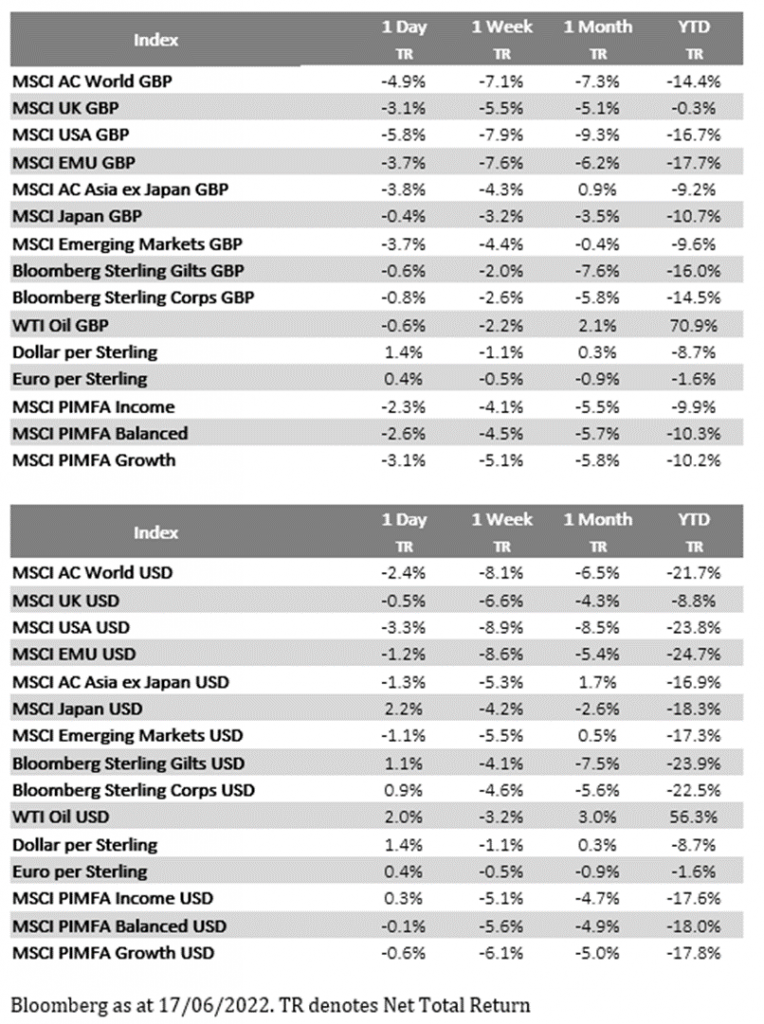
Bloomberg as at 16/06/2022. TR denotes Net Total Return

Please continue to check our Blog content for advice and planning issues and the latest investment, markets and economic updates from leading investment houses.

Please keep safe and healthy.

Carl Mitchell – Dip PFS

Independent Financial Adviser

16/06/2022

Team No Comments

Brooks Macdonald Weekly Market Commentary – Persistent inflation pressures added to speculation

Please see the latest Weekly Market Commentary from Brooks Macdonald received yesterday evening:

  • A hawkish European Central Bank (ECB) statement and a US Consumer Price Index (CPI) beat drove equities and bonds lower last week
  • Persistent inflation pressures in the US have added to speculation that the Federal Reserve (Fed) may add 75bp hikes to its toolkit
  • This week sees the Federal Reserve, Bank of Japan and Bank of England issue their latest policy guidance

A hawkish ECB statement and a US CPI beat drove equities and bonds lower last week

After the hawkish messaging from the ECB on Thursday, markets entered the US CPI print on Friday with little momentum. The US CPI print, which came in above expectations, drove equity sentiment lower and the risk-off tone continues as European and Asian markets start the new week. Central banks will remain in focus this week with the US Fed, Bank of Japan and Bank of England (BoE) all due to update their policy stance.

On a headline basis, US CPI was expected to come in at 8.3% however after a large monthly surge, the year-on-year reading actually moved to 8.6%. The core reading also came ahead of market expectations, recording a 6% year-on-year gain versus 5.9% expected. The year-on-year core number does represent a decline from April’s figure (6.2%) however the market was perturbed by the surge in headline CPI in May. This added further fuel to the bond market sell-off, with 10-year US Treasury yields now trading over 3.25%. Friday’s US CPI beat has added to speculation that the Fed may start to look at 75bp rate hikes to tackle the inflation backdrop.

Persistent inflation pressures in the US have added to speculation that the Fed may add 75bp hikes to its toolkit

The Federal Reserve has guided the market towards expecting another 50bp rate hike at this week’s meeting however the possibility of a 75bp rate hike may now be on the table for the July meeting given the CPI print last week. The Fed, like all market participants, are reacting to the inflation prints as they are released, of more difficulty for the Fed however is that they need to guide the market as to the upcoming expected path of policy which remains heavily clouded by demand and supply side factors. The Bank of England is also expected to raise interest rates this week but by a smaller 25bp increment. The Bank of England has struck a more balanced tone than the Fed, worried that interest rate hikes could disproportionately impact the UK economy. With global inflation fears ignited once again, the BoE will need to choose between prioritising inflation or the economy.

This week sees the Federal Reserve, Bank of Japan and Bank of England issue their latest policy guidance

With central banks looking to set policy not only immediately, but also guide towards future decisions, the importance of individual data points is increased. Last Friday’s CPI print will clearly feed into Wednesday’s decision but it will also inform the Fed’s broader statement over what the bond market can expect over the coming quarters. Such guidance may be misplaced given the highly uncertain backdrop, however markets have fallen sharply as investors prepare for another step up in the hawkish narrative from the US central bank.

Please continue to check our Blog content for advice and planning issues and the latest investment, markets and economic updates from leading investment houses.

Andrew Lloyd DipPFS

14/06/2022

Team No Comments

New worries, old concerns?

Please find below, a summary of this week’s Tatton articles, received from Tatton this morning – 13/06/2022

Outlook: new worries, old concerns?
After renewed positive sentiment in recent weeks, markets once again are showing signs of fragility. We could characterise this ‘risk off’ mood as growth scepticism or more wariness that inflation needs even stronger and swifter central bank policy tightening before being squeezed out. Last week’s change in emphasis from the European Central Bank (ECB) – while expected – provided the necessary headlines. Interest rates were unchanged, but ECB President Christine Lagarde “committed” that rates will rise by 0.25% at the July meeting, and that bond buying will also end (although there was no mention of actual bond sales). From the current overnight market rate of -0.5%, most economists expect the year-end traded rate to be around +0.75%. 

If the ECB is so certain of a rate hike next month, why not start now? If the ECB’s own inflation forecasts keep going up – and all the risks lie towards higher inflation – this is like driving towards a cliff edge with a broken speedometer and promising your passengers you won’t brake too sharply. There may be reasons to think the ECB’s laggardly stance (pun intended) is intentional because most believe the underlying issues are ‘global cost push’, and that the policy that matters comes from the US Federal Reserve (Fed). In which case, policy compression is already underway. US inflation data for May released on Friday worried some investors by being slightly above expectations (with monthly core consumer price index (CPI) inflation still rising at an annualised rate of 7%). US ten-year Treasury yields returned to above 3% last week. Perhaps investors are yet to be convinced inflationary pressures may have peaked.

The current upswing in market risk premia seems to us to be more of a straightforward tale of risk aversion. If energy prices keep rising, or some other external threat emerges, those more anxious investors who headed for the exit might been justified. But resilience levels and activity potential for the global economy have not been in as promising a state for a long time – as has been the resilience of systemically important financial institutions. We suspect last week’s wobble was no more than that. 

Monetary and fiscal policy: giving with one hand, taking with the other
Boris Johnson’s pyrrhic victory on Monday’s ‘no-confidence’ vote could have big implications for the UK economy. Not that you could tell from the market reaction: the FTSE 100 dropped ever so slightly in midweek, while sterling stayed at the same dollar value. But the Prime Minister’s weakened position makes him much more amenable to the whims of his colleagues, and the pressure to ease the UK’s tax burden is mounting. Backbench MPs are reportedly urging the Prime Minister to override the Treasury on cutting taxes, regardless of the inflationary impact. If this happens, it is unlikely to be matched by spending cuts, which could threaten another rebellion. As such, we should expect that the government will loosen fiscal policy in the coming months.

Let that sink in for a moment. Britain is currently seeing its highest inflation levels in 40 years – higher than any other G7 nation – and unemployment is the lowest it has been since the 1970s. Energy and goods supply is severely constrained, and with an excruciatingly tight labour market, we are on the cusp of a wage-price spiral. And amid all of this, the government is throwing more fuel on the fire by loosening fiscal policy. As politically and socially understandable as this may be, such a move would increase inflationary pressures and put the Bank of England (BoE) in a bind. In this environment, monetary policymakers cannot afford to balance growth prospects against price stability. Instead, they must tighten policy hard, raising interest rates and likely choking off growth potential. 

This combination of tight monetary and loose fiscal policy is far from confined to the UK either, as the ECB announcement made clear. More generally, it is a reversal of the policies promoted for more than a decade after the global financial crisis. In that time, we have seen incredibly easy financial conditions while governments have been reluctant to loosen the public purse-strings and in many cases applied outright fiscal austerity. Over the years, many called on politicians to match central banks’ largesse,  that it is happening now – while global inflation surges – will no doubt make many uncomfortable. 

Rising interest rates and central bank tapering puts upward pressure on yields. But so too does loose fiscal policy, as higher government borrowing increases the bond supply competing for investor’s buying interest. Both happening at the same time could mean dramatic upward pressure on yields – which is unlikely to stop anytime soon. Rising bond yields also push up borrowing costs for consumers and businesses. If these increase too rapidly, widespread defaults become much more likely – the classic harbinger of recession. The silver lining is that increased borrowing costs act as a dampener on demand, pulling down inflation and lessening the need for higher interest rates. Yields are pushing up from extraordinarily low levels, so there could still be some way for bond yields to go before there is a significant risk of triggering a debt default cycle. 
The BoE will certainly hope that is enough to tame price rises. With the UK economy forecast  to be the second-worst performing in the G20 (behind only sanction-ravaged Russia) tighter monetary policy could mean severe pain for businesses and consumers. But with the government apparently pushing ahead with fiscal aid, the central bank has little choice. What the new policy mix means over the longer-term remains to be seen.

A fistful of chips: from supply shortage to glut 
US technology giant Intel took a beating from investors last week, leading to a 5.3% fall in its share price on Wednesday. This came after projecting disappointing results for the second quarter. Intel reckons its profits will be around 70 cents a share, well below analyst estimates of 82 cents, and follows a disappointing first quarter of 2022, which saw falling revenues for its PC microchips. Intel’s management insists decent growth forecasts for 2022 will be achieved, implying a stronger second half than previously expected. Investors are not so sure that optimism is warranted, unnerved by signs of faltering demand for PCs – Intel’s largest revenue source. 
Of the other global chip manufacturers, NVIDIA has had a harder time this year whereas Taiwan Semiconductor Manufacturing Co (TSMC), the world’s most valuable chip maker, expects revenues to grow 30% overall this year, a jump from the near 25% growth of last year. TSMC’s projections seem at odds with actual chip price moves, and concerns that demand for computer chips is stalling from global economic and political factors: war in Ukraine, Chinese lockdowns and the cost-of-living crisis across the developed world. Last year, waiting times for games consoles and new cars were unheard of all over the world. TSMC claim these supply shortages continue. 

Wait times for semiconductor delivery hit a record high in May, and chipmakers are raising prices due to rising costs, but in other respects, the chip shortage seems much less pronounced. Companies in need of chips are reportedly starting to see relief and, more importantly, demand has plateaued. Apple, one of TSMC’s best customers, is planning to keep its production of iPhones flat in 2022 – capping off a potential route for growth. This comes as global growth is slowing significantly and inflation is eating into consumers’ disposable incomes. Rapid price rises have also forced the hands of central banks, which are now tied into a rate-hiking cycle that will result in higher borrowing costs and less available capital. The smartphone industry has struggled with these headwinds all year, but the pressures are broad-based, hitting demand for goods well beyond consumer electronics. 

Therefore, despite manufacturer claims to the contrary, capital markets clearly believe chip demand is weaker than supply. Where once there was extreme undersupply, stock markets indicate there is now oversupply. This looks unlikely to change anytime soon, either. Slowing global growth and a cost-of-living crisis will hold back demand in the short term. And over the medium term, there are signs that supply will be boosted. Beyond the question of how we look at chip manufacturers from an investment perspective, the other takeaway from the easing of chip supply is perhaps this: just as chip shortages were the first sign last year of building supply chain disruptions, the easing of supply issues for ‘commoditised’ semiconductor chips now may well mean that price pressures from the supply shortage of goods might be behind us soon.

Please continue to check our Blog content for advice and planning issues and the latest investment, markets and economic updates from leading investment houses.

David Purcell

13th June 2022

Team No Comments

Brooks Macdonald – Daily Investment Bulletin

Please see investment bulletin below from Brooks Macdonald received this morning – 10/06/2022.

What has happened

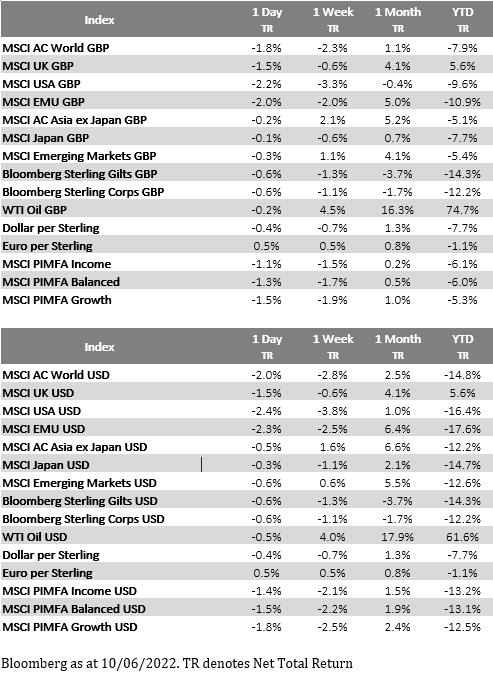
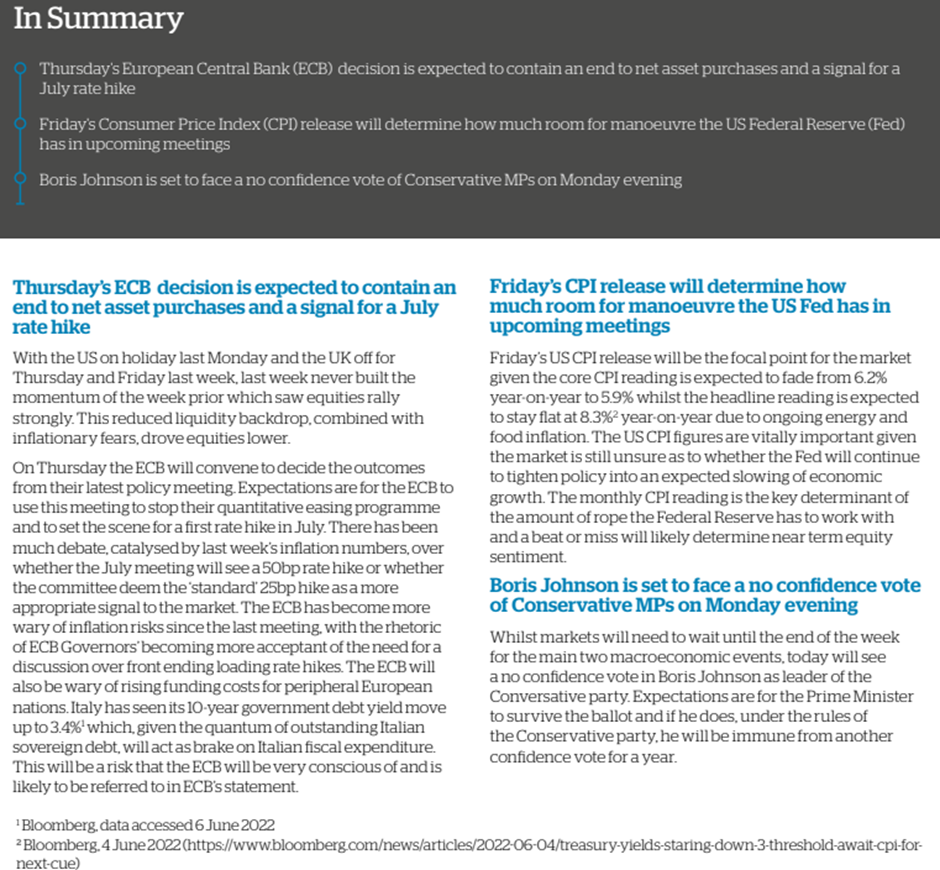
Equity sentiment was soured yesterday by a more hawkish than expected ECB that signalled the use of larger rate hikes from September if the inflation picture doesn’t materially improve. European equities fell after the announcement with US equities declining further after a late sell-off in the US trading session.

ECB meeting

In terms of actual announcements, the ECB came in line with market expectations, ending their net asset purchases at the end of June, and preparing the market for a July rate hike. The key discussion was around the size of future rate hikes with 25bps signalled for July. In terms of September’s meeting the ECB said that ‘a larger increment will be appropriate at the September meeting’ if the inflation outlook ‘persists or deteriorates’. This effectively shifts the burden of proof from the ECB previously hiking rates if it saw higher inflation risks to now hiking rates unless inflation risks decline. Whilst this may sound nuanced, the announcement was a sign of intent by President Lagarde that the ECB would act to bring inflation back to target. The risk of fragmentation between national bond markets was also discussed with Lagarde committing to using new or existing tools to tackle such an eventuality. Bond markets sold off with 10 year German bund yields rising 7.4bps to an 8 year high of 1.42%. Despite the commitment from the ECB President, the difference between Italian and German yields also widened, implying a fear that conditions would have to worsen materially before ECB Governors coalesced around a new asset purchase tool.

US CPI

Today’s main event will be the much anticipated US CPI release for May. Given the late sell-off in US markets, it would be fair to say sentiment is pretty shaky coming into this release. The market is expecting month-on-month headline inflation to surge due to higher gas prices and food prices. The core reading, which excludes these components, is expected to slow on a month-on-month and year-on-year basis.

What does Brooks Macdonald think

The ECB meeting yesterday is a reminder to markets that whilst inflation remains the most important data set for all market participants (including central bankers), what is also important is the willingness of central banks to wait and see whether inflation fades. President Lagarde, by shifting the burden of proof, is effectively saying that the ECB is not willing to be patient and will use 50bp rate hikes as a tool until inflation shows signs of coming under control.

Please continue to check back for our latest blog posts and updates.

Charlotte Clarke

10/06/2022

Team No Comments

Interesting data in volatile times

Following a meeting with Blackfinch Asset Management earlier this week, they provided the following data discussed during our meeting.  I thought it would be useful to share it with you.

Below, we’ve taken a look at the returns of the global stock market (MSCI All Countries World Index) since the start of 2000 up until the close on 18th May 2022. This period includes some of the worst stock market crashes on record including the Dot Com crash, the 9/11 Twin Towers attack, the Iraq Invasion, the Global Financial Crisis, COVID 19 and the ongoing situation with the Russian invasion, inflation fears and interest rate hikes.

Despite these, you will see that if an investor had held their investment for the entire period, they would have returned just over 82%. More importantly though is to see what would have happened if they’d sold out of the market and tried to time their re-entry. It is impossible to predict exactly when the ‘bottom’ of the market is, and history shows us that some of the best, and most pronounced, upside returns have happened in the most challenging economic times. The following table sorts the top 15, single day returns for the global stock market since the start of 2000. Notice how these best returns all happened at a time when investors would have been at their most nervous.

13/10/20089.3%
24/03/20208.4%
28/10/20087.0%
24/11/20086.6%
19/09/20086.2%
08/12/20085.7%
06/04/20205.5%
13/03/20205.3%
10/03/20095.1%
23/03/20095.1%
10/05/20104.8%
04/11/20084.7%
15/10/20024.6%
26/03/20204.6%
02/04/20094.4%

Another way to look at it is by assessing what would have happened if clients had sold out of the market and missed some of these upside days. The following plots what would have happened to an investors returns if they’d missed 1,2,3,4 or 5 of these top performing days (the first bar shows the return if they’d stayed invested over the entire period for reference):

For reference the table below shows the exact return figures plotted on the above chart

PeriodReturn
Full Period Invested82.5%
Missing Best 1 Day67.0%
Missing Best 2 Days54.1%
Missing Best 3 Days44.1%
Missing Best 4 Days35.2%
Missing Best 5 Days27.3%

As you can see, by missing just 1 or 2 of those best days during the past 22 years would have significantly reduced the client’s overall returns.

Looking at the data also highlights how quickly and dramatically upside moves can come to markets and it is our job as investment managers to ensure your client portfolios are positioned to make the most of those upturns when they arrive and to ensure the overall risk is managed in line with their expectations.

Comment

This understanding and data input from Blackfinch is nothing new.  I’ve been looking at this type of information for over 30 years.  However, in volatile markets, particularly when we have so much going on at the moment, compounded by a media that can take negative and biased views, it’s nice to remind yourself of the historic facts.

Remain invested, be patient and if possible, continue funding your pensions and investments.  Regular monthly funding works well over the long term especially in a volatile market.

Steve Speed

09/06/2022

Team No Comments

Brooks Macdonald – Weekly Market Commentary

Please see below last week’s Market Summary from Brooks Macdonald, which was published and received yesterday afternoon:

Please continue to check our Blog content for advice and planning issues and the latest investment, markets and economic updates from leading investment houses.

Please keep safe and healthy.

Carl Mitchell – DipPFS

Independent Financial Adviser

07/06/2022

Team No Comments

Why oil shares seem unshaken by the windfall tax

Please see below article received by AJ Bell yesterday evening, which provides an insight into the effect that Russia’s invasion of Ukraine has had on oil prices, and consequentially, oil stocks.

Bruce Kovner may not be the best-known hedge fund manager in the world but, as the founder of Caxton Associates, he is one of the most successful. He gives little away in public, but it is worth tracking down his few pronouncements and one of this column’s favourites is his comment, “What I am really looking for is a consensus the market is not confirming.”

Right now, so far as this column can tell, the consensus is that oil prices are going to stay high, either because OPEC+ will maintain supply discipline, or because oil firms are wary of big new drilling projects (because of environmental or political pressure or both), or because of the war in Ukraine, or perhaps a combination of all three.

So concerned is World Bank President David Malpass about oil prices that he is citing the Russian invasion of Ukraine, and its effect upon commodity prices, as a potential cause of a global slowdown, if not an actual recession.

Oil stocks are responding to this environment. Shares in Shell (SHEL) and BP (BP.) are both back to pre-pandemic levels and Shell is nudging toward its prior all-time peaks (even if BP is some way short of that).

But when oil stocks are studied in a wider context, it seems as if investors do not really believe that crude will remain in the ascendent for too long, possibly in the view that the long-run move away from hydrocarbons to alternative, renewable sources of energy is still on track.

Higher price, lower profile

Whether this is a good example of a situation where share prices remain sceptical of what seems like the consensus is something that investors can only decide for themselves, but managing the transition from oil and gas to wind, solar and others may yet take time.

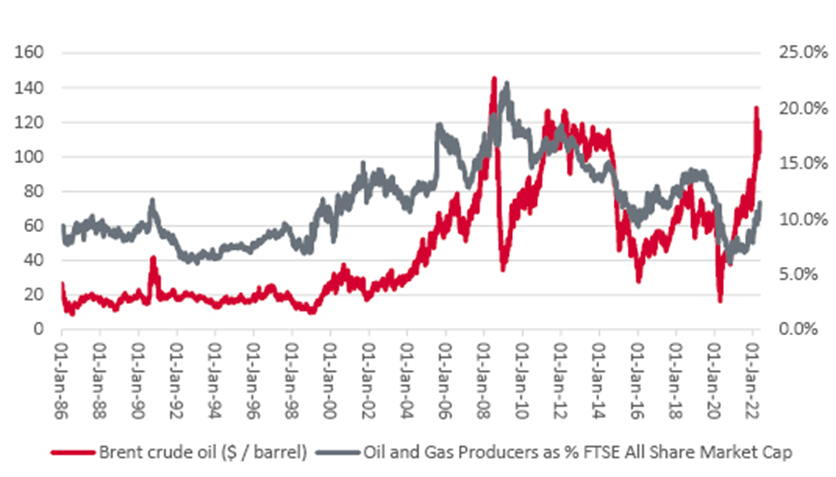
It is therefore interesting to note that oil stocks still represent only 11.4% of the FTSE All-Share’s market capitalisation, compared to historic highs north of 20%, when oil also traded consistently above $100 a barrel.

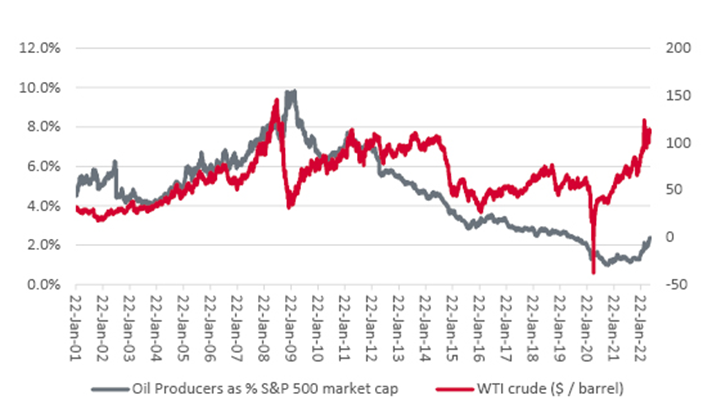
UK oil stocks remain of diminished importance in the UK equity market

Oil stocks also seem to be relatively out of favour in the USA, where their profile, as measured by their percentage of the overall stock market’s valuation, is still languishing near historic lows.

In the USA, the major oil producers command an aggregate market capitalisation which represents just 2.4% of the S&P 500 index’s total $33 trillion price tag. Granted, that is a big leap from the lows of autumn 2021 but it is barely a quarter of the highs seen in the middle of this millennium’s first decade.

US oil stocks also have a much lower profile relative to historic averages

Love and hate

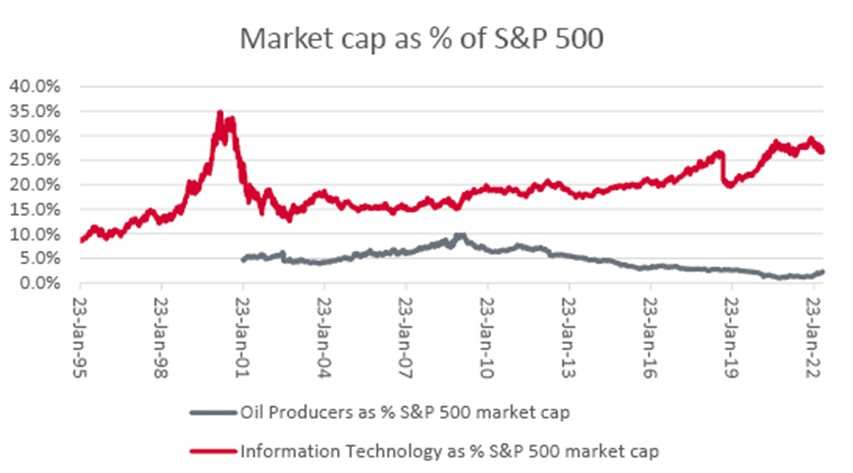
This is in stark contrast to the market’s apparent ongoing love affair with technology stocks. The US Information Technology sector did not quite reach its prior peak at around 35% of total S&P 500 market cap this time around. That may be no bad thing, given how badly that 1998-to-2000 surge came to grief in 2001-to-2003’s bear market, but tech still reached 30% during the pandemic as some investors decided it was the only story in town. Tech’s loss of favour may feel uncomfortable for many, but its reversal of fortune still looks minor compared to the rout of twenty years ago.

Tech still carries a hefty market weighting in the USA

This takes us to another money management legend, Bridgewater’s Ray Dalio, who is less circumspect when it comes to expressing his views publicly than Mr. Kovner. One pearl from Mr. Dalio is this: “The biggest mistake that investors make is to believe that what happened in the recent past is likely to persist. They assume that something that was good investment in the recent past is still a good investment. Typically, high past returns simply imply that an asset has become more expensive and is a poorer, not better, investment.”

The crunching falls in many tech stocks would perhaps lead investors to think the consensus is bearish, just as oil shares’ ongoing resilience, even in the face of the UK’s 25% windfall tax, would give the impression that everyone is bullish on oil stocks.

The historic trends given to these sectors, and their relative weightings now, would suggest that may not be the case. Tech still feels loved, oils still feel reviled.

Such a view may be borne out over time, and this column has no crystal ball with which to confirm or contradict current trends. But the UK Government is now introducing its third piece of legislation that can only sustain demand for oil and gas, in the form of the discount on energy bills for all and further support for less affluent households. This follows the subsidies for domestic air travel and cut in fuel duties.

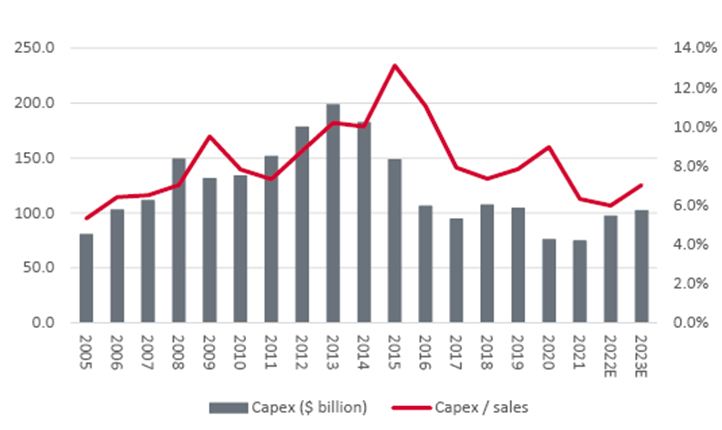
That stimulus, or ‘stimmy,’ comes when supply is already tight relative to demand, as banks, insurers and fund managers decline to offer finance for new exploration work and the Government threatens any successful risk-taking with more tax. Not surprisingly, oil majors’ capex is nearer its lows than cyclical highs.

Oil majors are still being careful with their capex plans

This could be bullish for oil and the consensus seems to agree, even if share prices and valuations appear less convinced. Over to you, Mr. Kovner.

Please check in again with us shortly for further relevant content and news.

Chloe

06/06/2022

Team No Comments

Brewin Dolphin Markets in a Minute

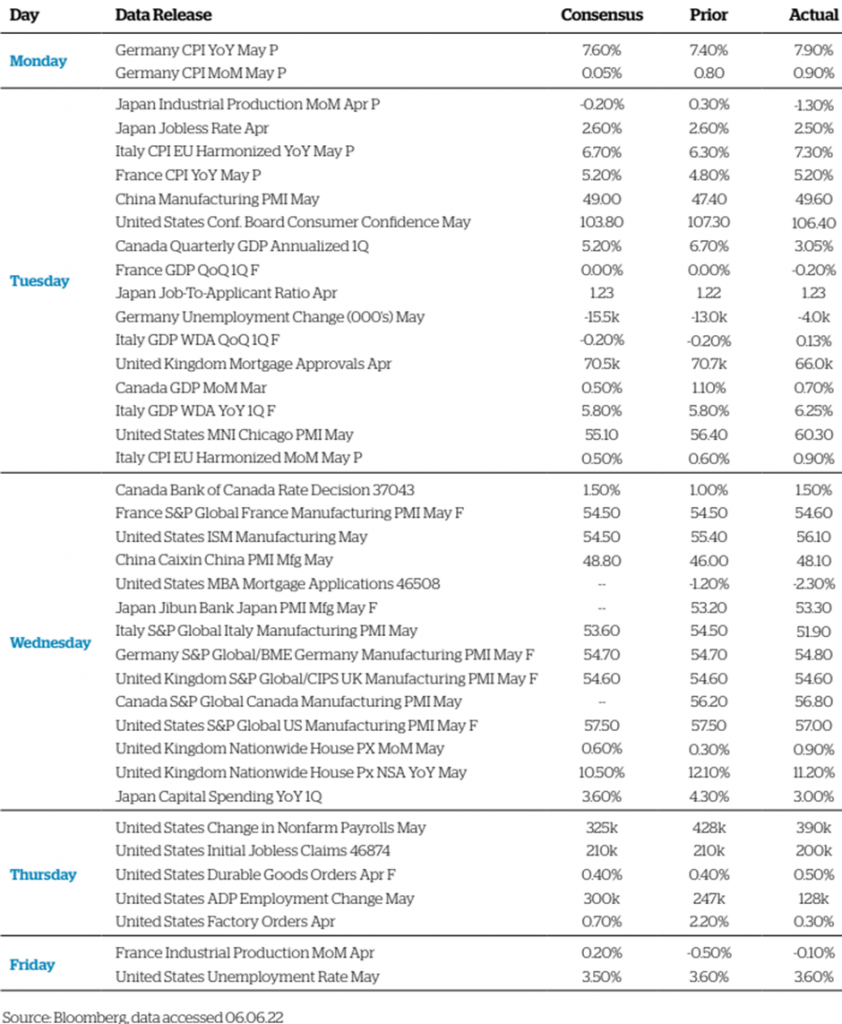
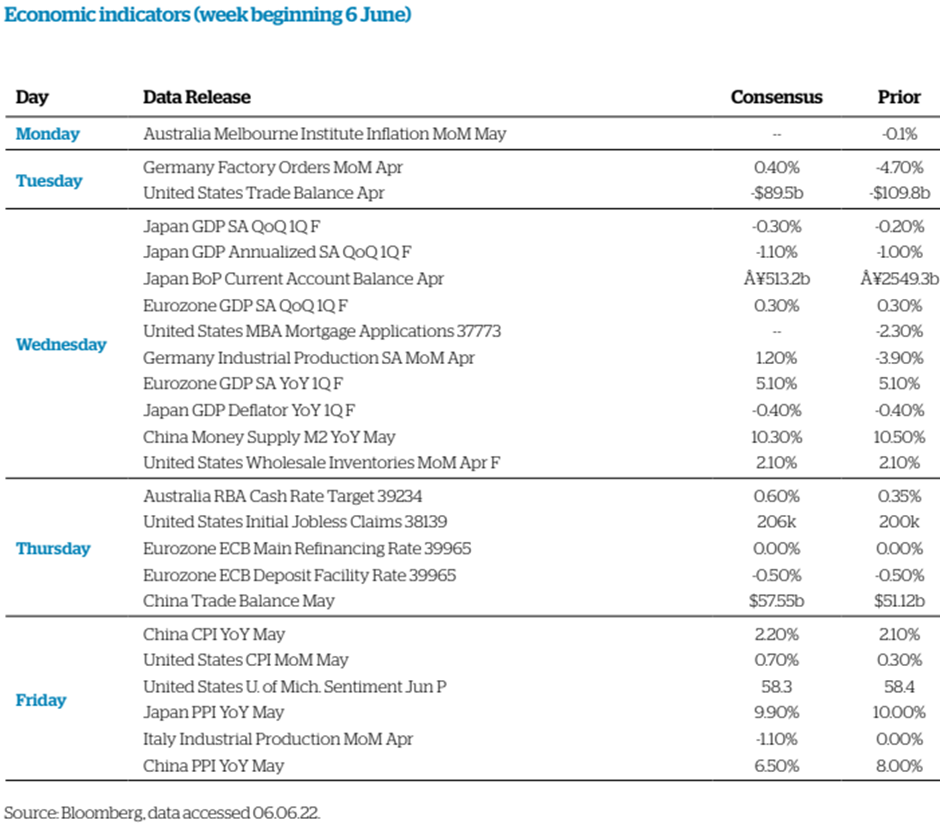
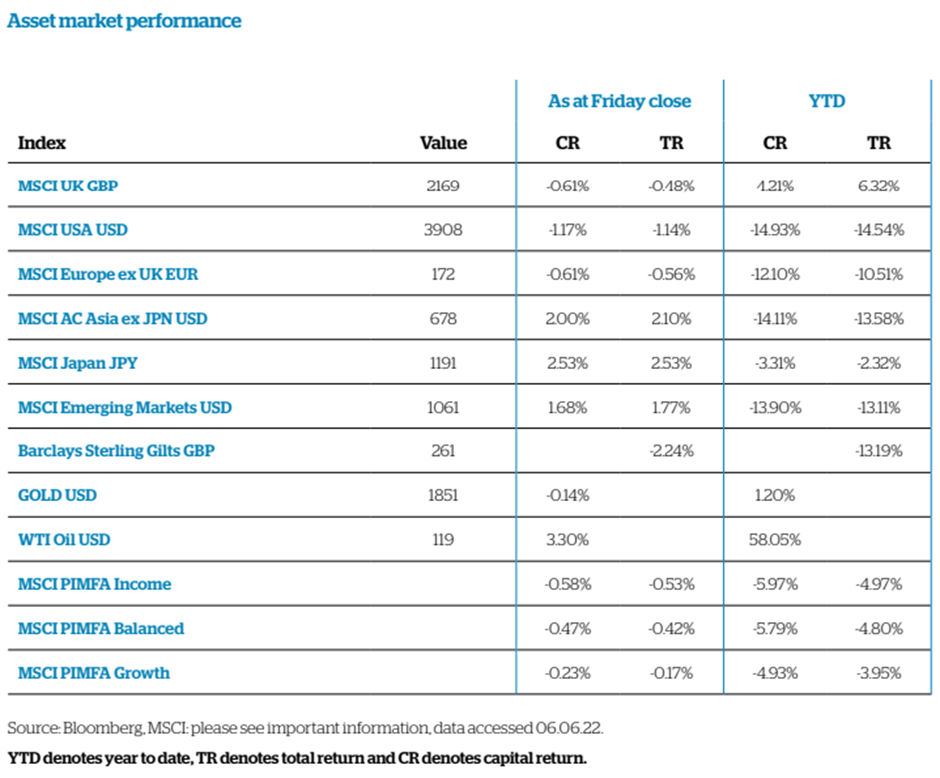
Please see below this week’s Markets in a Minute update from Brewin Dolphin, which was received yesterday evening:

Please continue to check our Blog content for advice and planning issues and the latest investment, markets and economic updates from leading investment houses.

Andrew Lloyd DipPFS

01/06/2022