Team No Comments

Energy price shock turns into Central Bank focal point – Tatton Monday Digest

Please see below the Tatton Monday Digest article received this morning – 04/07/2022

Overview: Energy price shock turns into central bank focal point

As we start the second half of 2022, the pressure is clearly building. The excess monetary liquidity – the unavoidable consequence of central banks’ pandemic-fighting measures – is now draining from markets and hitting the global real economy. Markets already sense that growth is slowing, and it is being reflected in government bond yields. The ten-year US Treasury yield has moved back down to 2.90%, having traded briefly at 3.50% about two weeks ago. The move was matched by the fall in the German ten-year Bund from 1.90% to below 1.30%, and the UK ten-year Gilt from 2.73% to 2.13%. Although 0.6% may not sound a big number, in the context of last Friday’s bond markets, it constitutes a substantial move. And, as we noted last week, markets have shifted inflation expectations lower by about 0.3-0.4% – rising energy costs would usually be associated with rises in inflation expectations. However, we are now observing a big shift – energy cost rises are having the same impact on markets as rising taxes. Russia’s grip on the price of energy appears significant and while those effects can be mitigated in the long-term, they are difficult to avoid in the near or even medium-term. This places considerable pressure on businesses and their profit margins. It also means that sales revenues are likely to suffer as consumers fret over their household budgets as the extra expenses diminish their savings. US businesses and households are also under price pressures, as demonstrated by the latest personal consumption expenditure data. US consumers increased dollar spending in May versus April by just 0.2% and inflation adjusted (real) expenditure dropped by about 0.4%.

Markets are already sensing that inflation-boosting growth is in the process of slowing quickly enough now to warrant a softening in central bank guidance towards the autumn. Nevertheless, the rhetoric coming from last week’s big central bank get-together in Portugal remained resolutely hawkish. We expect the European Central Bank (ECB) will still want to raise rates this month – there were several speakers at the Portugal meeting suggesting a 0.5% repo rate rise – and they may keep going from there. Interestingly, however, these rate increases will happen while the ECB continues to purchase assets. What it takes with one hand, it gives with the other, and that rather incongruous policy is helping to hold back rising credit spreads in the weaker nations.
Still, the negative effects of the energy war being waged on Europe may be softened somewhat for the weakest nations by such monetary policy moves. However, while European governments may want to turn on the fiscal taps to help households and businesses, the policy effectively channels money into Russia’s war-chest, unless there is also an increase in energy supply from elsewhere. This places the onus on fast expansion of tanker capacity to the US and others, and on building better political relationships the Middle East and North Africa. Across the globe, there are major initiatives to secure new partnerships, coalitions, alliances, call them what you will. Maybe, for the UK and the EU, it will also provide an incentive to bury the hatchet and return to a more pragmatic relationship model.

Challenges usually drive change, and greater risk tends to mean greater potential returns. As we enter the second half of 2022, market participants are certainly downbeat, reflected in lower price-to-earnings multiples and higher credit spreads. A resolution of the conflict with Russia is very unlikely anytime soon, but securing other energy supplies is possible. If and when that happens, the headwinds blowing against the global economy should slacken considerably.

Credit crunch begins to bite

Stocks and sovereign bonds regularly make the headlines, the travails of corporate credit markets often have a much more direct impact on companies and, by extension, the economy. Things are not looking good in that regard – with the cost of financing increasing dramatically for many businesses. The hard times in corporate credit are exemplified by investment flows. Despite sinking stock markets this year, the amount of money invested in equities has increased, albeit very slightly. Credit markets, though, have haemorrhaged capital. According to Bank of America, $200 billion has flowed out of corporate bonds in 2022. The squeeze looks widespread, affecting most sectors. Moreover, the longer-term impact of the pandemic is also being felt broadly across sectors because of extra debt taken on during lockdowns. Given the interplay between debt, default and growth, credit stress is often a clear sign of looming recession.

This makes sense given the relative risks in each region. US consumers are being hit by inflation and companies are facing higher debt payments, but neither of these are yet at breaking point. In Europe, energy prices are much higher, and show little sign of coming down. Natural gas prices are nearly six times higher in Europe than they are across the Atlantic. And the squeeze is widespread across the continent, putting serious pressure on growth prospects.

Here and across the channel, the sirens of negative economic growth that define recessions are growing louder (indeed, we may already be at the beginning of one). Strangely enough, that may mean credit stress is approaching its peak, after which bonds should be due a better performance as spreads reduce again when actual default levels become fact-based rather than fear-based. That is the view of some distressed debt investors, who suspect this could be a good low point to buy in. A contrarian view perhaps, but, with any luck, enough investors will believe it enough to turn the market around.

Investors learn to shrug off China’s Covid fears

China’s zero-Covid policy, an extreme outlier among nations’ late-stage pandemic strategies, is not changing anytime soon. This is despite its damaging effects on the economy and its unpopularity with the growing Chinese middle class. In a speech delivered at Wuhan last Tuesday, China’s President Xi declared he would rather “temporarily sacrifice a little economic growth” than “harm people’s health”. Given how long his ‘Zero-Covid’ policy has been in place, one might wonder how temporary that sacrifice will be.

It is curious, then, that Chinese equities are faring so well. The CSI 300 index has been on an upward trajectory for the last two months, and June looks set to deliver the best monthly returns in two years. Xi’s speech coincided with a slight pullback midweek, but even that had recovered by the end of Thursday’s trading. If Chinese citizens are concerned with the zero-Covid policies, investors seem unphased. Some have suggested this may be down to a softer Covid policy than meets the eye. Despite the President reiterating the party line, China’s State Council announced last week that the quarantine for international arrivals would be cut in half – down to seven days in a government facility, followed by three days at home. This comes a few weeks after the President himself declared that Covid containment must be balanced against economic growth – a sign of shifting priorities in Beijing.

We suspect other reasons for China’s stock market strength, and that investor optimism is down to policy changes in other areas, and early signs of returning domestic growth. Beijing recently signalled it would also take a less severe approach to the tech sector, which suffered from crackdowns over the last two years. This is a positive turn, and indicates a general easing up of the Party’s interventionism. Last week, the People’s Bank of China (PBoC) pledged to keep monetary policy accommodative as the economy recovers from its slowdown. It follows on the heels of earlier measures to loosen policy, such as the PBoC’s reserve ratio cuts, which have been an important factor in boosting China’s credit impulse (the contribution of credit to GDP).
More generally, economic readings are improving. Recent surveys of business sentiment show a rebound from lockdown malaise, with the manufacturing purchasing manager’s index (PMI) jumping to 50.2 in June, from 49.6 in May (a level of 50 or above indicates expansion). This move is broad-based too, with all major sub-components increasing. The non-manufacturing PMI (comprising services and construction) jumped to an even greater 54.7, up from 47.8 last month.

These signs all point to an improvement in the world’s second-largest economy. And with a supportive policy backdrop (for investment at least) we should expect the rebound to go further. We should not underestimate the headwinds that zero-Covid brings, but with virus cases decreasing through the summer months, short-term growth is likely to improve.

Please continue to check back for our latest blog posts and updates.

Charlotte Clarke


04/07/2022

Team No Comments

Daily Investment Bulletin

Please see below article received from Brooks Macdonald this morning, which provides an update on markets with a focus on current geo-political events.

What has happened

The financial press is awash with statistics that describe quite how poor H1 was for markets. Some of the more impactful include the worst H1 in total return terms for US equities in 60 years and US 10-year Treasuries have had their worst H1 since… 1788. Yesterday was a fitting end to the turbulent quarter with any positive gains from quarter end rebalancing more than offset by fears over incoming economic data.

Recession fears

June has been characterised by a rapid increase in the market’s implied chance of a US (and global) recession. Yesterday’s string of economic data added incrementally to those fears with US weekly initial jobless claims showing signs of trending higher from the start of the year, and personal spending (inflation adjusted) declining -0.4% in May. The Atlanta Fed 2Q GDP nowcast which attempts to estimate GDP as various data points are revealed, suggested a -1% contraction in Q2. Given US Q1 GDP was negative (though arguably for international rather than domestic reasons), another decline would bring the US into a technical recession. There were some better signs yesterday in the Core PCE inflation readings which grew by 0.3% month-on-month versus expectations of a 0.4% gain. Regardless of this one data point, markets are still fearful of how central banks can respond to this deteriorating economic outlook given enduring inflation pressures.

Energy

One of the major drivers of this enduring inflation pressure is energy, with the supply of Russian oil and gas a particular problem for continental Europe. Yesterday there was some more constructive news with President Biden set to travel to the Middle East in July to discuss increasing oil supply. OPEC+ have ratified a further increase in the bloc’s oil supply which will help to ease some of the supply issues.

What does Brooks Macdonald think

Risk sentiment enters H2 in a despondent mood, particularly as Q2 saw relatively few places to hide from the sell-off in equities and bonds. With yields having now risen significantly since the start of the year, the worst of the bond sell-off may be behind us unless inflation shows signs of becoming much more stubborn than the market currently expects. Against that backdrop, bonds can start to play a more active role in balanced portfolios, providing an additional option to investors looking to diversify away from their equity risk.

Index 1 Day1 Week1 MonthYTD
 TRTRTRTR
MSCI AC World GBP -1.6%0.4%-5.1%-11.3%
MSCI UK GBP -1.9%2.3%-5.2%1.6%
MSCI USA GBP -1.4%0.0%-5.0%-12.5%
MSCI EMU GBP -1.8%0.6%-8.1%-16.8%
MSCI AC Asia ex Japan GBP -1.5%1.5%-1.0%-6.9%
MSCI Japan GBP -1.0%0.4%-4.5%-11.4%
MSCI Emerging Markets GBP -1.7%1.2%-3.2%-8.4%
Bloomberg Sterling Gilts GBP 0.9%-0.3%-2.0%-14.8%
Bloomberg Sterling Corps GBP 0.4%-0.8%-3.4%-14.2%
WTI Oil GBP -4.1%1.9%-4.4%56.3%
Dollar per Sterling 0.4%-0.7%-3.4%-10.0%
Euro per Sterling 0.1%-0.3%-1.0%-2.3%
MSCI PIMFA Income -0.7%0.5%-4.2%-8.8%
MSCI PIMFA Balanced -0.9%0.7%-4.4%-8.9%
MSCI PIMFA Growth -1.2%1.0%-4.8%-8.4%
Index 1 Day1 Week1 MonthYTD
 TRTRTRTR
MSCI AC World USD -1.1%0.0%-8.4%-20.2%
MSCI UK USD -1.5%1.8%-8.5%-8.6%
MSCI USA USD -0.9%-0.4%-8.3%-21.3%
MSCI EMU USD -1.3%0.1%-11.3%-25.1%
MSCI AC Asia ex Japan USD -1.0%1.1%-4.5%-16.3%
MSCI Japan USD -0.6%0.0%-7.9%-20.3%
MSCI Emerging Markets USD -1.2%0.8%-6.6%-17.6%
Bloomberg Sterling Gilts USD 1.1%-1.3%-5.5%-23.6%
Bloomberg Sterling Corps USD 0.5%-1.8%-6.9%-23.1%
WTI Oil USD -3.7%1.4%-7.8%40.6%
Dollar per Sterling 0.4%-0.7%-3.4%-10.0%
Euro per Sterling 0.1%-0.3%-1.0%-2.3%
MSCI PIMFA Income USD -0.3%0.1%-7.6%-18.0%
MSCI PIMFA Balanced USD -0.4%0.3%-7.8%-18.0%
MSCI PIMFA Growth USD -0.7%0.6%-8.1%-17.6%

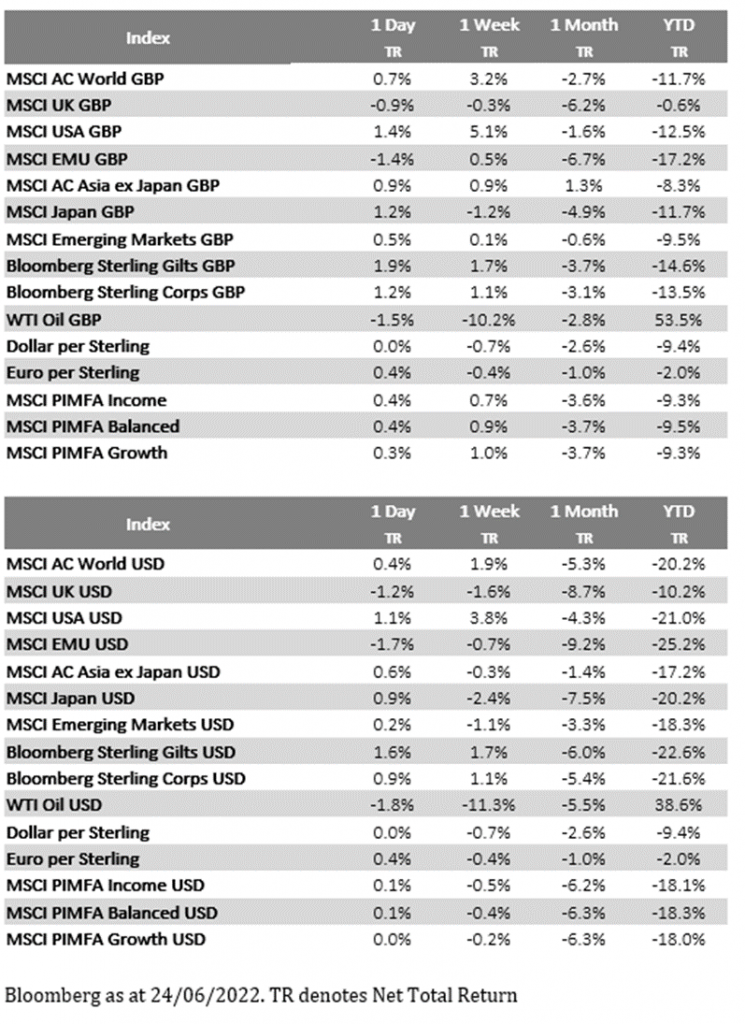
Bloomberg as at 01/07/2022. TR denotes Net Total Return

Please check in again with us soon for further relevant content and market news.

Chloe

01/07/2022

Team No Comments

Brooks Macdonald – Daily Investment Bulletin

Please see the latest Investment bulletin from Brooks Macdonald received today – 30/06/2022

What has happened

US equity markets ended broadly flat yesterday as the positive effects of quarter-end rebalancing were offset by further concerns over the aggressive zeal of central banks to tame inflation.

Central bank panel

Fed Chair Powell, ECB President Lagarde and BoE Governor Bailey all stressed their commitment to tackle inflation and acknowledged that there will likely be economic pain in order to achieve that goal. In terms of particular takeaways, Lagarde said that she didn’t think ‘we are going back to that environment of low inflation’, suggesting that post pandemic ECB policy may be structurally tighter than we have seen in the last decade. Powell interestingly still described the US economy as strong despite the more mixed incoming data, suggesting that he still believes the economy has sufficient momentum to absorb further tightening.

European inflation

Tomorrow we will see the release of Euro Area CPI data which will be an essential input into whether the ECB starts the cycle with a 25bp hike, as expected, or opts for a larger hike. Yesterday saw Spanish CPI come in far higher than markets were expecting, rising to 10% versus expectations of 8.7%. By contrast the German CPI figures came in at 8.2%, far below the 8.8% expected by the market. Forecasting inflation at this time is particularly difficult given it takes time for pressures to filter through to the end basket but should a genuine divergence be occurring this makes setting ECB wide policy even trickier.

What does Brooks Macdonald think

As we reach the last day in Q2, it is important to recognise how much the market view has shifted since the first quarter. In Q1 inflation fears grew and central bank rhetoric toughened but there was still significant hope that the Fed, and other central banks, could engineer a soft landing with interest rates cooling excess pandemic demand but avoiding a recession. In that context value equities strongly outperformed growth equities and the rotation created huge volatility within equity markets. Q2 saw less of a rotation, with investors now questioning the ability to avoid a recession and equities selling off in a more uniform fashion. The key question over the coming quarter will be whether the Fed, in particular, starts to take the poorer incoming data into account when setting policy.

Bloomberg as at 30/06/2022. TR denotes Net Total Return

Please check in again with us shortly for further relevant investment content.

Cyran Dorman

30/06/2022

Team No Comments

Brewin Dolphin – Markets in a Minute

Please find below, a market update received from Brewin Dolphin, yesterday evening – 28/06/2022

Global stock markets rose last week as reports of a slowdown in economic growth helped to calm interest rate fears.

The S&P 500 ended its holiday-shortened trading week up 6.5%, lifting it out of bear market territory, amid signs the Federal Reserve’s monetary tightening was helping to moderate inflation. The Dow and the Nasdaq climbed 5.4% and 7.5%, respectively.

Stocks in Europe broke their three-week losing streak, with the STOXX 600 and FTSE 100 advancing 2.4% and 2.7%, respectively. Weaker-than-expected purchasing managers’ indices (PMIs) helped to alleviate fears of more aggressive interest rate hikes.

In China, the Shanghai Composite gained 1.0% after the country’s president Xi Jinping said it would adopt “more forceful measures to deliver the economic and social development goals for the whole year and minimise the impact of Covid-19”.

Last week’s market performance*

• FTSE 100: +2.74%

• S&P 5001 : +6.45%

• Dow1 : +5.39% • Nasdaq1 : +7.49%

• Dax: -0.06%

• Hang Seng: +3.06%

• Shanghai Composite: +0.99%

• Nikkei: +2.04%

*Data from close on Friday 17 June to close of business on Friday 24 June. 1 Closed Monday 20 June.

China eases Covid-19 restrictions

UK and European indices started this week in the green as an easing of Covid-19 restrictions in China boosted investor sentiment. The FTSE 100 climbed 0.9% on Monday (27 June) with miners leading gains after G7 leaders pledged a $600bn boost to global infrastructure. In contrast, the Dow, S&P 500 and Nasdaq gave back some of last week’s gains, ending the trading session down 0.2%, 0.3% and 0.7%, respectively.

In economic news, US pending home sales unexpectedly rebounded in May after declining for six consecutive months. Sales rose by 0.7% from the previous month but were down 13.6% on a year-on-year basis.

The FTSE 100 was up 1.1% at the start of trading on Tuesday as hopes of an economic rebound drove commodity prices higher and boosted mining stocks.

UK inflation accelerates to 9.1%

The UK consumer price index, published last Wednesday, showed inflation hit a new 40-year high in May as food and energy prices soared. The Office for National Statistics (ONS) said prices rose by 9.1% in the 12 months to May, slightly higher than the 9.0% increase recorded in April. Prices for food and non-alcoholic drinks rose by 8.7% year-on-year, the biggest jump since March 2009.

Encouragingly, core inflation – which strips out food and energy prices – eased to 5.9% in May from 6.2% in April. On a monthly basis, consumer prices rose by 0.7% in May, much less than the 2.5% monthly increase seen in April.

Consumers rein in spending

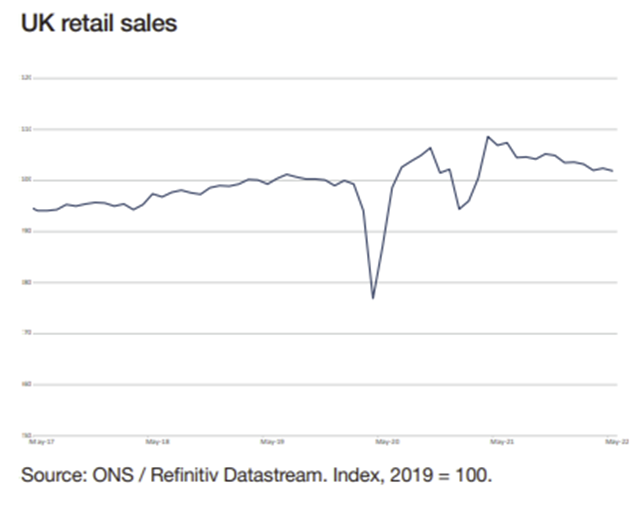
The latest UK retail sales data suggests rising prices are resulting in consumers reining in their spending. Sales volumes fell by 0.5% between April and May, reversing the expansion seen in the previous month.

The decline was driven by a 1.6% fall in food store sales, which the ONS said seemed to be linked to the impact of rising food prices and the cost of living.

Separate figures showed UK consumer confidence fell to its lowest level since records began. GfK’s consumer confidence index slipped by one point to -41 in June, with a particularly large drop in expectations around personal finances. “With prices rising faster than wages, and the prospect of strikes and spiralling inflation causing a summer of discontent, many will be surprised that the index has not dropped further,” said Joe Staton, client strategy director at GfK.

Eurozone business growth slumps

Last week’s economic data also showed a slowdown in business growth in the eurozone. The S&P Global flash eurozone PMI composite output index fell from 54.8 in May to 51.9 in June, a 16-month low. Manufacturing output contracted for the first time in two years and service sector growth cooled considerably, particularly among consumer-facing services.

Companies also scaled back their business expectations for output over the coming year to the lowest since October 2020. Both the stagnation of demand and worsening outlook were widely blamed on the rising cost of living, tighter financial conditions and concerns over energy and supply chains.

Chris Williamson, chief business economist at S&P Global Market Intelligence, said: “Eurozone economic growth is showing signs of faltering as the tailwind of pent-up demand from the pandemic is already fading, having been offset by the cost-of-living shock and slumping business and consumer confidence. Excluding pandemic lockdown months, June’s slowdown was the most abrupt recorded by the survey since the height of the global financial crisis in November 2008.”

Signs US inflation is moderating

Over in the US, data suggested inflation could be moderating. The University of Michigan’s consumer sentiment survey showed consumers expect inflation to rise at an annualised rate of 5.3% in June, below forecasts and the peak rate of 5.4% recorded in March and April. Meanwhile, S&P Global’s flash PMI data for June showed the pace of input price inflation eased to the lowest for five months, and output charges rose at the softest pace since March 2021.

However, the data also revealed the weakest upturn in US private sector output since January’s Omicron[1]induced slowdown. The rise in activity was the second softest since July 2020, with slower service sector output growth accompanied by the first contraction in manufacturing production in two years. Meanwhile, business confidence slumped to the lowest since September 2020. “Business confidence is now at a level which would typically herald an economic downturn, adding to the risk of recession,” said Williamson.

Please continue to check our Blog content for advice and planning issues and the latest investment, markets and economic updates from leading investment houses.

David Purcell

29th June 2022

Team No Comments

Brooks Macdonald Weekly Market Commentary | Market shifts focus to recession risks

Please see the latest Weekly Market Commentary from Brooks Macdonald received yesterday evening:

  • The market focused on recession risks last week as economic data disappointed and European energy security came in focus
  • With European and US inflation data in focus, bond markets will be looking for signs of peaking price pressure
  • Wednesday sees the Federal Reserve (Fed), European Central Bank (ECB) and Bank of England (BoE) heads discuss the need to navigate economic growth fears and inflation risks

The market focused on recession risks last week as economic data disappointed and European energy security came in focus

Recession fears raised their heads again last week with bond markets pricing in a more dovish global central bank backdrop as a result. After one of the worst weeks for equity market performance the week prior, equities recovered significant ground, particularly in the US which was insulated from the energy security risks in continental Europe.

With European and US inflation data in focus, bond markets will be looking for signs of peaking price pressure

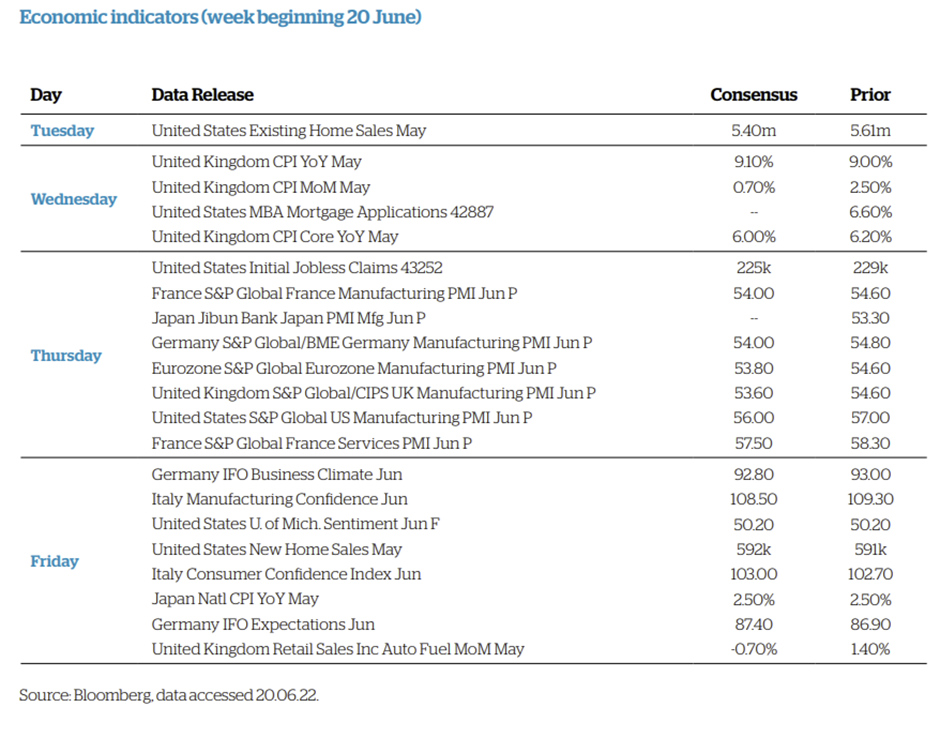
This week we see a series of inflation releases from Europe and the US. On Wednesday the German Consumer Price Index (CPI) data will be released, followed by the wider Euro Area on Friday. There is some debate as to whether we are at peak inflation yet in the Eurozone with consensus expectations pointing to a small tick up in the year-on-year rate compared to last month. With commodity prices having fallen significantly in June however, this may mean we are a month or so away from that peak. Thursday sees the release of the US’s core Personal Consumption Expenditures (PCE) inflation alongside a series of personal income and spending data. This Core PCE release is the Fed’s preferred inflation measure so will be closely watched as investors debate whether a 50 or 75bp rate hike is most likely for the July meeting.

10 year yields fell in both Europe and the US last week as economic data continued to paint a weaker picture and fears over a Russian gas cut-off played through European markets. Central banks remained hawkish however with San Francisco Fed President Daly backing another 75bp rate hike at the July meeting, joining other governors who are considering another outsized move. One of the focuses of the market will be this disconnect between the market’s focus on economic growth risks and the Fed’s focus on inflation risks. With a tight US labour market, economic growth fears have been relegated by the US central bank but given that is now a real concern in the bond market, the Fed will come under pressure to consider both factors at upcoming meetings.

Wednesday sees the Fed, ECB and BoE heads discuss the need to navigate economic growth fears and inflation risks

One of the highlights of this week will be the ECB’s Forum on Central Banking which sees Fed Chair Powell, ECB President Lagarde and Bank of England Governor Bailey join a policy panel on Wednesday. Given the range of views on the relative importance of economic risks between those three central banks, this is likely to be an interesting conversation and may encourage all participants to adopt a more balanced tone.

Please continue to check our Blog content for advice and planning issues and the latest investment, markets and economic updates from leading investment houses.

Andrew Lloyd DipPFS

28/06/2022

Team No Comments

Tatton Investment – Market Update

Please see below Tatton’s update on recent market events which was received this morning:

Overview: Public sentiment wrestles with economic realities

Inflation continues to dominate the financial market narrative. Last week the Office for National Statistics (ONS) announced that inflation, as measured by the Consumer Price Index (CPI), rose from 9% in April to 9.1% in May, while the Retail Price Index (RPI) reading increased to 11.7% compared to May 2021. And yet, believe it or not, inflation pressures are receding. Signs suggest the global supply-chain squeeze is easing, and the cost-push is passing by. While energy prices have been stickier (especially in Europe) crude oil prices came down sharply last week. Perhaps most hearteningly, there has also been a broad-based decline in agriculture prices since peaking around mid-May. However, the good news is being accompanied by more negative growth signals and ramping up recession talk. Last Thursday’s flash Purchasing Manager Indices (PMIs) for major areas added to the gloom – showing a greater decline in optimism among businesses than economists forecasted one week ago. The lack of enthusiasm is not surprising. The follow-though of inflation sees people deciding they don’t want to pay the price for goods, thereby reducing demand, which means less activity and therefore less growth. The phrase “demand destruction” means exactly that.

There is undoubtedly a slowdown underway. Business confidence has deteriorated from very positive levels, but is still at neutral rather than negative. While employment may worsen (it does lag confidence measures), it is unlikely to contract massively unless there is another shock to the global economy. There has been a slowing in hiring but jobs cuts are few and far between just now, and employers will be reluctant to lose workers again, given how difficult it has been to recruit in the past two years. Therefore, the sequencing of the slowdown is important. The fallback in input cost-price pressures is welcome and, clearly, it’s a good thing that this is happening before firms have to set about cutting labour costs. This must lessen the chance that the slowdown will be prolonged. What’s more, central banks are only partially through their rate cycle, and they still have some degree of flexibility. They don’t have to tighten if they believe cost pressures are abating enough – they just have to convince markets that they will do what is necessary. Markets are – once again – climbing the wall of worry and that is likely to persist through the summer. We cannot expect a meaningful equity market recovery until the soft patch is likely to end but, equally, the likely payoff is high enough to stay invested. We will be watching and assessing changes as intently as ever over the summer months.

Emerging market resilience is encouraging

It has been a tough year for investors so far and riskier assets have been hit particularly hard. So far, emerging market (EM) bonds have suffered their worst losses since 1994 – with JPMorgan’s dollar-denominated bond index falling 15% year-to-date. EMs characteristically have plenty of their own problems – and this year has been no different, with idiosyncratic issues across China, Turkey and Latin America, as well as Russia’s invasion of Ukraine providing a major roadblock for growth. Investors have paid attention, and as of last month, $36 billion had flowed out of EM mutual and exchange-traded funds this year, according to research provider EPFR. This has had a negative impact on some EM currencies – none more so than the Turkish lira. Turkey’s currency has lost more than 23% of its dollar value this year, amid further political controversy for its authoritarian president Erdogan. Earlier this month, Erdogan vowed to cut interest rates again, despite inflation surging to more than 70%. The Turkish treasury responded with a new bond plan to ensure stability for the lira, but investors are yet to be convinced. Erdogan’s policies are a major barrier to foreign capital, making it hard to see an upside.

Elsewhere, Argentina continues to be on the edge of default and disaster, its currency falling nearly 17% this year. Argentina’s government negotiated a $44 billion debt refinancing plan with the International Monetary Fund (IMF) in March, but its central bank is still failing to get short-term interest rates high enough to stop the ongoing devaluation. However, apart from these two, EM currencies have fared reasonably well. The most shockingly ‘good’ performance is perhaps the Russian rouble, which has managed a near-unbelievable turnaround over the last three months. Despite war and isolation from the west, the rouble has gained 96% against the dollar since March, making for more than a 40% gain year-to-date. While not as dramatic, Brazil, Mexico, Colombia and Peru have all seen their currencies gain since the start of 2022. Asia has been a different story, as lockdowns in China have curtailed demand. Asian currencies have generally struggled, with all of them falling against the dollar year-to-date. Interestingly, the weakest currency in the region is not an EM, but the Japanese yen – falling more than 15% year-to-date. Divergent monetary policy – with the Bank of Japan keeping rates low while the rest of the world tightens – is the main cause. Tellingly though, the next weakest Asian currencies are the South Korean won and the Taiwanese dollar. These are both classed as EMs, but in reality, are much more similar to Japan in terms of development.

China’s drastic economic slowdown weighs heavily on Asia’s prospects. But like Japan, China has nothing like the inflation pressures we see in the west. This has allowed China’s government to keep monetary and fiscal policy broadly supportive. The zero-COVID policy is clearly a negative, but with Li Keqiang recently suggesting a change of tack, the outlook for the world’s second-largest economy could improve. Bond yields are currently lower in China than in the US, providing a decent foundation for risk assets.

Overall, EMs have outperformed major developed markets this year. This is impressive considering the headwinds many countries have faced and shows a level of resilience that will no doubt continue to be important. Moreover, many analysts suggest that with EMs much more oriented towards technology and services than in the past they are well-positioned over the medium and long-term. The early inflation fighting in some EMs is certainly paying off, despite hiccups here and there. While EMs could be in for more pain should commodities worsen, the outlook is relatively positive, considering the difficult global backdrop.

Has the music stopped for private equity?

The recent SuperReturn International private equity conference, held in Berlin, shone the spotlight at the rapidly changing fortunes of the private equity industry. In 2021, historically low-interest rates and abundant liquidity ensured a frenzy of dealmaking – leading to record profits at the largest industry names. But this year’s gathering was full of dire warnings: spiking inflation, a looming recession and a slowdown in fundraising. One executive called it “a time of reckoning for our industry”.

Private equity has enjoyed a ‘gilded age’ since the global financial crisis in 2008 introduced an era of cheap financing, which is a boon for this type of investment. As well as increasing the amount of capital available for buyouts (taking stock market quoted companies private), loose monetary policy also pushes up equity valuations (by decreasing the ‘risk-free’ rate of government bond yields, thereby making stocks more attractive). By the same token, the tighter monetary policy makes life difficult for private equity firms. When financing costs go up, valuations go down and buyers become scarce, leaving the owners of leveraged assets potentially exposed. Industry executives were fearful of this in early 2020, but lockdowns brought an unprecedented surge of monetary and fiscal support – increasing savings and generating impressive equity returns. Now though, the world’s major central banks are in full tightening mode as they battle surging inflation. Even as the cost-of-living crisis eats into consumer and business demand, there is no suggestion central banks will ease up – meaning financial conditions are likely to only get tougher.

There is no immediate threat of distress for funds run by private equity firms – and certainly not for the larger players. But if financing costs for private equity target companies become overstretched for a more extended period, the sector could become more stressed, with a potential impact on the wider financial system, given pension funds and other long-term investors are the major holders of these assets (both the equity and the loan capital). For private equity firms themselves, the reputation risk is big. If the ‘low volatility, high returns’ model is damaged, funding will be much harder to come by in the future. Most holders of private equity assets are not overly concerned right now. Our portfolios do not hold them directly and we believe any indirect exposure is insignificant. Nevertheless, the potential impacts are significant, so we will be vigilant in the months ahead.

Please continue to check our Blog content for advice and planning issues and the latest investment, markets and economic updates from leading investment houses.

Please keep safe and healthy.

Carl Mitchell – Dip PFS

Independent Financial Adviser

27/06/2022

Team No Comments

Brooks Macdonald – Daily Investment Bulletin

Please see investment bulletin below from Brooks Macdonald received this morning – 24/06/2022.

What has happened

Recession fears continue to be the major story in markets with bonds rallying significantly in response to market downgrades to future economic growth. Despite these growth concerns, the fall in bond yields helped equity markets, with the US technology index posting outperformance as lower discount rates supported growth equities.

Economic growth fears

Flash PMI surveys of economic activity suggested a poor outlook for the US and European economies with the Euro Area composite reading missing expectations quite significantly. The US weekly initial jobless claims also show signs of ticking up, suggesting that some of the tightness in the labour market may be easing. Whilst that may be good news for inflation pressures it paints a far less constructive economic picture. Bond yields fell in response to this data and that is despite a continued hawkish narrative from the US Federal Reserve. Governor Bowman endorsed ‘increases of at least 50 basis points in the next few subsequent meetings’ and Fed Chair Powell said that the Fed’s commitment to deal with inflation was ‘unconditional’. Despite these strong words, the market simply doesn’t believe that the Fed, or indeed other central banks, will be able to continue to aggressively tighten monetary policy throughout 2023 as recession risks will provide central banks with other problems to deal with.

UK Politics

The UK awoke to the news that the Conservative party had lost both parliamentary seats in yesterday’s by-elections. Both seats are symbolic with Wakefield a traditional Labour seat won by the Conservatives at the last election and Tiverton & Honiton representing a safe Conservative seat. Conservative MPs will now be considering their future ability to win a general election (and retain their own seats) if both traditional Tories and ‘new’ Tories have decided to either not turn out or change allegiances.

What does Brooks Macdonald think

Of course, few governments are popular at the ‘mid-term’ stage however the dual electoral defeats will undoubtedly lead the Conservative party to reassess their confidence in Boris Johnson. For the 1922 Committee to change their rules, and allow a further vote of no confidence, the clamour would need to be overwhelming. Whilst it hasn’t been too long since the vote, there has been a deafening silence from most Cabinet members who are keeping their cards close to their chest. Sterling is largely unmoved by the results, however any second order consequences will quickly feed into the currency market.

Please continue to check back for our latest blog posts and updates.

Charlotte Clarke

24/06/2022

Team No Comments

Daily Investment Bulletin

Please see below article received from Brooks Macdonald this morning, which informs us of the key global events effecting markets this week.

What has happened

Equities struggled yesterday as recession fears gripped markets yet again. A fall in the oil price, which has continued today, weighed on energy stocks in particular.

Federal Reserve

The market’s focus yesterday was on Fed Chair Powell’s testimony to the Senate Banking Committee. Whilst his monetary policy comments didn’t deviate too sharply from last week, Powell was open around the risk of a recession, describing it as ‘a possibility’. Powell was also more cautious around the chances of the Federal Reserve engineering the so-called soft landing, with that outcome viewed as ‘very challenging’. On interest rates, Powell said that restrictive interest rates were needed to tackle inflation and that the Fed were proceeding towards that outcome. Bond markets focused on the recession comments with yields falling on the day despite Powell’s commitment to raise rates above their neutral level. Whilst few doubt that the Fed is now serious about inflation, there is scepticism as to whether the central bank will be able to raise rates in time before they need to react to a recessionary backdrop.

UK inflation and politics

The May UK CPI reading came in at 9.1% year-on-year, in line with expectations and its highest rate since 1982, garnering much media attention. The core CPI reading actually came in below market expectations at 5.9% year-on-year which will be a helpful reading for the more dovish members of the Bank of England. Today sees two important by-elections in the UK with the results likely to be viewed as a poll on the future electoral success of Boris Johnson. The Wakefield seat is part of the ‘Red Wall’ so analysts, and Tory MPs, will be scrutinising the results to see whether traditionally Labour seats may now return to Labour, with Brexit less of an everyday topic and the impact of Partygate still fresh in the mind of the electorate.

What does Brooks Macdonald think

Sterling has underperformed due to expectations that there will be an increasingly large gap between the interest rates of major currencies, such as the US dollar, and the pound. Another factor is political risk, both in terms of the leadership of the Conservative Party but also the future trading relationship between the UK and EU. Should today’s by-election result in a poor showing for the Conservatives, near term political risk will likely rise as Tory MPs clamour for a change in the internal rules to allow another vote of confidence on the Prime Minister.

Index 1 Day1 Week1 MonthYTD
 TRTRTRTR
MSCI AC World GBP -0.4%-2.6%-2.6%-12.3%
MSCI UK GBP -0.9%-2.5%-3.7%0.3%
MSCI USA GBP -0.1%-2.4%-2.0%-13.7%
MSCI EMU GBP -0.4%-1.8%-3.6%-16.0%
MSCI AC Asia ex Japan GBP -2.3%-3.8%-0.9%-9.2%
MSCI Japan GBP 0.1%-2.7%-5.6%-12.7%
MSCI Emerging Markets GBP -2.2%-4.1%-2.0%-10.0%
Bloomberg Sterling Gilts GBP 1.7%-0.8%-6.2%-16.1%
Bloomberg Sterling Corps GBP 1.1%-0.8%-4.7%-14.5%
WTI Oil GBP -4.0%-9.4%-4.6%55.8%
Dollar per Sterling -0.1%0.7%-1.7%-9.4%
Euro per Sterling -0.4%-0.4%-1.9%-2.4%
MSCI PIMFA Income -0.1%-1.9%-3.6%-9.6%
MSCI PIMFA Balanced -0.2%-2.1%-3.5%-9.8%
MSCI PIMFA Growth -0.5%-2.4%-3.3%-9.5%
Index 1 Day1 Week1 MonthYTD
 TRTRTRTR
MSCI AC World USD -0.5%-0.9%-4.2%-20.5%
MSCI UK USD -0.9%-0.9%-5.3%-9.1%
MSCI USA USD -0.1%-0.8%-3.6%-21.8%
MSCI EMU USD -0.5%-0.2%-5.2%-23.9%
MSCI AC Asia ex Japan USD -2.3%-2.2%-2.5%-17.7%
MSCI Japan USD 0.0%-1.1%-7.2%-20.9%
MSCI Emerging Markets USD -2.3%-2.5%-3.6%-18.5%
Bloomberg Sterling Gilts USD 2.0%1.2%-7.4%-23.8%
Bloomberg Sterling Corps USD 1.3%1.2%-5.9%-22.3%
WTI Oil USD -4.0%-7.9%-6.2%41.2%
Dollar per Sterling -0.1%0.7%-1.7%-9.4%
Euro per Sterling -0.4%-0.4%-1.9%-2.4%
MSCI PIMFA Income USD -0.1%-0.3%-5.2%-18.1%
MSCI PIMFA Balanced USD -0.3%-0.5%-5.1%-18.3%
MSCI PIMFA Growth USD -0.5%-0.8%-4.9%-18.0%

Bloomberg as at 23/06/2022. TR denotes Net Total Return

Please check in again with us shortly for further relevant investment content. 

Chloe

23/06/2022

Team No Comments

Stocks slump as central banks hike interest rates

Please see below this week’s Markets in a Minute article from Brewin Dolphin received yesterday afternoon – 21/06/2022

Global equities fell sharply last week after several central banks announced interest rate increases.

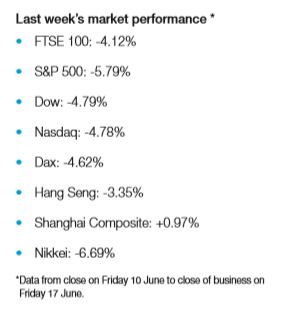
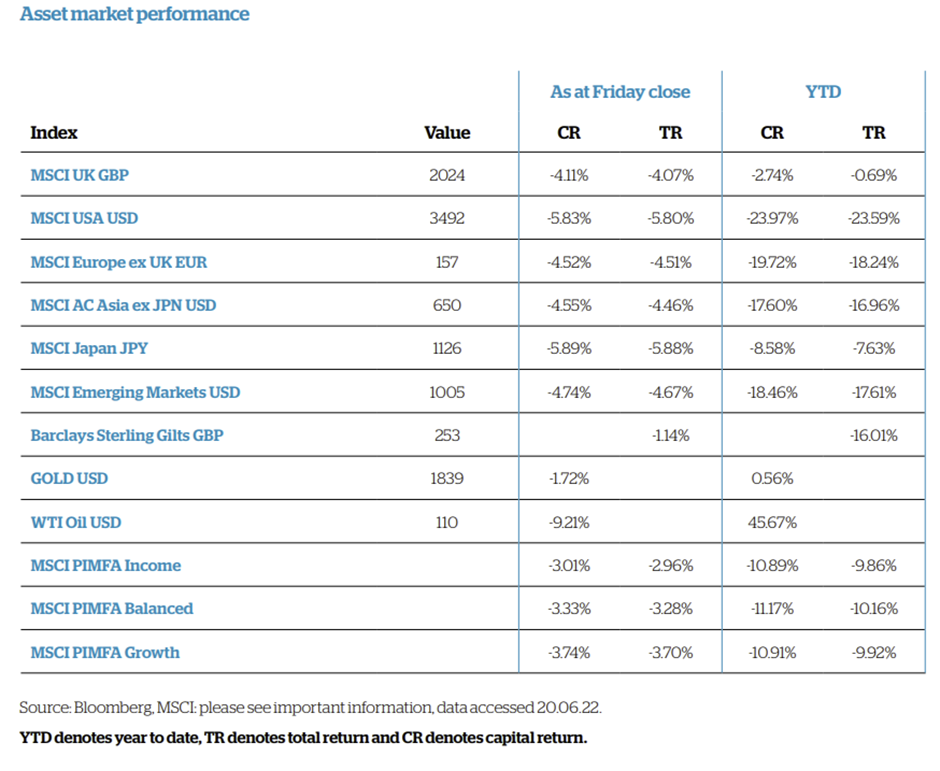
The S&P 500 recorded its worst weekly decline since the onset of the pandemic, sliding 5.8% and officially entering bear market territory (down more than 20% from its January peak). The Dow and the Nasdaq both fell 4.8% as the Federal Reserve announced its most aggressive rate hike since 1994.

In Europe, the STOXX 600, Dax and FTSE 100 all lost more than four percentage points as the European Central Bank (ECB) called an emergency meeting and the Bank of England (BoE) and Swiss National Bank both raised interest rates.

Fears of a global recession weighed on Japan’s Nikkei 225, which plummeted 6.7%. In contrast, the Shanghai Composite added 1.0% on news China had approved ten fixed-asset investments worth 121 billion yuan – a more than six-fold jump from April – in an effort to boost economic growth.

UK house prices hit fresh record high

UK and European indices started this week in the green, with the FTSE 100 and STOXX 600 up 1.5% and 1.0%, respectively, at the close of trading on Monday (20 June). US markets were closed on Monday for a public holiday. Figures from Rightmove showed UK house prices hit a record high for the fifth consecutive month in June to reach £368,614. However, the 0.3% month-on-month rise was the smallest increase since January and suggests the pace of price growth is slowing. Rightmove said price rises are expected to slow further in the second half because of worsening affordability challenges, bringing the annual rate of price growth down from the current 9.7% towards 5.0%. The FTSE 100 was up 0.6% at the start of trading on Tuesday following a rebound in Asian markets overnight.

Federal Reserve lifts interest rates by 75bps

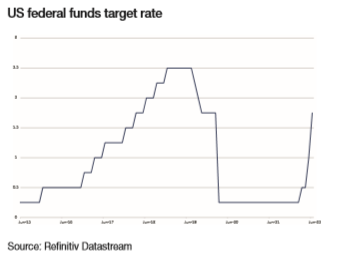
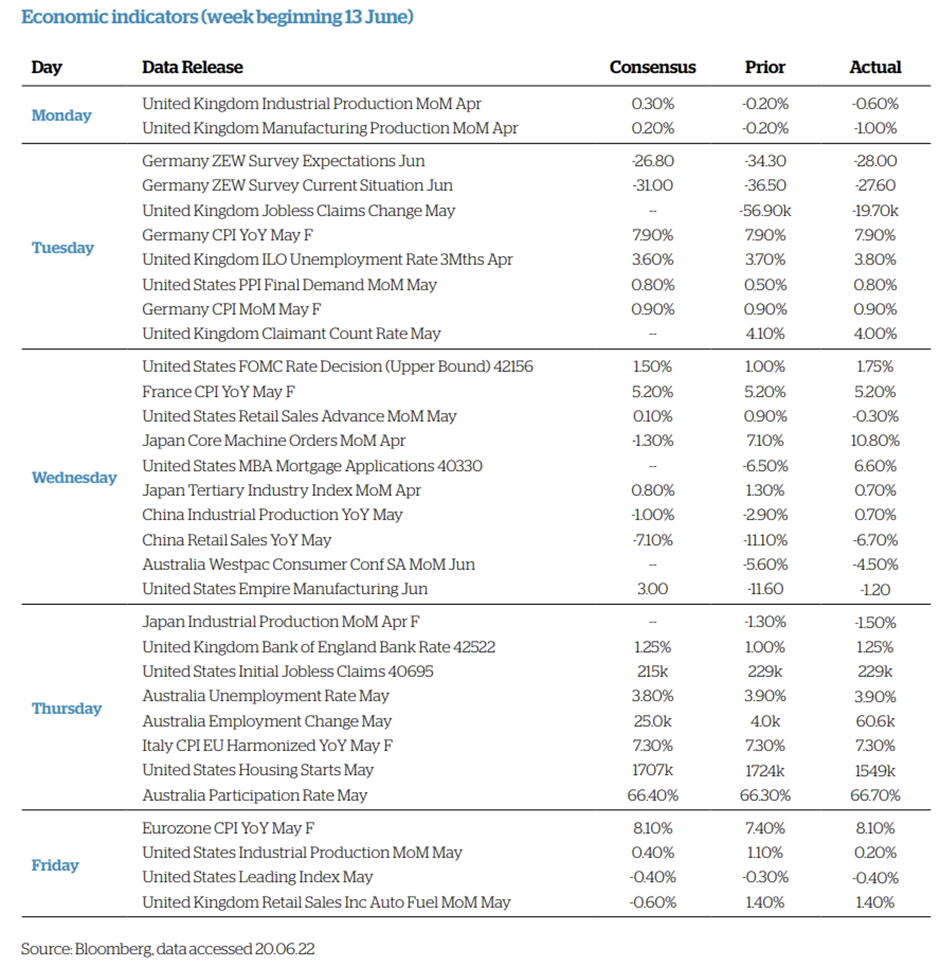
Last week’s economic headlines were dominated by the US Federal Reserve’s decision to increase interest rates by 75 basis points (bps), its steepest rate hike for nearly three decades. This takes the level of its benchmark funds rate to a range of 1.5-1.75%, the highest since just before the pandemic hit.

Fed chair Jerome Powell said the increase was “an unusually large one, and I don’t expect moves of this size to be common”. However, he added that the July meeting is likely to see an increase of 50 or 75 bps.

Members of the Federal Open Market Committee (FOMC) expect the benchmark rate to end the year at 3.4% and rise to 3.8% in 2023 – one percentage point higher than anticipated in March. The FOMC also cut its outlook for gross domestic product (GDP) growth for 2022 to 1.7%, down from 2.8% previously. Inflation, measured by personal consumption expenditures, is expected to measure 5.2% this year, up from 4.3% previously, before falling sharply to 2.6% in 2023.

US retail sales weaker than expected

Fears that interest rate hikes could spark a recession were exacerbated by disappointing US retail sales data. Sales fell unexpectedly in May by 0.3% from the previous month, driven by a steep decline in auto sales and a drop in furniture sales, according to the Department of Commerce. Economists had expected a rise of 0.3%.

Receipts at auto dealerships dropped by 3.5%, the largest fall in almost a year, and online store sales fell 1.0%. Sales at service stations surged by 4.0%, driven by record high gasoline prices. Excluding gasoline, retail sales fell by 0.7% month-on-month.

BoE makes fifth consecutive rate hike

Here in the UK, the BoE increased its base interest rate from 1.0% to 1.25%, the highest level in 13 years. This was the fifth time in a row that the Monetary Policy Committee voted to increase rates. It came after annual inflation rose to 9.0% in April amid large increases in global energy and goods prices, fuelled by the Ukraine war and the pandemic.

The Bank said inflation is expected to be over 9.0% during the next few months and top 11.0% in October, following an additional large increase in the Ofgem energy price cap. Meanwhile, GDP is expected to fall by 0.3% in the second quarter, worse than previously expected. The Bank did not update its outlook for the third quarter, but it has previously said it expects the economy to grow in July to September, meaning the UK would avoid a recession (defined as two consecutive quarters of shrinking GDP).

ECB holds emergency meeting

The ECB held an emergency meeting last week to address rising borrowing costs in some member states. This followed a surge in bond yields in countries like Italy and Spain and growing fears that the eurozone could be on the cusp of another debt crisis.

Noting the widening gap in the cost of borrowing between stable countries like Germany and other more vulnerable member states, the ECB said it would accelerate plans to create a “new anti-fragmentation instrument”. It also said its governing council had approved plans to apply flexibility in the way it reinvests bond proceeds from its Pandemic Emergency Purchase Programme – in other words, focusing on buying the bonds of vulnerable member states like Italy.

Please continue to check back for our latest blog posts and updates.

Cyran Dorman

22/06/2022

Team No Comments

Weekly Market Commentary – The Fed U-turned on its forward guidance

Please find below, a weekly market update received from Brooks Macdonald, yesterday evening – 20/06/2022

  • US and European equity markets fell heavily last week as the Federal Reserve (Fed) u-turned on its forward guidance
  • President Macron’s party has lost overall control of the National Assembly, challenging future legislative plans
  • Fed Chair Powell testifies to Congress this week, keeping central bank policy front and centre

US and European equity markets fell heavily last week as the Fed u-turned on its forward guidance

 Last week saw one of the worst weeks for equity markets in recent memory as last minute changes to central bank policy mixed with a poorer economic backdrop. The losses were widespread with few markets and sectors able to avoid the contagion. European peripheral bond markets fared better, as the market gained some comfort from the European Central Bank’s (ECB) emergency meeting to discuss how to tackle any fragmentation between national bond markets.

Whilst last week’s Federal Reserve meeting is out of the way, investors are still reeling from the last minute change in Fed forward guidance which saw a 75bp interest rate hike in June after such a hike had previously been ruled out1 . Forward guidance is extremely difficult at a time when the central bank is data dependent on what happens to inflation and economic growth, however a feeling that the words of Fed Chair Powell should be taken with a pinch of salt will only heighten volatility. This week Chair Powell will testify to both the Senate and House Committees where he is expected to be questioned on what the central bank is doing to control the inflationary spike in the US. Last week Powell said that a 75bp rate hike would not become a typical event however with forward guidance in question, this may not stop markets from pricing in such an outcome.

President Macron’s party has lost overall control of the National Assembly, challenging future legislative plans

The French legislative elections have seen President Macron lose overall control of the National Assembly. Whilst Macron’s party remains the largest overall party, any legislative items will require delicate coalitions to be formed. The elections saw a strong showing for far left and far right parties, splitting the centrist vote. Macron is likely to rely on votes from the fractured centre right parties to pass key items such as pension reforms however such legislation is likely to need to be watered down to pass through a complex web of political priorities.

Fed Chair Powell testifies to Congress this week, keeping central bank policy front and centre

The recent market volatility has been driven by inflation data and the central bank reaction to that data. With the US closed on Monday, no US inflation releases this week, and Powell unlikely to err too much from his statements last week, we may be in for a calmer week. Now we are back to an era of emergency central bank meeting however, the chance of a surprise has greatly increased.

Please continue to check our Blog content for advice and planning issues and the latest investment, markets and economic updates from leading investment houses.

David Purcell

21st June 2022