Team No Comments

Brewin Dolphin – Markets in a Minute

Please see below this week’s Markets in a Minute article from Brewin Dolphin received this morning – 20/07/2022

Stocks volatile as US CPI tops forecasts

Stock markets were volatile last week as US inflation rose at a faster rate than expected and the European Commission lowered its growth forecasts.

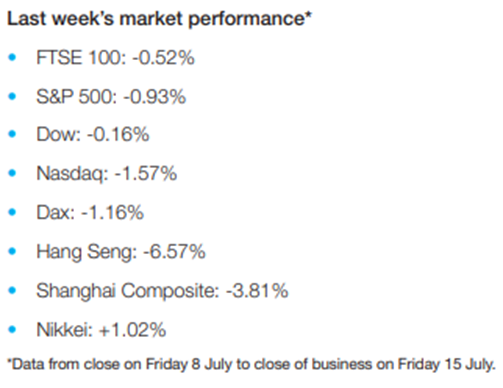
US indices fell sharply on Wednesday after the Labor Department reported that the consumer price index (CPI) had hit a new 41-year high in June. However, separate inflation data released on Friday was interpreted as good news by investors and helped to limit losses for the week. The S&P 500 finished the week down 0.9%, while the Dow and Nasdaq slipped 0.2% and 1.6%, respectively.

The pan-European STOXX 600 fell 0.8% and Germany’s Dax declined 1.2% amid ongoing concerns that Russia may extend the closure of the Nord Stream 1 gas pipeline to Germany. The FTSE 100 eased 0.5% as an unexpected expansion of UK gross domestic product (GDP) helped to limit losses.

In China, the Shanghai Composite fell 3.8% as GDP in the second quarter grew by just 0.4% from a year earlier, down from a 4.8% expansion in the first quarter.
Rising oil prices boost energy shares

The price of Brent crude oil rose 2.6% on Monday (18 July) after a meeting between US president Joe Biden and Saudi Arabia’s Crown Prince Mohammed bin Salman didn’t result in a pledge to raise oil output. This boosted energy shares and helped the FTSE 100 climb 0.9% on Monday. In the US, the S&P 500 slid 0.8% after Bloomberg reported that Apple was planning to slow hiring and spending growth next year.

The FTSE 100 started Tuesday’s trading session in the red as investors digested the latest UK jobs data. The unemployment rate held at 3.8% in the three months to May, while the number of people in employment rose by 296,000 – the biggest increase since the three months to August last year. However, regular pay in real terms (excluding bonuses and adjusted for inflation) was 2.8% lower than a year ago.

US consumer inflation hits 9.1%

Last week saw the release of the closely watched US CPI, which showed consumer prices rose by 9.1% in the 12 months to June, the fastest pace since 1981. This was higher than the 8.6% jump seen in May and the 8.8% rise forecast by economists.
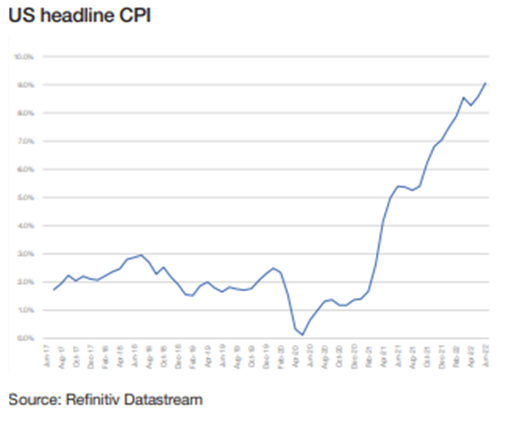
Gasoline prices surged by 59.9%, while the price of food and shelter increased by 10.4% and 5.6%, respectively. Core CPI, which strips out volatile food and energy costs, Markets in a Minute 19 July 2022 rose by 5.9% from a year ago, higher than the 5.7% estimate but lower than the March peak of 6.5%.

On a monthly basis, consumer prices increased at a fasterthan-expected rate of 1.3% after advancing by 1.0% in May. Adjusted for inflation, workers’ hourly wages fell by 1.0% month-on-month or 3.6% from a year ago.

Inflation expectations decline

Fears that inflation could result in the Federal Reserve hiking interest rates by 100 basis points at its next policy meeting were somewhat alleviated by a drop in consumers’ inflation expectations. The University of Michigan’s consumer sentiment survey for July showed Americans expect inflation to measure 2.8% in five years’ time, down from 3.1% previously and the lowest level in over a year.

Meanwhile, there was also a lower-than-expected rise in import and export prices in June. According to the Labor Department, import prices rose by just 0.2% from the previous month, following a 0.5% increase in May. Economists were expecting import prices to advance by 0.7%. Export prices rose by 0.7% in June after surging by 2.9% in May.

European Commission cuts GDP forecast

Over in Europe, the European Commission lowered its GDP growth forecast for 2023, saying the war in Ukraine had set the economy “on a path of lower growth and higher inflation” when compared with its spring forecast. The EU economy is expected to grow by 1.5% next year, while the euro area is expected to grow by 1.4%, both down from the previous 2.3% projection.

Valdis Dombrovskis, European commissioner for trade, said: “Russia’s war against Ukraine continues to cast a long shadow over Europe and our economy. We are facing challenges on multiple fronts from rising energy and food prices to a highly uncertain global outlook.”

Inflation is expected to peak at 8.4% in the third quarter in the euro area, before declining steadily and falling below 3% in the last quarter of 2023. However, the commission said this will depend on the evolution of the war – in particular, its impact on Europe’s gas supply.

UK economy returns to growth

Here in the UK, the economy returned to growth in May, with GDP expanding by 0.5% from the previous month, following a 0.2% decline in April. This was mainly driven by a large rise in GP appointments. Economists had been expecting zero growth in May because of the rising cost of living.

Consumer-facing services fell by 0.1% as retail trade declined. However, this was better than the 0.8% contraction in April thanks to a surge in holiday bookings. Production grew by 0.9% while construction expanded by 1.5%, the seventh consecutive month of growth.

Please continue to check back for our latest blog posts and updates.

Charlotte Clarke

20/07/2022
Team No Comments

Daily Investment Bulletin

Please see below article received from Brooks Macdonald this afternoon, which provides the latest update on global markets.

What has happened

Monday started with a more optimistic tone as earnings reports from Goldman Sachs and Bank of America both beat expectations, an important test after the misses from the financial sector last week. The news that Apple was set to slow hiring and spending in 2023 drove risk appetite lower however with US indices ending down for the day after a sell-off that took place after the European close.

European gas supplies

The timing of the reopening of the Nord Stream 1 pipeline remained high on investors’ agenda on Monday with Gazprom saying that they were unable to fulfil their supply obligations to at least one major customer due to ‘extraordinary’ circumstances. This added to a downbeat assessment of the security of European gas supplies ahead of Thursday’s scheduled reopening. In a sign that the high natural gas price is also weighing on utilities, Germany’s Uniper, applied to extend their credit line from state-owned KfW. There were also reports of a draft EU document that assessed the potential damage caused by a cut-off of Russian gas supplies, with EU GDP hit by 1.5% in the worst case scenario.

Earnings Season

Markets were happy to shrug off the concerns over European energy security earlier on Monday, focusing on the upcoming earning season. Goldman Sachs saw an almost 50% decline in net income for the second quarter but the results came in ahead of market expectations. Comments from the bank suggesting that they may look to pause hiring replacements for departing employees painted a more cautious assessment of the upcoming year however it required similar comments from Apple to catalyse the risk off tone late in the US session. Netflix reports later today and given the poor run of recent earnings results, and stock market reaction, investors will be watching the results closely. Markets may be less keen to extrapolate any Netflix weakness across the broader sector as in recent earnings seasons, at least some of Netflix’s weakness was idiosyncratic rather than a poll on the overall health of the technology sector.

What does Brooks Macdonald think

Yesterday’s price movements, driven by the earnings and guidance from companies, underlines how important corporate results are to market levels. So far this year we have seen heavy falls to the price of companies whilst the earnings expectations have remained robust. Whether or not the market is now ‘cheap’ is largely determined by how earnings develop over the next 12 months.

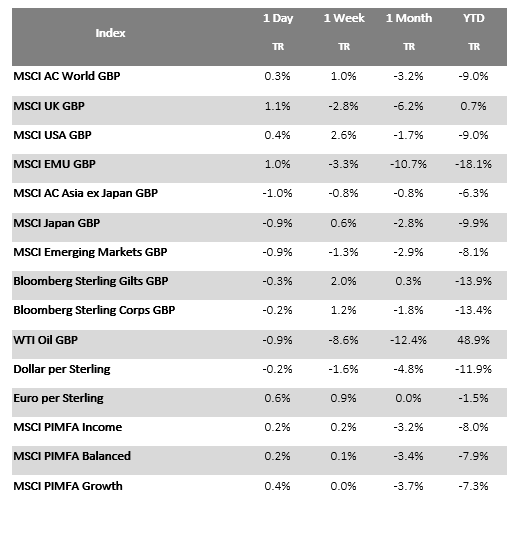
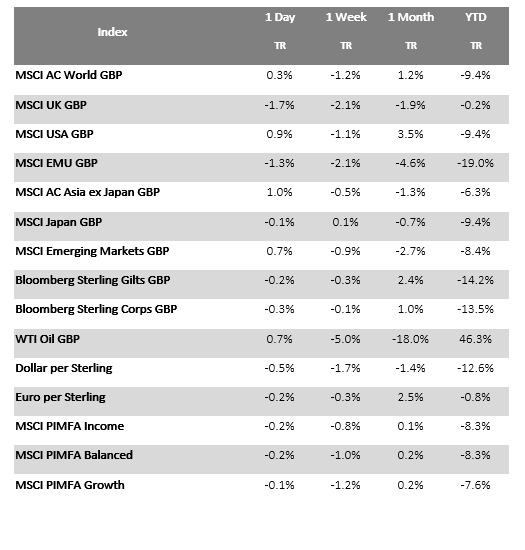
Index 1 Day1 Week1 MonthYTD
 TRTRTRTR
MSCI AC World GBP -0.8%-0.9%4.6%-9.3%
MSCI UK GBP 0.9%0.3%3.1%2.4%
MSCI USA GBP -1.8%-1.4%6.2%-9.9%
MSCI EMU GBP 0.8%1.1%0.5%-16.4%
MSCI AC Asia ex Japan GBP 0.8%-0.8%1.0%-6.9%
MSCI Japan GBP -0.6%-2.2%3.0%-10.1%
MSCI Emerging Markets GBP 0.9%-0.8%0.1%-8.5%
Bloomberg Sterling Gilts GBP -0.5%-0.4%1.2%-15.0%
Bloomberg Sterling Corps GBP -0.3%-0.3%0.7%-14.0%
WTI Oil GBP 4.1%-2.2%-4.7%54.2%
Dollar per Sterling 0.8%0.5%-2.4%-11.7%
Euro per Sterling 0.2%-0.5%1.2%-0.9%
MSCI PIMFA Income -0.4%-0.5%2.0%-8.0%
MSCI PIMFA Balanced -0.5%-0.6%2.4%-8.0%
MSCI PIMFA Growth -0.6%-0.6%3.0%-7.2%
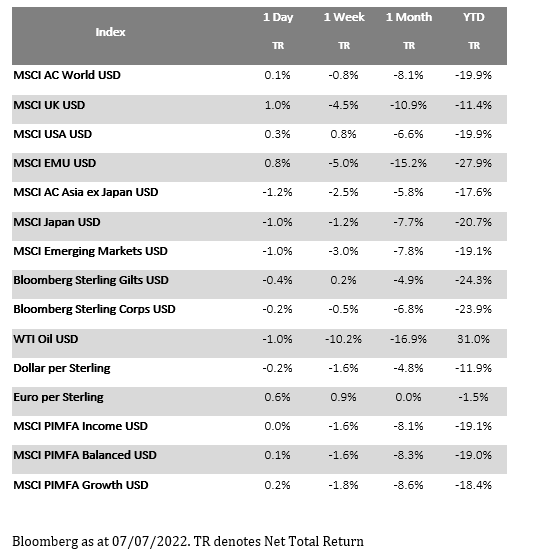
Index 1 Day1 Week1 MonthYTD
 TRTRTRTR
MSCI AC World USD 0.2%-0.1%2.8%-19.7%
MSCI UK USD 1.9%1.1%1.4%-9.4%
MSCI USA USD -0.8%-0.6%4.4%-20.2%
MSCI EMU USD 1.8%1.9%-1.3%-26.0%
MSCI AC Asia ex Japan USD 1.9%0.0%-0.7%-17.6%
MSCI Japan USD 0.4%-1.5%1.2%-20.4%
MSCI Emerging Markets USD 1.9%0.0%-1.7%-19.0%
Bloomberg Sterling Gilts USD 0.9%0.7%-0.1%-24.6%
Bloomberg Sterling Corps USD 1.1%0.9%-0.6%-23.6%
WTI Oil USD 5.1%-1.4%-6.4%36.4%
Dollar per Sterling 0.8%0.5%-2.4%-11.7%
Euro per Sterling 0.2%-0.5%1.2%-0.9%
MSCI PIMFA Income USD 0.6%0.3%0.3%-18.6%
MSCI PIMFA Balanced USD 0.5%0.2%0.7%-18.6%
MSCI PIMFA Growth USD 0.5%0.1%1.2%-17.9%

Bloomberg as at 18/07/2022. TR denotes Net Total Return

Please check in again with us shortly for further relevant content and news.

Chloe

19/07/2022
Team No Comments

Brooks Macdonald – Daily Investment Bulletin

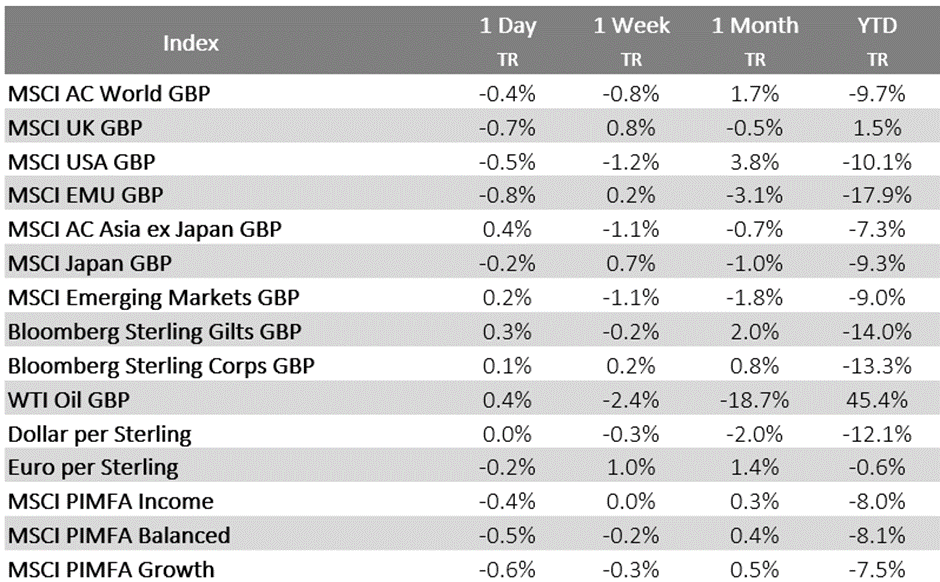
Please find below, a Daily Investment Bulletin received from Brooks Macdonald, this morning – 15/07/2022
What has happened 

Risk appetite remained supressed yesterday as bank earnings and recessionary fears combined into another poor day for equity markets. JPMorgan yesterday missed expectations and Morgan Stanley saw investment banking revenue halve compared to the previous year. Q2 earnings will be a key determinant of whether the market concludes that the year-to-date falls adequately compensate for the expected deterioration of margins over the short to medium term.  

Federal Reserve 

With the US CPI report causing investors to reappraise the near term path for US interest rates, ‘Fed speak’ is being scrutinised to gauge the chances of a 100bp hike. The Fed will enter their communication blackout window on Saturday so yesterday’s comments are one of the last tests of Governor sentiment that the bond market has to work with. Governor Waller yesterday said that the CPI beat earlier in the week justified another 75bp rate hike however he was open to a larger hike if economic data was stronger than expected. President Bullard meanwhile also supported a 75bp hike, with the result that markets reduced their expectations for a 100bp hike. The 2-year US Treasury yield gave back some of its recent rise, trading at 3.11% at the time of writing. US technology stocks were a particular beneficiary of this reduction in rate expectations, managing to secure a small gain yesterday even as the broader US market sold off.  

Italy 

European political risk returned to the fore yesterday as Prime Minister Mario Draghi attempted to resign after the Five Star Movement refused to back his government in a confidence vote. Draghi said that ‘The loyalty agreement that was the foundation of my government has gone missing.’ With President Mattarella declining the resignation, the Italian political backdrop is uncertain with a fresh round of elections possible. Italy has been facing a large number of economic and political challenges since COVID, as reflected in the spread between German bond yields and Italian yields. Yesterday saw that spread widen to its largest level in over a month.

What does Brooks Macdonald think? 

Adding to the concerns of a global slowdown, overnight China released their Q2 GDP data which showed that the economy contracted on a quarter-on-quarter basis. China continues to struggle in applying the zero COVID policy to the latest Omicron led surge and this slowdown may well prompt Beijing to provide further economic support to ensure that the economy does not stall over the summer.

Please continue to check our Blog content for advice and planning issues and the latest investment, markets and economic updates from leading investment houses.

David Purcell

15th July 2022

Team No Comments

Brooks Macdonald – Daily Investment Bulletin

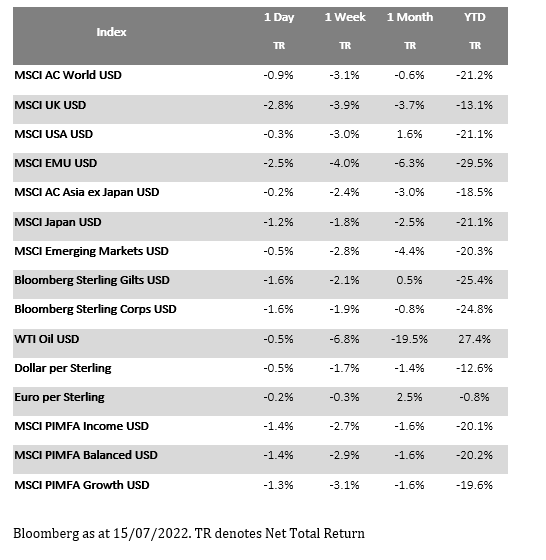
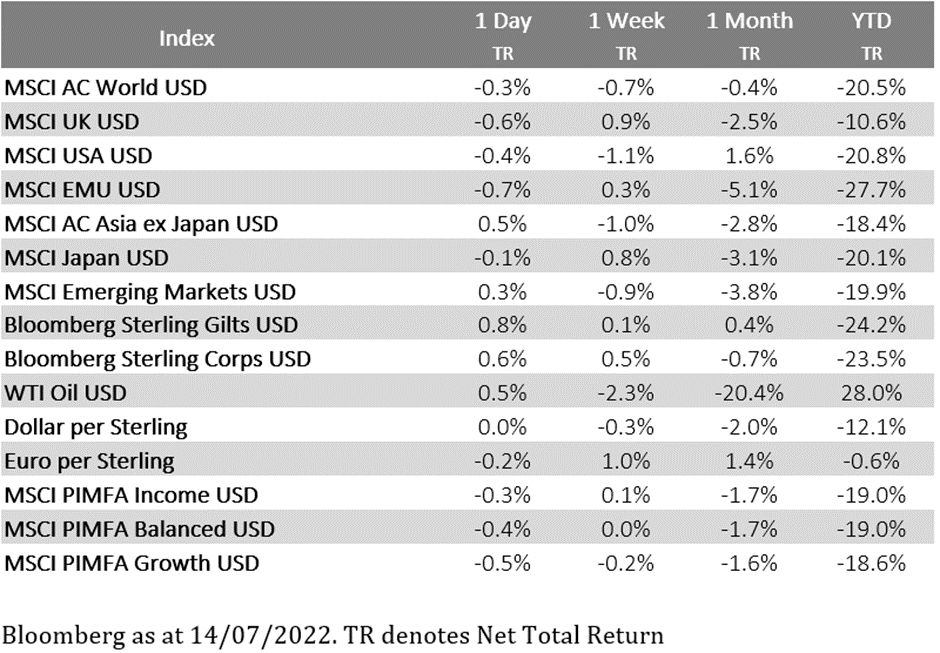
Please see below the latest daily investment bulletin from Brooks Macdonald, which was published and received this morning (14/07/2022):

What has happened?

US equity futures dipped sharply after the release of the June CPI print, however the market staged somewhat of a comeback to end the day only mildly in the red. The bond market was less sanguine however, with a surge higher in the US 2-year bond yield as investors priced in more aggressive Fed rate hikes.

US CPI

Both the headline and core CPI readings came in higher than the market was expecting. The month-on-month figures saw a dramatic 1.3% increase in the headline and 0.7% in the core reading. Both of these 20bps more than the market was expecting. The market took little comfort from the components of the CPI surge, with a broad showing of inflationary pressure amongst the basket as the year-on-year headline CPI figure crept above 9%. The sharp moves in bond markets mean that investors are pricing in around 90bps of rate hikes at the July meeting, effectively meaning that investors feel a 1% hike is more likely than a 75bp hike. Adding to this grim mood within bond markets, Cleveland Fed President Mester provided a suitable summary of the report as ‘uniformly bad – there was no good news in that report at all’.

Bond Market moves

 In March of this year we were debating the impact of a slight intraday inversion of the 2s10s yield curve, as I write the 2-year yield sits at 3.22% and the 10-year yield at 2.97% – a pretty clear statement from the bond market that they believe the Fed will raise rates in the short term but need to cut them in 2023. For context, this is the largest inversion of the yield curve that we have seen since 2000. This surge in US bond yields was enough to finally lead the Euro to fall below parity with the US dollar however the Euro recovered a small amount of ground by the end of the day and remains hovering around 1 Euro to the dollar.

What does Brooks Macdonald think

June’s CPI number was always going to be messy given the moves that were taking place in commodity markets during the month. Whilst yesterday’s report wasn’t particularly enjoyable reading, the broader context is that commodity prices have fallen quite substantially. Compared to three months ago, oil is down over 10%, copper almost 30% down and wheat down 25%. It will take some time for these falls to feed into the consumer inflation basket but should the commodity sell-off continue, better inflation reports will lie ahead.

Please continue to check our Blog content for advice and planning issues and the latest investment, markets and economic updates from leading investment houses.

Carl Mitchell – Dip PFS

Independent Financial Adviser

14/07/2022

Team No Comments

Brewin Dolphin – Markets in a Minute

Please see below this week’s Markets in a Minute article from Brewin Dolphin received late yesterday afternoon – 12/07/2022

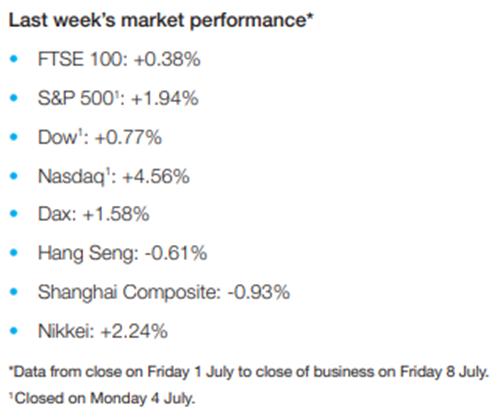
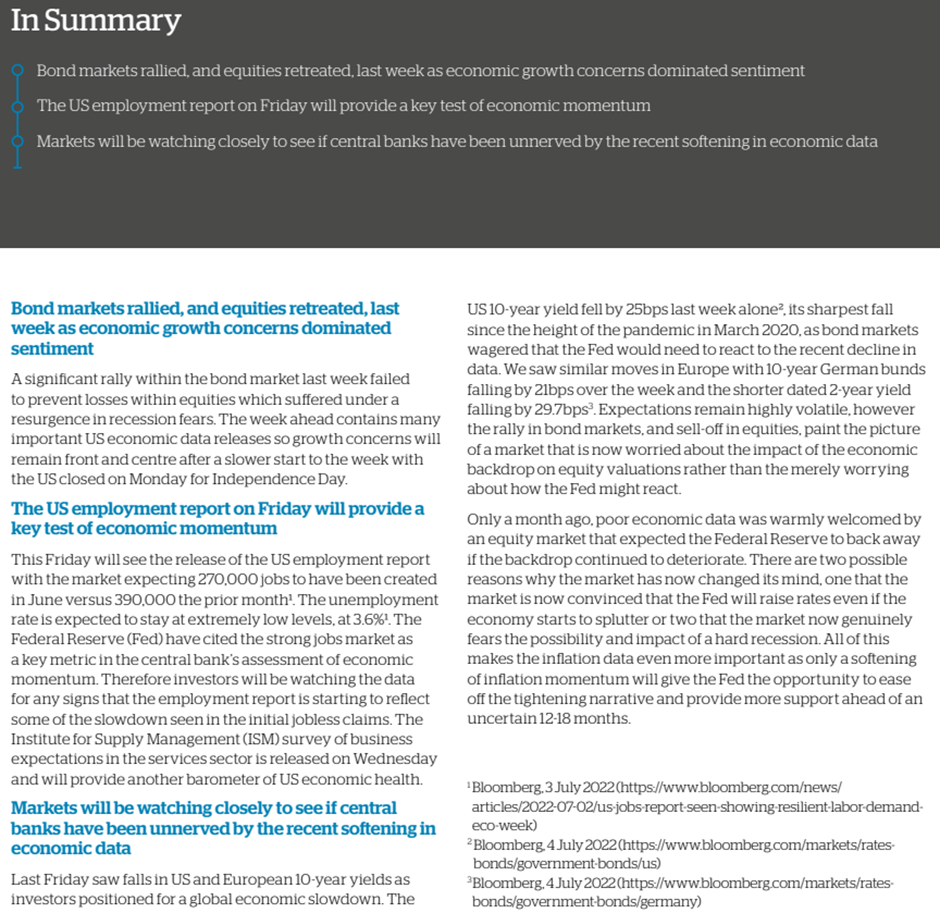
Stock markets were mixed last week as coronavirus cases rose in China, and the US Federal Reserve vowed to tackle inflation.

The Shanghai Composite fell 0.9% as cities across China reimposed restrictions designed to stem the spread of Covid-19. A senior health official said Shanghai, which recently ended a two-month lockdown, faces a “relatively high” risk of further community transmission of the virus.

The UK’s FTSE 100 edged up 0.4% as prime minister Boris Johnson announced his intention to resign, after more than 50 ministers and several Cabinet members stepped down. Johnson will remain as caretaker prime minister until a new leader of the Conservative Party has been chosen.

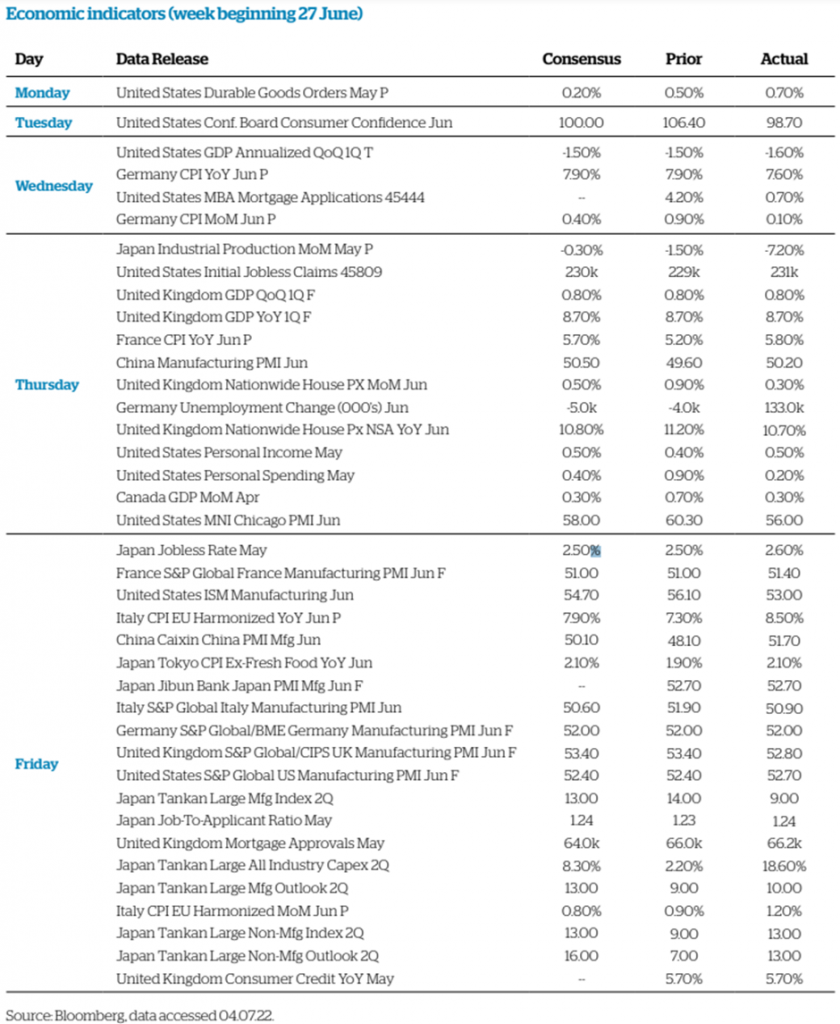
In the US, the S&P 500 ended its holiday-shortened trading week up 1.9%, lifting it out of bear market territory. Friday’s payrolls report from the Labor Department showed employers added 372,000 non-farm jobs in June, well above expectations of around 270,000.

Shares in Europe also advanced, with the STOXX 600 and Germany’s Dax up 2.5% and 1.6%, respectively.

Russia halts gas flows to Germany

Stocks started this week in the red amid concerns that a temporary halting of Russian natural gas supplies to Germany could become permanent. Gas supplies via the Baltic Sea pipeline Nord Stream 1 were halted for ten days from Monday for annual maintenance work. However, there are fears the shutdown could be extended and exacerbate Europe’s gas crisis.

Germany’s Dax fell 1.4% on Monday (11 July) while the STOXX 600 declined 0.5%. Hong Kong’s Hang Seng tumbled nearly 3% after Beijing regulators issued fines to several technology firms for non-compliance with anti-monopoly disclosure rules. US stocks were also weaker ahead of the release of the latest inflation data.

The FTSE 100 was down 0.4% at the start of trading on Tuesday following a weak session in Asia overnight.

Federal Reserve pledges to fight inflation

Last week saw the release of the Federal Reserve’s June policy meeting minutes, in which officials emphasised the need to fight inflation through further interest rate hikes. Members of the Federal Open Market Committee said the July meeting would likely see a further increase in rates of 50 or 75 basis points (bps), following a 75- bps hike in June. Members said the June increase was necessary to control inflation, which is at its highest level since 1981.

“Participants concurred that the economic outlook warranted moving to a restrictive stance of policy, and they recognised the possibility that an even more restrictive stance could be appropriate if elevated inflation pressures were to persist,” the minutes said.

Members acknowledged that raising interest rates could slow the pace of economic growth but said returning inflation to 2% was “critical to achieving maximum employment on a sustained basis”. Fed officials expect US gross domestic product to rise by just 1.7% this year, down from the March estimate of 2.8%.

Demand for services slowing

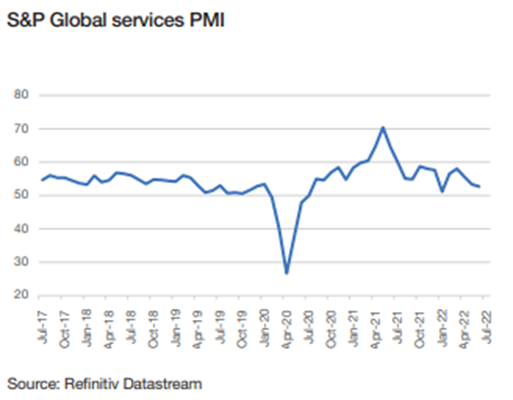
There was evidence of a slowing US economy in the latest S&P Global services purchasing managers’ index (PMI). The business activity index dropped for the third month running from 53.4 in May to 52.7 in June. Although business activity remained above the 50-point mark that separates growth from contraction, it was the weakest rise in activity since January.

New orders fell for the first time in nearly two years as sustained price pressures and economic uncertainty hit demand. Confidence about the year ahead also dropped to a 21-month low, while the rate of input cost inflation slowed from May’s survey but was still among the fastest since the series began in October 2009.

Meanwhile, the US manufacturing PMI fell from 57.0 in May to 52.7 in June, the lowest for almost two years, led by a near-stagnation of factory output and the first fall in new orders since May 2020.

Euro area retail sales miss forecasts

The volume of retail sales in the euro area rose by a seasonally adjusted 0.2% month-on-month in May, missing economists’ forecasts of 0.5% growth, according to data from Eurostat. This followed a 1.4% drop in April, which was revised down from initial estimates of a 1.3% drop.

While sales volumes of non-food products rose by 1.2%, automotive fuel sales fell by 0.2% and sales of food, drinks and tobacco declined by 0.3%. On an annual basis, sales of food, drinks and tobacco dropped by 3.6%.

UK house prices hit record high

The UK housing market defied expectations of a slowdown in June with average property prices rising by 1.8%, the biggest monthly increase since early 2007, according to Halifax. On an annual basis, prices rose by 13% and pushed the typical UK house price to another record high of £294,845.

Russell Galley, managing director at Halifax, said the supply-demand imbalance continued to be the reason behind the sharp increase in house prices. “Demand is still strong – though activity levels have slowed to be in line with pre-Covid averages – while the stock of available properties for sale remains extremely low,” he said.

Galley added that while a slowing of house price growth may come later than previously anticipated, it should still be expected in the months ahead as increased pressure on household budgets and higher interest rates impact affordability.

Please continue to check back for our latest blog posts and updates.

Charlotte Clarke

13/07/2022

Team No Comments

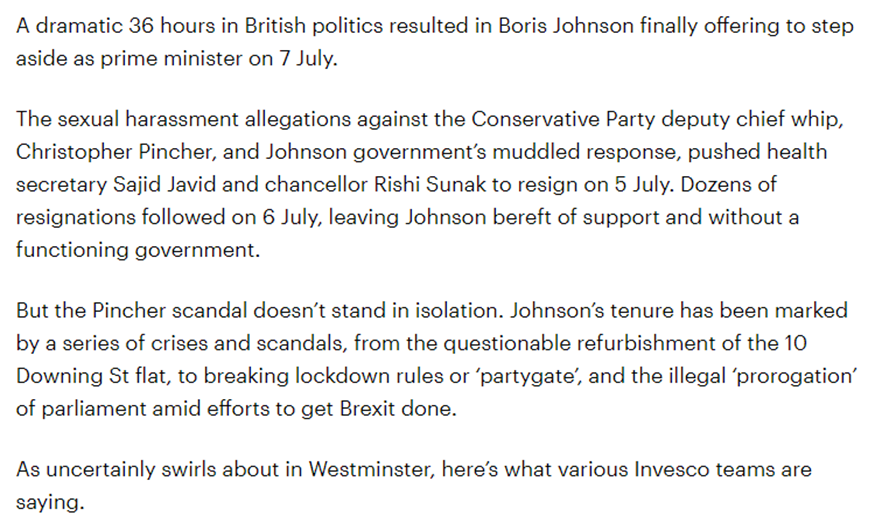
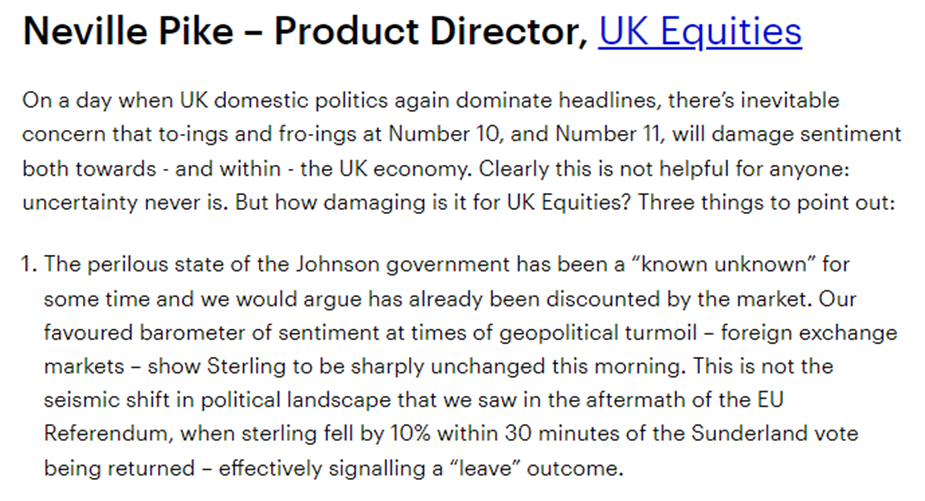
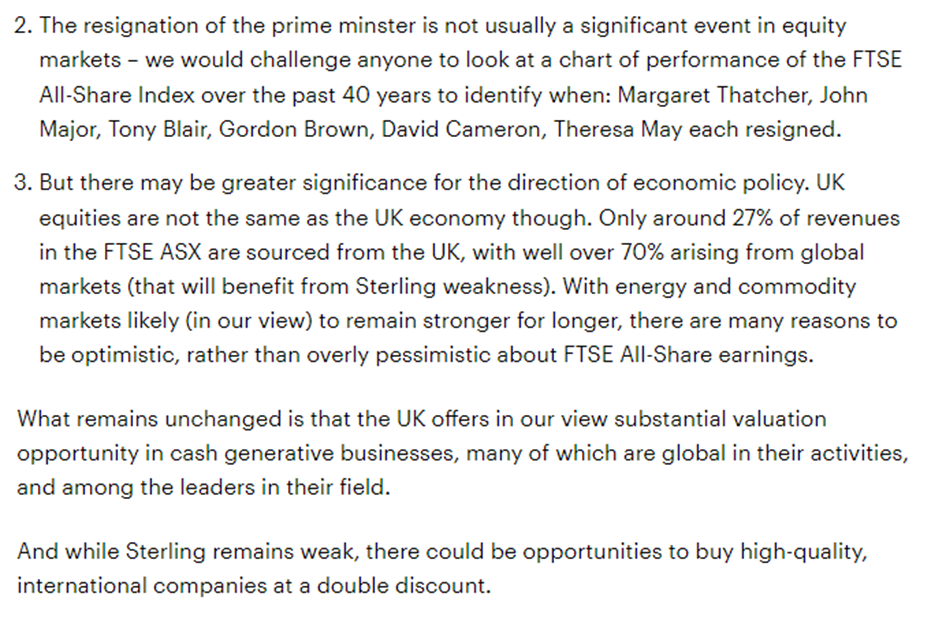
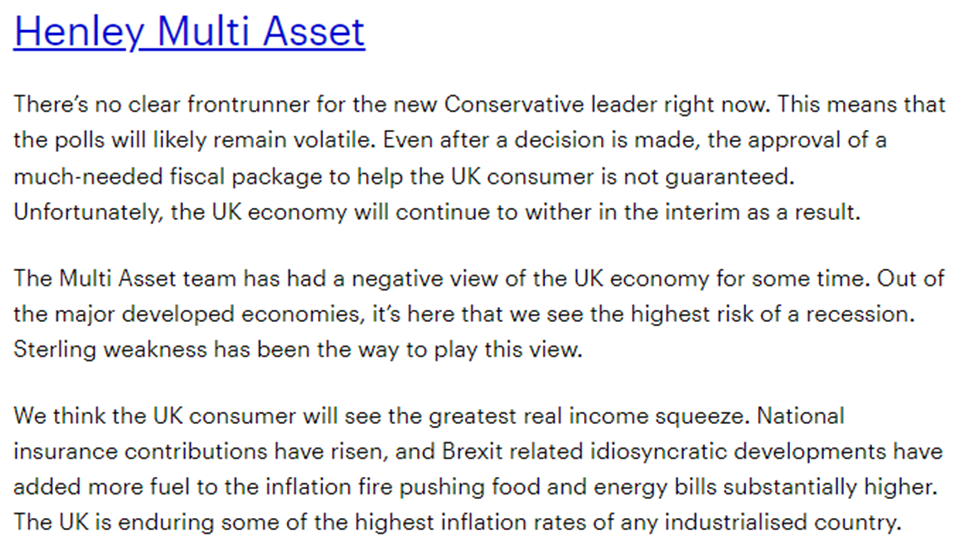
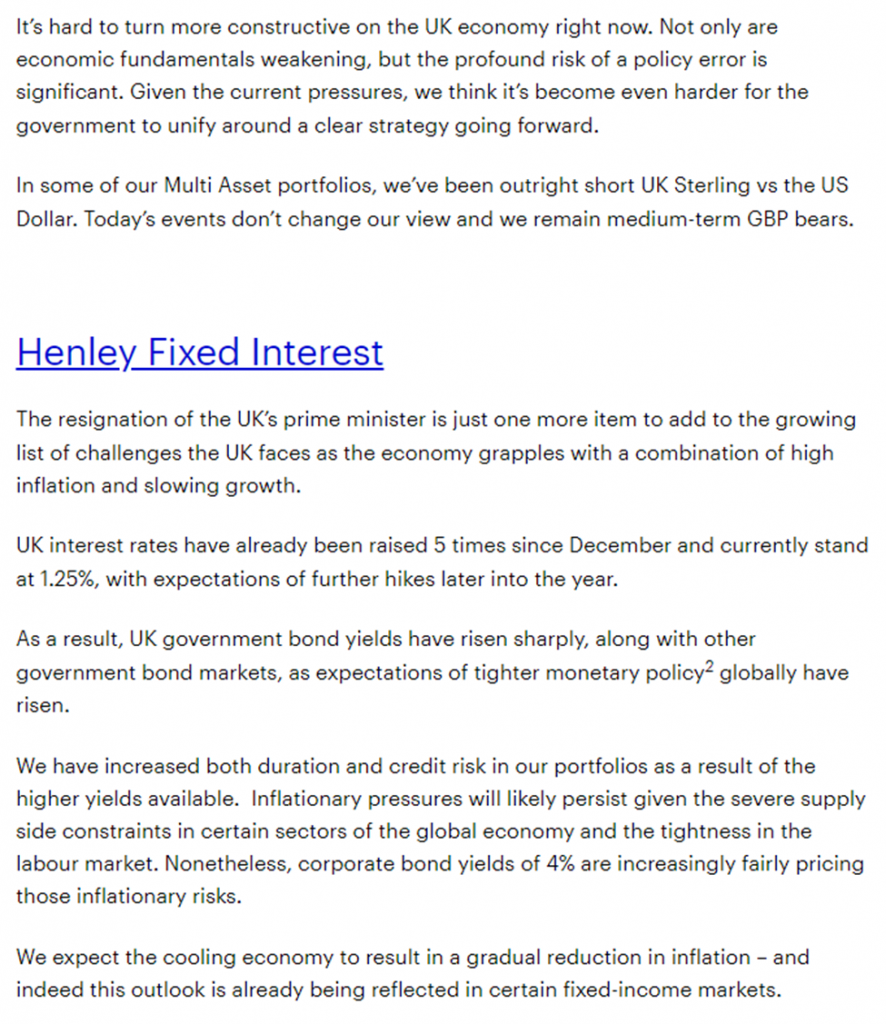
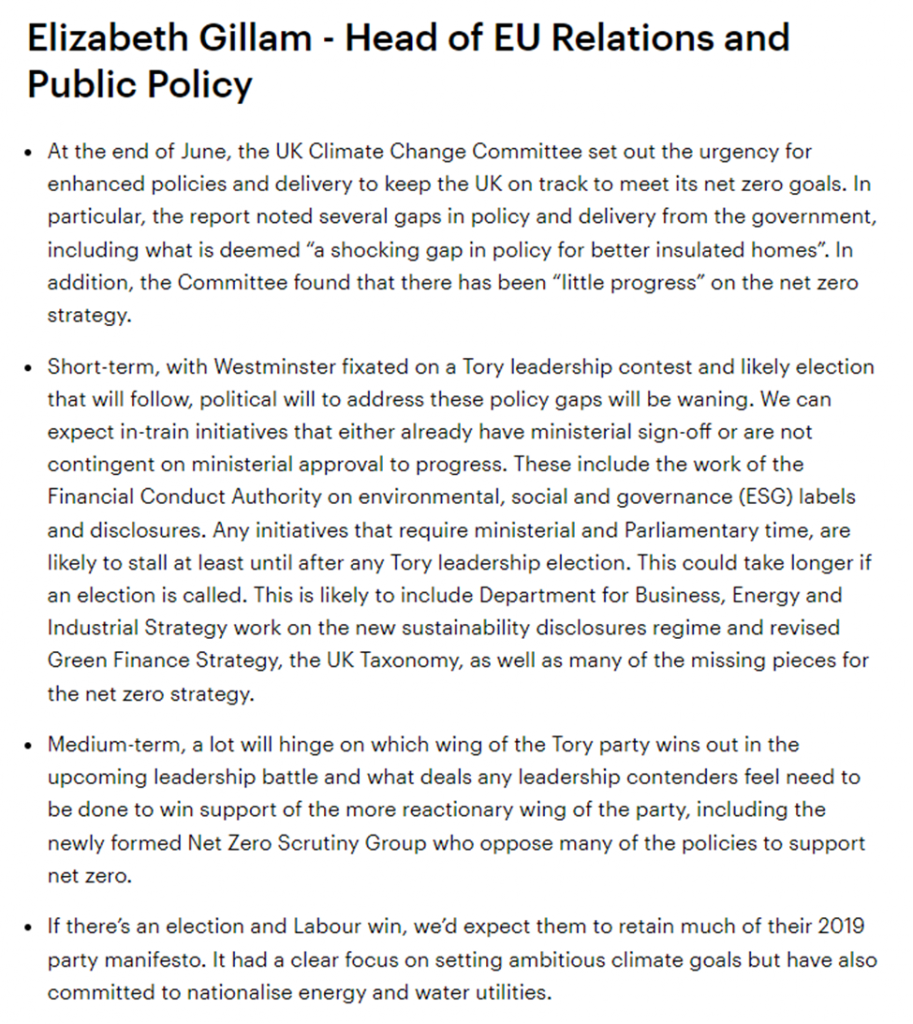
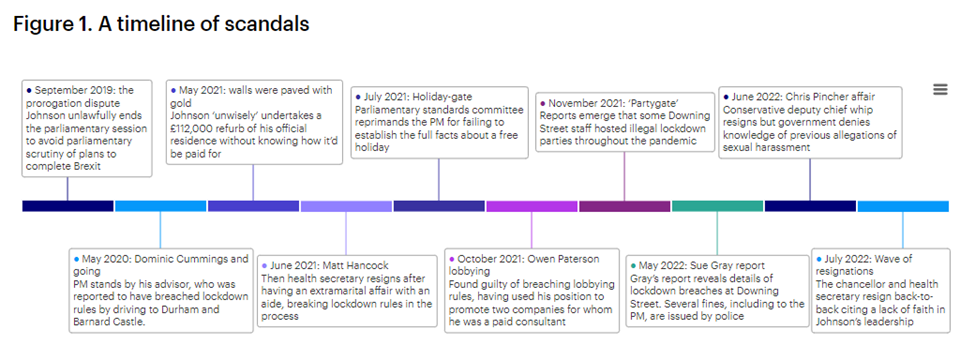
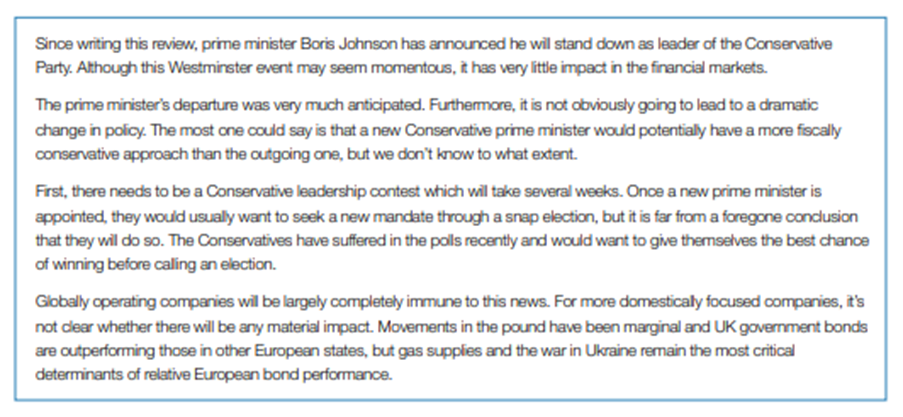
Invesco Analysis: Bye bye Boris. What does his exit mean for the UK?

Please see below for some interesting insights from Invesco regarding the departure of Boris Johnson and its impact on the UK Economy. This was published yesterday, 07/07/2022:

Although replacing the Conservative party leader is unlikely to impact equities, the delay in implementing any further fiscal policies may adversely impact the UK Economy. The hope is that the decision won’t take too long.

Check back for further updates on this and other relevant content.

Cyran Dorman

08/07/2022

Team No Comments

Brewin Dolphin – Quarterly Review Q2, 2022

Please see below the Quarter 2 analysis from Brewin Dolphin which was released yesterday:

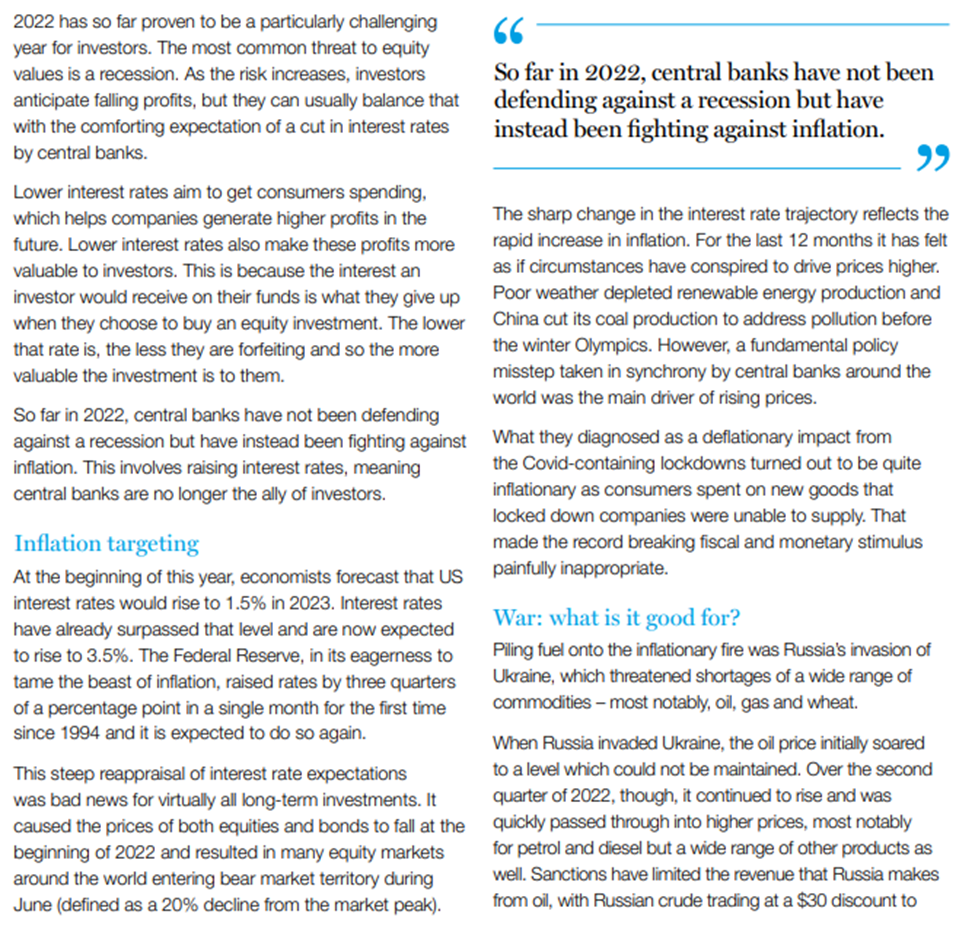
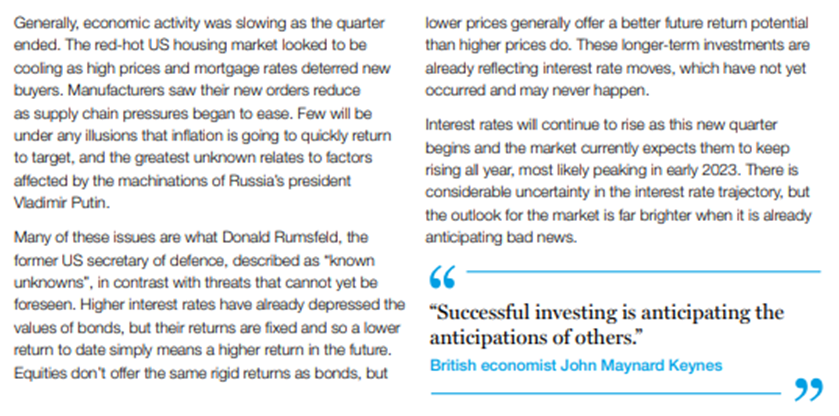
Geopolitical upheaval limiting supplies and exacerbating inflation has been the theme of Q2 and looks to continue into Q3. Brewin Dolphin do hint here that inflation may have reached its peak. This means the volatility we have seen lately may be with us a little longer.

The message is still to focus on long-term investment goals and remain invested while markets recover. Hopefully Q3 will bring more positive news.  

Please check back with us soon for further updates.

Cyran Dorman

08/07/2022

Team No Comments

Brooks Macdonald Daily Investment Bulletin

Please find below, a Daily Investment Bulletin received from Brooks Macdonald this morning – 07/07/2022

What has happened

 Despite fairly dire economic sentiment, equities made gains yesterday with European equities outperforming as they caught up on the late US rally on Tuesday night. Below the surface, investors continue to rachet up their probabilities of a recession with commodity prices falling and the US 10-year Treasury yield remaining below the 2-year yield, a historical precursor to recessions.

 Boris Johnson

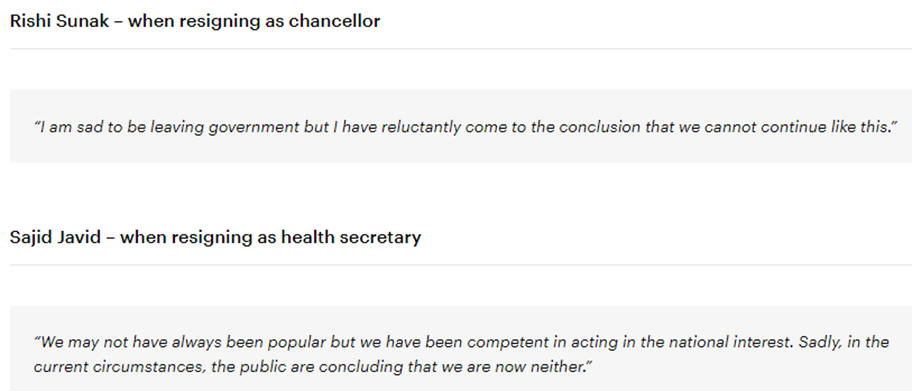
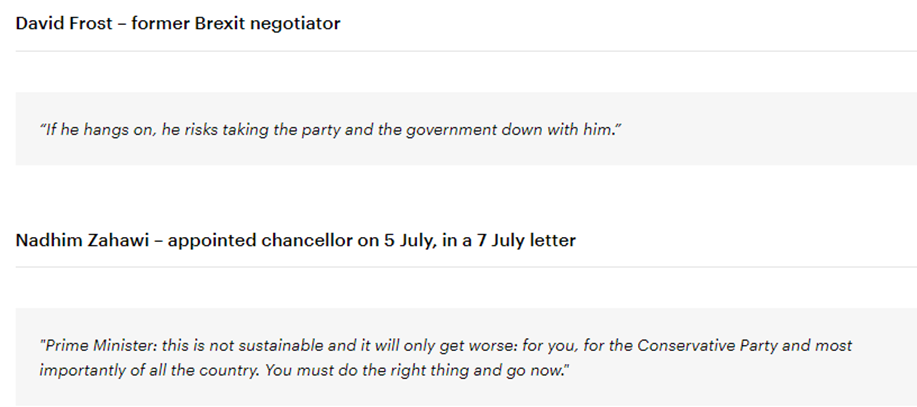
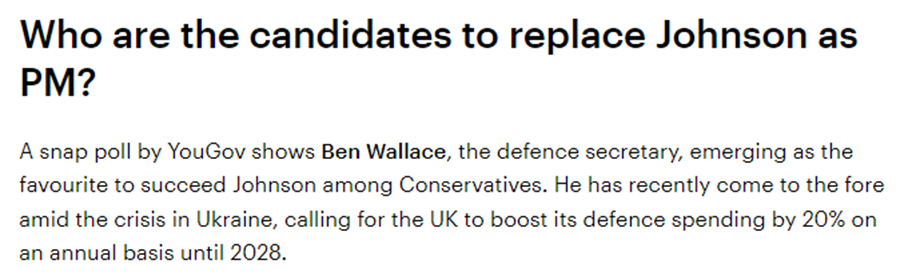
 This paragraph has needed to be rewritten several times in the last hour but with the announcement that Boris Johnson will step down as Conservative leader, the scene is set for a leadership contest, the winner of which will become Prime Minister. Yesterday saw some fairly extraordinary scenes with a large number of ministers resigning but Boris Johnson remaining resolute that he retained a political mandate to govern after the large majority at the last general election. This morning, Downing Street officials briefed that Boris Johnson would resign as Conservative leader later today whilst remaining caretaker Prime Minister until the election process is concluded in the autumn.

 What next

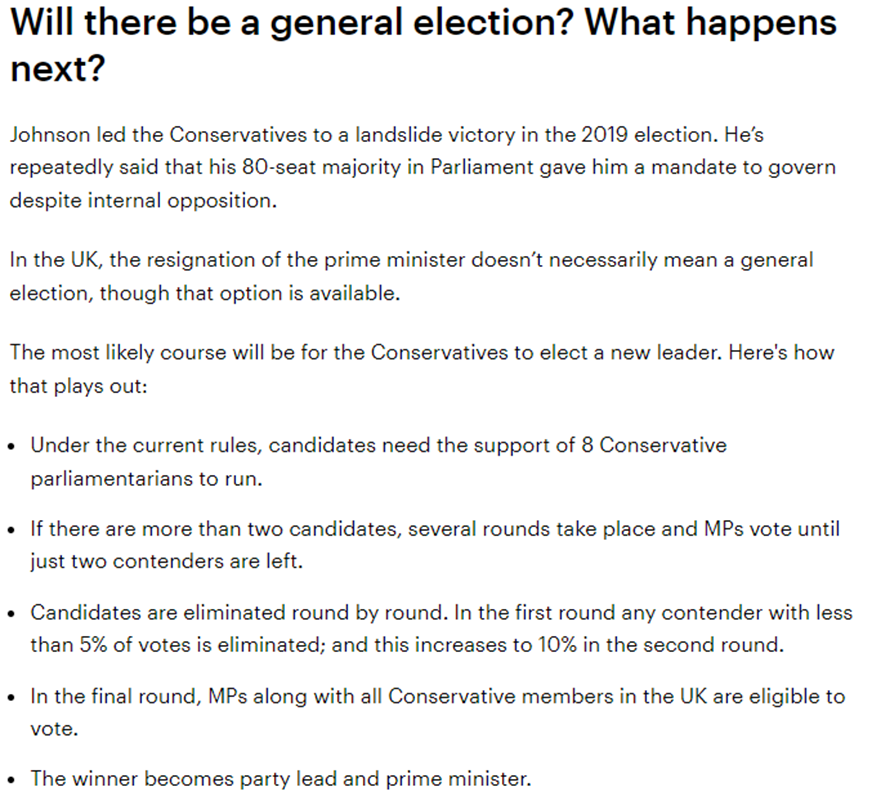
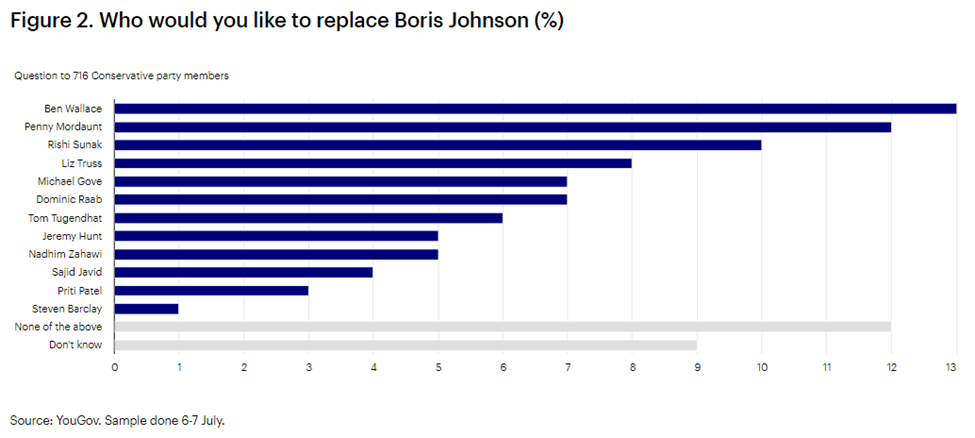
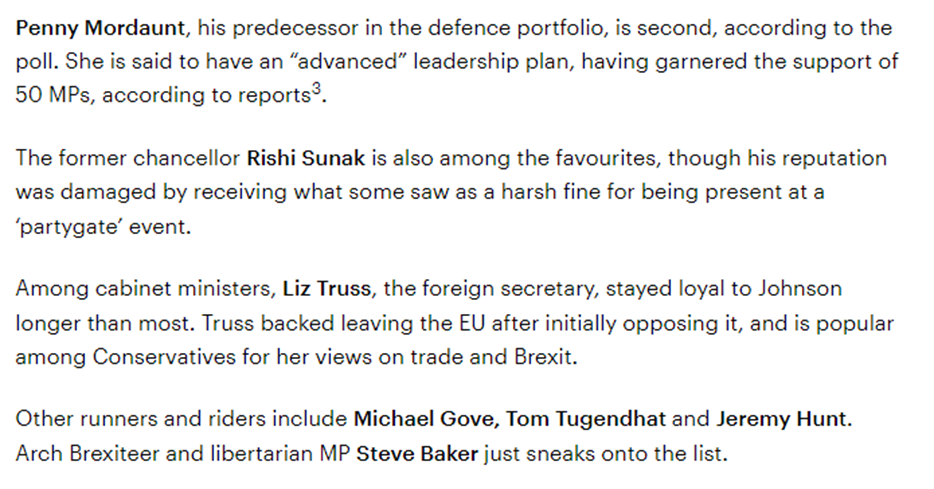
 Sterling has seen a small bounce this morning versus the major currency pairs however until a clear leader emerges from the pack of contenders, the true economic and political impact of the change in leader will be hard to price in. At this stage we probably shouldn’t read too much into the bookmakers odds however Penny Mordaunt is leading. Mordaunt has distanced herself from the Prime Minister for several months, which could prove a factor amongst MPs as well as the Conservative membership, and pairs pro-Brexit leanings with liberal Conservatism – potentially appealing to both wings of Tory MPs. Conservative MPs will debate the benefits of each candidate, voting until two candidates remain, with the ultimate winner chosen by Conservative party members.

 What does Brooks Macdonald think?

 Back in 2019, sterling’s price was closely correlated with the perceived probability of a softer or harder Brexit. In recent weeks, with global central banks opting for differing levels of aggression in tackling inflation, currency pairs have largely been determined by expected differences in interest rate policy. This leadership contest however will undoubtedly draw the attention of currency markets given a) the new leader would have up to 2 years until the next general election b) EU/UK relations remain highly uncertain and c) the cost of living crisis makes fiscal policy even more important.

Please continue to check our Blog content for advice and planning issues and the latest investment, markets and economic updates from leading investment houses.

David Purcell

7th July 2022

Team No Comments

Brewin Dolphin: Market in a Minute

Please see this weeks Markets in a Minute update from Brewin Dolphin received late yesterday:

Please continue to check our Blog content for advice and planning issues and the latest investment, markets and economic updates from leading investment houses.

Andrew Lloyd DipPFS

06/07/2022

Team No Comments

Brooks Macdonald – Weekly Market Commentary

Please see below last week’s Market Summary from Brooks Macdonald, which was published and received late yesterday afternoon:

Please continue to check our Blog content for advice and planning issues and the latest investment, markets and economic updates from leading investment houses.

Carl Mitchell – Dip PFS

Independent Financial Adviser

05/07/2022