Team No Comments

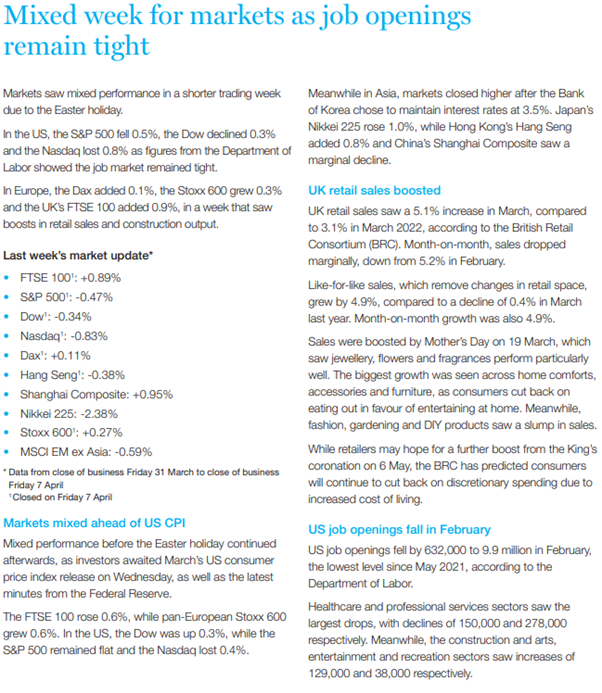
Brewin Dolphin: Markets in a Minute

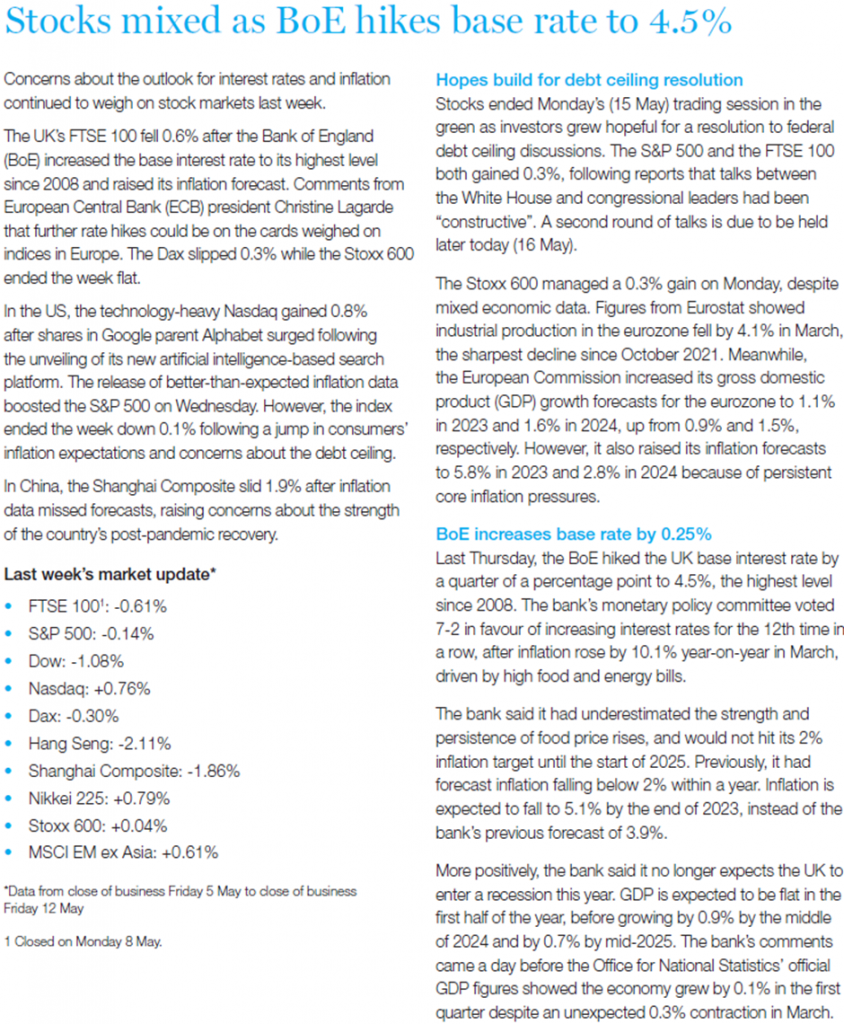
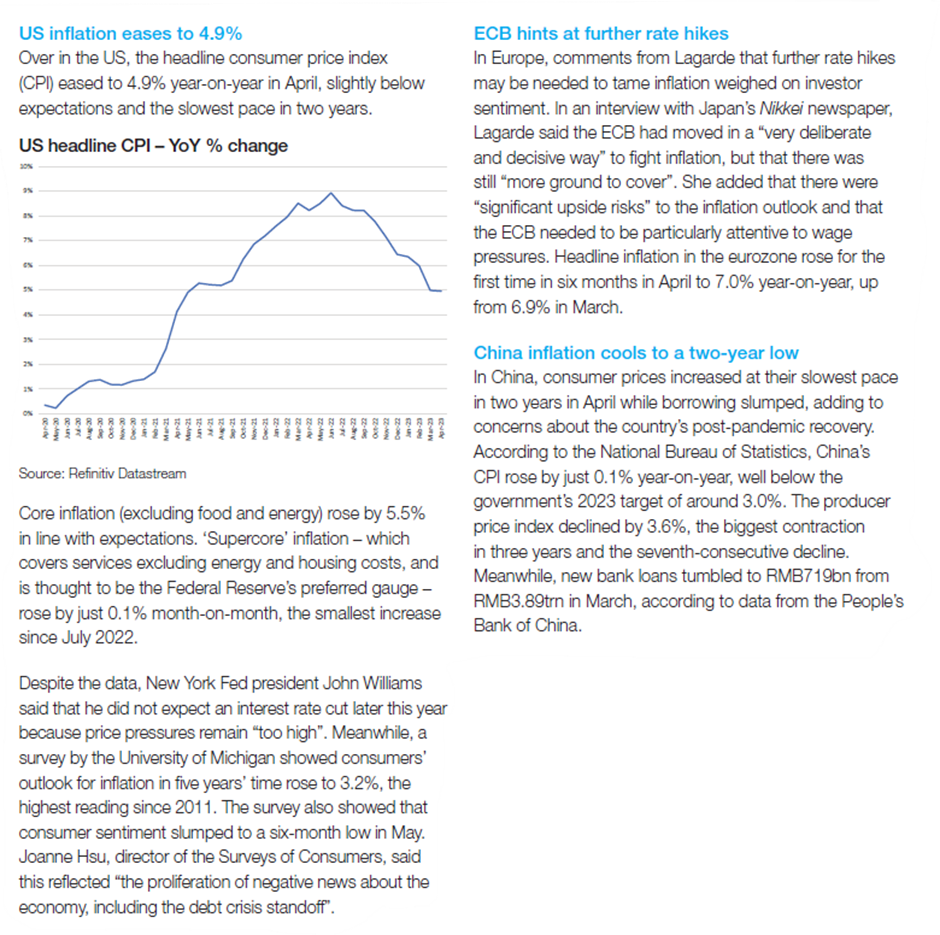
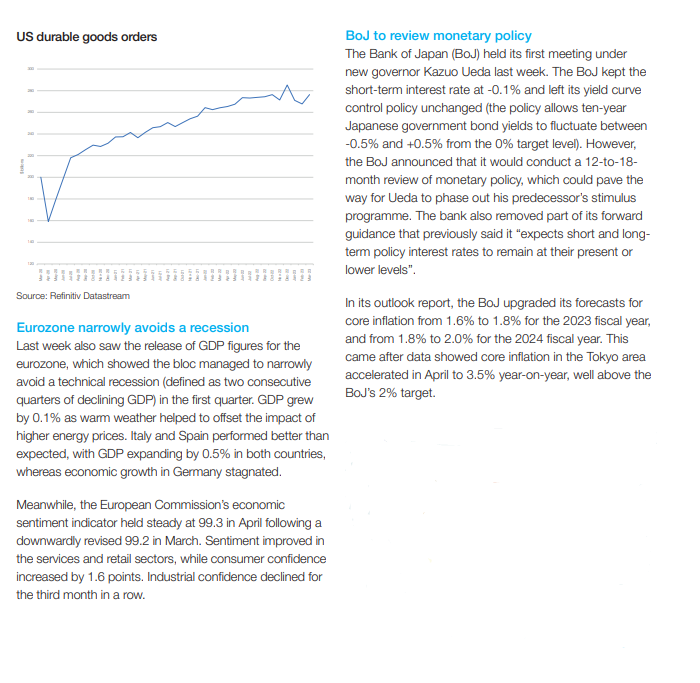
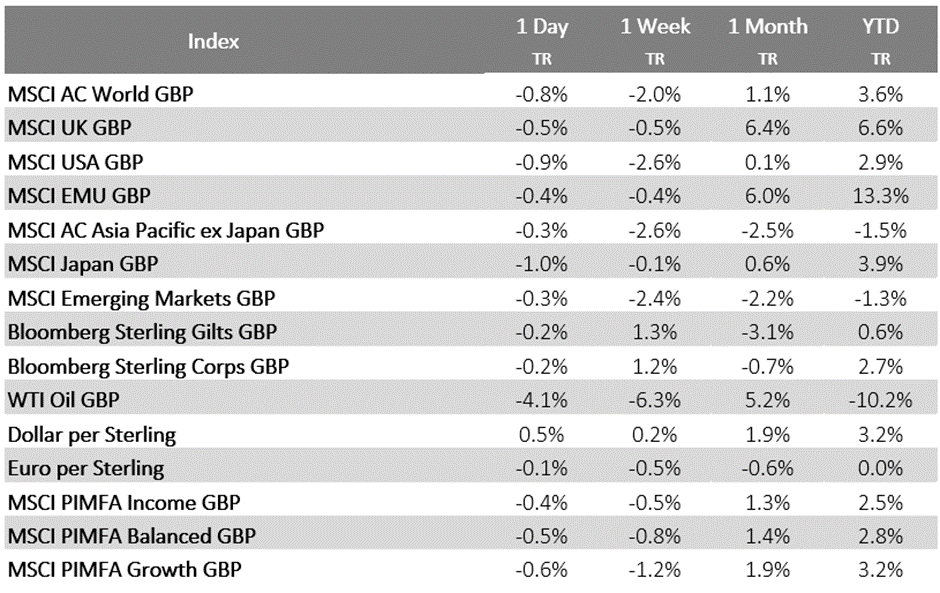
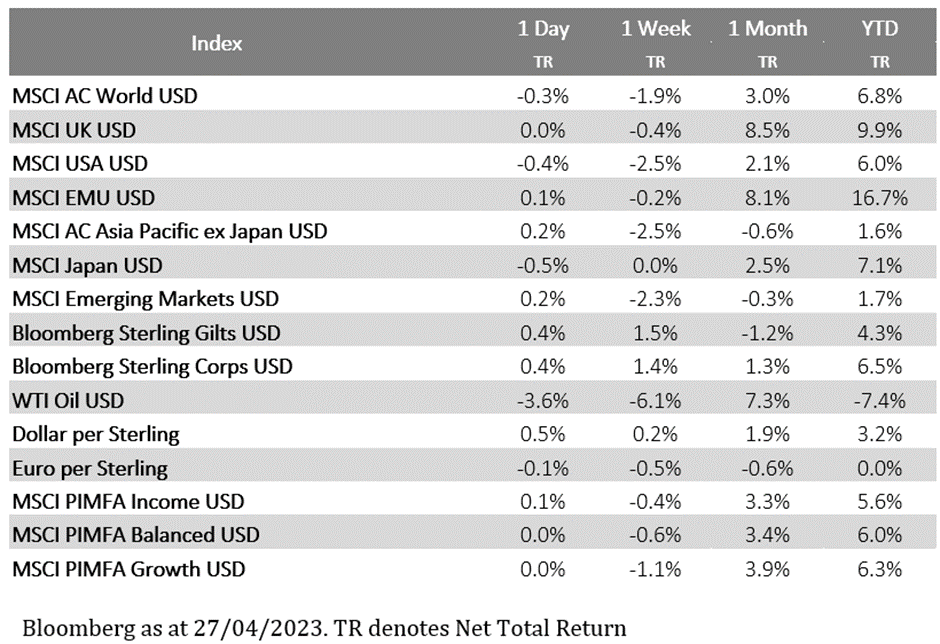
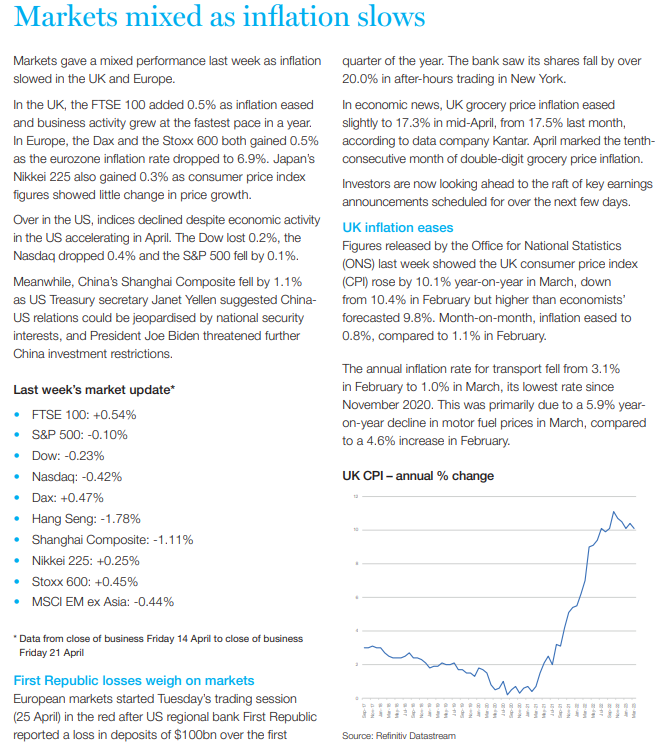
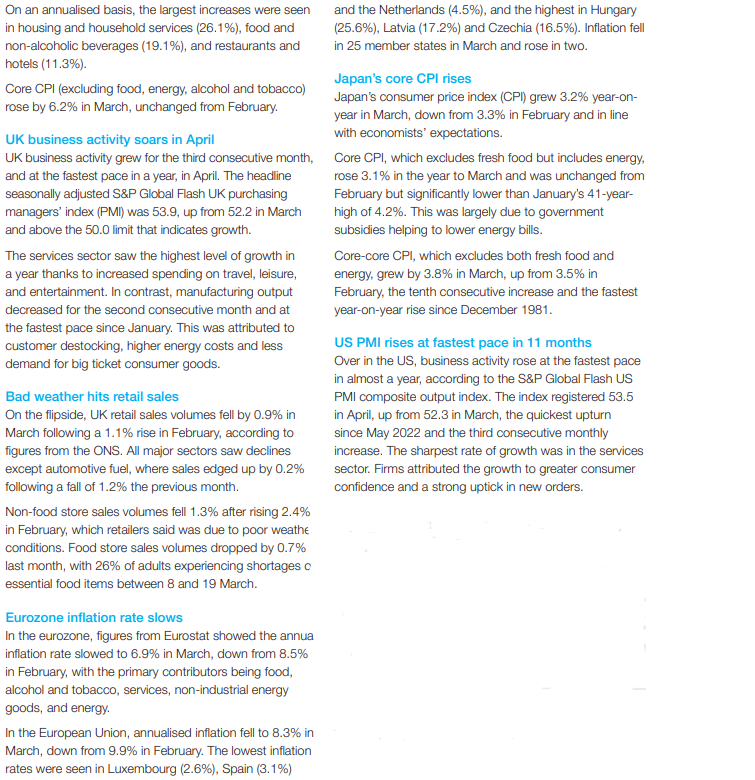
Please see this week’s Markets in a Minute update from Brewin Dolphin received late yesterday (16/05/2023) afternoon:

Please continue to check our Blog content for advice and planning issues and the latest investment, markets and economic updates from leading investment houses.

Carl Mitchell – Dip PFS

Independent Financial Adviser

17/05/2023

Team No Comments

Brooks Macdonald – Daily Investment Bulletin

Please see below todays (05/05/2023) Daily Investment Bulletin from Brooks Macdonald:

What has happened

Market sentiment on Thursday showed a split between continued worries around the health of US regional banks on the one hand, versus better than expected results from US tech heavyweight Apple. With Apple’s results announced after the regular market close however, they didn’t arrive in time to help the broader market, which closed lower on the day. For the day ahead, the focus is likely to stick with the banks sector, but elsewhere in economic news, US monthly non-farm payroll employment data for April is due – according to a Reuters survey, payrolls are expected to have increased by 180,000 jobs last month, which would be the smallest gain since December 2020 and which would be the third month in a row of deceleration in employment gains.

US regional bank worries continue

US regional bank news it seems is bookending the week. After the failure and sale of First Republic to JP Morgan at the start of this week, US regional banks resumed their share price slide on Thursday. In the crosshairs, PacWest’s share price has seen heavy falls this week on the back of a Bloomberg story that the bank was exploring sale options. While PacWest has since confirmed that “the company has been approached by several potential partners and investors – discussions are ongoing”, the bank has tried to calm market nerves, saying in a statement released yesterday that “the bank has not experienced out-of-the-ordinary deposit flows following the sale of First Republic Bank”, and that “core customer deposits have increased since 31 March”.

ECB hikes and leaves door wide-open for more, in contrast to Fed’s latest signalling

The European Central Bank (ECB) hiked interest rates by 25bps on Thursday, taking its deposit rate to 3.25%, a post-2008 high, and up from a negative rate of -0.5% in less than a year when it first starting hiking in July 2022. While the pace of hikes was a downshift from 50bps at each of its previous 3 meetings, the ECB did not appear to follow the Fed regarding interest rate path outlooks. While the Fed on Wednesday hinted at a possible pause, the ECB left the door wide-open for additional tightening on Thursday. As well as plans to stop reinvestments of its Eur3.2trillion Asset Purchase Programme from July, ECB president Lagarde said there were “still significant upside risks to the inflation outlook”, and on future possible rate hikes that “we have more ground to cover and we are not pausing”.

What does Brooks Macdonald think

There is a something of a separation in the way that both policy makers and markets are thinking at the moment. For central banks, they continue to believe that they can separate the interest rate ‘inflation vs economic growth’ trade-off from bank stress. Equally, markets are continuing to take solace in the latest Q1 earnings beats, including from tech, and meanwhile treating the current US regional bank hiatus as non-systemic. How US regulators in particular tackle the thorny issues around their regional banks, both in terms of regulatory oversight but also in terms of the potential for any deposit insurance cap changes in the weeks and months ahead will be key.

Please continue to check our Blog content for advice and planning issues and the latest investment, markets and economic updates from leading investment houses.

Andrew Lloyd DipPFS

05/05/2023

Team No Comments

Brewin Dolphin – Markets in a Minute

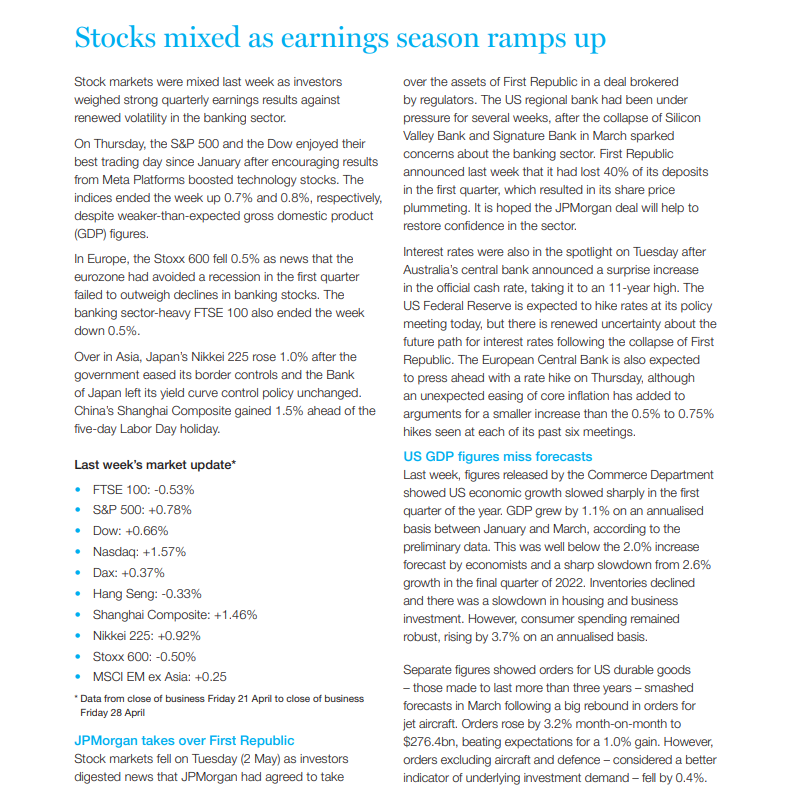
Please see below article received today from Brewin Dolphin providing a market summary. Received today – 04/05/2023.

Please check out Blog content for advice, planning issues and the latest investment, market and economic updates from leading investment houses.

Adam Waugh

04/05/2023

Team No Comments

Invesco – UK elections: Sunak’s big test, Starmer’s vision and implications for markets

Please see below Invesco article regarding the upcoming UK local elections. Received today -28/04/2023.

How will the elections impact UK markets?

UK politics and the UK economy are not the same as UK equity markets. Only around 25% of revenues in the FTSE All-Share come from the UK.

“Put simply, the outcome of the May election in Barnsley will have no discernible effect on the prospects for AstraZeneca’s world leading immuno-oncology pipeline; the size of the swing in North Tyneside will not affect sales of Unilever in Indonesia. Yet together these two companies alone comprise almost 12% of the FTSE All-share index,” said Martin Walker, Invesco Head of UK Equities.

That’s not to say we are in any way complacent about different prospects of businesses under future Conservative or Labour governments.

“It’s easy to see how policy on, say, energy supply, provision of utilities in general, or housing policies might potentially cause winners and losers, depending on the outcome of the general election. Indeed, our own investment analysis already factors in where we see opportunity and risk under different scenarios. As fund managers, our job is to stay alert – particularly at a time of heightened volatility,” Walker said.

When is the next UK election?

Voters across 230 English local authorities will head to the polls on Thursday 4th May. About 8,000 council seats are up for grabs across a mix of metropolitan boroughs (traditionally Labour areas) unitary authorities (where Labour is expected to make gains) and district councils (traditionally Conservative areas). The last time these seats were elected was pre-Covid, in 2019, when Theresa May was Prime Minister, Jeremy Corbyn was Labour leader and Parliament was heading for a Brexit deadlock. Then, the Conservative lost more than 1,300 council seats. This was their worst local election result since 1995 – while Labour lost 80 and the Lib Dems emerged with more than 650 gains. The National Equivalent Vote share had Labour and the Tories tied neck-and-neck on 31%, with the Lib Dems winning 17%.

Political momentum with Sunak

The political momentum currently lies with Sunak. After a torrid first 100 days in office, Sunak has begun to make some political headway. 

“Agreement of the Windsor Framework, stronger relations with the EU, a well-received Spring Budget and the handling of the collapse of Silicon Valley Bank’s UK branch have strengthened his leadership after a rocky start. As a result, his stock with the Tory grassroots has risen,” said Hook.

And voters are noticing too. Sunak is on a par with Keir Starmer on the question of who voters think would make the most capable Prime Minister; and Labour’s average poll lead over the Tories is down by 5 points since January.
 

Starmer’s task: demonstrate a decisive vote share lead

Sunak’s progress shouldn’t be overstated. A 15-point lead in a general election would deliver Starmer a substantial Parliamentary majority. Nonetheless, Starmer is under pressure to show that a poll lead translates into real votes at the ballot box.

Rather than council gains / losses, the key figures to watch, will be the projected National Equivalent Vote (NEV) figures from local elections experts Colin Rallings and Michael Thrasher – which calculate support for each party as if the elections were taking place in every part of the country. As a guide to interpreting Labour’s performance:

  • Minimum hurdle: take the mantle of the largest party in local government – a title held by the Tories since 2003.
  • Cause for concern: <6 point lead (NEV) over the Tories – suggests Labour are struggling to convert some poll support into votes.
  • Good: 10+ point lead (NEV) over the Tories – a feat Labour last managed in 1997, would show Labour on course for General Election majority.
  • Excellent: 15+ point lead (NEV) over the Tories – on course for a landslide majority.

How does industry view Starmer?

“In our discussions with the bosses of leading UK companies, it’s clear that there’s a dialogue with the government on matters of importance. Governments (of any colour) understand they need to have a performing banking sector,” said Walker.

“The sector is a significant contributor to the Treasury through the banking levy and surcharge. Our most recent discussions have highlighted that banks and financial services companies are already engaging with Starmer and Shadow Chancellor of the Exchequer, Rachel Reeves.”

In the outsourcing sector, an area of ‘hi-touch’ with central and local government, companies are saying that they’re working on engagement ahead of the 2024 election, and that although governments change, the challenges remain the same. One company pointed out: “the language from Starmer around working with the private sector and partnerships is positive. The depoliticising of the support service relationship is important.”

Segment view: Pensions

The UK pension sector is one of the largest in the world – approximately £1.7 trillion in defined benefits pension scheme assets are on UK companies’ balance sheets, according to McKinsey data from March 20231The sector experienced significant turmoil when Truss announced her ‘mini-budget’ in September last year2.

“After the political turmoil of the last year, a period of relative stability is much needed. The local elections are a good reminder that all politics is local – and the supply of quality, affordable housing remains one of the most pressing needs facing communities across the country. The political focus is necessarily on provision of social housing, but the reality is that more housing of all tenures is needed – and the private rented sector uniquely fulfils strong demand, government policy and investment returns.”

Stuart Boucher, Head of Local Government Pension Schemes, Invesco

Conservative MPs aiming for re-run of 1992

“Tory MPs are bracing for a loss of hundreds of council seats, if not more. But with the PM’s growing reputation for competence and the apparent ‘softness’ of Labour’s lead, they can also see a narrow path to an unlikely election win in 2024,” said Hook.

If, in a year’s time, inflation is substantially lower, economic growth higher, EU relations stronger and public sector strikes are in the rearview mirror, Tory MPs are hoping that voters might just give a less fractious Conservative Party another look. As such, they’re hoping the next election could be more like 1992 than 1997.

Macro view: Inflation

“UK consumer price inflation was reported to be 10.1% in March. Though down from the October peak of 11.1%, this remains uncomfortably high for the Bank of England. However, with natural gas prices down sharply (among other commodity price declines) and sterling strengthening, I suspect that Sunak’s target of inflation halving during 2023 is likely to be met. This should allow the Bank of England to signal an end to tightening around the middle of the year.”

Paul Jackson, Global Head of Asset Allocation Research, Invesco

Starmer’s challenge: define his vision

For Starmer, whatever the result, pressure will grow for him to set out a more detailed alternative vision for the country.

“Starmer’s core challenge is how to articulate a vision for stronger public services when the public finances are already stretched,” said Hook. “Pledging tax rises on higher earners risks undermining his claim to have pulled Labour back to the centre ground; but higher borrowing raises the spectre of a repeat of the market reaction to Liz Truss’s brief premiership.” 

“The third option,” Hook added, “to generate higher revenues from higher growth, would take time and mean Labour are limited in articulating a radical alternative to the current government. This would mean the election could increasingly become a contest between the party leader viewed as most competent: Sunak or Starmer.”

Please continue to check our Blog content for advice and planning issues and the latest investment , markets and economic updates from leading investment houses.

Adam Waugh

28/04/2023

Team No Comments

Brooks Macdonald – Daily Investment Bulletin

Please see below todays (27/04/2023) Daily Investment Bulletin from Brooks Macdonald:

What has happened

US technology shares had a good day yesterday, helped by strong results in the sector. Weighing against this positivity is ongoing concerns around the US regional banking sector which has remained in focus. Ultimately the bearish sentiment won out, with the equity market falling on the day.

US regional banks

First Republic was down an additional 30% yesterday with the share price hitting an all-time low. To show how much equity value has been destroyed, the bank had a market capitalisation below $1bn at one point yesterday, that’s from a peak of just under $40bn. First Republic are reported to be looking for support from the large US banks, emulating the deposit support they received during the March crisis. It appears increasingly likely that if the bank cannot find support from the private market it would need to go to the FDIC for support. The FDIC are alleged to have threatened to downgrade First Republic’s rating if a private deal is not forthcoming. Such a downgrade would limit the bank’s access to the Fed’s liquidity facilities and would likely catalyse another crisis of market confidence. All of this is reoccurring at the same time as the Fed is in its communication blackout window ahead of the upcoming interest rate decision. Given the uncertainties the market downgraded the chance of a 25bp interest rate hike below 75% at one point yesterday.

Technology

One of the positive stories within markets has been the robust earnings of technology heavyweights. The software sector was up over 4% yesterday, outperforming a falling market, as Microsoft surged over 7% due to better than expected results that showed the company’s cloud unit grow revenue by over 30%. After the US closing bell Meta delivered its results, also coming in above market expectations which will help support the wider technology sector in today’s trading.

What does Brooks Macdonald think

While the tug of war of market sentiment is largely taking place between stronger tech earnings and weaker US regional banks at the moment, the US debt ceiling is not far from investors’ minds. Republican House Speaker McCarthy tweaked his proposed debt ceiling bill which passed through the House yesterday but will fail at the Democrat controlled Senate. The bill represents the starting gun on negotiations which could create a significant market risk over the summer.

Please continue to check our Blog content for advice and planning issues and the latest investment, markets and economic updates from leading investment houses.

Carl Mitchell – Dip PFS

Independent Financial Adviser

27/04/2023

Team No Comments

Brewin Dolphin – Markets in a Minute

Please see below article ‘Markets in a Minute’ from Brewin Dolphin providing an update on markets and econominc news. Received late yesterday – 25/04/2023.

Please continue to access our Blog content for advice and planning issues and the latest investment, markets and economic updates from leading investment houses.

Adam Waugh

26th April 2023

Team No Comments

Invesco: Will Fed hawks go too far in their inflation fight?

Please see the below article from Invesco received over the weekend:

I’ve just returned from my first trip to Asia since the pandemic, where I was honored to be asked to present at a conference. I’d forgotten how long the flights are, and how the onboard movies are critical to passing the time. On one leg of my journey, I counted 12 superhero movies offered on one flight. Thanks to my insomnia, I wound up watching five of them. A pervasive theme, which I never really paid attention to before when I watched these movies with my kids, was the idea that superheroes have enormous power, but sometimes they can make mistakes in using that power — with very significant repercussions. Another theme is that reasonable, well-intentioned superheroes can have strong differences of opinion, and it’s much easier to believe you are right than to actually be right.

Maybe these themes really struck me now because I think central bankers see themselves as modern-day superheroes, or as close to superheroes as economies can find. And to be fair, they have resolved major threats to economies in recent years, from the Global Financial Crisis to the pandemic to the UK gilt yield crisis last fall. But as institutions with powerful policy tools, there is a built-in risk that they might make mistakes that are far-reaching and very consequential. We saw that first-hand when US Federal Reserve (Fed) Chair Jay Powell insisted that inflation was transitory and chose not to start hiking rates until March of 2022.

From there, of course, the Fed embarked on an aggressive tightening policy. And while we wait to see the full impact of that policy on the economy, I think the risks are increasing that the Fed could make a mistake in where it goes from here.

Inflation is cooling, but the hawks remain wary

It’s clear that the US economy is cooling, and so is inflation. Maybe not all forms of inflation are easing as quickly as the Fed would like, but they have been moving in the right direction. Even core services ex-shelter inflation, the focus of the Fed’s inflationary concerns, is showing signs of progress: the 3-month annualized run rate is at 4% after peaking at 9.2% last year. And we got a very encouraging March US Producer Price Index (PPI) report, suggesting we will likely see further easing of the US Consumer Price Index (CPI), as the CPI tends to follow the PPI with a lag.

What is not clear is how much damage the Fed has already done to the economy because of its aggressive tightening thus far, much of which has arguably not yet shown up in the data because of the lagged effects of monetary policy. And yet, we’re still getting hawkish Fedspeak:

  • Last week Fed governor Christopher Waller said there has been minimal progress on inflation in the last year and more rate hikes are needed to get inflation under control. He said inflation “is still much too high and so my job is not done.”
  • San Francisco Fed president Mary Daly said, “While the full impact of this policy tightening is still making its way through the system, the strength of the economy and the elevated readings on inflation suggest that there is more work to do … How much more depends on several factors, all with considerable uncertainty attached to their evaluation.”
  • Perhaps more concerning was what we got from the minutes of the Fed’s March meeting: Federal Open Market Committee (FOMC) participants observed that “inflation remained much too high” and that “the labor market remained too tight.” It seems the Fed would likely have hiked 50 basis points had the banking sector mini-crisis not occurred in March.

Luckily, there are some cooler heads that will hopefully have an impact on Fed deliberations. Chicago Fed President Austan Goolsbee said the Fed should proceed cautiously with any more rate hikes given the stress in the banking system, “At moments like this of financial stress, the right monetary approach calls for prudence and patience.”

Other central banks are taking a hawkish tone

The Fed isn’t the only central bank talking hawkishly:

  • European Central Bank (ECB) President Christine Lagarde continues to share her concerns about inflation. Last week she warned that she expects price pressures to remain high for some time. And now the ECB is considering another “jumbo” rate hike at its next meeting. Don’t forget the ECB is also busy working to rapidly reduce the size of its balance sheet.
  • Last week Bank of England Governor Andrew Bailey assured that the mini-banking crisis would not have an impact on the path of rate hikes: “What we have not done — and should not do — is in any sense aim off our preferred setting of monetary policy because of financial instability. That has not happened.”

I think the Fed poses the most danger to the US economy given how much tightening it has done and given the significant economic weakening that has already occurred, as we have seen in falling Purchasing Managers’ Indexes. But other central banks that continue to tighten in this environment also pose a risk to their respective economies. We just don’t know how much damage has already been done. This adds to the uncertainty around what central banks will do next. As San Francisco Fed President Mary Daly made clear, “…  there are good reasons to think that policy may have to tighten more to bring inflation down…But there are also good reasons to think that the economy may continue to slow, even without additional policy adjustments….” Or as Christine Lagarde said in an interview on Sunday, “… we are faced with high uncertainty because of multiple factors, you know, from all corners of the world.”

The impact of aggressive tightening

Besides the contributions it has made to the mini banking crisis, the Fed is causing other problems too as a result of its aggressive tightening. For example, net interest on public debt has risen 41% thus far in fiscal year 2023 versus fiscal year 2022 largely because of the increase in interest rates. Discussion of this topic might not be found in the FOMC minutes, but it’s an important one since money spent servicing debt is money not available to be spent in other, more productive ways. I can’t help but wonder that, with superheroes like this, who needs supervillains?

Then there is the uncertainty around the debt ceiling. We have to worry that if an agreement is not reached expeditiously, we may have a repeat of the summer of 2011 — or worse. I hope that’s not the case, but in this politically charged environment, it could be.

Implications for investors

As I conclude this commentary, it occurs to me that it’s been another week in which I’m writing about central banks. I realize my central bank commentary series is starting to rival the number of superhero movies I’ve seen — but unfortunately, the reality is that central banks are still largely controlling the narrative when it comes to both economies and markets.

In my view, the current environment with central banks argues for defensive positioning in the very near term, especially in the US, for those who are tactical allocators. However, for those who are strategic allocators, I believe it’s time to start looking for opportunities to selectively add to one’s portfolio.

Whether you are a tactical or strategic allocator, there are two asset classes I believe may perform well in the near term and the longer term:

  • Within equities, I’m most positive on the technology sector. Many tech companies are reducing costs, which should help take pressure off profit margins. In addition, many tech stocks offer secular growth at a time when growth is scarce, which should make them more popular with investors.
  • Within fixed income, I’m most positive on investment grade credit. High quality debt with relatively high yields makes sense to me in this environment.

With both these views, the main short-term risk, especially for tactical investors, is that continued hawkishness by the Fed in excess of what markets already expect could lead to some renewed upward pressure on long-term interest rates, which in turn could drive longer-duration assets like tech equity or investment grade credit prices somewhat lower. But with inflation cooling and the economy slowing, the Fed should be at or near the end of the tightening cycle, which should limit these risks.

In general, though, I favor being diversified across and within the three major asset classes: equities, fixed income and alternatives.

I believe it also makes sense to be globally diversified across asset classes. Western Europe is further behind in its rate hiking phase than the Fed, which suggests that US fixed income and longer-duration sectors of US equities (like technology) are probably better positioned than European fixed income or growth/tech equities.

China is in a much earlier stage of its reopening and recovery, with much less inflation risk (since its government didn’t do major job protection programs, fiscal transfers, or monetary easing in the way the West did, accounting for a less aggressive reopening rebound). The People’s Bank of China can therefore afford to be much more dovish, pointing to a better overall financial environment than in the West. This environment suggests “risk on” positioning may perform better.

Emerging markets as a whole are in a more advanced phase, but with major differences, calling for diversification and active country selection and risk management: Some are arguably at or near in the end of tightening in many cases (such as India), though there are others where more hiking may be needed (South Africa for example, and perhaps parts of Central/Eastern Europe, which still have very high inflation and are probably likely to keep leading the ECB in hiking) or where policy and political uncertainty point to sustained ultra-high rates (like Brazil).

The key for investors is to understand where the risks are, both upside and downside. Right now, many of those risks are coming from central banks. While well intentioned, central bankers don’t often merit superhero status. Don’t forget that central bankers are only human, and they can often be driven by the same emotions that can hobble investors from achieving their goals, such as pride and fear. Central bankers only carry briefcases and financial calculators, not magic lassos and sabers. And while they might wear Canali suits, they don’t wear capes.

Please continue to check our Blog content for advice and planning issues and the latest investment, markets and economic updates from leading investment houses.

Andrew Lloyd DipPFS

24th April 2023

Team No Comments

Evelyn Partners Update – Investment Outlook

Please see below article received today (14/04/2023) from Evelyn Partners summarising their investment outlook:

Please continue to check our blog content for advice and planning issues and the latest investment markets and economic updates from leading investment houses.

Adam Waugh

14/04/2023

Team No Comments

Brewin Dolphin: Markets in a Minute

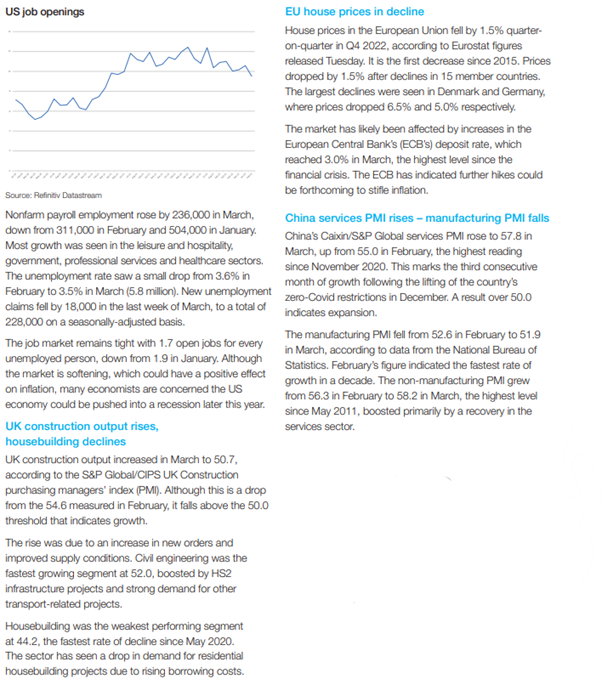
Please see this weeks Markets in a Minute update from Brewin Dolphin received late yesterday afternoon:

Please continue to check our Blog content for advice and planning issues and the latest investment, markets and economic updates from leading investment houses.

Andrew Lloyd DipPFS

13/04/2023