Team No Comments

EPIC Investment Partners – IMF Growth Forecasts Blog

Please see below and article received from EPIC Investment Partners this morning (12/04/2023), which summarises their views on the International Monetary Fund (IMF) recently revised forecasts for the UK economy and predictions for other global economies:

The Daily Update: IMF Growth Forecasts

Yesterday (11/04) the International Monetary Fund (IMF) upgraded its outlook for the UK economy, saying it now believes Britain is on track to contract by 0.3% this year, half the 0.6% decline the IMF forecast in January, then expand by 1% in 2024. However, that’s where the good news ends for Blighty, as the IMF believes we will still be the worst-performing large economy on the planet this year. Only Germany will be the other advanced nation to see negative growth this year, and that is by just 0.1%.

So much for Chancellor Jeremy Hunt’s view that the “the declinists are wrong, and the optimists are right” about the UK’s economic prospects. Not that he sees anything wrong in that statement. “Thanks to the steps we have taken, the OBR says the UK will avoid recession, and our IMF growth forecasts have been upgraded by more than any other G7 country,” he said. As they say, torture the statistics long enough and eventually they’ll confess.

Overall, the IMF downgraded its forecast for global growth by a small margin of 0.1% from its 2.9% projection in January, lower than the 3.4% seen last year, with a slight recovery next year to 3%. However, there is a 25% chance that global growth will fall below 2% for the first time since the 2008-09 global financial crisis, more than double the normal odds.  

The Fund’s chief economist Pierre-Olivier Gourinchas said the global economy was at risk of a hard landing, pointing to governments and central banks being behind the curve on getting the inflation genie back in the bottle whilst avoiding slamming the brakes on growth and employment. “We are entering a perilous phase during which economic growth remains low by historical standards and financial risks have risen, yet inflation has not yet decisively turned the corner”, he said.  

Advanced economies are now projected to grow by 1.3% this year and 1.4% in 2024. Within the G7, the US leads the way with an expansion of 1.6% in 2023 and 1.1% in 2024. Canada is eyed at 1.5% for both this year and next, with Japan following with estimates of 1.3% and 1% respectively. After growing 3.5% last year, the EU is viewed as growing 0.8% and 1.4%.  

Away from the G7, emerging markets and developing economies are forecast to grow 3.9% this year after a growth of 4% last year and 4.2% next year. China’s forecast came in at 5.2% and 4.5% with India leading the way at 5.9% and 6.3%. Russia’s economy contracted 2.1% last year, however the IMF believes it will recover most of that contraction with 0.7% growth this year and 1.3% in 2023.  

Please continue to check our Blog content for advice and planning issues and the latest investment, markets and economic updates from leading investment houses.

Carl Mitchell – Dip PFS

Independent Financial Adviser

12/04/2023
Team No Comments

Brooks Macdonald – Daily Investment Bulletin

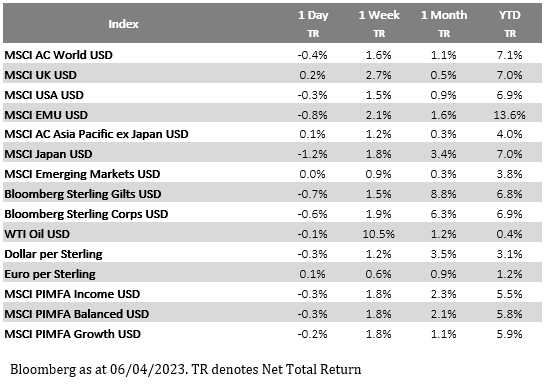
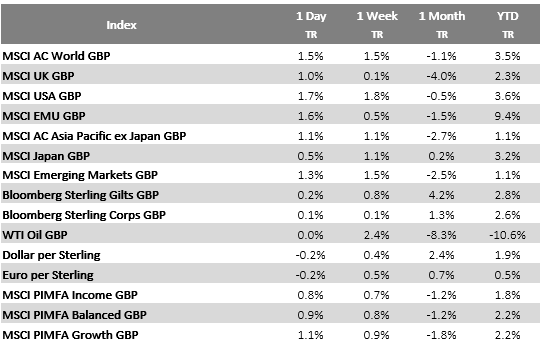
Please see below article received from Brooks Macdonald today 06/04/2023 which provides their views on recent global market events:

What has happened

Market sentiment worsened yesterday with additional data releases pointing towards weakness in economic growth. The ADP’s private payroll report came in far lower than market expectations, mirroring some of the softening labour market evidence from the job openings survey on Tuesday. US equities fell yesterday with technology shares underperforming despite rate expectations continuing to fall.

US economic data

After the ADP report set the scene for a risk-off day of equity market trading, the final PMI readings for March were released. There were some sizeable downgrades versus the flash estimates with both the services and composite readings disappointing. To cap off the weak day for data, the US ISM services index came in lower than estimates with declines within the employment and new order subcomponents compared to the previous month. These data releases cemented the market’s view that it was no more than a coin toss as to whether the Fed will raise interest rates by 25bps at their May meeting. Given the focus on employment readings in recent days this sets the market up for the US jobs report which is released tomorrow despite most markets being closed for Good Friday.

US employment report

In terms of what to expect from the jobs report, the consensus expectation is for 240k new jobs to have been created in March, down from the 311k seen in February. The unemployment is expected to remain steady at 3.6% and average hourly earnings are expected to tick down on a year-on-year basis from 4.6% to 4.3%. With the softer employment numbers recently, a major question will be whether this has impacted wage inflation or the average length of the working week (which is expected to remain steady at 34.5 hours).

What does Brooks Macdonald think

Despite employment remaining tight compared to historical averages, investors are starting to consider whether we may be seeing a pivot in labour market strength. The US employment report is therefore crucially important as it could confirm the recent trends in business demand for new workers. Investors will have until Monday in the US, and Tuesday in the UK, to conclude whether the report provides further impetus to the decline in equity markets this week.

Please check out blog content for advice, planning issues and the latest investment, market and economic updates from leading investment houses.

Adam Waugh

06/04/2023

Team No Comments

Tatton Investment Management – Monday Digest

Please see below, a ‘Monday Digest’ from Tatton Investment Management discussing the key economic news from the past week. Received this morning – 03/04/2023:

Overview: Markets look beyond banking sector stress

March ran the whole gamut of emotions for investors, but for the average UK investor holding globally diversified risk profiled portfolios, Q1 still ended above where it began, even if the journey was rather bumpy. Bank run fears that caused so much March angst and downward volatility quickly abated, allowing markets to mostly recover into positive territory. However, just because stock markets have proved relatively resilient this time, we should not assume the episode will pass without further consequences. The global financial system’s ‘immune system’ becomes weaker after each attack, and right now the global economy is vulnerable and busy fighting off the ravages of inflation.

That said, the recovery rally in stock markets has told us that market liquidity remains reasonably healthy. It also appears that end-of-quarter rebalancing provoked some rather reluctant buying back of equities to cover underweight positions. Both government and corporate bond markets were eerily subdued as last week drew to a close. The week ahead could be fairly quiet too, and ahead of the Easter holidays, most of us would welcome that.

Banking scare meets inflation pressures

The banking sector is still scrambling to deal with the fallout from Credit Suisse’s forced sale and Additional Tier 1 (AT1) bond write-off. Credit conditions have become very challenging since several US regional banks collapsed, with lenders trying to reduce their risk exposure by handing out fewer loans. However, US bank failures, and subsequent turmoil in the financial system, have helped ease underlying concerns about the extent of further interest rate rises.

With the financial system effectively taking over tightening from the US Federal Reserve (Fed), markets now assume that policy rates may not need to rise much from here. Indeed, investors have built in expectations that rates will fall by the end of the year. However, given that corporate credit has two components – the ‘risk free’ rate of government bonds and the credit spread – this has eased conditions for companies with higher credit ratings, but worsened them for those with lower ratings.

The cost of both long-term and short-term borrowing has increased dramatically, and all maturities of borrowing are now well above the ten-year historic cost of corporate borrowing. Many companies will have no choice to refinance some borrowing, but most will also choose to cut back spending elsewhere. In essence, the US economy (and indeed the wider global economy) is going through a deleveraging process – which usually leads to lower growth prospects. That might not be such a bad thing for long-term stability, but lower growth means weaker credit metrics for many companies, particularly those at the lower end. We welcome the recent calm, but weaker credits are surely still in for a rough ride.

Is the microchip market heating up again?

The semiconductor industry has bounced between supply-demand extremes of late – and has experienced the ‘bullwhip effect’ post-pandemic. From its peak in late December 2021 to its early October 2022 trough, the Philadelphia Semiconductor Index (SOX) fell 47%, significantly sharper than the 26% fall in the wider US stock market. But since the end of last year, chipmakers have been on a roll. Cyclical adjustments are no doubt part of the story, but the current trend kicked-off with a sharp rally in early November. This was around the time OpenAI released the prototype of its ChatGPT program for general use. The chatbot’s ability to write detailed, knowledgeable and readable content on any given topic has gathered a lot of attention in the media. It also dramatically pushed up the estimated valuation of OpenAI and similar companies, as well as driving substantial investment toward artificial intelligence (AI) in general.

The fact that big tech companies are investing heavily in AI and advanced computing techniques is nothing new, so in itself the release of a new chatbot should not drastically increase demand for chips. Optically, though, it is a huge boost for the tech industry. For the last few years, those in the know have been critical of stagnation in the industry – not in terms of revenue, but in terms of genuinely transformative innovation. The accusation has been that many of the biggest players had effectively run out of new ideas and investor attention has waned as a result. The visibility of innovations like ChatGPT is therefore extremely valuable from an investment perspective, as it reaffirms the industry’s long-term growth prospects.

While it is unsurprising ChatGPT prompted a rally in chipmaker stocks, it is equally unsurprising this occurred while government bond yields were stabilising and investors were getting excited about the prospect of looser monetary policy. Certainly, the political appetite for public policy involvement in the tech sector has grown dramatically as tech has become synonymous with society’s security. Moreover, we already have seen high profile calls for tighter AI regulation or even pausing its development, including an open letter signed by Elon Musk and Steve Wozniak, among others. This is a battle set to run and run and as a result, investing into chipmakers at these sky-high levels may prove the sole preserve of tech optimists.

Please continue to check our Blog content for advice and planning issues and the latest investment, markets and economic updates from leading investment houses.

Carl Mitchell – Dip PFS

Independent Financial Adviser

03/04/2023

Team No Comments

Brooks Macdonald daily investment bulletin

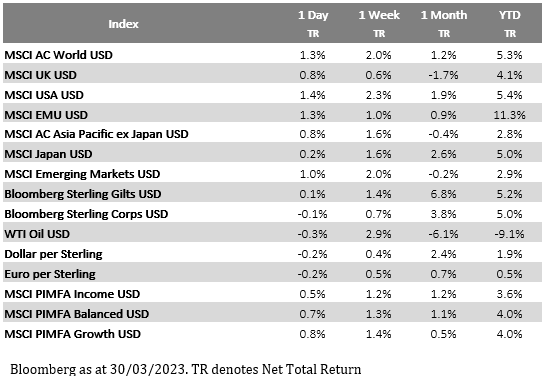
Please see below article received from Brooks Macdonald today 30/03/2023 which provides their views on recent global market events:

What has happened

Equity markets managed to retain their calm from earlier in the week yesterday and as risk appetite returned, US and European equity markets saw a broad rally. With yesterday’s rally, the US equity market has now closed above the level set before Silicon Valley Bank entered the newswires. US technology outperformed, with the sector set for a strong Q1 barring any major issues in the next few days.

Central Bank Speakers

Fed Speakers yesterday stuck to the data dependent script with Barr saying that the Fed would make a ‘meeting-by-meeting judgement on rates’ that would evolve as the data unfolded. The bond market began to settle down yesterday, pleased to hear the data dependent messaging reiterated and now the market expects just over 50bps of interest rate cuts after the terminal rate is reached at May’s meeting. The calm in the bond market reflects the fact that much of the post SVB rally in sovereign bonds has unwound over the last trading week. It was a similar message from the ECB yesterday as Kazmir stressed that members of the ECB governing council had ‘agreed we will not give guidance about May ECB policy meeting’ as the bank observes incoming data. Kazimir added that the ‘ECB shouldn’t back down on rates but maybe slow the pace.’

UK data

There was some stronger UK data yesterday as both consumer credit and mortgage approvals beat market expectations. Whilst consumer credit data could show a stretched consumer reliant on credit to meet the cost-of-living squeeze, the mortgage approvals are more unambiguously positive. The Bank of England’s Mann said that the UK economic outlook had improved given lower wholesale energy prices and the associated energy price caps. Of course, robust economic demand could put the Bank of England under pressure to hike rates further however it does push back against market expectations of a UK recession.

What does Brooks Macdonald think

A recession in the UK and Europe has been a consensus view amongst many investment strategists since the start of the year. Indeed, that expectation, combined with disinflationary data, helped equities to rise in January of this year as investors hoped that a short recession would help eliminate any demand-led inflationary pressure. The robust economic data globally pushes back against this recessionary expectation but at the same time risks inflation staying higher-for-longer which may necessitate more aggressive central bank action down the road to unanchor any increases in consumer inflation expectations.

Please check out blog content for advice, planning issues and the latest investment, market and economic updates from leading investment houses.

Adam Waugh

30/03/2023

Team No Comments

Brooks Macdonald Weekly Market Commentary

Please see the latest Weekly Market Commentary from Brooks Macdonald received this morning:

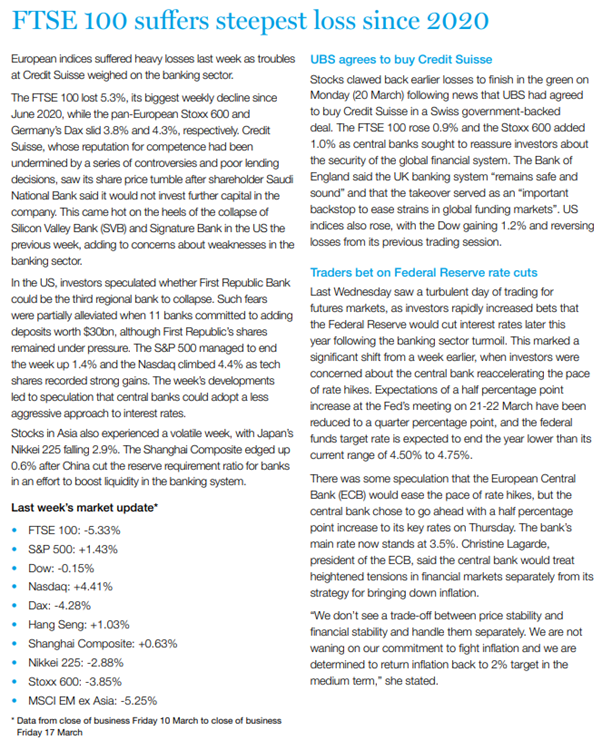
Banking fears characterised last week with concerns culminating in questions over Deutsche Bank’s creditworthiness

Despite the UBS and Credit Suisse deal, last week was characterised by high levels of banking sector volatility, culminating with fears over Deutsche Bank’s credit worthiness on Friday. Words from regulators and officials over the weekend have helped to calm market concerns setting a better backdrop for European financials this week.

This week sees important US and European inflation readings including the US Federal Reserve’s preferred measure

While investors have been focusing on the banking sector risks in the short term, inflation will quickly return as a major driver of market sentiment. This week sees the release of the US Personal Consumption Expenditure (PCE) inflation numbers, the preferred measure of the US Federal Reserve. Core PCE is expected to have expanded by 0.4% on a month-on-month basis, keeping the year-on-year figure flat at 4.7%. Within the PCE release will be the US personal consumption and income lines which are both expected to decline after strong results in January. These barometers of consumer demand will also be supported by the releases of the Conference Board’s consumer confidence survey as well as the Michigan Sentiment survey. Europe will also see a fresh set of inflation data with Germany’s preliminary inflation readings released on Thursday before the Eurozone wide release on Friday. The market expects the annual rate of Eurozone Core Consumer Price Index (CPI) to pick up from 5.6% to 5.7%, pushing back against hopes of a rapidly falling inflation picture.

With the communication blackout concluded, Fed officials will now be able to comment on the volatility of the last few weeks

Throughout the banking turmoil of the last few weeks Fed speakers have largely been unable to comment given the pre-meeting communication blackout. This week sees a range of Fed speakers as they are now able to comment on not only the Fed’s 25bp hike last week but also the broader contagion risks in the banking sector. The market ended the week expecting only a 25% chance of a 25bp rate at the May meeting, with bond investors increasingly favouring the chances of no change at all. With 88bps of interest rate cuts priced in, how Fed speakers comment on this pricing will be an important bond market force this week.

With sentiment so fragile currently, it is perhaps no surprise that speculation and rumour around the health of major US and European banks can trigger such a strong risk-off response. Authorities and investors will be hoping however that the market can return to focusing on the fundamentals this week such as inflation and the state of the consumer, rather than another round of banking fears.

Please continue to check our Blog content for advice and planning issues and the latest investment, markets and economic updates from leading investment houses.

Andrew Lloyd DipPFS

28/03/2023

Team No Comments

Evelyn Partners Update: BoE March Review

Please see below an article from Evelyn Partners, which was published and received earlier today (23/03/2023) and covers their views on the Bank of England’s monetary policy decision to raise interest rates by 25bps:

What happened?

The Bank of England increased rates by 0.25% today at their March monetary policy meeting, which is in line with market and economic expectations. This takes the base rate to 4.25%, its highest level since 2008. The Monetary Policy Committee (MPC) voted 7-2 in favour of 25bps – 0bps respectively so policymakers continue to have diverse view on the best course for rates, although to a lesser extent than the 3-way split seen in December.

What does it mean?

When making their decision, committee members would have been weighing the fragility of the banking sector against the need to bring inflation back to target.

On one hand the recent turmoil in the banking sector, which began with collapse of Silicon Valley Bank (SVB), will remind central banks that things can break when monetary policy is rapidly tightened. Although contagion risks look to have receded for the time being, the BoE will need to tread carefully if they decide to further tighten monetary policy from here. The BoE recently acknowledged: ‘more sharp moves in asset prices could expose weakness in parts of Britain’s financial system’ in a letter to law makers.

On the other hand, yesterday’s CPI print showed that inflation re-accelerated in February with both headline and core CPI posting a gain of 1.1% and 1.2% respectively for the month. On top of this the labour market continues to remain tight putting pressure on wage growth which could further stoke inflation and cause it to become entrenched.

Moreover, recent UK economic data has been surprising on the upside: February’s PMI readings came in well above consensus with the composite figure reported at 53.0, consistent with a recovery in economic growth. Growth expectations are likely to get a boost as falling energy prices feed through to a reduction in household expenditures, boosting real incomes and stimulating the economy. A boost to growth could cause inflation to decelerate slower the than the BoE’s forecasts currently expect, which may cause monetary policy to remain tighter for longer in response.

In sum, today’s decision to increase the base rate indicates two things. First, the battle against inflation is not yet won. Second, the Bank is confident in its ability, and tools, to maintain financial stability.

Bottom Line

Today’s 25 basis point rate hike by the BoE signals there is still more work to be done to tame rampant inflation, as well as highlighting the banks need to remain cognisant of the risks over-tightening can pose to the economy. 

Please continue to check our Blog content for advice and planning issues and the latest investment, markets and economic updates from leading investment houses.

Carl Mitchell – Dip PFS

Independent Financial Adviser

23/03/2023

Team No Comments

Evelyn Partners Update – March Fed rate decision

Please the below article from Evelyn Partners providing an update on the Federal Reserve decision on interest rates received yesterday, 22/03/2023.

What happened?

The Federal Reserve met today and chose to increase rates 25bps. This was in line with the latest market expectations and takes the target range to 4.75% – 5%. The Fed also published their quarterly ‘dot plot’ which shows where committee members see rates heading in the future. It showed rates peaking this year at a level of 5.1%, the same level they had thought at its last publication in December. The Fed’s quantitative tightening programme continues at its previous pace of up to $95 billion a month.

What does it mean?

Less than two weeks ago Fed chair Powell was suggesting that it may be appropriate to increase rates by 50bps at this meeting if the data continued to show strength. Since then, February’s 300k job growth and 0.5% MoM core CPI inflation bolstered this case, and the meeting may have delivered it were it not for problems in the banking sector. The failure of Silicon Valley Bank in the US and Credit Suisse in Europe caused market participants and the Fed alike to reconsider the path for interest rates in the US.

Futures markets had expected interest rates in the US to peak at around 5.5% in July and remain at this level for the foreseeable future. SVB hit the headlines on 10 March and investors digested the likely fallout over the weekend. By the close of business on Monday, markets were pricing in a peak of just 4.75% as soon as May and a full percentage point of reductions by the year end – a remarkable turnaround. Since then, those expectations moved back higher, and earlier today the peak was expected at around 5% in May before declining to around 4.5% by the end of 2023. Expectations for today’s meeting declined from a 50bps increase to 25bps prior to the announcement, although at one stage markets were suggesting the most likely outcome was no change.

The unusual level of volatility in expectations prior to today’s meeting shows the market’s changing expectations for how the Federal Reserve was going to balance the pressing need for financial stability alongside its mandate of price stability. Clearly stress in the banking sector has added to uncertainty and made the Fed’s job more difficult. In the statement today, they remark “Recent developments are likely to result in tighter credit conditions for households and businesses and to weigh on economic activity, hiring, and inflation. The extent of these effects is uncertain.”

They also changed elements of language in the statement from last month “ongoing increases in the target range will be appropriate” to the softer “some additional policy firming may be appropriate”. Markets’ initial reaction to the statement was dovish, with the yield curve steepening and stock prices broadly increasing. Given the robust economic numbers coming out of the US, some commentators had expected a move higher in the ‘dot plot’ which did not come.

Bottom Line

Today, the Fed followed the European Central Bank in delivering an expected interest rate increase at their March meeting – we expect the Bank of England will do similarly tomorrow and increase their base rate by 25bps. Clearly central banks believe that fight against inflation is not yet won and while recent turbulence in the banking sector is of concern, it is not enough for a significant change of course. After the statement, market expectations are for rates to peak at the next meeting in May, and we continue to suggest increasing duration in government bond portfolios as the Fed comes ever closer to the end of this hiking cycle.

Please check our blog content for advice, planning issues and the latest investment, market and economic updates from leading investment houses.

Adam Waugh

23/03/2023

Team No Comments

Brewin Dolphin: Markets in a Minute

Please see this weeks Markets in a Minute update from Brewin Dolphin received late yesterday afternoon:

Please continue to check our Blog content for advice and planning issues and the latest investment, markets and economic updates from leading investment houses.

Andrew Lloyd DipPFS

22/03/2023

Team No Comments

Brooks Macdonald daily market update

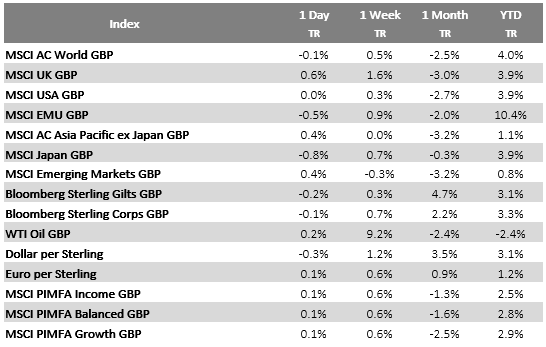
Please see below an article received from Brooks Macdonald today 17/03/2023 which provides their views on recent global market events:

What has happened

Equities stabilised, then rallied yesterday as investors concluded that contagion risks were receding in the aftermath of the SVB and Credit Suisse issues.

Bank crises

Shares in First Republic Bank, a regional US bank considered to be one of the most exposed to a SVB-style event, opened lower yesterday but started to recover as reports suggested that a support package was imminent. Just before the market closed, a consortium of major US banks contributed $30bn of uninsured deposits to First Republic. First Republic announced after the market close that it would be suspending its dividend and will be seeking to repay some debt instruments. Credit Suisse equity rallied yesterday after the overnight news that the bank would be using a Swiss National Bank liquidity facility to meet near-term liabilities. The bond market was less impressed however with credit default swaps, effectively an insurance contract on the bank’s debt, remaining elevated and their bonds remaining under pressure.

ECB meeting

The ECB chose to follow through on its pre-announced 50bp interest rate hike despite the meeting coming within the midst of the current banking sector turmoil. Arguably the outsized hike was a ‘dovish’ move in that the ECB made no future commitment to the path of interest rates, stressing a data-dependent approach going forwards. This is no real surprise as the ECB must have felt boxed in by their previous 50bp guidance and one wonders whether they would have proceeded with that larger hike without the prior commitment. The ECB said that it was monitoring the current market volatility closely, adding that the ‘euro area banking sector is resilient, with strong capital and liquidity positions.’

What does Brooks Macdonald think

With the ECB meeting out of the way, investors are already looking ahead to the Fed meeting next week with markets broadly pointing to a 80% probability of a 25bp move and 20% probability of no change at all. With the Treasury market the release valve for SVB tensions over the last week, as some of the immediate fears have subsided the yield curve is unwinding its emergency pricing with the 2-year yield up over 25bps yesterday alone. The other important change has been a heavy revision of the number of Fed rate cuts expected in the second half of this year, with bond investors now pricing in a longer pause and decline after the Fed reaches its terminal rate.

Bloomberg as at17/03/2023. TR denotes Net Total Return

Please check out blog content for advice, planning issues and the latest investment, market and economic updates from leading investment houses

Adam Waugh

17/03/2023

Team No Comments

Brewin Dolphin: Spring budget 2023

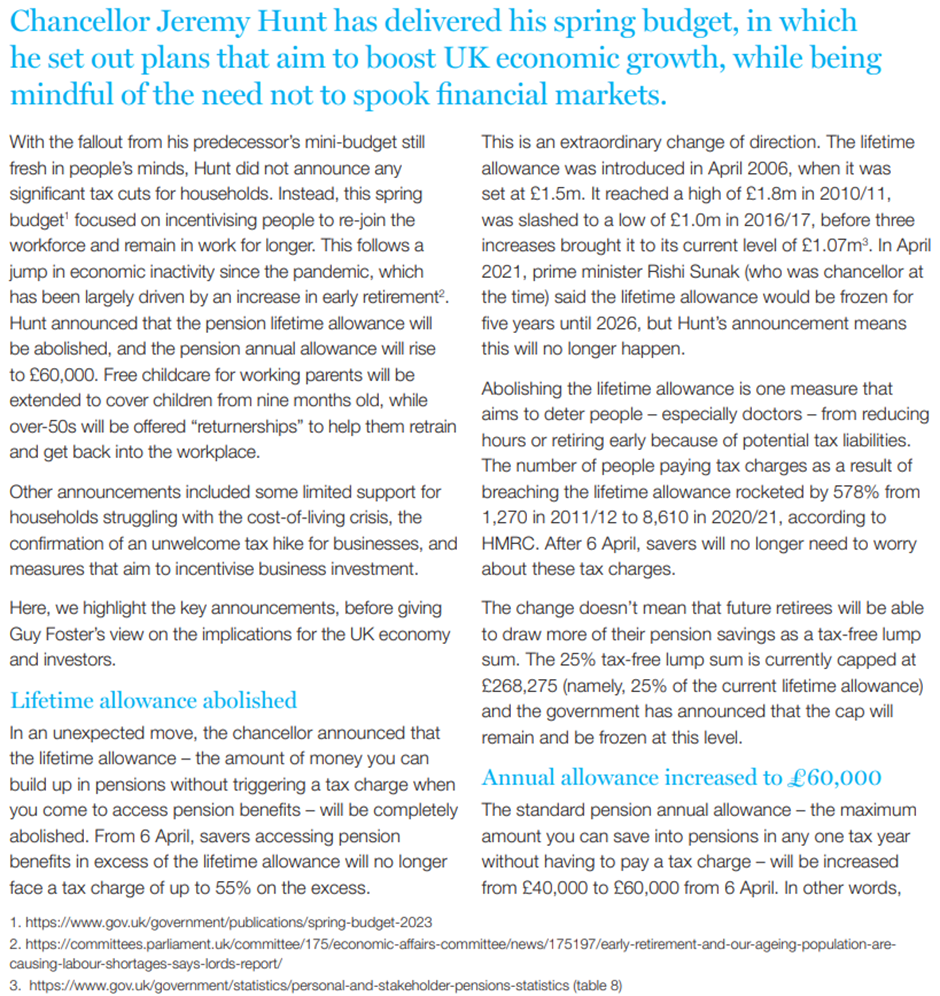
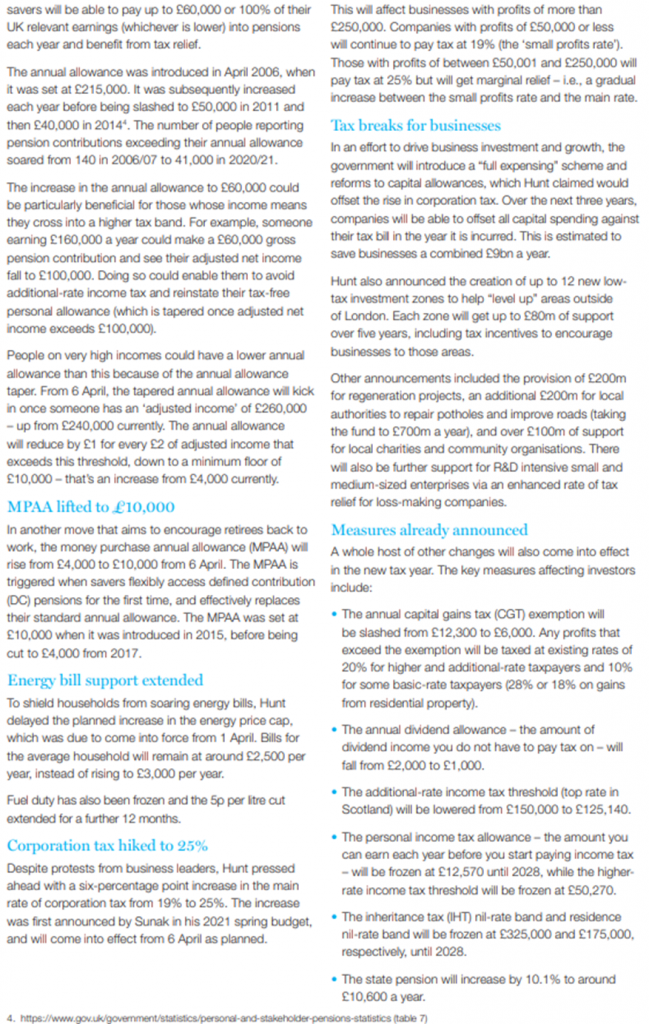
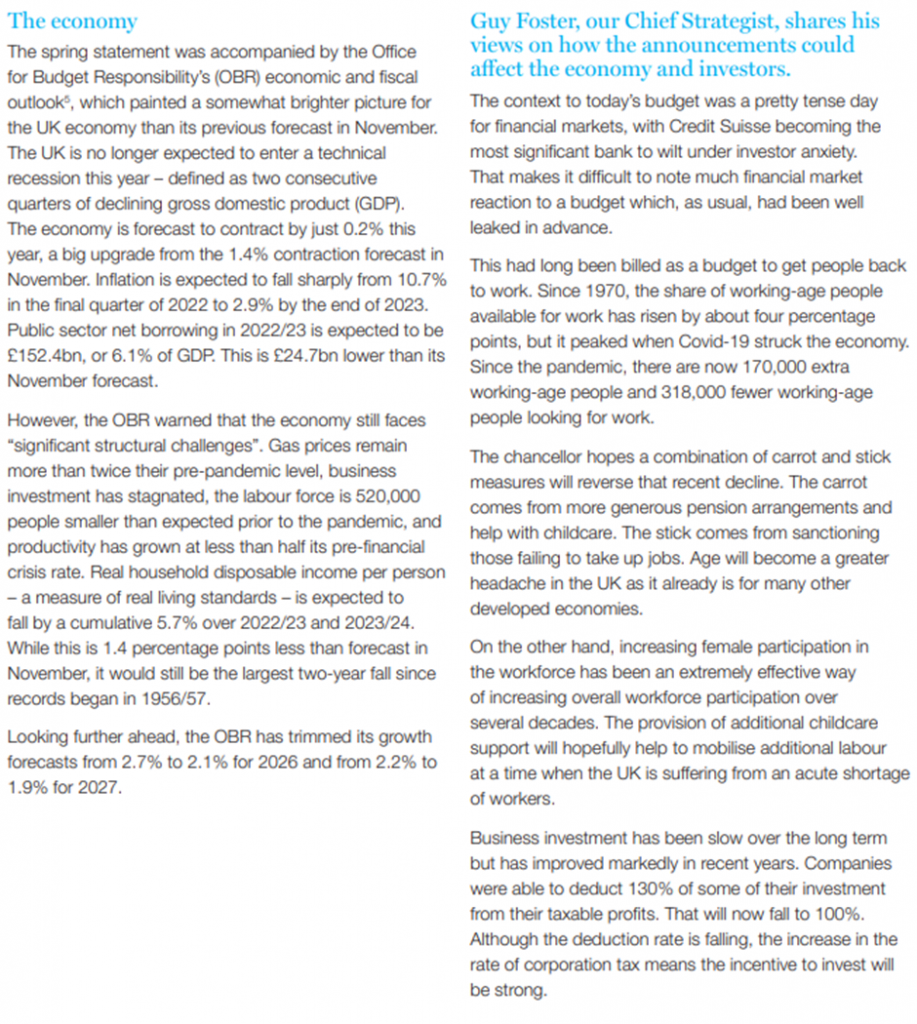
Please see below an article published and received late yesterday (15/03/2023) evening from Brewin Dolphin, which provides their summary of the Chancellor’s Spring Budget which he delivered yesterday:

As you can see from the above the Chancellor made some surprise announcements which will certainly be welcomed, particularly around pensions. The announcements on Pensions,

  • Abolishment of the Lifetime Allowance;
  • Increasing the Annual Allowance (annual savings amount) to £60,000.00; and
  • Increasing the Money Purchase Personal Allowance up to £10,000.00 per annum

All of the above will present financial planning opportunities to help people service their overall tax-efficiency.

Please speak to a Financial Adviser if you would like to know more on the above and what opportunities these announcements could mean for you.

Please continue to check our Blog content for advice and planning issues and the latest investment, markets and economic updates from leading investment houses.

Carl Mitchell – Dip PFS

Independent Financial Adviser

16/03/2023