
Please see this week’s Markets in a Minute update below from Brewin Dolphin, received yesterday afternoon – 21/07/2026.
Why have semiconductor stocks fallen?
After achieving exceptional gains, semiconductor stocks have retreated – but what’s driving the sharp sell-off?
Key highlights
- Tensions in the Middle East intensify, lifting oil prices and reminding investors that inflation risks remain uncertain, reinforcing a cautious approach from central banks.
- Semiconductor stocks sell off sharply despite strong results from TSMC and ASML, suggesting the weakness reflected profit-taking, leveraged positioning and valuation concerns rather than deteriorating AI fundamentals.
- The U.S. economy remains resilient, with healthy consumer spending, a stable labour market and solid bank earnings continuing to support the broader outlook.
Oil prices rebound as Middle East tensions intensify
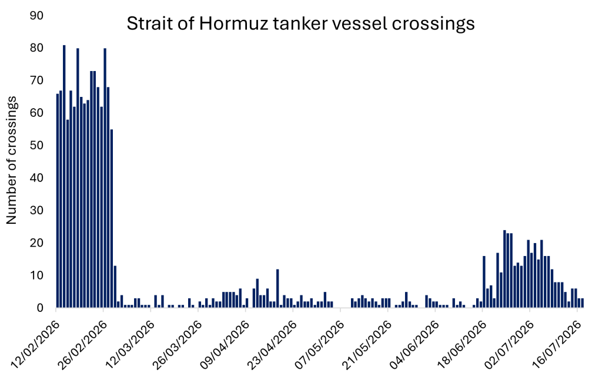
The standoff in the Gulf set the tone from last Monday’s open and never fully released its grip. The Strait of Hormuz remains a live question, with the Joint Maritime Information Centre reporting the southern route technically open but the threat level severe, and vessels warned of mines.
Source: Bloomberg
Meanwhile, Iran’s Revolutionary Guard, said it would let no ship pass until foreign interference ended. Traffic appeared to halt almost entirely, though some clients close to the market suggested ships were still moving with their transponders switched off.
Last Tuesday, President Donald Trump floated a plan to charge a 20% toll on cargo transiting the Strait and to reinstate a U.S. naval blockade. The plan lacked any credible route to implementation, and by Wednesday it had quietly been dropped.
Overall, Brent crude oil prices jumped by more than 13% in a week to over $86 per barrel.
The near-term worry runs deeper than crude itself. More than 10% of global refining capacity remains offline following Russia’s export ban and repeated Ukrainian strikes on its refineries. With inventories of refined products low, that bottleneck has pushed petrol, diesel and jet fuel higher – gasoline rose around 6% at one point. These all feed directly into inflation expectations. Longer-dated oil futures still point to a supply glut later this year, so the market’s discomfort is about timing, not a permanent shift.
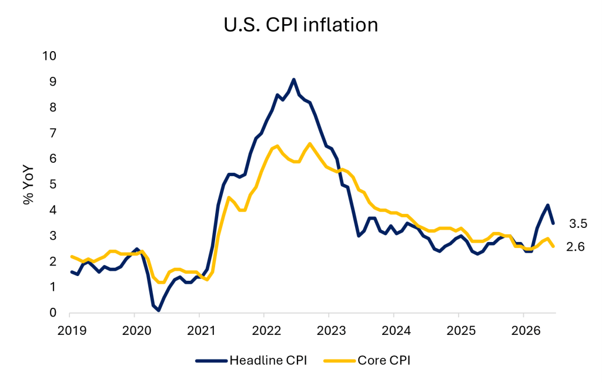
On a positive note, the latest U.S. inflation report offered some reprieve. Headline consumer price index (CPI) inflation contracted 0.4% in June, driven by energy prices. Core CPI was flat on the month, the biggest downside surprise since mid-2022.
Source: Bloomberg
Core services excluding shelter inflation fell sharply, shelter inflation decelerated and even the tech-related categories showed deepening deflation. The odds of a July hike evaporated. But this is a pause, not an all-clear; with a tight labour market, booming AI investment, loose financial conditions and rising oil again, we still think a rate rise is likely at one of the year’s final three meetings.
The Federal Reserve (the Fed) Chair, Kevin Warsh, told Congress the Fed has “no tolerance” for persistently elevated inflation, while adding it’s in no rush.
Semiconductor stocks stumble despite strong AI fundamentals
Ironically, the sell-off came despite another week of encouraging news for the AI investment cycle.
Both TSMC and ASML delivered strong results and maintained constructive outlooks. TSMC continued to benefit from robust demand for advanced AI chips, while ASML – whose lithography machines underpin the world’s most advanced semiconductors – highlighted strong order momentum and confidence in sustained demand.
As two of the industry’s most important bellwethers, their results reinforce the view that AI infrastructure investment remains on a solid footing and that hyperscale spending continues to support the sector.
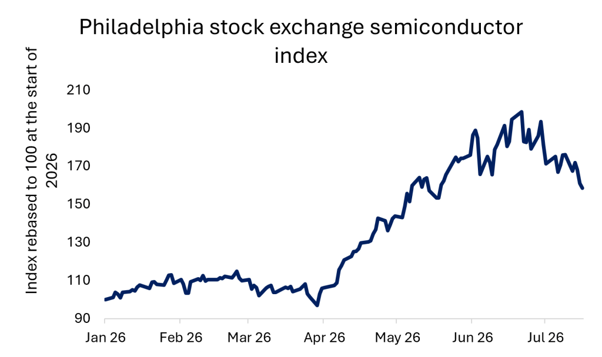
So, why did semiconductor shares fall? The answer appears to lie more in market positioning than fundamentals.
Source: Bloomberg
Following an exceptional rally over the past year, investors took the opportunity to lock in profits as valuations across parts of the sector became increasingly demanding. Technical factors also amplified selling pressure, including leveraged exchange-traded funds (ETFs) in South Korea that accelerated declines in memory chip stocks and increased short-term volatility.
The recent correction therefore appears to reflect sentiment rather than a meaningful change in the outlook for AI. As earnings season gathers pace, guidance from the major technology companies on AI demand, capital expenditure and monetisation will be closely watched.
Economic fundamentals remain supportive
Against the market volatility, the underlying economic picture changed very little.
Recent U.S. economic data continue to suggest that growth is resilient. Initial jobless claims have fallen more than expected in recent weeks, while retail sales indicate that consumer spending continues to hold up.
Corporate earnings have also provided reassurance. Large U.S. banks generally reported solid results, supported by resilient consumer spending, healthy credit quality and improving capital markets activity. While management teams remain mindful of geopolitical uncertainty and the interest rate outlook, there was little evidence of meaningful stress among either households or businesses.
Taken together, these indicators suggest the U.S. economy continues to enjoy relatively solid foundations. That should continue to provide support for corporate earnings, even if markets experience periods of heightened volatility.
Attention now turns to earnings season, with updates from the major technology companies likely to shape sentiment around the AI investment cycle. Geopolitical developments in the Middle East will also remain in focus, given their potential implications for oil prices and inflation.
Please continue to check our blog content for advice, planning issues and the latest investment market and economic updates from leading investment houses.
Charlotte Clarke
22/07/2026