
Please see the below article from Brooks Macdonald discussing how markets struggled to gain traction amid Middle East tensions, UK fiscal questions, and US trade policy concerns. Received this morning – 21/07/2026.
What has happened?
Markets struggled to gain traction yesterday. The S&P 500 fell -0.19%, while the NASDAQ (-0.05%) and Magnificent 7 (-0.07%) also edged lower as investors remained cautious despite some stabilisation in semiconductor stocks following last week’s sharp sell-off. European equities were also weaker, with the STOXX 600 down -0.30%. The FTSE 100 underperformed, falling -0.71%, as UK assets came under broader pressure.
Oil swings as Middle East tensions evolve
Investor sentiment towards the Middle East improved briefly after Reuters reported that Iran had received a proposal for a 10-day ceasefire aimed at reviving last month’s interim agreement. However, optimism quickly faded after the Houthis threatened a maritime blockade on Saudi Arabia, while President Trump struck a more hawkish tone and the US carried out a tenth consecutive night of strikes. Against this backdrop, Brent crude rose +1.27% to $89.22/bbl.
UK fiscal questions drive gilt sell-off
UK markets underperformed after newly appointed Prime Minister Andy Burnham said he would use “any flexibility” available within the government’s fiscal framework. Investors interpreted the remarks as potentially opening the door to higher borrowing, prompting a gilt sell-off. 10-year yields rose +8.1bps to 5.03%, while 30-year yields climbed +8.9bps to 5.74%. Attention also turned to the new government’s line-up. In a surprise move, Burnham appointed former Defence Secretary John Healey as Chancellor. Healey is generally viewed as one of the more market-friendly figures within the party, though his fiscal views remain unclear. Sterling ended the day down -0.16% against the US dollar. With further policy announcements expected this week, investors will be looking for greater clarity on the government’s economic agenda.
What does Brooks Macdonald think?
Alongside developments in the Middle East and the UK, trade policy is re-emerging as a potential market focus. Overnight, the US announced plans to impose a 50% tariff on selected Canadian goods under Section 338 of the 1930 Tariff Act, a provision that has never previously been used. While the measures will affect only around $20bn of imports and are unlikely to have a significant immediate economic impact, they may signal a more aggressive phase of US trade policy. With the administration’s temporary 10% global tariff set to expire on Friday and several Section 301 investigations still ongoing, additional tariff announcements could follow. While any single measure may have a limited effect, the cumulative impact could add to uncertainty around global trade and supply chains.
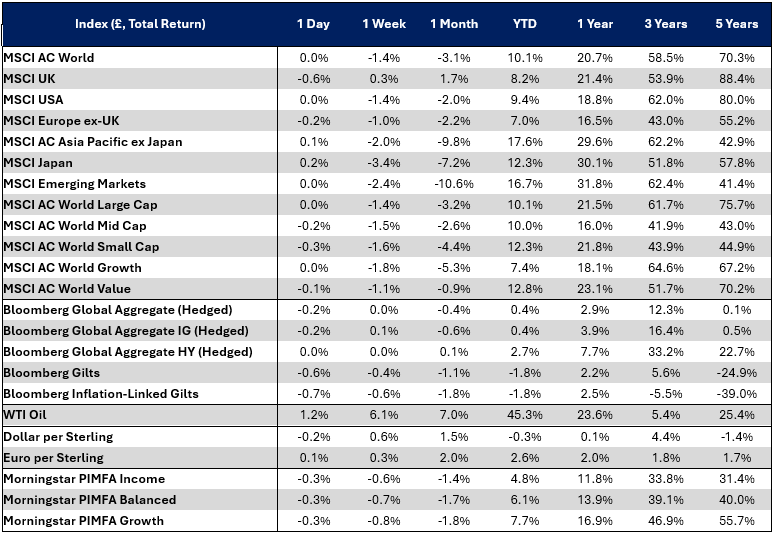
Bloomberg as at 21/07/2026.
Please continue to check our blog content for advice, planning issues and the latest investment market and economic updates from leading investment houses.
Alexander James Roberts
21/07/2026