
Please see below the daily update article from Brooks Macdonald, received this morning – 23/07/2026:
What has happened?
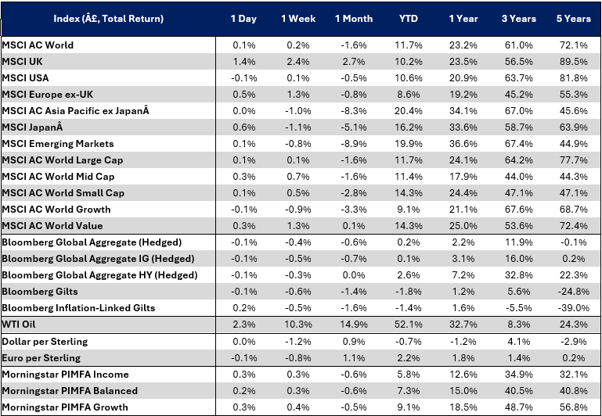
Renewed tensions in the Middle East continued to dominate markets, pushing Brent crude to a seven-week high and fuelling concerns that central banks may need to keep interest rates higher for longer. Government bonds came under pressure on both sides of the Atlantic, with the US 2-year Treasury yield rising 3.5bps to 4.30%, its highest level since February 2025. Equity markets were more mixed. The S&P 500 fell -0.14%, while European shares outperformed, with the STOXX 600 gaining +0.58%.
Escalation keeps energy markets on edge
There was little sign of easing in the US-Iran conflict, with both sides issuing fresh warnings and US Central Command confirming another round of strikes overnight. Meanwhile, reports of Houthi attacks on oil tankers in the Red Sea added to concerns about global energy supplies, particularly as Saudi Arabia has rerouted exports through the region. Brent crude rose +3.36% to $94.07/bbl, while European natural gas futures climbed +4.82% to €62.54/MWh, their highest closing level since early 2023.
Big Tech earnings fail to reassure investors
US equity futures edged lower overnight following earnings releases from Alphabet and Tesla. Although Alphabet exceeded expectations, helped by strong cloud revenue growth, investors focused on the company’s higher-than-expected capital expenditure plans, sending the shares more than -3% lower in after-hours trading. Tesla also fell over -4% after reporting its first quarter of negative free cash flow in more than two years, as rising operating costs offset healthy vehicle sales.
What does Brooks Macdonald think?
Today’s main event will be the ECB’s policy decision. While rates are widely expected to remain unchanged following June’s increase, the accompanying guidance may prove more important than the decision itself. The recent surge in oil and natural gas prices complicates the outlook for policymakers. Higher energy costs can push inflation higher. Markets are currently pricing close to two additional ECB rate hikes by year-end, so investors will be paying close attention to whether policymakers share those concerns or continue to signal confidence that inflation could stay steady. More broadly, the ECB’s assessment will offer an early indication of how other central banks may respond if geopolitical tensions continue to filter through into energy markets and inflation expectations.
Please continue to check our blog content for advice, planning issues and the latest investment market and economic updates from leading investment houses.
Andrew Lloyd
23/07/2026