Please see today’s Brooks Macdonald’s Daily Investment Bulletin received this morning:
What has happened
Monday saw somewhat of a lull for equity and bond markets with investors awaiting today’s US CPI report before making any decisive moves. There was a modest recovery in Brent Crude oil prices after the declines of recent weeks, leading energy to be one of the best performing equity sectors on the day. European equities, which had missed out on some of Friday’s rally in US markets which took place after the European close, climbed three quarters of a percentage point.
UK
The UK saw a significant shakeup in senior cabinet staff yesterday after the removal of Suella Braverman as Home Secretary. That role will be replaced by James Cleverly alongside the eye-catching return of David Cameron (via the House of Lords) to government through the role of Foreign Secretary. Today sees the latest UK employment data which has been the subject of a review by the ONS after being delayed last month due to worries over its statistical quality. Average Weekly Earnings dipped slightly but the reading including bonuses was far stickier than markets were expecting, which will keep the pressure up on the Bank of England.
US CPI
Today’s main event will undoubtedly be the US CPI release which comes at 1:30 pm UK time. The market is expecting a headline month-on-month growth of 0.1% and for that to bring the year-on-year reading down from 3.7% to 3.3%. The core reading however is expected to remain sticky, at 0.3% month-on-month, which keeps the annual number at 4.1%. Stubborn core inflation will be an unhelpful narrative for the Federal Reserve to deal with as it seeks to strike a balance between economic and inflation risks.
What does Brooks Macdonald think
Inflation has clearly fallen significantly since its peaks however the risk now is that US inflation now settles at an elevated level and proves difficult to shift. The demand side of inflation has been far more resilient than most economists believed, with excess savings supercharging consumption over the last 3 years. Should this still have further to run, the Fed may be forced to consider further interest rate hikes even though the recent tightening of monetary policy is yet to fully run its course through the US economy.
Please continue to check our Blog content for advice and planning issues and the latest investment, markets and economic updates from leading investment houses.
Please see the below article from Tatton Investment Management providing a brief analysis of markets and the key news from global economies over the past week. Received this morning 13/11/2023.
Overview: Back-pedalling central bankers
The turnaround rally in stock and bond markets – prompted by dovish central bank comments – petered out towards the end of last week, with central bankers at pains to reverse their messaging, or at least reaffirm their commitment to keeping rates high for as long as it takes to get inflation back to their 2% target.
This comes against the backdrop of seemingly having passed through the peak in nominal growth (real growth + inflation) and are now heading back down to more normal levels. In most cycles we would expect to see real growth become negative for a time while inflation starts to undershoot central bank targets. That normally means contraction of economic activity (aka a recession). What matters for capital markets is the depth and pace of the downswing. The increased uncertainty heightens the likelihood that banks, investors and other intermediaries in the financial system respond to rising risks and uncertainty by pulling their liquidity prematurely. This in itself creates the downswing in both markets and economies (of course, if it happens, no bank or investor would say they were premature).
This therefore constitutes the point of greatest danger for a policy error by central banks. Indeed, because we start from such elevated inflation levels, there is a lot more uncertainty about where we are in this trajectory. But despite most central bank policymakers reiterating that rates will remain restrictive, investors now think the tail risks of higher rates and therefore a policy error have diminished. Whether it’s the US Federal Reserve (Fed), the European Central Bank (ECB) or the Bank of England (BoE), the discussions are acknowledging that rate rises are almost certainly over for now and that cuts are on the cards.
This week brings the release of provisional inflation data, which feels even more important in the current environment. UK consumer prices rises are expected to have fallen back to 4.7% year-on-year, which should allow Prime Minister Rishi Sunak to claim a victory in his inflation pledge (to halve inflation from December 2022’s +10.5%). That will be less important than the signal it might send about the chances of rate cuts in the second half of 2024.
Bank of England giving and receiving mixed messages
When the BoE kept interest rates on hold last week, Governor Andrew Bailey told reporters it was too early to talk about cutting rates. But last Tuesday, BoE chief economist and fellow Monetary Policy Committee (MPC) member Huw Pill was quoted saying market expectations of an interest rate cut next year are not “unreasonable”. Bailey and Pill are realistically outlining the same view on the economy, but tone can make a world of difference to avid central bank watchers. In fairness to the MPC though, if their policy guidance is confusing, it is probably because the UK economy appears rather fickle – with growth oscillating from slight positive to slight negative, while prices continue to rise.
Markets tend to dislike the uncertainty of mixed messages but rather like the prospect of easier monetary policy. However, the labour market situation is more complicated than it appears. The MPC’s estimates of how jobs might respond to their policies are hampered by the fact that the reliability of the available data has become less than ideal for making that call. For the headline unemployment rate published by the Office for National Statistics (ONS), this is well known, since it only comes out after a significant delay and so offers at best an indication of how things were five or six months ago. But the household, company and tax data used for the more up to date job market assessment has since the pandemic also become far less reliable than it used to be.
UK year-on-year inflation is still high in both absolute and relative terms, so it makes sense for Bailey to silence any dovish noises, but of course the Governor has had to bear the brunt of the public’s ire over the cost-of-living crisis. No doubt, his speeches will continue to insist that the BoE decisions are dependent on incoming data. The problem is that being dependent on the data from the main official sources means “behind the curve”. We think they will not be so hidebound.
Europe’s natural gas on a bumpy road down
European gas supplies officially reached 100% of storage capacity at the beginning of November. This is a far cry from the fears of last year, when Russia’s war in Ukraine decimated Europe’s energy supplies and policymakers planned for rolling blackouts. Policy choices have obviously played a big part. The immediate priority was finding other short-term sources, exemplified by the massive increase in imports of liquified natural gas (LNG), but structural changes for the medium and long term have been aggressively pursued too. Strict storage build targets are part of it, helped by moves to limit household and business energy consumption – particularly in Germany – thanks in part to an unusually mild winter. Less remarked on has been the increase in storage capacity itself, although this slow process has not yet had a massive impact at the aggregate supply level.
The biggest structural push, over the longer term at least, has been to ween Europe off natural gas altogether. But even if the EU’s long-term energy security and environmental ambitions both point towards renewables, politicians are well aware that gas will be needed for the foreseeable future. Pipelines to alternative suppliers are being built, and there has been a marked increase in LNG inflows. Recognition of this need is perhaps why wholesale gas prices have not fallen further. Reserves were still above a reassuring 60% of capacity at the start of spring – the seasonal low point for reserves – and the build has been ahead of schedule ever since, but European gas and energy prices are still high by historical levels. This is despite weak demand on the continent, both current and projected.
Even with abundant supplies, the technologies for transporting or using them are not very flexible. This is fine if we can plan for periods of supply-demand imbalance, but the last few years have shown that the best laid plans go awry. For example, even with gas supplies filling up all available tanks, Europe is estimated to have at most two months of required gas for the winter. Two months spare should be more than enough, but further complications could always come about. The brittle nature of energy markets means that prices will likely remain volatility, even if the general trend is downward.
Still, a slow downward path will be good for European businesses and households. But unfortunately, this improvement in absolute terms is unlikely to give much benefit in relative terms. For one thing, the current oversupply is largely down to weak economic demand – hardly a good sign for the near future.
Please check our blog content for advice, planning issues and the latest investment, market and economic updates from leading investment houses.
Please see the below article from Evelyn Partners for their thoughts on the UK Q3 2023 GDP announcement:
What happened?
UK real gross domestic product (GDP) neither grew nor contracted in the third quarter with the headline quarter-on-quarter (QoQ) GDP growth rate estimated at 0.0% for Q3. This was better than had been expected by the median estimate among economists, of a 0.1% contraction. However, the growth picture was weaker than in the second quarter of 2023, when the economy expanded by a modest 0.2% QoQ.
What does it mean?
The UK economy managed to dodge a contraction in the third quarter, just edging out the 0.1% contraction that has been forecasted by economists, to instead show no growth for the quarter. This was driven by September’s monthly growth data which at 0.2%, was ahead of the expected flat growth forecast for the month. This means the UK economy is not yet teetering on the verge of a technical recession, which is defined as two consecutive quarters of negative GDP growth. On a year-on-year basis the UK economy has expanded by 0.6% over the last 12 months.
Despite a strong start to the first half of the year, consumption has now started to wane, with the sector contributing -0.2 percentage points to the QoQ real GDP figure. Within this, retail sales contracted by near 1% QoQ with consumer facing services contracting by a more pronounced 3%. Higher interest rates have likely weighed on discretionary spending over the summer, prompting a deterioration in consumer confidence. Further evidence of higher rates filtering through into the real economy could be seen from residential investment which fell 1.7% QoQ marking its fourth consecutive quarterly decline.
Government spending also weighed negatively on the quarterly growth rate, contributing -0.1 percentage points. Real government consumption expenditure fell by 0.5% in the third quarter following an increase of 2.5% in the previous quarter. The fall in government consumption in the latest quarter mainly reflects lower spending on health and on education, which fell by 1.4% and 0.3%, respectively.
A bright spot came from net trade, which contributed 0.4 percentage points to the QoQ rate. Export volumes increased by 0.5% in the third quarter, following a fall of 0.9% in the second quarter. The increase was driven by a 2.8% rise in services exports, which offset a fall of 2.0% in goods exports. Import volumes fell by 0.8% in the third quarter. This decline was driven by a 3.5% fall in goods imports, which offset a 4.2% increase in services imports.
Similarly, inventories remained a positive contributor to the headline figure, as it has now for four consecutive quarters, adding 0.2 percentage points to the QoQ growth figure.
Looking ahead:
The lagged impacts of tight monetary policy are beginning to impact the UK economy, as the cost of capital increase, households will experience a reduction in disposable incomes as aggregate mortgage payments tick up. However, as the labour market remains tight with unemployment at near recent lows and wage growth remaining elevated, this should act as a partial buffer for any downside potential on consumption heading into Q4 and into next year.
Although the BoE have seemingly paused on interest rates with markets pricing in only a ~20% chance of one more hike over the next three meetings, it does not mean rate cuts are on the immediate horizon. However, BoE chief economist Huw Pill recently hinted at rate cuts materialising sooner than participants expected. With the economic growth picture deteriorating and inflation starting to come under control it could prompt the BoE to cut rates as soon as Mid 2024.
Bottom Line
With the UK economy managing to avoid contraction in the third quarter the risks of an imminent technical recession have been delayed for now. However, as the impact of higher interest rates continue to put the brakes on consumption, the resulting drag on the real economy could lead to negative economic growth in the coming quarters which might prompt the BoE to cut rates sooner than expected.
Please check our blog content for advice, planning issues and the latest investment, market and economic updates from leading investment houses.
Please see below, Brooks Macdonald’s Daily Investment Bulletin received this morning – 09/11/2023.
What has happened
US equities managed to deliver a small gain yesterday, marking the 8th consecutive day of gains, as the bond rally continued. Further falls in the oil price also helped support the view that inflation would come down quickly, with Brent Crude closing below $80 per barrel for the first time since July. In terms of the bond rally, the US 10-year Treasury yield fell below 4.5% after the bond market absorbed a fresh $40bn 10-year Treasury auction, raising hopes that the current level of supply would not destabilise the rally.
Bond market rally
The recent fall in bond yields is already following through to US mortgage pricing with the average 30-year mortgage rate down 0.25% over the last week alone. The overall rate remains above 7.5% however so we are by no means back to ‘cheap’ borrowing even if the path of travel is to be welcomed. Mortgage applications rose as a result but remain subdued versus recent history. Fed Chair Powell will today speak at a panel at the IMF conference so he may shine some additional light on current Fed thinking post the last week’s moves. Over in Europe, sovereign bonds also rallied despite prominent ECB bankers stressing that it was ‘far too early’ to be talking about cutting Euro Area interest rates.
Inflation
The fall in energy prices yesterday helped lower market expectations for inflation with medium term Euro Area inflation expectations falling to one of their lowest levels in six months. The energy moves were not limited to just the oil price with European natural gas prices falling. Reflecting concerns about the resilience of global demand, the highly economically sensitive copper price also fell yesterday.
What does Brooks Macdonald think
While the market has been quick to price in an improving inflation backdrop within Europe, consumer surveys still point to higher expectations. The ECB’s Consumer Expectations Survey is published with a significant lag, so reflects thinking in September but at that point, 1 year inflation expectations increased by 0.5% month-on-month to 4%. Falling energy prices should start to filter through to expectations over the coming months however the ECB will need to see a shift in consumer mindset in order to entertain any thoughts of a rate cut in 2024.
Please continue to check our Blog content for advice and planning issues and the latest investment, markets and economic updates from leading investment houses.
Please see below article received from Brewin Dolphin yesterday afternoon, which provides a positive global market update.
Global equities rallied last week on expectations that interest rates may have finally reached their peak.
The S&P 500 rose 4.6%, its strongest weekly gain in almost a year, after the Federal Reserve indicated that the recent increase in long-term Treasury yields could mean that a further rate hike is not required. The Dow added 3.4% and the Nasdaq surged 5.4%.
In Europe, the Stoxx 600 and Germany’s Dax both added around three percentage points after eurozone inflation fell to its lowest level since July 2021. The FTSE 100 gained 1.2% as the Bank of England voted to keep interest rates unchanged.
The positive sentiment carried over to Asia, where Japan’s Nikkei 225 advanced 4.1% and China’s Shanghai Composite rose 0.3% despite concerns about China’s economy.
Eurozone business activity contracts further
European stock markets slipped into the red on Monday (6 November) as investors took profits after five-consecutive days of gains and data painted a gloomy picture of the eurozone economy. The latest HCOB eurozone purchasing managers’ index (PMI) showed the rate of decrease in business activity accelerated in October. The index fell to a 35-month low of 46.5 in October, down from 47.2 in September. New orders for goods and services fell at the quickest pace since May 2020. Over in Asia, South Korea’s Kospi surged 5.7% on Monday after the country re-imposed a ban on short selling.
UK and European indices were flat at the start of trading on Tuesday as investors analysed weaker-than-expected economic data from Germany and China. German industrial production slumped 1.4% in September, driven by a 5% decline in automotive industry production. Chinese exports dropped 6.4% year-on-year in October, much worse than the 3.5% decline expected by analysts. Imports unexpectedly rose by 3.0% over the same period.
Fed delivers dovish policy statement
Last week saw the US Federal Reserve vote to leave interest rates unchanged, as widely expected. The November meeting did not contain any new economic projections, which meant that all eyes were on the postmeeting press conference.
During the conference, Federal Reserve chair Jerome Powell noted that the recent surge in long-term US bond yields and mortgage rates had done some of the Fed’s job for it. He said Fed officials will be watching the effects of higher yields as they consider whether to hike rates again. Powell also said the Fed has come far in terms of its tightening campaign and that it takes time for higher interest rates to impact the real economy.
The comments were interpreted to mean that interest rates may have reached their peak, which drove steep declines in bond yields across different maturities.
US labour market cools
The drop in bond yields was further fuelled by a weakerthan-expected nonfarm payrolls report, released on Friday. Nonfarm payrolls increased by just 150,000 in October, while job growth in August and September was revised down by 101,000. Manufacturing was a notable area of weakness, with the sector experiencing net job losses of 35,000 last month. The Bureau of Labor Statistics said this reflected a decline of 33,000 in motor vehicles and parts that was largely due to strike activity. Average hourly earnings increased by 0.2% month-on-month, the lowest reading since February 2022, and the unemployment rate ticked up to 3.9%.
Although the data suggests the economy is slowing, markets reacted positively because it added to the conviction that the Fed will abandon its plan of one more rate hike in December.
BoE holds base rate at 5.25%
Here in the UK, the Bank of England (BoE) chose to leave interest rates unchanged for the second time in a row at 5.25%. The vote was 6-3, with three of the nine Monetary Policy Committee members favouring another 25-basis point increase.
While the BoE’s hiking campaign might have come to an end, the Bank went out of its way to flag that monetary policy will remain restrictive for some time as inflation and wage growth remain elevated. BoE governor Andrew Bailey said it was “much too early to be thinking about rate cuts”, adding: “We will keep interest rates high enough for long enough to make sure we get inflation all the way back to the 2% target.”
The most recent year-on-year inflation figure was 6.7%. The BoE expects inflation to fall sharply in the coming months, remain at around 3% next year, and drop below the 2% target at the end of 2025 – later than previously forecast. It also expects the UK economy to grow by 0.1% for the rest of this year and remain flat in 2024.
Japan approves stimulus package
Over in Asia, the Japanese government approved a $113bn stimulus package that aims to boost growth and help households cope with the rising cost of living. According to Reuters, the package includes temporary cuts to income and residential taxes, payouts to lowincome households, and subsidies to curb petrol and utility bills. The government estimates that the plan will boost Japan’s gross domestic product (GDP) by around 1.2% on average over the next three years.
Last week also saw the Bank of Japan (BoJ) announce a further relaxation of its yield curve control policy. The BoJ said the 1.0% ceiling for ten-year Japanese government bond yields will now be regarded as a reference rather than a strict cap on rates.
Please check in again with us soon for further relevant content and news.
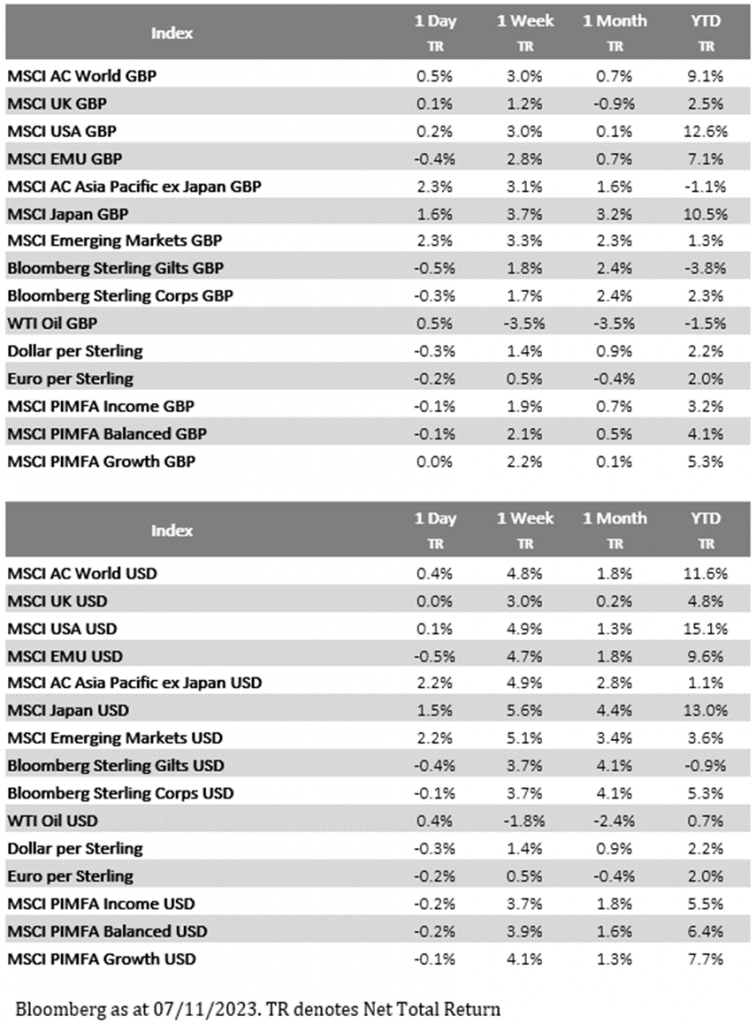
Please see below, Brooks Macdonald’s Daily Investment Bulletin which outlines the key factors currently affecting global markets. Received this morning – 07/11/2023
What has happened?
There was a bit of pushback against last week’s hopes of peak US interest rates and imminent cuts yesterday. The bond pressure was particularly acute in shorter dated bonds with the 2-year US Treasury yield rising by almost 10bps. Despite these moves, the US equity market managed to stay in positive territory for the day however below the surface, the US small cap index suffered under the weight of rising yields.
Central banks
Market expectations for a Fed interest rate hike rose slightly yesterday as did expectations of the central bank’s rate at the end of 2024. One of the drivers behind this was commentary from the Minneapolis Fed’s Kashkari who is one of the more hawkish members of the central bank. Kashkari said that ‘we need to let the data keep coming to us to see if we really have got the inflation genie back in the bottle’. A warning against declaring victory too early. On that note, the Reserve Bank of Australia lifted its cash rate yesterday in response to a slower-than-expected decline in inflation.
Lending conditions
The Senior Loan Officer Opinion Survey (SLOOS) from the Federal Reserve also captured the market’s attention. The survey is an important barometer of lending standards and therefore by extension the difficulty, or ease, of obtaining credit in the US economy. The survey showed some improvement in US banks’ willingness to lend however mortgage availability remained poor with the lending standards actually tightening for that component. While there was some improvement within the survey, the tight standards are still at levels previously associated with a recession.
What does Brooks Macdonald think?
The improved SLOOS data yesterday helps support an improving economic narrative however the standards, in aggregate, act as a break on the US economy. Should this tightness continue, it raises the risk of a hard economic landing. Until these lending standards ease, companies that have significant walls of upcoming bond or loan maturities, and therefore need to refinance, will find themselves at a material disadvantage to those who have secured longer term financing.
Please continue to check our Blog content for advice and planning issues and the latest investment, markets and economic updates from leading investment houses.
Please see the below Tatton Investment Management Monday Digest article received this morning – 06/11/2023.
Overview: Central bank dovishness proves contagious
Last week, we noted how negative sentiment in stock markets can become a self-perpetuating destructive force for an entire economy as the investing public feels the heat of feeling poorer (at least on paper). But seven days later, we look back at an impressive stock market recovery that proved far more substantial and persistent than anyone would have dared to suggest possible. So, what has fundamentally changed? Well, not the economic data, where there has been no significant changes from the previous ‘not as bad as expected’ string of releases. What did change though was that – contrary to expectation – the US Federal Reserve (Fed) seemed to adopt a similarly somewhat dovish tone to the European Central Bank (ECB) of the previous week.
Few were expecting any interest rate move from the Federal Open Markets Committee (FOMC) this month, but a majority of commentators thought another 0.25% move in December likely given next month’s meeting has more research inputs. But after Wednesday’s meeting, Fed Chair Jerome Powell gave the strong impression the FOMC is becoming convinced their work is done; that the employment market is becoming less heated, wage growth is calming, and inflation is set to come back towards target. It felt like the opposite of the Fed’s September message and the market reacted accordingly.
In comparison, the Bank of England (BoE) is still in more of a bind. Its Thursday meeting concluded with the same ‘no rate rise’ decision as their US and European counterparts, while the BoE’s statement acknowledged the stress in the UK economy, with interest rates hurting many. Nearer-term measures of inflation in the UK also are helpful at the margin but the BoE’s biggest worry remains and differs in that measures of wage inflation are still uncomfortably high.
Indeed, overall the mix of monetary and fiscal policy globally has already begun to shift to accommodation. The fiscal supports from China announced last week, and Japan this week, are substantial and added to investor perceptions that the investment environment may be about to become friendlier. Of course, much depends on the US. We’ve repeatedly seen that bouts of equity market positivity have supported households and businesses with already strong savings balances. The tight US financial conditions leading up to the FOMC meeting have been loosened in only two days. Following relatively weak US employment figures today, FOMC members have to believe the easing in the US labour market is more than seasonal if they are to hold on to their new-found dovishness.
What last week’s market moves also suggest is that institutional investors have been short of risk assets, both in equity and bond markets, while private households have been diverting money into their savings rather than investment accounts. This type of rebalancing flow may be ‘short-term’ but it can still go on for some time. Nevertheless, this past week’s market action informs us that the ‘higher for longer’ rates perception that only just sunk in over October may have already reached its expiry date given central bankers’ unexpected dovish tones.
Does Emerging Markets growth always mean returns?
Why would you invest in Emerging Markets (EM)? In a word, growth. As the name suggests, developing economies generally have high potential to develop, and foreign investors are keen to get in on the action. It does not always work out, of course, but that is just part of the game: high risk comes with high reward. We have written a lot about emerging markets in recent months, from the obvious China – whose ‘emerging’ status perhaps stretches the definition somewhat – to India, Brazil and Argentina. The risk-reward profile of EM investment means that for every India or Brazil success story, there are plenty of Argentina-style cautionary tales.
This simple mantra goes some way to explaining why EM assets are generally considered risk-on, doing well when global investors (primarily concentrated in wealthy developed nations) feel confident and vice versa. But in reality, things are a little more complicated. EM assets – certainly those in the benchmark MSCI EM index – have arguably been more affected by weakness in China (whose assets make up around 30% of the index’s total market capitalisation) than monetary tightening in the US and Europe this year. On the other hand, as we noted in recent months, Brazil and India have fared surprisingly well, despite weak global growth and tight financial conditions.
One obvious yet often overlooked complication for EM investors is that there is a world of difference between EM growth and returns on EM assets. China is the clearest example of this. Chinese gross domestic product (GDP) expanded from just over $11 trillion in 2015 to nearly $18 trillion in 2022 – meaning 62.4% growth, according to the World Bank. In that time its benchmark CSI 300 stock index grew just 10%, with plenty of volatility along the way. In contrast, the US economy grew just under 40% in the same period, but delivered 86% equity growth. Chinese stocks have sunk 8% this year, while US companies have added 10% to their share values. This reflects the fact that Chinese companies have faced huge problems – prompting an exodus of western capital. And yet, despite undeniable growth disappointment in the world’s second largest economy, the absolute level of growth has held up okay – certainly compared to the dire performance of Chinese equities.
When making the case for EM investment – either in a specific region or in EMs more generally – economists and analysts often point to growth-supportive factors, like weakness in the US dollar or supportive trade conditions. But those factors do not always weigh in favour of EM assets themselves. Indeed, they can often suggest foreign companies with EM exposure. Other asset classes – like corporate or government bonds – can often provide more exposure to EM growth. Growth, on its own, is rarely enough.
Please continue to check our Blog content for advice and planning issues and the latest investment, markets and economic updates from leading investment houses.
Please see below article received from EPIC Investment Partners this morning, which coversthe Bank of England’s stance on keeping the base rate at 5.25%.
As expected, the Bank of England followed the Fed, voting 6-3 in favour of keeping the base rate at 5.25%, with a warning that monetary policy will likely need to stay tight for an “extended period of time”. Andrew Bailey, the Governor of the central bank, warned that whilst progress had been made in the fight against inflation, it was still too high and there was “absolutely no room for complacency”.
“We will keep interest rates high enough for long enough to make sure we get inflation all the way back to the 2% target. We will be watching closely to see if further increases in interest rates are needed, but even if they are not needed, it is much too early to be thinking about rate cuts,” Bailey said, adding that the committee would rely on future data to balance the risks “between doing too little and doing too much”.
In its latest Monetary Policy Report released with the decision, the committee acknowledged that inflation has fallen below the earlier projections made in August. The bank’s revised outlook now sees the consumer price index (CPI) at around 4.75% in Q4 of 2023, followed by a fall to about 4.5% in Q1 of the next year and a further drop down to 3.75% in Q2.
As for the UK’s GDP, it is now expected to have stagnated in Q3 2023, which is a weaker performance compared to the MPC’s August forecasts. The GDP is now projected to exhibit only 0.1% growth in the fourth quarter, also falling short of the previous expectations from August.
This was the first MPC that former US Federal Reserve Chair Ben Bernanke attended, as part of his review into the Old Lady’s forecasts and communications. The BoE appointed Bernanke in July to examine the forecast process after heavy criticism from politicians and some economists for underestimating the threat inflation posed. His review is focused on the lessons to be learned for future forecasts “during times of significant uncertainty.” It will not pass judgment on past policy decisions.
Today sees the penultimate Nonfarm Payrolls numbers for 2023. The market is going for +180k lower than October’s bumper +336k with an unemployment rate of 3.8%, hourly earnings of 0.3% and a participation rate of 62.8%.
Lastly, how the mighty have fallen. “Crypto King” Sam Bankman-Fried had gone from being (a supposedly) multi-billionaire to a broke, convicted fraudster who faces decades behind bars. The 31-year-old former CEO of FTX was found guilty by a jury on all seven charges of fraud and conspiracy against him. The sentencing for these charges, which carry up to 115 years in prison, is scheduled for March 2024.
A jury took just over four hours yesterday, including dinner, to conclude that Bankman-Fried stole USD 8 billion in customer funds from his crypto exchange FTX to fund risky investments, political contributions, and luxury real estate.
Please check in again with us shortly for further relevant content and news.
Please see the below article from EPIC Investment Partners providing their commentary on the FOMC Hold Rates/The Old Lady’s Table Mountain. Received this morning 02/11/2023.
The FOMC held interest rates at the 22-year high for the second straight meeting, albeit with Fed Chair Powell keeping the door slightly ajar to the possibility of additional tightening. Overall, there were very few changes to the accompanying statement to that given in September. All in all, Powell continued to acknowledge the downshift in inflation, whilst warning it was not “yet definitive enough”, adding that while the labour market is “rebalancing” it remains tight. He also reiterated the strength in GDP growth, but also acknowledged that “many forecasters are forecasting it will be slow”.
In the Q&A after the release, Powell reiterated that the Fed remains on guard against inflation threats. However, he didn’t specifically suggest that a resumption of hiking is imminent. In response to a question about whether financial conditions are sufficiently restrictive to get inflation to 2%, Powell said: “We haven’t made any decisions about future meetings. We have not made a determination and we are not confident at this time we have reached such a stance. We are not confident that we haven’t or we have. That is the way we are going to be going into these future meetings, is to be, you know, determining the extent of additional further policy tightening that may be appropriate to return inflation to 2%.”
With regards to the tight labour market and wages, Powell noted: “What we have seen is a very positive rebalancing of supply and demand, partly through just much more supply coming online”. “If you look at the broad range of wages, wage increases have really come down significantly over the course of the last 18 months, to a level where they are substantially closer to that level that would be consistent with 2% inflation over time. We can proceed carefully at this time”, Powell added.
Eyes now turn to the Old Lady at midday as she looks set to hold rates on the “Table Mountain” strategy as evidence continues to mount that the economy, labour market and inflation are weakening. At the time of writing, money markets are pricing a less than 5% chance of the BoE hiking rates.
The Table Mountain term comes from BoE Chief Economist Huw Pill, speaking in Cape Town recently, where he stated he supports the idea of a lower peak for interest rates and holding them there for longer to contain inflation, hence the Table Mountain approach.
Please check our blog content for advice, planning issues and the latest investment, market and economic updates from leading investment houses.