Team No Comments

Brewin Dolphin – Markets in a Minute

Please see below an article from Brewin Dolphin detailing their views on recent market data and events which was published yesterday (09/07/2024) and received this morning:

Janet Mui, Head of Market Analysis, discusses how markets digested the news of Labour’s landslide election win, France’s hung parliament, and the latest U.S. economic data.

It was politics that occupied the news headlines last week. And while it’s had some impact on markets, the UK general election was met with market apathy given that the result had been expected – that’s despite a historic seat gain for Sir Keir Starmer’s Labour Party.

This result is popular with the markets, as Labour is seen as a more functional governing party compared to the years of infighting, division and leadership contests under the Conservative Party.

A strong majority for Labour means an endorsement of the party’s leader and policy agenda. In Labour’s case, its commitment to avoid a repeat of Liz Truss’s infamous brush with fiscal mortality means a likely period of economic orthodoxy is welcome.

In France, by contrast, a majority for Marine Le Pen’s National Rally Party over the weekend would’ve been a concern for markets because her policy agenda seems fiscally cavalier. However, last week, it seemed increasingly likely that National Rally wouldn’t achieve a majority, causing French assets to perform relatively well. Indeed, National Rally came third in the second round of voting on Sunday. Left-wing alliance New Popular Front won 188 seats while President Emmanuel Macron’s liberal coalition Ensemble came in second with 161 seats.

The strength of Labour’s performance stands in contrast to a general tide of increased preference for more socially conservative policies. UK voters don’t necessarily have a different perspective on what’s important, but they do have a different political system, and this victory for Labour had more to do with the fracturing of the rightwing vote than a triumph of the left.

This was Labour’s third highest seat haul, but its sixth lowest share of the popular vote, since 1945. Its vote share was up less than 2% on the 2019 election, in which Jeremy Corbyn’s Labour was trounced by Boris Johnson.

The splitting of the right-wing vote across the Conservatives and Reform UK was instrumental in delivering huge seat gains for Labour and the Liberal Democrats. Also contributing towards Labour’s success was the decline in the Scottish National Party’s vote share.

With a Labour majority always seeming the most likely result, the market was apathetic, with no discernible movement in bonds or currency markets.

Within the FTSE 100, the housebuilders were amongst the leaders. They are perceived to benefit from Labour’s plan for a blitz of planning reform, which will enable more housebuilding. The policy will doubtless be unpopular with many existing constituents, but a large majority helps quell any stirrings of rebellion.

Is a change on the cards for the Democrats?

The biggest political headlines were drawn by U.S. President Joe Biden, as he has been fighting to retain his position as the presumptive Democratic nominee to contest the presidential election this November.

A few Democrats have finally started to break cover and call for Biden to stand down. By convention, a sitting president is not challenged when seeking re-election, but Biden’s advanced years have caused many to question the wisdom of him standing.

The issue has been that nobody else has been seen to stand a better chance of beating Trump than Biden, but that seems to be changing with head-to-head polling suggesting that Vice President Kamala Harris may have a better chance than Biden. She would be the easiest replacement candidate for the party as she was already Biden’s stated running mate. Prediction markets and betting odds seem to suggest that Harris may even be considered more likely to face the voters.

Bond markets would likely look fondly on a change in Democratic candidate now that Biden’s chances have diminished so much. They perceive Trump as a malign inflationary influence.

However, in reality, the economic consequences of a Trump presidency are more complex than that, depending on whether his party would also control the Senate and House of Representatives (all of which are quite possible).

Is economic momentum slowing?

It’s easy to get distracted by the politics but, of course, the more tangible factor affecting markets is economics. Last week’s business surveys from across the globe painted an ambiguous picture of the economic outlook.

Manufacturing activity remains muted although the low level of inventories should reassure us that downside is limited. Services sector activity continues to expand but does so at a slower rate than in May. There were confusing irregularities in the data, making it difficult to see a distinct trend.

In general, the economy looks to have lost some momentum compared to the first quarter. What’s consistent is evidence that price growth is slowing.

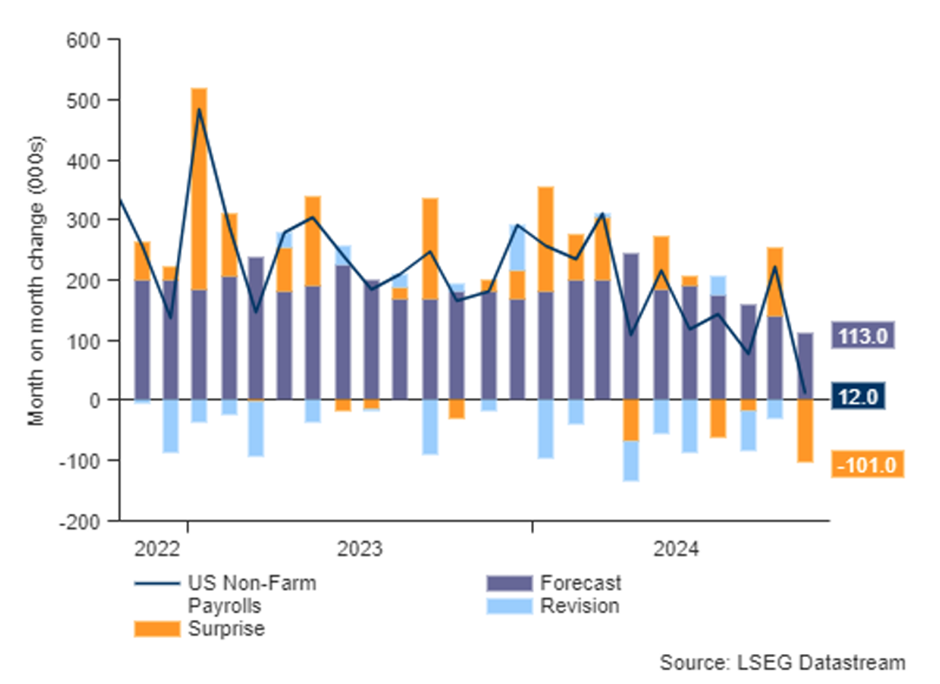
The book end to last week was Friday’s U.S. employment report. Headline employment growth was slightly ahead of expectations, but there were plenty of caveats to threaten the positive headline.

The unexpected jobs growth came from government hiring, with the private sector slower than expected. The unemployment rate ticked up and this has been moving higher in a way that could be consistent with a recession. However, the moves have been about increasing labour supply, rather than job losses or a slowdown in hiring. April and May’s jobs growth was also revised down to a more modest pace.

Finally, wage growth slowed on an annual basis. Taken as a whole, this was a labour market report that will help the Federal Reserve to build the case for rate cuts. If services sector inflation (excluding housing) is reasonable in June, the case for a September rate cut will have become very compelling.

Please continue to check our blog content for advice, planning issues and the latest investment, market and economic updates from leading investment houses.

Carl Mitchell – DipPFS

10/07/2024

Team No Comments

EPIC Investment Partners – The Daily Update | The Middle East’s Journey to Net Zero

Please see today’s daily update from EPIC Investment Partners received this morning:

The Middle East is experiencing a remarkable transformation in sustainability, with 2024 marking a watershed year for ESG across the region. Businesses are spearheading this change, rapidly transitioning from ambitious goals to tangible actions and reshaping industries and economies. 

A recent survey by PWC reveals impressive progress: 80% of companies now have formal sustainability strategies, up from 64% in 2023. Over half have fully integrated these strategies into their core operations. Leadership is driving this change, with 50% of companies either having appointed a Chief Sustainability Officer or planning to do so within a year. 

Climate action is at the forefront, with half of all surveyed companies pledging to achieve carbon neutrality within realistic timeframes. This significant increase in net-zero commitments showcases the region’s determination to address climate change. Transparency is also improving, with over 40% of companies producing comprehensive sustainability reports and an additional 24% disclosing selected ESG metrics. 

Innovation plays a crucial role, as companies explore cutting-edge technologies like GenerativeAI to enhance their sustainability efforts. The financial sector is supporting this green transition, with a growing number of companies accessing green loans and bonds. This trend is bolstered by significant initiatives like the UAE’s USD 30bn ALTÉRRA climate investment fund. 

Collaboration is key, with the private sector actively seeking partnerships to drive the sustainability agenda forward. Consumers are aligning with this shift, showing willingness to pay premiums for sustainably produced goods. Companies are recognising the economic benefits of sustainable practices, with some state-owned organisations demonstrating significant cost savings and competitive advantages. 

Looking ahead, there’s a growing focus on sustainability education and upskilling to ensure the region has the expertise needed to maintain momentum. While challenges remain, the Middle East is positioning itself as a leader in sustainable development. 

With many of the countries in the region, e.g. Abu Dhabi and Qatar, ranking amongst the wealthiest in the world, and with the growing focus on sustainability, the Middle East is an attractive hot spot for fixed income investment. Discerning investors seeking both returns and alignment with sustainable practices are finding the region increasingly attractive.  

Please continue to check our blog content for the latest advice and planning issues from leading investment firms.

Charlotte Clarke

09/07/2024

Team No Comments

Tatton Investment Management – The Monday Digest

Please see the below article from Tatton Investment Management detailing their thoughts on global markets over the last week. Received this morning 08/07/2024.

New government, same economy

The election results were emphatic but full of contradictions. Labour achieved one of the largest majorities ever with the lowest winning vote share, and it did so by promising change while emphasising continuity. The contradiction most relevant to investors is that capital markets were unmoved by this political earthquake.

Even though UK stocks rallied on Friday morning, this probably had more to do with global factors than domestic politics – just like last month’s sell-off. Markets are nonchalant because Kier Starmer continues to emphasise fiscal discipline. This is more about Liz Truss’ legacy than his own preferences: the former prime minister’s disastrous ‘mini budget’ reaffirmed the position of capital markets as the most unforgiving opposition of all. That means fiscal growth upside from the new government is limited, but growth indicators are already trending up and could well benefit from Labour’s stability.

That is a far cry from the US. Debt-to-GDP has risen dramatically in the last decade under successive administrations, and this is likely to continue regardless of who wins the November election. But Morgan Stanley research suggests that fiscal policy will be looser under Trump – so Biden’s recent debate failure has increased fears about debt instability. The US usually avoids bond market punishment thanks to its global economic dominance, but that could be tested if its fiscal stance worsens further. Even Jay Powell seems to be worried about the US eventually at risk of facing a ‘Liz Truss moment’.

US stocks continue to outperform all the same. Lately this has been a ‘bad news is good news’ story, with weaker economic data firming up expectations of a Federal Reserve rate cut. There are problems with this mindset. Stock market returns are so concentrated on a handful of mega-tech companies, but background macro conditions seem to have worsened for the group. And while slower growth might mean quicker rate cuts, it could also mean weaker profits. Markets seem to expect a ‘goldilocks environment’, but that could just be hubris. We will have to watch valuations, relative to the unfolding economic progress, closely.

June 2024 asset returns review

Global stocks returned a healthy 3% in sterling terms through June, but returns were highly concentrated on the dominant US mega-tech sector. Interestingly, emerging markets (EMs) also outperformed, jumping 4.7%, despite a 1.6% fall in Chinese stocks – the biggest component of EM indices. This continues the theme of dispersion between China and wider EMs. The latter rallied 6.8% because of rebounds in India and South Africa. Both had previously slumped due to surprising election results, but we said at the time that such political upsets are often overdone and can be good buying opportunities. So it proved.

European stocks saw a political sell-off too, dropping 1.7%, after President Macron’s surprise election call. We wait to see if the French far-right can win an outright majority in second-round voting. The 1.1% drop in UK stocks, on the other hand, isn’t political. The large multinationals that dominate the FTSE 100 are just particularly sensitive to global commodity demand – which has been weak for commodities other than oil. Markets were neither surprised by Labour’s landslide nor fearful of its moderate policies.

The US outperformed again, gaining a further 4.3%. This came despite weakening economic data through June. Investors clearly see slowing growth merely as proof that the Federal Reserve will cut interest rates in September. Bond yields moved gradually lower, but spiked into the end of the month. Reasons for the spike aren’t certain – but we suspect it could be down to struggling Japanese banks offloading their foreign bond holdings.

US strength was yet again really strength of a handful of mega-tech stocks. It shows how skewed returns are that Nvidia alone accounts for 35% of the S&P 500’s year-to-date returns. Monitoring this concentration and the risks it brings is the key challenge for investors in the second half of 2024.

Are Americans wrong about their economy?

US consumers are much less confident about the economy than aggregate economic data should suggest. The US continues to outperform in growth and capital market terms, but 55% of Americans think their economy is in recession, and 49% think the S&P 500 is down year-to-date, according to a Harris poll for the Guardian.

Consumer confidence has never recovered to pre-pandemic levels, despite strong growth and low unemployment during that time. This is a big problem for Joe Biden, and it has been suggested that highly partisan US news sources could be to blame. Backing this up is the fact that economic confidence differs dramatically by party affiliation – but political bias isn’t the whole story.

Some economists have suggested that traditional economic measures miss key factors, like the psychological impact of inflation and high interest rates. The clearest example is that average real (inflation-adjusted) hourly earnings are still below where they were in mid-2020. These were boosted during the pandemic thanks to emergency stimulus, but that did little for confidence because consumers couldn’t spend it on what they wanted at the time.

Wealth inequality, which grew during the post-pandemic recovery, is a crucial component too. Low aggregate unemployment hides the fact that the worst off are struggling much harder. Booming stock market returns are concentrated on just a handful of mega-tech companies, an uncanny reflection of America’s unevenly spread opportunities.

The US economy is set to gradually slow and restart at the aggregate level, but aggregate figures hide so much of what makes the economy important to people. The sentiment gap might have more of a concrete impact – both economically and politically – as growth comes down.

Please continue to check our blog content for advice, planning issues and the latest investment, market and economic updates from leading investment houses.

Alex Clare

08/07/2024

Team No Comments

What does the election mean for UK markets?

Please see below article received from Jupiter Asset Management this morning, which provides their market predictions following the Labour Party’s victory in the UK General Election. 

As the nation wakes up after polling day, the public, press and markets will be digesting news of the result. To give an investment perspective on what it means for markets, we asked some of our experts for their immediate reaction.

Matthew Beesley, CEO

“The UK market has very healthy underlying fundamentals and is trading at near all-time high levels. Yet frustratingly at the same time, the valuations of UK stocks are also at record low levels because of the political uncertainty of the last few years. There is every reason to hope that the new government will usher in a period of political stability, prioritise the Edinburgh reforms and hold themselves accountable to a clear industrial growth strategy that will cement the UK’s recovery and turn it back into a key focus for international investors.”

Adrian Gosden and Chris Morrison, Investment Managers, UK Equity Income

“This election was decided without major policy announcements from either of the main parties, and we are hopeful that a stable political backdrop will prove to be good for the economy and for market sentiment. UK equities have enjoyed solid performance this year to date, and we are looking for a sustained rebound in the market, helped by supportive factors such as weakening inflation, a potential Bank of England rate cut, attractive valuations for UK equities and good earnings performance from UK companies.”

Tim Service, Investment Manager, UK Small & Mid Cap Equities

“After nearly a decade of political shocks in the UK, today’s election result feels unusual for a Labour win having been so predictable. I expect this to be good news for the UK equity market over the medium-term, if for no other reason that markets and companies alike crave certainty. A government with a clear mandate will give companies confidence to hire people and invest in the future, while markets can better discount future company profits accurately.

However, ‘certainty’ is a still a relative concept given Labour’s campaign rhetoric to deliver change – so it’s important for investors to consider how new legislation, tax and spending plans might affect individual companies. We hope that Labour can start addressing productivity issues through planning reform and infrastructure investment, while also reenergising the UK’s capital markets. We are encouraged that Labour seems to recognise the problems, but would stress the urgency with which the remedies are required.”

Mark Nash, Huw Davies and James Novotny, Investment Managers, Fixed Income – Absolute Return

“Relative to the high level of uncertainty seen in the aftermath of international elections over the last few weeks (South Africa, India, Mexico, EU, France) and the concerns around President Biden’s performance at the first US presidential debate, the UK election has been something of a non-event. Labour’s victory means that we have now entered a period of relative stability in UK politics which is in stark contrast to the possibility of continued volatility elsewhere, especially in the run up to the US presidential elections in November. The UK could well look like a haven of political stability, a very different landscape to the years since the Brexit referendum.

The new government has to contend with the perilous scale of the UK’s twin deficits, with the adverse market reaction to Liz Truss’s mini budget almost two years ago still vivid in our memories. Labour will need to convince the market, and also the electorate, that they are fiscally prudent while still improving the shoddy state of UK public services and anaemic productivity and growth profile, none of which will be easy.

Growth will be their get-out-of-Jail free card, easier said but hard to deliver. They look likely to rest their hopes on a better trade deal with the EU to try and reduce friction at the border with the EU, and also by liberalising the UK planning laws. If they can succeed in this endeavour, then there may be some renewed hope for better UK growth along with less inflationary pressure within the UK. Despite the UK’s fiscal position, we believe Gilt yields look cheap compared to other countries that have a weak fiscal position (e.g. France) so there may well be some flows towards Gilts from other challenged sovereign bond markets that continue to have political problems now our election is done and dusted.”

Please check in with us again soon for further relevant content and market news.

Chloe

05/07/2024

Team No Comments

EPIC Investment Partners – The Daily Update

Please see the below article from EPIC Investment Partners detailing their discussions on water companies amidst growing environmental concerns. Received this afternoon 04/07/2024.

A judicial decision over 14 years in the making ended on the 2nd of July, with the Supreme Court ruling in favour of private businesses and people over United Utilities, the water company responsible for Northwest England and some six million people. This landmark ruling, with its significant implications, has opened the door for private legal actions in nuisance and trespass against water companies due to unauthorised sewage discharges and the related effects of pollution.

As early as 2010, the Manchester Ship Canal Company, owners of the 129-year-old Manchester Ship Canal, tried to bring a claim that the discharges from United Utilities 121 sewage outfalls within the canal constituted a trespass. However, United Utilities argued that the 1991 Water Industry Act, which privatised the sector, meant only regulators could act. In 2012, the high court sided with United Utilities and dismissed the claim. Despite an appeal process, the Supreme Court upheld this ruling in 2014. 

In March 2021, the High Court confirmed this, stating it was the role of regulators, not the courts, to address problems caused by sewage dumping. However, The Environmental Law Foundation, supported by the Good Law Project, challenged this decision, arguing that there should be legal options for people directly affected by sewage pollution. The case went up to the Supreme Court, which overturned previous rulings and found that United Utilities can be held accountable for damage caused by discharges. Lord Reed and Lord Hodge said: “The supreme court unanimously allows the canal company’s appeal. It holds that the 1991 act does not prevent the canal company from bringing a claim in nuisance or trespass when the canal is polluted by discharges of foul water from United Utilities’ outfalls, even if there has been no negligence or deliberate misconduct.”

In a related development, United Utilities and five other water firms have been mandated to publish live sewage discharge maps. These maps, released before a 2025 government deadline, provide real-time updates on sewage overflows, helping the public know the safety of local waters. This initiative came after significant public pressure and environmental campaigns, particularly focusing on areas like Lake Windermere, where United Utilities had a major incident of raw sewage discharge.

Following this ruling, water companies in the UK, more broadly, could face a spate of legal challenges by people and businesses affected by sewage pollution, where fines and regulatory action have previously not been enough to curtail pollution. The Good Law Project’s interim head of legal, Jennine Walker, said: “This is a sensational victory. It gives us stronger legal tools… to hold water companies to account after repeated failures from our toothless and underfunded regulators… and empowers people and businesses to use the courts to challenge industrial-scale polluters like United Utilities, who have put profits and the shareholder interest over protecting our environment.”

These events underscore the increasing regulatory and legal challenges water companies face in the UK, particularly concerning environmental protection and public transparency. United Utilities Group shares fell -2.5% yesterday, however, the wider utility complex remained broadly flat.

Please continue to check our blog content for advice, planning issues and the latest investment, market and economic updates from leading investment houses.

Alex Clare

04/07/2024

Team No Comments

Brewin Dolphin – Markets in a Minute

Please see this week’s Markets in a Minute update below from Brewin Dolphin, received yesterday afternoon – 02/07/2024.

Guy Foster, Chief Strategist, discusses the result of the first round of the French election and the impact it’s had on equity and bond markets. Plus, Janet Mui, Head of Market Analysis, examines fresh U.S. inflation data.

Markets traded broadly sideways last week, with relatively little economic news or corporate earnings results. While markets may have been quiet, there was plenty of politics for investors to ponder.

The election-heavy year continued with France hitting the polls on Sunday for the first round of legislative elections. Candidates are competing for one of 577 National Assembly deputy positions, which they’ll win if they receive 50% of votes in their constituency, representing at least 25% of registered voters.

However, if they don’t win a position, a second round will take place where voters will select one of the top three candidates who have achieved 12.5% or more of the votes. In this round, the candidate who receives the most votes is elected.

Marie Le Pen’s far-right National Rally party won 33% of the popular vote, while President Emmanuel Macron’s centrist Together coalition (which includes his Renaissance party) achieved 21%. The second round of voting takes place on Sunday.

The UK election looms…

Taking place between the two French rounds of voting is the UK general election.

The two leaders, Labour’s Sir Keir Starmer and the Conservative Party’s Prime Minister Rishi Sunak, debated last week and the consensus seems to be that the prime minister won the argument but still won’t prevail in the election.

When the election comes, the market’s reaction is likely to be muted, as a Labour victory has seemed so likely for a long time – but the margin of victory could be important.

UK elections are notoriously difficult to poll, and prediction models are producing some wildly different forecasts of the possible Labour margin of victory (from 50-150 seats). This could be due to a lack of enthusiasm for the opposition or the performance of other parties, such as Reform or the Scottish National Party.

The size of the margin gives a new prime minister a mandate and equates to their right to make decisions. If this was accompanied by a bold policy agenda, investors would react to those policies being implemented. However, as Labour’s offering has been relatively vanilla, the mandate should therefore protect the leadership from rebellions and contribute to a feeling of general political stability.

Belief in the U.S. president weakens…

More newsworthy was the first U.S. election debate on Thursday.

President Joe Biden, who has been lagging former President Donald Trump in the polls, pushed for this debate because it was seen as an opportunity to expose Trump’s weaknesses.

However, it was also recognised as a risk if Biden was to appear frail, which is exactly what happened. His voice and the dithering nature of his answers will have reinforced the suggestion he’s too old to serve another four-year term. Prediction markets immediately marked his potential chances lower, but Biden’s losses were bigger than Trump’s gains (and the gains of potential candidates Gavin Newsom and Kamala 2 July 2024 Harris). Speculation’s now mounting that Trump might end up facing a different candidate in November.

The obvious candidate would be current Vice President Kamala Harris, but there is little evidence that she would perform well against Trump. For that reason, Governor of California Gavin Newsom is the most likely pick, with a handful of other state governors also amongst the speculation. So far, they have all been firm in their commitment to Biden’s cause, so any change of candidate would need to be initiated by him deciding not to stand. The candidacy will be confirmed at the Democratic National Congress in late August.

The third-party candidates line up…

This year’s election will also feature some third-party candidates. That’s not unusual, however, their influence tends to be limited. In fact, no third-party candidate has won any Electoral College votes (effectively winning a single state) since 1968.

However, it is possible for third-party candidates to influence the election. In 1992, Ross Perot is credited with taking votes from George H. W. Bush, which ultimately helped Bill Clinton. The highest polling third-party candidate in this election, Robert F Kennedy Jr., has appeal across both voter bases, but is especially popular with the young.

Third-party candidates usually underperform on election day, although the low level of satisfaction with the big party candidates could change that.

The Green Party’s Jill Stein is also expected to run. It’s sometimes observed that her vote share in Michigan, Wisconsin and Pennsylvania in the 2016 U.S. presidential election was greater than Trump’s margin of victory over Hillary Clinton in each of those states. Therefore, Clinton might have won that election had Stein not run and her supporters had instead supported Clinton (which they might not have).

Although unlikely, it’s possible that a third-party candidate wins enough Electoral College votes to prevent either Trump or Biden (or his replacement) from winning the 270 votes required to become president. Under those circumstances, the newly elected House of Representatives would select the new president on the basis that each state has a single vote (despite a state like California having 60 times the population of Wyoming).

Therefore, regardless of which party controlled the largest number of seats in Congress, the fact that there are more Republican states than Democrat states means this approach would likely favour Trump.

The debate seeming to improve Trump’s chances led to a rise in the dollar. Traders may have perceived that Trump will cause growth, inflation, or both by virtue of promised tax cuts and threatened import tariffs. However, the gains didn’t last and historically, markets have seemed to find it hard to really think through the implications of different presidents. Hardly surprising given there are so many different potential combinations of presidential and Congress control.

The Falcon Heavy lands…

The threat of higher inflation is one scenario but continued progress in the contemporary space race offers some hope for deflationists.

Elon Musk’s Falcon Heavy rocket successfully deployed the final satellite in the geostationary operational environmental satellite series (GOES-R), with the now familiar sight of its boosters landing in an upright position.

The conquest of space seems like science fiction but is believed to carry tangible economic benefits. One of these is the implementation of space-based solar power, in which energy is captured by space-based solar panels and beamed to earth in the form of microwaves for conversion to electricity. It’s also anticipated that an unmanned nuclear power plant could be built on the moon, allowing for further expansion of human influence in space, including asteroid mining.

Realistic returns from space are years away but could see enormous changes in availability of some natural resources, with knock-on effects for the countries that might currently supply them on earth.

Please continue to check our blog content for advice, planning issues and the latest investment market and economic updates from leading investment houses.

Charlotte Clarke

03/07/2024

Team No Comments

Brooks Macdonald | Daily Investment Bulletin

Please see below, the Daily Investment Bulletin from Brooks Macdonald which covers the latest news affecting global markets. Received this morning – 02/07/2024

What has happened?

Yesterday has seen some interesting moves in the US government bond market. Despite an in-line US inflation print last Friday, US 10-year bond yields still moved higher yesterday, up +6.5 basis points (bps) on Monday to 4.461% and building on its +11.0bps move up on Friday. A narrative has built up that in the aftermath of the Trump-Biden US presidential TV debate last Thursday which Trump was widely considered to have won, markets appear to be pricing in a higher probability of a Trump victory in November and with it an expectation of larger US fiscal deficits. That has also reverberated over in Europe, with government 10-year bond yields yesterday higher across the region, including UK, France, and Germany. The higher US bond yields are also rippling across FX markets, leading to a higher US dollar, which in turn is pushing the Japanese Yen to a fresh 38-year low this morning.

An early start to the Atlantic hurricane season

In the last 24 hours, currently in the Caribbean Sea, hurricane Beryl has strengthened to a Category 5 hurricane (the highest category). It is the strongest storm to ever form in the Atlantic at this time of the year. The hurricane has made landfall in several countries in the Caribbean and is moving West-Northwest. It is expected to hit south-east Mexico by the end of the week and potentially onwards into the Gulf of Mexico, home to a number of US offshore oil field operations. The US National Oceanic and Atmospheric Administration (NOAA) has so far recorded maximum sustained wind speeds of 165mph, and the storm is thought to be getting stronger. Separately the NOAA has warned that the North Atlantic could get as many as seven major hurricanes this year, up from an average of three in a season. The NOAA said that record high sea surface temperatures are partly to blame, and meteorologists have this week expressed surprise as to how quickly hurricane Beryl has developed. Brent Crude oil futures are currently trading up at US$86.85 per barrel, close to 2-month highs.

 A Trump presidency looks a little more likely

On top of US President Biden’s weak showing at last week’s TV presidential debate, a Trump victory in November has been further buoyed by a decision in Trump’s favour yesterday from the US Supreme Court. The court has ruled that presidents have some immunity for their “official” acts whilst in office. With likely much legal to-and-fro now expected over what are deemed “official” acts, expectations are that the criminal trial over Trump’s attempt to overturn the 2020 election could well be delayed for a year or more, and very likely till after the US election in November.

What does Brooks Macdonald think?

The current political temperature in the US matters for markets. Should Trump win in November, he is expected to impose more tariffs on Chinese exports, an emphasis on more tax cuts, as well as pursue a US-first, likely more isolationist policies more broadly. As such, whilst current Biden has presided over a sizeable budget deficit in office already, a Trump presidency is expected by some to put incremental upward pressure on inflation expectations, and coming at a time when the US Federal Reserve is likely to be hoping to be underway in its interest rate cutting glide path.

Please continue to check our blog content for the latest advice and planning issues from leading investment firms.

Alex Kitteringham

2nd July 2024

Team No Comments

Tatton Monday Digest

Please see the ‘Monday Digest’ article below, received from Tatton Investment Management this morning. 

Tatton Monday Digest Politics, where policy takes a back seat

Last Friday marked the end of the second quarter, culminating in the day after the first 2024 US Presidential debate, widely seen as disastrous for Biden, yet financial markets have remained relatively steady. Institutional investors are currently engaged in their scheduled portfolio rebalancing, however, this time it is causing minimal disruption across asset classes. 

Thursday’s debate was anticipated to scrutinise presidential fitness rather than policy details. Biden’s disastrous performance raised concerns even among loyal Democrats, potentially jeopardising his electoral viability with any loss of voter support being very damaging.

We think betting markets show a more unbiased indicator than polls, reflecting a notable shift post-debate. Trump’s odds improved to 54.8%, a 4% gain, while Biden’s plummeted below 25%, a decline exceeding 15%. Betfair Exchange Politics indicates a 60% likelihood of Republican victory, signalling diminished prospects for Democrats if Biden remains their nominee.

Amidst debate fallout, California Governor Gavin Newsom emerged as a prominent alternative in market discussions should Democrats opt for a candidate change. The viability of such a shift hinges on internal polling and strategic calculations within the Democratic Party, which may in flux at the moment.  

Market reactions following the debate were almost blasé. US stock futures saw modest gains, contrasting with a decline in US Treasury bond prices (indicative of rising yields). The dollar also rose. International stocks were a little weaker. This implies that investors are currently expecting a slight near-term benefit for US growth should Trump win, but that it may also mean a worse budget deficit.

Looking beyond the US, global elections share common themes: aspirational manifestos mean that most important policies will not be clear until well after the elections are finished amidst heightened voter polarisation. In France the right wing did well in the first round of voting, but outright victory may be hampered in the second round by tactical voting simply to prevent the Le Pen from winning. In the UK, Labour’s centrist manifesto seems less alarming to markets, yet clarity on actual policies also remains vague.

Compared to the start of the year, global economic data remains mixed with a slight positive bias, bolstered by upward revisions in world growth forecasts. The Chinese economic policy push to bolster economic activity has driven down goods inflation, but this signals weakening domestic demand. The US shows a loss of growth momentum with slew of profit warnings from consumer-facing companies ahead of Q2 results. Consumer caution over inflation has tempered spending, impacting sectors like housing and consumer goods.

Gentle economic slowing that allows the Fed to cut rates, should lead to rebounding growth amid an otherwise stable dynamic characterised by tight labour supply driving business investment into productivity enhancing technology advancements. Europe is in a similar position although admittedly with softer underlying growth.

Looking ahead, companies broadly remain on a positive path, but market risk will continue to emanate from policy volatility uncertainties. We’ll know a bit more next week after the UK elections and possibly a lot more after the second round of the French election 

Basel III banking regulation – the Unending Endgame

Last week marked the 50th anniversary of the Herstatt Crisis, a pivotal event that triggered the establishment of the Basel Committee on Banking Supervision by the G-10 nations. In 1974, Herstatt Bank’s collapse during currency trading left a $620 million loss ($400bn today) on the global banking sector, prompting G-10 nations to form the Basel Committee on Banking Supervision to mitigate such risks.

Initially overseen by the Bank for International Settlements in Basel, Switzerland, the committee aimed to regulate an increasingly interconnected global financial system. It took 14 years, until 1988 for Basel I, which introduced international banking regulations focusing on capital adequacy, classifying assets into risk categories and requiring banks to maintain capital equal to at least 8% of their risk-weighted assets.

It was hoped Basel I would prevent bank failures spilling into the global financial system, but it failed. The Barings Bank collapse in 1995 and the Long Term Capital Management debacle in 1998 underscored its limitations and led to Basel II. Introduced in 2004, it aimed to enhance risk management and transparency by assessing asset risks more accurately, however it also failed spectacularly to prevent the 2008 financial crisis. This led to the development of Basel III, implementation of which began in 2010 and continues, albeit slowly, with the final phase known as the “Basel III Endgame.”

Basel III extended Basel II’s focus on risk management – increasing minimum capital requirements, raising common equity levels from 2% to 4.5% of risk-weighted assets. It introduces capital buffers to absorb losses during economic stress, mandates liquidity ratios to ensure banks maintain high-quality liquid assets and imposes stricter requirements on globally significant banks.

However, Basel III places greater weight on banking regulation but not on other financial institutions such as private equity and credit firms, which are now seeing stronger equity returns. Last week US bank shares rose when the US Federal Reserve Recent announced revision to moderate the impact on large banks with sizable trading operations reducing the increases in capital adequacy to about 5% from a potential 16% rise.

In Europe, implementation has been delayed pending alignment with potential US revisions. Politics may disrupt the final outcomes as well. It is worth remembering, that Trump removed some of the regulations for US regional banks in his first term and he may seek to allow US banks more latitude.

Perhaps more likely is that the non-bank players, especially the private equity and credit firms, will seek to prevent similar regulation being applied to them, as highlighted by the Bank of England last week when it reenforced the need for international co-ordination for private equity  cross jurisdictions.

So, for the banks, “Endgame” might be applied to this Basel episode. For private equity firms, their episode will probably be called “Opening Gambit”.

The rise and fall of Ocado

Ocado, known for its distinctive green and white delivery vans and association with M&S, began in 2000 as a pioneering online grocery service in the UK. Initially praised for its innovative technology and logistics, including automated Customer Fulfilment Centres (CFCs), Ocado quickly gained market traction. Its 2010 stock market debut saw shares rise from an initial 180p to nearly 600p, buoyed by efficient operations and a partnership with Waitrose, which bolstered its IPO.

A turning point for Ocado was licensing its Smart Platform technology globally, securing deals with major retailers like Morrisons, Kroger, Casino, and Aeon. This expansion underscored Ocado’s tech prowess and potential for substantial revenue growth, reflected in its share price peak of around 2886p in 2020.


However, the grocery sector’s fierce competition and narrow margins strained Ocado, despite its technological edge. High costs associated with building and maintaining CFCs, alongside increasing competition from Amazon Fresh and traditional grocers going digital, pressured Ocado to continually innovate.

The COVID-19 pandemic briefly boosted Ocado as online grocery demand surged. However, the temporary spike strained operations and inflated costs, raising concerns about long-term sustainability post-pandemic. Analysts, including Morgan Stanley, now project prolonged cash flow challenges and debt accumulation.

Morgan Stanley’s cautious forecasts include fewer CFC deployments and heightened debt levels, signalling ongoing operational and financial hurdles for Ocado. This shift in sentiment has driven a significant decline in Ocado’s share price from its peak to just 281p last week, underscoring investor scepticism about its ability to manage these challenges effectively.

Looking ahead, Ocado must focus on cost management, margin improvement, and expanding its technological services to new markets to regain investor confidence. While its innovative approach sets it apart, navigating the competitive and cost-sensitive grocery sector remains a formidable task.

Ocado’s journey serves as a cautionary tale in the tech industry, highlighting the complexities of sustaining growth amid operational pressures and competitive forces. Its evolution underscores the volatile nature of high-growth enterprises reliant on borrowed potential, where minor shifts in profitability drivers can lead to significant market reactions.

Please check in again with us soon for further relevant content and market news.

Chloe

01/07/2024

Team No Comments

EPIC Investment Partners – The Daily Update

Please see the below article from EPIC Investment Partners detailing their thoughts on global markets and AI. Received this morning 28/06/2024.

With the UK election fast approaching, we thought we’d step away from the political arguments and negative commentary about the UK and focus on a brighter side of the economy.

The UK runs a sizeable current account deficit of just under 3% of GDP. In terms of goods exports, the UK ranks a lowly 13th place in the world, just behind Belgium.

Things would be a lot worse were it not for the UK’s sizeable surplus in services. The UK is the second largest exporter of services in the world, accounting for an impressive 7% of world service exports. A crucial driver behind this growth is the substantial investment in artificial intelligence (AI) and related technologies. According to the OECD, the UK ranks third globally, following the US and China, for venture capital invested in AI and data start-ups. This is a testament to the country’s commitment to innovation and technological advancement.

The UK’s AI sector benefits from a well-established ecosystem that includes world-renowned universities, a skilled workforce, and supportive government policies. This environment has fostered numerous successful AI start-ups and attracted significant international investment. Moreover, the UK government has been proactive in promoting AI and tech development. Initiatives like the AI Sector Deal, part of the UK’s Industrial Strategy, aim to boost AI research and application across various industries. The strategy includes substantial funding for AI research, fostering public-private partnerships, and developing a skilled workforce to support the AI sector’s growth.

The emphasis on AI and technology not only strengthens the UK’s service exports but also positions the country well for future economic challenges and opportunities. The continued investment in AI could lead to significant advancements in various sectors, including healthcare, finance, and transportation, further enhancing the UK’s competitive edge in global markets.

Talking of brighter sides, England did at least manage to top the group at the Euros. Before the competition started, we decided that our NFA result predictor should favour the Wealthy Nations. Whilst the individual results have shown mixed results, the 3*+ countries have dominated the tables. Of the 12 qualifiers who topped the six groups, 10 countries are rated 3* or better with only Spain and Portugal (both 2*) bucking the trend.

Slovakia scraped in as one of the best 3rd placed teams and are also rated 2* so, based on NFA scores, England (4*) should comfortably beat Slovakia. However, having watched England’s first three games, one might be forgiven for tempering expectations.

Please continue to check our blogs for advice, planning issues and the latest investment, market and economic updates from leading investment houses.

Alex Clare

28/06/2024

Team No Comments

EPIC Investment Partners: Daily Update – Economic Challenges Loom as 2024 Unfolds

Please see below, EPIC Investment Partners daily market summary which covers their views on global markets and economies and was received yesterday (26/06/2024):

As we near the second half of 2024, the global economy finds itself at a crossroads, balancing optimism for a soft landing with persistent challenges. The World Bank’s upgrade to its global growth forecast to 2.6% for 2024 reflects a cautiously optimistic outlook, with the United States remaining a key driver of global economic resilience. 

However, the US economy is showing signs of deceleration. Real GDP growth is projected to slow to 1.5% in 2024, down from 3.1% in 2023. Consumer spending, which has been a cornerstone of economic strength, is weakening as households deplete savings and face rising loan delinquencies. The labour market is also expected to soften, with unemployment potentially rising to 4.5% by year-end. 

Inflation remains a central concern. The Fed anticipates core PCE inflation at ~2.8% for 2024, above its 2% target. This persistent inflation has led to a more hawkish stance, with the central bank projecting a higher funds rate of 5.1% for 2024. Despite this, markets still expect two 25bps rate cuts in 2024, priced in from September. 

The political landscape adds another layer of complexity. The upcoming US election in November could significantly impact trade, tax, defence, and immigration policies. With the US government already spending as if the nation is in deep depression (clearly underpinning inflation), the US is facing a severe debt crisis as national debt nears USD 35tn and is increasing rapidly. Interest payments alone now consume around USD 1tn annually, surpassing many crucial programme budgets. Despite acknowledgment from past and present politicians, effective action remains absent. The only viable path forward is to curb government spending, limiting increases to below average economic growth. However, political will for such measures is lacking, risking severe future economic consequences. 

Financial markets appear to be pricing in a near-perfect scenario. The S&P500 has reached multiple new highs in 2024, and volatility remains low. The 10-year US Treasury yield, while fluctuating, appears to be stabilising given reduced expectations for Fed rate cuts. The US dollar maintains its strength, underpinned by the Fed’s cautious approach and its safe-haven status. 

However, risks loom on the horizon. The full impact of previous interest rate hikes may still be unfolding. The persistence of above-target inflation continues to challenge policymakers. Market volatility could increase as the US election approaches, with potential implications for global trade and economic policies. 

As we move through the latter half of 2024, the global economy walks a tightrope. Central banks’ abilities to navigate the delicate balance between stabilising inflation and supporting economic growth will be crucial. While a global soft landing remains possible, the path forward is fraught with uncertainties. Policymakers, businesses, and investors will therefore need to remain vigilant, adapting to a rapidly evolving economic landscape. As always, flexibility and careful risk management will be key to navigating these uncertain economic waters. 

Please continue to check our blog content for advice, planning issues and the latest investment, market and economic updates from leading investment houses.

Carl Mitchell – DipPFS

Independent Financial Adviser

27/06/2024