Team No Comments

Brooks Macdonald – Daily Investment Bulletin

Please see below, todays Daily Investment Bulletin from Brooks Macdonald covering their thoughts on markets and the ongoing Geopolitical Issues. Received today – 08/07/2025:

What has happened

Equity markets faced volatility yesterday as investors reacted to President Trump’s tariff announcements. The S&P 500 closed down -0.79%, with losses accelerating after the tariff news, though it rebounded from a daily low of -1.25% as markets priced in potential trade negotiations. The ‘Magnificent 7’ tech stocks fell -1.03%, with Tesla plummeting -6.79% after Elon Musk’s announcement of a new ‘America Party,’ raising concerns about political and market uncertainty. The Russell 2000 small-cap stocks index, which are more vulnerable to tariff impacts, fell -1.55%. In Europe, markets closed before the tariff news fully hit, allowing the STOXX 600 (+0.44%) and Germany’s DAX (+1.20%) to post gains, buoyed by optimism over a potential US-EU trade deal following positive talks between EU Commission President Von der Leyen and Trump. In the UK, the FTSE 100 lagged, declining -0.19%, reflecting broader caution.

Trump’s tariff announcements

President Trump escalated trade tensions yesterday, announcing new tariff rates via social media. Japan and South Korea face 25% tariffs, while South Africa, Malaysia, and Indonesia are set to see rates of 30%, 25%, and 32%, respectively, among twelve targeted countries. Trump emphasised that goods transhipped to evade tariffs will face the higher rate and warned that retaliatory tariffs from other nations would trigger reciprocal US increases. White House Press Secretary Karoline Leavitt indicated more tariff letters would follow later this week. However, these higher rates are not in force yet for a few weeks as Trump also signed an executive order delaying these hikes, maintaining the current 10% tariff rate until at least 1 August, therefore providing a window for negotiations. Trump signalled flexibility, noting the deadline was ‘not 100% firm’ and open to adjustments for trade deals.

What does Brooks Macdonald think

The tariff announcements again introduce significant uncertainty for global markets, particularly for more sensitive sectors like small-cap stocks and industries reliant on international supply chains. While the delay until August 1 offers a reprieve, the threat of higher tariffs could dampen investor confidence and disrupt trade flows, and potentially fuelling inflation and pressuring corporate margins. However, the prospect of trade deals, especially with the EU, provides a counterbalance, as successful negotiations could mitigate some risks. We expect continued market volatility as investors monitor trade talks and further developments. For now, a cautious approach favouring well diversified portfolios seems prudent as markets navigate this period of heightened geopolitical and economic uncertainty.

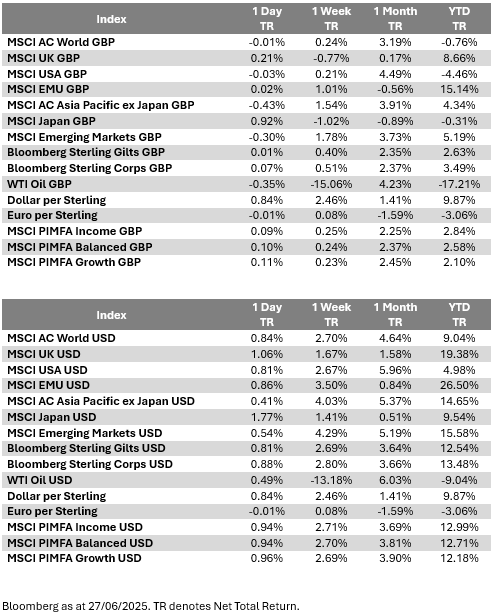
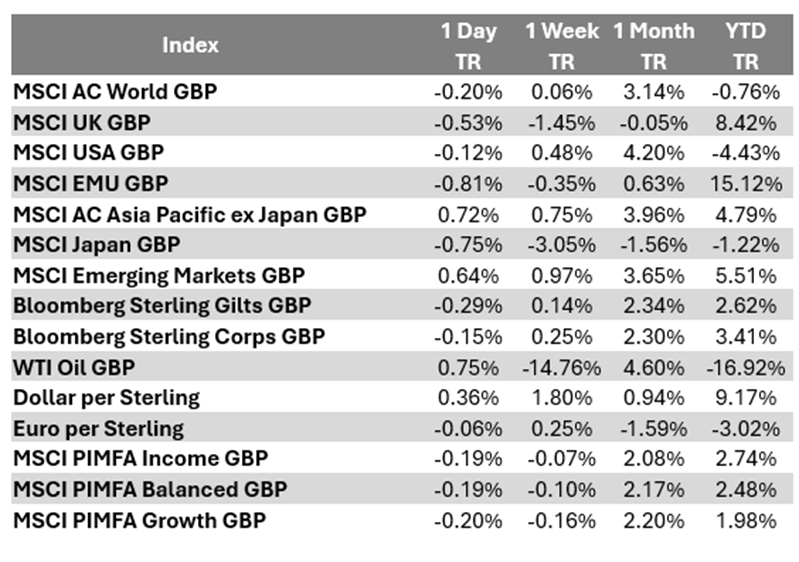
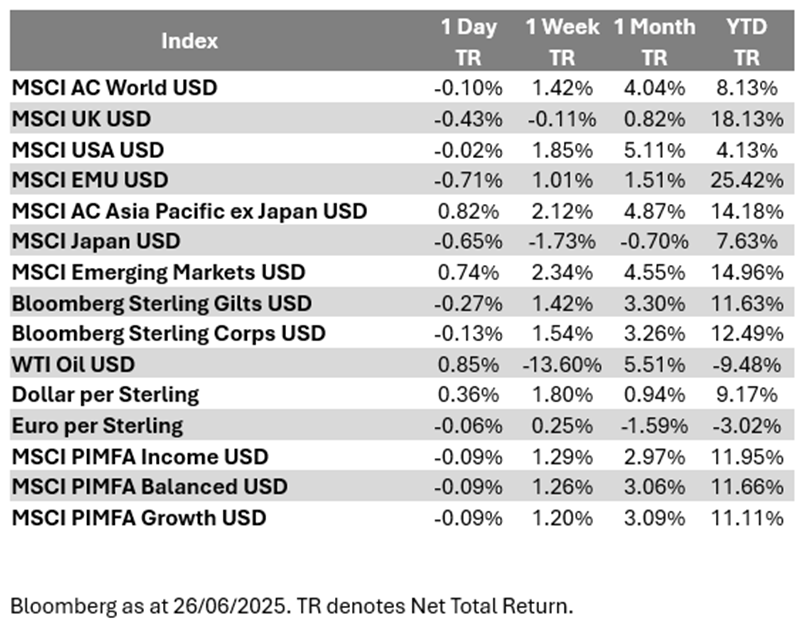
Bloomberg as at 08/07/2025. TR denotes Net Total Return.

Please continue to check our blog content for the latest advice and planning issues from leading investment management firms.

Marcus Blenkinsop

8th July 2025

Team No Comments

Tatton Investment Management: Monday Digest

Please see below, an article from Tatton Investment Management, analysing the key factors currently affecting global investment markets. Received this morning – 07/07/2025

Markets bask in the sunshine

Markets broke all-time highs last week. Small and mid-cap stocks outperformed the ‘Magnificent Seven’ – and even UK stocks climbed to new heights, despite the government’s policy u-turn.

The rise and fall of UK bond yields showed investors support Rachel Reeves – seen as the chief architect of Labour’s fiscal rules. People don’t like tax cuts but bond investors do; they agree that the best growth support will be lower interest rates. Gilts buyers won’t allow the treasury any borrowing headroom, and believe Reeves will keep to her fiscal promises so, after Starmer’s wobbly support, the difference between UK and US yields actually narrowed slightly.

The FTSE 100 hit an all-time high, partly thanks to US private equity groups’ interest in discounted (in price-to-earnings valuations) UK stocks. That calculation isn’t affected by the relatively minor yield increase.

By comparison, bond markets are nonchalant about US fiscal indiscipline. Trump’s “One Big Beautiful Bill Act” (OBBBA) will stretch the deficit but investors care more about growth. US sentiment was helped by Thursday’s strong labour market report, broadening the stock market rally to smaller companies. International investors were sceptical when it was just the Mag7 rallying, but the broader rally is a clear return to US economic positivity. This could reverse some of 2025’s US capital outflows, benefitting the dollar. Institutional investors and hedge funds have  recently positioned against the dollar, so a short squeeze could easily ensue, pushing it higher.

But the longer-term trend is still against the dollar. OBBBA makes US bonds vulnerable. Trump persuaded Republican budget hawks to back his tax cuts with promises of tariff revenue, but he could easily lower tariffs ahead of next year’s mid-term elections. OBBBA’s Medicaid cuts are also hurting public health insurance providers, evidenced by Centene’s 40% share price drop.

Generally, equity markets have opened the week slightly down, mildly disappointed on the trajectory of tariff talks. The July 9th deadline has effectively been moved to August 1st but Trump’s nasty side might be back. He is sending a “take-it-or-leave-it” ultimatum to many  countries. On Friday, he promised additional tariffs (70% on China) and then, on Sunday, added a further to 10% to “Any country aligning themselves with the Anti-American policies of BRICS”. [which now comprises Brazil, Russia, India, China, South Africa and from last year Egypt, Ethiopia, Indonesia, Iran, Saudi Arabia and the United Arab Emirates]. More hopefully, Europe appears to be making headway with trade negotiations. Meanwhile, deals that might boost equities may hurt bonds as investors will fear lower revenues. This week promises to be interesting.

June asset returns review

June was a remarkably strong month for markets, despite geopolitical volatility. Global stocks climbed 2.8% in sterling terms and all major equity markets finished higher. You would never have guessed there was an Israel-Iran war from looking at the returns table. Polymarket’s odds on Iran shutting the Strait of Hormuz went above 50% at one point – coinciding with a $75 per barrel oil price peak – but oil traders correctly predicted de-escalation after Iran’s symbolic strike on an empty US base. Oil prices climbed 4.6% through June but gold prices (which rise in times of panic) fell 2.1%.

US stocks were among the best performers (up 3.4%) after better-than-expected corporate earnings. In sterling terms, though, the US underperformed in Q2 thanks to dollar weakness. On the flipside, euro and sterling strength helped UK and European equities last quarter – though both were virtually flat in June. Defence stocks benefitted from the 5% defence spending commitment at the end of the month.

Dollar weakness helped ease global liquidity, as did the move down in US bond yields. The Federal Reserve and Bank of England both signalled interest rate cuts ahead – and markets (thankfully) ignored Trump’s threats against Fed chair Powell. Looming tariffs have tied the Fed’s hand on rate cuts, but markets now expect several before the end of the year.

Emerging markets’ outperformance (up 4.3% through June – beating all other regions) was another sign of investors’ confidence. EM companies are benefitting from the weak dollar, which makes their dollar-denominated debt easier to service. China also gained 2.5% despite continued economic weakness and the government’s inability to stimulate demand, though its economy and markets have become detached from the western world. China’s gain is a sign that markets expect more tariff reprieve after the 9 July deadline for Trump’s moratorium.

Our 2025 outlook: what’s changed?

At the start of the year, most investment houses expected US outperformance to continue. We were less convinced, given US policy risks (tariffs and the fiscal deficit) and European potential. That has broadly played out, but we were surprised at the speed of Trump’s market disruption. By April, it became clear that tariffs would hurt US demand most, while Washington’s international antagonism ironically benefitted growth elsewhere (by getting Europe to invest).

US stocks rapidly recovered from the “Liberation Day” sell-off, after Trump backed down and company earnings proved resilient. The dollar didn’t recover, though, which is why US returns are still negative year-to-date for UK investors.

The US economy mostly maintained its momentum (though the data has been skewed by a pre-tariff buying spree) but there are now clear signs it is slowing. The labour market is cooling, which doesn’t suggest a recession but dents US exceptionalism. The Federal Reserve sees tariffs as a growth negative and markets are pricing in interest rate cuts – despite a near-term fiscal expansion through tax cuts.

UK and European growth was weak, but that allowed the ECB to cut rates four times. Chinese growth continued to disappoint, as Beijing seems unable to stimulate demand US tariffs hit exports.

While we don’t see a US recession, there’s not much to get excited about. Tax cuts will bring a minor boost, but they are mostly extensions and the fiscal multiplier will be small. The fiscal multiplier on EU defence spending could be much higher. That won’t come until next year, but markets will likely front-run the benefits.

Although many expect mild US tariff inflation, wages are slowing – sapping disposable income and denting consumer confidence. Rates are still high in absolute terms and refinancing is hurting companies. These risks might not dent US stock market optimism, but we expect they will be seen in continued dollar weakness.

Please continue to check our blog content for the latest advice and planning issues from leading investment management firms.

Alex Kitteringham

7th July 2025

Team No Comments

EPIC Investment Partners -The Daily Update

Please see below, The Daily Update from EPIC Investment Partners covering their thoughts on global markets in relation to the latest US unemployment data – Received today 04/07/2025:

US Jobs: A Tent Held Up by Fewer Poles

Yesterday’s payroll data effectively rules out a Federal Reserve rate cut in July. The figures highlight a nuanced picture behind the headline employment figures. The Bureau of Labor Statistics (BLS) reported a rise of 147,000 non-farm payrolls in June, beating forecasts and pushing unemployment down to 4.1%. Yet, disparities exist, and earlier in the week ADP showed a loss of 33,000 private-sector jobs, suggesting underlying weakness. Moreover, the labour force participation rate fell to 62.3%, the lowest since late 2022, indicating unemployment declined largely due to workforce exits rather than robust hiring. Total employment remains 603,000 below April levels. 

Job gains in June were concentrated primarily in government roles, notably state education (+73,000) and healthcare (+39,000). This narrow distribution raises concerns about broader economic resilience, prompting one economist to liken the labour market to “a tent increasingly held up by fewer poles.” 

The data complicates matters for the Fed. At the core of the Fed’s policy challenge lies a demographic shift resembling Japan’s recent experience. Since Japan’s working-age population peaked in the 1990s, the country has experienced persistent labour shortages, maintaining unemployment near 3%. Despite this tight labour market, Japan continues to face sluggish economic growth and persistent deflation, necessitating decades of ultra-accommodative policies by the Bank of Japan. 

The US now faces similar demographic pressures, driven by accelerated retirements among baby boomers, intensified by pandemic-era workforce exits. Participation rates among older Americans remain notably below pre-pandemic levels. Declining birth rates and sharply reduced immigration further restrict the entry of younger workers. According to the Conference Board, the US must add roughly 4.6 million workers annually, four times the recent average, to match current labour demand. If the labour supply continues to shrink this will push unemployment rates lower due to fewer active jobseekers rather than vibrant job creation. 

This demographic reality presents a significant dilemma for the Federal Reserve. Traditionally, declining unemployment indicates labour market tightening, potentially fueling wage inflation and necessitating rate hikes. Current labour shortages have indeed triggered notable wage pressures. However, the Fed must discern whether this tightness genuinely signals an overheating economy or reflects demographic constraints. Fed Chair Jerome Powell recently noted pandemic-related retirements have removed over two million workers—a structural issue monetary policy alone cannot address. 

Given these demographic constraints, the Fed is likely to maintain higher interest rates for an extended period to manage inflation. This “higher for longer” scenario, which will likely further frustrate Donald Trump, implies a weaker growth outlook compared to an environment where the Fed focused purely on boosting employment. Whilst the knee-jerk reaction was for US Treasuries to sell-off, the prospect of falling inflation and weaker growth is a longer-term positive for bond investors. 

Please continue to check our blog content for the latest advice and planning issues from leading investment management firms.

Marcus Blenkinsop

4th July 2025

Team No Comments

EPIC Investment Partners – The Daily Update

Liberation Day 2.0 – What’s next for global markets?

Please see below, todays Daily Update from EPIC Investment Partners covering their thoughts on Global Markets in relation to Trump’s upcoming tariff pause deadline:

The deadline for the 90-day pause in ‘Liberation Day’ tariff hikes moves closer as we approach the 9th of July, dubbed ‘Liberation Day 2.0’; investors and global markets are waiting for signs from the Trump administration. The quick de-escalation was to enable trade talks to move forward, but stability has been more elusive than perhaps the US had hoped. So far, the only confirmed deals have been with the UK and China, and the negotiations with other countries continue.

Since Liberation Day 1.0, the S&P 500 has rallied markedly, with a climb of over 20% from the recent lows. However, there are now concerns that the restoration of tariffs will threaten market stability. Analysts have warned of risks to equities, and ensuing volatility, especially if we see a more marked move towards deglobalisation and the ‘TACO’ trade gets cut short.

Another important area of concentration is bond markets. The US Treasury market witnessed significant volatility around the most recent round of tariff announcements, leading to a short-lived spike in yields and borrowing costs. With the US debt reaching more than $36 trillion, and the ‘Big Beautiful Bill’ potentially widening the deficit, the bond markets may be under further pressure, with more comprehensive and wider reaching ripple effects.

White House comments show that an extension is still possible, but recent statements by President Trump have created more ambiguity. Whether Trump follows his classical ‘the Art of the Deal’ playbook, or indeed goes with a more sanguine approach, volatility in markets is much more likely in the short and medium term.

We continue to actively monitor the global environment and stand ready to adjust portfolios if needed, rather than being passengers in passive indices with no option but to be taken along for the ride.

Please continue to check our blog content for the latest advice and planning issues from leading investment management firms.

Andrew Lloyd

3rd July 2025

Team No Comments

Brewin Dolphin – Markets in a Minute

Please see this week’s Markets in a Minute update below from Brewin Dolphin, received yesterday afternoon – 01/07/2025.

Unpacking the drivers of renewed market optimism

We examine the factors driving renewed market optimism and their potential implications for interest rates.

Key highlights

  • Optimism returns to markets: The S&P 500 hit new highs, inflation pressures eased with lower oil prices, and slowing inflation supports expectations for two U.S. rate cuts by the end of the year.
  • Geopolitical and policy stability: Geopolitical tensions eased with an Israel-Iran ceasefire and progress in U.S.-China and U.S.-Canada trade negotiations, while the removal of Section 899 from Trump’s ‘One Big Beautiful Bill’ has reassured Wall Street.
  • U.S. domestic demand concerns: Personal consumption growth slowed sharply, U.S. first-quarter GDP was worse than expected, and May household spending contracted, raising concerns about domestic demand.

Stocks rally as risks recede

Global stocks performance

Source: Refinitiv Datastream

The S&P 500 surged to a new record high, finally joining the MSCI World and Nasdaq 100, which had already surpassed previous peaks. The move completes a rapid rebound from April’s correction − a full recovery in just one quarter − as investors reprice assets on the back of easing macro risks.

Several headwinds that previously dampened sentiment, including geopolitical threats and trade tensions, have subsided or moderated. Markets are embracing a backdrop of measured disinflation, diplomatic progress, and long-term secular tailwinds such as artificial intelligence-led innovation.

The strength of technology stocks was again evident last week, with Nvidia reclaiming its title as the world’s most valuable company. Meanwhile, the U.S. dollar declined, lifting sterling to a four-year high and generating numerous news headlines.

One of the key developments last week was the announcement of a ceasefire between Iran and Israel, alleviating a major geopolitical concern. Although fragile, the ceasefire helped reduce the risk of escalating Middle East tensions or spillover effects and eased concerns about potential oil supply disruptions in the Gulf.

As a result, Brent crude prices declined, more than reversing the gains since the start of the ‘12-day war’. This is a familiar pattern as geopolitical shocks often trigger knee-jerk reactions in oil markets but tend to fade quickly when diplomacy prevails. Importantly, oil market sensitivity appears to be lower than in past cycles, partly due to the U.S.’s role as a major energy producer and the global transition towards energy efficiency.

The market’s reaction also reflects the view that this particular geopolitical shock was largely contained within the oil sector, with limited spillover into broader risk assets. With energy prices stabilising, inflationary pressures may ease further, which supports the case for monetary policy flexibility in the second half of the year.

From trade tensions to trade optimism

Oil prices

Source: Refinitiv Datastream

The broader improvement in market sentiment also stems from developments on the U.S.–China trade front. The U.S. Secretary of Commerce, Howard Lutnick, confirmed a finalised tariff framework with China that would allow rare earths to flow.

This marks a meaningful shift in tone. Rather than escalating trade tensions, both sides appear to be seeking a diplomatic path forward. The move reduces some uncertainty for multinational firms and global supply chains and reinforces the impression that the U.S. is adopting a more pragmatic approach. Ahead of the 9 July tariff deadline, the administration is trying to project a sanguine tone for a change.

Lutnick mentioned 10 potential trade deals are imminent but provided no detail. Typically, comprehensive trade deals are years in the making. But any direction of partial or quick wins would be helpful.

Perhaps less discussed outside of financial media was the proposed removal of Section 899 from the One Big Beautiful Bill Act. Section 899 is considered a ‘reciprocal’ or ‘revenge tax’ on foreign investments for countries whose tax policies the U.S. deems discriminatory. Its removal will bring huge relief to investors who were worried about punitive tax measures on U.S. assets, which have dire consequences of exacerbating the risk of capital outflow.

Overall, the more conciliatory, diplomatic and sanguine tone from the U.S. administration has lowered the temperature around trade and investment risks.

Fed rate-cut case builds

The U.S. dollar extended its slide last week, hitting a three-year low amid improving global risk sentiment and renewed speculation over future leadership at the Fed. Reports that President Trump may pre-announce his preferred Fed Chair nominee raised expectations that a more dovish tilt in monetary policy may lie ahead.

But markets may have got ahead of themselves. Bear in mind, President Trump is the one who nominated Jay Powell in 2017. It means Trump does not always get what he wants. The Fed’s dual mandate (maximum employment and stable prices) should surpass Trump’s influence.

The market derives confidence from the Fed to remain independent and to do the right thing. With no official announcement and several months to go, this remains a speculative narrative, and the market may be overpricing its implications in the short term. For instance, markets are currently pricing in three rate cuts in 2026, as opposed to one cut as indicated by the ‘dot plot’.

Meanwhile, economic data last week added weight to the dovish policy narrative already taking shape. The final Q1 Gross Domestic Product (GDP) shows personal consumption was sharply revised from 1.2% to just 0.5%. Personal spending data in May has contracted which adds to the concern that U.S. consumers are becoming cautious on their spending.

This softening in household spending suggests that underlying demand may be more fragile than previously believed, even as headline inflation continues to moderate. The combination of slower growth and declining inflation is now reinforcing the market’s pricing of two Fed rate cuts by year-end, provided tariff risks remain contained.

At the same time, Fed officials remain divided. While a few members have voiced openness to a July rate cut, the majority maintain a data-dependent, cautious stance. For now, the Fed appears willing to wait for further confirmation before acting. But markets are increasingly confident that the direction of travel of monetary policy is one of gradual easing.

Please continue to check our blog content for advice, planning issues and the latest investment market and economic updates from leading investment houses.

Charlotte Clarke

02/07/2025

Team No Comments

EPIC Investment Partners: The Daily Update – Gold, a safe haven for goodies (and baddies)

Please see the below article from EPIC Investment Partners detailing their thoughts on the macro economy and the surgency of the gold market. Received this morning 01/07/2025.

US net investment income has turned negative for the first time since the data series began to be published in 1960. It declined from a recent peak of 1.4% in 2018 to a negative 0.07% of GDP in the four quarters to 3Q24 according to Bureau of Economic Analysis. Previous dailies have noted the rapid decline in America’s net international investment position (NIIP), which represents the difference between US assets abroad and foreign assets in the US. America’s net international investment position deficit has risen from 39.9% of GDP at the end of 2017 to a record 89.9% of GDP at the end of 2024.

Following the Russian invasion of Ukraine, the Group of Seven froze Russia’s foreign exchange reserves held in the Group of Seven currencies. While the Russian economy has not collapsed, Bloomberg recently reported that Russia’s economy is facing a worsening outlook that is far graver than publicly acknowledged. There is a credible risk of a systemic banking crisis in the next 12 months according to Russian banking officials. 

The increasing evidence of Russia’s mounting economic problems (due to sanctions) and the seemingly unstoppable decline in America’s financial position have been behind the resurgence of central bank gold bullion purchases. A report issued last week by the European Central Bank highlighted the shifts underway in the portfolios of global central banks.

Central bank reserve managers bought 1,000 metric tons of gold in 2024, double the pace of the previous decade. Interesting both Germany and Italy are reported to be considering repatriating their physical gold reserves currently held in America. At the end of 2024 the dollar accounted for 58% of global foreign exchange reserves compared to 65% a decade earlier. Gold has now replaced the Euro as the second largest component of central bank reserves after the dollar.

There is no evidence that either Japan, China or the Swiss (the countries with the three largest foreign exchange reserves) are reducing their dollar assets but it seems increasingly unlikely that they will add to existing dollar reserves.

Please continue to check our blog content for advice, planning issues and the latest investment, market and economic updates from leading investment houses.

Alex Clare

01/07/2025

Team No Comments

Tatton Investment Management – Monday Digest

Please see below, an article from Tatton Investment Management analysing the key factors currently impacting global investment markets. Received this morning – 30/06/2025:

Markets calibrate to Trump 2.0


We wrote before that US involvement in the Israel-Iran war was ‘priced in’ and therefore unlikely to hurt markets. Quite the understatement. US stocks approached all-time highs and oil prices fell the moment Iran struck a US air base – as traders correctly interpreted the strike as symbolic and ultimately de-escalatory. You could argue the Middle East is no longer as big a concern for western economies (thanks to the US shale boom) but we suspect it’s more that markets have adjusted to Trump 2.0’s extreme “art of the deal”. 

The president made his show of strength, and investors think that makes him more inclined to extend the 90 day tariff moratorium when it expires on 9 July. 

UK and European stocks lagged, but are still ahead of the US year-to-date. The 5% of GDP defence spending target will mean more fiscal expansion – even if it’s never actually reached. Defence stocks are big winners but the 1.5% allocated to defence-adjacent investment will benefit the broader European economy. 

The UK market also got some good news in the form of software company Visma choosing London for its IPO. This is a good sign, given the UK stock market liquidity problem we discussed last week. 

The dollar weakened again, despite positivity in US stocks. Its decline in 2025 has hampered returns on US assets for investors outside the US. We’ve put it down to capital outflows before, but that makes less sense given the gain in US capital assets. We can speculate that it might be down to those outside the US converting their dollars (payments for selling to Americans) to local currency, rather than funneling them back into US assets.

Investor optimism is good preparation for the upcoming hurdles: tax cuts in the “Big Beautiful Bill” and the 9 July tariff deadline. The risks are real, but hopefully that optimism pulls us through. 

Improving US earnings outlook has a distribution problem


US equity earnings are doing better than expected – and better than elsewhere – despite tariffs weighing on the outlook. Q1 earnings for S&P 500 companies comfortably beat estimates, and recent analyst revisions have been significantly less negative than into “Liberation Day”. But almost all of that positivity comes from the ‘Magnificent Seven’ tech stocks (though perhaps we should say magnificent six, given Tesla’s continued losses). Excluding the Mag7, the rest of the S&P has similar projected 2025 earnings to Europe – and below Japan and China. Expectations for 2026 and 2027 are even worse for the US index. 

Of course, taking out the best performers (the Mag7) will always make an index worse – and even then it’s pretty similar to the Eurostoxx 600. Considering the wider index is important, though, because it gives a better indication of the US economy. The Mag7 are fairly isolated from tariffs (barring perhaps Apple) for example, being genuinely global. Tariffs are expected to hurt most other companies – but you might also argue this is too pessimistic. Most expect Trump to delay tariffs past the 9 July suspension deadline, for example, and you could argue that analyst predictions are a little too negative (meaning future earnings beats are likely). 

Pessimism itself is bad for US companies, however. It delays business investment and lowers the value of the dollar – reducing the value of equity earnings for international (particularly European) investors. In sterling terms, for example, US earnings look significantly worse than Europe’s. 

The currency outlook introduces an extra risk, which threatens price-to-earnings valuations (already more expensive in the US than anywhere else). US stocks have less exceptional profit growth than we are used to, and the risks (including currency) are higher. Without even considering the broader geopolitical risks, it isn’t hard to see why global investors’ love affair with US stocks is waning. 

Do androids dream of investment opportunity?


Humanoid robots are one of the more curious investment stories gaining traction. Swiss bank UBS expects the market for human-like robots will reach $1.7tn by 2050, while Morgan Stanley predict $5tn. These estimates are always a little speculative (those most interested in future tech tend to be the most optimistic) but the reports are based on thorough analysis of resource availability, market structures and future regulation. In short, new tech (particularly the AI ‘brains’) will make robots cheaper and more viable, while aging populations will increase the demand. 

Take the figures with a pinch of salt, but they show the robot market has potential. Morgan Stanley put together a “Humanoid 100” list of companies that make the “brains” (AI systems), “body” (mechanics) or, the most valuable, “integrators” (putting them together). China could benefit significantly, with lower production costs than anywhere else. China’s overproduction problem has hampered its economy more broadly, but it could be a benefit in the robot race. Many analysts think China is already ahead of the US.

Morgan Stanley’s list of robo-stocks is familiar, if a little underwhelming: Tesla, Amazon, Nvidia, Alphabet, Meta, TSMC, Tencent, Alibaba. You would hope that futuristic innovation would deliver fresh new companies (and it probably will, to some extent) but the big tech names have the best chances. They have the most capital and are already involved in AI. 

For example, big tech companies still stand the most to gain from the slow (relative to expectation) rollout of autonomous vehicles (AVs), in part because the lead times are so long and require more investment capital. 

The AV story (investment buzz followed by as yet underwhelming impact) shows that technology adoption isn’t a straight line. Not only are there regulatory and social barriers, but short-term cyclical factors (the automotive recession) can delay development. We should track the robot investment theme, but bear in mind these risks.

Please continue to check our blog content for the latest advice and planning issues from leading investment management firms.

Marcus Blenkinsop

30th June 2025

Team No Comments

Brooks Macdonald Daily Investment Bulletin

Please see below, todays Daily Investment Bulletin from Brooks Macdonald covering their thoughts on markets and the ongoing Geopolitical Issues:

What has happened

The US S&P500 equity index edged up +0.80% in US dollar price return terms yesterday, leaving it just 0.05% below its February record. In contrast, the broader MSCI All Country World Index (also in US dollar price return terms) has already got there – hitting another fresh all-time closing high yesterday and in doing so notching up its seventh fresh record high this month. That performance picture however includes a boost from a weaker US dollar currency so far this year – for context, in sterling price return terms, that same global equity index is still below its January record high.

US-China trade deal finalised

US Commerce Secretary Howard Lutnick said last night that the US and China have now finalised a deal codifying the Geneva trade talks back in May – the deal includes a commitment from China to deliver rare earth metals, following which, Lutnick said the US would “take down our countermeasures”. Separately, Lutnick said US President Trump is preparing to finalise a slate of trade deals in the next two weeks and expected to follow the US tax cut bill which is going through Congress currently. On the tax cut bill, there was good news here too, as Section 899, a “revenge tax” provision (which would have hiked taxes on foreign investors and companies from countries deemed to discriminate against US companies) has been scrapped.

US inflation data due

Later today, at 1.30pm UK time, we get the US Personal Consumption Expenditure (PCE) inflation data for May. The Bloomberg median forecast is for a +0.1% month-on-month rise in core PCE (which excludes food and energy prices). If that is the number, it would cap the third month in a row of +0.1% month-on-month prints, and it would equate to a 1-month annualised rate of just +1.21%, well below the US Federal Reserve’s +2% inflation target – in turn, also likely increasing pressure on the US Federal Reserve to cut interest rates.

What does Brooks Macdonald think

It is worth keeping an eye on UK government bond markets in the run-up to the planned government welfare reform vote next Tuesday. The planned savings from the bill were expected to help the Chancellor keep within fiscal rules, however given internal Labour party opposition, that now looks in doubt. How the government’s fiscal maths gets squared later this year in the Autumn budget is not yet clear but higher taxes and/or higher borrowing are likely to adversely impact UK economic growth and gilt yield near-term outlooks.

Please continue to check our blog content for the latest advice and planning issues from leading investment management firms.

Andrew Lloyd

27th June 2025

Team No Comments

Brooks Macdonald Daily Investment Bulletin

Please see below article received from Brooks Macdonald this morning, which provides a global market update for your perusal.

What has happened

One-day equity market performance was largely flat to small down yesterday, though a bright spot was US megacap tech stock NVIDIA which notched up a fresh all-time record high. For the most part though, despite Middle East risk moving into the rear-view mirror, investors appeared to be having a hard time finding new reasons to buy stocks. One benefit of the smaller moves yesterday was the market’s “fear-gauge” VIX volatility index (which reflects option-pricing derived annualised 30-day forward-looking implied volatility of the US S&P500 equity index) – that closed on Wednesday at a 4-month low of 16.76 index points – for context, the longer-term VIX average sits at just under 20.

Tax cuts and tariffs centre stage again

With the Israel-Iran ceasefire continuing to hold, markets are focusing back on other things near-term, and top of the list are tax cuts and tariffs. First up, is US President Trump’s tax and spending cut bill currently working its way through Congress, which Trump is pushing to get signed before the 4 July US holiday. Second, the 90-day reciprocal trade tariff pause that Trump put in place back in April with most countries apart from China is due to end on 9 July, less than two weeks away now – Trump’s National Economic Council director, Kevin Hassett, said earlier this week that “we’re very close to a few countries and are waiting to announce after we get [Trump’s tax and spending cut] Big Beautiful Bill closed”.

A new Fed Chair in the wings?

The Wall Street Journal reported yesterday that US President Trump might announce US Federal Reserve (Fed) Chair Jerome Powell’s replacement by September or October this year. If that proves to be the case, it would mark an unusually early appointment (Powell’s term doesn’t end until May next year). Adding to the rumour mill, Trump said yesterday that he had 3 or 4 people in mind as potential replacements.

What does Brooks Macdonald think

US President Trump has made no secret of his desire to see US interest rates lower, characterising Fed Chair Powell as “Too Late Powell”. The risk of an early announcement, however, is that it could effectively create a shadow Fed chair with the power to influence market sentiment and undermine Powell’s authority. Further, just because US interest rates could be cut more easily under a new Trump-friendly Fed chair, it doesn’t necessarily follow that bond markets would play ball, especially in terms of longer-term bond yield interest rates which the Fed has much less control over.  

Please check in again with us soon for further relevant content and market news.

Chloe

26/06/2025

Team No Comments

Brewin Dolphin – Markets in a Minute

Please see this week’s Markets in a Minute update below from Brewin Dolphin, received yesterday afternoon – 24/06/2025.

Middle East conflict: oil prices surge, then retreat

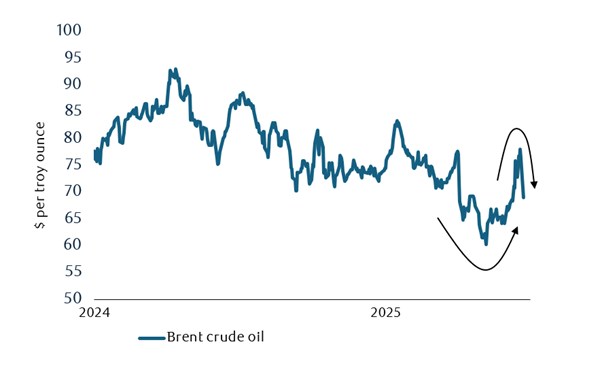
Oil prices rose sharply amid heightened tensions, but a ceasefire saw prices return to pre-conflict levels.

Oil reflected the Middle East crisis with prices rising by around $10, but that has largely dissipated

Oil prices

Source: LSEG/Bloomberg

It’s been a dramatic few days in the Middle East with some broadening of participation and targets. Over the weekend the U.S. struck three uranium enrichment facilities in Iran, and we wait to hear how effective those strikes were. Thereafter, Iran retaliated with missiles launched at a U.S. air base in Qatar. Those attacks were easily intercepted, and the base had already been evacuated as a precaution. The event was considered to be stage-managed to allow the Iranian regime to credibly claim they had responded.

Over the course of the crisis, around $10 of risk premium had been incorporated in the prevailing oil price. That had the potential to add 0.3% to 0.4% to U.S. inflation and detract a similar amount from growth. Prior to the incursions, the oil market was over-supplied and prices had been weak. OPEC seemed unwilling to defend the price.

Following the U.S. action and the stage-managed Iranian response, President Trump announced a ceasefire had been agreed. The price fell below the level at which it was trading prior to Israel’s initial attacks. In the short-term, hopes are high that this crisis is resolved however, critically, questions remain over whether the ceasef fire is being observed. Over the longer term it remains to be seen whether the U.S. action is enough to discourage, or ensure the end of, Iran’s nuclear ambitions.

Core inflation has been gradually decreasing despite tariffs (so far)

Core inflation

Source: LSEG Datastream

Despite anxiety over U.S. tariffs in the last few months, the U.S. economy remains in reasonable shape.

The headline U.S. retail sales growth was below expectations, but this seems to be driven by the usual one-off elements. For example, when the weather takes a turn for the worse, consumers delay their buying and that affected the U.S. during May as seen in the weather sensitive building materials and garden equipment sales sector.

However, despite the anxiety, the American economy has continued to function normally. Consumers have yet to be subjected to the burden of tariffs. They can worry about them, but they aren’t changing their spending habits. Going forward, that could change when prices eventually start to rise, not least because now there’s an increase in the all-important gasoline price to contend with.

Uncertainty over this left the Federal Reserve on hold, but they’re still effectively endorsing the markets’ expectations of two more interest rate cuts this year. Beneath the surface though, that level of conviction appears to be dropping and the case for just a single cut grows louder. This declining expectation of interest rate cuts would normally weigh on the dollar, but it hasn’t been trading in line with interest rate expectations recently. Added to which, the dollar remains very overvalued relative to other major currencies, so the case for a weak dollar remains intact.

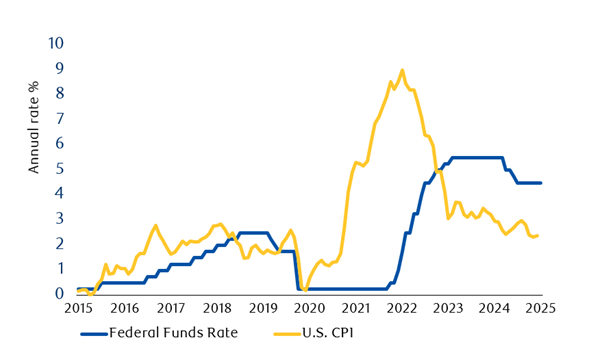
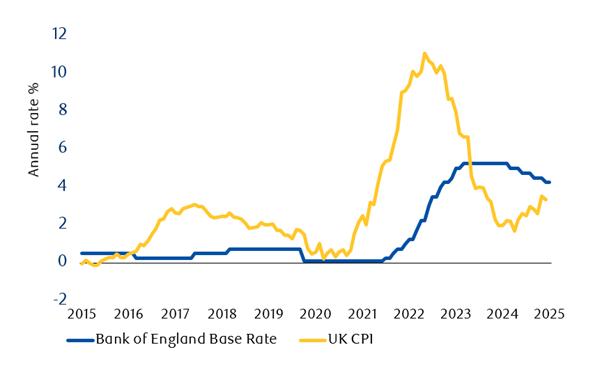
Interest rates have been cut, but inflation remains a problem in the UK

Interest rates

Source: LSEG Datastream

The UK also saw weak retail sales, which adds to a pattern of weaker economic data that has been coming from the UK.

House prices were strong at the start of the year, but now they’re slowing. Employment has been on a downward trend which seems to have accelerated. Added to which, interest rates were raised very sharply between 2022 and 2023. So, there would seem to be ample opportunity to continue cutting rates, and a growing rationale for doing so.

However, the challenge facing the Monetary Policy Committee (MPC) is that core Consumer Price Index (CPI) remains too high at a time when inflation has spent much of the last three years well above the inflation target, a fact which is increasingly becoming enshrined in consumers’ expectations of inflation. As such, it remains the imperative of the Bank of England (BoE) to continue to see validation of its rate cutting stance as it progresses with monetary easing.

The BoE held interest rates this month but is expected to cut them again in August. Lower interest rates would support the UK bond market and lower bond yields would be helpful for the Chancellor, Rachel Reeves. Public finance data suggested that she had some success reining in government expenditure following the Spring Budget, however higher bond yields mean that interest costs are due to eat away at her fiscal headroom and raise the risk of further tax increases in the autumn. 

Please continue to check our blog content for advice, planning issues and the latest investment market and economic updates from leading investment houses.

Charlotte Clarke

25/06/2025