Team No Comments

Weekly market commentary: Outlook for inflation remains uppermost for investors

Please see below weekly market commentary received from Brooks Macdonald yesterday afternoon, which provides a global market update as we lead up to Christmas.

As markets start the last full trading week of 2022, the outlook for inflation remains uppermost for investors

Equity markets finished last week on the back foot, as the US Federal Reserve (Fed) in particular, but also the European Central Bank (ECB), kept to their hawkish messaging over the inflation and interest rate outlook. But over the week as a whole, while German 10 year Bund yields rose, US 10 year Treasury yields fell, suggesting US bond markets might be questioning the Fed’s inflation outlook. This came as the Fed, ECB, and the Bank of England (BoE) all down-shifted their rate hikes to 50bps last week,1 and US CPI consumer price inflation for November missed analyst expectations on the downside for the second month in a row. In the Fed’s latest summary of economic projections that were published last week, US headline PCE personal consumption expenditures inflation is expected to end 2023 at 3.1%, which would be an almost halving of the 6% rate printed for October.2 Later this week, November US PCE inflation data is due out on Friday, providing markets with arguably the last big economic data focal point ahead of Christmas. Before that, on Tuesday, we will get producer price inflation data for November out of Germany, where October’s print had seen the first month on month fall in producer prices since May 2020.

Bank of Japan meets

Following last week’s jam-packed news flow from the Fed, BoE, and ECB, this week the central bank baton is handed over to the Bank of Japan (BoJ) who are due to announce their latest policy settings on Tuesday. Versus the hiking we’ve seen this year from most major developed central banks, the BoJ has stuck with a loose monetary policy stance with its short-term interest rate at -0.1% and capping 10-year bond yields around 0%3. As a result, interest rate differentials have been a big driver of Japanese yen weakness in currency markets in 2022. Despite Japanese inflation having picked up recently, the ex-fresh food and energy CPI annual inflation rate (the so-called ‘core-core rate’) was running at 2.5% for October,3 still some way below the levels seen in many developed markets elsewhere. On the subject of inflation, Japan’s latest November CPI print is due out on Thursday this week.

EU energy ministers meeting to resume natural gas price cap talks

European Union energy ministers are due to resume talks today, aimed at getting agreement on a natural gas price cap. Despite months of negotiation, EU countries have not yet been able to reach agreement over the cap and the level and conditions to set it at. Indeed, questions remain as to whether a natural gas price cap could ease or in fact actually end up worsening Europe’s energy crisis. For example, representatives from Europe’s biggest gas market Germany have previously cautioned that a cap on natural gas prices in the region could disrupt the functioning of the continent’s energy markets and divert much-needed gas supplies to other regions globally where prices are not capped. According to EU energy regulators in a report published April this year (ACER, the EU’s Agency for the Cooperation of Energy Regulators), the total EU27 storage working gas volume capacity is only approximately 27% of the annual gas consumption in the EU27.4 As a result, despite relatively high storage levels coming into the current winter period, arguably a bigger problem for EU countries will be faced next year and in particular next year’s winter, given expectations of continued energy supply disruption which could challenge efforts to refill gas stores. This suggests the risk of an enduring and unwelcome relative price headwind for both European businesses and consumers continuing in 2023.

Please check in again with us shortly for further relevant content and news.

Merry Christmas.

Chloe

20/12/2022

Team No Comments

Daily Investment Bulletin

Please see below article received from Brooks Macdonald earlier this afternoon, which provides a global market update following positive economic developments in the US and Europe.

What has happened

Equity markets ended the day slightly lower as economic growth concerns continued. Bond yields fell as this weaker demand narrative was priced in, with the US 10-year yield now down to 3.42%, maintaining the significant inversion of the yield curve.

Economic growth

Nearer term strong economic momentum in the US, such as the upward revision to Q3 productivity, is doing little to shake the market’s malaise over the state of the global economy. Europe also saw some more constructive data with Euro Area growth revised up by 0.1%. Despite this, yesterday saw further falls in the US and international oil benchmark with Brent crude closing yesterday with a year-to-date loss. These moves, whilst implying far weaker demand, should reduce inflationary pressures, with US gasoline prices already at their lowest levels since January of this year. The 10-year inflation breakeven, a market proxy for inflation expectations, fell to just 2.27% as investors wager that the current period of heightened inflation will fade.

Central banks

The Bank of Canada hiked rates by 50bps yesterday however they did so alongside a dovish statement that said that the ‘Governing Council will be considering whether the policy interest rate needs to rise further.’ Whilst this does not mean that the Bank of Canada has necessarily reached its terminal rate, that will ultimately be driven by the change in the rate of inflation, it is the closest we have had this cycle to a ‘pause’ in rate rises. With many in the market hoping for a 25bp rate rise from the Bank, Canadian government bonds underperformed yesterday despite the more dovish overtones within the policy statement.

What does Brooks Macdonald think

Next week’s Fed and ECB decision will, alongside the US CPI print, set the scene for December. Unhelpfully for the ECB, the latest inflation survey saw upgraded expectations of 1-year Euro Area inflation.  The central bank will be far more concerned about medium term expectations such as the 3-year rate which remained unchanged at 3%, however the ECB and the Fed not only need to tackle actual inflation but also consumer and business expectations. This is one of the reasons why we should expect continued hawkish rhetoric from those two banks even if their actions become softer in the coming months.

Index 1 Day1 Week1 MonthYTD 
 TRTRTRTR 
MSCI AC World GBP -0.8%-4.6%-0.9%-8.1% 
MSCI UK GBP -0.4%-1.0%3.0%7.4% 
MSCI USA GBP -0.6%-5.9%-2.6%-9.1% 
MSCI EMU GBP -0.6%-1.3%4.1%-8.0% 
MSCI AC Asia ex Japan GBP -2.1%-2.9%4.2%-11.4% 
MSCI Japan GBP -0.7%-2.1%1.7%-7.8% 
MSCI Emerging Markets GBP -1.8%-3.6%0.8%-11.5% 
Bloomberg Sterling Gilts GBP -0.1%0.4%4.7%-21.4% 
Bloomberg Sterling Corps GBP 0.1%0.8%5.3%-17.2% 
WTI Oil GBP -3.4%-12.7%-26.1%6.0% 
Dollar per Sterling 0.6%1.2%6.0%-9.8% 
Euro per Sterling 0.2%0.3%1.1%-2.3% 
 
Index 1 Day1 Week1 MonthYTD 
 TRTRTRTR 
MSCI AC World USD -0.4%-2.3%5.1%-17.0% 
MSCI UK USD 0.0%1.3%9.3%-3.0% 
MSCI USA USD -0.2%-3.7%3.4%-17.9% 
MSCI EMU USD -0.2%1.1%10.5%-16.9% 
MSCI AC Asia ex Japan USD -1.7%-0.6%10.5%-20.0% 
MSCI Japan USD -0.3%0.2%7.9%-16.7% 
MSCI Emerging Markets USD -1.5%-1.4%7.0%-20.1% 
Bloomberg Sterling Gilts USD -0.3%2.8%11.4%-29.2% 
Bloomberg Sterling Corps USD -0.1%3.2%12.0%-25.4% 
WTI Oil USD -3.0%-10.6%-21.5%-4.3% 
Dollar per Sterling 0.6%1.2%6.0%-9.8% 
Euro per Sterling 0.2%0.3%1.1%-2.3% 
  Bloomberg as at 08/12/2022. TR denotes Net Total Return 

Please check in again with shortly for further relevant content and news.

Chloe

08/12/2022

Team No Comments

Brooks Macdonald Daily Investment Bulletin

Please see below Daily Investment Bulletin received from Brooks Macdonald this morning, which provides a global market update as we enter the festive season.    

What has happened

European equities rose yesterday, reflecting some of the large surge in US indices seen after the European close on Wednesday. US equities meanwhile trod water with banks declining due to a further fall in bond yields and US interest rate expectations. With yields falling and economic growth fears rising, growth equities continued their outperformance yesterday with large cap technology shares rising despite the slight fall in the headline US index.

Economic data

There was little good news within the ISM manufacturing data yesterday which fell into contractionary territory for the first time since May 2020. Both new orders and the employment measure also contracted. The release has added to market concerns over the risk of recession in 2023 and mirrors some of the negativity seen in other data releases in recent weeks. With the Fed, after Powell’s speech, now viewed as more aware of the economic risks in 2023 and beyond, bad economic news is no longer necessarily good news for markets. In a sign that a bit of normality has returned, yields fell on the back of this poorer data as bond markets priced in a loosening of Fed policy in future years. The terminal rate is now only expected to reach 4.86% in the US, a major downgrade from last week’s figure.

US employment report

Today sees the latest release of the US non-farm payroll figures which the market expects to come in at 200,000 new jobs created in November compared to 261,000 created in October. Whilst the overall unemployment rate is expected to hold steady at 3.7%, 200,000 new jobs would be the weakest reading in two years. With markets already concerned about economic growth momentum, a weak employment report would likely catalyse further fears of a cyclical slowdown.

What does Brooks Macdonald think

More positively, reduced economic momentum does appear to be filtering through to the inflation numbers, however. The PCE inflation number, which is the Fed’s preferred gauge, came in below expectations at both a headline and a core level. The question for markets now is how quickly the inflation numbers can fall and therefore allow the Fed and other central banks to react to the recessionary risks in 2023.

Index 1 Day1 Week1 MonthYTD 
 TRTRTRTR 
MSCI AC World GBP -1.9%0.4%1.5%-5.5% 
MSCI UK GBP -0.2%1.2%5.5%8.3% 
MSCI USA GBP -2.6%0.2%-0.9%-6.0% 
MSCI EMU GBP -0.1%0.4%7.9%-6.9% 
MSCI AC Asia ex Japan GBP -1.5%3.4%9.6%-10.1% 
MSCI Japan GBP 0.1%-0.9%4.7%-5.6% 
MSCI Emerging Markets GBP -2.0%2.3%5.8%-10.0% 
Bloomberg Sterling Gilts GBP 0.4%-1.3%2.6%-21.4% 
Bloomberg Sterling Corps GBP 0.5%-0.6%4.0%-17.5% 
WTI Oil GBP -1.8%2.3%-13.9%19.2% 
Dollar per Sterling 1.6%1.1%6.6%-9.5% 
Euro per Sterling 0.5%0.1%0.1%-2.1% 
MSCI PIMFA Income -0.7%0.0%2.2%-6.6% 
MSCI PIMFA Balanced -0.9%0.1%2.4%-6.0% 
MSCI PIMFA Growth -1.2%0.3%2.2%-4.1% 
 
Index 1 Day1 Week1 MonthYTD 
 TRTRTRTR 
MSCI AC World USD 0.7%1.6%8.3%-14.4% 
MSCI UK USD 2.5%2.3%12.6%-1.9% 
MSCI USA USD 0.0%1.3%5.7%-14.8% 
MSCI EMU USD 2.6%1.5%15.2%-15.6% 
MSCI AC Asia ex Japan USD 1.1%4.6%16.9%-18.6% 
MSCI Japan USD 2.8%0.2%11.7%-14.5% 
MSCI Emerging Markets USD 0.6%3.5%13.0%-18.4% 
Bloomberg Sterling Gilts USD 3.4%-0.3%9.8%-28.8% 
Bloomberg Sterling Corps USD 3.5%0.5%11.3%-25.3% 
WTI Oil USD 0.8%4.2%-8.1%8.0% 
Dollar per Sterling 1.6%1.1%6.6%-9.5% 
Euro per Sterling 0.5%0.1%0.1%-2.1% 
MSCI PIMFA Income USD 1.9%1.1%9.1%-15.4% 
MSCI PIMFA Balanced USD 1.7%1.3%9.3%-14.9% 
MSCI PIMFA Growth USD 1.4%1.4%9.1%-13.1% 
  Bloomberg as at 02/12/2022. TR denotes Net Total Return 

Please check in again with us soon for further relevant content and news.

Chloe

02/12/2022

Team No Comments

Tatton Monday Digest

Please see below article received from Tatton this morning, which provides a global market update as we approach the festive season.

Overview: Strength in weakness


Market sentiment seems to have improved significantly from one month ago. The release of the minutes from the Federal Open Markets Committee’s (FOMC, US central bank rate setters) 2nd November meeting offered documented evidence that members see a case for tempering its interest rate increases at future meetings. It is reasonably clear that recent declines in both actual inflation data and continued falls in the raw material cost inputs have changed perceptions of medium-term risks.

Moreover, despite the still-present potential for shock from the crypto-currency market, US retail investors appear to be heading back into the equity market. Government and corporate bonds have all recently gone up in price, although equity investors appear to be more positive about the future than bond investors. They expect earnings growth to either rebound next year or for the following years to be more profitable than usual. Perhaps investors have given up on the promise of fanciful riches from speculation in new currencies, and would rather invest in the more certain profits of companies. November retail volume flows have been the best in two years for small and mid-caps, according to JP Morgan’s flow data.

For us, one of the most interesting dynamics in capital markets this year has been the massive decline in corporate high-yield bond issuance. Given how fast and far yields rose, companies may be awaiting a better opportunity to issue debt, as investors are turning more optimistic and willing to buy at a yield that is significantly lower than seen two months ago. If and when issuance finally picks up, it will provide a real acid test and unveil whether lower junk bond yields have been the result of low issuance or a real sentiment shift towards a more optimistic 2023 outlook.

A last word on China, which we talked about last week in positive tones. While moving away from its ‘zero-Covid’ policy was inevitable, the transition was never likely to be smooth. Chinese authorities’ relentless past messaging about the dangers of the virus spreading may have been useful in gaining acceptance of the stringent lockdowns, but now those fears are a big impediment to opening up. It is going to be challenging, for sure, but nevertheless, there is no real alternative and so we expect China to gradually open up, even if that is interspersed by many renewed regional short-term lockdowns.

PMIs paint a gloomy picture for businesses 


Regular readers will know that Purchaser Manager Indices (PMIs) surveys are important surveys of business sentiment. These surveys have been a surprisingly reliable indicator of future growth, where marks above 50 indicate expansion, and anything below that points to contraction. Across the latest PMI surveys for Europe and the US, companies are showing a high degree of pessimism. For November, every single European and American PMI we monitor came in below 50.

This is more confirmation, if any was needed, that times are tough. However, we should note that there was nevertheless a fair amount of good news in last week’s PMI releases, particularly coming from Europe. Economists expected the Eurozone PMI for the manufacturing sector would be again lower at 46, down 0.4 points from the previous month. In fact, European manufacturers posted a more upbeat reading of 47.3. Likewise, Europe’s services sector PMI came in at 48.6, matching last month’s reading and beating expectations of 48. The Eurozone’s composite figure beat both expectations and last month’s figure with a reading of 47.8. Clearly, these are not levels to get too excited about – they still point to a dreary picture in absolute terms. But they indicate a surprising amount of resilience from European businesses. That is hugely significant, given the overwhelming negativity on the continent.

The biggest surprise within the latest set of PMIs however, came from the US. Even though the US economy has slowed in recent months, economists expected only a mild decline. The November flash data was therefore quite worrisome: US PMIs came in well below expectations across the board, showing a sharp drop-off from last month. Manufacturing sentiment was expected to stay exactly neutral at 50, but instead came in at a decidedly downbeat 47.6. The predictions for the services sector were slightly worse at 48, but even that proved too optimistic, as US firms posted 46.1. It is difficult to make cross-country comparisons with the absolute figures, but even so, the fact that the aggregate reading for the US was below even struggling Germany is remarkable.

These PMIs suggest we may be entering a new phase of the global slowdown. Before, the focus was on hard input cost pressures and which region might be worst affected. Now, the problem may be more about employment and wage inflation and lagged effects of monetary tightening. While labour markets are tight around the world, the US jobs market is particularly tight, forcing the Fed to be more aggressive than most. This is perhaps a sign that the much-discussed ‘engineered recession’ could be upon us – to the relative benefit of Europe and the relative detriment of the US.

Continued labour market tightness keeps up pressure 


Even with slowing growth and generally pessimistic outlooks from companies, labour shortages continue. This is a particular issue in the US, where wage pressures have stayed high despite aggressive monetary tightening from the Fed. US employers added 261,000 extra jobs in October alone, after similar figures over the previous two months. This may come as a surprise, given high-profile reports of job losses across key US industries. Tech giants like Amazon and Meta made headlines recently by announcing a wave of job cuts and hiring freezes. But these news stories are not a good guide to overall employment trends. First, tech sector job openings remain well above their pre-pandemic peak. And more importantly, the US mega-tech sector accounts for a rather small part of overall US employment. 

Cyclical factors have contributed to the labour market squeeze. But the problem that policymakers now realise is that labour shortages appear to be structural. Over the past five years, governments (especially the UK and US) have moved towards tighter immigration controls, with the explicit aim of preventing employment competition for domestic workers. The result is a disconnect between what businesses and politicians say about jobs. We see this here in the UK, and the Confederation of British Industry (CBI) recently pleaded with Rishi Sunak’s government to ease migration controls, while policy continues to move in the opposite direction.

This creates a difficult situation for central banks, and especially the Fed. The FOMC minutes last week revealed most committee members expect to slow the pace of interest rate rises, and falling input price inflation backs this up. The next meeting is less than three weeks away, on 14th December. The underlying structure of the labour market is still such that wage-inflation could return quickly. Policymakers will be focused on the festive period ahead, to see how resilient consumer demand is. Anyone expecting the Fed or the Bank of England to ease off soon might be disappointed. 

Please check in again with us soon for further relevant content and news.

Chloe

28/11/2022

Team No Comments

Autumn Statement 2022

Please see below article received from Brewin Dolphin yesterday evening following the 2022 Autumn Statement.

Chancellor Jeremy Hunt has delivered his autumn statement, in which he set out plans to increase taxes and reduce spending in an effort to narrow the gap between the government’s income and outgoings

After his predecessor’s mini-budget in September triggered a slump in the pound and a sell-off in UK government bonds, this autumn statement was very much about reassuring the markets by demonstrating fiscal responsibility. The statement did not contain any nasty surprises, as many of the tax increases had been leaked in advance, and it was accompanied by growth forecasts from the Office for Budget Responsibility (OBR) – something that was noticeably missing from the mini-budget.

The raft of tax hikes included slashing the capital gains tax (CGT) exemption, dividend allowance and additional-rate income tax threshold, and extending the freeze on the personal allowance, higher-rate income tax threshold and inheritance tax (IHT) nil-rate band. Hunt also announced that public spending would rise by just 1% a year in real terms in the next parliament. The energy price cap will increase from April 2023, meaning the average household will see their bills rise from £2,500 to £3,000 a year.

Here, we highlight the key announcements, before giving Guy Foster’s view on the implications for UK economic growth and investors.

Capital gains tax

What has changed? The chancellor announced that the annual CGT exemption will be slashed from £12,300 in the current tax year to £6,000 in 2023/24 and £3,000 in 2024/25. Any profits (‘gains’) that exceed the exemption will be taxed at the existing rates of 20% for higher and additional-rate taxpayers and 10% for some basic-rate taxpayers (28% or 18% on gains from residential property).

What does it mean for investors? A higher-rate taxpayer who makes a capital gain of £20,000 in the 2023/24 tax year could face a CGT bill of £2,800, rising to £3,400 in 2024/25. This is a considerable increase from £1,540 currently. There are several ways to mitigate CGT, including investing in an ISA, making the most of the CGT exemption each tax year, and using losses to reduce your gain.

Dividend tax

What has changed? The annual dividend allowance – the amount of dividend income you do not have to pay tax on – will fall from £2,000 in the current tax year to £1,000 in 2023/24 and £500 in 2024/25. The rate of dividend tax will remain at 8.75% for basic-rate taxpayers, 33.75% for higher-rate taxpayers and 39.35% for additional-rate taxpayers.

What does it mean for investors? A higher-rate taxpayer who receives dividend income of £5,000 in the 2023/24 tax year could pay £1,350 in dividend tax, rising to £1,518.75 in 2024/25. This compares with £1,012.50 currently. Maximising your ISA allowance each year could become even more important, as any dividends you receive on investments held in an ISA are tax free. Some specialised investments may enable you to reduce dividend tax, but it’s important to seek advice on whether they are right for you.

Income tax thresholds

What has changed? The additional-rate income tax threshold will be lowered from £150,000 to £125,140 from April 2023. The personal allowance (the amount you can earn each year before you start paying income tax)

and the higher-rate income tax threshold have been frozen at their 2021/22 levels of £12,570 and £50,270, respectively, for an additional two years until 2028. Over a nine-year period from 2019/20, the personal allowance and higher-rate tax thresholds will have risen by just £70 and £270, respectively.

What does it mean for investors? Lowering the additional-rate income tax threshold will result in more people paying the 45% top rate of income tax. Someone earning £150,000 could face an income tax bill of £53,703 in 2023/24, up from £52,460 currently. Meanwhile, freezing the personal allowance and higher-rate tax threshold could see more people drifting into higher tax bands because of inflation. An individual who earned £50,000 in 2021, and whose income rises in line with actual and forecast consumer price index (CPI) inflation1 , could see their income tax bill rise from £7,486 to £15,825 by 2028.

One way to potentially reduce your income tax bill is to save into a pension. If your salary and/or bonus means you cross into a higher tax band, making a personal pension contribution could mean your adjusted net income falls to below the threshold and potentially avoids higher or additional-rate tax.

Inheritance tax nil-rate band

What has changed? The IHT nil-rate band and residence nil-rate band have also been frozen for another two years until 2028. The IHT nil-rate band has remained at £325,000 since 20092. Over this period, the average UK house price has surged by 77% from £154,006 to £273,135 in 2022, according to Nationwide3 . By 2028, families will have missed out on almost 20 years of inflation-linked increases. The residence nil-rate band – an additional allowance for those who pass on their main residence to children or grandchildren when they die – was last increased in April 2020 to its current level of £175,000.

What does it mean for investors? Freezing the thresholds could result in more families being caught in the IHT net. In the last decade alone, IHT receipts have rocketed from £2.9bn in 2011/12 to £6.1bn in 2021/224 . There are several ways to help mitigate IHT, particularly if you plan ahead.

Pension lifetime allowance

What has changed? Nothing. It was widely expected that the pension lifetime allowance – the total amount you can save into your pension before incurring tax charges – would also be frozen for another two years, but this did not happen. The existing freeze will therefore end in 2026, unless anything changes between now and then. The lifetime allowance rose in line with CPI inflation between 2018/19 and 2020/21, but has stayed at its current level of £1,073,100 since then. If it were to keep pace with actual and projected CPI1 , and therefore retain its value to individuals, the lifetime allowance would need to rise to £1,432,337 by 2026, according to our calculations.

What does it mean for investors ? The combination of long-term investment growth and high inflation could see more people inadvertently breaching the lifetime allowance and facing a hefty tax charge when they come to draw pension income.

Pension tax relief

What has changed? Nothing. There were rumours that the chancellor was considering scrapping higher rates of pension tax relief and moving to a single flat rate of 20%, but this did not come to fruition.

What does it mean for investors? Higher and additional-rate taxpayers can continue to benefit from tax relief of up to 40% and 45%, respectively (subject to limitations).

State pension

What has changed? The state pension will increase in line with inflation by 10.1% in April 2023.

What does it mean for investors? Those who qualify for the full state pension will receive an additional £870 in the 2023/24 tax year.

The economy

This autumn statement was accompanied by the OBR’s economic and fiscal outlook5 , which painted a gloomy picture of the UK economy. High inflation is expected to result in living standards declining by 7% in total over the two years to 2023/24, wiping out the previous eight years’ growth. The OBR warned that the squeeze on real incomes, rise in interest rates and fall in house prices would weigh on consumption and investment, tipping the economy into a recession lasting just over a year from the third quarter of 2022. GDP is forecast to fall by 1.4% in 2023 before rising by 1.3% in 2024 as energy prices and inflation drop.

While government borrowing is forecast to rise from £133.3bn, or 5.7% of GDP, last year to £177.0bn this year (7.1% of GDP), it should gradually fall to £69.2bn (2.4% of GDP) in 2027/28 as a result of tax rises and scaledback fiscal support. Similarly, underlying debt is projected to rise sharply from 84.3% of GDP last year to a 63-year high of 97.6% in 2025/26, but then fall modestly in the subsequent two years.

With such a wide range of measures being announced, Guy Foster, our Chief Strategist, shares his views on how they could affect the economy and investors.

Even without the extensive trailing of measures in the media, the tax hikes and spending cuts in this autumn statement were to be expected, coming in the shadow of former chancellor Kwasi Kwarteng’s widely criticised minibudget. Hunt would have been keen to avoid the market turmoil created by Kwarteng’s now-scrapped tax-cutting measures and, instead, demonstrate to the markets that the UK government is capable of making responsible spending and taxation decisions. Estimates of the size, or even the existence of, the fiscal black hole vary, but if markets lose faith in the government, it can lead to higher borrowing costs which ultimately hit consumer spending as interest rates rise.

Higher taxes and lower spending should eventually help to bring down inflation, which rose to a 41-year high of 11.1% in October. This will, however, be of little consolation to households who face paying more tax at a time when wallets are already squeezed. Freezing tax thresholds draws more people into the income tax net, more assets into taxable estates for inheritance tax purposes, and diminishes the real value of the pension lifetime allowance.

The challenge for the chancellor has been to confront inflation without damaging the UK’s longer-term growth prospects. Like many developed economies, the UK has seen declining birth rates and rising life expectancy, which is a headwind for economic growth. It makes it harder to maintain a low tax base for a given level of public services, and makes achieving higher productivity more important than ever. Yet trying to increase productivity comes with many challenges: changes now may take a long time to bear fruit; determining how much benefit measures will yield is highly subjective; and there is invariably some sort of cost to such measures – either economic (i.e., investment in education) or political (i.e., immigration or planning reform).

Nonetheless, the announcements confirming funding for the Sizewell C nuclear power station and HS2 rail project, along with reforms to Solvency II insurance rules that aim to free up funding for infrastructure, were among the measures demonstrating that growth was an important part of the chancellor’s juggling act.

Please check in with us again soon for further relevant content and news.

Chloe

18/11/2022

Team No Comments

Stocks rise as US inflation eases

Please see below ‘Markets in a Minute’ article received from Brewin Dolphin yesterday evening, which provides a largely positive global market update.

Global stock markets rallied last week as lower-than[1]expected US inflation raised hopes the Federal Reserve would slow its pace of interest rate hikes.

The S&P 500 rose 5.9% to mark its best week since June. Technology stocks performed particularly strongly, helping the Nasdaq surge 8.1%.

Signs of easing US inflation also boosted stocks in Europe and Asia, with Germany’s Dax and Japan’s Nikkei 225 advancing 5.7% and 3.9%, respectively. China’s Shanghai Composite added 0.5%, with gains held back by the first decline in Chinese exports for two years.

The FTSE 100 was the weakest performer among the major indices, declining 0.2% on the back of disappointing UK gross domestic product (GDP) numbers.

Investors look ahead to autumn statement

The FTSE 100 started this week in the green, rising 0.9% on Monday (14 November) as investors looked ahead to UK chancellor Jeremy Hunt’s autumn statement on Thursday. Hunt is expected to announce a range of tax increases and spending cuts to help plug a hole in the public finances. In economic news, data from Rightmove showed the average UK house price declined by 1.1% in November following a 0.9% increase the previous month.

US stocks fell on Monday following reports that e-commerce giant Amazon is considering laying off 10,000 employees – roughly 1% of its global workforce. The S&P 500 slipped 0.9% and the tech-heavy Nasdaq lost 1.1%.

The FTSE 100 was up 0.2% at the start of trading on Tuesday, as investors digested the latest labour market data from the Office for National Statistics (ONS). The unemployment rate was an estimated 3.6% in July to September, 0.2 percentage points lower than the previous three-month period and 0.4 percentage points below pre-pandemic levels.

US inflation lower than expected

Last week’s economic headlines were dominated by the surprise drop in US inflation. The headline CPI rose by 7.7% year-on-year in October – the slowest rate since January and below the 8.0% figure expected by economists. On a monthly basis, the CPI rose 0.4%, below expectations of around 0.6%.

Even more encouraging was an easing in core inflation, which strips out food and energy prices. This fell back to an annual rate of 6.3% from a 40-year high of 6.6% in September. Shelter was the dominant factor driving core CPI, rising by 0.8% month-on-month in October – the biggest increase in over 32 years. When food, energy and shelter are stripped out, the CPI declined by 0.1% from the previous month.

Following the release of the data, several Federal Reserve officials appeared to signal their support for a slower pace of interest rate hikes. Patrick Harker, president of the Philadelphia Fed, was quoted in the Financial Times as saying: “In the upcoming months, in light of the cumulative tightening we have achieved, I expect we will slow the pace of our rate hikes as we approach a sufficiently restrictive stance.” And Lorie Logan, president of the Dallas Fed, said: “While I believe it may soon be appropriate to slow the pace of rate increases so we can better assess how financial and economic conditions are evolving, I also believe a slower pace should not be taken to represent easier policy.”

But consumer sentiment remains low

On a less positive note, a report on Friday showed US consumer sentiment fell in November to its lowest level since July. The University of Michigan’s preliminary reading dropped to 54.7 from 59.9 the previous month. Economists polled by Reuters had forecast a reading of 59.5. One-year inflation expectations edged up to 5.1% from 5.0% in October, while buying conditions for durable goods fell 21% due to high interest rates and continued high prices.

“Instability in sentiment is likely to continue, a reflection of uncertainty over both global factors and the eventual outcomes of the election,” said survey director Joanne Hsu.

UK economy shrinks in third quarter

Here in the UK, figures released on Friday showed UK GDP shrank by 0.2% in the third quarter, marking the first quarterly decline since the start of 2021. Output slowed in services, production and construction, while real household expenditure declined by 0.5% as prices soared. GDP in September alone fell by 0.6%, although the ONS noted that data for the month was affected by the bank holiday for the state funeral of HM Queen Elizabeth II.

Regardless, it leaves the UK economy, unlike its developed European peers, smaller than it was before the pandemic.

The data came a week after the Bank of England warned the UK was heading for its longest recession since records began a century ago. GDP is expected to continue falling through 2023 and into the first half of 2024.

Chancellor Jeremy Hunt said he would try to make any recession “shallower and quicker” than predicted, adding that there is “a tough road ahead”.

Eurozone facing imminent recession

The eurozone and most EU countries are also heading for an imminent recession, according to the European Commission. EU economy commissioner Paolo Gentiloni said at a press conference that the economic situation had “deteriorated markedly” and the eurozone was heading into two consecutive quarters of contraction – the technical definition of a recession.

The commission said that while GDP growth in the EU is likely to be better than expected this year – at 3.3% rather than 2.7% – a weaker external environment and tighter financing conditions are expected to tip the EU, the euro area and most member states into a recession in the last quarter of the year. “As inflation keeps cutting into households’ disposable incomes, the contraction of economic activity is set to continue in the first quarter of 2023,” the commission added. “Growth is expected to return to Europe in spring, as inflation gradually relaxes its grip on the economy.”

Please check in again with us soon for further relevant content and news.

Chloe

16/11/2022

Team No Comments

European stocks soar as BoE turns more dovish

Please see below ‘Markets in a Minute’ article received from Brewin Dolphin this morning, which offers a global market update and touches on higher interest rates and inflation levels.   

UK and European stocks rose for a third consecutive week last week after the Bank of England (BoE) signalled a more dovish outlook for UK interest rates.

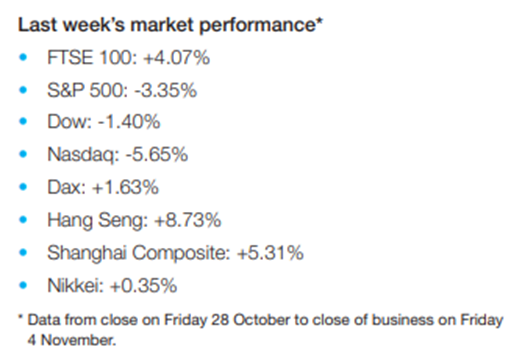
The FTSE 100 leapt 4.1%, Germany’s Dax gained 1.6% and the pan-European STOXX 600 rose 1.5%. This was despite warnings of a two-year UK economic slump and higher-than-expected eurozone inflation.

China’s stock markets also rallied, with the Shanghai Composite surging 5.3% on rumours the country was considering relaxing its zero-Covid strategy. These hopes were subsequently quashed over the weekend, when China’s National Health Commission reiterated its commitment to eliminating Covid-19 and said its prevention and control strategy was “completely correct”.

US indices ended the week lower after Federal Reserve chair Jerome Powell said it was “very premature” to consider pausing interest rate hikes. Better-thanexpected nonfarm payroll numbers helped the S&P 500 rebound on Friday after a four-day selloff, but the index still finished the week down 3.4%. The Nasdaq sank 5.7% as the fallout from disappointing technology sector earnings continued.

Stocks rise ahead of US CPI

US indices rose on Monday (7 November) as investors looked ahead to Tuesday’s midterm elections and the release of the closely watched consumer price index (CPI) report. The Dow advanced 1.3% and the S&P 500 added 1.0%.

In contrast, the FTSE 100 slipped 0.5% on Monday as the denial of any easing of China’s zero-Covid policy dented investor sentiment. In economic news, data from Halifax showed house prices fell by 0.4% month-onmonth in October, the steepest monthly decline since February last year. The blue-chip index extended declines at the start of trading on Tuesday, as figures from BRC/ KPMG showed UK retail sales slowed in October.

BoE lifts base interest rate to 3.0%

Last week, the Bank of England’s monetary policy committee (MPC) voted to increase the base interest rate by 0.75 percentage points – the biggest rate hike since 1989. The base rate now stands at 3.0%, up from just 0.1% in December last year. The BoE warned of a “very challenging outlook”, with the economy forecast to remain in recession for two years until mid-2024 and unemployment rising to 6.4%.

BoE governor Andrew Bailey said that while the Bank couldn’t make any promises about future interest rates, “we think [the] bank rate will have to go up by less than currently priced into financial markets.” The BoE pointed out that if rates rose to 5.25%, inflation would fall to zero in three years’ time. This suggests smaller rate hikes would be needed to return inflation to the 2% target. Following the MPC meeting, markets now expect interest rates to peak at about 4.6%.

Fed warns of higher interest rates

Whereas the BoE’s comments were seen as relatively dovish, the chair of the Federal Reserve adopted a hawkish tone after US interest rates were lifted by 0.75 percentage points, in line with expectations.

A statement by the Federal Open Market Committee was interpreted by markets as a signal that the central bank could slow the pace of rate hikes. In a post-meeting press conference, however, Powell said interest rates would peak at a higher level than previously expected and that the Fed has “some ways to go” in its attempt to rein in inflation. He also hinted that the central bank preferred to raise interest rates too high, potentially sparking a recession, rather than risk keeping rates too low to bring down inflation.

“If we were to overtighten, we could then use our tools strongly to support the economy,” he said, in comments reported by the New York Times. “Whereas if we don’t get inflation under control because we don’t tighten enough, now we’re in a situation where inflation will become entrenched. And the costs – the employment costs, in particular – will be much higher.”

Eurozone inflation hits 10.7%

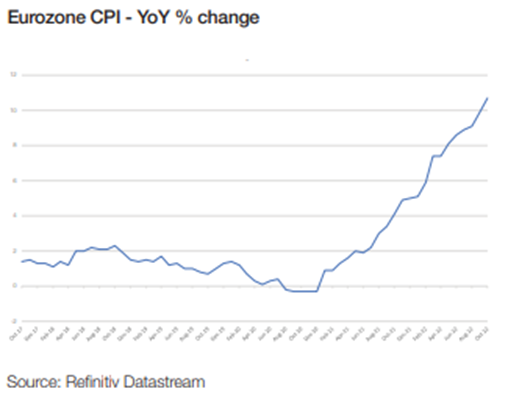
Last week also saw the release of the latest eurozone inflation figures. According to Eurostat, annual inflation rose to a higher-than-expected rate of 10.7% in October, up from 9.9% in September. This was driven by surging energy prices, which increased 41.9% year-on-year. Food, alcohol and tobacco prices also rose sharply, by 13.1% year-on-year.

On Friday, European Central Bank (ECB) president Christine Lagarde reiterated the ECB’s focus on bringing down inflation. She said that in order to avoid fuelling prices, member states should stick to temporary and targeted support for households affected by the cost-ofliving crisis.

Global manufacturing PMI slips further

Elsewhere, JPMorgan’s global manufacturing purchasing managers’ index (PMI) fell further into contraction territory in October, slipping to 49.4 from 49.8 in September. The output index signalled a third successive monthly drop, with the rate of decline accelerating to the fastest since June 2020. Of the 31 economies included in the survey, 21 reported falling production. The eurozone and the UK saw marked downturns on the back of weak demand, while the pace of growth in North America remained only marginal. The gauge of business optimism fell to its lowest level since May 2020 and was particularly weak across the eurozone, UK and US.

Please check in again with us shortly for further relevant content and news.

Chloe

09/11/2022

Team No Comments

Brooks Macdonald Daily Investment Bulletin

Please see below article received from Brooks Macdonald this morning, which provides a market update and reflects on global economic developments.

What has happened

Despite some initial optimism after the release of the Federal Reserve statement, Fed Chair Powell’s press conference lead to concern that the Fed’s terminal rate could be higher than previously guided and that rates may stay at that level for some time. Against this backdrop equities and bonds both repriced in US trading with the US dollar seeing a fresh bout of strength.

Bank of England

Before we turn to the Fed, today’s Bank of England meeting will be the next milestone for central bank watchers to ponder. The Bank of England has seen a remarkable turn of events since its last meeting in September which has seen the mini-budget, quantitative easing, policy reversal and a change in Prime Minister. The net effect of all of this is that, despite a very volatile round trip, markets still expect the Bank to raise interest rates by 75bps at this meeting. In some ways the central bank is flying blind yet again, as the November Autumn Statement by the government may have very different inflationary impacts depending on how the government chooses to fill the fiscal hole. Despite the political backdrop being far more stable than a month ago, the UK still has a significant inflation problem and that will need to be addressed by the Bank today.

Federal Reserve

The market initially rallied after the Fed raised interest rates by 75bps and inserted the following in the statement, saying that the ‘Committee will take into account the cumulative tightening of monetary policy, the lags with which monetary policy affects economic activity and inflation’. The bond market interpreted this as a dovish pivot and a sign that the pace of interest rate hikes would slow. Powell was at pains to stress during his press conference that whilst the pace of hikes may slow, the terminal rate may need to be higher than the Fed had guided in September and policy may need to stay in restrictive territory for some time to keep inflation under control.

What does Brooks Macdonald think

Powell was consistent in stressing that the rises of under-tightening were greater than over-tightening, continuing to stress the Fed’s role in quashing inflation. There was very little new news in Powell’s statement, but his words pushed back against the market’s, perhaps naïve, belief that the Fed would pivot quickly from rapid tightening to rapid loosening. Now markets are beginning to price in interest rates plateauing at the terminal rate for several meetings, bond yields need to readjust.

Index 1 Day1 Week1 MonthYTD
 TRTRTRTR
MSCI AC World GBP -1.5%0.2%1.4%-8.3%
MSCI UK GBP -0.6%1.3%3.5%2.1%
MSCI USA GBP -2.5%-0.7%1.6%-7.4%
MSCI EMU GBP -0.7%-0.8%5.6%-14.2%
MSCI AC Asia ex Japan GBP 1.0%4.0%-5.6%-17.2%
MSCI Japan GBP 0.9%2.2%1.6%-9.1%
MSCI Emerging Markets GBP 0.7%3.7%-3.2%-14.3%
Bloomberg Sterling Gilts GBP 0.1%1.5%4.2%-23.3%
Bloomberg Sterling Corps GBP 0.3%1.5%5.3%-20.4%
WTI Oil GBP 2.0%3.6%9.8%41.2%
Dollar per Sterling -0.1%-1.2%2.7%-15.2%
Euro per Sterling -0.1%0.7%1.9%-2.4%
MSCI PIMFA Income -0.6%0.8%3.3%-9.2%
MSCI PIMFA Balanced -0.8%0.7%3.0%-8.9%
MSCI PIMFA Growth -1.0%0.6%2.8%-7.1%
Index 1 Day1 Week1 MonthYTD
 TRTRTRTR
MSCI AC World USD -1.6%-1.0%4.6%-22.2%
MSCI UK USD -0.7%0.1%6.7%-13.5%
MSCI USA USD -2.6%-1.9%4.7%-21.5%
MSCI EMU USD -0.8%-1.9%8.9%-27.3%
MSCI AC Asia ex Japan USD 0.9%2.7%-2.7%-29.8%
MSCI Japan USD 0.8%1.0%4.7%-22.9%
MSCI Emerging Markets USD 0.6%2.5%-0.3%-27.3%
Bloomberg Sterling Gilts USD 0.1%0.3%7.0%-35.1%
Bloomberg Sterling Corps USD 0.3%0.2%8.2%-32.7%
WTI Oil USD 1.8%2.4%13.2%19.7%
Dollar per Sterling -0.1%-1.2%2.7%-15.2%
Euro per Sterling -0.1%0.7%1.9%-2.4%
MSCI PIMFA Income USD -0.7%-0.4%6.4%-23.1%
MSCI PIMFA Balanced USD -0.9%-0.5%6.2%-22.8%
MSCI PIMFA Growth USD -1.1%-0.6%5.9%-21.2%

Bloomberg as at 03/11/2022. TR denotes Net Total Return

Please check in again with us soon for further relevant content and news.

Chloe

03/11/2022

Team No Comments

How to measure the new Chancellor’s progress

Please find below, an update on the new Chancellor’s progress so far, received from AJ Bell, yesterday evening – 30/10/2022

Jeremy Hunt is the fourth Chancellor of the Exchequer in four months. He is likely to measure success in terms of jobs, economic growth and ultimately opinion polls and then votes when the next General Election comes around, in 2024, if not earlier.

“Jeremy Hunt is the fourth Chancellor of the Exchequer in four months. He is likely to measure success in terms of jobs, economic growth and ultimately opinion polls and then votes when the next General Election comes around, in 2024, if not earlier. Advisers and clients will be looking to their portfolios to gauge the effect of his policies.”

Advisers and clients will be looking to their portfolios to gauge the effect of his policies. Mr Hunt’s first-day hat-trick of share prices up, sterling up and gilt yields down (17 October) was a good start, as he calmed markets with a return to something that looked like fiscal orthodoxy and promises of some numbers that would actually add up, come the launch of the Medium-Term Fiscal Plan, and the Office for Budget Responsibility’s independent analysis, on 31 October.

Gilt yields have started falling as the pound stabilises

But sterling might already be rolling over and the benchmark ten-year gilt yield is still some fifty basis points (0.50%) higher than when Mr Hunt’s predecessor Kwasi Kwarteng launched his hurried, and ultimately ill-fated, mini-Budget on 23 September. There is still work to be done before jokes about the UK turning into an emerging market stop being funny and start turning serious.

Lessons of history

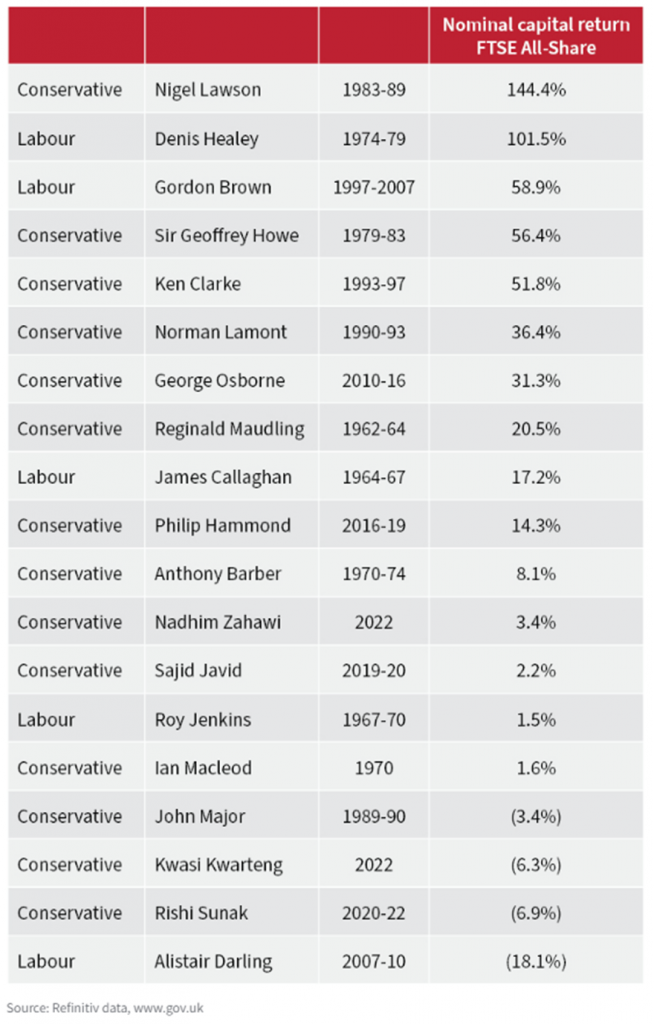
Jeremy Hunt is the twentieth Chancellor of the Exchequer since the inception of the FTSE All-Share index in 1962. Whether he will match Gordon Brown for longevity remains to be seen, as the Labour Chancellor held office for 3,708 days from 1997 to 2007, but he will certainly be hopeful of outlasting his Conservative predecessor, Kwasi Kwarteng, who managed just 38 days.

Fourteen of his predecessors have been Conservative and five Labour, so the public has, so far, preferred to have the Tories in office and in charge of the nation’s finances.

At first glance, from an advisers’ and clients’ point of view, there is little in it between the two parties’ financial stewardship.

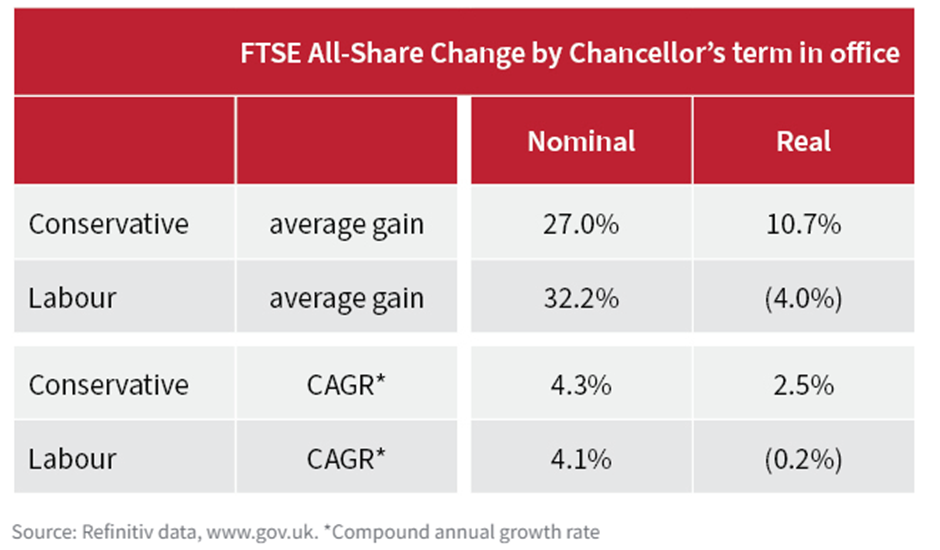
Under Conservative Chancellors, the FTSE All-Share has chalked up a total capital gain of 354%, in nominal terms. That equates to an average advance per Chancellor of 27% (and the average is dragged down by the short tenure of both Nadhim Zahawi and Kwasi Kwarteng).

Under Labour the benchmark has risen by 161% for an average gain of 32.2%.

Across 36 years of Tory Chancellorships that is a compound annual growth rate (CAGR) of 4.3% against 4.1% under 24 years of Labour in 11 Downing Street and two of the top-five best spells under a single Chancellor come under Labour, again in nominal terms.

FTSE All-Share performance by Chancellor of the Exchequer in nominal terms

“The picture changes profoundly when inflation is taken into account and capital returns from the FTSE All-Share are assessed in real (post-inflation) terms rather than nominal ones.”

However, the picture changes profoundly when inflation is taken into account and capital returns from the FTSE All-Share are assessed in real (post-inflation) terms rather than nominal ones.

FTSE All-Share performance by Chancellor of the Exchequer in real terms

Here, Conservative Chancellors come out well on top, as the withering effect of inflation upon investors’ returns from the stock market under Labour’s Healey Chancellorship of the mid-to-late 1970s comes into play, even if Labour supporters will argue his record is tarnished by the need to tackle the mess left behind by the Conservatives’ Anthony Barber’s crack-up boom and the oil price spike of the early seventies.

“The Barber boom and its legacy was one reason why the Truss-Kwarteng mini-Budget frightened markets, as inflation was already lofty before the stimulatory, tax-cutting plan, which conjured up the spectre of more inflation and faster interest rate increases, even as the economy potentially slowed.”

The Barber boom and its legacy was one reason why the Truss-Kwarteng mini-Budget frightened markets, as inflation was already lofty before the stimulatory, tax-cutting plan, which conjured up the spectre of more inflation and faster interest rate increases, even as the economy potentially slowed.

From the narrow perspective of advisers and clients, inflation also chewed up the nominal gains made by the FTSE All-Share under Mr Barber (and under one of his Conservative successors, Geoffrey Howe, for that matter).

FTSE All-Share performance by Chancellor of the Exchequer in real terms

Advisers and clients could therefore be forgiven for wishing Mr Hunt to look back to, and learn from, the experiences of both Barber and Healey, as, helped by the Bank of England, he attempts to steer the economy between the twin threats of inflation on one side and recession on the other.

Misery Index

“The economist Arthur Okun’s Misery Index could be a useful tool to measure the Chancellor’s progress.”

The economist Arthur Okun’s Misery Index could be a useful tool to measure the Chancellor’s progress. It simply adds together the prevailing rate of inflation to the prevailing rate of unemployment, to remind all that full employment is no guarantee of content if there is inflation and that low inflation is no guarantee of happiness (or political success) if unemployment is high.

The Misery index, based on the last published unemployment rate of 3.5% and the last retail price index inflation reading of 12.4%, is 15.5% (RPI is no longer an officially recognised statistic, but the dataset has a longer history that CPI).

That is the highest reading since 1991, when the UK was in a deep recession, and one that was resolved, at least in part, by the devaluation of sterling after its inglorious exit from the Exchange Rate Mechanism in 1992. If the Misery Index starts to drag Mr Hunt down, then sterling could be quick to show further strain.

Past performance is not a guide to future performance and some investments need to be held for the long term.

Please continue to check our Blog content for advice and planning issues and the latest investment, markets and economic updates from leading investment houses.

David Purcell

31st October 2022

Team No Comments

Markets in a Minute – Stocks rise as Liz Truss resigns as prime minister

Please see below ‘Markets in a Minute’ article received from Brewin Dolphin yesterday evening, which provides a global market update with reference to Rishi Sunak’s replacement of Liz Truss as Prime Minister of the UK.

Stocks in Europe and the US recorded strong gains last week as Liz Truss resigned as UK prime minister and many of her fiscal policies were scrapped.

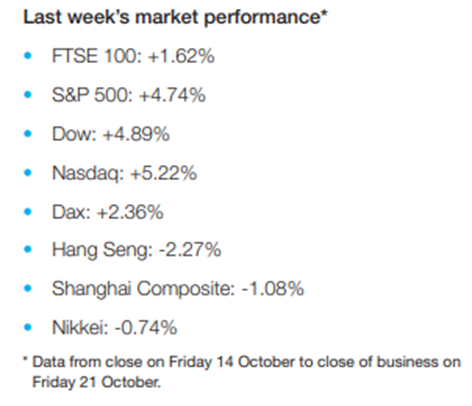
The FTSE 100 gained 1.6%, Germany’s Dax added 2.4% and the pan-European STOXX 600 advanced 1.3% as Truss resigned after only 45 days in office. The announcement came after new UK chancellor Jeremy Hunt reversed almost all the tax-cutting measures contained in last month’s mini-budget.

In the US, the S&P 500 enjoyed its best weekly gain in nearly four months, rising 4.7%. Strong third quarter earnings results and a suggestion that the Federal Reserve might moderate its pace of interest rate hikes helped to boost investor sentiment.

In Japan, the Nikkei declined 0.7% as the yen hit a 32-year low against the US dollar and Japanese core annual inflation accelerated to 3.0% in September. China’s Shanghai Composite fell 1.1% after the country’s statistics bureau said it was delaying the release of third quarter gross domestic product (GDP) data, leading to speculation that China is on track to miss its official growth target of 5.5% this year.

Rishi Sunak named UK’s next PM

Stocks rose on Monday (24 October) as Rishi Sunak was named the UK’s next prime minister. The announcement came shortly before the Conservative Party leadership nominations deadline, with Sunak’s rival Penny Mordaunt pulling out of the race and backing him in the final minutes. The FTSE 100 ended the trading session up 0.6%, while Germany’s Dax gained 1.6%. In the US, the S&P 500 added 1.2% ahead of a big week for third quarter earnings, including Microsoft, Alphabet, Meta Platforms, Apple and Amazon.

UK inflation rises to 10.1%

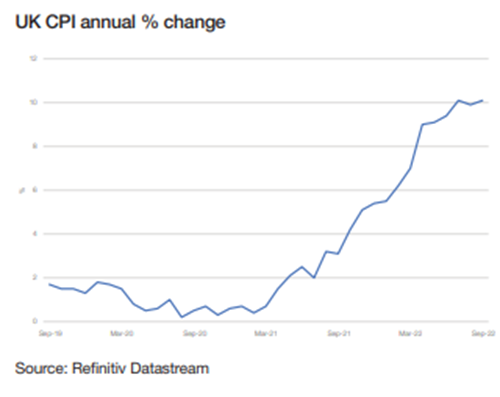
Inflation in the UK rose above 10% for the second time this year in September, according to figures from the Office for National Statistics (ONS). The headline consumer prices index (CPI) measured 10.1%, matching July’s 40-year high after dipping slightly to 9.9% in August.

Food and non-alcoholic drinks were the biggest contributor to the increase, with prices soaring by 14.6%, a 42-year high. Of this, the largest upward effects came from bread and cereals, meat products, and milk, cheese and eggs. This more than offset price declines at petrol pumps. Motor fuels inflation eased to an annual rate of 10.9%, down from a peak of 15.2% in June.

Core inflation, which excludes energy, food, alcohol and tobacco, rose to 6.5% in September from 6.3% in August, adding to expectations of a large interest rate rise on 3 November.

Inflation hits spending and confidence

The latest retail sales data suggests high inflation is resulting in UK shoppers reining in their spending. Retail sales volumes fell by 1.4% in September from the previous month, according to the ONS. This was much worse than the 0.5% fall forecast by economists in a Reuters poll. Retail sales in September were below pre-pandemic levels for the first time since February 2021. However, the ONS emphasised that data had been affected by the bank holiday for the funeral of HM Queen Elizabeth II. In the three months to September, sales volumes were down by 2.0% when compared with the previous three months, although the amount spent was up 0.5%, reflecting higher prices.

Elsewhere, GfK’s consumer confidence index remained close to last month’s historic low, rising by just two points to -47 in October. The major purchase indicator fell by three points, which GfK’s client strategy director Joe Staton said was particularly worrying for the final quarter, which many businesses rely on to strengthen their balance sheets.

“But the biggest danger by far is inflation, now rising at its fastest rate for 40 years,” said Staton. “Households are not just running scared of burgeoning energy and food prices, and the prospect of further base rate rises increasing mortgage costs. They are now facing the likelihood of tax rises and even austerity measures.”

US homebuilder sentiment at a decade low

Over in the US, an index of homebuilder sentiment hit a ten-year low in October as rising mortgage rates and supply chain bottlenecks for building materials made new housing less affordable. The National Association of Home Builders / Wells Fargo Housing Market index dropped eight points to 38. That marked the lowest reading since August 2012, excluding a short-lived drop in spring 2020 when the US went into lockdown.

Meanwhile, mortgage applications fell by 4.5% in the week ending 14 October from a week earlier, and housing starts dropped 8.1% in September to a seasonally adjusted annual rate of 1.439 million units. The average 30-year fixed mortgage rate has hit 6.94%, the highest since 2002, according to the Mortgage Bankers Association.

Please check in again with us soon for further relevant content and news.

Chloe

26/10/2022